



Abstract
The present study investigated factors associated with parent awareness and socialization surrounding COVID-19-related racial disparities among White parents of children ages 1.5–8 living in Canada and the United States (N = 423, 88% mothers). Participants responded to an online survey about parenting during the pandemic between mid to late-April 2020. Participants reported on their level of awareness of COVID-19-related racial disparities as well as how often they discussed these with their children. Although 52% reported some level of awareness, only 34% reported any amount of discussion with their child about it. Regression models were used to further examine stress-related, socioeconomic, parenting, and news-watching associations with awareness and socialization. This study provides unique insight into which White parents are aware of racial inequities exposed by the pandemic and which are choosing to speak to their children about them. Current summary recommendations for White racial socialization and related research are also presented.
Introduction
The coronavirus pandemic was initially hailed as “the great equalizer” for its seemingly global and indiscriminate impact (Cuomo, 2020). Certainly, all families experienced disruptions to daily life (Gruber et al., 2021). However, the chronic stress and strain already disproportionately affecting minority populations was starkly exposed and amplified soon after the pandemic hit. Across the globe, racial and ethnic minorities experienced increased rates of mental health issues, job loss, economic strain, infection, and mortality rates (Bhala et al., 2020; Gruber et al., 2021). Importantly, these disparities are tied to historic and present-day oppression against many marginalized populations, contributing to higher rates of pre-existing medical conditions, barriers to health care access, and tenuous conditions of employment (Millett et al., 2020). Catastrophic times in history, such as COVID-19, often expose deep-rooted discrimination and inequity, which can open the door to systemic change via critical awareness and action. Here, we investigate factors linked to parental awareness of, and deliberate socialization around, COVID-related racial and ethnic disparities in White Canadian and American families during the first months of pandemic-related stay-at-home orders.
Media Coverage of Disasters and Awareness of Disparities
Some research following natural disasters has provided evidence that exposure to information about racial disparities can shift awareness and understanding of those disparities. Following Hurricane Katrina—a natural disaster with widely-documented racial inequities in harm and rescue efforts—White Americans reported lower awareness of racially unjust responses compared to African Americans, a pattern that persisted 10 years after the disaster (Doherty, 2015). However, an experimental study showed that exposure to images from Katrina, combined with explanations of racism, shifted the beliefs of White American participants to view the social system as less just than they had previously reported believing (Eccleston, Kaiser, & Kraynak, 2010). Because COVID-19 impacted everyone, although disproportionately, this presents a unique context when compared to Katrina—a disaster that was more remote for many people. Indeed, widespread access to technology and media in 2020 has shined a particularly strong light on the disproportionate impact of COVID-19 on racial and ethnic minority communities (Chowkwanyun & Reed, 2020). This may therefore be serving as a source of increased information about pandemic-related disparities, potentially leading to increases in awareness. However, awareness may not always translate into discussing this information with others, let alone one’s children. This may be especially true when considering the central topic of race.
Racial and Ethnic Socialization Across Development
Racial-ethnic socialization (RES) has been defined as “the mechanisms through which parents transmit information, values, and perspectives about ethnicity and race to their children” (Hughes et al., 2006, p. 747). Foundations of racial awareness and bias begin early in life, with differential attention to racialized faces beginning as early as 5 months old (Pickron, Fava, & Scott, 2017) and awareness of broader social differences emerging around age 2–3 (Nesdale, 2013). Because children are already assimilating information about race early in development, parents play an important role in contextualizing and interpreting their children’s observations. Most research on RES has been conducted in racial minority groups and, in these studies, has been found to positively impact development and mental health (Anderson & Stevenson, 2019; Huguley, Wang, Vasquez, & Guo, 2019; Williams et al., 2020). Less is known, however, about the socialization strategies and child outcomes among White families.
Racial and Ethnic Socialization Among White Families
For White parents in the United States and Canada, engaging in RES with children may help contextualize information they are already incorporating into social cognitive schemas (Loyd & Gaither, 2018). However, RES in White families has historically been low and, when practiced, has limited discussion of structural components (e.g., medical racism and police violence) that underlie inequities. Research from the 1990s to the present has documented that White parents rarely, if ever, engage in conversations about race (Lesane-Brown, Brown, Tanner-Smith, & Bruce, 2010; Zucker & Patterson, 2018) and do not see these conversations as an important topic of discussion (Hagerman, 2014). Some families report providing access to “diverse spaces” as their solution to teaching their White children about race (Underhill, 2019). Intergroup Contact Theory suggests that this exposure may be key to eliminating racial bias (Pettigrew, 2008). However, exposure may be insufficient without accompanying discussions of societal inequities.
Extant research highlights that when discussions do occur, colorblind approaches are prominent. Colorblind socialization focuses primarily on promoting the equal treatment of others, while avoiding discussion of historical and ongoing systemic oppression that White people benefit from (Pahlke, Bigler, & Suizzo, 2012; Vittrup, 2018). Colorblind socialization may be due, in part, to a lack of awareness of historical and current experiences of racial and ethnic minority communities (Matlock & DiAngelo, 2015). In Canada, for example, the Environics Institute survey of 2016 reported that only two-thirds of non-Indigenous Canadians were aware of the practice of residential schooling of Indigenous Canadians, which contributed to severe intergenerational trauma linked to present-day inequities (Kaspar, 2014). Without such knowledge, it may be hard for parents to contextualize health disparities between White and Indigenous Canadians, or other marginalized groups.
Colorblind socialization approaches and avoidance of race conversations among White families remain central even following widely publicized events involving racial justice issues. For example, following the high-profile shooting of an 18-year-old Black man, Michael Brown, in Ferguson, Missouri, two-thirds of White parents in one study reported not speaking with their three to 10-year-old children about issues associated with the shooting or about race more generally (Underhill, 2018). Similarly, in another study of racially-motivated shootings, close to two-thirds of White parents reported not discussing the events with their children and those that did centered discussions on colorblindness (Abaied & Perry, 2021). In both studies, parents reported the desire to shield their children from the negativity of racism in society—a luxury not afforded to Black or Indigenous parents or other parents of color.
Although there is limited literature on factors that shape engagement in socialization practices among White parents, awareness of inequities is expected to be a key factor. During the COVID-19 pandemic, White parents must navigate the dual complexity of understanding their own awareness of racial inequity as well as how to engage with their child to, in turn, help them become aware of racism. Understanding systemic racism, along with the respective consequences of privilege or inequity, has been identified as key to mitigating unjust outcomes for racially marginalized individuals (Bonilla-Silva, 2006; Loyd & Gaither, 2018; Matlock & DiAngelo, 2015). Media coverage and experiences of the COVID-19 pandemic offer a natural opportunity for increasing awareness and education on these topics within White families. However, pandemic-related stress may also narrow focus onto ones’ own needs to the neglect of understanding broader disparities.
The Present Study
Following the documentation of racial disparities during COVID-19, there have been calls to better understand and disrupt the embedding of racism in society (e.g., White-Cummings, 2020). The current study seeks to understand correlates of awareness about disparities and racial socialization in White families during the initial few months of stay-at-home orders in Canada and the U.S., prior to the resurgence of Black Lives Matter (BLM) protests in June 2020. Using survey data collected online from mid-through late-April 2020, we examine variables associated with awareness and socialization surrounding pandemic-related racial disparities in a group of White parents. Key correlates included pandemic-related stress, child age, country, news-watching, parental sociodemographic risk, and parenting.
Methods
Participants
Demographic Data.
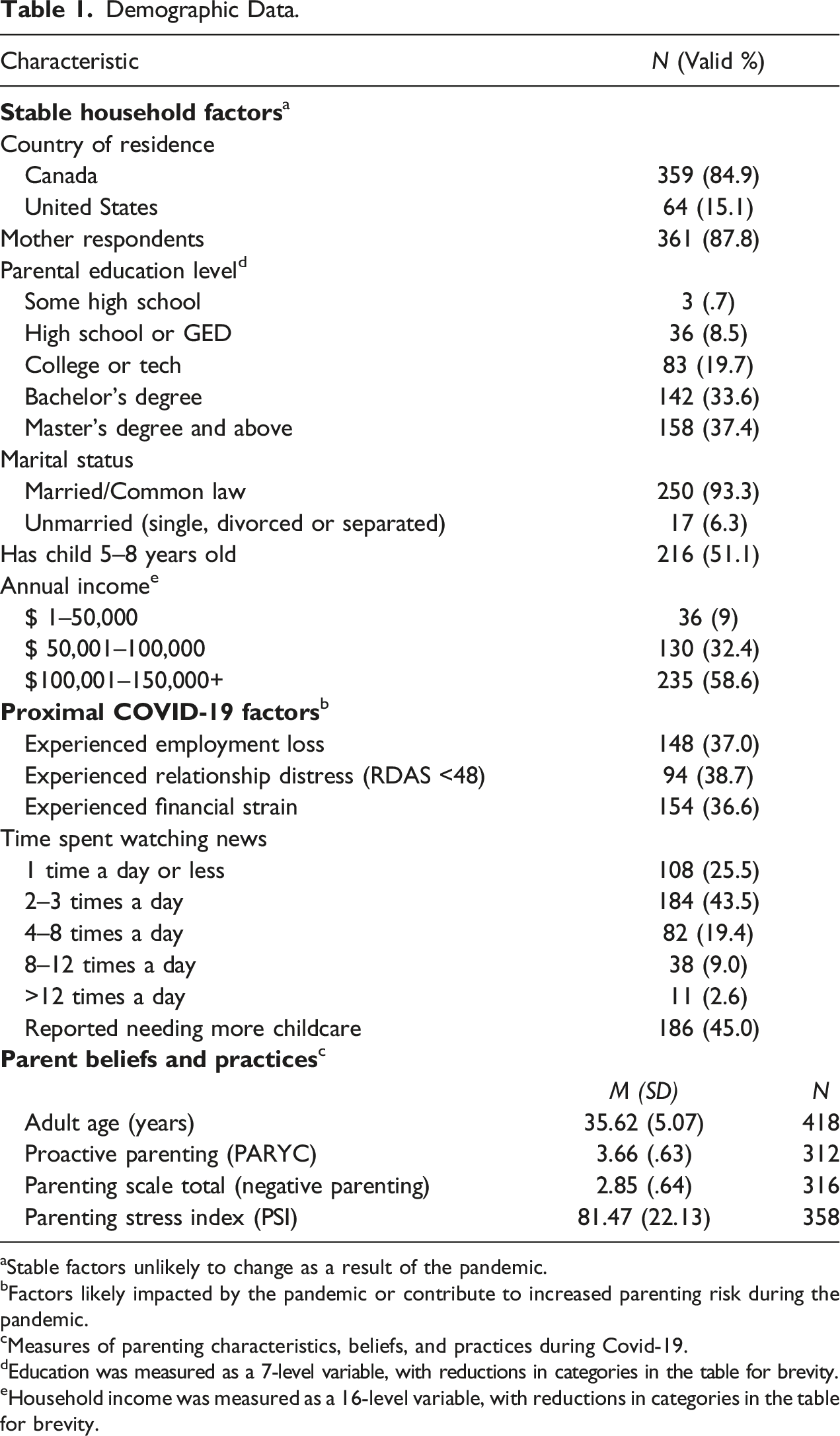
aStable factors unlikely to change as a result of the pandemic.
bFactors likely impacted by the pandemic or contribute to increased parenting risk during the pandemic.
cMeasures of parenting characteristics, beliefs, and practices during Covid-19.
dEducation was measured as a 7-level variable, with reductions in categories in the table for brevity.
eHousehold income was measured as a 16-level variable, with reductions in categories in the table for brevity.
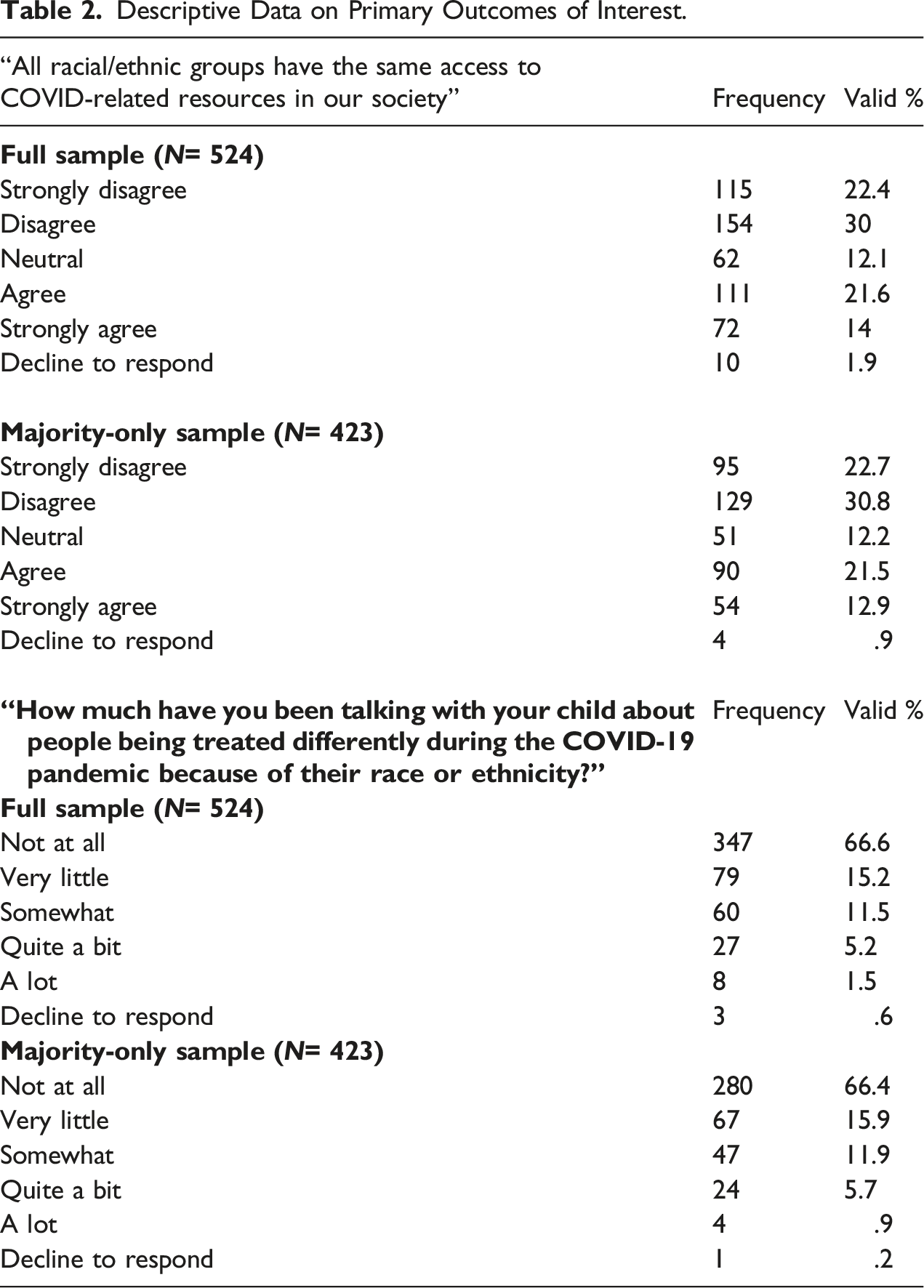
Descriptive Data on Primary Outcomes of Interest.
Procedure
Approval was granted by the University of Manitoba’s ethics review board. Informed consent was obtained before online survey completion using REDCap electronic data capture tools (Harris et al., 2009). Parents of multiple children identified their most-challenging child in the 1.5–8 age range when completing the Parenting Stress Index and Parenting Questionnaire. Participants were entered into a drawing for one of five US$100 electronic gift cards. This project was not supported by any funding agencies or organizations and we declare no conflicts of interest.
Measures
Demographic information
Parents were asked to specify family demographic information, including changes to demographic information as a result of the COVID-19 pandemic. Variables to assess sociodemographic risk included marital status (married or cohabitating vs. single, separated, or divorced), annual household income, and caregiver education. Child age was asked in terms of whether children fell into the 18-month to 4-year or five-to 8-year category. Additionally, race/ethnicity was asked through the proxy question “Do you identify as someone coming from a racial/ethnic minority background?” Identification with the majority was taken to index a White racial identity. Minority-identifying was assumed to be non-White, but we were not able to parse racial or ethnic variability within this group due to race reporting restrictions in Canada.
Awareness of racial disparities
Awareness was measured through a single item that was modified for this study from a question on the Critical Consciousness Scale (Diemer, Rapa, Park, & Perry, 2017): “All racial/ethnic groups have the same access to COVID-related resources in our society.” Responses were rated on a 5-point Likert scale ranging from 1 = “Strongly Disagree” to 5 = “Strongly Agree.” Responses were reverse-scored such that higher scores indicated greater belief (i.e., awareness) that racial/ethnic disparities existed in society. A “Decline to Respond” option allowed participants to skip this question (N = 9, 1.7%). The question came from a Critical Reflection: Perceived Inequality subscale (α = 0.90; Diemer et al., 2017). Construct validation for the full scale can be found in Diemer and colleagues (2017).
Socialization of racial disparities
Deliberate socialization was assessed through a single item that was modified for this study from a question on the Parental RES Behaviors measure (Hughes & Chen, 1997; Pahlke et al., 2012): “How much have you been talking with your child about people being treated differently during the COVID-19 pandemic because of their race or ethnicity?” Responses were rated on a 5-point Likert scale from 1 = “Not at all” to 5 = “A lot.” A “Decline to Respond” option allowed participants to skip this question (N = 2, .4%). The question came from a Discrimination Against Other Groups subscale (α = 0.92; Pahlke et al., 2012). Construct validation for the full scale can be found in Hughes and Chen (1997).
Current stressors related to COVID-19
Employment loss was measured as any loss of hours including working reduced hours or being laid off. Financial strain was assessed as how difficult a participant would find it to manage unexpected expenses (rated on a 5-point scale from 1 = “very difficult” to 5 = “very easy”). Unmet childcare needs were assessed with a 4-point scale from “1 = I have sufficient childcare for my child(ren)” to “4 = I have no childcare and need childcare.” Responses above 1 indicated unmet childcare needs. Relationship Distress was measured using the 14-item Revised Dyadic Adjustment Scale (Busby, Christensen, Crane, & Larson, 1995) that assesses relationship strain and adjustment with items on a five-point scale. Higher scores indicate greater stability and satisfaction. Internal consistency for the total scale was good (α = 0.85).
Time spent watching COVID-related news
News-watching was assessed through a single item that was created for this study, asking how much of the time the caregiver spends watching the news or reading coverage about COVID-19. There was a five-point scale ranging from “rarely (1 time a day or less)” to “all of the time (>12 times per day)”.
Parenting
Three elements of parenting were included. Proactive parenting was assessed from the Parenting Young Children scale, a 21-item self-report measure asking parents to rate how often they engaged in specific parenting behaviors in the past month (Haskett, Ahern, Ward, & Allaire, 2006; McEachern et al., 2012). Internal reliability for each subscale has previously been confirmed (McEachern et al., 2012). Negative parenting strategies were assessed using the Parenting Scale (PS). This is a 30-item self-report measure of ineffective discipline strategies, which asks parents to rate how likely they would be to use each strategy (Arnold, O’Leary, Wolff, & Acker, 1993). The PS has demonstrated good internal consistency and test-retest reliability (Rhoades & O’Leary, 2007). Parenting stress was assessed using the Parenting Stress Index—Short Form (PSI-SF), a 36-item self-report measure of parents’ stress across three domains: (1) Parental Distress, (2) Parent-Child Dysfunctional Interactions, and (3) Difficult Child (Abidin, 1990; Haskett et al., 2006). The scale has also demonstrated good internal consistency and test-retest reliability (Haskett et al., 2006).
Hypotheses and Statistical Analysis
We hypothesized that associations between COVID-related stress and awareness of racial inequities as well as racial socialization may depend on racial identification. Specifically, minority-identifying parents may become more aware and see more of a need to socialize children as they are increasingly and disproportionately affected. Given that socialization rates are typically low for majority-identifying parents, including following large-scale disasters, we hypothesized that experiencing stress would be associated with less engagement in socialization practices. With increased pressures from the pandemic, White families may feel a need to focus on more proximal struggles, rather than on discussing broader social issues of race with their children. We additionally expected that those with older children and those with greater awareness would report more socialization.
Correlations of all Study Variables.
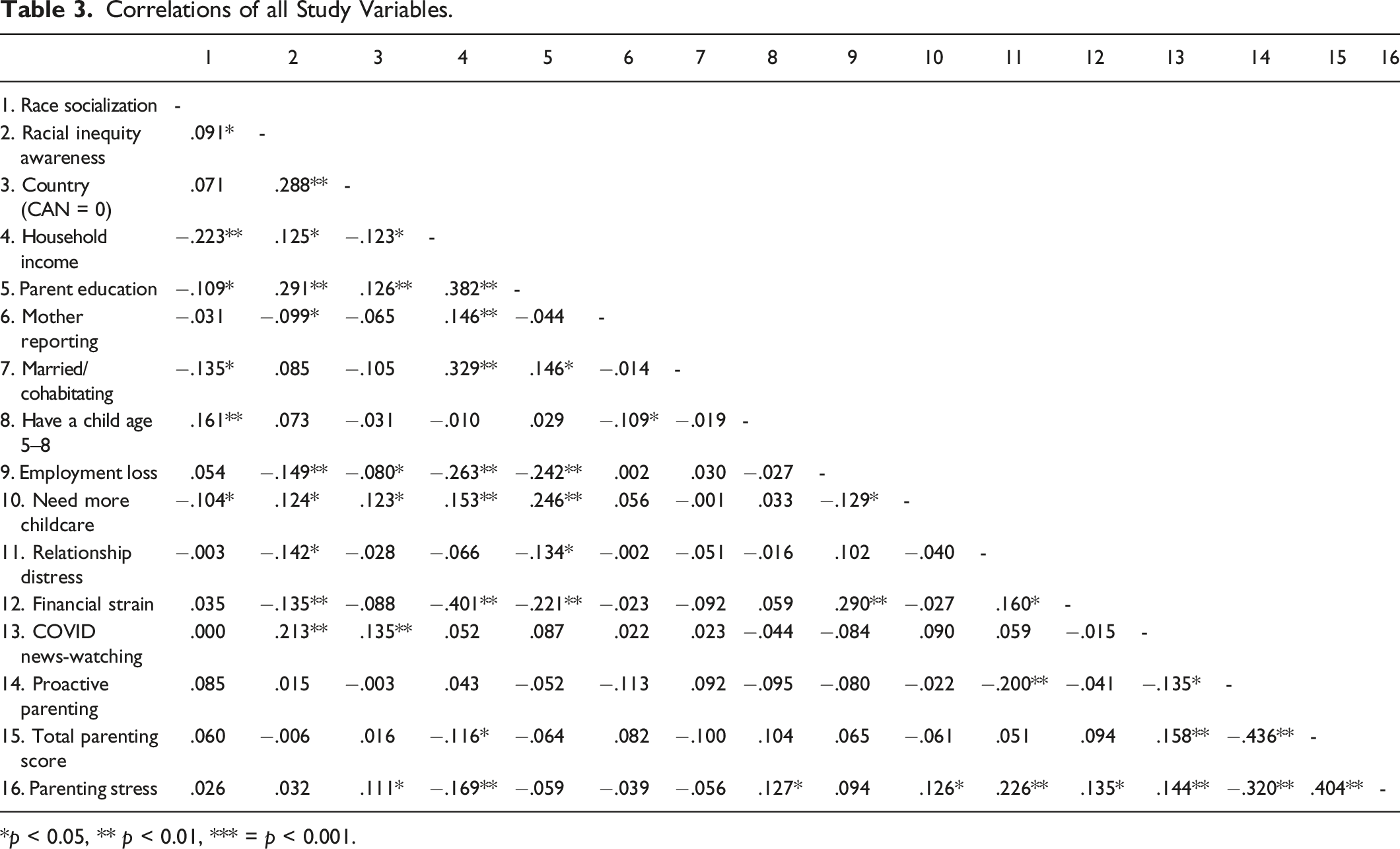
*p < 0.05, ** p < 0.01, *** = p < 0.001.
Results
Minority Race Identification
Although there was a range of awareness of racial inequity across the full scale (median = 2/5 “Disagree”), reports of socialization were very low for the entire sample (median = 1/5 “Not at all”). Sixty-six percentage of the full sample reported not discussing racial inequities with their children at all, 68% within minority-identifying parents. A t-test indicated that there were no significant differences in awareness (t(121) = −1.11, p = .268) or socialization (t(119) = −.226, p = .822) across racial identification groups. Models were then run only within the majority-identifying group assumed to be White (N = 423, 83%). Figures 1 and 2 display the distributions for the primary outcome variables for awareness and socialization across the full sample and the White subsample. Histogram of responses to the question assessing awareness of racial inequities during the COVID-19 pandemic in the sample of White parents. Histogram of responses to the question assessing socialization around racial inequities during the COVID-19 pandemic in the sample of White parents.

Associations with Awareness
On the bivariate level for the White sample (see Table 3), awareness was significantly and positively associated with income, education, child care needs, news-watching, and being American (vs. Canadian). It was negatively associated with employment loss, relationship distress, financial strain, and being a mother. Marriage status, child age, and all parenting variables were not associated with awareness on the bivariate level.
Results of Regression Models Predicting Awareness of Inequity and Racial Socialization.
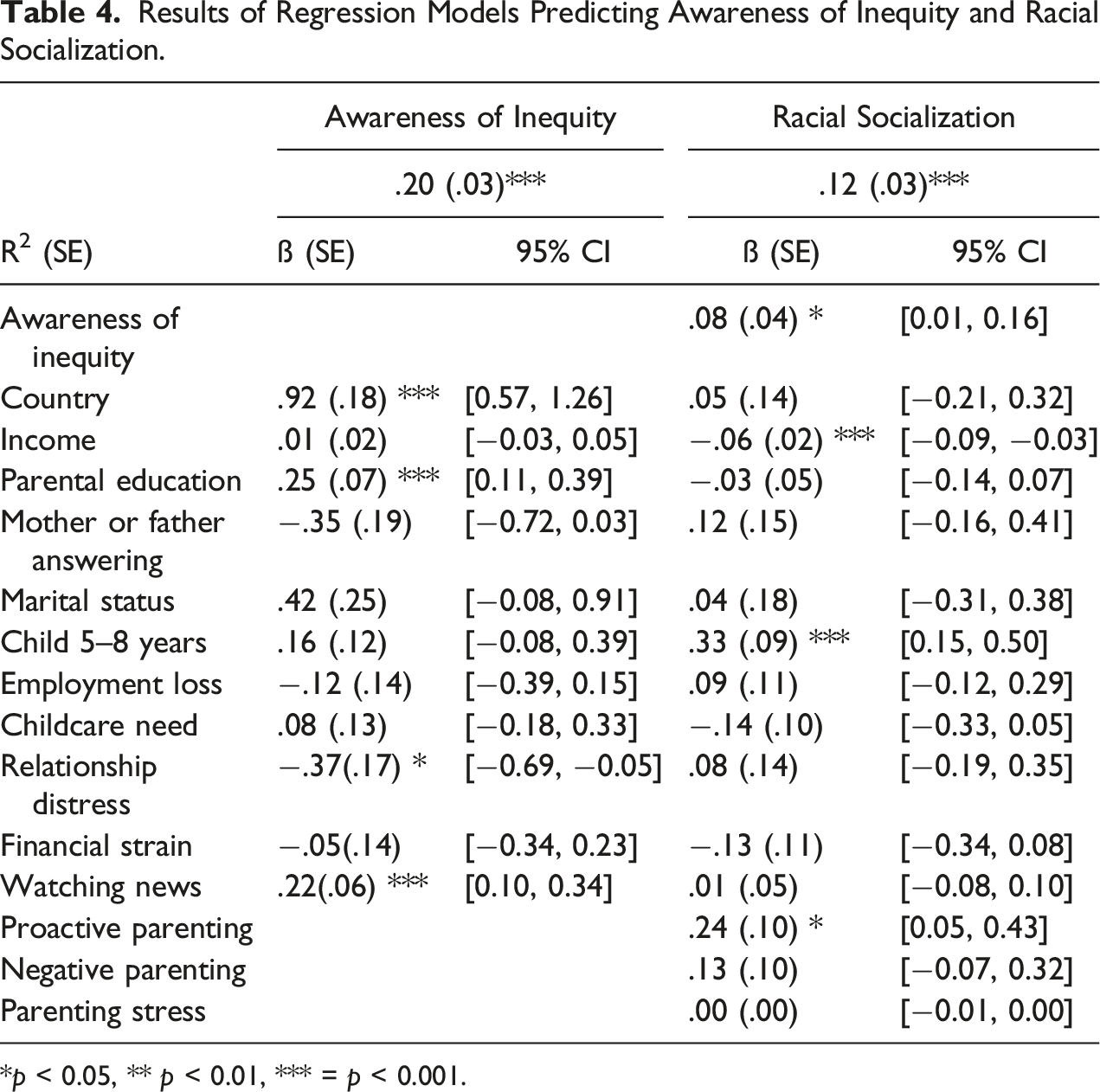
*p < 0.05, ** p < 0.01, *** = p < 0.001.
Associations with Socialization
On the bivariate level for the White sample, socialization was significantly and positively associated with awareness and having an older child, but negatively associated with income, parent education, being married or cohabitating, and child care needs. Country, being a mother, experiencing employment loss, relationship distress, or financial strain, watching more COVID-related news, and all parenting variables were all not significantly associated at the bivariate level.
In the full model, also within White parents only, none of the stress indicators (employment loss, relationship distress, financial distress, and child care needs) were significantly associated with socialization. However, having an older child was significantly associated (0.326, p < 0.001), such that more socialization was reported for parents of children in the 5–8 year-old bracket compared to the 1.5–4 year-old bracket. There were no significant differences in socialization between countries or with amount of news-watching. Of the parenting variables, only proactive parenting was associated with socialization (0.239, p < 0.05), with more proactive parenting associated with more socialization. Interestingly, household income was also a correlate (−0.059, p < 0.001), but education was not, such that increases in income were associated with less socialization (see Figure 3). Awareness of racial inequity was also associated with socialization, such that increased awareness corresponded with increased socialization (0.083, p < 0.05; see Figure 4). Full model results can be found in Table 4. Bar chart displaying differences in mean income, grouped by binary socialization level (None = 1/5 “not at all”; Some = from 2/5 “very little” to 5/5 “a lot”). Mean annual income at a level of 0 is US$0 - US$10,000, increasing by intervals of US$10,000; 12 = US$110,000 - US$120,000. Error bars are at a 95% confidence interval. Bar chart displaying differences in mean awareness, grouped by binary socialization level (None = 1/5 “not at all”; Some = from 2/5 “very little” to 5/5 “a lot”). Error bars are at a 95% confidence interval.

Discussion
Critical race scholars have identified a need for White individuals to understand realities of racial inequity, with roots in historical and present-day oppression. Communicating these concepts to children, starting early in life, can foster an environment wherein racially diverse and marginalized groups may exist with fewer barriers to justice and equity (Bonilla-Silva, 2006; Loyd & Gaither, 2018; Matlock & DiAngelo, 2015). Catastrophes that starkly expose societal inequities (e.g., health outcomes associated with disproportionate healthcare access and other systemic injustices) may provide an opportunity for increased awareness and socialization. The COVID-19 pandemic has exposed deep-rooted racial inequities (e.g., Bhala et al., 2020), but it has thus far been unclear how this disaster might shape awareness of and socialization around related racial injustices. Using data collected from mid-to late-April in 2020—following stay-at-home measures in Canada and the U.S., and before the social justice uprisings following the killing of George Floyd—this study provides unique insight into which parents were aware of racial injustice exposed by the pandemic and which were choosing to speak to their children about these topics.
Results revealed no differences in awareness and socialization between White and non-White samples. However, due to limited descriptive data on group-identification, we were not able to probe this further (see limitations). Within White participants, being American, watching more pandemic-related news, having more education, and experiencing less current relationship distress were significantly associated with increased awareness, which in turn was associated with increased socialization. Associations between awareness and country, news-watching, and education suggest that increased exposure to information about racial disparities may be an important correlate of awareness of racial inequity. One factor that may be shaping these results is that, due to historical misuse of racial demographic information collected for research, these data and associated racial disparities are rarely publicly reported in Canada (Grant & Balkissoon, 2019). Therefore, data clearly demonstrating racial inequities during COVID-19 have been limited (Bowden, 2020). Although reports of COVID-related racial disparities started emerging in Canada later in 2020, this media presence was sparse early on in the pandemic when data for this study were collected, certainly in comparison to the emphasis in the U.S. The association between education and awareness is consistent with literature on the impact of intergroup contact, and learning about race, on the racial attitudes and awareness of racism of college students (McClelland & Linnander, 2006).
Consistent with research conducted prior to the pandemic, 66% of White families did not report any discussions of COVID-19-related racial disparities with their children. Although, having an older child and engaging in more proactive parenting were associated with greater socialization. Our results also suggest that most indicators of pandemic-related stress did not correlate with awareness or socialization. However, having a higher income, a potential insulator against stress, corresponded with lower rates of socialization. Overall, while personal experiences of stress were generally not associated with awareness among White parents (with the exception of more relationship distress being associated with less awareness), exposure to media and education did emerge as important correlates.
Discrepancies between awareness and socialization rates in this sample were stark. 52% reported some level of awareness (disagreeing, or strongly disagreeing that all racial/ethnic groups have the same access to COVID resources). However, only 34% reported any amount of discussion with their child about pandemic-related racial inequities, with only 18% reporting at least “some” conversations. Even within the subsample that had older children (age 5–8), 58% reported not talking at all with their child about people being treated differently during the pandemic because of their race or ethnicity. Importantly, this rate is collapsing across parents of all children in the 5–8 year range. Had we been able to parse age within this category, we would have expected increasing rates with age (e.g., Hughes et al., 2006). These data suggest that a large portion of White parents actively avoided conversations with their child surrounding racial disparities highlighted by the pandemic, similar to reports of racial socialization in other samples (e.g., Underhill, 2018; Vittrup, 2018).
Variables associated with more socialization included increased awareness of racial inequity, lower income, having an older child, and more proactive parenting strategies. Similar to awareness, some stress indicator variables (in this case, only childcare needs) were correlated at the bivariate level, but did not remain significant in the full model. Observed associations with income may align with predictions of Racial Contact Theory (Pettigrew, 2008). For example, there is some evidence to suggest that wealthier White families actively choose more White, insulated neighborhoods, and that they engage in less socialization around race compared to middle-income White families that live in more racially diverse neighborhoods (Hagerman, 2014). In our sample, education, but not income, was associated with awareness; conversely, income, but not education, was associated with socialization. These results highlight how each component of socioeconomic status may be associated with different types of engagement with social justice issues. For example, a parent may be educated and aware of racial injustice but, if the family has a higher income, may not find it socially appropriate to speak with children about race; this has been supported by other research (Hagerman, 2018). Income may also provide insulation from experiencing societal inequities, resulting in less impetus to prepare children for challenging disparities in society (Slopen et al., 2016).
Limitations
Limitations primarily surrounded restricted questions used to measure outcome variables and the cross-sectional nature of the study. Due to the already lengthy nature of the Parenting During the Pandemic survey and concerns about participant burden during a global pandemic, responses to one question, rather than a full scale, were used to assess both awareness and socialization specifically surrounding pandemic-related disparities. However, both questions came from validated and commonly-used scales. Our intention was to gather information about socialization occurring as a result of pandemic-exposed disparities. However, it is possible that if parents are not discussing race to begin with, they may not suddenly be willing to discuss specific COVID-related disparities. Additionally, while responses surrounding socialization cannot speak to more nuanced strategies or content, the data do provide useful information about rate of race conversations surrounding this specific event. Due to being cross-sectional, the data can also only speak to associations between variables and not predictive utility. Additionally, due to restrictions on collecting race data in Canada, our study was limited by a broad assessment of minority or majority racial group-identification rather than specific racial or ethnic groups. Due to this, we are not able to analyze how the pandemic has shaped direct socialization and awareness among more specific racial minority groups. Even with these assessment limitations, these data provide important insights into White parents’ engagement with their children following a monumental and highly-publicized time in history.
Future Directions
Future work from our research group will include comparative data regarding differences in parent-reported awareness and socialization following the resurgence of the BLM movement after the killing of George Floyd on May 25th, 2020. In Canada, media coverage over the summer months of 2020 reveal repeated instances of racial inequities with the killings of Chantel Moore, Regis Korchinski-Paquet and Ejaz Choudry by police officers in response to calls expressing concern about their mental health (Grant, 2020). Although White parents were already being called on to speak more directly with their children about race following the start of the pandemic (e.g., White-Cummings, 2020), this was amplified and reiterated globally after the increases in BLM activity (e.g., Graham, 2020) and may be having a more direct impact on White racial socialization. In addition, future studies would benefit from a more direct assessment of socialization strategy (e.g., colorblind vs. color-conscious) as this may be a more accurate indicator of social progress towards racial equity (Bonilla-Silva, 2006; Pahlke et al., 2012; Vittrup, 2018).
Current Recommendations for White Racial Socialization
Although White parents might feel unsure about expressly socializing their children about race from a young age, color-conscious racial socialization has been identified by critical race scholars as key for long-term societal change (Bonilla-Silva, 2006; Loyd & Gaither, 2018; Matlock & DiAngelo, 2015). Professional psychologists and scholars suggest that rather than avoiding children’s race-related questions, it is best to discuss the topic calmly with them and explain race in age-appropriate ways (e.g., Briscoe-Smith, 2008). The following websites are examples of curated lists of information and tips on racial and ethnic socialization:
https://www.embracerace.org/resources/teaching-and-talking-to-kids
https://www.unicef.ca/en/blog/talking-your-kids-about-racism
https://extension.umn.edu/family-news/talking-children-about-racism
Importantly, psychologists and sociologists encourage White families to go beyond discussions by both celebrating diversity in their day-to-day lives and taking action steps that work to remedy injustice. For example, having children involved in multicultural sports/recreational groups and presenting children with media (including movies, books, and toys) with characters that look different from themselves all help build relationships with people of other ethnicities (e.g., Hagerman, 2014).
It is important to note that evidence supporting specific socialization approaches for White families is very limited (Hagerman, 2017; Scott, Shutts, & Devine, 2020). Empirical investigations of antiracist parenting strategies and human development are a critical next step to inform recommendations. Suggestions for this include identifying clear outcomes of interest, building interventions from a firm foundation in theoretical and empirical work, and carefully assessing individual differences in both parents and children (Scott et al., 2020).
Footnotes
Declaration of Conflicting Interests
The author(s) declared no potential conflicts of interest with respect to the research, authorship, and/or publication of this article.
Funding
The author(s) received no financial support for the research, authorship, and/or publication of this article.
Author Note
Work was performed at the University of Manitoba.
