




Abstract
This study aims to examine the subjective perspectives on marriage of Arabs with disabilities living in Israel. Semi-structured interviews were conducted among 15 Arabs in Israel with physical, visual impairment, and mental disorders. Themes were generated using thematic analysis. Two main recursive and intertwined themes emerged: reflections about marriage and the reality of marriage. The real-life situation feeds into social perceptions: when the disabled person sees that people with disabilities hardly marry, this increases self-stigma and the fear of rejection. Similarly, social and personal perceptions exacerbate the situation on the ground. Gender also played a key factor with women with disabilities facing more stigma and negative experiences relative to men with disabilities. The findings call for raising awareness of the marital rights of Arabs with disabilities and combating negative social attitudes towards them as first steps to creating a more accessible and inclusive environment, with particular attention to gender differences.
Introduction
The right to marry and start a family is recognized in Article 16 of the 1948 United Nations Universal Declaration of Human Rights (UN General Assembly, 1948). Worldwide, however, persons with disabilities 1 have experienced historical discrimination in the form of both legal prohibitions and cultural resistance to exercising this right (Rimmerman, Gur, & Gilad, 2019; Shakespeare & Richardson, 2018). These barriers were addressed by the 2006 United Nations Convention on the Rights of Persons with Disabilities (CRPD). Article 23 requires states to “eliminate discrimination against persons with disabilities in all matters relating to marriage, family, parenthood and relationships, on an equal basis with others.” It further obligates states to ensure that persons with disabilities can marry and establish a family by providing adequate support, including “appropriate assistance to persons with disabilities in the performance of their child-rearing responsibilities” (UN General Assembly, 2007).
The State of Israel ratified the CRPD in 2012 (United Nations Treaty Collection, 1948). In addition to CRPD compliance, Israel has far-reaching domestic laws and policies empowering persons with disabilities. The most significant statutory protection of disability-related rights is the 1998 Equal Rights for Persons with Disabilities Law (Ministry of Justice, n.d), aiming “to protect the dignity and liberty” of persons with disabilities and secure their “equal and active participation in society”; the law further entitles them to support sufficient to live independently, realize their potential, and retain control over their lives by making their own decisions (see also Rimmerman et al., 2015). Israel recognizes the right of individuals with disabilities to marry and establish families, the duty to accommodate parents with disabilities, and the obligation to provide those parents the necessary support to raise their children (Feuerstein, 2019). Nevertheless, many barriers impede the implementation of these rights, and people with disabilities in Israel still face many obstacles in marriage and parenthood particularly amongst minority groups (The Civic Forum for Promoting the CRPD in Israel, 2020).
This article is the first exploration of the self-perceptions and experiences of marriage among Arabs with disabilities living in Israel. The few studies that have been conducted in this area have examined the perspectives of social workers or care givers. For example, one study on marriage among Arab men with intellectual disabilities (ID) found that most eventually get married and have children. However, it is uncommon for Arab women with ID to marry and start a family. Among men, the marriages are usually arranged with non-disabled Arab women, motivated by the lack of other opportunities to establish a family, and a concurrent desire to leave their parents’ households and live independently. These women were described as partly or fully aware of their husbands’ ID prior to marriage (Gur, Gnaeem-Badran, & Stein, in press; Gur, Gnaeem-Badran, & Ashley Stein, 2020).
Two additional studies have focused on non-disabled Arab women who marry men with ID in Israel. Strier and Zidan (2013) examined the non-disabled women’s decisions to marry and their subsequent experiences and found that they agreed to marry due to the limitations, Arab society places on unmarried women beyond a certain age. These women shared the cultural and religious prioritization of marriage in Muslim Arab society, whereas they described their decision-making process as arising from a series of social and family pressures, they also portrayed getting married as their own choice, one which liberated them of the social oppression of being single and bestowed them with some degree of social autonomy. The issue was also studied by Manor-Binyamini (2018) among the Bedouins in southern Israel, a subset of the Muslim Arab population. Manor-Binyamini’s study explored how educated Bedouin women perceive the causes and meaning of their marriages to Bedouin men with ID. Six main reasons were presented: the need for independence; age; family and societal pressures; receiving social protection of the husband or man; destiny; and the desire for children.
The current study is part of a larger investigation into the subjective experiences of Arabs with disabilities in Israel through the lens of intersectionality theory (Crenshaw, 2017). Intersectional research is increasingly recognized as imperative if the full range of experiences and perspectives of diverse persons, including those with disabilities, are to be revealed (Goethals, De Schauwer, & Van Hove, 2015; Warner & Brown, 2011). An intersectional framework provides important insights into how disability interrelates with other identities, contributing to unique experiences and stigmas (Goethals et al., 2015; Warner & Brown, 2011).
Understanding the subjective experience of Arabs with disabilities living in Israel can shed light on the circumstances of their lives, especially the complex relationships arising from their multiple identities—national, political, religious, and gender—that, when combined with disability, create complex forms of discrimination. Our study is innovative in exploring the perceptions and life experiences of a population that encounters multiple forms of discrimination. In Israel, Arab people with disabilities are a minority within a minority, and their rich lived experiences have not received adequate attention in the literature.
Arab Society in Israel
Arabs in Israel are described as a society in transition, moving on a continuum from modernization to conservatism, with an overall collectivist character (Abo-Baker & Al-Solaim, 2005). Previous studies described processes of conservation and modernization in different areas of life, fueled by rising rates of education, improvement in the status of women and their labor market integration, birth rate decline, smaller families, and urbanization (Azaiza, 2013; Kandel, Morad, Vardi, Press, & Merrick, 2004). However, religious and traditional norms and values endure and guide personal and community lives. Arabs currently comprise 21.1% of Israel’s population (Central Bureau of Statistics, 2020) and include three main sub-population groups: Muslims (the numerically largest and culturally dominant group), Christians, and Druze, all of whom share a relatively higher poverty rate and lower participation in the labor market relative to the Jewish population (Sulimani-Aidan, 2020).
Arab society in Israel may be characterized as traditional and patriarchal, with social authority being a function of age, gender, and extended family status (Abo-Baker, 2016; Haj-Yahia & Zaatut, 2018). It is marginalized from the dominant Jewish society due to geographic, religious, and cultural differences and the wider political conflict. Arabs are an indigenous minority, one that has populated Palestine for centuries, whereas most Jews are first- to third-generation immigrants. Arabs have firm ties to the land, consider themselves its true owners, and claim the special rights accorded to native peoples. Given their historical, religious, national, and emotional connections, Jews feel the same way (Samooha, 2010). Despite the numerous differences between Arab communities in Israel they are often perceived, especially by the Jewish population, as being a single sub-population distinct from the dominant culture–a national minority (Neikrug, Roth, Judes, & Zmiro, 2014). As such, the relationships between Arab and Israeli society, and between Arab society and Israel’s governmental institutions and the services they provide, are complex (Sulimani-Aidan, 2020).
Disability in the Arab World
Saad and Borowska-Beszta (2019) found that in the global Arab community disability status was a significant factor leading to exclusion, mistreatment, and deprivation of rights to education, employment, and social inclusion. Overall, they found that persons with disabilities experienced stigma and oppression, were perceived as inferior, and tended to suffer from neglect, contempt, and abuse. In the Israeli context, the common attitude to individuals with disabilities among the Arab population is generally negative, dominated by shame, and can result in hiding disability to the point of avoiding receiving help from external sources (Mazawi-Marjyyah, 2001). According to Sandler-Loeff and Shahak (2006), Arabs with disabilities cope with multiple forms of discrimination, some shared with other disabled persons in Israel and elsewhere, and others more severe and unique to Israel’s Arab society. In their view, one of the more prominent reasons for that is internalized low self-image and negative prejudice. Caught in a vicious cycle, individuals with disabilities are seen as weak and of lower worth by society, and consequently perceive themselves that way.
Gender adds another element of stigma, rendering women with disabilities, especially in the more conservative parts of the Arab world, at a compounded disadvantage (Amin, Shaari, & Khairuddi, 2020). According to Turmusani (2001), disabled women in the Islamic Middle East are devaluated and given the lowest status. Girls with disabilities are more likely to be consigned to care facilities than are boys with similar disabilities, and are at higher risk of being sexually abused (Plummer and Findley, 2012). Women with disabilities are also placed in economic jeopardy due to being tasked as caregivers and kept out of school, thus depriving them of opportunities for socioeconomic advancement (Gharaibeh, 2009).
Cultural Family Norms of Arab Society in Israel
Arab women in Israel are similar to some segments of other Middle Eastern Arab societies, although awareness, education, and gender equality movements are rapidly increasing and making a difference throughout the Arab world (Karkabi-Sabah, 2009). Despite culturally constructed roles evolving as part of the modernization and acculturation experienced by Arab society in Israel (Segal-Engelchin, Huss, & Massry, 2016), the family unit remains central and individual marriages are subject to collective social norms (Ramadan, 2017).
Alongside the changes taking place in Arab society in Israel, including the change in the status of women toward more autonomy, there is still a perception by which women are expected to fulfill traditional roles but not as often as before
(Abu Baker, 2007). This gendered responsibility, with consequent autonomous constraints, further underscores the cultural importance of marriage where a woman’s status remains largely dependent on being married or eligible for marriage (Amer, Howarth, & Sen, 2015).
Method
A qualitative method using semi-structured interviews was chosen to enable the participants’ free expression of their subjective experiences. Qualitative approaches share a similar goal in that they seek to arrive at an understanding of a particular phenomenon from the perspective of those experiencing it (Vaismoradi, Turunen, & Bondas, 2013). Qualitative research is focused on achieving trustworthiness and credibility about the subject of the study, without claiming to find an absolute truth (Hammersley, 1995). Semi-structured interviews, one of the most common methods of data collection in qualitative research, are excellent for gathering in-depth accounts of personal experience (McArdle, McGale, & Gaffney, 2012).
Participants
Participants’ Characteristics.

The first author contacted the Masira Fund and Center for the Advancement of People with Disabilities in Arab Society in Israel (Masira) to locate participants. Masira is an initiative funded by the Joint Distribution Committee (JDC) to integrate and empower Arabs with disabilities in their own communities. Masira’s community programs throughout the country have impacted more than 30,000 Arabs with disabilities and their families (Masira, n.d.). Masira’s director provided the first author with 17 potential interviewees. After speaking to the first author, 15 agreed to participate.
Instrument
An interview guide was developed by the article’s co-authors, an interdisciplinary group of five researchers in the field of disability, and was based on current issues addressed in the literature. The following topics were identified and included. (1) Multiple identities (“What identities do you have in your life?” “Which domain has the strongest impact on your life? Give an example”; “Describe the experience of having these domains. Living with disability? Living as a minority? A double burden?”) (2) Intersection of identity domains (“Do these intersectional domains have any implications on your life? Social inclusion? Work? Education? Marriage? Social rules and relationships?” “Do multiple identities sometimes have positive implications? Please tell me a story about it”). (3) Perceptions on coping strategies and resources (“Do you feel society understands people with disabilities? Please talk about society (including friends and neighborhood) and your own family”; “Are there obstacles to receiving help?” “What resources help you to overcome these obstacles?”) (4) Recommendations (“In what areas is there need for improvement and change?” What are your recommendations to enable this change?”).
Procedure
The study was approved by the institutional review board of the School of Social Work at Bar-Ilan University. The interviews were conducted in July through September 2020 online due to COVID-19 restrictions, with the exception of two interviews where the first author visited the participants in their homes. There was no difference in the duration (up to 90 minutes) or content of interviews conducted online and face-to-face, and all interviewees signed an informed consent form.
The interviews were recorded and transcribed. Each interview began with the interviewer describing the purpose of the study as well as her background. It was emphasized that participation was voluntary and that participants had the right to withdraw from the study without penalty at any stage. Participants were assured that all measures would be taken to protect their confidentiality; accordingly, the article uses pseudonyms. Questions were open-ended to encourage participants to talk at length about their experiences (Smith, Flowers, & Larkin, 2009).
The first author, who conducted the interviews, is a Muslim Arab researcher living in Israel. She has both employment and research experience in the field of disability, having worked as a co-coordinator under Israel’s Rehabilitation of the Mentally Ill in the Community Law, 2000, and engaged in studying ID and mental disorders. She has neither professional nor personal relationships with the participants. The interviews were conducted in Arabic.
Data Analysis
Thematic analysis was used to identify major themes that emerged from participants’ responses. As an independent qualitative descriptive approach, thematic analysis is considered “a method for identifying, analyzing and reporting patterns (themes) within data” (Braun & Clarke, 2006, p. 79). We chose it because it can provide analyses of people’s lived experiences in relation to an issue, or the factors and processes that underlie and influence particular phenomena. It can identify patterns in people’s reported practices or behaviors related to, or their views and perspectives on a certain issue (Braun, Clarke, & Weate, 2016).
The interview recordings were transcribed to allow for subsequent cross-sectional analysis. Next, initial codes were generated and sorted into potential themes by line-by-line reading and thematic analysis. The next phase was theme development, refinement, and naming. These three phases involve the core analytic work in thematic analysis: organizing codes and coded data into candidate themes, reviewing and revising those candidate themes, and developing a rich analysis of the data represented by the finalized themes. Next, the first author began to insert quotes that were related to the main themes and sorted them into subthemes. Finally, the identified major themes and subthemes were reviewed to understand how they fit together, and what comprehensive story appeared throughout the data. Appropriate quotes were incorporated into the findings section to clarify the themes.
Triangulation refers to using multiple methods or data sources in qualitative research to develop a comprehensive understanding of phenomena (Patton, 1999). In the present study, two types of triangulation were used: (1) Investigator triangulation which involved the participation of two or more researchers, in this case four researchers, in the same research to provide multiple observations and conclusions; and (2) Data source triangulation consisted of collecting data from different types of people, in this case a sample size of 15, to gain various perspectives and validation of data (Carter, Bryant-Lukosius, DiCenso, Blythe, & Neville, 2014).
Results
This article discusses two out of the many themes that emerged from the data (the others are discussed in articles under development). The first theme is “Reflections about Marriage by Arabs with Disabilities Living in Israel.” The participants’ views included internalized stigmas and concerns, but also positive views regarding the desire and right to marry, and their ability to maintain a marital relationship. The second theme is “The Reality of Marriage for Arabs with Disabilities Living in Israel.” Participants’ interviews in this theme reveal a bleak picture of marriage prospects for Arab women with disabilities and relate the bitter experiences of those who married. The two themes are interrelated and iterative: reflections on marriage are derived from the reality of marriage, and vice versa (Figure 1). Reflections about Marriage and the Reality of Marriage among Arabs with Disabilities Living in Israel.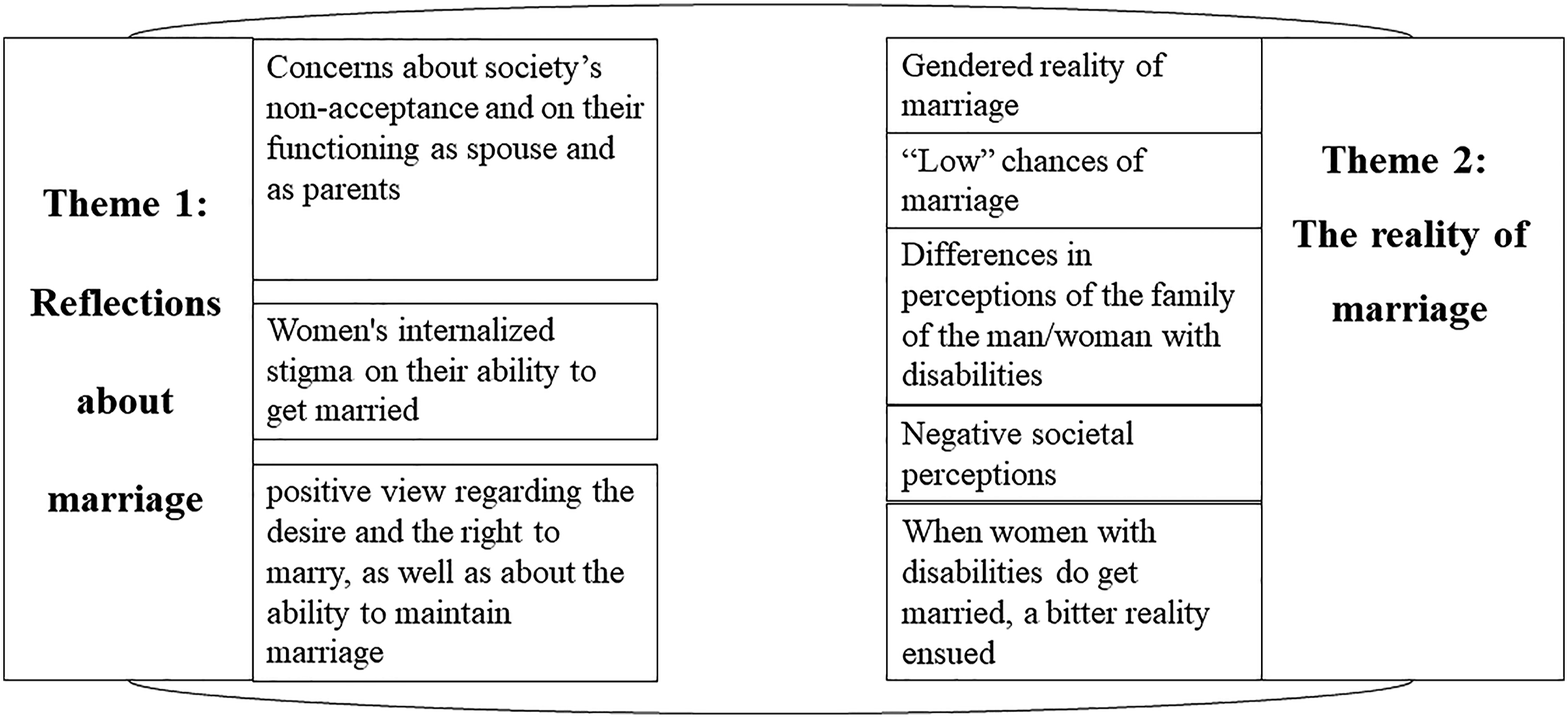
Reflections about marriage varied. Some participants revealed internalized stigma as to their ability to get married and raised concerns about societal rejection, functioning as spouses and parents, and support needs. At the same time, some participants desired marriage and viewed it positively, as well as their ability to remain married.
Many participants internalized stigmas and prejudices as to their inability to get married, and some shared believed married life was irrelevant to them. “I never even once told my family that I wanted to get married. They gave me complete freedom and independence. Marriage was never an issue in my household; I replaced it with caring for my nephews. This life is marked with concessions, forgoing school trips, getting married, and having a family. For persons with disabilities, life is full of sacrifice.” (Omar, 48, single man, high school education, physical disability).
Nora grew up in her family with the understanding that women with disabilities do not marry. “My family raised me on the basis that I’m a person with a disability, so I cannot get engaged or fall in love. Even I did not allow myself to live the teenage stage as others. If anyone discussed the marriage issue with me, I would feel shame and humiliation. I learned that a person with a disability is allowed to marry when I went to the university. I watched a movie about a woman with a severe disability in a seminar. This woman’s disability was much more complicated than mine was. The movie showed her life pathway, and how she got engaged, married, and had children – when I was watching the film, I buried my head in my hands because I was unable to watch – I was shocked […] but my outlook did not change, that marriage was not for me, but for others […]. After completing my university studies, I felt an emotional emptiness.” (Nora, 38, single woman, M.A., physical disability).
Some interviewees expressed concerns about the idea of getting married. They worried about social acceptance–including from potential spouses and their own families–their functioning as spouses and parents, and their support needs. “I had so many questions, and there was hesitance about marriage, fear of being disabled, who would accept me, and if she did, would her family? Would it be a girl with a disability? Or not… I was concerned that if I married a woman with visual impairment like me, and my child, for example, had fever, how we would read the thermometer? Who wants to read us a written letter? And if we needed something at night, must we wake up everyone? Many hypothetical questions, but on the other hand I dare say, so what, women with visual impairment are human too.” (Sami, 35, married man, M.A., visual impairment). “The family does not discuss marriage with me because it is implicitly understood that I’m not interested. That was true for me in my early twenties, but today I show strength by telling them this is not an essential issue for me. Still, deep in my heart, this is a crucial issue for me, although this option is unavailable and socially unacceptable.” (Malak, 26, single woman, M.A., visual impairment). “The issue of marriage is complex, and it is one of the most challenging issues intersecting with disability. Because if a person has a good education, employment, knowledge, then disability becomes part of it, but not completely. Nevertheless, once you talk about marriage, disability emerges as prominent in two ways. Firstly, for persons with disabilities, fears emerge regarding whether they want to marry a person with a disability or not. Many thoughts surface, for example, once I get married, to not rely on my husband to accompany me everywhere or to manage if I want to get an ambulance for my husband – will I live in a city, not a village? Secondly, being a woman matters.” (Dalal, 27, single woman, M.A., visual impairment).
Concerns varied according to gender, with men more frequently referring to employment and the severity of their disability. Employment is a significant consideration among men with disabilities because males are considered the main breadwinners in their families and employment status affects their marriage prospects. The women’s concerns were more socially related. “I currently don’t think about marriage. First, I want a steady income to be independent once married. Today I don’t have my own room […]. In addition, I’m not sure about Arab girls' awareness of the mental disorders. My doctor told me that marriage would solve psychological problems because it brings comfort and reassurance, but I want to have a stable job and a good income.” (Ali, 29, single man, B.A., mental disorder). “I had many love relationships during my life, and there were feelings in them. Still, I was running away from the fact that the other party knew everything about me and was ready to propose to me. Nevertheless, I ran away due to the instability of my disability and my disease, as with time, my condition deteriorated. I’m somewhat sensitive about my case, and I don't want to have anyone involved with me.” (Omar, 48, single man, high school education, physical disability). “Of course I want to marry – this is human nature according to God. That said, not once did I discuss this topic with my family, nor did they discuss it with me. Frankly, I don’t want to discuss it because I don’t want them to say any unpleasant thing about this issue.” (Hoda, 38, single woman, B.A., physical disability).
Yet, together with these concerns, some positive views emerged regarding the desire and right to marry, as well as about the ability to maintain marriage: “Women with a disability have the right to parenthood. Being visually impaired does not mean that you cannot do housework. Many visually abled mothers use house helpers, so what’s the problem when we use housework assistance.” (Laila, 41, single woman, M.A., visual impairment). Other participants of both genders offered similar perspectives: “I wanted to complete my bachelor's and master’s degrees. Then, I did not care much about marriage. However, as I grew up, I became motivated to be like other girls because I don’t lack anything. I’m like others – I even have more advantages, but I also have difficulties and challenges, similar to what everyone else is facing.” (Malak, 26, single woman, M.A., visual impairment). “Many people expect disability to be a problem in marriage. I dare say that in every marriage, there are problems and difficulties – you can have a violent, angry and addicted husband, in that sense disability is more manageable than these problems. Moreover, the disability is known before marriage. Still, the rest of these problems are often revealed only after the marriage.” (Yosuf, 37, single man, high school education, and physical disability). “Every woman with a disability has the right to marry and live a full human experience. God created the instinct for women to desire men and men to desire women […] this encourages every woman with a disability to marry, but it is imperative to choose the supportive, helpful, and right person.” (Nora, 38, single woman, M.A., physical disability).
Three participants referred to the importance of choice and self-determination among women with disabilities, as well as the idea of companionship, in contrast to a functional marriage. Two are quoted below: “I’m not married because I’m a demanding person, and no-one can suit me – I want someone who moves me intellectually and emotionally and who’s on the same wavelength.” (Heba, 45, single woman, M.A., visual impairment). “I thought that the whole world is open for me, and I can achieve all I want, but my disability constrained me. If I did not have a disability, I would have married like others, I would have had children, and would become a grandmother. I wanted to decide on my life, not have my family decide for me. And exchange marriage [between two families] and marrying my cousin doesn’t work for me.” (Mona, 60, single woman, M.A., physical disability).
Some participants referred to social change and visibility that is needed in Israel’s Arab society regarding marriage for people with disabilities. Nora, for example, shared: “We need success stories in the experiences of marrying women with a disability because, at that time, society will learn from it. But as long as these experiences are not shared, unfortunately, our society buries such successes even before they start, and there will be no change.” (Nora, 38, single woman, M.A., physical disability).
Theme 2: The Reality of Marriage
Gendered realities arose regarding married life. Married men and women with disabilities encountered different difficulties and challenges, and related divergent experiences. The findings clearly indicate that, compared to men, Arab women with disabilities have significantly lower prospects to marry. Although Islam encourages people with disabilities to marry, there is a gap between religious law and reality. “Men with disabilities had more chances to get married than Arab women with disabilities.” (Sami, 35, married man, M.A., visual impairment). “A religious and legal right exists, so that a person with a disability may marry. Many young men with disability want to marry, women refuse [to marry men] because of [their] disability, or parents reject them.” (Yasmin, 45, single woman, B.A., physical disability). “If I am a mother and want to allow my son to marry. I would not accept a woman with disability." (Mona, 60, single woman, M.A., physical disability). “Marriage is every girl’s dream, but women with a disability do not have a chance to meet their partner. In our society, men choose women for marriage.” (Heba, 45, single woman, M.A., visual impairment).
Women with disabilities and their scarce marriage opportunities are associated with the homemaking responsibilities culturally imposed on women in Arab society. These women encounter several barriers to their desire to marry. By comparison, Arab men with disabilities are viewed as much more likely to marry, and when they do, they usually marry women without disabilities. Often, the source of any difficulties are the demands made by the family of the man seeking marriage. “It is highly common for parents of men with a disability [to make an effort] to find a helper [for their sons]. Women are considered as the home basis, while men work outside the house and provide financial support. That is why when the family marries their son to a housemaker and home manager, she should be a woman without a disability.” (Heba, 45, single woman, M.A., visual impairment). “For men with visual impairment, when proposing to marry a woman, usually those without visual disability […] they probably seek to marry somebody who will support him. Not all visually impaired persons think about autonomy like me; a visually able man doesn’t consider marrying a visually impaired woman, and if he agrees to, his family disagrees.” (Malak, 26, single woman, M.A., visual impairment).
The important role that women play in the family—helping, caring, supporting, and maintaining family integrity—was seen by women participants in this study as negatively affecting their marriage prospects. “For a long time, society has viewed women as men’s helpers – well, how is it possible for this helper who is unable to see to be able to do specific jobs and need a helper?”. (Heba, 45, single woman, M.A., visual impairment). “My family, even though I’m a man [with disability], objected that I marry a visually impaired woman because they want a woman who can see to compensate for my imperfection.” (Sami, 35, married man, M.A., visual impairment).
Differences were revealed in the perceptions of women compared with that of men with disabilities by their own families. Participants reported that women with disabilities received both explicit and implicit negative messages from their family about their ability to marry, while men with disabilities were assumed able to marry. “Let us differentiate between marriage and forced marriage – in our society – and it is common for parents of men with disability to marry them off to find a helper.” (Heba, 45, single woman, M.A., visual impairment). “I live independently from my family’s home. That’s because I once said to my mother that I could not enjoy freedom and independence as the house is busy with all my sisters, brothers, and their children. Therefore, she became convinced to build a place beside them for me only; but recently I found out from my brother that my mother agreed to my request because she was certain that I wouldn’t marry. You won't believe the shock that I had when I learned about this.” (Mona, 60, single woman, M.A., physical disability). “I can say that marriage, which we already know does not happen, as at some stage the family informs you that this is a big deal if it is ever discussed. I was not even asked about this, whether I’m in a relationship or allowed to have one.” (Laila, 41, single woman, M.A., visual impairment). “I disagreed with my family about the issue of marriage, and when I grew older, I understood that my mother did not want me to marry. She undermined my appearance and mentioned the men are greedy. Then, I was good looking and in my twenties, she wanted to protect me from the consequences marriage, “I don’t want anyone to touch you, control you, and hurt you”. My father never once talked about the issue, but my mother’s talk controlled me – so that I would not allow anyone to get closer to me, and I admit I could not get over that.” (Mona, 60, single woman, M.A., physical disability).
On the hand, family and wider society conveyed positive messages to men with disabilities: “My family gave me complete freedom and independence to decide about marriage. Despite marriage issue was never problematic in my household, I replaced it with caring for my nephews.” (Omar, 48, single man, high school education, physical disability). “My family, even though I am a man, objected that I marry with a visually impaired woman because they want a woman who can see to complement my imperfection.” (Sami, 35, married man, M.A., visual impairment).
These negative messages also came from these women’s own communities and social networks: “The difficulty was that people around me never saw me as a girl who might have a partner. Many times, when we are sitting together, they play matching games and match all girls but not me. I was never visible, and I don’t have the potential.” (Heba, 45, single woman, M.A., visual impairment). “A man has the right to marry but not the woman. The most important is to have a boy who bears his name. People sarcastically tell me that the man would say, I need to take care of her, and I can hardly take care of myself. While talking to a neighbor two days ago, he told me, are you seriously thinking about getting married {sarcastic}? This is impossible, like it is impossible to believe that the devil enters God’s heaven.” (Hoda, 38, single woman, B.A., physical disability). “A friend of mine with a disability had a relationship for nine years, yet her family refused to marry them at any cost. Although her disability is not as difficult as mine, she is not allowed to live, get married, and have children like me. It’s tough that society is not ready to discuss this issue and does not accept women with a disability.” (Nora, 38, single woman, M.A., physical disability).
Often, when women with disabilities did marry, like Mais, a bitter reality ensued, as the women came to realize that the social forces acting against them are broader and more powerful than their own or their prospective husbands’ families. “I did not choose my husband. They married me when I was young, and everything was decided for me. My husband is 16 years older than me and divorced. I did not care; I thought he could pamper me because I am young and beautiful; instead, he hit me and insulted me.” (Mais, 45, married woman, High school education, mental disorder). “Today I’m unwilling to give up on the basics, such as having a partner with values and principles […]. Still, there are persons with disability who suffer because of their inflexibility in the partner’s qualities. Disabled male youth today can marry faster than disabled women can. I see many educated, beautiful women with disability who marry uneducated men, or men with frivolous qualities, or men much older than themselves. Why are women’s disabilities considered a negative issue?” (Dalal, 27, single woman, M.A., visual impairment). “Often, women with disabilities never married or when they did, they were a second or third wife.” (Hoda, 38, single woman, B.A., physical disability).
Discussion
Israel is bound by both the CRPD and its domestic laws to empower persons with disabilities (The Equal Rights for People with Disabilities Law, 1998; United Nations Treaty Collection, 1948). However, disability rights laws cannot ensure social inclusion without the concurrent eradication of negative societal attitudes and the barriers they create (Clarke & Crewe, 2000; Vilchinsky & Findler, 2004). Such obstacles continue to have a disproportionate effect on persons with disabilities, both in Israel and globally (Rimmerman et al., 2019; Shakespeare & Richardson, 2018).
The CRPD does not mention persons with disabilities with intersectional identities beyond a single mention in its preamble (UN General Assembly, 2007), and international human rights law provides only limited overt protection to disabled individuals belonging to racial or ethnic minorities (De Beco, 2020). Thus, the current investigation makes positive inroads by recognizing the impact of intersectional identity and discrimination, and by doing so through the perceptions of the stakeholders–in this case, Arabs with disabilities living in Israel. These individuals constitute a minority within a minority, and their unique lived experiences must be acknowledged and represented in order to effectively promote their social inclusion and quality of life. This article is the first exploration of marriage among Arabs with disabilities living in Israel that presents the group members’ own voices.
Two main themes were revealed by the data. The participants reflected about marriage, with both concerns (e.g., Dalal and Hoda) and positive attitudes (e.g., Laila, Malak, Yosuf, and Nora), and spoke negatively about the reality of their marriage prospects and actual marital experiences. These themes are intertwined as reality feeds into social perceptions and vice versa. For example, the reality in which women with disabilities rarely marry increases self-stigma and fear of rejection. Conversely, many women do not see themselves as being entitled to marry to begin with, and therefore do not struggle for social change.
Reflections about marriage varied. Some participants revealed internalized stigma as to their ability to get married (e.g., Nora and Malak), and some raised concerns about the idea of getting married. Their concerns included social acceptance by potential spouses and their families, the ability to function as spouses and parents, and the availability of adequate support. Some participants, however, expressed positive views regarding their desire and right to marry, as well as about their ability to maintain marriage, and referred to social changes that are needed in Israel’s Arab society.
Gender differences also stood out in the context of concerns about marriage. The main concerns of men stemmed from gendered cultural settings in traditional Arab society in which men are expected to marry, start a family, and be the main breadwinners. Their concerns therefore focused on the severity of the disability as preventing them from meeting the social standard for men, and on the lack of adequate employment that would allow them to be the main providers (e.g., Semi, Ali, and Omar). Indeed, the growing interdependence between the labor market and marriage prospects is considered a reason for falling marriage rates among people with disabilities (Tumin, 2016). Reframing marriage as a major transition has meant that young people increasingly view economic security as a prerequisite for marriage (Cherlin, 2010). People with disabilities have relatively low labor force participation, even after completing higher education (Queirós, Wehby, & Halpern, 2015). Because of the growing emphasis on financial stability as a prerequisite to marriage, unemployment, or low income may have become stronger barriers to marriage among people with disabilities.
By contrast, most of the concerns of the women participants stemmed from their nuclear family’s approach of discouraging marriage for women with disabilities (e.g., Nora, Malak, and Hoda). The family is considered a supportive resource that improves the lives of disabled members, but the family was also mentioned in this study as one of the causes of concerns by these disabled women. At the same time, the female participants (e.g., Laila, Malak, and Nora) expressed their desire for a relationship in which they would love and be loved and referred to it as a legitimate right, as well as insisting on their right to choose a spouse yet also not taking that right for granted.
It seems that the fears and hesitation that the disabled have about the issue of marriage is the result of social realities in Arab society. They acknowledge examples of disabled persons who were able to marry, but face societal and family pressures that cause them to hesitate and fear marriage.
Regarding the reality of marriage, the findings clearly indicate that Arab women with disabilities have lower marriage prospects than do Arab men with disabilities, and that the latter usually marry women without disabilities. In turn, Arab women with disabilities received both explicit and implicit negative messages from their societies, communities, and even their own families about their ability, or rather inability to marry. Those who did marry described bitter realities (as reflected in the Mais, Dalal, and Hoda interviews). This does not imply that there are no women with disabilities in Arab society who are married and happy in their marital life, but there is a dearth of evidence to that effect, whereas families’ opposition to the idea of marriage for disabled women has not been studied in Arab society, one of the reasons behind this may be excessive fear for the women or exaggerated protectiveness towards them, due to the traditional view of women, especially young ones, as vulnerable, let alone when living with a disability.
Our findings thus confirm previous studies describing marriage among Arabs with disabilities living in Israel. Those studies, however, were external to the lived experiences of disabled Arabs in Israel, presenting the perspectives of social workers regarding Arab parents with ID (Gur et al., in press, 2020), or those of non-disabled Arab women who married Arab men with ID (Manor-Binyamini, 2018; Strier & Zidan, 2013).
More broadly, two trends found in this study confirm findings from other studies. The first is that when people with disabilities are married, there is a higher likelihood for them to have a spouse without a disability. The second is that disabled persons get married less frequently than non-disabled persons do, highlighting the fact that marriage is a particular area within disability rights where progress can be made only with great difficulty (McClendon, Kuo, & Raley, 2014; Tumin, 2016). In practice, the right to marry within Arab society in Israel is exercised mainly by men with disabilities, and rarely by women with disabilities. This is partly due to the patriarchal nature of Arab society, and is compounded by the fact that men with disabilities have more employment opportunities than do women with disabilities. Many women accepting these structural obstacles, which further reinforce this reality (Saad & Borowska-Beszta, 2019).
Thus, Arab women with disabilities living in Israel suffer from multiple layers of discrimination: a marginalized gender within a minority group (disabled persons) that is in turn subsumed within another minority group (Arab society in Israel). Disability has a profound impact on disabled women’s ability to perform their expected gender roles due to the stereotypical conception that they are “incomplete” (Mehrotra, 2008, p. 40) and not qualified to perform the challenging roles expected of women in Arab society. This set of circumstances places them in a highly vulnerable position, and therefore special efforts should be made to promote and protect the rights of these women. This finding is supported by other studies on Muslim disabled women (Amin et al., 2020). For example, a study conducted in Jordan found that disabled men refused to marry disabled women even while recognizing their own stigmatization, and instead looked for “real women” (Jalal & Gabel, 2014).
Most of the participants achieved higher education, and are keen to attain self-realization by getting married and starting a family of their own. Their difficulty getting married illustrates, again, how marriage is a particular area within disability rights where advancement is difficult (McClendon et al., 2014; Tumin, 2016). Although progress has been made when it comes to work and education, marriage requires much more intervention due to the persistence of gender role differentiation and the importance of marriage as a social institution for integration into and acceptance by the community. This last point makes marriage something that is simultaneously desired by people with disabilities but also feared by them. Desired because they want to be integrated into society, but also feared as they do not know how successful marriages will be, especially in a society that is not supportive or open to their rights.
Limitations and Future Directions
The limitations of this study relate to its qualitative design, as well as the relatively small sample size, both of which make it difficult to generalize our findings to broader populations. Generalization is also problematic due to the particular nature of Arab society in Israel, which is both an indigenous minority and one involved in an intractable ethnonational conflict. Additionally, the authors’ interpretations of the data are affected by personal characteristics and experience. Hence, we recognize that different conclusions could be derived by others from the same data. Finally, no software was used for data analysis, triangulation, or member checking.
The current study provides avenues for future research. Our findings yielded only few “success stories,” in which women with disabilities married and established families. There is a need for further research that will focus on the experiences of Arab women with disabilities who have succeeded in marrying and starting families. Learning from their personal experiences will shed light on the challenges and methods of overcoming these socially constructed barriers. Further research can take place among families where both spouses have disabilities and provide information on how these families cope with social difficulties. In light of the collective nature of Arab society in Israel, studies among the extended family, including parents of adults with disabilities, would provide an overall picture of the reasons for family opposition to the marriage of women with disabilities. In turn, such information can help create culturally sensitive interventions for promoting marriage and establishing families among Arab women with disabilities living in Israel.
Implications for Policy and Practice
The study’s findings have practical implications for professionals who aim to support Arabs with disabilities in exercising their right to marry and establish families. According to the 2011 World Report on Disability, knowledge and attitudes are important environmental factors affecting all areas of service provision and social life for persons with disabilities (World Health Organization, 2011). Raising awareness of rights and challenging negative attitudes are often the first steps toward creating more socially accessible and inclusive environments for persons with disabilities. Notably, community-based programs can challenge stereotypes, leading to greater visibility and participation by individuals with disabilities (Ibid).
Article 8 of the CRPD is a mandate to raise awareness across society regarding the rights of persons with disabilities (UN General Assembly, 2007). Such an obligation is incumbent upon Israel’s government, and can be promoted through civil society organizations that are engaged in disability rights work on behalf of Arabs with disabilities (The Civic Forum for Promoting the CRPD in Israel, 2020).
Moreover, and beyond legal and moral obligations, there is great value in raising awareness of cases in which Arab women with disabilities have married and established families. Highlighting positive stories can help shift the narrative to that of empowerment, and emphasize that disability does not inherently limit these women in marriage, parenthood, or any other aspects of their lives. Such a rights-based discourse is vital across society in order to decrease stigma, prejudice, and discrimination of Arab women with disabilities living in Israel, and beyond.
In addition to awareness-raising efforts, adequate support in the form of governmental social services and community assistance is needed to promote and support marriage among Arabs with disabilities living in Israel. Although there are many programs in Israel that aim to integrate individuals with special needs into greater society (Kol Zchut, n.d.), programs specifically tailored to Arab society, and ones devoted to supporting partnerships and marriages are rare. In fact, the only program in Israel that is specifically dedicated to this purpose is a comprehensive social training scheme that provides young people with cognitive disabilities the requisite skills to form long-term partnerships, marry, and maintaining a shared household and a rich family life (The Feuerstein Institute, n.d.).
We believe that similar programs are needed, with special emphasis placed on cultural issues. Within Israel, a psychosocial program is needed that can focus specifically on Arab women with disabilities and in doing so ensure that any interventions are culturally sensitive to the needs of Israel’s Arab community. According to Al-Krenawi (1999), psychosocial interventions are socially stigmatized and therefore uncommon in this population. He thus proposed that interventions conceptualize individual problems as part of the family context, and with reference to religious rulings. In the context of Arab society in Israel, this means taking into consideration the need to maintain the integrity and cohesiveness of the family, as well as the traditional gender roles in the Arab family, without challenging the wife’s full responsibility for the children and house making (Cinamon, Habayeb, & Ziv, 2016; Ramadan, 2017). Finally, reliable and accessible information is needed for young Arab women with disabilities living in Israel regarding supports in this area.
Footnotes
Acknowledgments
We thank the participants for their agreement to join this study. We thank the participants for sharing their thoughts and life experiences, which have made an invaluable contribution to the development of knowledge on this important issue.
Declaration of Conflicting Interests
The author(s) declared no potential conflicts of interest with respect to the research, authorship, and/or publication of this article.
Funding
The author(s) received no financial support for the research, authorship, and/or publication of this article.
