



Abstract
This study examines whether there is a relation between assigned skin tone and parental racial socialization of their young children (ages 5–8). The concurrent mixed methods design combined quantitative and qualitative findings to explore the complexity and role skin tones play in Black parents’ messages to their children. In the quantitative strand, 178 Black parents completed a survey and questionnaire. The qualitative strand consisted of a one-on-one interview with 10 parents from the quantitative sample. Quantitative findings revealed that parents who assigned a light skin tone to their children engaged in more specific types of racial socialization than those who assigned a darker skin tone to their children. Analysis of qualitative interviews revealed parents’ unique messages based on assigned skin tones. Data from the two strands were integrated using a weaving approach that compared findings from both strands.
Introduction
A critical aspect of Black parenting is racial socialization. Researchers devoted to studying how parents talk to their children about race have highlighted specific types of racial socialization content (e.g. cultural socialization, preparation for bias, promotion of mistrust, egalitarianism; see Hughes et al., 2006) and the frequency parents share those messages. Additionally, empirical evidence has noted that child characteristics, such as gender and age, influence Black parents’ racial socialization practices (Caughy et al., 2011; Lloyd, 2022; Mandara et al., 2010). However, little attention has focused on another characteristic that may influence Black parents’ racial socialization—skin tone.
The Complexity of Skin Tone
One of the legacies of slavery is a color caste system based on the continuum of skin tones that determine the social worth of people (Herring & Haynes, 2017; Jablonski, 2012). Dating back to the institution of slavery, the differential treatment of people based on their skin tone and phenotypic characteristics has significantly shaped the life chances and outcomes among Black people (Monk, 2014). Black people with lighter skin tones are often afforded more privileges and viewed as attractive, civil, and intelligent, whereas society often views Black people with darker skin tones and Afrocentric features as unattractive, mean, and unintelligent (Herring & Haynes, 2017; Hunter, 2016; Landor, 2017; Maddox & Gray, 2002). Furthermore, Black people with lighter skin tones have more wealth (Goldsmith et al., 2006; Herring & Haynes, 2017), higher levels of occupational prestige (Keith & Herring, 1991; Reece, 2018), higher levels of education (Monk, 2014), lower levels of social rejection (Hebl et al., 2012), and better health outcomes (Slaughter-Acey et al., 2020) as compared to Black individuals with darker skin tones. However, it is important to note that these findings do not suggest that lighter-skinned Black individuals are exempt from experiencing racial discrimination; instead, the findings acknowledge that darker-skinned individuals face racial experience and the additional stressor of colorism.
Black parents may be aware that their children see and hear the negative stereotypic messages (e.g. the cartoon about Serena Williams and Naomi Osaka (Cave, 2018) that explicitly and implicitly inform them about the value of skin tones and physical characteristics. However, only a few studies have examined if parents' awareness and understanding of the skin tone hierarchy is related to their racial socialization (see Edwards, 2014; Landor et al., 2013). In one study, Landor et al. (2013) utilized data from a longitudinal sample of 767 Black families to assess whether skin tone was related to differences in the quality of parenting and racial socialization. The scholars found that darker skin boys received more racial socialization practices related to promoting mistrust. The findings suggest that skin tone is a distinct area worthy of focus in racial socialization research.
The Current Study
As such, this study examines the relationship between skin tone and racial socialization of Black parents living in a midwestern state. Specifically, this work investigates the following:
Quantitative Research Questions
1. To what extent do Black parents’ self-assigned skin tone and assigned skin tone of their children relate to their racial socialization practices, after accounting for the child’s age, child’s and parent’s gender, and neighborhood racial composition? 2. Do Black parents’ use of the racial socialization dimensions differ based on the skin tone they assign to their children?
Qualitative Research Questions
1. How do Black parents who perceive their children as having a dark, medium, or light skin tone describe their racial socialization practices? a. What factors influence Black parents’ decisions about communicating race-related messages to their children?
Mixed Methods Research Questions
1. In what ways do the survey and interview data align or contradict one another?
Methods
Study Design
Quantitative (i.e. survey, behavioral observational) and qualitative data (i.e. interviews) were collected and analyzed concurrently (QUAN + QUAL). Findings from one data type were not dependent on the other (Plano Clark & Ivankova, 2016). The purpose of concurrent triangulation was to examine the relationship between skin tone and Black parents’ racial socialization from different perspectives. The design permits analysis of convergence and divergence between the data sources.
Sample
The sample for this study consisted of Black parents who (a) identify as the parent of the child; (b) self-identify as Black or African American; (c) have at least one child between the ages of 5–8; (d) parent resides in [blinded].
Quantitative Participants
The quantitative sample consisted of 178 parents, including 96 (53.6%) mothers. Many parents in the sample described their skin tone as dark (38.5%) or medium (31.8%), whereas 17.9% of parents described themselves as having a very dark skin tone.
Parents’ descriptions of their child’s skin tones were similar. The number of participants who described their skin tone and their child’s skin tone as very light was less than 5%. Thus, very light and light were combined, resulting in 11.7% of parents describing their skin tone as light, and 12.8% of parents describing their child’s skin tone as light.
Qualitative Participants
Descriptive Characteristics of Qualitative Sample.
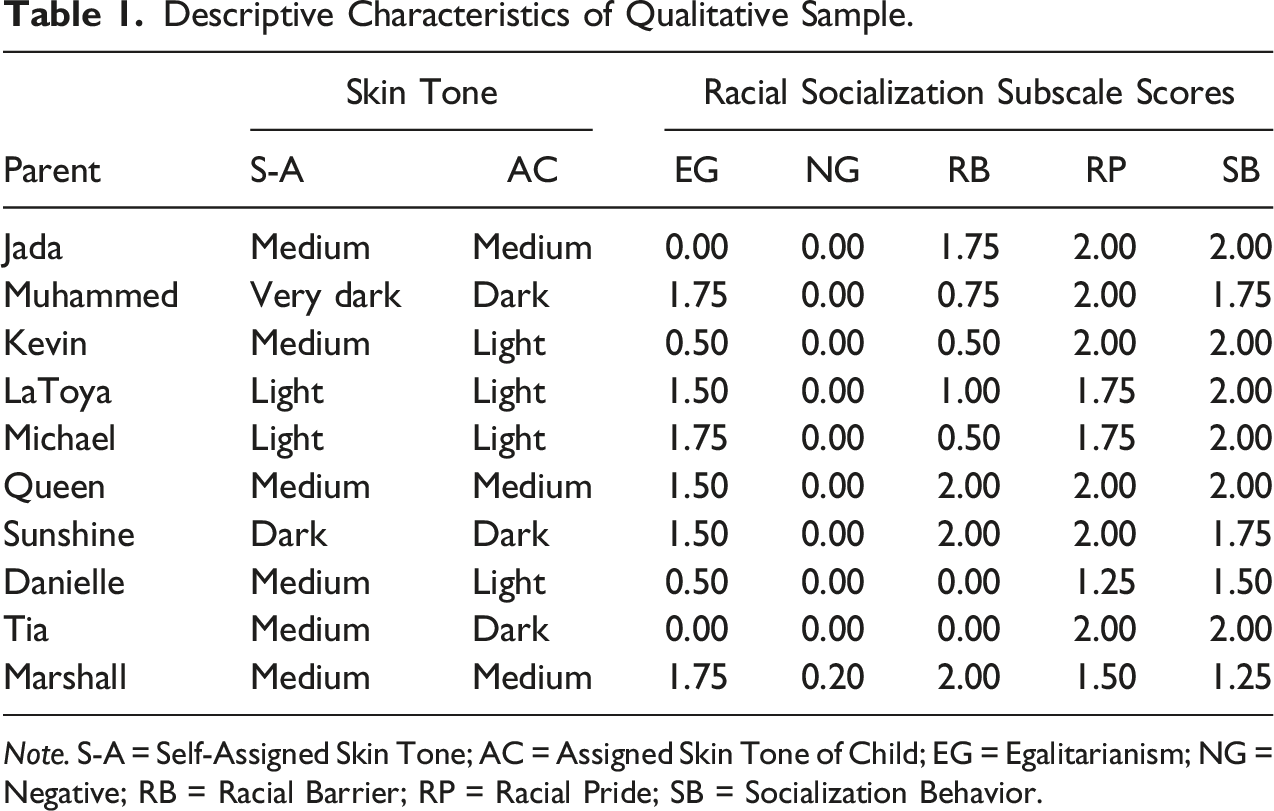
Note. S-A = Self-Assigned Skin Tone; AC = Assigned Skin Tone of Child; EG = Egalitarianism; NG = Negative; RB = Racial Barrier; RP = Racial Pride; SB = Socialization Behavior.
Quantitative and Qualitative Measures
National Survey of American Life Scale
Parents categorized their skin tone and their child’s skin tone using the National Survey of American Life scale. Participants reported their answers on a 5-point scale of 1 (very dark brown); 2 (dark brown); 3 (medium); 4 (light brown); 5 (very light brown).
Racial Socialization Measure
The Racial Socialization Questionnaire-Parent-Version (RSQ-P; adapted from Lesane-Brown et al., 2008) assessed parents’ racial socialization practices. The RSQ-P is a parental self-report that assesses the frequency with which parents engage in racial socialization behaviors and activities with their children. Participants completed five subscales: racial pride, racial barriers, egalitarian, negative, and socialization behaviors. The Racial Pride subscale (4 items; a = .82) measures the extent to which parents emphasize Black unity, teachings about heritage, and instilling positive feelings towards Blacks (e.g. “Told target child that s/he should be proud to be Black”). The Racial Barriers subscale (4 items; a = .77) measures the extent to which an awareness of racial inequities and coping strategies are emphasized (e.g. “Told the target child that some people try to keep Black people from being successful”). The Egalitarian subscale (4 items; a = .80) measures the extent to which parents emphasize messages regarding interracial equality and coexistence (e.g. “I have told my child that because of opportunities today, hardworking Blacks have the same chance to succeed as anyone else.”). The Negative subscale (5 items; a = .87) measures the extent to which parents convey messages that disparage Black people (e.g. “Told the target child that learning about Black history is not important”). The Socialization Behaviors subscale (4 items; a = .83) measures the frequency of various socialization activities or behaviors related to Black culture (e.g. “Bought the target child books about Black people”). Participants responded to each item using a 3-point rating scale (0 = never to 2 = more than twice) to indicate how often they have communicated each message or behavior to the target child in the past year. The five subscales were created by averaging across each subscale item such that higher scores indicate a greater frequency of the message or behavior.
Semi-Structured Interviews
Interview questions were constructed based on the literature review on racial socialization and skin tone. Interview questions focused on parents’ racial socialization related to skin tone.
Procedure
Surveys
Participants reviewed the eligibility criteria and provided informed consent electronically. Data collection began after the participant gave consent. Participants completed an online survey that consisted of demographics and self-report questionnaires about themselves and the target child. Participants who completed the online survey received a $10 Amazon gift card.
Interviews
The semi-structured interviews consisted of questions designed to understand parents’ perspectives of their racial socialization practice with their children. For example, “What are your views about skin tone?”, “How do you think [child’s name] skin tone affects his/her life? Does that influence how you talk to your child about race?”. Researchers have used similar questions to explore how Black parents engage their young children in racial socialization (see Edwards, 2014). The researcher asked all parents the same questions; however, the probes and follow-up questions varied based on their responses. On average, parent interviews took approximately 30 minutes, and each parent received a $30 gift card. The University of [blinded] Institutional Review Board approved this project, and all participants gave informed consent.
Analysis Plan
Quantitative
Statistical analyses were conducted using the Statistical Package for Sciences software (SPSS) version 26.0. To address the first research question, to what extent do Black parents’ self-assigned skin tone and assigned skin tone of their children relate to their racial socialization practices, after accounting for the child’s age, child’s and parent’s gender, and neighborhood racial composition, the researcher conducted hierarchical multiple regression. For the second research question, do Black parents’ use of the racial socialization dimensions differ based on the skin tone they assign to their children, the researcher conducted a one-way multivariate analysis of variance (MANOVA). Parents’ assigned skin tone of their children (light, medium, dark, and very dark) was the group variable, and racial socialization dimensions (egalitarian, negative, racial barriers, racial pride, and socialization behaviors) as the dependent variables. Descriptive statistics were calculated to get the means, standard deviation, and the number of cases of all the dependent variables for each independent variable group. Because of unequal sample sizes, Pillai’s Trace was used to determine if the main result from the MANOVA was statistically significant. A post hoc test was conducted to test statistically significant univariate one-way ANOVAs. A second MANOVA was conducted to investigate whether the types of racial socialization parents engage in significantly differed based on their self-assigned skin tone.
Qualitative
A deductive approach was used to answer the qualitative research questions. The analysis was guided by the goal of exploring how Black parents who perceive their children as having a dark, medium, or light skin tone describe their racial socialization practices and what factors influence their decision. A priori codes were created based on racial socialization and colorism literature to find patterns in participants' responses using a priori codes created based on racial socialization and colorism literature.
The Rigor of the Study
Triangulation and transferability were used to establish credibility. Various forms of collected data (e.g. observations, interviews, and field notes) were used to search for convergence among the multiple forms of data to form themes. Transferability was established using a thick and rich description of the participants, research process, and qualitative findings (Anfara et al., 2002).
Mixed Methods Analytic Plan
Integration at the results level allows for quantitative and qualitative findings to be compared, providing a better understanding of the relationship between skin tone and Black parents’ racial socialization practices. Integrating concurrent data analysis was completed following the guidelines of Creswell & Plano Clark (2011) (Hebl et al., 2012): (a) explore and analyze the two phases separately; (b) merge the data to answer the mixed methods research questions; (c) use a joint display to analyze and demonstrate how the data compare.
Results
Quantitative
Means, Standard Deviations, and Intercorrelations of Racial Socialization Scales, Parent and Child Gender, and Child Age.
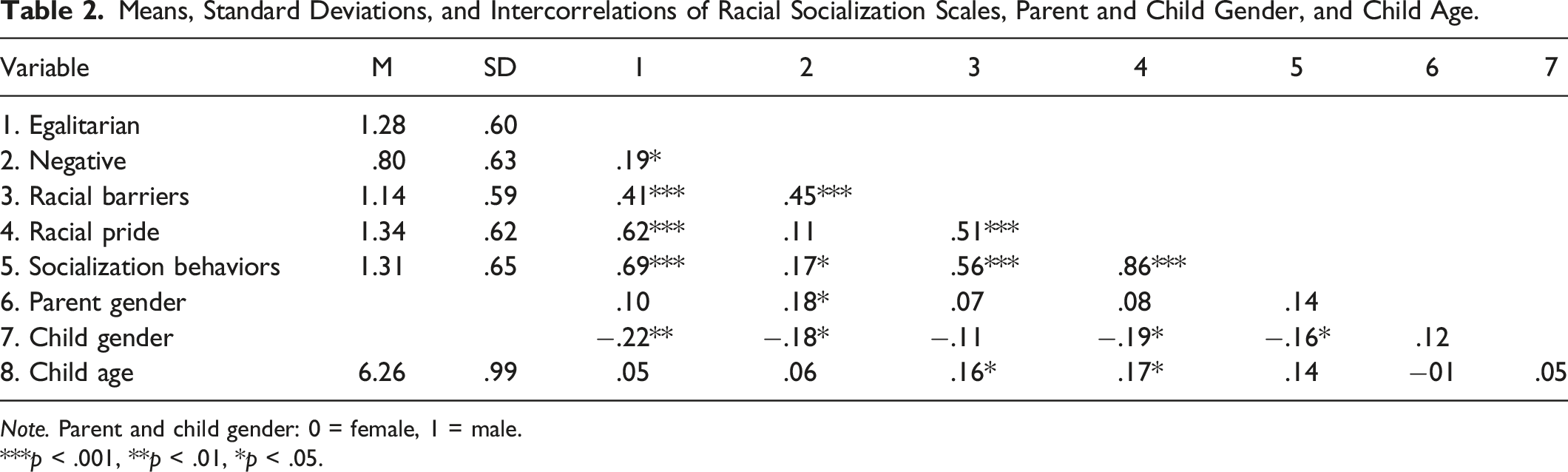
Note. Parent and child gender: 0 = female, 1 = male.
***p < .001, **p < .01, *p < .05.
Hierarchical Multiple Regression Predicting Racial Socialization from Child and Parent Gender, Neighborhood Racial Composition, and Parent and Child Skin Tone.
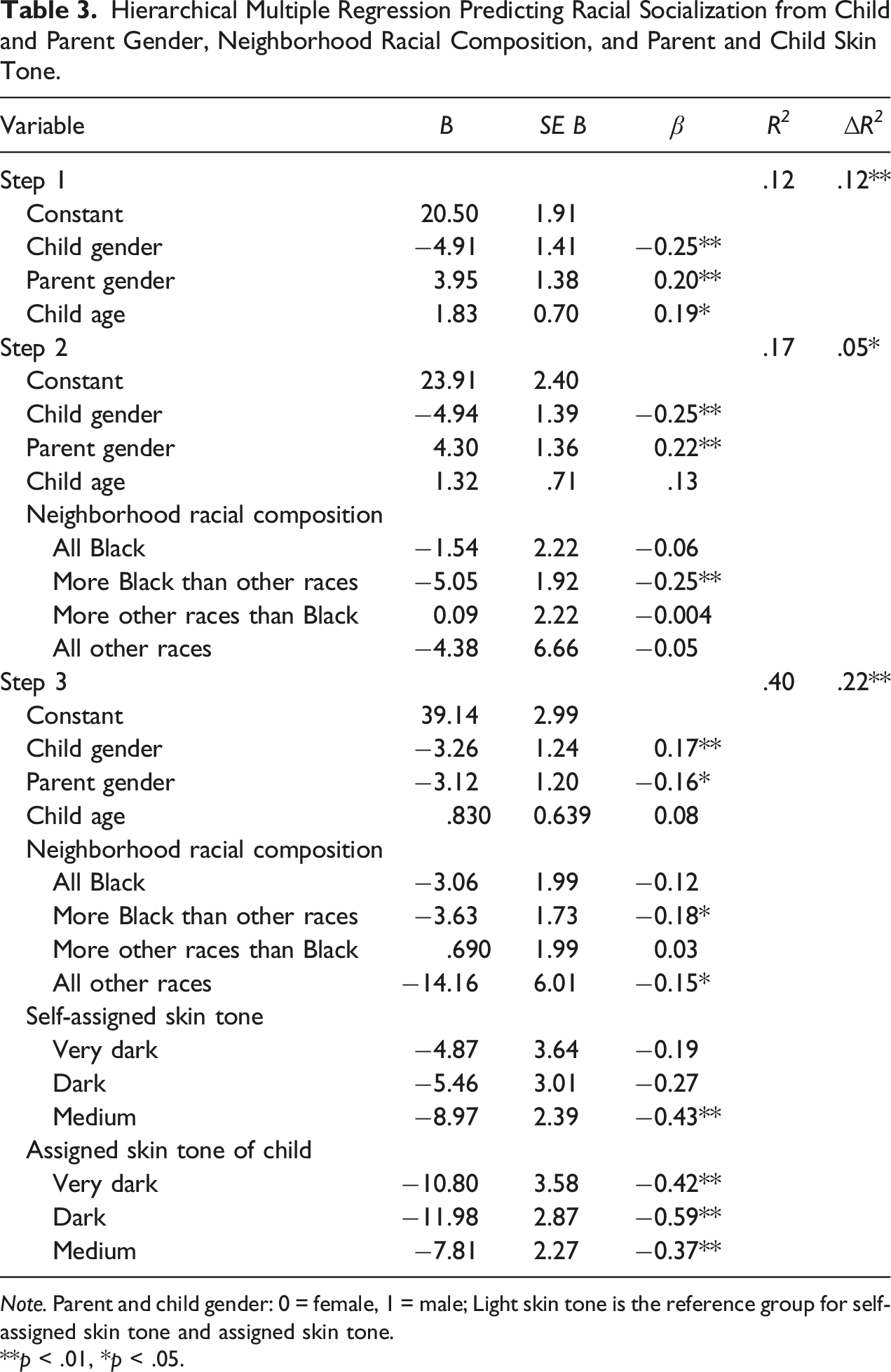
Note. Parent and child gender: 0 = female, 1 = male; Light skin tone is the reference group for self-assigned skin tone and assigned skin tone.
**p < .01, *p < .05.
Comparison of Racial Socialization Behaviors as a Function of Child’s Assigned Skin Tone.
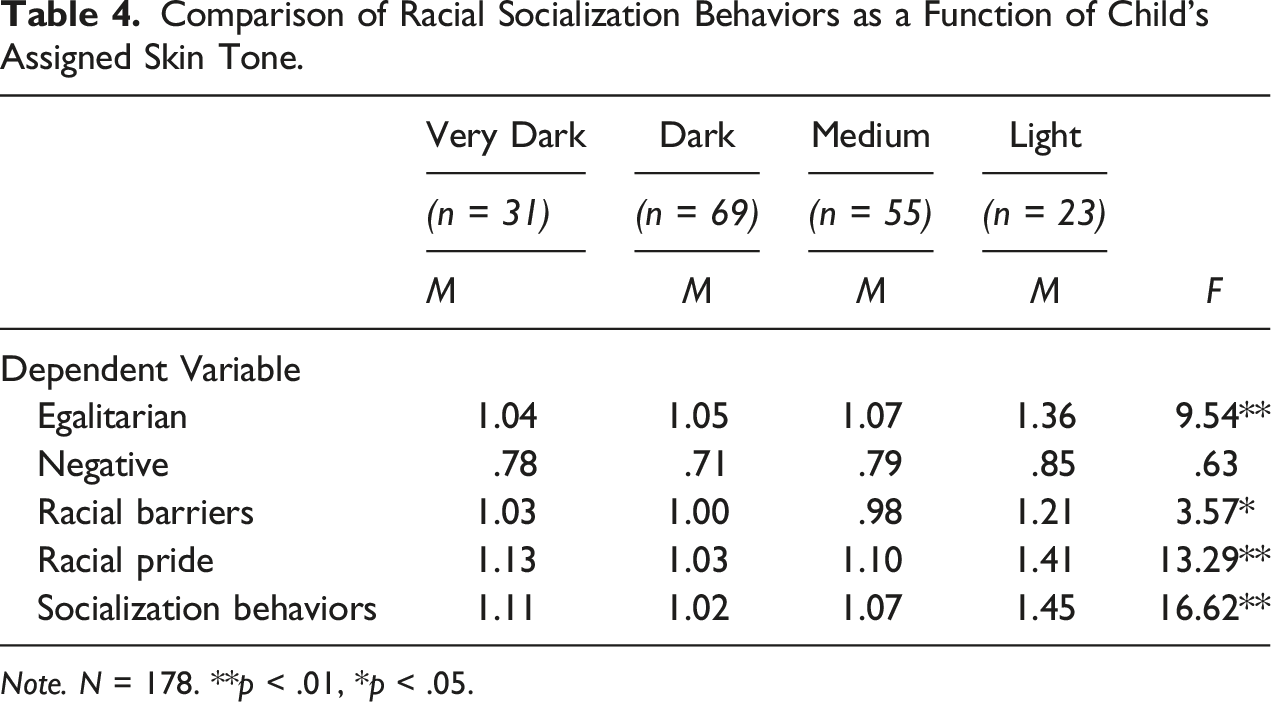
Note. N = 178. **p < .01, *p < .05.
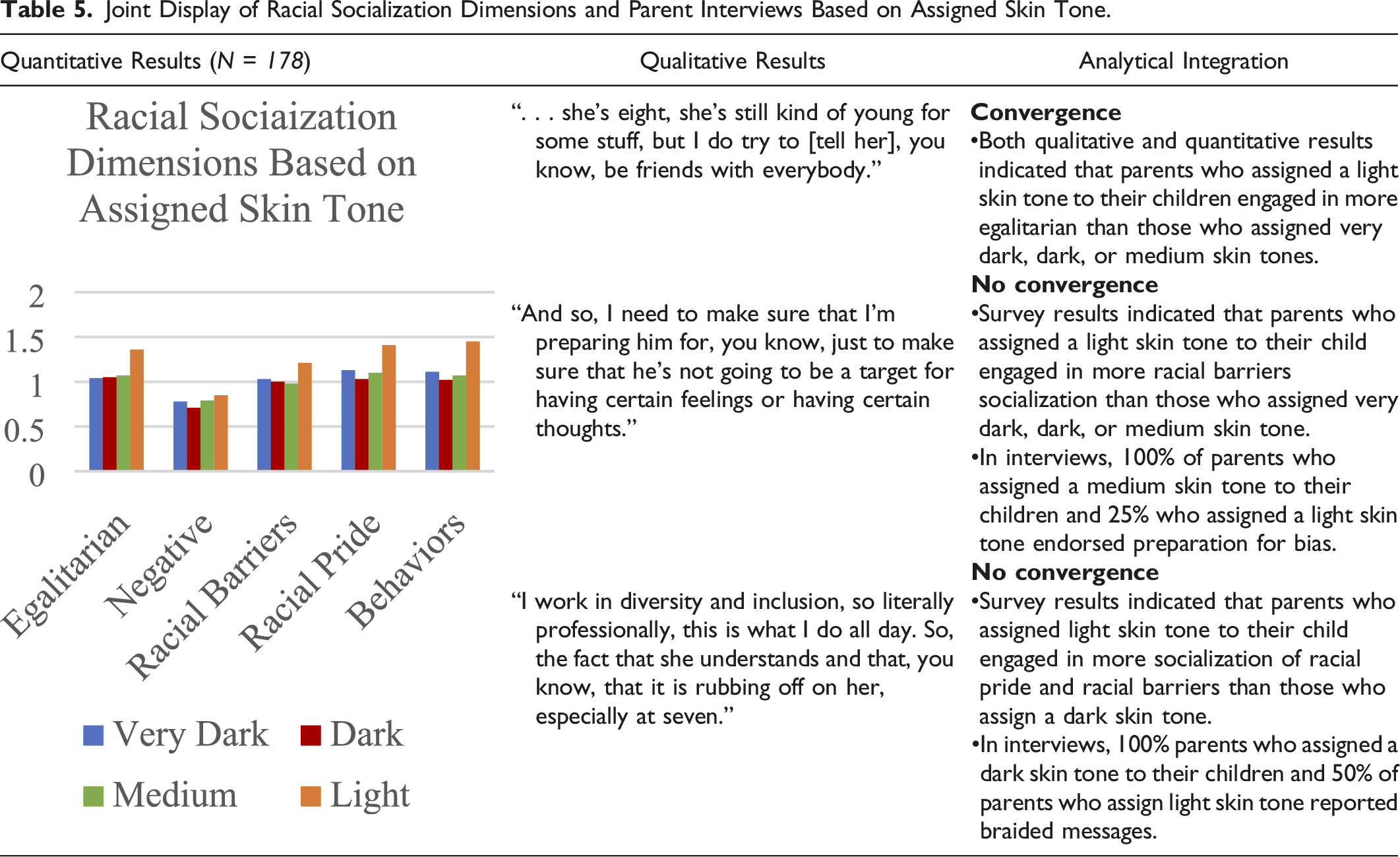
The Games-Howell post hoc test revealed significant pairwise differences on dependent variables egalitarian messages, racial barriers, racial pride messages, and socialization behaviors between the following groups: light and very dark, light and dark, and light and medium. Upon inspection of the mean scores, parents who assigned light skin tone to their children (M = 1.36, SD = .28) transmitted significantly more egalitarian messages, on average, than parents who assigned very dark (M = 1.04, SD = .24), dark (M = 1.05, SD = .22), or medium (M = 1.07, SD = .31) skin tone to their children.
Parents who assigned light skin tone to their children engaged in significantly more racial barrier messages (M = 1.21, SD = .33), on average, than parents who assigned very dark (M = 1.03, SD = .23), dark (M = 1.00, SD = .25), or medium skin tone (M = .98, SD = .38). Parents who assigned light skin tone to their children (M = 1.41, SD = .22) transmitted significantly more racial pride messages, on average, than parents who assigned very dark (M = 1.13, SD = .21), dark (M = 1.03, SD = .27), or medium skin tone (M = 1.10, SD = .26) to their children. Parents who assigned light skin tone to their children (M = 1.45, SD = .25) engaged in significantly more socialization behaviors, on average, than parents who assigned very dark (M = 1.11, SD = .21), dark (M = 1.02, SD = .24), or medium skin tone (M = 1.07, SD = .30) to their children. Parents who assigned very dark skin tones to their children did not significantly differ in transmitting egalitarian messages, racial barriers, racial pride, or socialization behaviors compared to parents who assigned dark or medium skin tones. Parents who assigned dark skin tones to their children did not significantly differ in transmitting egalitarian messages, racial barriers, racial pride, or socialization behaviors compared to parents who assigned medium skin tones to their children.
Qualitative
Analysis of the parent interviews revealed themes unique to parents who describe their children’s skin tone as dark, medium, or light. Messages were considered unique to specific groups when all parents in the group engaged in the message. For parents who described their child’s skin tone as dark, braided messages stood out as a common theme. Parents who describe their children as having a medium skin tone discussed providing messages related to Black girl magic/Black boy joy and preparation for bias. Messages of silence about race stood out for parents who described their children as having a light skin tone. In addition to unique messages, qualitative analysis revealed common messages across all parents: cultural socialization and “conversation within a conversation.”
Message Unique to Assigned Dark Skin Tone
Braided Messages
All parents (n = 3) who assigned a dark skin tone to their children shared messages that braided their experiences with their racial socialization (ages 5, 5, and 7). Notably, the parents in this group were self-assigned as having a medium (n = 1), dark (n = 1), or very dark skin tone (n = 1). Sunshine presented an argument for using her experience as a dark-skinned woman and her education to guide her racial socialization: I think it's my experience as a dark-skinned woman . . . So, before the world can put their norms on her, I have to make a solid foundation, so she can immediately dispel [stereotypes]. After she has had a foundation, she knows the [stereotypes] are not accurate when someone tries to project them on her . . .the first person that had access to her ideology, her thinking and her norms is going to be me . . .so when other things come to her, she can immediately be like, sorry, that's not correct.
Sunshine discussed how her family is “pro-Black,” and her dad “ran around with the Panthers.” She talked about being proud of having “ties and roots to Africa,” but she still dealt with racial trauma. She hoped that sharing her experiences, her family’s history, and preparing her daughter to deal with stereotypes would somehow protect her, stating: “what I had to endure, hopefully, she won’t have to endure.”
Muhammed used his experience as a dark-skinned man to respond to his daughter’s questions about the police. He recalled explaining that “they think I be doing something I ain’t supposed to.” Unlike Sunshine, Muhammed questioned his approach. He noted: “that used to have my baby scared of the police,” but now she seem like she cool [because] I guess she must’ve met a couple of cops at school or something.”
Message Unique to Assigned Medium Skin Tone
Black Girl Magic/Black Boy Joy
Parents’ Black girl magic/Black boy joy messages promoted children’s self-esteem and self-confidence. These conversations appeared to be shared among parents (n = 3) who assigned a medium skin tone to their children (ages 6, 7, and 8). Among this group, parents discussed how they engaged in messages and activities that celebrated Black girl magic and Black boy joy. Consider how Jada discussed teaching her son “resilience, confidence,” and having “a sense of belonging”: I expose him to a lot of different things. He does a lot of things with sports. He's always around positive role models, whether they are his teenage cousins or friends. He does a lot of different enrichment activities outside of school. That focuses a lot on just being proud to be black. So, I think that kind of starting him off early [is good], and I think once he fully understands the dynamics of what we're trying to do and what we're trying to teach him, I think he's gonna appreciate it. I think he’s gonna have an appreciation for being an African American boy.
Another parent explained that she has noticed that Black girls often share that they want to change their skin tone, facial features, or body types. She wanted to teach her daughter to “balance out critique” to build confidence. She explained: So, one of the things that we do with her is affirmations or “I ams.” And I remember when I first started doing them with her, she was like, what? And I used to make her stand in front of a mirror. Like, I need you to talk to you . . . and just reinforcing things that she does well and knowing how to balance out critique so that she doesn't, you know, get low self-esteem.
Parents in this group believed that Black girl magic/Black boy joy messages are adaptive for their children with a medium skin tone. Like their children, all (n = 3) parents in this group were self-assigned to have a medium skin tone. Their messages reflect a necessary adaptation to what their children may see represented in movies, books, or comments heard on the playground.
Preparation for Bias
All parents who assigned a medium skin tone to their children reported transmitting messages that prepared them for bias. For example, Marshall warned his son about discrimination but provided some strategies to deal with it: I want to teach him that, you know, people gonna judge you from your color . . . and you have to learn how to block that out. Because if you let something like that control you, they got you or whatnot . . . they can control you. They can get you mad by calling you a racist name; they got you, [Scott]. You can't let them control your mind or whatnot. You just gotta swallow it, eat it up, or whatnot.
Some parents in this group reported engaging in preparation for bias after their child reported racial incidents, while others took the opportunity during an everyday activity with their children. For example, Jada discussed a conversation with her son while they read a book where the character could not check out a book because he was a Black. She described their interaction: I asked [Dupri] how he would feel if he went somewhere and was denied service. And he told me he would feel sad. And so that was kind of a teachable moment, but I didn't know exactly what to say to him . . . But I asked what is something you would do if this was to happen to you?
She added that she told Dupri to “be loud in your protest. If you are being mistreated, make people know that you know, that you’re being mistreated and that you’re gonna find a way to come out of that mistreatment.”
Message Unique to Assigned Light Skin Tone
Silence About Race
All (n = 4) parents who assigned a light skin tone to their children revealed that they were silent around race-related topics with their children (ages 5, 5, 8, and 8) prior to this study. Two parents in this group self-assigned as having a light skin tone, and two self-assigned as having a medium skin tone. Parents reported that they would begin transmitting messages when the time was right. For example, Michael disclosed that he would have a conversation with his daughter “if [she] had a situation or something that came up, but right now, no, she hasn’t had any situations where I need to talk to her about it.” The other three parents had similar responses, one parent adding, “he’s five; nothing has really come up.” One parent explained why he was silent around race with his son. He stated that his son “may have a little more success in life just because he’s a lighter skin tone . . . unless there’s some humongous paradigm shift, [that is] just going to be how it is.”
Message Common Across All Assigned Skin Tones
Conversation within a Conversation
All (N = 10) parents reported engaging in a conversation within a conversation. A conversation within a conversation is related to messages about skin tone and colorism. As explained by a parent who assigned a medium skin tone to her child: There is kind of like that conversation within the conversation. So, you have a conversation about Black people and White people, Hispanic people, but then when you go into the Black community, you then start talking about the whole colorism thing and light skin versus dark skin.
Some parents discussed how they responded to their children’s comments or questions about skin tones. For example, one parent talked about a conversation he had with his son about his friends with very dark skin tones: He got a bunch of Sudanese friends, and he asked, “why[are] they so dark or whatnot? Why we can't we get dark like them?” or he'll make comments like “their skin is beautiful” or whatnot. But he just doesn’t understand why they so dark. So, he'll make comments about skin complexion and why White people are white . . . I do my best to explain to him [that] they're Europeans; we came from Africa.
Three themes emerged when exploring Black parents’ decisions regarding race-related messages to their children. Parents reported several factors described by the themes of skin tone and gender, and delicate balance. These themes highlight Black parents’ decision-making when transmitting race-related messages to their children.
Skin Tone and Gender
Parents discussed how their child’s skin tone and gender influence their decisions about communicating race-related messages to their children. Some parents of Black girls (n = 4) discussed practicing affirmations. For example, LaToya talked about showing her daughter pictures of Black dancers because she wanted her daughter to know that “you as a Black girl, have Black girl magic.” Sunshine noted that because of her experience as a dark-skinned woman, she wanted to provide her daughter with examples of girls and women with dark skin tones. She described her morning ritual: In the morning, when she's getting dressed, I playBrown Skin Girlby Beyonce and Blue Ivy. And I play the video on YouTube. She listens to the song, but the imagery of that video is very powerful. Like there's Naomi Campbell in there. There’s Lupita's in there. Kelly Rowland is in there. There’s a Sudanese model in there. And those are just the dark-skinned girls. So, [it is] the visuals of you are a beautiful brown skin girl. And I do pump her with that ideology . . . that you’re beautiful and you’re Black is beautiful and that's okay. And [in] this world, there are multiple shades, and not one is more important than the other.
Hair was an important topic for some girls’ parents (n = 3). According to one mother, her daughter “never says anything about her skin color at all. It’s just the hair part.” She described how she ensures her daughter wears natural hairstyles, such as braids and twists, hoping that her daughter will “love her hair just the way it is.” Queen had similar feelings. She wanted her daughter to know that “she is, with her darker complexion and her curly coily hair, just as beautiful as a Disney character named Elsa with long white flowing hair.”
Parents of Black boys (n = 4) discussed preparing their dark skin sons for those who view them as a threat. As Marshall pointed out, “they love you now, [but] they gonna be scared of you later . . . based on your skin . . . Us black men gotta roll with the punches, I guess, but there is nothing we can do about that.” Another father talked about preparing his son for racialized experiences: At the end of the day, they're going to see him as a black kid. So, you have to understand; this is what goes along with being a black kid . . . There are going to be instances where you might have to fight. There are going to be instances where you might have to walk away. There's going to be instances where you might have to bite your lip and take whatever you have to take at the moment . . . And kind of just get them ready for whatever comes.
However, he believed his son’s skin tone would protect him from people being “not as racist” toward him: I think having to fight against what people are already going to assume or think of him that's an uphill battle. I think it'll help because he is lighter that, you know, he is gonna have experiences where people are going to maybe not be as racist, or not racist at all towards him because he fits in, he has curly hair.
Delicate Balance
Like Queen, parents (n = 6) discussed finding the balance between children’s knowledge about recent racial tension and their race-related communication. For example, Marshall believed that because he had a Black son, he had “to talk to him about all that stuff . . . ‘cause he see the George Floyd, he see the marches, he see all that going on.” Sunshine noted the significance of recent public racial violence and the “delicate balance” of discussing the issue with her daughter: We all saw the murder of George Floyd on tv. I wouldn't be surprised if [Mulan] visually see that officer’s knee and George Floyd’s neck. And she could recognize that image . . . And I wouldn't be surprised if [children] ages five to eight would say, ‘Hey, that's George Floyd. Hey, that's James Scurlock. Hey, that's a Brianna Taylor . . . It's a delicate balance; you do have to address what's in the news. When the murder of George Floyd happened, [I] had to have a certain conversation that she may not be ready for, but you do have to do it based on the current trends.
Still, Sunshine struggled when presented with an opportunity for her daughter to engage in a Black Lives Matter march. She recalled how vicarious racial trauma made her stop and think about her daughter wearing a Black Lives Matter t-shirt: I remember a moment . . . at her school they had a Black Lives Matters march, and they got t-shirts that said Black Lives Matter. And I remember my heart felt something like, hold on, hey, do I want her to wear that shirt? Do I want that? Not [just] the target on her back; do I want that target on her front? Like, oh wait, this is cool on the poster. I guess it's a great bumper sticker. It's a great tweet. But hold on.
Sunshine’s description of her experience illustrates the juxtaposition of owning your power and exposure to risk. She ultimately decided to allow her daughter to wear the t-shirt because “it’s [about] the bravery,” but admits it was difficult to process.
Another example of a delicate balance is parents’ reflection on finding the balance between their children’s racialized school experiences and parenting. One parent reported that she intentionally sent her daughter to a specific school because “I don’t want her to have to unlearn negative ideology or traditional American ideology.” Marshall’s son also attends a school where most teachers and students are White. He talked about teaching his son about racism in America but cautions him not to share the information with school peers or challenge his teachers. Marshall stated: we tell him to keep stuff at home . . . we don’t want you telling these kids that, and they go home telling their mom, and then the school gets in it . . . But when teachers tell him certain stuff that we [have] talk[ed] to him [about], he’ll go back and be like, nah, that’s not true. My parents said this, but we’ll tell him like, hey . . . dial it down. Cause we don’t want . . . the kids being confused. We don’t know what their parents teaching them.
These parent reports demonstrate how Black parents engage in proactive racial socialization while simultaneously trying to counteract White supremacist ideologies that frame most school systems.
Integration of Findings
Racial Socialization Differs Based on Skin Tone
Quantitative and qualitative results regarding their racial socialization practices did not converge for parents who assigned a dark skin tone to their children (Table 5). Survey results revealed that parents who described their children as having a dark skin tone engaged in less racial pride and racial barriers than parents who described their children as having a light skin tone. However, qualitative analysis told a different story. Additionally, parents in this group reported relying on their racial experiences to help inform their racial socialization. They explained that the pervasive racism they encountered based on their skin tone compelled them to discuss personal matters of discrimination with their children. Furthermore, parents in this group recognize the duality of dealing with painful experiences associated with having a darker skin tone and expressing pride in having a darker hue.
Although survey results revealed that parents who describe their children as having a medium skin tone engaged in less racial pride than parents who describe their children as having a light skin tone, the opposite was true for those who participated in the interviews. Parents who assigned a medium skin tone to their children encouraged them to have racial pride by engaging in affirmations or exposing them to experiences in which they could see themselves represented. By contrast, parents who assigned a light skin tone to their children encouraged them to be themselves without any emphasis on race. Furthermore, quantitative results indicated that parents who assigned a light skin tone to their children engaged in more racial barriers than parents who assigned a medium skin tone, but qualitative analysis provided a different perspective. Parents who assigned a medium skin tone to their children warned them about the possibility of racial bias and encouraged them to stand up and defend themselves. In contrast, parents who described their children’s skin tone as light acknowledged that they might face bias when they are older, but they were not currently preparing their children.
The divergence in the findings could be related to two issues. The quantitative focused on parents’ frequency of racial socialization. However, the qualitative focus allowed parents to reflect and make meaning of their race-related communication with their children—something that a survey cannot capture.
Joint Display of Racial Socialization Dimensions and Parent Interviews Based on Assigned Skin Tone.
Discussion
Black families in America have historically dealt with racism and skin tone hierarchy. There is a growing body of literature on Black parents’ process of addressing racial discrimination implicitly and explicitly with their children. However, little research has examined whether this parental process varies by skin tone. Findings from this study indicated a relation between Black parents’ engagement in racial socialization and how they describe their children’s skin tone. Parents who describe their children’s skin tone as very dark, dark, or medium engaged in less racial socialization than those who described their children’s skin tone as light. Yet, qualitative findings suggest that parents engage in unique messages based on the assigned skin tone of their children. This is noteworthy because it highlights the importance of using a mixed methods approach, as noted by Hughes and colleagues (2008), “to empirically capture the richness, depth, and complexity that characterize [racial] socialization . . . is akin to ‘trying to catch a moonbeam’” (p. 228).
Parents who describe their children’s skin tone as dark reported translating their own experiences with racism into messages for their children. However, parents who described their children’s skin tone as medium reported engaging in messages related to building their children’s self-esteem and confidence. Parents who described their children’s skin tone as light reported that it was not the right time to have a race-related conversation with them. The difference in racial socialization based on skin tone supports the assertion by critical race theory that a human-created skin tone hierarchy exists. It has a social reality that determines how parents engage in racial socialization (Bonilla-Silva, 2018).
Limitations
While the findings from this study contribute to the growing racial socialization literature, they also contained limitations. First, this study included only Black parents. A recent study of Mexican mothers and their daughters found an increase in maternal cultural socialization for girls who had a darker skin tone (Derlan et al., 2017). Thus, future research would benefit from examining the relation between skin tone and racial socialization with multiple racial/ethnic groups. Secondly, there were some sample-based limitations. The sample from this study was drawn from a midwestern state where the Black population is approximately 5%. We must consider the population of Black parents from different states with a higher percentage of a Black population may have access to additional or various supports for their racial socialization. Thus, the restricted geographical location, the reliability and generalizability of the results are limited. A final limitation was that data collection occurred during a heightened sociopolitical time when educational institutions were forced to refrain from teaching children about America’s history related to Black people. Because of the current racial climate, Black parents’ frequency in their discussions about race and racism with their children may shift.
Directions for Future Research
This study provides a foundation for future projects investigating skin tone and racial socialization. Further research on Black parents’ racial socialization between siblings with different skin tones may provide a better understanding of skin tone’s integral role in Black parents’ early racial socialization. This includes considering its influence on the sibling relationship and their relationships with others (e.g. peers and other family members). Additionally, a more extensive study of parents who share a similar and different skin tone with their children could provide a more nuanced understanding of racial socialization. Parents who share similar skin tones may feel they can relate more to their children’s racialized experiences, whereas those with different skin tones may rely more on their perceptions about what it means to be their child’s skin tone.
The racial socialization measure used in this study captured Black parents' frequency of racial socialization. However, this measure did not capture aspects that emerged in the interviews, such as parents’ skills and confidence in navigating race-related conversations with their children. Future studies should use recent measures designed to measure Black parents’ confidence, skills, and stress in engaging in race-related communication with their young children (Racial Socialization Competency Scale (RaSCS); Anderson & Stevenson, 2019). In addition, future research should consider changes in parent behaviors over time. Smith-Bynum’s theory of racial socialization in action (2021) proposes that parents vary in their judgment of when and how to deploy racial socialization in its various forms. A more extensive longitudinal study may help provide a deeper understanding of how Black parents’ racial socialization practices vary over time and how this may shift children’s beliefs, attitudes, and preferences regarding skin tone. The difference in racial socialization based on skin tone supports the assertion by critical race theory that a human-created skin tone hierarchy exists. It has a social reality that determines how parents engage in racial socialization (Bonilla-Silva, 2018). This study suggests that Black parents’ awareness of the skin tone hierarchy relates to how they socialize their children around race and racism.
Lastly, further exploration of racial socialization is needed to understand additional dimensions or types of racial socialization. This includes considering how parents engage in messages promoting social justice or challenging the status quo. These considerations would contribute to our understanding of the complexity of Black parents’ racial socialization. Furthermore, it would be important to consider how these additional dimensions relate to children’s racial identity development.
Conclusion
There is a complex relationship between parents’ racial socialization practices and their assigned skin tones for themselves and their children. Some parents viewed their children’s skin tone as a reason to prepare them for a society that would perceive them as a threat, while others believed their children’s skin tone would protect them from the perils of anti-blackness. Thus, while racial socialization is a critical aspect of Black parenting, it is important to recognize that there is no one-size-fits-all approach.
Footnotes
Declaration of Conflicting Interests
The author(s) declared no potential conflicts of interest with respect to the research, authorship, and/or publication of this article.
Funding
The author(s) received no financial support for the research, authorship, and/or publication of this article.
