



Abstract
This study investigates trends and prevalence of Intimate Partner Violence (IPV) among out-of-wedlock adolescent mothers and their likelihood of being IPV victims later in a marriage. We address possible selection bias using a propensity score matching technique. The study uses the Kenyan DHS and finds that the prevalence of IPV (a composite measure of emotional, physical, and sexual violence) was 43%, but 28%, 12%, 34%, and 13% for emotional, severe physical, less-severe physical, and sexual IPV, respectively. Overall, out-of-wedlock adolescent mothers are associated with approximately 14% higher likelihood of IPV later in marriage than non-adolescent mothers. Policy and intervention plans for out-of-wedlock adolescent motherhood are clear strategies for abating IPV. This could be addressed by advocating for improved human capital among girls, laws to combat domestic violence and rape, and managing cultural practices like acceptance of “wife-beating.”
Introduction
Intimate partner violence (IPV) is defined as violence by an intimate partner or ex-partner and is linked to poor birth outcomes (Berhanie et al., 2019), miscarriages, stillbirths (Dhar et al., 2018; Pastor-Moreno et al., 2020), and mental health problems (Wathen et al., 2016). Additionally, witnessing or experiencing violence as a child can lead to anxiety and depression (Jouriles and McDonald, 2015; Martinez-Torteya et al., 2016), aggressive behaviors (Beckmann, 2020; Holmes et al., 2015), poor performance in school (Kiesel et al., 2016), and a higher likelihood of perpetrating IPV later in life (Choi and Temple, 2016). These are perturbing observations because, as per a 2021 World Health Organization (WHO) report, a third of ever-partnered women have experienced physical/sexual violence from an intimate partner or non-partner at some point in their lives worldwide, with the highest prevalence in Africa and South-East Asia.
Child marriage (marriage or informal union under 18 years) is often cited as a key risk factor for IPV (see (Ahinkorah et al., 2022; Hong Le et al., 2014; Kidman, 2017; Yount et al., 2016). Perhaps it is because these two, child marriage and IPV, are strongly correlated in the case of sub-Saharan Africa because of the male-dominated cultural traditions and practices and the high prevalence of child marriages, adolescent pregnancies, and IPV (Ahinkorah et al., 2022). Some insights into child marriages show that they are characterized by a household power imbalance (Jensen and Thornton, 2003) and are typical in communities that support male dominance (Santhya et al., 2010). One drawback of these marriages is that they impede women’s autonomy and decision-making power (Erulkar, 2013; Jensen and Thornton, 2003; Santhya et al., 2010), placing them at elevated risk for IPV (Santhya et al., 2010). Of course, these marriages lead to adolescent motherhood, but interestingly approximately 10% of adolescent motherhood still happens outside marriage. Insights from these child marriage studies are important, but out-of-wedlock adolescent mothers are characteristically different from adolescent motherhood in marriage. Therefore, it may be naive to translate the results wholesale to out-of-wedlock adolescent mothers.
This paper studies the latter and examines whether it influences the likelihood of IPV among Kenyan women. We do this by comparing the likelihood of IPV for out-of-wedlock adolescent mothers to those of non-adolescent mothers later in life. The significance of this study is threefold: first, estimating the impact of out-of-wedlock adolescent motherhood is challenging because of other factors that give rise to a correlation between out-of-wedlock adolescent motherhood and IPV. For instance, some women may prefer to start a family early because they do not hold high educational or occupational aspirations like other women in their community (Rindfuss et al., 1980) or do not see other life purposes within their reach (Winter, 1997). These preferences could potentially influence motherhood status and risk for IPV. Still, it may also be due to factors beyond the adolescent’s control, such as cultural practices, poverty, or rape. We use a propensity score matching (PSM) method to address this selection issue.
Second, IPV and adolescent motherhood are still significant social challenges because of the immediate adverse effects on women and children and their capacity to adversely affect future generations. We are not aware of studies that have explored the IPV experiences of a subset of adolescents who had their first child out of wedlock. We fill this scholarly gap in the literature. Third, IPV is more prevalent in sub-Saharan Africa. The projected substantial increases in the fraction of adolescents in Africa than in other regions (United Nations, 2015) and the cultural dynamics that favor men’s dominance will likely exacerbate the problem and make this study more relevant. In Kenya, for example, a recent article shows that public health officials are already concerned and are raising alarms over soaring adolescent pregnancy and IPV rates. According to this article, Kenya is ranked among the top five worldwide in adolescent pregnancy cases and violence against the same group (Maichuhie, 2022). Our findings and recommendations provide policymakers with additional tools to strategically target this subset of adolescents as they deal with domestic violence in Kenya and other sub-Saharan African regions.
Related Literature on IPV Risks
Studies show that high income and being employed reduce IPV risks (Dhungel et al., 2017) as the two improve women’s bargaining power within the household (Lundberg and Pollak, 1996), and women’s ability to support themselves if they exit an abusive union. However, some studies also suggest that more resources may lead to a backlash, especially when it favors the wife, as the husband attempts to re-acquire power gained by women and reinstate dominance within the family (True, 2012). In Kenya, for example, Kimuna et al. (2018) find that working women experienced more violence than their nonworking counterparts.
The literature also emphasizes education’s importance in familiarizing women with ideas and norms that challenge existing cultural viewpoints on IPV (Krause et al., 2017; Pierotti, 2013). It suggests that education expands women’s prospects (Cannonier and Mocan, 2018), informs them of global fights against IPV (Pierotti, 2013), and encourages them to be more intolerant of wife-beating practices (Gurmu and Endale, 2017). Like with income, some studies also report that education may yield more violence, especially when wives out-earn their husbands, but this increased risk depends on women’s initial bargaining position. These studies indicate a threshold below which improved education disadvantages women, as men amplify violence to reassert dominance. Beyond this threshold, there is less violence because women have enough power to exit an abusive union (Cools and Kotsadam, 2017; Jewkes, 2002). However, Kenyan women lag in educational attainment, employment, access to credit, and property ownership compared to their male counterparts (Kimuna et al., 2018). Moreover, along with a general culture of economic disempowerment, these unfavorable circumstances encumber access to economic opportunities and increase their dependence on their male partners, making them vulnerable to IPV.
There is evidence that societies that accept “wife-beating” or promote gender stereotypes have high IPV incidences and that women who find IPV “justifiable” are also more likely to be IPV victims (Sunmola et al., 2020). Acceptance of wife-beating has, however, decreased in most countries (Cools and Kotsadam, 2017), but it is still high in sub-Saharan Africa and South Asia compared to other regions (see Tausch, 2019). Women’s subordination is still ingrained in some Kenyan societies owing to cultural norms, and this is evident in 2008/09 and 2014 DHS data, which show that over 50% of Kenyan women agree that “wife-beating” is justified to correct a disobedient wife. Adegoke and Oladeji (2008) add that a husband in sub-Saharan Africa is likely to assert authority over his partner to correct behavior using physically punitive measures like beating. Some cultures even interpret it as demonstrating love for their partners (Kimuna et al., 2018). Most societies in Kenya are structured on long-standing societal and cultural norms of male superiority; communities accept these cultural norms and are undoubtedly central to domestic violence (Lawoko et al., 2007).
Data and Methodology
Data
We pool data from the 2008/2009 and 2014 Kenya Demographic and Health Survey (DHS). The DHS data are national household sample surveys of reproductive-aged women (i.e., 15–49) and provide health, gender, schooling, and socioeconomic details. The surveys are mainly done every five years and contain a core questionnaire and a separate module on domestic violence. While multiple women in a household receive the core questionnaire, only one woman is chosen per household for this domestic violence module. The domestic violence module is a standardized module that collects self-reports of emotional, physical, and sexual IPV, measured using a modified Conflict Tactics Scale (CTS). This approach has several advantages compared to many other data sets on IPV. For example, it uses several different questions about specific acts of violence, and therefore measures of abuse are less likely to be degraded through misunderstanding of what amounts to violence. CTS also provides respondents with multiple opportunities to report cases of abuse, which reduces the likelihood of under-reporting.
DHS handles interviews with high confidence and sensitivity due to the sensitive nature of the subject matter. Interviewers are trained to handle the interviews with the utmost sensitivity, ensure privacy, and are strictly prohibited from progressing when privacy is not assured. As noted earlier, sub-Saharan Africa generally has high IPV acceptability, and although under-reporting is possible, it is more likely to be less substantial than in countries with lower acceptability rates. In addition, the survey is administered with great care, which provides more confidence that the under-reporting of IPV is low.
We exclude women born before 1970 or younger than 20 years. This exclusion ensures that we focus on the most recent birth cohort that our data permits. In addition, since the survey question asked whether one has experienced violence “in the last 12 months” of the survey month, we believe that including less than 20 year olds may capture experiences at age 18. Therefore, our analysis covers women born between 1970 and 1994 with at least one child. The final sample in the study is 7,445.
Outcome variables
To construct emotional IPV, we use the survey question that asks whether the respondent’s current or most recent partner ever: humiliated them/threatened them/insulted or made them feel bad. An affirmative answer to any of these questions is coded as emotional IPV. Less-severe physical IPV is based on whether the respondent’s current or most recent partner ever: pushed/shook/slapped/threw something at them/twisted their arm/struck them with a fist or something that could cause injury/kicked/dragged them. Severe physical IPV is based on whether the respondent’s current or most recent partner ever: attempted to strangle them/burn/threatened with a knife, gun, or other types of weapon/attacked with a knife, gun, or other types of weapon. Finally, sexual IPV is based on whether the respondent’s current or most recent partner ever: physically forced them to have sexual intercourse/forced them to perform other sexual acts they did not want. The composite IPV measure is coded as 1 if a woman reports emotional, sexual, or physical violence; otherwise, 0. In this case, IPV is coded as 1 even though it could refer to only one form of IPV (i.e., sexual violence), but this is consistent with the literature on IPV attitudes (see Behrman and Frye, 2021; Cools and Kotsadam, 2017).
Sample Description
Sample Characteristics.
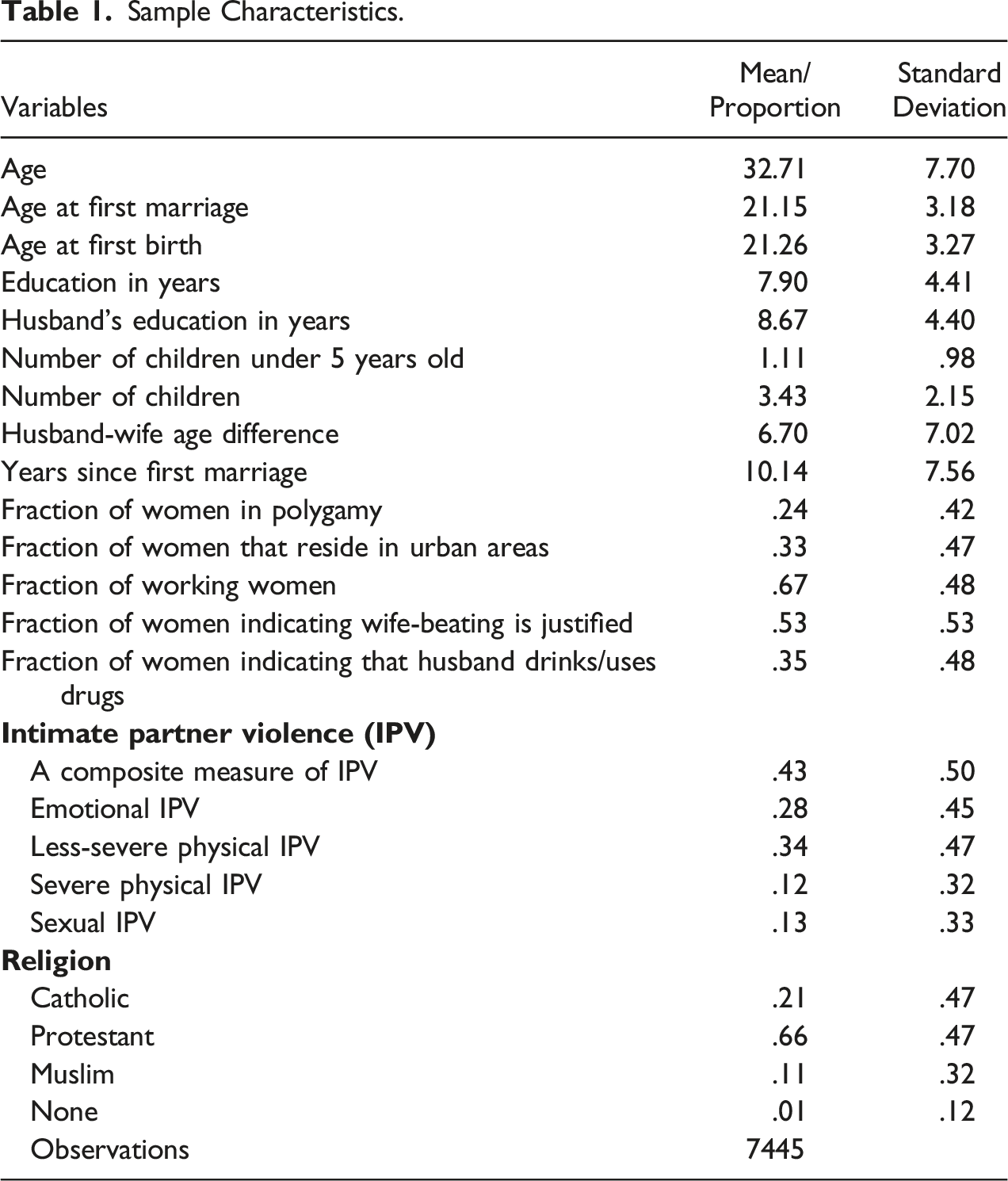
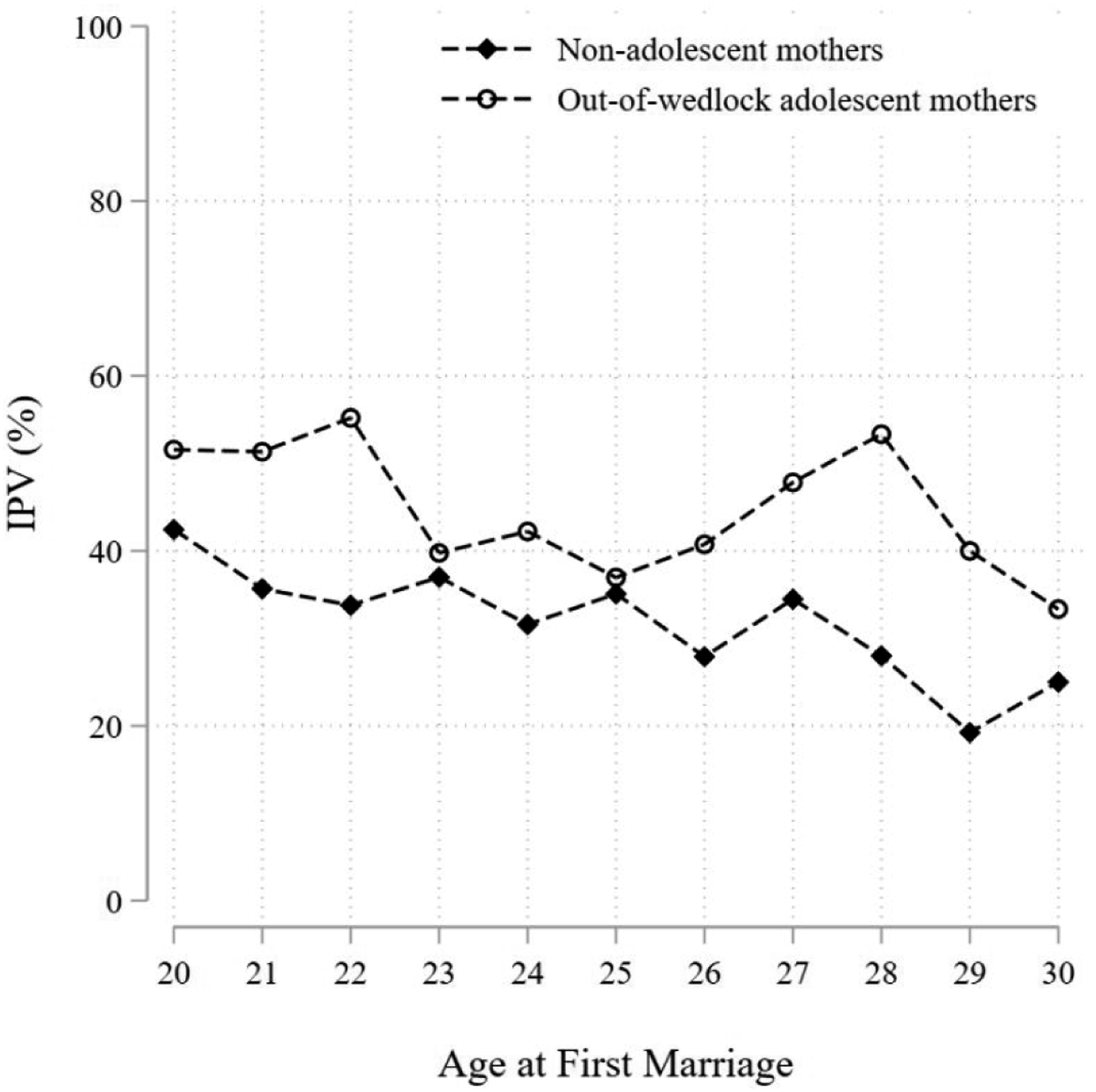
Figure 1 plots IPV by birth cohort, comparing non-adolescent and out-of-wedlock adolescent mothers. We find that the latter is likelier to report IPV compared to non-adolescent mothers. We also see that IPV cases for non-adolescent mothers have declined (Mann–Kendall test’s p-value = .0001) but have remained steady for out-of-wedlock adolescent mothers (Mann–Kendall test’s p-value = .1363). The Mann–Kendall trend test checks the existence of a trend; the null hypothesis is the absence of a trend, while the alternative hypothesis is its presence. Figure 2 examines the relationship between IPV and age at first marriage and finds that women who marry early are likelier to report IPV. Additionally, we note a more considerable decline in IPV for non-adolescent mothers (Mann–Kendall test p-values <.05) than for out-of-wedlock adolescent mothers. Figure 2 is critical for our analysis because it shows that while IPV is prevalent in Kenya, it remains higher for out-of-wedlock adolescent mothers than for non-adolescent mothers in marriage. IPV by mothers’ birth cohorts. IPV by age at first birth.
Methodology
In the absence of selection bias concerns, we would estimate a standard regression model as follows
Often studies use an instrumental variables (IV) approach to resolve this bias, and miscarriage, age at menarche, county-level abortion rates, or county-level physician availability are typical instruments in the adolescent motherhood literature (see Kane et al., 2013). However, one limitation is the difficulty in identifying good instruments. Another is that, like OLS, IV procedures tend to impose a linear functional form between the treated and the control, which may not hold since coefficients from the two groups could differ (Jalan and Ravallion, 2003). An alternative is the propensity score matching (PSM) method. Unlike the IV procedure, PSM does not require the functional form assumption; however, it requires the conditional independence assumption (CIA), which we discuss later in the paper.
Propensity Score Matching
PSM is commonly used in non-experimental studies to reduce selection bias. The PSM method constructs propensity scores (probability that a unit receives treatment, i.e., a woman becomes an out-of-wedlock adolescent mother) for each unit in a sample using a set of observable variables. Following (Smith and Todd, 2005), we base the selection of observable variables on three criteria: 1) we include variables that influence out-of-wedlock adolescent motherhood, for example, age of sexual debut, 2) variables that influence IPV, for example, employment status, attitude toward IPV acceptability, wealth, number of children under 5, and husband’s education level, and 3) we exclude variables that are affected by the treatment. Further, our variable selection is guided by previous studies on determining adolescent motherhood and IPV. The resulting propensity score, which ranges from 0 to 1, summarizes all the relevant details in the multidimensional characteristics into one score. The purpose of estimating the propensity score is to match individuals with similar estimated propensity scores, ensuring that the individual characteristics of the treated and the untreated groups are similar before the treatment. This exercise also ensures that the effect observed on the outcome variable is only influenced by the treatment status. Therefore, while we only observe individuals once, that is, after the treatment, PSM eliminates statistical differences between the groups as if the treatment was fully randomized.
Various matching methods, which vary in identifying comparison groups and assigning weights, are proposed in the literature. We use some standard matching methods: Nearest Neighbor Matching and Kernel Matching. In the nearest neighbor method, the treated individuals are matched with the untreated partners with the closest propensity score, with or without replacement. The kernel-matching method uses a weighing mechanism to match each treated individual with all untreated individuals. Still, an untreated individual with the closest propensity score is given more weight than those further away. These methods differ from the standard regression methods discussed above because standard regression uses a whole untreated sample as a comparison group with equal weight. We report typical regression results to serve as a benchmark.
Results and Analysis
Treatment Effect Estimation
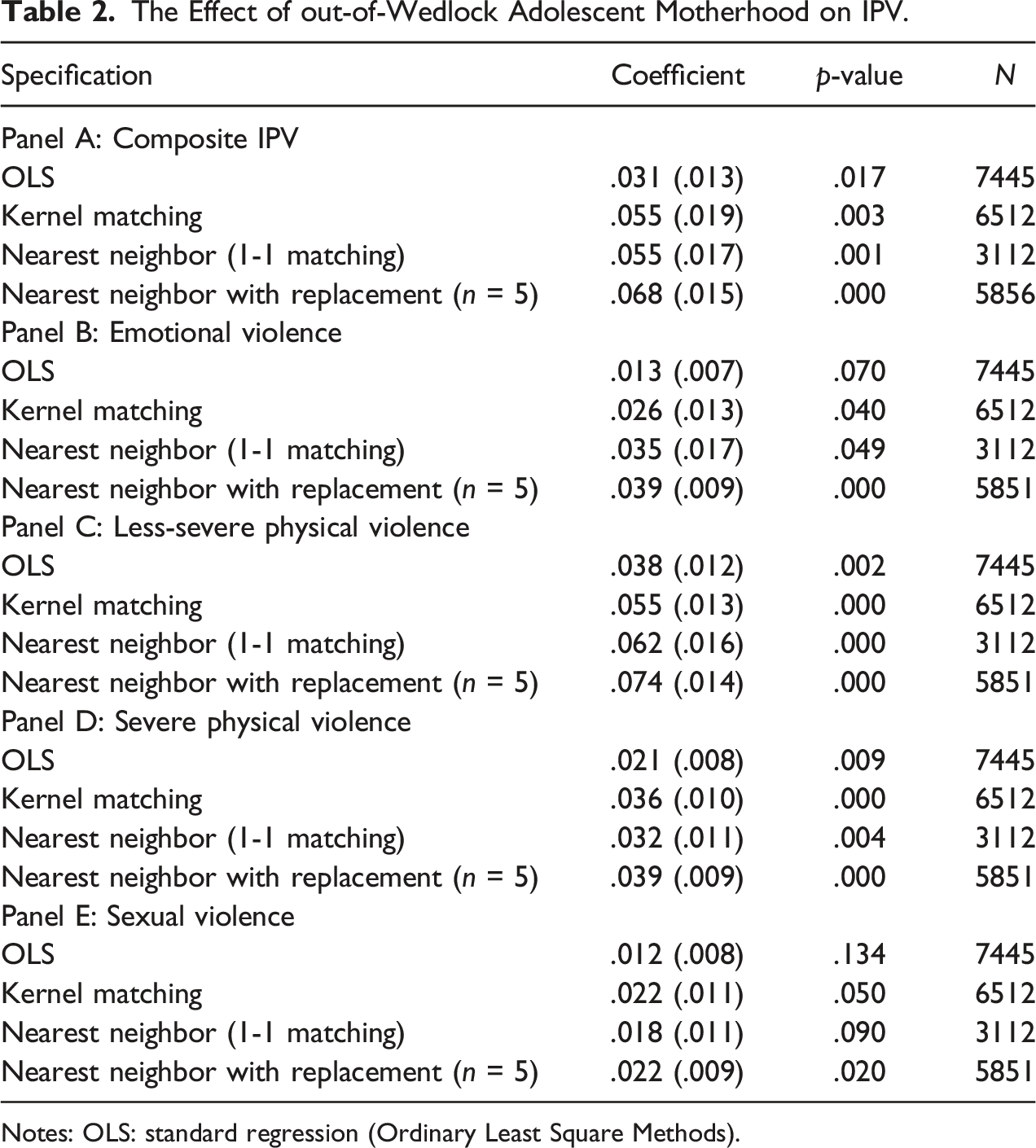
The Effect of out-of-Wedlock Adolescent Motherhood on IPV.
Notes: OLS: standard regression (Ordinary Least Square Methods).
Covariate Balance Analysis for out-of-Wedlock Adolescent and Non-Adolescent Mothers Before Matching and After Matching.

Note: Treated are out-of-wedlock adolescent mothers, and Untreated are non-adolescent mothers. Matching is based on the kernel-matching method. The standard difference is computed as the difference in means or proportions (between the treated and the untreated) as a fraction of the square roots of their sample variances; a standardized difference below .1 is acceptable (Rosenbaum and Rubin, 1985).
We find consistent evidence that out-of-wedlock adolescent motherhood increases the probability of multiple forms of IPV compared to non-adolescent mothers. Additionally, our result suggests that the extent of these risks varies, in that out-of-wedlock adolescent motherhood increases the likelihood of less-severe physical violence relatively more than emotional or sexual violence. We also find that OLS results are consistently lower than the PSM, regardless of the choice of matching, and suggest that the failure to control for selection bias could be discounting the effect of out-of-wedlock adolescent motherhood on IPV.
Evidence of Common Support and Covariate Balance
Figure 3 confirms that the PSM assumption holds. It shows that propensity scores are balanced between the two groups, non-adolescent and out-of-wedlock adolescent mothers, after matching, that is, the two lines overlap, which confirms evidence of “common support” (Imbens and Rubin, 2015). We also assess the balance of the two groups on the baseline characteristics. We present the bivariate comparisons and standardized bias before matching (columns 1–3) and after matching (columns 4–6) in Table 2. A bias of less than .1 indicates a negligible difference between the two groups (Rosenbaum and Rubin, 1985). We note substantial differences between the two groups before matching. For example, out-of-wedlock adolescent mothers are more likely to indicate that “wife-beating is justified,” have more children, and marry earlier than non-adolescent mothers. These differences further make a case for using the PSM technique for the analysis. The post-matching comparisons, however, eliminate all the previously statistically significant differences (standardized mean difference range from .00 to .07), indicating that a successful balance has been achieved. Kernel density for the balance of propensity scores.
Discussion
Our results may be attributed to several mechanisms. First, transitioning to motherhood is a significant advancement in a woman’s lifetime (Mercer, 2004) and may add further challenges for out-of-wedlock adolescent mothers compared with non-adolescent new mothers. Out-of-wedlock adolescent mothers now have to abruptly manage critical changes like adulthood, motherhood, and employability. Additionally, health expenses, which begin early and add more financial burden to the adolescents and their families, intensify social and fiscal vulnerability and may encourage the adolescents to seek emotional or financial partnership through marriage (Rigsby et al., 1998). Unfortunately, these economic dependencies are IPV’s critical risk factors (Dhungel et al., 2017).
It is also likely that out-of-wedlock adolescent mothers marry “lower quality” partners, who are likelier to be violent. Partners prefer a spouse with certain desirable traits, and these traits play a vital role in romantic relationships (Figueredo et al., 2005); while individuals have different concepts of an ideal partner, personal qualities relative to prospective partners' qualities form the basis of a partnership (Kirsner et al., 2003). In this case, quality could be influenced by education, income, and psychological issues (e.g., depression, addiction, or alcoholism). The higher the income or education, the higher the quality of a potential husband; and the higher chances of depression or alcoholism, the lower the quality of a potential husband. If marriage proposals are conditional on women’s qualities as well, then proposal rates could decline with “quality” because out-of-wedlock adolescent mothers, for instance, have lower education levels and low earning potential. Consequently, out-of-wedlock adolescent mothers are likely to attract similar qualities, and pursuing a partnership with higher qualities would lead to rejection (Figueredo et al., 2005). The implication is that their “quality” trims down the pool and the “quality” of potential husbands, which, in return, predisposes them to higher IPV risks (Vyas and Watts, 2009).
Another possible explanation is the financial incentives, which are tied to dowry. Bridegrooms more often pay dowry, and financial incentives, especially for low-income families, could motivate families to search aggressively for their daughter’s possible suitor (Alston et al., 2014), especially given her circumstances as an out-of-wedlock adolescent mother. Overall, all the above mechanisms indicate that out-of-wedlock adolescent motherhood reduces the arrival rate of marriage proposals, the value of being single, and the average quality of potential grooms. Intuitively, a woman with a better outside-of-marriage option or who faces a higher average quality of potential husbands can be more discriminating concerning the quality of their potential partners. In light of the above contexts, out-of-wedlock adolescent mothers are less likely to be selective.
Policy Implications, Limitations, Future Research
Most adolescent mothers have lower educational attainment, fewer chances for employment, etc. However, this group is often disadvantaged before becoming adolescent mothers. Therefore, policies should focus on income and wealth inequality by emphasizing the importance of schooling to communities that put less emphasis on girls' education or subsidizing schooling costs for low-income people. Muchiri (2021), for example, shows that subsidized schooling costs reduce adolescent motherhood, while other studies show that education reduces the risk for IPV (Cannonier and Mocan, 2018; Krause et al., 2017; Pierotti, 2013).
Most adolescent mothers drop out of school either because of the shame that comes with the pregnancy or institutional policies that do not support adolescent mothers' educational aspirations. In addition, some women lack basic information on sexuality because the topic is not discussed openly due to cultural norms or a lack of support groups to guide and encourage wise choices. Therefore, policies that encourage and support adolescent mothers to continue schooling or ensure reproductive health is provided to schoolgirls should be introduced because these two can potentially affect multiple generations. For example, children of adolescent mothers are likelier to do poorly in school (Kiesel et al., 2016), and children exposed to IPV are likelier to be perpetrators (Choi and Temple, 2016).
This study’s strengths are highlighted throughout the paper, but we encourage readers to consider the following limitations. First, PSM eliminates observable heterogeneity between the treated and control groups but does not address unobservable differences. Nevertheless, we have provided enough evidence to bolster our study’s internal validity by ensuring the fundamental assumptions hold. Secondly, we acknowledge that the outcome variables are self-reported, and recall bias is possible. Also, while there is a higher degree of privacy, under-reporting is likely due to cultural norms on marriage-related issues, especially concerning sexual violence. The survey is also voluntary, and we are unsure of how data from the non-respondent would have affected the outcome. Finally, this line of research can be improved in multiple ways, including using the latest DHS data whenever available, using other analytical tools that control for selection bias, or even examining whether similar results are observed in other Sub-Saharan African countries that share similar characteristics as Kenya. Despite this concern, the study provides an excellent analysis of how being an out-of-wedlock adolescent mother impacts the likelihood of IPV and addresses selection bias.
Conclusion
This paper examines the effect of out-of-wedlock adolescent motherhood on IPV. We acknowledge the presence of selection bias and mitigate the concern using a PSM approach. The efficacy of the PSM method relies on the ability to match out-of-wedlock adolescent mothers to non-adolescent mothers with a similar distribution of characteristics that predict the likelihood of out-of-wedlock adolescent mothers; we provide evidence that these assumptions hold. Our findings indicate that out-of-wedlock adolescent mothers have a higher risk for IPV than non-adolescent mothers, and these results are robust to multiple matching methods. Furthermore, we analyze different forms of IPV and still find that out-of-wedlock adolescent mothers are likelier to report IPV.
Altogether, our findings are of great consequence in sub-Saharan Africa, where poverty is high, there is a projected influx of teens, and traditional views on gender roles and wife-beating are still evolving. Our findings also highlight the importance of reducing out-of-wedlock adolescent pregnancies, especially in low-income households where adolescent motherhood impacts educational achievement and future income potential, and these two have favorable implications for closing income/wealth inequality and addressing social mobility, which is central in many social policy discussions.
Footnotes
Declaration of Conflicting Interests
The author(s) declared no potential conflicts of interest with respect to the research, authorship, and/or publication of this article.
Funding
The author(s) received no financial support for the research, authorship, and/or publication of this article.
