



Abstract
Religion is an important cultural institution that shapes family ideologies and behaviors. Although previous research has documented religious differences in parenting behaviors and parent–child relationships in adolescence, how religion influences parental support of young adult children is not clear. Using data from the Transition into Adulthood Supplement (TAS) of the Panel Study of Income Dynamics (PSID, 2005–2017; N = 9,754 person-years), we employed mixed-effect logistic and linear regression models to examine the impacts of young adults’ religious affiliation, religious salience, and parent–child religious concordance on parental coresidence and financial support. The results show that mainline Protestant and Catholic young adults are more likely than nonreligious youth to live with their parents. Catholic and Jewish young adults receive more financial support from their parents than nonreligious youth did when they are religiously concordant with their mother. The associations between religious affiliation and parental support are strengthened by young adults’ religious salience and religious concordance with their mother.
Religion is an important cultural institution that shapes people’s family-related values and behaviors. Religious messages, social networks in religious circles, and family activities organized by religious institutions all serve as socializing forces. Prior literature suggests that religious affiliation and engagement may foster strong ties between generations within the family. Previous studies have examined the impacts of religiosity on parenting practices (Bartkowski & Xu, 2000; Ellison & Sherkat, 1993; Smith et al., 2019) and the quality of parent–child relationships during adolescence (Regnerus & Burdette, 2006). Another line of literature has focused on the connection between religiosity and relationships between older parents and adult children, particularly the old age support and care that adult children provide to their parents (Gans et al., 2009; Hwang et al., 2021; King et al., 2013). However, little attention has been paid to religion’s role in shaping the relationship and support exchange between middle-aged parents and young adult children.
Due to prolonged postsecondary education, economic insecurity, and delayed marriage and childbearing, many U.S. young adults now depend on their parents for extended periods before fully establishing financial and residential independence (Newman, 2012). Young people may experience economic difficulties and failure events such as job loss, breakups, and divorce during their transition to adulthood. Parents often respond to these challenges by providing necessary support to their young adult children, helping them achieve the status of adulthood by, for example, completing education, finding jobs, and starting their own families (Fingerman et al., 2009; Swartz et al., 2011). The percentage of young adults ages 18–29 in the United States living with their parents has increased in the past two decades (Fry et al., 2020). Previous studies have examined how parents’ economic resources and young adults’ gender, race/ethnicity, and life-course events influence parental financial and housing assistance to young adult children (Fingerman et al., 2009; South & Lei, 2015; Swartz et al., 2011). However, besides the early studies on religious differences in young adults’ expectations of premarital independent residence (Goldscheider & Goldscheider, 1987), little research has been done on how religiosity is associated with parental support during young adulthood.
In this study, we employ nationally representative longitudinal data from the United States to examine how religious affiliations and religious salience are associated with the housing and financial support unmarried young adults receive from their parents. We also explore whether religious concordance between the mother and child further promotes parental support and for which religious groups. Many people experience religious disaffiliation and switching during young adulthood (Uecker et al., 2007); therefore, it is important to examine whether discordance between young adults’ and parents’ religious affiliation influences parental support and coresidence.
Theory and Literature
With the delayed timing of marriage and childbearing and prolonged postsecondary education, young adults today take longer to obtain adult roles than previous cohorts. Due to the high costs of tuition and housing coupled with labor market uncertainties, young adults often rely on parents for continued economic and housing support until they achieve full economic independence. Admittedly, material support provided by parents to young adults depends on parents’ economic capability and young adults’ needs and achievements of adult roles (Fingerman et al., 2009). However, housing and economic support from parents to young adult children tend to vary across racial/ethnic groups and immigrant backgrounds due to their distinct family values, norms, and preferences (Mitchell et al., 2004). Cultural groups can create and reproduce a set of norms and timetables that guide parents’ and young adults’ behaviors regarding the transition to residential and economic independence. Some cultural groups valorize familism and mutual support, while others value individualism and individual autonomy. As an important cultural institution, religion can promote certain family values and norms that shape the support middle-aged parents provide to young adult children.
First, religion can influence parents’ willingness to support young adult children by promoting strong intergenerational bonds. Most religious groups prioritize strong and enduring family relationships. Judeo-Christian doctrines encourage marriage, procreation, and loving relationships within the family (Pearce & Axinn, 1998; Wilcox, 2002). The Bible explicitly advises children to honor and obey their parents and encourages parents to teach their children. Religious institutions communicate these ideas through sermons, other clergy statements, religious texts, and other religious media (Pearce & Axinn, 1998). Many religious books offer biblical advice to parents about how to maintain a positive relationship with adult children (e.g., How to Connect with Your Adult Children and You Never Stop Being a Parent). These messages could make parents feel more obligated to support and guide their children through the transition to adulthood. Religious institutions also offer formal support to families and provide opportunities for parents and children to spend time together while attending religious services and activities (e.g., family camps, retreats, and counseling). Together with religious teaching, these religious activities can help promote intergenerational closeness and encourage support exchange between parents and children. Previous research suggests that closeness to parents is positively associated with the frequency of financial transfers from parents to young adult children (Hartnett et al., 2013). Closeness to parents also predicts later home-leaving among youth and a higher probability of returning home after living independently (South & Lei, 2015; van den Berg et al., 2021). Because religiosity is linked to positive relationships between parents and young adult children (Pearce & Axinn, 1998; Regnerus & Burdette, 2006), we expected religious young adults to be more likely to live with their parents and receive financial support.
Moreover, religion can promote altruism and encourage attention to other people’s needs over the self. According to contingency theory, the relationships between parents and children are adaptive (Eggebeen & Davey, 1998), meaning that parents and adult children offer each other support in response to each other’s needs. Because religious teaching and values emphasize the importance of positive family relationships and prioritizing others’ needs over the self (Pearce & Axinn, 1998), religious people may be more responsive to family members’ needs. Thus, religious parents may be more willing to help young adult children, who today often need prolonged parental support.
Furthermore, religious denominations’ attitudes toward marriage can influence young adults’ decisions about home-leaving and parents’ willingness to economically support their children’s independent residence. Most Christian denominations, especially conservative ones, emphasize the primacy and centrality of marriage and oppose premarital sex and cohabitation (Pearce & Thornton, 2007). Compared with nonreligious families, Christian families are more likely to encourage early marriage and emphasize the traditional norm of staying at home until marriage because residential independence from parents before marriage weakens parents’ control over children’s behaviors. Additionally, religious young adults usually avoid cohabitation, which reduces their desire to live independently before marriage. Religious parents who are concerned about premarital sex and cohabitation may be less motivated to economically support their grown children’s premarital residential independence. These reasons can lead to religious young adults’ longer coresidence with their parents compared with nonreligious youth.
Furthermore, religious differences in attitudes toward education and worldly pursuits can lead to different forms of parental support. For example, Jewish families place a higher value on children’s pursuit of higher education and professional success than other religious groups (Horwitz et al., 2022). For conservative Protestants, due to the high tensions between religious faith and secular (scientific) education, avoiding the secularizing effects of higher education is one way to preserve their subculture (Ellison & Musick, 1995). Secular education is thought to undermine the theological foundations of conservative Protestantism (Darnell & Sherkat, 1997). A study of White adults in the United States found that educational attainment is the highest among Jews and the lowest among fundamentalist Protestants, with Catholics and mainline Protestants situated between the two (Lehrer, 1999). Because they place high value on education and personal success, Jewish parents may provide more economic support to help children obtain college and graduate education and pursue their career. Instead of keeping their children home, they may encourage and economically support them to leave home and pursue their educational and career goals.
Finally, religious groups may hold different beliefs about the norms of transitioning to adulthood that shape parents’ and young adult children’s behaviors. A few studies have examined how religion as a cultural dimension influences people’s views on age norms and the importance of achieving different adult statuses. Barry and Nelson (2005) found that students in a Catholic college rated taking responsibility and financial capacity as more important in adulthood than their peers in a public institution did. However, they were less likely to rate themselves as having achieved these criteria than those in the public institution were (Barry & Nelson, 2005). Using General Social Survey data, Smith (2004) found that nonreligious Americans rated residential independence more important for young people’s transition to adulthood than their Protestant and Catholic counterparts did, but ratings on the importance of financial independence did not differ by religious affiliation. In the same study, Protestants and Catholics also named older normative ages for independent living than people without a religious affiliation did. These differences might be due to the familistic culture among Christian religious groups and individualism among nonreligious people. Moreover, studies conducted in the 1980s showed that religious affiliation and religiosity are important determinants shaping family norms about young adults’ coresidence with their parents. Compared with mainline Protestants, Jews and youth with no religion are more likely and traditional Protestants and traditional Catholics less likely to expect premarital residential independence (Goldscheider & Goldscheider, 1987). The frequency of church attendance and religious self-perception are related to lower expectations of residential independence before marriage (Goldscheider & Goldscheider, 1988).
In sum, Christian religious institutions communicate profamily messages, emphasize others’ needs, and provide various family activities. These religious teachings and activities strengthen intergenerational ties and promote parents’ support of young adult children. Religious individuals also hold distinct values and norms regarding marriage, education and worldly success, and the transition to adulthood compared with nonreligious individuals. Thus, we expect that Christian young adults are more likely than nonreligious young adults to live with their parents before marriage and receive economic support from their parents. Jewish young adults may have a similar rate of parental coresidence as nonreligious young adults, but they tend to receive more parental economic support than other groups. Additionally, because individuals who perceived religion important are more likely to adhere to religious norms, Christian young adults’ religious salience should be positively associated with parental coresidence and economic support from parents.
Beyond individual religiosity, religiosity congruence between parents and young adult children can influence intergenerational relationships and assistance. Intergenerational congruence in religious values is an indicator of successful socialization of values and norms (Glass et al., 1986). Generations with a congruent religious affiliation are more likely to hold similar views on familial issues such as marriage, cohabitation, divorce, and parent–child relationships (Gay et al., 1996). Involvement in the same religious institution can also create opportunities for communication and common activities between parents and children, thus promoting intergenerational bonds. Conversely, children deviating from their parents’ religious backgrounds can induce disappointment and resentment in parents, eliciting deleterious effects on the quality of intergenerational relationships (Bengtson, 2013). Parents and children with congruent religious attendance and perceived importance of religion tend to report higher-quality mother–child relationships (Pearce & Axinn, 1998). Concordant religious affiliation in young adulthood is associated with emotional closeness and frequency of contact over time between parents and adult children (Hwang et al., 2018). Using data collected in the 1990s, another study found that parents give more financial assistance to adult children when the parent and child have concordant religious denominations (Myers, 2004). While Myers (2004) has focused on all adult children and financial support, our analysis examines the link between religious concordance and parents’ housing and financial support to children in young adulthood. Because religious concordance implies stronger intergenerational ties and reinforcement of religious norms, we expect that religious concordance between parents and adult children promotes parental support of children during transition to adulthood in terms of housing and economic transfers. In contrast, the discordance between children’s and parents’ religious affiliations may harm intergenerational relationships because of possible disagreement on various issues and fewer common activities. Religious discordance between children and parents may weaken the positive associations between Christian religious affiliations and support from parents.
Data and Methods
Data
We used longitudinal data from the Panel Study of Income Dynamics (https://psidonline.isr.umich.edu) and its Transition into Adulthood Supplement (TAS) collected between 2005 and 2017. The PSID is a nationally representative longitudinal survey of U.S. families that focuses on economic indicators such as income, employment, education, and family life, among others. The core PSID began in 1968 with an initial sample of approximately 5,000 families comprising about 18,000 individuals. The heads of these families were interviewed annually until 1997 and have been interviewed biennially since then. Starting in 2005, the PSID initiated the TAS to enhance understanding of the period of life when young adults begin to leave the parental home and form their own households. The TAS collected data from all young adults ages 18 and older who participated in the PSID’s earlier Child Development Supplement and whose families were still participating in the main PSID. They were interviewed biennially beginning in 2005 until they reached age 26. Since 2017, all adults ages 18 to 28 have been included in the TAS. Information about TAS respondents’ parents comes from biennial main PSID interviews between 2005 and 2017. Among eligible TAS respondents, the wave-specific response rates ranged from 86 to 92% between 2005 and 2017. Of the 11,282 observations of young adults in TAS, we discarded 1,538 observations of respondents whose mothers were no longer living or were not interviewed in the main PSID and 2,370 observations of respondents who were married or cohabiting. Our analytical sample comprises 7,384 person-year observations of 2,656 PSID-TAS respondents who had a living mother and were not married or cohabiting. The PSID-TAS contains a small amount of missing data, with imputed variables having an average of 4% missing values. We used multiple imputations to generate 10 sets of data and combined the results across data sets using Rubin’s rule (Rubin, 1987).
Measures
The dependent variables in this study were young adults’ coresidence with their parents and parents’ financial support of their young adult children. In each interview, the respondents were asked where they lived most of the time during the previous fall and winter. Possible responses included parents’ home, apartment or room respondents rented, college dormitory, sorority or fraternity house, apartment/house owned by parents, apartment/house owned by respondents, spouse’s parents’ home, or military. Based on this question, we constructed a binary variable indicating whether a respondent lived in their parents’ home (= 1) or any other place (= 0). In each wave, respondents were also asked about the amount of responsibility they take for earning their living, paying their rent, paying their bills, and managing their money. The responses to each item ranged from 1 “Someone else does this for me all the time” to 5 “I am completely responsible for this all of the time.” We constructed a financial responsibility scale by adding these items (the value of the scale ranges 4–20).
Our main independent variables were young adults’ religious affiliation, religious salience, and religious concordance with their mothers. Religious affiliation was a categorical variable containing six categories including evangelical Protestant, mainline Protestant, Catholic, Jewish, other religions, and nonreligious. Steensland et al. (2000) developed the RELTRAD scheme to classify respondents’ denominational affiliations into categories that reflect the development of American religious traditions and yield meaningful interpretations. We approximated the RELTRAD scheme to distinguish evangelical and mainline Protestant traditions. 1 We kept Catholicism and Judaism, and combined other religions such as Hinduism, Buddhism, and Islam in the “Other religion” category. We coded respondents who said they belonged to no religion, were atheist or agnostic, or otherwise expressed no religious preference as “none.” To capture respondents’ religious salience, we further separated evangelical Protestant, mainline Protestant, and Catholic youth into those who thought religion is not important, somewhat important, and very important. Due to the limited sample size, we were unable to further divide Jewish and other religious youth into smaller groups according to how important they perceive religion to be. We avoided using religious attendance to measure religiosity because frequency of attending religious services can be a consequence of parental coresidence when parents require their young adult children to attend.
We also constructed an indicator of whether a respondent and their mother have the same religious affiliation. To construct this variable, we measured both the mother’s and the child’s religious affiliation using a categorical variable that distinguishes between Protestant, Catholic, Jewish, other religions, and nonreligious to compare the mother’s and child’s religious affiliation. We were only able to use a crude religious affiliation measure for the mothers because the main PSID did not record specific Protestant denominations for parents. We used mother–child pairs instead of father–child pairs because many of the young adults’ fathers were not interviewed in the main PSID.
We included several control variables in this study. We controlled for the year of the survey along with demographic information about the respondent’s age, gender (female = 1), race/ethnicity (White, Black, Hispanic, or other), geographic region, educational enrollment status (not enrolled in college or high school, currently enrolled in college, or college graduate), employment status (employed, unemployed, or student/other), annual earnings from work in the previous calendar year (logged and converted to 2006 constant dollars), and parent status. Furthermore, information on respondents’ mothers included their years of education, total family income in the previous calendar year (logged and converted to 2006 constant dollars), home ownership (yes = 1), and number of children. Finally, we considered whether the respondent’s family recently immigrated to the United States, which is defined in the sample as a family added to the PSID as part of the immigrant sample in 1997, 1999, or 2017.
Analytical Strategy
We first describe the distributions of our dependent and independent variables. We then estimate multilevel regression models with random intercepts to examine the influence of young adults’ religious affiliation and religious salience on their likelihood of coresiding with their parents and being financially independent while controlling for other individual and family characteristics. We employed multilevel models to account for the correlation among observations of the same respondent and properly estimate the standard errors of the regression coefficients. The coefficients reveal whether affiliation with different religious denominations and perceived importance of religion influence the support young adults receive after we account for differences in young adults’ socioeconomic attainment and family backgrounds. Moreover, we estimated multilevel regression models of parental coresidence and financial independence using religious discordance and its interaction with young adults’ religious affiliation as the main independent variables. The results would show whether religious discordance with parents reduces the likelihood of housing and financial support provided by parents and whether this reduction varies by religious affiliation.
Results
Descriptive Statistics for Variables Used in the Analysis of Religion and Parental Support (PSID-TAS 2005–17).
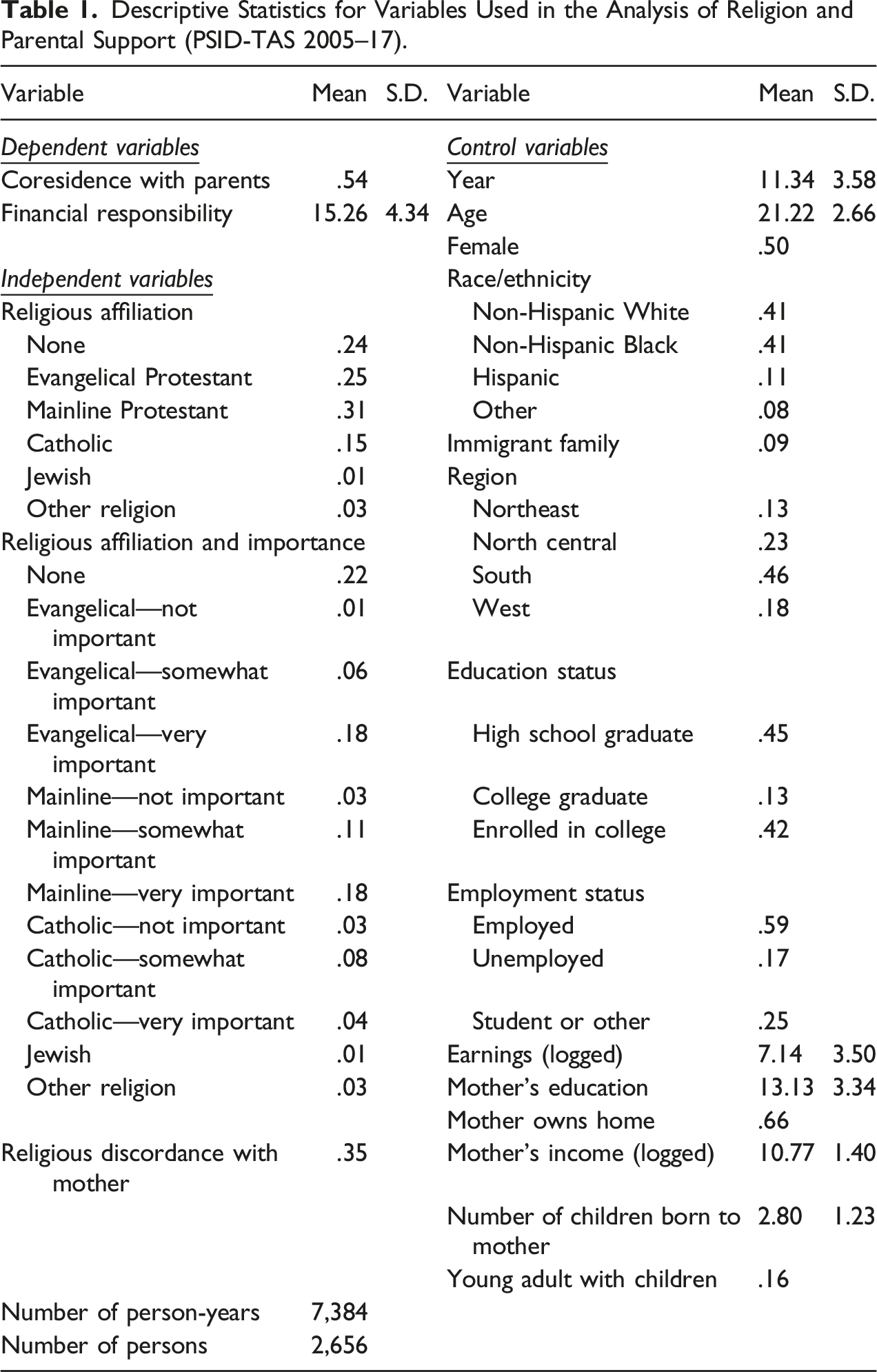
Regarding religious affiliation, 24% of the young adults in this sample were nonreligious, 25% evangelical Protestant, 31% mainline Protestant, 15% Catholic, 1% Jewish, and 3% affiliated with other religions. The majority of evangelical Protestants perceived religion as very important to them (18% of the 25%). Similarly, the majority of mainline Protestants thought religion was very important (18% of the 31%). Less than one third of Catholics thought religion was very important (4% of the 15%). In terms of religious concordance, 65% of young adults were affiliated with the same religion as their mother, and 35% were affiliated with a different religion than their mother.
On average, the respondents were 21.2 years old when observed, and half were female. The sample contained 41% non-Hispanic Whites, 41% non-Hispanic Blacks, 11% Hispanics, and 8% respondents of another race/ethnicity. Additionally, 9% of the young adults belonged to an immigrant family. The respondents lived in all four regions of the United States. Among the young adults, 45% were not enrolled in college or high school, 13% were college graduates, and 42% were enrolled in college. Most (59%) of the young adults were employed; 17% were unemployed; and 25% were students, disabled, on leave from work, or in some other circumstances. The mean of the young adults’ logged earnings from work in the previous calendar year is 7.14 (equivalent to $1,261). About 16% of young adults had children.
We also measured the demographic and socioeconomic characteristics of the mothers of these young adults. On average, the mothers had received about 13 years of education, 66% owned their homes, and the average of their logged family income from the previous calendar year was 10.77 ($47,572). The average number of children born to each mother was 2.8.
Regression Models of Young Adults’ Coresidence with Parents and Financial Responsibility.
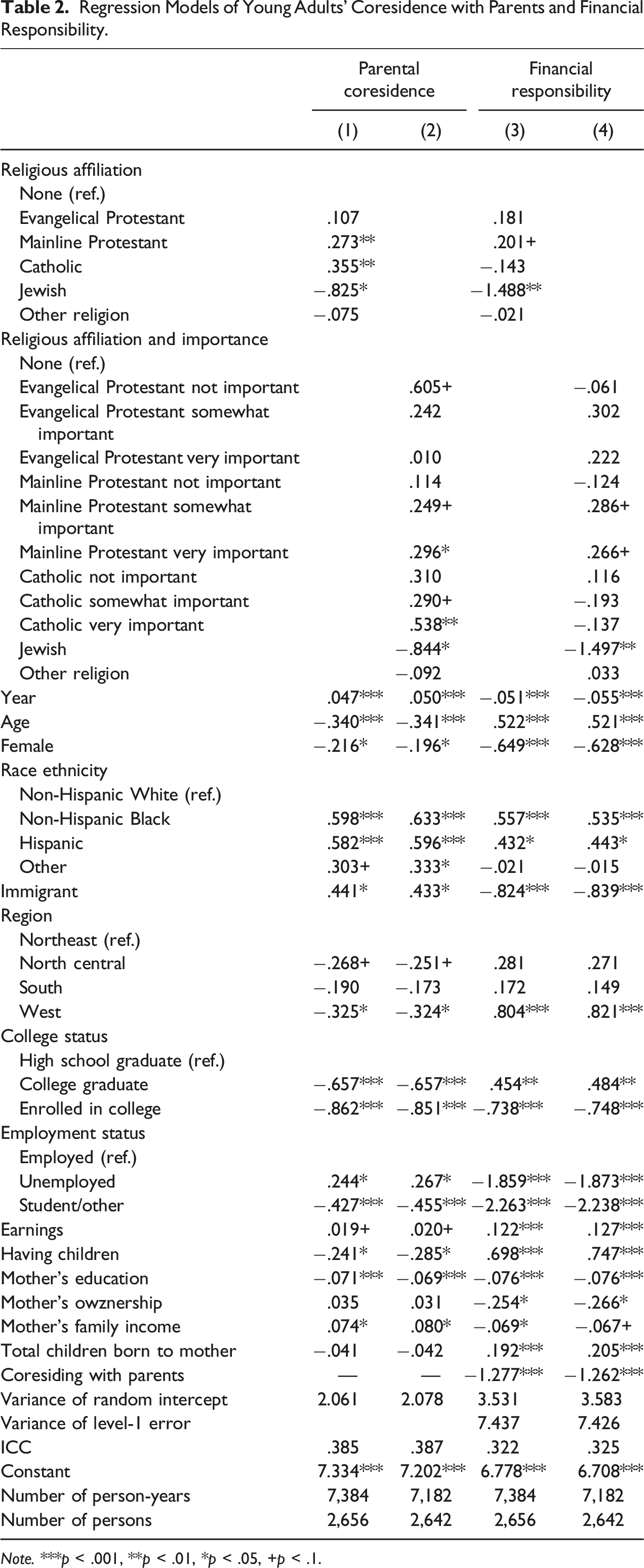
Note. ***p < .001, **p < .01, *p < .05, +p < .1.
Model 2 further examined the role of religious importance in shaping young adults’ odds of living with their parents. For Mainline Protestants and Catholics, the more important the respondents considered their religion, the more likely they were to live in the parental home. Youth who placed a greater importance on their religion were more likely to adhere to religious teachings and norms, thus less motivated to establish independent living before marriage and more willing to maintain family ties by staying in parents’ home. However, positive gradients in the likelihood of parental coresidence by religious importance were not observed among evangelical Protestant youth.
In the models predicting parental coresidence, the effects of control variables were also worth noting. In terms of demographic characteristics, older, female, White, and non-immigrant young adults were less likely to live in their parents’ home than their counterparts. Young adults in the Western region were less likely than youth in the Northeast region to live in parental homes, probably due to the high housing costs in the Northeast. Young adults’ activity status was also important. While attending or being graduated from college were associated with a lower likelihood of parental coresidence, unemployment increased the odds of living in parents’ home. Having children also made young adults less likely to live with their parents. Parents’ socioeconomic status had complicated impacts on young adults’ living arrangement. While mother’s education negatively predicted the odds of living with parents, mother’s family income was positively associated with parental coresidence, probably because the amenities in wealthy homes were attractive to young adult children.
Models 3 and 4 in Table 2 are mixed-effect linear regression models of young adults’ financial independence. Coefficients in Model 3 showed that Jewish youth assumed fewer financial responsibilities than nonreligious youth after many demographic and socioeconomic factors were controlled for. Evangelical Protestants, mainline Protestants, Catholics and youth affiliated with other religions did not differ from nonreligious youth in their level of financial independence. Consistent with our expectation, Jewish parents provided significantly more financial support to young adult children, probably due to their culture’s emphasis on obtaining higher levels of education and career success (Horwitz et al., 2022).
Model 4 further investigated the role of religious salience in influencing the financial responsibilities of religious youth. Mainline Protestants who rated the importance of religion higher tended to have a higher level of financial independence than those who rated the importance of religion lower. Our supplementary analysis showed that the increased financial responsibility among mainline Protestant youth was concentrated among older youth (aged 24–28) rather than younger youth (aged 18–23), probably due to mainline Protestant denominations’ emphasis on individual responsibilities especially for those in their late 20s. For mainline Protestant youth, parents’ support came in the form of coresidence rather than financial transfers. Again, Jewish youth had lower levels of financial independence than nonreligious youth did.
We also want to note some effects of the control variables. In more recent years, young adults have become less financially independent from their parents. Older, male, minority and non-immigrant youth were financially more independent than younger, female, White, and immigrant respondents were. Relative to youth in the Northeast, those living in the West assumed more financial responsibilities. It is not surprising that current students and unemployed youth assumed fewer financial responsibilities than college graduates and employed youth. Young adults with higher earnings and those with children were more financially independent. Parents’ socioeconomic status determined parents’ capability of providing economic support to children. Mother’s education, home ownership, and family income were associated with fewer financial responsibilities for young adults. Moreover, having more siblings required young adults to take on more financial responsibilities. Finally, coresidence with parents was associated with fewer financial responsibilities for young adults, suggesting the interconnectivity between residential and financial independence.
Regression Models Examining the Relationship between Religious Discordance and Young Adults’ Coresidence With Parents and Financial Responsibility.
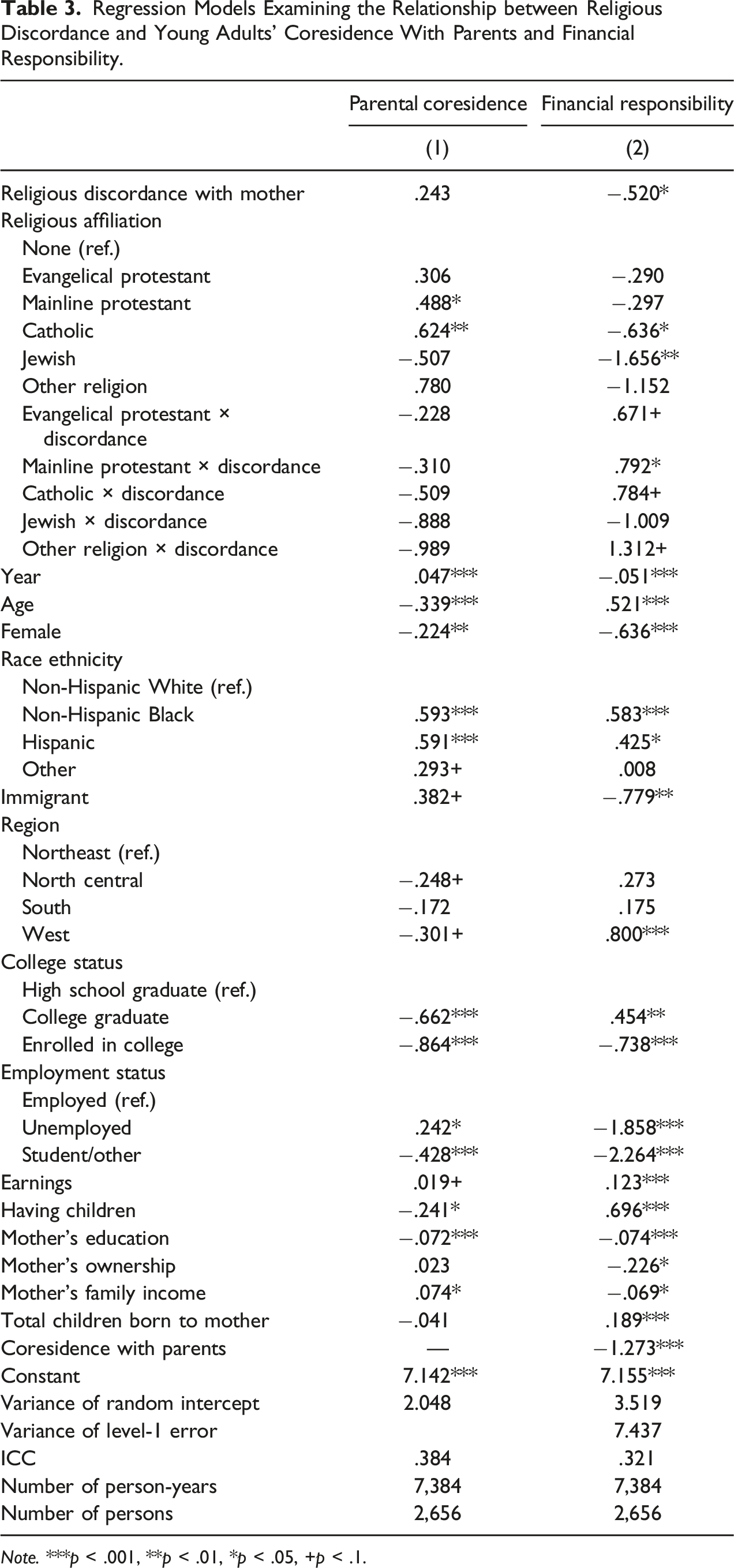
Note. ***p < .001, **p < .01, *p < .05, +p < .1.
Figure 1 presents the predicted probabilities of parental coresidence using results from Model 1 in Table 3. Religiously concordant youth affiliated with other (non-Christian) religions had the highest probability of parental coresidence (.61) among all groups, followed by concordant Catholics (.59) and mainline Protestants (.56). Concordant and discordant Jewish young adults had the lowest probabilities of living with their parents among all groups (.38 and .28, respectively). To infer whether religious disaffiliation was linked to lower rates of parental coresidence, we should compare nonreligious youth with religious mothers (discordant nonreligious youth) to concordant religious youth. Although there are some differences, for example, concordant Catholic youth had a higher probability of living with their parents than discordant nonreligious youth did (.59 vs. .52), none of the differences were statistically significant, as shown by the overlapping confidence intervals of the predicted probabilities. Thus, young adults’ religious disaffiliation was not likely to reduce parents’ willingness to house their young adult children. Predicted probabilities of parental coresidence.
Model 2 in Table 3 examined the interactive effects of religious discordance and religious affiliation on young adults’ financial independence. First, the coefficient for discordance suggests that having a religious mother reduced the financial responsibilities of nonreligious youth. Even though the youth did not identify a religious affiliation, those from religious families tended to receive more financial support from parents than those from nonreligious families. Furthermore, the main effects of Catholic (b = −.636) and Jewish (b = −1.656) young adults indicate that when their religion was concordant with their mother’s religion, Catholic and Jewish youth assumed fewer financial responsibilities than concordant nonreligious youth. (Our supplementary analysis showed that these effects were concentrated among young adults aged 18–23, indicating that supporting children’s college education was a main reason for Catholic and Jewish parents’ financial support). The negative effect of being Catholic weakened when the young adult’s religion was discordant with their mother’s faith. When young adults and their mother were religiously concordant, both evangelical and mainline Protestants were indistinguishable from nonreligious youths in their level of financial independence. (The negative coefficients for the interactions between evangelical and mainline Protestants and discordance only indicate that religiously discordant Protestants did not enjoy reduced financial responsibilities like the nonreligious youth with religious mothers did).
The relative levels of financial responsibilities can be discerned more clearly in Figure 2. Using estimates from Model 2 in Table 3, we predicted the levels of young adults’ financial responsibilities by religious affiliations and religious concordance. The concordant nonreligious youth assumed the most financial responsibilities (15.7) among all groups. Nonreligious youth who were religiously discordant (i.e., those with religious mothers) assumed fewer financial responsibilities (15.1) than the former group, suggesting that religious parents are more willing to provide financial support to children than nonreligious parents. Both concordant and discordant Jewish youth assumed fewer financial responsibilities (14.0 and 12.5, respectively) than any other group, owning to Jewish parents’ generous financial support to young adult children, supporting their education and career building. Religiously discordant Protestants and Catholics were not very different from their religiously concordant counterparts in the amount of financial responsibilities. Predicted values of financial responsibilities.
Discussion and Conclusion
Although religion is an important institution that shapes family ideology and practices, its role has been neglected in extant literature examining parental support during the transition to adulthood. This study examined how parents’ housing and financial support of young adult children are influenced by young adults’ religious affiliation, religious salience, and religious concordance with their mothers. The findings from our analysis lead to a few conclusions. First, we showed denominational differences in parents’ support of young adult children. Young adults affiliated with some Christian denominations received more support from their parents than nonreligious young adults did. Specifically, mainline Protestant and Catholic young adults were more likely than their nonreligious peers to live with their parents after we controlled for a wide array of sociodemographic characteristics of the young adults and their families. Catholics also tended to receive more financial support from their parents than nonreligious youths did if their religion was concordant with their mother’s faith. Evangelical Protestants were not different from nonreligious youth regarding parental coresidence or financial independence. Relative to their nonreligious peers, Jewish youth were less likely to live with their parents but more likely to receive financial support.
The positive association between Christianity and parental support is possibly due to the religious teaching that emphasizes parents’ responsibility to guide their children and children’s obligations to obey and respect their parents (Pearce & Axinn, 1998). Engagement in organized religious activities may cultivate strong and enduring intergenerational relationships, making parents more likely to attend to their young adult children’s needs by housing them or providing necessary economic support. Catholic youths may also have different perceptions about the normative age for becoming independent from parents and the criteria for transitioning to adulthood compared with nonreligious youths (Barry & Nelson, 2005; Smith, 2004). These differences in ideologies and beliefs may lead to Catholic and Protestant families’ distinct behaviors in supporting children during the transition to adulthood. The parental support received by evangelical Protestant youth is not distinct from those of nonreligious youth. Although evangelical Protestant denominations equally emphasize positive family relationships and the importance of assisting family members, their potential positive influence on parental support may be offset by the value they place on individual independence and responsibilities. Jewish young adults stand out as a unique group due to their low tendency to live with their parents and high parental financial support. This can be explained by the emphasis placed on education and professional success in Jewish culture. Our findings suggest that parents’ of different religious groups may support their young adult children in different ways, some by sharing their residence and others by transferring financial resources.
Second, religious salience can to some extent reinforce the denominational differences in young adults’ residential independence but not their financial independence. Our analysis showed that the positive impacts of mainline Protestant and Catholic affiliations on parental coresidence were strengthened when young adults considered religion more important. These increases in parental residence by the importance of religion were not observed among evangelical Protestants. Young adults who perceive religion as more important may be more likely to adhere to religious norms about whether and when it is necessary to live independently before marriage. Due to conservative Christianity's opposition to premarital sex and cohabitation (Pearce & Thornton, 2007), more religious Christian youth may be less motivated to pursue residential independence before marriage. Moreover, more religious Christian youth tend to place a greater value on maintaining family ties and are emotionally closer to their parents, which increases their likelihood of living in the parental home.
Third, religious concordance between young adults and their mothers strengthens the relationship between young adults’ religious affiliation and parents’ financial support. The results shown in Table 3 indicate that Catholic youth assumed fewer financial responsibilities (relative to nonreligious youths) only when their religious affiliations were concordant with their mother’s religion. For religiously discordant youths, affiliation with Catholicism was not associated with fewer financial responsibilities. Another interesting pattern is that for nonreligious youth, religious discordance with their mothers was associated with fewer financial responsibilities, which means the nonreligious young adult children received more financial support from their parents when their mother was affiliated with any religion than when she was not. Religious mothers still provide more financial support to young adult children even if their children do not identify with a religion. Thus, recent increases in religious disaffiliation and switching among young adults are not likely to reduce the amount of parental support.
Future research could benefit from addressing some of this study’s limitations. First, we focused on young adults’ religious concordance with their mothers only. Research is needed to examine how religious concordance with fathers affects parental support received by young adults. Second, future research could explore the mechanisms that account for religious differences in parental support of children during young adulthood, such as perceptions of the normative age of transition to adulthood and markers of adulthood. Unfortunately, we did not have measures of respondents’ worldviews in this regard. Moreover, previous literature has indicated that religious beliefs and behaviors are associated with better mental health and internal locus of control (Ryan & Francis, 2012). It is unclear whether these psychological processes account for religious differences in achieving independence. Finally, more research is needed to show the differences among young adults affiliated with various non-Christian religions in terms of the support they receive from parents.
This study provides new evidence that religious affiliation fosters parental support of children in young adulthood. Other factors being equal, Catholics and mainline Protestants are more likely to stay in the parental home, while Catholic and Jewish youth are more likely to receive financial support relative to nonreligious youth. The impacts of religious affiliations are strengthened by the salience of religions to young adults and their religious concordance with their mother. With parental scaffolding, these religious young adults may be better adjusted to life-course transitions and more successful in attaining adult roles than nonreligious young adults. Thus, religion as a cultural institution shapes the diverse processes of the transition to adulthood in the United States.
Footnotes
Declaration of Conflicting Interests
The author(s) declared no potential conflicts of interest with respect to the research, authorship, and/or publication of this article.
Funding
The author(s) disclosed receipt of the following financial support for the research, authorship, and/or publication of this article: This work was supported from the Gretel Weiss Graduate Student-Faculty Collaboration Grant from the Department of Sociology, Rutgers University.
