



Abstract
Child and family routines were significantly disrupted by the COVID-19 pandemic stay-at-home orders, leaving individuals isolated from school, work, and peer networks. This work examines how social support from family/friends and systems was connected to associations between parental stress and child behavior problems. Data was collected between January and March of 2021 from 195 parents of children in elementary school who were primarily in remote learning due to the pandemic. Hierarchical linear regression models indicated that younger child age and child gender were associated with parental stress in step 1; only child age remained significant when child behavior problems were added. Support from family, but not external systems, attenuated associations between child characteristics and behavior on parental stress, though child behavior problems remained consistent with parental stress even when support was present. Exploring parental stressors and investing in support networks may protect children and families from immediate and ongoing challenges.
Introduction
The stay-at-home orders brought on by the COVID-19 pandemic forced families to make significant shifts to family routines. This included forced adaptations to supporting children through online schooling (Adams et al., 2021; Peltz et al., 2021), which placed significant new stressors on parents (Adams et al., 2021; Perry et al., 2021; Wu & Xu, 2020). Stress is a key determinant of parenting practices with parental stress having impacts on the well-being of parents and children (Masarik & Conger, 2017). Social support can attenuate the challenges caused by stress, with individuals who report more support experiencing fewer consequences of stress than those with less support (Cohen & McKay, 2020). While prior work has shown that stability in home routines during COVID-19 stay-at-home orders positively influenced family well-being (Cohodes et al., 2021; Fosco et al., 2022), less is known about the ways in which social support to families attenuated parental stress experienced during a period of extended remote learning. In this work, we examine the associations of social support from family/friends and systems on the stress of parents.
Parental Stress and Social Isolation
Stress related to parenting is a psychological reaction that occurs when parents experience demands that are inconsistent with expectations (Holly et al., 2019). These can be further exacerbated when parents feel isolated. Experiences of social isolation by parents have been linked to higher rates of stress (Tucker & Rodriguez, 2014). During the COVID-19 pandemic, social isolation was identified as getting in the way of parenting (Lee et al., 2021). Common stressors reported by parents included changes to a child’s routine and demands of online schooling (Adams et al., 2021).
Schools play an important role in the development of children. School routines provide stability in child and family routines which when disrupted impact the child and the family system (Brazendale et al., 2017). Recent findings highlight that extended remote learning during the COVID-19 pandemic was a stressor for parents of school-aged children related to increased work/life balance demands, specifically remote working while also supporting remote schooling for children (Almeida et al., 2022; Chen et al., 2022; Davis et al., 2021; Nyanamba et al., 2022). Parents also reported poorer mental health, specifically increased anxiety and depression during the stay-at-home orders (Almeida et al., 2022, Davis et al., 2021; McGoron et al., 2022). Mental distress was even higher among parents who reported having a child who struggled with remote learning (Davis et al., 2021). Increased stress during this time was also associated with feelings of burnout (Nyanamba et al., 2022). This is important given the relationship between parental burnout and parenting behaviors (Griffith, 2022; Kerr et al., 2021). Positively, parents who reported more support during the pandemic also reported less distress (McGoren et al., 2022). More research about how parental feelings of isolation impacted the family system is warranted, particularly given the isolation and stress families experienced as a result of the COVID-19 pandemic.
Child Factors Influencing Parental Stress
There are many factors that can influence parental stress. While some are extrinsic to the family system (e.g., poverty, Masarik & Conger, 2017), child factors can influence how parents feel about parenting. There is some evidence that child age and gender can contribute to parents’ feelings of stress, with more stress reported among parents of younger children and parents of boys, particularly during the COVID-19 pandemic (Giannotti et al., 2022; Jiang et al., 2022). Parents of children with difficult behaviors face additional challenges, with behaviors noted as the most significant indicator of parental stress (Jackson, 2000). These relationships, however, may be bidirectional (Jiang et al., 2022), parental reactions contributing to parental stress and children’s behaviors (Mackler et al., 2015). Lavigne et al. (2012) found a direct connection between what they call contextual stressors, such as parental and family stress, environmental stress, and SES with externalizing behaviors in children. Finally, Semke et al. (2010) found that parents who experienced more stress had less motivation to be involved with their children’s education when their children exhibited disruptive behaviors. This challenge may have been exacerbated by the COVID-19 stay-at-home orders. In fact, school closures (Chen et al., 2022) and online school demands (Adams et al., 2021) were found to contribute to parental stress. Exploring child factors as drivers of parenting stress therefore provides an opportunity to identify domains to target during family interventions.
Social Support
Social supports are defined as the people and systems in an individual’s life that provide them with care, network, and reliably add value to someone’s life (Zimet et al., 1988). Thoits (2011) found that individuals with higher levels of social support reported lower stress and overall improved wellness. Personal and social support may mitigate parenting stress (Gallagher et al., 2010; Lakey & Orehek, 2011). Parents interact with a variety of settings such as schools, community centers, pediatricians, and their own workplace. They also interact with partners, co-parents, and extended family. Each of these systems provides the opportunity for a parent to either feel supported or may cause an increase in parental stress. During the COVID-19 pandemic, greater support was found to be associated with lower perceived stress (Brown et al., 2020; Chen et al., 2022) and greater psychological well-being (Chen et al., 2022) of parents.
Support From Partners and Extended Family
The quality of family relationships can have an impact on an individual’s overall well-being (Thomas et al., 2017). Positive extended family support can influence mental health, specifically reducing symptoms of depression in adults (Taylor et al., 2015). When parents feel supported in their romantic relationships, there is a positive impact on the parent’s stress level (Choi et al., 2019; Ponnet et al., 2013) and their children’s behavior (Camisasca et al., 2019). Parents with more instability in their relationships report higher levels of parenting stress (Halpern-Meeky & Turney, 2016).
Support From External Systems
Children spend most of their day in school. During the COVID-19 crisis, relationships between elementary school parents and schools may have become even more tenuous as children’s learning needs were required to be met at home. Garbe et al. (2020) found that, though parents largely agreed with the stay-at-home orders, they reported feeling overwhelmed with the educational needs of their children during remote learning and that most parents spent between one and two hours a day helping their children with their schoolwork. Community and neighborhood connections also provide important informal support to parents. With increased social capital through community networks, parents have opportunities to seek help from others and feel connected (Ferguson et al., 2016). Informal networks and community-based support are seen to increase adults’ well-being (Giordano et al., 2013) and for parents, reduce stress and increase parental wellness (Owen & Anderson, 2017; Strange et al., 2016). While schools and other community supports are known to reduce the stressors of parents, there is a scarcity of research investigating if social support received during the COVID-19 pandemic influenced the well-being of parents.
Summary
Parents of elementary school students may experience multiple stressors. Understanding the role of external and familial supports can help parents increase their family resilience. Parents interact with a variety of settings and may feel supported in these interactions. Parents with children who exhibit challenging behaviors may experience increased isolation and stress. Parents’ feelings of support could be associated with their perceptions of their children’s behaviors and overall stress. This study aims to identify relationships among parents’ stress during the COVID-19 pandemic, their perceptions of their children’s behaviors, and their perceived support.
Methods
Participants for this study were a convenience sample of parents of elementary-aged students. Recruitment was online only due to pandemic stay-at-home orders, and the surveys were administered online as well. In order to capture the most diverse sample possible, participants were recruited through local schools (from varied districts) and organizations in the Los Angeles metropolitan area, as well as online resources (such as social media, parent groups, and Listserv for schools’ parent groups) from January to March of 2021. To be eligible, parents had to be over the age of 18 and have a child between the ages of 5 and 11. Included in the online survey were a brief description and a consent form. The average time for completion was 31 minutes. Participants were also given the option to enter a raffle for a $50 Amazon gift card as an incentive for completing the survey. The sponsoring university’s Institutional Review Board approved all protocols.
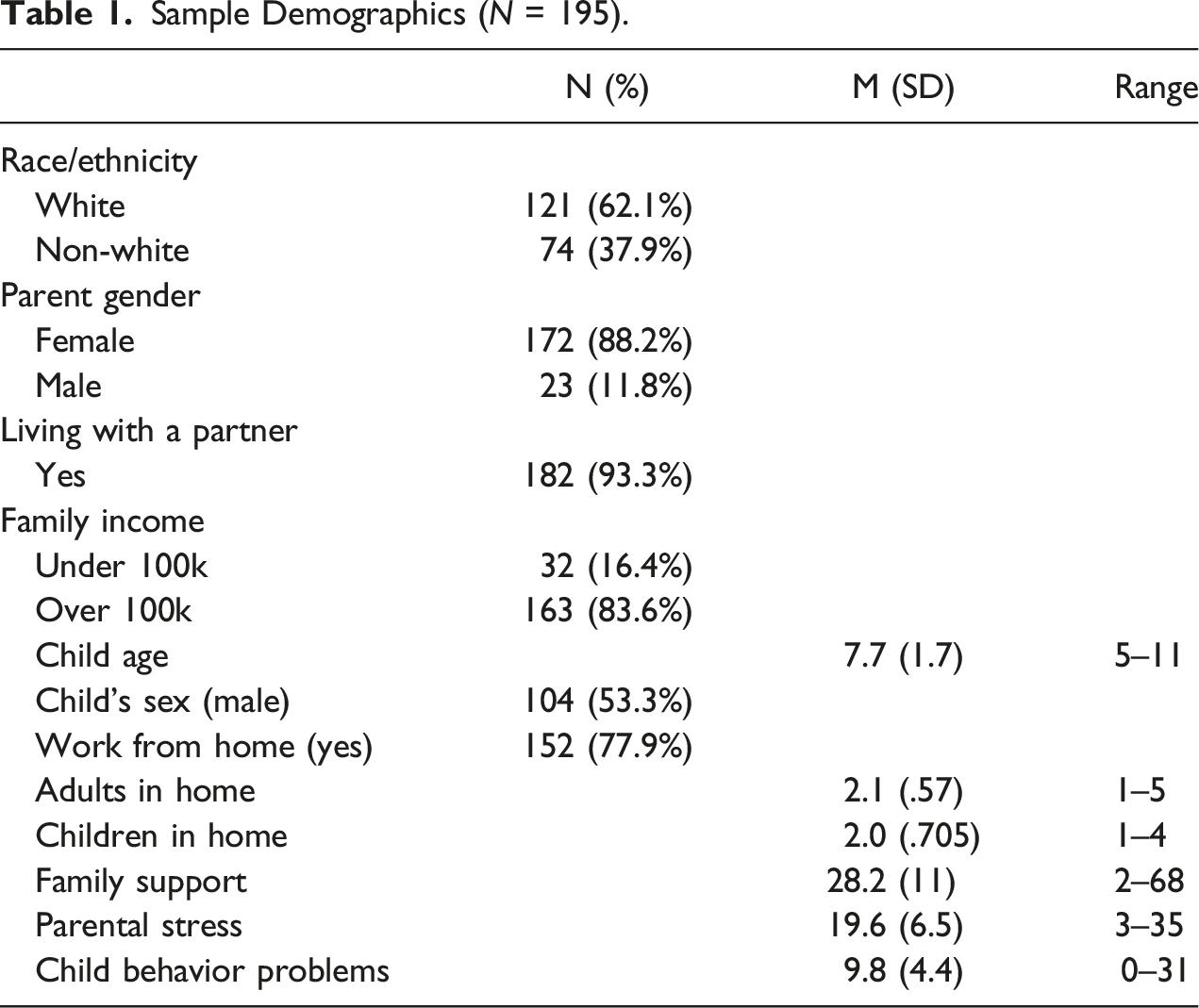
Sample Demographics (N = 195).
Measures
Parental Stress
Parental stress was measured, using the 10-item version of the Perceived Stress Scale (PSS-10)(Cohen & Williamson, 1988). Participants were asked to reflect on the past month and then answer Likert-type questions about their feelings of stress during that time ranging from “0-Never” to “4-Very Often.” Four items were reverse coded, with higher scores representing higher stress. Sample questions from the scale are, “In the last month, how often have you been upset because of something that happened unexpectedly?” and “In the last month, how often have you been able to control irritations in your life?” (Cohen & Williamson, 1988). The PSS-10 has good internal reliability (Cohen & Williamson, 1988); for this study, the PSS had a reliability score of α = .89.
Parental Perceived Support
To measure perceived support from various systems, the 18-item Family Support Scale (FSS) was used (Dunst et al., 1984). Participants were asked to consider various sources of support such as “your spouse,” “your parents,” “your co-workers,” or “school/daycare center” (Dunst et al., 1984). They completed a Likert-style scale that ranged from “0-Not Available” to “5-Extremely Helpful” about each item in the list with higher scores representing higher perceived support. This scale has been found to have good internal reliability (Dunst et al., 1984). The internal reliability score for this scale based on this study was α = .89.
Children’s Behaviors
To measure parents’ perceptions of their children’s behaviors (externalizing, internalizing, and inattentive behaviors), The Brief Problem Monitor (BPM) was utilized. Parents were asked to reflect on their child’s behavior over the past month and answer 19 Likert-style questions from “0-Not True” to “2-Very True” with higher scores indicating more serious behavioral concerns. Sample behaviors were “Argues a lot,” “Can’t sit still, restless, or hyperactive,” or “worries.” The BPM has test–retest reliability across all subscales with an overall alpha of .85 (Achenbach et al., 2011). For this study, the reliability score was α = .90.
Covariates
Covariates include parent gender, race (white vs. non-white), child’s age, child gender, and whether the parent left the house for work. Due to the sample size in response categories, race/ethnicity was transformed into binary outcomes (white vs. non-white).
Statistical Analysis
Hierarchical regressions were conducted in three stages to examine the factors that were associated with parental stress. The first stage examined the association between the sociodemographic variables (race, child age, child gender, parents’ gender, and work from home) and parental stress. In the second stage child behavior was added, controlling for sociodemographic factors. The final stage included parental stress, controlling for sociodemographic factors and child behavior problems. OLS regression was estimated for parental sense of competence. As suggested by Cohen et al. (2013), variables were estimated concurrently in subsequent stages. SPSS version 28.0 was used for the analysis.
Results
Descriptive statistics for the variables and sample demographics are shown in Table 1. More than half of the parents were white (62.1%), and the majority were female (88.2%). More than two-thirds of parents worked from home (77.9%), and the majority reported an annual household income of over $100,000. Most participants indicated being in a relationship and living with their partner (93. 3%). The mean age of the target child was 7.7 years old (SD 1.7 years) with just over half of children sex reported a male. The average number of adults in the home was 2, and the average number of kids in the home was 2 (see Table 1).
We found bivariate associations between perceived stress and child behavior problems (B = −.478, p < .001), social support (B = −.295, p < .001), child gender (B = −.171, p < .05), child age (B = −.204, p < .01), race (B = −.200, p < .01), and working from home (B = .179, p <. 05). Social support was also associated with child gender (B = −.183, p < .05) and race (B = −.174, p < .05).
Hierarchical Ordinary Least Squares (OLS) Regression for Parental Stress.

*p < .05, ** p <.01, *** p < .001
Hierarchical Ordinary Least Squares (OLS) Regression for Parental Stress by Support Types.

*p < .05, ** p <.01, *** p < .001
Discussion
The COVID-19 pandemic created exceptional strain on all people but created unique challenges for individuals parenting minor children. The increased time parenting, parenting while also working remotely, and scaffolding academic needs of children, all while mitigating COVID exposure contributed to this distinctive experience (Adams et al., 2021; Chen et al., 2022; Cohodes et al., 2021; Fosco et al., 2022). In this work, we extend the current literature base on parenting during COVID by exploring the influence of child behavior problems on parental stress and the association between social support from family and those outside the family network and parental stress. Our findings contribute to our understanding of the relationship between child behavior problems and parenting and provide important insights into the relevance of family support specifically in strengthening family systems, particularly during times of heightened distress.
There were a number of demographic variables that were consistently associated with parental stress. While there was no association with parent gender, and limited associated with child gender, race/ethnicity and child age were fairly consistent in their association with parental stress. While we found a correlation between child gender and child behavior problems at the bivariate level, these did not hold in the hierarchical linear regression models. Our findings on child gender are supported by an extensive systematic review which found no support for child sex as a predictor of parental stress (Fang et al., 2022). Our findings do diverge from at least one study of parental stress during COVID in Italy which showed that having a male child was associated with reporting increased stress during the COVID-19 pandemic (Giannotti et al., 2022).
However, like Gianotti and colleagues (2021), we found a strong association between child age and parental stress, with parents of younger children reporting more stress than those with older school-age children. It may be that child age masked the potential relationship between gender and parental stress, or that age was a more significant driver of parental stress. This may be associated with independence; younger children may have needed more academic, technological, and recreational support during the pandemic, whereas older children had more ability to be self-regulating around schoolwork and leisure time. Though this aligns with previous research, this study emphasized children in elementary school specifically, which highlights the vast developmental changes that happen between kindergarten and fifth grade. What the findings suggest is that families with younger children may be particularly vulnerable to external stressors and that practitioners working with young families want to be particularly attentive to age and developmental stage of children, and work with parents to understand and be ready for demanding and shifting developmental needs of children over the lifecourse.
We found that child behavior problems were strongly and positively associated with greater reports of parental stress, even when support was present. Child behavior problems, particularly externalizing and internalizing behaviors, have been found in prior work to increase parenting stress (see meta-analysis; Barroso et al., 2018). Work conducted with parents during the COVID-19 pandemic suggests that quarantine increased both parental stress and child behavior problems, suggesting this external stressor had both unique and inter-related impacts on parents and children (Spinelli et al., 2020). Challenges balancing work commitments and parenting may have contributed to these outcomes. Parents were found to use more screen time, with more parental involvement associated with less use of screen time and greater stress predicting screen time (Seguin et al., 2021). This is relevant because screen time is associated with both internalizing and externalizing behaviors both directly (Twenge & Campbell, 2018) and indirectly (via lack of sleep; Lissak, 2018). Because our data were cross-sectional, we are not able to determine the directionality of the relationship between child behavior problems and parental stress, though the literature suggests that often this relationship is bi-directional (Mackler et al., 2015). As such, further work using a longitudinal design is needed to identify intervention points to reducing problem behaviors in children and parental stress.
Social support is an important factor in promoting positive well-being among children and parents. Like prior work (Chen et al., 2022), we found that greater reported social support was highly associated with lower reported stress. While prior work of parenting experiences during the COVID-19 pandemic highlighted the relationship between types of support (instrumental and emotional) on parenting stress (Chen et al., 2022), we examined from where support was received to provide better guidance to clinicians as to how to best help families build support networks. In our work, support from family appeared to drive that positive association between reported support and reduced parental stress. In fact, we found no association between support outside of the family system and parental stress. This may be because of the disconnect parents reported feeling from primary systems (like schools) during the COVID-19 pandemic. During the COVID-19 crisis, relationships between elementary school parents and schools may have become even more tenuous as children’s learning needs have been required to be met at home and disparities that were exacerbated by consistent remote access and ability to support student learning at home (Domina et al., 2021; Sonnenschein & Stites, 2021). Garbe et al. (2020) found that parents' feelings of overwhelm about their children's educational needs influenced their feelings of stress during remote learning. These findings suggest the need to help parents strengthen family networks or build family-like network (strong interconnectivity and mutuality of support), to decrease stress experienced by parents, particularly during times of extreme stress.
Limitations
While our findings provide important insights into parenting challenges during the COVID-19 pandemic, a limitation of cross-sectional data is that we are unable to determine temporal order between variables. The behaviors of children were based on parents’ reports and not direct observation. Further, our sample is from one region of the Unites States that had particularly restrictive COVID policies; at the time this work was conducted, stay-at-home orders/remote schooling had been in place for 10 months. Because of this, parental stress may have been higher in this sample than among U.S. parents overall during the COVID-19 pandemic. Further, data was gathered during a period of political unrest (Insurrection at the U.S. Capitol) and ongoing racial unrest which may have further exacerbated parental stress. Finally, the majority of the sample (60%) reported an annual income of more than $100,000. As such, our findings cannot be generalized to parents with lower family income who may have experienced stress and child behavior problems differently.
Implications
During COVID-19 stay-at-home orders, parents of school-aged children experienced unique stressors which have had a lasting impact on children and families (National Academy of Science, Engineering, and Medicine [NASEM], 2023). Children routines were destabilized as they were disconnected from their school settings, peers, and programs (i.e., after school programs and sports) that positively impact their well-being. Findings in this study provide evidence for the challenges that arose during the prolonged period of remote schools which has implications for research and can guide clinical practice. Recommendations for further research include multiple methods of inquiry, including qualitative methods that can help us better understand the relationship between child behavior problems and parental stress, including the role of support from families and external sources. Further work is needed to provide a deeper understanding of these relationships to support clinicians in creating conditions that strengthen family support and reduce or alleviate parental stress. Specifically, how to meet the continuing needs of parents through direct practice and evaluating how parents experience support from service providers.
Parental stress can impact many elements of family functioning and the overall wellness of parents (Masarik & Conger, 2017). As such, parental stress should be considered in the treatment of children, particularly when children present with externalizing, internalizing, or inattentive behaviors. When parents are stressed, they are more irritable and have more difficulty parenting. Because of the trickle-down effect of parental stress on children’s behavior via parenting behaviors (Masarik & Conger, 2017), understanding and treating a parent’s stress has the potential to positively influence the behaviors of the child. Based on our findings, practitioners who treat elementary school-aged children should consider an assessment of pandemic-related stressors (immediate and continued) and identify ways to support parents in reducing these stressors.
Cognitive Behavioral Family Therapy (CBFT) highlights the connections between family interactions and core beliefs (Schwebel & Fine, 1992). Utilizing this approach, a practitioner could help a parent understand that by working to reduce their own stress levels, they may observe and respond to their children’s’ behaviors differently. This could be done by encouraging a parent to prioritize their own stress-reduction techniques. A Cognitive Behavioral approach would help understand connections between a parent’s feelings of stress and their perceptions of their children’s behaviors. Reduction in parental stress may have an impact on the parent’s ability to address their child’s behaviors (Ward & Lee, 2020). As noted in the NASEM report (2023), addressing the direct and indirect effects of the pandemic on parents and children is critical. Based on findings in this study, this will include the identification and use of support networks.
Understanding the connection between familial and external supports and parental stress gives us information about how parents understand and feel our support as practitioners. Although systems who work with children often outreach and attempt to build rapport with parents, our study revealed that parents felt more supported by familial systems. Our study revealed that service providers should not undervalue familial support. If these do not exist, building support networks should be a targeted goal. These may include strengthening of social networks such as religious institutions, neighborhood supports, and community networks.
Though many parents and children are no longer experiencing immediacy stress related to COVID-19, there is clear evidence that without intervention, stressors experienced during the COVID-19 pandemic took a substantial toll on the well-being of children and adults (NASEM, 2023). This study highlights how parents may need support during other periods of heightened stress, such as illness, poverty, and racism-related stress. Interventions that help families process pandemic experiences can provide parents and children with tools to navigate future stressors with less significant disruption. With skills to manage distress and the intentional building (or maintaining) of support networks that can provide parents and children with emotional and tangible support will support the well-being of family systems and potentially mitigate challenging lifecourse trajectories.
Footnotes
Declaration of Conflicting Interests
The author(s) declared no potential conflicts of interest with respect to the research, authorship, and/or publication of this article.
Funding
The author(s) received no financial support for the research, authorship, and/or publication of this article.

Appendix
Correlations of analysis variables
1
2
3
4
5
6
7
1. Perceived Stress
2. Child behavior problem
.478***
3. Social support
–.295***
–.124
4. Parents gender
–.104
–.013
–.07
5. Childs gender
–.171*
–.183*
.118
–.021
6. Child age
–.204**
–.070
.066
–.045
.149
7. Race
–.200**
–.174*
.068
–.024
–.061
.034
8. Work from home
.179*
.101
.025
–.151*
0.049
0.017
–.068