



Abstract
For families with an early history of parental abuse and neglect (EHPAN), personal and situational stressors can increase relational vulnerabilities. We examined relationship dynamics between midlife adults with EHPAN and their parents during the first year of the COVID-19 pandemic. Analysis of semi-structured qualitative interviews with 31 participants (aged 44–50), examined patterns of contact and support to provide insights into relationship dynamics and relational changes experienced during the pandemic. Three relational themes characterized midlife adult child-parent relationships during COVID-19: tightening ties with parents while taking few COVID-19 precautions; keeping customary ties to maintain the status quo centered around instrumental support; loosening ties in which the relationship drifted. We found areas of resilience and vulnerabilities within each type of relationship. Recognizing that past adversity continues to shape relationship dynamics throughout the life course underscores the need for further research to identify factors that contribute to long-term family resilience and challenges.
Introduction
Research on families with an early history of parental abuse and neglect (EHPAN, i.e., parent was abusive/neglectful in early childhood) suggests the aftermath of abuse and neglect (whether physical or emotional) during childhood continues to influence family relationships throughout adulthood. In a study of midlife and latelife adults, a higher frequency of childhood emotional abuse was associated with diminished family closeness, particularly for women (Savla et al., 2013). Similarly, a study of families with EHPAN found less cohesive relationships between adult children and their mothers, but not between adult children and their fathers (Kong, 2018). With respect to the provision of emotional support by persons in midlife, childhood maltreatment was associated with lower perceived availability to provide emotional support to family members (Fitzgerald & Morgan, 2023) and less emotional support given to their family (Fitzgerald et al., 2020). Similarly, Kong and Moorman (2015) found that adults maltreated by their mothers in childhood provided less frequent emotional support to their mothers in adulthood; however, maltreatment was not associated with the provision of instrumental support. Collectively, the above investigations highlight that early maltreatment influences contemporary family relations well into late life. Continued inquiry is needed to identify nuances within these relationships, particularly when they are faced with challenges outside of their control. Guided by life course theory and utilizing data from an ongoing investigation of the correlates and consequences of child maltreatment (Herrenkohl et al., 2021a, 2021b), the purpose of the current investigation was to explore the dynamics of adult child-parent relationships (e.g., interactions, processes, support) in families with EHPAN to understand midlife adults’ perspectives of the impact of COVID-19 on their relationship with their parents.
Adult Children-Parents Ties
We focus on the ties between adult children and parents because these longstanding relationships are central to family life. Research shows considerable solidarity between adult children and their parents, including frequent contact, common activities, positive sentiments, shared values, exchange of assistance and resources, and commitment to familial roles and obligations (Silverstein & Bengtson, 1997). The type, frequency, and amount of contact and support provided or received between adult children and their parents vary and depend on geographic proximity, availability, current needs and abilities, and familial and cultural norms (Fingerman et al., 2020). However, adult child-parent relationships are not without tensions and conflicts. Both members of the dyad express feelings of ambivalence within their relationship (Pillemer et al., 2012; von Humboldt et al., 2021), perhaps stemming from increasing parental care needs (Pine & Steffen, 2019) and the emotional complexities that characterize family ties (Suitor et al., 2014). Research specific to how adult child-parent relationships play out in aging families with EPHAN is limited (Herrenkohl et al., 2022; Pillemer et al., 2012; Savla et al., 2013; Silverstein & Bengtson, 1997).
Adult Children-Parent Relationships During COVID-19
During the first year of the COVID-19 pandemic, policies and procedures put in place to combat the spread of COVID-19 (e.g., distancing) disrupted family life and relationships. Public health efforts placed many stressors on families that potentially amplified existing relationship vulnerabilities or bolstered relationship resilience. To our knowledge, COVID-19 research has not focused on relationships between parents and midlife adult children with an EHPAN.
Other than research on adult children actively engaged in the care of parents with physical and cognitive impairments, parent-adult child relationships during the pandemic have received little attention. A study of 438 adult daughters during the first wave of COVID-19 in Israel found that when daughters worried about their mothers dying or had higher perceived ambivalence about their mother-daughter relationship, they experienced more emotional distress (Segel-Karpas & Ayalon, 2022). In their examination of 70 adult child-parent dyads in China, Jiang and Fung (2022) found that during COVID-19 shutdowns, the daily exchange of support was positively associated with well-being. When adult children and mothers received more support, they increased their support to each other. Furthermore, adult children reported more positive (and less negative) affect on the days when their mothers provided them more support. A qualitative analysis of U.S. parents’ perceptions of their relationship with their adult children during the pandemic found that although older parents spent less in-person time with their adult children, they perceived little or no changes in the quality of their relationship (Vaterlaus et al., 2021). Instead of spending time in-person, parents reported that they checked in with one another more frequently. Conversely, a study of adult children’s perceptions of family roles changes during COVID-19 revealed a shift in roles as adult children tried to meet their parents’ emotional needs (e.g., consoling parent), often without receiving support in return, and instrumental needs by taking on practical tasks such as grocery shopping (Hernandez & Colaner, 2022). Assuming more of a parental role, they employed a variety of strategies to persuade their parents to adhere to public health recommendations for self- and community care. A Turkish study affirmed the importance of communication within families during the pandemic (Geçer & Yildirim, 2023). Adults reporting more positive family communication made greater use of approach coping, which led to better psychological health in the face of adversity surrounding the pandemic.
Life Course Perspective
Life course theory offers important insights into the ways in which family histories interact with personal and environmental influences to shape long-standing relationships (Elder, 1977). Linked lives is a central feature of the life course perspective; it emphasizes relational interconnectedness. Children’s lives are embedded within and influenced by their relationships with others, most notably their parents. In addition, the life course perspective posits that there are transitions and trajectories in individual development and relational ties. Transitions are events or a series of events marking a change in one’s relationship (Elder, 1985); trajectories are the culmination of transition events resulting in long-term patterns of (in)stability.
In the context of parent-child relationships, there is a normative support trajectory that includes a dependence on parents in childhood that shifts to more independent or interdependent relationships in adulthood. For example, while parents and children may provide one another emotional support, older parents with a decline in physical and cognitive functioning may begin to rely on their adult children for assistance. When these normative pathways include additional stressors (e.g., greater parent-support demands on adult children), it can result in ambivalent and sometimes negative feelings about the parent-child relationship (Pillemer et al., 2019), particularly if their relationship is already compromised by EHPAN (Kong & Moorman, 2015).
We conceptualized EHPAN as a major life event that impacts relationship trajectories (Greenfield, 2010). EPHAN has long term and varying consequences on health and interpersonal relationships across the life course. For example, college students with EPHAN were more likely to report negative internalized self-image (i.e., feeling worthless) and report viewing others as threatening and harmful (Wright et al., 2009). Poon and Knight (2011) found adults aged 60 and older with EPHAN reported poorer sleep quality, mediated by whether they had a good or poor relationship with their parent. Others reported that abuse during childhood resulted in less cohesive relationships between adult children and their mothers (Kong, 2018) and predicted lower levels of emotional closeness to family in midlife and late life, particularly for individuals with lower levels of self-acceptance (Savla et al., 2013).
Furthermore, we draw upon the life course concept of period effects to situate intergenerational relationships in the context of the COVID-19 by examining midlife adults with an EHPAN interactions with their parents during this historical event (Bengtson & Allen, 1993). That is, we conceptualize COVID-19 as a critical event or possible “disruptive transition” that could serve as a catalyst for changes (Reiss & Oliveri, 1980) in adult child-parent relationships. Adults with EPHAN have shown a reduced sense of self-efficacy in their ability to handle or adapt to stressful situations (Poon & Knight, 2011). Focusing on these potentially at-risk midlife adult child-parent relationships will shed new light on microlevel familial processes within the context of a macrolevel societal disruption (e.g., COVID-19) (Fingerman et al., 2020). That is, this study examined COVID-19 as a possible transition event in the life course trajectory of midlife adult children’s relationships with their parents (Settersten et al., 2020).
The purpose of this study was to examine relationships between midlife adults with EHPAN and their parents during the first year of the COVID-19 pandemic. Specifically, we sought to understand how social distancing and other pandemic-related precautions affected their relationships.
Method
Participants
Participants in this study come from the Lehigh Longitudinal Study (see Herrenkohl et al., 2021a, 2022b; a study that originated in the 1970s when adult child participants were preschoolers. Over a 2-year period, two county child welfare agencies referred the study to all new and some ongoing cases in which there was at least one abused or neglected child 18 months to 6 years of age in the home. Families were also recruited from community programs in which the children from the child welfare agencies participated (e.g., day care, Head Start). The final sample included 457 children (248 males and 209 females). The identity of the parent (i.e., mother, father) who was the alleged perpetrator of the early abuse/neglect was not specified in the dataset. T. I. Herrenkohl was a member of the original team of investigators and the lead investigator for each proceeding wave of data collection. K. A. Roberto and L. Fedina joined the project leadership team as co-investigators for the development of the fifth wave of the project and the current study.
The current study sample was selected from 303 participants who completed the fifth wave of data collection and reported they had in-person contact with at least one parent in 2019–2020 [Blinded]. This sample was majority female (53%), White (84%), and middle-aged (M age = 46). Participants who met the study inclusion criteria (i.e., in-person contact with a parent) were mailed a letter informing them of the study and requesting their participation. We recruited participants to take part in a semi-structured, qualitative telephone interview regarding relational and individual experiences during the COVID-19 pandemic. Once we completed 43 interviews with midlife adult children with a documented history of child welfare involvement, we determined the breadth and depth of data saturation was met and ended recruitment (Fusch & Ness, 2015; Saunders et al., 2018). Of the 43 cases, we excluded 12 additional cases from analysis because interview data revealed both parents were deceased (n = 7), no contact with a living parent (n = 2), parental relationship not discussed (n = 1), and data quality issues (e.g., incomplete answers, inaudible content; n = 2).
Participant Characteristics.
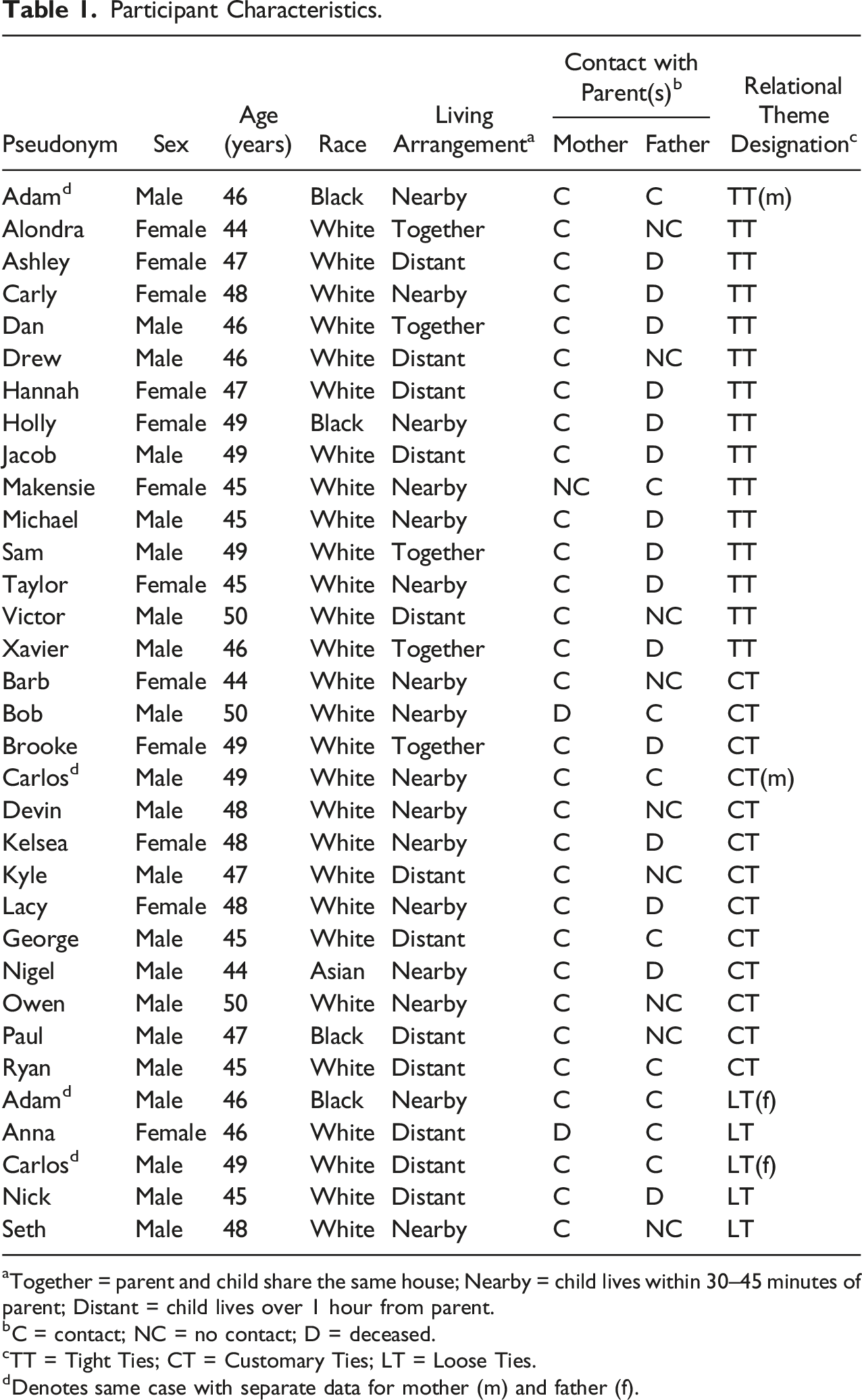
aTogether = parent and child share the same house; Nearby = child lives within 30–45 minutes of parent; Distant = child lives over 1 hour from parent.
bC = contact; NC = no contact; D = deceased.
cTT = Tight Ties; CT = Customary Ties; LT = Loose Ties.
dDenotes same case with separate data for mother (m) and father (f).
Procedure
The project interviewer, who served as one of the interviewers for a previous wave of the Lehigh study, contacted the potential participants to answer questions about the study and obtain their verbal informed consent. They had previously interviewed some of the current study participants. Interviews were conducted between December 2020 and May 2021 and took approximately 30 minutes to complete. We framed all interview questions within the context of the pandemic. Examples of the stem for the semi-structured questions included: (1) How did shelter-in-place affect your relationship with your [parent]? (2) How would you describe your interactions with your [parent] since social distancing began? (3) In what ways is your relationship with your [parent] now, since the pandemic began, most satisfying [challenging] for you? (4) What types of support and care are you currently providing [receiving from] your [parent]? (5) What would you like us to know about you and your [parent’s] relationship that we have not asked you about? The interviewer used prompts to help participants reflect on their relationship and to elicit illustrative examples. Participants received $50 for their participation. Interviews were audio-recorded and transcribed verbatim prior to coding and analysis, and pseudonyms were assigned to maintain confidentiality. The Institutional Review Board at Lehigh University, the University of Washington, and the University of Michigan approved the study.
Data Analysis
Data analysis was iterative and involved all authors in distinct roles throughout the coding, analytical, and interpretive process. Immediately following data collection, the research team conducted a preliminary review of the transcripts, guided by core concepts (e.g., stress, resilience, relationship dynamics). One shared observation emerged: participants could be grouped by how they discussed their relationship with their parents (Rosenblatt & Wieling, 2018). Team members then independently generated emergent coding ideas and developed a preliminary codebook including possible codes and content areas, case numbers, coder initials, and notable quotes (Rosenblatt & Wieling, 2018). Next, the team decided to “bound the view” (Guest et al., 2012a) of core concepts into separate analytical topics. E. C. Potter and K. A. Roberto took the lead for the current analysis.
Open Coding
We coded in Microsoft Word and created Excel tables to keep track of the coding process and identify discrepancies. We conducted line-by-line open-coding in which we broke apart words, phrases, or sentences into segments of code (Corbin & Strauss, 2008). Each code was given a unique label or identifier (e.g., “obligatory,” “emotional check-in,” “parent visits”). In building a new codebook, we confirmed or refined preliminary codes and discussed newly created codes with team members. The final codebook consisted of 105 open-codes with total consensus between the lead analysts after deliberation.
Focused Coding
Axial coding methodology (Simmons, 2017) informed our focused coding. Specifically, we (a) examined the data to identify the ways in which codes could be categorized in the context of a single phenomenon (relationships in the context of COVID-19); (b) identified the most important and central codes that we deemed worthy of being its own category; and (c) created categories from existing codes (e.g., open code “emotional support” became its own category) or from several different codes (e.g., context category generated from open codes “living arrangement,” “distance,” and “relationship history”). In addition, we drew connections across open codes and collapsed categories with overlap. The final focused coding resulted in 10 categories and 51 subcategories, which informed the relational themes.
Throughout the coding process, we relied on several techniques to ensure credibility and trustworthiness. We tracked which codes and categories appeared most frequently and we utilized constant comparison to draw more refined insights across categories. We also used bracketing (Tufford & Newman, 2012), the practice of reframing pre-conceived notions in research. For example, we originally coded instrumental support exchanges in terms of what was absent from support (“Lacking emotional closeness”), and then reframed the codes to focus on what was present. We also looked for “silence” or gaps in the data (Guest et al., 2012b) and observed that we did not code cases in which the midlife adult child had no contact with a parent. Identifying this silence ensured that we coded for Ties to Parents across all relationship types because we needed to locate data explaining why children remained connected to their parents. Lastly, we triangulated ambiguous data with the Lehigh longitudinal dataset (e.g., if we sensed an implicit tension in a case, we checked quantitative data on the feelings they reported toward their parent). All codes and categories were formulated and reconciled through team discussions. These techniques helped ensure that our focused categories reflected the depth and nuances of the participants’ narratives as well as the breadth of experiences across the sample.
Thematic Analysis
Codes by Relationship Type.
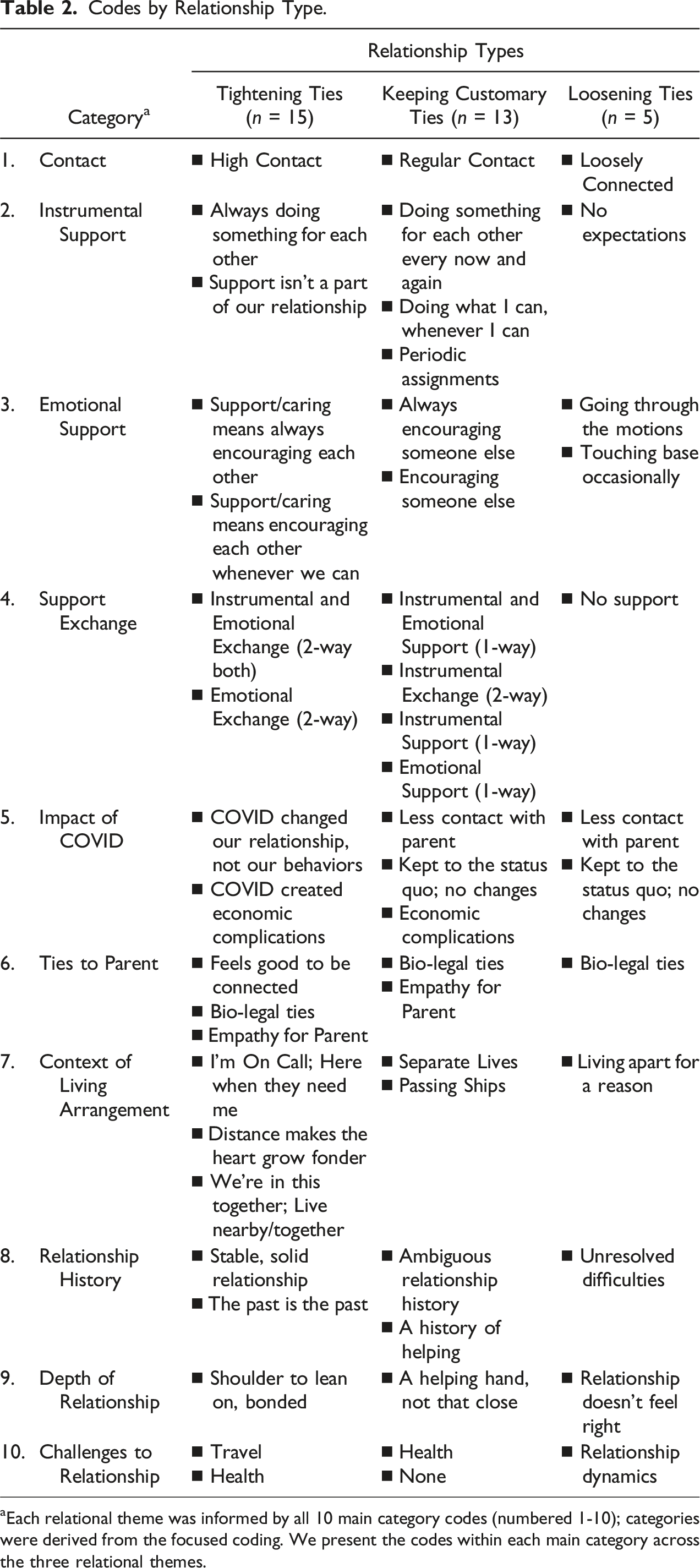
aEach relational theme was informed by all 10 main category codes (numbered 1-10); categories were derived from the focused coding. We present the codes within each main category across the three relational themes.
Findings
We present our findings by first discussing the commonalities identified across participants. We then present the three relational themes. Within each theme, we summarize the ways in which midlife adults perceived the impact of COVID-19. Following this, we examine three relational dimensions (emotional support, instrumental support, and barriers to relationship) to help articulate how midlife adults perceived COVID-19. The relational history of the sample sheds important insights into relationship dynamics during COVID-19. We describe 33 narratives across 31 cases (2 participants included separate narratives for their mother and father); the count of participants reflects the narratives captured in our analysis (n = 33).
Common Threads
Themes around care and connection overlapped across the entire sample. The most predominant idea (28 narratives, 27 cases) was midlife adult children’s evaluation that “care” and “support” were synonymous with intensive instrumental needs, and thus, parents who were independent or self-sufficient were not in need of actual care or support. For many participants, they did not need to provide care, but instated “wellness checks” (i.e., checking in on their parent’s well-being; n = 13). This level of care and support was manageable for most participants; some midlife adult children expressed thankfulness that their parent was self-sufficient (“She’s good. She’s able to move around, thank God,” Adam) during COVID-19. For connection, bio-legal kinship ties remained a strong social norm (n = 13); children remained connected to their parent out of a sense of obligation, duty, or an unwritten contract. But maintaining connection came with challenges; half of the sample (n = 16) identified multiple and overlapping challenges to the relationship. We articulate the most prominent within each theme.
Another commonality centered on COVID-19. Midlife adults perceived COVID-19 as having marginal impacts on their parent-child relationships. That is, the impact of COVID-19 was not a seismic event for the families. Fourteen participants described the impact of COVID-19 as negligible (“nothing has changed”, “it’s as though it [COVID-19] never happened”) or minimal in comparison to other events in their life (“If you would’ve asked me three years ago, after my father died, it was very stressful,”). For those participants that identified changes due to COVID-19, they tempered the degree of change to avoid overselling the impact (“just a little more,” “counts on us a little more,” “a little bit,” “really wasn’t anything different”). Overall, participants did not describe COVID-19 as a stimulus for major parent-child relationship change.
Tightening Ties (TT): Ensuring the Relationship, Despite COVID-19
For 15 participants, COVID-19 prompted greater emotional closeness and more connection regardless of the dangers of COVID-19. Midlife adult children found themselves “more worried about [parents], in a good way” (Taylor), and reflective. Hannah explained, “I think it’s [COVID-19] actually made it [relationship] better…made me more conscious of the fact that you could lose someone.” These emotional changes often resulted in midlife adult children tightening their ties with their parent more by checking in and learning how their parent was holding up. Participants worked to keep their relationship normal—even in the face of health risks posed by COVID-19. Most participants described instances in which they did not implement COVID-19 health behavior changes around their parent, and some reported more in-person contact with their parent during COVID-19. Despite not living together and working throughout the pandemic’s most restrictive shutdowns, Makensie described that, “we wear [mask] when we go to outside stores and stuff like that…[but] him and I are around each other all the time, so we don’t wear our masks around each other.” A small portion of those that tightened ties explained that they reduced physical contact but increased calls and connection with their parent to protect them (n = 4). We examine the relational components of tightening ties without taking precautions: emotional closeness, instrumental availability, and desire for less complicated circumstances.
Emotionally Bonded
Midlife adult children with tightening ties (TT) (n = 15) had relationships with parent(s) based on emotional closeness and exchanges of support. They maintained daily, mostly positive, contact with their parent. Often, emotional support was a consistent and important feature in the context of a stable and “solid” life-long relationship. Victor explained, “Me and mom are tight, and that’ll never change. I love her with all my heart.” For some, emotional closeness developed only after a breakthrough in the relationship—after facing hardship. Makensie explained, “While [my father] was in jail, we started writin’ letters. I had written him a letter explaining how I felt about everything…. Writin’ letters back and forth and stuff [strengthened our relationship].…When I decided to go back to school…he was one of my big supports. ‘You can do this.’… He gives me the encouraging words that I need.”
Regardless, emotional support was key in TT. Midlife adult children that tightened ties could identify specific instances where they provided emotional support to their parent in the past and present (e.g., “moral support,” “pep talks,” “advice”). They also felt and acknowledged their parent’s emotional support—“I know she’s proud of me. She tells me all the time,” explained Holly, “that’s my support right there.” Furthermore, such support made it so that their bond was motivated in part by the good feelings stemming from the relationship with their parent. Sam was “just happy” that his mother lived with him so he could “take care of her and do the things that [he] can do for her.” Of note, those with TT had differing living arrangements—some lived together, some lived nearby (less than 30 minutes), and some lived apart (60 min+). Emotional closeness was so central to these relationships, however, that even those living apart felt bonded to their parent because of their consistent and meaningful emotional connection. COVID-19 bolstered emotional closeness for these midlife adults.
Instrumental Availability
Instrumental support (e.g., transportation, finances, food) complemented emotional support, and proximity mattered. For some midlife adults, their relationship with their parent did not include instrumental support (due to geographic distance), but they still felt bonded to their parent; thus, solidifying the centrality of emotional support in TT. For some who lived nearby, they met essential needs—helping with important paperwork, shopping for groceries—ensuring their parents’ tangible needs were met. Others provided more casual instrumental support, as Holly articulated, “I’ll go grab her some coffee, I’ll help her clean, or go get her some tea.” For a few, instrumental support was exchanged. Drew’s mother currently served as his power of attorney while he went through a divorce, “she’s been helping me above and beyond right now. That’s what my mom’s always doing.” Instrumental support, however, was supplemental to the emotional support and thus, taking steps to protect the health of their parent (e.g., social distancing, masking) was less central. Being there for each other was more important.
Desire for Less Complicated Circumstances
When it came to challenges to the relationship, several midlife adults that tightened ties did not identify any major challenges to the relationship and none identified COVID-19 as a challenge to the relationship. Instead, they identified distance (requiring travel) and health problems (either personal or parent). These midlife adult children often did not have the time, resources, or ability to visit their parent in-person regularly. Long-distance travel served as a barrier for Victor (e.g., “requiring a lotta gas and a lotta money”). Jacob identified both travel and his personal health as a challenge, explaining that after a recent shoulder injury, he “unfortunately” could not complete a long-distance drive—having to rely on phone and video calls to maintain contact with his mother.
Keeping Customary Ties (CT): COVID-19 Did Not Help Relationship
For 13 participants keeping customary ties (CT) during COVID-19, they worked to keep themselves available to help their parent or keep their parent safe; sometimes this resulted in less contact with their parent, particularly when parents lived at a distance. Notably, five midlife adult children reduced contact out of respect or safety for their parent—not personal grudges. Kyle explained, “I really haven’t made no effort to walk over to the house or visit because—with the epidemic on—I prefer to stay away.” Six participants had less contact due to the economic challenges (e.g., job loss, “busy working,” “unpredictable hours”) posed by COVID-19. For these families, COVID-19 was not a bonding experience, but an obstacle in maintaining the status quo with their parents. We examine the relational components of keeping customary ties: emotional distance, an instrumental helping hand, and keeping the status quo.
Close, But Not That Close
For midlife adults keeping CT (n = 13), emotional ties were more neutral and less central than those who TT. They had about weekly contact with their parent and used value-neutral language like “it’s just a normal relationship” (Devin) to describe their emotional closeness. Relationships were matter of fact, and often midlife adult children invoked the importance of bio-legal kinship ties to explain their connection to their parent. Kelsea offered, “It’s not like I can choose to say, ‘I’m not speaking to you anymore.’ I could never do that…she’s my mom.” Participants maintained contact with their parents because they were supposed to stay in contact. While midlife adult children offered their parents consistent or periodic emotional support, they often did so without expectation of receiving support from their parent. That is, emotional support was not a prerequisite; Lacy explained, “We were never really huggers….My mom and I are close, but we’re not real close….Some people are really close, and they’ll tell their parents everything. We’re not that type of family.”
Unlike TT, emotional connection was not at the forefront of keeping CT. Lines of communication were open, but participants often spoke about emotional support in generalities. “We do communicate,” explained Kyle, “We talk, but nothing to write home about.” Several participants struggled to identify specific examples of emotional support in their relationship. George laughed at the idea of receiving emotional support, “Well, I don’t know ‘cause I don’t see any of those things. Yeah, that [question]’s weird.” Four participants resisted answering the question about emotional support received from their parent, stating that the “question doesn’t really apply.” Emotional support did not underlie these relationships during COVID-19.
A Helping Hand
Keeping CT revolved around task-based, instrumental support, typically taking the form of running errands, picking up items, grocery shopping, and checking that their parent had things they needed. They worked to meet their parents’ physical needs when appropriate. Lacy’s task-oriented relationship responsibilities demonstrated ritual instrumental expectations and neutral emotional boundaries. She calls me on my days off, and she’s like, “…can you take me shopping?” I’m like, “Sure. I’ll be over.” …. Usually, she calls if she needs or wants something. I don’t call and say, “Hey, how’s it going?” I only call if I have to tell her something.
The impetus for instrumental support varied within keeping CT. For some, they explained their history of helping their parent—having stepped up during a parent’s crisis (e.g., death of a spouse, worsening dementia, cancer diagnosis). There was little evidence of reciprocity among these relationships; and during COVID-19 participants waited for their parents to call when they needed something. Parents would often “make up a list” (Owen) and they worked to complete each request. For others, instrumental exchange was a ritual—an expected and routine part of the relationship. For example, Carlos explained that his mother and stepfather had an understanding that during COVID-19 “I’ll go buy [items] for them. I’ll leave it on the porch. That helps [them] out… and whenever we need something or whatever, they’ll help us out.”
Status Quo Is Working
Midlife adults keeping CT were most likely to say that there were no challenges or barriers to maintaining their relationship with their parent during COVID-19, an indication that the instrumental status quo was working. For the most part, that meant midlife adult children and their parents led separate lives—with emotional neutrality. That is, midlife adult children checked in, met the needs of their parent, and checked out. For those living nearby, CT resembled passing ships—in which midlife adult children and their parents led separate lives without much interaction. Ryan illustrated this point most clearly “I don’t know. I do my thing. They do theirs. We see each other when we see each other.” Unless doing a check-in, no news was good news when keeping customary ties during COVID-19.
Loosening Ties (LT): COVID-19 Meant Even less Contact
For 5 participants, COVID-19 was not a catalyst for relationship change; yet ties to their parents loosened. In a few instances COVID-19 contributed to estrangement as Carlos explained, “[T]alking to him [dad] about the virus is….I don’t know… Tell you the truth, I really don’t know what to talk to him about.” For some, there was even less interaction with their parent—continuing to drift. Others maintained the status quo with their parent—maintaining a comfortable distance. COVID-19 behavior changes were not needed whether due to geographic distance or limited contact: “I haven’t seen him, so there’s no interaction” (Adam). The COVID-19 pandemic promoted distance. We examine the relational components of loosening ties: emotional dissatisfaction, instrumental absence, and unresolved relationship difficulties.
Emotionally Unfulfilled
Midlife adults with loosening ties (LT) (n = 5) reflect those relationships with tenuous connections between midlife adult children and their parent. They had about monthly contact with a parent; however, their relationships were marked with obligation, strain, and dissatisfaction. In addition, there was no expectation of emotional support from the parent. Members of the LT group felt unsure about or reported that they “don’t know” (Anna) what they were getting out of their relationship. Yet, LT often explained that their continued connection to their parent came out of a sense of obligation. Carlos explained, “I just respect ‘em, my parents, and I just do what I gotta do and that’s it.’”
LT maintained phone contact with their parent but acknowledged that it was superficial at times. Carlos explained that there was no “real bonding with my dad. My bonding with my dad is more like him saying, ‘Hey, how’s the family, how’s this guy?...I’ll [respond], ‘I don’t see these people.’” For others, like Seth, their connection was always strained. “Always been tryin’ to talk to her and communicate to her for a long period of time. They’re usually short, the talks. Yeah, they’re not fulfilling, but like I said, I get to hear she’s alive and doin’ good or whatever.”
These ‘check-ins’ were a common trait with LT—often occurring periodically, without consistent frequency. For some, contact centered on major holidays (“I talk on the phone with [parent] Merry Christmas…Happy New Year…Happy Easter… that’s it,” Anna) or for the sake of others, like grandchildren (“I just do it [FaceTime] with my dad because that way he can see the kids,” Carlos). LT relationships were not described with a glowing outlook, but with reality-checks. As Seth explained, “There’s nothing spectacular or what do you call it – just the small relationship that we do have”—their relationship with their parent was a compartmentalized aspect of their life. As such, COVID-19 was not a shared experience for those with LT.
No Expectations of Instrumental Assistance
For adults with LT, instrumental support was also not expected—midlife adult children rarely or never provided tangible assistance to their parent. Instrumental support was not necessary for parents deemed self-sufficient—some were “busy all the time” (Anna). For families living geographically apart, instrumental support was even less relevant. For those living nearby, they reported that other family members were the expected providers. Seth explained, “My brother’s around her all the time….they live together….If she really needs something, [she’ll] give me a call, I’ll pick you up….That’s rare, I mean.” Thus, midlife adult children with LT offered instrumental support on the periphery of the relationship. Their parent’s economic or instrumental hardships due to COVID-19 were not their burden to bear.
Unresolved Difficulties
Within LT, midlife adult children identified relationship dynamics as the main challenge or barrier to their relationship with their parent. Nick explained, “My own personal feelings toward my mom….A major obstacle is that she puts off an air that she doesn’t want or need my help for anything. If you do not ask, you do not receive. Somebody can only offer so much.”
The tenuousness of LT relationships often centered on unresolved difficulties over the life course. Midlife adult children described difficult childhoods and moments in their lives that soured the relationship with their parent, but unlike TT or CT, LT remained strained. Sometimes strains extended from childhood. Seth explained, “My relationship with my mother has always been strained. I was put in foster care…my mother fought to get me back…then I took her to court and was emancipated from my mother at age of 15…went back into foster care….it’s been strained all my life.”
Across their life course, LT described the ways in which their relationships did not feel “right.” Furthermore, they were not looking to change the relationship and lived with the unresolved difficulties. COVID-19 did not prompt opportunities for relationship changes.
Discussion
This study explored relationship dynamics between midlife adult children with EHPAN and their parents during the COVID-19 pandemic. Major disruptive events—COVID-19, natural disasters, societal conflicts, and the like—put enormous stress on families which can result in negative changes in family relationships like increased conflict, increased family violence, and increased unmet needs; it can also result in positive changes like improved relationships, post-traumatic growth, and improved communication (Cassinat et al., 2021; Walsh, 1996). With little precedent, we anticipated that stressors associated with COVID-19 could have readily created large discrepancies in needs, wants, and behavior within families, resulting in additional relational tension (Birditt et al., 2009) in families with EHPAN. However, rather than COVID-19 having a major impact on relationship dynamics, we found that relationship history shaped these parent-midlife adult child interactions during COVID-19 (Settersten et al., 2020). Findings revealed three distinct relational themes characterizing relationship dynamics prior to and during the initial stages of the pandemic. We do not suggest that these relational themes are a product of EHPAN, but we do posit that the relational themes cannot be fully understood outside of EHPAN. For participants with TT, COVID-19 was not a major catalyst transition event—other relationship breakthroughs had changed the trajectory of the relationship. However, during the pandemic—and in the absence of any daily caregiving responsibilities—midlife adult children with TT adapted to find ways to maintain regular and meaningful connection to their parents. Sometimes their ways of engagement went in the face of COVID-19 health guidance, but the pandemic did seem to bring them closer, potentially tightening bonds. For CT, midlife adult children adapted to maintain and deliver support (sometimes literally), but relationship expectations remained the same, despite COVID-19. For LT, filial obligation drove their contact with their parent and COVID-19 was not a transition event that changed or improved the relationship. Overall, findings highlight the endurance of these parent-midlife adult child relationships and demonstrate familial resilience despite EHPAN and COVID-19.
The challenges associated with the early stage of the pandemic did not appear to create additional or distinct types of issues or disruptions for families with an EHPAN beyond those reported for late life family relationship more generally (Jiang & Fung, 2022; Vaterlaus et al., 2021). The longer-term implications of this historical event, particularly for at-risk groups like families with an EHPAN, will require further investigation. It is unknown how individuals will manage lingering COVID-related anxiety and physical health issues, which can alter patterns of support and relationship dynamics within families (Hernandez & Colaner, 2022). In addition, the associated economic turndown, changes in community systems (e.g., availability of mental health services), and policies passed during the past few years will continue to influence the lives of families for years to come.
At a micro level, many participants identified unique individual challenges and stressors effecting their relationships with their parent during the pandemic. We speculate that a shift in family roles within the context of societal transformations will influence the dynamics and quality of the parent-midlife adult child relationship well into late life, effecting further interactions (Lang & Schutze, 2002), relationship ties (Fingerman et al., 2004), and well-being (Fingerman et al., 2008). Because older parents are frequently dependent on their adult children, including in maltreating families (Kong & Martire, 2019; Kong & Moorman, 2015; Parker et al., 2018), it is important to consider how existing patterns of support and tensions may shape the provision of parental care. For example, the solid emotional foundations in TT relationships present opportunities for a smooth transition if new care demands arise or create new challenges as a shift in emotional support (two-way to one-way support) may create more stress for them. For participants with CT, established support patterns may help set expectations or create challenges for future care needs. If the type of instrumental support and intensity of emotional support provided during the pandemic continues or evolves, midlife adult children with CT may either come to view emotional support as a task they can step-up and fulfill, or perhaps they will have difficulty meeting new care demands of a relationship that was “close, but not that close” to begin with (Segel-Karpas & Ayalon, 2022). Similarly, participants with LT reported longstanding difficulties with their parents that continued to negatively affect their relationship during COVID-19, leaving them unfulfilled in their relationship with their parent. If new care demands arise, midlife adult children in LT with unresolved tensions may experience additional conflict and resentment navigating various challenges if the parents’ needs and expectation for support change (Kong & Martire, 2019). Thus, questions about relational processes within these families will continue to arise as they proceed through the life course. Practitioners need to be cognizant of family history and disruptive transitions as they design interventions and provide support and education programs for persons engaged in parent care (Kong & Moorman, 2015).
Limitations and Future Research
This study provided insights into EHPAN relationships and how they fared during the pandemic. Findings of our study identify relationship characteristics, describe midlife adult children-parent interactions during COVID-19, and inform future data collection efforts on new areas of exploration among families with an EHPAN. However, it is not without its limitations. First, this study was conducted from the point of view of midlife adult children. Future research would benefit from a dyadic perspective to further capture the evolving dynamics of parent-child relationships. Second, we provided a retrospective account of behavior and changes during the pandemic’s earlier lockdown days and prior to the widespread availability of vaccination. Responses of some participants suggested indifference to public health directives, perceiving that their behaviors had little or no effect on their relationship with their parent. The unanticipated length of the pandemic (and its associated challenges) necessitates further examination of midlife adult children-parent relationships to understand how families with an EHPAN respond to long-term and far-reaching crises like the pandemic. Third, from our study design we can only conclude about relationships between parents and midlife adult children in which there was an EHPAN. We cannot speak to the specific relationship between a midlife adult child and the parent who was the perpetrator of the early abuse/neglect. Future studies focused on specific relationships with the parent who perpetrated abuse/neglect are needed to further understand the dynamics of these relationship ties and how and why they may change over time.
Conclusion
The present study uncovered variation in parental ties during the COVID-19 pandemic among midlife adult children who experienced EHPAN. The findings emphasize the importance of considering a life course perspective to address unanticipated (and expected) challenges among vulnerable families. Recognizing that past adversity may alter midlife adult child-parent relationship dynamics suggests the need for interventions that address adult children’s emotional needs as well as the maintenance of satisfactory relationships with their parents as they age. In addition, programs that promote the development of adaptive coping and self-care strategies can help adult children cultivate acceptance of intra- and inter-personal changes and increase personal strengths (i.e., purpose, emotional regulation) commonly associated with enhanced individual physical wellbeing and relational resilience. Thus, our findings underscore the need for further explorations to better understand factors that contribute to the long-term resilience seen in some families with EHPAN as well as the lifelong relationship difficulties experienced by others.
Footnotes
Declaration of Conflicting Interests
The author(s) declared no potential conflicts of interest with respect to the research, authorship, and/or publication of this article.
Funding
The author(s) disclosed receipt of the following financial support for the research, authorship, and/or publication of this article: This work was supported by the National Institute on Aging at the National Institutes of Health [R01AG059823, R01AG059823-02S1].
