




Abstract
We analyzed data from over 26,000 parents and non-parents from 24 European countries. We tested for differences between parents and non-parents on several indicators of happiness, health, and civic and community engagement. Results showed that there were no differences in global evaluations of happiness, life satisfaction, or subjective health. Non-parents reported being more depressed. Parents were more likely than non-parents to engage in social activities. Parents reported more health problems than non-parents; fathers had the largest BMI and were most likely to engage in risky health behaviors. Fathers and men without children reported the most political interest and were most likely to have voted. Fathers also reported being the least involved in religion and mothers the most involved. In sum, parents and non-parents did not differ greatly on happiness outcomes, but parents were worse off on health outcomes, and fathers in particular were more involved in civic engagement than non-parents.
Introduction
Parents often report that having children is the greatest joy of their lives. But does being a parent make people happier than non-parents? Does this happiness extend to greater health and health-relevant behavior? Are parents more engaged with society and their communities than non-parents? Using data from over 26,000 respondents to the European Social Survey, we sought to answer these questions. We examined three pillars of well-being: happiness, health, and civic engagement.
Some studies have found that parents are happier than people without children (e.g., Nelson et al., 2012), but others have found the opposite effect (e.g., Evenson & Simon, 2005). Nelson et al. (2014) developed a model to explain why these opposing effects have been observed in the literature. The model highlights the complexity of this issue. On the one hand, children elicit many positive emotions, but also negative emotions. On the positive side, parents may experience fulfillment of their basic psychological needs to a greater extent than non-parents. Furthermore, parents adopt a socially valued role in society and may experience greater happiness as a result. However, children can also cause poor sleep, strained relationships with one’s romantic partner, and financial worry. These adverse effects may lower global ratings of happiness or cancel each other out.
Studies comparing parents on happiness and well-being measures with non-parents show mixed results. One study examined parents of newborns, parents of older children, and non-parents. Parents of newborns had higher life satisfaction than other parents and non-parents, but also showed a decline in flourishing (Brajša-Žganec et al., 2022). A study examining the effect of the COVID-19 pandemic on happiness in parents and non-parents found that parents fared better during the pandemic than non-parents (Koziol & Augustine, 2025), suggesting a protective effect of parenthood on well-being during times of crisis. Other work shows that American non-parents are becoming increasingly unhappy over time and parents are becoming increasingly happy (Herbst & Ifcher, 2015). By contrast, a Chilean study reported that parents had lower life satisfaction, positive affect, and negative affect than non-parents (López-Bauta et al., 2024). However, meaning in life was higher in parents.
In terms of physical health, studies show that parents do not differ from non-parents in terms of cardiovascular health, but parents did show a larger body mass index (BMI) (Gregory et al., 2024). In this study, parents were also less likely to smoke tobacco than non-parents. A meta-analysis and systematic review of longitudinal studies reported that mothers were likely to have an increased BMI relative to non-mothers (Corder et al., 2020). Parents also lost less weight than non-parents in a randomized weight loss program (Bramante et al., 2020).
Studies have found differences between parents and non-parents in terms of physical activity. Specifically, a meta-analysis of 25 effect sizes found that parents were less likely to engage in physical activity than non-parents (Bellows-Riecken & Rhodes, 2008). However, older fathers engage in more sports than younger fathers (Becker et al., 2022). Thus, parents may show lower physical health and engagement in health-related activities than non-parents.
Some may believe that having children might make people engage in civic life as they wish to secure the best possible world for their children. However, the demands of parenting may limit the amount of time available to engage in civic life. For instance, one study found that being the parent of a young child resulted in a decline in civic engagement including voting (Jackson & Pietryka, 2022). This decline in civic participation may be greater for mothers than fathers (Grechyna, 2023). However another study using the European Social Survey data found that parents had higher levels of civic engagement than non-parents (Kroll, 2010). Religious participation may also suffer as a result of having children. However, it is equally plausible that religious participation would increase as parents may choose to raise their children with faith even if they had not been pious in the past.
The Present Research
In this study of European residents from 24 countries, we examined whether parent status was related to happiness, health, and civic engagement. To this end, we conducted a series of regression analyses controlling for age, country of residence, and cohabitation status. We were mainly interested in the relationships between parent/non-parent status and gender and their interaction.
Method
Participants
Data were taken from the European Social Survey (ESS) Round 11 dataset (https://www.europeansocialsurvey.org/). Respondents were 26,914 men (48.51%) and women (51.49%) from 24 countries: Austria, Belgium, Croatia, Cyprus, Finland, France, Germany, Greece, Hungary, Iceland, Ireland, Italy, Lithuania, The Netherlands, Norway, Poland, Portugal, Serbia, Slovak Republic, Slovenia, Spain, Sweden, Switzerland, and the United Kingdom. The mean age was 53.73 (SD = 20.73) and ranged from 15 to 90 years old (median = 59). A total of 40.69% were living with a partner and 58.78% were not. A total of 51.49% reported having children and 48.51% did not have children.
Materials
Participants completed a large face-to-face interview (with more than 200 questions). We focus on items assessing the following three themes: happiness, health, and engagement with society.
Happiness
Several items assessed happiness- and unhappiness-related constructs. Participants responded to “All things considered, how satisfied are you with your life as a whole nowadays?” (0 = Extremely dissatisfied, 10 = Extremely satisfied); “Taking all things together, how happy would you say you are?” (0 = Extremely unhappy, 10 = Extremely happy); “Were happy, how often past week” (1 = none or almost none of the time, 4 = All or almost all of the time); “Enjoyed life, how often past week” (1 = none or almost none of the time, 4 = All or almost all of the time); “Felt lonely, how often past week” (1 = none or almost none of the time, 4 = All or almost all of the time); “How much control over life in general nowadays” (0 = No control at all; 10 = Complete control); “How often do you meet socially with friends, relatives or work colleagues?” (1 = Never, 7 = Every day); “Compared to other people of your age, how often would you say you take part in social activities?” (1 = Much less than most; 5 = More than most); “How many people, if any, are there with whom you can discuss intimate and personal matters?” (0 = None, 6 = 10 or more).
Four items assessed depression during the past week: “Felt depressed, how often past week” (1 = none or almost none of the time, 4 = All or almost all of the time); “Felt that everything you did was an effort?”; “How much of the time during the past week you felt sad”; and “how much of the time during the past week. Could you not get going?” (1 = None or almost none of the time, 4 = All or almost all of the time) (Cronbach’s α = .79).
We also computed a measure of trust in others from three questions: “Generally speaking, would you say that most people can be trusted, or that you can’t be too careful in dealing with people?” (0 = You can’t be too careful; 10 = Most people can be trusted); “Do you think that most people would try to take advantage of you if they got the chance, or would they try to be fair?” (0 = Most people try to take advantage of me; 10 = Most people try to be fair); “Would you say that most of the time people try to be helpful or that they are mostly looking out for themselves?” (0 = People mostly look out for themselves; 10 = people mostly try to be helpful) (Cronbach’s α = .79).
Health
The following item assessed subjective health: “How is your health in general?” (1 = very good, 5 = very bad). To compute a number of health problems, we summed “yes” responses to the past 12 months to the health-related areas, which were included in the survey: heart or circulation problems, high blood pressure, breathing problems, allergies, back or neck pain, muscular or joint pain in hand or arm, muscular or joint pain in foot or leg, stomach or digestion related, skin condition related, severe headaches, and diabetes. Body mass index (BMI) was calculated from height and weight. Frequency of eating fruits and vegetables was combined from two items: “How often do you eat fruit, excluding drinking juice” and “How often do you eat vegetables or salad, excluding potatoes” (1 = never, 7 = three or more times per day), r (27,094) = .41, p < .0001. Physical activity was assessed with one item: “On how many of the last 7 days did you walk quickly, do sports or other physical activity for 30 minutes or longer?” (1 = 1 day, 7 = 7 days). One question assessed cigarette smoking (1 = I have never smoked, 6 = I smoke daily, 10 or more cigarettes). One question assessed frequency of alcohol use (1 = never, 7 = daily). To assess binge drinking, participants were shown a card demonstrating the amount of alcohol consumed during a binge and asked how often they drank that amount of alcohol (1 = never, 5 = daily or almost daily).
Civic and Community Engagement
One item assessed interest in politics: “How interested would you say you are in politics” (1 = Not at all interested, 4 = Very interested) and political orientation: “In politics people sometimes talk of ‘left’ and ‘right’” (0 = left, 10 = right). Participants also responded to “how confident are you in your own ability to participate in politics?” (1 = not at all confident, 5 = completely confident). Participants also indicated (yes or no) if they voted in the past election, contacted a politician or government official in the past 12 months, donated to a political party or pressure group in the past 12 months, or volunteered for a non-profit or charity in the past 12 months. One item assessed general religiosity: “Regardless of whether you belong to a particular religion, how religious would you say you are?” (0 = Not at all religious, 10 = very religious). Two items assessed religious behavior: “How often do you attend religious services nowadays?” and “How often, if at all, do you pray?” (1 = Never, 7 = Every day), r (26,505) = .67, p < .0001.
Statistical Analyses
All data were analyzed in R (R Core Team, 2024). We conducted ordinary least squares multiple regression analyses for each outcome controlling for age, living with partner, and country of residence. For the dichotomous outcomes (e.g., donating to charity), we conducted logistic regression analyses with the same covariates. Our focus was on the relationships between parent/non-parent status and gender and their interaction. In the presence of significant interactions, post-hoc tests were conducted with the emmeans package in R (Lenth, 2024). Familywise error rate was controlled with Benjamini and Hochberg’s (1995) false discovery rate. The data and the R code are freely available here: https://osf.io/bnugq/?view_only=d1e7d4af45d94674a3eadf64a88f25e4.
Results
Happiness
Happiness-Related Outcomes
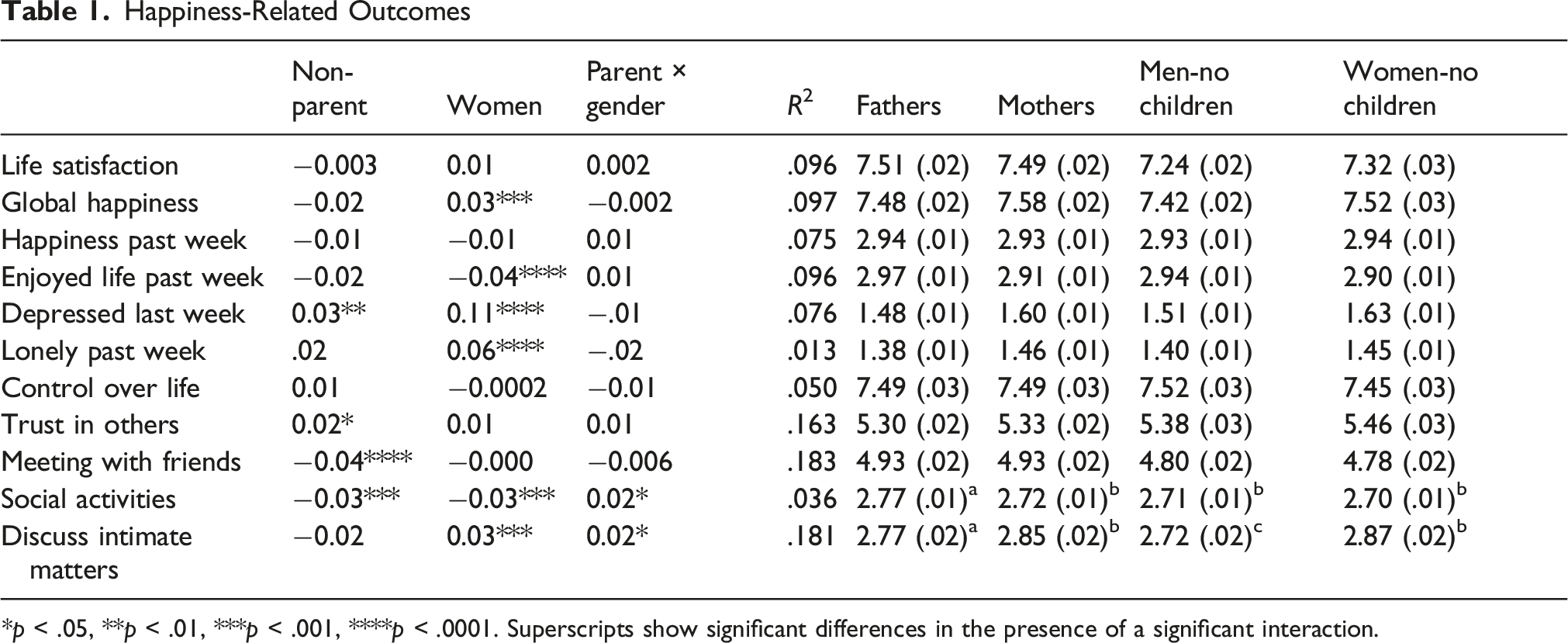
*p < .05, **p < .01, ***p < .001, ****p < .0001. Superscripts show significant differences in the presence of a significant interaction.
Health
Health-Related Outcomes
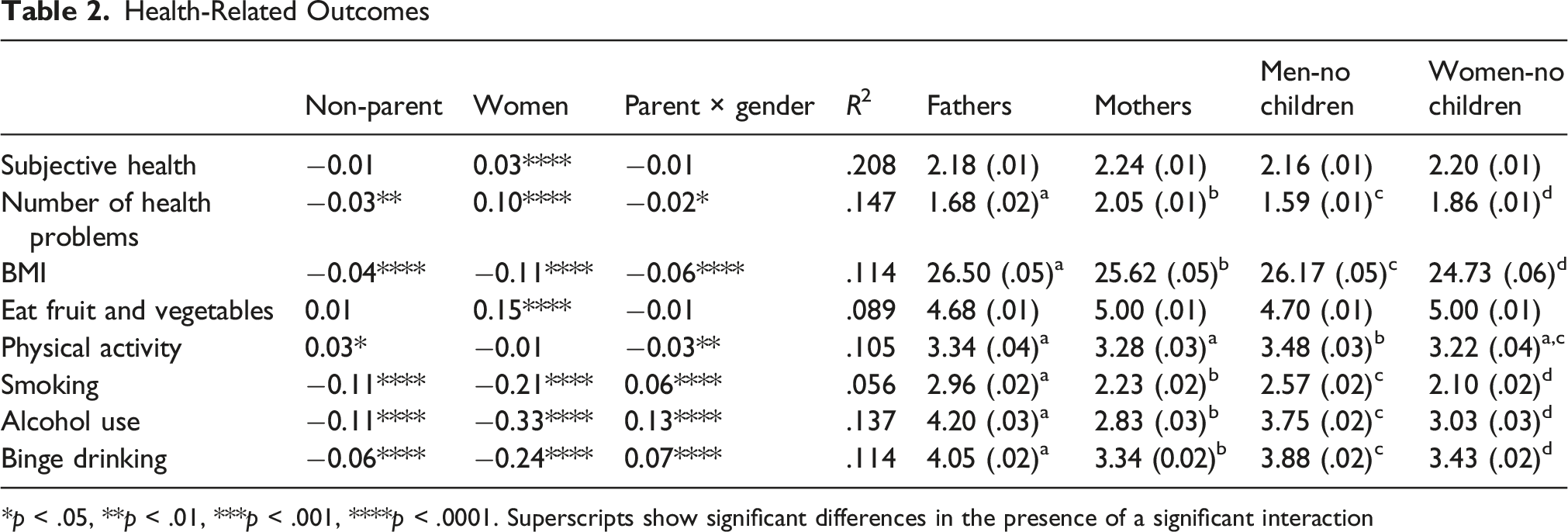
*p < .05, **p < .01, ***p < .001, ****p < .0001. Superscripts show significant differences in the presence of a significant interaction
Civic and Community Engagement
Civic and Community Engagement Outcomes
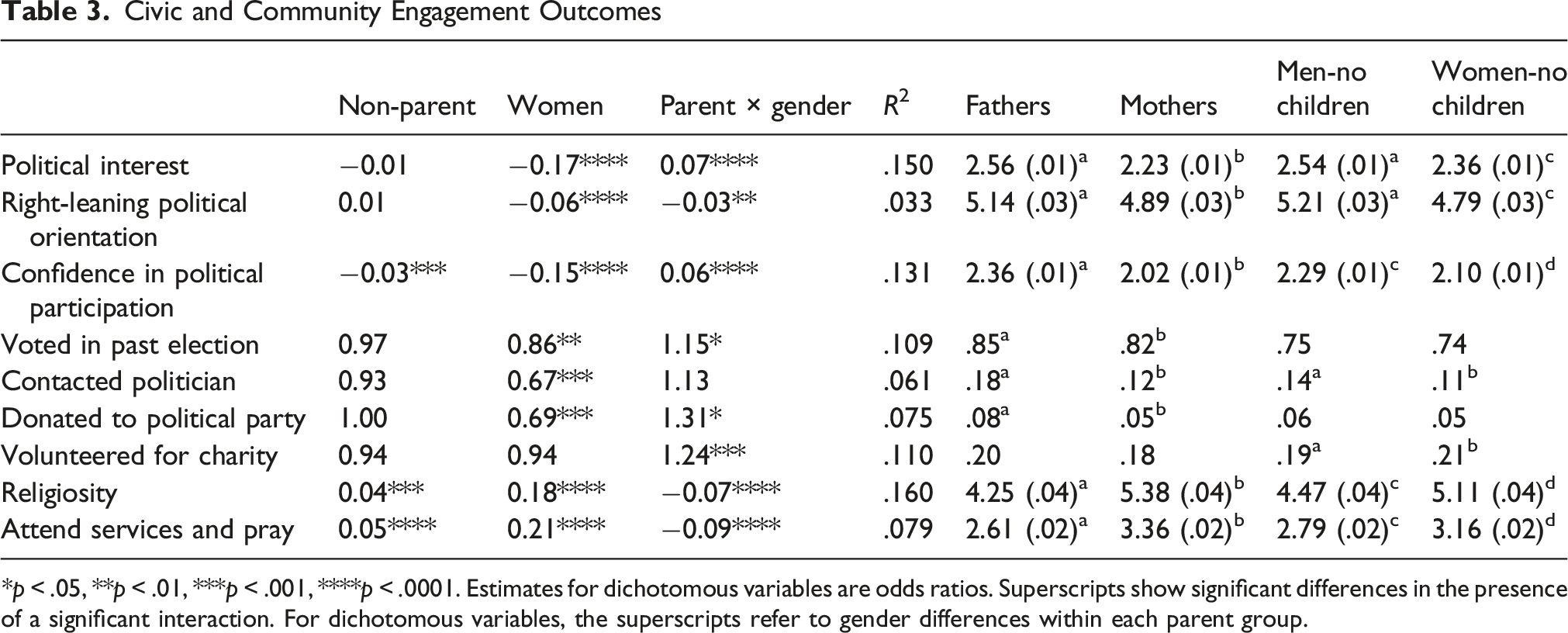
*p < .05, **p < .01, ***p < .001, ****p < .0001. Estimates for dichotomous variables are odds ratios. Superscripts show significant differences in the presence of a significant interaction. For dichotomous variables, the superscripts refer to gender differences within each parent group.
There were several significant parent status × gender interactions. Fathers and men without children reported being the most interested in politics, followed by women without children and mothers. Fathers and men without children were equally the most conservative, followed by mothers. Women without children were the most liberal. In terms of confidence to participate in politics, fathers reported the greatest confidence, followed by men without children, women without children, and mothers. There were also significant interactions for voting, donating to a political party, and volunteering for charity. Fathers were most likely to vote followed by mothers and non-parents. Women without children were most likely to volunteer for charity. In terms of religiosity, mothers reported being the most religious, followed by women without children, men without children, with fathers being the least religious. This finding was mirrored in attending religious services and praying, with mothers doing both the most frequently, followed by women without children, men without children, and fathers the least frequently.
Discussion
In this study, we investigated whether parenthood status and gender were related to happiness, health, and civic and community engagement when controlling for age, cohabitation status, and country of residence. We observed several differences between the groups, typically as a function of gender. We found very little support for the possibility that parents and non-parents experience different levels of happiness, subjective health, or life satisfaction. As noted, the literature is mixed and there are processes that support both happiness and unhappiness in parents (Nelson et al., 2014). Thus, a null finding for happiness is not entirely unexpected even with the vast statistical power observed in this study. There were two small effects worthy of mention: non-parents were slightly more likely to report feeling depressed during the past week than parents. And, non-parents were also slightly more trusting of others as compared to parents.
Consistent with the global judgments of happiness and life satisfaction, we found no differences between parents and non-parents on evaluations of their subjective health. However, gender interacted with parenthood status on a number of health-related outcomes. For instance, mothers reported the largest number of health conditions and fathers and mothers had higher BMIs as compared to their non-parent counterparts. These findings are consistent with past research (e.g., Gregory et al., 2024). However, contradicting some previous research, fathers were most likely to smoke, drink alcohol, and binge drink (Gregory et al., 2024). Mothers and fathers also reported more health problems than their non-parent counterparts. Thus, in terms of these few health indicators, fathers and mothers were worse off than non-parents. In terms of civic engagement, fathers showed the most political interest and confidence in political participation. They were also most likely to have voted. However, mothers were the highest in religiosity, and reported praying and attending religious services the most often.
This research was limited in several regards. First, the effects we observed were small (i.e., standardized βs between .02 and .13 for the interaction terms). Thus, the implications from these effects should be interpreted cautiously. Second, the survey was administered in person face-to-face. As such, some participants may not have been truthful or were unwilling to provide a response. We were also limited by the questions that were asked in the source dataset. Thus, we could not examine the processes through which being a parent or not influences the outcomes.
Another limitation is that the data were limited to European respondents. Although 24 countries were sampled, these findings may not generalize to other cultures. For instance, one study of East and Southeast Asian countries found no differences between parents and non-parents on happiness (Chao & Glass, 2020). Another study from Canada of parents and non-parents and immigrants and non-immigrants found that immigrant parents engaged in the most religious practices (Browne et al., 2021). The field could benefit from more data from non-Western, rich, educated, industrial, and democratic (i.e., WEIRD) nations (Henrich et al., 2010).
One important limitation is that the non-parents could not be differentiated into subgroups. For instance, childfree people are those who voluntarily chose not to have children, whereas childless people are those who wanted to have children but could not. Clearly, these two groups of people may differ in happiness, if not health and civic engagement. Thus, in future research, it would be appropriate to distinguish between the childfree and childless if possible.
In sum, although we found no differences between parents and non-parents in most of the areas examined, several subtle differences did emerge. At least among Europeans, non-parents reported feeling more depressed and meeting up with friends and colleagues less often than parents. Similarly, fathers may be at risk for alcohol abuse and obesity. Fathers also reported relatively greater engagement with politics than the other three groups.
Footnotes

Funding
The authors received no financial support for the research, authorship, and/or publication of this article.
Declaration of Conflicting Interests
The authors declared no potential conflicts of interest with respect to the research, authorship, and/or publication of this article.