




Abstract
This study examines longitudinal effects between marital adjustment (MA) and perceived family support (PFS), considering the moderating role of stepfamily type (simple vs. complex). Although higher PFS levels are linked to better MA, forming a new relationship may change support perceptions. It remains unclear whether PFS predicts or follows MA over time, whether the association is bidirectional, and whether stepfamily type moderates this link. 130 participants were included (64 simple stepfamilies, 66 complex). PFS and MA were measured at baseline (T 0 ) and 6 months later (T 1 ). The final model presented a good fit to the data [χ2 (2) = 6.97, χ2/df = 3.49, p = .031; CFI = .98; TLI = .86; RMSEA = .14] and revealed longitudinal and moderating effects: high PFS predicted greater subsequent MA only among adults in complex stepfamilies. These results highlight the importance of differentiating simple and complex stepfamily dynamics in remarried couples.
Keywords
Introduction
The literature has documented that perceived social support is a latent construct with a predictive role at the level of Martial Adjustment (MA; Dehle & Weiss, 2002; Falke & Larson, 2007; Santos et al., 2018). Social support contributes to a person’s adjustment to different contexts, including marriage (Mert, 2018). Social support acts as a buffer, protecting individuals against the effects of stress (Sharda, 2022), but it can also serve as a “coping assistant” when someone provides child-care assistance, for example (Thoits, 1986).
However, the literature includes results that are inconsistent depending on the sample or source of support. For example, Kurdek and Schmitt (1987) found a negative correlation between social support and marital satisfaction, an inextricably linked component of MA (Kendrick & Drentea, 2016). A study with remarried couples found that social support, especially support provided by friends, does not affect the adjustment of stepcouples (Kim, 2010). Various researchers have shown that spousal support, through supportive behavior, affection, and love, leads to marital satisfaction (e.g., Kurdek, 2005; Pasch & Bradbury, 1998), which is directly related to positive adjustment (Kendrick & Drentea, 2016). On the other hand, Mert’s (2018) research proved that the level of MA increases as the level of perceived support from family and friends increases. Other investigators demonstrate that positive psychological variables such life as satisfaction (Gümüs, 2015) or psychological wellbeing (Tarhan, 2012) can be an intermediary between perceived social support and MA level. However, to the best of our knowledge, it is not known whether structural variables, such as household type composition, can play this intermediary role.
There are two major and distinguish types of social support: perceived social support (PSS) and received social support (RSS). The first “refers to the perceived availability and adequacy of social connections; RSS focuses on the quantity and quality of the support given” (Eagle et al., 2019; p. 2056). Most authors have found PSS to be a better predictor of mental health status than objectively measured social support. According to Lakey and Cronin (2008), low levels of PSS are significantly related with poor psychological condition.
In relation to marital system, the individual’s subjective appraisal of social support quality, availability and adequacy (RSS components) may also exert positive effects on marital quality via PSS which in turn increases marital quality (Zimet et al., 1988). It is known that partner is typically the primary source of social support for couples, but it is also known that individuals receive support from other network members, especially from family members (Benson, 2012; Suanet & Antonucci, 2017).
Stepfamilies’ Perceptions of Social Support: The Role of Family Support
Most of the time, social support comes from existing social and family networks and is given according to levels of proximity and commitment (Antonucci et al., 2010). Family support provided by parents of stepcouples tends to be lower because (1) they are generally older than parents of first-married couples and thus may have less physical and emotional availability and (2) although they may have offered support in their child’s first-marriage, they may be reluctant to get involved in their stepparenting and remarital conflicts (Kurdek, 1991). This is in accordance with the norm of noninterference developed by Clingempeel and collaborators (1992), which indicates that “older family members should not cross household boundaries when the younger household is headed by a couple” (cit in Ganong & Coleman, 2017, p. 103). After a divorce, the former couple experiences a significant reduction in social support. For instance, friends may pull away because they feel embarrassed to take a side or disapprove/reject the change (Goetting, 1982). Nevertheless, parents may be more available to offer resources and financial and emotional support after a first-married dissolution as the son/daughter adjusts to the changing family situation.
If that son/daughter remarries, the non-interference norm suggests that his/her parent’s efforts to help can be considered by both generations as unwanted and intrusive. Thus, this norm of non-interference can lead to a significant reduction in social support for remarried people. Despite all the conditions that increase the likelihood of stepcouples having less social support, the literature confirms that family support is related to remarital satisfaction (Johnson et al., 2008). Marital satisfaction and stability in remarriage are directly related to being part of a social network (Kim, 2010) and the lack of social support was identified by stepcouples as one of the biggest problems for their family (Cherlin, 1978).
The stress caused by a divorce may negatively effect the couple’s social networks. For example, there is a risk for divorcees associated with mobilizing social support. This risk is related to the fact that divorcees often have to disclose stigmatizing or undesirable information in order for support to be provided (Brashers et al., 2004). Wilder (2016) found that as risk of support increases, the effectiveness of the support provision decreases.
People who remarry after a divorce often have to remake their support networks considering several constraints (i.e., the norm of noninterference, stigmatization for being divorced, and risk for mobilizing social support) that are not present in people who marry for the first time. Thus, it is possible that the dynamics of providing social support by family may be different for the stepcouples when compared to other couples and, consequently, alter their social support’ perceptions. However, when a divorcee remarries, the presence of a new spouse and the possibility of developing a new positive marital system can be a buffer against the perception of ineffective support provided by the family. In line with this, it is known that well-adjusted marriages have a more positive outlook on life, tending to perceive their family dynamics with more satisfaction (Hicks & Platt, 1970).
Although there is evidence that high levels of social support predict higher marital adjustment (Abbas et al., 2019), an alternative possibility that may explain the correlation between these two variables is that happy and well-adjusted couples are more apt to perceive any form of support in a more positive manner. Thus, it is also possible that the association between marital adjustment and perceived social support is bidirectional.
Marital Adjustment in Remarriage: Does the Stepfamily Type Matters?
Stepfamilies can assume different structural typologies even when all configurations consider the presence of children from prior relationships (Clingempeel et al., 1987). Postdivorce, post-bereavement, post-cohabitation, and never-married people can form a stepfamily. Stepfamilies are an increasingly common family structure worldwide, essentially related to the increased divorce rates (Ganong & Coleman, 2017). Stepfamilies can be classified into two different categories: simple or complex. A simple stepfamily is a family in which only one partner has children whose birth preceded the current relationship. A complex stepfamily is defined as a family that contains: (1) children from each partner (married or common-law) and no other children, (2) children from one partner (married or common-law) and at least one mutual child of the couple, or (3) children from each partner (married or common-law) and at least one other mutual child of the couple (Papernow, 2013; StatCan, 2011). Thus, complex stepfamilies can simultaneously be mother-stepfather and father-stepmother household families. In all of these configurations, different personal and family histories for each partner and his/her children can be sources of complexity and need to be considered in the adaptation process (Ganong & Coleman, 2017). Although divorce has been replaced by the death of a spouse as the most common precursor to remarriage (DeLongis & Zwicker, 2017), stepfamilies are generally created after a significant emotional loss for at least for one of the elements of the stepfamily. Thus, the complexity of stepfamilies comes not only from their structure but also from the losses suffered before their formation; the adaptations that must be made at the individual, marital, and family systems; and the new roles and relationships that must be assumed (Costa, 1994).
When a stepfamily is created, a new family structure emerges where family norms and obligations are less clearly defined than in first-marriage families. This lack of institutionalized guidelines and the ambiguity surrounding family members’ roles may lead to more strained relations (Cherlin, 1978). Stepcouples, in particular, may face challenges in their adjustment not only due to the stepfamily dynamics, but also within their marital relationship (Dupuis, 2007). MA has been defined as “the process by which married couples attain mutual gratification and achieve common goals while maintaining an appropriate degree of individuality” (American Psychological Association, 2015). According to Kendrick and Drentea (2016), MA is how each partner adapts to the other and to the new roles and responsibilities. In context of stepfamily, this process can be even more complex, considering the specific stressors that are addressed to remarriage and stepparenting conditions. Overall, remarried people tend to experience higher conflict and stressfully situations (DeLongis & Zwicker, 2017; Papernow, 2013) and less marital satisfaction (e.g., Ivanova, 2016). A literature review conducted by Falke & Larson, 2007 concluded that the major factors related to lower remarriage adjustment included not only variables related to couple itself (e.g., emotional attachment to an ex-spouse and serial marriage), but also variables related to stepfamily dynamics (e.g., roles of stepchildren and stepfamily complexity).
The presence of stepchildren has been reported as the highest stressful component related to MA in stepfamilies (Bir-Akturk & Fisiloglu, 2009; Kim, 2010; Santos et al., 2018). However, others report no significant negative effects of having them in the household (Johnson et al., 2008). More recently, Jensen and Ganong (2020) confirmed what has been said for decades in the literature—“gains in stepparent-child relationship quality was linked to gains in couple relationship quality” (p. 15). This is in accordance with family systems perspective that highlights the relational interdependencies that all type of families can experience—all family subsystems (e.g., couple dyad; individual wellbeing) influence and are influenced by other family subsystems (parent-child dyad) (Hargrove, 2009). Consequently, the greater the existence of stepparental subsystems within the family (e.g., stepfather-child relationship and stepmother-child relationship), the greater the complexity of relational dynamics.
Complex stepfamilies can be considered to be more challenging compared to simple stepfamilies and that’s where the marital satisfaction is significantly lower (Cherlin, 1978; Schultz et al., 1991). Parents in complex stepfamilies are more likely to discriminate between their stepchildren and biological children in terms of affection. This increases tension between the spouses, destabilizes the stepparent-stepchild relationship and can contribute to a higher redivorce rates (Coleman et al., 2002). Because stepcouples have commonly ambiguous family boundaries, spouses can experience role conflict when assuming stepparental roles and when raising their stepchildren (Stewart, 2005). It has been documented that this ambiguity is one of the biggest threats in adapting to the new family; usually creating a lot of conflict and these conflicts negatively affects marital satisfaction (Stewart, 2005). To avoid this dissatisfaction, (step)parents might feel pressure to increase their efforts to manage stepfamily dynamics (Jensen & Ganong, 2020). These efforts are more demanding in complex stepfamilies because they have more stepparent-child dyads to deal. The pressure felt could develop tension within the stepcouple, decreasing relationship quality (Jensen & Ganong, 2020). Despite of all the difficulties and challenges, complex stepfamily formation turns out to be more likely than simple stepfamily formation because parents are less likely to start a new union with a childless partner (Vanassche et al., 2015).
Besides the presence or absence of children, the structural differences between household types and its influence on a stepcouple relationship have also been studied. A study conducted by Jensen and Ganong (2020) found that the association between stepparent-child relationship quality and stepcouple relationship quality seems to be moderated by household type but only among stepparent reporters. The authors found that higher stepparent-child relationship quality leaded to higher marital quality only for stepfathers. Although these results were not found for stepmothers, Doodson and Davies (2014) concluded that their levels of depression were significantly higher compared with biological mothers and this is even more significant for stepmothers in complex stepfamilies. According to Hagen (1999), depression is itself an adaptive behavior, in which a request for social support is underlying.
Previous empirical investigations into stepfamilies’ functioning dynamics have focused on the role of social support in preventing marital maladjustment (Dainton, 2019; DeLongis et al., 2004; Johnson et al., 2008). Family support, in particular, has assumed a prominent role as a protective factor (Falke & Larson, 2007; Santos et al., 2018). However, to our knowledge, there are currently no longitudinal reports on the implications of different household configurations in stepfamilies and how they impact the relationship between PFS and MA in adults who live in stepfamilies.
The Present Study
In orderr to examine the direction of associations between MA and PFS, this study aims to (1) to investigate the directions of longitudinal effects between MA and PFS and (2) to test the moderating effect of stepfamily type (simple versus complex) in these associations. We hypothesized that the association between MA and PFS would be moderated by stepfamily type expecting that, higher PFS will contribute to higher MA measured 6 months later, especially in families with higher levels of complexity (complex stepfamilies). In order to study these effects, the authors collected data in a sample of 130 subjects at two points: baseline (T 0 ) and 6 months later (T 1 ) in order to evaluate the psychosocial adjustment trajectories of adults who lives in a stepfamily.
Method
Participants
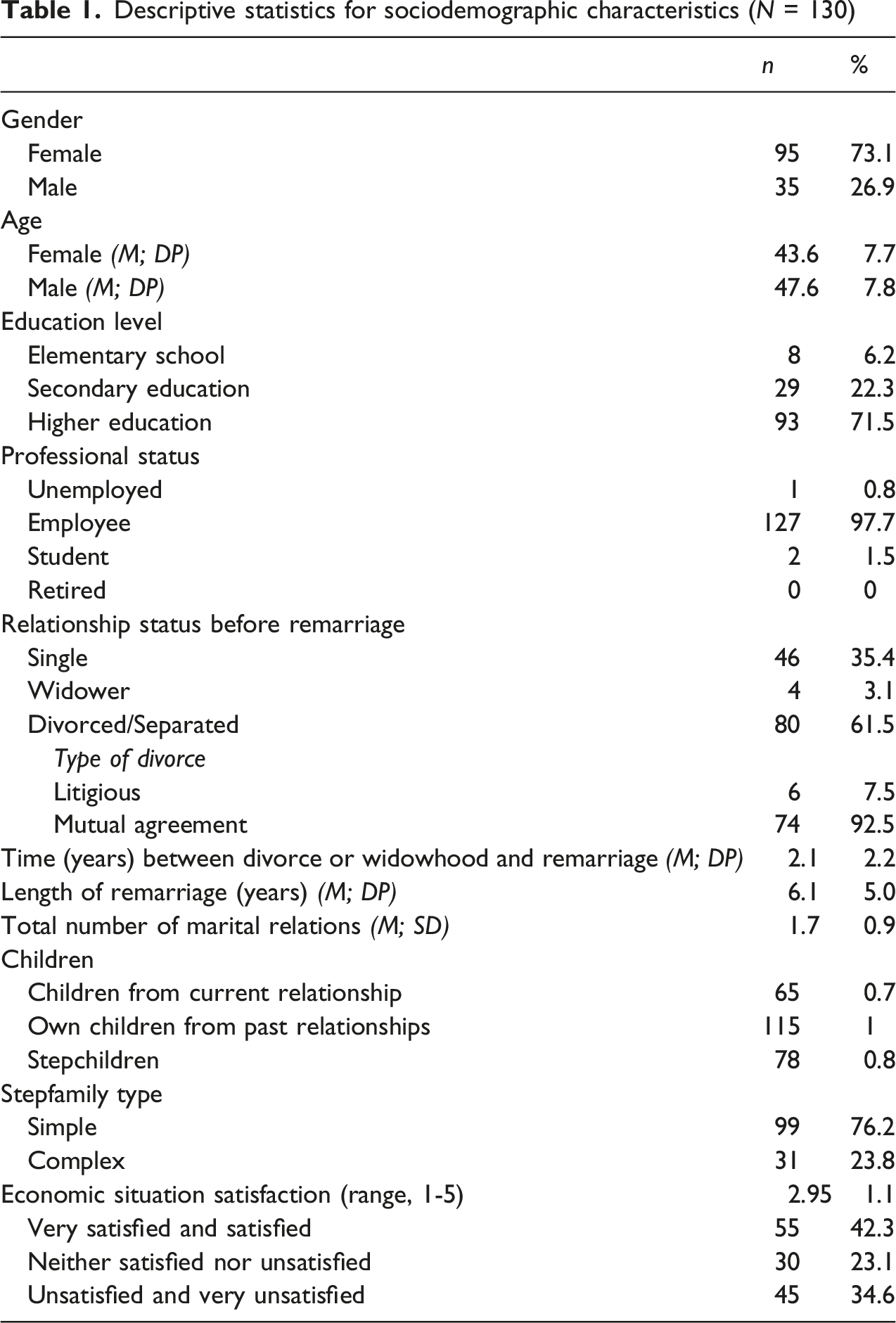
The sample consisted of 130 Portuguese participants (95 women and 35 men). Eligible participants had to have lived with their partner in the same household for at least 6 months (cohabiting or remarried), with at least one child from a previous relationship of one of the partners. The mean age of participants was 44.7 (SD = 7.9) years old, with men (M = 47.6 years, SD = 7.8) being older than women (M = 43.6 years, SD = 7.7). Participants had been remarried or cohabiting for 6.1 years on average (SD = 5.0), but the variation was high (from 1 year to 24 years). Participants of this study were predominantly well-educated; at least some college degree level had been completed by 71.5% of the sample (n = 93). Most participants (62.3 %) reported having been in two or more previous remarriages or cohabiting relationships. Thirty-nine (30%) participants had biological children from past relationships and 25 (19.2%) participants only had stepchildren. Seventeen (13.1%) individuals reported having both stepchildren and biological children from a previous relationship. Thirty (23.1%) participants reported having a combination of mutual children, stepchildren and biological children from a previous relationship. Sons and daughters’ age ranged from 4 to 37 years old.
Measures
Sociodemographic characteristics were collected through a specific questionnaire developed for this study. Participants were asked about gender, date of birth, level of education, and professional status. Information about current remarital relationship included length of the relationship, pre-remarital status, type of divorce (when applicable), time spent between the previous and current relationships, number of children from previous relationships, and number of stepchildren and mutual children. Based on this information, participants were categorized as belonging to a simple stepfamily (only one adult brought a child from previous relationships; without mutual children) or a complex stepfamily (both adults brought a child from previous relationships; with or without mutual children).
The Portuguese version of the Revised Dyadic Adjustment Scale–R-DAS (Busby et al., 1995; Pereira et al., 2017) was used to access marital adjustment. The R-DAS contains 14 items that yield three subscales’ scores (Consensus, Cohesion, and Satisfaction) and a total score for MA with a higher score indicating greater MA. All items are rated on a Likert-type scale. Questions 1 through 6 are reversed coded starting at always agree (5) and decreasing to always disagree (0). In this study, only the total adjustment score was used once the three subscales’ scores at T0 and T1 were significantly and positively correlated (r ranging from .51 to .81, p < .01). The R-DAS demonstrated to be a reliable measure of MA in remarital population (Cronbach alpha of .84; Higginbotham & Agee, 2013). The reliability coefficients for this study were .90 (T 0 ) and .91 (T 1 ) for the total score.
The Portuguese version of the Multidimensional Scale of Perceived Social Support (MSPSS; Martins et al., 2012) is a self-report measure used to assessed PSS from three sources (1) family, (2) friends, and (3) significant other (e.g., partner). The MSPSS is a common measure used to access individuals’ perceptions of the support received from social networks. The MSPSS contains 12 items that yield three subscales’ scores (Family, Friends, and Significant Other) and a total score for social support with a higher score indicating a positive perception about social support provided. Consistent with the aims of the present study, only the Family subscale’ score was used. All items are rated on a Likert-type scale starting at disagree very strongly (1) and increasing to agree very strongly (6) and higher scores indicate grater PSS. The MSPSS was found to be a reliable measure of PSS in various samples (Cronbach alpha range from .79 to .98; Kazarian & McCabe, 1991; Zimet et al., 1988; cited in Eker & Arkar, 1995) and in studies with different relationship configurations like same-sex couples (α = .88; Do et al., 2021) and divorced individuals (α = .88; Yilmaz & Fişiloglu, 2005). The reliability coefficients for total score in this study were .94 (T 0 ) and .92 (T 1 ) and .94 (T 0 ) and .93 (T 1 ) for the Family subscale.
Procedures
This study was part of a broader research project aiming to understand the psychosocial adjustment trajectories of people who lives in stepfamilies. Permission to conduct the research was obtained from the Ethics Committee of the Faculty of Psychology and Education Sciences University of Porto. Participants were recruited online through a web-based survey (LimeSurvey 3.15®), disseminated via leaflets (with a QR code for direct access to the online questionnaire) or mailing lists through both public (e.g., Portuguese Institute of Registries and Notaries, University of Porto) and private entities (e.g., Portuguese Psychologists Association). A project website (https://www.fpce.up.pt/recasamento/), Facebook (@recasamentonovasfamilias) and Instagram (@novasfamilias_novosdesafios) pages were also developed to help with dissemination between January 2019 and September 2023. Participation was not compensated. Before data collection, informed consent was obtained from all participants. All 677 participants that completed baseline assessment (T 0 ) and the ones who were willing and authorized to be contacted were invited through email to participate in a second assessment moment, 6 months later (T 1 ). A total of three email alerts were sent once a week, during three consecutive weeks, to each participant to remember the importance of their participation in the second moment of data collection. One hundred and eighty participants showed interest to participate in the second assignment and signed the second online informed consent, but only 151 participants (participation rate = 22%) finished the second online questionnaire. Of these, 21 were excluded from the final sample because they did not meet the study’s eligibility criteria (e.g., having (step)children), leaving 130 eligible participants for the current study.
Analysis
Statistical Package for Social Sciences (SPSS, 25.0) and IBM SPSS AMOS 25 were used for data analysis. All data collection protocol questions were mandatory; the participants were only able to advance to the next question when they finished the previous one; thus, no missing values analysis was necessary due to its inexistence. After Tuke’s analysis method, assessment of normality was performed considered kurtosis (<7) and skewness (<3) values (Marôco, 2018). No participant was considered as a potential outlier.
We used path analysis to investigate the covariance between the variables, testing for the adjustment of a cross-sectional model of relations between PFS and MA. These associations were examined using maximum likelihood (ML) estimation in Amos 25.0 for Windows. Comparative Fit Index (CFI), Tucker-Lewis Index (TLI), and Root Mean Square Error of Approximation (RMSEA) were used as fit indices for Confirmatory Factor Analysis (CFA). The following criteria were used: TLI and CFI ≥0.90, RMSEA <0.10, and χ2/df < 5 to indicate an acceptable fit (Marôco, 2010).
The model includes links between MA and PFS as longitudinal regression paths from each variable to the others from one point to the next (T 0 to T 1 ). In order to examine stepfamily type as a potential moderator of the paths involving PFS, path to T 1 MA was also drawn from the stepfamily type at time 1, and the respective two-way (PFS x stepfamily type) interaction terms for these variables. To examine stepfamily type as a potential moderator of the paths involving MA, path to T 2 PFS was also drawn from the stepfamily type at time 1, and the respective two-way (MA x stepfamily type) interaction terms for these variables.
The estimation of this model allowed us to test the hypotheses that (1) higher levels of PFS in T 0 will predict higher levels of MA in T 1 and (2) the association between PFS and MA would be moderated by stepfamily type. The test of this model also allowed us to conduct an exploratory investigation of the differences between simple stepfamilies and complex stepfamilies in the links between MA and PFS.
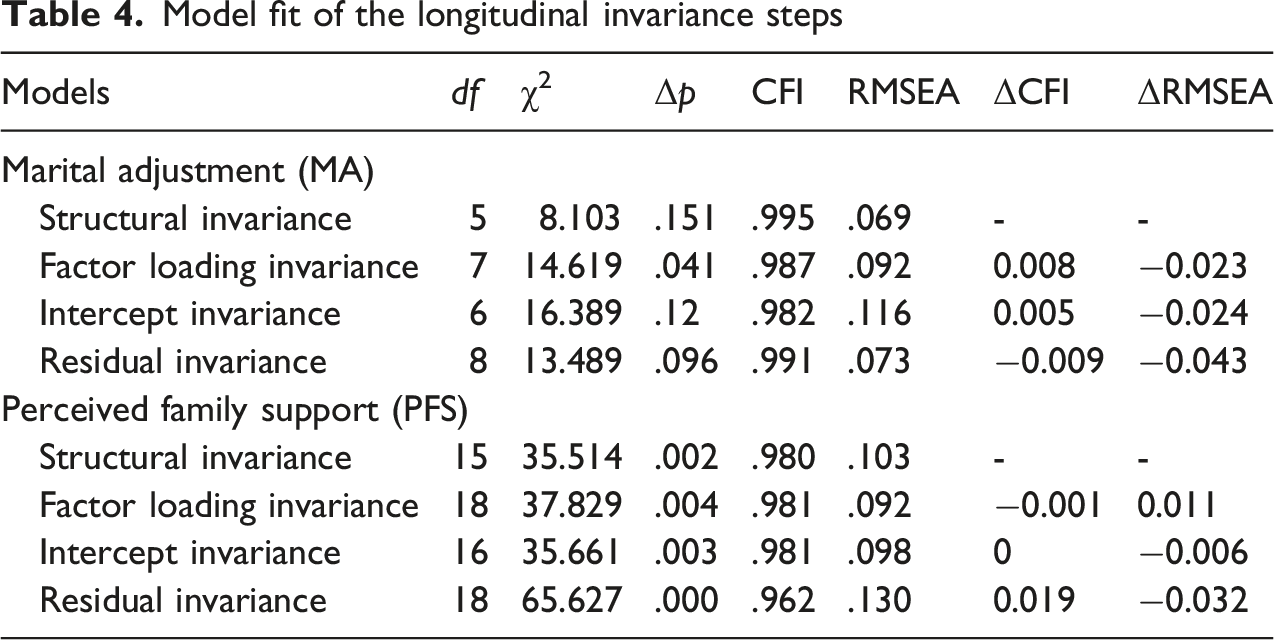
Personal perceptions about family support and MA may vary over time. Thus, the measure specified for its assessment needs to be able to assess the same constructs at various points in time. Testing the longitudinal invariance allows us to perceive the measurement consistency. As far as we know, this is the first study to use this approach. Measurement invariance among time was tested through the analysis of structural invariance, factor loading invariance, intercept invariance, and residual invariance (Cheung & Lau, 2012). When Δp > .05 (not significant), the models are invariant; when Δp ≤ .05 (significant value), ΔCFI and ΔRMSEA need to be analyzed considering the criteria proposed by Cheung and Lau (2012): ΔCFI ≤0.01 and ΔRMSEA ≤0.015 indicate no significant differences between models and invariance can be proved.
Results
Preliminary Analyses
Descriptive statistics for sociodemographic characteristics (N = 130)
Descriptive statistics for predictor, moderator, and outcome variables
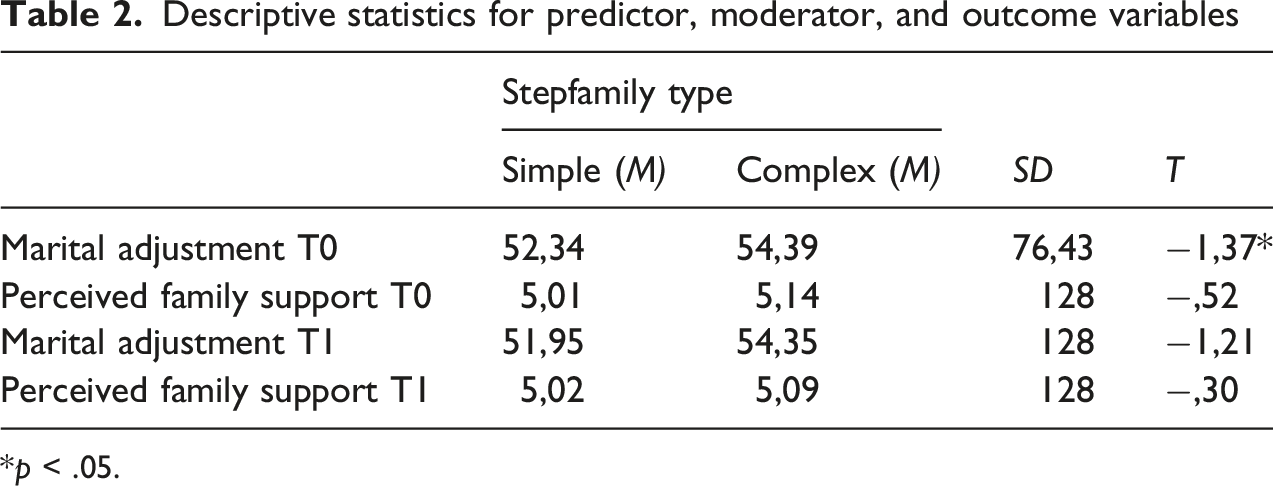
*p < .05.
Descriptive statistics and bivariate correlations among time 0 and 1 study variables
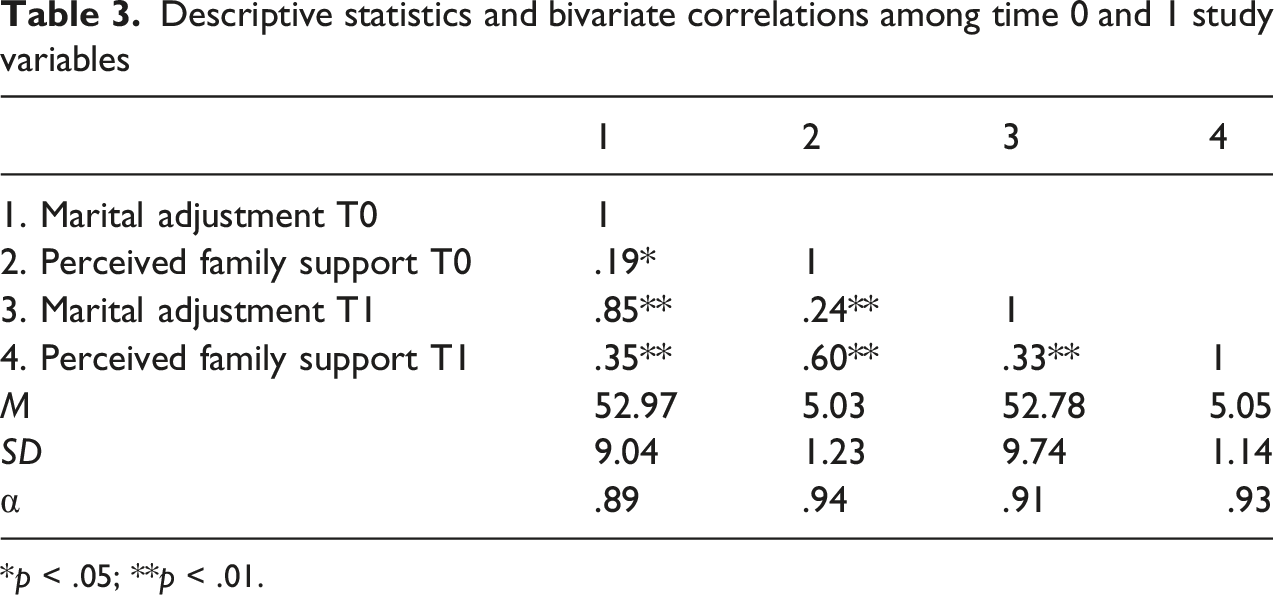
*p < .05; **p < .01.
Longitudinal Invariance
Model fit of the longitudinal invariance steps
Predictors of Levels of Perceived Family Support and Marital Adjustment
Considering the significant correlations between MA and PFS, scores of these variables were examined simultaneously in regression analysis. This analytic plan aims to examine associations between MA and PFS, although developed here to test not only the specific impact of the PSS from family but also to test associations between MA and PFS across a 6-month follow-up period. Maximum likelihood estimation in Amos for Windows (version 22) was used to examine these associations. Figure 1 illustrates the specified model developed based on direct and moderated associations formulated on the hypotheses. This model includes path analysis between variables (MA and PFS) in two different times (T
0
and T
1
). Results of the regression analyses indicates that T
1
MA was not significantly predicted by T
0
PFS (β = .02, SE = .03, p < .78). However, the opposite effect is observed: T
1
PFS was significantly predicted by T
0
MA (β = .25, SE = .12, p < .001). In addition, two autoregressive effects are observed: T
1
MA was significantly predicted by T
0
MA (β = .83, SE = .05, p < .001) and T
1
PFS was significantly predicted by T
0
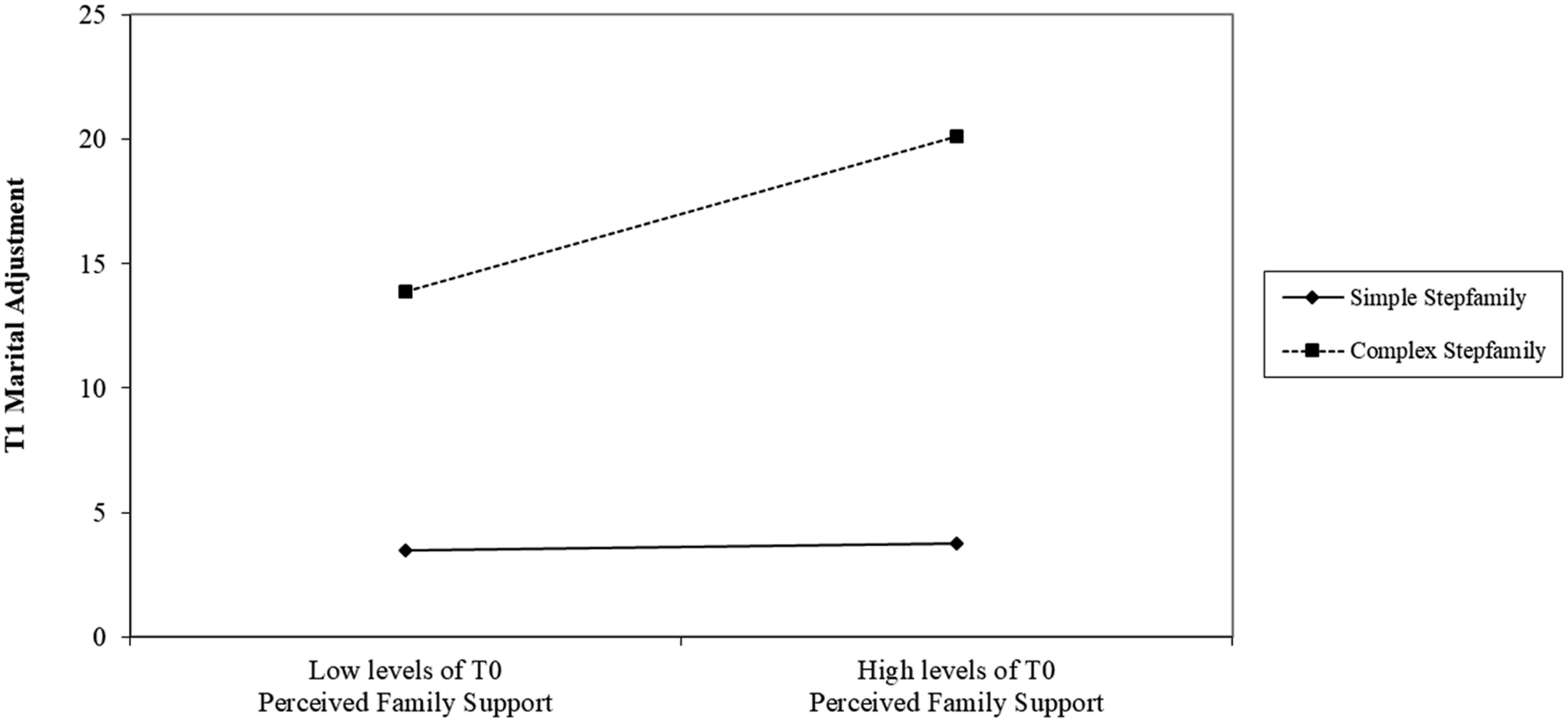
PFS (β = .55, SE = .06, p < .001). The final model (Figure 1) presented a good fit to the data: χ2 (2) = 6.97, χ2/df = 3.49, p = .031; CFI = .98; TLI = .86; RMSEA = .11. Although acceptable RMSEA levels should not exceed .10 (Marôco, 2010), according to Kenny and collaborators (2015), in models with a small sample size and a “small df values, RMSEA can exceed cutoffs very often, even when the model is correctly specified” (p. 501). In order to examine stepfamily type as a potential moderator of the paths involving PFS and MA, paths to Time 1 MA and Time 1 PFS were also draw from the respective two-way interaction terms for these variables (PFS x stepfamily type and MA x stepfamily type, respectively). Our results found that the two-way interaction terms involving PFS and stepfamily type was significant (β = .14, SE = .07, p = .005): MA T
1
was significantly predicted by T
0
PFS only when the stepfamily type variable moderates the relationship between them. Interaction terms were analyzed using simple slope analysis (Aiken & West, 1991). The analyzes indicate that increases in PFS were associated with increased levels of later MA, but only among adults that lives in complex stepfamilies. However, no significant results were found to the two-way interaction terms involving MA and stepfamily type. Figure 2 displays the interaction. Standardized regression coefficients for Time 0 predictors of Time 1. *p ≤ .01. **p ≤ .001 Interaction of stepfamily type (simple and complex) in the association between T0 perceived family support and T1 marital adjustment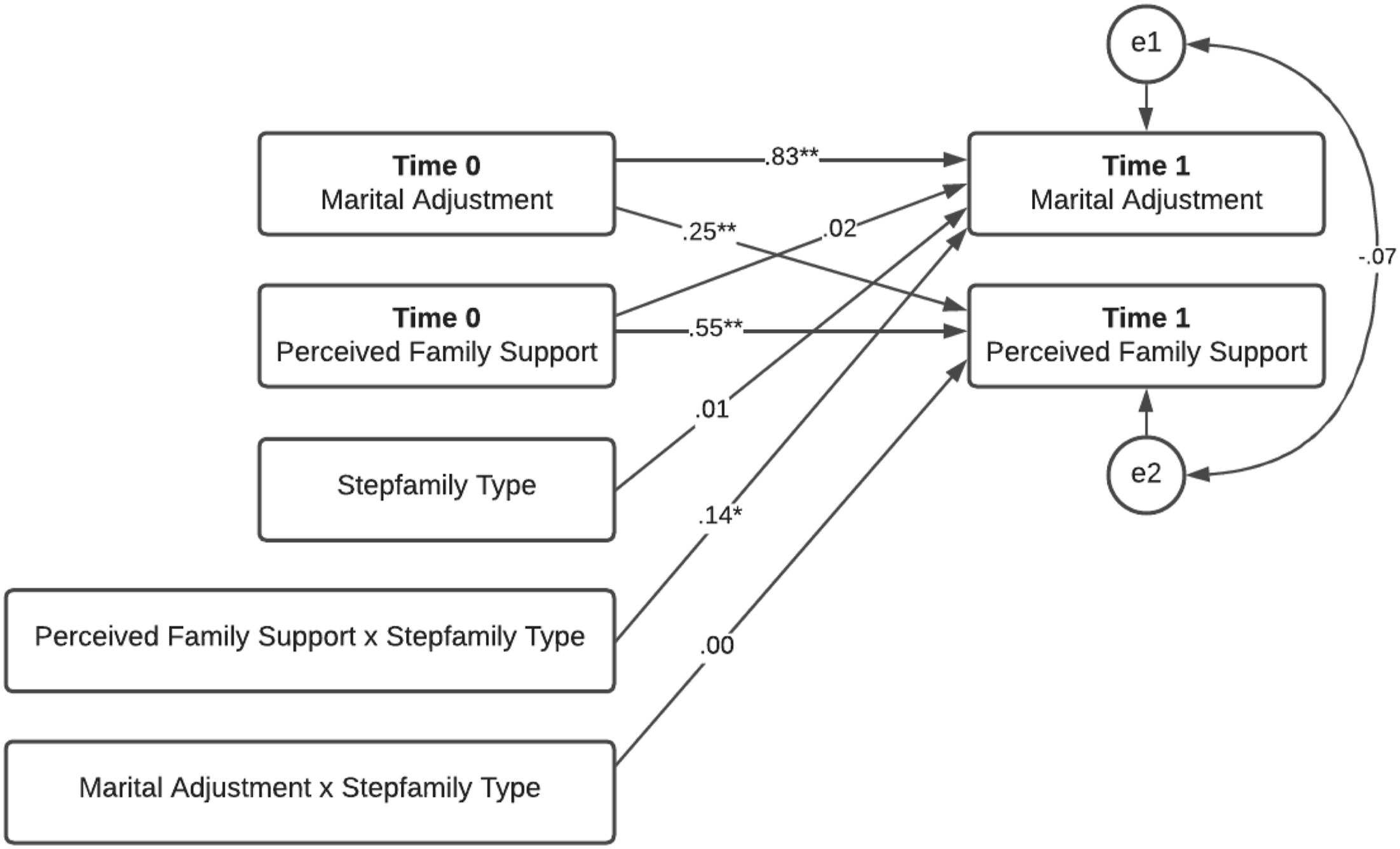
Discussion
This 6-month longitudinal study aimed to examine the direction of longitudinal effects between PFS and MA in the context of stepfamilies. Additionally, another purpose was to test whether these associations could be moderated by the stepfamily household type (simple stepfamily or complex stepfamily). Examining this relation contributes to the field’s understanding of structural differences between household types and their influence on the stepcouple relationship.
This study found that T 1 MA was significantly predicted by baseline MA, and T 1 PFS was also significantly predicted by baseline PFS. These findings provide evidence for the stability of individual differences from baseline to 6 months later and suggest that participant’ relative standings on MA and PFS have changed very little over time, due to the sizable autoregressive coefficients obtained (Selig & Little, 2012). Previous longitudinal research with married participants had yielded similar results regarding the direction of MA effects. Goldfarb and collaborators (2019) had found similar results, with baseline MA predicting the same variable later. However, there remains a lack of longitudinal research concerning MA in people who lives in stepfamilies. Thus, our results contribute to the literature on the stability of MA in remarried people. The results found in this study are also congruent with previous research evaluating perceived support. Eagle and collaborators (2019) found that perceived support relates to how a person evaluates their supportive situation, rather than a true reflection of how much instrumental support they receive. This perception tends to be stable over time since perceived support involves a long-term appraisal of the sense of support. This is in line with the stability we found in our results for PFS.
Consistent with previous studies (e.g., Kim, 2010), our results suggest a positive association between MA and PFS. As for the longitudinal analyses, we found that baseline MA significantly predicted later PFS, but there was no significant effect for the inverse path, suggesting that the temporal relation between these variables is unidirectional. In other words, the presence of higher levels of MA significantly predicts higher levels of PFS over time. Previous research had yielded mixed results regarding the direction of these effects. Although most studies have found that PFS positively affects and predicts individual’ MA levels (e.g., Mert, 2018), there are also studies (e.g., Kurdek & Schmitt, 1987) that found a negative correlation between social support and remarried couple’ marital satisfaction. Despite this, we know that stable couples demonstrate well-adjusted marriages. In turn, stable and well-adjusted marriages tend to perceive their family dynamics with more satisfaction and have a more positive outlook on life (Hicks & Platt, 1970), accentuating the positives and relativizing the impact of the negatives (Meunier & Baker, 2012). Additionally, according to Uchino (2009), people with high levels of PSS have a “positive psychosocial profil.” Thus, our results suggest that remarried couples with higher levels of MA will tend to perceive the availability and adequacy of family connections more positively.
As hypothesized, we found a positive association between PFS and later MA that was moderated by stepfamily type. Our results demonstrate that while stepfamily type was not directly associated with absolute levels of MA, it was associated with temporal levels of MA, and these levels were found to vary as a function of PFS. Specifically, the current study suggests that increases in PFS were associated with increased levels of later MA, but only among adults who live in complex stepfamilies.
In the literature, there is evidence to suggest that complex stepfamilies report significantly lower marital satisfaction (Cherlin, 1978), higher levels of stress (Pasley & Ihinger-Tallman, 1984), depression (especially in stepmothers; Doodson & Davies, 2014), and ambiguity in family boundaries and roles (Kim, 2010) when compared to adults who live in simple stepfamilies or even nuclear families. These are also families with a higher number of (step)parenting and co-parenting dyads as well as intergenerational relationships, in particular with grandparents and stepgrandparents. These large extended family relationships can be synonymous with high structural complexity, leading to the presence of stress and conflict (Falke & Larson, 2007; Gosselin & David, 2007). On the other hand, the existence of a higher number of relational dyads with extended family may also mean the existence of a larger and more available family support network (Amah, 2021). Thus, complex stepfamilies may have a more extensive support network at their disposal, which can lead to higher (and more satisfactory) levels of PFS.
The internal functioning dynamics of the complex stepfamily may also provide a possible explanation for increasing PFS levels, and consequently, lead to higher levels of MA. Unlike in simple stepfamilies, all members of the complex stepfamily experience dual roles. That is, the woman is simultaneously a mother and stepmother, the man is both a father and stepfather, and children can be both a son/daughter and stepson/stepdaughter simultaneously. This possibility that all members of the complex stepfamily can experience dual roles diminishes role ambiguity (Van der Pas & Van Tilburg, 2010) and can lead to higher levels of empathy (Crosbie-Burnett, 1989), making the perception of intra-family support greater. For example, Shapiro and Stewart (2011) concluded that the support of stepsiblings can be very significant within the family when they accept and validate the role of stepparents. This validation and acceptance contribute to more positive stepchild-stepparent relationships that increase marital quality (Bryant et al., 2016).
Thus, we posit that one possible explanation for the moderating effect of stepfamily type on the relationship between PFS and MA is that the external (large extended family networks) and internal (role sharing) structural characteristics of complex stepfamilies may increase levels of PFS and consequently lead to higher levels of MA.
Study Strengths and Limitations
This study has some strengths and limitations that must be considered. The small sample size might limit the ability to detect potentially meaningful relationships among study variables. Furthermore, our sample was predominantly composed of women, which may limit the generalizability of our findings. More studies should be performed on larger samples to confirm the present findings. Since the sample was unavoidably voluntary, selection biases may have occurred, causing the responses of study participants to be different from those who refused to participate. Additionally, response bias may also have been attributed not only to participant dropout, which is inevitably linked to the longitudinal design, but also to the self-reporting measures about family and couple relationships that may induce social desirability. Objective or observational measures should be considered for future studies.
As for the limitations, we only focused on the effect of stepfamily type on the interaction between PFS and MA, not considering the multidimensional dimension of each type of stepfamily, particularly the quality of intra-stepfamily relationships. New studies must consider the quality of the stepchild-stepparent relationship as a variable that may influence the results. Nevertheless, we believe that this study makes an important contribution to the literature on stepfamily functioning, particularly for families in Western Europe and researchers with international perspectives. A major strength is the collection of longitudinal data from people who live in stepfamilies—a population that is difficult to locate due to the lack of institutions dedicated exclusively to their needs. This longitudinal approach allows for a more solid perspective of the questions investigated in our study.
Footnotes

Funding
The authors disclosed receipt of the following financial support for the research, authorship, and/or publication of this article: This work was supported by Portuguese Science and Technology Foundation under the project PD/BD/143069/2018.
Declaration of Conflicting Interests
The authors declared no potential conflicts of interest with respect to the research, authorship, and/or publication of this article.