



Abstract
For more than 20 years, the efficacy of using the wraparound approach to support high-risk youth has been examined in educational and community settings. Few studies show the value of wraparound service from either a school- or community-based agency as a dropout prevention strategy. Findings from a federal research grant project suggest that many high-risk teens reconnect with educational goals once their lives become more stable after receiving wraparound support. A discussion of the barriers that prevent the most needy school-age youth from accessing wraparound service is offered, with suggestions for how school personnel can increase high school graduation rates for their students with the highest needs.
School personnel have a myriad of responsibilities for educating our nation’s young people, and a limited budget. But the cost of not educating a student is great, for the individual and the taxpayers. Every 9 seconds a student drops out of high school in our nation (Martin & Halperin, 2004). Over a lifetime, it is estimated that high school dropouts will require over $210,000 related to lower earnings, need for social services, and costs associated with court involvement (Levin, Belfield, Muennig, & Rouse, 2007). What causes students to drop out? Can educators customize their efforts to identify and support high-risk student needs and thus reduce the dropout numbers without breaking the bank?
The Dropout Challenge
Statistics from the National Center for Educational Statistics (NCES) 2007-2008 graduation data shows that only 75% of freshman graduate from high school in 4 years (NCES, n.d.). In recent months, there has been renewed focus to reduce the dropout rate in U.S. high schools and provide dropout prevention strategies in our schools. Factors that affect a teen’s decision not to complete high school can include academic failure (learning problems or ineffective instruction), disinterest in school (lack of a relevant curriculum or feeling alienated), or problematic behavior (related to school violence or bullying or ineffective discipline). Research is growing on the importance of universal design for learning strategies to improve effective instruction for all types of learners (Hall, Strangeman, & Meyer, 2011) and for schoolwide positive behavior supports and interventions to increase academic performance while reducing discipline referrals (www.pbis.org).
Other factors can also effect a student’s decision to stay in school. Some students experience problematic life events that make school success almost impossible. These life events may include mental health concerns (emotional or psychiatric problems, depression, attention deficit hyperactivity disorder, learning problems, low self-esteem), family concerns (the teen has a child or must work to help support the family), or the presence of significant risk factors (homelessness, stress from being a foster child or aging out of foster care, substance abuse problems, or involvement with the court system). These life problems often start early in a child’s life and continue to create issues that make it difficult for a student to focus on schoolwork. How can schools address such a range of needs for their most at-risk learners, in order to reduce or prevent the rate of students dropping out and help high-risk students succeed in schools?
The National Governors Association (Princiotta & Reyna, 2009) provides a plan to assist school districts in achieving higher graduation rates for all students. This plan directs schools to actively promote high school graduation for all its students, suggesting that someone be assigned the responsibility for dropout prevention. The plan also suggests that schools target the youth who are most at-risk for dropping out, including building a flexible fund into the school budget to meet the needs that may arise when targeting this group. Third, the plan involves schools reengaging youth who have dropped out of school, which in some schools has been met by having a graduation coach who can individualize the connection between the high-risk students and school completion. Finally, the plan suggests that schools provide a rigorous and relevant way for students to finish high school, whether through a diploma or high school graduation equivalency diploma (GED).
The nation’s schools need to address the dropout challenge. Traditional models have yet to yield significant changes in the graduation rates since the 1970s (Heckman & LaFontaine, 2008). This article describes another tool that is a promising practice in community support services, one which can be applied to support high-risk teens in schools and which was used in a grant-funded program to support high-risk teens.
The Wraparound Process
The wraparound process meets the criteria established by the National Governors Association in several ways. Wraparound services are offered in many communities in the United States by agencies that are tasked with meeting the needs of high-risk youth who may well end up in out-of-home placements. Flexible funding is a vital part of the wraparound services offered by these communities, with pooled agency funds designed to meet the actual needs of the high-risk youth rather than offering the traditional menu of agency services. The purpose of the wraparound process is to identify and then support the high-risk youth’s individual strengths and then to encourage personal goal setting. This often includes problem solving for immediate crisis situations so that the youth can then better address educational and life goals. The wraparound process involves a wraparound facilitator (WF), who acts in the capacity of a coach, helping the student identify positive and trusted people to support the teen through the steps of stabilizing his/her life for both short- and long-term goals. These youth identify natural supports (e.g., friends, family, neighbors, and mentors) that come together with paid agency supports (e.g., case workers, probation officers, and teachers) to form a child and family team (CFT). The CFT meets with the youth, family, and facilitator in order to help the youth achieve individualized goals and support them to navigate the system and become independent.
The National Wraparound Initiative (Penn & Osher, 2007) describes the 10 principles of the wraparound process. Typically, these principles are followed during four phases of the wraparound process: (a) engagement and team preparation, (b) initial plan development, (c) plan implementation, and (c) transition. The WF is the one person who is totally committed to the process and trained to facilitate and support the movement of the individual toward his/her goals in a healthy and supportive way. This process typically takes 3 to 18 months, depending on the individual, his/her needs, and the ability of the individual to maintain focus and feel supported during this time. There are CFT meetings, phone calls, and client-centered plans that connect the individual to any needed agencies or natural supports that help the client move into a more stable life setting.
Mental health and child welfare agencies offer a wraparound approach in many states in the United States as a community support. But schools can also be an entry point for these services, especially working with youth with emotional/behavioral challenges (Eber & Nelson, 1997; Epstein et al., 2005). This process is beginning to be used in schools for those few students (1% to 2%) who have the highest level of emotional or behavioral needs (Eber, Breen, Rose, Unizycki, & London, 2008). The wraparound approach can help sort out the elements that have a negative impact on those high-risk teens being successful in school and in life. School personnel who provide this wraparound support do so in collaboration with community teams, families, and agencies, for a comprehensive support service. The elements of a good wraparound approach provide a promising practice for promoting positive youth and system outcomes to youth with high-risk needs, that is, those with serious emotional and behavioral disorders. This process can support the stabilization of lives of some of the most high-risk students in our schools, which enables them to focus on personal goals such as education. This can be a direct school service for reintegrating youth back into the school system.
Purpose of the Article
The purpose of this article is to review and disseminate findings from a federal Earmark grant–funded research project involving the use of wraparound service to support high-risk teen parents. The connection between the high-risk youth who stayed involved with wraparound support over time and their reconnection with school became apparent by the end of the study. This study also compared two different school/community models for delivering wraparound services to youth. County A provided support via a wraparound program that was administered in a centralized location, the county’s intermediate school district, and County B offered services using community agencies that varied over time based on which agency was the recipient of the contract, thus a decentralized approach.
Method
Target Population
This federal grant project used the wraparound model to support teens with the highest risks for becoming dropouts from schools. The teens who participated in the project met the project eligibility criteria of being 13 to 21 year olds who were already pregnant or parenting and who also had one or more of the following risk factors: homelessness, mental health problems, in/aging out of foster care, and/or already associated with juvenile justice. These teens were referred through community wraparound teams in two counties in a Midwest state over a 2-year period because they matched the eligibility criteria. They were served by state-trained WFs, who were hired through the grant to specifically work with this high-risk group. These high-risk teen parents were determined to be the most critical youth needing support to alter their lives so they could become successful adults and parents, as well as increasing positive outcome for their children.
In the second year of the grant, a small pilot program was included targeting teens who were identified as seriously emotionally disturbed and were served in a center-based school for students with emotional problems. These younger teens (aged 11-13 years) had one or more of the four risk factors of the larger target population of the project but did not have to be a teen parent.
Participants
Over the 2 years of the project, 42 adolescents became participants in the study. Thirty-eight of these teens were females, and 3 of the 4 males came from the small pilot program at the center-based school. Ages of participants ranged from 11 to 20 years, with the majority (34) being aged 16 to 20 years. With regard to ethnicity 26 African American, 12 Caucasian, 1 Hispanic, 1 American Indian, and 2 undisclosed. The most common risk factor for the participants was homelessness (25), followed by mental health needs, court involvement, substance use, and then foster care. Table 1 displays the distribution of these characteristics.
Demographics of Participants in Wraparound Project (N = 42)

Four women with Masters in Social Work degrees were hired by the project staff and received state training as WFs. Two were hired for the full 2 years of the project, one for each county served. Both these women were African American. Two others were hired for the last year, both Caucasian, one who helped to handle the high caseload in County A and the other to bring wraparound support to the pilot program in the center-based school for young teens in County B.
Procedure
High-risk teen parents who matched the requirements of this study were referred to the program by family members, agency workers, school social workers, and self-referrals in order to receive the wraparound intervention to help stabilize their lives. They were assigned to the grant-funded WF in the county in which they lived. These WFs worked in county agencies (one within the intermediate school district where County A’s wraparound services were housed and one in a not-for-profit agency in County B). The teens could receive wraparound support whether they participated in the study or not, but all chose to participate. The length of stay in the program varied for each individual and was determined solely by the commitment of the teen or their readiness to “graduate.”
After the initial meeting, the WF would facilitate steps to alleviate any immediate crisis the teen was encountering (homelessness, eviction, health issues), while also working with the teen to identify their CFT who would work with the teen to meet other goals. The WF’s kept monthly logs of progress on life domains (e.g., housing, employment, education, health/mental health) for each participant, as well as doing a pre- and postassessment to determine any change or improvement in any life domain as a result of the wraparound intervention. All four WFs were trained to score participants using two standardized assessments, the Child and Adolescent Functional Assessment Scale (CAFAS; Hodges, 1990) and the Functional Assessment Rating Scale (FARS; Ward& Dow, 1998). Program participants were also invited to participate in exit interviews once their case was closed. Project staff held quarterly meetings with grant and community agency staff, culminating in a final focus group discussion of the project.
At various times during the 2 years, WFs in both counties invited participants to activities that the participants requested, such as nurturing parenting training, budget workshops, or social events where they could bring their young children, such as trips to the library or cider mill. The WFs also recognized that some participants did not have consistent and stable support to help achieve goals or to serve on their CFT, so the grant project trained and provided mentors for those participants.
Research Design
This project used a mixed methods format for determining the effects of the wraparound intervention, with pre/post test descriptive analysis as well as qualitative analysis of exit interviews and focus group summaries.
Results
Changes in Life Functioning
At the end of the project, descriptive results showed that the length of time that the teens stayed involved in the wraparound service directly corresponded with whether they met their personal goals and improved in life functioning within their various life domains. The teen client data were sorted by their length of time in the program using three categories: Nonengagers, who stayed on average 2.3 months but who never engaged in the process; Early Dropouts, who generally only focused on one goal and then drifted away in less than 5.3 months; and a final group, Participators, who stayed through to completion of the wraparound process (on average 8.5 months), where they met at least one or more goals they had set and worked successfully with their WF and CFT to solve the problems in their lives. Table 2 represents the progress the teens made within the wraparound process, sorted by the length of time they stayed involved in the program.
Completion of Wraparound Steps for Clients in Two Counties, by Level of Participation

Final analysis of the client progress showed that length of time receiving wraparound services increased client success. Nonengagers were unable to connect with even the basic elements of the wraparound process, but descriptive data show that 9 of 11 clients maintained or improved their educational status. Early Dropouts were able to make some progress in the wraparound process, such as identifying and meeting (on average 2.3 times) with their CFT and setting personal goals, and 10 of 11 clients maintained or improved their educational status. The Participator group, those who stayed involved with the wraparound process on average 8.5 months, made progress on their personal goals and educational goals, with 19 of 20 clients showing improved educational results.
Two different standardized measures were used to determine the growth or stabilization of the Participator clients, who stayed long enough for pre-and posttest analysis. The WFs were trained and certified to administer the CAFAS (Hodges, 1990) and the FARS (Ward & Dow, 1998). Higher scores on these assessments represent higher risk (more problems), so a decline in scores demonstrates growth or stabilization. Scores for the 20 Participators, as seen in Figure 1, show that their average growth in life functioning on the CAFAS went from 42 (pretest) to 32 (posttest) and on the FARS from 41 (pretest) to 32 (posttest).
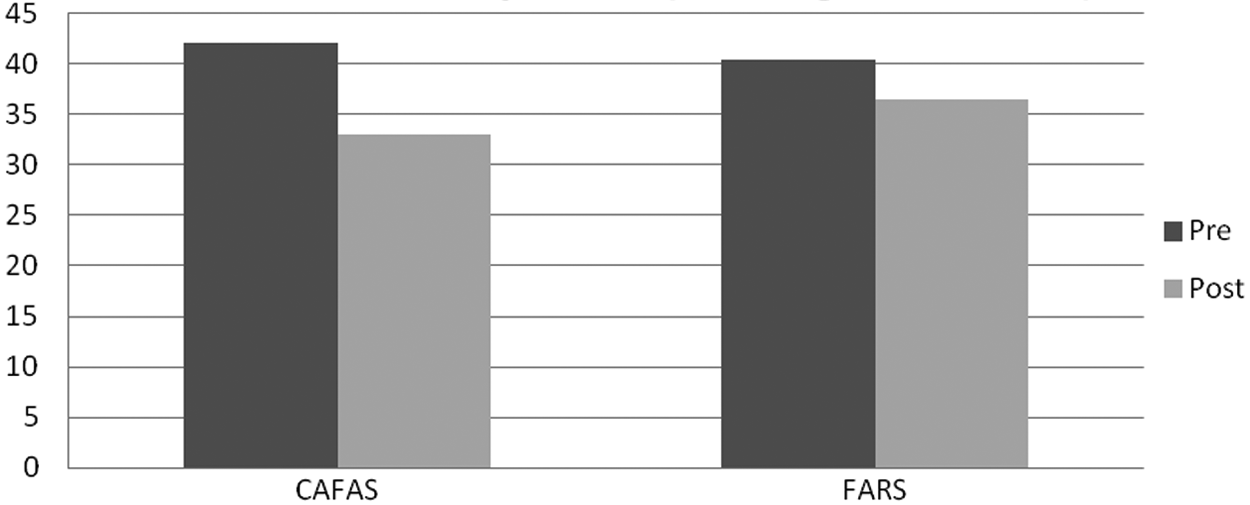
CAFAS and FARS: Average scores pre and post for 20 participators (average 8.5 months)
An unforeseen problem with using these two assessments with the high-risk teens/teen parents who participated in this project was observed, because even their scores at baseline were much lower than would be expected for clients in typical community wraparound programs. A typical CAFAS pretest score for a client receiving wraparound support in a community would be about 100. The data from the project’s WFs in both counties were similar in finding that the high-risk teens could only be rated low on their pretest scores on the CAFAS (e.g., average of 41), despite their high-risk profiles. In reviewing this phenomenon (which would have kept the high-risk teens out of the community wraparound programs), it was determined that the scoring was appropriately done but that the assessments did not allow for scoring that spoke to some of the critical problems that the clients were encountering. The CAFAS measured key clinical and behavioral aspects for adolescents, but it did not measure the adult responsibilities that our young parents encountered, such as providing basic needs for their child (children) and struggling with homelessness and unemployment. Furthermore, CAFAS is designed to assess minors who have caregivers, whereas most of our clients did not have caregivers, even if they were minors, but instead they had a caregiver role themselves. Although the FARS also measured clinical and behavioral domains, as well as activities of daily living, interpersonal relationships, and other domains relevant to our clients, it alone did not provide enough information to determine that our clients had been successful in our program. As a result, the grant team developed a new assessment, The Success Index for Teen Parents, where clients were rated as being at Crisis, Vulnerable, or Stable levels for pre- and postanalysis. The facilitators were trained to use this new index by scoring a series of vignettes. Interrater reliability was tested and resulted in an 86.8% reliability factor. Facilitators used this new assessment at pre- and posttimes to measure how the Participator clients were functioning in 11 different life domains: Housing, Financial Resources/Income, Access to Mental Health Care, Teen Parenting and Home Environment, Informal Support System, Legal Lifestyle, Education, Behavior, Safety, and Interpersonal Relationships. Figure 2 shows this comparison highlighting the 6 life domains showing the most significant progress. The wraparound process appears to have helped stabilize the lives of the 20 high-risk teen parents (just under half of the 42 program participants), the group of Participators who stayed on average 8.5 months using this intervention.

Success Index for Teen Parents: Percentage of participators rated as crisis or vulnerable by life domain
Changes in Educational Status
The high-risk teen parents were found to engage in educational outcomes correlated to the length of time they engaged in the wraparound treatment/intervention. The percentage who kept an educational goal as a part of their planned increased over time. There were 64% of the Early Dropouts who had an educational goal, 82% of the Nonengagers set an educational goal, and 95% (19 of 20 teens) of the Participators also set educational goals. The Participators, in fact, established two or more educational goals on average, and 95% of them maintained or improved their educational status, as measured on The Success Index, using pre- and posttest results. Seventeen of these Participator teens (85%) were enrolled in school or acquired their GED as they exited from the wraparound project. The results of the Nonengager group (average 5.3 months in treatment) were lower but still credible, as 91% of them maintained or improved their educational status, although only 55% increased the percentage enrolled in school or their GED. For the high-risk teens who participated in wraparound services an average of only 2.3 months, the Early Dropouts, 82% maintained or improved their educational status and 67% increased their enrollment in school or GED. Table 3 demonstrates this educational progress over time by groups.
Postintervention Educational Outcomes

Results from the Success Index.
Perceptions From Exit Interviews
The Participator clients (clients who stayed committed to the wraparound process) met with their natural support teams (CFTs) on average 5.7 times, as well as just with their facilitators 4.7 times, in order to discuss their goals, plans, and progress. It is to be noted, however, that these data do not include additional time and activities performed by the WFs, such as resource coordination, phone calls, text messages, and meetings in which a task/action plan was carried out, like the facilitator taking the client to DHS and helping the client fill out paperwork. The high-risk teen parents who graduated from the wraparound program were asked to contribute their own thoughts about whether wraparound services helped them. Exit interviews addressed what the Participators liked about wraparound support, how their CFT helped them, and what they would say to someone else about wraparound. The exit interview also addressed what clients said their goals had been and whether they had been successful.
Questionn: How did wraparound help you?
“(My facilitator) kept my best interest in mind. She kept asking if I needed anything and was concerned about me emotionally as well as physically with the pregnancy.” “It helped a lot. I’m more vocal now. I can talk to people. I don’t really get as mad now.” “I realized at first I thought that no one really cared because I’m a teenage mother and everything. But once I met my facilitator, she talked me down, talked to me, told me it’s okay to be supported, she showed me support, she had faith in me. So when someone else has faith in me I have to have faith in them too. At the time, I was unstable, and wraparound really helped me to become stable for me and my child.”
Question: How did your wraparound team help you?
“Their support was really helpful, just knowing they were on my side.” “My advisory teacher at the high school . . . was like another mother; she really helped me through a lot, me and my daughter.” “It was a rule in the meeting that there was only one speaker at (a) time. So . . . I was able to say what I needed to without being interrupted or somebody interfering with something or saying something against it.”
Question: What would you say to another teen parent about wraparound?
“Wraparound has your best interest in mind, they are genuine. It brought the people on my team together.” “The good thing about wraparound is that you do have a supportive team. And I like wraparound because you have choices. Everybody has to have a choice in life. “They help you prepare for the future.” “It helps you. It actually gives you a person that wants to come around and be like, I’m here for you other than your family . . . you are actually able to reach out to someone else in the community. And somebody that wasn’t around all the time but when they were around you and were actually, you know, able to get help from them.”
Question: Tell me about your goals and if you accomplished them.
“One of my goals was to graduate and I should be graduating this year. Another goal was to get my own place and now I have my own apartment. I also wanted to get a job and now I have three.” “(My goals were to) stay safe (I had a problem with hurting myself) and healthy and to have a good labor. Both were met.” “I didn’t accomplish my goal. It was to be graduated from school and go to college for (my) CNA. I had the one check, my car broke down, but I’m still trying to work on it. I (am) just going to get my GED.”
Discussion
Limitations
A major limitation of this study was one of sample size. Despite much effort to recruit clients in two large counties, the total number who participated across the 2 years was much lower than expected for several reasons. County A was approximately four times larger in population than County B, and provided wraparound services through the intermediate school district, so recruiting high-risk teen parents for this study in County A was easier in that location than in County B. However, WFs in both counties had to maintain small caseloads of 8 to 12 clients at one time because of the high needs of their wraparound clients. The target population of this study was also outside conventional referral/delivery models for wraparound service in the communities, which impeded the ability to identify a higher client base within the time of the grant program. As a result of these factors, the small sample size impeded the type of statistical analyses that could be conducted. Therefore, only descriptive analysis and limited bivariate analyses were appropriate.
In addition to the limitations imposed by the small sample size, the needs of the clients made a more rigorous random control outcome design unethical, and therefore a single group outcome monitoring design was used. Without a comparison or control group, there are limitations to the validity of the study results. Positive outcomes could be a result of factors other than the program intervention (i.e., maturation of participants, outside events, historical events). However, testing effect, attrition, and instrumentation effect were monitored and managed through the implementation of evaluation protocols.
A final limitation of this study involved the very nature of the risk factors and vulnerability of the clients who were targeted and a treatment or intervention that required a long time commitment. It was asking a great deal for these clients to find the time and energy to commit to a process that worked best if they could maintain involvement over the course of many months. The high-risk factors (e.g., homelessness, mental health issues) that were included in the target population contributed to difficulties for the WFs to maintain contact with the clients. The group identified as Nonengagers ended their commitment quickly before relationships could be started, and the group identified as Early Dropouts found help with their crisis condition but then exited the program. Approximately half of the clients in this study were able to engage for sufficient time to demonstrate stabilization or success on their personal goals. The clients who could demonstrate more resilience in coping with the risks in their lives became the Participator group, the ones who could profit most from this intervention.
Barriers to Accessing Wraparound Services
There are a number of agencies that support the well-being of children and adolescents in communities in the United States, including some that provide wraparound services for teens. As a result of this study, however, two barriers became apparent that would prevent high-risk teens from accessing community wraparound support. These include difficulties related to where high-risk teens can find and access wraparound services within their communities (entry point) and whether they would be eligible to obtain that service based on agency restrictions.
Barrier 1: Entry point for accessing wraparound services
The high-risk teen parents in this project came from communities in two different counties that provided wraparound services in two different ways. County A administered wraparound services through a centralized system located at the intermediate school district. A centralized system is defined in this research project as a social service (e.g., wraparound) being administered by one agency in one location, even if the funding sources for the service change over time. A preexisting steering committee composed of community agency personnel helped facilitate the delivery of all wraparound services within the intermediate school district. School social workers (in 28 school districts) were also trained to make referrals for high-risk students to the county wraparound team. The grant-funded trained WF in County A was added to a preexisting team of trained facilitators but was tasked to work only with the specific population identified for the grant-funded study. Referrals came from school personnel, social service agencies, or by word of mouth in the community.
County B administered wraparound services through a decentralized system. In this system, social services were administered by agencies throughout the county that could change based on which agency held the contract to provide that service. Although a few school social workers were aware of the county wraparound services, there was no countywide training for the school social workers (9 school districts) regarding this service and no systematic referral process for it from the school districts. Placement of the grant-funded WF was done in collaboration with a community-based wraparound team and one local nonprofit agency that volunteered to support the project. The facilitator for County B was housed in this one nonprofit agency, and referrals for the grant-funded WF also came through school personnel, social service agencies, or by community word of mouth.
At the end of the research project, a focus group of two county administrators of wraparound programs (one from each county), three grant-funded facilitators, and three grant project personnel determined that there was a difference in high-risk teens finding wraparound services in communities served by a centralized versus decentralized social service system. There was consensus that the access and support of wraparound service being delivered in County A, with a centralized delivery system through the school district, was superior to the access and support in County B, which had decentralized social services. The service in the centralized county was well established and well known, and there was an ongoing community team that supported the wraparound referrals and program within the school district. Despite any changes to the funding sources of wraparound in this county over time, the program maintains stability in being operated through the school district. There was no problem in recruiting high-risk teens who would profit from being associated with wraparound support in this county, and in fact there was a wait list for clients. In the decentralized system of County B, it was agreed that problems for operating a comprehensive wraparound program included lack of power, visibility, and resources. Although there had been continuous wraparound support for those clients associated with the Department of Human Services, there had been great change over time for community mental health referrals. The focus group recognized how hard it was to communicate the availability of a wraparound service to support the teens in this study within this county; neither schools nor community members had ready knowledge about referring or accessing this service. This confusion included factors such as not knowing which agency had received the funding to deliver the service, the limitations for qualifications of clients allowed by the funding agency, and how clients, especially high-risk teens, might learn of the service to access the help they need. At the conclusion of the grant project, the focus group recognized the consistency of support that occurred with the wraparound program in the centralized county was absent in the decentralized county, which subsequently had been forced to reduce capacity in terms of providing wraparound support to the community’s high needs members.
Barrier 2: Eligibility criteria barriers to accessing wraparound
An important result of this study is the discovery that the high needs teen parents who were participants in this study would not have met eligibility criteria for the wraparound programs in either county that was involved in this study. Typical eligibility requirements for wraparound programs include chronic or severe levels of mental health needs (e.g., recent hospitalization), chronic impaired functioning (rating of 100 or more on CAFAS), and being at risk of removal from home. Once a client is found eligible, their application is assessed by community teams to determine if wraparound is suitable to support them. Because of this strict criterion, most of our teens in this study would not have been eligible to receive wraparound support, especially because of not having a high CAFAS score. They may have had chronic mental health needs, but had not been hospitalized recently; many were homeless and with a child but would have been directed to agencies dealing with homelessness. The clients in this study were adolescents and young adults and also had adult roles in the sense that they were parents or soon-to-be parents. They also had mental health needs and in many cases they were also homeless. Their pretest scores on the CAFAS were not anywhere near the 100 level, the typical score demonstrating “risk,” but this was not because they were without risks. The elements on the CAFAS did not address the issues that these young parents faced: homelessness, financial struggles, mental health needs, parenting needs, and the struggle to keep engaged educationally, many times because of lack of transportation and child care. Programs offering wraparound support for unique populations are cautioned when identifying eligible clients to look beyond assessment tools such as the CAFAS and FARS, as the low scores of some clients may not represent the high needs and crisis situations of these clients. This might well be the case for schools that want to develop programs to include wraparound services to support their high-risk teens.
Implications and Future Directions
The wraparound process may be most successful for high-risk students who can commit to this support system over time. Almost half of the high-risk teen parents and teens who participated in this study (20 of 42) were able to commit to the wraparound process for long enough (over 8 months) to result in stabilizing their lives and successfully meeting at least two of their personal goals. This statistic is impressive when recognizing that half of the participants were able to get control of their lives and move forward with a good chance of success. Pre- and postassessments for these Participators suggest positive movement on stability in six major life domains of the Success Index: housing, legal issues, finances, employment, education, and interpersonal relationships. Comments from their exit interviews suggest that wraparound was a successful intervention for them.
Nineteen of the 20 Participators (95%) had educational goals that resulted in their maintaining or improving their educational status, which suggests that a wraparound intervention could result in a positive impact on keeping many of the 1% to 2% highest risk students in school. The relationship that develops between the WF and the teen, as well as the supportive CFT to stand behind the teen’s efforts, seem to help the teen stabilize and solve the complex issues that contribute to their high-risk status. Once they feel more stable, it appears that the teens recognize the importance of continuing their education and set goals to reflect this priority. If a school were to follow the National Governors Association (Princiotta & Reyna, 2009) suggestion of having one person in a district assigned the responsibility of dropout prevention and perhaps even having a graduation coach, it seems reasonable to think that this person might include the wraparound process as an element of the dropout prevention program as a direct school service.
An additional implication drawn from this study is that there may be a dosage effect to the use of wraparound support as a tool to keep high-risk students engaged in schools. In the short term (2 months), the Nonengager group in this study did not show completion of goals, but most of these clients did maintain their educational status and there was evidence of improved stability in their life domains. At the mid range of time (5 months), 10 of 11 of the Early Dropout high-risk teens had maintained their educational status. And for the Participators, who stayed on average at least 8 months, 19 of 20 (95%) had educational goals and had maintained or improved their educational status, and 85% were enrolled in high school or actively pursuing their GED or advanced education. Additional studies with larger populations of high-risk teens would be needed to confirm this positive educational affect. This dosage effect suggests the importance of an agency such as a school being involved in the delivery of wraparound support, since the high-risk students are already connected with the school, and support can start at the grade level where the high-risk conditions are first noted. The clients in this study were high-risk students on the verge of dropping out of school, and perhaps there was a positive effect even from the attention and support of being invited to participate in the wraparound process and to work with someone to alleviate the student’s “crisis” condition that helped even the Nonengagers benefit.
The results of this pilot program suggest that having wraparound services available through the school district is beneficial for students accessing the support. Research bears out that schools are a good entry point for this service. Studies have shown that youth who received wraparound services that were initiated in schools maintained their educational placements and overall classroom performance (Epstein, Nordness, Gallagher, & Nelson, et al., 2005). Additional research is needed to determine whether schools can be successful in addressing the needs of their highest risk students by including wraparound support as a part of their dropout prevention program. There is already research where wraparound services are being used to support students referred for or identified with EBD in schools (Eber & Nelson, 1997). Has this continued in other schools and for students beyond those with EBD? Has it been successful? Could wraparound be used for high-risk teens to support them before they drop out? Although the number of at-risk teens in this study was small, almost half were successful in stabilizing their lives and returning to their educational goals. The first step if a school were interested in expanding their dropout prevention program would be to determine if philosophically they felt their role could include this type of service. There is definitely a long-term trend for public schools to take on more social and community roles, becoming the hub for students and families to access health and social services and community involvement (Coalition for Community Schools (n.d.); www.communityschools.org). The direct service of providing a trained WF within the local school district is a natural outgrowth of effective and more comprehensive school roles. Since this service may prevent a student from dropping out of school or facilitate the student’s reengagement in school, it can have a much greater impact on community school roles. Students who maintain enrollment from freshmen to high school graduation contribute to a much greater societal savings by becoming productive members of our society. Wraparound intervention occurring within the walls of a high school (or earlier) could greatly alter the lives of many young adults in a very positive manner.
Since the highest risk students in our schools are often the potential consumers of this type of support, it makes sense for schools to play a role in either being the entry point for students to receive wraparound support or in helping these students connect with wraparound support in their communities. Secondary school faculty (mostly school social workers and counselors) are beginning to make referrals for high needs students to connect with outside agencies for wraparound services, but this may not be enough. Referring teens to a service such as wraparound assumes that the high-risk teens will be able to negotiate the steps to find and access such support in the community, even though they may be homeless, lack transportation, have mental health issues, or have family issues that prevent them from following through on the recommendation from school. The traditional model of referring the potential client to an agency somewhere in the community acts as a liability for most students that they are often unable to overcome. The student fails to get appropriate help and life issues overwhelm all aspects of the student’s being. The result for schools is that the students will probably drop out; the result for the students is that they may continue to be overwhelmed by life issues and never finish their education nor be able to compete for jobs in our society. There is a need for schools to redirect their efforts for their highest risk youth and assist in providing an entry point to services such as wraparound support. This most important entry point for student efficacy must occur within the school walls.
Finally, there is a need for research to look into not only issues related to high-risk teens having access to wraparound support but also how to measure the level of their functioning with life events at the beginning and end of their intervention with wraparound support. In this study, the use of traditional assessments did not capture the high needs of the teen parents, and the CAFAS assessments that served as typical screening procedures for students interested in community wraparound programs would have kept the participants in this study from accessing support without the grant-funded study. For the purposes of this study, we had to develop a new measurement scale we believe to be more appropriate. This Success Index for Teen Parents needs further research to establish validity indices. Articles are in process for sharing more about this tool.
In summary, time has come for schools to look more closely at students who are at risk for dropping out. Any prevention program should consider options for students whose reasons for not continuing their educations are because of life issues rather than academics alone. One such program that is a promising practice involves wraparound services as a person-centered plan that supports the strengths and choices of students at high risk for dropping out. Students have heard the message, that education is vital to their success in life. Now they need the support so they can stabilize the varied risk factors in their lives so that they can access that education.
Footnotes
Acknowledgements
The authors wish to acknowledge the U.S. Department of Justice, Office of Justice Programs, Office of Juvenile Justice and Delinquency Prevention (OJJDP), for awarding two OJJDP earmark grants to support this research project.
Laura Blackman-Urteaga, grant project coordinator, is now at Ronald McDonald House Charities of the Huron Valley, Ann Arbor, Michigan.
The author(s) declared no potential conflicts of interest with respect to the research, authorship, and/or publication of this article.
The author(s) disclosed receipt of the following financial support for the research, authorship, and/or publication of this article:
This research projected was supported by two Office of Juvenile Justice and Delinquency Prevention Earmark grants.