



Abstract
Many educational models emphasize that best instructional practices are effective when working collaboratively with stakeholders. Professional learning communities focus on learning, collaborative endeavors, and shared accountability. The purpose of this article is to introduce an effectual framework for developing school counselor instructional leadership through the implementation of school counselor collaborative teams. The authors highlight the combined impact of intentional collaborative school counseling and instructional best practices. Four types of collaborative configurations and a school example are presented to illustrate the framework.
Professional school counselors can be key players and leaders in advancing educational opportunities for all students (Dollarhide, 2003; House & Hayes, 2002). They contribute to closing achievement and opportunity gaps (House & Sears, 2002; Martin, 2002), increasing graduation rates, preparing students for college and postsecondary careers (McDonough, 2004), and resolving social emotional situations for students (American School Counselor Association [ASCA], 2012; Sink & Stroh, 2003). Increasingly, administrators are acknowledging the worth of school counselors and the need to work collaboratively with other educators (Carey & Dimmitt, 2006; Stone & Clark, 2001). The American School Counselor Association (2012), Education Trust (1997), and National Office for School Counselor Advocacy (2012) promote school counselor leadership and collaboration as critical components for the scope and practice of school counselors. This article focuses on the coupling of school counselor leadership and collaboration to increase school counselor participation in the instructional environment (Janson, 2009; Lambert, 2002; Reeves, 2006). Using the structure of professional learning communities (PLCs) as a model (DuFour, 2003a, 2003b; DuFour, DuFour, Eaker, & Many, 2010; Marzano, 2003), a framework for developing school counselor leadership through the implementation of school counseling collaborative teams (SCCTs) is presented. First, PLCs are operationally described before sketching the relationship between PLCs and the implementation of comprehensive school counseling programs based on the ASCA model. Next, the impact of SCCT approaches on the instructional environment, how to develop teams, and an example of the impact of SCCTs on student learning are described. Finally, suggestions are provided to assist school principals with developing and promoting SCCTs.
The ASCA (2012) provides a framework for school counselors to build data-driven comprehensive school counseling programs and underscores the impact of collaboration and leadership. This process of identifying program foci and goals, improving learning, and meeting the needs of all students occurs through collaborative dialogue with parents and guardians, administrators, teachers, and community members (Amatea, Daniels, Bringman, & Vandiver, 2004; Bryan, 2005; Griffin & Farris, 2010). Thus, the need for school counselor leadership and collaborative mobilization cannot be underestimated.
A growing body of literature (Adelman & Taylor, 2002; Curry & DeVoss, 2009; DuFour, DuFour, Eaker, & Karhanek, 2004; Hord & Hirsh, 2009; Lambert, 2002; Marzano, 2003; Murphy, 2002) recognizes that improving the quality of education and increasing opportunities for all students requires intentional collaboration and implementing evidence-based practices (DuFour, 2003a; Reeves, 2011). Specifically, the presence of collaborative processes, partnerships, and practices can also contribute to sustained learning outcomes that help students achieve at high levels (Bryan, 2005; DuFour et al., 2010; Gallimore, Ermeling, Saunders, & Goldenberg, 2009; Neuman & Simmons, 2000). This transformation occurs when educators are dissatisfied with status quo or discrete pockets of student excellence (Reeves, 2005).
Murphy (2002) examined the “strength” of teacher engagement and commitment to lead through the willingness to collaborate with others as a way of demonstrating leadership capacity. Teacher training programs such as Teach for America have also endorsed the principles and standards that enable collaboration inside and outside classrooms that lead to improved student performance in rural and urban public education settings (www.teachforamerica.org). Throughout the years, teachers have been afforded instructional leadership and collaborative opportunities that allow them to “think outside the box” and create alternative methods of instruction, use flex hours to meet with parents, share common planning periods for the purpose of developing best practices, and have an active voice on faculty committees. Similarly, school counselors must collaborate to share knowledge and resources so that all students benefit from the school counseling program (Griffin & Farris, 2010).
Likewise, the literature has illuminated the need for school counselor leadership skills to enhance academic success for all students (DeVoss & Andrews, 2006; House & Hayes, 2002; Martin, 2002), initiate systems of change (Lee & Goodnough, 2007), challenge inequities (Young, 2012), share in schoolwide decision making (Bemak, 2006; Kaffenberger, Murphy, & Bemak, 2006), and promote professional identity (Brott & Myers, 1999; Shillingford & Lambie, 2010). School counselors are also called to action to become accountable leaders who collect data, use accountability strategies, and share relevant outcomes (Carey & Dimmit, 2006; Sink, 2009; Young & Kaffenberger, 2013). To work as school leaders that affect systemic change means a transformation from traditional counseling roles to collaborative interactions and distributive practices such as regularly facilitating professional development training and promoting schoolwide college programs (Janson, Stone, & Clark, 2009).
PLCs and the ASCA Model
In order to appropriately serve all students, contribute to closing achievement gaps, and address the urgent need for school counselors to assume collaborative leadership roles, tenets of PLCs are recommended. The concept of a PLC is often broadly used to describe individuals who share common interests. For the purpose of this article, a PLC is defined as “educators committed to working collaboratively in recurring cycles of collective inquiry and action-research to achieve better results for the students they serve” (DuFour et al., 2010, p. 11). The collaborative ongoing process fosters a collective inquiry for the fundamental purpose of perpetuating student learning at high levels. A PLC requires a focus and commitment to ensure that each student learns (Figure 1). There are parallel beliefs that as students continually learn, associated educators should also continually learn. Consequently, all educators within a school building may constitute a PLC. Members of PLCs also believe that student investment makes a difference and is critical to improving teaching and learning.

The PLC cycle and student learning.
Katzenbach and Kahn (2010) discuss the need for solid educational leadership teams that enable members to identify achievement barriers and problem solve. It is this characteristic, collaborative teaming, that is an essential component of a PLC and creates a foundation for school counselor leadership within PLCs as a part of a collaborative team. According to DuFour et al. (2010), there are essential characteristics that drive a PLC. The first, shared mission, vision, values, and goals require a collective commitment to establishing and articulating school beliefs that govern instructional actions and behaviors. There is a clear and compelling vision for what needs to happen to ensure sustained student learning. Second, PLCs operate in teams that share a common purpose, create momentum, and drive improvement called collaborative teams.
The third characteristic, collective inquiry, requires members to continuously question status quo, think outside the box, seek new strategies and interventions, and reflect on results. It is with the next characteristic, action orientation, that members acknowledge the importance of engagement and seek to transform vision into reality. Action orientation emphasizes the important work that is needed to communicate a conviction to accomplishing goals through collaborative efforts and that the most powerful learning happens within the context of taking action (DuFour, DuFour, Eaker, & Many, 2006).
The fifth characteristic, commitment to continuous improvement, requires members to bring present reality closer to future ideal. Through an ongoing systematic cycle, members engage in gathering evidence of current levels of student learning, developing strategies to build on strengths and address weaknesses in learning, implementing strategies, analyzing the impact of the changes to discover what was effective and what was not, and applying new knowledge in the next cycle of continuous improvement (DuFour et al., 2010). Results orientation, the last characteristic, presumes that the judgment of effectiveness is observable, measurable, and that there is an ongoing cycle of planning, action, and checking for desired outcomes. Assessments are used to identify students that need additional interventions, and evaluation is based on the results rather than intentions.
Comparatively, the ASCA model provides a framework for what the school counselors want each student to know, understand, and be able to accomplish through engagement of academic, personal-social, and career counseling curricula (ASCA, 2012). The model consists of four major components—Foundation, Management, Delivery, and Accountability—that are encapsulated with four overarching themes. The themes are leadership, collaboration, advocacy, and systemic change. All themes embrace the significant role of school counselors. Yet, leadership skills are vital to the delivery of comprehensive school counseling programs and are often used when school counselors collaborate with stakeholders, advocate on behalf of students, and promote systemic change (ASCA, 2012; Bore & Bore, 2009; Mason & McMahon, 2009).
The foundation component of the ASCA model encompasses student and professional competencies and program foci to create comprehensive programs that improve student learning outcomes (ASCA, 2012). It is this component that addresses the what and helps school counselors focus on what they believe about student learning. The Management component incorporates needed school counseling assessments and tools to execute comprehensive services and addresses when, why, and under what authority the program is implemented. For example, school counselors are encouraged to develop calendars, use data to measure their effectiveness, establish advisory councils, and develop closing the gap action plans. The how of the program is illustrated in the Delivery component through direct interactions such as small group and classrooms guidance lessons with students and indirect services such as presentations that advocate on behalf of students. The accountability component addresses how students are different as a result of the school counseling interventions through data analysis and continual evaluation of program results (ASCA, 2012). Outcomes are frequently measured in terms of the impact on student achievement, attendance, and behavior.
PLCs provide a structure for collaboration through a continuous cycle of improvement and can help school counselors focus on a directional vision. They address what knowledge and skills students should acquire, how to recognize if students have acquired the skills, how to respond if skills are not learned, and how to enrich learning for students who are proficient. Both the ASCA model and PLCs promote high standards for all students, stress identification of goals, emphasize the use of data to assess program effectiveness, and focus on outcome results (Table 1).
ASCA Model and PLC Components.

Note. ASCA = American School Counselor Association; PLC = professional learning community.
Creating Sustainable School Counseling Collaborative Teams
The function of transformative school counseling services in 21st-century education demands that school counselors emerge as educational leaders. The ASCA model provides a framework to position school counselors in the forefront of school improvement and student achievement (ASCA, 2012; Young & Kaffenberger, 2011). The development of an effective SCCT that underscores the beliefs of PLCs can be a catalyst to build shared leadership capacity and collaborative influence (Janson, 2009; Lambert, 2002). Implementation of an SCCT requires the identification of a school counselor leader and support of the entire counseling team, supervisor, and the principal. Although the assumption of leadership skills is a given, the SCCT leader should be a champion and a visionary thinker with the capacity to recruit members who commit to working interdependently to produce better outcome results for students. The team leader should also possess high self-efficacy and unfailing persistency to stay the course (Kanter, 2004; Shillingford & Lambie, 2010). Conceptually, implementation cannot survive a principal’s indifference or opposition if substantive change is to occur (DuFour et al., 2006, p. 191).
It is important to note that whether a school functions as a PLC or not does not preclude the development of an SCCT or limit the critical need for school counselors to develop a collaborative team culture that allows team members to have interdependent relationships aimed at achieving the common goal of learning for all. Collaborative teaming should be a process that propels the success of PLC models that work together for the common goal of fostering equitable school counseling interventions and increasing academic success for all students (DuFour, 2003a).
School Counseling Collaborative Team Configurations
Four possible configurations for SCCTs are recommended. The first, school SCCTs, consist of all school counseling personnel within a school working together to allow students the opportunity and access to all school counseling services and interventions offered in their building. Vertical SCCTs allow school counselors from feeder elementary, middle, and high schools to work together. Similarly, students and parents progress through a developmental comprehensive school counseling program and systemic school/family partnerships can be cultivated. Bryan (2005) stressed collaborative school-family community partnerships with students, families, and community members working jointly to enhance academic, personal/social, and career interventions. The third, area SCCTs, permit school counselors within a geographic area to work toward common goals, which in turn allow students and parents to explore opportunities beyond the confines of their individual school building. School counselors assigned as a singleton counselor or working in isolation may prescribe to area SCCTs. Many district school counseling leaders can also employ this configuration with school divisions for the development of shared resources and advocacy efforts. The last configuration, interdisciplinary SCCTs, matches school counselors with other student support educational professionals working toward the completion of common goals. Students gain the advantage of a K-16 model that allows for seamless transition into postsecondary schools.
Regardless of the SCCT configuration, team members should recognize that levels of learning occur through collaborative efforts of engagement and strategies such as use of data for higher student achievement (Stone & Dahir, 2007; Whiston & Quinby, 2009; Young & Kaffenberger, 2013). Emphasis is not placed on whether school counselors are collaborating, but rather on, “What are they collaborating about?” (DuFour et al., 2006, p. 91). This question is the foundation for the development of equitable school counseling interventions and strategies for all students. Thus, SCCTs can emerge out of a continuous cycle of professional development commitment that involves the following steps: (a) defining the structure, (b) identifying members, (c) building support and “Buy In,” (d) creating purposeful team meetings, and (e) evaluating effectiveness.
Defining the Structure
When implementing an SCCT, a number of structural considerations need to be in place. The first consideration should be identification of team members. In some cases, multiple school counselors working in a building will be able to form a collaborative team in their school, school SCCT. In settings where school counselors work in isolation, they may consider vertical SCCT or area SCCT level teaming with feeder schools. For example, it may be appropriate to work with vertical feeder schools or schools serving the same level of students within neighboring districts. It may also be appropriate to include student services colleagues whose work supports the school counseling program, interdisciplinary SCCT. This may include school social workers, school psychologists, the administrator who supervises the school counseling staff, or other support staff.
Identifying Members
Once the structure of SCCTs is established, members should be identified to facilitate the tenets of PLCs. An SCCT team may have one leader or rotate and share responsibilities throughout the school year to allow shared leadership capacity to grow among all members (Lambert, 1998). The collaborative team leader guides members to consensus goal-setting; determines when, where, and how often the SCCT will meet; and determines how records of the meetings are recorded and distributed to members.
A designated time should be identified, not as an option, but as a necessity during the week to allow counselors to meet and work together. Once this time is established, the principal and SCCT need to collaborate to determine how urgent student matters involving the school counselor will be handled during that time. If, however, it is not possible to meet during the school day, the collaborative team may initially choose to meet briefly before or after school hours, and they should use data from their meetings to advocate for common planning time during the school day.
Building Support and Buy-In
Administrations have finite, and often limited, resources to use within their school community and will allocate them to the areas they believe will yield the most “bang for the buck” with regard to student achievement. When collaborative teams anchor school counseling programs in the instructional mission of the school while demonstrating the causal relationship to student achievement, gaining support or buy-in from key stakeholders such as principals should be an expected outcome (Stone & Clark, 2001). An SCCT’s effectiveness is found in accessing, collecting, and analyzing student achievement data sources. The SCCT will need to present the data they have collected and show the impact of their programs on student achievement or present data from evidence-based school counseling programs that have had similar impact (Young & Kaffenberger, 2009).
However, being effective and efficient users of time in the aforementioned way requires precious time that often is illusive in the average school day. In some school communities, principals may find it difficult to conceive releasing school counselors from noncounseling tasks such as lunch duty or testing and to reallocate essential time to work with students and address systemic issues. When SCCTs are able to glean support and buy-in from the administration, the school counselor’s time will be reallocated to address educational issues. Initially, the collaborative team leader may need to carve out the necessary time in addition to other duties to validate the need for focused school counseling time management.
Creating Intentional Team Meetings
Although some school counselors may acclimate to the formation of collaborative teams, determining the content of the meetings can be much more challenging. An SCCT agenda varies from a department agenda meeting as the SCCT meeting is student focused while departmental meetings are organizational and task driven. A department meeting focuses on the distribution of information, the management of the department, and department responsibilities while the SCCT meeting is used to plan solely for student learning and achievement. SCCT meetings are student and data driven. An SCCT meeting follows the PLC cycle of continuous improvement by asking the four essential questions that can be applied to SCCTs (Figure 2).
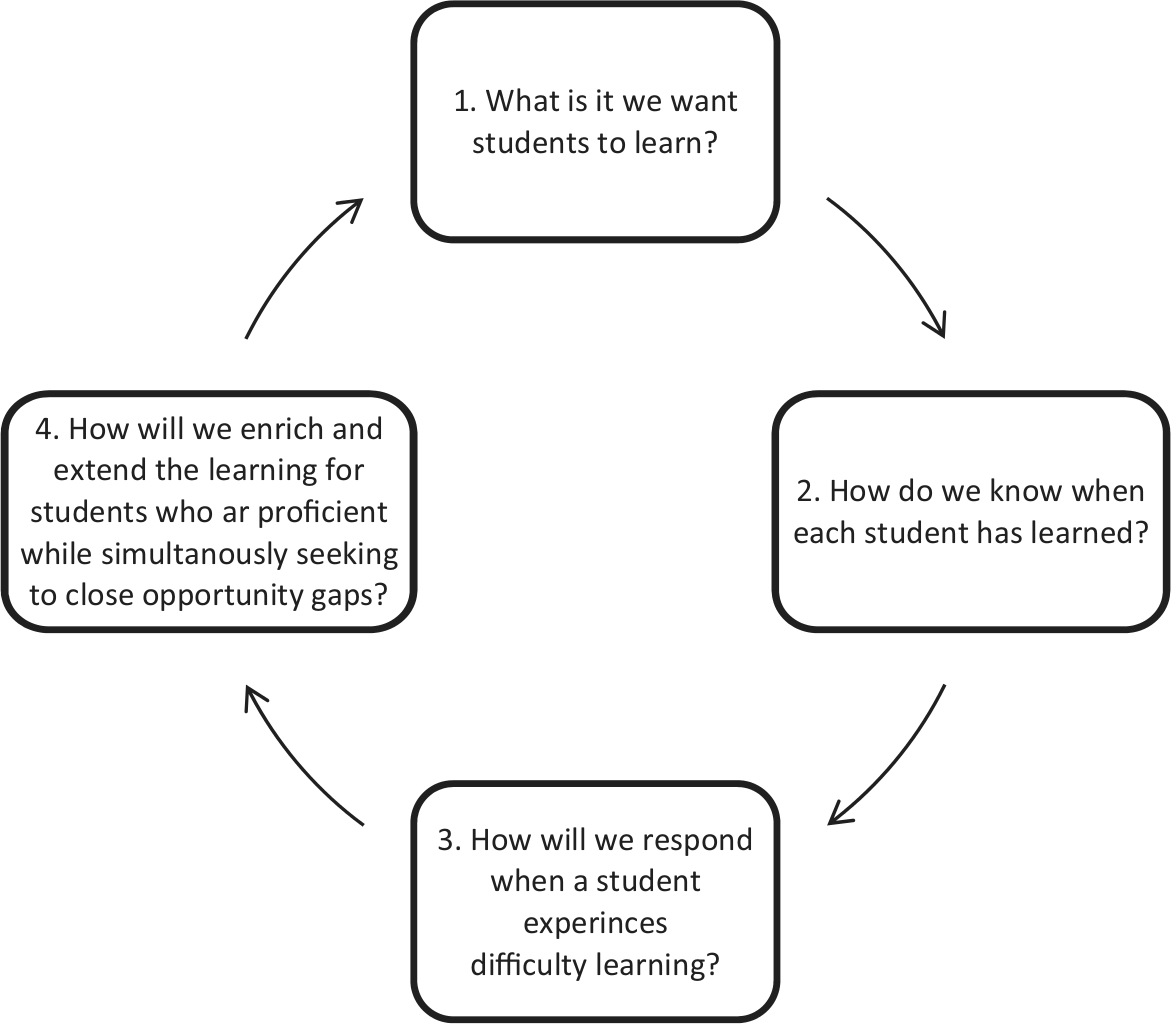
The PLC cycle and school counseling collaborative teams.
The primary focus must be on how the SCCT can create and implement programs that will have direct bearing on student achievement and learning outcomes. The ASCA model dictates that goals must be set to determine effectiveness of programming in achieving learning outcomes and that they should be clear and measurable (ASCA, 2012). One way to accomplish this may be through the SMART goal practice and alignment with the school and district instructional goals. SMART is an acronym for Specific, Measurable, Attainable, Results-oriented and Time-bound (Doran, 1981; O’Neill & Conzemius, 2005). Well-established goals will allow the SCCT members to maximize their time together and ensure that work is focused on student learning and outcomes. The goals of the SCCT become a natural extension of the school counseling program goals recommended in the ASCA National Model and should be directly tied to the overall school goals. Goals should be developed within the SCCT meetings and should allow members to reach consensus about the work they will accomplish.
Once goals are set, the SCCT members should identify an action plan for each goal. Development of action plans are based on the understanding of why students are not meeting the instructional and/or school counseling standards or achieving at a specific level. Data may need to be collected by the SCCT to understand achievement gaps through the facilitation of focus groups or distribution of needs assessments or surveys to parents, teachers, students, or other stakeholders (Young & Kaffenberger, 2013). The SCCT leader should encourage all members to review professional literature to determine what evidence-based resources are available to develop programs and interventions.
Evaluating and Measuring Effectiveness
Evaluating effectiveness shifts the focus from teaching to learning. What is it we want students to learn? School counselors apply this question by a focus on outcomes and the effectiveness of their interventions. Rather than reviewing and evaluating data that focus on the number of students served, school counselors look at outcome data that show the measurable impact of their programs and interventions on academic performance, discipline, and attendance (ASCA, 2012). Counselors can then employ a backwards design education model to develop school counseling program curricula and content that will enable students to learn the identified standards. How do we know when each student has learned? School counselors can assess student learning around identified counseling standards by using formative and summative assessments, analyzing needs assessments, and measuring student performance data (ASCA, 2012; Marzano, 2003; Marzano, Water, & McNulty, 2005; Reeves, 2005). Additionally, school counselors should track and report changes in academic achievement, attendance, and behaviors as a result of their interventions and based on the action plans. The results from formative and summative assessments are used to validate school counseling program effectiveness. Such interventions may also be identified by analyzing school report cards and program data. However, the ultimate goal is to measure outcome data and determine measurable ways that student achievement improved.
The next question to ask is, How will we respond when a student experiences difficulty in learning? School counselors frequently use classroom guidance or small group counseling interventions to address students who have not achieved desired standards. In addition, counselors may use data to advocate for systemic change when groups of students are unsuccessful and barriers to academic success exist. Counselors work collaboratively with other educators and family-community partners to identify resources to support students who are experiencing difficulties in spite of interventions and support (Griffin & Farris, 2010).
Last, how will we enrich and extend the learning for students who are proficient while simultaneously seeking to close opportunity gaps? When school counselors believe that all students can achieve, they advocate for equitable services and opportunities for all students. For example, this could mean participating in student support teams to identify students at risk for failing, creating accessible enrollment opportunities in courses of rigor for all students or sustaining effective programs for students who are continually achieving. The final aspect of enriching and extending learning requires reflecting on unanswered questions by continually assessing the impact of learning on practices, programs, and policies.
School Counseling Collaborative Teams in Action
One middle school’s success around improving student achievement is an example of the power of SCCTs. During the 2007-2008 school year, the school counseling department began the transformative journey to more closely align services with student learning using the ASCA model as their foundational guide. Early in the process, it was obvious that implementation of the ASCA model required school counselors working together with other educators in their building. Although PLCs were established and functioning within the school as evidenced by county-wide ongoing effectiveness measures, the school counseling department did not incorporate the beliefs and characteristics of PLCs. Therefore, the school counseling staff decided to establish a collaborative structure and incorporate the tenets of PLCs, through the use of school SCCT processes. To determine “what the school counselors wanted each student to learn,” they reviewed school data to identify gaps of learning and actively engaged in dialogue with teachers and administrators. It was determined that at each grading period, the school had approximately 400 of the 1,200 students on the D/F list in math, science, English, or history. The best practice used by the school counseling department was to attempt to meet with each student on their caseload who had a grade of D or F. The number of students assigned to each school counselor was too large to be productive, which often resulted in the same students appearing on the D/F list each grading period. The school counseling department needed to actively engage in dialogue with teachers and administrators to address this problem. Consequently, a needs assessment was developed by the school counseling team starting with the basic question to teachers, “Think of the students who received Ds or Fs in your classes, what are the basic skills needed for these students to be able to engage and successfully achieve?” As a result, they were able to develop a closing the gap plan for students identified with multiple Ds and Fs, also known as “red zone” students by school administrators because other systems of interventions had not proven successful. The plan included delivery of interventions based on the needs assessment responses via a 10-session small group setting. The results of the initial program showed a 33% decrease in the D/F list.
After sharing the results with the school principal and administrative staff, the principal leveraged resources in an effort to increase the exposure of the program to more students. The school counselors were relieved from noncounseling related tasks and provided opportunities to plan and cofacilitate with teachers to develop a small group elective curriculum. Specifically, the SCCT members collaborated with teachers to determine how to increase achievement for “red zone” students in the areas of reading, English, and math, as well as decrease their discipline referrals. Twelve 7th graders and fifteen 8th graders participated in a 5-week academic intervention program called Success Prep. The curriculum was based on needs assessments given to the school staff and designed to foster healthy relationships (Bryan, 2005), improve organization and study skills, identify their learning styles, self-advocate, use formative and summative assessment strategies (Marzano, 2003), and set SMART goals (Doran, 1981; DuFour et al., 2010; O’Neill & Conzemius, 2005).
The power of the SCCT became a daily practice that motivated the school counselors, teachers, and students. To determine if students acquired the essential knowledge and skills, the SCCT met with students during and at the conclusion of the interventions. At the conclusion of the interventions, SCCT members met with students to remind them of their goals, to determine what additional supports they needed to reach the goals, and to continue providing support. Data from outcome results suggest relative contributions to closing gaps for participants. For example, the reading state proficiency pass rate for 7th grade students was 66% during the first year’s intervention and increased to 71% pass rate during the second year. The average math GPA for 7th graders was 2.05 and subsequently increased to 2.75 during the following school year. Similarly, 8th grade English GPA increased from 2.80 to 3.10.
During the third year, a new area of concern was found after examining student achievement data in honors courses. African American and Hispanic students constituted 50% of the school’s population and 50% of students enrolled in honors courses; however, they were not achieving at the same rate as Caucasian and Asian students. African American and Hispanic students in honors classes were not passing state assessments at the highest rates in reading and math and averaged a grade of “C” in the classes. The SCCT members in collaboration with teachers developed and delivered a new Success Prep curriculum to address this achievement gap. The final data results of the Success Prep honors program yielded 90% of the state tests taken by the students in the program passed. Fifteen percent of those tests were in the advanced range and 50% of the students’ scores increased from the previous year. The average grade of the students in the honors core classes increased to a B.
Members of the SCCT responded to what students learned and achieved by (a) communicating students’ accomplishments to the principal and teaching staff; (b) increasing collaboration with teachers; (c) expanding the Success Prep program to enrich learning for all students, not just students in danger of failing; (d) communicating with school counselors at feeder schools to advocate for similar programs; and (e) collecting longitudinal data.
As a result, the SCCT became the driving force for providing comprehensive school counseling services, so much so, that the school counseling department applied and earned national recognition as a model school counseling program. Recognized ASCA Model Program (RAMP) status is bestowed to school counseling programs that, through the use of data and collaborate efforts, successfully demonstrate “how students are different as a result of what school counseling services” (ASCA, 2012). The RAMP designation became the natural outcome of all the collaborative work around student achievement.
Principal’s Role in Fostering School Counseling Collaborative Teams
School leaders, specifically principals, can create a culture that allows school counselor collaboration to thrive by partnering with school counselors and ensuring they have access to the necessary resources and supports (Bore & Bore, 2009). First, principals can work with school counselors to ensure they have the time to engage in collaborative teaming. This may involve minimizing noncounseling related responsibilities and reallocating counselor time to ensure impact on student achievement, determining how urgent situations will be handled when counselors are in SCCT meetings, and building buy-in among the entire staff to ensure this time remains a priority. If vertical, area, or interdisciplinary SCCT models are going to be used, the principal may also need to serve as an advocate with professional colleagues to ensure that buy-in exists when collaboration will happen outside of a single building.
Next, principals and school counselors can collaborate to ensure that there is an alignment between the goals of the school and the goals and the work of the SCCT. Principals can provide school counselors with access to data or analyses of data necessary to establish goals and create work plans, ensure the inclusion of a school counselor on the school planning committee, and provide a platform for school counselors to review and discuss their work and results with the school administration on a regular basis and to share results with the entire school staff at least once a year.
Finally, principals may need to provide their school counselors with professional development to ensure that SCCTs are effective. Although most school counseling preparation programs currently teach the ASCA National Model, many counselors completed preparation programs that did not prepare them to collaborate or work as instructional leaders (Carey & Dimmitt, 2006). Principals can work with school counselors to assess their knowledge of PLCs and ability to engage in collaborative teaming and create a professional development plan that supports each counselor in addressing any skill deficits necessary to do the work of an SCCT. Specific examples could include the following: data collection and analysis, goal-setting and work plan development, and assessment strategies. In addition, the SCCT leader or leaders may need training to support their leadership role. Principal support is paramount for SCCTs to be effective. Principals can cultivate effective SCCTs by providing school counselors with the necessary resources and advocacy to engage in this work.
Conclusion
As does the ASCA model, the foundation of PLCs builds on a shared mission and commitment to high levels of learning and achievement for all students (ASCA, 2012; DuFour, 2003). Implementing SCCTs can underscore the irrefutable role of school counselors and their school counseling leadership capacity, increase collaborative relationships, and enhance their ability to use and analyze data (House & Hayes, 2002; Janson, 2009; Lambert, 1998; Marzano, 2003). Developing SCCTs allow counselors to self-reflect, understand the concerns and interests of stakeholders, problem-solve issues, and diminish existing obstacles within the instructional environment. School counselors who are willing to lead or participate in SCCTs and collaborate with instructional staff about the impact of data can also improve learning outcomes for students.
Footnotes
Declaration of Conflicting Interests
The author(s) declared no potential conflicts of interest with respect to the research, authorship, and/or publication of this article.
Funding
The author(s) received no financial support for the research, authorship, and/or publication of this article.