




Abstract
This article discusses the outcomes of a partnership between four high schools and one university to reduce the need for remediation in reading and writing. The purpose of the partnership was to build relationships between secondary and postsecondary faculty and to create a senior year English Transition course for students who did not meet ACT benchmarks for reading and/or writing. We discuss recommendations for school administrators and paired t-test results for assessments used in the English Transition course.
Keywords
Statement of the Problem
College and Career Readiness
In light of recent educational reform efforts, secondary schools have become increasingly aware of the need to graduate students that are prepared for the rigors of college and career. To illustrate, a large proportion of students who enter college (40%) are required to take at least one developmental course (Attewell, Lavin, Domina, & Levey, 2006), usually math (Attewell et al., 2006; Bailey, Jeong, & Cho, 2010; Garcia, 2011; Prince, 2010). ACT, the assessment used to predict college success, found “of the 1.5 million 2010 high school graduates who took the ACT test, only 24 percent met all four college readiness benchmarks for English, mathematics, reading and science and surprisingly 28% met none of the four college readiness benchmarks” (ACT, 2011, p. 3). The most current statistics on ACT performance are quite alarming. Interestingly, “when reading is at the core of the problem, the probability of success in college appears to be very low” (Merisotis & Phipps, 2000, p. 75) and significantly reduces the chances of completing a degree (Oudenhoven, 2002). Currently, postsecondary developmental courses are offered at 2-year and 4-year institutions, private and public, with the greatest percentage of courses offered at public 2-year institutions. At the university where this research takes place, sequences of developmental courses are offered in math, English, and reading for students who have not met ACT benchmarks and/or other admission requirements. Alternatively, high school principals and administrators can implement interventions that reduce the need for remediation. As a result, college readiness indicators are addressed prior to leaving the high school setting; student assessment and school transition to college percentages are targeted for improvement. Additionally, teachers and students realize the importance of addressing college/career expectations and goals, improving teacher satisfaction and student engagement. All in all, these factors work to improve not only college/career readiness but also school graduation rates. This report provides principals with information they need to make curriculum changes in their schools and evidence that supports the implementation of an English Transition course (ETC).
Review of Literature College Readiness
Because college readiness encompasses a variety of skill sets, it is difficult to obtain a succinct definition among the various organizations and researchers that focus on this issue. The National Association of Developmental Education and The National Council of Teachers of English do not define college readiness holistically. The Educational Improvement Policy Center provides the following operational definition for college readiness, The level of preparation a student needs to enroll and succeed—without remediation—in a credit-bearing general education course at a postsecondary institution that offers a baccalaureate degree or transfer to a baccalaureate program. Succeed is defined as completing entry-level courses with a level of understanding and proficiency that makes it possible for the student to be eligible to take the next course in the sequence or the next level course in the subject area (D. T. Conley, 2007, p. 5).
In fact, there is little agreement on what “college-ready” means (Bailey et al., 2010), and if defined it can include cognitive and noncognitive facets (Porter & Polikoff, 2012).
The terms college readiness and career readiness are generally adjoined. Callan, Finney, Kirst, Usdan, and Venezia (2006) state, The knowledge and skills that students need to succeed in postsecondary education are equivalent to the ones they need in the workforce. Today, however, when the vast majority of high school students aspire to attend college, states need policies that require K-12 and postsecondary education to collaborate to improve the college readiness of all high school students. (p. 263)
Principals should view partnerships with university faculty as a positive step toward school improvement.
Because of the culmination of previous reports and findings (America Diploma Project 2004; Goals 2000: Educate America Act, 1994; Nation at Risk, 1981; No Child Left Behind, 2001; Race to the Top, 2009), we have witnessed the development and adoption of National Common Core Standards for College and Career Readiness (2010; http://www.corestandards.org). The standards, which articulate expectations for academic success from kindergarten to the postsecondary level in language arts, math, science, and social studies, were developed in collaboration with teachers, school administrators, and experts to provide a clear and consistent framework to prepare our children for college and the workforce. At present, 45 states and three territories have formally adopted the Common Core Standards.
Kentucky was the first state to adopt the National Common Core Standards. Prior to the adoption of new standards, Kentucky enacted Senate Bill 1 (SB1, 2009), which called for a statewide reduction in college remediation among colleges and universities. We reference Kentucky because it is within this policy framework that led to the genesis of this project; however, other states have legislated similar measures. Kentucky SB1 (2009) called for the Kentucky Council on Postsecondary Education, the Kentucky Board of Education, and the Kentucky Department of Education (KDE) to address disconnects in curriculum and expectations between secondary schools and postsecondary institutions. SB1 has several stated goals; however, the overarching objective was to reduce the need for remediation by 50% by 2014—an ambitious goal for teachers, school administrators, and other stakeholders.
Ultimately, the universal standards for college and career readiness fulfill national and state mandates to prepare our citizens to compete in a global market and to reduce the need for remediation at the postsecondary level. Baker, Clay, and Gratama (2005) in their report, “The Essence of College Readiness: Implication for Students, Parents, Schools, and Researchers,” claimed that all high school students must receive preparation for college because the 21st century-“knowledge economy” dictates higher skill levels. Additionally, the Education Commission of the States (Armstrong, 2005) contends that if high school graduates are to be successful in today’s workforce, they must have a robust high school education and 2 years of postsecondary education. Armstrong adds that nearly 97% of high school students aspire to attend college, but just 60% have acquired the minimum credits for admission. Collaborating with university faculty and implementing a course that targets college readiness deficiencies addresses high school curriculum needs, school success goals, and broader social implications of preparedness.
This article discusses the outcomes of a partnership between four high schools and one university, aimed at creating an ETC to reduce the need for remediation in reading and writing. The purpose of this descriptive report is to illustrate the structure of our partnership, discuss the framework of a senior-year ETC, provide evidence of student achievement, and offer implications for secondary administrators. Because this project grew to include a total of 16 high schools within the University’s service region, we argue that the learned experiences from this effort can be useful to other secondary schools that may be considering a collaborative model—whether it be driven by policy dictates or by student needs. In this article, we discuss how four English faculty members from one regional university met state and university-mandated stewardship policy by collaborating with four local high schools forming a professional learning community (PLC) to address the issues surrounding students’ college and career readiness. This partnership drove the creation of a senior-year ETC(s) at each collaborating school. Because of this report, principals are able to consider a viable college/career readiness curriculum option and how it could fit their distinct school demographic.
We begin with a discussion of the significance and background of school-university partnerships and other interventions for college readiness. Then, we discuss our partnership, a description of the ETC, research methodology, and analysis, which includes paired t-test results of the pretest/posttest reading and writing student scores indicating significant gains in both content areas. The article concludes with recommendations that secondary administrators, policy makers, and educational leaders should take into account when considering a collaborative partnership (PLC) between secondary and postsecondary institutions as an approach for addressing students’ issues surrounding college and career readiness and the need for reduced student remediation at the postsecondary level.
Background School-University Partnerships
Researchers agree that partnerships between Universities and secondary schools are crucial in order to develop a seamless transition from secondary to postsecondary coursework. Teachers, both high school and postsecondary, have reported difficulty initiating, sustaining, and achieving successful partnerships. Often the culture of the high school settings differs dramatically from that of postsecondary institutions (Azinger, 2000; Nunley & Gemberling, 1999). In the past, high school personnel have resented the impositions of postsecondary faculty whose expectations do not comply with the constraints of high school scheduling, student attitudes, parental involvement, and local idiosyncrasies (Warren & Peel, 2005).
Importantly, most interventions for college readiness are summer intervention programs, sometimes residential and often led by community colleges that target multiple college readiness issues rather than specific content areas (Ami, 2001; Bradd, 2010; Buck, 1985; Khan et al., 2009; R. S. Moore et al., 2007; Morrow & Morrow, 1992; Risku, 2002; Santa Rita & Bacote, 1996; Suhr, 1980). The current trend to provide summer bridge programs that address multiple areas of student growth, within 4 to 8 weeks, limits the substance of instruction that addresses specific content deficiencies. It takes considerable time to address the unique set of challenges of underprepared students, and some may argue that one semester or roughly 16 weeks of reading or writing instruction at the postsecondary level is inadequate.
In all, a senior-year high school ETC provides the time necessary to prepare students for the rigors of college-level reading and writing and catches students before they graduate, a desirable goal. We have found that administrators, teachers, and students respond favorably to this new direction in curriculum design. A senior-year, for-credit ETC is one kind of intervention/initiative among several options, for example, summer bridge programs, tutoring, and online modules; however, the latter do not provide concomitant support and assistance of postsecondary faculty.
Often, especially during a time of educational standards and curriculum reform, secondary teachers encounter considerable challenges and pressures and may even feel a heightened sense of isolation. Partnerships serve as action research projects connecting social sciences, aligning secondary and postsecondary goals and altering the historical patterns associated with student transition from secondary to postsecondary institutions; thus, these partnerships promote societal change and ease teacher tensions. High school teachers involved in this project have said, “I finally feel I am teaching what I’m supposed to teach,” and “I think this is one of the most important classes we can offer.” Another secondary administrator said, “Eventually we won’t even need an English transition course. We will know what to do when students enter high school, and we can scaffold the necessary skills each year thereafter.” Also, an English professor who is engaged in the project and who is nearing retirement said, “This is something we should have done 25 years ago.” Denzin and Lincoln (2008) legitimize these comments by saying, “Universities emphasize respect for the past and its structuring value schemes while simultaneously engaging in research designed to change the human condition” (p. 59). Furthermore, secondary teachers have expressed greater satisfaction with courses/curriculum that are tied directly to student success and real-world applications than with courses that are strictly content driven.
Our Partnership
Professional Learning Community
In January 2010, four English Department faculty members from a 4-year institution located in the state of Kentucky began collaborations with targeted schools to design a high school ETC that implements college and career readiness standards for language arts. The ETC regional stewardship initiative employed a PLC model, meeting monthly with high school teachers to develop curriculum and inform literacy instruction. Our collaborative project respected the professional expertise of high school teachers; we played a supportive role, seeking funding, providing professional development (PD), and offering assessment and curriculum support. We considered the PLC as one approach to increase college readiness and reduce the number of students requiring remediation at our university and our best method for addressing schooling challenges. Milton D. Cox (2004) proclaimed, “Faculty learning communities create connections for isolated teachers, establish networks for those pursuing pedagogical issues, meet early-career faculty expectations for community, foster multidisciplinary curricula, and begin to bring community to higher education” (p. 5). Richard DuFour (2004) emphasizes the importance of collaboration for school improvement and outlines major objectives of a PLC, which include (a) ensuring that students learn, (b) creating a culture of collaboration, (c) removing barriers to success, (d) focusing on results, and (e) committing to work hard. Our goal was to build professional relationships between high school and college instructors in order to enrich reading and writing instruction at both levels; create opportunities for PD for all participants; engage in research that informs instruction, program development, and assessment; and finally, work toward reducing the need for college-level remediation in both reading and writing.
PLC Meetings
With this philosophy and these goals in mind, postsecondary English faculty began collaborations with secondary administrators and teachers to bridge the secondary and postsecondary student achievement gap. University faculty planned and facilitated monthly meetings, at a centrally located facility; we addressed pedagogy, curriculum, and standard assessments as well as concerns, successes, and future directives. The meetings were informal, sometimes resembling controlled chaos. Because a senior-year ETC was a new, innovative approach, and we were in the midst of broad educational reform efforts, we wrestled with uncertainty and changing conditions as developments in state policies emerged during the project. The high school teachers shared their concerns and progress, and we closed each meeting with a list of actions that each group would address before the next meeting and an evaluation form (Appendix B). The list of actions and evaluations assisted postsecondary faculty with planning for subsequent meetings and summer PD events. The summer PD was a 2-day event held in early June and included the following sessions led by six university English faculty: (a) Old Business and Updates; (b) Nelson-Denney (ND) and COMPASS review; (c) Aligning Core Content and Assessments/Filling the Gaps; (d) Preparing to Read; (e) Active Reading; (f) Annotating Text; (g) Reading With a Purpose; (h) Creating a Culture of Reading and Writing; (i) Rhetorical Strategies; (j) Discerning Organization: Improving Comprehension, Writing, and Learning; (k) Vocabulary Development; (l) Reading/Writing Student Essay; and (m) Reading and Writing Connection.
Time Line
To begin, superintendents, principals, and teachers agreed to participate in 3- to 4-monthly collaborative sessions (January-May 2010) prior to the implementation year (August 2010). We did not set out to prescribe a set of lessons. We began by reviewing developmental course syllabi; reviewing entry-level English course syllabi; providing desk copies of textbooks assigned to these courses; discussing admission, testing, and placement policies; and sharing our own experiences about teaching developmental courses. Secondary teachers and postsecondary faculty continued to refine course objectives (March-June 2010). Our summer PD assisted teachers with curriculum development. As monthly meetings continued (August 2010-May 2011), we unremittingly worked to align common core standards with ET course objectives. ET course teachers shared their planning and teaching experiences.
The consensus among participants, both secondary and postsecondary, after the initial year included the following: (a) our project was critical to understanding the gap between postsecondary expectations for college readiness and secondary curriculum, namely, mastery of persuasive essay writing and expository text comprehension; (b) recognizing the Common Core Standards emphasis on use of expository text versus traditional forms of literature, which created tension among high school teachers, who found this a difficult transition/shift; (c) underprepared students encounter motivational and self-efficacy challenges; and (d) if students perceive the course to be for college preparedness and they do not intend to go to college, they are less apt to engage in the course. Thus, teachers must find ways to frame the course and present the skills as requisites for both college and career readiness.
As our collaborations progressed, and the number of participating schools grew from 4 to 16 (August 2011-May 2012), the monthly meeting took on a PD emphasis, providing instructional strategies for reading and writing. Later, high school teachers who had taught their ET course for a year became mentors to new participants, sharing their experiences and successful lessons.
English Transition Course
With the assistance of postsecondary faculty, ETC teachers designed their course, course content, instructional resources, student learning objectives, and best pedagogical practices based on Common Core Standards for Language Arts, Developmental Course syllabi, and school curriculum maps. Schools were encouraged and supported in tailoring the course to fit their district demographics and school climate. The Common Core Standards were not officially approved until June 2010; therefore, planning took on multiple “starts and fits” as state and national developments became known. Four high schools implemented their senior ETC for the 2010 academic year. The courses were created at the senior level, targeting students who had not achieved satisfactory ACT results. The objective of the courses was to help these students achieve non-probationary admittance to colleges and universities in the state of Kentucky, foremost the host university of this project. ACT scores in the areas of math, composition, and reading determine college readiness; thus, if benchmark ACT scores are not met, students enter college on a probationary basis. Therefore, the ETC course was offered to seniors who did not achieve satisfactory ACT scores in writing (18 or higher) and/or reading (20 or higher).
Initially, we began by looking at the Common Core anchor standards for reading and writing, Grades 6 to 12, to get an idea of how mastery, range of skills, and application might look across grade levels. Then, we compared Grade 12 standards for reading and writing to the Student Learning Outcomes on Developmental reading and writing course syllabi to find alignment and potential gaps. This process allowed us to create a working syllabus that included a course description, recommended texts, and course objectives.
We arrived at the following course description: English 12 Transition: Focuses on developing comprehension skills, systematic methods for learning college-level vocabulary, analyzing structure and ideas of written materials, and developing critical reading skills. Focuses on academic writing. Provides strategies for improving content, organization, voice, reading to write, and editing in analytical essays and reports. Exit exam required. Also focuses on academic behaviors: time management, academic discipline, and willingness to seek help from faculty, understanding admission requirement, college costs and institution tiers and types, cognitive competencies.
We arrived at the following suggested texts:
Mercury Reader by Pearson Custom Publishing, 2009
Faigley, L. (2009). The Little Penguin Handbook (2nd ed.). New York, NY: Pearson. Supplemental Texts (teacher discretion)
We suggested the following course objectives after reviewing the Common Core Standards and Developmental Course Syllabi:
Practice active reading strategies to develop comprehension.
Students will demonstrate the ability to use strategies to develop vocabulary.
Demonstrate competence in summarization of a variety of texts using annotations and graphic representations.
Analyze selected readings to promote proficient critical thinking skills.
Demonstrate competence of digital literacy.
Communicate effectively by applying skills in reading, writing, speaking, and listening and through appropriate use of information technology.
Use appropriate methods of critical thinking and quantitative reasoning to examine issues and to identify solutions.
Distinguish the methods that underlie the search for knowledge in the arts, humanities, natural sciences, history, and social and behavioral sciences.
Integrate knowledge that will deepen their understanding of, and will inform their own choices about issues of personal and public importance.
Students will write academic essays that are rhetorically appropriate, organized, focused on a thesis, and developed with evidence and valid argumentation.
Students will write essays that respond critically to readings and that incorporate words or ideas of others appropriately.
Students will develop strengths in writing through practice, revision, and attention to the composition process.
Meanwhile, teachers were involved with the deconstruction of standards and developing learning targets in their respective schools. Pre-established curriculum maps were another point of reference and varied per school; however, we did not formally examine these as a part of our working partnership but recognize these documents played a role in teacher planning. We concluded that a set of four modules could work for all schools, regardless of scheduling differences, to serve as a framework for organizing the course around college readiness objectives. Each module (thematic) included a product for writing (polished essay or research paper) supported by products (e.g., annotated articles, summary and/or synthesis of articles) from reading assignments that informed writing. Overall, we agreed that 10 to 15 pages, (revised final drafts), roughly 2,500 to 3,750 words (does not included ungraded writing and/or informal writing assignments), would be required. A suggested introductory theme was “College Preparedness” and might include articles “How to Mark a Book” by Mortimer Adler and “The Case Against College” by Caroline Bird and the memoir A Hope in the Unseen by Ron Suskind. Teachers were free to modify existing thematic units, and we brainstormed a variety of scenarios and texts for consideration.
Ongoing concerns included organizing visits to the host university library and/or scheduling a library liaison visit on-site, securing guest speakers on college and career readiness, Blackboard orientation/use, defining college and career dispositions, assisting students with setting goals, increasing complexity and variety of texts, and building student self-efficacy, motivation, and engagement.
Each school wrestled with the issues surrounding curriculum and reform and created their course separately. Although our meetings were a chance to share ideas, challenges, and triumphs, we did not work toward a unified ET course in an effort to preserve teacher autonomy and respect the diverse nature of each school setting.
Method
Research Questions
We were interested in the following questions:
Design
This school-university partnership is linked to action research, which attempts to do something about a particular phenomenon (e.g., underprepared students) to solve a social problem (e.g., low college readiness, persistence, and graduation rates; Dane, 1990). Tomal (2003) said, “In action research, the researcher is concerned with using a systematic process in solving educational problems and making improvements. The researcher(s) utilizes appropriate interventions to collect and analyze data and then to implement actions to address educational issues” (p. 8). Additionally, action research (a) is concerned with improving conditions or learning in a particular context, (b) relies less on inductive reasoning and more on the practical nature of solving a problem, (c) is collaborative in nature and led by a “change agent,” (d) is considered more of a process than a methodology, (e) results in specific actions plans, and finally (f) includes various interventions (Tomal, 2003). That said, university faculty approached the partnership with the aforementioned research premise in mind, establishing research objectives and partnership goals. Importantly, this report describes the initial process of the partnership (a 3-year pilot project, 2010-3013), a description of the ET course, and first-year student outcomes—a portion of research and ongoing collaborations that in its totality will evidence our commitment to action research.
The Office of Field Services, an entity within the university that maintains an ongoing relationship with local schools, was vital to the development of this project. The Director of Field Services utilized a purposeful sampling process, selecting sites based on their proximity to the university and previous collaborative experiences. High school administrators selected teachers based on their interest in the project and their perceived ability to develop a new course curriculum. Snowball sampling methods apply beyond the first pilot year. A memorandum of understanding, outlining the three phases of the study (course preparation, course implementation, course evaluation), was used to obtain consent from school district leaders and teachers (Appendix A).
Funding
English faculty secured funding from both internal and external sources. The university’s College of Education stipulated funding for collaborative meetings (facility and catering), resource materials, and PD opportunities that were a result of our collaborative as well as spring semester course releases for English faculty facilitating the project. Two external grants provided additional funding; one for assessments and the other, monies needed to conduct summer PD for participating teachers. The latter provided $10,0000, covering facility and catering costs, supplemental pay for facilitating English faculty, stipends for consultant English faculty, and materials and resources. Each participating teacher received a copy of Readicide by Kelly Gallagher and Critical Passages: Teaching the Transition to College Composition by Kristin Dombek.
University
The host university has a history of over 100 years and is located in the south-central region of the United States. It is a comprehensive university, primarily residential, with a high number of transfer and undergraduate students and fewer graduate students. Fall 2010, the university reported a full-time and part-time enrollment of 14,396 undergraduate students: 5.7% Black, 0.9% Asian, 1.7% Hispanic, 0.9% nonresident alien, 0.5% American Indian/Alaskan Native, 86.9% White, 2.1% two or more races, 0.1% Native Hawaiian or Pacific Islander, and 1.0 % unknown. The same semester, the average ACT composite score among entering freshman was 21.1 and transfers was 20.6, averaging 21. The fall 2010 acceptance rate was 65.8%. Of the 2,593 freshman, 723 did not meet ACT benchmarks for writing. Students are required to enroll in developmental English classes if their ACT English score is below 19. Meanwhile, 985 did not meet ACT benchmarks for reading. Students are required to enroll in developmental reading courses if their ACT reading score is below 21.
High Schools
Although our collaborative endeavor grew to include 16 high schools, this report discusses the four schools that comprised our first-year cohort, of which 179 students were served by an ETC. All four schools were public and represented three separate school districts. The school populations represent diversity in race, national origins, gender, socioeconomic background, and disability. One school (A) provided 32% of the student population with two ETCs taught by separate teachers. Both teachers were male with 3 to 4 years of experience in the high school setting; one teacher instructed developmental courses at the regional university where this study took place. Another school (B) comprised 26% of the student population, with two ETCs taught by separate teachers, both males with 13 years teaching experience. A third school (C) contributed to 33% of the student population with one female, first-year teacher, instructing two ETCs. The fourth school (D) provided 9% of the student population, offering one ETC, taught by a female instructor with 7 years of teaching experience. According to School Report Card documents published by the KDE, Schools A-D 2010 ACT average for students (Grade 11) for reading ranged from 19.4 to 20.8 and for writing ranged from 18.4 to 20.2. All schools’ averages are at or -near benchmarks for both content areas, with the exception of school D where the average ACT score for writing was 20.2.
The Kentucky Legislative Commission (published September 14, 2011), describes each school population. We believe each district profile is an accurate reflection of the individual high schools participating in this study. Demographics, graduation rates, and transition to college rates are provided by School Report Card documents published by the KDE. Schools A to D demographics show a predominately White student body and overall graduation rates above 84%, one the highest at 90%. Interestingly, fewer students transition to college at this school, below 50%. KDE reports on five Transition to Adult life categories: (a) college, (b) military, (c) work, (d) vocational/tech training, and (e) work/PT school. Two schools show similar graduation rates (85.9% to 84.5%) and transition to college rates (69.9% to 64.6%) while another school has the highest transition to college at 77.9% and a graduation rate of 88.2%. Additionally, the schools have a high population of students receiving free/reduced lunches.
Analysis
As an aspect of our partnership, we included measures to examine student progress. At the inception of the project, assessments were based on the University’s current testing and admission guidelines; therefore, two assessment instruments were used, one for reading and another for writing. For each form of assessment, students completed three tests: (a) a pretest near the beginning of the school year, (b) a formative test somewhere between mid-December and January, and (c) a postexam near the end of the school year. Testing dates varied per school. Each school determined their assessment dates, and testing occurred on-site. Teachers administered reading tests with the assistance of the research team’s reading assessment coordinator. Teachers administered writing exams with the assistance of the research team’s writing assessment coordinator. To be clear, university faculty were never on-site, assistance and training was provided at PLC meetings and/or via email communications. Teachers reported end-of-course test scores to their school counselors and university faculty. We reported posttest scores to our university’s Office of Placement and Testing; thus, any student who achieved college readiness indicators then bypassed the need for developmental course(s).
Data Sources
The ND reading survey (Brown, Fischco, & Hanna, 1993; Form H) is a two-part test that includes a total of 38 items and 80 vocabulary and 7 reading comprehension passages. This exam can be given in 45 minutes and is frequently used for pre- and posttest purposes (http://www.riversidepublishing.com/products/ndrt/details.html). This test is a widely adopted measure of reading comprehension and is approved by the participating university to determine college readiness. The research project’s designated writing assessment coordinator determined on-demand (OD) writing prompts, similar to the university’s testing and placement prompts that determine college readiness. Normed scoring sessions that included high school and postsecondary English faculty were conducted for pre, formative, and post student essays. The instrument of measurement was a six-point rubric approved by the university’s Department of English and Theatre and the Office of Academic Placement and Testing. This instrument measures the approach to assigned topic, evidence of effective detail, organization, use of transitional words or phrases, sentence structure, and use of standard written English. Participants use pre, formative, and post evaluations to plan student interventions and provide best pedagogical practices.
Our quantitative analysis used a single group pretest/posttest design and examined the academic achievement of high school seniors (n = 179) enrolled in an ETC at four schools participating in the first year of the 3-year pilot project. Achievement was measured in two ways: gains and college readiness. First, pre- and posttest analyses examined whether students achieved significant gains in either reading or writing, regardless of whether college readiness indicators were met. Second, students who passed the course and met college readiness indicators on post examinations avoided the need for college-level remediation. Posttest scores were reported to the University’s office of Academic Placement and Testing. Additionally, the single-group pretest/posttest design controls for very few threats to internal validity; circumstances such as multiple settings, several teachers, various schedules, and differentiated course curriculum dictate that generalizations and conclusions must be viewed with caution. Under the circumstances of our collaborative action research effort, identifying a control group is not essential. We note that students in a regular English class may perform equally or better than ETC students, without teacher participation in our collaborative.
To answer Research Question 1, we analyzed the outcomes of pre and post reading and writing assessments administered in our four pilot schools during the 2010-2011 academic year by conducting a paired t test and confidence interval (CI) using Minitab 16, a statistical software program. We chose a paired t test of aggregated student scores as the best measure to ascertain whether students made significant gains in skill acquisition. As an exploratory measure, we performed a histogram test and determined that pre- and posttest results displayed normal distribution curves, indicating the probability of reliable results. To answer Research Question 2, we looked at the total number of students who completed post exams and the number of students who met college readiness indicators for the exam to determine an overall percentage of students who achieved college readiness.
Our analyses included assessment results for 179 students. To obtain reliable results, we removed any student data that did not provide both pre- and posttest scores for comparison. Consequently, our sample population was reduced to 159 students in reading and 111 in writing. A variety of reasons contributed to missing pre- and/or posttest scores: some students dropped the course, others transferred to another school, and some were absent the day of scheduled testing and failed to make up the test on another day or simply refused to take the exam. The number of students who completed post exams differs from the pretest/posttest comparison numbers, due to the aforementioned reasons; thus a greater number of students are included in college readiness percentages.
Reading Comprehension and ND
Our analysis (n = 159) of the reading comprehension subtest, which includes passages of high school and college level material that determines comprehension as well as reading rate, indicates an ND sample mean pretest of 22.528 and a sample mean posttest of 27.321. The posttest sample mean increases almost 5 points, indicating significant gains (−4.792). The CIs provide additional explanation, indicating reasonable estimates of population mean differences. The CI is negative (−5.883, −3.702) and (0) is not contained within the CI, thus we are 95% confident the posttest mean is significantly higher than the pretest mean. Paired t-test results are provided in Table 1. Overall, pre and post ND means are below college readiness indicators; however, students do improve significantly over the span of the ET course, with a jump of nearly 5 points.
Paired t-Test and CI: ND-Pre, ND-Post.
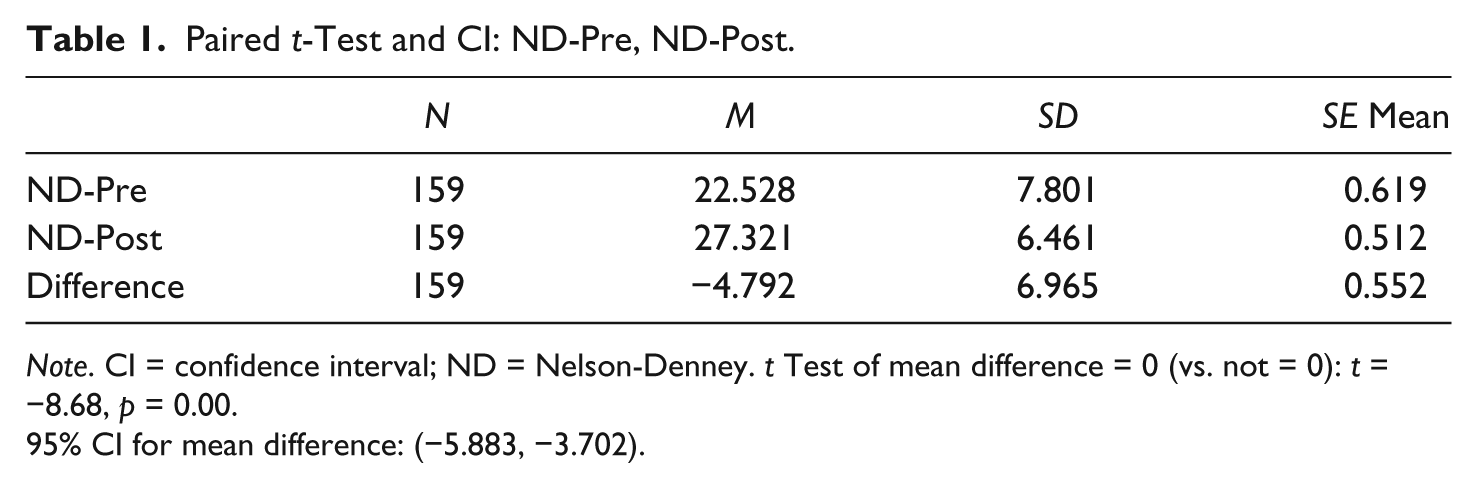
Note. CI = confidence interval; ND = Nelson-Denney. t Test of mean difference = 0 (vs. not = 0): t = −8.68, p = 0.00.
95% CI for mean difference: (−5.883, −3.702).
Persuasive Writing and OD Essays
The writing pre- and posttest consisted of University approved OD writing prompts designed to determine college readiness and/or OD writing assignments that fit into established curriculum. High school teachers scored the pretests, but the posttests were scored in two rounds: the first score by high school teachers and the second by university English faculty. Our analysis (n = 111) focused on the results of OD responses evaluated holistically for (a) a clear, meaningful approach to the assigned topic and supports the approach with effective detail; (b) organization through paragraphs and transitional signals; (c) reasonably coherent and fluent sentence structure; (d) word choice that is mostly accurate; and (e) some proofreading mistakes and errors in standard written English. This analysis indicated a sample mean pretest of 2.4595 and a sample mean posttest of 3.8198. The posttest sample mean increases almost 1.4 points, indicating significant gains (−1.3604). The CIs provide additional explanation indicating reasonable estimates of population mean differences. The CI is negative (−1.5511, −1.1696) and (0) is not contained within the CI, thus we are 95% confident the posttest mean is significantly higher than the pretest mean. In addition, the p is less than .05. The CI and p both indicate a significant difference between pre- and posttest scores. Paired t-test results are provided in Table 2. Overall, OD means are below college readiness indicators at the onset of the ET course. Post OD means indicate a significant gain and students were moved beyond the college readiness indicator of 3.5 to 3.8.
Paired t Test and CI: OD-Pre, OD-Post.
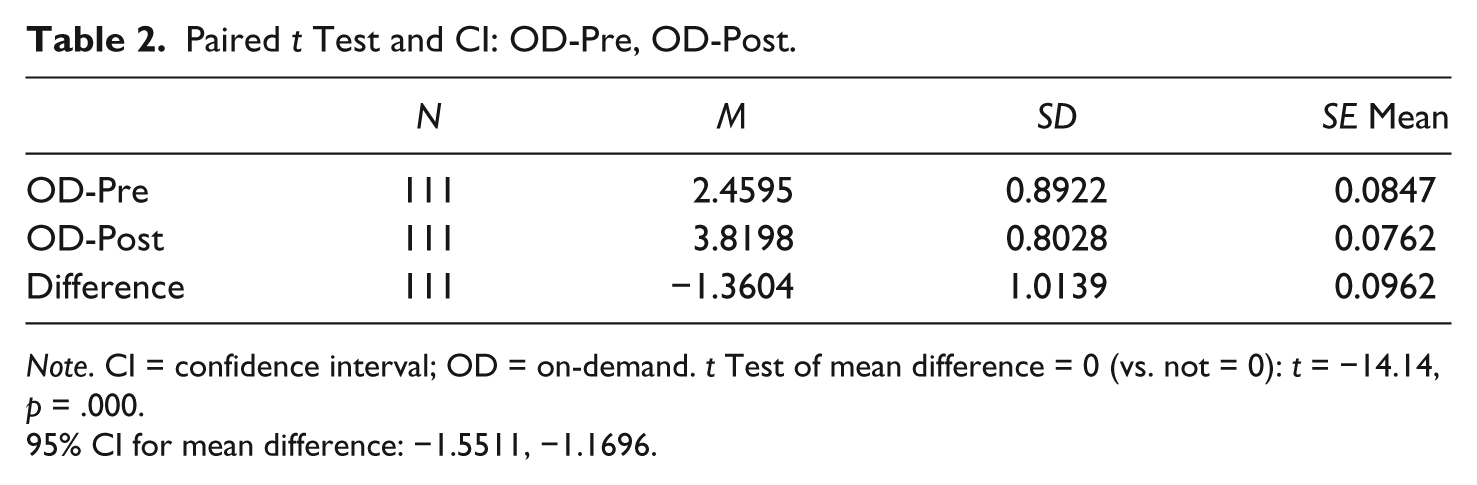
Note. CI = confidence interval; OD = on-demand. t Test of mean difference = 0 (vs. not = 0): t = −14.14, p = .000.
95% CI for mean difference: −1.5511, −1.1696.
Findings
Our data indicate that students who participate in the ETC show significant gains in reading achievement. Furthermore, many students achieved college readiness before embarking on their postsecondary careers. To achieve college readiness, students must score 31/38 on the reading comprehension subtest provided at the end of the school year. Thirty-two percent (58/179) of ETC students achieved college readiness. Although this number is not as significant as college readiness outcomes for writing, results do indicate a step in the right direction for students and State mandates to increase college readiness.
Our data indicate that students who participate in the ETC show significant gains in writing achievement, and a greater percentage achieved college readiness before embarking on their postsecondary careers. To achieve college readiness, students must receive a combined post score of 3.5 or higher on the 6-point scale. Sixty-eight percent (94/139) of ETC students achieved college readiness. There is a slight discrepancy in the number of students who completed post exams (n=139). Some students did not include student identification numbers on their post essay exams, making it difficult to track their data. Clearly, scoring and tracking writing data is more cumbersome and complex than standardized reading assessment requirements for comparative and college readiness purposes.
Overall, our findings indicate that students who participated in the ETC, described in this investigation, show significant gains in reading and writing achievement. Although both areas suggest significant gains in skill acquisition, writing scores demonstrate significant gains and college readiness. Many students achieved college readiness before embarking on their postsecondary careers, thereby saving money and time to achieve degree status. A greater percentage of students achieved college readiness in writing, but this result is not surprising since reading instruction has not been a focus in secondary English classes (M. W. Conley, 2009; Wharton-McDonald & Swiger, 2009). These findings cannot confirm the cogency of an ET course per se; multiple settings were involved, and course content, as well as teaching methods, varied considerably. Furthermore, because the exploration was conducted within a distinct geographic region, the findings cannot be generalized to other settings or institutions. However, as an outcome of the school-university partnership, high schools modified their school curriculum to address the needs of underprepared students and implemented tools that measure college readiness and found positive results.
Implications
Postsecondary faculties’ participation in this project created new knowledge of collaboration with secondary schools through PLCs and an ETC. This knowledge points to five important recommendations that secondary educational leaders and administrators should take into account when considering a collaborative partnership (PLC) between secondary and postsecondary institutions as an approach for addressing students’ issues surrounding college and career readiness and the need for reduced student remediation at the postsecondary level.
Taking the Initiative
Secondary school personnel should consider initiating conversations with university faculty within math, English, and/or Education departments at a local 2-year or 4-year institution of higher education. Four-year postsecondary faculties are responsible for scholarship, service, and teaching; soliciting their assistance and/or developing a working partnership helps faculty address service interests and obligations. Postsecondary faculty may be hesitant to reach out to secondary schools for fear of intrusion and/or not having the needed secondary contacts.
Selecting Teachers for Postsecondary Partnerships
School administrators should appoint highly qualified experienced teachers who are likely to remain committed to the ETC course/partnership on a lasting basis. If teachers are transitory, it is difficult to sustain a productive working relationship with postsecondary faculty. In addition, experienced teachers found it easier to traverse the demands of creating a new course aligned with the rigors of college and career readiness, as well as the instructional needs of underprepared students.
Providing Teacher Support
Secondary administration should provide professional support to English Transition faculty and recognize the ETC and faculty as a prong to traditional English curriculum, which typically includes Senior 4 (the ETC could serve as Senior 4), dual-credit, and Advanced Placement courses. In this case, administrators provided funding for substitute teachers to serve the ETC faculty classroom while the teachers attended monthly meetings and PD opportunities.
Engaging in Partnership
While teachers and administrators were supportive of our efforts and anxious to participate in the development of this course, there were varying degrees of school administrative and faculty participation. Administrators or instructional supervisors often accompanied these teachers to our orientation and working sessions. Three of the four pilot schools were very active and participated in regular meetings on a monthly basis. The fourth pilot school was not as active as the others in monthly meetings or course design. Although the engagement of administrative staff was not necessary after the initial meetings, teachers who attended sporadically or infrequently found it difficult to stay abreast of the developments and PD sessions that are provided by postsecondary faculty to develop pedagogy.
Maintaining Communication With Teachers
Teachers from three of the schools reported satisfaction with and complete support from their administrators, although they also indicated that the administrators were not always as informed as necessary (particularly in establishing schedules, selecting students, and assigning courses). Additionally, administrators and school counselors need to be aware of the unique instructional needs of at-risk students and encourage an open dialogue. Scheduling and student placement were commonly expressed as concerns. Transition in administrative leadership and the lack of communication to new leaders sometimes interfered with the lines of communication between participating faculty, secondary, and postsecondary. Additionally, school counselors should be versed in the course goals, data collection and storage, and student placement procedures.
Significance
The information gleaned from the partnership between our university and multiple high schools assists teachers and students with college readiness, promotes the objectives of state and postsecondary education entities, provides research opportunities to inform future efforts, offers specific relevant data to support secondary and postsecondary partnerships, and recommends five important considerations for high school administrators. The project aimed to offer insights to teachers/administrators and bolster conditions for students who are considered “at risk.” McMillan and Schumacher (2006) define action research, claiming that its methods are often mixed and rigorous research control is not essential. The authors contend that action research (a) has changed to be more collaborative; (b) values engagement and individual contributions, where teachers play an important role; (c) appraises professional actions throughout the process; (d) develops trusting relationships; (e) can occur within a classroom, by teams in a school, or between institutions; (f) seeks to solve everyday or relevant problems; (g) focuses on the processes and outcomes of a change strategy; and finally (h) requires a time commitment (McMillan & Schumacher, 2006).
Preliminary findings indicate that our partnership is on the right track. As we move forward, our focus will be to build new ties with other districts/schools within the university’s service region, sustain the relationships we have currently formed, and assess teacher perceptions of what it means to create and teach an ET course. Instructionally, we will meet teacher requests, providing additional PD opportunities, especially in reading strategy instruction. Teachers demonstrate and state their comfort and confidence with writing instruction; however, formal and informal feedback from teachers indicates that there is a strong desire/need for reading instruction assistance. Furthermore, our quantitative analysis supports the need for a reading emphasis as fewer students achieved college readiness.
We maintain the scope of our partnership required communication and participation among multiple levels of university and postsecondary faculty. More important, our endeavor can serve as a model for consideration, whether similar in scale or modified to accommodate time and/or funding constraints.
Footnotes
Appendix A
Appendix B
Declaration of Conflicting Interests
The author(s) declared no potential conflicts of interest with respect to the research, authorship, and/or publication of this article.
Funding
The author(s) disclosed receipt of the following financial support for the research, authorship, and/or publication of this article: Funding from the Collaborative Center for Literacy Development, University of Kentucky (Grant No. 4814/211600); Council on Postsecondary Education, Enhancement of Assessment and Placement Efforts (Grant No. 452303); and Kentucky Department of Education, Center for Learning Excellence (Grant No. 4849/Award No. PON254011000027753).