




Abstract
Principal standards and license requirements in each of the 50 states are analyzed in this qualitative study in light of federal Race to the Top incentives for states to strengthen school leadership preparation and practice. Nineteen states have adopted the 2008 Educational Leadership Consortium Council (ELCC) standards verbatim and the remaining 31 state principal standards include the basic tenets of ELCC standards, as well as additional standards that reflect each state’s particular focus. These standards are increasingly being used as the basis of practicing principals’ evaluations as part of states’ initiatives to secure federal Race to the Top funds. The ELCC standards also serve as the criteria for national principal preparation accreditation from the Council for the Accreditation of Educational Programs. State requirements for obtaining a principal license, however, do not necessarily align with these professional standards of practice, which might indicate a gap in the principal development pipeline. Common license requirements focus primarily on basic requirements of teaching experience, degree or program completion, and passing a state assessment, but many states do not specify that preparation programs must be accredited, nor are state assessments necessarily aligned with ELCC standards. A rubric is provided for assessing the alignment of the components of a state school leadership licensure system that is aligned with the ELCC standards and reflects best practices found in the research regarding qualifications for school leadership.
Coherence has often been identified as a critical element in sustainable systemic change (Burke, 2014; Fullan, 2001, 2005). School leadership has been documented as having an impact on student performance in numerous studies, making the development of school leaders equipped with the skills and knowledge necessary for improving student achievement imperative (Barnett, 2005; Devin, 2004; Leithwood & Seashore-Louis, 2012; Leithwood, Seashore Louis, Anderson, & Wahlstom, 2010; Murphy, Elliott, Goldring, & Porter, 2007; Wallace Foundation, 2007a; Waters, Marzano, & McNulty, 2003). An ideal system for principal development would focus on the skills and knowledge identified through the research and by professional organizations as the foundation for a school leader’s success in improving student achievement throughout preservice preparation, licensure, and into professional practice (Young & Mawhinney, 2012). With the merger of National Council for Accreditation of Teacher Education (NCATE) and the Teacher Education Accreditation Council into one national accrediting body for principal preparation programs, the Council for the Accreditation of Educational Programs (CAEP), the use of the Educational Leadership Consortium Council (ELCC) standards now serves as consistent criteria for national principal program quality recognition. These ELCC standards are based on the Interstate School Leadership Licensure Consortium’s (ISLLC) standards. 1 The criteria for principal licensure and practicing principal evaluation, however, rest within each state’s power to define.
Following a review of the literature related to the development of the ISLLC/ELCC standards used in national principal preparation program accreditation and policies regarding state principal licensure and evaluation, the study’s methodology will be explained in more detail. The findings of the study are then presented and recommendations for increasing both the quality and coherence of principal preparation and licensure are discussed. Recommendations include a rubric that can be used to evaluate the alignment of principal licensure requirements with the standards for preparation and practice based on best practices found in the literature.
Literature Review
The focus of the literature review is to better explain the relationship between state policies, universities engaged in preparing future educational leaders, and school districts that hire newly licensed administrators. The policies and practices at each level—preparation by universities, licensure by states, and evaluation by school districts—should be aligned in order to ensure that all principals possess the necessary skills and knowledge to increase the achievement of all students, which is the focus of the American public education system (Ash & D’Auria, 2013; Darling-Hammond, 2010; Fullan, 2012; Hargreaves & Ylimaki, 2014). To do so, the literature review is divided into three sections: the role of a school leader, professional standards for building leaders, and policies related to state principal licensure and evaluation.
The Role of the School Leader
History
In the 1920s, the position of the school leader evolved from a head teacher to the position of principal. As the number of students attending schools increased, the need for specific training and experience for principals to be successful became apparent (Whitehead, Boschee, & Decker, 2013). The focus of this training was predominantly on scientific management principles based on the work of Frederick Taylor (Brown, 2005). In the 1930s, the role of the principal evolved to be “one of dignity and importance,” which included the fostering of social contacts within the community (Whitehead, Boschee, & Decker, p. 34). The emphasis on scientific management expanded to include coordination of curriculum and supervision of teachers in the 1940s as schools were seen as essential to preserving the ideals of democracy and citizenship. The responsibility of principals to manage both effective teaching and the operation of the school increased in the 1950s, with the 1960s bringing the additional responsibilities of managing conflict in a time of shifting social values and maintaining the power and structure of the educational bureaucracy. The principal of the early 20th century was primarily a manager of schools focused on maintaining orderly buildings rather than delving into the ambiguities of education (Tyack & Hansot, 1982, p. 174). The practice of principals slowly evolved during the latter part of the 20th century as research-based best practices became identified and incorporated into the training provided to aspiring educational leaders (Kowalski, 2009, p. 354).
Current Role
The current emphasis on the principal as an instructional leader began in the 1980s with Brookover and Lezotte’s (1982) work with effective schools. “Since then, the evidence of the importance of instructional leadership at schools continues to mount” (Glick, 2011, p. xv). Principals engage in instructional leadership through a variety of practices including establishing long- and short-term goals related to the school’s mission and vision, building a safe and healthy school climate that focuses on and supports student learning, supervising and evaluating teachers in formative manner that promotes continual professional growth of teachers in a school, and using human and material resources to support the instructional process (Glickman, Gordon, & Ross-Gordon, 2013; Hoy & Hoy, 2013; Kay & Greenhill, 2013; Ylimaki, 2014). In a study by Hallinger and Murphy (1986), effective instructional leaders of high-performing schools accomplished the following:
Developed mission and goals
Promoted quality instruction through supervision
Promoted a positive learning culture through rewards, high expectations, and professional development
Developed a safe and orderly environment with appropriate economic and community resources (Ylimaki, 2014, p. 2).
Research in the late 1990s and early 21st century have elaborated on the details of each of these vital roles that a successful principal must fulfill (Young & Mawhinney, 2012).
In describing the various skill sets that effective principals must possess, Darling-Hammond, LaPointe, Meyerson, and Orr (2007) wrote, “They must be educational visionaries and change agents, instructional leaders, curriculum and assessment experts, budget analysts, facility managers, special program administrators, and community builders” (p. 1). If that list of skills was not sufficiently daunting, Marzano, Waters, and McNulty (2005) performed a meta-analysis of 69 quantitative studies to identify 21 responsibilities of principals that correlate with student achievement (pp. 42-43). Training in these areas identified by the research as critical for school leaders to increase student achievement should be guided by national and state principal standards and, ultimately, enables principals to redesign school as opposed to just managing them (Darling-Hammond et al., 2007, p. 1).
For principals to positively affect student achievement, they must be committed to the bringing about lasting change, support instruction in schools, and nurture all teachers so that they can reach their full potential (Darling-Hammond et al., 2007, p. 1). Adams and Copland (2005) summarized the need for principals to be able to positively influence student achievement when they wrote, “Today’s school principal operates in an era that prizes student learning above all else” (p. 11). The professional standards developed in the late 1990s and revised in 2008 attempt to define these critical roles and skills that support student learning in order to guide school leadership policies across the nation.
Professional Standards
Based in the emerging research on the skills and knowledge needed for a principal to positively influence student achievement, a consortium of national education organizations was convened by the National Governors Association in 1995 to develop national principal standards to guide practice and preparation of school leaders across the United States (Young & Mawhinney, 2012). ISLLC included the following, covering all major national education groups:
American Association of Colleges for Teacher Education
American Association of School Administrators
Association for Supervision and Curriculum Development
Council of Chief State School Officers
National Association of Elementary School Principals
National Association of Secondary School Principals
National Council for Accreditation of Teacher Education
National Council of Professors of Educational Administration
National Policy Board for Education Administration
National School Boards Association
University Council of Educational Administration
This consortium produced the first American national building leader standards in 1996 (National Policy Board for Educational Administration [NPBEA], 2011). The purpose of the ISLLC standards was to provide “guidance to state policymakers as they work to improve educational leadership preparation, licensure, evaluation, and professional development” (The Council of Chief State School Officers [CCSSO], 2008, p. 1). The ISLLC standards were adopted by the NCATE and became the criteria for principal preparation program national accreditation (NPBEA, 2011).
To reflect the most current demands of the role of building leader, ISLLC revised the standards in 2008, continuing the intent of the standards to inform state policy development (NPBEA, 2011). With significant support from the NPBEA and University Council of Education Administration, the new standards were adopted by the Educational Leadership Constituent Council (ELCC). The ELCC is recognized by the CAEP, which is the national accrediting body formed from the merger of NCATE and the Teacher Education Accreditation Council, as the Specialized Professional Association whose standards should guide preservice school administrator program evaluation and accreditation.
The ELCC standards, based on the 2008 ISLLC standards, which serve as the basis for national principal program accreditation are listed in Table 1 (NPBEA, 2011).
Educational Leadership Consortium Council Building-Level Standards.

Each standard also has several elements that elaborate on the skills and knowledge needed by principal in that standard area. “The ISLLC standards, collectively, attempt to identify the skills necessary for educational leaders to positively affect a school building” (Cray & Weiler, 2011, p. 930) and, specifically, student achievement.
The NPBEA (2011) explained that the ELCC standards should inform every aspect of principal preparation programs as they develop preservice school leader’s awareness, understanding, and application of the skills and knowledge encompassed in the standards.
The overall program should represent a synthesis of key content and high impact field-based experiences extended over time that result in the school leader candidates’ demonstration of the professional knowledge, skills, and dispositions articulated in the ELCC standards, and, most importantly, candidates’ success in improving student achievement following graduation. (p. 6)
Each ELCC standards is based on a empirical research, as detailed by Young and Mawhinney (2012), thus ensuring that principal preparation programs accredited through CAEP using the ELCC standards represents the most current knowledge of best practices in school leadership.
As Green (2012) observed, “It is debatable that national standards alone will enhance the quality of leadership performance in today’s schools” (p. 1). While leadership preparation programs use the standards to redesign or develop programs in order to earn national CAEP accreditation, the standards are also used by states to inform principal licensure and evaluation policies. It is the states’ licensing and evaluation systems that can “ensure that only the most accomplished and qualified professionals move into these critically important positions” (Brown, 2006, p. 526).
State License Requirements
By virtue of the fact that the word “education” does not appear in the Constitution of the United States of America, the Tenth Amendment, which entrusts all powers not explicitly mentioned in the Constitution to the states, places responsibility for maintaining and overseeing a system of public schools on the states (Alexander & Alexander, 2012, pp. 119-120). The primary authority related to education rests almost exclusively with the legislative body. This fact is true of virtually every aspect of public education, from funding, to curriculum requirements, to evaluation guidelines, to licensing requirements. Adams and Copland (2005) stated, “Determining the focus and scope of principal licensing is largely a responsibility of state policymakers” (p. 40). How the focus and scope of licensing are determined, however, vary a great deal among states (Feistritzer, 2003). Examining the principal licensing policies across states can provide an insight into consistencies or inconsistencies of school leadership practices as “licenses govern practice” (Adams & Copland, 2005, p. 14).
Adams and Copland (2005) studied the requirements in all 50 states for licensing a principal and concluded that most states fall into one of two categories: (1) license requirements that stress “individual characteristics,” or focus on background checks and degree attainment or (2) license requirements that are so extensive that there is little possibility for the candidate to obtain the requisite “scope and depth” necessary to excel in a leadership capacity (p. 1). As evidence of the excessive number of requirements, Adams and Copland (2005) reported that the average number of requirements between all 50 states was 39 (p. 13). Arkansas was reported as having 435 different requirements (p. 13).
According to Archer (2006), “Few licensing rules for principals affect the knowledge and skills need to lead instructional improvement” (p. 5). It appears that state licensing requirements do not necessarily align with research-based best practices or emphasize the identified skills leaders need to successfully oversee public schools (Adams & Copland, 2005, p. 1). According to Adams and Copland (2007), one possible remedy to this disconnection is for state policy makers to use tests before awarding a license since these tests typically stress entry level skills and exclude those not sufficiently prepared to lead a school from receiving a license (p. 160).
Adams and Copland (2005) concluded that there is “insufficient similarity among state licensing requirements to indicate coherence or even common direction among principal knowledge and skills” (pp. 29-30). This lack of similarity is surprising given the fact that the requisite skill set for a successful principal transcend state requirements (Adams & Copland, p. 30). In the end, “leadership for learning requires more than licensing. It needs a policy framework that makes coherent linkage among the standards, goals, and policy targets that define licensure’s purpose and the practice it enables” (Adams & Copland, p. 3).
The National Conference of State Legislatures (NCSL, 2013), however, found more similarity among principal licensure standards. These include the following:
Number of years the license is valid
Years of experience as a licensed educator
Hours of professional development necessary for renewal
Endorsement areas such as a K-12 or specific endorsement for elementary or secondary administrator
Passage of a state examination
While the passage of a state examination addresses Adams and Copland’s (2007) recommendation, it does not ensure that the examination is based on research-based content, however.
The NCSL noted that many state licensure systems are being redesigned as two-tiered, with the first tier reflecting the requirements for initial licensure and the requirement of mentoring or induction, advanced professional development, and demonstration of on-the-job competency via principal evaluations in order to obtain an advanced license. As with state licensure assessments, the degree to which each or any element of licensure requirements is based on or aligned with the state and national professional standards is determined by each individual state, however. Alignment should be explicit and not simply assumed.
Once an aspiring school leader has completed a preparation program and met state licensure requirements, the real work of being a principal begins. Adams and Copland (2007) stressed the need for school districts hiring newly licensed administrators to remember that the license “represents only entry-level knowledge and skills” (p. 158). A newly licensed principal possesses a minimum level of understanding related to leading a school, enough to “do-no-harm,” and still require support and mentoring (Adams & Copland, 2007, p. 158). Adams and Copland succinctly summarized the meaning of the earned license by stating that “licensing only starts our future leaders on the path they need to travel” (p. 157). Districts are then responsible for further developing principals into successful school leaders who positively affect student learning.
Principal Evaluations
While 40 states have adopted the ISLLC standards as the basis of state principal standards (NCSL, 2013), the evaluation system for practicing principals used by states should align with these standards in order for principal development and practice to truly be coherent. In other words, principal evaluations should be based on the state’s principal standards. Past practices in principal evaluation in many states have not aligned with state or national professional standards, (Heck & Marcoulides, 1996, NCSL, 2013), however that appears to be changing (Catano & Stronge, 2006). The process of evaluating principals also varied a great deal even within states, and Thomas, Holdaway, and Ward (2000) found that these evaluations were often conducted very sporadically.
Local control, which allowed school districts to determine how and when principals were evaluated has been impacted by the Race to the Top (RttT) competition guidelines. However, the RttT guidelines have identified the recruitment, development, reward, and retention of effective principals as one of four purposes for the federal initiative (Clifford & Ross, 2011; U.S. Department of Education, 2013). In each phase of funding since 2010, RttT grants have been awarded to states that either have or promise to significantly restructure the principal evaluation process. Similar to new teacher evaluation systems adopted in these states, the new principal evaluation systems appear to be based on the states’ principal standards with an additional component based on student achievement (Clifford & Ross, 2011). With the development of state principal evaluation systems that use state principal standards based on the ISLLC standards as the criteria for judging practicing principal performance, the content of principal preparation programs and the expectations for principal performance are increasingly in alignment, both being guided by the same basic set of professional standards.
Conclusion
The role of the building level principal has evolved over the years from one focused on managerial tasks to one today where it is expected that educational leaders positively affect student achievement through their work with curriculum, culture building, community outreach, and data manipulation, while still managing a safe and orderly school building. The responsibility for developing effective educational leaders is shared between state policy makers, who are entrusted with developing meaningful state license requirements, universities that are charged with offering current curriculum that emphasizes the requisite skills and knowledge, and school districts that must continue the development of newly licensed principals once hired. Central to the alignment of the efforts of these three levels of principal development is the explicit use of professional standards to guide policy that positively affects school leadership practice.
Research Questions
In order to determine the alignment of state principal standards and licensure requirements, a qualitative study was conducted. Alignment of principal preparation programs was represented in the study by the requirement of the completion of an accredited school leadership preparation program as a condition for licensure. The research questions guiding this study were the following:
What are the similarities and differences between principal standards of practice in the 50 states as compared with the 2008 ISLLC/ELCC building leader standards?
How do state principal license requirements and standards of practice align to ensure adequate preparation of preservice school leaders to assume school leadership positions?
Methodology
A qualitative document analysis was conducted to answer the two guiding research questions. The department of education website for each state was searched to identify the principal standards and principal license requirements for each of the 50 states. Links to state code and other documents that were posted on the state department of education websites were followed to identify the principal standards and licensure requirements for each state. The standards and license requirements for each state were then placed in an electronic file and printed.
The principal standards for each state were analyzed to determine the following:
Adoption of 2008 ISLLC/ELCC standards
Adoption of a modified version of 2008 ISLLC/ELCC standards (i.e., additional standards, listing of specific competencies, etc.)
Adoption of standards other than ISLLC/ELCC
NVivo software was used to match phrasing from the ISLLC/ELCC standards with state standards in the coding process. Phrasing used in state standards that differed from ISLLC/ELCC standards were then coded using open coding.
As discussed earlier, the ELCC standards are used as the criteria for national principal preparation programs by CAEP and are based on the 2008 revised ISLLC standards. The study’s assumption was that alignment of state principal standards of practice with national professional standards for preparation program accreditation would signify coherence between preparation and expected school leader performance.
The licensure requirements for each state were first listed in a spreadsheet format. Requirements were coded using open coding in NVivo software. Common requirement categories were then identified using axial coding. The minimum, average, and maximum requirements in common categories were identified next. Additional requirements of each state were noted that did not fit into the common categories identified. The state principal license requirements were also analyzed to determine whether the ISLLC/ELCC building level leader standards were reflected or imbedded in the license requirements as a measure of alignment between the state standards and license requirements. This included the specification of the completion of a nationally accredited preparation program as a condition of licensure, as well as other criteria that were identified as explicitly linked to or based on state or professional standards. This analysis was conducted using NVivo software to identify reference to standards and also significant terms or phrases used in the ISLLC/ELCC standards. Alternative licensure requirements were not examined in this study with the researchers’ assumption that the majority of school leaders are produced through traditional rather than alternative licensure programs.
Finally, the researchers identified gaps in license requirements based on current research regarding the competencies and experiences that are needed by school leaders, as discussed in the literature review. This included the requirement for completion of a mentorship or induction program, additional professional development, and in-service evaluations based on ELCC aligned state principal standards. The researchers then developed a rubric to assess state principal license requirements based on the review of the literature on best practices in developing school leaders and current state principal license requirements.
Findings
The variations in state adoption of the ISLLC standards will first be discussed, followed by a summary of common principal license requirements and variation within each of the common requirements for licensure identified.
State Standards
Nineteen states have adopted the 2008 ISLCC/ELCC principal standards verbatim. The remaining 31 states have adopted standards that include all the ISLLC/ELCC standards, as well as additional standards. For example, Alabama includes planning for continuous improvement and technology leadership as separate standards, in addition to ISLLC/ELCC standards of leadership of teaching and learning, human resource development, diversity, stakeholder relationship building, management of the learning organization, and ethical behavior. Connecticut relabeled the first ISLLC/ELCC standard regarding the development, articulation, implementation, and stewardship of a vision of learning as “The Educated Person” and included two standards focused on professional development of school personnel. Other states, such as Florida, adopted revisions recommended by the RttT committee that include the four domains of student achievement, instructional leadership, organizational leadership, and professional and ethical behavior, with 10 standards listed within those four domains (U.S. Department of Education, 2013).
The order of the standards also reflects each state’s priorities or emphasis, such as in Louisiana where “ethics and integrity” are listed in the first standard, whereas ethical behavior is the last ISLLC/ELCC standard. The Texas standards emphasize the need for leaders to be learner centered by including the term in each standard, such as “learner-centered values and ethics of leadership,” “learner-centered leadership and campus culture,” “ learner-centered human resources leadership and management,” “learner-centered communications and community relations,” “learner-centered organizational leadership and management,” “learner-centered curriculum planning and development,” and “learner-centered instructional leadership and management.” Virginia and Minnesota both list communication skills as a separate standard.
The use of data and systemic approach to school improvement are also specified by some states in the principal standards. Illinois emphasizes “living a mission and vision focused on results” instead of the simply vision-focused wording of the first ISLLC/ELCC standard. “Leading and managing systems change” is also listed as a separate standard for Illinois principals. Maryland includes “collecting, analyzing, and using data to identify schools’ needs” as a specific standard, as well as “using systems thinking to establish a clear focus on attaining student achievement goals.”
Michigan’s standards, which were developed in 2011 by Reeves and McNeill, are perhaps the most individualized of the states’ standards, with four domains of results, leadership, programs, processes, and systems listed. Within the domain of “Results,” improved student achievement and teacher performance results are specified, as well as the elimination or reduction of the achievement gap and increased overall school performance. The “Leadership” domain encompasses a vision for learning and achievement factors and leadership behavior factors, such as being informed; strategic and systemic; fair, legal, honest, ethical, and professional; and resilient. The “Program” domain includes the high fidelity and reliability of instructional program factors and safe, effective, and efficient school operational factors. The “Processes” domain covers community building factors and evidence-based and data-informed decision-making factors, while the final “Systems” domain covers technology integration and competence factors and human capacity factors.
Embedded in each state’s standards for principal practice are the elements of vision, school culture, and program development; management of a “safe, efficient, and effective” learning environment; responding to diverse needs; ethical behavior, and responding to external factors to increase student learning, which are the core ideas of the ISLLC/ELCC standards (CCSSO, 2008, NPBEA, 2011). The modifications that 31 states made to the ISLLC/ELCC standards in creating their own state standards only build on the ISLLC/ELCC standards, providing more detail, reorganizing the sequence, or recategorizing the essential ideas to emphasize the state’s specific priorities for its school leaders. Several states with modified ISLLC/ELCC standards, such as Georgia, Indiana and Pennsylvania, provide crosswalks between the state’s standards and the ISLLC/ELCC standards (Georgia also provides a crosswalk between the state standards and NPBEA and International Society for Technology in Education standards).
The alignment between the ISLLC/ELCC standards used by CAEP/ELCC for national principal preparation program accreditation and the states’ standards for principal practice is a great advancement in the coherence of school leadership development. This coherence can be even greater when states use the principal standards they have adopted as the basis for licensure assessments and principal evaluations conducted at the district level. Using standards-based novice principal evaluations as a criterion for obtaining an advanced license also strengthens the coherence of the principal development pipeline (Young & Mawhinney, 2012).
Principal License Requirements
The criteria for principal licensure in the states varied, but the most common requirements included the following:
A valid educator license
Experience in an educational setting
Completion of a preparation program
Passage of an assessment
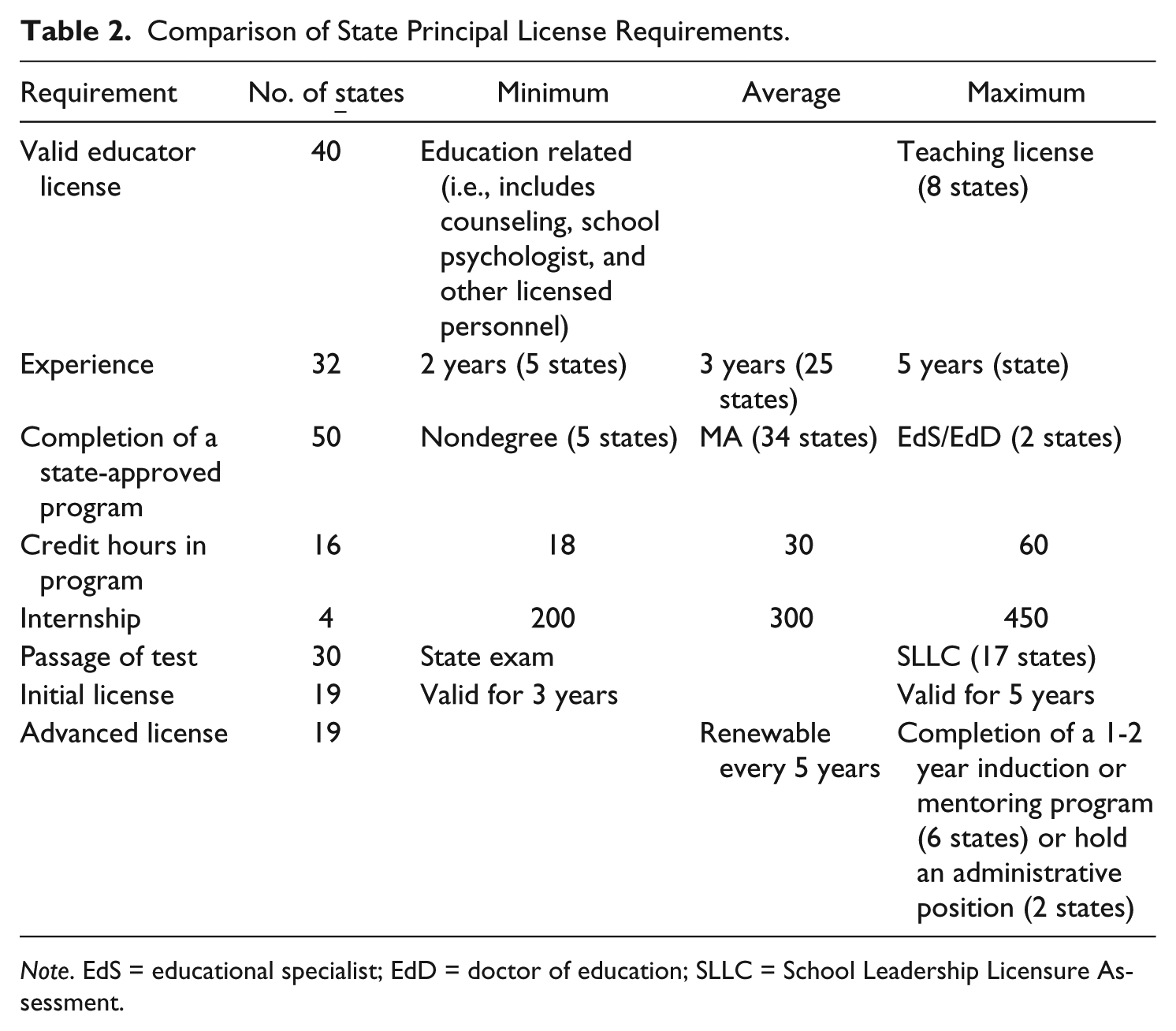
The minimum, average, and maximum requirements in each area are presented in Table 2. Specific variations and additional requirements of various states to obtain a principal license are also discussed.
Comparison of State Principal License Requirements.
Note. EdS = educational specialist; EdD = doctor of education; SLLC = School Leadership Licensure Assessment.
Forty states require that principals also hold a valid educator license. Eight of those states explicitly require that the license be a teaching license, while the other states will accept licensure in areas such as school counselor, psychologist, or equivalent licenses. Thirty-two states require a certain amount of documented experience in a school setting as a condition of licensure. Three years of experience in a school setting was the most common requirement listed by 25 states, but the range included 2 years of experience by five states to the greatest amount of experience required by the state of Hawaii, which was 5 years. Several states, such as Arkansas, Georgia, Indiana, and New Mexico, required principals to hold a teaching license but did not list a specific number of years of experience as a teacher prior to obtaining a principal license.
Each state required that a principal complete a state-approved course of study to obtain a principal license. Thirty-four states specified that principals must complete a master’s degree program and four of those states required that the program be either nationally accredited (by CAEP, formerly NCATE) or aligned with the ISLLC/ELCC standards. (As mentioned earlier, CAEP requires alignment with the ELCC standards as a condition of accreditation.) Five states required a program of training for licensure but did not specify the completion of a degree as a condition of obtaining a principal license. Georgia and Minnesota required the completion of an educational specialist (EdS) or doctoral degree to obtain a principal license. Sixteen states listed a specific number of credit hours that were required for a principal license program or degree, ranging from 18 to 60 credit hours beyond a bachelor’s degree, with an average requirement of 30 credit hours.
Four states specifically require the completion of an internship in principal preparation programs. The criteria for the internship experiences were not stated in the licensure requirements of these states so it could not be ascertained whether the internship was based on the states’ principal standards. National accreditation, however, also requires field-based experiences as part of a principal preparation program so states requiring national program accreditation would also include internships. Internships in accredited programs are based on the ISLLC/ELCC standards. Of the states that specifically require an internship, most did not specify the number of hours to be completed on the department of education website for the state where principal licensure requirements were posted or in associated links. Of the states that did list internship hour requirements, these were typically found in state code and ranged from a minimum of 200 clock hours to the most clock hours (450) required in Utah.
Thirty states require principals to pass a state test in order to acquire a license. The School Leadership Licensure Assessment (SLLA) by the Educational Testing Service was the most common exams used in 17 states. The SLLA content areas reflect the ISLLC/ELCC standards (Educational Testing Service, 2013). All other tests appeared to be developed by individual states, although many of the state-specific tests were developed by the Educational Testing Service, which developed and administers the SLLA. The researchers were unable to determine if the states’ or ISLLC/ELCC standards served as the basis for the 14 other states that required the passage of an assessment for licensure.
Nineteen states delineated between initial principal licensure and more advanced or experienced licensure with an initial license being valid for 3 to 5 years and more advanced licenses renewable every 5 years. In California and Georgia, one must be in an administrative position to acquire the more advanced or “Clear” principal license. Kentucky, Missouri, New Jersey, Ohio, Pennsylvania, and South Carolina require the completion of an induction or mentoring period, ranging in length from 1 to 2 years, for principals to obtain a more advanced license.
Discussion
Thirty-five states have revised their state principal standards since 2008 to reflect the ISLLC/ELCC standards revisions. Across all 50 states, the ISLLC/ELCC standards are either explicitly included or embedded within state principal standards. This indicates increased coherence of principal preparation for on-the-job expectations of school leaders because both national program accreditation by CAEP and states’ standards are based on the ISLLC/ELCC standards. However, the adoption of more detailed standards (e.g., focusing on technology or the use of data for systemic change) by individual states could create a different set of knowledge and skill expectations in specific areas that leadership preparation programs will undoubtedly base curriculum and field experiences on in those states which could decrease the alignment and coherence among preparation programs across states.
Twenty-four states have made changes to principal license requirements since 2010 when the RttT competition for federal funding was initiated. The specific changes were not noted on the states’ department of education websites, however, and could include alternative licensure requirements. Overall, the basic requirements to obtain a principal license through the “traditional” means of a university-based preparation program were consistent across the states, particularly in the areas of prior educational experience, completion of a state-approved training program (typically at the master’s degree level), and passage of a state assessment. As stated earlier, the requirement of the completion of a nationally accredited program assures coherence across states regarding program content and field experiences aligned with the ISLLC/ELCC standards used by CAEP. One could infer that school leadership preparation and other license prerequisites are assumed to be somewhat consistent across states, as reflected by the 2010-2015 National Association of State Directors for Teacher Education and Certification interstate license reciprocity agreement that 41 states have signed as of June 30, 2012, which includes general or initial principal licensure reciprocity (http://www.nasdtec.org/agreement/Signees_6-30-2012.pdf).
The true test of a school leader’s training is what actually happens in the school setting. This is where the actions of school districts play a critical role to build on and support the development of new principals. Districts are implicitly involved in preservice school leader preparation through internships required as part of state or national preparation program accreditation or through explicit internship requirements in states such as Idaho, Maine, New Mexico, and Utah, thus providing another source of alignment between preparation and expectations for practice. In 2005, Adams and Copland found that “fewer than 20 states rely on induction programs, mentoring, professional development, or other on-the-job training as a means of knowledge and skill development” (p. 31) and that number does not appear to have formally grown, based on licensure requirement policies examined in this study.
Many of the states that have recently revised their school leader licensure requirements have extended the districts’ responsibility for continuing the development and support of new principals by including the mandatory completion of mentoring or induction programs in order to obtain an advanced school leader license. These states include Kentucky, Missouri, New Jersey, North Dakota, Ohio, Pennsylvania, and South Carolina. The successful completion of these mentoring and induction programs provide a powerful means to ensure that school leadership competencies are demonstrated in actual school settings and increase the quality of principals (Hitt, Tucker, & Young, 2012).
It is perhaps implicit in the successful completion of the mentoring and induction programs discussed above that participating novice principals receive satisfactory evaluations. This is one area that could be used to strengthen the alignment of preservice preparation and licensure to standards of practice. In one state, Colorado, automatic renewal based on the principal performance standards and evaluation process adopted in 2011 has been proposed. Maine, Mississippi, New Hampshire, New Mexico, North Carolina, Ohio, South Dakota, Wyoming, and Tennessee either have or are in the process of updating the principal evaluation process used in each state but the researchers were not able to determine from the data gathered whether district evaluations of principals were being discussed as a condition of advanced licensure in any states besides North Carolina, Colorado, and New Mexico. If states were to adopt a requirement for satisfactory on-the-job evaluations as part of advanced licensure, this would perhaps complete the alignment between principal preparation expectations and expectations for practice with an emphasis on outcomes. This emphasis on the results of school leadership, as well as the results of leadership preparation programs, is a relatively new phenomenon and can be viewed as a logical extension of the emphasis on effective teaching and subsequent reforms to teacher evaluation systems across the nation. Both changes focus on increased student achievement, brought to the forefront of educational reform by NCLB and reinforced by RttT’s (Armstrong, 2006; Spring, 2011).
Although in many states, school districts are able to develop and implement district teacher and principal evaluation systems under the principle of local control, the parameters of such systems are increasingly being guided by state policies that have been developed in response to RttT. The anticipated consistency across school districts in a state with principal performance assessed on the demonstration of state principal standards in practice based on ISLLC/ELCC standards should create an environment where leadership preparation and performance expectations are very closely aligned.
Recommendations and Conclusion
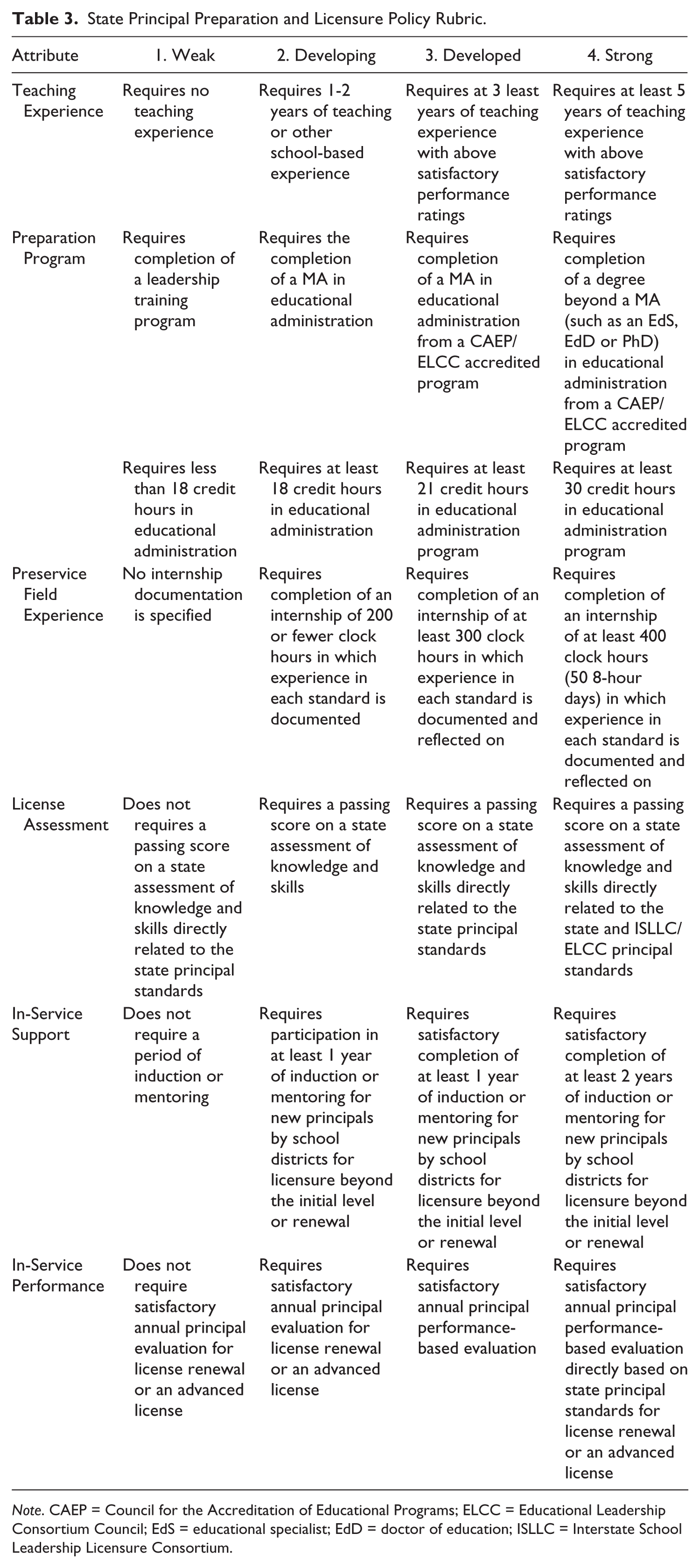
In comparing the principal standards and license requirements of the 50 states, the authors developed a rubric of policies that would support a highly aligned and coherent system of school leader development among university preparation programs, state departments of education, and school districts. From the literature on effective school leadership and leadership preparation and current state practices, the areas of Teaching Experience, Preparation Program, Preservice Field Experience, License Assessment, In-service Support, and In-service Performance emerged as essential elements in developing effective school leaders. Indicators in each area are described for a weak, developing, developed, and strong state principal preparation and license policy system, with a strong system containing rigorous requirements that are highly aligned with state principal standards in Table 3.
State Principal Preparation and Licensure Policy Rubric.
Note. CAEP = Council for the Accreditation of Educational Programs; ELCC = Educational Leadership Consortium Council; EdS = educational specialist; EdD = doctor of education; ISLLC = Interstate School Leadership Licensure Consortium.
In the area of Teaching Experience, a strong policy which would encourage experienced and successful teachers to advance to school leadership positions would require 5 years of teaching experience with above satisfactory annual evaluations for each year of experience. Hitt et al. (2012) recommend the demonstration of successful teaching experience as a prerequisite for admission into leadership preparation programs, based on the premise that An individual’s experience as a classroom leader undoubtedly contributes to success as an educational leader. A strong foundation as a classroom teacher provides potential educational leaders with the experience and insight necessary to lead others who continue to occupy that role. Individuals with strong instructional backgrounds are better able to relate to and lead teachers, and identify and model effective classroom practices. In short, successful teaching experience indicates the ability to lead a classroom, with the classroom being a microcosm of the school. (pp. 4-5)
Hallinger (2010) and Thomson (1989) presented persuasive evidence to support the requirement of successful teaching for school leaders. The rubric moves from the requirement of no teaching experience in a weak licensure system to the requirement of some teaching experience in a developing system. The requirement of successful teaching experience (represented by teacher evaluation ratings) moves licensure systems into the developed and strong ratings on the rubric, with the differentiation that more (5 years) successful teaching experience exposes potential school leaders to more instructional situations and indicates growth in instructional practices over a period of time. Given the emphasis on learner leaders in the literature, learning teachers are more likely to continue in a growth trajectory as a principal (Ash & D’Auria, 2013; Leithwood & Seashore Louis, 2012; Reeves, 2006; Senge et al., 2000).
In the area of Preparation Program, a policy that required a degree beyond a master’s would ensure that principals had already attained advanced preparation in a content area, demonstrating a continuation of learning and a desire to improve one’s personal teaching practices. Hitt et al. (2012) explained that having an advanced degree demonstrates commitment to education in general and also broadens one’s potential as an instructional leader. Research supports these claims, revealing that preservice principals are more successful in their preparation programs and demonstrate greater effectiveness as school leaders (Browne-Ferrigno & Muth, 2009; Robinson, Lloyd, & Rowe, 2008).
In addition to earning an advanced degree, the preparation program for school leadership completed by principals prior to licensure would ideally be both state and nationally accredited. This would ensure that the curriculum of the preparation program was aligned with ISLLC/ELCC standards that have been identified by every significant educational organization in the United States as embodying the critical knowledge and skills school leaders must demonstrate (CCSSO, 2008; NPBEA, 2011) and increasingly serves as the basis for practicing principal evaluation systems (Clifford & Ross, 2011). Hitt et al. (2012), Darling-Hammond et al. (2007), and Orr and Pounder (2010) also present strong arguments for the requirement of completion of a NCATE/CAEP accredited program to obtain a principal license.
The rubric for state principal licensure system assessment combines the preceding two elements. Completion of a training program for school leadership that is not accredited is listed as representative of a weak system. Requiring the completion of an advanced degree is designated as a characteristic of a developing system in this area, whereas the completion of an advanced degree in an accredited program merits a developing system rating. The requirement of completion of a degree beyond a master’s in an accredited program would earn a licensure system a rating of “Strong” in this area.
A second component of the Preparation Program area in the proposed rubric would specify that the school leadership preparation program must be at least 30 credit hours in length for principal licensure in a “Strong” licensure system. This would allow for at least 5 credit hours for coverage of content in each of the six ISLLC/ELCC standards (including internship or field experiences). While credit hours may be viewed by some as “seat time” requirements rather than an indication of rigor, it is difficult to argue that more can be covered with equal depth in less time. The proposed rubric identifies the requirement of the completion of less than 18 credit hour program as a characteristic of a “Weak” licensure system. A “Developing” system would require at least 18 credit hours of preservice school leadership training, the number of hours that was identified in the analysis of the current states’ licensure requirements as the lowest number of specified preservice program hours. The requirement of 21 credit hours of training would signify a “Developed” system and a 30-credit-hour requirement would be characteristic of a “Strong” system. The authors recognize the 30 credit hours may still not be sufficient to incorporate multiple authentic field-based experiences related to each ISLLC/ELCC standard and element, however, many degree programs in educational leadership are 30 credit hours and have been able to earn NCATE/CAEP accreditation, signifying that each standard is sufficiently covered in these programs (NCATE, 2013).
The third area on the proposed state principal licensure system rubric is completion of a Preservice Internship. A requirement of the documentation of at least 400 clock hours of internship that would addressed each ISLLC/ELCC standard would ensure that new principals had the equivalent of 50 8-hour days or a little over 2 months of practical school-based experience. Hitt et al. (2012) advocate for an emphasis on field-based experiences in preservice school leadership programs, including but not limited to a structured internship experience. Cunningham and Cordiero (2009) cites research that supports the completion of an authentic and rigorous school leadership internship based on the ISLLC standards, as well. The Education Development Center (2009, pp. 3-4) outlines the following characteristics of a high-quality internship, as well as the research that supports each characteristic:
Includes developmentally sequenced opportunities for intern to further develop, apply, and practice leadership skills in real-world clinical settings for at least 1 year under the direct supervision of both university faculty and expert field practitioners (Darling-Hammond et al., 2007; Peterson & Kelley, 2001; Martineau & Hannum, 2004)
Requires intern to complete a comprehensive series of problem-based projects and activities that are explicitly linked to leadership standards and district performance expectations for principals (CCSSO, 2008; Darling-Hammond et al., 2007)
Provides intern with expert coaching and mentoring support that includes daily opportunities for intern to be observed and receive feedback from experts while practicing and developing their skills (Darling-Hammond et al., 2007)
Provides formal formative and summative assessments of intern performance at scheduled intervals throughout the clinical practice experience (Goldring, Porter, Murphy, Elliot, & Cravens, 2007; Levine, 2005; Murphy, Moorman, & McCarthy, 2008)
Offers intern the opportunity to develop competencies in more than one school level
The proposed rubric extends from no internship requirement in a “Weak” licensure system to 200 clock hours in a “Developing,” 300 clock hours in a “Developed,” and 400 clock hours in a “Strong” system. These experiences would, as noted in the Educational Development Center (2009) report, span at least 1 year.
Based on the powerful impact that reflective practice has on behavior, the rubric also addresses the requirement of reflection on internship experiences as a characteristic of “Developed” and “Strong” licensure systems. York-Barr Sommers, Ghere, and Montie (2005), Rebore and Walmsley (2008), and Murphy (2011) document the strong, positive effect of reflection on school leadership practices and is frequently advocated in principal preparation texts, as well (Hoy & Hoy, 2013). Requiring principal license applicants to also reflect on those standards-based experiences would also promote reflective school leaders and encourage new school leaders to make meaningful connections between their preparation program content and the challenges faced by school leaders on a daily basis (Cunningham & Cordiero, 2009).
Finally, a passing score on a state assessment linked directly to the state principal standards would also be required for licensure, although the authors recognize that such an assessment is only meaningful if the test is well constructed and based on those knowledge and skills identified in the ISLLC/ELCC standards (Hitt et al., 2012). Passing such an assessment “ensures that students have mastered the body of knowledge critical to role before stepping into a leadership position” (Hitt et al., p. 7). For this reason, requirement of passage of an assessment based on state and ISLLC/ELCC standards is identified as a characteristics of a “Strong” principal licensure system in the proposed rubric and assessments based only on state principal standards merit one a “Developed” rating in this area. Passage of an assessment not specifically grounded in either state or national school leadership standards is identified as characteristic of a “Developing” system, whereas a “Weak” system does not require any assessment for licensure.
The proposed rubric also extends beyond initial principal licensure requirements to include demonstration of effectiveness and growth as a novice school leader in order to earn an advanced leadership license. In-service support systems such as mentoring and induction programs and satisfactory performance-based evaluations are the two elements considered as a basis for an advanced license in school leadership on the rubric. Mentoring as part of an induction process is advocated by several researchers and practitioners as a means of developing, supporting, and retaining high-quality, effective school leaders (Southern Regional Education Board [SREB], 2007; Wallace Foundation, 2007; Weingartner, 2008; Young, Sheets, & Knight, 2005). Acculturation to a school, as well as the professional role of a school leader, does not happen overnight and needs to extend past the initial year of service as a principal (Bundy & McKay, 2004; SREB, 2007; Wallace Foundation, 2007). The proposed rubric identifies the lack of participation in an induction or mentoring program as a characteristic of a “Weak” licensure system. A “Developing” system would require participation in such a program, however a “Developed” or “Strong” system would require satisfactory completion of an induction or mentoring program. This completion rating would be awarded on the basis of artifacts and mentor and/or district supervisor recommendation. Another different noted on the rubric between “Developed” and “Strong” licensure systems is the length of the induction or mentoring program, with two years earning the higher rating.
The last item in the proposed rubric addresses the performance of novice principals as a consideration for license renewal or the granting of an advanced license for school leadership. Actual job performance is arguably the best indicator that a school leader should continue in such a position. As states are increasingly developing principal evaluation systems based on state principal standards (which are either the exact ISLLC/ELCC standards or grounded in the ISLLC/ELCC standards with language modifications, this measure would further increase the alignment of principal preparation and licensure with expectations of practice. In the proposed rubric, states that require satisfactory performance on as annual standards-based performance evaluation for license renewal or an advanced school leadership license would earn a “Strong” rating. If the annual evaluation is performance-based but not explicitly linked to the state’s standards, the state licensure system would earn a “Developed” rating in this area. Satisfactory annual evaluations without any specific requirements would earn a “Developing” rating, with the lack of consideration of novice principals’ performance in licensure renewal earning a “Weak” rating. As state department of education website were reviewed in this study, indication of at least one state moving toward the inclusion of performance evaluations of novice principals as a criteria for license renewal or advanced licensure was noted. The authors include this element in the rubric in order to support the development of a completely aligned, coherent school leadership pipeline across the nation, from preparation programs to state licensure requirements to district evaluations of principals.
In conducting the research in this study, many state department of education website did not have the school leader licensure requirements or the state principal standards clearly posted. Often, licensure requirements were only stated in school code and principal standards had to be obtained from the state’s school leader organization. In a few cases, representatives from education departments had to be contacted directly in order to obtain this information. In order to ensure both the clarity of requirements and expectations, as well as transparency of the licensure and evaluation process, clearly labelling such requirements on department of education websites or having direct links to such information would very helpful to those interested in school leadership credentials. The authors would also advocate for the principal standards, license requirements, and evaluation policies to be clearly posted on the each state’s department of education website. Given the emphasis on developing effective school leaders, both in the literature and in recent federal initiatives, finding the criteria for becoming a principal should not become one of the biggest challenges in the process.
Developing effective school leaders requires an integration of state policies that ensure that university preparation programs, state license requirements, and district professional development and evaluation systems are aligned with state principal standards. With states embracing the ISLLC/ELCC standards and revising principal evaluation systems (CCSSO, 2012), perhaps it is the appropriate time to take a truly systemic look at how all the pieces and players in the school leadership pipeline can work together. When universities, state departments of education, and school districts have a clear idea of what is needed for effective school leadership for the 21st century, coherent state education policies can perhaps make that idea a reality for every school in America. Every state appears to be in agreement that the ISLLC/ELCC standards provide that definition of what an effective school leader does. With such a consensus on the desired outcome of school leadership development efforts, the alignment of practices among preparation programs, state education departments, and school districts to focus each group’s contribution in developing effective school leaders appears to be the next logical step in that quest for continuous school improvement.
Footnotes
Declaration of Conflicting Interests
The author(s) declared no potential conflicts of interest with respect to the research, authorship, and/or publication of this article.
Funding
The author(s) received no financial support for the research, authorship, and/or publication of this article.