




Abstract
Discriminatory discipline has been widely documented for decades, yet little progress has been made to narrow the gap. Due to the long-standing history of discriminatory discipline, current nationwide data, and recent federal initiatives, there is a need for a comprehensive examination of this critical issue. Therefore, we discuss populations effected by discriminatory discipline, including students of color and students in special education. Research indicates that prevention and intervention efforts that begin at the administrative level are necessary.
Disproportionality in student discipline has been widely analyzed as far back as the 1970s when the Children’s Defense Fund (1975) documented the overrepresentation of Black students in school suspension data. Since then, researchers have found that several student groups have been overrepresented in disciplinary referrals (Kaufman et al., 2010), suspensions (Sprague, Vincent, Tobin, & Pavel, 2013), and expulsions (Aud, Fox, & KewalRamani, 2010). The most notably overrepresented groups have been boys (Aud et al., 2010), Black students (Wallace, Goodkind, Wallace, & Bachman, 2008), and students in special education (Vincent, Sprague, & Tobin, 2012).
With the ever increasing use of Zero Tolerance policies, school officials disproportionately discipline several student groups at increasingly higher rates (APA Zero Tolerance Task Force, 2008). Disproportionality has been frequently measured in the form of office discipline referrals (ODR), in-school suspensions, out-of-school suspensions (OSS), and expulsions. Current research has continued to demonstrate the overrepresentation of Black students in disciplinary referrals and suspensions (Skiba et al., 2011), while the field has grown to include Hispanic/Latino students (Brown & Di Tillio, 2013), American Indian students (Whitford & Levine-Donnerstein, 2014), and a combination of American Indian and Alaska Native students (Sprague et al., 2013).
Current Nationwide Disciplinary Data
Discriminatory discipline has been documented as early as preschool and has continued beyond childhood. To put the following information into perspective, the nationwide representation of school age students in 2013-2014 was approximately 50.3% White, 24.7% Hispanic/Latino, 15.5% Black, 4.8% Asian, 3.1% multiracial, 1.1% American Indian/Alaska Native (AI/AN), and 0.4% Native Hawaiian/Pacific Islander (NH/PI), while 14.0% have received special education services and 9.9% have received services for English language learners (ELL; Office for Civil Rights [OCR], 2016).
Preschool
There were more than 1.4 million children enrolled in public preschools during the 2013-2014 school year and of those children, approximately 41% were White, 30% were Hispanic/Latino, 19% were Black, 4% were Asian, 4% were multiracial, 2% were AI/AN, and <1% were NH/PI, while 20% received special education services and 12% received ELL services (OCR, 2016). Nearly 7,000 public preschool children obtained one or more OSS during the academic year; approximately 47% were Black, 28% were White, 19% were Hispanic/Latino, 4% were multiracial, 2% were AI/AN, 1% were Asian, and <1% were NH/PI, while 15% received special education services and 7% received ELL services (OCR, 2016). Figure 1 is a visual representation of the preschool population and OSS disaggregation by race/ethnicity and gender.

Public preschool population and out-of-school suspension (OSS) in percentages. Results for 1,439,188 public preschool children (OCR, 2016).
Primary and Secondary School
There were more than 50.1 million students enrolled in public K-12 schools during the 2013-2014 school year and of those students, approximately 50% were White, 25% were Hispanic/Latino, 15% were Black, 5% were Asian, 3% were multiracial, 1% were AI/AN, and <1% were NH/PI, while 12% received special education services and 10% received ELL services (OCR, 2016). Nearly three million K-12 public school students obtained one or more OSS during the academic year; approximately 39% were White, 32% were Black, 23% were Hispanic/Latino, 3% were multiracial, 2% were AI/AN, 1% were Asian, and <1% were NH/PI, while 1% received special education services and <1% received ELL services (OCR, 2016). Figure 2 is a visual representation of the K-12 student population and OSS disaggregation by race/ethnicity and gender.
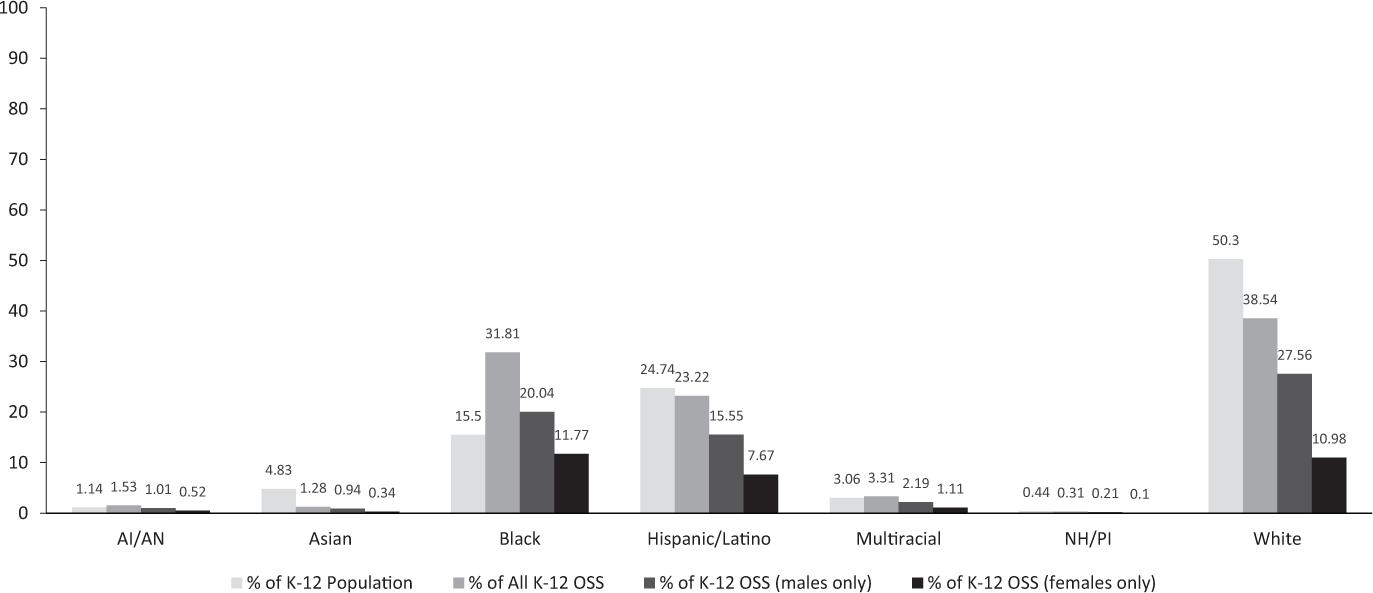
Primary and secondary public school population and out-of-school suspension (OSS) in percentages. Results for 50,035,746 K-12 public school students (OCR, 2016).
As evidenced by the most current disciplinary data available from the (OCR, 2016), disproportionality has continued to exist, with severe overrepresentation for preschool, primary, and secondary children and students who are Black and a significant underrepresentation for preschool, primary, and secondary children and students who are White. As such, it is important to identify the legal implications of these incidences.
Legal Implications
Discriminatory discipline manifests itself in two ways; when a student is subjected to differential treatment based on demographic characteristics (e.g., gender, race/ethnicity, special education status, ELL, and socioeconomic status [SES]) and when a policy is neutral on its face—meaning that the policy itself does not mention demographic characteristics, but is administered in a biased manner with disparate impacts (i.e., a disproportionate and unjustified effect on students of a particular demographic). According to the Joint “Dear Colleague” Letter issued by the U.S. Department of Education, Office for Civil Rights, and the U.S. Department of Justice, Civil Rights Division (USDOE/OCR; 2014), Titles IV and VI protect students from discrimination “based on race in connection with all academic, educational, extracurricular, athletic, and other programs and activities of a school, including programs and activities a school administers to ensure and maintain school safety and student discipline” (p. 6). Title IV and VI protections apply to all aspects of the disciplinary process, from classroom-based behavior management practices, to behavioral referrals, and to the documentation and disposition of the incident. All potential violations are the basis for federal criminal investigations conducted by the Department of Justice’s Civil Rights Division (DOJ) for Title IV or the Department of Education’s OCR and the DOJ for Title VI.
Finally, other statutes such as Title IX (e.g., harassment), Section 504 of the Rehabilitation Act of 1973, and the Individuals with Disabilities Education Act (IDEA) have potential legal implications due to discriminatory practices. IDEA requires collection and examination of data regarding disproportionality based on race/ethnicity, including the incidence, duration, and type of disciplinary consequences, such as suspensions and expulsions [34 CFR 300.646(a)] [20 U.S.C. 1418(d)(1)]. IDEA also requires states to disaggregate data on suspension and expulsion rates by race/ethnicity by local education agencies; or provide a comparison to the rates for nondisabled children within those agencies [34 CFR 300.170(a)] [20 U.S.C. 1412(a)(22)(A)]. If there is evidence of significant disproportionality the state must establish requirements for review and revision of policies, practices, and procedures [34 CFR 300.646(b)] [20 U.S.C. 1418(d)(2)].
Rationale
Due to the long-standing history of discriminatory discipline, current nationwide disciplinary data, and legal implications, it is clear that school personnel may benefit from an understanding of the topic at hand and steps moving forward. As such, the purpose of this article is to provide a comprehensive overview in the area of discriminatory discipline. Specifically, we will discuss research in discipline disproportionality in the following areas: (a) as it has influenced various student populations and schools, (b) theoretical underpinnings of origin, and (c) student consequences. Furthermore, we will provide recommendations for prevention and intervention that can be utilized by teachers, staff, and administrators moving forward.
Current Trends in Discriminatory Discipline
A thematic analysis of discriminatory discipline has led to several areas where research has been clearly established, where it is emerging, and where further work needs to be launched. Established areas include gender, race/ethnicity (specifically for Black students), SES, and special education status. Emerging areas within these fields include Lesbian, Gay, Bisexual, Transgender, and Queer (LGBTQ) students, American Indian students, and Hispanic/Latino students. There has been an increased interest in discriminatory practices and disproportionality by student age/grade level, as well as by school characteristics. As will be discussed, research is needed for Asian American students.
Disproportionality: Gender and LGBTQ
Gender
Consistent findings in discipline data across time relate to gender. Males are disproportionately more likely to receive exclusionary discipline as a consequence than females (Anyon et al., 2014; Brown & Di Tillio, 2013; Finn & Servoss, 2014; Kaufman et al., 2010; Martinez, McMahon, & Treger, 2016; Rocque, 2010; Skiba, Chung, Trachok, Baker, & Sheya, 2014; Whitford & Levine-Donnerstein, 2014). Brown and Di Tillio (2013) found 72% of ODRs in their study were given to males. The disproportionality of males to females held not only across racial/ethnic and age groups but also across types of ODRs, and while males received the most ODRs, the gap between males and females appears to decrease with age (Kaufman et al., 2010).
Martinez et al. (2016) confirmed this finding and further posited that ODRs were given more often for externalizing behaviors, which are more common in males. In a study reviewing types of referrals given, males were found to receive more referrals for classroom disruption, while the highest referral category for females has been insubordination (Lo & Cartledge, 2007). Several studies reported the odds of exclusionary discipline for the same behavior has been higher, with a range of 1.24 to slightly more than two times higher, for males versus females (Finn & Servoss, 2014; Skiba Arredondo, & Rausch, 2014). The conclusion that males receive disciplinary consequences more frequently than females, however has been true within, but not across minority groups. For example, evidence shows Black females receive exclusionary discipline consequences at a higher rate than White or Hispanic/Latino males (Finn & Servoss, 2014). Additionally, Black females appear to have seen the greatest rate increase of exclusionary discipline consequences in recent years (Skiba, Chung et al., 2014).
Lesbian, Gay, Bisexual, Transgender, and Queer
There have been preliminary data collected from LGBTQ students. Initial research in this area has indicated that this population may face disproportionate representation in disciplinary actions (Poteat, Scheer, & Chong, 2015; Skiba, Chung et al., 2014). There has been a rise in discipline consequences for this population, especially for nonheterosexual females (Poteat et al., 2015). One reason given for this overrepresentation is that sexual minority students have faced greater exposure to peer victimization and therefore have been more likely to engage in behaviors such as drinking, fighting, truancy, or carrying a weapon for protection (Poteat et al., 2015; Skiba, Chung et al., 2014). These behaviors often fall under disciplinary categories that mandate an exclusionary discipline consequence (Poteat et al., 2015; Skiba, Chung et al., 2014). Additionally, LGBTQ students may be selectively punished because school officials might blame them for their own victimization, which reinforces the ideology of differential treatment as a contributor to discriminatory discipline (Poteat et al., 2015).
Disproportionality: Race/Ethnicity
As previously discussed, overwhelmingly, the research over the past 40 years has shown that students of color have been disproportionately represented in school discipline data. Furthermore, race and ethnicity are the single most predictive characteristics for likelihood of school discipline (Finn & Servoss, 2014; Skiba et al., 2011; Skiba, Arredondo et al., 2014). Consistently, since the 1970s, Black, American Indian, and, to some extent, Hispanic/Latino students have been overrepresented in discipline data, while White and Asian students have been consistently underrepresented. Not only has disproportionality been an issue but students of color have often received harsher punishments for challenging behavior than their underrepresented counterparts (Finn & Servoss, 2014; Mallet, 2015; Martinez et al., 2016).
Black Students
Historically, data have consistently identified Black students as having the highest rates of disciplinary actions, including ODRs, OSS, and expulsions, than any other group, with rates anywhere from 1.25 to 3.5 times more likely than White students (Brown & Di Tillio, 2013; Finn & Servoss, 2014; Lo & Cartledge, 2007; Martinez et al., 2016; Peguero, Shekarkhar, Popp, & Koo, 2015; Rocque, 2010; Skiba, Arredondo et al., 2014; Whitford & Levine-Donnerstein, 2014). Additionally, for both mandatory discipline (i.e., zero tolerance) behaviors, as well as more subjectively disciplined behaviors (i.e., defiance, disrespect, and noncompliance), Black students have received punishment, not only more often but punishment that has been more severe, even though the reported behaviors have been no different than that of White students (Englehart, 2014; Finn & Servoss, 2014; Lo & Cartledge, 2007; Martinez et al., 2016). Finn and Servoss (2014) found this phenomenon to hold true for both Black males and Black females. Specifically, Wallace et al. (2008) found Black males were three times more likely to receive exclusionary discipline consequences than White males and Black females were five times more likely to receive exclusionary discipline than White females. Indeed, even in schools with predominantly Black populations, racial/ethnic disproportionality is likely to occur. In a school where 85% of the population was Black, Black students were charged with 90% of the total ODRs (Lo & Cartledge, 2007).
American Indian Students
American Indian students, while not as large a proportion of the population as Black students, hold relatively similar levels of overrepresentation in disciplinary actions (Brown & Di Tillio, 2013; Whitford & Levine-Donnerstein, 2014). Whitford & Levine-Donnerstein (2014) found that while American Indian students represented only 23.5% of the total population in the schools studied, they accounted for 33.7% of the total ODRs. American Indian students have been almost twice as likely to receive an ODR as White and Hispanic/Latino students and have been more likely to receive higher rates of OSS and expulsions than White students (Brown & Di Tillio, 2013; Whitford & Levine-Donnerstein, 2014).
Hispanic/Latino Students
The data regarding Hispanic/Latino students have been less clear regarding disproportionate representation. Finn and Servoss (2014) found that Hispanic/Latino students have been one and a half times more likely than White students to be suspended for similar behaviors, while Brown and Di Tillio (2013) found that Hispanic/Latino students have been disciplined at rates very close to proportional. Still other studies indicate that Hispanic/Latino students have behavioral rates similar to that of White students as they become assimilated; typically beyond second-generation immigrant status (Peguero, Shekerkhar, et al., 2015). Interestingly enough, first-generation Hispanic/Latino students are less likely to misbehave (Peguero, Shekerkhar, et al., 2015); possibly an indication that behavioral challenges in schools are a problem faced at higher rates in the United States than at the countries of origin for first-generation students.
Additionally, Peguero, Popp, and Shekarkhar (2015) found that as Hispanic/Latino students increased their SES and engaged in participation in sports the odds of punishment increased. No reason for this phenomenon has been identified. Still other studies have reported mixed findings dependent on other factors, such as grade level (Martinez et al., 2016). It is possible that findings concerning Hispanic/Latino students are mixed and continue to change because the influx of Hispanic/Latino immigrants has made this group the fastest growing immigrant population at this time, with an ever changing dynamic across different parts of the United States (Peguero, Shekarkhar, et al., 2015).
Asian American Students
Research is limited on the discipline characteristics of Asian American students. However, current research indicates that these students have been consistently underrepresented in discipline data findings (Anyon et al., 2014; Peguero, Popp, et al., 2015; Rocque, 2010). Anyon et al. (2014) indicated that being Asian American was one of two protective factors for receiving ODRs at the individual level. Schools with higher proportions of Asian American students have also reported lower risk of punishment for students, while higher SES and higher test scores further reduced the likelihood of Asian American students being disciplined (Peguero, Popp, et al., 2015). It is important to point out that this finding may not be an accurate representation of all Asian American student groups after individual ethnic backgrounds have been disaggregated in the data.
Disproportionality: Socioeconomic Status
SES, frequently measured by enrollment in free and reduced priced lunch programs, has been an area in which research findings are shifting. This shift to more complicated and comprehensive data analysis suggests that SES has had little to no effect on disproportionality in discipline (McElderry & Cheng, 2014; Triplett, Ayana, & Lewis, 2014). Instead, SES has been correlated with other variables, such as race/ethnicity and school security measures, which more directly tie into disproportionality (Mallet, 2015; Skiba, Arredondo et al., 2014; Wright, Morgan, Coyne, Beaver, & Barnes, 2014). Rusby, Taylor, and Foster (2007) reported elementary schools with greater numbers of economically disadvantaged students and larger class sizes have had fewer ODRs. However, Wright et al. (2014) indicated that students from economically disadvantaged backgrounds who attended predominantly low SES schools were at increased risk for disproportionality in school disciplinary actions. Additionally, high levels of poverty have been reported to correspond with high levels of OSS; students from two-parent households (with greater access to resources) have been less likely to be suspended (Peguero, Popp, et al., 2015; Wright et al., 2014). However, while poverty has been shown to be a predictor for increased suspension rates of White students, it has not significantly predicted rates for Black students (Wright et al., 2014). While correlations between economically disadvantaged students and disproportionality has been affirmed across studies, many have indicated SES has failed to account for racial disparities (McElderry & Cheng, 2014; Mcloughlin & Noltemeyer, 2010; Skiba et al., 2011; Triplett et al., 2014; Wallace et al., 2008). Additional research indicates the highest overall rate of suspension has occurred in poor urban districts, but the highest disproportionality between Black and White students, however, occurred in high-resource suburban districts (Skiba, Arredondo et al., 2014). Consequently, these findings lend further credence to the idea that SES is an inconsistent predictor of disproportionate discipline.
Disproportionality: Special Education Identification
Students with disabilities represent yet another group historically overrepresented in disciplinary actions. Data show that students with disabilities have received a greater number of ODRs, suspensions, and expulsions than students without disabilities (Brown & Di Tillio, 2013; McElderry & Cheng, 2014; Sullivan, Van Norman, & Klingbeil, 2014). This phenomenon is evident regardless of race/ethnicity or gender. In one study, though only 11.7% of the school population was identified for special education services under IDEA, 18.2% of discipline referrals involved students with disabilities (Brown & Di Tillio, 2013). Students with disabilities have been two to three times more likely than their same-age peers to be suspended, despite legal safeguards, such as manifestation determination, that have been put into place in order to prevent students with special needs from being removed from educational settings (Sullivan et al., 2014). Sullivan et al. (2014) reported that although 7.4% of all students are suspended annually, of those suspended, 19% are students with disabilities.
Emotional and Behavioral Disorders
McElderry and Cheng (2014) reviewed data disaggregated by type of disability and asserted that students with emotional and behavioral disorders (EBD) were 11 times more likely than same-age peers and nearly 9 times as likely as students with other disabilities to receive exclusionary discipline consequences. Nearly half (47%) of all students with EBD have been suspended at least once, while a third have had multiple suspensions (Sullivan et al., 2014). In addition, students with attention deficit hyperactivity disorder are also overrepresented in disciplinary actions (Sullivan et al., 2014). Often, educators are not prepared to work with students with EBD or attention deficit hyperactivity disorder, which can mitigate existing behavioral challenges for these populations (Oliver & Reschly, 2010).
Learning Disabilities
Juvenile detention centers have also been predominantly populated by male students of color with learning disabilities (Mallet, 2014). Males accounted for 79% of the population in detention centers; 42% were Black, and 30% to 35% had a disability, with the most prevalent being those with learning disabilities. Students with disabilities have been adjudicated at a younger age than their nondisabled peers, approximately 10 months earlier, than nondisabled peers, which has led to higher rates of recidivism and longer periods of detention (Mallet, 2014). As a result of such overwhelming evidence of disproportionality based on gender, race/ethnicity, and special education, the Department of Education and the Department of Justice have been actively investigating school districts for civil rights violations related to disproportionate discipline issues (Triplett et al., 2014; Wright et al., 2014).
Disproportionality: Age/Grade Level
There has been general agreement across the field as to the impact of age/grade level on disproportionality. As students grow older, they are more likely to be subjected to exclusionary practices (Martinez et al., 2016; McElderry & Cheng, 2014; Rocque, 2010). Middle school students have been at the greatest risk for ODRs and expulsions (Anyon et al., 2014; Finn & Servoss, 2014). Some researchers attribute this increase in referrals at the middle school level to school structures that fail to meet the developmental needs of early adolescents, such as the need to develop autonomy (Anyon et al., 2014). Additionally, the types behaviors reported on ODRs have correlated with age/grade level, thus, suggesting that different types of behaviors occur at different developmental levels. For example, at the high school level, ODRs were mostly associated with attendance issues, respect at the middle school, and aggression at the elementary school level (Kaufman et al., 2010; Rusby et al., 2007).
Disproportionality: School Characteristics
There are several school characteristics that may have an impact on discriminatory discipline. These characteristics include school size, composition, location, and administrative practices.
School Size
Larger schools have tended to institute higher levels of exclusionary discipline; schools with a population under 300 have tended to suspend 16.6% of students, while schools with a population over 1,200 have tended to suspend 38.4% of students (Finn & Servoss, 2014). Additionally, Black males had higher rates of suspension as school size increased (Finn & Servoss, 2014; Mallet, 2015). As a result, urban schools had greater proportions of discipline policies and these discipline policies increased the rates of disproportionality for culturally and linguistically diverse, as well as economically disadvantaged students (Mallet, 2015; Peguero, Popp, et al., 2015; Peguero, Shekarkhar, et al., 2015). Finally, at the middle school level, as teacher/student ratios have increased along with school size, there has been a corresponding increase in student disciplinary action (Martinez et al., 2016).
School Composition and Location
An increase in the number of diverse students increases the probability for higher rates of disproportionality (Finn & Servoss, 2014; Martinez et al., 2016; Peguero, Popp, et al., 2015; Skiba, Arredondo et al., 2014; Tajalli & Garba, 2014). Larger numbers of economically disadvantaged students of color, especially Black students, enrolled in a school have tended to correlate with an increase in school security measures and increases in exclusionary discipline practices (Finn & Servoss, 2014; Peguero, Popp, et al., 2015; Skiba, Arredondo et al., 2014). Finally, larger, high-diversity, predominantly economically disadvantaged schools tend to be located in large cities and within neighborhoods that have higher crime rates; these schools also experienced high rates of exclusionary discipline (Finn & Servoss, 2014; Martinez et al., 2016; Peguero, Popp, et al., 2015).
Administrative Practices
Administrative policies, practices, and individual administrator characteristics, have shown to considerably alter the existence of discriminatory discipline within a school system. The expansion of zero tolerance policies and their inconsistent definition and implementation over the past 20 years has led to an increase in exclusionary discipline rates, and by extension, an increase in the discipline gap (Anyon et al., 2014; Brigid Flannery, Fenning, McGrath Kato, & Bohanon, 2013; Drakeford, 2006). Unclear policies and practices that are inconsistently implemented open the door to disproportionate discipline outcomes (Anyon et al., 2014; Drakeford, 2006; Gregory & Weinstein, 2008). Nonsafety-related discretionary discipline issues such as defiance, disrespect, disruption, attendance, and noncompliance have accounted for the majority of ODRs, and there is a significant relationship between low-level offenses and suspensions (Drakeford, 2006; Lo & Cartledge, 2007; Skiba et al., 2011; Whitford & Levine-Donnerstein, 2014).
Furthermore, individual variations in principal and teacher attitudes toward exclusionary discipline practices have been shown to be more influential than individual student or behavioral characteristics (Brown & Di Tillio, 2013; Gregory & Weinstein, 2008; Skiba, Arredondo et al., 2014). Principals who had favorable opinions toward exclusionary practices led schools that had greater numbers of exclusionary discipline disproportionality (Skiba, Arredondo et al., 2014). At the administrative level, students of color, especially Black students, have been more likely to have received exclusionary discipline for minor behavioral infractions and have been underrepresented for application of moderate (nonexclusionary) practices (Skiba et al., 2011).
At the classroom level, students who perceive their teachers to be caring, yet demanding, had fewer discipline problems (Gregory & Weinstein, 2008). In contrast, students who perceive their teachers to unjustly apply rules, exhibit differential treatment, or have lower expectations for students, problem behaviors and disengagement in academic instruction have increased (Drakeford, 2006; Gregory & Weinstein, 2008). Overall, at the classroom level, Black students in elementary school have been twice as likely, and at middle school almost four times more likely, to receive an ODRs than White students (Skiba et al., 2011).
Theories as to Causes of Discriminatory Discipline
Attempts to identify causal links as to why discriminatory discipline exists have been often subject to controversy (Wright et al., 2014). Current explanations point to conflicting behavioral patterns for economically disadvantaged and culturally and linguistically diverse students, implicit bias, and biased policy development and implementation.
Conflicting Ideals
Whether conscious or unconscious, there have been theories, such as those proposed by W. E. B Du Bois and those in critical race theory that acknowledge racism continues to exist in institutional forms that perpetuate the oppression of marginalized groups (Martinez et al., 2016). One of these institutional constructs is the consistently homogenous representation of teachers across the country. Over 80% of all teachers are White and serve in predominately culturally and linguistically diverse schools (Englehart, 2014). There may be a discontinuity in cultural matches between culturally and linguistically diverse students and their predominantly White teachers. If indeed cultural discontinuity has contributed to discriminatory discipline, it is essential that more teachers are recruited from culturally and linguistically diverse backgrounds, and economically disadvantaged backgrounds, and include those with disabilities.
Student Preparedness
Some researchers suggest that economically disadvantaged and culturally diverse students have come to school less prepared academically and behaviorally, and therefore have experienced negative discipline outcomes due to their lack of school appropriate skills (Wright et al., 2014). For example, in 2013, for eighth-grade students, mathematics proficiency rates ranged for a high of 60% for Asian/Pacific Islander students to 45% for White, 21% for Hispanic, and 14% for Black students; likewise, for reading, scores ranged from a high of 52% for Asian/Pacific Islander students to 46% for White, 22% for Hispanic, and 17% for Black students (The Nation’s Report Card, 2015; see also Lee & Reeves, 2012; Reardon, Greenberg, Kalogrides, Shores, & Valentino, 2013).
Implicit Bias
Inarguably, disproportionality in school discipline based on student race/ethnicity has existed for multiple documented decades. Multiple studies (e.g., Anyon et al., 2014; Martinez et al., 2016; McElderry & Cheng, 2014; Skiba, Chung et al., 2014; Triplett et al., 2014) have identified personal implicit bias of individuals who work with students in both educational and juvenile justice systems as having contributed to overrepresentation of students of color in school discipline. Anyon et al. (2014) have suggested the most influential predictor of exclusionary discipline is an ODR, which reflects adult perceptions of student misbehavior, and not necessarily actual observed behavior. Staff misperception/misinterpretation of student behavior, which may be caused by cultural mismatches between students of color and predominantly White staff, may have exacerbated discriminatory discipline by employing exclusionary discipline practices (Martinez et al., 2016; Triplett et al., 2014; Wallace et al., 2008). Triplett et al. (2014) and Lo and Cartledge (2007) have provided further evidence of the concept of implicit bias, finding that teachers have held negative and discriminatory perceptions of students of color, demonstrated by the fact that these students have been selected more often for punishment and disciplined more harshly for the same offenses as their White peers. Devine, Forscher, Austin, and Cox (2012) lent support to the implicit bias theory when they successfully taught study participants strategies to reduce prejudice that have subsequently resulted in a reduction of implicit bias. Some of these strategies included, stereotype replacement, counterstereotypic imaging, individuating, perspective taking, and contact. Reducing implicit bias has been known to hinge on an individual’s awareness of their own prejudices as well as a concern for their negative consequences. Only the consciousness of these factors has been enough to create the motivation it takes to break the habit of prejudicial practices. These strategies could potentially be applied to classroom settings in order to reduce or eliminate implicit bias.
Biased Policy Implementation
Through the 1960s and into the 1970s, there was an increase in school violence centered on desegregation and the Civil Rights movement (Mallet, 2015). In order to build relationships and to make neighborhoods and schools feel safer, funding, under the Omnibus Crime Control and Safe Streets Act (1968), was established to institute a police presence into communities and local schools (Mallet, 2015). Across the 1980s, there was a “get tough on crime” movement that included a “three strikes” policy for students that was instituted to deter misbehavior in schools and move students with behavioral challenges outside of school buildings (Hoffman, 2014). The 1990s saw a shift in discipline policies with an adoption of the widespread use of zero tolerance policies. These policies were driven by perceived gang violence and the rise of the “super predator” and mass murder school shooters (Triplett et al., 2014). In reality, there have been no empirical data to support the notion of an increase in school violence. In fact, zero tolerance policies have been widely criticized as inappropriately leading to increases in disciplinary actions and continued disparities in disciplinary consequences for economically disadvantaged students and students of color (APA Zero Tolerance Task Force, 2008; Skiba, 2000).
The use of zero tolerance policies to intimidate and punish students has substantially increased the number of OSS and expulsions throughout the United States (Skiba, 2000). The use of zero tolerance policies has been responsible for effectively removing challenging students, but has not appeared to significantly improve student behavior (Skiba, 2000). Furthermore, although it has been argued that zero tolerance policies may have allowed for consistency in school discipline, there has been no evidence of this effect (APA Zero Tolerance Task Force, 2008). Welch and Payne (2010) found schools with the largest proportions of Black students have been implementing zero tolerance policies at higher rates than all other schools and have had the highest use of suspensions and expulsions as administrative consequences. Suspension and expulsion have not been shown to be effective behavior deterrents. In fact, they have been demonstrated to simply allow for the prediction of future misbehavior (APA Zero Tolerance Task Force, 2008). McFadden, Marsh, Price, and Hwang (1992) discovered that 75% of suspended students have received one to five more ODRs throughout the remainder of the school year in which they obtained their first suspension.
Consequences of Discriminatory Discipline
A compelling amount of evidence demonstrates that exclusionary discipline further marginalizes students who are the most vulnerable members of the educational community. Students who have the greatest need for positive and supportive educational environments have been those most likely to be pushed out of school by exclusionary practices (McElderry & Cheng, 2014). This practice persists despite research documenting that removal from the educational setting affords virtually no benefit for individuals, school systems, or communities as a whole, nor does it improve a student’s behavior (Anyon et al., 2014; Brown & Di Tillio, 2013; Martinez et al., 2016; Triplett et al., 2014).
Discriminatory discipline also sets the stage for a large number of negative educational and life outcomes. High rates of exclusionary discipline have resulted in lost instructional time affecting at-risk students’ access to educational services (Hoffman, 2014; Martinez et al., 2016). Lost academic instruction contributes to inequalities in achievement, declines in academic performance, increased likelihood of grade-level retention, higher rates of school dropout, and a decrease in opportunities to develop social and emotional skills (Anyon et al., 2014; Finn & Servoss, 2014; McElderry & Cheng, 2014). Students who have experienced multiple failures in the school environment, across both academic and social domains, become increasingly disengaged from the learning environment as they perceive school rules to be harsh and unfair, thus limiting their sense of belonging in academic environments (Drakeford, 2006; Finn & Servoss, 2014). This disengagement also increases disruptive behaviors in the classroom, leading to higher rates of exclusionary discipline (Brown & Di Tillio, 2013; Hoffman, 2014; Lo & Cartledge, 2007). Higher disciplinary exclusions also caused a decline in the overall academic achievement in schools (Mallet, 2015). Furthermore, these greater rates of exclusion of “problem students” have caused dissatisfaction with school governance that then negatively affect the greater community (McElderry & Cheng, 2014).
Poor school outcomes that have been related to exclusionary discipline have had an extremely high likelihood of creating poor life outcomes. For example, students who have been involved in exclusionary discipline have been significantly more likely to be adjudicated or referred to law enforcement (Anyon et al., 2014; Martinez et al., 2016). Students who move through the juvenile justice system have had a greater risk of not finishing school, and those placed in detention centers have also been more likely to be involved in repeat offenses and violations of court orders on their release (Skiba, Chung et al., 2014). Katsiyannis, Thompson, Barrett, & Kingree (2013) found suspended students have been five times more likely than students who had never been suspended to be charged with a violent crime as an adult. Additionally, incarcerated youth and those who do not graduate have found that they are unable to find and/or maintain gainful employment as adults.
Conclusion
The purpose of this article is to provide a comprehensive overview of discriminatory discipline. Specifically, we examined discipline disproportionality in the following areas: (a) impact on various student populations and schools, (b) theoretical underpinnings of origin, and (c) student consequences.
Current research documents that prevention and intervention efforts that begin at the administrative level are necessary to narrow the discipline disproportionality for males, LGBTQ students, students of color, students who are economically disadvantaged, and students in special education. These administrative prevention and intervention efforts must address personal bias in school personnel, recruitment of a heterogeneous group of teachers, early childhood behavioral and academic preparation for school, as well as policy and administrative practices. Federal guidance on this issue provides useful recommendations to minimize discriminatory practices.
Recommendations
Federal Guidance
First, the USDOE (2014) has identified three guiding principles to improve school climate and discipline: “(1) Create positive climates and focus on prevention; (2) Develop clear, appropriate, and consistent expectations and consequences to address disruptive student behaviors; and (3) Ensure fairness, equity, and continuous improvement” (p. 1).Second, the joint efforts of the U.S. Department of Education and the Office for Civil Rights (USDOE/OCR, 2014) recommend the following 12 specific practices to minimize discriminatory discipline practices: (a) correcting the records of students subjected to differential treatment; (b) providing compensatory, comparable academic services to students removed from academic instruction; (c) revising discipline policies to provide clarity in defining infractions and fair consequences; (d) developing and implementing strategies for teaching that reinforce positive student behavior and reduce the use of exclusionary discipline; (e) providing training in discipline policies and classroom management techniques; (f) providing supports for struggling students who engage in disruptive behavior; (g) designating a school official as a discipline supervisor; (h) conducting and/or reviewing a comprehensive needs assessment; (i) at least annually, conducting a forum on discipline, open to students, teachers, and administrators; (j) developing a training and information program for students and community members on discipline policies; (k) creating a plan for improving teacher-student relationships; and (l) conducting an annual comprehensive review of school resource officer interventions and practices.
Implementing Multitiered Levels of Support
For example, Positive Behavior Interventions and Supports (PBIS; 2016) incorporates several individually empirically validated practices into a continuum of supports for students with challenging behavior at the primary (schoolwide), secondary (classroom), and tertiary (individual) levels. The system allows for school personnel to (a) organize evidence-based practices, (b) improve implementation of these practices, and (c) maximize academic and social behavior outcomes for students (Horner, Sugai, & Anderson, 2010; PBIS, 2016). PBIS has been shown to improve behavioral and academic outcomes (e.g., Bradshaw, Mitchell, & Leaf, 2010; Bradshaw, Waasdorp, & Leaf, 2012; Horner et al., 2010). Within multitiered systems of support, it is important to implement instructional practices that maximize student engagement and academic performance (e.g., opportunities to respond, specific praise, explicit instruction, etc.; see Archer & Hughes, 2011).
Exploring and Implementing Alternatives to Exclusionary Measures
For example, Peterson (2005) suggests promising alternatives such as problem solving and/or contracts, enables students to identify alternative behavior choices, restitution, allows students to help restore or improve the school environment, community service, requires students to engage in supervised community service, coordinated behavior plans, structured and individualized and based on functional behavior assessment, and alternative programming-scheduling changes (short or long term) to allow for independent study or work experiences (see also Losinski, Katsiyannis, Ryan, & Baughan, 2014).
Implement Culturally Relevant, Empathy Stimulating Professional Development
School interventions have sought to improve overrepresentation, often with a focus on modifying student behavior, rather than improving teacher behavior and attitudes. Students, identified as low achievers and those in special education, have had desired academic effects from having teachers who participated in long-term professional development and were constructively confronted with their misconceptions about diverse student learning needs and abilities (Hattie, 2009). Research has also shown a correlation between empathy interventions for teachers and a reduction in suspension rates at schools (Okonofua, Paunesku, & Walton, 2016). Therefore, professional development must be long-term, engage participants in meaningful dialogue that requires them to become aware of the needs of diverse students, and be provided for both new and veteran teachers, in order to make the greatest impact across school sites.
Footnotes
Declaration of Conflicting Interests
The author(s) declared no potential conflicts of interest with respect to the research, authorship, and/or publication of this article.
Funding
The author(s) received no financial support for the research, authorship, and/or publication of this article.