



Abstract
The Every Student Succeeds Act encourages home, school, and community partnerships as a method for improving academic achievement. Districts who seek federal funding must provide outreach to all caregivers within the district, making meaningful efforts to attract those with the greatest barriers to engagement. This review provides a thematic analysis of methods for cultivating home and school partnerships with caregivers of students who are culturally and linguistically diverse in special education. Emphasis is placed on the roles and responsibilities of school principals based on the development of culturally responsive school leadership. Student impact, as well as recommendations for practice are provided.
More than 6.5 million students in the United States receive special education services under the Individuals With Disabilities Education Act (IDEA, 2004; U.S. Department of Education [USDOE], 2016). Academically, students in special education have averaged 32.5% proficiency in eighth-grade state reading assessments, 29% proficiency in eighth-grade mathematics, and have had a 63.1% graduation rate (USDOE, 2016). Behaviorally, these students have presented with behavioral challenges at rates disproportionate to their representation within schools (Vincent, Sprague, & Tobin, 2012). Although roughly 13% of the population, students in special education comprised 21.1% of reported disciplinary exclusion; 19.7% of in-school suspensions, 22.7% of out-of-school suspensions, 20.7% of expulsions, and 25.8% of school-related arrests (USDOE, 2016).
In an effort to prevent, or intervene, schools have instituted promising practices, including Positive Behavioral Interventions and Supports and wraparound services; both of which are important to student success (Eber et al., 2011). One integral component within wraparound services, and one of the biggest challenges for many schools, is that of caregiver involvement. Cultivating, increasing, and then maintaining successes in home and school partnerships requires much more than getting caregivers involved; it requires active engagement with the school community. Due to the ever changing family dynamics across the country, in which many children and youth are being raised by not only biological and adoptive parents but also extended family, and other adults, we refer to parental involvement and engagement as home, family, or caregiver engagement throughout this article.
Benefits of Caregiver Engagement
Students whose caregivers are involved in school-related activities and events, regardless of their identification as a culturally and linguistically diverse (CLD) student in special education, have had higher grade point averages, higher standardized test scores, better attendance, higher probability of staying in school, better social skills, and improved behavior (Henderson & Mapp, 2002; Jeynes, 2007). In a meta-analysis of 716 studies, Hattie (2009) found caregiver engagement in schools has had a positive effect on academic achievement (d = 0.51) with an average increase in academic achievement greater than those of character education programs (d = 0.24), social skills programs (d = 0.40), and extracurricular programs (d = 0.17; Hattie, 2009). Additionally, students whose caregivers have been consistently involved in their schooling have been less likely to be referred to special education, and those with a disability have spent less time in special education programs (Miedel & Reynolds, 1999).
Barriers to Caregiver Engagement
Although the benefits of caregiver engagement can be invaluable, there are also barriers, including family structure, socioeconomic status, and time and availability, perceived school climate, and potential caregiver-teacher miscommunication (Hornby & Lafaele, 2011). Caregivers with less resources and time to dedicate to activities outside of the home or their employment will undoubtedly have difficulty participating in school activities, while teachers who lack time and training in working with caregivers can be perceived as uncaring or unwilling to involve them in their student’s education (Hornby & Lafaele, 2011). Furthermore, cultural and linguistic differences between caregivers and school personnel can lead to miscommunication and differing attitudes regarding acceptable involvement (Hornby & Lafaele, 2011).
Funding and Legal Considerations
Every Student Succeeds Act (ESSA)
Title I federal funding, under ESSA, is heavily linked to “parent and family engagement.” ESSA (2015) provides for funding to support technical assistance and training to implement and enhance “family engagement policies, programs, and activities that lead to improvements in student development and academic achievement” (p. 581). Although not all caregivers must participate in partnerships, districts must provide outreach to all caregivers within a district, making efforts to attract those with the greatest barriers to meaningful engagement (i.e., economically disadvantaged families, CLD families, families with members who have disabilities, and families with limited English and literacy proficiency; ESSA, 2015). In addition to ESSA, there are mandatory regulations within special education law that outline caregiver involvement.
Individuals With Disabilities Education Act (IDEA)
Beyond typical caregiver involvement and engagement, for example, helping with homework, volunteering in the classroom and at the school site, attending workshops and events, there has also been a legal aspect of parent involvement and input specifically within special education. IDEA requires caregiver (i.e., those with educational rights) inclusion in their student’s education, by explicit obligation to be on their student’s Individualized Education Plan (IEP) team [34 CFR 300.321(a)(1)] as full and equal participants (Yell, Katsiyannis, Ennis, & Losinski, 2013). As outlined by Yell (2016), courts have found school districts in violation of IDEA who did not appropriately include caregivers (e.g., Doug C. v. Hawaii Department of Education, 2013), which can have financial consequences to the district, if caregivers are awarded monetary damages, lawyers and specialist fees, as well as compensatory services and other corrective action. IDEA does not require caregiver engagement beyond the IEP process. However, including caregivers throughout the school year, as opposed to only the months, weeks, days, or even hours just prior to an IEP meeting, may help build relationships long before the IEP is due.
School Principal Roles and Responsibilities
Culturally Responsive School Leadership (CRSL; Khalifa, Gooden, & Davis, 2016) is a domain within culturally responsive practices (CRP) first introduced as culturally relevant pedagogy by Ladson-Billings (1995) and has evolved to include components of responsivity, sustainability, and revitalization (Ladson-Billings, 2014; McCarty & Lee, 2014; Paris & Alim, 2014). CRSL is practice initiated and maintained by school principals with the intent to address the needs of CLD students, caregivers, and teachers; factors include development of personnel critical consciousness, hiring, supporting, and retaining culturally responsive teachers, promoting an inclusive environment, and engaging students and caregivers in community contexts (Khalifa et al., 2016). With regard to caregiver engagement for CLD students in special education, the roles and responsibilities of school principals is to create a safe environment where students and caregivers feel included in the school community; this involves communicating with caregivers, interacting in the community, and providing training for teachers.
Rationale
Considering the prominent impact caregivers have on education and the potential barriers to their involvement and engagement, we will provide a current look at successful methods for cultivating, increasing, and maintaining engagement, including CRSL, particularly for work with CLD students in special education. The current research regarding caregiver engagement falls into one of four themes; communication, formally established engagement, caregiver education, and personnel training. In addition to reviewing the themes, we will highlight recommendations for administrators to consider as they work to establish or improve caregiver engagement at school sites.
Communication
Supporting activities between home and school, through effective communication, is a primary component in practices of enhancing home-school communication (Garbacz et al., 2015). Successful schools have established meaningful open lines of communication between administrators and teachers, between teachers and students, and between schoolwide personnel and caregivers (Minke, Sheridan, Kim, Ryoo, & Koziol, 2014; Pewewardy & Fitzpatrick, 2009). Effective methods for communicating include garnering trust and fostering multidirectional exchanges of information, using technology, and understanding the potential needs and dynamics within diverse home situations.
Trust and Multidirectional Communication
Multidirectional communication encourages conversation that is initiated from both caregivers and educators (Garbacz et al., 2015). Caregivers may feel unwelcomed in educational environments and uncomfortable initiating conversations with school personnel. Inviting caregivers to contact school personnel first is a straightforward method to get them open to the idea of direct communication and involved in their student’s education. Sharing resources, communicating clearly and honestly, being positive, open, and tactful, as well as coordinating and organizing information have been viewed by caregivers as indicators of quality communication (Murray & Mereoiu, 2015). Additionally, respect, reciprocity, inclusivity, and thoughtfulness should be included in all communication with caregivers (Pewewardy & Fitzpatrick, 2009).
Should conflicts arise, the teacher-parent partnership model is a strengths-based team approach and conflict resolution strategy for working through caregiver and school personnel conflicts (Murray & Mereoiu, 2015). Teacher-parent partnership model encourages educators to connect emotionally with caregivers of at-risk students, building good communication that increases caregiver buy-in.
Use of Technology
Often, caregivers are unaware of opportunities and information that encourage them to get involved in their student’s education. J. Smith, Wohlstetter, Kuzin, and De Pedro (2011) used basic technology in the form of an interactive website and e-mail as a means of notifying caregivers of volunteer opportunities available to them. Using e-mail, text messaging, and mass social media to notify caregivers when these opportunities arise can be an open invitation from the school asking for caregivers to be part of the school community. Providing a newsletter of school updates and past events at the end of each week, month, or grading period is too late to get caregivers involved. Information needs to be communicated with caregivers frequently and long in advance of any opportunities for involvement.
More than 90% of homes use cell phones as their primary source of outside contact (Chen & Pakter, 2012). With the abundance of cellular devices in the United States, educators should use this tool to their advantage in getting caregivers of CLD students in special education involved. Text messages can be used to communicate student achievement, behavior, attendance, and more. There are many free website and smart phone application, such as Remind, that allow teachers and school personnel to send one-way or two-way mass text messages to interested caregivers.
CLD Families and CRSL
With a multitude of learners in the classroom, the probability of educating students from multiple cultures and having a classroom with a diverse set of language needs is higher than ever. Public schools, on average, have a special education population of 13%, while CLD students make up half of the American classroom and are experiencing an upward trend (Kena et al., 2016; USDOE, 2016). Nationally, CLD students in special education are American Indian/Alaskan Native (17%), Black (15%), White (13%), Hispanic/Latino (12%), multiethnic (12%), Pacific Islander (11%), and Asian (6%); with 10% being English Learners (Kena et al., 2016).
Furthermore, communicating with caregivers in their native language is paramount to encouraging effective communication. One common technique for breaking down the language barrier in communicating with caregivers is to provide translators for school meetings (J. Smith et al., 2011). Another strategy involves communicating with caregivers through weekly reports in their native language (Bower & Griffin, 2011). This can be accomplished with advanced coordination from the district office or school site translators. Allowing caregivers to access their student’s academic information in their native language will give them the ability to understand their learners’ progress better, which in turn will allow them to be more involved and can encourage engagement. Furthermore, sending home automated messages informing caregivers about upcoming school activities in caregivers’ native language is a positive practice for communicating with linguistically diverse populations (Rodriguez, Blatz, & Elbaum, 2013).
Culturally responsive standards-based instruction, consists of a communication component that helps educators understand how to work with caregivers and their students (Pewewardy & Fitzpatrick, 2009). The culturally responsive standards-based instruction model emphasizes reaching out to linguistically diverse families by empowering them through training sessions and keeping them regularly informed (Rodriguez et al., 2013). Research indicates that school principals can have a direct positive impact on school climate and student behavior and achievement by cultivating strong relationships with students and caregivers and providing settings where they feel included in the school community (Ishimaru, 2014; Khalifa, 2013; Riehl, 2000). Multidirectional communication is a means for initiating a sense of inclusion for both students and caregivers. Principals can facilitate a sense of inclusion to students, caregivers, and teachers by providing a clear and direct vision for schoolwide culturally responsive practices and home-school communication and modeling expectations and behaviors during school site and community interactions (Gardiner & Enomoto, 2006; Khalifa et al., 2016; Tillman, 2005; Webb-Johnson & Carter, 2007).
Formally Established Engagement
Home-school partnerships are programs that focus on a mutually beneficial plan to provide and sustain a positive school climate for students, caregivers, and school personnel. Home-school partnerships assist in meeting long-term goals for student success and include cooperation, coordination, and collaboration between caregivers and educators to enhance student’s opportunities for success (T. Smith, Myers, Moen, Kim, & Sheridan, 2013). They can be created by engaging caregivers in parent-teacher conferences, school activities and events, engaging caregivers in student’s extracurricular activities, and encouraging caregivers to monitor their student’s academic progress (Bailey & Bradbury-Bailey, 2010). When caregivers are engaged in home-school partnerships adolescents have “an increase in academic achievement, cognitive development, and improved student behaviors resulting in higher grades, better critical thinking skills, and less discipline problems” (Bailey & Bradbury-Bailey, 2010, p. 65). Research has also found home-school partnerships to be associated with increased student attendance (Sheldon, 2007).
Establishing formal home-school partnerships, such as the National Network of Partnership Schools, encourage educators and families to work in tandem toward educational and behavioral goals for CLD students in special education. Results indicate that the more coordination established among environments, the more benefits there are on student’s education and development (Sheldon, 2007).
Wraparound Services
Wraparound services are another option for increasing caregiver engagement in school settings. In its simplest sense, wraparound is a multiagency, community-based, individualized planning process for meeting student needs (Eber et al., 2011). Wraparound services can include introducing caregivers to social service agencies, who can then provide them with basic food and housing needs, employment, access to GED and English language courses, college credit, parenting classes, home ownership, and loans (T. Smith et al., 2013). Other services that can be included are child care, carpools, materials for use at home, and family therapy (Chen & Pakter, 2012; Terzian & Mbwana, 2009). Students with behavioral and learning disabilities require the boosted academic achievement that can be provided by adding a variety of wraparound services, in conjunction with academic programs (Jeynes, 2012).
Involving Caregivers in the Decision Process
Regardless of the legal requirements of IDEA, providing caregivers with the opportunity to be involved in school decision making is another way to engage them in the local school community. Administrators should hold regularly scheduled home and community focus groups for caregivers to help shape school policies (T. Smith et al., 2013), and schools should make positive changes based on focus group recommendations and feedback. This will not only help improve school climate but also help caregivers see that their voices and opinions are being heard and appreciated (T. Smith et al., 2013).
Schools can also engage caregivers by including them on governing boards (T. Smith et al., 2013). The involvement of caregivers in these activities empowers them and makes them part of the school community. One study showed that when caregivers of CLD students were represented in school governance, overall engagement increased (T. Smith et al., 2013). Having shared governance in schools emphasizes the concept that schools are community centers and all members play an important role (Garbacz et al., 2015).
CLD Families and CRSL
When working with families from CLD backgrounds in special education, it is important for teachers to address culturally responsive issues in the classroom (Pewewardy & Fitzpatrick, 2009). Research shows that when the caregivers of students with disabilities are involved in their education and intervention teams schools are more closely able to match services to student needs (Murray & Mereoiu, 2015).
Caregivers and families of CLD students in special education can become involved by attending school functions, responding to school obligations, helping their student with homework, and by providing encouragement to their student (Brown & Brandon, 2009). However, to get caregivers and families to participate in activities, it requires educators to create a welcoming environment for everyone in the community (Bailey & Bradbury-Bailey, 2010). Educators can involve families in the school culture by incorporating funds of knowledge and practicing culturally responsive pedagogy. Funds of knowledge is a strengths-based approach that refers to the knowledge that students obtain from their home and community environments, through interactions with others, which they then bring into the school setting (Moll, Amanti, Neff, & Gonzalez, 1992). Teachers who understand and appreciate funds of knowledge, and incorporate it in their classrooms, make the effort to integrate what students learn at home into the classroom (Araujo, 2009). One way to bring families into the classroom is to have them come and share their culture with the class. Teachers can have family volunteers from CLD backgrounds come into their classrooms and share their culture and experiences. Successful teachers also promote native language instruction (Araujo, 2009). School principals who model CRSL engagement practices integrate the local community into school events and activities, advocate for all students, including CLD students, and identify methods for cultivating meaningful positive relationships with students and caregivers (Gardiner & Enomoto, 2006; Ishimaru, 2013; Johnson, 2006; Khalifa, 2012).
Caregiver Education
Educating caregivers about school programs and academic teaching methods has shown to increase caregiver self-efficacy and facilitate increased involved in student’s education (J. Smith et al., 2011). Providing caregivers with skills can significantly improve adolescent outcomes and provide positive impacts on disruptive behavior, delinquency, and substance use (Terzian & Mbwana, 2009).
Intervention Agents
Having caregivers involved in academic aspects of student’s education is not uncommon. Educating caregivers on how to become intervention agents, and encouraging them to get engaged in behavioral interventions for their students can cultivate partnerships between home and school environments that work toward improving problem behaviors. Teaching caregivers academic and behavioral intervention strategies will allow them to become involved in both aspects of their student’s education; including teaching them to identify and record their student’s academic and behavioral progress, how to respond to behavior, modeling procedures, providing feedback and guided practice, and helping caregivers teach other family members the strategies (Park, Alber-Morgan, & Fleming, 2011). When caregivers understand the concepts of academic and behavioral approaches, they tend to become more involved in the process (Park et al., 2011). Educating caregivers on how to use the same rating for intervention programs at home as their student’s teachers do in the schools allows for consistency in learning and makes them more of a central part in their growth (Mbuva, 2012).
The widely popular multitiered model, response to intervention (RTI), provides another example of caregiver training that has gone well. RTI scaffolds student learning, often before referring them to special education services for those with learning disabilities. Educating caregivers about RTI allows them to be involved in implementation of the program with their own student (Byrd, 2011). Educating caregivers about RTI reduces misunderstandings when students are referred for special education (Byrd, 2011).
In another example, training for caregivers has encouraged them to become involved in checking student’s homework, conferencing with teachers about academic material, and building a relationship among the two parties (Jeynes, 2012). Providing educational training and seminars in a family’s native language assists them in understanding school concepts and topics better than if they were presented in a nonnative language (Rodriguez et al., 2013). When caregivers are better able to understand educational concepts, they are better able to assist their students in their education and better able to be involved.
Advocacy
Educating caregivers on how to be advocates for their students can involve them in the school community and provide needed support for CLD students. Topics may include graduation requirements, postsecondary education requirements, how to afford college, keeping kids safe on the Internet, how to help students navigate peer pressure, and more. Similar programs, like the Empowered Youth Program, have helped Black students make significant gains in postsecondary enrollment and completion since the 1990s (Bailey & Bradbury-Bailey, 2010).
Another method for assisting CLD students and getting their caregivers involved is by educating them on being special education advocates. Educating caregivers of students in special education involves educating them in special education law and policy, as well as skills to help them work productively with local education agencies. Burke (2013) explored two models for educating caregivers; through Special Education Advocacy Training and the Volunteer Advocacy Project. Special Education Advocacy Training and Volunteer Advocacy Project were designed to help caregivers develop basic competencies for education advocacy; all of which relied on building knowledge in foundations and legal aspects of advocacy, as well as conflict resolution (Burke, 2013). School principals who model CRSL practices evaluate caregiver perceptions of education opportunities and the home-school partnership, using that information to continuously improve the partnership and principals’ own cultural knowledge (Gardiner & Enomoto, 2006; Ishimaru, 2013; Khalifa et al., 2016).
Teacher Training Programs
One of the biggest obstacles to home and school partnerships can be teachers themselves. Although most teachers truly want their student’s caregivers to get involved and engaged with the learning environment, many do not have the knowledge on how to build engagement and keep it going year after year (Hiatt-Michael, 2001; Hoover-Dempsey, Walker, Jones, & Reed, 2002). Both preservice and in-service teachers can benefit from direct training on making home-school partnerships work for their individual classrooms and students (Hiatt-Michael, 2001; Hoover-Dempsey et al., 2002). It is important that teachers be given the encouragement and opportunity to assess, learn, and reflect on training. By that, we mean assess their own assumptions about caregivers, learn about their student’s backgrounds, and then continuously reflect on their knowledge and growth.
Teachers can sometimes fail to recognize that they may bring negative assumptions and lack of understanding about CLD students, and students in special education into the classroom and educational environment. Teachers who are provided training and experience in various forms of diversity are likely to be more appreciative of differences and empathetic to the experiences and needs of their students and their caregivers (Hiatt-Michael, 2001; Hoover-Dempsey et al., 2002). School principals who model CRSL teacher development practices build a team of teachers to continually identify areas of need at the school site and methods for improving culturally responsive practices (Gardiner & Enomoto, 2006; Khalifa et al., 2016). Furthermore, principals should analyze academic and behavioral data or CLD students, including those in special education, hire culturally responsive teachers, and organize regularly scheduled culturally responsive professional development to improvement student outcomes (Ginsberg & Wlodkowski, 2000; Khalifa et al., 2016).
Conclusion
Due to the benefits, as well as funding and legal considerations surrounding home-school partnerships, such as improved academic achievement, federal funding through ESSA, and special education requirements, it is highly essential that schools make every effort to actively encourage caregivers to become, not just involved, engaged at their student’s schools. The following information (outlined in Table 1) provides strategies for schools to transform research into practice in communication and engagement, and teacher training. School principals, as instructional leaders, play a pivotal role in ensuring the success of these endeavors.
Strategies for Advancing Academic and Behavioral Outcomes Through Improved Caregiver Engagement.
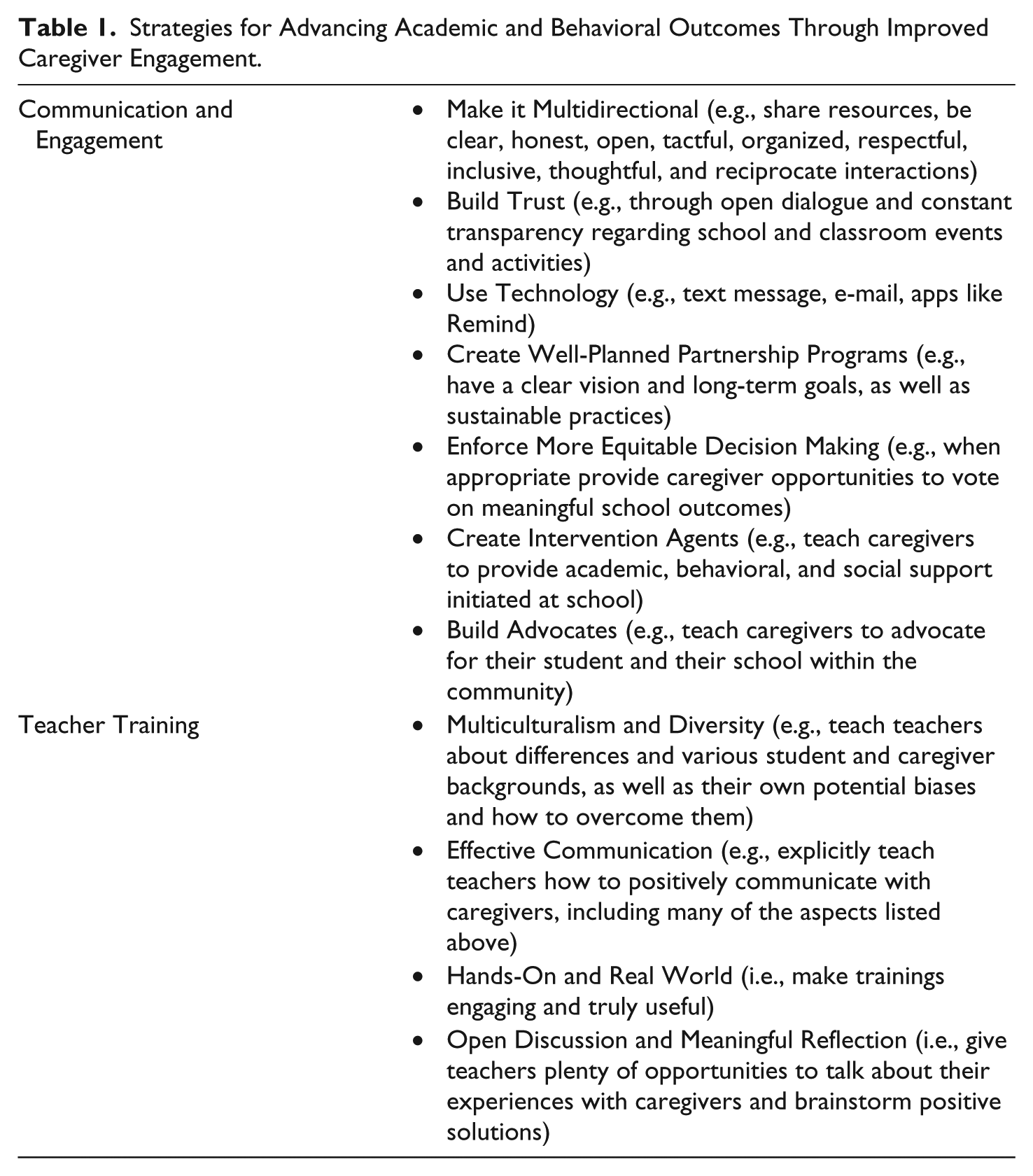
Communication and Engagement
Communicating with families is a practice schools can immediately implement. There are multiple methods for establishing communication between home and school and once effective methods for communication are established, it is important to consider the methods by which communication can continue to occur. Contacting caregivers via telephone and focusing on both the student’s successes and challenges is critical. Teacher who work with CLD students in special education all too often only call home when there are challenges, but caregivers may be more inclined to communicate if they also get the opportunity to hear the successes their student have had at school (e.g., Murray & Mereoiu, 2015).
Engaging caregivers and families of at-risk students can be done in any school setting and at any academic level. Involving caregivers in the decision-making process is one step toward engaging them in their student’s education, because caregivers have a vast pool of knowledge and understanding about their student and can provide insight and understanding into student problem behavior and academic difficulties. Furthermore, educating caregivers about research-based strategies allows them the opportunity to use scientifically proven strategies with their student at home, giving caregivers the confidence, and strategies used by educators helps them feel included and on the educational team (e.g., J. Smith et al., 2011).
Teacher Training
Explicitly training teachers how to work with caregivers is important. The get the maximum benefit from training, it is essential that the following areas are addressed: (a) teachers’ previous experiences with caregiver involvement; (b) teachers’ assumptions, both positive and negative, about the students in their classroom, as well as assumptions of their caregivers; (c) strategies to overcome invalid assumptions and perceptions, such as diversity training; (d) strategies for communicating with caregivers, including hard to reach caregivers; and (e) extensive opportunities for hands-on and real-world experiences, as well as open discussion and meaningful reflection regarding experiences with the training and attainment of the training objectives (e.g., Hoover-Dempsey et al., 2002).
Footnotes
Declaration of Conflicting Interests
The author(s) declared no potential conflicts of interest with respect to the research, authorship, and/or publication of this article.
Funding
The author(s) received no financial support for the research, authorship, and/or publication of this article.