




Abstract
To examine the relationships between principal time use, race, and teacher perceptions of their school and principal, this study analyzes data from the 2015-2016 NCES National Teacher and Principal Surveys. Data from 31,950 teachers and 5,710 principals were analyzed using ordinal logistic regressions while controlling for principal time use in curricular tasks, student interactions, administrative tasks, parent interactions as well as principal and student population race. Significant findings include that teacher perceptions of their school and principal were significantly related to the racial composition of their school’s student body and/or the principal’s race, but not to principal time use. Implications and recommendations for researchers and school leaders are offered.
Introduction
The attitudes and perceptions of key stakeholders such as teachers, administrators, parents, and students continue to be an important area of research in education (Griffith, 2004; Koh et al., 1995; Price, 2012; Tschannen-Moran & Gareis, 2015). These perceptions can provide valuable insight into the role schools play in society as well as their effectiveness in helping students reach educational goals. Prior research has investigated relationships between principals, student demographics, and teachers’ perceptions of their schools and leadership (Aydin et al., 2013; Leithwood, & Jantzi, 2005; Nguni et al., 2006; Walker, 2009), but further research using large nationally representative survey datasets could prove helpful in better understanding these relationships. As the primary leaders of their campuses, principals have long been a focus of educational research. Several research teams have attempted to both quantify (Gaziel, 1995; Martin & Willower, 1981) and examine the ways principals spend their time (Grissom et al., 2015). Prior research has shed light on the intricacies of principals’ administrative tasks and time allocation, but there is much to be learned about how their choices impact the way teachers view their leadership.
To provide a more comprehensive perspective of how teachers view their schools and their school leaders, the present study uses data from the 2015-2016 National Center for Educational Statistics (NCES) National Teacher and Principal Survey (NTPS) to examine the relationships between principal time usage, principal race, student race, and teacher perceptions of their school and their principals in order to answer the following research question:
How well does principal race, principal time spent on curriculum-related tasks, administrative tasks, student and parent interactions, and percentage of Hispanic, Black, and white 1 students in the school predict teachers’ perceptions of liking how things are run at the school, having an administration that is supportive of staff, having a principal that enforces rules for student conduct and backs up the teachers, and having a principal that communicates what he or she wants with the staff?
Guided by the body of research on these subjects, we hypothesize that principal time usage will have a significant impact on teacher perceptions of how well their school is run, how supportive school leaders are of staff, whether they enforce school rules, and communicating well. Additionally, we hypothesize that the percentage of Black and Hispanic students will have a significant but negative impact on those same perceptions while the percentage of white students will have a positive impact. Finally, we hypothesize that having a principal of color will have a significant but negative impact on these teacher perceptions.
Literature Review
The present study is guided by prior research on the subjects of principal time use, principal race, student race, and their impacts on teacher perceptions of their schools and leadership.
Principal Time Use
In the 2015-2016 NTPS Principal Questionnaire, principals were asked to estimate the percentage of their time spent on categories of tasks during the school year. The categories of tasks as listed in the survey were
Internal administrative tasks, including human resource/personnel issues, regulations, reports, school budget.
Curriculum and teaching-related tasks, including teaching, lesson preparation, classroom observations, mentoring teachers.
Student interactions, including discipline and academic guidance.
Parent interactions, including formal and informal interactions.
Other tasks. (Goldring, Taie, Rizzo, & Riddles, 2017a)
Education scholars have examined principal time usage and have come to mixed conclusions from their limited data sets. According to Grissom et al. (2013), principals spend the largest percentage of their time (roughly 13%) on instruction-related activities with some variation caused by campus type and student prior achievement. Van Vooren’s (2018) study of K–5 principals revealed the complex array of tasks faced by school leaders in greater detail. For their sample of principals, special education-related tasks occupied the largest portion of their time. Additionally, Camburn et al. (2010) found that, on average, the principals they studied spent 23% of their time attending to student affairs, 19% of their time acting as instructional leaders, and 14% of their time handling personnel issues. In his comparison of principals at average and high-performing schools, Gaziel (1995) found that principals at high-performing schools spent greater amounts of time on instructional management, school improvement, and personnel management tasks than their counterparts at lower-performing campuses. And finally, examination of Kmetz and Willower (1982) and Martin and Willower (1981) shows that elementary principals spent more time on instructional matters than their high school peers (27% to 17%). All of these studies allow a glimpse into how principals spend their time, but all use smaller, more localized samples than what is available through the large nationally representative data set of the NTPS.
While principal time use has been a popular topic of educational research (Camburn et al., 2010; Peterson, 1977; Van Vooren, 2018), more attention has been focused on connecting leadership and time use with principal job satisfaction (Grissom et al., 2015; Martin & Willower, 1981) or student and campus achievement (Horng et al., 2010; Quinn, 2002; Robinson et al., 2008) than teacher perceptions. Other education research has examined how teachers perceive the effectiveness of their principals (Burkhauser, 2017; Wahlstrom & Louis, 2008), but not as it relates to time usage. The current study hopes to address these previous limitations by examining the connection between principal time use and teacher perceptions of their leadership and school effectiveness.
Principal Race
Research has long identified the importance of principals to the success of their students, schools, and teachers (Allen et al., 2015; Hallinger et al., 1996). The connection between principal effectiveness and student performance is a topic of considerable interest, but the connection to principal race is not always made by researchers. For example, Grissom et al. (2015) investigated the connection between student performance data and principal evaluations and found that while principals can have a great effect on their students’ achievement, the model used for these evaluations can impact the results significantly. Other researchers have investigated the relationship between principal race and teacher outcomes. Viano and Hunter (2017) found that teacher–principal race congruence (being of the same racial group) affects teacher satisfaction. The results of this study indicate that white teachers have more negative perceptions of their jobs and schools when they are under the purview of Black principals, but these effects do vary regionally across the United States. Similarly, Grissom and Keiser (2011) found that white teachers felt more positively about their work in schools when led by white principals and Black teachers working under white principals earned significantly less than their white colleagues. Clearly principal race is an important variable when investigating teacher perceptions of their school leadership.
Student Race
Multiple studies have documented that schools with higher percentages of students of color have lower teacher retention rates and draw less interest from teacher candidates (Darling-Hammond, 2004; Hanushek et al., 2004; Scafidi et al., 2007). Also, studies have shown that principals of urban and low-performing schools have lower job satisfaction (Chang et al., 2015) and are more likely to leave for another job (Béteille et al., 2012) than their peers on suburban, high-performing, and less-diverse campuses. Additionally, researchers have shown that teachers’ expectations of their students’ abilities and behavior is negatively affected by their non-white students’ race (Diamond et al., 2004; Ferguson, 2003; Oates, 2003; Rong, 1996).
How student race affects principal time use is a less-addressed area of research. Horng et al. (2010) discovered that principals’ time usage was affected by the demographic composition of their student body. Principals in schools with the highest quartile of Black students spent a significantly higher percentage of their time on administrative tasks than did their peers in the lowest quartile. Sebastian et al. (2018) examined principals’ self-reported time logs and found that principals spend their time on a diverse array of tasks but largely work collaboratively with coworkers instead of alone. They also found that principals spend the largest percentage of their time on administrative or leadership tasks and the amount of time they spent on various tasks was affected by school context, including student achievement, but student race was not investigated. Despite these published reports, there is a dearth of educational research examining the connections between student demographic composition and how teachers perceive their principals. This present study uses student demographic information such as percentages of Black, Hispanic, and white students to determine if there is an impact on teacher perceptions of their school leadership and school effectiveness.
Teacher Perceptions of Schools, Principals, and Students
Teachers are vital to the effectiveness of schools and the achievement of their students (Darling-Hammond, 2000; Hattie, 2003). Their perceptions of their schools and working conditions, school leaders, and their students have been thoroughly examined in a variety of contexts over the decades (Lee et al., 1993; Mitchell et al., 2010; Shen, 1997). As previously discussed, many studies address the connections between a principal’s time usage and their own job satisfaction and perceptions, but there is a lack of connection between that same time allocation and teacher perceptions of their schools and leaders.
There have been multiple studies linking teacher perceptions of their administrator’s leadership quality or style to campus climate (Kelley et al., 2005) and their ability to perform their jobs (Tschannen-Moran, 2009). Principal leadership can impact teacher and student performance (Valentine & Prater, 2011; Ylimaki et al., 2007) and it stands to reason that the choices about how they spend their time would impact their ability to lead. Therefore, research addressing teacher perceptions of how their leaders spend their time would help to fill a knowledge gap that exists in this area.
As mentioned prior, many notable studies have pointed out the connections between student demographics and teacher perceptions of their schools (Horng, 2009) and their effectiveness (Valentine & Prater, 2011). A large portion of the research on this topic examines differences of teacher perceptions of their students along a Black/white dichotomy, but the changing demographics of American schools necessitates a change in attitude. Some recent research has included Latino and Hispanic students as their own separate population of students (Bates & Glick, 2013; McGrady & Reynolds, 2013; Stearns et al., 2014), but additional investigation of teacher perceptions of this growing group of students is warranted. Other studies have pointed out that teacher racial biases against non-white students (a) can have an negative effect on their perceptions of the students’ abilities (Ready & Wright, 2011), (b) lead to higher numbers of disciplinary actions (Morris & Perry, 2016), and (c) can negatively affect teacher retention (Simon & Johnson, 2015). Obviously, the interaction between student demographic composition and teacher perceptions are multifaceted; this present study seeks to further deepen the knowledge base on this complicated relationship.
Method
The present study uses the 2015-2016 restricted-use NTPS from the NCES. The NTPS is the newest redesign of the past Schools and Staffing Survey and it focuses on teachers and principals in greater detail than in the past. The new sampling methodology consists of a systematic proportionate-to-size sample, with an oversampling of some schools depending on its charter status, grade level, urbanicity, and poverty status (Goldring et al., 2017a). As such, it is a nationally representative sample, which can be used to generalize to the larger teacher population in the United States. For the present study, two surveys, the Teacher Survey and the Principal Survey, were merged using the control number.
For reporting purposes, unweighted sample sizes are provided and rounded to the nearest ten in accordance with IES guidelines. The final sample used in this study consists of all teachers and principals in public schools, a total of 31,950 teachers and 5,710 principals. Table 1 displays demographic characteristics for these teachers and principals.
Demographic Characteristics of U.S. Teachers and Principals in 2014-2015 NTPS.
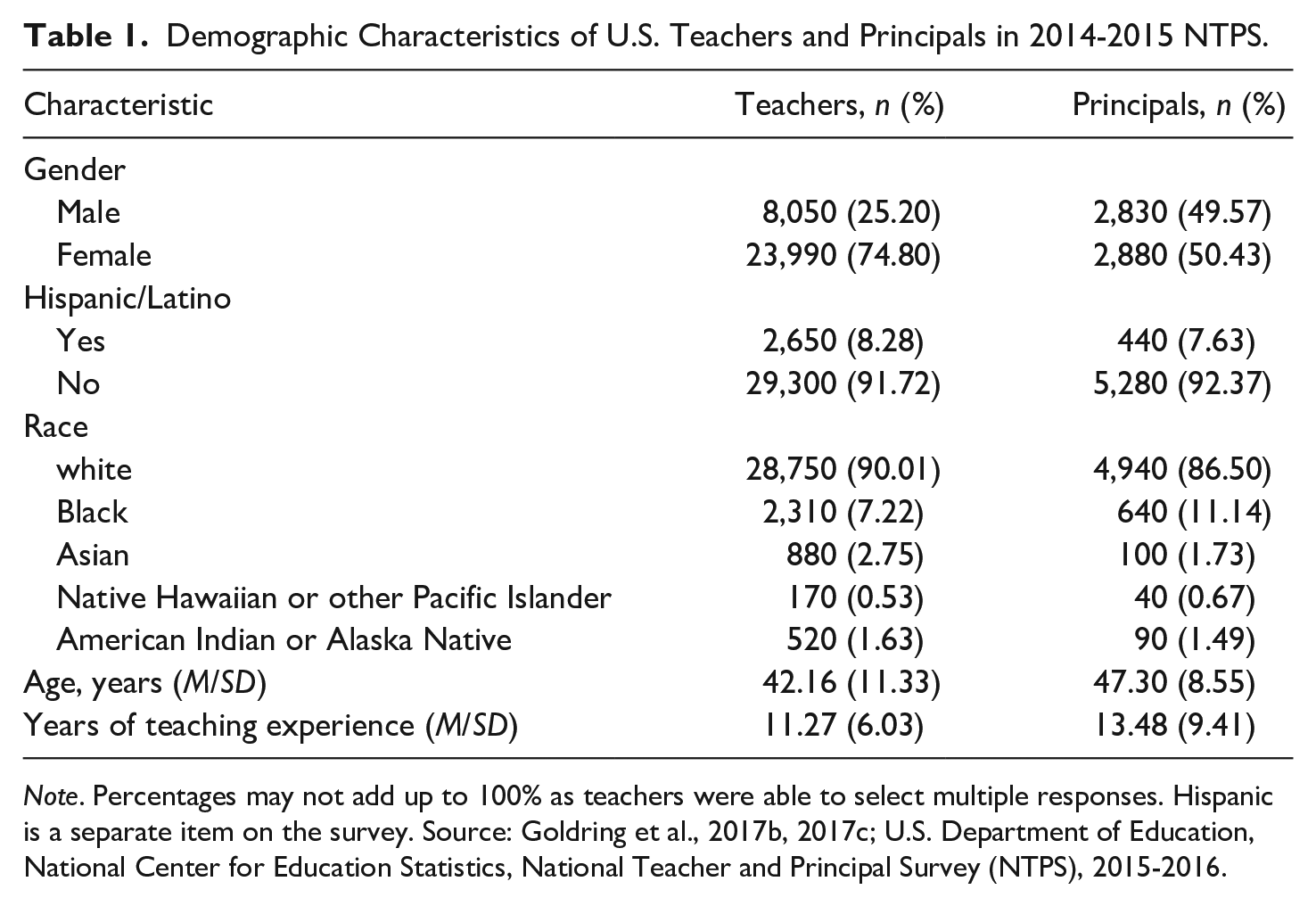
Note. Percentages may not add up to 100% as teachers were able to select multiple responses. Hispanic is a separate item on the survey. Source: Goldring et al., 2017b, 2017c; U.S. Department of Education, National Center for Education Statistics, National Teacher and Principal Survey (NTPS), 2015-2016.
Measures
The following continuous predictor variables used in this study were used: Curricular Tasks representing the amount of time the principal spends on curriculum-related activities such as teaching, lesson preparation, observing classrooms, or mentoring teachers; Student Interactions representing the amount of time the principal spends on student interactions including disciplinary actions or guidance activities; Administrative Tasks representing the amount of time the principal spends on administrative activities such as formal personnel interactions, reporting, and budgetary activities; and Parent Interactions representing the amount of time the principal spends on formal and informal interactions with parents. Additionally, the percentage of Hispanic students, percentage of Black students, and percentage of white students were used as numerical control variables while principal race was used as a categorical control variable. Table 2 displays summary statistics for these variables.
Summary Statistics for Predictor Variables.

Note. Source: U.S. Department of Education, National Center for Education Statistics, National Teacher and Principal Survey (NTPS), 2015-2016.
The outcome variables that were used in this study were coded on a Likert-type scale where 1 represented strongly disagree and 4 represented strongly agree”: School is Well-Run representing the teacher’s perception of liking how things are run at the school, Supportive Principal representing the teacher’s perception of having an administration that is supportive of staff, Rules Enforced representing the teacher’s perception of having a principal that enforces rules for student conduct and backs up the teachers, and Communicates Well representing the teacher’s perception of having a principal that communicates what he or she wants with the staff. Where necessary, some variables that were originally reverse-coded were recoded accordingly.
Analysis
A series of ordinal logistic regressions were run, as all the dependent variables were Likert-type (Long & Freese, 2014). All data analyses used Stata 16 (StataCorp, 2019) statistical software. In addition, the “svy” suite in Stata 16 was used, as it accounts for the complex survey sampling design that is found with NTPS. Jackknife weights and standard errors were used in accordance with suggestions made in the survey manual provided by NCES (Goldring et al., 2017a). All coefficients were converted to odds ratios for ease of interpretation.
Different models were run for each census region for comparative purposes. These regional differences are not presented in this article; however, they can be found in Supplemental Appendices A to D. Conforming to accepted conventions, only findings significant at the α = .05 level are reported.
Results
Research Question
How well does principal race, principal time spent on curriculum-related tasks, administrative tasks, student and parent interactions, and percentage of Hispanic, Black, and white students in the school, predict the teacher’s perception of liking how things are run at the school, having an administration that is supportive of staff, having a principal that enforces rules for student conduct and backs up the teachers, and having a principal that communicates what he or she wants with the staff?
Table 3 displays the results predicting the teacher’s perceptions of various outcomes. We use time spent on various tasks, principal race/ethnicity, and student demographics to predict the likelihood of having favorable teacher perceptions for each of the outcomes. The odds ratios in Table 3 can be interpreted as follows: an odds ratio of exactly 1.000 indicates that an increase in a predictor variable has no impact on the odds of an outcome (a positive teacher perception) occurring. An odds ratio greater than 1.000 indicates that an increase in a predictor variable increases the odds of an outcome occurring. Similarly, an odds ratio less than 1.000 indicates that an increase in a predictor variable reduces the odds of an outcome occurring.
Odds Ratios Results of Ordered Logistic Regressions Predicting Teacher Perceptions for Principal and School Outcomes.

Note. All SEs are jackknife standard errors. Source: U.S. Department of Education, National Center for Education Statistics, National Teacher and Principal Survey (NTPS), 2015-2016. AA = African American, PI = Pacific Islander, NH = not Hispanic.
p < .05. **p < .01. ***p < .001.
Overall, how principal time is spent is not significantly related to any of the outcomes. However, for all outcomes except the perception that a principal is communicative, being a Hispanic and/or Black principal significantly reduces the likelihood that their teachers will have favorable perceptions of them, compared with white principals. Specifically, we observe that being a principal that identifies as Hispanic reduces the likelihood of having teachers perceive that the school is well-run by 22.4%, while being a principal who identifies as Black/African American reduces that likelihood by 18.7%. Similarly, a Hispanic principal is 17.7% less likely and a Black principal is 16.9% less likely to have teachers perceive them as being supportive when compared with a white principal. Finally, a Hispanic principal is 16.8% less likely to have teachers perceive them as being an effective enforcer of student conduct rules.
We also observe that student demographics in some cases significantly predicts teacher perceptions of their principals and their schools. Particularly, having a larger percentage of Black students is associated with a 0.6% reduction in the likelihood of teachers’ perception of liking how the school is run and a 0.2% reduction in the likelihood of teachers’ perception of having a communicative principal. Additionally, each percentage increase in white students increases the likelihood of teachers’ perception of having a school that is well-run, having a supportive principal, and having a principal that enforces student conduct rules by 0.2% to 0.4%, but is less likely to be perceived as having a communicative principal by 0.2%. Largely, having greater percentages of non-white students negatively impacts teachers’ perceptions of their principals and their schools, while having greater percentages of white students has a positive impact on those same perceptions.
When examining study results by census region, we notice similar patterns of teacher perceptions of principals and schools. Teacher perceptions across all outcomes were largely negatively affected by having a principal of color (specifically Native Hawaiian, American Indian, and Alaska Native principals). When considering student demographics, the region composing the Western half of the country is the only geographical area that is associated with favorable teacher perceptions for liking how their school is run, having a supportive principal, and having a principal who is a rules enforcer: for each additional percentage increase in Hispanic students those perceptions were significantly increased. The regional breakdown of results can be found in Supplemental Appendices A to D.
Discussion
The present study sought to determine if different measures of principal choices on how they spent their time were associated with teacher perceptions of their leadership and the effectiveness of their school. Additionally, principal race and student body racial composition were examined as potential influencers of these same teacher perceptions. The results of this present study indicate that teacher perceptions of school effectiveness, administrative support, administrative enforcement of school rules, and administrative effectiveness of communication were significantly impacted by the race of their principal and the racial composition of their school’s student body, but not by principal time use. This was an interesting finding, as it was initially hypothesized that principal time use would have an effect on teachers’ perception of leadership and school effectiveness.
Previous research had measured the impact of principal leadership on teacher perceptions of their leadership and their school (Kelley et al., 2005; Tschannen-Moran, 2009), but connections between principal time usage and teacher perceptions were not documented. The present study establishes that the percentage of time spent by principals on different categories of tasks did not significantly impact teacher perceptions of their effectiveness or their campus. Explanations for this lack of connection between principal time use and teacher perceptions is interesting and deserves further exploration.
Examination of principal time use statistics told an interesting story about how principals fill their schedules. Full sample survey data show that principals spend the largest percentage of their time on administrative tasks (30.8%) followed in order by curriculum-related tasks (29.8%), student interactions (22.1%), and parent interactions (14.1%). This partially supports but also helps to contextualize the findings of prior research studies from Van Vooren (2018), Grissom et al. (2013), and Camburn et al. (2010). These studies used smaller, more localized samples, so their findings should be seen as complementary to the percentages of principal time usage reported by respondents in the present study’s larger, nationally representative sample. Further analysis revealed that principal time use differed along racial lines. white principals spent more time on student interactions than their non-white contemporaries. Hispanic/Latino, Asian, and Native Hawaiian/Pacific Islander principals all spent significantly more time on administrative tasks than white principals. Black principals spent a significantly larger percentage of their time on curriculum-related tasks and a significantly smaller percentage on administrative tasks. (Please see Supplemental Appendix E for a full breakdown of principal time use statistics by race/ethnicity.) There are many possible explanations for these differences, but further contextual exploration is recommended to better understand why principals from different racial groups are using their time differently.
Education research had proposed that teachers’ feelings about their principals and schools could be affected by race, but the present study supports the conclusions of various researchers (Ballou & Podgursky, 1995; Grissom & Keiser, 2011; Viano & Hunter, 2017) of principal race being an important predictor of teacher perceptions of administrative duties. Additionally, the present study’s conclusions support the finding of a negative impact of diverse student body composition on teacher perceptions of their schools as highlighted by Horng (2009) and Valentine and Prater (2011). The present study supports the idea that schools with large percentages of students of color are seen as being less effective or less well-run than schools with a higher percentage of white students. DeMatthews (2016) has documented the need for school leaders and administration to look beyond menial tasks and use a critical social justice lens to form their model of campus leadership, even when principals of color encounter challenges in addressing equity in their schools (DeMatthews, 2018). Others have written about the need to address race, racial biases, and color blindness in working with students, specifically Black males (Carter et al., 2017). Relatedly, the importance that principal and student race plays in teachers’ perceptions of time may be a function of the trust that a predominantly white teacher workforce has for principals of color (Brezicha & Fuller, 2019). The present study is also able to contribute important information about the impact of student body racial composition on teachers’ perceptions of their principals’ effectiveness: an area of research that was lacking in the field.
Limitations and Recommendations
The present study has increased generalizability because it uses a nationally representative sample, but limitations still exist. As with most nationally representative datasets, this sample is cross-sectional and thus we are unable to track teachers over a longer period of time. With regard to the percentage of time use by the principal for four of the predictors, we are limited by the wording of the survey items. That is, while a few examples are provided in the item description, we have little insight as to how survey respondents might interpret their actions into the given time use categories. Future research on this topic could focus on the nuances of principal time usage. Likewise, with the outcomes, we are also limited by the wording of the items. While we know that the teacher may agree or not on liking how the school is run, having a supportive administrator, having an administrator who enforces the rules, or having an administrator who is communicative, we recommend that future studies look into how principals support (or not) their teachers; communicate with faculty, staff, and parents; how they enforce (or not) the rules; and how they run their school. Additionally, we only have teacher perceptions of their principal. That is, we do not know whether the principal might think they are performing well across any of our outcome domains. Therefore, future research may want to try to understand principal perceptions of their own abilities.
This study also highlights the need to further understand why principal time use was not significantly related in most cases to teacher perceptions of the principal’s job and why race was a significant predictor, both in terms of student demographics and the principal’s race. The findings in this study support prior research showing that racial bias may play a significant role in the educational experiences of teachers and students but that those connections may vary regionally (Grissom & Keiser, 2011; Oates, 2003; Viano & Hunter, 2017). Moreover, future research may want to account for the nesting of teachers within principals/schools by using multilevel models. That said, one of the biggest delimitations of this study is that the restricted nature of the dataset used for this study allowed for the merging of teachers and principals in matching schools, which enriched the depth of the research questions we explored.
Implications
Future Research
The present study quantifies the perceptions of teachers of their schools and school leaders based on both principals’ self-reported time usage and student and principal race. While the finding that principal time usage did not significantly affect teacher perceptions, it does reveal some of how teachers think about how their principals spend their time. One path of additional inquiry might be aimed at trying to determine whether or not teachers have an accurate picture of what their principal actually does during their time on campus. This could be accomplished through shadowing a larger sample of principals in addition to interviewing or surveying teachers on school campuses to see if their perceptions matched up to the reality of what their school leaders are doing. Additionally, qualitative research could be used to further support, strengthen, or challenge the findings of the present study and examine the relationship between student and principal race and teacher perceptions.
Theory
The present study’s findings that teacher perceptions of their school and their principals’ abilities are influenced by the demographic composition of the schools’ students support claims made by other researchers that teachers would benefit from further training in evaluating the biases they bring to their classrooms or attempt to practice culturally relevant pedagogy in their classrooms (Irvine, 2010; Ladson-Billings, 1995, 2014; Valenzuela, 2016). The present study does differentiate between three racial groups: Hispanic, Black, and white students. As some researchers have noted, a preponderance of research on student race and schools focuses on the Black/white dichotomy; but the wider inclusion of the Hispanic/Latino population is overdue. Additionally, the present study does show that the impact of student demographics on teacher perceptions does differ regionally (tables in the Supplemental Appendices). This suggests that there may be a need for interventions targeted to the specific needs of geographic regions, maybe even as fine as the state, county, or school district level.
Practice
The present study demonstrates that the way in which principals choose to spend their time does not greatly affect their teachers’ perceptions about the effectiveness of their leadership or their school campus. This is not to say that principal time use is unimportant, however. Other studies have demonstrated that principal time usage can affect student achievement (Horng et al., 2010) and principal job satisfaction (Grissom et al., 2015). Principals have individual strengths and weaknesses and district leaders need to continue to innovate to allow these men and women to use their talents to help their teachers and students in the most appropriate ways. Some schools have begun the practice of employing school administration managers (Alvoid & Black, 2014; Walker, 2009) in hopes that these more administrative task-focused principals would allow for other members of the leadership team to make instruction and teacher support higher priorities.
As presented in this study and other research (Grissom & Keiser, 2011; Howard, 2016; Viano & Hunter, 2017), school administrators need to recognize that their own race and the racial composition of their school’s student population will impact the perceptions of the teachers working under their supervision. Incorporating antibias training into teacher professional development, perhaps even during on-boarding, might help to acclimate teachers to the context within which they will be working (Han & Thomas, 2010; Vaught & Castagno, 2008; Weinstein et al., 2004). Especially productive might be training or development sessions centered on helping teachers see their practices from a more critical perspective (Gorski, 2009). School leaders might also consider hiring teachers with existing connections to their locales or with similar backgrounds as their students, as research suggests these commonalities might help both students and teachers (Dee, 2004; Egalite & Kisida, 2018; Viano & Hunter, 2017). This can present a challenge, however, as 79.3% of American teachers are white (Snyder et al., 2019). Finally, school administrators, especially those of color, should seek to openly acknowledge differences in perspectives or philosophies that could exist between their teachers, their students, and themselves. Discussing these differences could lead to better understanding between stakeholders and avoid the formation of some of the negative perceptions identified in this present study.
Conclusion
The present study found that teacher perceptions of their school, administrative support, administrative enforcement of school rules, and effectiveness of administrative communication were significantly related to the racial composition of their school’s student population and the race of their principal. To a large extent, teacher perceptions were negatively affected when their school had a greater percentage of students of color or a principal of color. Directionality and magnitude of the association varied by region; highlighting the need for more geographically localized interventions to address teacher biases. Additionally, teacher perceptions were not significantly related to the amount of time principals spent on curricular tasks, student interactions, administrative tasks, and parent interactions.
Supplemental Material
new_ntps_app_A_B,_C,_D_and_E, – Supplemental material for Race Against Time: The Effects of Principal Race and Time Use on Teacher Perceptions of Leadership
Supplemental material, new_ntps_app_A_B,_C,_D_and_E, for Race Against Time: The Effects of Principal Race and Time Use on Teacher Perceptions of Leadership by Jeffrey Keese, Mario I. Sùarez and Hersh Waxman in NASSP Bulletin
Footnotes
Declaration of Conflicting Interests
The author(s) declared no potential conflicts of interest with respect to the research, authorship, and/or publication of this article.
Funding
The author(s) received no financial support for the research, authorship, and/or publication of this article.

Supplemental Material
Supplemental material for this article is available online.
Notes
Author Biographies
References
Supplementary Material
Please find the following supplemental material available below.
For Open Access articles published under a Creative Commons License, all supplemental material carries the same license as the article it is associated with.
For non-Open Access articles published, all supplemental material carries a non-exclusive license, and permission requests for re-use of supplemental material or any part of supplemental material shall be sent directly to the copyright owner as specified in the copyright notice associated with the article.
