



Abstract
We present outcomes from a field test of a student-centered and technology-driven school safety framework. We describe the framework components rooted in school violence prevention. Results from our field test indicate moderate student and teacher use of the framework components, improvements in student perceptions of school safety, reductions in student reported peer victimization, and reductions in teacher and parent reported inappropriate student behavior. Consumer satisfaction rating were adequate. We present recommendations for implementing a school safety framework emphasizing student voice.
Every student is entitled to feel physically and emotionally safe at school. Indeed, physical and emotional safety are prerequisites for school engagement and academic learning (Bradshaw et al., 2014). Unfortunately, too many students lack a fundamental sense of safety in school due to peer victimization in the form of bullying, harassment, or social isolation and pervasive media coverage of school violence. According to the most recent Youth Risk Behavior Survey (YRBS) conducted in 2019, 19.5% of high school students report being bullied at school (Kann et al., 2018). These same data indicate that females (23.6.3% vs. 15.4% for males) and White students (23.1% vs. 14.8% for Latinx and 15.1% for Black students) are particularly at-risk for being victimized by bullying. Bullying rates have not changed significantly in the YRBS since 2009. A total of 15.7% of students completing the YRBS reported being cyberbullied in the past year. More female (20.4%) than male (10.9%) students were cyberbullied, and more White (18.6%) than Latinx (12.7%) or Black (8.6%) students were cyberbullied. Cyberbullying rates have been highly stable in the YRBS since 2011. Peer victimization is more prevalent than being threatened or injured with a weapon. Twelve percent of students reported being threatened or injured with a weapon at school in 2019 (Basile et al., 2019). In addition to female and White students, students from sexual minority backgrounds are particularly affected by peer victimization. In 2019, 59.5% of LGBTQ students reported feeling unsafe at school due to their sexual orientation, 68.7% reported verbal harassment, 25.7% reported physical harassment, and 11% reported physical assault (Kosciw et al., 2020).
Peer victimization has been identified as an important predictor of violent behavior affecting the safety of individual students and entire school communities. Research shows that many students who engage in extreme violence (e.g., school shootings) report prior peer victimization experiences (Bradshaw et al., 2008; Lankford, 2015; Skiba et al., 2004). In those cases, peer victimization occurred across extended periods of time—months or even years—and—in the eyes of the victimized student—remained largely unaddressed (Langman, 2013). In conjunction with other unaddressed needs, including mental health supports (Langman, 2017) and social isolation (Flannery et al., 2013a), and societal factors including traditional norms of masculinity (Farr, 2018) and glorification of violence (Leary et al., 2003), peer victimization becomes a powerful catalyst for violent behavior compromising school safety.
If peer victimization could be addressed in a timely and appropriate manner, escalation into violent acts of revenge might potentially be averted. The literature suggests that, prior to engaging in violent acts, many offending students shared their intentions with peers (Langman, 2015; National Threat Assessment Center, 2019; Vossekuil, 2004) but that these peers did not share this critical information with adults who might be in a position to intervene (Langman, 2017; National Threat Assessment Center, 2019; Newman et al., 2004). In such cases peers have reported that they did not share information with school adults due to fears of punitive consequences and retaliation from peers (Allnock & Atkinson, 2019; Brank et al., 2007; Stone & Isaacs, 2002; Syvertson et al., 2009).
Recommendations to Reduce Peer Victimization and Prevent Violent Behavior
Recommendations from the Federal Commission on School Safety, established after the 2018 Parkland tragedy, include (a) promoting positive school climates free from peer victimization where students feel connected to their school community, and (b) reporting of suspicious behaviors, situations and safety concerns (US Department of Education, 2018). The STOP School Violence Act of 2018 offers funding for anonymous reporting systems to encourage students to share safety threats with adults. The most recent U.S. Secret Service’s report, Protecting America’s Schools (National Threat Assessment Center, 2019), states It is critical that schools implement comprehensive programs designed to promote safe and positive school climates, where students feel empowered to report bullying when they witness it or are victims of it, and where school officials and other authorities act to intervene. (p. v)
Current School Safety Practices
The U.S. Department of Education’s Report on Indicators of School Crime and Safety: 2020 (Irwin et al., 2021) reports student perceptions of their schools’ safety practices. Results indicated that written codes of conduct (94.3% of respondents) and required sign-in for visitors (90.4%) were the most prevalent observed practices, followed by adult supervision in hallways (88.7%), security cameras (86.0%), locked entrance and exit doors during the day (84.6%), security guards or assigned police officers (75.4%), random locker checks (46.7%), required student ID badges (28.3%) and metal detectors (11.9%). Over the last decade (2009–2019), the use of written codes of conduct and adult supervision decreased slightly (1.3 and 1.9 percentage points, respectively). The largest increase occurred in locked entrance and exit doors and use of security cameras (20.3 and 16 percentage points, respectively). In addition to these safety practices, many schools implement practices responsive to the recommendations put forth by the Federal Commission on School Safety and the U.S. Secret Service, namely promoting a positive school climate and reporting of safety threats.
Promoting a Positive School Climate. To reduce peer victimization and promote positive school climates, many states and districts have invested in (a) multi-tiered systems of support (MTSS) to implement behavior supports (Stoiber & Gettinger, 2016), (b) Social-emotional learning (SEL) (Young & Webb, 2019), or (c) Restorative practices (RP) (Fronius et al., 2019)
School-wide positive behavior interventions and supports (SWPBIS) is an MTSS behavioral support system (Horner & Sugai, 2015). It promotes students’ compliance with behavioral expectations by rewarding desirable and punishing undesirable behaviors. While students have a nominal role in defining behavioral expectations, school adults implement reward and punishment systems based on their perceptions of rule compliance and violations. Successful implementation and outcomes for SWPBIS have been greater at the elementary than at the middle or high school level (Bradshaw et al., 2010; Noltemeyer et al., 2019). Implementation in high schools has been challenging due to a focus on academic rather than social competence, students’ self-management expectations, and adolescent students’ desire for autonomous decision-making and sensitivity to peer pressure (Flannery et al., 2013b; Syversten et al., 2007).
SEL curricula tend to focus on self-awareness, social awareness of others, responsible decision-making, self-management, and relationship management (Weissberg et al., 2015; Zins et al., 2007). SEL implementation occurs primarily in pre-K and elementary grades. An audit of U.S. states’ SEL standards conducted in 2014 indicated that only three states have K-12 SEL standards (Dusenbury et al., 2014). Implementation of SEL programs has been associated with improvements in student behavior and academic outcomes (Durlak et al., 2011; Taylor et al., 2017). Research suggests that student voice might not be sufficiently integrated in the development and implementation of SEL curricula, and that greater emphasis on student engagement might be needed (Halliday et al., 2019).
RP focus on empowering students—especially adolescent students—to share in decisions that affect them, forge positive and protective peer and student-teacher relationships, and promote self-awareness and social awareness (Gregory & Evans, 2020). As such, student voice appears to be central to RP. Results from initial randomized controlled trials indicate that RP holds promise to promote positive school climates through student-centered relationship-building and shared decision-making (Anyon et al., 2014; Augustine et al., 2018).
The literature suggests that practices promoting a positive school climate benefit from strong school-home partnerships. Continuity of behavioral support, SEL, and relationship building across school and home contexts promotes positive student behavior, and parent-identified concerning behaviors might be of interest to school personnel as they intervene to prevent escalation of peer victimization into violence (Rappaport & Thomas, 2004).
Reporting of Safety Threats. To provide students with an opportunity to report threatening behaviors, many states have established statewide tiplines (e.g. Safe2Tell (CO), Okay2Say, (MI), SafeUT (UT), Fortify Florida (FL), SafeVoice (NV), and SafeOregon (OR)). Student tiplines acknowledge that students have access to critical safety information and underscore the importance of student voice in the prevention of school violence. Most of the existing tiplines allow anonymous reporting to offer students safety from potential peer retaliation. Reports made to statewide tiplines are commonly monitored by the state police. The evidence of tiplines’ capacity to prevent violent behaviors and respond to student concerns is still emerging (Stein-Seroussi et al., 2021). In its 2018 School Tipline Toolkit, the Office of Justice Program's National Criminal Justice Reference Service states: “Tip lines are promising, but much is still unknown about their effectiveness” (Planty et al., 2018, p. 1).
In this context, providing students with a reporting tool within a non-punitive school climate that stresses SEL and restorative relationship building seems to emerges as one approach to preventing peer victimization and potential escalation into violent behavior. To investigate the feasibility of this approach, we conducted a small-scale feasibility study of a recently developed comprehensive school safety framework focused on student reporting within a positive and restorative school climate. The study was driven by the following research questions:
Do students use the reporting tool? Is implementation of the framework components associated with changes in (a) students’ perceptions of their school environment and peer victimization, (b) teacher perceptions of student behavior, and (c) parent perceptions of student behavior? Are the framework components perceived as acceptable and feasible by administrators, teachers, and students?
Methods
The study was part of a multi-year grant focused on iterative development and testing of the Student Ownership, Accountability, and Responsibility for School Safety (SOARS) framework. We anchored SOARS conceptually in the following key premises from the literature: First, school violence is often the result of longstanding perceived victimization by peers (National Threat Assessment Center, 2019). Second, adolescent students tend to be more knowledgeable about peer victimization affecting themselves or others in their school community than school adults (Langman, 2015; National Threat Assessment Center, 2019; U.S. Department of Education, 2018; Vossekuil, 2004). Third, adolescent students are reluctant to share this information with school adults due to fear of retaliation and lack of trust in adults’ ability to respond appropriately (Syvertsen et al., 2009). And fourth, to build trust between students and school adults and promote student willingness to share critical safety information, it might be necessary to encourage non-punitive, restorative approaches to peer conflict and discipline incidents (Mirsky, 2011).
The SOARS Framework
The SOARS framework is student-centered and technology-driven. The first and central component of the framework is a reporting tool called Advocatr that is accessible via mobile app or the website located at https://advocatr.org/. Because all users sign in with a username and password, information submitted through the app is confidential, but not anonymous. Advocatr allows students to report a safety concern (“Something Wrong”) as well as positive behavior (“Something Right”). It also allows users to check the status of the reports they submitted. While we developed the app, we conducted focus groups with students in order to tailor the app to students’ needs and preferences (Espelage et al., in print). The option to report positive behavior was developed in direct response to students’ request not to focus exclusively on negative events. This is consistent with the literature recommending peer norming of positive behavior to encourage prosocial peer interactions and improve school climate (Connell, 2017).
When students report Something Wrong or Something Right they are prompted to provide information about the event and the emotional impact it had on them. When students check the status of a report they made, they see whether the report has been received, is in review, or is closed. All information submitted via Advocatr goes to a school-based SOARS coordinator, who can reach out to the reporting student to address their concern or gather more information to resolve the issue.
The second component is the 9-week SOARS curriculum designed to support student use of the Advocatr reporting tool. Teachers deliver instructional activities that focus on (a) shared ownership of school safety, (b) advocacy and self-advocacy, (c) physical and emotional safety, and (d) RP and accountability. Each activity takes about 20 min and is accompanied by a brief instructional video and a one-page “Did-You-Know” document which summarizes key information relevant to the target concept. The videos and “Did-You-Know” documents are also available to students at any time via the website. The lesson plans made available to teachers specify the lesson goals (e.g., “To help students understand the value and importance of standing up for what's right.”) and learning objectives (e.g., “state what it means to stand up for someone,” “give one example of being an advocator”) and the materials needed to present the lesson (e.g., Video “What's an advocator,” paper, pencil). A brief warm-up/icebreaker activity, such as writing a few sentences about a person who stood up for you, is followed by suggested prompts for discussion of key concepts (e.g., “How did it make you feel when someone stood up for you?”) and key terms (e.g. “advocacy,” “social justice”) involving the entire class. Finally, the lesson plan suggests homework to encourage students to further engage with the lesson's goals (e.g., “Write a paragraph about an event in your life when you wish you would have stood up for someone but didn’t. Why didn’t you do it? Were you scared or nervous about the consequences?”).
Because consistency across school and home is highly recommended (Gonzalez-DeHass et al., 2005), the third component of the framework consists of informational briefs for teachers and parents. These briefs summarize the research base supporting the SOARS framework and are intended to promote teacher and caregiver awareness and knowledge of the impact physical and emotional safety have on students’ learning, of the importance of advocacy and self-advocacy, and of restorative approaches to conflict resolution.
The fourth component is a student-led, school-wide safety campaign. The instructional activities invite students to participate in the campaign, which can be guided by existing student leadership teams. The purpose of the campaign is to raise awareness of the Advocatr app and promote a sense of community and shared responsibility for the physical and emotional health and safety of all school community members (Klassen et al., 2000). The framework provides students with steps for planning, preparing, implementing, and evaluating a safety campaign.
Introducing a student-centered and technology-driven safety framework into high schools requires careful roll out and incremental implementation. While school staff, students, and parents were supportive of the SOARS components in theory, some questions about how implementation of the framework components would impact actual school operations remained. Most importantly, it was unclear, how many reports students would submit via the Advocatr and how responding to those reports might impact staff time. To accommodate the uncertainty about usage rates and impact on school operations, we focused the initial field test on three of the four framework components. prior to a larger efficacy trial. Because we deliberately limited the scope of the study to a few classrooms, it was not possible to test the feasibility of the school-wide student-led safety campaign.
We used a quasi-experimental one-group design to assess the feasibility of implementing the framework components in high schools and its association with changes on key outcomes from pretest to posttest. The study occurred in the 2018–19 school year.
Participants
Two high schools participated: one in the Pacific Northwest, and one in the Midwest. Table 1 provides an overview of the participating schools’ overall student enrollment.
Participating School Demographics.

In collaboration with school administrators, we recruited teachers to assist with onboarding students to the Advoctr app and to deliver the classroom instructional activities. Each participating teacher recruited students from one of their classrooms. Any student who provided active parent consent and student assent was eligible to participate in the study. Each participating student's parent was invited to complete the parent measure. Across the 2018–19 school year and across both sites, 10 unique teachers participated, 121 unique students, and 20 unique parents. Table 2 provides an overview of participant demographics.
Participant Demographics.

Not all participants completed all demographic questions. Participants could select multiple racial backgrounds. Some parents had more than one child at different grade levels. Participating teachers taught English Language Arts, Art, Health, and Science.
Study Procedures
At the beginning of the school year, one administrator at each participating school completed the Existing Practices Checklist indicating what policies and practices were in place at the school.
Teachers participated in a two-hour training that introduced them to the overall logic of the SOARS framework and specifically to the Advocatr app, the curriculum and lesson plans, and the informational briefs. Teachers then chose one of their classes for participation and disseminated recruitment materials to all students and their parents in the class. All students who provided active parental consent and student assent were asked to complete the Safe School Survey and the Peer Experiences Questionnaire (PEQ), and parents were asked to complete the Behavior Problem Index (BPI) for their consented child. The consented students were then given access to the Advocatr app. About two to three weeks into semester 1, teachers were asked to complete the BPI for each consented student in the class.
Over the next ten weeks, teachers first introduced their class to the Advocatr app and then taught one weekly lesson about the core concepts on which Advocatr is built: (a) shared ownership of the school's safety, (b) self-advocacy, (c) physical and emotional safety, and (d) restorative conflict resolution. In the second semester, teachers repeated lessons they felt were most relevant for their students, and students retained access to the Advocatr app. At the end of the school year, administrators, teachers, and students were asked to complete post measures, including a Consumer Satisfaction Questionnaire.
Throughout the school year, a school-based SOARS coordinator, supported by grant funds, received all Advocatr reports made by students. The SOARS coordinator responded to the reports in collaboration with the school's assistant principal or dean of students, who routinely responded to discipline incidents and handled disciplinary consequences.
Teachers who discontinued the study after semester 1 if their class lasted only one semester, and students and parents who left the study because of student mobility were asked to complete post measures at the end of semester 1. New teachers, students, and parents who joined the study at the beginning of semester 2 followed the same procedural steps as participants at the beginning of semester 1.
Measures
Administrators. To understand the school context for our intervention, we asked administrators to complete the Existing Practices Checklist. This checklist asked for a listing of current initiatives and practices and the extent to which those initiatives and practices were implemented.
Students. We measured the frequency of Advocatr reports made by students by type of report (“Something Right” and “Something Wrong”). We also measured the frequency of types of safety concerns, as well as types of positive behaviors students noticed.
Students completed the Safe School Survey and the PEQ. The Safe School Survey (Skiba et al., 2006) consists of 42 items that assess student perceptions across four scales: (a) Personal Safety, (b) Incivility/Disruption, (c) Delinquency/Major Safety, and (d) Connection to School/Positive School Climate. The four scales were identified using principal component analysis and demonstrated good internal consistency and construct validity (Skiba et al., 2004). Students were asked to indicate the extent to which they agreed with each statement. Response options ranged from 1 (Strongly Disagree) through 5 (Strongly Agree) on a 5-point Likert-type scale. For the present study, Cronbach's α at pretest and posttest were: α = .87 and .86 for the Personal Safety scale, α = .86 and .88 for the Incivility/Disruption scale, α = .82 and .88 for the Delinquency/Major Safety scale, and α = .93 and .92 for the Connection to School/Positive School Climate scale.
The Peer Experiences Questionnaire (PEQ; Vernberg et al., 1999) consists of 18 items that assess students’ experiences as both victims and perpetrators of different types of anti-social behaviors at school (e.g., hitting, rumor spreading, intimidation, threats, social exclusion). Nine items assessed perpetration (e.g., student engaging in these behaviors towards peers) and nine items assessed victimization (e.g., student experiencing these behaviors from peers). The PEQ has demonstrated good test-retest reliability, internal consistency, and convergent validity (Vernberg et al., 2000). Students were asked to indicate the frequency with which they engaged in or experienced each behavior. Response options ranged from 1 (Never) through 5 (Several times a day) on a 5-point Likert-type scale. For the present study, Cronbach's α at pretest and posttest were: α = .93 and .73 for the Perpetration scale, and α = .87 and .70 for the Victimization scale.
Teachers. To assess fidelity of implementation, teachers were asked to complete an Implementation Checklist to record when they implemented each lesson and which lesson component (e.g., video, informational brief) they used.
To cross-validate student self-reported behavior from the teacher perspective, we asked teachers to complete the Behavior Problem Index (BPI; Moore et al., 2002). The BPI allows teachers to rate students on six problematic behaviors: (a) cheats or tells lies, (b) disobedient at school, (c) difficulty concentrating, (d) trouble getting along with other children, (e) bullies or is cruel or mean to others, and (f) strong temper and trouble controlling temper. The 6-item BPI showed good internal consistency, test-retest reliability, and reliable predictive power in longitudinal samples when compared with the 28-item version of the BPI (Moore et al., 2002). Teachers were asked to indicate the extent to which each item applied to each student. Response options were 0 (Never True), 1 (Sometimes True), and 2 (Often true) on a 3-point Likert type scale. Cronbach's α for the present study was α = .70 at both pretest and posttest.
Parents. To cross-validate student-self-reported behavior as well as teacher ratings of student behavior from the parent's perspective, we asked parents to complete the BPI as described above for their participating child.
Consumer Satisfaction Questionnaire. Administrators, teachers, and students completed the Consumer Satisfaction Questionnaire at the end of their participation. The questionnaire was modeled after Ifinedo (2017) and measured Program Acceptability (e.g., “How acceptable do you find the SOARS framework?,” “How much do you like the Advocatr app?”) and Program Feasibility (e.g., “In my class, I had the time to implement the instructional activities.” “In my school, I had the opportunity to use Advocatr when I needed to use it.”). The number of items varied across participant groups. Program acceptability items were rated on a 5-point scale ranging from 1 (Do not like it at all) to 5 (Like it very much). Program feasibility items were rated on a 6-point scale ranging from 1 (Strongly disagree) through 6 (Strongly agree).
Analytical Procedures
To assess changes across time, we first calculated means and standard deviations for all measures. Items were recoded as necessary prior to analysis to make sure that the directionality of all items was the same. We then conducted statistical significance testing for student outcomes only, because our sample of teachers and parents was too small to yield interpretable outcomes. We conducted paired sample t-tests for students who provided pretest and posttest data. Third, we examined differences in student outcomes across grade levels, gender, race, and sexual orientation. We calculated effect sizes using Cohen's d, with small, medium, and large effects being represented by values .2, .5, and .8 respectively (Cohen, 1992).
Results
School Context
The administrator-completed Existing Practices Checklists indicated that one school reported implementing Tier 1 School-wide Positive Behavior Interventions and Supports to criterion (SWPBIS; Horner & Sugai, 2015) and was in its first year of implementing the Tier 2 Check-in/Check-Out program (Hawken et al., 2014). The school was also partially implementing Trauma-Informed Practices. The other school reported implementing SWPBIS for 10 years; however, implementation was not consistent. It had been implementing RP for 3 years, but felt the need to evaluate its implementation. Implementation of multi-tiered systems of support were reported as emerging.
Implementation Fidelity
Based on the teacher-completed Implementation Checklists, seven teachers completed all nine scripted lessons and showed all videos to their students. Use of the Did-You-Knows accompanying the lessons was limited because teachers felt that students lacked the time to engage with this component of the intervention. One teacher, who was substituting for a teacher on sick-leave, completed only three of the nine scripted lessons due to time constraints. Two teachers did not complete the checklist.
Student Outcomes
Advocatr Use. During the school year, students produced a total of 20 “Something Wrong” reports and 24 “Something Right” reports. The majority of safety concerns were based on bullying (n = 9) followed by alcohol and drug use (n = 6) and “other” (n = 5). Positive behaviors students noticed included helping someone out (n = 8), being kind (n = 4), complimenting someone (n = 2), showing empathy (n = 2), and “other” (n = 3). Some positive reports did not specify a behavior.
School Climate Perceptions and Student and Peer Behavior. Of the 121 students who participated, 73 completed the Safe Schools Survey and the PEQ at pre and post; 36 were exposed to the intervention for 1 semester, and 37 were exposed to the intervention for two semesters. Table 3 summarizes changes from pretest to posttest for student self-reported perceptions of their own and others’ behavior (Peer Experiences Questionnaire) and of their school environment (Safe School Survey), as well as teacher-reported student behavior (Behavior Problem Index).
Students’ Self-Report and Teacher Report Paired t-Test Results for Pretest-Posttest.

Note. *p < .05. **p < .01. ***p < .00. t is p < .10. Cohen’s d of .2, .5, and .8 are considered small, medium, and large effects respectively.
Students reported statistically significant decreases in feeling victimized, t(73) = −2.39, p = .02, d = .289; student-reported decreases in engaging in victimizing behavior did not reach statistical significance, t(73) = −1.74, p = .087, d = .200. Students reported statistically significant improvement in their perceptions of personal safety, t(73) = 2.25, p = .03, d = .295; statistically significant decreases in disruptive behaviors in their school, t(73) = −5.18, p = .001, d = .588; and statistically significant decreases in delinquency and major safety concerns in their school, t(73) = −2.76, p = .007, d = .317. They also reported improvements in their perception of school connectedness, but this change did not reach statistical significance, t(73) = 0.78, p = .44, d = .087. Based on teacher-report, student engagement in anti-social behavior decreased from pre to post, but this change did not reach statistical significance, t(69) = −1.66, p = .102, d = .203. We did not find differences in outcomes across student gender, race/ethnicity, sexual orientation, and grade level.
A total of 16 parents completed the BPI for their participating child at pre and post. Because of the small sample size, we calculated descriptive statistics for the parent-completed BPI. Compared to teachers, parents rated their child's behavior more negatively at both times. From pretest to posttest, there was a small decrease in parent-reported negative child behaviors from M = 1.37, SD = .39 to M = 1.32, SD = .34.
Follow-up testing for differences across student gender, race/ethnicity, sexual orientation, and grade level did not yield any statistically significant results.
Consumer Satisfaction. Figure 1 provides an overview of consumer satisfaction ratings provided by administrators, teachers, and students. All participants rated the intervention's acceptability as adequate, with students providing the comparatively lowest ratings. All participants rated the intervention's feasibility as adequate, with students providing the comparatively highest ratings.
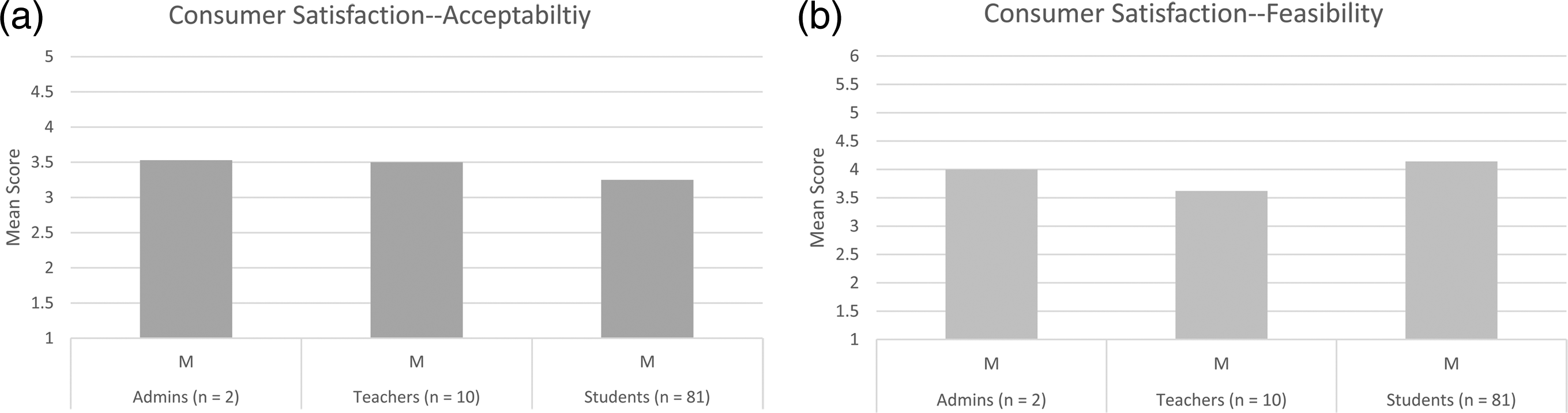
Consumer satisfaction ratings for administrators, teachers, and students.
Discussion
The purpose of our study was to assess the feasibility of three of the SOARS framework's components in high schools. The SOARS framework offered an alternative or supplement to existing school safety practices, such as security cameras, police officers, and locked doors. Given the literature's emphasis on student voice in preventing violent behavior, and the linkage between peer victimization and violent behavior, our primary goals were to test (a) Advocatr usage and (b) associations between implementation of the framework components (Advocatr, SOARS curriculum, informational briefs) and changes in student perceptions of school climate and peer victimization. To cross validate student self-reported behavior, we asked teachers and parents to assess the student's behavior as well. Finally, we examined acceptability and feasibility of the framework components within high school settings to assess the ease with which the framework can be implemented. The results of our study provided important insights into the successes and challenges of implementing a multi-component school safety framework in high schools. These insights allowed us to further refine our framework components, describe implications for high school leaders concerned about school safety, and offer guidance for further research to identify practices that promote the physical and emotional safety of adolescent students.
Our findings indicated that students used Advocatr to report safety concerns as well as positive behaviors they noticed. A total of 17% of students who had access to Advocatr reported a safety concern, and 20% of students reported a positive behavior. To assess how Advocatr use compared to similar reporting tools, such as statewide tiplines, we estimated use of some statewide tiplines by dividing the number of reports received in the reporting period with the enrollment of the schools that had adopted the tipline. These calculations yielded use estimates ranging from .92% for a recently launched tipline (Millette, 2019) to 2.18% for a tipline currently in its 15th year of implementation (Ellis, 2019). These are gross estimates, because anonymous tipline reports do not allow differentiation between unique and repeat reporters. Nevertheless, they provide some estimate of reasonable expectations. Students’ use of Advocatr seemed somewhat higher than estimated uses of statewide tiplines. This higher usage might have been due to teachers implementing the curriculum intended to support student use of Advocatr, as well as the fact that it allowed students to report positive behaviors as well. In addition, students might be more willing to avail themselves of a reporting tool that is monitored by local school personnel, as opposed to statewide tiplines that are commonly monitored by the state police. Sharing safety information requires trust in the individuals who receive and respond to this information. Students might feel greater trust in school personnel whom they know than state police personnel.
On the one hand, the moderate usage rates of Advocatr assuaged school administrators’ concerns that they would be inundated with student reports; on the other hand, Advocatr seemed underused. Anecdotal feedback from the participating teachers and the SOARS coordinators at the participating schools indicated that many students associated using Advocatr with snitching.
Adolescent students generally tend to associate reporting of peer behavior with snitching, which is unquestionably taboo (Allnock & Atkinson, 2019). This deeply ingrained anti-snitching culture represented a major barrier to students reporting “something wrong.” It might also have impacted students’ willingness to report “something right,” as the reporting of prosocial behaviors was associated with use of the same tool. Further development of the Advocatr tool will need to be sensitive to adolescents’ fear of being labeled a “snitch” and thereby making themselves vulnerable to peer retaliation. This is a major concern in research focused on student voice to promote school safety. Given that students are often the only ones aware of a safety threat, their reluctance to share this information with adults could endanger many other students and entire school communities (Planty et al., 2018). Greater use of reporting tools would not only provide school adults with important safety information, but also provide them with data on how different student groups defined by race/ethnicity, gender, sexual orientation, or ability experience their school environment. These data could be invaluable in identifying concerning behaviors before they escalate into violence.
While our study showed promising changes in student perceptions of their school climate as well as teacher and parent reported changes in student behavior, implementation of the framework components seemed challenging. Some of the challenges were logistic and would likely apply to any instructional or student support practice. For example, one school experienced greater turn-over in participating staff and students than the other school. Staff who left the study due to sick or maternity leave were replaced with substitute or new teachers. Participating teachers in these schools taught one-semester classes. As a result, teachers had to recruit new students in the second semester. Participation in the other school was more stable, with the same English teachers teaching the same classes for the entire school year. While implementation in one school was more challenging than in the other, those challenges also reflected authentic, constantly changing school environments.
Other challenges might have been due to limited contextual fit of the framework components. Students accessed the Advocatr via their phones; some teachers have a no-phone policy in their classroom and had to make adjustments to this policy to allow students to use the reporting tool during class, or encourage use of the tool during transition or break times, or after school. Given adolescents’ busy schedules, multiple commitments, and sometimes short attention spans, postponing reporting of concerning or prosocial behavior to a time when access to the reporting tool is allowed might lead to underreporting
While teachers appreciated the content of the SOARS curriculum and felt that it was highly relevant to high school populations, they struggled finding the time to deliver it in their classrooms. Ironically, this challenge was exacerbated by students’ responsiveness to the curriculum content. Teachers shared with us that it was relatively easy to engage students in class discussions about advocacy/self-advocacy and physical versus emotional safety and that students had a lot to say about these concepts.
Our participating schools took different approaches to implementing the curriculum. One school chose primarily 9th grade classrooms for participation, and focused on 9th grade Health, College and Career Readiness, and art classes. The other school chose only English classrooms across all grade levels. These decisions were based on schools’ perceptions of the best fit of the SOARS curriculum. We tried to develop the SOARS lessons in advocacy/self-advocacy, physical and emotional safety, and RP and accountability to be broadly applicable. The two schools’ different approaches to implementing the curriculum suggested that the curricular content can be integrated with different core subjects. However, while the majority of teachers, seven out of ten, implemented the SOARS curriculum with fidelity based on self-report, some teachers were less consistent in their implementation.
Further development of the SOARS curriculum might need to focus on carefully aligning the content with common core state standards as well as tailoring the content to various grade levels. High school students differ greatly in maturity across the grade levels, and designing content in a manner that appeals to younger as well as older grade levels seems important. Consistent implementation might also be encouraged with better alignment of the framework components with existing initiatives. The two high schools participating in our study both implemented SWPBIS to some degree. One school implemented RP, while the other had begun implementation of Trauma-Informed Practices. These initiatives are often seen as complementary in their effort to better understand and prevent the impact of adverse childhood experiences, stress, and victimization on student behavior and a focus on non-punitive responses to inappropriate behavior to keep students connected to and engaged with their school communities (Walkley & Cox, 2013). One of the schools had recently experienced administrative turn-over. As a result, staff and students needed to rebuild trust in new administrators.
Further development of the SOARS components might focus on better linking the Advocatr and the accompanying curriculum with SWPBIS and Trauma-Informed Practices. Student advocacy and RP appear relevant to these practices . A school that is committed to a restorative approach to discipline might value student reports and encourage students to make their voice heard and become active participants in resolving peer conflicts.
The informational briefs providing overviews of the key concepts of the SOARS curriculum (e.g. physical vs. emotional safety, reporting vs. snitching, advocacy, RP) appeared difficult to use during the classroom lessons. Further development will need to focus on providing greater structure for engaging students, teachers, and parents with these overviews of key concepts. Structured professional development sessions or presentations at parent nights might be one strategy to promote greater exposure of school staff and parents to the key concepts on which the framework components are built.
Despite these challenges, changes in student perceptions of their school's safety were as expected. While all domains of the Safe Schools Survey changed in the desired direction, students’ perceptions of negative domains, such as disruption and incivility or major delinquency changed more drastically than students’ perceptions of positive domains, such as personal safety and school connectedness. Perhaps the absence of threats is more easily noticeable than the presence of supports, as students—like many adults—seem to be conditioned to focus on their environment's deficits rather than its strengths.
Changes in student perceptions of being victimized by peers were greater than changes in student perceptions of their own behavior victimizing others. This seems reasonable given that adolescents are still developing the traits of empathy and social accountability (Landazabal, 2009; Sawyer et al., 2018), and might more readily perceive themselves as victimized by others than acknowledge the impact their behavior might have on others.
Although not statistically significant, students rated their own engagement in victimizing behavior as lower at posttest compared to pretest. This decrease in negative behavior was validated by teacher report as well as parent report. Parents rated their child's engagement in negative behaviors much higher at both timepoints, which might be due to parents having greater awareness of their child's behavior at all times, compared to teachers’ awareness of student behavior based on a limited number of hours during the day or week.
Although the literature indicates that female, White, and non-heterosexual students appear to be disproportionately impacted by victimization, we did not find significant differences in student perceptions across student gender, race, grade level, and sexual orientation. Vulnerable students who have experienced peer victimization might require more time to build trust in adults and peer behaviors and change in their perceptions is likely to be gradual and incremental. The more positive experiences vulnerable students have across time, the greater their trust in their school might become.
Finally, consumer satisfaction was acceptable overall. It was interesting to see that students rated the program's acceptability lower compared to school staff. On the other hand, students rated the program's feasibility higher than school staff. Students felt more confident than teachers and parents that the technology could be readily implemented in their school. This difference in perceptions between students and adults might reflect students’ comfort with mobile apps and technology generally (Anderson & Jiang, 2018). As we further develop the framework components to achieve better contextual fit with adolescent anti-snitching culture, curricular state standards, and existing student support initiatives, we anticipate greater consumer acceptability and perceived feasibility.
Limitations
Our study's findings should be interpreted in the context of a number of limitations. First, the different implementation models used by our schools resulted in students receiving different dosages of the intervention. Students who attended classes that met for only one semester were exposed to the intervention for a shorter period of time than students who attended classes that met for the entire school year. In addition, high student mobility in our participating schools reduced the number of students who completed both pretest and posttest assessments.
Second, our sample size limits generalization of outcomes. Results of a power analysis of the student outcomes indicated that the analysis had sufficient power of 0.80 to detect a small to medium effect given the sample size and statistical test used in this study. Statistical significance should still be interpreted with great caution given the sample. Our teacher and parent samples were small and allowed descriptive analyses only.
Third, implementation fidelity was measured only with teacher self-report. We did not conduct direct classroom observations of teacher or student behavior due to the limited scope of our study. Given that our focus was on testing the feasibility of the new technology in schools, this limitation should not detract substantively from the interpretability of our outcomes.
Fourth, the active parental consent procedure made student recruitment challenging. Students needed to take the parental consent form home, obtain a parent signature, and then return the form to their teacher. This process proved to be difficult for students given their many commitments. Obtaining student assent was also challenging due to the deeply ingrained anti-snitch culture among high school populations.
Finally, the absence of a control group did not allow us to draw any causal inferences. Changes in student outcomes might have been due to naturally occurring maturation effects, or any other practice the school or individual teachers might have implemented during the study. Given that both schools implemented SWPBIS to some degree and one school implemented RP, it is likely that changes in outcomes might have been impacted by those practices as well. However, given that schools are dynamic environments, it is challenging under most circumstances to tease out effects of one single intervention. In general, schools are reluctant to cease already existing practices in order to test a new intervention in isolation.
Implications for Secondary School Leaders
Violent behavior on school campuses can traumatize entire school communities and irrevocably change the lives of students, parents, and school personnel. Therefore, students’—as well as school personnel's—safety is often of concern for school leaders. While hardening of school environments and procedures is often recommended (Kim & Carlson, 2021), an emphasis on student voice and reducing peer victimization through relationship building and rebuilding might offer an important alternative. If students share critical safety information, it might be possible to intervene and avert tragedies. The SOARS framework was designed to assist school personnel in encouraging students to make their voices heard and promote school safety.
Consistent with the literature, our study has shown that establishing lines of communication between adolescent students and adults can be challenging, given adolescent students’ desire for independence from adults and autonomous decision-making. Our study suggests that students might avail themselves of reporting tools if those tools are accompanied by curriculum that introduces them to the concepts foundational to responsible reporting. Our participating teachers reported that students readily engaged with the core concepts of advocacy/self-advocacy, accountability, and physical and emotional safety. While this engagement seems promising, encouraging students to act on their interest in these concepts and report concerning behaviors remains challenging. Establishing trusting relationships and supportive environments where the stigma of snitching and potential peer retaliation are minimized appears to be critical.
Recommendations and Future Directions
Despite its limitations, our study yielded valuable findings that allow us to suggest recommendations and next steps. School safety is non-negotiable. Given that adolescent students have greater knowledge of threats to school safety and the need for school personnel to gain access to this knowledge, it is critical to explore ways in which students feel comfortable sharing information. Listening to the voices of students, especially marginalized students, needs to remain an active ingredient of promoting school safety and trust between students and adults at school (Espelage & Swearer, 2008; Rodríguez & Brown, 2009). Students need to feel empowered to prevent peer victimization and school violence by sharing information and participating in conflict resolution. Shared authority might promote student agency in the form of reporting concerning behaviors as well as positive experiences (Basu & Barton, 2010).
Because students’ reluctance to share information is also due to fear of punitive discipline consequences, it seems important to promote non-punitive discipline approaches. The emerging evidence base supporting RP in schools is encouraging (Gregory & Evans, 2020); however, more research is necessary to examine how best to implement it in high schools. Pairing teacher training in RP with student access to Advocatr might encourage adolescent students to take greater ownership of their school's safety while teachers could simultaneously promote the trusting relationships necessary for students to do so.
A small number of students were willing to try out Advocatr and make their voices heard. Building on this promising beginning and encouraging more students to avail themselves of the tool could incrementally lead to improved communications between students and staff that appears necessary to reduce threats to school safety. Longer implementation of Advocatr and gradual norming of its use could make reporting a socially acceptable part of a school's culture
Experimental and adequately powered testing of all components of the SOARS framework will provide further insights into the benefits of Advocatr and the accompanying framework components.
Footnotes
Declaration of Conflicting Interests
The author(s) declared no potential conflicts of interest with respect to the research, authorship, and/or publication of this article.
Funding
The author(s) disclosed receipt of the following financial support for the research, authorship, and/or publication of this article: This article was made possible by a cooperative agreement funded by the National Institute of Justice, U.S. Department of Justice (2015-MU-MU-K003). The opinions, findings, and conclusions or recommendations expressed in this publication are those of the authors and do not necessarily reflect those of the Department of Justice.
