



Abstract
Jackie Robinson was the first acknowledged Black player in 20th century Major League Baseball (MLB). By 1951, a few Black players had performed credibly at the Major League level, while others were integrating Minor League Baseball. Unlike other labor situations where proxies for productivity must be used, Minor League players at the AAA level—the level just below the Major Leagues—performed and compiled their playing statistics under similar competitive environments. Using regression analysis, we test whether there is evidence of discrimination in promoting Black players to the Major Leagues, based on productivity data from the early 1950s.
Keywords
Introduction
Jackie Robinson became the first acknowledged Black player in Major League Baseball (MLB) in the 20th century when he debuted with the Brooklyn Dodgers in 1947. Despite his success and the success of many of the Black players who followed him, it took 13 seasons for all MLB teams to field Black players. Many contemporary observers during the 1950s suggested that the slow pace at which Black players were introduced to the Major Leagues was due in part to discriminatory attitudes on the part of players, owners, and fans (Bardolph, 1959).
Although there is a vast literature on the economics of discrimination, empirical analyses have been constrained by the limited availability of detailed firm-level data on wages, skills, and productivity for individual workers. Fortunately, as Kahn (2000) and others noted, modern professional sports provides a rich “Labor Market Laboratory” in which to explore questions such as how a player’s performance and skill result in wage determination and other labor market outcomes. There are few markets with such a wealth of data on the labor market activity of individual workers and firms as professional baseball.
Much of the discrimination literature on MLB focuses on the relationships between player performance, race, and earnings. We address a different aspect of labor market discrimination: whether promotion from the minors to the majors was influenced by a player’s race. We constructed a data set with individual performance measures for Black and White players in baseball’s highest Minor Leagues—AAA leagues—for the years 1951 to 1955. This unique data set allows for a detailed empirical analysis of the promotion process during the early years of introducing Black players into MLB.
The Process of Introducing Black Players
Prior to Jackie Robinson, Major League owners congratulated themselves on promoting a widening collection of European ethnicities into the game: Irish, German, Polish, Italian, and other Europeans mixed together on the field. Some owners also hired players from the Caribbean. Two of the more publicized Latin players were Armando Marsans and Adolfo Luque. Cincinnati Reds’ manager, Clark Griffith, signed Marsans in 1911, while the Boston Braves signed Luque for 1914. Owners who signed players from the Caribbean issued assurances that these players were racially White. In addition, Marsans’ and Luque’s participation with Cuban teams that were known to field Black players did not preclude them from playing in the big leagues. Despite the owners’ disclaimers, Luque endured racial slurs from the likes of Casey Stengel, who called Luque a “Cuban [derogatory term]” (Ruck, 2011, p. 63).
In spite of their early appearance in the majors, the number of Latin players remained low. Baseball researchers Mark Armour and Daniel Levitt (2012) found that less than 1% of MLB players in both the 1947 and 1948 seasons were “Latino.” The likelihood that some of them had African grandparents or great-grandparents would seem to be pretty high, despite the owners’ disclaimers. In the mores of the time, having even a great-grandparent of (sub-Saharan) African descent “made” one Black in the eyes of many Americans (and also in some state laws). Therefore, some “White” players may have wittingly or unwittingly broken the color line earlier in the 20th century. To a degree, then, being “Black” was a matter of perception. Many of the Latin players may not have considered themselves “Black”; some ostensibly White players might have been perceived as “Black,” had they acknowledged having a Black parent, grandparent, or great-grandparent. The irony to modern sensibilities is that professional golfer Tiger Woods, who has more Asian than African ancestry, is generally perceived and lauded for being African American. A century ago, though, Woods and a legion of other talented athletes would have been denied the opportunity to prove themselves in professional sports (Sanborn, 1922).
Jackie Robinson proved an immediate success on the field, winning MLB’s Rookie of the Year Award in 1947 and Most Valuable Player Award in 1949. His Brooklyn Dodger teammates Roy Campanella and Don Newcombe also won honors in 1951. Along with the Cleveland Indians’ Larry Doby and Luke Easter, the Dodgers’ trio demonstrated the talent available in the pool of African American players. Although these were all excellent players, the next wave of African American players proved to be dominant—Willie Mays, Ernie Banks, Henry Aaron, and Frank Robinson.
While these are the players that baseball fans remember, less noted are those Black players who had only brief careers in MLB. For the first few seasons of introducing Black players, owners discovered that being Black was no guarantee of success. Shortly after Jackie Robinson debuted, four other Black players appeared in the Major Leagues: Don Bankhead, Willard Brown, Larry Doby, and Hank Thompson. None excelled in their inaugural season, although Doby and Thompson would eventually become regular players. Six more Black players began their Major League careers in 1948 and 1949, and four struggled initially. Eventually they became solid players, although often after a gap in their big league careers. The pace of introducing Black players dwindled to a single player in 1950, before Willie Mays stepped on the Major League stage in 1951. Seven other Black players joined him in making their Major League debuts that season, but most had very brief careers. After Mays, Ernie Banks, Hank Aaron, Roberto Clemente, and Frank Robinson appeared in the next five seasons.
One team became a lightning rod for lagging in promoting Black players: the New York Yankees. Although the Yankees were years ahead of the Boston Red Sox in adding Black players, many African American leaders and fans wondered why the Yankees, with their abundance of resources, failed to place a Black man on their roster. The Yankees’ management claimed that they could not find a player worthy of promotion. Only in 1955 did the Yankees introduce a Black player, Elston Howard. Although Howard eventually proved to be a good player, winning a Most Valuable Player Award in 1963, he was not a dominant slugger in the Mays-Aaron-Robinson mold.
The Yankees, though, had been quick to sign Black players to their Minor League system, after Jackie Robinson proved his ability. They had some talented players under contract, such as Vic Power, a Puerto Rican Black, but the Yankees were hesitant to promote Power to the Major Leagues. Power claimed the Yankees feared him, because he was outspoken and, worse, flamboyant on and off the field (Moffi & Kronstadt, 1994). Eventually, the Yankees traded him to Kansas City and employed Bill Skowron as their first baseman. Howard, too, wondered why the Yankees took so long to promote him. The Yankees claimed they had several other good catchers in their system and that incumbent catcher Yogi Berra was durable.
Power’s and Howard’s experiences raised some questions about equity. Were White and Black players promoted equally rapidly, given similar Minor League statistics, or were Blacks promoted at a different rate?
Labor Market Discrimination Model
Labor market discrimination occurs when equally productive workers face unequal labor market outcomes because of racial or ethnic prejudice; we focus on racial prejudice in this article. The unequal outcomes might include wage differentials for equally productive workers (wage discrimination), or barriers to job opportunities because of a worker’s demographic traits (occupational segregation). According to the neoclassical approach, as developed by Gary Becker (1971) and others, labor market discrimination results from three sources of prejudice: (a) employers, (b) coworkers (including supervisors), and (c) customers. These economic agents exhibit a “taste for discrimination” because of inherent racial, gender, or ethnic biases against certain groups of workers. In professional sports, discrimination may arise from one, or a combination of, team owners, players and managers, and fans. There is a strong consensus that professional baseball during the first half of the 20th century was influenced by all three forms of discrimination (see Bardolph, 1959; Kahn, 2000; Lanning, 2010; Tygiel, 1983).
According to Becker’s model, if MLB team owners during the 1950s exercise their “taste for discrimination against Black players,” these owners behave as if the marginal labor cost of hiring or promoting a Black player exceeds that of an equally productive White player. This perceived incremental labor cost is known as the “discrimination coefficient.” When faced with equally productive Black and White players, discriminating teams are thus less likely to promote the Black player.
Long-run competitive market pressures are supposed to mitigate racial biases, as non-discriminating teams reap higher profits by promoting Black players. However, if the product market is less than competitive, or customer discrimination is widespread, it is possible for unequal labor market outcomes by race to persist in the long run. Given the monopolistic market structure of professional sports (due to the reserve clause that bound a player to one team and to territorial rights limiting the entrance of new teams) and the prevailing racial attitudes of American society during the first half of the 20th century, the persistence of segregation in professional baseball is not surprising. Hence, the discriminatory behavior of owners, players, and fans did not simply disappear as soon as Jackie Robinson took the field in Brooklyn.
As it is plausible that the market forces which lead to racial wage inequality may also result in unequal opportunities for occupational advancement, Becker’s wage discrimination model can be adapted to investigate empirically how Black Minor League players were promoted to Major League status. One might logically assume a two-step process where a team initially selects a group of players from the minors, then determines their wages, position, and so on. The initial selection is based on two criteria: (a) a minimum threshold of productivity
If a team is biased against Black players, the promotion criteria for player i can be expressed in probabilistic terms as

If owners exhibit a taste for discrimination, D is positive for Black players. This leads to two possible outcomes: (a) For White and Black players of equal productivity, a White player will be promoted first and (b) to be promoted to the majors, Blacks must achieve a higher threshold of productivity, skill, and talent than comparable White players. This result is analogous to findings from the wage discrimination literature. Interestingly, the notion of higher required performance standards for promoting Black Minor League players was also expressed in Bardolph’s (1959) seminal work on the desegregation of professional sports.
The Data
Baseball is well-known for its plethora of statistics. Players compile batting and fielding statistics, and although the importance of such statistics in determining a player’s value are subject to debate, the statistics are compiled under roughly similar conditions. Player productivity, then, is relatively observable.
We used statistics from the three top Minor Leagues in Organized Baseball (the Major Leagues—National and American Leagues—are at the top of Organized Baseball). We examined the 1951-1955 Minor League seasons and promotion to the Major Leagues between 1951 and 1956. Up to the 1951 season, 12 Black players had played in the Major Leagues, and Minor League teams had only a sprinkling of Black players. Thus, including seasons before 1951, therefore, would likely add little to the statistical analysis, given the relatively small number of Black players who would be included. During the 1950s, the Pacific Coast League (PCL), American Association (AA), and International League (IL) were the top Minor Leagues. The PCL differed from the other two leagues in that it contained a larger proportion of former Major League players. 2 We also used a dummy variable for players whose Minor League team was affiliated with a Major League team rather than being an independent Minor League team.
The leagues maintained accurate statistics for each player. The Sporting News (1951-1956) published these statistics in its Official Baseball Guides, issued every year. Recently, Baseball-Reference.com has made available batting statistics and age for players with at least one at bat per scheduled game. We included these players in our sample and ignored those players with fewer at bats. We did this because, on average, players with fewer at bats were substitutes and also because there was too little reliability reflected in their statistics, due to statistical variance. We included stolen bases as a proxy for foot speed. During the years covered in our study, base stealing was not emphasized in MLB; managers, though, may have valued foot speed with regard to fielding and base running. Major League observers frequently mentioned Black players’ foot speed as a key attribute distinguishing them from White players (Howard & Wimbish, 2001).
We used fielding statistics listed in the Official Baseball Guide and Baseball-Reference.com to determine whether a player was a middle infielder—second baseman or shortstop—or a catcher. Players at these positions generally had lower hitting ability than outfielders and corner infielders, and we will use dummy variables for them. A player’s position was the one in which he played the most games, although if a combined shortstop–second base number of games exceeded any other position, he was coded as a middle infielder.
We used a player’s age as a proxy for his overall baseball experience, and included a dummy variable for previous MLB experience.
Identifying which players were considered Black required several sources. The Sporting News (1951-1955) Baseball Register listed Major League players and some Minor League players before each season. For the 1951-1955 editions (covering the 1950-1954 seasons), the Register listed players’ ethnic background. Because later editions of the Baseball Register did not contain information on a player’s race, identifying the race of career Minor League players became more difficult for 1956 on. We considered players identified as “American Negro” or “Puerto Rican Negro” as Black for our dummy variable; for the purposes of this study, Latin players who are not Black, are considered White players. Unfortunately, not all of the AAA players were listed in the Register. Moffi and Kronstadt (1994) listed all Black players who appeared in the Major Leagues between 1947 and 1959. Their list, of course, does not include Black players toiling in the Minor Leagues. However, we will assume that all players who appeared in the Major Leagues between 1946 and 1959 and who were not one of the handful of Black players listed as appearing in the Major Leagues between 1947 and 1959 are White or Latin. Baseball-Reference.com lists whether players performed in the Negro Leagues, as do books by Dixon and Hannigan (1992), Loverro (2003), and Figueredo (2007). Identifying the racial background of many career Minor League players who never appeared in MLB required examining baseball periodicals, such as the Sporting News and Major League publications, and Internet sources, such as newspaper articles and obituaries (a complete list is available from the authors). Only in a few cases did we rely on photos.
Major League owners appeared to scour the Negro Leagues without signing amateur Black players until the early 1950s. During the first 10 years of integration in the Major Leagues, the vast majority of Black players were veterans of the Negro Leagues. Although the Negro Leagues were slowly disappearing, as Major League teams raided their rosters, Negro League veterans continued to debut in the Major Leagues well into the 1960s. The first Black players who were not Negro League alumni to reach the Major Leagues arrived in 1953. By 1956, the majority of Black players debuting in the Major Leagues were no longer veterans of the Negro Leagues (Moffi & Kronstadt, 1994). 3
For our dependent variable, a player was listed as “promoted” for, say, the 1953 season, if he appeared in a Major League game in August or September of 1953 or April or May of 1954.
Means and standard deviations for the model variables are shown in Table 1. The statistics are given for White players, Black players, and all players. A larger percentage of White players than Black players were catchers, whereas the opposite is true for middle infielders. As expected, a much larger percentage of White players had previous MLB experience but, interestingly, nearly one third of the Black players had previous experience in the majors (indicating they had been demoted at least once). The distribution of players across the three Minor Leagues was about even. The Black players were, on average, about 1 year older than the White players. Roughly two thirds of the players played for Minor League teams that were affiliated with a Major League team. Last, Black players average higher on-base percentages and slugging percentages than their White counterparts. Black players averaged more stolen bases than White players.
Descriptive Statistics—Means and (SDs).
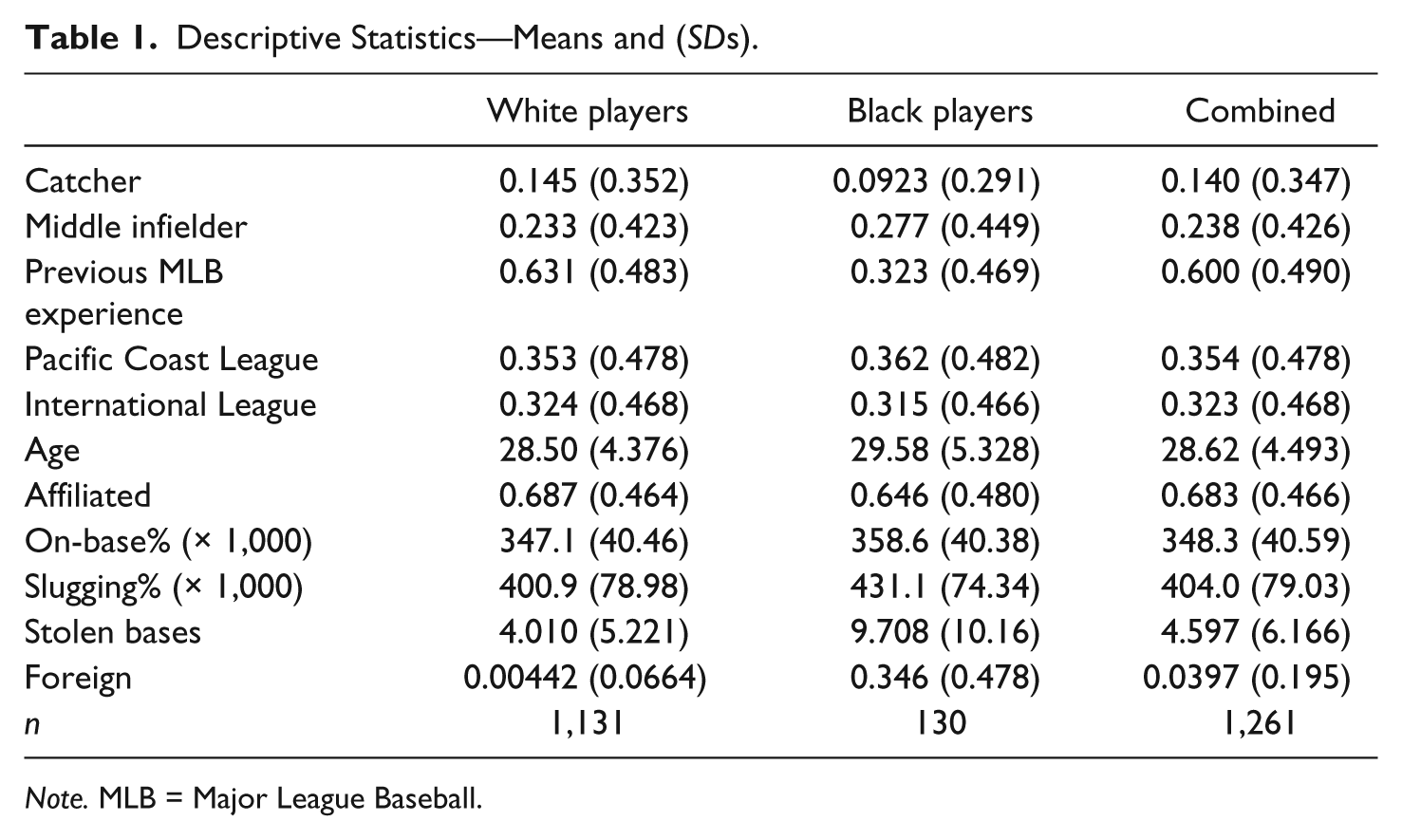
Note. MLB = Major League Baseball.
Regression Results
To compare the promotion outcomes of Black and White Minor League players, we estimated a standard logistic regression model, with the results presented in Table 2. The dependent variable in the model is Promoted, which is equal to 1 if the player was promoted to the Major Leagues and 0 otherwise. The independent variables include position dummy variables for catchers and middle infielders; a dummy variable equal to 1 if the player had any previous Major League experience; dummy variables for players playing in the PCL and IL; the player’s age; a dummy variable equal to 1 if the player played for a Minor League team that was affiliated with a Major League team; the player’s on-base percentage, slugging percentage, and stolen bases; dummy variables for the years; a dummy variable equal to 1 if the player was Black; and a dummy variable equal to 1 if the player was foreign-born.
Logistic Regression (Dependent Variable: “Promoted” = 1).
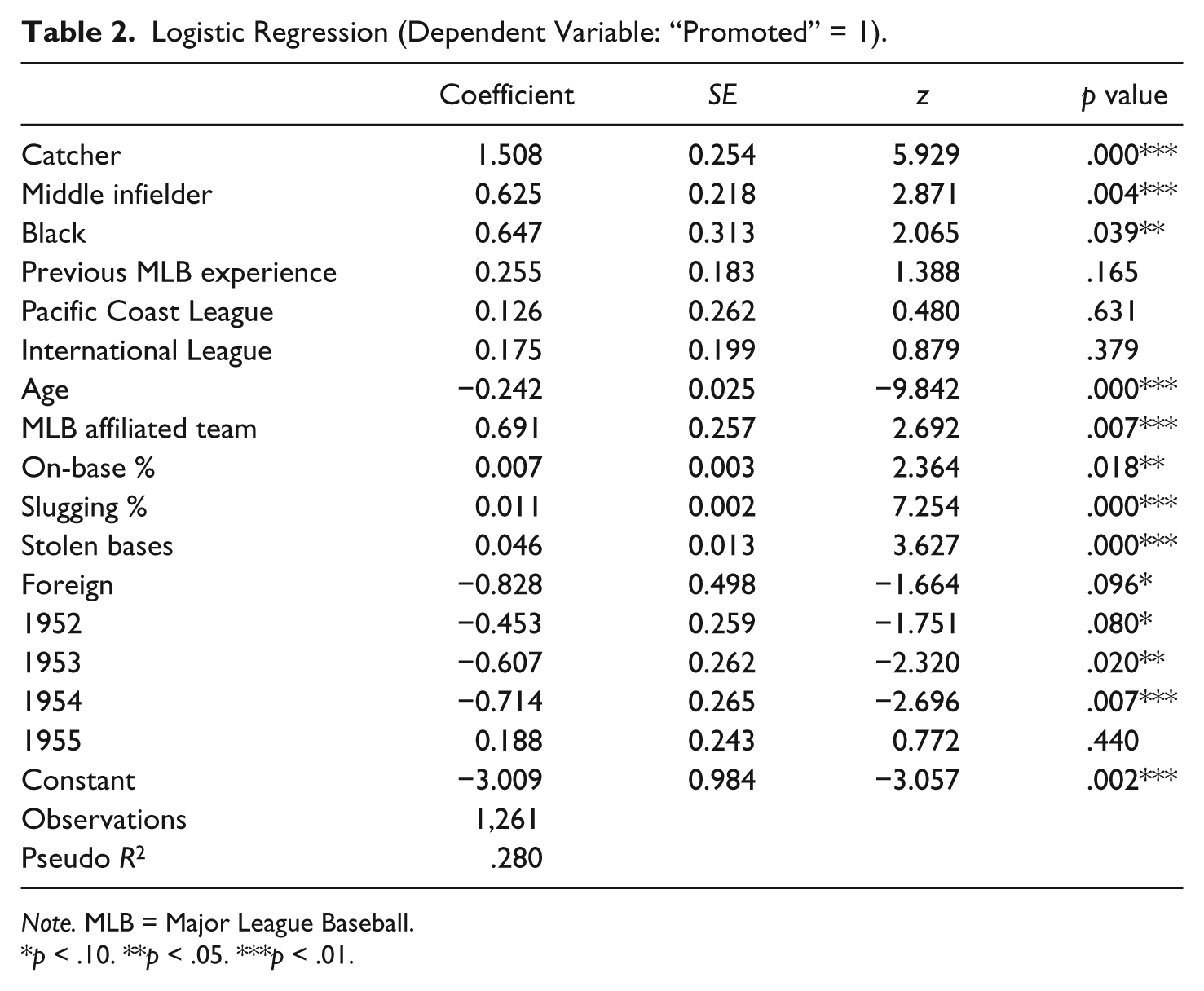
Note. MLB = Major League Baseball.
p < .10. **p < .05. ***p < .01.
Consistent with Human Capital Theory, numerous player performance measures are positively, and significantly, related to the likelihood they will be promoted to the Major Leagues. On-base percentage and slugging percentage are both positive and statistically significant. Even though the time period under investigation is pre-Moneyball, players who could get on base and move other players around the bases were more likely to be promoted even then. In addition, position appears to matter as well; all else equal, middle infielders and catchers were more likely to be promoted than corner infielders and outfielders. Being younger increased the likelihood a player would be promoted, but having previous Major League experience was not statistically significant.
The dummy variables for players playing in the PCL and IL were not statistically significant. This result suggests that these players were as likely to be called up as were the players from the AA. As one would expect, though, playing for an affiliated team did increase the likelihood of being promoted.
Year dummy variables were included to account for differences in overall promotion between years. Players in 1951 and 1955 had a similar likelihood of being promoted, whereas in 1952, 1953, and 1954, players were less likely to be called up to the Major Leagues.
The coefficient on Black is positive and statistically significant. This implies that, holding all else equal, Black players were more likely to be promoted than were non-Black players. This finding suggests that during the early stages of MLB racial integration, those team owners who chose to promote Black players to their Major League teams appeared to be more willing to promote young Black minor leaguers to the majors than similarly productive White players. This finding contrasts with those reported in Bellemore (2001), although his study focuses on a later period (the 1960s and 1970s) and uses a different model specification. For example, Bellemore’s model does not test whether a player’s nationality affects the likelihood of promotion. In contrast, our regression model includes the variable “Foreign” (coded “1” if a player [White or Black] was born outside the United States. 4 As the results in Table 2 show, the dummy variable for foreign-born was negative and statistically significant (albeit at the 10% level). Thus, Black players from the Caribbean appeared to have a slight advantage over light-skinned or White Caribbean players (although, all else equal, Carribean players are less likely to be promoted overal).
Discussion: The Ambiguous Findings
The positive and statistically significant coefficient on the Black dummy variable raises questions, especially because not all owners were keen to hire Black players. Given that the Detroit Tigers and Boston Red Sox had no Black hitters who appear in our database, a negative and significant coefficient on the Black dummy variable would have been easily explained. The Washington Senators, another dilatory team in hiring Black players, did not have any Minor League affiliates at the AAA or Open level.
Although it is reasonable to suspect that being Black affected the promotion decision in the early 1950s, there are three possible, if dubious, explanations for some owners’ desire to promote Black players: It was lucrative to hire Black players; there was outside pressure exerted upon teams to integrate; or MLB owners could pay Black rookies less than White rookies.
The evidence that fans flocked to home games of teams that integrated is thin (Table 3). Attendance fell by 1,000 per team, whereas teams’ win–loss records fell from .487 to .479 on average after integration.
Integrating the Major Leagues.
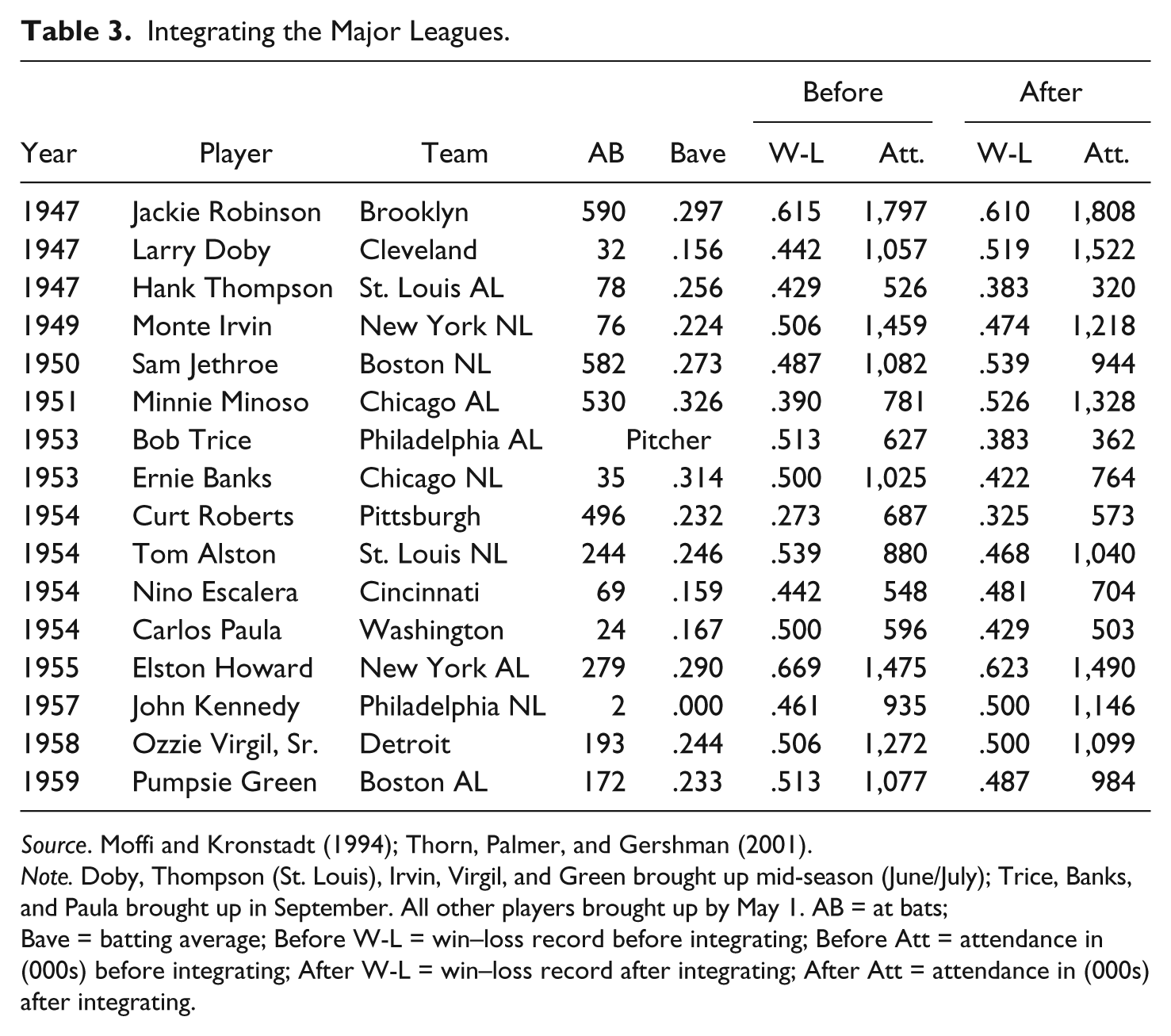
Note. Doby, Thompson (St. Louis), Irvin, Virgil, and Green brought up mid-season (June/July); Trice, Banks, and Paula brought up in September. All other players brought up by May 1. AB = at bats; Bave = batting average; Before W-L = win–loss record before integrating; Before Att = attendance in (000s) before integrating; After W-L = win–loss record after integrating; After Att = attendance in (000s) after integrating.
Three teams promoted Black players in 1947. The Brooklyn Dodgers saw their attendance rise by fewer than 11,000 fans at Ebbets Field, less than a 1% increase. The Dodgers’ win–loss record was actually a little worse in 1947, but the team won a pennant. Thereafter, the team’s attendance reflected baseball’s general decline. Whether or not fans outside Brooklyn liked Black players, they certainly flocked to Dodger games, as the team perennially led the league in road attendance; the team’s popularity on the road might have reflected not only the presence of Black players (whom rival fans might have loved or hated) but also the team’s prowess, winning six pennants between 1947 and 1956.
The Cleveland Indians’ debut of Larry Doby coincided with a revival in the team’s attendance (almost 500,000 more in 1947), but Doby’s limited exposure was an unlikely explanation; the team was on the upswing and won 12 more games that season than in 1946. The St. Louis Browns fared poorly with Willard Brown and Hank Thompson, both of whom played sparingly, in 1947. The team’s attendance fell by 200,000 along with its win–loss record.
While the Dodgers and Indians would continue to field strong teams and draw reasonably large crowds, other teams that promoted Black players had little reason to find it a boon. Despite these discouragements, integration proceeded in 1951-1953, with more teams debuting Black players. Thus, a bandwagon effect appears unlikely.
Did owners succumb to public pressure to hire Black players? The bellwether New York Yankees, as mentioned earlier, were dilatory in finding the right player to promote. Sports fans wrote letters to the New York Times criticizing the team’s refusal to promote a Black player, especially when the team traded Vic Power to the Athletics. General Manager George Weiss unctuously claimed, “color played no part in the Yankee decision to let Vic go.” He added, “It would be weak to hold Power just because we were afraid of censure . . . . I see no reason why a Negro player should be differentiated from a White, or why a promising deal should be passed up because of fear of criticism.” Sportswriter Joe Williams agreed with Weiss: “No reasonable mind would quarrel with this view. Pressure groups and spurious liberals have been badgering Weiss for some time. That he has refused to be intimidated is to his credit. Weiss is not a social worker. He’s a baseball man, his job is to win pennants” (Surdam, 2008, pp. 186-188).
The Pittsburgh Pirates were another team lagging in promoting Black players. C. Wendell Smith, a prominent African American sportswriter for the Pittsburgh Courier, had been advocating using Black players in MLB since the 1930s. Despite his efforts, the Pittsburgh Pirates did not hire a Black player until 1954 (Curt Roberts).
The Washington Senators had pioneered hiring Latin American players and were quite familiar with Black players in the Caribbean, but owner Clark Griffith and later his nephew Calvin Griffith displayed hesitance in hiring Black players, and, like the Boston Red Sox, the franchise was not later known for its enlightened treatment of its Black players. The younger Griffith made some publicized remarks about Washington, D.C., reflecting his fears: “the trend in Washington is getting to be all colored” (“Baseball Candor via Air Vent,” 1958). Naturally fans and the press in Washington, D.C., clamored for the Senators to hire a Black player but to no avail until late 1954.
Thomas Yawkey, the Boston Red Sox’s owner, refused to promote a Black player and he withstood criticism for several years. When the Red Sox finally promoted a Black player to the majors, neither the team ownership nor the Black players were at peace (Bryant, 2002).
These lagging teams, then, refute the argument that owners and general managers succumbed to pressure during the early 1950s.
There is a third potential argument for the coefficient on the dummy variable for Black being positive: Perhaps owners could hire Black players for lower salaries than comparable White players. To address this, we used salary data from the Haupert Salary Database, University of Wisconsin–La Crosse. Professor Haupert has salary data from player contract information held at the National Baseball Hall of Fame. The Hall of Fame did not have contracts for all players playing in the 1951-1956 seasons, so our findings are based on a subset of players.
Black pioneers Jackie Robinson and Larry Doby each had contracts worth US$5,000 for their 1947 rookie seasons. Several White rookies had similar salaries. Roy Campanella signed a contract for US$6,500, which was higher than many rookies. In 1949, Monte Irvin signed a contract for US$5,000; his salary was similar to other White rookies. Minor League players promoted to MLB, who had prior MLB experience, generally received in excess of US$5,000 to US$6,000. Black players promoted to the Major Leagues during the 1951-1956 seasons did not systematically receive lower pay than comparable White players. Most players brought up for the first time received minimal salaries of US$5,000 to US$6,000.
The available salary information lends scant evidence that owners may have preferred to promote Black players, because they could pay such players less than White players.
Conclusion
We used several measures of productivity in assessing a Black player’s chances of being promoted to the Major League and found that a dummy variable for being Black was positive and statistically significant. Given some teams’ hesitance to employ any Black players, our finding is ambiguous. Potential arguments for owners to hire Black players, such as a bandwagon effect, public pressure, or lower salaries, do not appear to fit the circumstances. Promoting Black players, then, was not a straightforward process.
Although it took 13 seasons for every MLB team to put a Black player on the field, this rate of integration was more rapid than that of Latino players. Adrian Burgos Jr. points out that after the Philadelphia Athletics briefly employed Luis Castro, a Columbian, in 1902, it was not until 1958 that the Detroit Tigers completed the process by hiring Ozzie Virgil. In Virgil, the Tigers were also hiring their first Black player, a year ahead of the Boston Red Sox (who had been the second team to hire a Latino player in 1908; Burgos, 2007).
The process of hiring Latino players before 1947, of course, required discretion and quite possibly deception. Owners had to assure the public and their fellow owners that these Latinos were White. This necessity, of course, winnowed the field of potential Latin players.
None of the early Latino players became dominant players, although Al Lopez, Adolfo Luque, and Vernon “Lefty” Gomez enjoyed successful careers. In contrast, after 1951, Black players, especially in the National League, dominated not only stolen bases (for example, Jackie Robinson) but also slugging prowess. Willie Mays, Ernie Banks, Henry Aaron, Frank Robinson, and Willie McCovey became Most Valuable Players and perennial All Stars. Even the most racist owner could now see how good some Black players were.
Jackie Robinson’s debut had a secondary effect. By removing the need to limit themselves only to the lightest-skinned Latin players, baseball owners could more freely tap into the talent in the Caribbean and Latin America. Such players as Minnie Minoso, Roberto Clemente, Orlando Cepeda, and Juan Marichal would become Hall-of-Fame players and greatly enriched the game, alongside their African American teammates.
There may also have been an unintended consequence to the admission of Black and Latin players to MLB. Because MLB and its associated Minor Leagues refused to admit the Negro Leagues into so-called “Organized Baseball,” those entities died a lingering death during the late 1940s and 1950s. Blacks lost economic opportunities as owners, managers, and coaches (Ruck’s, 2011, Raceball is just one of several sources describing the deleterious effects integration had upon the Negro and Cuban Leagues).
Footnotes
Acknowledgements
The authors thank Professors Tony Krautmann of DePaul University, Kevin Quinn of St. Norbert College, and Michael Haupert of University of Wisconsin at LaCrosse, and participants at the Illinois Economics Association meetings, Missouri Valley Economics Association meetings, and University of Northern Iowa College of Business Administration Friday seminar. Professor Haupert graciously allowed the authors to use salary data from his database. The authors thanks David Glime, UNI Archives, for providing a photo of Minor League player Don Dalhke and Ben Taylor of U-Illinois archives for providing a photo of Minor League player Jim Neufeldt. The authors also thank George Rugg, curator of the Joyce Sports Collection at Notre Dame.
Declaration of Conflicting Interests
The author(s) declared no potential conflicts of interest with respect to the research, authorship, and/or publication of this article.
Funding
The author(s) disclosed receipt of the following financial support for the research, authorship, and/or publication of this article: The University of Northern Iowa College of Business Administration provided funds for trips to South Bend and Chicago for research and to present the paper in Memphis.