




Abstract
The aim of this article is to provide insight on how claims that sport contributes to development or peace are transformed into facts. Beyond a theoretical discussion about how sport for development and peace (SDP) facts are built, this article demonstrates, in rich detail, the subtle art of SDP fact building for funding purposes. Specifically, through an integrative literature review and two case studies, a mix of fact-building actors composed of experts, literature, and allies, is exposed and analyzed. Furthermore, a conceptual model that synthesizes the relationship between the mix of fact-building actors and contextually predisposed funding agencies is also proposed.
Introduction
In the vast catalogue of human activities, it is generally accepted that sport possesses great power to bring people together. Rivaled possibly only by entertainment, religion, and politics, the examples of the passion and emotional response generated by sport are numerous (Richelieu, 2014). Such widespread influence, combined with a common sense belief in the power of sport to break down all walls and all barriers (Wilson, 2012), may arguably facilitate the task of convincing funding agencies to support sport projects in general, and sport for development and peace (SDP) projects in particular. Yet, little appears to be known about how the growing number of SDP agencies transform claims, ideas, or dreams that sport possesses the power to contribute to development or peace into facts that influence funding agencies. Thus, the specific aim of this article is to obtain insight about how SDP agencies construct the fact that SDP works. However, notwithstanding how imperative theorization may be in this emerging scientific field (Schnitzer, Stephenson, Zanotti, & Stivachtis, 2013), our approach is not solely based on theoretical reflection. Rather, this article will examine the constructing of rather grandiose facts, such as sport breaks down all walls and barriers, in action. By analyzing two case studies, this article sheds light on a world of negotiation, seduction, and shifting networks, which provides understanding about the epistemological roots of SDP.
The importance of this article lies in the perception that the power of sport is often taken for granted, to the point where few dare to critique or question this fact. This state of affairs is so problematic that some authors have argued that generalized acceptance of the fact that SDP works without question may be currently contributing to a “condition . . . where one only listens to those who are already in lock-step agreement, reinforcing set beliefs and creating situation ripe for miscalculation” (Coalter, 2013, p. 21). Hence, modestly reducing this incestuous amplification about the power of sport is the overarching goal of this article.
Viewed through our chosen analytical lens, the generalized acceptance of the fact that SDP works may be an example of what Latour (1987) describes as going along. More specifically, Latour argues that “fact writing . . . limits the number of possible readings to three: giving up, going along and working through” (p. 60). Giving up seems to be the usual reaction as most people will not bother to read fact writing such as academic journals, non-governmental organizations (NGOs) annual reports, or voluminous United Nations (UN) documents. Going along is what most individuals who are interested in the subject, and have taken the time to read the article or document, will do. These readers decide to accept the arguments and statements, and will contribute to transforming knowledge claims into fact by using it themselves in later discussions or publications (Latour, 1987).
The third option is to question and work through the fact. This option is understandably the least chosen as it is costly both in terms of time and money because this option implies that the skeptic would have to more or less re-create, then dissect, everything the authors went through to establish, or black box, their knowledge claim (Latour, 1987). In other words, challenging a fact is what Latour (1987) describes as opening the black box, and opening a few SDP black boxes may provide valuable contribution to this emerging and still under theorized research field (Schnitzer et al., 2013). Nonetheless, this costly effort appears timely since Kidd (2007) reminds us that very few SDP programs have been critically evaluated and that their results may often be taken for granted. Our efforts, however, are not intended to directly evaluate SDP as a whole, as this would be beyond the scope of this article. Yet, our focused, but still valuable contribution lies in better understanding the larger field of SDP evaluation through demonstrating the mechanics of SDP fact building.
Following an overview of our research methodology and pertinent literature, this article analyses the mechanics of two SDP fact-building black boxes. Through this process, we will demonstrate that a mix of fact-building actors composed of experts, allies, and literature is established by SDP agencies to transform the claim fact that SDP works into a fact. We posit that one motivation for deploying fact-building efforts is that established facts will theoretically increase the perceived salience (Van Rooy, 1997) and credibility of SDP. This is important because credibility and salience provided by fact over claim arguably facilitate obtaining funding in a new public management (NPM) context. Focusing on fact building as a funding tactic in an NPM facilitated the construction of a conceptual model that crystallizes our understanding of how funding agencies are seduced into supporting SDP projects. Conclusions as well as avenues for future research will be presented.
Method
Arguably, “there are many methods for studying the fabrication of scientific facts and technical artifacts” (Latour, 1987, p. 21), but that the simplest way is to follow the engineers and scientists to the time and place where the facts come from. A similar approach could conceivably be adapted to the field of SDP by replacing scientists and engineers with SDP executives, bureaucrats, and managers. Thus, the intent of following SDP actors to where and when SDP claims are transformed into facts justifies mobilizing qualitative research methodologies for this article. As the relationships linking SDP actors with their respective funding agencies are rich and complex, several qualitative methods were considered. Then, based on a paired comparison analysis of promising methods, two complementary approaches were retained for this article: an integrative literature review of what influences funding agencies and two case studies of SDP agency fact building.
Concurrent Integrative Review and Case Studies
Integrative reviews, arguably, have the potential to contribute to the emerging field of SDP research by summarizing past empirical research in a way that contributes to theory, policy, and praxis (Whittemore & Knafl, 2005). This method is promising as it allows for the inclusion of empirical, practical, and theoretical data related to a research phenomenon (Broome, 1993). In addition, Torraco (2005) opines that integrative reviews are pertinent tools for addressing new or emerging topics, which appear to be the case with SDP. In an effort to better understand how SDP facts are constructed with the intention of influencing funding agencies, Table 1 synthesizes the integrative review stages mobilized for this project (Whittemore & Knafl, 2005).
Five Review Stages.
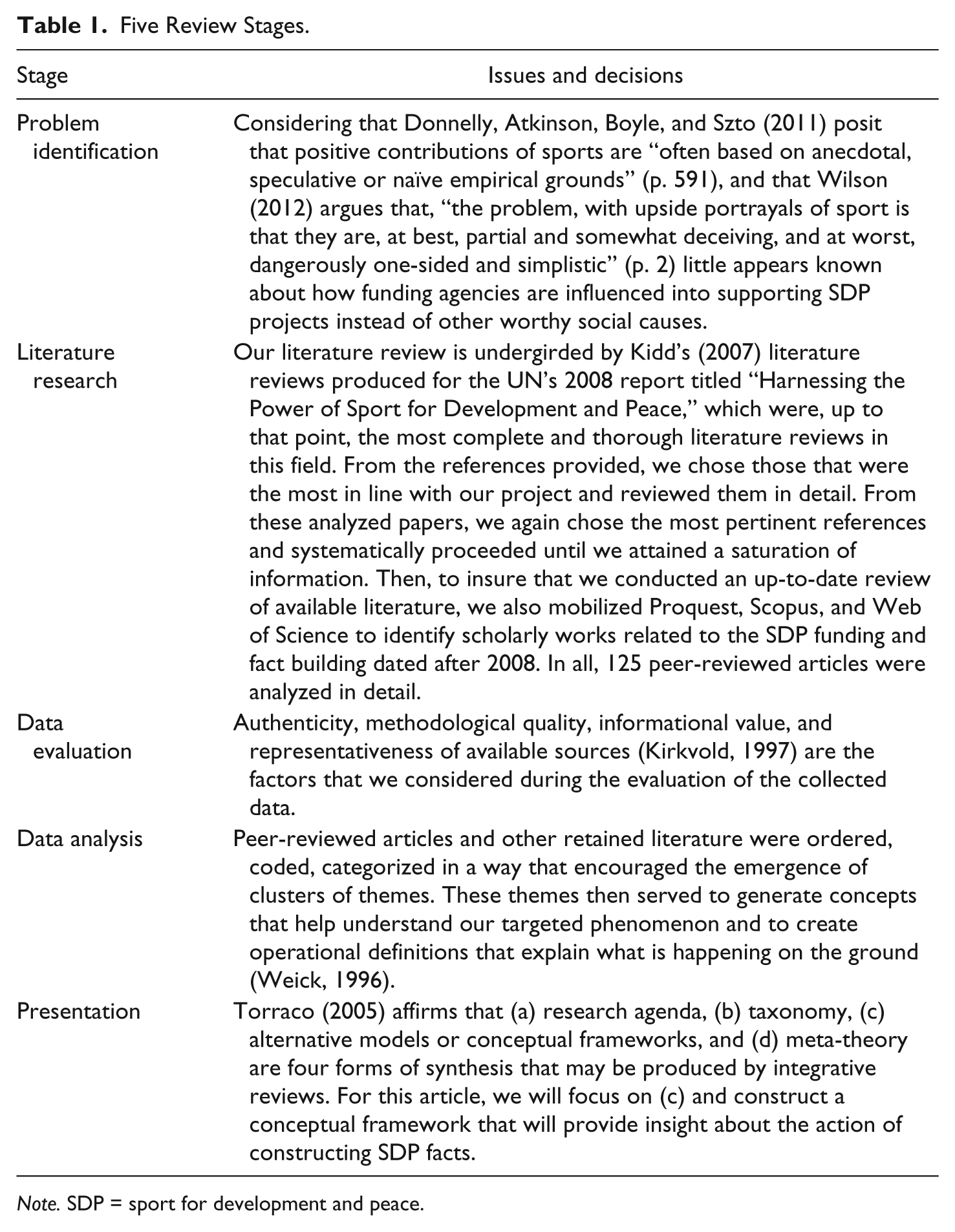
Note. SDP = sport for development and peace.
Case Studies
Yin (2009) argues that case studies are pertinent when seeking to understand real-life phenomena within blurred contextual boundaries. Thus, even if the integrative review provided much insight, reviewing published scholarly works provided insufficient understanding of SDP fact building in action. In addition, considering that “your overall goal is to collect the richest possible data” (Lofland & Lofland, 1984, p. 16), we chose to triangulate our research by analyzing two fundamentally very different cases that reflect the rich and complex field of SDP.
For both case studies, a content analysis of electronic and printed media combined with in-depth interviews were conducted. However, throughout our work, we remained cognizant of Marshall and Rossman’s (2011) argument that research that relies on an in-depth interview are often supplemented with other data such as electronic media and discourse analysis. Thus, data for each case were collected according to case characteristics, familiarity heuristics, and access opportunities. In addition, we actively identified and analyzed how non-human actors (Latour, 2005), such as operational data-collecting tools or paper and electronic reports, also influenced fact-building processes.
The first phase of the analysis of the data generated by both methods consisted of applying codes generated from the literature review, words used by participants, and researchers’ insight (Marshall & Rossman, 2011) to the selected documents and to the transcribed in-depth interview verbatim. Coding efforts provided connection with the data, improved our understanding of SDP fact building, and facilitated developing theories based on available data (Basit, 2003). The second phase of the analysis consisted of looking for patterns and themes among the narratives (Boyce & Neale, 2006). Specifically, strategies and process deployed to garner support for claims, as well as fact-building maneuvers and actions were highlighted.
Before discussing insight obtained, let us briefly present both cases as well as certain methodological specificities applied to each.
Case-specific data were obtained primarily through in-depth, semi-directed interviews with subject matter experts. The interviews that lasted between 1 and 2.5 hr were conducted with civilian subject matter experts as well as serving Canadian Armed Forces Officers who have participated in a variety of peace-making or peace-keeping missions in Afghanistan and Bosnia-Herzegovina. Because gaining access to interview participants who are in a position to share sensitive information may be a time-consuming and stressful process (Monahan & Fisher, 2014), certain academics recommend finding a known sponsor who can provide entry (Patton, 2002). Hence, professional and personal networks were put to contribution to secure interviews with subject matter experts and serving officers. As security concerns were clearly expressed by several interviewees, defining characteristics such as names, ranks, and unit affiliations will not be used in this article and the terms participant and interviewee will be applied. Furthermore, as both age and gender may serve to identify participants, gender-free alternatives will be privileged throughout.
In addition, benefiting from participants highly collaborative attitude, access was granted to operational data-collecting tools such as the Tactical Conflict Assessment Planning Framework (TCAPF) reports, official operational material and documents used by the North Atlantic Trade Organization (NATO) troops during peace-keeping missions.
The UN’s commitment for human rights and fundamental freedom for all creates an environment where many pertinent materials relating to this study are readily available in the public domain. In line with the practice of integrative reviews, Appendix A synthesizes the printed and electronic media, published both before and immediately after the 2008 report, which, combined with the UN Office on Sport for Development and Peace’s (UNOSDP) annual reports, also contributed to enriching this case study (Duff, 2011). This integrative literature review was augmented by several in-depth interviews with staff who worked on the coordination and production of the final report as well as with a governmental advisor on development of sport and on sports for development projects. However, remaining respectful of confidentiality concerns that were expressed by interviewees for this specific case, the specific function and defining characteristics such as names and gender of participations will not be used for this case study.
Literature Review
The analysis of the peer-reviewed literature reveals that the broad field of sociology provides the privileged theoretical lenses through which academics explore SDP. Currently, a variety sociological lenses are used to primarily explore the potential of sport such as focusing on building character (Calloway, 2004), “breaking the ice” to rebuild relationships between divided people (Gasser & Levinsen, 2004), encouraging social change (Schulenkorf, 2010), favouring grass roots development (Willis, 2000), facilitating social inclusion (Vermeulen & Verwell, 2009), and increasing self-esteem and self-efficacy (Coalter, 2013). In comparison, there is far less research that focuses on the limits of SDP such as the historical use of sport as a tool for preparing for war (Armstrong, 2002), sport as an activity that contains colonial residue (Darnell & Hayhurst, 2011, p. 185), or the idea that sport “inherently privileges males and masculine ways of thinking and Europeanist forms of cultural expression” (Kidd, 2007, p. 7).
However, the analysis of published literature demonstrates an absence of research about the complexities of SDP funding. Addressing this lacuna appears timely in light of the complexity of the relationships constructed between the state and sport, which are deeply influenced by the “extension to sport of the rules of neo-liberal economics” (Bourdieu, Dauncey, & Hare, 1998, p. 17). As such, neo-liberal economics and its related NPM principles (Gendron, Cooper, & Townley, 2007; Larner, 2000; Pollitt & Dan, 2011) may provide valuable contextual explanations about shifts in funding practices, which have left many organizations scrambling to diversify their funding sources such as the UNOSDP, which entered a financial partnership with Samsung Electronics Co. on June 6, 2013 (Naik, 2013).
Thus, better understanding the context is a pertinent tactic for better understanding how and why funding agencies decide to financially support SDP and through these efforts, this section will tell “a story by critically analyzing the literature and arriving at specific conclusions about it” (Torraco, 2005, p. 361). Better understanding funding agencies is important, because an unreceptive agency would conceivably not provide any financial or material support, regardless of how powerful a case an SDP agency made.
Neo-Liberal Influence on SDP Funding
Through our analysis of published literature, numerous authors identify neo-liberalism as having considerable influence on funding and SDP agencies (Beacom, 2009; Bourdieu et al., 1998; Coalter, 2010; Darnell, 2007; Green & Houlihan, 2006; Kidd, 2008; Lemke, 2007; Parry, 2012). In brief, neo-liberalism is described as “a theory of political economic practices that proposes that human well-being can best be advanced by liberating individual entrepreneurial freedoms and skills within an institutional framework” (Harvey, 2005, p. 2). More specifically, Giulianotti (2011) argues that it is one of four policy domains mobilized to alleviate human problems, whereas Darnell and Hayhurst (2011) claim that neo-liberalism currently plays a dominant role within the political economy of international development.
The impact of neo-liberalism on SDP is complex. King (2006) explains that neo-liberalism represents the trend to reduce the role of states in favour of corporate intervention. Under this philosophy, the role of the state, civil society, and corporations have become blurred and an environment that encourages private giving instead of government spending has emerged. One result is that “NGOs are viewed by many official agencies and members of the public as more efficient and cost-effective service providers than governments, giving better value-for-the-money” (Edwards & Hulme, 1996, p. 961). By rolling back state involvement in social causes, the tenors of this philosophy favour charitable contributions and active philanthropy instead of state intervention. Yet, Mintzberg (1996) is quick to remind us that business is not all good, and that government is not all bad, and that each has its place in a balanced society alongside cooperative and NGOs. In other words, corporate values may be predominant in society, but government and civil society should be careful about how they choose to share power if society hopes to maintain a certain balance.
As NGOs have three basic sources of funding, notably self-funding, donors, and grants (Fowler, 1992), neo-liberal thought has spurred several funding trends such as the rise of corporate social responsibility (CSR; Giulianotti, 2015) and the implementation of NPM (Gendron et al., 2007; Larner, 2000; Pollitt & Dan, 2011).
As government grants represent a large portion of many SDP agencies funding, understanding the nuances of NPM is important because SDP agencies, which faced with fierce competition from numerous important social causes, need to pull funders toward their cause (Wilson, 2012). In such a highly competitive funding environment, establishing the fact that SDP works firmly in the mind of NPM practitioners would theoretically reduce their hesitation to finance SDP projects. To better appreciate the details about the operationalization of this fact-building process that will be provided in the next section of this article, let us first discuss theoretical impacts of neo-liberalism on SDP funding through grants.
The Influence of NPM on SDP
As SDP agencies rely on competitive funding sources (Wilson, 2012), it is unsurprising that they will be increasingly responsive to the conditions imposed by their funding partners. As such, SDP agencies may need to adapt their operations to the ongoing rise in NPM’s “emphasis on efficiency, economic rationalism and managerial authority” (Green & Houlihan, 2006, p. 52). One impact of this new emphasis on efficiency and business procedures is that funding agencies will likely imbed the ideology that change is a logical, controllable, measurable, and accountable process (Wallace, 2009). Accordingly, a change-as-measurable paradigm will imply funding processes dominated by business plans and detailed procedures for reporting, monitoring, and evaluation progress (Wallace, 2009). In this way, new levels of professionalization may become required from SDP agencies to secure vital funding.
As a result, it is now commonly accepted for funding agencies to make “demands around social policy, budget allocations and . . . and systems of accountability” (Wallace, 2009, p. 202). The impact, Wallace argues, is that NGOs now have to work in a context where many of their strategies are established not by the needs on the ground, but by the needs of the funding agency. This state of affairs may imply that an SDP agency may not only have to follow the evaluation processes imposed by the funding agencies to receive financial and material support, but may also need to be more sensitive to the fundamental needs of the funding agency. For example, SDP agencies may have to deploy schemes that will not only make decision makers perceive the salience of development and peace but also make them believe that sport has the power to influence these important social issues (Van Rooy, 1997). Such efforts to crystallize the salience and power of SDP may explain the ever “growing piles of internal monitoring and evaluation manuals, the growing external clamor for impact assessment and proofs of effectiveness—tied to new public management’s paradigm” (Wallace, 2009, p. 210). Furthermore, this combined need to crystallize development and peace as important social causes, as well as establishing sport’s potential to contribute to them, provides better understanding about the reasons behind efforts to transform the claim that SDP works into a fact.
Transforming Claims Into Facts
The competition between NGOs is legendary and “pushing for increased profile, funding and market share drive many boards and directors” (Wallace, 2009, p. 210). As NGOs in general, and SDP agencies in particular, are arguably not as powerful as many larger, well-organized and well-funded political groups, a parallel can be drawn here with how transnational advocacy networks “must use the power of their information, ideas and strategies to alter the information and value context within which states make policies” (Keck & Sikkink, 1998, p. 95). Thus, a first tactic NGOs could use to influence state funders is to develop “information politics, or the ability to move politically usable information quickly and credibly to where it will have the most impact” (Keck & Sikkink, 1998, p. 95). Through this tactic, SDP agencies would gain power by posing as unbiased sources of scientific information (Schepers, 2006), which in turn can be leveraged to obtain increased profile, funding, or market shares. Moreover, being perceived as an unbiased source of scientific information may be all the more important considering the NPM context, which requires organizations to provide objective indications of competence (Willem & Lucidarme, 2014). Put differently, the raison d’être of an SDP project may now, more than ever, need to be supported by facts that provide indications of competence on which funding is underpinned.
The seminal book Science in Action provides insight on how such essential facts are constructed. In this work, Latour (1987) argues that “the construction of facts is a collective process” (p. 29) and that the “status of a statement depends on how it is used by later statements” (p. 27). In other words, a statement, or a knowledge claim, that is ignored will not become a fact, so it is important to understand the tactics of convincing the reader to not ignore, and then to use a given knowledge claim. Understanding this is important, as it is this process that will, over time, transform claims into facts.
The first rhetorical vehicle that writers of fact may use to convince skeptics is described as the “argument from authority” (Latour, 1987, p. 31). Bringing in not only influential but also more numerous allies may be scorned by those who believe that truth is all that should be needed. However, referring to opinions and ideas of experts, authors, and respected authorities in a given field is a simple and efficient tactic because if someone wanted to object to your claim, they now also have to object to the opinion of an expert. Yet, if the perspective of contesting an expert is not sufficiently intimidating to sway skeptics, an author can also consider mobilizing numerous, and possibly boisterous, allies. Thus, the take away message here for practitioners is that even if these last are not experts, their sheer volume can sometimes be just as persuasive as experts.
Conversely, if opinions of allies and experts are still not sufficient to convince the skeptical reader, an author may have to mobilize written text, or even many texts, to support their arguments. A fascinating aspect of this escalation in persuasion is that it is not only limited to the prestige and reputation of your experts, allies, or texts, but again, may also be a matter of numbers (Latour, 1987). For instance, the more articles and references you are able to use reinforce your knowledge claim because a skeptical reader would have to weaken all the references before being in a position to weaken your core arguments. Thus, the presence or the absence or references, quotations and footnotes is so much a sign that a document is serious or not that you can transform a fact into fiction or a fiction into fact just by adding or subtracting references. (Latour, 1987, p. 33)
Yet, regardless of the number of experts, allies, and literature mobilized, “by itself a given sentence is neither a fact nor a fiction; it is made so by others, later on” (Latour, 1987, p. 25). Thus, the status of a fact depends on others using it, and in this process eventually establishes the claim as a fact. The important point here is that a fact presented in a “closed, obvious, firm and packaged premise” (Latour, 1987 p. 25) will be easier for others to use. Hence, establishing a certain alignment between the aim of an SDP project and the funder’s mission should also facilitate the acceptance of the fact by the funder. More specifically, “the first and easiest way to find people who will immediately believe the statement, invest in a project, or buy a prototype is to tailor the object in such a way that it caters to these people’s explicit interests” (Latour, 1987, p. 108). The advantage of this piggy-backing, or we want what you want strategy, is that no other force is needed to transform claims into a fact because the targeted agency already agrees with your premise as it is already aligned with their mission. Practically, this could also lead an SDP agency presenting their project as a shortcut to mission attainment. For instance, as we will see in the case of soccer in Kandahar, field officers aligned the objectives of a proposed soccer program as a shortcut to achieving the overarching 3D approach of building peace and stability through amalgamation of defence, diplomacy, and development (Coombs, 2013). In other words, the proposal of renovating soccer fields and setting up an amateur league may be viewed as a “if you want peace, you first need soccer” shortcut. Thus, having established the theoretical groundwork for our study, let us provide more details about SDP fact building in action.
Findings
Case 1: Soccer Night in Kandahar: Using Literature, Experts, and Allies to Build Facts
One participant explained that, in 2010, field officers who coordinate development projects for the Canadian contingent in Afghanistan thought that soccer had potential to help attain their mission of bringing peace and stability to the Panjawi and Kandahar districts of southern Afghanistan. Building on the feedback from the ground, this interviewee stated that the field officer team became convinced that watching peaceful soccer matches could provide a sense of normalcy to this community, and thus considered that a restored soccer pitch in the heart of the city could become a powerful tool for winning the hearts and minds of the local population. This participant shared that the field team had astutely discovered that “soccer stadiums in Kandahar were a great opportunity . . . with the World Cup fast approaching, we knew that soccer held a great deal of interest to many fans.” Yet, another participant explained that such a project might face an uphill battle to get funding because “most politicians and bureaucrats neglected to consider the potential of sport for peace and preferred investing in electricity, schools and roads.” Thus, one interviewee explained that the first action to kick-starting a soccer program was to gather supporting literature in the form of TCAPF reports.
This same participant explained that, in this theatre of operations, military intelligence was gathered and reported through a common TCAPF tool developed by the United States Agency for International Development (USAID). The TCAPF training provided to the Canadians by the Worldwide Joint Training and Scheduling Conference (2009) bluntly argues that until a contingent understands that in some cultures, honour, justice, and revenge matter more than schools, roads, and jobs, its peace-building programming will not be effective. Essentially, the aim of the TCAPF is to get the person’s opinion on the general state of their area and gauge their attitude toward the government. These exchanges generally take place during patrols and are conducted . . . with villagers at random, ideally over a period of months. (Treseder, 2010)
Thus, the idea behind this data-collecting tool is that all troops would ask the same four questions to the residents they encountered and follow up each question with “why.”
The answers are then transcribed into the TCAPF form reproduced in Figure 1 and become, in a certain point of view, a non-human (Latour, 2005) fact-building actor as the collated data will influence the sector headquarters (HQ) to act on the reported observations. This reporting tool was important to the Kandahar field officers as one participant explained that the TCAPF reports demonstrated that sports infrastructure were considered to be even more important than hospitals and schools in his area.
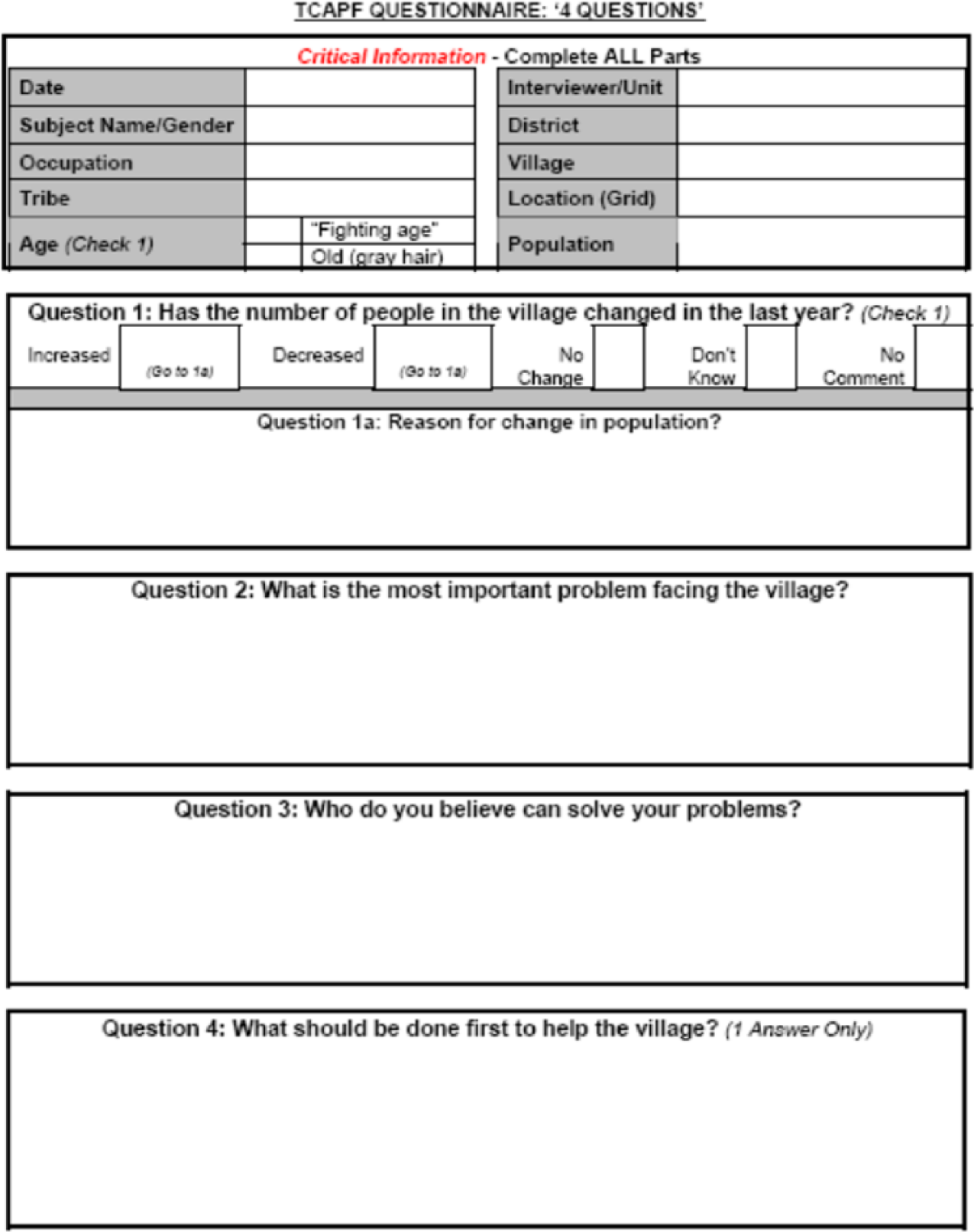
Tactical Conflict Assessment Planning Framework (TCAPF) -USAID infrastructure Workshop (2009).
However, as one participant explained that sport was not traditionally high on combat mission priorities, the field officers knew that the TCAPF report alone may not be enough to get funding. So, once the TCAPF reports began identifying that soccer may be a good option for mission attainment, the field officer discussed the project with the Canado-Afghan cultural adviser attached to their unit, who immediately supported the initiative. This Canadian citizen of Afghan origin accompanied the mission as an expert on Pashtun affairs and helped convince the chief planning officer for the contingent that this was a valuable program. With the added influence and connections of this superior officer who directed all reconstruction in the province, they set out to get the civilian representatives of the Canadian International Development Agency (CIDA) to join their growing coalition. As they wanted to present their project in a way that the chain of command simply could not say no, one participant explained that the project team subsequently sought to gather powerful allies that would tip the balance in their favour and guarantee success. The allies they needed were identified as the local Shura (council of elders) and the regional governor whom they managed to convince to endorse the project. One participant explained that getting them on board was achieved through lengthy discussions in which they realized that what the Shura and the Governor wanted were examples of progress that were tangible to the local population. For instance, one interviewee told us that increasing the length of available electricity from 4 to 8 hr a day would have been seen as a real accomplishment. Yet, the Shura understood that such an increase would take a very long time to achieve. Thus, this same interviewee said that that one argument that was used to get the Shura to support was to explain to them that this soccer project could be done in the short term and thus become a quick tool for keeping the local population happy. In addition, the participant explained that because “the Governor can come and cut the ribbon . . . to put an Afghan face on the project, so for the population, it is the Governor of Kandahar that delivered on their request”, the soccer program became politically very interesting for the local government. Moreover, it was explained to us that the support from the elders and the Governor was very important because the Canadians could now present the project as driven by Afghans for Afghans. This appears as being significant because one participant said that the Taliban would have most likely attacked and destroyed a NATO branded sport project.
Case 2: Constructing the UN’s 2008 Report on the Potential of SDP—Experts and Allies Building Literature
Many SDP agencies, such as the Canadian SDP NGO Right To Play, depend on government and corporate funding for a large portion of their operations (Wilson, 2012). It appears plausible that if skeptical funding agencies can be convinced that sport truly contributes to development and/or peace, it will be easier for such SDP agencies to obtain the funds they claim to need. In this case study, however, it is significant to note that Right To Play had a key role in coordinating the production of the SDP IWG major report for the benefit of the UN titled, Harnessing the power of sport for development and peace: Recommendations to Governments (Koss, 2008). In this capacity, one participant explained, Right To Play was funded by four international Governments to act as a secretariat for the working group. The four Governments acted as a steering committee, so everything we produced had to be vetted by this steering committee. So every draft, every document we produced would be presented to them and they would get it vetted by their governments.
Once this steering committee was established, one participant explained that one of the very first steps in building the report was to mobilize experts to lend their weight to the process. First, Dr. Bruce Kidd, PhD, who was, at that time, the dean of the Faculty of Physical Education and Sport at the University of Toronto, was asked to produce literature reviews on concepts related to SDP. This is an interesting first move because the use of other texts is a pertinent mechanism to convince people of the truth of your position because “there is a point in oral discussion when invoking other texts is not enough to make the opponent change his or her mind. The text itself should be brought in and read” (Latour, 1987, p. 33).
One participant explained that the second step was to get legal advice; “We took that (literature review) along with a variety of UN documents and key frameworks, then we hired a consultant in Geneva, who had worked on UN and Peace keeping initiatives.” This step may be a reflection of what Latour (1987) describes as the argument from authority. One participant clarified that the authority figure in this case was an internationally renowned subject matter expert and lawyer. Marshaling such an expert creates the situation where it becomes more difficult for someone to declare the SDP IWG’s position as false. Put differently, anyone who wants to question the idea that sport may contribute to development or peace now has to not only argue with a PhD but also with an internationally respected lawyer. In addition, the final report acknowledges the support of a broad variety of allies such as the Athens, Torino, and Beijing committees for the Olympics games, individual contributors such as Elizabeth Mulholland, Judy Kent, Ken Lodewyk, Jonathan Somer, and Elise C. Roy as well as the private sector partner Johnson & Johnson. This public acknowledgment of multiple supporters suggests not only an appreciation for their support but also a further effort of buttressing their claims by publically showcasing their supporters.
What is more, the analysis of related documents demonstrates that final report went through several iterations to garner extensive support. Appendix A demonstrates that a roundtable session was held during the 2002 Salt Lake City Olympics that served to produce an initial position paper. The 20 high level stakeholders met during the Athens Olympics and produced the Report from Athens Roundtable Forum that was held on August 14, 2004. These efforts served to underpin the June 2006 UNOSDP from practice to policy report that was written with expressed intent of preparing recommendations that would be presented at the Beijing Olympics. However, one more meeting was organized before the Beijing Olympics to increase the number of supporters and improve the chances of getting the report approved.
Latour (1987) would likely agree with the tactic of gathering ever increasing support before presenting the report because, for him, the “construction of facts is a collective process” (p. 29). Thus, the preparation dialogues were mostly done electronically, but there were also face-to-face meetings and in 2007, as 43 ministers of youth and sport and the working group got together in Ghana for a three day working session, one week before Christmas, and they went through the report page by page. And at the end we had clear direction of where we were going and buy-in by different stakeholders
said one of our research participants about the Accra call for action on SDP, which both, vetted the working papers and produced a series of nine recommendations (see Appendix A).
Following the Ghana meeting, an interviewee explained that the re-worded documents were once again vetted electronically by the steering committee and then the working group. By this time, it appears that the working group had been converted from simple participants into allies, because there appears little evidence of resistance against the recommendations that would be presented to the delegated ministers involved with the SDP IWG. This exercise was completed during the fourth SDP IWG meeting held in Beijing during the 2008 Olympics when 38 delegated ministers “went around the table and endorsed the report. But they had already endorsed it so it was just rubber stamping of the report that was done,” said one research participant. Yet, obtaining the “rubber stamp” seemed to have been an important step in obtaining sufficient credibility before it was submitted to the UN General Assembly for final approval. The UN General Assembly Resolution A/RES/63/135: Sport as a means to promote education, health, development and peace was adopted by the general assembly in December 2008.
Discussion and Contributions
Prying open, then analyzing the contents of two SDP black boxes provides much insight about the emerging field of SDP in general, and SDP funding management in particular. For instance, in an NPM context, establishing that SDP works as a fact is seen by practitioners as a powerful tactic for influencing funding agencies. To better understand how SDP agencies transform the claims that SDP works into facts, Figure 2 proposes a conceptual model of the mix of experts, allies, and literature mobilized by SDP agencies to influence funders.

SDP Fact building Mix.
This model has the advantage of being a practical rejoinder to Weick’s (1996) argument that administrative sciences should focus on relationships. However, without falling into a deterministic pitfall, Figure 2 synthesizes the complex relationships described in this article. While conceding that other concepts also influence funding decisions, this conceptual model demonstrates similarities between how scientists and SDP agencies build facts. By marshaling a different mixes of experts, allies, and literature, both the scientist and SDP agencies strive to have their claims accepted as fact. In other words, this article demonstrates that Latour’s fact-building process may have applications beyond the realm of science, which in itself may be a valuable theoretical contribution.
Another theoretical contribution of this model is that it demonstrates that neo-liberal-driven predisposition to contribute to the greater good in society appears to offer piggy-back or shortcut opportunities (Latour, 1987). As such, knowledgeable SDP agencies can now shrewdly align their operations on NPM-driven priorities, which would facilitate obtaining funding, especially in the case where states view development and peace as priorities. Put differently, this state of affairs could allow SDP agencies to implement we want what you want or a first sport, then development or peace, fact-building shortcuts.
In addition, Figure 2 encourages us to refine our focus even further to better understand the subtle nuances in SDP fact-building processes. For instance, analyzing two cases reveals that it is not simply experts, allies, and literature that are used by SDP agencies for fact building, but more precisely a mix of fact-building actors that is mobilized. Specifically, in Case 1, the mix of fact-building actors was composed of operational literature (TCAPF reports), many experts (field officers, Canado-Afghan advisor, civilian CIDA coordinator), and influential local allies (the Shura and local Governor). In comparison, Case 2 demonstrates that experts, (Professor Kidd and an expert lawyer) and numerous and influential allies (50 nation working group) were more important than literature. Put differently, this article reveals that SDP agencies are constructing fact through a mix of fact-building actors rather that systematically mobilizing experts, allies, and literature.
Focusing on the mix of fact-building actors may provide promising avenues for future research. For example, more research could provide insight about the relationship between the aim of a fact-building operation and the chosen mix of fact-building actors. For instance, Case 1 mixed experts, allies, and literature to obtain direct funding for a tactical grass roots SDP project, whereas Case 2 mixed experts and allies for the construction of powerful literature that may subsequently be wielded by SDP agencies to obtain funding. Such a research tack could address important academic questions such as the following: What influences the mix of experts, allies and literature? What is the relationship between the aim of the process and the chosen mix? Does the relative strength of available fact-building actors affect the mix? Conceivably, such research may demonstrate that targeting government agencies with only numerous, yet very well-connected or highly visible allies, such as entertainment or professional sports spokespersons, may be sufficient to obtain funding. Hence, instead of considering that all SDP projects need experts, allies, and literature to transform the claim that SDP works into a fact, it may actually be more accurate to argue that what SDP agencies need is a targeted mix of fact-building actors that fits their given context. However, discussing all implications of complex concepts such as the mix, and fit, of fact-building actors is beyond the scope of this article. Yet, such research efforts may nuance and refine Latour’s thesis and demonstrate that a mix of fact-building actors that fits the context is what is needed to build fact. Finally, such research may also provide theoretical underpinnings that would help practitioners understand whether it is the type of funding agency, the context of the funding request, or the availability of fact-building actors that ultimately shapes the mix fact building and its fit with the targeted funder.
Conclusion, Limits, and Future Research
Our conceptual model demonstrates that experts, allies, and literature are mobilized by SDP agencies to transform the claim that SDP works into a taken-for-granted fact. By combining the analysis of extant literature and two very different cases, our research also demonstrates that it is a mix of fact-building actors that is used to transform the claim that SDP works into fact. Yet, this article demonstrates that little is known at this time about how a given fact-building mix is constructed, what specific mix is needed in different funding contexts, or about which mix of fact-building actors is needed to seduce specific types of funding agencies.
However, this article does argue that contextual factors such as the current NPM trend may positively predispose funders into accepting SDP claims as fact. Yet, more knowledge appears to be needed to confirm how external pressures, such as neo-liberal-driven NPM or the strong emotional bonds we share with sport, predispose funding agencies to be receptive to SDP facts. Hence, another limit of our model is that we still do not know whether SDP agencies capitalize on positively predisposed funders or whether certain elements of the fact-building mix seduces funding agencies more than others. Such research efforts could also examine whether less predisposed funding agencies can become receptive to SDP funding requests through fact building. This could provide more insight about which mix of fact-building actors are more influential on funding decisions. Put differently, we now know that a sport for peace project in Afghanistan needed TCAPF reports, the word of a trusted field officer, the support of the expert in Pashtun affairs, both the military and civilian reconstruction agents, as well as powerful local authorities to insure that the commanding officer could not say no to their request; what we do not know is why this specific mix was needed although other SDP projects may get funding with only the influence of powerful experts and allies. It thus appears plausible that the targeted funding agencies in Case 1 had attained a certain level of predisposition to make the requests receivable and that the tactic of mobilizing allies, experts, and literature ultimately nudged this predisposed funding agency. But what we do not know is whether this predisposition influenced the final mix of fact-building actors, in the same way as those agencies that are not initially receptive,
One promising avenue for future research that emerged may be to move beyond the currently dominant sociology lens that is often used in this field and to explore the relationships built between SDP agencies and their funding partners through other research angles such as mobilizing international sports management or marketing theory. Broadening the scope through which academics analyze this field may provide valuable insight and understanding, and research that would apply a follow the money approach (Wechsler, 2001) to SDP could obtain better understanding about the nuances and complexities of the sense making behind the asking for, and giving of, SDP funding. Moreover, such a project could not only provide insight about government funding decisions but also explore the rich and complex world of CSR and its relationship with SDP sponsorship decision making. Such research appears important because taking care of social welfare through CSR may soon become essential for corporations that need to secure both resources and corporate legitimacy (Hess & Warren, 2008).
Our research, with two cases being studied, is thus a first step in the analysis of how the claims that SDP works are transformed into facts. And, considering that SDP is a growing industry (Cornelissen, 2011), it remains important to gain more insight about the factors that influence SDP funding. In the face of growing global competition for government funding, better understanding of tactics that seduce funding agencies to choose SDP instead of other worthy social causes may be essential for the sustained growth of SDP.
Footnotes
Appendix

| No. | Document title | Author | Date | Note |
|---|---|---|---|---|
| 1. | Resolution (48/11) | UN General Assembly | October 25, 1993 | Observance of the Olympic Truce 7 days prior to opening ceremonies and 7 days following closing ceremonies |
| 2. | Resolution (48/10) | General Assembly | October 25, 1993 | International Year of Sport and the Olympic Ideal |
| 3. | Resolution (58/5) | UN General Assembly | November 17, 2003 | Sport as a means to promote education, health, development, and peace |
| 4. | Harnessing the Power of Sport for Development and Peace. The Athens Roundtable Forum. Position Paper | Right To Play | August 14, 2004 | Produced following a roundtable session held by Right To Play during 2002 Salt Lake City Olympiads and provides examples of projects using sport to prevent HIV/AIDS and to promote peace. |
| 5. | Report from Athens Roundtable forum | Right To Play | August 14, 2004 | 20 high level stakeholders met during the Athens Summer Olympic games and engaged governments in discussions about sport and development. Welcoming speeches set the stage to address the specific policy potential of sport to achieve social, economic, health, and development goals, and to initiate the creation of guiding concepts for governments to use sport as a policy tool for development and peace and focused on sport and HIV/AIDS and sport and peace. The main outcome was the establishment of the working group. |
| 6. | SDP IWG (2006) From practice to policy |
Mr. Adolf Ogi | June 2006 | A report investigating current practice at the national government level and to inform the development of a series of policy recommendations for presentation at the Beijing Olympics in 2008. http://www.un.org/wcm/content/site/sport/sdpiwg_keydocs |
| 7. | Children’s Rights in Sport | Norwegian Olympic and Paralympic committee and confederation of sports | May 11-13, 2007 | Document presented to the UN general assembly discussing children’s (less than 12 years old) rights in sport. The objectives are to contribute to that sport activities are organized according to the children’s needs and that all children are included in sport. These rights include safety and security friendship and well-being, based on the children’s needs, mastery, influence, freedom to choose, competitions for all. |
| 8. | THE Accra Call for Action on Sport for Development and Peace | SDP IWG and Right To Play | December 4, 2007 | The Executive Committee held third meeting at Accra: Ghana and brought together 43 ministers of youth and sport to discuss ways to harness the power of sport and produced nine recommendations and sought to sustain global momentum in support of SDP: Reiterated the importance of its final report to advancing international efforts to harness the power of sport to advance national and global development and peace goals; Agreed to the ongoing need for a coordinating forum to support knowledge exchange and capacity building and SDP policy implementation following the completion of the original SDP IWG mandate; Requested Right To Play to examine the feasibility and develop a strategy for extending the SDP IWG mandate for 2008-2010; Urged United Nations agencies, programs, and funds to fully recognize, and provide tangible support to countries wishing to harness, the peace and development potential of sport; Recognized the need for the work of the SDP IWG to continue in the long term within the UN system up to 2015 (Millenium development goals (MDGs)); and Discussed the need for an international framework on SDP to coordinate outreach and advocacy; mobilize additional resources; foster new programs and initiatives; and measure progress against universal targets, timelines, and milestones for the global use of SDP. |
| 9. | Beijing Declaration on Sport for development and Peace | SDP IWG | August 7, 2008 (4th meeting of the SDP IWG) | 38 governments convened to endorse the Beijing Declaration. Endorses the SDP IWG final report, “Harnessing the Power of Sport for Development and Peace: Recommendations to Governments”; A. Recognizes that the final report provides a comprehensive overview of the existing evidence of the contribution of sport to the advancement of development objectives including health, gender equity, inclusion of people with disabilities, child and youth development, peace building, and conflict resolution; |
| B. Recognizes the fundamental role that sport can play in building a sense of community and citizenship; |
||||
| 10. | UN General Assembly Resolution |
Adopted by the General Assembly | December 2008 | Recalling its resolutions 58/5 of November 3, 2003, 59/10 of October 27, 2004, its decision to proclaim 2005 the International Year for Sport and Physical Education, to strengthen sport as a means to promote education, health, development and peace, and its resolutions 60/1 of September 16, 2005, 60/9 of November 3, 2005, 61/10 of November 3, 2006, and 62/271 of July 23, 2008 |
| 11. | Post Publication of UNOSDP report | |||
| 12. | Case Study: Brazil | UNOSDP | May 5, 2010 (1st plenary session) | A study of theoretical impacts of upcoming mega-events in Rio and of the Segundo Tempo program |
| 13. | Case Study: Azerbaijan | UNOSDP | May 5, 2010 (1st plenary session) | A review of the National Strategy on Physical education and sport development from 2009 and 2020. |
| 14. | Minutes | Mr. Poul Hansen, Head of UN Office on Sport for Development and Peace, |
May 5, 2010 (1st plenary session) | Minutes to the inaugural plenary session. In these minutes they account for the adoption of the rules and procedures, elect officers, present sport and child working group strategic plan, discuss child protection in sport, discuss how to use sport to strengthen child and youth education, how sport can enhance transferable skills and employment opportunities and implement monitoring. |
| 15. | Governing Principles | SDP IWG | May 5, 2010 (1st plenary session) | Covers: Mandate, objectives, organization, participation, procedures |
| 16. | Annotated Provisional Agenda for the First Meeting | SDP IWG | May 5, 2010 | 1. Provide a forum for governments to benefit from each other’s experiences and share best practices; |
| 17. | UNOSDP | December 8, 2010 | There are three main objectives of this meeting: |
|
| 18. | Minutes |
Poul Hansen | May 12, 2011 | • Adoption of rules of procedure |
| 19. | Women’s International Leadership development Programme | European Non-Governmental Sports Organisation (ENGSO) | December 8, 2010 | To strengthen networking between women |
| 20. | Sport and Child & Youth Development | SDP IWG | December 8, 2010 |
|
| 21. | Minutes of 2nd plenary session Geneva, Switzerland | Poul Hansen | May 12, 2011 | Attendance, opening of meeting, adoption of rules, reports of regional representatives, election of officers, report on monitoring implementation, building capacity to support policy development |
Note. SDP = sport for development and peace; UNOSDP = UN Office on Sport for Development and Peace; SDP IWG = Sports for Development and Peace International Working Group.
Declaration of Conflicting Interests
The author(s) declared no potential conflicts of interest with respect to the research, authorship, and/or publication of this article.
Funding
The author(s) received no financial support for the research, authorship, and/or publication of this article.
Author Biographies
 .
.