




Abstract
Rarely does the Byzantine world of football administration get exposed as clearly as during the 2006 calciopoli scandal. This scandal laid bare the interpersonal relationships of football administrators at the top three Italian men’s football clubs: Juventus, Inter, and AC Milan. This article draws on the media leaks that revealed the inner workings of those working within football to argue that the football clubs are pyramids of power for club presidents that allows them to operate within the Italian power elite. This is done through interpersonal clientelistic networks that operate within a neopatrimonial system. Theoretically, this article draws on four main concepts: C. Wright Mills’s concept of the Power Elite, Lomnitz’s model of “Pyramids of Power,” Eisenstadt’s notion of neopatrimonialism, and Mauss’s utilization of the gift. Power is exercised through quid pro quo relationships, with certain key individuals operating as brokers to the flow of favors throughout the network.
The 2006 calciopoli scandal in Italian football will be analyzed throughout this article to demonstrate the neopatrimonial networks within Italian politics, business, and football. Briefly, the scandal came about through distinct investigations into match-fixing rings in Parma and Udine which coincided with investigations into match-fixing involving the Neapolitan organized crime syndicate, the Camorra. In parallel, separate investigations were taking place into a sports agency in Rome called GEA Sport, as well as an examination of potential doping at Juventus. The inherent problem of the system was initially highlighted 6 months earlier when the judicial inquiries were presented to the president of the football federation, Franco Carrara, who took no action. This resulted in the inquiries being leaked to the media. Although the scandal implicated all of the top three clubs, as well as Florentine and Lazio, the initial investigation centered on the director of football at Juventus, Luciano Maggi. He came to symbolize the personalized nature of the neopatrimonial system as he was situated at the nexus of a wide network of politicians, administrators, referees, and journalists. Moggi cultivated these contacts through a series of roles in Naples, Rome, and Turin. The scandal resulted in Juventus, Italy’s most successful and well-supported club, being stripped of the 2005 and 2006 league titles and relegated. Meanwhile, several of Italy’s other leading clubs, AC Milan, Fiorentina, and Lazio, were docked points. Five years later, the recriminations continued as the main beneficiary of calciopoli, Internazionale (“Inter”), was identified as being complicit in the original allegations as their owner was a director of Telecom Italia that ordered the wiretaps into Juventus and Milan, and a former Inter director became president of the league and quickly dispensed justice over their rivals. Political connections were vital in how power was exercised.
Theoretically, this article draws on four main concepts: C. Wright Mills’s (1956) concept of the Power Elite, Lomnitz’s (1982) model of “Pyramids of Power,” Eisenstadt’s (1973) notion of neopatrimonialism, and Mauss’s (1967) utilization of the gift. Each of these will be elaborated later and Figure 1 attempts to show this figuratively. Sitting atop Italian political society is the Power Elite comprised of three interlocked pyramids of power: politics, industry, and football. Individuals at the apex of these three pyramids constitute the Italian Power Elite. While these pyramids may stand alone, at their summit are individuals who belong within each structure. Silvo Berlusconi embodied this structure as he is a successful businessman, previous owner of the football club AC Milan, and former Prime Minister. Within each pyramid, neopatrimonial networks operate to exercise power. Neopatrimonialism is the corruption of bureaucratic systems for personal gain (Eisenstadt, 1973). These networks are constituted through social relations that are enacted through the quid pro quo exchange of favors. Mauss’s (1967) understanding of gift exchange will be used to demonstrate how key individuals use patronage and gift exchange within this neopatrimonial network. Gifts symbolize not only future obligations, but power within social relationships. The importance of using these concepts is that it breaks away from the notion that deregulation and privatization of ownership automatically improve competition to a wider range of actors. This article will show that interpersonal connections can be used to corrupt and undermine political and economic integrity.
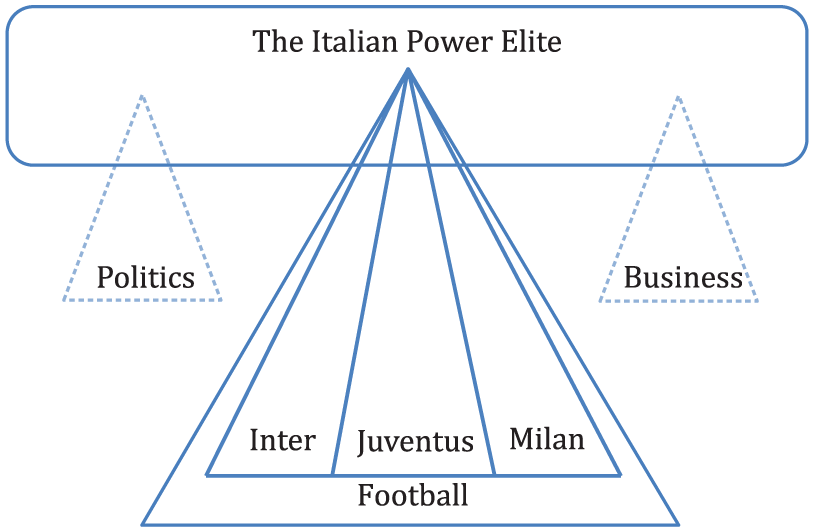
Conceptual view of the Italian power elite.
This article addresses three aspects relevant to contemporary sociology. First, it seeks to show how football can be a key site for political domination and consequently an important site to understand how power can be exercised. Second, through analysis of transcripts of a major football scandal, calciopoli, it argues that power is exercised through personal relationships using gift exchange and patronage. Third, it demonstrates how these interpersonal relationships form a widespread neopatrimonial network that draws on these gifts and patronage to maintain the Power Elite. The Byzantine world of Italian politics is opaque and difficult to access. Yet through media publication of numerous transcripts of the calciopoli scandal, it is methodologically possible to see who exercises power, not only in analysis of the conversations but through the way the carefully selected transcripts were leaked. Consequently, this article will interrogate only one pyramid of the Italian Power Elite: football. Despite this, it will still be possible to discern clear links with the other pyramids of the Power Elite, often because the same people are located within all three pyramids.
The Italian Power Elite
In his analysis of the “Power Elite,” C. Wright Mills (1956) identified a confluence of individuals and groups at the apex of American society. Mills identified how power coalesced around certain institutions; the interests of politics, industry, and the military were interlaced in postwar America. In many cases, the same individuals would occupy strategic locations within government. This was reinforced by Eisenhower’s acknowledgment of the “Military-Industrial Complex” to illustrate how business operated for the military with the support of the government. Individuals within these roles, Mills (1956) argued, Are in positions to make decisions having major consequences. Whether they do or do not make such decisions is less important than the fact that they do occupy such pivotal positions: their failure to act, their failure to make decisions, is itself an act that is often of greater consequence than the decisions they do make. (p. 4)
Significantly, the Power Elite sat at the apex of the three institutions of power: the military, industry, and politics. While the military held, and continues to hold, a key position within American political life, this does not automatically translate to other nations. America retains a military presence within Italy, so the Italian military does not have such a strategic importance. Despite this, one can still see a convergence of political and industrial interests in Italy, where the military as the symbolic institution of physical power is replaced by football.
Silvio Berlusconi embodies the exercise of political power in Italy. He is a successful businessman who owns three of Italy’s four private television channels. In 1986, he purchased AC Milan football club and transformed their fortunes both on and off the pitch. Following the tangentopoli scandal in 1992, Berlusconi used his television channels to announce that he was “entering the field” of politics. He established a political party called Forza Italia, which was named after a football chant, as well as drawing on football as a wider metaphor for politics (Porro & Russo, 2000). Drawing on the national popularity of football, Berlusconi simplified political language and communicated to a wider audience (Croci, 2001). Communicating in the language and emotion of the national-popular enables hegemony (Gramsci, 1971). While the media and politics have been identified as important spaces for utilizing power across the electorate (Arsenault & Castells, 2008; Castells, 2013; Herman & Chomsky, 1988), this excludes other areas of influence. Football is an important space of power in Italy (Doidge, 2015), and unlike Berlusconi, not all politically connected power brokers are explicitly tied to the media.
Berlusconi is not unique in this combination of being a politically connected businessman who owns a football club (Doidge, 2015). Until 2013, Inter was owned by Massimo Moratti, who inherited his father’s oil business and sat on the board of Pirelli and Telecom Italia. His sister-in-law, Letizia Moratti, was president of the state-owned television network, RAI, as well as being Mayor of Milan and a minister within a Berlusconi government. In Turin, the founders and owners of Fiat, the Agnelli family, has owned Juventus since 1923. Their former Fiat and Juventus president, Gianni Agnelli, was made a senator for life in 1991. Where Mills (1956) argued that America’s “power elite” was based on dense personal connections between politics, business, and the military, in Italy, power is accumulated around politics, business, and football.
The hegemony of the Italian power elite between business, politics, and football extends into football governance. Mills (1956) argued that “the power elite are not solitary rulers. Advisers and consultants, spokesmen [sic] and opinion-makers are often the captains of their higher thought and decision” (p. 4). These include professional politicians, administrators, and celebrities. These act as brokers that work within their institution to uphold the power of the Power Elite. Until 2010, the Italian football league was regulated and administered by Lega Calcio while the Italian Football Federation (FIGC) ran the game. Franco Carraro, the president of the FIGC at the time of calciopoli, epitomizes the game of musical chairs that takes place at various institutions. He had been president of the League on three separate occasions, in addition to being a former president of AC Milan, president of CONI (the Italian Olympic Organization), member of the Union of European Football Associations executive committee, and president of the FIGC. In addition, he was also a banker, a former mayor of Rome, minister of tourism for the Socialists, and senator for Berlusconi’s political party. Elsewhere, Adriano Galliani, the vice-president of Berlusconi’s AC Milan, was also president of Lega Calcio and member of the G-14 lobbying group of most powerful clubs in Europe. There is a clear conflict of interest in being vice-president of a club and guarantor of the integrity of the league (Porro & Russo, 2004). Galliani was seriously implicated in the calciopoli scandal as AC Milan’s referee’s liaison officer, Leonardo Meani, was overheard speaking to Gennaro Mazzei, the head of assistant referees on several occasions. This was with the full approval of the club’s vice-president Galliani. As the prosecutor Stefano Palazzi stated, “Meani was in telephone contact with linesmen, who were asked, when in doubt, to favour AC Milan. Galliani approved” (Dunne, 2006). As a result, Galliani resigned his position as president of the league. When the Italian league was reconstituted in 2010, however, the Milan vice-president was re-elected as a board member.
Pyramids of Power
Mills (1956) undertheorized the finer details of the three dominant institutions in American society. While Mills (1956) observed the interconnected relationships at the confluence of American political hierarchy, he effectively created an image of a dualistic society with the “Power Elite” at the top and “the Mass Society” underneath. Although it is useful to see how certain key groups bestride positions of power, it is dangerous to create a simplistic dualism around a society of several million people. Calciopoli demonstrated how the Italian Power Elite exerted their interest through their football powerbases. To illustrate the vertical hierarchies within each institution, Lomnitz’s (1982) metaphor of the pyramid is instructive. Lomnitz (1982) argued that Mexican social structure is “a set of free-standing pyramids, each of which duplicates itself hierarchically like a crystal from top to bottom” (p. 52). Fundamentally, these pyramids are institutionalized networks of relationships that operate in support of those at the peak. These informal relationships provide opportunities for reciprocal exchange that allows power to flow through the network (Lomnitz, 1982). In this way, political stability is achieved. But more importantly, this stability ensures the elite groups remain in situ and others remain marginalized.
Whereas Mills focused on the elite politicians, military, and industrialists, Lomnitz is focused on the hierarchies within four distinct pyramids or sectors: public, organized labor, private, and marginal labor. Consequently, she excludes the politicians that seem to sit above and outside these pyramids, whereas Mills’s theorization ensures that politics is one of the primary institutions. Furthermore, the military is not an independent pyramid due to the marginal influence of the Mexican military. Combining Mills and Lomnitz provides the theoretical scaffolding for analysis of Calciopoli (see Figure 1). Within Italian political society there exists a Power Elite that operate across football, politics, and industry. Each of these institutions operate as a pyramid of power that provides a powerbase for the Power Elite. While it is beyond the scope of this article to provide in-depth analysis of Italian political hierarchies to reinforce the veracity of the power hierarchies within politics and industry, the Calciopoli scandal provide an important insight into how the reciprocal networks operate within the football pyramid.
The analogy of the pyramid of power can be further subdivided. Elite Italian football clubs represent distinct subpyramids of power. They draw on the power and social connections of the owners and strategic individuals, and exert influence across their own neopatrimonial network. Just as Fiat and Benetton remain at the apex of a network of small family businesses in the style of the Emilan model (Piore & Sabel, 1984), before Calciopoli, provincial football clubs were under the influence of Juventus, Inter, and Milan. The semipowerful clubs of Roma, Lazio, Napoli, and Fiorentina sit slightly outside of the top three, but were still under their influence. The elite clubs have the resources to purchase the best players. The rules of football ensure that it is only a team of 11 players who can play. Although squad sizes have developed so that teams can compete in many competitions, they still need to develop their players. They often send them out on loan to a provincial club who temporarily gain a player of better quality, or on reduced wages. Shortly before calciopoli, it was highlighted in the Italian media that there were a number of connections between Juventus and Siena (Richardson, 2006). This was reaffirmed during calciopoli as it became clear that Luciano Moggi was influencing the recruitment of players, not only through Juventus but also through his son’s agency, GEA World, who controlled 20% of players in Italy. In 2005, the former Siena midfielder, Stefano Argilli, was forced to leave the club because he refused to sign for GEA. He said, “Our new manager was GEA, our general manager was GEA, half the team was GEA. It was clear to me that if I wanted to stay, I would have to sack my agent and join GEA as well” (Marcotti, 2006, p. 14).
Italy’s familial capitalism facilitates these neopatrimonial networks. This is exemplified by GEA World sports agency. Their list of shareholders reads like a catalog of family members connected to the football world. Two shareholders, Andrea Cragnotti and Riccardo Calleri, were the children of former Lazio presidents. There were also connections to Parma as Francesca Tanzi was the sister of Calisto Tanzi who built and bankrupted Parmalat and their subsidiary football club. Capitalia, the bank that underwrote Parma’s debt, along with Lazio and Roma, was also an investor. They employed Franco Carraro, the former head of the FIGC who suppressed the original calciopoli report (Hamil, Morrow, Idle, Rossi, & Faccendini, 2010). More fundamental to the scandal was the sons of two key figures at Juventus. Alongside Moggi’s son, Alessandro, was Davide Lippi, the son of a former head coach of Juventus and Italy’s World Cup winning side. This agency provided the crucial resource for accessing players, while the footballers themselves gained a greater chance of selection for the national team or Juventus.
Calciopoli highlighted how separate pyramids of power were established at the elite three clubs. Even though the initial investigation centered on Juventus’s general manager, Luciano Moggi, he always maintained his innocence. As the quote used for the title of this article states, he argued that everyone was guilty. This echoed the same justification as Bettino Craxi, the former Prime Minister who was severely implicated in the tangentopoli scandal of 1992. Although the rest of this article will highlight how Moggi acted as a broker within the Juventus neopatrimonial pyramid, the other two elite clubs were implicated.
As highlighted earlier, AC Milan was found guilty of establishing their own power network centered on their referee’s liaison officer, Leonardo Meani, with the support of Adriano Galliani. What was important about calciopoli was that Inter was the club that had the most to gain from the elimination of their two biggest rivals, yet they were untouched by the scandal initially. After the resignation of Galliani, a former senator and vice-president of Inter, Guido Rossi, took control of the league. His first task was to resolve the scandal quickly, which he did before becoming the new president of Telecom Italia, the telecommunications company that authorized the wiretaps for calciopoli. Coincidentally, Telecom Italia was presided over by the second largest shareholder at Inter, Marco Tronchetti Provera, while Inter’s president, Massimo Moratti, was also a director. Although Moggi exerted power through his network, he could not compete with the power in Inter’s pyramid.
It is important to reiterate that these pyramids are not solidified structures. They are fluid and ebb and flow along with the resources available. Significantly, they do not only operate vertically, as Lomnitz (1982) argues, Flexibility and fluidity are thus provided by the individual networks of reciprocal exchange that informally cut across hierarchical boundaries between the sectors. These networks circulate resources from one pyramid to another . . . It becomes advantageous to have relatives or friends in all three sectors. (p. 66)
Certain individuals will be connected across all three clubs. It was alleged in calciopoli that Luciano Moggi had corrupted the referee designators, Paolo Bergamo and Pierluigi Pairetto, to gain compliant referees. In his defense, Moggi alleged that thousands of phone transcripts were not included in the original investigation and these showed that other clubs were in contact with Pairetto and Bergamo. Likewise, favors and influence will be dispensed horizontally. This was exposed during the financial crisis at the start of the 21st century. Clubs utilized an accounting measure called plus-valenze. This is where the profit made on the sale of players could be spread over an accounting term, “Sales are immediately entered into the accounts, whilst purchases are spread over the entire period of the contract” (Foot, 2006, p. 491, italics in original). Traditionally, this would benefit the smaller clubs, but the larger clubs realized they could be creative with their accounting and transfer players between clubs at inflated prices. Several players were exchanged between the Milan clubs in the 1990s (La Corriere della Sera, 2008). Meanwhile, in 2004, Inter and Juventus exchanged for the same value (the future world cup winning captain) Fabio Cannavaro for a Uruguayan reserve goalkeeper (Foot, 2006). Inter effectively gave away their best player to their rivals. Gift exchange is an important part of negotiating power.
Neopatrimonialism
Max Weber (1968) identified patrimonialism as a form of political legitimation and domination alongside charismatic and legal-rational ideal types. Patrimonial domination existed when a ruler provided favors and gifts to followers in return for their support. For Weber, the ruler was legitimated by tradition and used the institutions of state to dispense patronage upon his or her followers. The growth of modern bureaucracies and industrialization transformed state institutions; yet, this did not mean that patrimonialism ceased. Roth (1968) reintroduced the concept of patrimonialism by highlighting the role of “personal rulership” that continued within modern institutions. To clearly delineate Weber’s traditional patrimonialism from modern forms, Eisenstadt (1973) introduced the notion of neopatrimonialism. For Esienstadt, this was a shift to a more bureaucratic, party-orientated form of patronage that characterized the organization of politics and its relationship with the periphery. Médard (1982) developed this notion and argued that neopatrimonialism was due to an underdeveloped state, with state institutions privatized in the hands of one ruler, rather than in the legal-rational bureaucracy. Yet if all power is consolidated in the hands of one ruler, then this is traditional patrimonialism, not neopatrimonialism. Mediterranean countries, however, exhibit continuity between tradition and modernity (Sapelli, 1995), so it is difficult to make a clear demarcation between traditional patrimonialism and neopatrimonialism.
In reality, putative legal-rational structures exist and patrimonialism operates within these structures. Even the smallest state, however undeveloped, has bureaucratic institutions. As Clapham (1985) argues, neopatrimonialism is “a form of organisation in which relationships of a broadly patrimonial type pervade a political and administrative system which is formally constructed on rational-legal lines” (p. 48). Like Médard, Clapham sees the state as a façade, which permits the state official to operate with personal authority outside of the legal-rational structure. This dual aspect of neopatrimonialism is also addressed by Bratton and van de Walle (1997) who “characterise as neopatrimonial those hybrid regimes in which the customs and patterns of patrimonialism co-exist with, and suffuse, rational-legal institutions” (p. 62). Individuals dominate the institutions and shape laws and regulations according to personal authority.
Consequently, neopatrimonialism is the relationship between patrimonial and legal-rational authority that emphasizes the former and minimizes the latter. Despite this, “not all political and administrative decisions are taken according to informal rules determined by private or personal interests” (Erdmann & Engel, 2007, p. 104). In a neopatrimonial system, the patrimonial aspect dominates the other two ideal types. Under neopatrimonialism, Formal structures and rules do exist, although in practise the separation of the private and public sphere is not always observed . . . they permeate each other: the patrimonial penetrates the legal-rational system and twists its logic, functions and output, but does not take exclusive control over the legal-rational logic. (Erdmann & Engel, 2007, p. 105)
Neopatrimonialism is an interwoven concept between patrimonialism and legal-rational, but with focus on personal and informal relationships. The omission of Weber’s third ideal type of charisma, however, is surprising. The growth of new media technology has increased the opportunities for individuals to present themselves to their followers. Thus, the growth of neopatrimonialism within modern institutions rests on charismatic individuals who not only dispense favors and services but also can communicate with their clients. These charismatic individuals often work within their own sphere of influence.
The crucial question rests on the endurance of patrimonialism in modern societies. Economic uncertainty necessitates the help of a powerful patron (Lemarchand & Legg, 1972). As Bechelloni (1980) states, In Italy . . . all cultural undertakings were economically fragile, requiring, with some exceptions, help from the state or from private patrons in order to survive. This had two important consequences: there never were many economically self-sufficient cultural or journalistic enterprises, and intellectuals and journalists . . . always lived in a state of financial uncertainty and hence enjoyed little autonomy. The state, which was in control of this situation, always had ample opportunities for manoeuvre and interference . . . (pp. 233-234)
This occurs clearly with Berlusconi who owns three of the four private television channels and his brother owns the national newspaper, Il Giornale. Similarly, La Stampa newspaper is owned by Fiat (and the Agnelli family).
This economic uncertainty also occurs in Italian football. A financial crisis at the start of the 21st century highlighted that even the top clubs were in precarious financial situations. The structural inequalities of the league perpetuated financial fragility. Until 2010, each club negotiated their own television deal. Clubs like Juventus and AC Milan could command larger audiences and so negotiated more financially beneficial packages. Smaller clubs were left with fewer resources, and the larger clubs exploited this situation through patronage in the player transfer system.
The dense interrelated networks that cross football, politics, and business also inhibit reform. The lack of legal-rational authority inhibits change. Although the judiciary are independent, they have been systematically undermined under the various governments of Silvio Berlusconi. The former prime minister has endured many prosecutions relating to financial issues (Ginsborg, 2004). Notwithstanding the fact that his governments shortened the statute of limitations on many of the laws relating to these, Berlusconi was found acquitted in all of these cases. Despite this, he regularly attacked the judiciary with comments like “You’d have to be mad to be a magistrate” or “the judges are anthropologically different from the rest of the population” (Ginsborg, 2004, p. 163). Further to this, the Berlusconi governments regularly utilized decree laws that circumvented parliamentary debate (Testa, 2013). Despite being the Prime Minister and technically the upholder of the law, the legal-rational system was systematically undermined in favor of personal interests.
Patronage and Clientelism
While neopatrimonial describes the system, and pyramids provide a metaphor, in reality, the system is permeated with individuals interacting within various networks. The personalized and informal aspects of the networks are also vital in understanding how hegemonic power is sustained. Power flows through the neopatrimonial networks and depends on the relations between client and patron (Gellner, 1977). Early anthropological studies illustrated the specific interpersonal relations between social actors within informal, often unequal, hierarchies (Weingrod, 1968). In particular, the notions of patronage and clientelism in Italy have received considerable attention (Banfield, 1958; Boissevain, 1966; Silverman, 1965, 1975, 1977; Graziano, 1976; Zuckerman, 1977). Political scientists also identified how clientelism effectively became a way for the Christian Democratic party to effectively control Italy as a single-party state, or partitocrazia (partyocracy; Della Porta, 1995; Ginsborg, 1996, 2003; Tarrow, 1967; Weingrod, 1968). This was spectacularly exposed during the tangentopoli scandal of 1992 that revealed the neopatrimonial networks within Italian politics and led to the ultimate demise of the Prime Minister Bettino Craxi (Ginsborg, 2003). The calciopoli scandal reflected many similar neopatrimonial networks to tangentopoli, and despite Berlusconi’s skillful presentation to distance himself from the previous regime, these clientelistic practice continued (Doidge, 2015).
Clientelism and patronage are intimately related (Bratton & van de Walle, 1997; Eisenstadt, 1973; Erdmann & Engel, 2007; Graziano, 1976; Piattoni, 2001) and show how reciprocal relationships between patrons and clients become established. For Piattoni (2001), “Patronage and clientelism, then, are largely the same phenomenon with the latter being more penetrating and all-encompassing than the former . . . clientelism ‘implies’ patronage . . . With clientelism, the emphasis is clearly put on the clients: how to win their vote, retain their support, command their allegiance” (p. 7). Whereas patrons used to force their clients, under neopatrimonial systems, there is more negotiation and clients have some agency in choosing to yield to the patron.
Fundamentally, clientelistic networks are informal, personal relationships where patrons and clients provide reciprocal favors. For Lemarchand and Legg (1972), Political clientelism may be viewed as a more or less personalised, affective and reciprocal relationship between actors, or sets of actors, commanding unequal resources and involving mutually beneficial transactions that have political ramification beyond the immediate sphere of dyadic relationships. (pp. 151-152)
This emphasizes the relational and reciprocal aspects of clientelism, and these still continue within neopatrimonial institutions. For Clapham (1985), “Clientelism is indeed the application of the principles of neopatrimonialism to relationships between superiors and inferiors” (p. 55). All political parties engage in patronage by utilizing state resources for the benefit of their followers, whether they are tax cuts or public spending. The degree in which they are regulated by the legal-rational determines the distinction of whether they are seen as overtly patrimonial. Consequently, emphasis on independent legal-rational aspect helps to overcome the overtly patrimonial and charismatic. In this manner, clientelism is political support granted through dyadic relationships.
The informal hierarchies established by patron–client relationships parallel the Church. Saints were seen as closer to God than the individual, and the clergy were closer to the saints. To gain access to God, one must negotiate through the intermediaries of the clergy and saints (Boissevain, 1966). Putnam, Leonardi, and Nanetti (1993), however, suggest that this phenomenon is limited to less “civic” areas, in particular, the Southern regions. Putnam argues that regions with a tradition of civic engagement are more co-operative, more democratic, and less corrupt. This assertion completely disregards the two biggest scandals in Italian society in recent years. Both tangentopoli and calcipoli originated in the more “civic” north. As Luciano Moggi asserts in the title to this article, clientelism is a common practice across the peninsula and not restricted to one person.
There are certain key aspects of clientelistic relationships. As the diverse actors have access to different resources, the relationship is inherently unequal (Boissevain, 1966; Lemarchand & Legg, 1972). The inequality of the relationship helps ensure its durability; the client is indebted to the patron for goods or services (Lemarchand & Legg, 1972). These relationships are not merely needy clients requesting support from friendly patrons. In some cases, the patron utilizes the unequal balance of power in the relationship to their advantage. Undoubtedly, the various family businesses that have bought into Italian football have financially, socially, and politically benefited from the transactions they have exercised. The Tanzi family used Parma players to boost the image of Parmalat in South America, while Berlusconi has capitalized on the image of football to promote his political career (Doidge, 2015; Foot, 2006; Ginsborg, 2004; Porro & Russo, 2000).
The example of calciopoli once again provides the opposite example of power being used to coerce the client to bend to the will of the patron. What the scandal demonstrated was that referees had been established as clients to Moggi. In Italy, referees are not randomly selected for matches but designated by a committee. The heads of this committee, Pierluigi Pairetto and Paolo Bergamo, were close friends of Moggi. Client referees were assigned to games of Juventus, or their rivals. They would overlook fouls by Juventus players, or sanction fouls on opponents. Once locked into the patron–client relationship, the referee was pressured to perform. Moggi was a close friend of Aldo Biscardi, the presenter of the longest running football show on Italian television. Moggi would call Biscardi to ask him not to show particular incidents of biased refereeing. If a referee did not comply, then Moggi would ensure that all his errors were highlighted on television. Herman and Chomsky (1988) argue that journalists rely on a quid pro quo relationship with politicians to gain access to information. The same is true of football and television presenters. In return for fulfilling these requests, Moggi would use his contacts at Juventus and GEA World sports agency to provide exclusive guests for the show. Moggi would also resort to physical threats to coerce referees. In one example, he shouted at the referee for not giving a penalty. Moggi himself was recorded as saying that “I locked the referee and linesmen in the toilet and took the keys away with me to the airport” (Marcotti, 2006, p. 14).
Quid Pro Quo: The Importance of Reciprocity
The success of the patron rests on their ability to grant favors to their clients. The greater the cliental network, the more opportunities can be bestowed elsewhere in the network; this improves the position of the client who profits from a powerful patron (Boissevain, 1966, 1974). Both parties legitimate the dyadic relationship through fulfilling their quid pro quo obligations. As Mauss (1967) demonstrates, the exchange of gifts is symbolic of future responsibilities. The gift places a duty on the receiver to return the favor in the future; there is no immediate responsibility to reciprocate, as Mauss (1967) argues, “a [gift] necessarily implies the notion of credit” (p. 35). Simmel (1950) noted, all contacts among men [sic] rest on the schema of giving and returning the equivalence . . . social equilibrium and cohesion do not exist without the reciprocity of service and return service . . . Beyond its first origin, all socialisation rests on a relationship’s effect which services the emergence of this relationship. (p. 387)
Effectively a “favour-bank” is established. When a gift or favor is provided, the obligation must be fulfilled at some point in the future. As Barth (1966) argues, each actor in a set of relationships keeps a kind of mental ledger of the value gained and lost in relation to other actors. Each subsequent action changes the balance and influences future behaviour. The less asymmetrical the relationships, the greater likelihood of the obligations remaining open-ended. Under conditions of near status equality, each transaction may be viewed as complete in itself. (p. 4)
As highlighted in the previous section, politicians provided favors in return for Moggi’s assistance. The importance of reciprocity is best illustrated in a phone conversation with a television presenter, Fabio Baldas, who was persuaded not to show a controversial penalty decision:
OK . . . if I need a favour will you do me a favour?
No problem.
You’ll call me back soon?
Yup, soon.
Fine, bye. (La Repubblica, 2006)
The succinct nature of this conversation highlights how there was an understanding that a reciprocal favor would be provided. There was no immediate request for something in return, just an agreement that a phone call would be made soon.
The key aspect of Mauss (1967) is that he identifies the importance of power in these social transactions. He identifies three key obligations within the ritual: giving the gift, receiving it, and repayment. The first obligation implies a position of power that the giver not only has something worthy of being given but also knows that this places the receiver into a subservient position. The familial nature of Italian capitalism also facilitates these reciprocal arrangements. As Moggi was an employee of Juventus, he could access staff discounts to cars from the club’s parent company, Fiat. He would pass these discounts onto those who granted him favors. In some cases, he provided them as gifts, as he did on one occasion, when Moggi called the home of the Agnelli’s to request a Maserati sports car (Corriere della Sera, 2006). 2
Second, there is an obligation to accept the gift; refusal can lead to a loss of face or potentially provoking the ire of the giver. The president of Fiorentina, Diego Dalla Valle, was an outspoken critic of the hegemonic position of Juventus, Milan, and Inter. He openly resisted the neopatrimonial network, and his team ended up suffering as a result. The Florentine club were drawn into a relegation battle and Dalla Valle felt obligated to go to Moggi and request his support. This retreat merely reinforced the power of the gift-giver and places them in a more powerful position.
Finally, there is an implicit assumption that the gift will be returned. This is what makes gift-giving within business so complicated. There have been numerous stories that imply gifts were provided to referees in return for future favors. While at Torino, Moggi was also accused of providing prostitutes for referees in 1992, although he claimed that they were interpreters and he was not culpable if they had not been used for his intended purpose. Twice, news stories surfaced about the (then) president of Roma who had given referees Rolex watches in 2000 and Christmas hampers and Krug champagne 4 years later (Doidge, 2015). Although Sensi, like Moggi, claimed this was normal practice, a gift is not expected to be value free.
Conclusion
The Italian Power Elite sit astride three distinct powerbases: politics, business, and football (see Figure 1). Through an analysis of the Calciopoli scandal, it is possible to see that football, one of these key powerbases, is a complex network of neopatrimonial connections. This scandal showed that each club had established a power network created to influence the results of their team. This was not for economic gain but for the power and prestige of owning a successful football club and how this impacted their political standing. The metaphor of Lomnitz’s (1982) pyramids of power helps illustrate how each club developed their own powerbase. Sitting atop these pyramids are politically connected individuals who can draw on a variety of forms of influence to maintain their position. Within these pyramids, power operates through personalized networks. These social relations operate within a neopatrimonial system. Effectively, the bureaucratic system has been utilized to exert power for the patrons, which in turn reflect the prestige of the owners (who are politically connected businessmen). These networks operate through social relations developed through gift exchange and favors. These relations operate vertically through the separate pyramids, as well as horizontally between clubs, politics, and business.
The importance of football as a form of social research is it is often integral to wider society not a separate entity. That said, this is not restricted to football and could apply in other corporate and cultural spaces, including the arts, television, or leisure provision. Despite the magnitude of the scandal, and the financial crisis that preceded it, these problems seem structural within Italian football, business, and politics. The lack of independence of the authorities inhibits effective regulation and ensures hegemony. Patron–client relationships seem deeply embedded in various aspects of Italian society and this constrains development. As Lomnitz (1982) argues, a reciprocity network is not merely a useful mechanism for obtaining certain resources: it is an end in itself . . . The entire system benefits from the existence of such contacts of an informal nature, which serve to contain and eliminate sources of conflict at all levels. In this way, political stability is achieved. But more importantly, this stability ensures the elite groups remain in situ and others remain marginalised. (p. 67)
The problem with Italian football is that patronage has become an end in itself. The lack of independent regulation inhibits the global development of the sport outside of Italy. Foreign investment has increased in Italy since Calciopoli, notably at Roma, Inter, and Milan (Doidge, 2015). Time will tell if external influences can challenge the powerbases of the major clubs.
Footnotes
Acknowledgements
The authors thank the anonymous reviewers and Thomas F. Carter, Jayne Caudwell, and Daniel Burdsey for their instructive comments on earlier versions of this article.
Declaration of Conflicting Interests
The author(s) declared no potential conflicts of interest with respect to the research, authorship, and/or publication of this article.
Funding
The author(s) received no financial support for the research, authorship, and/or publication of this article.
