




Abstract
This article analyzes a selection of documentaries about the boxer and cultural and political icon, Muhammad Ali. I trace the evolution of dominant popular narratives about Ali, identify their underlying ideological positions, and argue for the role played by these films in the production and propagation of such narratives. I also explore how archival materials are incorporated into these films and how they can subvert or complicate the narratives they are intended to illustrate. I conclude by imagining a theoretical approach to studying Ali which is neither mobilized by nor confined to ideologically determined narratives, focusing instead on Ali’s acts of performance as represented in the archive.
“Us and Him”
In the final scene of Bill Siegel, Pikelny, and Ali’s (2014) documentary, The Trials of Muhammad Ali, journalist and Ali chronicler Robert Lipsyte makes the following observation about perceptions of the boxer: “There’s so many ways of looking at him that have only to do with us, and have nothing to do with him.” Lipsyte is correct in identifying this act of projection as a central characteristic of representations of Ali, but who exactly is the “us” to whom he refers? The film audience? White liberals? That slippery category known as the “American public?” Conversely, which “Ali” is he speaking of? The irrepressible young man who won the gold medal at the 1960 Rome Olympics? The outspoken Black nationalist and antiwar activist reviled by the White establishment? Or the quiet shuffling figure who lit the torch at the 1996 Atlanta Olympics, becoming, in the words of Gerald Early (1998), the “Great American Martyr” (vii)?
Making legible the multiple, fluid, and historically determined nature of these categories “us” and “him,” this article will trace the evolution of popular narratives about Muhammad Ali, and his social, cultural, and political legacy. It will do so through an analysis of four films drawn from the robust canon of documentaries about the boxer: Jim Jacobs’ (1970) AKA Cassius Clay; Leon Gast’s (1996) When We Were Kings; Carlos Larkin, Pugliese, Passport International Productions, and Snagfilms’s (2001) Muhammad Ali: The Greatest; and Siegel, Pikelny, and Ali’s The Trials of Muhammad Ali. This collection of films spans every decade from the 1970s to the present (excluding the 1980s, when no documentaries were made about the boxer), and reflects the diverse range of representational and ideological approaches which have shaped popular understandings of Ali and his legacy over that period.
My reading of these works consists of two overlapping lines of inquiry: an analysis of dominant narratives about Ali and their relationship to documentaries about the boxer; and a consideration of the interplay between these films and the archival moving images of Ali which they either incorporate or exclude. In the first, I argue that in addition to offering us a historical snapshot of their moments of production, these works played an important role in reflecting, propagating, and/or producing an evolving and contested set of popular narratives about Ali. Of particular interest is the role played by documentaries in a narrative and ideological shift in popular discourses about Ali, which began in the mid-1990s. Where earlier documentary representations of the fighter portray him in radical opposition to mainstream White America, later works present teleological narratives which cast Ali as a model for, and beneficiary of, incremental liberal progress.
In the second line of inquiry, I offer an analysis of the relationship between archival moving images related to Ali and documentaries about the boxer. This entails both how archival materials are incorporated into (or excluded from) these works, and how they “resist” or undermine this incorporation. By focusing on the relationship between the archival document and the documentary, I show the ways in which these films negotiate Ali’s complex historical legacy in the service of a given ideological project. I also highlight moments in which Ali’s archival performance opposes or exceeds these ideological projects.
Approaching Ali through documentary narratives and archival performance, I complicate the reductive nature of contemporary discourse about what constitutes a “correct” understanding of the fighter’s political legacy. While my critique focuses on the dominant liberal narrative of Ali’s legacy, my broader concern is that debate over whether Ali should be framed as a liberal icon or a radical one obscures other ways of thinking about him. I am arguing for an encounter with Ali which, heeding Lipsyte’s observation, has “something to do with him,” or more accurately, something to do with his archival presence and performance. This is not meant to depoliticize Ali’s legacy, but to understand those politics as fluid, inconsistent, changeable, and not limited to explicit actions or statements.
In the following sections of this article, I first offer a historical snapshot of the evolution of public perceptions of Ali (particularly beginning in the mid-1990s) and their relationship to contemporaneous documentaries. I then consider Ali’s current status as a signifier for the triumph of liberal racial politics in America, and the ways in which this status–as expressed in documentaries–is complicated by Ali’s archival performances. Following this, I offer close readings of the four aforementioned Ali documentaries. I conclude the article by reflecting on how a more speculative, archive-based approach to studying Ali could lead to new ways of thinking about the boxer and his legacy.
Iterations of Ali
In the 1970s, three feature documentaries were produced about Muhammad Ali. All were made by politically left filmmakers and are sympathetic to the fighter’s struggles outside the ring. Despite being in Ali’s “camp,” these works portray him as a racially and politically divisive figure, a controversial symbol of the immense social changes taking place in the United States and abroad. That symbolic importance was diminished in the 1980s, a result of, among other things, Ali’s retirement from boxing, his turn away from radical left politics, broader shifts in the cultural and political landscape, financial difficulties, and the onset of Parkinson symptoms. These factors resulted in an absence of documentary projects produced about Ali during the decade, and an almost complete lack of attention paid to this period by later documentarians.
In the 1990s, the golden age of hip hop and liberal multiculturalist rhetoric, Ali was reclaimed as a hero of the civil rights movement. This was due in no small part to the release of Leon Gast’s Academy Award–winning documentary, When We Were Kings. However, the boxer’s earlier outspoken anger at the White establishment was now subsumed by his shaking and diminished form, an image made indelible by his lighting of the 1996 Olympic torch. Ali’s reemergence, stricken with Parkinson’s disease, marked the beginning of a sharp shift in the relationship between the man and his legacy, and the mainstream cultural and political establishment. As scholar Michael Ezra (2009) contends, this changing relationship reflected “a full-blown movement to canonize” Ali, casting him “as a standard bearer of American values and the embodiment of the best things this country has to offer” (p. 137).
Whether an act of reconciliation, assimilation, appropriation, or exploitation, this change accelerated in the 21st century, when Ali’s condemnation of the 9/11 terrorists, coupled with his call for peace and understanding toward Muslims, further cast him as a kind of liberal pacifist patriot. In 2005, in the throes of the Iraq war, this 180 degree turn was cemented when president George W. Bush awarded Muhammad Ali (and Ali accepted) the Presidential Medal of Freedom. The media component of this shift included an explosion of documentaries about the boxer. Most of these films presented this new perception of Ali as a form of narrative resolution and of moral closure. Ali’s story, resolved via his liberal redemption, was now framed teleologically as the inevitable triumph of American democracy.
The ongoing “canonization” of Ali positions him as both a survivor of America’s “past” racism and a symbol of collective national transcendence of that past. In this regard, Ali’s legacy echoes that of his predecessor Jackie Robinson, whose “body-image,” Alessandra Raengo (2008) has argued, became shorthand for America’s nascent “integration story” (p. 2). However, where Robinson’s body image symbolized the tip of integration’s spear in a postwar America still 7 years from Brown v. Board of Education, the metonymic significance of Ali as embodiment of liberal progress and American exceptionalism emerged long after his career had ended. This followed years of relative symbolic insignificance, preceded by a period when Ali was understood by much of the White establishment to embody the anti-White and segregationist tenets of the Nation of Islam.
In this way, the racial symbolism of Ali’s body image stands on less firm historical ground than Robinson’s, but is also capable of escaping historical periodization in a way that Robinson’s legacy has not. As a result, Ali’s body image has been transformed into a changeable signifier of ahistoricized and decontextualized notions of racial justice and social equality. This has meant a de-radicalizing liberalization of the boxer’s legacy, a turn many, including Michael Ezra and biographer Thomas Hauser, attribute to Ali’s fourth wife, Lonnie, and to Ali’s literal inability to speak for himself (Ezra, 2009, pp. 164-165; Zirin, 2007, p. 367).
The current perception of Muhammad Ali embodying liberal triumph over racial injustice is inextricable from the dominant post-Olympics narrative of his life. Offering a redemption story that is affirmational and legible to a wide audience, it is omnipresent in most Ali documentaries made after 1996. Ali’s archival presence, however, does not always support this narrative. Agreeing with scholar Joshua Malitsky (2014) that, “visual documents often resist full incorporation into the documentary argument or narrative” (p. 209), I contend that in the space of the archive we can begin to locate the limits of this narrative, and thus begin to conceive of its transcendence. This usually requires identifying what Jaimie Baron (2012) calls “intentional disparity” in a documentary, the difference between the “original” intent of a piece of archival media (or, as I argue, the intent of the individual, here Muhammad Ali, appearing in front of the camera) and the often conflicting intent of the film in which it appears (p. 111). When considering some films, our identification of “intentional disparity” constitutes an act of resistance to a documentary’s intended narrative or ideology. Yet as Malitsky points out, within the genre of the sports documentary, films often make “use of this tension . . . to provide a space for individual expression,” thus highlighting the singularity of their subject (p. 209).
Attentive engagement with Ali’s archival performances, whether through or against their intended usage, creates the possibility of new approaches to theorizing Ali which complicate dominant narratives of the boxer. It also provides scholars with an opportunity to reflect more broadly on questions of historicization, narrative, ideology, affect, and performance, posed at the intersection of the document and the documentary. Through the following close readings, I consider these larger questions and offer some test balloons for what might constitute a theory of Ali which deemphasizes ideologically determined narratives and takes as its starting point the boxer’s archival depiction and performance.
Ali in Media Res
The 1970s saw the release of Jim Jacobs’ (1970) A.K.A. Cassius Clay, William Greaves’ (1974) The Fighters, and William Klein’s (1974) Muhammad Ali, The Greatest. 1 With their narrative openness and formal experimentation, and speculative and essayistic approach to Ali’s political and cultural significance, these documentaries stand in contrast to the rigid liberal teleology that marks most later films about the boxer. There is a sense in these works that Ali’s story is still unfolding, that to offer some type of narrative and/or moral closure would be preemptive and disingenuous. This same sense of contingency extends to the nontraditional structure and esthetics of all three films.
Where Greaves’ and Klein’s films offer unique combinations of verité tropes with those of the fight film and avant-garde film practices, respectively, Jim Jacobs’ A.K.A. Cassius Clay plays like a cross between a television newsmagazine, a special interest documentary on boxing history, and a stylized performance piece featuring direct address by Ali and legendary fight trainer Cus D’Amato. It was the most widely distributed of the three films during its initial release and is the only one to make extensive use of archival materials to offer a biographic overview of the boxer’s life. Made in collaboration with Ali during his exile from the ring, the film’s mishmash of styles is well-suited to representing the fighter’s controversial historical and cultural significance, but also his playfulness, irreverence, and oddness. Jacobs, a prominent collector of historical fight films, structures the film around a series of sequences in which Ali and D’Amato watch selections from his collection, discuss the fighting styles of earlier boxing greats, and bicker playfully about how Ali would fare if matched against them.
Complementing these sequences are a mix of archival materials and onscreen narration (performed by actor Richard Kiley) recounting Ali’s biography, and reflecting on his present circumstances and cloudy future. While the film presents many of the same biographical highlights as later documentaries about the boxer, it refuses to ascribe a teleological significance to them, making possible an open-ended and speculative encounter with Ali and his as-yet-unwritten legacy. This sense of contingency is notably articulated (particularly to modern viewers) in a sequence where Kiley wonders if Ali might become the leader of a forthcoming “black revolution” (quoted in A.K.A. Cassius Clay, Jacobs, 1970).
Despite being produced in media res of Ali’s career, A.K.A. Cassius Clay does articulate some degree of objective and temporal distance from the events it chronicles. We see this most clearly in a revealingly inconsistent use of sepia filters over archival materials, intended to differentiate images the film considers “past” from those it regards as “present.” This stylistic technique provides an effective visual cue when we see Ali and D’Amato in full color, watching a sepia tinted Joe Louis fight. The boxer and trainer watch the historical images, debating, speculating about, and trying to imagine what the sepia signifies as impossible, namely, an encounter between the past fighter and the present one, in the ring, in the flesh.
This neat visual taxonomy is troubled, however, when the sepia is or is not applied to archival images from Ali’s own life and career. The dividing temporal or chronological line between which images warrant sepia and which do not suddenly becomes less clear. In the film’s representational confusion, we see an example of what Michel de Certeau (1988) calls “the vibration of limits” produced at (and by) the juncture point of a discrete present and a historical past (p. 38). Who is the past Ali and who is the present Ali? In what ways does the latter differentiate itself from the former? When does Ali as he is currently constituted emerge in the historical record? When do we remove the sepia tone? Regarding A.K.A. Cassius Clay, these are mostly questions of style and form, and their relation to the production of a historical narrative. The film illustrates the difficulties of representing historical and temporal difference, of drawing a stable demarcation line between past and present. The stakes rise significantly, however, and attain a political dimension, when these questions are addressed to ensuing documentaries about Ali. Later works are tasked with retroactively representing, and ascribing meaning to, multiple contradictory stages in Ali’s social and political life. As such, parsing the relationship between the historical Ali and the present Ali becomes a much more fraught endeavor.
Ali as History, Ali as Body
From the late 1970s through the beginning of the 1990s, Muhammad Ali found himself increasingly out of the public spotlight. This protracted exile is reflected by an absence of documentary films made about him during this period. 2 In 1996, however, two media events took place that drastically shifted public perceptions of Ali: the release of Leon Gast’s Academy Award–winning documentary When We Were Kings, and Ali’s lighting of the torch at the Olympic games in Atlanta. Both the film and Olympic appearance historicized the fighter, claiming a place for him in a grand narrative of liberal progress and American exceptionalism. When We Were Kings refamiliarized audiences with Ali’s earlier social, political, and cultural prominence, and his appearance at the Atlanta Olympics positioned Ali’s return to the spotlight as a new chapter in his story which was unifying rather than divisive, liberal rather than radical. As a result, Ali became “the perfect vessel,” in the words of scholar Sohail Daulatzai (2012), “through which to reimagine America’s past and its future during the post–Cold War 1990s, because his redemption as a national hero . . . suggested that, because of his ‘courage,’ the racism and imperialism he fought against no longer exist” (p. 139).
Ironically, the now “imperfect vessel” that was Ali’s diminished corporeal form only magnified this dynamic. His “opposer” 3 was no longer perceived as external, no longer framed in terms of racism, structural inequality, and state violence, but was now understood to reside in his body and mind. This resulted in a melancholy and depoliticized narrative of Ali’s courage and dignity, which emphasized personal over political struggle. Commensurate with this narrative shift was a visual and archival one, whereby the historical images introduced by When We Were Kings and those produced during Ali’s Olympic appearance became mainstays of later Ali documentaries and marketing campaigns featuring the boxer.
The torch lighting has become the image most closely associated with this newly shifted perception of the fighter. However, it was the concurrent release of Leon Gast’s When We Were Kings, the most critically acclaimed and commercially popular of all Ali documentaries, which, in the words of Early (1998) “re-awakened [Ali] in the public’s mind” (ix). The film depicts Ali’s 1974 reclamation of the heavyweight title from George Foreman, in the bout famously known as the “Rumble in the Jungle.” Staged in the newly independent African nation of Zaire, Gast frames the fight as both a symbol and celebration of contemporaneous triumphs in the struggle for Black liberation. He makes this connection explicit in the film’s opening montage, intercutting archival footage from various Black liberation movements throughout Africa and the United States with footage chronicling Ali’s pugilistic rise, and a live performance by South African singer Miriam Makeba from a music festival which accompanied the fight.
The timing of the release of the film in the same year as the Atlanta Olympics, and at the tail end of the golden age of Hip Hop, is partly responsible for the film’s popularity. The former drastically increased Ali’s mainstream visibility, and the latter reflected an ascendant cultural movement for whom Ali fulfilled the role of historical forebearer, alongside fellow civil rights icons Malcolm X and the Black Panthers. 4 However, the timing of the film’s release was not the result of canny marketing, but an unwelcome yet ultimately fortunate byproduct of its tortuous and torturous production history.
The film was originally slated for release in 1976, but the 280,000 feet of undeveloped film stock shot by Gast and his crew became the subject of multiple legal struggles, first with the government of Liberia which had funded the project, and then with the film’s producer, promoter Don King. Finally obtaining legal ownership of the footage in the late seventies, it took Gast another 15-odd years to afford to have it all developed, and to edit the film into a 2-hr cut (Ahrens, 1997). Given this protracted production history, When We Were Kings offers a unique case study regarding the incorporation of “archival” materials featuring Ali into the documentary form. If the film’s production had followed the planned (and more normative) timeline, the footage of and around the 1974 fight would not have been considered archival at all, and thus would not be imbued with the particular qualities that such a label implies. Yet because the film was in production for 21 years, its now-historical footage was received by audiences as archival, even though it was not necessarily treated as such by Gast. The film cannot really be said to incorporate its archival materials then, because it is its archival materials. In fact, it might be more accurate to refer to this footage as “un-archival” in nature.
Jaimie Baron’s (2012) work on archival moving images and their incorporation into later films is helpful in understanding what I mean here. Expanding on earlier classificatory models of the appropriation film, Baron identifies two central qualities for evaluating this relationship, “temporal disparity,” and the previously discussed intentional disparity. Where the latter refers to the degree to which the intent of archival materials is consistent with the intent of the later incorporating work, the former engages the esthetic and material differences which distinguish historical versus “contemporary” media, and the effect these differences have on a viewer, “who perceives a ‘then’ and a ‘now’ generated within a single text” (p. 106). By referring to When We Were Kings’ historical footage as un-archival, I am arguing that while it produces this effect of temporal disparity in viewers, the film’s peculiar production history results in an inversion of the traditional hierarchy of intentional disparity. This means the intent of When We Were Kings emerges out of, and is secondary to, the intent of its un-archival materials.
Gast’s original intent for the footage was ostensibly to produce an observational documentary. This is evident in the film’s searching, mostly handheld camera work (shot by Albert Maysles, among others) and often expansive editing style, approaches more commonly associated with direct cinema practices than with the historical documentary. Yet late in the editing process, producer Taylor Hackford suggested the addition of talking head interviews to make the film more accessible to a contemporary audience (Ahrens, 1997). Unlike most historical documentaries, however, these interviews (with Norman Mailer, George Plimpton, Spike Lee, and others) serve to illustrate and contextualize an already existing narrative produced through the un-archival materials, rather than the other way around. At a number of points, When We Were Kings does look back on the events of 1974 with a periodizing nostalgia, but in the process of doing so it does not exclude a more curious and speculative approach to its subject. In this way, it represents the juncture point between documentary representations of Ali from the 1970s, and those which were to follow.
The combination of stylistic elements and Gast’s unique relationship to the footage results in an Ali documentary in which the boxer’s archival performance is treated not only as a means of illustrating or advancing the film’s narrative and its underlying ideological position, but also as a source of pleasure, awe, and curiosity. While the talking heads wax poetic about the Ali legend and about his historical significance, Gast revels in the corporeal charisma and sophisticated performance of Ali himself. The fighter is given ample space within the film for “personal expression,” emerging in this case not out of tension between the document and the documentary (as Malitsky argues), but out of Gast’s willingness to linger on, and with, his subject.
This is on display in an early sequence, when Ali tells the story of the controversial punch which knocked out Sonny Liston during their 1965 rematch. Lounging in the sun, framed on either side by a companion, Ali recounts the night in question. With good humor and dramatic flair, he addresses the allegation that the winning blow was in fact a “phantom punch,” and that Liston actually threw the fight. The scene is convivial and intimate, offering a languorous and understated illustration of Ali’s onscreen charisma.
Perhaps more compelling even than Ali’s story is the sequence’s opening image, a close-up on the fighter’s face cradled in his massive right hand. For a brief second he gazes thoughtfully into space, recalling that night in Lewiston, Maine, almost 10 years prior. Instead of opening on a fully engaged Ali launching into his story, Gast gives us this quiet portrait. He lets us see Ali seeing his historical self (See Figure 1). The fleeting moment of contemplation before performance hints at the limits of only understanding Ali through a political and/or teleological framework. Emphasizing action over contemplation, and motion over stillness, such frameworks often deter reflection on the content of their form, and the form of their content. In showing us the moment before the action commences, Gast is both providing a non-narrativized encounter with Ali’s body image, and drawing our attention to the intentionality and craft of his performance.
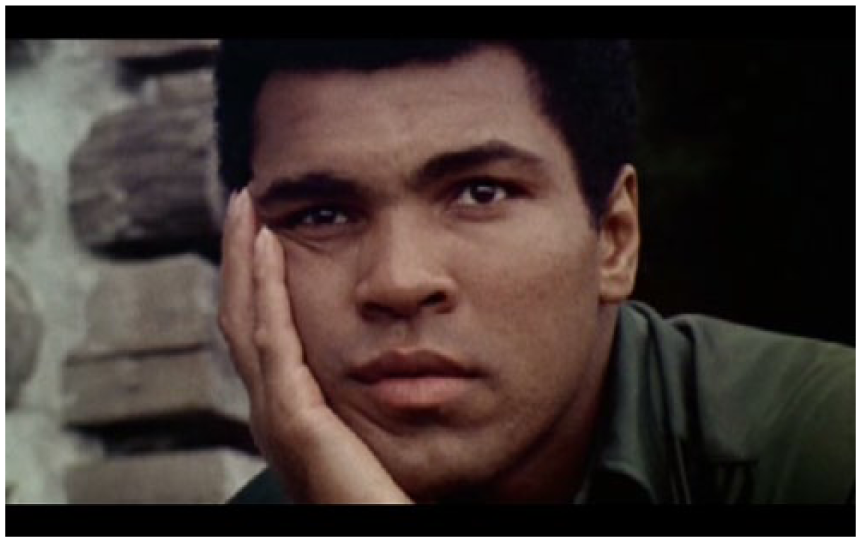
Screengrab of a pensive Muhammad Ali from When We Were Kings (Gast, 1996).
The Triumph of a Triumphant Ali
The dominant post-1996 narrative of Muhammad Ali, which continues into the present day, positions him as a symbol of reconciliation between the left counterculture of the 1960s and the political establishment. He represents the triumph of liberal progress over racial intolerance and injustice, a teleological narrative reflecting a broader teleology of American exceptionalism. This recalls Raengo’s (2008) articulation of Early’s (1998) take on the film The Jackie Robinson Story, as a “tale of success of the disadvantaged that never challenges the systemic inequalities creating such disadvantage—and as conveying the triumph of a self-redeeming Western liberalism: America takes notes of the injustices of race and corrects its past mistakes” (p. 21). The result is a kind of sanding down of Ali’s biography, where what does not comfortably fit ideologically and/or narratively is diminished or elided. The scale and intensity of the vitriol directed toward Ali in his earlier days is minimized, but so too is his earlier support for racial segregation and his fall from grace during the 1980s.
In a book-length meditation on the “style” of Muhammad Ali, German scholar Jan Phillip Reemtsma (1998) articulates the potential pitfall of framing a boxer’s career in terms of triumphs: “When you write about victories, your writing style takes on a teleological tinge. And even when you want to avoid it, you fall easily into artificial drama” (p. 118). Heeding Reemtsma, I would argue that popular narratives about Ali have calcified around a series of challenges bested, thus offering “artificial drama” and a sense of inevitability in equal measure. As a brash young David he defeats the Goliath that is Sonny Liston. Suffering professional martyrdom as a conscientious objector to the Vietnam War, Ali’s position, for which he is at first vilified, eventually becomes a vanguard one. Returning to the ring, a too slow, too weak, too old Ali vanquishes the indomitable George Foreman through strategic brilliance. And finally, after years of beatings, then years of whispers about his health, he emerges, physically broken, but somehow, someway, triumphant, a symbol of the resilience of the human spirit.
The appeal of this narrative, a product of its redemptive tone and the simplicity and coherence of its structure and symbolism, was likely at least partly responsible for the ensuing explosion of popular media about the boxer. Since 2001, there have been countless feature-length documentaries, television specials, shorter documentary works, two narrative features, and myriad advertising campaigns, all featuring Ali and/or his archival presence. The vast majority of these works hew closely to the post-Olympics narrative.
Two documentaries which complicate this narrative in different ways are Carlos Larkin’s et al. (2001) Muhammad Ali: The Greatest 5 and Bill Siegel’s aforementioned The Trials of Muhammad Ali. These films advocate and/or reflect very different ideological positions, cultural and creative aspirations, and levels of production quality. They also differ greatly in how they make use of archival materials featuring Ali, and in their relative success at incorporating these materials. Yet both films are notable for marking the limit points of what is considered “acceptable” political discourse about Ali, a spectrum ranging from the most progressive strains of the mainstream left, to just right of the political center. They do not stand in diametric opposition to the liberal orthodoxy that underlies most Ali documentaries, but they do attempt to problematize this orthodoxy. In so doing, these films make legible to us the ways in which the prevailing narrative regarding Ali is shaped by, and thus advances, a liberal ideological position.
While ascribing to the dominant narrative of Ali’s reconciliation with mainstream America, Muhammad Ali: The Greatest breaks from other post-2000 documentaries by condemning the politics of Ali’s youth. In other films, Ali’s reconciliation is framed as a celebration of America’s progress in regard to race relations. He is celebrated for standing up to injustice back in the “bad old days,” and we are meant to congratulate ourselves on how much society has changed since then, and honor Ali for his sacrifice. In Larkin’s film, however, there is an implied condemnation of Ali’s refusal of military induction and his turn to Black radicalism, an inference that these acts were inherently un-American.
This position is articulated most clearly in the film’s final scene, which depicts the symbolic replacement of Ali’s 1960 Olympic gold medal during the 1996 Atlanta games. (Ali famously but apocryphally threw the original medal in the Ohio River, after returning from Rome to the same bigotry and racism he had experienced before his Olympic triumphs.) In Larkin’s reading, Ali’s actions during the 1996 ceremony not only represent an act of reconciliation, but a repudiation of his earlier politics of the 1960s and 1970s. As the filmmaker (who serves as the film’s narrator) tells us in voiceover: With a trembling hand, the fighter who had scorned so much of the establishment, the champion who had been hated and loved by millions, the man who had started his journey so long ago and had eschewed many of the values he now embraced, lifted his new gold medal to his lips and kissed it. That said more than he ever had in his entire life. (Quoted in Muhammad Ali: The Greatest, Larkin et al., 2001)
The sentimentality of Larkin’s statement obscures a center-right reframing of the post-Olympics narrative. Despite his dim view of the actions most responsible for Ali’s exalted status, Larkin still presents the boxer as a national hero. Yet instead of ascribing Ali’s heroism to his radical politics and refusal to fight during the Vietnam war, the filmmaker credits it to Ali’s eventual “embrace” of, and by, the political and cultural establishment. The fighter’s legendary gift of gab, through which he articulated his radical political beliefs, is dismissed as so much hot air in comparison to his symbolic (and silent) act of reconciliation in kissing the gold medal. In Larkin’s perverse reading, Ali’s heroism is not just burnished by his bravery in publicly confronting his illness, but is a direct result of Ali’s illness robbing his ability to speak.
The filmmaker’s conservative take on the boxer also plays a role in his deployment of Ali’s archival performances. This is evident in a sequence examining Ali’s 1967-1970 exile from the ring. Consisting of archival footage of two speeches from the speaking tours Ali went on to support himself financially during this time, the sequence highlights his pro-segregation rhetoric, a topic usually glossed over or deemphasized in most other Ali documentaries.
The sequence is edited to give a sense of escalating antagonism, to chronicle Ali’s radicalization by the Nation of Islam. In the first speech he is jovial, and lines such as “Strong coffee is black coffee. You make it weak, you integrate it,” are delivered with a wink, and received by his archival audience with a laugh. In the second speech, the boxer is wearing dark sunglasses and a grim expression, and he points angrily at his audience: We are not seeking to lose our identity in blood mixing! . . . We don’t hate you! We don’t hate those of you that are white! We just want to stay black! I love my color! I just love myself! (quoted in Muhammad Ali: The Greatest, Larkin et al., 2001)
At first blush, the Ali on display in this second speech, with his reference to “blood mixing” and repetitive use of the word hate (hurled in such a way that it seems to belie his denial), is an intimidating and frightening presence, which Larkin exploits in arguing that Ali’s real act of heroism was his turn away from radical left and Black nationalist politics. And yet, Ali’s archival performance does not let itself be incorporated so easily. He may initially come across as angry and inflammatory, but his delivery of the clip’s concluding lines tempers that stridency with a vulnerability, an open-hearted plea for empathy and understanding. In this way, the affective qualities of Ali’s articulation of self-love and racial pride directly undermine Larkin’s agenda, the sincerity and nuance of his archival performance calling attention to the lack of these qualities in the film itself.
While the center-right politics of Muhammad Ali: The Greatest make it unique within the canon of Ali documentaries, it is shoddily made, esthetically unambitious, and superficial in its presentation of the boxer’s life and career. This is in marked contrast to Bill Siegel’s The Trials of Muhammad Ali, a meticulously researched, carefully conceived film that conveys a sense of urgency in its presentation of Ali’s radical legacy. Like Siegel and Siegel (2002) previous film, The Weather Underground, The Trials of Muhammad Ali pushes past gauzy liberal narratives of the 1960s, exposing contemporary audiences to the deep and rancorous social, cultural, and political divisions of the period. It is, in Siegel’s words, a “fight film” not a “boxing film,” focusing on Muhammad Ali’s battles “beyond the ring,” during the period from his conversion to the Nation of Islam in 1964 up until the Supreme Court decision to overturn his conviction for draft evasion in 1971 (Sachs & Sachs, 2013).
Siegel’s film shows the depth of Ali’s historical opposition to the establishment, but also the depth of the White establishment’s antagonism toward him. The presentation of the latter, an insistence that we remember the profound ugliness of the institutional vitriol toward Ali, differentiates it from most other post-2001 Ali documentaries. To accomplish this, Siegel introduces unseen or rarely seen archival footage which gives a face and a voice to Ali’s “opposers.” The capacity of this additive act to open up and reframe Ali’s story beyond the dominant narrative is a potent reminder that archival materials do not simply illustrate such narratives but actively contribute to their creation or transcendence. This is apparent in the opening sequence of The Trials of Muhammad Ali, which juxtaposes two sets of archival materials.
The first is from Ali’s appearance on The Eamonn Andrews Show, a British talk show. The episode in question features the liberal American talk show host David Susskind berating Muhammad Ali for his political stand and religious affiliation. Ali’s passport was revoked at the time of filming, and so while Susskind is in studio, the boxer appears via closed-circuit television. As such, the historical containment of Ali’s corporeal body persists through the present containment of his archival one. He appears as a captive audience, his face a mute mask of sadness and defiance as Susskind tears into him: I find nothing amusing, or interesting, or tolerable about this man. He’s a disgrace, to his country, to his race, and what he laughingly describes as his profession. . . . He will inevitably go to prison, as well he should. He’s a simplistic fool, and a pawn. (Quoted in The Trials of Muhammad Ali, Siegel et al., 2014)
The contempt Susskind expresses toward Ali is likely a revelation to contemporary audiences accustomed to the post-Olympics narrative. Where other Ali documentaries discuss Ali’s divisive standing during this period in the abstract, Siegel’s use of the archive gives it a powerful tangibility and specificity, a face and a voice. In so doing, the filmmaker is pushing back against what scholar Robin Marie Averbeck (2014) identifies as a “strictly enforced blindspot” of liberal narratives of social and political struggle, the representation of “victims without victimizers.” The Susskind clip does not perhaps add much to our factual knowledge of Ali’s struggles, but in visualizing one of his “victimizers,” it forces a visceral encounter with those struggles, thereby denying us the comfortable abstraction of the triumphal liberal narrative.
The affective heft of these “new” archival materials heavily influences our perception of the opening sequence’s second set of archival images. These depict a silent, shuffling Ali being awarded the 2005 Presidential Medal of Freedom by George W. Bush. Susskind’s tirade about Ali collides with Bush’s honoring of him, producing a cognitive dissonance that begets a narrative one, as we attempt to reconcile these diametrically opposed and wholly incompatible perceptions of the boxer. It is a juxtaposition as stark as A.K.A. Cassius Clay’s use of sepia tone. Yet unlike that earlier work, the dissonance between images is not merely temporal, but also ideological. The brutal reality of Susskind’s excoriation renders the pomp and artifice of the medal ceremony suspect. Ali documentaries often enlist footage of the latter as a means of moral and narrative closure, yet Siegel presents the event as both an empty charade and the starting point for an interrogation of the gap between past hatred and present veneration. How and why did Muhammad Ali go from heavily racialized traitorous “pawn” to peaceful patriot? When did we remove the sepia tone?
In an interview about the film, Siegel identifies the Atlanta games as the moment of “resurrection of Ali as a ‘safe’ figure. And from then on, we’ve been able to put him in our ‘beloved’ category.” He then goes on to imply that in staging this reconciliation with the establishment, Ali’s appearance at the Olympics also enacted an erasure of historical memory. Reflecting on the boxer’s receipt of the Presidential Medal of Freedom, Siegel wonders: “Do you think George W. Bush really understood the person he was putting that medal around?” (Sachs & Sachs, 2013).
It is a worthwhile question, and one that perhaps should be asked of Bill Siegel himself. The Trials of Muhammad Ali, despite its crucial intervention in the preservation and articulation of Ali’s radical past, never satisfactorily addresses the question it poses through its opening juxtaposition of archival materials. The film powerfully evokes a young and radicalized Ali, but seems at a loss when trying to “understand” or explain how that Ali could someday find himself being awarded the Presidential Medal of Freedom, especially in the midst of a preemptive war against a predominantly Muslim country. This starkly presented juxtaposition undermines the liberal teleological narrative used by most post-Olympics documentaries as a means of reconciling the disjunction between past and present Ali. In his desire to push back against the whitewashing of the boxer’s legacy, however, Siegel replaces it with the equally debatable narrative that the earlier Ali is the authentic one.
Framed another way, it can be argued that while the filmmaker better understood who Ali was, the former president had a firmer grasp on who Ali had become. In 2006 (Ali, Kiley, D’Amato, Jacobs, & Evslin, 2006), Ali, in concert with current wife Lonnie, struck a $50 million deal with the advertising firm CKX Inc., for an 80% stake in Ali’s “name, image, and likeness, as well as the rights to all of his licensing agreements” (Ezra, 2009, p. 191). Ali’s literal act of selling out can certainly be interpreted as long overdue “reparations” for the lost earnings of his exile years, but that does not diminish the dissonance with his radical past. As scholar Michael Ezra (2012) pointedly argues, Ali’s current standing is “not a reflection of the triumph of the 1960s, Black power, civil rights, the anti-war movement, or whatever other contemporary label you wish to attach to his salad days, but in some ways a reflection of their defeat.”
Staking positions to the left and right of the dominant Ali narrative, The Trials of Muhammad Ali and Muhammad Ali: The Greatest trouble the liberal consensus regarding the boxer’s legacy. In so doing, they reveal that those documentaries which offer a superficial or uncritical engagement with the political dimensions of Ali’s biography are perhaps the most political films of all. Where there is injustice, there are competing ideologies. When there is a victim, there are also always victimizers. Minimizing or negating these realities, a “blindspot” of liberal narratives of social struggle is itself a profoundly political act.
“What You Want Me to Be”
Through a close reading of four documentaries, I have traced the evolution of popular perceptions of Muhammad Ali and his cultural and political significance. Much of my critique is focused on the mid-1990s ascendance of a teleological narrative, which frames Ali as a symbol of liberal progress in America’s ongoing struggle for racial equality. In positing strategies to resist this narrative, I would like to conclude by revisiting those documentaries produced before, and at the moment of, its ascendance.
A.K.A. Cassius Clay grapples seriously with the question of who Ali was, and who he might become. When We Were Kings offer a portrait of the boxer that emerges from, and is led by, Ali’s archival presence and performance. The first film is a heterogeneous and multivalent work, whose speculative quality is not just a result of its production in media res of Ali’s career, but of a genuine engagement with its subject’s expansive and dynamic sense of self. The second film is grounded in Ali’s onscreen performance and our affective response to it, rather than treating these performances solely as illustration or evidence for a predetermined historical narrative. Together, they provide a model for thinking about and representing Ali which is generative and malleable, and which emerges out of critical engagement with Ali’s archival (or un-archival) form.
With Muhammad Ali’s death in June 2016, all footage of the boxer became archival, affixed with a final definitive sepia tone. There is no longer a past or present Ali, only a historical one. This does not of course mean the end of debate over the boxer’s legacy. In fact, if we define a legacy as what one leaves behind when they are gone, then all debate up to this point has been merely preamble. In that sense, the true debate over Muhammad Ali’s legacy begins now.
Footnotes
Declaration of Conflicting Interests
The author(s) declared no potential conflicts of interest with respect to the research, authorship, and/or publication of this article.
Funding
The author(s) received no financial support for the research, authorship, and/or publication of this article.