



Abstract
Recent studies demonstrate that interpersonal violence toward athletes (VTA) is a significant problem in some countries. However, in Canada, little scientific evidence on the prevalence of this issue exists. The objective of this study was to describe the magnitude of interpersonal violence toward young Canadian athletes in the context of sport and to explore associated risk factors. A total of 1,055 athletes, aged between 14 and 17 years, anonymously completed an online survey about their experiences of various types of interpersonal violence in sport. The sample consisted of 763 girls and 292 boys, with a mean age of 15.3 ± 1.1 years. Results showed that 79.2% of athletes reported at least one experience of psychological violence followed by 39.9% reporting physical violence, 35.7% reporting neglect, and 28.2% sexual violence. Being older, being a girl, having specialized in a sport early on, and a high number of hours of weekly practice were related to higher odds of reporting psychological violence or neglect. Being older, being a boy, reporting a nonheterosexual sexual preference, greater number of hours of weekly practice, being in an interregional or provincial sport level, and practicing only team sports were related to higher odds of reporting physical violence. Reporting a nonheterosexual sexual preference and being in an interregional or international sport level were associated with higher odds of reporting sexual violence. In conclusion, this study shows that VTA, particularly psychological violence and neglect, is a serious problem in youth sport in Canada. These results may help to influence public decision makers to intervene and develop and implement strategies to prevent VTA.
Introduction
Recent cases of sexual abuse of athletes reported in the media around the world, such as the Larry Nassar (Kerr & Stirling, 2019; Mountjoy, 2019) or Bertrand Charest (Leavitt, 2017) cases, highlight the important issue of the protection of athletes from diverse forms of violence. Sexual misconduct in sport is problematic; however, other forms of interpersonal violence exist, which are less discussed in the media, research, or sport community. These include psychological abuse, physical abuse, and neglect (Mountjoy et al., 2016). Since the end of the 1980s, violence toward athletes (VTA) was documented in sociological studies (Brackenridge, 2001); however, this issue still remains not only subject to taboos in the sport community, but also in the social arena. This problem needs to be more addressed as research on VTA, the scope of the problem, and risk factors in sport are scarce. Thus, it is imperative to monitor these problems and identify risk factors to design effective interventions to prevent VTA (Sleet et al., 2003).
Magnitude of Interpersonal VTA
As Parent and Fortier (2017) observed, the vast majority of studies conducted in the field of VTA are qualitative and often concern only one form of victimization, in particular sexual violence. Other studies have been conducted in very specific contexts in sport or in some specific forms of violence such as bullying in sport (Adler, 2014; Evans et al., 2016; Gendron et al., 2011), sexual violence of coaches (Parent et al., 2016), or hazing (Allan & Madden, 2008; Jeckell et al., 2018). This situation limits comprehension of the problem and the links between diverse forms of violence. In the literature on youth victimization, experts believe in the importance of examining violence in its multiple forms to better understand common risk factors and links between its various forms (Hamby et al., 2017). A better knowledge of these risk factors will help create more effective prevention initiatives.
In 2017, Parent and Fortier demonstrated the extent to which the magnitude of interpersonal VTA remains understudied (Parent & Fortier, 2017). A few countries, such as Belgium, the Netherlands, United Kingdom, and Canada, have demonstrated the significance of this problem (Alexander et al., 2011; Kerr et al., 2019; Vertommen et al., 2016). Alexander et al. (2011) questioned more than 6,000 adults between the ages of 18 and 22 years from the United Kingdom about their experiences of interpersonal violence in the context of sport during their childhood (before 16 years of age). Seventy five percent (75%) reported emotional harm, 29% sexual harassment, 24% physical harm, and 3% sexual harm. Another study of 4,043 adults between the ages of 18 and 50 years, conducted in Belgium and the Netherlands, found lower prevalence rates of violence before 18 years of age (e.g., 37.6% for psychological violence, 11.3% for physical violence, and 14.3% for sexual violence; Vertommen et al., 2016). In a recent study conducted among 1,001 current and former national team athletes in Canada, 58.6% reported experiences of emotional harm, 12.4% of physical harm, 19.7% of sexual harm, and 66.6% of neglect in the sport context (Kerr et al., 2019). These suggest that the magnitude of VTA is quite high.
Despite some recent advances in prevalence studies examining diverse forms of interpersonal violence in the sport context, research has focused on adults and retrospectively assessed violence experienced in sport during childhood or adolescence (e.g., Vertommen et al., 2016). However, it is recognized that the inclusion of teenagers in these types of studies provides them the opportunity to take part in the social discourse in addition to reducing the risk of bias related to memory (Finkelhor et al., 2014; Priebe et al., 2010; Ybarra et al., 2009). Adolescence also appears to be a crucial period for conducting early interventions to minimize negative repercussions of the violence before they are crystallized (Exner-Cortens et al., 2013; Gomez, 2011). With the exception of the recent study of Kerr et al. (2019), another important limitation of studies related to VTA is that neglect is rarely assessed (Parent & Fortier, 2017). Thus, it is presently difficult to determine the magnitude of neglect toward young athletes. Neglect is considered as a form of violence both outside (Krug et al., 2002; Stoltenborgh et al., 2013) and inside sport (Fortier et al., 2020; Mountjoy et al., 2015, 2016; Stirling, 2009).
Finally, the operationalization of physical violence in studies on VTA is also problematic. The majority of sport researchers favor a definition of physical violence that emphasizes actual or implied potential physical harm to the athlete (also referred to as physical abuse), rather than the purely physical nature of the aggression (Alexander et al., 2011; David, 2005, Stirling, 2009). Thus, in addition to documenting events that are generally considered physical violence (e.g., pushing, hitting, or punching), some researchers have incorporated events that do not involve any physical contact in their definition of physical violence, such as the enforcement of excessive and intensive training (Alexander et al., 2011; David, 2005; Mountjoy et al., 2015; Stirling, 2009; Vertommen et al., 2016), the forced pursuit of training and competition despite the presence of an injury or exhaustion (Alexander et al., 2011; Raakman et al., 2010), the imposition of consumption of doping products (David, 2005; Mountjoy et al., 2015), or the imposition of severe diets to lose weight (Brackenridge et al., 2010; David, 2005). However, literature outside sport considers that the definition of physical violence should be focused on the nature of the actions (physical contact) toward the child rather than on the consequences (physical) of these actions when defining manifestations of physical violence (Butchart et al., 2006; Clément & Dufour, 2009; Trocmé et al., 2010). Thus, these important manifestations should be included in questionnaires about violence in sport but may be better categorized as psychological violence rather than physical violence (Fortier et al., 2020).
Risk Factors of Interpersonal VTA in Sport
The few existing quantitative studies examining VTA showed that sex, sport level (elite vs. non-elite), and belonging to a minority group represent associated risk factors for VTA, irrespective of the relationship with the perpetrator (e.g., coach vs. another athlete; Alexander et al., 2011; Vertommen et al., 2016). Vertommen and colleagues (2016) reported that athletes belonging to sexual (lesbian/gay/bisexual) and ethnic minority groups, athletes with a disability, and elite athletes experienced significantly more violence in the context of sport than other athletes. Men also reported a higher prevalence rate of physical violence, whereas women reported more sexual violence. There were no significant differences between sexes for psychological violence. To date, the most frequently studied risk factors for VTA are sex, minority status, and sport level. However, other risk factors, such as type of sport and early sport specialization, deserve exploration. Studies that include type of sport as a potential risk factor are scarce and there is limited knowledge about the association between type of sport and VTA. For example, Evans et al. (2016) found no significant differences between individual and team sport for bullying in sport while other researchers (Fasting et al., 2004; Olhert et al., 2018) found no differences between type of sport for sexual violence. Despite these results, sports have different subcultures (Young, 2012) and the links between these variables may be different when a more global picture of VTA is considered. Finally, Malina suggested in 2010 that early sport specialization may increase the vulnerability of young athletes to abuse by those in position of authority. However, this potential risk factor of VTA has, to our knowledge, never been confirmed in empirical studies.
Aim of the Study
In the light of the current available literature, the objectives of this study were to (a) describe the magnitude of interpersonal violence experienced by young teenager athletes in the context of sport, including psychological violence, neglect, physical violence, and sexual violence, and (b) examine the associations between these different forms of VTA and age, sex, ethnicity, sexual preference, disability, early sport specialization, hours of practice weekly, sport level, and sport type.
Method
Procedures and Participants
A convenience sample of French–Canadian athletes between the ages of 14 and 17 years, and who were participating in an organized sport (i.e., playing within a league, club, or sport team with organized training and competition) at the time of the study, was recruited to participate in an online study assessing their experiences in sport. Participants were recruited on a voluntary basis through online advertisements on social media, email lists of sport partners, and flyers distributed in sport competitions. Interested participants accessed, through a hyperlink, an anonymous survey hosted by a secured online survey software, Qualtrics, where they provided electronic informed consent prior to starting the questionnaire. The completion time ranged from 30 to 45 min. All procedures were approved by the ethics committee of the institution where the study was conducted (approval number 2014-131 Phase III/October 26, 2016).
A total of 1,259 athletes met the inclusion criteria and began the online survey. Among them, 1,055 completed the questionnaire on interpersonal violence in sport and were included in this study. The final sample consisted of 763 girls and 292 boys. Participants had a mean age of 15.29 years (SD = 1.07). Most participants reported that they were Canadian (95.3%, n = 1,005); 4.5% Western European (n = 48); 2.0% Asian (n = 21); 1.2% Eastern European (n = 13); 1.5% First Nations, Inuits, Métis, or Aboriginal (n = 16); 1.2% sub-Saharan African (n = 13); 1.0% Latin American (n = 11); 0.9% North African (n = 9); and 0.4% African American (n = 4). Most participants reported that they were attracted only or mainly to persons of the opposite sex (92.5%, n = 976), 1.7% only or mainly to persons of the same sex (n = 18), 1.3% to both sexes (n = 14), and 4.4% reported that they felt no attraction, that were questioning their sexual attraction, or that they had never thought about it. Most reported that they practice only one competitive sport (62.7%, n = 662), with 37.3% (n = 393) reporting practicing at least two competitive sports. The sports practiced varied widely, with soccer (21.0%, n = 222), volleyball (13.0%, n = 137), swimming (10.8%, n = 114), ice hockey (9.5%, n = 100), basketball (8.0%, n = 84), track and field (7.1%, n = 75), cheerleading (6.9%, n = 73), and American football (4.6%, n = 49) being the most common. A total of 19.2% (n = 203) reported that they were competing in their sport at local or regional levels, 7.2% at the interregional level, 46.6% (n = 492) at the provincial level, 20.6% (n = 217) at the national level, and 5.4% (n = 57) at the international level. Most athletes practiced only team sports (49.1%, n = 518), whereas 37.5% (n = 396) practiced only individual sports, and 12.7% (n = 134) practiced both. Most athletes reported that they practice this sport between 6 and 10 hr a week (37.3%, n = 393), 14.3% (n = 151) less than 5 hr, 26.4% (n = 278) between 11 and 15 hr, 14.0% (n = 148) between 16 and 20 hr, and 8.1% (n = 85) for more than 20 hr a week.
Measures
Interpersonal violence in sport
The Violence Toward Athletes Questionnaire (VTAQ; Parent et al., 2019) was used to assess the self-reported experiences of interpersonal violence against children and adolescents in sport. The VTAQ is based on the World Health Organization (WHO) definition of violence (Krug et al., 2002), namely, “the intentional use of physical force or power, threatened or actual, against oneself, another person, or against a group or community, that either results in or has a high likelihood of resulting in injury, death, psychological harm, mal-development or deprivation” (p. 5). The WHO typology of violence was used to determine the four forms of interpersonal violence, namely, sexual, psychological, and physical violence as well as neglect (Krug et al., 2002). For precisions about the definitions used for each form and examples of items used in VTAQ, please see Parent et al. (2019).
The VTAQ consists of 70 items that assessed different types of violence in sport perpetrated by a teammate or an opponent, a coach, or a parent. Four items assessed psychological violence from a teammate or an opponent, 16 items for psychological violence and neglect from a coach, and 17 items for psychological violence and neglect from a parent. Two items assessed physical violence from a teammate and an opponent, nine items for physical violence from a coach, and eight items for physical violence from a parent. Three items assessed sexual violence from a teammate and an opponent and 11 items for sexual violence from a coach. Items are rated on a 4-point Likert-type scale measuring frequency with which various events took place in the sport context, where 0 = never; 1 = rarely, 1 to 2 times; 2 = sometimes, 3 to 10 times; and 3 = often, more than 10 times. The VTAQ showed high internal consistency in our sample, with an ordinal Cronbach’s alpha between .79 and .98.
The total score and scores by type of violence were examined as yes/no dichotomous variables, using a low threshold to categorize athletes as having experienced violence in sport, which represents that the participant reported at least one experience of violence in the context of sport (i.e., 1 to 2 times or more). A total score was coded 0 = no violence, and 1 = at least one event of at least one type of violence. Three subscales by type of violence (i.e., physical, psychological and neglect, and sexual) were also coded 0 = no experience of this type of violence, and 1 = at least one event of this type of violence. The three subscales by type of violence were summed together to create a variable that represents the number of different types of violence experienced (0 to 3 types of violence).
Risk factors
A sociodemographic questionnaire was used to collect data on age, sex, ethnicity, sexual preference, and disability or functional limitations. Questions pertaining to the characteristics of their current and past sport activities were also used to assess the number of hours of practice weekly (training and competition), the sport level (i.e., highest competition level achieved), and early single-sport specialization (0 = no and 1 = yes) that was defined as an intense training in a single sport more than 8 months per year before 12 years of age (LaPrade et al., 2016). For the measurement of early sport specialization, we developed three questions based on previous work on the subject (Jayanthi et al., 2013, 2015; LaPrade et al., 2016): Before the age of 12 years (a) did you stop practicing one or many sports to focus on a main sport? (b) did you practice a single sport for more than 8 months per year? and (c) did you consider that your main sport was more important than other sports? We considered that participants who answered yes to the three questions experienced early sport specialization.
Statistical Analyses
All data were analyzed using SPSS Version 25.0 and were evaluated for significance at an alpha level of .05. First, we computed frequency analysis by type of violence and χ2 analyses comparing proportions between boys and girls. Thereafter, to examine risk factors of each type of interpersonal VTA, all predictors were entered simultaneously into a multiple logistic binary regression. Because the highest frequency of missing data on the predictor variable was 4.3% for sexual preference, missing data were not treated.
Results
Magnitude of Interpersonal VTA
A total of 84.5% (n = 892) of athletes reported at least one type of violence, with no significant differences between boys and girls. Table 1 displays frequencies of each type of VTA for the entire sample as well as for boys and girls separately. The proportion of girls reporting psychological violence and neglect were higher compared with boys (respectively, 82.6% and 77.7%), whereas physical violence was higher in boys compared with girls (respectively, 49.3% and 36.3%). The frequency of sexual violence was similar in boys and girls (respectively, 25.3% and 29.2%).
Frequencies of Each Type of Interpersonal VTA and the Number of Different Types Experienced (Low Threshold Measure, That Is, at Least One Experience).

Note. VTA = violence toward athletes; SA = sexual abuse.
p < .05. **p < .01. ***p < .001.
Risk Factors for Interpersonal VTA
Multiple logistic regression analyses were used to examine relationships between VTA and age, sex, ethnicity, sexual preference, disability, early sport specialization, hours of practice weekly, sport level, and sport type. Tests of statistical significance, odds ratios (ORs), and 95% confidence intervals for all potential predictors are reported separately by type of violence in Table 2. Only statistically significant correlates are discussed in the following.
Multiple Logistic Regression for Type of Interpersonal VTA.
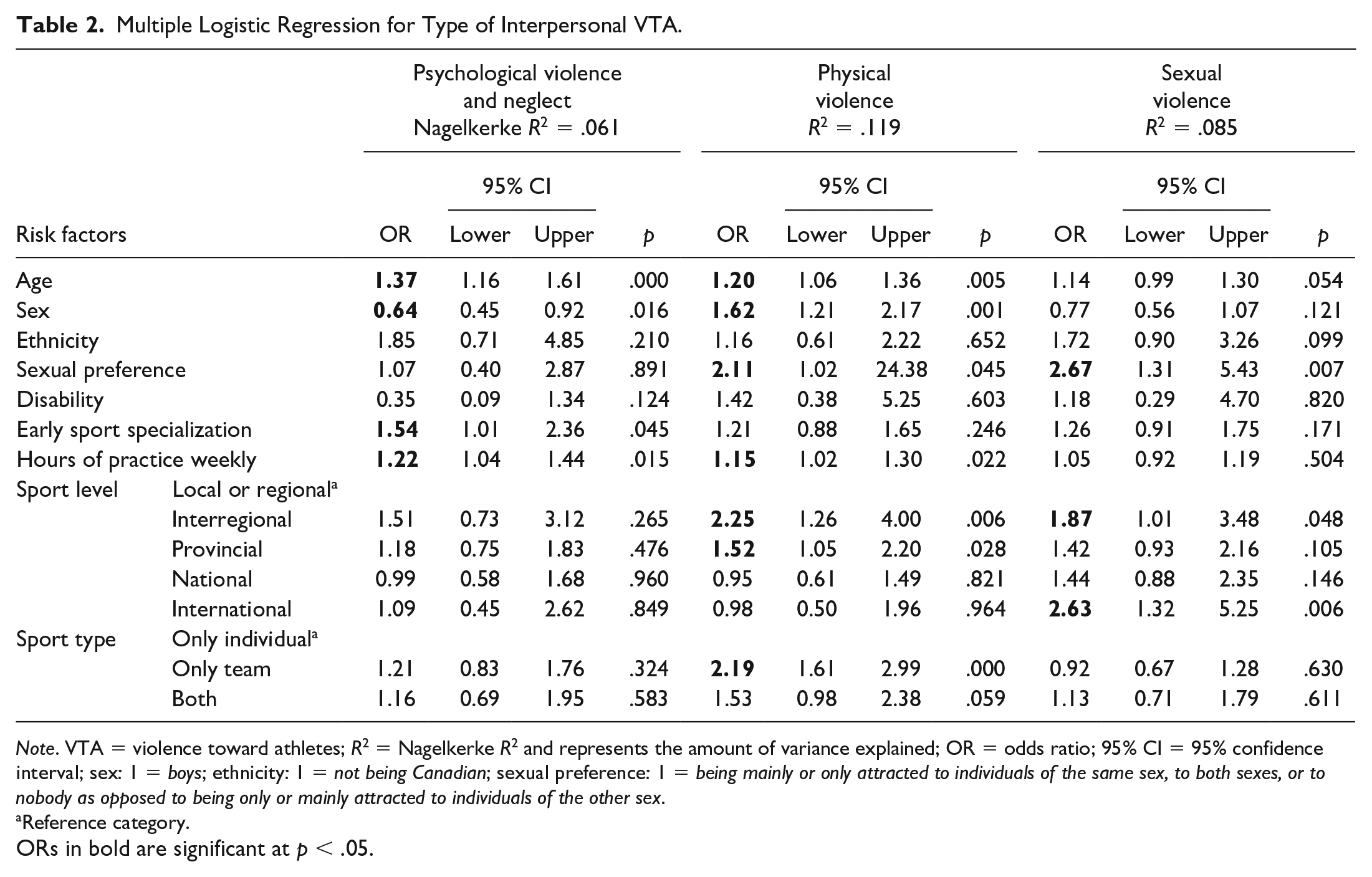
Note. VTA = violence toward athletes; R2 = Nagelkerke R2 and represents the amount of variance explained; OR = odds ratio; 95% CI = 95% confidence interval; sex: 1 = boys; ethnicity: 1 = not being Canadian; sexual preference: 1 = being mainly or only attracted to individuals of the same sex, to both sexes, or to nobody as opposed to being only or mainly attracted to individuals of the other sex.
Reference category.
ORs in bold are significant at p < .05.
For psychological violence and neglect, age, sex, early sport specialization, and hours of practice weekly emerged as significant correlates. Higher age at the time of study completion (OR = 1.37), specializing early in a sport (OR = 1.54), and a higher number of hours of weekly practice (OR = 1.22) were all related to a higher odd of reporting a history of psychological violence or neglect. Boys were less likely to report a history of psychological violence and neglect compared with girls (OR = 0.64). For physical violence, age, sex, sexual preference, hours of weekly practice, sport level, and sport type were all significant predictors. Higher age at the time of study completion (OR = 1.20); being a boy (OR = 1.62); being mainly or only attracted to individuals of the same sex, to both sexes, or to nobody (OR = 2.11); a higher number of hours of weekly practice (OR = 1.15); being in an interregional (OR = 2.25) or a provincial sport level (OR = 1.52); and practicing only team sports (OR = 2.19) were associated with a higher odds of reporting a history of physical violence. For sexual violence, sexual preference and sport level emerged as significant correlates. Being mainly or only attracted to individuals of the same sex, to both sexes, or to nobody (OR = 2.67) and being in an interregional (OR = 1.87) or an international sport level (OR = 2.63) were associated with a higher odds of reporting a history of sexual violence.
Discussion
Magnitude of Interpersonal VTA in Sport
This study demonstrates that the magnitude of interpersonal VTA is relatively high, particularly with respect to psychological violence (79.2%) and neglect (35.7%). These results are similar to the prevalence rates reported by Alexander et al. (2011; 75%) and Kerr et al. (2019; 58.6% for emotional harm and 66.6% for neglect). However, results from Vertommen et al. (2016) have shown a lower prevalence rate for psychological violence (37.6%). As prevalence estimates of psychological violence and neglect in sport in a sample of young active athletes currently do not exist, it is difficult to compare these results with estimates in previous studies using adult samples. The high estimate of psychological violence and neglect may be explained by several factors. Even if we used a validated scale of VTA (Parent et al., 2019), our classification of items may lead to a higher rate of psychological violence and neglect. Indeed, the psychological violence and neglect subscale included some items usually classified in previous studies as physical abuse/violence (Alexander et al., 2011; Kerr et al., 2019; Vertommen et al., 2016). This illustrates the need for consistency in definitions used in prevalence research on VTA (see Fortier et al., 2020, for a discussion on this point). Moreover, a low threshold was used to estimate the prevalence rates. This included athletes who reported having at least one experience of interpersonal VTA. The high prevalence rates for psychological violence and neglect could also be explained by the normalization of these types of violence in the context of sport. Qualitative studies have shown how emotional abuse is normalized in sport by athletes, parents, and coaches (Jacobs et al., 2016; Kavanagh, 2014; Smits et al., 2017; Stirling, 2011; Stirling & Kerr, 2013). Some studies revealed that emotional abuse (e.g., yelling, bullying) is sometimes used to develop mental toughness in athletes (Owusu-Sekyere & Gervis, 2014) and to motivate or maintain discipline (Stirling, 2011). In these cases, there appears to be a normalization and justification of the processes by which one believes to favor the performance (Stirling, 2011). As mentioned by Kerr et al. (2019), “certain practices are not only normalized and harmful but necessary for performance outcomes” (p. 44).
Sexual violence was experienced by 28.2% of athletes in our study (27.1% for sexual harassment, 2.0% for sexual abuse without contact, and 2.1% for sexual abuse that included contact). These percentages are within the range of prevalence rates observed in previous research. In a recent review, Parent and Fortier (2017) highlighted that sexual harassment prevalence varied between 3% and 52% and sexual abuse between 0.2% and 9.7%. These differences may be explained by sample sizes and characteristics, definitions used, methods of questioning, types of sexual violence, and types of perpetrators. In our sample, the magnitude of physical violence is relatively high (39.9%) compared with other studies. Vertommen et al. (2016) obtained a prevalence of 11.3%, whereas Alexander et al. (2011) reported a prevalence of 24%. Measurement consideration could explain these differences. In our measure (VTAQ), items related to on-field violence were included, whereas Vertommen et al. (2016) did not consider this context in their measurement. Other research conducted specifically on on-field violence and young athletes show much higher prevalence estimates of physical violence. In a Canadian study of 609 elite soccer players aged between 12 and 17 years, 58.5% reported experiencing at least one form of physical violence (e.g., pushing, shoving, bumping, and punching) by peer athletes during the game (Gendron & Frenette, 2016).
In terms of sex differences, we noted that a higher proportion of girls reported having experienced psychological violence and neglect compared with boys. Although the current findings are not in line with results from Vertommen et al. (2016) and Alexander et al. (2011), which showed no significant differences between men and women on psychological violence, they corroborated results of Kerr et al. (2019) where more women, who are currently athletes, experienced psychological harm (40.8% compared with 17.7%) and neglect (44.6% compared with 21.8%) compared with men. Our hypothesis for this higher rate in girls is based on some assumptions. Given that prevalence rates of bullying (cyber and traditional; Jadambaa et al., 2019), neglect (Stoltenborgh et al., 2013), and emotional abuse (Stoltenborgh et al., 2012) do not present differences between sex in the general population, and that (b) the same results were obtained in sport for bullying (Evans et al., 2016), we could imagine that the items included in our questionnaire about sport-specific psychological violence and neglect from parents and coaches could explain this difference. Indeed, it is possible that girls are more at risk of experiencing sport-specific forms of psychological violence and neglect from parents or coaches, such as forced physical exertion, forcing/asking the athlete to train and compete with injuries, and forcing/asking the athlete to dope or to use unhealthy weight-management behaviors. This hypothesis remains to be tested. For sexual violence, no differences in sex were found, which support previous results showing that girls are not more at risk of experiencing sexual abuse from a coach than boys in sport (Parent et al., 2016). However, Vertommen et al. (2016) reported that women were significantly more represented as victims of sexual violence. This could be explained by the questioning approach for sexual violence, especially for sexual abuse (from an authority figure), when experiences in childhood and adolescence are examined (Parent et al., 2016; Parent & Fortier, 2017). Terms such as “forced” or “unwanted” are irrelevant because of the absence of valid consent in those cases (Mathews & Collin-Vézina, 2019). Previous results showed that sexual contacts perceived as consensual with a coach exists and can contribute to the underestimation of the problem if those kinds of questions are not asked (Parent et al., 2016). It also appears that boys are overrepresented in this situation (Parent et al., 2016). Parent and Bannon (2012) and Hartill (2005, 2009) already discussed this possible underestimation of sexual abuse of boys in sport in previous articles and why some boys do not see themselves as a victim or do remain silent about it. For physical violence, our study shows that more boys reported experiencing physical violence compared with girls, which is supported by other findings (Alexander et al., 2011; Vertommen et al., 2016). Literature about on-field violence in sport pointed out that behaviors of physical aggression are more present in male sport (Fields et al., 2007; Gendron et al., 2011). That could explain the difference we observed between sexes.
Finally, the results of this study show that a proportion of young athletes in the sample experienced more than one form of violence in the sport context (31.6% experienced two forms and 16.6% experienced three forms) with no significant differences between sexes. Vertommen et al. (2016) found that 4.1% of their sample experienced all three forms of interpersonal violence in sport. Similar to our results, Olhert et al. (2019) found that 33.3% of their sample (n = 1,529 German elite athletes) reported experiencing two forms of interpersonal violence and 15.9% all three forms. However, because data on multiple victimization is scarce, more studies are needed to better understand the relationship between different forms of violence.
Risk Factors of Interpersonal VTA in Sport
The results of this study demonstrate that age, sex, sexual preference, early sport specialization, hours of practice per week, sport level, and sport type are risk factors for one or more types of interpersonal VTA. In contrast to previous results (Vertommen et al., 2016), disability and ethnicity were not found to be predictors of VTA. As age increased, the risk of experiencing psychological violence and neglect and physical violence was higher, which may have been due to exposure. Vertommen et al. (2016) observed that age was a predictor of psychological but not physical violence and that the younger participants were more at risk. However, in the current sample, age varied between 14 and 17 years, whereas Vertommen et al. (2016) included a larger age range of adults between 18 and 50 years. For sexual preference, being attracted to individuals of the same sex, to both sexes, or being asexual, constituted a risk factor. Vertommen et al. (2016) also obtained the same results for physical and sexual violence where sexual minority (bisexuality) was a predictor. Other studies on sexual violence inside and outside of sport (Martin-Storey et al., 2018; Olhert et al., 2018) also showed that belonging to sexual minorities was associated with higher risk of sexual violence.
Early sport specialization defined as “intensive year-round training in a single sport at the exclusion of other sports” (Jayanthi et al., 2013, p. 252) was associated with a higher risk of experiencing psychological violence and neglect. Malina (2010) suggested that early sport specialization could increase vulnerability to abuse by persons in position of authority, especially because “abuse—emotional, physical, and sexual—is a potential byproduct of dependence” (p. 368). He discussed the fact that risks associated with early sport specialization include social isolation, overdependence, manipulation, and burnout in young athletes. To our knowledge, this study is the first to support the hypothesis of Malina (2010). Our results demonstrate the importance of questioning the way sport is structured in young athletes. This may also be explained by the high pressure that could be placed on young athletes in this situation. Researchers have suggested that some characteristics of organized sport, such as unhealthy training programs, constitute institutional/organizational violence (Mountjoy et al., 2015; Stirling, 2009). A greater number of hours of practice per week was also related to higher risk of reporting psychological violence and neglect in our study, which may be linked to our observations on early sport specialization. In terms of sport level, higher levels of implication in sport (international) was associated with a higher risk of experiencing sexual violence. Finally, team sport was related to a higher odds of experiencing physical violence. This is not surprising as there is more opportunity for physical violence (e.g., body checking, tackling) in team sports.
Limitations
Our results should be interpreted in light of certain limitations. First, the use of a convenience sample with more girls than boys limits the representativeness of our sample. Participants were recruited in Quebec, Canada, which limits the generalization of our results to other cultures or geographic regions as social, educational, and cultural functions inherent in sport may vary from one culture to another. To be included in the current study, participants had to be currently involved in an organized sport. As some athletes may have left sport in response to a violence experience, our results may be lower than the real occurrence of VTA in sport. Future research should replicate our findings with a representative sample of adolescents including current and retired athletes. Second, the correlation design makes it impossible to determine causality between risk factors and the occurrence of VTA in sport. Hours of practice weekly, sport level and even sport type may also be affected by a history of VTA in the sport context. Third, only self-report measures were used, which have inherent biases and are dependent on athletes’ self-perceptions of their history of violence. However, self-reported questionnaires help to have a better picture of the extent of abuse and violence compared with formal reports to police (Hardt & Rutter, 2004). Finally, other relevant characteristics of the VTA in sport were not included in this study, such as the duration of the violence, the relationship to the perpetrator, and the use of threat. Future research examining VTA in sport should recruit larger samples that allow to divide athletes reporting violence in sport into small, but considerable subgroups based on multiple indicators of the severity of the VTA, including types of VTA, types of perpetrators, and duration.
Conclusion
This study shows that VTA, particularly psychological violence and neglect, is an existing problem in youth sport. This is the first study to use a validated tool to measure all forms of VTA (Parent et al., 2019) in a large sample of young athletes. Moreover, because early sport specialization was shown to be a predictor of psychological violence and neglect, more research must be conducted to clarify links between these variables. Furthermore, future research should consider the profiles of victims of VTA, especially victims of multiple forms of violence. Our study provided information about the magnitude, but not the correlates or predictors, of multiple forms of victimization. In addition, considering that the current sample was a convenience sample, the next generation of studies should focus on the prevalence of VTA using a representative sample. A better monitoring of this issue is necessary in each country on a regular basis to capture the prevalence and risk and protective factors to prevent VTA. In conclusion, this study shows that VTA, particularly psychological violence and neglect, is a serious problem among young Canadian athletes. These results may help to influence public decision makers to intervene, develop, and implement strategies to prevent VTA.
Footnotes
Declaration of Conflicting Interests
The author(s) declared no potential conflicts of interest with respect to the research, authorship, and/or publication of this article.
Funding
The author(s) disclosed receipt of the following financial support for the research, authorship, and/or publication of this article: This work was supported by the Social Sciences and Humanities Research Council of Canada, under grant no. 108560, and Ministère de l’Éducation et de l’Enseignement supérieur du Québec, under grant no. 104153.
