




Abstract
Black U.S. military affiliated sport fans hold a unique place in society, as their multiple identities (i.e., racial and career) may possess conflicting elements. Militarism preaches nationalism, meritocracy, and bootstrapism, whereas Black sport activism questions if these “American” values extend to people of color. The current study interviewed Black military affiliated individuals (N = 10) to understand their perceptions on nationalism and racism within the landscape of contemporary sport activism. The protests initiated by Colin Kaepernick of the National Football League, who took a knee during the pregame national anthem, was a focal point for discussion with the participants. Three main themes were identified in the interviews: (a) protectors of the first amendment, (b) the “right” and “wrong” way to protest, and (c) new racism and color blindness in sport. This study allows a group that is not often studied to voice their perceptions of nationalism and racism in the context of sport activism.
Introduction
The 2016 National Football League (NFL) season marked a significant point in modern athlete activism. Throughout the season, numerous players, represented most prominently by San Francisco 49ers Quarterback Colin Kaepernick, chose to take a knee when the U.S. national anthem was played before games. Kaepernick explained that he was motivated to protest by witnessing police brutality and other forms of racial injustice toward Black people and other oppressed racialized groups in the U.S. (Boren, 2020). While many people argued that such protests were disrespectful to the military, it is notable that Kaepernick's decision to kneel came after a conversation with former NFL player and Army Green Beret, Nate Boyer. Boyer informed him that soldiers often take a knee to show respect (Boren, 2020). Ultimately, the wave of NFL protests sent the media into a firestorm with journalists offering a range of perspectives about the issue (Cooper, 2020).
Highlighted by the protests of Kaepernick and others, sport media has offered space for athletes expressing their disdain for police brutality and other forms of racialized inequity. Conversely, it has also offered a platform for those who object to such protests, often calling them “unpatriotic” and “disrespectful” to the military, despite the fact Kaepernick sought to make clear that his protest was not focused on militarism (Doehler, 2023). While military members are often positioned in U.S. discourse as fighting for the country's “freedoms,” the long history of oppression and violence directed at Black people in the U.S. leads to many Black military members struggling to come to terms with their conflicting career and racial identities (Winters et al., 2023). In this context, the current study investigated the ways in which people who identify as Black and are associated with the military make sense of notions of U.S. nationalism and racism amid the recent wave of athlete activism. Specifically, the current study interviewed Black military members who consume sports media to understand their perceptions of nationalistic discourse and racism within the context of sport activism in the media. Sport scholarship has yet to investigate military members’ perceptions of sport activism. Therefore, this novel research can help sport scholars understand two potentially competing intersectional identities that permeate the U.S. sporting landscape. The current study builds upon research in the areas of intersectionality (Crenshaw, 1989), racial identity (Coogan, 2012), and the relationship between nationalism and sport (Butterworth, 2014). In constructing a theoretical foundation for the current study, we draw from scholarship on racism in U.S. society, intersectionality, race in sports, and the connection between militarism, political ideology, and sports.
Theoretical Framework
The two principal theoretical lenses informing the study are critical race theory (CRT) and intersectionality. We use CRT to interpret and explain the nature of racism in contemporary U.S. society. Intersectionality, meanwhile, provides a fruitful means of thinking about the interactions between the potentially conflicting identities of Black military members. In addition, we provide a conceptual grounding for the study by reviewing literature related to race and sports media as well as the military, race, and sports.
Racism in Contemporary U.S. Society
While overt, explicit racism in the U.S. has declined compared to decades past, racialized dynamics in society continue to shape the experiences of people of color. Critical race theory was developed to help us better understand the dynamics underpinning racism and racial inequity (Delgado & Stefancic, 2017). On the surface, CRT addresses four foundational tenets: (a) the “invisibility” of race, often referred to as color blindness, which attempts to make claims that race no longer matters in society (Bonilla-Silva, 2022); (b) racism advances the interests of white people, both literally and figuratively, so there is little concern for eradicating the system for the majority of whites; (c) race is a social construction without a biologically imposed basis; and (d) dominant society's tendency to shift understandings of racial groups depending on the context of the contemporary situation (e.g., the shift from a curious Muslim neighbor to one who is a security threat after 9/11; Delgado & Stefancic, 2017).
The first and second tenets are the most important for informing this study. Color-blind racism rests on the belief that because there are numerous examples of people of color who are successful in society, previous historical constraints on people of color no longer exist (Bonilla-Silva, 2022). This problematic representation of racial relations in the U.S. deemphasizes the legal, cultural, and societal boundaries that still hold relevance for people of color. Color-blind ideology elevates white prerogatives and ideals that are positioned as commonsense (Apfelbaum et al., 2012), making persistent racial inequity part of the normal functioning of society. Color-blind ideology is part of a system that Bonilla-Silva (2022) describes as “new racism,” which includes: “…the increasingly covert nature of racial discourse and racial practices; the avoidance of racial terminology and the ever-growing claim by whites that they experience “reverse racism”; the elaboration over a racial agenda over political matters that eschews direct racial references; the invisibility of most mechanisms that reproduce racial inequality; and, finally, the rearticulation of some racial practices characteristic of the Jim Crow period” (pp. 38–9).
For an example of new racism in sport, Davis et al. (2017) found that many college students believe race does not matter for career progression in sports due to the visible number of professional Black athletes.
Studies centered on racialized sport activism have employed CRT to further understand Black athletes’ social efforts. McCoy (2022) argues that CRT is a valuable tool for understanding collegiate student–athletes’ protests amid contemporary social issues, such as George Floyd's murder. Frederick et al. (2019) analyzed Facebook comments on ESPN's website related to the 2016 ESPYs in which prominent athletes such as LeBron James and Carmelo Anthony called for more activist efforts in sports. In that study, Frederick et al. utilized CRT to argue that activism is interpreted through a complex lens with some members of the public advocating for more activist efforts, while others are critical of athlete activism. Increasingly, such scholarship is working toward understanding the intricacies of public perceptions of sport activism. Specific to the current study is understanding the contradiction of Black military affiliated members’ upholding white values of U.S. nationalism, meritocracy, and hard work while simultaneously experiencing the politics of Black sport activism that highlights ways in which the U.S. fails to uphold such values for people of color. Critical race theory provides a lens to tease out racialized understandings of the population's interpretations of Black sport activism.
Intersectionality
Intersectionality was a concept developed by Crenshaw (1989) as a response to the failure of legal systems to recognize intersecting axes of oppression, such as race, gender, and social class. Through her analysis, Crenshaw identified how most institutionalized discourse legitimizes traditional power relations through a focus on single, rather than multiple, identities of subordination (Carbado et al., 2013). Intersectionality, in contrast, focuses on the ways in which multiple identities marginalize or reify power relations and inequities. As a theoretical construct, intersectionality posits that social positions must be viewed relationally for a fruitful understanding of oppression (Phoenix & Pattynama, 2006). Intersectionality as a theoretical tool can also provide insight for how certain identities may be privileged in one instance, while marginalized in another (Carbado et al., 2013). For participants in the current study, there is a long history in the U.S. of valorizing military service through publicly sanctioned acts of admiration, such as Veteran's Day; however, such valorization stands in contrast to the history of oppression faced by Black people.
In sports literature, intersectionality has been used to understand how multiple identities interact with one another. Examples include Simien et al. (2019) identifying how Black woman athletes’ lived experiences differ from those of other women, Isard and Melton (2022) quantitatively uncovering that traditionally feminine and white women receive the most attention in WNBA media coverage, and Ryan and Martin (2013) arguing for more intersectional work to be completed in the amateur sports world to understand how certain identities are privileged in certain spaces. Such studies are guideposts for instances in which intersectionality was effectively utilized in sport research. Following the suggestion of Akom (2008), the current study uses insight from the theoretical constructs of intersectionality and color-blind ideology to understand the racialized experiences of people who hold multiple, potentially conflicting identities.
Race and Sports Media
Consumption of media can lead individuals to decode messages through a dominant-hegemonic, negotiated, or oppositional position (Hall, 1973/2019). Hall's theory posits that dominant discourse about phenomena, such as racial stereotypes, are worthy of analysis to understand how consumers might grasp content. In the U.S., the majority of sport media content is created, edited, and produced by white men (TIDES, 2021). Whether purposeful or not, racial stereotypes are prevalent in sport media (Anderson & Raney, 2018; Christensen et al., 2016; Coogan, 2012; Crowe, 2021; Ferrucci et al., 2016; Leonard, 2017; Love et al., 2021; Rugg, 2019). If consumers decode sport media messages from a hegemonic perspective, it would be easy to understand why racist stereotypes persist in sport discourse, especially from frequent media consumers.
Through an amalgamation of different texts, Leonard (2017) argued the main factors that compose the dominant racial ideology of sport media is white nostalgia emphasizing the love of the game over the love of money for athletes, the brains over brawn stereotype in which the desirability of the “intelligent” white athlete is favorably covered compared to the “natural” athletic ability of the Black athlete, a public celebration of the work ethic of the white athlete, and praise of white athletes’ character juxtaposed to Black athletes. Additionally, Leonard (2017) exposes how race typically defines media representations for athletes leading to white athletes receiving redemption and Black athletes struggling to receive positive coverage following news of transgressions. Exemplifying Leonard's argument, Coogan (2012) found that sport media relied on racialized stereotypes when covering former NFL quarterback Michael Vick's (Black) dog fighting ring compared to a redeeming quality that occurred after Ben Roethlisberger's (White) domestic assault.
Other stereotypes have been evidenced in sport media research, such as Rugg (2019) identifying how the media constructed former NFL linebacker James Harrison through the Black criminal stereotype, while also emphasizing his “choice” toward physicality in a contact sport. Sport media demonstrates color blindness by articulating physicality rather than showing neoliberal conditions that restrain Black men's class mobility leading many to see physical sport(s) as a means of financial success. The overphysical stereotype is another important concept of Blackness that was found in Christensen et al.'s (2016) and Crowe's (2021) mediated discourse analyses on Ray Rice's domestic violence case. This stereotype emphasizes that Black men are prone to physicality and enact physical action when the opportunity presents itself. Historically, Black men have been demonized for assumed animalistic virility and physicality (Carrington, 2010; Kendi, 2016).
While this research paints a picture of the stereotypes evident in coverage of Black athletes, there has been key social events that have heightened awareness of Black disadvantages in the U.S. In addition to Kaepernick, athletes like LeBron James have protested while games were televised nationally to foster justice (Galily, 2019), and some writers have hailed the summer of 2020 as the “Summer of Protests” due to increased awareness of people of color being murdered by police officers (Tynes, 2020). Ultimately, Kaepernick's (and others’) protest(s) can be viewed as part of a historical legacy of Black athlete activism dating back to the early 1900s (Cooper et al., 2019).
Other contemporary sport research has shown trends in sport media coverage that indicate progressive racial representation. Boykoff and Carrington (2020), for example, found that most coverage in five major U.S. newspapers presented Kaepernick's protest in a positive light. In another study on Kaepernick's activism, Eschmann et al. (2021) found that social media users were more likely to make progressive concessions about their initial antiprotest stance once they learned his reasons for protesting. In another example of somewhat progressive findings, Lewis et al. (2020) found that race was not a factor for how sportscasters discussed athletes during college football National Signing Day, while 98% of the comments made were by white sportscasters toward a Black majority athlete pool.
Issues of racial representation have long been critiqued in sport literature (Oseguera et al., 2018), as white men continue to disproportionately dominate sport media roles (TIDES, 2021). With the historical lack of progression in terms of racial representation in sport media, along with new, slightly more progressive trends identified in scholarship, it is relevant to ask members of a traditionally oppressed group how they experience and perceive contemporary sport media. Furthermore, the group of participants in the current study possess a second identity that is crucial to understand as it relates to the sporting landscape—their military affiliation.
The Military, Race, and Sports
Black military members hold an important position for understanding the juxtaposition of national pride and racial oppression in the contemporary U.S. Political leaders have long thought of the sports world as a meaningful place to prepare future military members (Boykoff, 2016). Since the era-defining terrorist attack of September 11, 2001, sports have often converted their events into platforms for supporting military action (King, 2008). In the post-9/11 landscape, mediated sports have frequently worked to foster community through belligerent forms of nationalism (Butterworth, 2010) to “unify” America (Butterworth, 2014). Examples of nationalism in sport include playing the National Anthem before a game, pregame flyovers by military aircraft, and discourse relating sports to war, such as “you want a coach who the players will go to war for,” (McCluskey, 2019). Butterworth (2014) argues that through performative nationalistic displays in sports, the U.S. attempts to deflect attention from their military intervention in the Middle East post-9/11. Additionally, he argues that mediated sport creates an illusion of democracy in which American citizens are inundated with nationalistic discourse while leading them to believe it is their duty to “support the troops.” Reinforcing the connection between sport and nationalism, Smith and Tryce (2019) found that consumers’ attachment to ideas centered on nationalism was the most significant factor as to why people viewed athlete activism negatively. Keeping the career choice of the population in this study in mind, this information is important background to determine underlying variables for participants’ interpretations of their multiple identities. With the foundations of CRT, intersectionality, and the concepts constructed through critical examinations of race and military ideologies in sport, the current study builds on critical sport scholarship by addressing the question: How do Black military affiliated people make sense of nationalism and racism in the context of contemporary sport activism?
Methodology
The current study was informed by an interpretivist perspective with a critical slant (Lindlof & Taylor, 2019), following a belief that everyone has their own subjective truth, and interviewing people can bring awareness to their cultural struggles (Rubin & Rubin, 2012). Grounding the study within this paradigm involves an attempt to center the voices of interview partners and their meaning-making process. In this spirit, we use the term “partners” rather than interviewees to emphasize the process of co-constructing knowledge with participants (Rubin & Rubin, 2012).
In a qualitative interview study, the researcher functions as the instrument of analysis (Lindlof & Taylor, 2019). Interviews in the current study were conducted by the lead researcher—a white, cisgender man, who grew up as an Army “brat” and experienced the military lifestyle throughout his upbringing. Two additional members of the research team were a white, cisgender man and a Black, cisgender man who assisted with analysis, interpretation of findings, and writing of the research report. Given the limitations associated with our positionality, we seek to emphasize the experiences of interview partners through strategies including long, direct quotes to adequately capture the true meaning of their responses (Lindlof & Taylor, 2019). Prior to initiating data collection, we received institutional review board approval from our host university.
Method
The discussion and analysis in this study draws from data generated by in-depth interviews. Through interviews, researchers should construct themselves as respondent/active listeners (Lindlof & Taylor, 2019), who create a conversational space for interview partners to elaborate in depth about the research question(s) (Pezalla et al., 2012). While the semistructured interviews in the current study were guided by a few main discussion prompts, most of the questions stemmed from responsive interviewing (Rubin & Rubin, 2012). After some initial conversation to establish rapport, the lead researcher would begin with a general question, such as “Which sports do you consume and for how many hours?” Another line of inquiry focused on sport media consumption patterns such as “Would you mind telling me how you receive information about sports?” One other line of questioning focused on their feelings about the military encapsulated by questions such as “What was the sporting culture while you were in the military?” and “Did you experience any racial discrimination in the military?” Much of the interview was constructed to explore how the interview partner felt during the recent wave of athlete activism, including questions such as “What is your opinion on Kaepernick's protest?” and “What are some social outcomes you’ve seen that are a result of the protest?” Following a responsive approach (Rubin & Rubin, 2012), subsequent questions and discussion built off interview partners’ replies to initial questions.
Participants were recruited through multiple strategies. The first recruitment strategy was through social media sites—mainly Facebook. The lead researcher, who has many friends and contacts who are or know Black military affiliated people, would use his network to directly message potential interview partners. As an additional strategy, the lead researcher made contacts through veteran and military organizations on university campuses along with reaching out to all military organizations centered on sports such as Sports4Vets and All Army Sports. Finally, snowball sampling was used (Lindlof & Taylor, 2019), as interview partners were invited to refer potential participants to the lead researcher. Ultimately, 10 partners participated in interviews, all of whom identified as Black, watched sport media frequently (i.e., at least 7 hours per week), served in a military role for at least 2 years, and were between the ages of 21–75. Two years was chosen as a selection criterion because individuals must go through basic training and then Advanced Individual Training to begin their military careers. The training process can last anywhere between 6 months to one and a half years. Given the training required as one enters military service, the research team felt as though the two-year mark provided sufficient time for individuals to become familiar with military lifestyle (see Table 1).
The Table Provides the Interview Partners' Demographic Information.
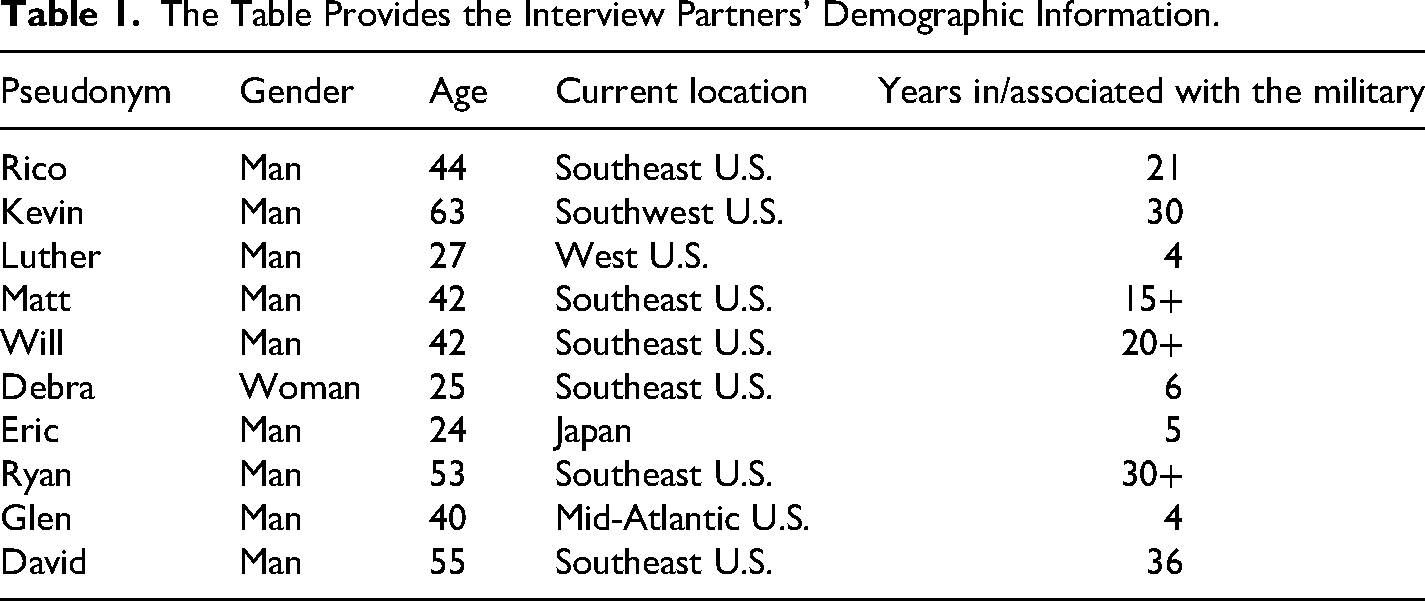
The conversations varied between 28 min and 1 h and 20 min with an average length of 47 min. Interview partners ranged in age from 24 to 63 years old, nine identified as men and one as a woman, they had served between 4 and 36 years in the military, nine were enlisted while one was an officer, and they were originally from diverse regions of the U.S. with one being born on a military post in Germany.
The interviews were analyzed through qualitative coding techniques. First-order coding, second-order coding, and recoding through the constant comparative method were utilized. First-order coding focused on an open-coding approach that selectively found information pertinent to the research questions and focused on macro- and meso-level processes (Miles et al., 2016). The codes were primarily inductive and the research team entered the study with prior knowledge of the literature related to sports, race, and nationalism that is presented in this manuscript. As such, the codes are also somewhat deductive in nature, although the team did not set out to apply specific codes to the data prior to analysis. Second-order coding grouped the first-order codes into categories to develop themes (Miles et al., 2016). This step was completed through the constant comparative method that condenses data through recoding to formulate themes that are the most consistent through each text (Fram, 2013). The research team met after the second round of coding to reach consensus on themes and representative examples. Lindlof and Taylor (2019) advise researchers to code through multiple readings of texts. Constant comparison and recoding was applied until the three most consistent themes were constructed in accordance with the research question.
Findings
Despite many interview partners currently serving in the military, they often seemed open to discussing how their identities impacted their perceptions of nationalism, activism, and racism in sport and media coverage thereof. Three major themes were identified from the interviews. The first theme is “protecting freedom of speech” which emphasized that, no matter what their perceptions of activism, nationalism, and race, as a military member, they swore to protect citizens’ freedoms. The second theme is “the ‘right' and ‘wrong' way to protest,” which offers a divergence in thought related to the appropriateness of Kaepernick and other athletes kneeling during the national anthem. The third and last theme is “identification of new/colorblind racism in sport media,” which highlights how the interview partners were keenly aware of the operation of new and colorblind racism in the sport media they consumed in their daily lives.
Protectors of the First Amendment
An idea explicitly raised in eight of the 10 interviews was that military members serve to protect people's freedom of speech and right to protest. This was clearly articulated in Will's response: I thought it [the protest] was great—and I disagree sometimes with a few of my military friends and everything else—but I don't understand the fact of, we fought for everyone's freedom to protest and act and speak on how they want regardless if you’re a Klansman or whatever. You have that right. So what's the difference from a man taking that stance and now we're going back on our words? Especially military, we took an oath to that.
Here, we see Will contend that it should not matter whether one agrees with what another person says; as a military member, they took an oath to protect everyone's freedom of speech and right to protest.
Eric shared a similar comment supporting the idea that military members should protect the right of people, like Colin Kaepernick, to express themselves however they see fit: The things that we [military members] do and allow the flag to be raised is kind of like to allow those people, to allow regular people to hold those freedoms, who, you know, do. Like, you know, freedom of speech, as long as it's justified, and I believe his [Kaepernick's] reasoning was justified, there was no, there's no reason to be angry about it.
With this comment, Eric identifies protection of freedom of speech as part and parcel of symbolism associated with the U.S. flag that military members have sworn to uphold and protect. Eric feels that Kaepernick's reasoning for his protest was “justified” due to freedom of speech rights the military guarantees. Further emphasizing the military's role in protecting freedom of speech, Eric commented on the unique perspective he held as a member of the military: I think the most patriotic people, who are like diehard people about like, you know, the flag, the national anthem, but at the same time they're not willing to serve in the military, serve the country…So it's, like, I find that to be very hypocritical in a sense. With Colin Kaepernick, he stood up for what he what believed in, and many veterans, many military members, I think, backed him in that sense, regardless if they were Black or white.
In these comments, Eric contrasts the perspectives of military members with those of the “most patriotic” civilians, highlighting the “hypocrisy” of civilians who criticize Kaepernick's supposedly disrespectful protest. In this way, his comments suggest that military members are in a position to have a unique appreciation for the importance of freedom of speech and protest.
The “Right” and “Wrong” Way to Protest
While interview participants were largely supportive of Kaepernick's right to protest, their feelings about his method of protest were more divergent. Specifically, three participants raised questions about whether kneeling during the national anthem prior to NFL games was the most appropriate means to draw attention to social justice issues. Meanwhile, seven interview partners voiced general support for Kaepernick's decision to protest by taking a knee during the anthem. Luther, who initially held a negative view toward Kaepernick's method of protest, explained the complexities involved with the evolution of his beliefs: After sitting down and thinking about it myself, I think he [Kaepernick] did it perfectly. I think what he was doing was a beautiful way of doing it. Someone of his, someone of his stature with the, the spotlight that was always on him, you know, he had the biggest stage that you can possibly have when it comes to a very mixed, like a big racial mix of people in the world, in America. Everybody watches sports, everybody. All different types of races watch sports and football being the biggest stage, especially at that time, I think he did it beautifully.
This idea is further supported through David's words, And everybody on social media, “he took a knee, he took a knee,” instead of actually, you know, trying to understand why the man took a knee. What social media says “oh I won't take a knee, he's just taking a knee, it's a dishonor to the flag.” But they don't know the backstory… He took it to make a purpose or bring some light through some social injustice. That's why he did it.
Both interview partners make it a point to describe the protest method as not disrespectful due to the reason behind his protest, and “beautiful” because of the prominent status of football in the U.S.
On the other hand, three interview partners viewed Kaepernick's method of protest more negatively. This is embodied in Rico's response when asked about Kaepernick's method: So he [a mentor to Rico] said, if you play into certain aspects and you do certain things to combat it, not in the, in the smartest way, you bring forth more con, more conflict. And I think…the manner in which it was done, especially being a sports icon, it kind of brought forth more conflict. Am I saying that a point should have been made, if you have a strong feeling about something? Yes. But when you look at your stature of where you stand up being a celebrity, you know, a highly watched quarterback, it can, it can hinder the situation more than help because [of] what happened.
In his response, Rico emphasizes that kneeling during the national anthem may have brought more conflict than good and expresses that the situation caused more division in society. While Rico recognized the potential importance of protesting, he voiced a concern that Kaepernick's method of protest may have been counterproductive.
In addition, Ryan, a recruiter, articulated his perceptions of symbolism involved with the U.S. flag and national anthem: Me being a 30-year vet in the Army, you know, raising my right hand to defend this country, saluting the flag, things of that nature, had, having friends who, you know, the flag is draped over the casket and so on and so forth. Individuals that, like I said, were my buddies or maybe this young kid that I may have put in the Army, who ends up, unfortunately, dying, and you going back and talking to the family and things of that nature. I, like said, I don't like the fact that he did that [kneeling during the national anthem]…but we’re talking about 30 years of that [the symbolism of the flag and national anthem] been ingrained in me, and me, knowing what the flag represents and knowing that individuals have shed their life. Have shed their life in order for everyone to have, you know, the lives they have in the U.S., it's sad.
In voicing his opposition to Kaepernick's method of protest, Ryan draws on his long career in the military to explain potential reasons why a protest that takes place during the national anthem may be seen as disrespectful. Overall, although participants were generally supportive of Kaepernick's right to protest and recognized the importance of bringing attention to social justice issues, several participants questioned the method of protest, drawing on their specific perspectives as military members.
New Racism and Color Blindness in Sport Media
Eight interview partners alluded to some features of new or color-blind racism as they relate either to sport media coverage of Black athletes or perceptions of Black people. Although the terminology was usually not explicit, excerpts that exemplify an awareness of new and color-blind racism permeated much of their responses. Glen, for example, provided an explanation of how new racism operates: Yeah, I think we don't live in a society now where it [racism] is going to be egregious, you know. You're not going to hear the commentators say, “well, that was a hell of a dunk, that [n-word] really can”—you're not going to hear that, right? But I think a lot of the backlash and the way sentences or verbiage is broken down, we can deduce what is being said. And I don't think that we have an even playing field as far as the way sports is analyzed, the way sports is reported, the way sports is, I think. There's a double standard, you know?
Asking Will if he notices racialized discrepancies in sport coverage, he stated: Kind of…The more athletic and mobile quarterbacks are Black. They [the NFL] wants to get away from the stand in the pocket guy, which was predominantly white. So I mean, they [sport media] do a pretty good job of masking it [racialized descriptions].
Will's acknowledgement of sport commentators “masking” racialized descriptions of quarterbacks evidences an understanding of how color-blind racism occurs in sport media.
Commenting on another example of how sport media members may reproduce racist ideas through color-blind language, three interview participants made a comparison of the treatment of Michael Vick (a former NFL quarterback who is Black) and Ben Roethlisberger (a former NFL quarterback who is white). As Eric explained: There's so many things that have happened in football, like, you know, the Michael Vick situation, where he was fighting with dogs and you know he went to jail for two years, did his time…While like athletes like, Ben Roethlisberger, literally, you know, beat women and sexually battered them and he's in the league, no problems…But there has to be some type of like level ground when it comes to these situations. You either handle it the same way, or like, or you just kind of like put it out there, like hey, this is what happens if you're a Black athlete and you mess up, and this is what happens if you're a white athlete and mess up.
In this comment, Eric identifies his perception of how the media remembers a Black quarterback negatively and a white quarterback positively years after their transgressions surfaced, displaying perceptions of uneven coverage in sport media.
Another identification of new/color-blind racism was in reference to the perpetuation of the unintelligent Black quarterback myth. Every single interview partner focused on football related to perceptions of Black intellectual inferiority, such as when Matt stated: So I think so as far as like, Black quarterbacks go, I think they get ridiculed a lot on certain things. Because I've seen like, a white quarterback might not have a good game as a Black quarterback. But I think they [sport commentators] kinda, they will talk about the Black quarterback a little bit more than a white quarterback to me.
Here, Matt went on to discuss how Black quarterbacks are stereotyped to a larger degree because of people “not trying to think.” Furthermore, Rico discussed the concept of racial stacking, “That, as far as football and how, for the most part your running backs are of the African American. Oh, it seems like it seems like and that certain positions, a specific ethnicity would carry a certain position in any given sport or dominate a position.” As Matt argues, the idea of racial stacking leads to perceptions of Black youth to play specific positions in sports rather than have a diversity of options at their disposal.
Discussion
When thinking through the connection between nationalism, racism, and activism in sport, our interview partners offered varied responses. Using Kaepernick's protest as a connection to discover interview, partners’ perceptions proved fruitful. Although the responses were not homogenous across the board, this research offers valuable insight regarding an understudied group navigating conflicting identities.
An interesting aspect of the conversations was that nearly everyone explicitly proclaimed that military members have a duty to protect freedom of speech for all U.S. citizens. Even if they disagreed with Kaepernick's method of protest, they felt strongly that he had the right to speak about any issue he wanted. Eight interview partners directly stated this idea, while the other two interview partners alluded to this idea, making it the most consistent theme. One partner, Will, even posited that a Klansmen (i.e., white supremacist) has the right to express themself how they see fit and that he took an oath to protect such freedoms through his military service. Militarism has an overt connection to sports in the U.S., especially after the terrorist attack of 9/11 when the U.S. crafted belligerent patriotic displays to foster community (Butterworth, 2010; King, 2008). Nationalistic displays in sports were generally not questioned by our interview partners, which is interesting in light of the fact that the majority of military members join for financial reasons rather than patriotic reasons (Krebs et al., 2021)—a finding illustrated in Eric's conversation in which he stated “…people don't join the military because they love America, they join the military because they're in a poor situation and they wanted to find their way out.” Our interview partners made it clear that one of the ideals that was cemented in their military experience was that they were protecting the freedoms of U.S. citizens even if they joined for financial reasons. No matter how they felt about their military service, all believed their service was imperative for protecting citizens’ rights, specifically the first amendment.
Despite the initial positive responses to Kaepernick's right to discuss social issues, interview partners provided a diversity of responses when asked if kneeling during the national anthem was an appropriate gesture. Seven interview partners responded positively to the method, stating that it was “beautiful” (Luther), that he did not do it to dishonor the flag (David), and that people should quit telling veterans how they should respond to the protest (Glen). Eric even said that he did not know anyone in the military who is truly “patriotic” like people outside the military and claims die-hard patriotism is even cultish at times. David, Debra, Kevin, and Luther felt that most people did not actually know what Kaepernick took a knee for, but rather positioned the media as influential to perceptions on his protest. The interview partners often seemed agitated that media members were speaking for them when it came to sport activist issues. Despite Boykoff and Carrington's (2020) finding that five mainstream news sources generally covered Kaepernick in more positive light, it is notable that our interview partners remembered the coverage as either negative or varied but never positive. However, it appears relatable that all individuals who did not express nationalistic pride found Kaepernick's kneeling method acceptable.
On the other side of the argument, Rico made it clear that he perceived Kaepernick's protest as causing more division than unity across society, while Ryan was worried about white America's perception of Kaepernick making a stand. Lastly, Matt was surprised at how many Black veterans were in agreement with Kaepernick's protest because he felt it violated the symbolic value of the flag and nation. A recruiter, Rico, made his nationalistic stance known from the beginning when asked about his job, and he stated that he “helps America's sons and daughters enlist.” Linguistically, by stating he is helping “America's sons and daughters,” Rico makes a point to emphasize that all U.S. citizens are “America's children,” hence presenting nationalistic laden discourse immediately in his job description. For Ryan, he has seen the flag draped over caskets, and, as a recruiter, he has known people he enlisted for service that have had a flag covered casket sent back home to their family. For some military members like Ryan, the flag represents giving a life for freedom. For 30 years, the military ideology and flag symbolism has been “ingrained” in him, so it becomes difficult to not see something, like what Kaepernick did, as “desecrating” the flag. It is important to reiterate, these individuals felt it was Kaepernick's every right to speak his mind, but it was not okay for Kaepernick to do so during the playing of the national anthem due to symbolic value. The interview partners who discussed nationalistic pride when describing their jobs tended to value the symbolism of the U.S. flag much more than did the other interview partners.
Through an intersectional lens (Crenshaw, 1989), we can conclude that the three interview partners above placed their military career identity in higher regard than identification with racial protests when considering the recent wave of athlete activism sparked by Colin Kaepernick. Their career identities involved being privileged as “national protectors,” while their racial identities have long been marginalized in U.S. society. On the other hand, for the seven partners who perceived Kaepernick's method of protest as appropriate, their military identity did not supersede their racial identity. It is worthwhile to note that the three members who viewed Kaepernick's method of protest negatively served or were associated with the military for at least 15 years. Thus, they had a longer time period of being socialized into military life, and their military identities interacted with their racial identities differently than did those of other partners. In line with the intersectional idea that certain identities may be privileged in some instances while marginalized in others (Carbado et al., 2013), it appears that an instance of activism in the context of the national anthem led certain interview partners to privilege their military identity when considering Kaepernick's protest. Through these interviews, we can identify a connection between nationalistic discourse and believing the flag strongly represents U.S. ideals. Color-blind racism would see these U.S. ideals advocated for by some of the interview partners as advancing white prerogatives (Apfelbaum et al., 2012).
Eight interview partners’ responses highlighted new racism, an idea emphasized by Bonilla-Silva (2022). Though not explicitly mentioned, the idea of racism acting in covert, subtle ways in sport media that are not obvious like in years past became a salient finding. The first instance of this came from Glen when he stated that you will not hear a commentator use denigrating language to describe an athlete, rather there is a “double standard” that Black athletes must contend with in sport coverage. This double standard relates to perceptions of Black socioeconomic status and stereotypes attached to their racialized bodies (Carrington, 2010; Kendi, 2016). Furthermore, the interview responses can be viewed through a lens of color-blind racism. Sport commentators seemingly do not recognize how race matters and their descriptions of athletes perpetuate racialized stereotypes (Buffington & Fraley, 2008; Crowe, 2021; Leonard, 2017). Sport commentators are predominantly white (TIDES, 2021) and all interview partners recognized this racial pattern while consuming sport media. Another notable finding is that the three interview partners who opposed Kaepernick's method of protest were less likely to speak about racist experiences in their past than were other participants. In this way, a belief in nationalism may perpetuate a feeling that race does not matter anymore, which is synonymous with color-blind racism. Conversely, a belief that race is inconsequential may also correlate with a higher likelihood of buying into nationalism in the U.S.
Interview partners mentioned several other instances of how new/colorblind racism persists in U.S. sport media coverage. One idea that came up in three conversations was the difference between punishments for Michael Vick and Ben Roethlisberger. Coogan (2012) and Leonard (2017) both found media coverage to redeem Roethlisberger (white) but not redeem Vick (Black) to the same extent. For further clarification, Vick was a former quarterback that pleaded guilty to a federal felony dog fighting charge (NFL.com, 2008). In 2008, Ben Roethlisberger allegedly raped a woman in a hotel, while another woman alleged that Roethlisberger raped her in a nightclub in 2010. Roethlisberger's case “…was out there for a little while, then it went away. He [Roethlisberger] still continued to be [viewed as] a positive guy” (Kevin). Three interview partners spoke in depth about the issue of fair punishment for both transgressions and related the race of the quarterback for reasons why Vick is remembered negatively. They were all painfully aware of the disproportionate punishment Black men faced compared to white men and they recognized issues that plague Black Americans, like color-blind racism (Leonard, 2017). They continue to consume sports, however, and feel as though sports are a necessary good for the community. In this way, future research could further analyze the connection Black military communities have to the sports world. Despite the awareness, three interview partners felt as if Kaepernick's protest was in bad taste due to their allegiance to U.S. nationalism and flag symbolism.
Given the partners’ awareness of racialized framing in sports, it may be surprising that only half of the interview partners claimed they experienced racism in their sporting experiences, and only two in their military experiences. It seems that either military culture successfully eliminates racialized preferences (which would match the commonsense ideology of nationalism and meritocracy preached in military spaces) or the interview partners did not notice how some of the discourses surrounding their experiences were racialized. One example is Will, who explicated explicit, derogatory statements directed toward him during his football high school playing days in the Midwest U.S. This example demonstrates that when interview partners discussed discriminatory racial experiences, they almost always were in reference to explicit racist actions rather than new/colorblind racism that they identified in sport media coverage. While some partners spoke of being able to “read between the lines” (Glen) in sport media coverage, these same individuals had more difficulty identifying covert racism in their everyday experiences, as one of the most powerful features of color-blind racism is the plausible deniability provided by practices that are formally neutral (Ray, 2022). Although it may be true that “all forms of racism are overt if our antiracist eyes are open to seeing racist policy in racial inequity” (Kendi, 2019, p. 221), it is also true that successfully confronting subtle, covert racism in everyday life can be challenging. Additionally, it may be easier for one to observe covert racism as an external observer than it is to identify it when one directly experiences such racism.
Limitations
It is important to note that of the 10 interview partners, nine were men, while only one was a woman. Given that the data were primarily informed by men's viewpoints, future research should further investigate how gender may intersect with militarism and sport, seeking additional insight from women as participants. In addition, age may have a role in participants’ perceptions, so a greater emphasis toward years of military service and age of participants could be impactful in future research. Further, it would be informative to ask similar questions to military members from other racial groups to investigate their experiences related to militarism and racial identity and to explore the extent to which they recognize new/colorblind racism in sport media.
Conclusion
The current study explored Black military affiliated people's perception of nationalism and racism in the context of athlete activism in sport. The study provides useful insight for understanding the relationships between race, militarism, patriotism, and sport among an often overlooked community with potentially conflicting identities. The results highlight some of the ways in which Black military members deal with conflicts that may arise between their observations of racism in sport and society, and their experiences in a hyper-patriotic military environment. In discussing the apparent contradiction of her father always flying the American flag outside his home despite experiencing racism throughout his life, Hannah-Jones (2021) writes: “how could this Black man, having seen firsthand the way his country abused Black Americans, the way it refused to treat us as full citizens, proudly fly its banner?” (p. 9). In answering the question, she later concludes: “He knew that our people's contributions to building the richest and most powerful nation in the world were indelible, that the United States simply would not exist without us” (p. 9). In a similar vein, interview partners in the current study remained proud of their military service, simultaneously serving to protect citizens’ “freedoms,” while also appreciating the importance of athlete activists, like Kaepernick, fighting to ensure those freedoms are extended to all citizens.
Footnotes
Declaration of Conflicting Interests
The author(s) declared no potential conflicts of interest with respect to the research, authorship, and/or publication of this article.
Funding
The author(s) received no financial support for the research, authorship, and/or publication of this article.
