



Abstract
Background:
Welfare reform in the 1990s encouraged states and localities to contract out cash assistance services to for-profit and nonprofit firms operating within the private sector. Although privatized welfare delivery was heralded in the wake of Temporary Assistance to Needy Families (TANF), scant empirical research evaluates welfare privatization and its potential relationship with administrative quality and program outcomes.
Objectives:
This study examines the relationship between administrative privatization and TANF program outcomes, including work participation activities, unsubsidized employment, employment closure, and monthly earnings, across a large sample of individual welfare clients in the state of Florida.
Results:
The results of methodologically appropriate hierarchical linear models demonstrate that ownership variables seldom enhance the quality of TANF outcomes, suggesting that privatization alone is not an administrative panacea in human support services. Although direct privatization effects are often found to be substantively small and inconsistent in terms of service quality improvement, in closed-case models, there is evidence that nonprofit welfare delivery is associated with superior TANF employment closure outcomes.
Introduction
The perpetual search for bureaucratic effectiveness is leading governments and researchers to rethink traditional modes of public service delivery. One popular approach to contemporary policy implementation, known as privatization, sheds direct governmental responsibility by integrating private sector actors and market forces into formerly government-controlled industries and services (Kemp, 2007; Lamothe & Lamothe, 2010; Osborne & Gaebler, 1993; Winston, Burwick, McConnell, & Roper, 2002). Contracting bureaucratic activities with private providers has routinely been undertaken by governments as a potential tool of governance but has recently been expanding vigorously into new social policy areas involving human support services (Heinrich & Choi, 2007; Sanger, 2003; Van Slyke 2003).
This study examines the relationship between privatized bureaucratic arrangements and program outcomes in the area of U.S. social welfare policy. With the passage of the Personal Responsibility Work Opportunity Reconciliation Act of 1996 (PRWORA), federal-level reforms encouraged welfare privatization by emphasizing bureaucratic innovation and organizational diversity in the delivery of welfare services at the local level (Sanger, 2003). PRWORA and its lead public assistance program, Temporary Assistance to Needy Families (TANF), instilled a policy framework of “devolution” in which states and localities were afforded increased autonomy in fashioning distinct administrative approaches to street-level implementation (Gainsborough, 2003; Soss, Schram, Vartanian, & Obrien, 2001).
In turn, states have responded by creating an increased role for private, both for-profit and nonprofit, entities in the delivery of welfare services (Crew & Lamothe, 2003; U.S. GAO, 2002; Sanger, 2003; Winston et al., 2002). Fifteen years after the passage of PRWORA, we know that all states except South Dakota have contracted some portion of their TANF dollars to private firms (U.S. GAO, 2002), but quantitative investigation into the ramifications of TANF privatization remains limited (for exceptions, see Crew & Lamothe, 2003; Heinrich & Choi, 2007; Sanger, 2003). This is unfortunate because with the economic recession of 2008 and sluggish recovery, vulnerable families are continuing to seek redistributive cash assistance services from private social service providers, yet little is known regarding how their experiences and outcomes might differ across public and private arrangements. This article investigates just one of many significant research questions left to explore in the area of welfare privatization. Does administrative ownership in TANF delivery influence the quality of program outcomes? More specifically, does privatizing TANF services yield superior client outcomes related to work participation activities, unsubsidized employment, case closure due to employment, and monthly earned income?
The few studies that exist on welfare privatization are qualitative case studies of privatized implementation within specific states and localities or administrative manuals instructing states on how to contract out welfare services (Breaux, Duncan, & Keller, 2002; Curtis & Copeland, 2003; Mead, 2000; Pavetti, Wemmerus, & Johnson, 1999; Sanger, 2003; Stevenson, 2003). While these studies offer in-depth descriptions of bureaucratic structures, none focus specifically on linking privatization arrangements to performance outcomes and none systematically examine variation in privatization and performance across a large number of cases, thereby hindering any generalizablity of scientific knowledge. Van Slyke notes that, “there has been an increase in researching the government nonprofit social service contracting relationship, but much of the work has been conceptual, prescriptive, and case specific rather than empirical and generalizable based on primary data collection” (Van Slyke 2003, p. 298).
One published large-N study undertakes multiple regression analysis of administrative ownership and aggregate TANF employment outcomes within the state of Florida (Crew & Lamothe, 2003). The authors report that Regional Workforce Boards (RWBs) utilizing governmental agencies in TANF implementation performed on par or more proficiently than RWBs with private service providers. While this evidence undermines the notion that privatization in workfare initiatives will improve the program outcomes of welfare clients, the analysis ultimately eschews the program outcomes of individual TANF participants in favor of aggregate indicators. More rigorous and comprehensive empirical tests are warranted in order to elicit more accurate causal predictions. Through incorporating client-level administrative TANF data from the U.S. Department of Health and Human Services (DHHS) and methodologically appropriate multilevel modeling techniques, this article provides analyses of observational data that plausibly have a causal interpretation and makes empirical contributions to the welfare privatization and program evaluation literatures.
Privatized arrangements are found to seldom improve client outcomes in meaningful and consistent ways. Indeed, clients served under for-profit firms are predicted to be less likely to be achieving full-time work preparation activities and by extension reduced probability of achieving full-time employment outcomes. However, clients served under nonprofit organizations are more likely to exit TANF for reasons of employment or earnings, whereas clients served under for-profit firms or government agencies are more apt to exit the program for nonemployment-related reasons such as client absenteeism or sanction for noncompliance with program rules. Privatization is not an administrative panacea in human support services, but all things being equal, the results suggest that nonprofit organizations will tend to outperform their public and profit-seeking counterparts in securing TANF client exits due to employment.
Theory
The Promise of Privatization: The Nature of Private Firms
The most frequently touted rationale for administrative privatization revolves around familiar microeconomic arguments that private markets, opening up competition and choice among rival providers and informed consumers, increase service quality and reduce costs of service provision (Boyne, 1998). Privatization has a storied history of public service provision in the United States and has been widely embraced in recent decades in an era of “entrepreneurial government” that demands efficiency and performance from government (Osborne & Gaebler, 1993). 1 Proponents claim that government agencies operate as sluggish rent-seeking monopolies, ensured survival and budgetary resources without facing competitive rivals or mercurial customer preferences, and are thus unmotivated to perform at optimal service levels. Whereas private firms operate alongside potential rivals and without binding government personnel constraints and are thus free to perform organizational duties with ultimate effectiveness (Donahue, 1989; Kemp, 2007; Savas, 1998).
For-profit and nonprofit managers have the organizational flexibility to directly control production activities and unharness resource allocation, adapting to changing administrative climates through briskly expanding or reducing the workforce or swiftly manipulating core business functions to meet existing and foreseeable challenges (Kemp, 2007; Sanger, 2003; Savas, 1998; Winston et al., 2002). For instance, private organizations retain the ability to openly hire and fire employees, rapidly increasing capacity to meet demands or reducing excesses when necessary (Savas, 1998). Conversely, public organizations oftentimes encounter entrenched public employee unions and rigid civil service requirements that impede flexibility in the hiring and firing of public employees (Brudney, 2005; Donahue, 1989; Sanger, 2003).
Ownership in government agencies, on the other hand, is diffused across the broader tax-paying citizenry, fostering the conditions for administrative stagnancy and inefficiency (Donahue, 1989; Savas, 1998). When private sector organizations fail to perform adequately, the adverse effects of contract termination and revenue loss are felt disproportionately by the primary owners, shareholders, or trustees who in turn have an undeviating economic interest to remain in business and maximize personal financial security. Under governmental control and diffused organizational ownership, rewards and failures are less immediate and apparent, and the impetus to innovate and maximize service potential is muted as a result (Savas, 1998).
Profit seekers and nonprofits both operate within a shared private sector milieu characterized by competition and risk, but there exists significant organizational distinctions between these two privatized ownership models that could potentially alter their effectiveness in providing welfare services to low-income populations (Blank, 2000). Nonprofit organizations are uninterested in profit-seeking motivations and maximizing shareholder value, the basic tenets of economic self-interest that underlie for-profit ventures (Drucker, 1990; Worth, 2012). The directors of nonprofit organizations do not stake exclusionary claim to corporate risks and earning potential as traditionally observed in for-profit contexts. Nonprofit organizations are uniquely registered with state governmental authorities and receive favored Internal Revenue Service tax status if they abide by the “nondistribution constraint” principle of nonprofit ownership (Heinrich, 2000; Worth, 2012) that earnings and donations remain shared organizational resources to be funneled into strengthening organizational activities (Drucker, 1990; Wolf, 1999).
Nonprofits are theoretically motivated disproportionately by altruistic social missions as opposed to profits or shareholder value, and a relatively selfless organizational posture should be exuded in the actions of frontline paid staffers and nonprofit volunteers (Blank, 2000). According to Hansmann (1987) and others (see Nelson & Krashinsky, 1973; Blank, 2000), nonprofits exist because they are better “trusted” to undertake soft services, such as education, day care, and workfare programs, in which service quality is more difficult to ascertain. For-profit firms are arguably more likely to pursue entrepreneurial innovation and organizational streamlining (Heinrich & Choi, 2007), but a narrow focus on the financial bottom line can come at the expense of service quality, especially with regard to vulnerable low-income populations that require a level of continuous care and sustained community relationships (Blank, 2000).
In the provision of hard services, such as asphalt laying or garbage collection, administrative outcomes are more readily observed and measured (Blank, 2000; Hefetz & Warner, 2012; Hodge, 2000). Human support services, on the other hand, are directed at a human-based clientele where complexity and ambiguity in service provision abounds (Blank, 2000; Sanger, 2003; Van Slyke, 2003; Winston et al., 2002). The programmatic tasks of hard services are substituted with softer and arguably more challenging endeavors that involve interpersonal attention and greater street-level decision making by case managers (Blank, 2000; Smith & Lipsky, 1993; Soss, Fording, & Schram, 2011). For instance, TANF case managers must properly diagnose client challenges to employment, seek to address the various employment barriers, assist with job searches, and closely monitor attempts to find employment (Sanger, 2003; Winston et al., 2002). When organizational activities are not readily tangible and observable, the potential for fraud and opportunism in the pursuit of atomized profit arguably increases among for-profits, whereas, government agencies and nonprofits should remain relatively attentive to public service needs (Blank, 2000; Heinrich, 2000; Salamon, 1987).
There is a priori reason to suspect that nonprofit organizations will outperform both for-profits and public agencies in the implementation of human support services, yet the empirical reality remains illusory. Administrative researchers argue that through organizational dependency on public dollars and contract renewal, nonprofits can succumb to “mission drift,” operating with greater attention on cultivating political favoritism and less regard for the life outcomes of disadvantaged clientele (Van Slyke, 2003). Beyond shifting toward political over service priorities, other factors such as poorly written performance contracts along with underresourced monitoring and oversight capabilities from government watchdogs can also yield suboptimal organizational performance among contracted service providers, nonprofit and for-profit alike (Heinrich & Choi, 2007; Van Slyke, 2003).
Potential Pitfalls of Privatization: Market Failure in Social Services
A substantial number of policy scholars espouse the potential pitfalls of privatizing social services, especially in the social policy arena (Blank, 2000; Morgan & England, 1988; Van Slyke, 2003). Previous research has demonstrated that efficient, effective markets rarely exist in the social policy arena, and market failure can provoke inferior and ineffective program outcomes (Sclar, 2000; Van Slyke, 2003). There is some doubt that private firms will face sufficient competition from rivals in the contractual bidding process or that competition will remain substantial after awarding an initial contract (DeHoog, 1984; Gilman, 2001; Johnston & Romzek, 1999; Morgan, 1992; Schlesinger, Dorward, & Pulice, 1986; Sclar, 2000; Soss et al., 2011; Van Slyke, 2003; Williamson, 1985). If adequate competitive pressures from rival firms are absent, private providers will operate in an environment akin to government monopolies, rarely fearing contractual replacement by rivals and the motivation to improve performance will wane (Gilman, 2001; Hefetz & Warner, 2004; Sclar, 2000). Although competition for TANF contract origination and renewal likely exists to some extent in most if not all jurisdictions, one or two exclusive workfare providers might administer TANF services, suggesting that meaningful organizational choices in pursuit of superior service quality may not exist at the street level. In Florida, for instance, entire regions of the state can be administered by one single provider of workfare services, and several regions operate with no more than two or three one-stop providers (Florida Department of Economic Opportunity, 2013).
Finally, the pure market model asserts that consumers must have both complete information and meaningful provider choices in order for maximum service quality to be realized; however, client information and choice are often inadequate and unfeasible in the market for human support services (Blank, 2000; Sclar, 2000). Although publicly available resources can successfully guide welfare program clients, such as the comprehensive Internet-based ACCESS portal in the state of Florida, imperfect information about the expected quality of organizational workfare services coupled with the dearth of meaningful provider choices should undermine the motivations of private, especially profit-seeking welfare providers to enhance service quality. In sum, just as public choice theory predicts administrative superiority among private providers, there is ample reason to suspect that public workfare providers will perform equally or with improved quality over privatized alternatives in the provision of human support services particularly.
Method
Examining Privatization and Program Outcomes: A Hierarchical Approach
Unlike previous welfare privatization research that employs aggregate outcome data and ordinary least squares regression, this article employs a “hierarchical” statistical methodology, known as multilevel modeling or hierarchical linear modeling (HLM), in which individual-level data are analyzed alongside higher level contextual measures. HLM techniques allow the program outcomes of individuals to be modeled as a function of both client characteristics and contextual measures at higher levels of analysis (Ingraham & Lynn, 2004; Lynn, Hienrich, & Hill, 2000). Individuals nested within higher level units likely share similar characteristics and outcomes, violating the independence assumption underlying standard regression techniques. Therefore, standard errors clustered at higher levels are likely underestimated and the likelihood of committing Type I error increases, potentially creating false positives. In the multilevel models constructed here, Level-1 variables represent the outcomes and characteristics of individual TANF clients, while Level-2 variables are measured across counties and capture the local administrative, economic, and political environments in which implementation occurs. 2
Incorporating client-level data generates distinguishing analytical leverage over aggregate approaches in several regards. Studies of social policy privatization that examine aggregate performance measures can fall prey to inferential bias known as the “ecological fallacy” because researchers are making inferences about program clients from outcomes measured at the state, county, or agency level. Relationships between client characteristics and program outcomes observed in the aggregate may simply not extend to the client level, and we remain uncertain until individuals are specifically examined. Aggregate measures average out the individual variation in client outcomes occurring at the street level and in the process may encumber the aspiration of accurate causal inference.
Another advantage of utilizing client-level data rests on the predictive side of the analysis. When aggregate measures are analyzed, the individual-level factors of clients that presumably influence administrative outcomes are largely ignored or merely agglomerated, resulting in the loss of valuable information about individual client characteristics. Data on program clients have the advantage of including an elaborate set of individual-level predictors, creating an improved ability to control for the distinctive traits of participating clients that can determine program success or failure. This ability will afford key insight into the client-level reasons that individuals vary in their TANF outcomes while more completely isolating the independent direct effects of higher level contextual measures on program performance.
Florida represents one immediate state of interest for the HLM analyses. In the aftermath of PRWORA, Florida pursued extensive second-order devolution, granting 24 RWBs, operating in 67 Florida counties, the autonomy to contract welfare services to private, public, or a mix of agency types and allowed private entities to operate entire local welfare offices. 3 Florida’s demographic diversity and pursuit of decentralized bureaucratic control results in meaningful variation in provider types and street-level operations across counties, making this state a popular choice for welfare reform researchers (Crew & Lamothe, 2003; Soss et al., 2011).
Client-Level Data: Outcomes and Predictors
Data for individual TANF clients in Florida originates from a public database of administrative data compiled by the Assistant Secretary for Planning and Evaluation operating under the U.S. DHHS and includes 6 years of observations (2000–2005) for both “open” and “closed” TANF cases in Florida. 4 Individual program outcomes for open TANF cases include full-time involvement in work participation activities, full-time involvement in unsubsidized employment, and monthly earnings from employment. 5 The work participation and unsubsidized employment variables are operationalized in a dichotomous fashion (engaged in full-time work participation activities [1] or not [0] and engaged in full-time unsubsidized employment [1] or not [0]). Earnings from employment are measured continuously as the total earned income from employment reported from the previous month in the TANF program. The dependent variables utilized in the closed case multilevel models include reason for case closure and reported monthly earnings from employment. 6 Monthly earnings from employment are measured analogous to the open cases. The case closure variable identifies closure due to employment/excess earnings and is measured in a dichotomous fashion (case closed due to employment/excess earnings [1] or closed for other reasons [0]). 7
Client-level predictors of program outcomes for both open and closed cases include race, gender, education, marital status, number of children, and age of youngest child. African Americans, Hispanics, and females have experienced a history of occupational discrimination and continue to encounter discriminatory attitudes and unique challenges to employment that could incite substandard TANF program outcomes (Danziger, Corcoran, & Danziger, 2000; Fording, Schram, & Soss, 2007; Gooden, 2000; Kalil, Seefeldt, & Wang, 2002). Levels of education should predict program success in that clients with higher levels of education are theorized to have an easier time procuring employment and finding jobs that offer elevated wages (Bos et al., 1999; Kaushal & Kaestner, 2001). Next, challenges associated with child rearing should influence the probability of occupational successes (Bloom, Hill, & Riccio, 2003). Two different variables, age of youngest child and caring for three or more children, are included to improve model specification, as it pertains to client-level predictors. Finally, clients that are married presumably have greater domestic stability and fewer burdens in their search for employment and might have more successful program outcomes than single clients (Chase-Landsdale et al., 2003).
Client race, gender, education, marital status, and number of children are operationalized as a set of dummy variables (African American [1] or not [0]; Hispanic [1] or not [0]; female [1] or male [0]; Less than 12 years of education [1] or 12 or more [0]; and single [1] or married [0]; three or more children [1] or fewer than three children [0]). Age of youngest child is measured continuously in years. Finally, past research has demonstrated that client participation in program activities can influence the achievement of full-time unsubsidized employment (e.g., vocational training or educational programs preclude unsubsidized employment). While data are lacking here regarding client participation in specific TANF program activities related to resume building, education, or job searches, data exist concerning client involvement in full-time work participation activities. In turn, a variable capturing full-time participation in work preparation activities is included as a predictor in the unsubsidized employment and earned income models for open TANF cases in Florida.
8
Operationalizing Administrative Ownership and the Local Environment
Administrative ownership is measured across counties in Florida from available data for the fiscal years 2000–2005 as a series of annual dummy variables, with ownership running from July 1–June 30 according to the fiscal year calendar in Florida. Crew and Lamothe’s (2003) privatization data are available for the fiscal years 2000 and 2001. Data from Fording, Schram, and Soss (2007) are available for the fiscal year 2004. Data for the years 2002, 2003, and 2005 were collected and coded by the author. The analysis follows the three-part coding scheme originally developed by Crew and Lamothe (2003) in which counties choose to retain governmental administration (Public), or contract with either for-profit (ForProfit) or nonprofit (NonProfit) organizations. Public serves as the baseline reference category throughout the statistical analysis. 9
Welfare contracting is pervasive and varied within the state of Florida over the 2000–2005 time period examined in this study. Figure 1 reports the total percentage of government, for-profit, and nonprofit providers operating across counties in Florida. TANF privatization is not exclusive to any particular geographic region in Florida, and privatization especially with for-profit firms has been increasing over the 6 years of observations in this study. In 2000 and 2001, government agencies operated TANF offices in nearly one third of Florida counties but accounted for less than 15% of welfare offices in 2004 and 2005. Public welfare agencies oftentimes operate in tandem with the Florida Department of Children and Families (DCF) and are primarily housed within local community colleges or other institutions of higher learning. 10
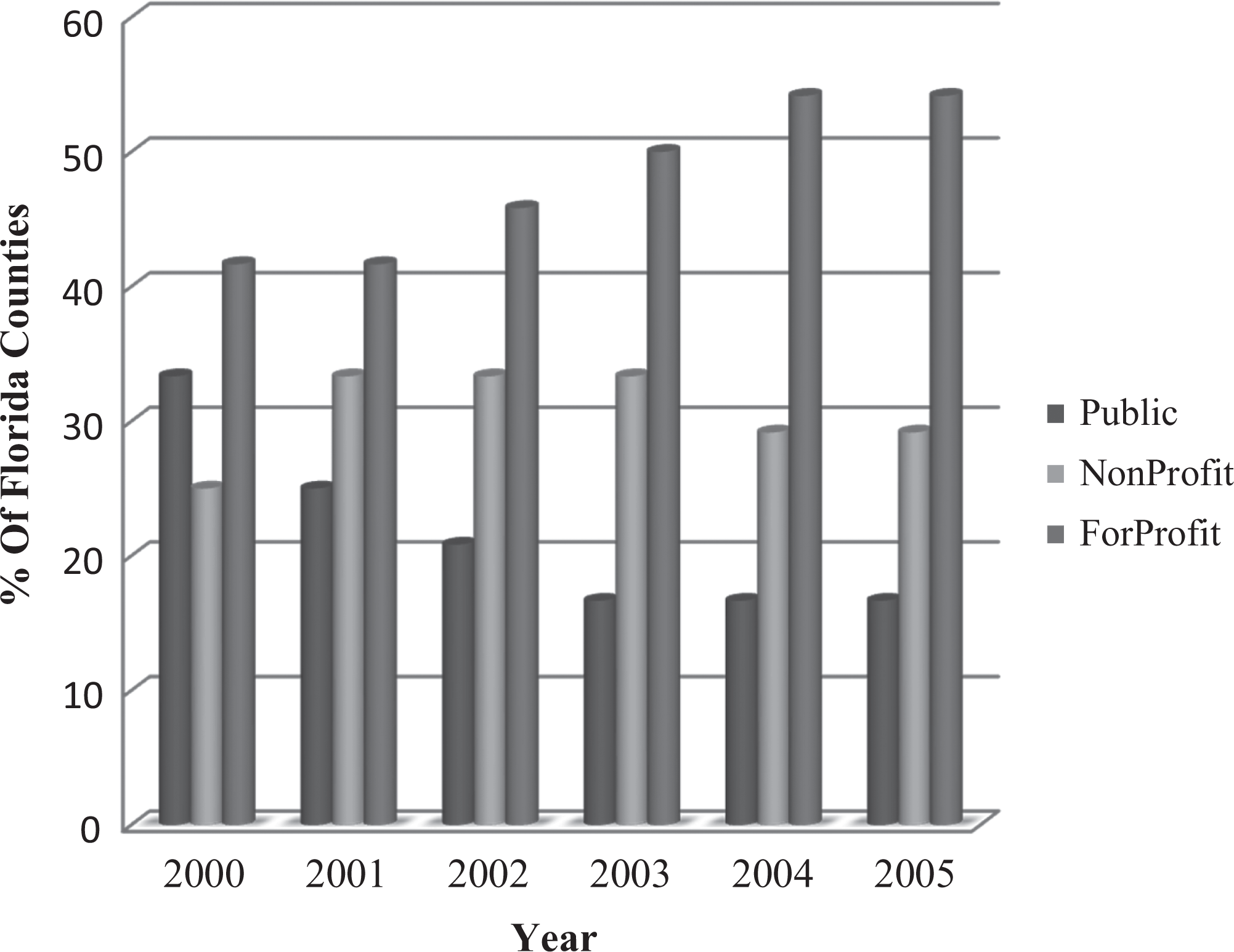
Temporary Assistance to Needy Families (TANF) administrative ownership across Florida Counties, 2000–2005. Note. Y-axis represents the percentage of Florida counties with various TANF administrative arrangements for a given year. Data for fiscal years 2000 and 2001 come from Crew and Lamothe (2003). Data for the fiscal year 2004 come from Fording, Schram, and Soss (2007). Data for the years 2002, 2003, and 2005 were collected and coded by the author.
A variety of nonprofits operate one-stop TANF career centers across the state of Florida. Approximately one third of Florida counties contract primarily with nonprofit organizations and that figure stays relatively steady across the 2000–2005 time period. Catholic Charities and Goodwill Industries were awarded contracts over the 6-year period examined here in counties such as Miami-Dade, Broward, and Leon-Tallahassee. Other locally based nonprofits operating TANF offices include the Florida Institute for Workforce Innovation, Workforce Connection, Inc., and Experience Works. Finally, several for-profit firms operate TANF offices in Florida, and for-profit contracting was increasing during the 2000–2005 time period. This is largely due to Affiliated Computer Services (ACS), the most prevalent for-profit administrative entity in the state of Florida. By 2004, ACS operated welfare offices in approximately one third of Florida counties. There is not much annual turnover in welfare providers from in Florida, but ACS has managed to successfully increase TANF market share over time. Although infrequent, the most common yearly alterations to contract arrangements were associated with procuring for-profit workfare provision. Gadsen and Leon Counties shifted from public to for-profit administration in fiscal year 2003, while Flagler, Volusia, Hernando, Pasco, and Brevard Counties undertook similar for-profit arrangements in 2004 after several years of government-controlled provision. Other for-profit firms operating in Florida include the Paxen Group, Kaiser Group, and the Training Institute.
In order to more completely isolate the independent effects of TANF administrative ownership, this analysis includes control variables related to the local socioeconomic and political environment that theoretically shape administrative settings and ultimately program outcomes of TANF clients (Ingraham & Lynn, 2004; Keiser & Soss, 1998). Additional county-level socioeconomic control variables utilized in the HLM analysis include the unemployment rate (Ewalt & Jennings, 2004) and poverty rate (Fording et al., 2007; Kim & Fording, 2010), along with the percentage of African American residents and the percentage of Hispanic residents (Kalil et al., 2002). Second, the indicator of the local political environment is conceptualized as a traditional left–right ideological continuum and is operationalized as the factor score from county referenda results of 18 ideologically relevant Constitutional Amendments from 1996 to 2004 in the state of Florida
11
(see Fording et al., 2007). The ideology scores range from zero to one, with higher values representing increased county conservatism.
Intrastate Hierarchical Logit Model
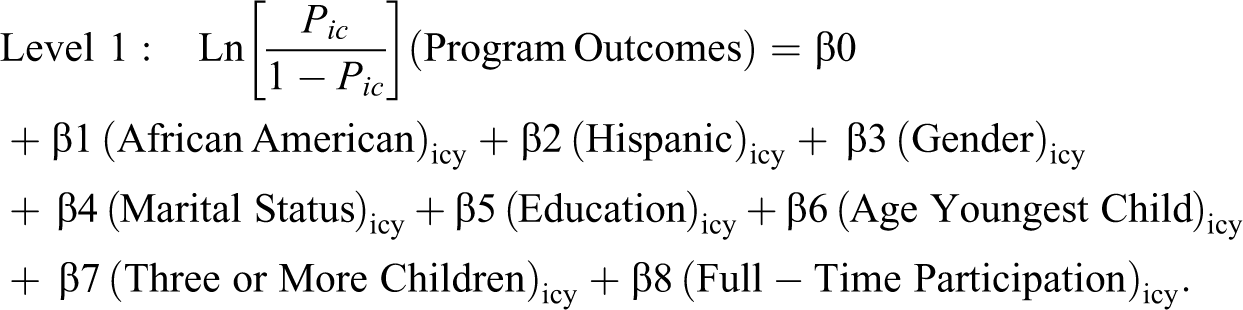

where icy = Individual client in county for a particular year and cy = County for a particular year.
Results
Tables 1 and 2 contain the pooled cross-sectional HLM estimations and accompanying predicted probabilities for both open and closed TANF cases for the 2000–2005 time period. 12,13 In short, the findings suggest that privatized arrangements infrequently and inconsistently influence or improve the quality of program outcomes for both open and closed TANF cases in Florida. However, there is evidence suggesting that TANF employment closure outcomes are relatively superior under nonprofit welfare delivery, while employment-related outcomes are found to be inferior or unchanged under profit-seeking arrangements.
HLM Analysis of TANF Privatization and Client Outcomes for Open Cases in Florida, 2000–2005.

Note. Cell entries are multilevel maximum likelihood coefficients/predicted probabilities (Participation and Employment models) and regression coefficients (Earnings model) with clustered robust standard errors in parentheses. The Participation and Employment dependent variables are both measured dichotomously indicating whether an open case client was engaged in full-time work participation activities or unsubsidized employment at the time of Department of Health and Human Services data collection. Predicted probabilities are calculated for each independent variable with all other variables held either at zero (if dichotomous) or at their mean (if continuous). The predicted probabilities represent the expected likelihood of achieving program outcomes for the independent variables when moving from zero to one (dichotomous independent variables) or when moving from the mean to maximum values (continuous independent variables). The Earnings dependent variable is measured continuously and represents total reported monthly earnings from the previous month of employment. The stars indicate statistical significance, not the bold-face. ICC = Intraclass correlation coefficient; HS = high school.
***p < .01. **p < .05. *p < .10.
HLM Analysis of TANF Privatization and Client Outcomes for Closed Cases in Florida, 2000–2005.
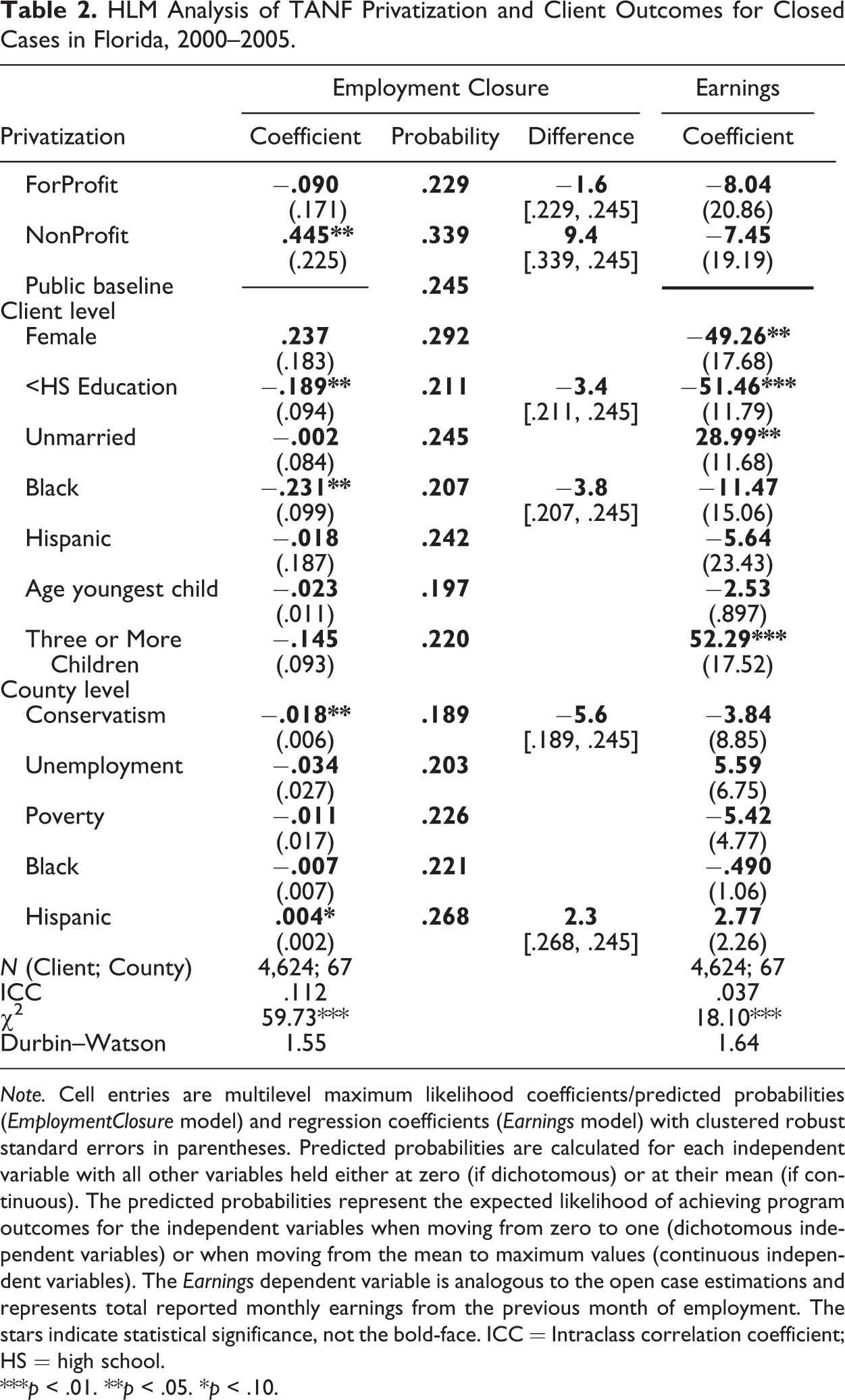
Note. Cell entries are multilevel maximum likelihood coefficients/predicted probabilities (EmploymentClosure model) and regression coefficients (Earnings model) with clustered robust standard errors in parentheses. Predicted probabilities are calculated for each independent variable with all other variables held either at zero (if dichotomous) or at their mean (if continuous). The predicted probabilities represent the expected likelihood of achieving program outcomes for the independent variables when moving from zero to one (dichotomous independent variables) or when moving from the mean to maximum values (continuous independent variables). The Earnings dependent variable is analogous to the open case estimations and represents total reported monthly earnings from the previous month of employment. The stars indicate statistical significance, not the bold-face. ICC = Intraclass correlation coefficient; HS = high school.
***p < .01. **p < .05. *p < .10.
The HLM regression coefficients for monthly earnings can be interpreted in a straightforward substantive manner, but the coefficients for the logistic HLM estimations represent the expected change in log odds and are not directly interpretable, thus predicted probabilities are calculated for the TANF work participation, unsubsidized employment, and employment closure models because these outcomes are measured in a dichotomous fashion. Predicted probabilities illustrate substantive differences in the expected program outcomes among various categories of the independent variables and will be used to discuss the findings throughout the rest of this study.
Table 1 presents the TANF open case results. First, with longitudinal data, there exists valid concern with error correlation over time, which can inhibit the efficiency of regression estimates, deflating standard errors while increasing the likelihood of accepting false positives, ultimately committing type I error. The data presented in this article represent pooled cross-sections rather than panel data collected on the same subjects, yet legitimate concerns of serial correlation remain. Year dummy variables included in the regression models proved insignificant to the estimations. As a critical diagnostic check, I estimated Durbin–Watson statistics for each regression model. With the exception of unsubsidized employment, which achieves a marginal level of statistical significance, the Durbin–Watson estimates fall relatively close to a value of 2 and as such fail to achieve statistical significance, suggesting minimal autocorrelation over time. Because the data are structured as cross-sections of Florida counties observed across multiple years, robust standard errors clustered at the county level are also estimated to account for within panel autocorrelation (see Bertrand, Duflo, & Mullainathan, 2004).
Moreover, the intraclass correlation coefficient (ICC) values indicate a nontrivial correlation of shared attributes at the county level in Florida meaning that HLM analysis should provide more efficient estimates than clustering standard errors using standard regression techniques. 14 The underwhelming ICC values hint that variability in client-level variables determine TANF program outcomes to a greater degree than higher level variables associated with the administrative, political, and socioeconomic context. Indeed, several client-level variables in Table 1 are found to be significant predictors of employment outcomes and in expected directions. 15,16
Turning to the Level-2 administrative ownership variables of interest found in Table 1 and most importantly for this research, we observe negative and statistically significant coefficient for the ForProfit variable in the Participation model. This suggests that clients served by for-profit firms are less likely to be achieving full-time work participation (−.414; p < .05) vis-à-vis government providers. While HLM logit coefficients are not directly interpretable, predicted probabilities reported in Table 1 can offer a clearer substantive picture of direct privatization effects. For instance, in the Participation model, the predicted probability of .486 in the baseline category, Public, means that ceteris paribus, a TANF client served under a government provider, is predicted to have a 48.6% chance of achieving full-time work participation. 17 How does this governmental baseline compare with the probabilities observed in privatized administrative environments? First, the negative and insignificant coefficients for the NonProfit variable across the Participation, Employment, and Earnings models suggest that TANF clients are no more or less likely to be working or earning more under nonprofit administration than in governmental settings. This is reflected in the diminutive and statistically insignificant impact differences of 4.7% (Participation) and 1.3% (Employment) between nonprofit and governmental administrative contexts.
Conversely, the negative and statistically significant ForProfit coefficient suggests that clients served under for-profit firms are less likely to be engaged in full-time work participation activities. Indeed, ceteris paribus, a client served under for-profit delivery, is expected to have a 38.3% chance of being engaged in full-time work participation. In terms of achieving full-time work participation activities, this translates into a sizable 10.3 percentage point reduced chance between for-profits and government providers and 5.6 percentage point reduced probability between for-profit and nonprofit providers. The significant negative privatization connection to TANF work participation activities does not seemingly extend to the probability of achieving unsubsidized employment. Both the for-profit and nonprofit variables are insignificant to the Employment model in Table 1. It appears that after controlling for full-time client participation in work preparation activities in the model, any direct effect of organizational form on unsubsidized employment is nonexistent. Irrespective of the administrative context, TANF clients exhibit a relatively low level of unsubsidized employment (see Appendix), but those participating in full-time work activities do have a significantly greater probability of successfully achieving unsubsidized employment and earning more monthly income.
Clients within for-profit firms are not found to be significantly different from governmental providers in terms of achieving levels of unsubsidized employment (Employment model), but clients are found to be participating in work preparation activities to a lesser degree among for-profits (Participation model), which could ultimately hinder the program successes of for-profit TANF clientele. Meanwhile, the insignificant coefficients for the NonProfit variable suggest that clients are no more or less likely to be working or earning more under nonprofit administration than in governmental settings. In short, there is scant evidence of any privatized superiority in the initial open case models.
Table 2 contains the HLM results for closed TANF cases in Florida. Once again, the individual-level variables largely behave in an expected fashion. Lacking a high school education is inversely related to case closure due to employment or excess earnings, and low educated clients earn less monthly income from employment (−51.46; p < .01). Females are also found to earn less monthly income than male clients in the closed case data set (−49.26; p < .05). Interestingly, TANF clients with three or more children are presumed to face heightened occupational barriers yet are predicted to earn approximately 52 dollars more per month (translating to nearly US$625 more per year) than those with fewer children. The client-level Hispanic variable proves insignificant to the estimations, but race remains a significant predictor in the closure models in that African American clients are predicted to be less likely to experience case closure due to employment or earnings. Across the open and closed case models, these findings further corroborate a substantial body of research that uncovers intimate links between racial identity and welfare policy outcomes in America (see Fellowes & Rowe, 2004; Gilens, 1999; Schram, Soss, & Fording, 2003; Soss et al., 2001).
Directing attention to the Level-2 variables in Table 2, we again observe that after controlling for client characteristics and the socioeconomic and political environment, privatized administrative environments do not influence TANF clients in consistently superior ways. The ForProfit coefficients are statistically insignificant across both the EmploymentClosure and the Earnings models, suggesting that we cannot reject the null hypothesis that for-profit firms have no statistical effect on TANF client outcomes. Put another way, clients served by for-profits are no more likely to exit TANF due to employment and are not earning more in monthly income than clients served in alternate administrative contexts. Throughout this entire analysis of open and closed TANF cases, for-profits are categorically not found to outperform government agencies or nonprofit organizations. With the increased costs of monitoring and accountability concerns that accompany third-party contracting arrangements, this systematic evidence across multiple years hints that contracting workfare services with for-profit firms might not readily yield performance gains in the welfare bureaucracy consistent with previous studies of welfare privatization (see Crew & Lamothe, 2003; Heinrich & Choi, 2007). On the other hand, there is evidence in Table 2 that suggests TANF clients are achieving relatively superior employment closure outcomes when served under nonprofit administration.
The NonProfit coefficient is positive and highly statistically significant in the EmploymentClosure model found in Table 2 (.445, p < .05), meaning that clients served under nonprofit organizations are expected to be more likely to exit TANF for reasons of employment or excess earnings vis-à-vis governmental providers. Relative to the predicted probability observed in the baseline Public category (.245), a client served under nonprofit administration has a 9.4 percentage point increased chance of exiting TANF due to employment or earnings (.339–.245) and has an 11 percentage point increased probability of experiencing an employment exit than an equivalent client served under for-profit administration. This finding concerning superior employment closure outcomes is tempered somewhat by the insignificant NonProfit coefficient in the subsequent closed case Earnings model in Table 2, predicting that nonprofit TANF clients are not expected to earn more monthly income than those served in other administrative environs. Clients in nonprofit settings appear to have a greater probability of exiting TANF due to employment rather than other reasons such as client absenteeism or sanction for noncompliance over this time period but are not necessarily garnering more lucrative jobs with relatively higher wages. Program clients are predicted to be marginally more likely to exit welfare due to employment under nonprofit agency ownership, but administrative lessons for broader economic security and self-sufficiency remain elusive.
In the open case estimations, government agencies were found to perform on par vis-à-vis nonprofit organizations while outperforming for-profit firms in which clients were less likely to be participating in full-time work participation activities. In the closed case estimations, public agencies continued to perform on par with profit seekers. This suggests that there is no privatization panacea as it pertains to for-profit welfare delivery in the state of Florida during the 2000–2005 time period examined in this study. For-profits themselves are found to perform on par with government providers in the closed case models but never demonstrate consistently superior performance over other organizational forms. However, there is evidence that nonprofit organizations are outperforming their governmental and for-profit counterparts at least when it pertains to case closure due to employment. Ceteris paribus, the evidence in Table 2 demonstrates that opening up welfare delivery to nonprofit organizations can yield superior closure outcomes for TANF clients.
Conclusion
Privatizing the administration of public policies through contracting with for-profit and nonprofit service providers is a popular tool of governance, yet the implications of contracting decisions across human support services remain understudied. One recent case in need of systematic empirical analysis involves welfare reform policy in America. It is well documented that subnational jurisdictions are privatizing workfare implementation under PRWORA, yet researchers have accumulated modest empirical knowledge about how variation in privatized administration affects the TANF program outcomes experienced by clients.
This analysis principally seeks to empirically connect privatized administrative arrangements to TANF program outcomes through utilizing methodologically appropriate hierarchical models that simultaneously incorporate both client-level and contextual factors across multiple years within the state of Florida. While the analysis is observational, nonexperimental, and nondeterminative, it seems plausible to view the estimates as causal. Individual clients are nested within higher level administrative, political, and social environments that precede TANF service activities and program outcomes experienced at the street level. With a relevant mixture of individual and contextual explanatory factors, the statistical models of TANF program performance, while not definitively causal, offer enhanced model specification and predictive ability over extant welfare privatization research. More often than not, the administrative ownership variables are insignificant to the open and closed case models, meaning that the likelihood of participating in full-time work activities or leaving TANF due to employment is no more likely in for-profit and nonprofit settings than among public providers.
One possible reason for the prevalence of null findings in the multilevel analysis could pertain to the system of transparent performance-based contracting that exists within the state of Florida. Although RWBs within Florida are free to contract welfare administration to private sector stakeholders, they are not at liberty to craft unique contracts that outline desired localized performance objectives. Performance benchmarks related to work participation rates and wage ratios, for instance, are centrally and uniformly developed at the state level by the Florida DCF. Regardless of administrative ownership, all welfare providers in Florida are held to uniform performance standards, and performance outcomes are publicly scrutinized in quarterly “red” and “green” reports that rank how various regions are performing in terms of work participation and the like. 18 The uniformity and transparency of performance pressures inherent in the Florida contracting system potentially mitigates the direct effects of administrative ownership. When governmental and nonprofit providers must compete alongside profit seekers for similar performance-based contracts, the efficacy of privatized ownership is seemingly muted. Privatization alone is not an administrative panacea in workfare services but is potentially enhanced when accompanied by rigorous and transparent performance management systems.
This study reports that among open cases, for-profit TANF clientele are less likely to be participating in full-time work participation activities and that full-time work participation matters significantly to ultimately achieving unsubsidized employment. The lack of performance gains experienced under privatized arrangements in Florida is potentially creating “double loop learning” among local government contractors similar to the experience in Wisconsin (Heinrich & Choi, 2007), in which fundamental administrative assumptions are questioned, enhancing the attractiveness of more publicly controlled delivery mechanisms. Under a cloud of corporate scandal and fraud, Soss, Fording, and Schram (2011) report that in the years following this study, several RWBs exterminated contracts with private providers and are moving toward in-house provision. Given the mediocre level of program performance reported among private firms coupled with costly monitoring activities and accountability concerns, local officials are increasingly choosing to “contract-in” with government providers in more recent years (Hefetz & Warner, 2004). Welfare privatization was popular in Florida for the 2000–2005 time period examined in this study but was not universally successful and has been routinely replaced with alternative governmental or nonprofit administrative arrangements.
Future TANF privatization research and privatization research more generally should move beyond examination of direct effects with program outcomes and begin examining the situational conditions under which privatization yields administrative successes and failures. For instance, the details and incentives of particular contracts along with various accountability mechanisms available to governments could hinder or enhance public monitoring and privatized effectiveness (Heinrich & Choi, 2007). A better understanding of transparency in contractual negotiations, the strength and capacity of oversight activities, and the particular incentives embedded within contracts could enhance our understanding of TANF privatization.
Future research would additionally benefit from moving beyond the states of Florida and Wisconsin. Quantitative endeavors connecting TANF privatization to employment outcomes are almost exclusively undertaken in these two states, thus the generalizability of any findings is limited until other states are examined. This study lends empirical support to previous assertions about the inadequacies of TANF privatization in Florida (see Crew & Lamothe, 2003; Soss et al., 2011), but researchers and policy makers require a more general understanding of the relationship between contracting arrangements and program outcomes. This can only be accomplished by extending multilevel analyses to other state and local contexts.
Footnotes
Appendix
Descriptive Statistics for Closed TANF Cases.

| Variables | Mean | SD | Min | Max |
|---|---|---|---|---|
| Client level (Level 1) | ||||
| Female | 0.93 | 0.25 | 0 | 1 |
| Single | 0.76 | 0.43 | 0 | 1 |
| Black | 0.52 | 0.50 | 0 | 1 |
| Hispanic | 0.21 | 0.41 | 0 | 1 |
| LTHS education | 0.60 | 0.49 | 0 | 1 |
| Age youngest child | 5.54 | 5.01 | 0 | 18 |
| Three or more children | 0.213 | 0.410 | 0 | 1 |
| Employment/earnings closure | 0.22 | 0.42 | 0 | 1 |
| Monthly earnings | 111.69 | 316.81 | 0 | 2,655 |
| County level (Level 2) | ||||
| For-profit | 0.54 | 0.50 | 0 | 1 |
| Nonprofit | 0.32 | 0.42 | 0 | 1 |
| Public | 0.15 | 0.36 | 0 | 1 |
| Conservatism | 0.426 | 0.237 | 0 | 1 |
| Black percentage | 13.42 | 9.45 | 2.1 | 57.1 |
| Hispanic percentage | 18.62 | 20.04 | 1.5 | 57.3 |
| Unemployment rate | 3.96 | 1.73 | 1.9 | 11.10 |
| Poverty rate | 18.19 | 5.48 | 6.8 | 26.0 |
Note. Adapted from U.S. Department of Health and Services Temporary Assistance to Needy Families (TANF) Database. LTHS = less than high school.
Declaration of Conflicting Interests
The author declared no potential conflicts of interest with respect to the research, authorship, and/or publication of this article.
Funding
The author disclosed receipt of the following financial support for the research, authorship, and/or publication of this article: This research was supported by a grant from the U.S. Department of Labor, Employment and Training Administration (ETA) under Contract Number DOLJ061A20380.