



Abstract
The adoption of growth strategies based on foreign trade, especially in the previous century when liberal policies began to dominate, is one of the main reasons for the increase in output and indirectly for environmental concerns. On the other hand, there are complex claims about the environmental effects of liberal policies and thus of globalization. This study intends to analyze the effects of global collaborations involving 11 transition economies that have completed the transition process on the environmentally sustainable development of these nations. In this direction, the effects of financial and commercial globalization indices on carbon emissions are investigated. The distinctions of globalization are used to distinguish the consequences of the two types of globalization. In doing so, the de facto and de jure indicator distinctions of globalization are used to differentiate the consequences of two types of globalization. In addition, the effects of real GDP, energy efficiency, and use of renewable energy on environmental pollution are dissected. For the main purpose of the study, the CS-ARDL estimation technique that allows cross-sectional dependency among observed countries is used to separate the short and long-run influences of explanatory variables. In addition, CCE-MG estimator is used for robustness check. According to the empirical findings, the economic growth and increasing energy intensity increases carbon emissions, but the increase in renewable energy consumption improves environmental quality. Furthermore, trade globalization does not have a significant impact on the environment in the context of globalization. On the other hand, the increase in de facto and de jure financial globalization indices results in an increase in carbon emissions, but de jure financial globalization causes more environmental damage. The harmful impact of de jure financial globalization on environmental quality suggests that the decreasing investment restrictions and international investment agreements of transition countries have been implemented in a manner that facilitates the relocation of investments from pollution-intensive industries to these countries.
Keywords
Introduction
The rise in output based on the use of fossil fuels following industrialization is one of the key factors influencing economic growth globally, particularly in industrialized nations. One of the primary causes of economic growth and the environmental issues that have been addressed in recent years is the rise in the usage of fossil fuels (Destek & Okumus, 2017; Okumus et al., 2021; Bekun, 2022). On the other hand, it is inaccurate to analyze the rising production and use of fossil fuels while neglecting the globalization phenomena, which has grown to enormous proportions over the past century. Countries’ adoption of growth strategies based on foreign trade is one of the primary causes of the increase in output and indirect environmental concerns, particularly in the previous century when liberal policies started to predominate.
There are numerous studies (trade openness, foreign direct investment, tourism, financial development, structural transformation, international agreement, etc.) that look at the serious environmental effects of the factors pointing to globalization as a research question, but it’s also possible to find studies (Destek, 2020; Nathaniel et al., 2021; Shahzad et al., 2022; Xia et al., 2022; Farooq et al., 2022) that look at the direct environmental effects of globalization. Focusing on the ways that globalization-related issues have an impact on environmental quality complicates the conclusions. For instance, while trade openness accelerates countries' absorption into international trade, it also boosts output levels. The percentage of fossil fuels utilized in a country’s manufacturing process is what matters most in this situation. Based on the continued dominance of fossil fuel-based production in modern society, this aspect is regarded as being destructive to the environment. It is acknowledged that the environmental consequences of foreign direct investments vary depending on the degree of development of the nations, and there are two main hypotheses for these effects (the pollution haven and pollution halo hypothesis) (see Yang et al., 2018; Destek & Okumus, 2019; Jiang et al., 2022; Balsalobre-Lorente et al., 2022; Bashir, 2022). On how financial development affects the environment, there is also no agreement. There are opinions in countries where the financial system is developed that the high costs of environmentally friendly technologies can be covered by the funds provided by the financial system as a result of financial development and that the environment will benefit from financial development (Destek, 2015, 2019; Nasir et al., 2019; Zhao & Yang, 2020; Nguyen et al., 2021). The environmental impacts of the industrialization and deindustrialization processes, respectively, are known to alter due to globalization, depending on whether the deindustrializing nations undergo premature deindustrialization (Destek, 2021). Although the environmental impacts of international accords are rarely studied, the political globalization index’s environmental impacts have been in recent years, and it is asserted that political globalization typically has favorable environmental benefits (Paramati et al., 2017).
It is well known that more study has been done recently on the direct environmental implications of globalization. The creation of the KOF globalization index of Dreher (2006), which is widely utilized in this research, is the primary factor supporting this notion. In addition, Gygli et al. (2019) just revised this index, which comprises subcomponents pointing to economic, social, and political globalization. Further, de facto and de jure distinctions were introduced to the phenomena of globalization. De facto globalization is a metric that depicts actual flows and activities as opposed to de jure globalization, which is a measure of rules that permit and regulate flows and activities (Leal et al., 2021). These two new globalization metrics are essential for performing more in-depth research on the phenomenon and for greatly condensing the multiplicity of meanings attached to it. From this angle, it should not be disregarded that a globalization index should also gauge the frequency of official deregulation, fiscal constraint, restrictive monetary policy, and privatization (Martens et al., 2015). The significance of de jure metrics is demonstrated in this context by the fact that the World Economic Forum’s Global Competitiveness Index assesses how much national governments embrace policies that promote “productivity” and “growth,” rather than international trade (WEF, 2013).
The purpose of this study is to investigate the impact of de facto and de jure globalization indices on environmental deterioration for 11 transition economies based on the debates (Bulgaria, Croatia, Czech Republic, Estonia, Hungary, Latvia, Lithuania, Poland, Romania, Slovakia, Slovenia). In order to avoid omitted variable bias, the impacts of economic development, energy efficiency, and the use of renewable energy on carbon emissions are examined. The choice of transition economies was made because they experienced liberalization first following the fall of the Soviet Union in 1990 and because they were considerably longer to embrace globalization than other nations.
The following are some of the study’s potential additions to the body of literature: i) This study is the first to look at how globalization—both de facto and de jure—affects transformational economies’ environmental conditions. ii) When assessing the consequences of globalization, the de facto and de jure differentiation is taken into consideration when examining the environmental effects of trade and financial globalization indicators in addition to the de facto and de jure distinction of the overall globalization index. iii) More reliable results are attained by using the recently created CS-ARDL approach in empirical analysis to account for any potential cross-sectional dependencies between the transformation nations.
Literature Review
Recent Literature on Globalization and Environment Nexus.
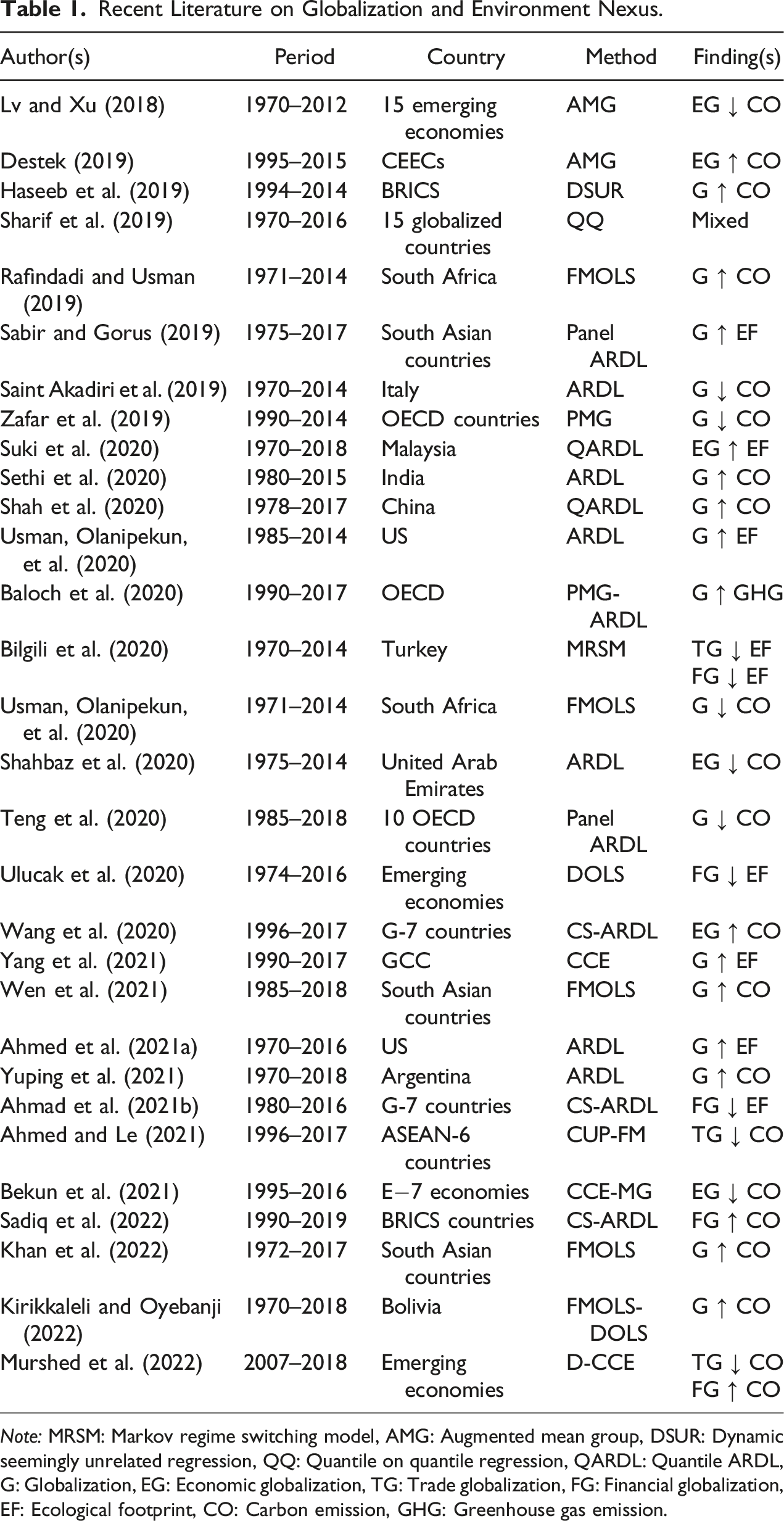
Note: MRSM: Markov regime switching model, AMG: Augmented mean group, DSUR: Dynamic seemingly unrelated regression, QQ: Quantile on quantile regression, QARDL: Quantile ARDL, G: Globalization, EG: Economic globalization, TG: Trade globalization, FG: Financial globalization, EF: Ecological footprint, CO: Carbon emission, GHG: Greenhouse gas emission.
Reviewing the research examining the effects of globalization on carbon emissions reveals that, on general, globalization causes environmental harm in emerging or impoverished countries. For instance, according to Haseeb et al. (2019) for BRICS nations, Rafindadi and Usman (2019) for South Africa, Sethi et al. (2020) for India, Sharif et al. (2020) for China, and Wen et al. (2021) for South Asian nations, a rise in the globalization index increases carbon emissions. However, the data show that globalization cuts emissions in industrialized nations. Indeed, globalization decreases emissions, according to Saint Akadiri et al. (2019) for Italy, Zafar et al. (2019) for OECD nations, and Teng et al. (2020) for 10 OECD countries. According to research based on the ecological footprint, this is not the case. Usman, Olanipekun, et al. (2020) and Ahmed et al. (2021a) have demonstrated that globalization increases the United States’ ecological footprint.
When the consequences of globalization’s sub-dimensions are explored, a small number of research studies have been conducted. Economic globalization minimizes environmental harm, as determined by Lv and Xu (2018) for 15 rising economies and Shahbaz et al. (2020) for GCC nations. In contrary to Destek (2019) and Suki et al. (2020), economic globalization is detrimental to environmental quality in Malaysia. There is numerous research examining the environmental consequences of economic globalization’s subcomponents. Bilgili et al. (2020) discovered that both trade and finance globalization lessen Turkey’s environmental harm. Likewise, Ulucak et al. (2020) and Ahmad et al. (2021b) have demonstrated that financial globalization decreases the ecological footprint. In contrast, Sadiq et al. (2022) found that financial globalization raises carbon emissions in BRICS nations.
In accordance with the primary objective of this study, relatively few studies have examined the de facto and de jure components of globalization. Leal and Marques (2019) investigated the impact of different dimensions of globalization on the environment for high and low-globalized countries using with FGLS method for the period from 1990 to 2016. The study found that de jure economic globalization increases carbon emissions in highly globalized countries. Aluko et al. (2021) compared the relative impacts of de facto and de jure economic globalization on environmental quality in 27 selected industrialized countries for the period of 1991–2016 and validated the environmental degradation reducing the impact of both de facto and de jure economic globalization. Acheampong (2022) examined the environmental effects of de facto economic globalization on carbon emissions with ARDL for the period of 1961–2016 in Ghana and concluded that de facto economic globalization has a neutral effect on the environment.
The few studies that have examined the environmental implications of the de facto and de jure elements of globalization have concentrated on globalization as a whole, as evidenced by the literature. In this study, environmental activities are evaluated by distinguishing de facto and de jure assumptions for globalization as a whole, trade globalization, and financial globalization; so filling a significant vacuum in the literature.
Empirical Strategy
Model and Data
We define environmental degradation as a function of economic growth, energy intensity, consumption of renewable energy, and globalization in the empirical model built to evaluate the environmental consequences of de facto and de jure globalization with overall globalization in 11 transition economies (Bulgaria, Croatia, Czech Republic, Estonia, Hungary, Latvia, Lithuania, Poland, Romania, Slovakia, Slovenia) as follows


Methodology
Preliminary Tests
Although the primary goal of the study is to assess the long-term environmental consequences of various globalization indices, in order to profit from the methodologies that separate short-term and long-term effects, it is required to give the appropriate assumptions through certain preparatory tests. As a result, in the first step of the empirical study, the CD test created by Pesaran (2004) is used to assess the validity of any potential cross-sectional dependency for each variable. The alternative hypothesis claims that the cross-section dependency is valid, despite the null hypothesis of the test indicating that there is no dependency between the cross-sections.
In the second phase, first- or second-generation panel unit root tests are used to determine if the variables are stationary given the findings of the cross-sectional dependency test. Developed by Pesaran (2007), the CIPS unit root test is utilized when cross-section dependence is present. The fact that the test accounts for any shock dependency between countries is by far its most substantial advantage, and its null hypothesis refers to the unit root process of the series. In the third step, panel cointegration tests are used to determine whether the long-term link between the variables is genuine. The Panel ECM-Based cointegration approach created by Westerlund (2007) is employed if the data set contains a cross-section dependence between the variables. The cointegration connection between the variables is deemed invalid by the null hypothesis of the test.
CS-ARDL Procedure
The ARDL test established by Pesaran and Smith (1995) and Pesaran et al. (1999) is updated by Chudik and Pesaran (2015) to include cross-section dependency for panel datasets. It is recognized that it yields consistent results in terms of cross-section dependency and endogeneity in addition to examining the long-term relationship between stationary series at different orders (Chudik et al., 2016). Thus, this method eliminates unobservable co-effects whose omission reduces the precision of elasticity calculation. Managing common correlation bias, and serial correlation issues, and addressing the model’s misidentification bias are further benefits of the CS-ARDL technique (Khan et al., 2021; Dogan & Pata, 2022). The test’s general methodology is as follows
Empirical Findings and Discussions
The results of Cross-sectional Dependence.
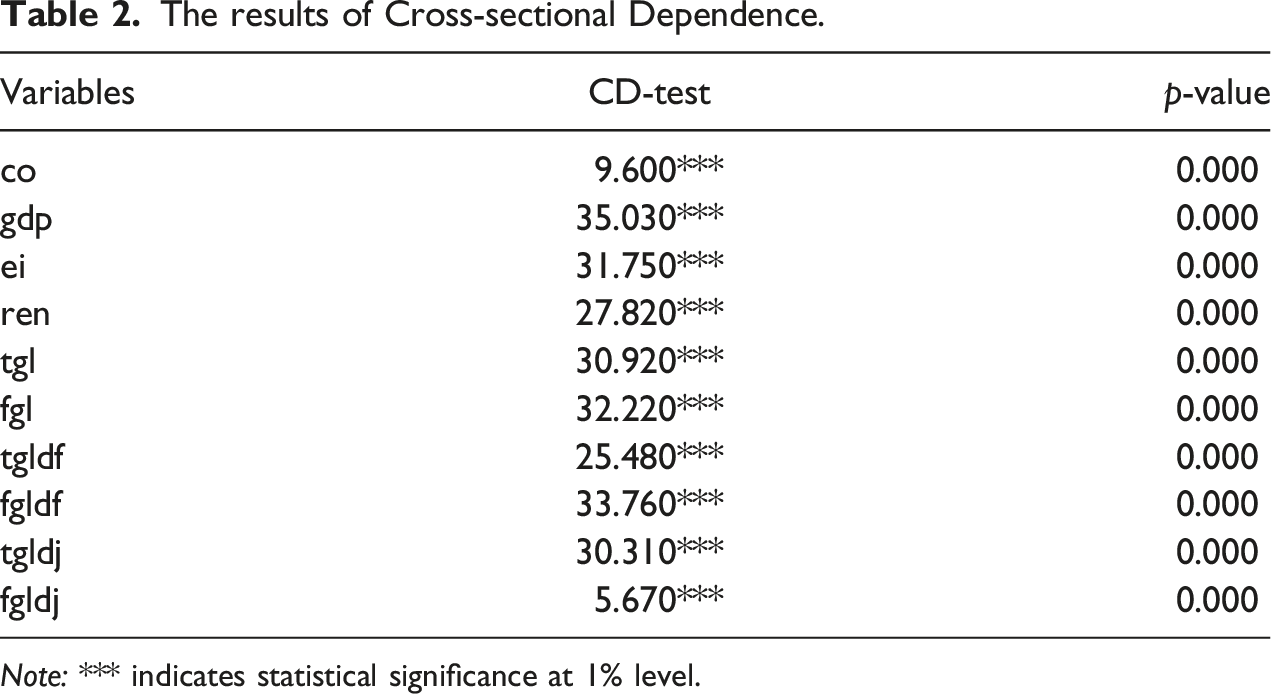
Note: *** indicates statistical significance at 1% level.
The results of Unit Root Process.
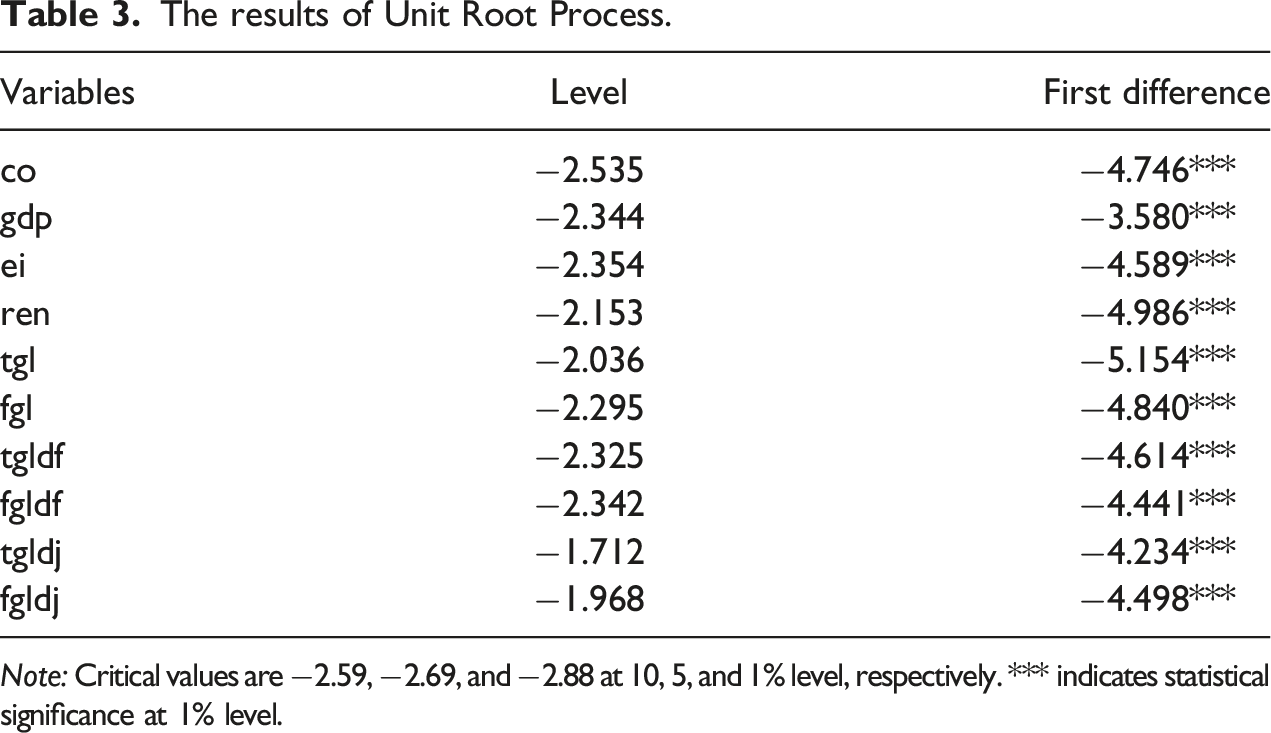
Note: Critical values are −2.59, −2.69, and −2.88 at 10, 5, and 1% level, respectively. *** indicates statistical significance at 1% level.
The results of Panel Cointegration.

Note: *, ** and *** indicate statistical significance at 10, 5, and 1% level, respectively.
The results of CS-ARDL Estimation.
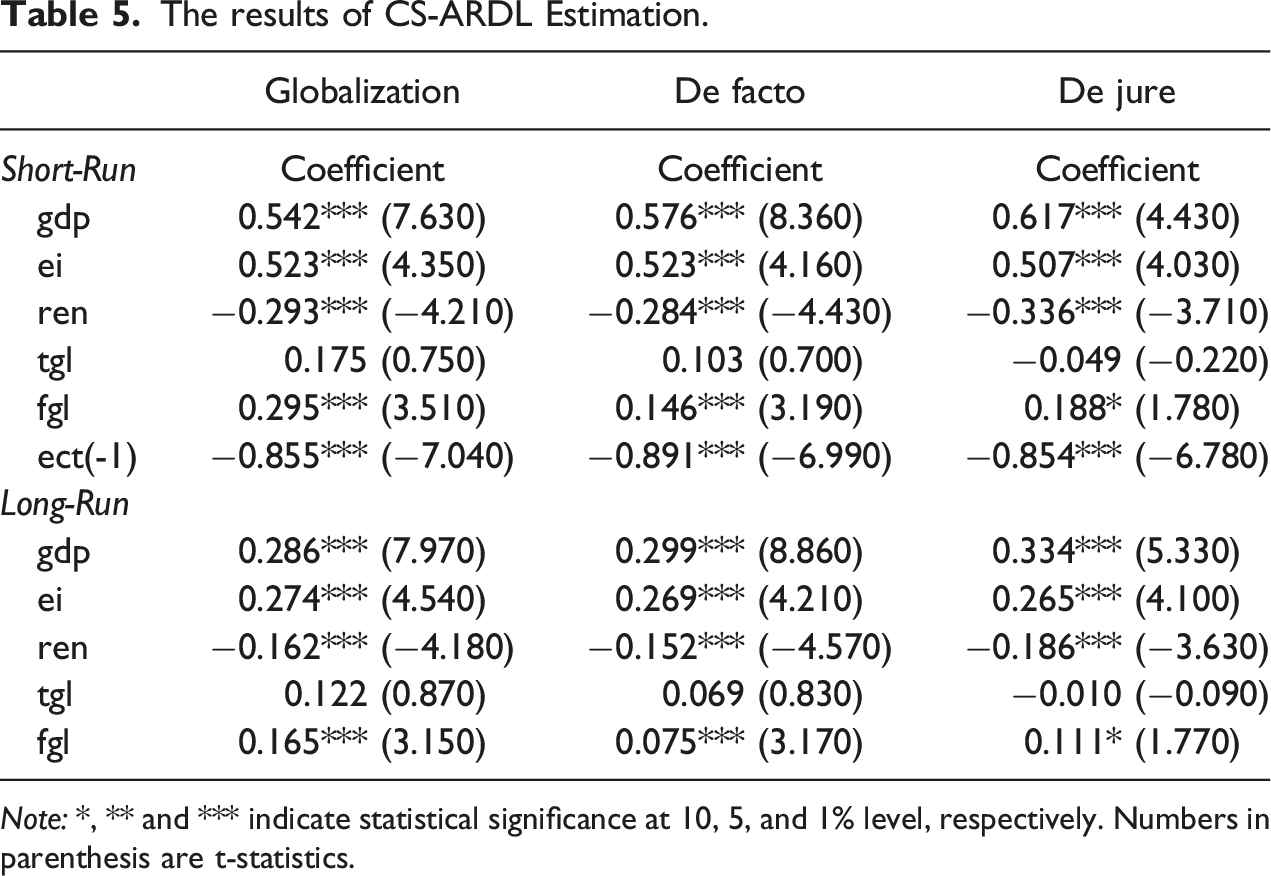
Note: *, ** and *** indicate statistical significance at 10, 5, and 1% level, respectively. Numbers in parenthesis are t-statistics.
In accordance with the overall objective of the study, when the trade and financial globalization indicators are examined, it is shown that although trade globalization has no statistically significant impact on the environment, finance globalization increases carbon emissions. 1% increase in the financial globalization index increases carbon emissions by 0.165%, according to empirical evidence. In addition, based on the findings of the de facto globalization model, de facto trade globalization has no substantial effect on the environment, comparable to global trade globalization. The opposite conclusion is that de facto financial globalization causes environmental damage. In actuality, 1% increase in the de facto financial globalization index results in a 0.075% increase in carbon emissions. De jure trade globalization does not have a substantial influence on the environment; however, de jure financial globalization diminishes environmental quality. In addition, the coefficients for the error correction term (ECT) indicate that short-term shocks adjust in around 14 months.
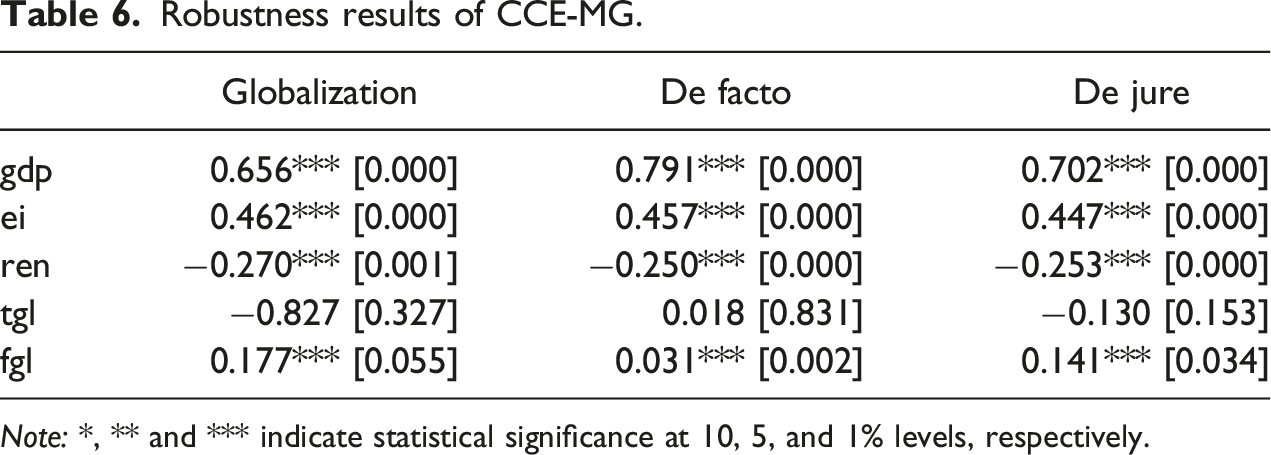
Robustness results of CCE-MG.
Note: *, ** and *** indicate statistical significance at 10, 5, and 1% levels, respectively.
When all findings are taken into account, it is discovered that economic expansion causes environmental harm in transition economies. This finding validates the studies of Shahbaz et al. (2018); Zafar et al. (2022); Destek et al. (2021); Adedoyin et al. (2021); Adebayo et al. (2021); Caglar et al. (2022); Destek et al. (2022); Liu et al. (2022); Manga et al. (2023). The fact that real national income growth causes both short- and long-term environmental deterioration indicates that a parabolic connection, or a Kuznets-type relationship, is not yet relevant for transition economies. This indicates that these nations have not yet reached a level of economic growth that minimizes environmental pollution, that they have not yet undergone a healthy structural transformation process, and that their environmental consciousness is insufficient. On the other hand, the fact that the negative impact of economic expansion on the environment is less than it was in the short term suggests that the negative consequences of growth have shifted from a form in which they are rising to one in which they are diminishing.
Similar to economic expansion, an increase in energy intensity hasten environmental deterioration, according to (Shahbaz et al., 2015; Shah et al., 2020; Ulucak & Khan, 2020; Zaidi et al., 2019). Given that the change in energy intensity is inversely proportional to the rise in energy efficiency, it is reasonable to assert that the growth in energy efficiency has reached a level that adds to the environmental quality of transition economies. Technological advancements often explain energy efficiency, which translates to increased production with less energy usage. In this context, it may be inferred that the studied nations adhere to a successful policy for the transfer of productive or technological capabilities, particularly in energy technologies. On the other hand, it is determined that a rise in the use of renewable energy decreases carbon emissions. This finding bolsters the research of Destek and Sinha (2020); Abbasi et al. (2021); Pata (2021); Sharif et al. (2021). Increasing renewable energy usage within the whole energy portfolio is predicted to minimize environmental damage.
As regards the environmental implications of globalization, it can be seen that the effects of globalization on trade and finance differ. De facto and de jure, the shift in the trade globalization index has no substantial impact on the environmental indicator of transition nations. In light of the fact that de facto trade globalization is explained by the trade of goods and services and the diversity of trade partners, it can be asserted that the countries in question do not pursue an environment-focused policy while increasing their trade activities or increasing the number of countries with which they conduct trade. This circumstance is neither beneficial nor detrimental to environmental quality. In the manufacture of commercial commodities, pollution-intensive items are not prioritized. Similarly, the same holds for the legal globalization of commerce. In their endeavors to expand their trade networks, the policymakers of nations in transition do not prioritize environmental concerns, but rather economic outputs. In their commercial connections with these nations, trade partner countries do not impose environmental requirements. However, the worst-case scenario for the globalization of the financial sector is obvious. Global financial globalization, de facto financial globalization, and de jure financial globalization all have demonstrated negative environmental impacts. This discovery is also consistent with Sadiq et al. (2022). Foreign direct investments are recognized to be one of the most essential components of de facto financial globalization. Typically, the pollution haven theory explains the environmental impacts of foreign direct investments. Developing countries are referred to be pollution havens as a result of the relocation of their pollution-intensive industries to countries with laxer environmental regulations, therefore evading the stringent environmental rules of industrialized nations, particularly those in need of finance. When this scenario is assessed in light of the facts, it becomes apparent that the transition countries, who began the globalization process relatively late, have become a pollution refuge for industrialized nations. The negative impact of de jure financial globalization on environmental quality suggests that the decreasing investment restrictions and international investment agreements of transition countries have been implemented in a manner that facilitates the relocation of investments from pollution-intensive industries to these countries.
Conclusions and Policy Recommendations
In recent years, several countries on a worldwide scale have made varied initiatives to achieve the United Nations' sustainable development goals. Sustainable development, by definition and by its very nature, is predicated on the stipulation that an improvement in one of the sustainable development indicators must not contradict another one. However, the compatibility between the various sustainable development goals must be thoroughly investigated. This study investigates the compatibility between SDG 13 (Climate Action) and SDG 17 (No Hunger) in this environment (Partnerships to achieve the Goal). This study focuses on the influence of various aspects of trade and finance globalization on environmental quality in 11 economies in transition. The period from 1995 to 2018 is evaluated using the CS-ARDL approach, which accounts for cross-sectional dependency and long-term impacts. In addition to examining the effects of globalization indicators, the effects of overall, de facto, and de jure distinctions for trade and financial globalization indices are also investigated. In addition to indices of globalization, environmental implications of real national income, energy intensity, and usage of renewable energy are also detected.
Long-term economic expansion and higher energy intensity enhance environmental harm in transition economies, according to empirical findings. On the other side, increasing the usage of renewable energy minimizes environmental damage. When the data are assessed along the axis of globalization, it is found that the global, de facto, and de jure aspects of trade globalization have no appreciable impact on the environment. In contrast, globalization of finance exacerbates environmental deterioration in its global, de facto, and legal dimensions.
In light of the fact that de facto trade globalization is explained by the trade of goods and services and the diversity of trade partners, it can be asserted that the countries in question do not pursue an environment-focused policy while increasing their trade activities or increasing the number of countries with which they conduct trade. This circumstance is neither beneficial nor detrimental to environmental quality. In the manufacture of commercial commodities, pollution-intensive items are not prioritized. Foreign direct investments are one of the most important components of de facto financial globalization, and the pollution haven theory typically explains the environmental impacts of foreign direct investments. Developing countries are referred to be pollution havens as a result of the relocation of their pollution-intensive industries to countries with laxer environmental regulations, therefore evading the stringent environmental rules of industrialized nations, particularly those in need of finance. When this scenario is assessed considering the facts, it becomes apparent that the transition countries, who began the globalization process relatively late, have become a pollution refuge for industrialized nations. The negative impact of de jure financial globalization on environmental quality suggests that the decreasing investment restrictions and international investment agreements of transition countries have been implemented in a manner that facilitates the relocation of investments from pollution-intensive industries to these countries.
Particularly prominent among policy ideas are those based on foreign direct investment. During globalization, the policymakers of the Transition nations should prioritize environmental criteria in their international investment-attracting agreements. In reality, the negative impact of economic expansion on the environment is directly tied to this circumstance. International corporations investing in these nations must be encouraged to take into account the diverse allure of these nations beyond the pursuit of lax environmental regulations. Various subsidies, tax incentives, and even tax exemptions should be granted in order to encourage businesses that produce with clean and environmentally friendly technology. Before beginning new projects, policymakers may request that foreign investors conduct environmental impact evaluations. This enables the identification of potential environmental concerns and the implementation of mitigating measures. By providing tax breaks and other financial incentives to businesses engaging in clean energy and other environmentally friendly projects, it can help encourage sustainable FDI. It might promote the transfer of technology from international investors to regional companies. This can encourage nearby companies to adopt greener technologies and cut carbon emissions. Finally, they can promote environmental governance by expanding public engagement in decision-making, enhancing information access, and strengthening the ability of regulatory organizations to monitor and enforce environmental laws.
The primary limitation of this research is that it solely addresses the environmental implications of globalization’s economic component. Since that the concept of globalization is complex, future research on the environmental implications of other globalization-related factors (social and political) could provide significant results. In particular, environmental implications should be noted and de facto and de jure indices of social and political globalization should be distinguished.
Footnotes
Declaration of Conflicting Interests
The author(s) declared no potential conflicts of interest with respect to the research, authorship, and/or publication of this article.
Funding
The author(s) received no financial support for the research, authorship, and/or publication of this article.
Data Availability
The datasets will be provided, if required.
