



Abstract
Limited research on diabetes education and support implementation in Appalachia, which is a critical knowledge gap considering barriers to care, and high prevalence rates. The aim was to understand what each facility is providing regarding diabetes education and services within West Virginia. This study reports cognitive interview qualitative findings from a multi-methods study. Individuals were recruited through an online search to identify clinics, organizations, and hospital staff that provided diabetes education in the state of West Virginia. Eligible participants were individuals who facilitated and managed diabetes education and support in counties of West Virginia. The interviews followed an 11-item interview guide, approved, and reviewed by a practicing Registered Dietitian and Certified Diabetes Care Education Specialist in West Virginia. All qualitative data from the interviews were hand-coded using grounded theory, by two researchers. 15 participating organizations from the state of West Virginia were included and described three phenomena: Diabetes Education Implementation (differences in: evaluation measures, modality, delivery format, topical areas); Barriers to Care (staffing, lack of training, evaluation, loss of research partnerships and funding); and Facilitators to Care (community-based involvement, interdisciplinary collaboration, capacity building (trainings). There are concerns with program drift and “risky” adaptations such as inconsistent evaluative measures, lack of training for program facilitators, variety of delivery formats, and content material. Findings recommend more alignment in program delivery to better implementation. Further studies should assess patient experiences with implemented diabetes education programs in West Virginia to further support the current research findings.
Introduction
In 2018, 34.2 million people of all ages had diabetes. Complications of diabetes include hospitalizations for major cardiovascular diseases, amputations, hypo/hyperglycemic crisis, kidney disease, vision disability, and deaths (Centers for Disease Control and Prevention, 2020). Trends in diabetes suggest a higher prevalence of diabetes in certain regions such as Appalachia. The Appalachian region consists of 13 states from southern New York to northern Mississippi (Marshall et al., 2017). Residing in Appalachia can increase the risk of many health outcomes when compared to their urban counterparts (Marshall et al., 2017). For example, West Virginia (WV), which is the only state entirely in Appalachia, has the highest rates of diabetes in the United States with 15.7% in 2020 (Better Policies for a Healthier America and Robert Wood Johnson, 2019; Farberman and Kelley, 2020), and is rural state in the union with two-thirds of West Virginians live in areas with less than 2,500 people reside (U. S. Census Bureau, 2010). As a result, WV faces many rural health-related challenges including lack of access to quality care (Misra et al., 2016; Misra and Sambamoorthi, 2018).
To increase access to diabetes-specific healthcare, WV Department of Health Promotion and Chronic Disease use many approaches to improve diabetic-related health outcomes. For example, implementation of the American Association of Diabetes Accredited program Diabetes Self-management education and support (DSMES). The DSMES is a comprehensive resource that aims to facilitate knowledge, skill, and ability necessary for diabetes self-management (Powers et al., 2016). This program is designed to address patient’s health beliefs about their diabetes diagnosis, cultural needs, current knowledge, physical limitations, health literacy, medical history, family support, financial, and emotional concerns to take on the challenges of self-management (Powers et al., 2016). The intervention of the DSMES has shown cost-effectiveness (Brown et al., 2012), a lower risk for diabetic complications (Brown et al., 2012), improves hemoglobin A1C (Gary et al., 2003), and behavioral aspects to diabetes (Powers et al., 2016), and to increase quality of life (Gary et al., 2003). The DSMES curriculum is depicted for facilitators and describes critical timing for delivery, key information to improve self-management and contains guiding principles including engagement (provide patient-centered care that reflects individual needs and culture), share information (involve patients in decision making), behavioral support (address psychosocial aspects of diabetes), and integrate other therapies (ensure collaboration and referrals from other programming) (Powers et al., 2016). However, the implementation of the aspects to DSMES is wide and varying. For example, The American Diabetes Association (ADA), who provides the standards for diabetes programming, discussed the change in delivery systems (how the intervention is provided), setting (where the intervention is given), and facilitation (who is educating patients) (Powers et al., 2016). Furthermore, current research suggests unreported program implementation (Mau et al., 2009; Sinclair et al., 2020), which can lead to program drift or positive defiance (Chambers and Norton, 2016).
It is important to report and evaluate program implementation to ensure that report health outcomes are in fact due to the implementation strategies embedded within the program intervention. Implementation strategies are evidence-based approaches or the “how to” component of changing healthcare practices (Proctor et al., 2013) and are key elements to implementation science. Implementation science seeks to understand the processes and factors that are associated with integration, sustainability, and adoption of evidence-based intervention within a variety of settings (Rabin et al., 2008). A key factor of understanding implementation is assessing strategies and core components of evidence-based interventions, which are the functions of related activities to achieve desired outcomes (Fixsen et al., 2009; Rabin et al., 2008). Desired outcomes include health outcomes and behavioral outcomes and also implementation outcomes, which describe the deliberate and purposive actions to implement practices and services to serve as indicators for implementation success (Proctor et al., 2010). Further, implementation science aims to understand how evidence-based interventions are adapted or transported into real-world settings, which is necessary to identify aspects to how programs are implemented as intended (Brownson et al., 2018; Gearing et al., 2011). However, implementation strategies (Proctor et al., 2013), adaptation (Chambers and Norton, 2016), and implementation outcomes (Proctor et al., 2010; Weiner et al., 2017) are regularly go unreported, specifically in nutrition interventions such as diabetes education (Mau et al., 2009; Sinclair et al., 2020). While current research assess implementation of DSMES in Hawaii (Mau et al., 2009; Sinclair et al., 2020), limited research on how DSMES is implemented in Appalachia, which is a critical knowledge gap especially considering barriers to care, and high prevalence rates. Additionally, in 2020, the WV Diabetes Action discussed implementation of the DSMES and evaluating behavioral and implementation outcomes (Division of Health Promotion & Chronic Disease, 2020). Therefore, the objective of this research study is looking to gain a better understanding of what each facility is providing regarding diabetes education and services within West Virginia. As well as discuss current barriers to care within the state and gain professional opinions on how to over those barriers.
Methods
This study received West Virginia University Institutional Review Board (IRB) approval (protocol number 201174400) in June 2021. Consent for the interview was written consent, via email to participants who expressed into in the study and asked for a signature then to be returned to the researchers via email.
Individuals were recruited through this study through an online search to identify clinics, organizations, and hospital staff that provided diabetes education in the state of WV. Eligible participants were individuals who facilitated and managed diabetes education and support in counties of WV.
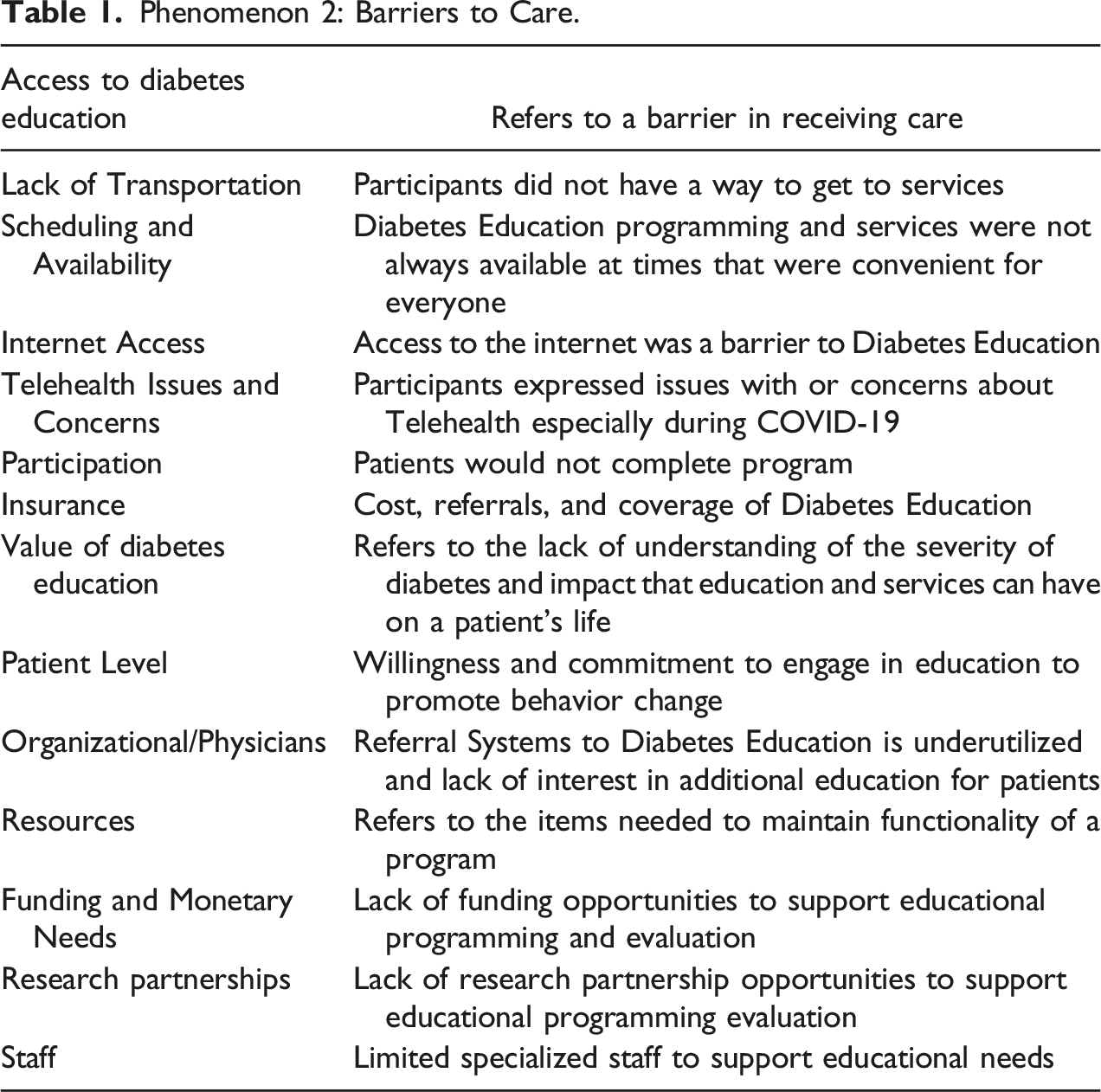
Phenomenon 2: Barriers to Care.
Analysis
All qualitative data from the interviews were hand-coded for themes using grounded theory (Malterud, 2001), by two researchers (AEW & KY). Researchers independently created coding dictionaries following the process of grounded theory (Glaser and Strauss, 2017) and then collaboratively reviewed and decided upon themes. Grounded theory provides a framework that emphasizes emerging themes or processes to form a central phenomenon that provide insight to a given situation (Creswell and Poth, 2016). The two researchers (AEW & KY) began with open coding, which aggregates data to form major categories. Then, axial coding emerged, in which the evaluators identified focused codes or overarching phenomenon. These core or overarching phenomena become the major theme in which data is placed into additional subcategories that relate to, explain, and provide evidence for the phenomenon. This process was completed for each interview and cataloged as an individual coding dictionary produced by one researcher (KY). Then, a secondary researcher and reviewer, collaboratively discussed phenomenon and categories with primary reviewer (AEW) to ensure discrepancies were addressed. Once this was completed, a larger coding dictionary was created for the entire dataset simultaneously by both researchers (AEW & KY).
Results
Organizational Demographics
Interviews were conducted with 15 participating organizations (25% response rate) from the state of WV delineated in Figure 1. While the interviews are not representative of the entire state, this study did provide organizations from a variety of different regions of WV and provides an insight to diabetes care. For example, 14 out of the 15 organizations treated Type 1 Diabetes, Type 2 Diabetes, prediabetes and gestational diabetes populations. The majority (12/15) of the organizations treated white individuals aged 45–65. Provider demographics varied including some CDCES (5/15); RDN (2/15); master’s in nutrition (1/15); Nursing (4/15); Pharmacy (3/15); Bachelors’ in Psychology (1/15); Masters’ in Public Health (1/15); and other (5/15) including lifestyle coaching, personal experience with diabetes, or work experience. Locations of Interviewed Facilities. Red dots indicate locations of interviewed organizations within a given county (in gray) in the state of West Virginia.
Diabetes Education and Care Implementation
The results from the thematic analysis categorized data into three themes or central phenomenon of interest with corresponding coding categories or subthemes with supporting quotes or synthesized data. The three central phenomena are visualized with subthemes and descriptions below. Salient quotes are used to provide description and example of the ideas categorized in the phenomenon or themes. The first phenomenon, Diabetes Education Implementation (Figure 2), describes the variety of intervention and implementation approaches to patient care among interview participants, which has four subcategories. The second phenomenon, Barriers to Care (Table 1), is defined by actual barriers to implementation and sustainability of diabetes education identified by participants and has three subcategories with initial codes supporting subcategories. The last phenomenon, Facilitators to Care, outlines strategies that address program implementation challenges, which has three subcategories or strategies discussed Figure 3. Phenomenon 1: Diabetes education implementation.
Discussion
The implementation of programs is an essential component of intervention effectiveness; yet, quite often underutilized, specifically in nutrition education interventions (Tumilowicz et al., 2019; Walker et al., 2021; Warren et al., 2020). Accredited Diabetes Education and Services, such as DSMES, has been shown to improve health outcomes (Gary et al., 2003), if implemented as intended governed by the National Standards for DSMES (Beck et al., 2017; Davis et al., 2022). In 2022, the DSMES standards were updated to six standards that describe support; population and service assessment; the DSMES Team; delivery and design; person-centered DSMES; and measuring and demonstrating outcomes of the DSMES services, ultimately to ensure programming is evidence-based and relevant to a variety of populations (Davis et al., 2022). This study highlighted many implementation infidelities comparatively to the standards within interviewed non-accredited programs and accredited programs in WV, in which implementation infidelities can impact negatively impact intended behavioral outcomes of programming if not assessed and addressed (O'Connor et al., 2007; Rabin et al., 2008). Phenomenon 3: Facilitators to care.
An overwhelming majority of participants described not evaluating or reporting their implemented diabetes education or services, which is a crucial aspect of all six DSMES standards. This finding is hoisted by only three programs interviewed were accredited by the ADA. Participants described limited motivation to evaluate programming if they did not have the resources to report to a governing body (such as the ADA). This is further negatively impacted by WV not having its own state-level ADA to assist and advocate for West Virginian’s access to accredited DMSES. A strategy to address the lack of evaluation and accreditation, is to support collaborative measures between researchers, accrediting bodies, universities, and diabetes education and support services. For example, previous studies discussed the importance of cultural adaptations, community involvement, and relevant experiential and strategy-based information for successful and effective DSMES implementation (Sinclair et al., 2020). In comparison, results from this study suggest that for program implementation to be successful, cultural competence and community involvement is necessary, which aligns with the findings from studies on diabetes program implementation (Sinclair et al., 2020). Therefore, future WV DSMES implementation should attempt to highlight culture and experiences of the community to better engage the population. To do so, more resources such as funding, interdisciplinary teams, and staffing are needed. Ultimately, if WV had its own ADA, there may be more funding, resources, and staffing needed to ensure adaptations to the DSMES and other programming are evaluated for effectiveness.
More so, this study highlighted many program adaptations to curricula such as removing topical areas, shortening interaction time, and using a variety of staff (trained or untrained) to implement diabetes programming. According to O’Connor and colleagues (2007), many of these adaptations are “risky or unacceptable” adaptations and can lead to program infidelity (O'Connor et al., 2007). Program fidelity describes the evaluation and sustainability of implementing a program as intended (Brownson et al., 2018; Gearing et al., 2011). Fidelity is an essential aspect of program implementation as it ensures that the program follow rigorous, evidence-based interventions, protocols, and guidelines, which provide promise of effectiveness and ultimately behavior change (O'Connor et al., 2007; Rabin et al., 2008). While adaptations are hard to avoid and necessary sometimes such as changing language, replacing images to promote diversity, addressing cultural differences, and adding relevant, evidence-based content, failure to report “risky” adaptations promotes program drift (O'Connor et al., 2007; Rabin et al., 2008). Program drift describes when an intervention is adapted either with intent or unintentional delivery through changes to program content, duration, delivery style and may diminish program effectiveness, especially if it is underreported or lacks evaluation (Chambers and Norton, 2016). The qualitative results reported in this study, identified concerns with program drift and “risky” adaptations such as inconsistent evaluative measures, lack of training for program facilitators, variety of delivery formats and content material. Chambers and colleagues (2016) urge researchers and program evaluators to utilize frameworks, such as the Adaptome Framework, to assist in reporting adaptations, which can emphasize positive deviance (when adaptations lead to better outcomes compared to original trials) of an intervention (Chambers and Norton, 2016). While adaptations of an intervention can lead to positive results (positive deviance), the concerns from this study are the lack of reporting and evaluation of program implementation, intervention adaptation, and behavioral outcomes.
Limitations
While this study provides key insights and highlights current implementation of some diabetes care and services in WV, it is not generalizable given the sample size and low response rate. This sampling technique was an attempt to engage as many participants as possible from a variety of practice settings. However, with voluntary participation schemes, this could contribute to more participation from programs that report better implementation. Similarly, the low response rate could contribute to sampling bias. Therefore, reported results are a convenience sample and are not generalizable; but provides formative information about diabetes program implementation in WV.
Conclusions and Key Recommendations
The study results suggest the importance of implementation evaluation of health programming, particularly diabetes education. Little is known about how adaptations to these curricula. Based on interviews and the discussion of findings, there are many key recommendations for evolving diabetes education and services in West Virginia. To start, many interviewees described the importance of engaging with the community to understand their needs to incorporate into curriculum. These cultural adaptations are necessary and typically are counted as acceptable (Chambers and Norton, 2016; O’Connor et al., 2007). By ensuring the intervention is acceptable among the community, typically leads to higher engagement and reach of programs (Glasgow et al., 1999, 2006, 2019). Therefore, future research should interview and involve the community and program participants to understand the individual impact of diabetes resources and programs. Additionally, participants mentioned more interdisciplinary training and involvement among care teams to promote collaboration and a general value and competency towards diabetes care and services. For example, webinars, organizational/hospital meetings to explain the 2022 National Standards for DSMES, would assist in building a knowledge base around the standardized practices for implementation (Davis et al., 2022). Lastly, it is essential to build capacity (funding, resources, knowledge, and partnerships) among organizations employing diabetes education and support to encourage evaluation of program implementation. For example, trainings in implementation science foster ideas in collaboration, and offer evidence-based frameworks for evaluation and adaptations to researchers and practitioners (Proctor and Chambers, 2017; Walker et al., 2021, 2023).
Key Recommendations
1. Engage and report cultural, community adaptations needed for participant involvement in programs. 2. Provide trainings for the multidisciplinary care team to change perceptions of diabetes education need and implementation science. 3. Work with local, state, and national organizations to identify partnerships and funding opportunities to assist in building capacity for evaluation standardization.
Footnotes
Author Contributions
All authors contributed to the study conception and design. Material preparation, data collection and analysis were performed by [Ayron E Walker], [Kasey Yost], and [Melissa D. Olfert. The first draft of the manuscript was written by [Ayron E Walker] and all authors commented on previous versions of the manuscript. All authors read and approved the final manuscript.
Declaration of Conflicting Interests
The author(s) declared no potential conflicts of interest with respect to the research, authorship, and/or publication of this article.
Funding
The author(s) disclosed receipt of the following financial support for the research, authorship, and/or publication of this article: This study was funded by the West Virginia Agricultural and Forestry Experiment Station Projects WVA00689 and WVA00721.
Review Board Statement
This research study was approved by the Institutional Review Board at West Virginia University (201174400). Written consent was obtained prior to the collection of any information.

Data Availability Statement
The datasets generated during and/or analyzed during the current study are available from the corresponding author on reasonable request.