




Abstract
To improve one of the lowest rates of literacy and numeracy in the world, the government of Brazil has targeted public education reform, given the strong link between an educated population and economic growth. This study examines the academic performance of the Brazilian public primary school system. It addresses the empirical shortcomings of prior research to examine the dynamics of the relationship between academic performance scores and several demographic and institutional variables, such as socioeconomic characteristics, variations in school infrastructure and school complexity, and teachers’ human capital. We employed quantile regression to explore the determinants of academic performance across 35,490 schools in rural and urban environments in Brazil. The dependent variable in our analysis captures the academic performance score, as measured by Brazil’s education authorities, of each school in our dataset. The model includes several education-related indices used in prior research and, as explanatory factors, measures of teachers’ human capital and the students’ socioeconomic level, which synthesizes information on parents’ education and household income. The results suggest that several institutional variables, including access to school libraries, computer facilities, projectors, and televisions, are positively and significantly related to the academic performance of primary students in Brazil’s system of public education. Furthermore, students’ socioeconomic level is positively associated with their academic performance.
Introduction
According to the Organization for Economic Cooperation and Development (OECD, 2017), Brazil has one of the lowest rates of literacy and numeracy, only 35%. 1 Countries at the top of this ranking maintain rates at or higher than 85% (OECD, 2017). To tackle the problem that a study by Mbiti (2016) indicates persists across the developing world, the Brazilian government adopted the National Plan of Education (PNE) 2014–2024. The PNE has 10 targets related to the Índice de Desenvolvimento da Educação Básica (IDEB) (Basic Education Development Index) that focus on placing Brazil on the same educational level as developed countries (Alves & Soares, 2013). These targets, as analyzed by Almeida et al. (2013), include student access to schools, student performance, school quality, and teacher supply and compensation. 2
The government’s focus on literacy and numeracy rates is understandable. The importance of an educated populace in stimulating national economic growth is well established in the economics literature. 3 The critical role played by teachers in educating the population has received increasing attention. For example, Hanushek (2011) found that a teacher who is a single standard deviation above average in terms of pedagogical effectiveness produces marginal gains of more than $400,000 per year when working with a class enrollment of 20. For the U.S., this finding suggests that if the least effective 5%–8% of teachers in the U.S. were replaced with teachers of average pedagogical skill, the education system would rank first in STEM fields, yielding an economic benefit (i.e., the present value of the relative increase in world ranking) of $100 trillion (Hanushek, 2011). The benefits to a less developed country such as Brazil from a similar realignment would also be quite remarkable.
Other covariates that explain academic performance within and across a country’s public school system include socioeconomic characteristics, school infrastructure, and complexity. 4 Although many studies have analyzed the different impacts of environmental conditions on school outcomes, none has analyzed how their impacts vary across both high- and low-performing schools, as well as across both urban and rural settings. The identification of differences between these types of comparisons is central to the formulation of more efficient education policies. Some studies have identified the determinants of IDEB results using logistic regression, while others have identified the influence of internal and external school factors through hierarchical linear regressions. 5 However, both methodologies fail to explain how these factors influence schools with different IDEB results. We aim to find the answer through the utilization of a quantile regression approach.
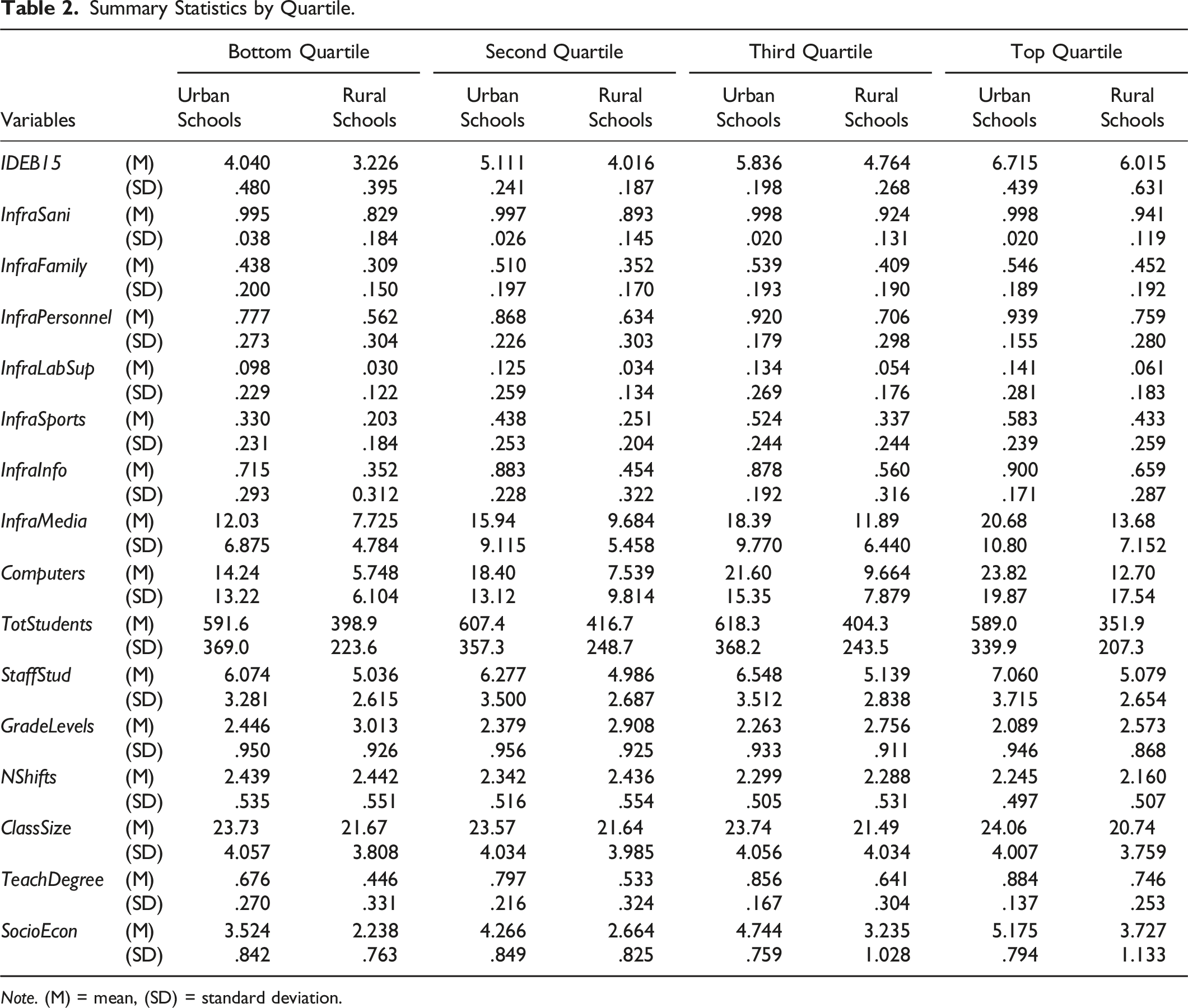
This study extends the literature by investigating the different impacts of various demographic and institutional variables (e.g., socioeconomic characteristics, school infrastructure, school complexity, and teachers’ human capital) on academic performance for high- and low-performing schools as well as urban and rural schools. In doing so, we address the empirical shortcomings of prior research by employing quantile regression to examine the relationships between academic performance scores, measured using the IDEB scores, 6 and data from 35,522 primary schools from the 2015 Instituto Nacional de Estudos e Pesquisas Educacionais Anísio Teixeira (INEP) census. The results find a set of education infrastructure variables related to information technology and multimedia, sanitation, personnel support, and sports to be positively and significantly related to the academic performance of primary students in Brazil’s system of public education. Additionally, both teachers’ human capital, measured by college degree completion, and the socioeconomic level of parents, captured by synthesizing parents’ education and household income information, are positively associated with academic performance. However, these variables differently impact urban and rural schools with high- and low-academic performance. For example, while socioeconomic status is relevant for low-performing schools, the professional qualifications of teachers have a greater impact in high-performing ones. This dynamic changes for rural schools, where socioeconomic conditions are almost identical between schools with lower and higher performance; however, teachers’ education is four times higher in high-performing schools.
In the next section, we provide a review of prior literature, with particular attention to published work on the relationship between education infrastructure, teachers’ human capital, and the academic performance of primary students. The Methodology and Data section presents the empirical methodology and data. The econometric results are presented and discussed in the Estimation and Results section, and concluding remarks follow in the last section.
Literature Review
We examine extant literature on the relationships between school infrastructure/teachers’ human capital and the academic performance of primary students. With each relationship in mind, we also focused on the research on the primary education system in Brazil.
School Infrastructure
A review by Glewwe et al. (2011) of the early literature (published between 1990 and 2010) investigates which specific school characteristics, if any, have positive impacts on education attainment. Based on the analyses of more than 75 high-quality studies, they conclude that almost all of the estimated impacts on time in school and learning of most school characteristics are statistically insignificant, especially when the evidence is limited to the highest-quality studies. The availability of desks is one of the few variables that has a positive effect on academic performance (Glewwe et al., 2011). More recent studies, such as Glewwe et al. (2020) and Hanushek (2020), further explore the role of school infrastructure on academic performance. The later studies point out that commonly purchased inputs in schools, including class size, teacher experience, and teachers’ education levels, exhibit weak relationships to student outcomes, suggesting that traditional education policies to improve input usage may not improve achievement (Hanushek, 2020). Hanushek (2020), however, reports that differences in teacher quality, defined in terms of effects on student performance, are important, even if they are not closely tied to salaries or other teacher attributes.
An early study by Branham (2004) employed data from 226 Independent School District schools in Houston in the US to explore the effect of school infrastructure on student attendance and dropout rates. Although the study found that the quality of school infrastructure has a direct effect on school attendance, it does not offer similar evidence regarding academic performance. That missing link is, however, provided in Durán-Narucki (2009), which examined data from 95 elementary schools in New York City on school building conditions and the results of standardized tests on English and math, and concluded that students attending schools with sub-standard facilities attended fewer days on average and had lower test scores on both subjects. Hong and Zimmer (2016) examined the causal impact of capital expenditures on school district proficiency rates in Michigan and found that these have positive effects on the academic proficiency levels of seventh grade students.
More recently, Adukia (2017) investigated the importance of adequate sanitation on the educational attainment of young girls in India using school-level data to show mixed results in that although school bathroom construction substantially increased the enrollment of young girls, academic scores did not increase following their construction. Conlin and Thompson (2017) analyzed the Ohio School Facilities Commission Classroom Facilities Assistance Program, which disbursed over $10 billion toward the improvement of local school facilities in 231 school districts between 1997 and 2011. They found, in line with Durán-Narucki (2009) and Hong and Zimmer (2016), that the percentage of students in the school district testing proficient in math and reading increased once the new and renovated buildings were ready (Conlin & Thompson, 2017). Lastly, Cuesta et al. (2016) examined the economics and education literature published from 1990 to 2012 to assess the extent to which specific types of school infrastructure have a causal impact on student learning and enrollment. They present evidence that school libraries and the creation of new schools lead to improved learning and enrollment. The literature also provides evidence that access to adequate bathroom facilities improves student learning, while laboratories and drinking water facilities increase enrollment (Cuesta et al., 2016).
Regarding research on this strand on Brazil, Franco et al. (2007) analyzed the relationship between school efficiency, as measured by the average performance of schools, and school characteristics associated with school performance. They found that infrastructure and school resources make a difference in education, but they vary widely across the country. Alves and Soares (2013) explored the relationship between IDEB scores and school infrastructure in Brazil and found, when controlling for other characteristics, that school infrastructure has a positive impact on IDEB scores. Pieri and Santos (2014) used factor analysis to explore the School Infrastructure Index (IIE), which captures student access to running and filtered water, sewage, concrete buildings, garbage collection, electricity, sports facilities, libraries, restrooms, laboratories, media equipment, computers, and printers. 7 They found that IIE explains 23% of the variation in academic performance, and that academic equipment and physical plant variables have the greatest impact on proficiency exam results. Most recently, Matos and Rodrigues (2016) examined 36,236 schools to evaluate the main factors allowing public schools in Brazil to reach the IDEB target; they reveal that for elementary schools, the most important factor is school infrastructure, but school complexity exerts a negative impact on a school’s ability to maintain IDEB standards (Matos & Rodrigues, 2016). However, as pointed out earlier, Pieri and Santos (2014) and Matos and Rodrigues (2016) employ hierarchical and logistic approaches, respectively, which did not explain how key intra-school and socioeconomic factors influence schools with different IDEB results.
Teachers’ Human Capital
Friedman’s (1964) seminal study examined educational background and its relation to compensation of public school teachers in New York City when the city school board opted to hire teachers with post-baccalaureate education levels, beyond those required by teacher certification processes. Since this early study, attention has shifted to the importance of teachers’ human capital in boosting academic performance. In one such example, Croninger et al. (2007) assert that a primary function of education policy is to assess whether teacher qualifications such as certification status, degree level, preparation, and experience predict student achievement. This study, which employs data from the Early Childhood Longitudinal Study (ECLS) to analyze the relationship between elementary school teacher qualifications and first-grade achievement in reading and mathematics, has found positive effects of teachers’ degree type and experience on reading achievement, while certification status is not a significant determinant of academic performance (Croninger et al., 2007).
Metzler and Woessmann (2012) estimated the causal effect of teacher subject knowledge on student achievement using a unique Peruvian dataset that tested both sixth-grade students and their teachers in math and reading. They find that one standard deviation in subject-specific teacher achievement increases student achievement by 9% of the standard deviation in math. However, the effects in reading are found to be much smaller and, in most cases, not statistically significant (Metzler & Woessmann, 2012). Next, Cebula et al. (2015) used Academic Performance Index (API) data from high schools in Los Angeles County (California) to examine the relationships between school performance (at the high school level) on standardized exams and both teacher pay/salaries and teacher quality, where the latter is measured by teachers’ human capital. They show that both teacher pay and teacher quality exercise positive impacts on school performance—an increase from the lowest to the highest range of teacher pay and teacher quality generates academic performance improvement of approximately three and six percentage points, respectively (Cebula et al., 2015).
In terms of research using data from Brazil, Pieri and Santos (2014) used factor analysis to explore the Index of Instructor Education (IFP), which captures teachers’ human capital. 8 They report that the IFP explains 45% of the variation in academic performance and that the most important variable is whether the teacher holds a bachelor’s degree. Interestingly, holding a “magistério” (teaching certificate) exerts a negative impact on the proficiency exams results. Finally, da Fonseca and Namen (2016) investigated how instructor profiles influence math instruction; they find that low wages impede math learning.
Methodology and Data
Prior empirical studies on academic performance have employed hierarchical linear models (Almeida et al., 2013) and logistic regression (Koslinski et al., 2014; Matos & Rodrigues, 2016). However, these methodologies fail to explain how prominent intra-school and socioeconomic factors influence schools with different IDEB results. We address these empirical shortcomings by employing quantile regression to explore the determinants of academic performance across schools in Brazil. This approach follows Koenker and Bassett (1978), who present a quantile regression model that yields robust estimators from the quantiles of the dependent variable, and Koenker and Machado (1999), who improved upon this foundational methodology. One of the advantages of quantile regression is that it allows for the analysis of the full range of the dependent variable while also adjusting the independent variables in each quantile, which addresses heteroskedasticity. We apply the Koenker and Machado (1999) methodology to a variation in quantiles from .02 to .98, with increments of .01, to estimate the following regression specification
9
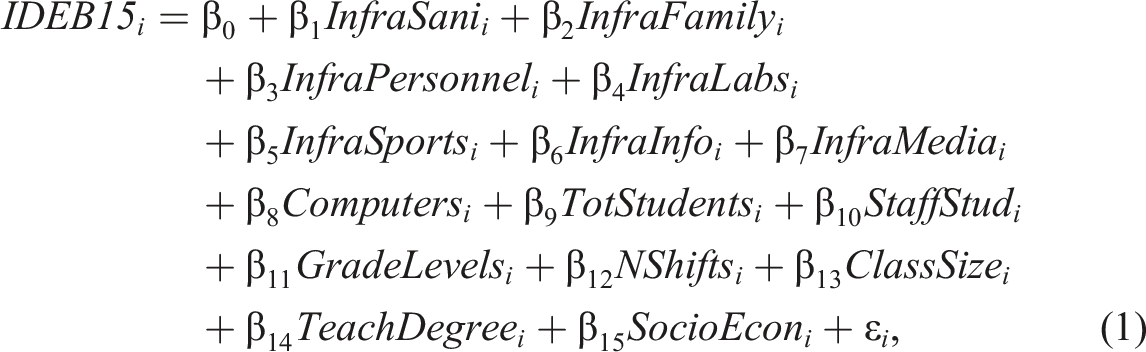
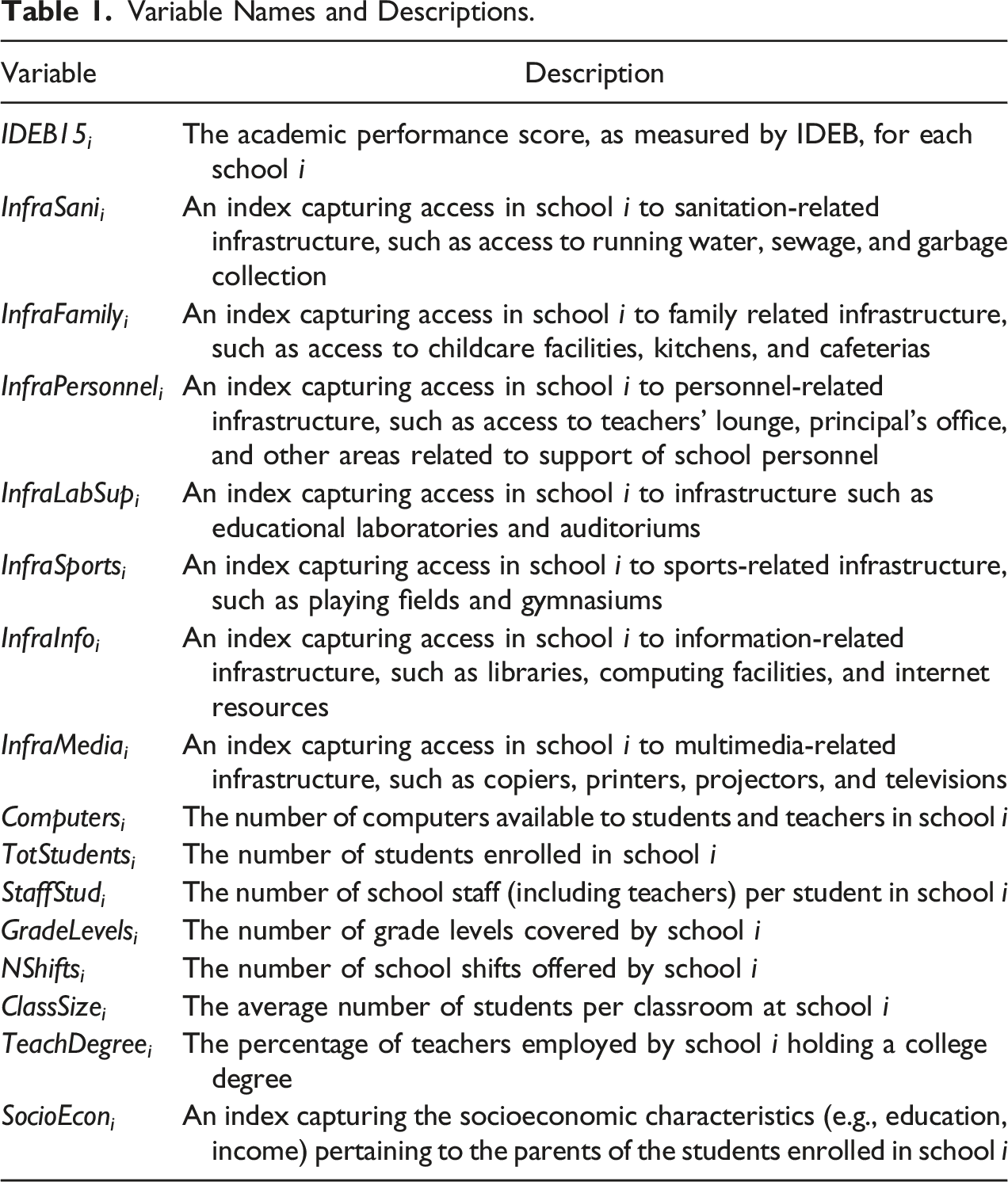
Other indices included in (1) are InfraFamily i , InfraPersonnel i , and InfraLabs i , and they constitute indices related to (a) access to childcare facilities, kitchens, and cafeterias; (b) access to teachers’ lounge, principal’s office, and other areas related to support of school personnel; and (c) access to educational laboratories and auditoriums. Each of these infrastructure variables is expected to be positively related to IDEB15 in (1) above, as are InfraSports i , InfraInfo i , and InfraMedia i , the indices related to (d) access to sports-related infrastructure, such as playing fields and gymnasiums, (e) access to information-related resources, such as libraries, computing facilities, and internet resources, and (f) access to multimedia-related infrastructure, such as copiers, printers, projectors, and televisions, respectively.
Also included on the right-hand side of (1) is Computers i , representing the number of computers available to students and teachers in school i. Burney et al. (2013) assert that this resource is particularly useful to both teachers and students. Therefore, Computers i is expected to be positively related to IDEB15 i . The variable attached to β10, StaffStud i is equal to the number of school staff (including teachers) per student enrolled in school i. It is included as a secondary index of school infrastructure (see Pieri & Santos, 2014). Each is expected to carry a positively signed coefficient in the empirical estimation of (1).
Additionally, several school complexity variables are included in equation (1). These are TotStudents i , GradeLevels i , and NShifts i , representing the number of students enrolled in school i, the number of grade levels covered by school i, and the number of school shifts offered by school i, respectively. 11 Research on school size as an element of school complexity by Lee et al. (2004) supports the notion that school size negatively affects student achievement. A negative expectation is similarly attached to GradeLevels i and NShifts i . Also included in school complexity is ClassSize i , which is the average number of students per classroom at school i. Although Matos and Rodrigues (2016) do not find a statistically significant effect on academic performance in Brazil from this variable, Crahay (2007) and Pieri and Santos (2014) provided support for us to include this variable in (1).
The penultimate regressor in (1) is TeachDegree i , which is the percentage of teachers employed by school i holding a college degree. In Brazil, the requisite qualification to teach in elementary schools is “magistério,” comparable to a high school diploma in the U.S. One of the kay targets of Brazil’s national plan (P. Brasil, 2014) is to raise this to a college degree. The literature emphasizes the importance of teachers’ human capital in shaping the academic performance of primary students (e.g., Croninger et al., 2007; Friedman, 1964; Metzler & Woessmann, 2012). Cebula et al. (2015) have found that teacher qualifications (human capital) support the academic performance of students in the U.S.; their findings are supported by Matos and Rodrigues for Brazil (2016). Thus, the parameter estimate attached to TeachDegree i in (1) is expected to be positive.
Finally, the variable SocioEcon i was included to capture the socioeconomic level of the parents of Brazil’s primary students. Specifically, it is the family socioeconomic level of the National Literacy Assessment (ANA), organized into seven levels; level one being the lowest and level seven the highest. It is a latent variable inferred from the other observable variables and synthesizes information on parents’ education and household income (M. Brasil, 2014). 12 Several studies have examined the impact of socioeconomic status on academic achievement, including Cebula et al. (2015), which, in its examination of the academic performance index (API) across Los Angeles County high schools, includes free lunch recipients. A contemporaneous study by Firpo et al. (2015) for Brazil includes socioeconomic status in an analysis of the determinants of students’ outcomes in the fifth grade of elementary school. Based on these studies, we expect that SocioEcon i will be positively related to IDEB15 i .
Variable Names and Descriptions.
Summary Statistics by Quartile.
Note. (M) = mean, (SD) = standard deviation.
Correlation Coefficients.
Estimation and Results
OLS Regression Results for Urban Schools: Dependent Variable = IDEB15.

Note. ***[*] denotes significance at the .01[.10] level.
Interestingly, larger schools and those offering more study shifts enroll students whose academic performance trails that of smaller schools and schools offering fewer study shifts. However, the result for the latter groups is not significant. Urban schools encompassing many grade levels and larger class sizes also enroll students whose academic performance lags behind that of schools with fewer complexities. A larger school staff relative to the student body is associated, as expected, with greater academic performance. Lastly, teachers’ human capital, proxied by TeachDegree, is positively and significantly related to IDEB15. This is a noteworthy result that supports those of Croninger et al. (2007), Metzler and Woessmann (2012), and Cebula et al. (2015).
A quantile regression-based graphical analysis of urban schools is provided in Figure 1. We present the estimator (on the y-axis) of each variable with respect to the quantile intervals examined (on the x-axis), where the red lines represent the coefficients from the OLS regression, and the black dots and gray areas represent the coefficients from the quantile regression and confidence intervals, respectively. Schools with the lowest IDEB15 scores reside in quantiles close to zero in each diagram, while each diagram also includes the average value of the coefficient along with its standard errors. Where the value on the y-axis is positive, the variable is positively related to IDEB15. Quantile regression for urban schools: Dependent variable = IDEB15.
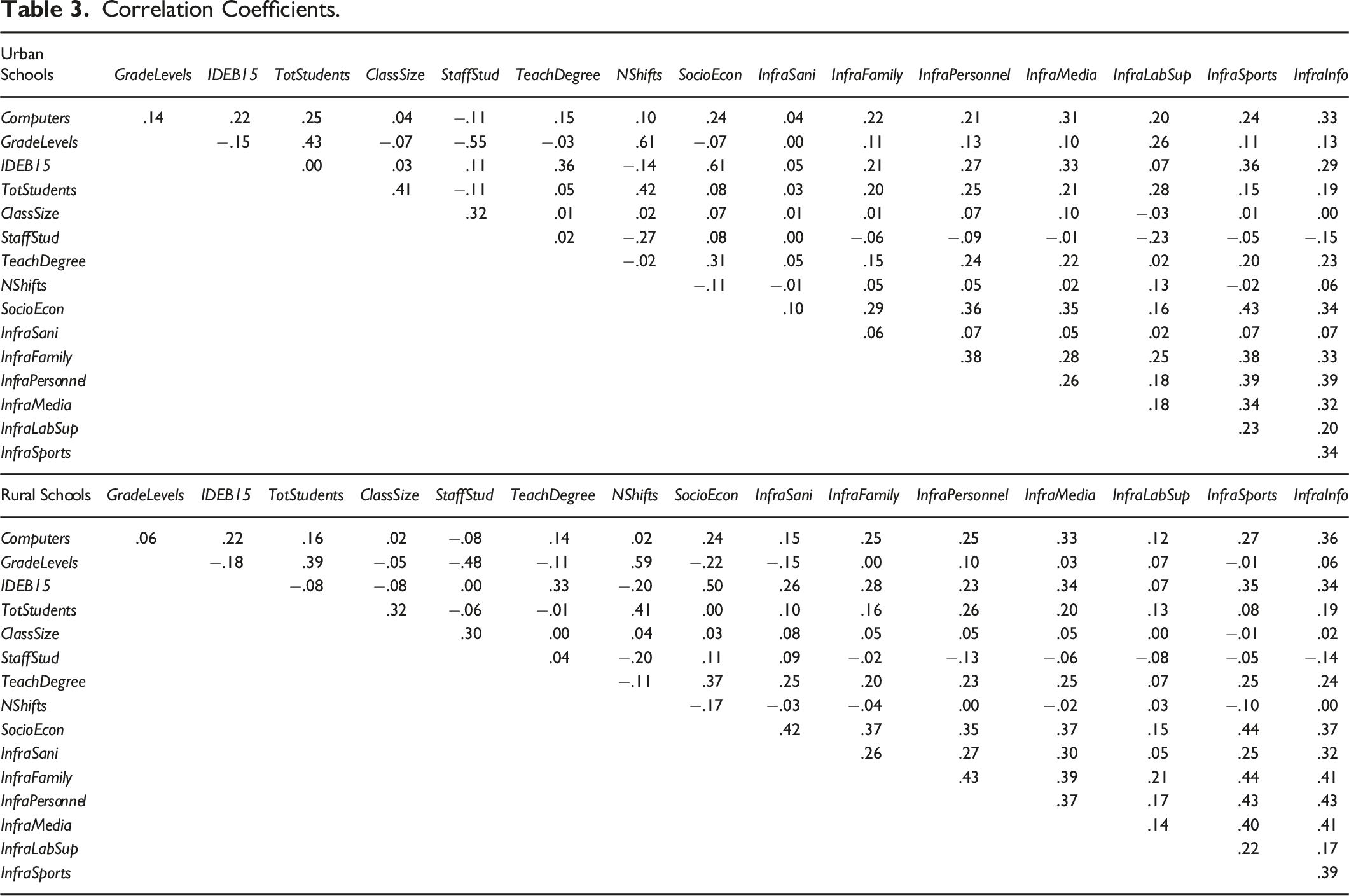
The results in Figure 1 indicate that InfraInfo and Computers were both positively related to variations in IDEB15 across urban schools in Brazil. Additionally, TeachDegree is positively related to variations in IDEB15 across urban schools in Brazil. This result supports those of Croninger et al. (2007), Metzler and Woessmann (2012), and Cebula et al. (2015), and may also be linked to differences across schools regarding teaching methods and other factors (see Haguette et al., 2016). Interestingly, the correlation between socioeconomic status and academic performance across schools is weaker among higher-achieving schools. Li et al. (2020), citing Costello et al. (2003) and Neville et al. (2013), point out that improving family economic conditions reduces children’s risk of psychiatric disorders, and that interventions targeting individual attributes (e.g., attention) can significantly facilitate child development in low-socioeconomic-status families. Given that relatively less access to therapies for attention deficits and other issues that may hinder academic performance increases with a rise in socioeconomic status, the stronger correlation between academic achievement and socioeconomic status across lower- and mid-achieving schools is less surprising. Li et al.’s research (2020) on how socioeconomic conditions and individual characteristics or attributes, such as self-efficacy, are interdependent forces that influence each other may also play a role in this correlation asymmetry.
OLS Regression Results for Rural Schools: Dependent Variable = IDEB15.
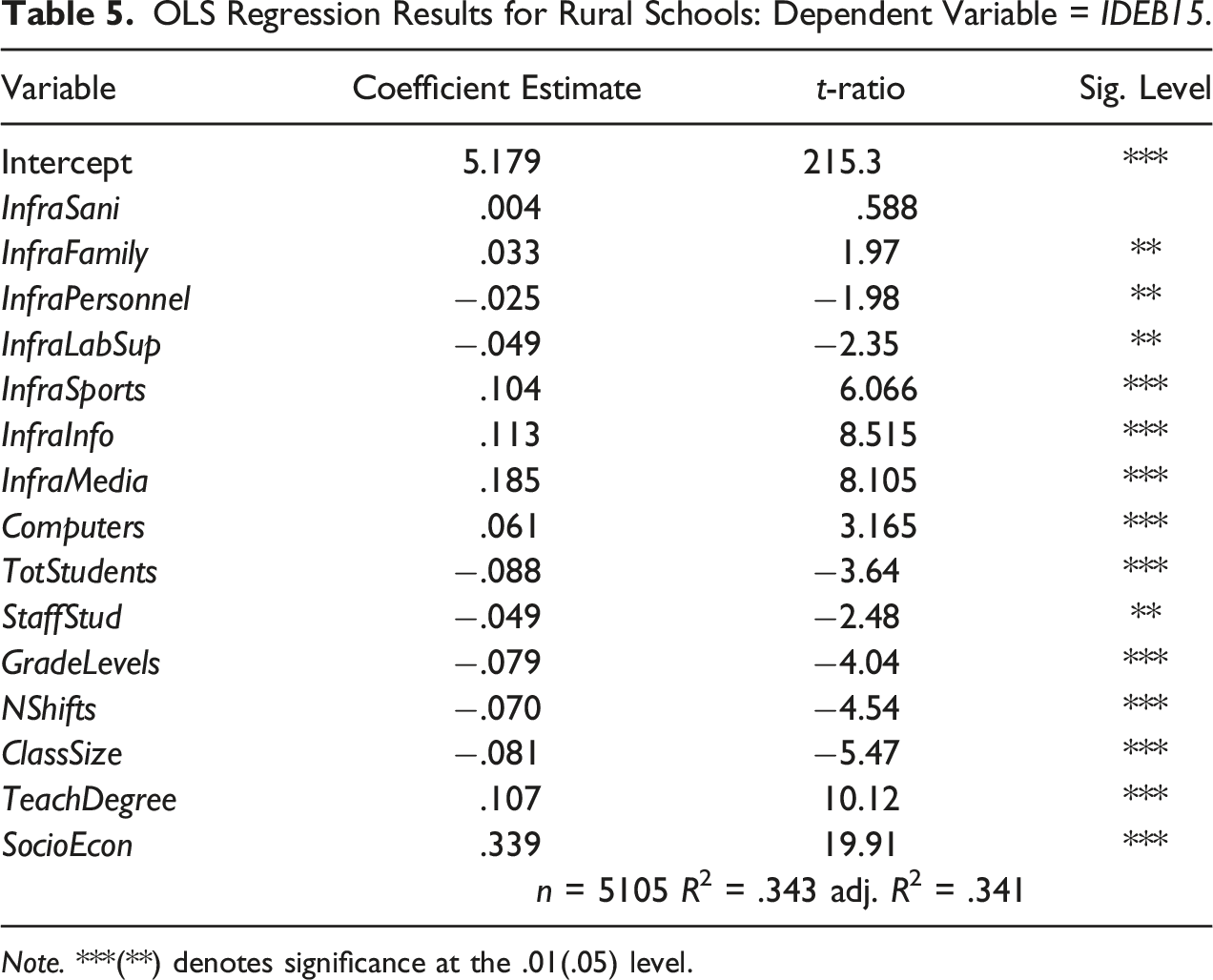
Note. ***(**) denotes significance at the .01(.05) level.
As before, larger schools and those offering a greater number of study shifts and larger average class sizes enroll students whose academic performance trails that of schools that are smaller and offering fewer shifts and larger average class sizes. Rural schools encompassing a large number of grade levels also enroll students whose academic performance lags behind that of their less complex counterparts. Another area where rural schools differ from their urban counterparts is StaffStud: this variable was unexpectedly negatively and significantly related to IDEB15. Teachers’ human capital, proxied by TeachDegree, is positively and significantly related to students’ academic performance in the case of rural schools, an important finding that supports Croninger et al. (2007), Metzler and Woessmann (2012), and Cebula et al. (2015).
A quantile regression-based graphical analysis for rural schools is provided in Figure 2. The results indicate that InfraInfo and InfraMedia are both positively related to variations in IDEB15 across rural schools in Brazil. Additionally, TeachDegree is positively related to variations in IDEB15 across rural schools in Brazil. This result supports those of Croninger et al. (2007), Metzler and Woessmann (2012), and Cebula et al. (2015), and may also be linked to differences across schools regarding teaching methods and other factors (see Haguette et al., 2016). As in the case of urban schools, the correlation between socioeconomic status and academic performance is weaker among higher-achieving schools. Again, Li et al.’s (2020) research citing Costello et al. (2003) and Neville et al. (2013) on the relationships between improvements in the socioeconomic status of families and (1) access to mental health therapies and (2) students’ concepts of identity and self, offer at least a partial explanation for this correlation asymmetry. Quantile regression for rural schools: Dependent variable = IDEB15.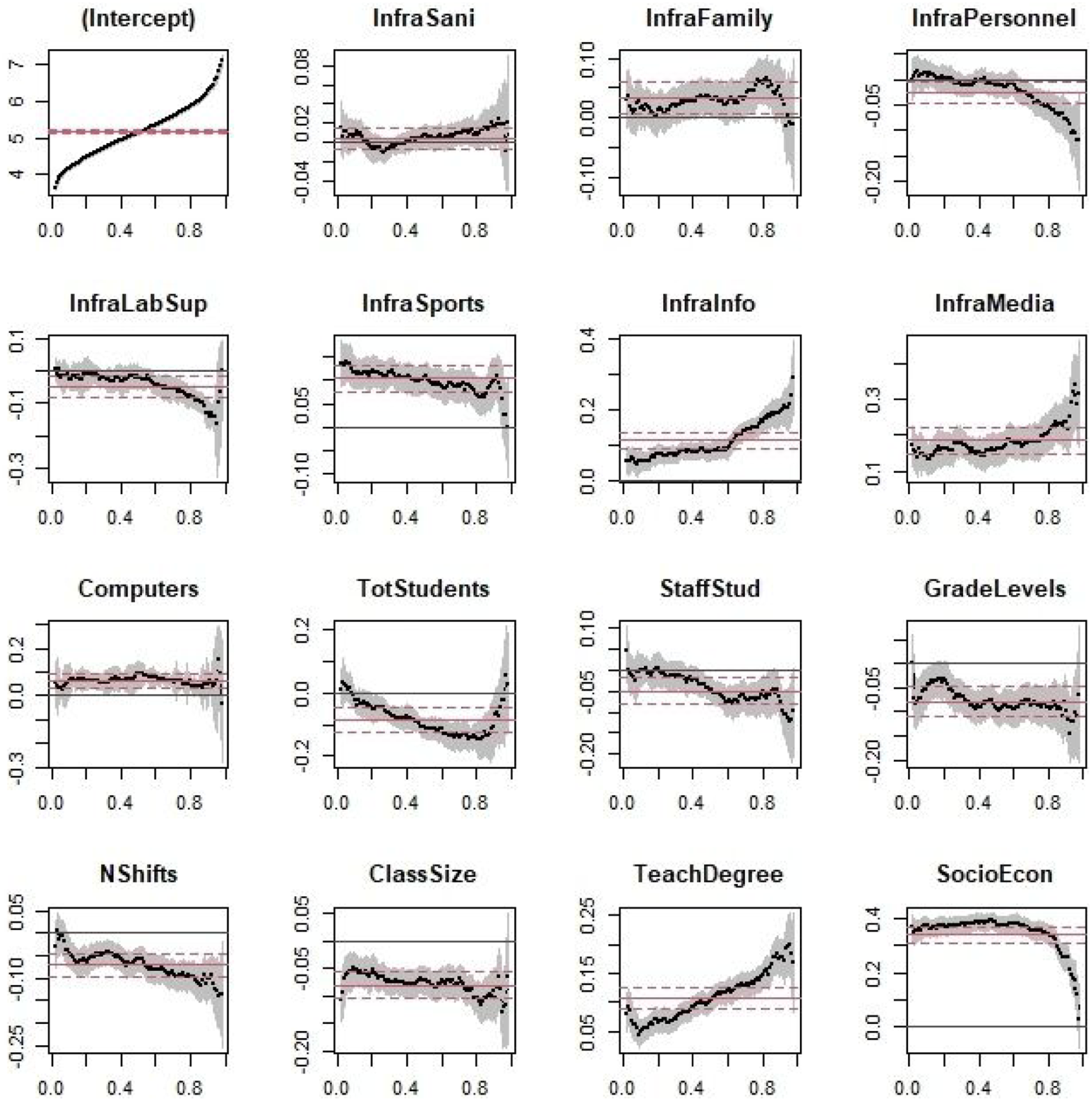
Summary of Main Quantile Regression Results for Urban and Rural Schools: Dependent Variable = IDEB15.

Notes: For the coefficient estimates, Very low: |Coef| < .05; Low: .05 ≤ |Coef| < .1; Middle: .1 ≤ |Coef| < .2; High: .2 ≤ |Coef| < .3; Very high: |Coef| ≥ .3.
aNo significance level in OLS.
bFor most schools, there was no difference. However, for schools with a high IDEB (quantile >.8), the impact was smaller.
Conclusions, Implications, and Limitations
This study employs quantile regression to examine relationships between the academic performance of primary school students in Brazil and various demographic and institutional variables, such as socioeconomic characteristics, variations in school infrastructure and school complexity, and teachers’ human capital thereby extending the education economics literature by addressing the empirical shortcomings of prior research.
General Conclusions
Our results based on data from 35,490 primary schools in Brazil suggest that several institutional variables in our model specification, including access to school libraries, computer facilities, projectors, and televisions, are positively and significantly related to the academic performance of primary students in Brazil’s public education system. We also found that parents’ socioeconomic level is positively associated with students’ academic performance. However, school complexity, captured in the number of grade levels and school shifts at primary schools, is negatively related to academic performance.
Theoretical and Practical Implications
The results related to parents’ socioeconomic level represent a contextual condition with a high impact on school results, affecting urban schools on a larger scale. In rural schools, its impact is somewhat milder, while in both cases, high-performing schools are less affected by this condition. The implication that low socioeconomic conditions are highly correlated with low incomes demonstrates that structural issues in society affect school performance, at least according to the standards currently used for their assessment. This implication supports studies conducted since the publication of Equality of Educational Opportunity (Coleman et al., 1966) and subsequent suggestions by Alves and Soares (2013) that the results of research on academic performance must be disclosed within a context, given that they must be seen as an effective expression of the social function of student learning in the environment they inhabit. Therefore, academic performance should not be viewed solely as the responsibility of school instructors and employees.
Finally, the negative relationship between school complexity and academic performance manifests differently across urban and rural schools. For urban schools, this relationship is stronger in schools with low IDEB, while in rural schools, this relationship is reversed. This result is reinforced by the negative relationship between the total number of students and school performance, which is more pronounced for schools with high IDEB. Thus, structural issues concerning the use of facilities and management of school units must be considered in the formulation of policies. In other words, decentralization of school levels into smaller units can contribute to better results. However, this is a complex issue, especially in view of the availability of resources and logistical infrastructure, which is mostly poor in developing countries, and innovative solutions, such as the separation of academic units within the same school facility, are needed.
Limitations and Future Directions
Despite our study extending the literature, several avenues remain for future research on school infrastructure and the academic performance of primary school students in Brazil. For example, future research could attempt to capture omitted variables that may increase the precision of our statistical findings and allow for policy recommendations regarding academic performance. The identification of factors that improve the academic performance of schools at the bottom of the socioeconomic scale would better inform public policy. Additionally, given that the qualification of teachers, as represented by the percentage of teachers with higher education, is the intra-school variable that most impacts IDEB (in both urban and rural schools), future research along the lines of Cebula et al. (2015) might shed more light on the benefits of additional investments in teacher qualifications. Finally, endogeneity was not formally addressed in our study, and future research might also examine a system of equations wherein some of the regressors examined here are jointly determined by the academic performance of schools. Such an analysis may, for example, determine whether high-achieving students go into schools with better infrastructure. A positive finding in such a case would suggest that higher academic achievement is the result of sorting, and not better infrastructure.
Footnotes
Declaration of Conflicting Interests
The author(s) declared no potential conflicts of interest with respect to the research, authorship, and/or publication of this article.
Funding
The author(s) received no financial support for the research, authorship, and/or publication of this article.
