



Abstract
With an educational issue that has caught the attention of many countries in the world (study load), a population of 8th graders from a typical Chinese metropolitan city (40,536 from 118 schools), and an advanced statistical strategy (multilevel piecewise regression), we examined whether there was a turning point in terms of the effects of study load on science achievement. We did identify a turning point for each and every measure of study load. For weekday learning on science achievement, we identified a turning point of 22.50 hr for the effects of in-school learning, 7.50 hr for the effects of homework, and 12 hr for the effects of after-school learning. For weekend learning on science achievement, we identified a turning point of 1.50 hr for the effects of in-school learning, 5 hr for the effects of homework, and 1 hr for the effects of after-school learning. In each case, the difference in effects before and after the turning point was statistically significant, indicating that the effects of study load on science achievement were nonlinear. All of these turning points offered important implications for science education.
The title in a featured article on InformED, Don’t overload students: Assigning too much work discourages learning (Stenger, 2018, July 24), effectively brings out the controversy, the debate, and the trend concerning study load and its effects on schooling outcomes of elementary and secondary students. Study load, the time commitment to learning activities, is one of the most critical educational issues worldwide that has witnessed perhaps the largest involvement in argumentation of policymakers, administrators, parents, educators, and students themselves across a wide range of cultures. Interestingly, the current research literature is rather barren on how much is too much.
The present study aimed to highlight a very unique approach to provide information on this worldwide critical discussion. If it is harmful, as argued in the article above, to overload students with learning activities (e.g., homework), then it could be equally harmful to quickly dismiss the important role of, say, homework, in the mastery of learning materials. Our research premise is that appropriate study load is necessary and conducive to positive schooling outcomes (e.g., high academic performance) but there may be a point or limit over and beyond which study load could lose its learning promoting function and could even become harmful to the wellbeing of school students. If this conception is reasonable, then it is operationally a search for a turning point concerning the effects of study load on students’ schooling outcomes. A turning point can be defined, in our case of study load, as a certain amount of study hours when students engage in learning activities (either voluntarily or involuntarily). Before this point, study load would improve learning; after this point, study load would produce no further improvement in learning and could even become a roadblock to learning. We have formulated a research question to capture this approach of thinking: Is there any turning point in terms of the effects of study load on academic achievement? This research question was answered in the present study within the context of science education for Chinese middle school students.
Review of Literature
We would now set up the background both substantively and methodologically for the investigation of this critical issue. With the worldwide attention to the issue of study load, it is surprising to observe the lack of research (i.e., empirical evidence) on this issue. There has been some research at the college level, but research is thin at the level of elementary and secondary education. 1
Study Load in College Education
At the college level, the theory of academic momentum is well known (e.g., Adelman 2006). According to the theory, more course credits improve academic performance of college students. Essentially, the theory suggests a strong positive correlation between study (course) load and academic performance (Attewell et al., 2012). In fact, according to these researchers, college students who undertake heavier study load (i.e., more courses each semester) show a stronger level of commitment to their academic goals and a higher level of responsibility to their academic studies, resulting in stronger academic self-concept that would benefit them for life. Support for the theory of academic momentum is broad and strong within the academic context (e.g., college completion) (Huntington-Klein & Gill, 2021). For a case of support being broad, even online study (course) load is shown to positively influence academic outcomes of community college students, especially those (as a particular group) who struggle with degree attainment (Shea & Bidjerano, 2019). For a case of support being strong, students engaging in heavier study load (i.e., registering in more course credits) have a greater GPA (grade point average) and greater retention, even after adjustment for academic ability, (prior) academic success, employment hours (on campus), and individual background characteristics (Szafran, 2001). Finally, there is other evidence beyond the academic context (e.g., Koch, 2018).
In contrast, it is also common (and reasonable) to take the practical position of time allocation. This position reasons that heavy study load spreads college students thin on many fronts. Specifically, heavy course load reduces time investment in each and every course. If academic performance is, to a large extent, a result of time commitment, then course load may negatively associate with academic performance (Pu et al., 2020; Stinebrickner & Stinebrickner, 2004, 2008). The manifestation of this negative impact of heavy study (course) load may go beyond the academic context (e.g., Mani, 2010; Sansgiry & Sail, 2006).
The two perspectives above are obviously conflicting, each with empirical support that is also conflicting. It is reasonable to relate the quality of research design with the credibility of knowledge claim when research studies show conflicting empirical findings. We would propose an alternative approach. Could it be possible that this difference or conflict actually comes from that researchers were looking at different regions of the effects of study load, that is, before and after a turning point?
Study Load in School Education
As to elementary and secondary education, educators face the same dilemma as we just discussed at the college level. There is a long-standing traditional belief that effort or time commitment is critical to learning. For example, homework is considered as “inherently good” (Gill & Schlossman, 2001, p. 27). Beliefs like this are dearly held in many countries such as China (Chen et al., 1996). Elementary and secondary students need to spend enough time in learning both at school and after school such as doing homework (e.g., Riegle-Crumb & Grodsky, 2010; Rosário et al., 2015). For example, homework reveals an impressive relationship with reading achievement of students in Grade 8 in many countries (Organization for Economic Cooperation and Development [OECD], 2001). Trautwein (2007) provided empirical evidence that homework is important at both student level and class level to mathematics achievement of German students across Grades 7 to 9. In fact, based on a comprehensive synthesis of research from 1987 to 2003 (conducted in the United States), Cooper et al. (2006) concluded that there is generally consistent evidence of the positive effects of homework on academic achievement (reading and mathematics) from kindergarten to Grade 12. There have been concerns about assigning small amounts of homework. For example, Gill and Schlossman (2003) humorously called the United States “a nation at rest” (p. 319) because most American students across grade levels tend to spend less than 1 hr studying (after school) on a typical day. 2
In contrast, the position of time allocation is also strong in elementary and secondary education. Different from college students, secondary students, particularly elementary students, are in a very important developmental stage. Apart from the development of intellectual abilities and skills, the development of life skills such as social skills is essential in such a developmental stage. Some researchers argued that students’ development of life skills as well as their physical and mental health should not be impaired as a result of study load (e.g., Tang & Yang, 2013). Perhaps out of these special attentions and cautions, the traditional beliefs discussed earlier have been heavily challenged in recent years, with arguments coming from different perspectives. The American Academy of Pediatrics warned that 73% of high school students do not get enough sleep (Jenco, 2018, January 25). Mainly as a result of heavy study load, a large percentage of Chinese students are near-sighted in eye vision (China Ministry of Education, 2011) and many Chinese students have negative attitude toward education and lack positive sense of belonging to school (Hu & Schaufeli, 2009).
Specific to the effects of homework, there are knowledge claims of null effects (e.g., Eren & Henderson, 2011). Other researchers challenge knowledge claims of positive homework effects by arguing that homework works only for certain groups of the student population not the entire population (e.g., Lin et al., 2015). For example, high school students with too much homework manifest physical symptoms (e.g., exhaustion), academic worries, and mental health problems (Galloway & Pope, 2007). Galloway et al. (2013) used their research findings on the effects of homework to challenge the traditional assumption on heavy homework loads, suggesting that researchers, practitioners, students, and parents need to unpack the existence of this assumption in the presence of evidence showing its negative effects.
Obviously, similar to the situation at the college level, the two perspectives above are conflicting, each with empirical support that is also conflicting. Given that homework is usually used in every country to promote learning, much attention is focused on the controversy of the homework effects. One way to address the inconsistent research evidence is to seek a thoughtful design of homework by teachers with perhaps parental involvement to promote positive effects (Patall et al., 2008; Trautwein et al., 2009), an idea quite similar to a call for homework standards. Again, we would propose our alternative approach. Could it be possible that this difference or conflict actually comes from that researchers were looking at different regions of the effects of homework, that is, before and after a turning point in the amount of homework?
Substantive and Methodological Issues of Study Load
We now summarize the current rather thin literature on study load at the college and school levels. Substantively, nearly all existing research concerning study load focuses on the effects of study load on various measures or aspects of students’ wellbeing such as academic achievement, physical health, and mental health, just to name a few (e.g., Boumi & Vela, 2021; Cooper et al., 2006; Murff, 2005). The research premise is the linear assumption of the effects of study load (i.e., arguing in a general term that usually infers the linear nature). Methodologically, although philosophical reasoning describes some existing research, there is an overwhelming application of traditional statistics (i.e., multiple regression) to analyze data. Students are usually treated as one whole group without data hierarchy, even in the case of students nested within colleges or schools.
There are indeed substantive and methodological concerns about research studies on the effects of study load at all levels of education. Substantively, the linear assumption of the effects of study load may well be an oversimplification of a sophisticated educational phenomenon. Huntington-Klein and Gill (2021) argued that it is not enough to inform whether increased study load enhances or harms some aspects of students’ wellbeing such as academic performance, suggesting that researchers cannot just provide a simple yes or no answer but need to be conditional in thinking. Methodologically, Huntington-Klein and Gill (2021) criticized the literature for being based too much on correlational techniques (i.e., multiple regression). Seeking methodological advancement in empirical research is both logical and critical because educational events tend to be much more complex than common research methods can handle (Cronbach, 1988). These are obviously a call for going beyond linear thinking substantively and seeking more advanced statistical techniques methodologically when examining the effects of study load.
Earlier, we attempted repeatedly to make a case for an alternative approach to reconcile conflicting empirical evidence on the effects of study load. The statistical technique behind this alternative is multilevel piecewise regression for the identification of a turning point concerning the effects of study load. We defined a turning point from the conceptual perspective earlier; analytically, a turning point is a particular value of a certain independent variable before and after which the effects of the independent variable are statistically significantly different on a certain dependent variable. The existing research studies, if they ever applied a regression approach to examine the effects of study load, have universally assumed a linear relationship between study load and educational outcomes. The turning point approach moves beyond this tradition of linearity in search of nonlinear relationship between study load and educational outcomes. Are turning points a real thing in education (i.e., how likely do turning points exist in education)? Concerning academic achievement, Marzano (2003) made it very clear that, in theory, some variables tend to impact academic achievement positively up to a certain point only. In practice, after noticing a weak association between childcare quality and child outcomes in the literature, Li et al. (2019) argued that quality must reach a threshold (another way to call a turning point) before it can influence outcomes, and they did identify quality thresholds (on measures of instruction and interaction with children) for language, early mathematics, and social skills of children three to six years of age. Arguments like these suggest that relationships that are typically referred to as nonlinear do exist in education and turning points may be far more common in educational issues than researchers think.
Finally, we pursued further methodological advancement even concerning the turning point approach. So far, most applications of piecewise regression in applied research tend to ignore data hierarchy such as students nested within schools. We argue that in the case of data hierarchy there is a need to apply multilevel modeling techniques to produce more credible knowledge claims. When an independent variable is entered into a (regular) multilevel regression, its effects are treated as linear on a dependent variable. Multilevel piecewise regression performs multilevel regression region by region or piece by piece, allowing for the possibility of the independent variable to have a nonlinear relationship with the dependent variable. Guided by all of these considerations above, we settled into multilevel piecewise regression as our primary statistical technique to identify turning points concerning the effects of study load on academic achievement within the context of science education.
Method
The Data
We utilized data collected from the (Chinese) Program for Regional Assessment of Basic Education Quality (referred to as “the Program” subsequently). The Collaborative Innovation Center of Assessment for Basic Education Quality at Beijing Normal University designed the Program to systematically collect data to monitor (and promote) the quality of regional K-12 education in China. The Program is curriculum-based (i.e., in alignment with school curriculum) and competency-oriented, gathering data annually from regional K-12 education systems from 2013. We obtained data concerning science education collected by the Program in 2016. We became interested in a special sample of a metropolitan city in the central part of China. 3 Our data included 40,536 eighth grade students from 118 middle schools.
The Variables
The dependent variable in the present study was science achievement. The Program developed a standardized science test that measured science achievement with a three-dimensional framework of knowledge (physics, biology, and geography), cognition (knowing, understanding, and applying), and scientific inquiry competencies (questioning, seeking evidence, and explaining). Most items were either situated in or developed from scientific issues and science problems of the real world. To successfully perform on this science test, students needed to apply what they have learned about science to daily situations in life. The test contained both multiple-choice items and open-ended items (partial credits were given when scoring all open-ended items). There were 36 items, of which 30 were multiple-choice items and six were open-ended items (Cronbach’s alpha is .84). 4 Raw scores were treated using IRT (item response theory) procedures that have been employed in the Programme for International Student Assessment (PISA) to estimate a scale score of science achievement for each student on a scale with mean = 500 and standard deviation = 100 (see, for example, OECD, 2017).
The independent variables (at the student and school levels) came from questionnaire data. The Program designed a student questionnaire to collect information about individual characteristics and learning experiences, a teacher questionnaire to collect information about teacher background, classroom practice, and professional development, and a principal questionnaire to collect information about principal background, school resources, and administrative approaches.
Study Load Measures.
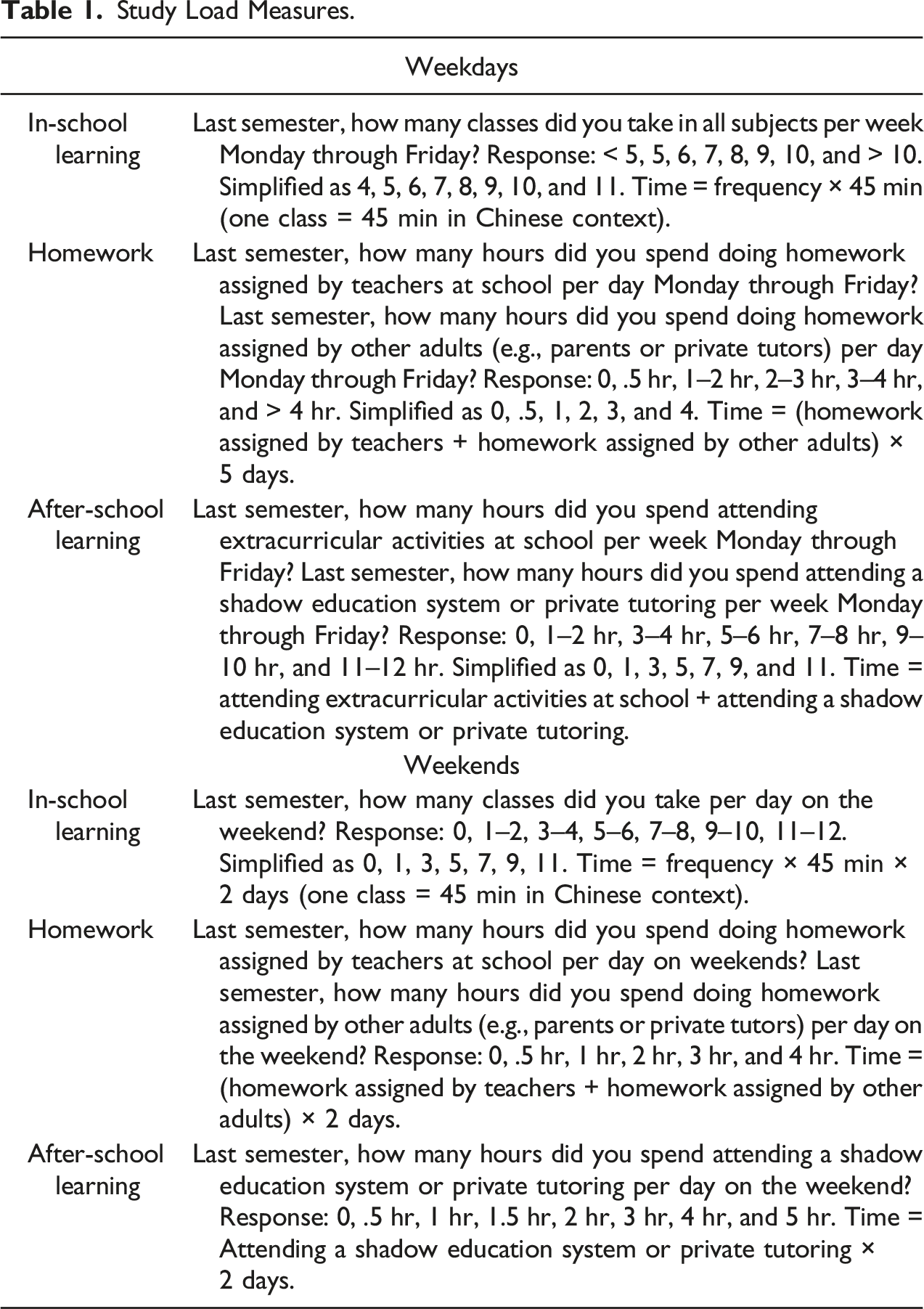
Each study load measure added up the amount of time (in hours) students spent in some specific learning activities (e.g., study load on in-school learning on weekdays added up the amount of time students spent in taking courses in school on typical weekdays, and study load on in-school learning on weekends added up the amount of time students spent in taking extra courses in school on typical weekends). We attempted to search for a turning point concerning the effects of each study load measure on science achievement.
The Control
Other independent variables functioned as control variables to “purify” the relationship between science achievement and study load. Using Ma et al. (2008) as the guideline, we selected control variables at both student and school levels. Student-level variables included gender, socioeconomic status (SES), single-parent household, one child, and left-behind child. The latest two variables were specific to Chinese education and important to adjust when examining Chinese students. The variable of one child captured the “One Child” policy which was still in effect in 2016 (i.e., a single child without any siblings). The variable of left-behind child captured the labor migration in China (i.e., a child does not live together with parents because parents migrate to a different place for better employment). Both variables were dummy variables (yes\no). SES was a standardized index variable. The Program created items in the student questionnaire similar to those used in PISA to gather information on parental occupation, household possessions, and family cultural activities (e.g., reading a book, attending a concert, and visiting a museum) as elements to build a measure of SES. The PISA’s procedure was also adopted to create the index (see, for example, OECD, 2017). Gender (male and female) and single-parent household (yes\no) were dummy variables, coming directly from our data.
School Climate Variables.

The Model
Because we attempted primarily to identify a turning point concerning the effects of study load (the independent variable) on science achievement (the dependent variable), the most appropriate statistical technique is the piecewise linear regression. This technique recognizes that a single linear regression line may not capture the complex relationship in the effects of the independent variable on the dependent variable. This technique then develops different linear regression lines piece by piece over different data regions. These linear regression lines can be either connected or disconnected. The specific values of the independent variable (study load in our case) that separate these linear regression lines are the turning points. In the present study, we sought one turning point or two data regions with connected linear regression lines, one for each region. Our rationale for this choice is that academic improvement is often difficult and continuous in nature (i.e., a connected gradual transition) rather than easy and dramatic in nature (i.e., a disconnected sudden jump).
When pooling students together in search for a turning point, the piecewise linear regression is straightforward. However, if students come from different schools (i.e., in the presence of data hierarchy), the piecewise linear regression must accommodate the data hierarchy. We thus developed a multilevel piecewise linear regression model for data analysis in the present study. 5 This decision was appropriate based on the recommendations of Peugh (2010) for adopting multilevel modeling for data analysis. Specifically in the present study, ICC (intraclass correlation) was .14 from our null model with only the dependent variable (i.e., schools were responsible for 14% of the variance in science achievement) and design effect was 48.95. Both estimates pointed to the need for multilevel analysis of our data.
In the context of students nested within schools, we assumed a piecewise linear regression with two pieces connected at one turning point of c. Mathematically, this multilevel piecewise linear regression could be written as
In our case of seeking one turning point, we chose to use the data-driven approach to develop an automated algorithm to test systematically the regression lines before and after c for statistical significance, identifying the first value of c in
Results
As we presented in our literature review, a variable may impact academic achievement positively up to a certain point only (Marzano, 2003), thus indicating a nonlinear relationship. With the introduction of our data, we were now able to provide a demonstration of this nonlinear phenomenon (see Figure 1).
7
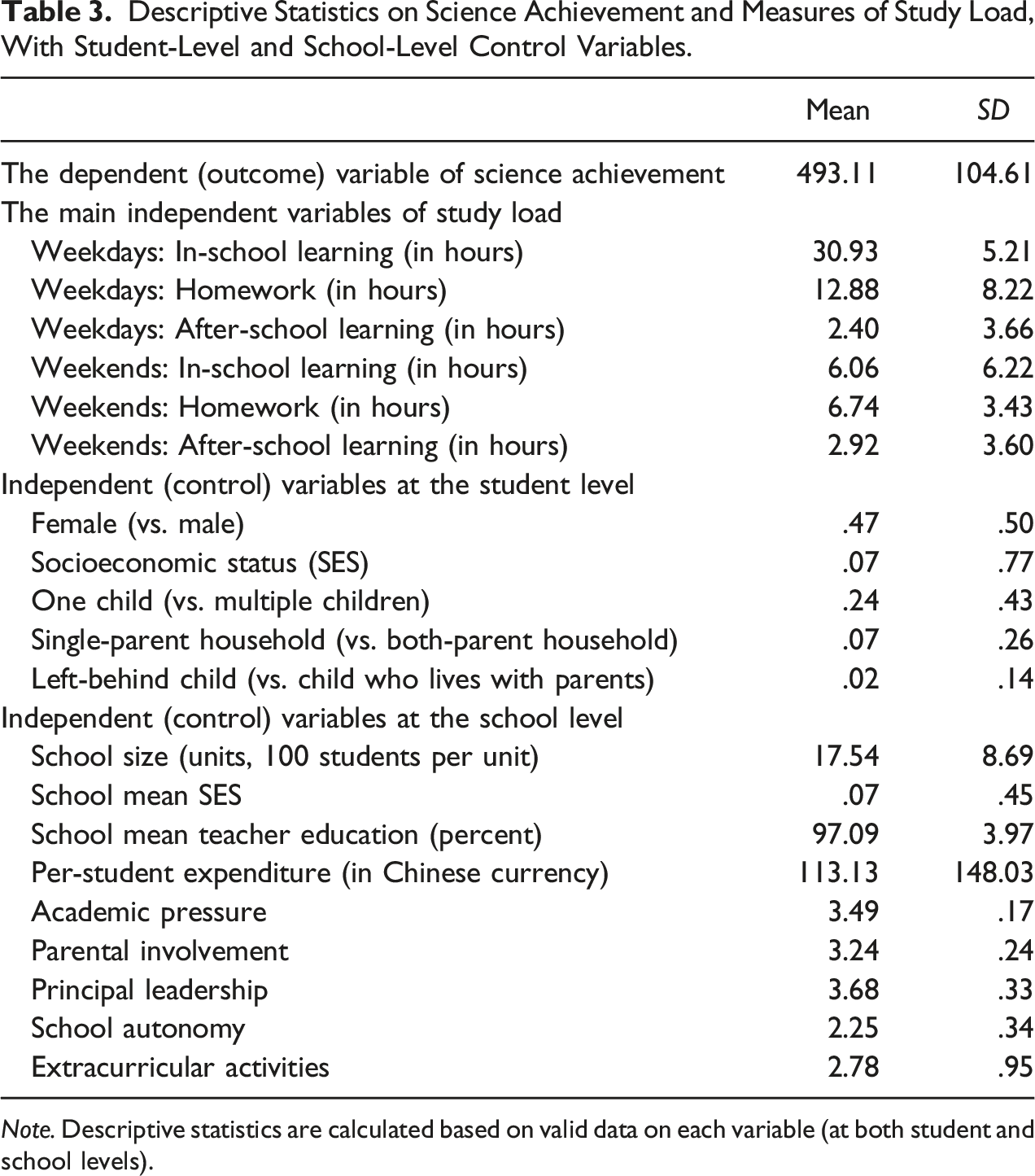
The upside-down U shape illustrates well Marzano’s (2003) notion. Our multilevel piecewise regression model aimed to capture nonlinear relationships. We began with descriptive statistics concerning science achievement and six measures of study load as well as student-level and school-level control variables within the context of science education of Chinese eighth grade students (see Table 3). Among other things, this table indeed indicated the heavy study load that Chinese eighth graders were experiencing. For example, homework (measured in hours) was between 12 and 13 hr during weekdays of a typical week (i.e., 12.88). This number would average to homework between 2 and 3 hr each weekday. Meanwhile, homework was between 6 and 7 hr during a typical weekend (i.e., 6.74). This number would average to homework between 3 and 4 hr each day over the weekend. We would emphasize that these hours were over and beyond all other commitments such as in-school learning during the weekdays and over the weekend for a typical week (see Table 3). An illustrative graph of a quadratic function showing the effects of study load on science achievement, estimated via OLS regression with science achievement as the outcome and a quadratic function of in-school learning during weekdays as the independent variable. Descriptive Statistics on Science Achievement and Measures of Study Load, With Student-Level and School-Level Control Variables. Note. Descriptive statistics are calculated based on valid data on each variable (at both student and school levels).
The Weekday Measures
Multilevel Piecewise Regression Models Estimating Turning Points Concerning Effects of Study Load on Science Achievement.
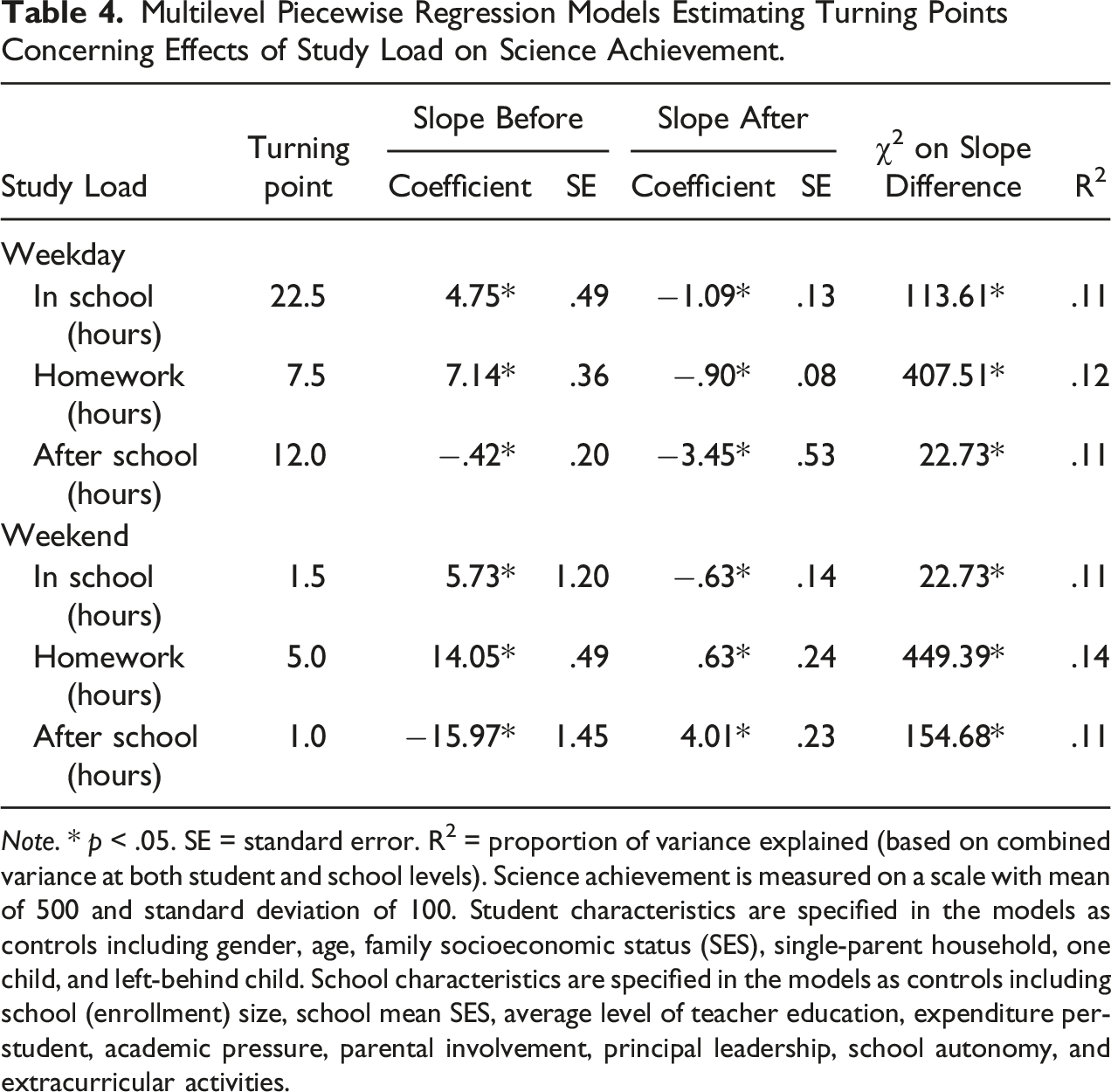
Note. * p < .05. SE = standard error. R2 = proportion of variance explained (based on combined variance at both student and school levels). Science achievement is measured on a scale with mean of 500 and standard deviation of 100. Student characteristics are specified in the models as controls including gender, age, family socioeconomic status (SES), single-parent household, one child, and left-behind child. School characteristics are specified in the models as controls including school (enrollment) size, school mean SES, average level of teacher education, expenditure per-student, academic pressure, parental involvement, principal leadership, school autonomy, and extracurricular activities.
In addition, we identified a turning point of 7.50 hr in terms of the effects of homework during weekdays on science achievement. Before the turning point, the effects (i.e., slope) were positive and statistically significant (effects = 7.14), indicating that homework hours were positively associated with science achievement (i.e., more hours, higher achievement). After the turning point, the effects were negative and statistically significant (effects = −.90), indicating that homework hours were negatively associated with science achievement (i.e., more hours, lower achievement). The difference in the two slopes before and after the turning point was statistically significant (χ2 = 407.51).
For the weekday measures, if in-school learning and homework shared the same pattern of effects on science achievement, then after-school learning indicated a different pattern. With a turning point at 12 hr, we emphasize that the effects (i.e., slope) of after-school learning during weekdays were negative to begin with. The effects were also statistically significant (effects = −.42), indicating that, before the turning point, after-school learning hours were negatively associated with science achievement (i.e., more hours, lower achievement). After the turning point, the effects of after-school learning during weekdays were still negative but to a much stronger degree. The effects were statistically significant (effects = −3.45), indicating that after-school learning hours were still negatively associated with science achievement (i.e., more hours, lower achievement) but in a much stronger degree. Such a degree could be well appreciated from the fact that the difference in the two slopes before and after the turning point was statistically significant (χ2 = 22.73). So, during weekdays, the negative effects of after-school learning on science achievement were eight times stronger (i.e., 3.45 ÷ .42) after the turning point than the negative effects of after-school learning on science achievement before the turning point.
The Weekend Measures
Interestingly, there were three different patterns of effects concerning turning points for the weekend measures. In Table 4, we identified a turning point of 1.50 hr in terms of the effects of in-school learning during a weekend on science achievement. Before the turning point, the effects (i.e., slope) were positive and statistically significant (effects = 5.73), indicating that in-school learning hours were positively associated with science achievement (i.e., more hours, higher achievement). After the turning point, the effects were negative and statistically significant (effects = −.63), indicating that in-school learning hours were negatively associated with science achievement (i.e., more hours, lower achievement). The difference in the two slopes before and after the turning point was statistically significant (χ2 = 22.73).
A different pattern emerged, with a turning point at 5 hr in terms of the effects of homework during a weekend on science achievement. Before the turning point, the effects (i.e., slope) were positive and statistically significant (effects = 14.05), indicating that homework hours were positively associated with science achievement (i.e., more hours, higher achievement). After the turning point, the effects were still positive but to a much weaker degree. The effects were statistically significant (effects = .63), indicating that homework hours were still positively associated with science achievement (i.e., more hours, higher achievement) but to a much weaker degree. The difference in the two slopes before and after the turning point was statistically significant (χ2 = 449.39). Thus, during a weekend, the positive effects of homework on science achievement before the turning point were 22 times stronger (i.e., 14.05 ÷ .63) than the positive effects of homework on science achievement after the turning point.
Still another different pattern emerged concerning the effects of after-school learning during a weekend on science achievement, with a turning point at 1 hour. Before the turning point, the effects (i.e., slope) were negative and statistically significant (effects = −15.97), indicating that after-school learning hours were negatively associated with science achievement (i.e., more hours, lower achievement). After the turning point, the effects were positive and statistically significant (effects = 4.01), indicating that after-school learning hours were positively associated with science achievement (i.e., more hours, higher achievement). The difference in the two slopes before and after the turning point was statistically significant (χ2 = 154.68).
Discussion
Summary of Principal Findings
We aimed to search for a turning point concerning the effects of study load (with six measures) on science achievement, using a multilevel piecewise regression model with students nested within schools. We did identify a turning point for each and every measure of study load. For the three weekday measures, we identified a turning point of 22.50 hr in terms of the effects of in-school learning on science achievement, a turning point of 7.50 hr in terms of the effects of homework on science achievement, and a turning point of 12 hr in terms of the effects of after-school learning on science achievement. For the three weekend measures, we identified a turning point of 1.50 hr in terms of the effects of in-school learning on science achievement, a turning point of 5 hr in terms of the effects of homework on science achievement, and a turning point of 1 hr in terms of the effects of after-school learning on science achievement. In each case, the difference in the two slopes before and after the turning point was statistically significant, indicating that the effects of study load on science achievement were nonlinear.
Characteristics and Implications of Weekday Measures of Study Load
We observed two patterns of effects on science achievement among the three weekday measures of study load. In-school learning and homework shared one pattern, and after-school learning indicated a different pattern. The first pattern of effects is that of “improve then decline” in that before the turning point, the effects were positive and statistically significant, but after the turning point, the effects were negative and statistically significant. Thus, more in-school learning and homework improved science achievement before the turning point, but more in-school learning and homework worsened science achievement after the turning point. The conclusion is clear that as far as science achievement is concerned, both in-school learning and homework were effective in prompting learning only to a certain level. Stated differently, more in-school learning and homework would not always guarantee better learning as far as science achievement is concerned.
The second pattern is about the effects of after-school learning on science achievement. The pattern is that of “decline then decline more” in that before the turning point, the effects were statistically significantly negative, but after the turning point, the effects were statistically significantly much more negative. Thus, as far as science achievement was concerned, after-school learning was harmful, period. The implication is that there should not be any attempt to provide after-school learning to students at all.
The two different patterns of effects imply two things to us. First, in-school learning and homework could already constitute enough academic activities during weekdays, and any after-school learning during weekdays could make students exhausted either physically or mentally or both. Therefore, we believe that after-school learning should be avoided during weekdays. Second, even if in-school learning and homework are legitimate academic activities, their effectiveness has a limit (22.50 hr for in-school learning and 7.50 hr for homework). Across these boundaries, even in-school learning and homework can become harmful to science achievement. We suggest that for both in-school learning and homework, teachers should make effective use of the hours within the boundary to promote science achievement.
Characteristics and Implications of Weekend Measures of Study Load
Although a turning point was found for each of the three weekend measures of study load, the three weekend measures indicated three different patterns of effects on science achievement. The pattern for in-school learning was that of “improve then decline” (similar to the first pattern in our discussion of the three weekday measures). The pattern for homework is that of “improve then improve less” in that before the turning point, the effects were statistically significant and strongly positive, but after the turning point, the effects were statistically significant and weakly positive. The pattern for after-school learning was that of “decline then improve” in that before the turning point, the effects were statistically significantly negative, but after the turning point, the effects were statistically significantly positive.
Overall, the turning points concerning the effects of weekend measures on science achievement surprised us in that we, perhaps influenced by arguments often established upon common wisdom, expected the weekend learning to show a much more negative picture than the weekday learning. Surprisingly, the weekend learning is just as positive as, if not more positive than, the weekday learning in terms of promoting science achievement. Unlike the three weekday measures, none of the three weekend measures ought to be avoided. There is a boundary of hours for in-school learning during weekends. The hours, 1.50, are obviously very limiting to educators and parents, but within this boundary, in-school learning during weekends was effective to promote science achievement.
Interestingly any length of homework during weekends would not be harmful to science achievement. Within the boundary of 5 hr, we expect that homework would sizably promote science achievement. Then, the issue becomes whether or not longer hours of homework (longer than 5 hr) during weekends are really worthy because beyond the boundary, the effects of homework, even though still positive, become much weaker. So again, the issue is whether or not it is worthy of the longer hours of homework to make students just a little bit better in terms of science achievement. This is a call that educators and parents have to make, hopefully taking into account the whole life and future of a student or child.
After-school learning during weekends represents another surprise to us. We did strongly discourage after-school learning during weekdays. But we cannot easily do the same here. This is the only place in this study where we could suggest a prolonged period of learning. Given a turning point of 1 hr, after-school learning during weekends must be longer than 1 hr to get into the positive territory. Nonetheless, we emphasize that in this positive territory, the effects were not dramatically strong as far as science achievement is concerned. This appears to be another call that educators, particularly parents, need to make, again hopefully taking into account the whole life and future of each student or child. Is it worthy for a student to invest long hours of after-school learning to become only a little bit better in science achievement?
Overall, the implication for educational policies and practices here is that we may not want to quickly dismiss learning during weekends. As a matter of fact, the positive effects of homework during weekends turned out to be the strongest of all positive effects concerning all measures of study load, both weekdays and weekends. We strongly suggest that it is going to be wise for educators and particularly parents to carefully balance learning between weekdays and weekends so that some room can be set aside for learning during weekends to take advantage of the strongest positive effects on science achievement. It does appear to us that it is not a good idea to consider weekdays learning and weekends learning in isolation of each other. A systematic planning seems to be critical to take full advantage of all the positive effects concerning study load so as to control study load of students and meanwhile maximize science achievement among students.
Further Insights
It is informative to note that, for the same measure of study load, values in Table 3 (descriptive averages) may be rather different from values in Table 4 (inferential or estimated turning points). For example, the average on in-school learning on weekdays was 30.93 hr, but the turning point for the same measure was 22.50 hr, nearly 1.50 standard deviation apart. Of course, these values do not contradict each other, because the average (in Table 3) is in isolation by itself (i.e., the actual hours spent determines the average) but the turning point (in Table 4) is in relation to science achievement (i.e., the relationship between actual hours spent and science achievement determines the turning point). Nonetheless, differences between Tables 3 and 4 highlight the fact that what the majority does may not represent the golden standard. The averages in Table 3 are central tendency measures indicative of where the majority of data points stand. But the optimal standard represented by the turning points in Table 4 may be rather different when another factor (science achievement in our case) comes into play. Because an average is of central tendency, a turning point far from its corresponding average indicates an unpopular status or a minority condition (i.e., there are far fewer data points around). For example, in terms of in-school learning on weekdays, 46% of students were in the range of ±1 hr around the average (i.e., 30.93) and 2% of students were in the range of ±1 hr around the turning point (i.e., 22.50). Therefore, administrators, educators, and parents may not want to jump on the bandwagon too quickly concerning study load. It is always more informative to understand study load in relation to a certain schooling outcome such as academic achievement.
The different patterns of findings between weekday and weekend study load measures also invite a more insightful look. We calculated the corrections of study load measures between weekdays and weekends (see Appendix A). Although most correlations were quite small, two of them did stand out, the two largest correlations. Students who spent more time doing homework during weekdays also spent more time doing homework during weekends (correlation = .62). Students who spent more time engaging in after-school learning during weekdays also spent more time engaging in after-school learning during weekends (correlation = .45). Obviously, during weekends, homework and after-school learning are the major academic activities. Their respective correlations, though not dramatically strong, indicate a certain level of co-occurrence of high study load during weekdays and weekends for the same measure of study load. This co-occurrence is negative to those good turning points. For example, as we argued earlier, after-school learning during weekdays should be avoided but after-school learning during weekends may be encouraged. Therefore, this co-occurrence may nullify the gain in science achievement from the (positive) high after-school learning during weekends with the loss in science achievement from the (negative) high after-school learning during weekdays.
Of course, we caution that these insights are all based on descriptive statistics (most researchers would now treat correlations as more descriptive than inferential because correlations do not consider any errors in calculation). The confirmation of these insights must come from explicit statistical modeling of the phenomena. We argue that these insights should not be considered at this time as an empirical basis to reform educational policies and practices; rather, they should function to open new doors for further confirmatory empirical research.
Limitations and Further Research
An educational issue that has caught the attention of many countries in the world, a huge population of eighth graders from a typical Chinese metropolitan city, and an advanced statistical strategy (i.e., model) brought many advantages both conceptually and methodologically to our study. We are confident of our findings on turning points concerning the effects of study load on science achievement. We do see nonetheless some potential improvements that could further strengthen the investigation into study load and its effects. The most important is the definition and measurement of study load. In our study, each study load measure is an overall count of time investment. Although it is perfectly legitimate to examine time investment (as study load measure) for relationship with science achievement, oftentimes it is what is done during a certain time investment that bears more informative messages than how long a certain time investment is. For example, for the same time investment (e.g., a certain hours of homework), some students may simply perform routine procedural practices, while some students may strategically engage in complex problem solving. Researchers would all likely agree that the effects of those different learning activities would be different, sometimes quite different, on science achievement. We are suggesting that researchers somehow may want to take into account what activities have occurred during a certain time investment (i.e., what learning characteristics have transpired during a certain time investment). Further research may collect information on these specific learning characteristics of study load measures relevant to science education. This type of research would greatly supplement our study for a more insightful relationship between study load and science achievement.
In addition, to further unfold the effects of study load on academic achievement, researchers may want to consider the interaction effects between study load and some important student-level variables (e.g., gender and SES) on academic achievement. We did not pursue this idea in our study because we were already working with six multilevel piecewise regression models (corresponding to the six measures of study load). Space limitation would prevent us from any meaningful analytical extension into more complicated multilevel piecewise regression models. Nonetheless, we believe that the idea of interaction effects is important both conceptually and methodologically because interaction speaks to the moderation of some (student-level) variables on the relationship between study load and academic achievement, an absolutely important area of investigation worthy of pursuing. For example, if the relationship between study load and academic achievement is different among students of differing SES, such a finding would speak volume to many educational issues even beyond the critical issue of study load (e.g., the equity issue).
Conclusion
Even though our data analysis revealed specific and insightful turning points, one for each and every measure of study load, the main message is that we confirmed that the effects of study load on science achievement are nonlinear across all (six) measures of study load. This finding may at least partially reconcile the mixed results or competing arguments in the literature as we summarized earlier in the literature review. We hope that more and more researchers would come to recognize the nonlinear nature of the effects of study load and devote more effort in the detection of turning points as the way to unfold the effects of study load on schooling outcomes such as academic achievement.
Footnotes
Author’s Note
We acknowledge support from the Regional Assessment of Basic Education Quality Program of the Collaborative Innovation Center of Assessment for Basic Education Quality at Beijing Normal University, especially for the all-round support from the team led by Prof. Jian Liu and Prof. Hongyun Liu. We also thank Dr. Xian Wu at the University of Kentucky for her assistance in producing this article.
Declaration of Conflicting Interests
The author(s) declared no potential conflicts of interest with respect to the research, authorship, and/or publication of this article.
Funding
The author(s) received no financial support for the research, authorship, and/or publication of this article.

Notes
Appendix
Correlations of Study Load Measures Between Weekdays and Weekends.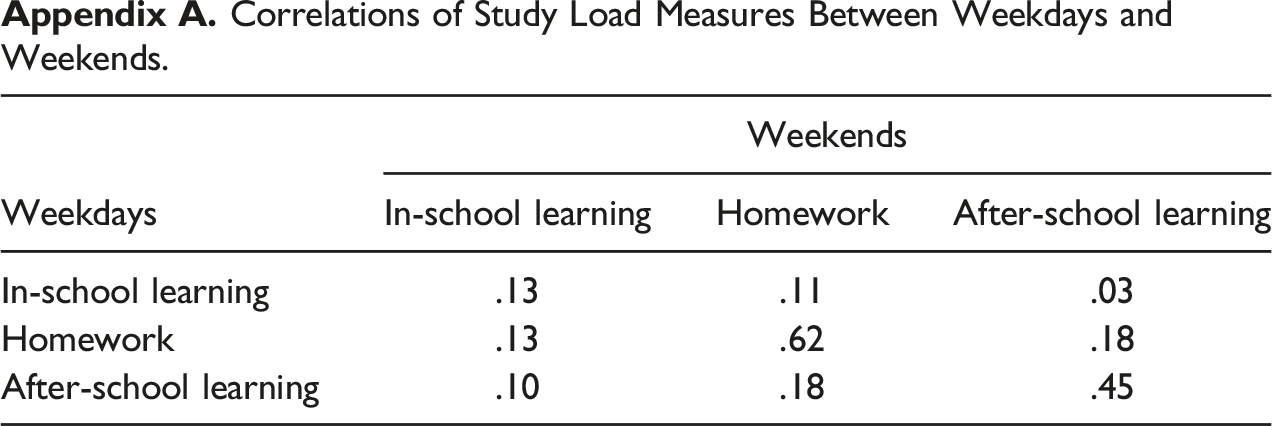
Weekdays
Weekends
In-school learning
Homework
After-school learning
In-school learning
.13
.11
.03
Homework
.13
.62
.18
After-school learning
.10
.18
.45