



Abstract
Green electricity tariffs marketed as “100% renewable” often rely on Energy Attribute Certificates (EACs), which allow a temporal mismatch between consumption and generation. This mismatch has raised concerns about the actual environmental impact of green electricity tariffs and the potential to mislead consumers. This paper examines German households’ awareness and preferences regarding temporal matching. Based on a stated-choice experiment with randomized information treatments and over 1,000 participants, we find: (1) 85% of consumers are unaware of the mismatch; (2) informing them about the mismatch reduces willingness to pay (WTP) for green electricity from 46% to 39% in our full sample, with stronger and more significant effects in relevant sub-samples; and (3) an explicit guarantee of temporal matching does not significantly increase WTP. We interpret these findings as an information failure in current green electricity markets, where a non-negligible share of consumers likely base their purchase decisions on incorrect or incomplete information. Various measures could help mitigate it, including clearer definitions and greater transparency mandates, alongside voluntary industry standards and third-party verification.
Keywords
1. Introduction
Green electricity tariffs marketed as providing “100% renewable” power have grown rapidly in popularity. In Germany, for example, household adoption increased from 19% in 2015 to 42% in 2022 (Bundesnetzagentur and Bundeskartellamt 2023). However, most of these tariffs rely on energy attribute certificates (EACs), such as those issued under the European Guarantees of Origin (GO) system, which allow suppliers to claim renewable sourcing without aligning generation and consumption in time or location (Einolander 2025). In particular, most current power market designs allow EACs to be traded for months after generation, enabling a significant temporal mismatch between electricity consumption and renewable production.
This temporal mismatch has raised growing concerns. System-level modeling studies suggest that annual, temporally decoupled EAC procurement delivers only modest additional emission reductions because it mainly incentivizes renewable capacity in hours when variable renewable output is already high, leading to cannibalization between renewable generation and limited displacement of fossil generation (Langer et al. 2024; Xu et al. 2024). Therefore, critics argue that the temporal mismatch reduces the price incentives for flexibility measures (e.g., storage or load shift) and may present an accounting misrepresentation to consumers (Monyei and Jenkins 2018; Winther and Ericson 2013). Scholars have consequently advocated for stricter rules on temporal matching in green electricity procurement and labeling (Riepin and Brown 2024; Scholta and Blaschke 2025).
Regulators have begun to respond. In 2023, the Advertising Standards Authority of Ireland (ASAI) upheld complaints against three electricity retailers for advertising their products as “100% renewable” despite relying on GOs. The ASAI found that such claims “exploit the credulity, inexperience, or lack of knowledge of consumers,” marking one of the first regulatory steps against potentially misleading green electricity marketing. 1 Yet this response raises a broader question: do consumers, in fact, misperceive these claims, and does this misperception meaningfully affect market outcomes?
This paper investigates whether green electricity markets, particularly those marketing “100% renewable” electricity, suffer from a form of information failure. Whereas most such products are based on EACs that allow for substantial temporal mismatch, consumers may mistakenly assume an alignment between renewable generation and their own electricity use that does not exist. We ask whether consumers hold misperceptions about these temporal characteristics, and whether these misperceptions influence their purchase decisions:
To answer these questions, we conducted a large-scale stated-choice online experiment in December 2024 with more than 1,000 German participants. Acknowledging that the geographical context can shape green-electricity preferences (Sundt and Rehdanz 2015), we remain cautious regarding the external validity of our findings. At the same time, Germany, as one of Europe’s largest and most advanced retail electricity markets, offers an illustrative and policy-relevant context. Participants were randomly assigned to one of three information treatments to test whether explicitly informing consumers about the absence or presence of temporal matching influences their product evaluation. A follow-up questionnaire assessed baseline consumer awareness.
Our findings suggest that the vast majority of consumers are unaware that most “100% renewable” electricity tariffs do not provide continuous temporal matching. When informed of this mismatch, a modest but significant share of participants show lower preferences for green electricity. This pattern indicates that the information treatment corrects misperceptions for a subset of consumers who do value temporal matching, whereas others either do not require hour-by-hour matching or prioritize other attributes such as price or overall renewable share. However, explicitly guaranteeing temporal matching does not significantly increase participants’ preferences, suggesting that many consumers already assume that such matching exists.
We interpret these findings as evidence of an information failure in green electricity markets. When a non-negligible share of consumers chooses “100% renewable” tariffs under incorrect beliefs about temporal matching, observed choices no longer reveal true preferences. This leads to inefficient allocations (Akerlof 1970), as reflected in the share of participants who revise their choice once this hidden attribute is clarified. At the same time, if annually matched and genuinely real-time matched tariffs are indistinguishable in their labels, demand for the latter is muted, weakening the price signal and investment incentives for products that actually deliver continuous temporal matching. This situation raises concerns about the integrity of current “100% renewable” claims and highlights the limitations of existing electricity disclosure frameworks. Our study contributes to the academic and policy debate in three main ways:
First, we offer novel empirical evidence that green electricity markets exhibit a form of information failure, where product labeling and consumer perceptions are misaligned. We thus extend the prior literature on consumer preferences for green electricity and add to a broader discussion on the transparency of sustainability claims.
Second, we show that this information failure has consequences for stated choices: in our experiment, up to one in five participants appear to base their choice on incorrect assumptions about temporal matching–directly conflicting with the EU’s electricity disclosure objectives and the goals of the proposed EU Green Claims Directive. Our findings can thus inform current policy debates on sustainability claims and greenwashing by supporting the case for stronger transparency mandates and clearer definitions for renewable electricity claims.
Third, we provide a potential behavioral explanation for why market-driven solutions for explicitly temporally matched electricity products have not gained much traction and show limited market presence. If consumers already believe that current tariffs ensure temporal matching, then demand for more granular products is unlikely to materialize without policy intervention or voluntary industry standards. Our study thereby contributes to the broader literature that investigates how non-financial, environmental information disclosure affects consumer choice.
The remainder of this paper is organized as follows: Section 2 reviews related literature on temporal matching, consumer preferences, and greenwashing in electricity markets. Section 3 outlines our methodology. Section 4 presents our empirical results. Section 5 discusses policy implications and limitations. Section 6 concludes.
2. Literature and Technical Background
This paper builds on and extends the existing literature on (1) temporal granularity of EACs, (2) consumer preferences for green electricity, (3) and greenwashing and information failure in green electricity markets.
2.1. Temporal Granularity of EACs
In the European Union, GOs serve as standardized EACs under the framework of the EU Directive 2018/2011 (European Parliament and Council of the European Union 2023). For each MWh of electricity generated, a GO is issued to the producer, containing details such as the energy source and time of production. These certificates can then be traded and transferred across the GO market that is officially administered by the Association of Issuing Bodies (AIB). Electricity retailers and end-users may then purchase GOs to verify and claim consumption of electricity from renewable sources. Figure 1 shows a flowchart illustrating the schematic mechanisms underlying the use of GOs to provide renewable electricity tariffs to households.
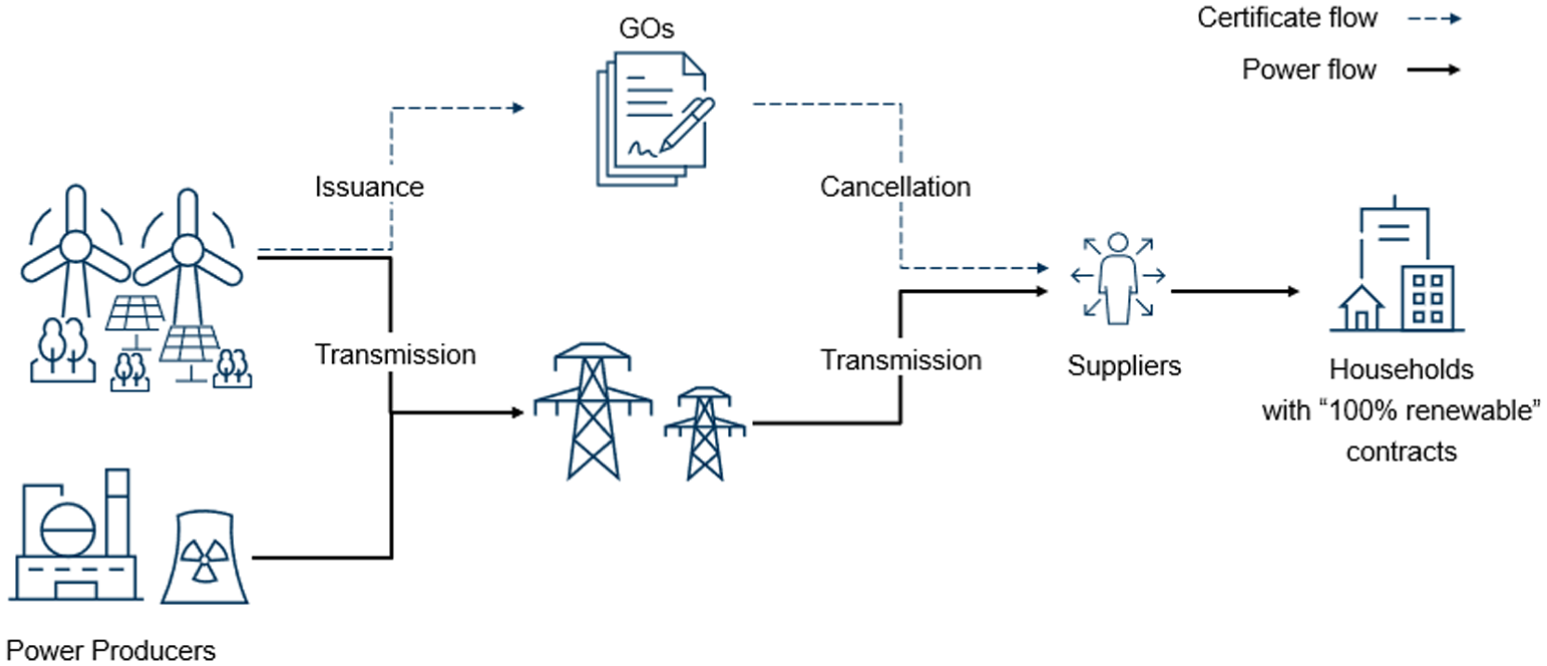
Flow chart of GO usage for green electricity disclosure.
Notably, the financial market for GOs is decoupled from the physical power market along two dimensions: geographically (with respect to the location of production and consumption) and temporally (with respect to the time of production and consumption; Einolander 2025). For example, a solar GO generated in Italy during the summer daylight hours may be used by a German consumer during a winter night. In what follows, we will refer to this decoupling as “mismatch.”
The geographical mismatch has received increasing attention in the literature from both a policy view (Hamburger 2019; Herbes et al. 2020; Mulder and Zomer 2016) and the consumer perspective (Laffan et al. 2024).
Our study focuses on the temporal mismatch of GOs. In line with current EU power market regulation, GOs can be traded for up to twelve months and canceled within an additional six-month window (AIB 2025), also termed “annual volumetric matching.” Thereby, GOs enable electricity retailers to label contracts as “100% renewable” without guaranteeing that renewable electricity is physically supplied at all times. This mechanism becomes particularly important in the context of significant fluctuations in renewable grid penetration, caused by the lack of storage capacity and the rising shares of variable renewable energy (VRE) sources, such as solar PV and wind.
The practice of annual, volumetric EAC matching that allows electricity retailers to mask these variations in renewable penetration has been met with increasing criticism in recent literature. In particular, studies have raised doubts about the contribution of temporally mismatched EACs to wider decarbonization goals (for a recent review, see Einolander 2025; Langer et al. 2024). For example, Xu et al. (2024) show that annual volumetric matching results in negligible long-term system-level emission reductions. As a key explanatory mechanism, their study shows that renewable energy procurement under annual matching primarily incentivizes the build-out of highly self-correlated renewable capacities. This results in cannibalization between competing projects and minimal displacement of existing fossil generation.
By contrast, a range of studies argue that higher temporal resolution (“granularity”) of EAC matching contributes more effectively to system-level decarbonization, for example by establishing an early market for advanced energy technologies and providing adequate incentives for adding flexible storage capacities (Riepin and Brown 2024; Scholta and Blaschke 2024). Complementing the academic literature, a range of market participants has also called for closer temporal granularity in green electricity procurement, including initiatives like the Energy Tag Initiative (Sotos et al. 2021) and Afry et al. (2023). From a policy perspective, some countries have started to mandate closer temporal matching, with Switzerland prescribing quarterly matching starting in 2027 (Swiss Federal Council 2023) and France already mandating monthly matching for GO disclosure since 2021 (French Energy Code 2023).
2.2. Consumer Preferences for Green Electricity
Consumer preferences for green electricity have been extensively examined, primarily through willingness-to-pay (WTP) studies and mostly employing stated preference methods (Merk et al. 2019). Reported WTP values vary widely, reflecting differences in elicitation formats, the type of renewable energy considered, and the study context (e.g., country and year). For the German context, Appendix C synthesizes relevant post-2010 empirical studies estimating households’ WTP for green electricity. Despite the observed heterogeneity, meta-analyses consistently find that, on average, households are willing to pay a premium for renewable over conventional electricity (Chaikumbung 2021; Soon and Ahmad 2015; Sundt and Rehdanz 2015; Wang et al. 2024).
Methodologically, the work most similar to ours is the experiment by Andor et al. (2018), which investigates how inequity considerations influence WTP for green electricity through a between-group study design with independent random samples. 2 In Andor et al. (2018), two treatment groups received varying information on surcharge exemptions for the energy sector. Compared to the control group, acceptance rates for a fixed price surcharge fell significantly when participants were explicitly informed of these exemptions. Thus, Andor et al. (2018) conclude that policies targeting perceived fairness of cost sharing for green electricity can substantially increase household’s WTP.
Research on the mismatch of green electricity production and consumption has so far focused predominantly on its geographical dimension. Several studies find that consumers prefer contracts supplied with more locally produced renewable power (Kaenzig et al. 2013; Kalkbrenner et al. 2017; Laffan et al. 2024; Lehmann et al. 2022). However, we are not aware of any empirical evidence on how households perceive or respond to the temporal dimension of green electricity.
2.3. Greenwashing and Information Failure in Green Electricity Markets
We also contribute to prior literature that investigates information disclosure and consumer choice in electricity markets. While electricity is generated from heterogeneous sources on the supply side, it becomes a homogeneous good at the point of consumption. This creates information asymmetry between suppliers and consumers regarding the generation source of the electricity delivered (Lise et al. 2007). While EACs offer a credible accounting mechanism to generally distinguish between renewable and fossil-based electricity, current regulatory frameworks generally allow for a significant temporal mismatch between generation and consumption (see Section 2.1). This creates inherent ambiguity for consumers, as “100% renewable” claims do not indicate when the corresponding renewable electricity is actually produced.
This ambiguity may be less deliberate deception and more what Liu and Fang (2025) term “compliant greenwashing”: suppliers fully comply with disclosure rules, yet consumers may infer a closer temporal and geographical alignment than the underlying EAC standard actually provides. As a result, some consumers make purchasing decisions based on incorrect assumptions about product attributes, while others, even if aware of these shortcomings, are unable to express a preference for closer matching products because all tariffs are uniformly labeled “100% renewable.” This undermines two key objectives of electricity disclosure: (i) enabling informed decision-making and (ii) strengthening demand for environmentally superior products (Markard and Holt 2003).
Drawing on the typology of advertising claims developed by Hastak and Mazis (2011), this dynamic is akin to an omission of material facts, where essential details regarding the spatial and temporal characteristics of electricity are inadequately disclosed. Therefore, we primarily interpret it as a form of information failure, leading to misinformed consumer choices and potentially suboptimal market outcomes (Beales et al. 1981).
Previous studies have explored the multifaceted dimensions of greenwashing across different sectors (for a recent review see, e.g., Santos et al. 2024) and the link to information disclosure (de Freitas Netto et al. 2020). A few existing studies focus specifically on the green electricity market. Reilly (2023) examines deceptive greenwashing through the misuse of EACs in the US. Through a game-theoretical analysis, Liu and Fang (2025) model the consequences of deceptive greenwashing and competition under information asymmetry among green electricity providers on decarbonization goals and social welfare. By surveying Irish retail electricity consumers, Laffan et al. (2024) provide evidence of information failure related to the omission of geographic origin in renewable electricity tariffs. They argue that this lack of transparency prevents consumers from accurately expressing their preferences for products based on more local energy sources. As a result, they advocate for policy interventions that require a clearer disclosure of where electricity comes from. Similarly, Markard and Holt (2003), Aasen et al. (2010), and Winther and Ericson (2013), show that both corporate and residential consumers express a general distrust toward EAC systems.
However, to the best of our knowledge, there is scarce evidence on whether the temporal mismatch inherent to most green electricity contracts misleads consumers or results in information failures. Specifically, it remains underexplored whether consumers may assume temporal matching where none exists, and how such misperceptions influence their preferences for green electricity. This paper seeks to address this gap.
3. Methodology
For our study, we conducted a stated-choice experiment as part of an online survey. The survey was administered through Appinio and took place between December 11th to 19th 2024. Participants were asked to make a hypothetical choice regarding whether they would accept to pay a premium to switch to a green electricity tariff. Before making their choices, participants were randomly assigned to one of three groups. Each group was then presented with systematically different information treatments regarding the temporal characteristics of their green electricity tariff. This between-group design allows us to empirically assess how consumers respond to information about temporal matching (RQ2). The survey concluded with a follow-up questionnaire, which we used to evaluate consumer awareness of temporal mismatch (RQ1) and conduct various robustness tests.
3.1. Experimental Design
Participants first received a concise overview of the forthcoming choice task. They were told that they would choose between a “standard” electricity contract, that is supplied by a mix of fossil-fuel and renewable sources, and a “green” electricity contract sources exclusively from renewable sources. 3 The reference price of the standard contract was set to 40€ per person per month, approximating the average individual electricity bill in Germany in 2024. 4
The core of the experiment is a hypothetical choice situation that followed the introduction. Each participant was asked to make a single binary decision—whether to pay a price surcharge to switch from the standard to the green electricity contract (see Appendix A.2). The surcharge was randomly drawn from
The follow-up questionnaire included a self-reported response certainty measure, two comprehension checks, and a series of socio-economic questions. Existing literature has explored a broad spectrum of factors that possibly influence preferences for green electricity tariffs (Herbes et al. 2015). To reduce total time spent on the survey and thus keep cognitive load in balance, we focus on the most commonly used factors related to our study design, including, for example, pro-environmental attitude and prior knowledge of electricity attribute certificates. A full description of the questionnaire is provided in Table A1. Additionally, Appinio automatically records key participant characteristics, such as age and gender. Summary statistics of the final sample are presented in Section 4.1.
A well-documented challenge in stated preference studies is hypothetical bias—the tendency of respondents to overstate their preferences for hypothetical choices compared to actual financial commitments (Loomis 2011). To mitigate this issue, prior studies have employed a range of mitigation strategies (see, e.g., Whitehead and Cherry 2007 for a discussion). We tackle potential hypothetical bias in two ways through our study design. First, we employ the certainty approach proposed by Johannesson et al. (1998) and refined by Blumenschein et al. (1998). As reviewed by Loomis (2011), this approach “yields a hypothetical WTP that matched actual cash WTP reasonably well.” Immediately after making their choice on the price premium, participants were asked to indicate whether they were “definitely” or “probably” sure about their decision. We then code responses according to their certainty status, allowing us to compare acceptance rates separately for each certainty group, following the study design of Andor et al. (2017b). Blumenschein et al. (2008) suggests that filtering for “definitely” sure responses allows to estimate WTP more accurately. Second, our study design aims to identify between-group treatment effects rather than precisely estimate absolute WTP values. Given the successful randomization of experimental groups, it is unlikely that hypothetical bias systematically differs across treatments. Therefore, we can confidently interpret differences in the number of people choosing the green tariff across experimental groups as reliable indicators of average treatment effects
3.2. Information Treatments
At the outset of the experiment, participants were randomly assigned into three treatment groups. 5 Each group received the same introductory explanation, but was exposed to a different information treatment regarding the temporal attribute of the offered green electricity contract (see Appendix A for the exact design).
Participants in the “Control” group received no additional information. This group forms the baseline for acceptance rates for the green electricity contracts. We then assess the effect of different information treatments by comparing acceptance rates of treatment groups against the control group.
Participants in treatment group A, the “Unmatched” group, received additional information about the temporal characteristics of their offered contract. Specifically, we informed participants that their contract does not guarantee a matching of electricity consumption with green electricity production at all times. Instead, any remaining fossil-based consumption is offset by electricity attribute certificates within a year. This information reflects the current EU regulations on the temporal matching requirements of electricity attribute certificates as standardized proof of renewable electricity consumption (European Parliament and Council of the European Union 2023).
Finally, participants in treatment group B, the “Matched” group, also received additional information about the temporal characteristics of their offered contract. In contrast to the “Unmatched” group, participants were explicitly told that their contract does guarantee a matching of electricity consumption with an equivalent amount of green electricity production at all times.
Across treatment groups A and B, we deliberately used as much non-technical language as possible, which was iteratively developed based on pre-tests and our literature review. In particular, we avoided specifying exact matching intervals (e.g., fifteen minutes or hourly) and more technical terms such as “annual volumetric matching.” While this approach may reduce precision in estimating preferences for different attribute levels, 6 our goal was to ensure that as many participants as possible could easily understand the main feature of their offered contract regarding temporal matching (i.e., “matched at all times,” vs. “not matched at all times”). This decision was made in the context of electricity being a low-involvement good for most people (Fait et al. 2022; Lehmann et al. 2022). Additionally, limited evidence on the perception of EACs suggests that both households (Winther and Ericson 2013) and businesses (Aasen et al. 2010) often struggle to understand the complexities related to these certificates. This aligns with broader research on energy disclosure schemes, which highlights the importance of clarity and simplicity in providing effective information that can genuinely influence consumer choices (Markard and Holt 2003; Wilhite 2007).
3.3. Participant Sampling
We recruited participants through Appinio, a professional online survey provider specializing in German-based panels. Since our target population consists of individuals who are responsible for making household energy decisions, we specifically recruited participants who confirmed that they were (jointly) responsible for energy-related decisions in their households. This approach follows a common practice in the relevant literature (e.g., Danne et al. 2021; Kalkbrenner et al. 2017; Knoefel et al. 2018) and ensures that our sample mirrors real-life decision-making contexts as closely as possible.
Additionally, we refined our final sample by including only participants who passed our comprehension checks (see Appendix A.3). This ensured that both the choice scenario and the information treatments were properly understood. Through an iterative sampling process, we arrived at a final sample size of 1,028 participants across all experimental groups.
4. Results
4.1. Sample Characteristics
Descriptive statistics of the final sample are summarized in Table 1. We include German population statistics, where available.
Descriptive Statistics Across Experimental Groups.
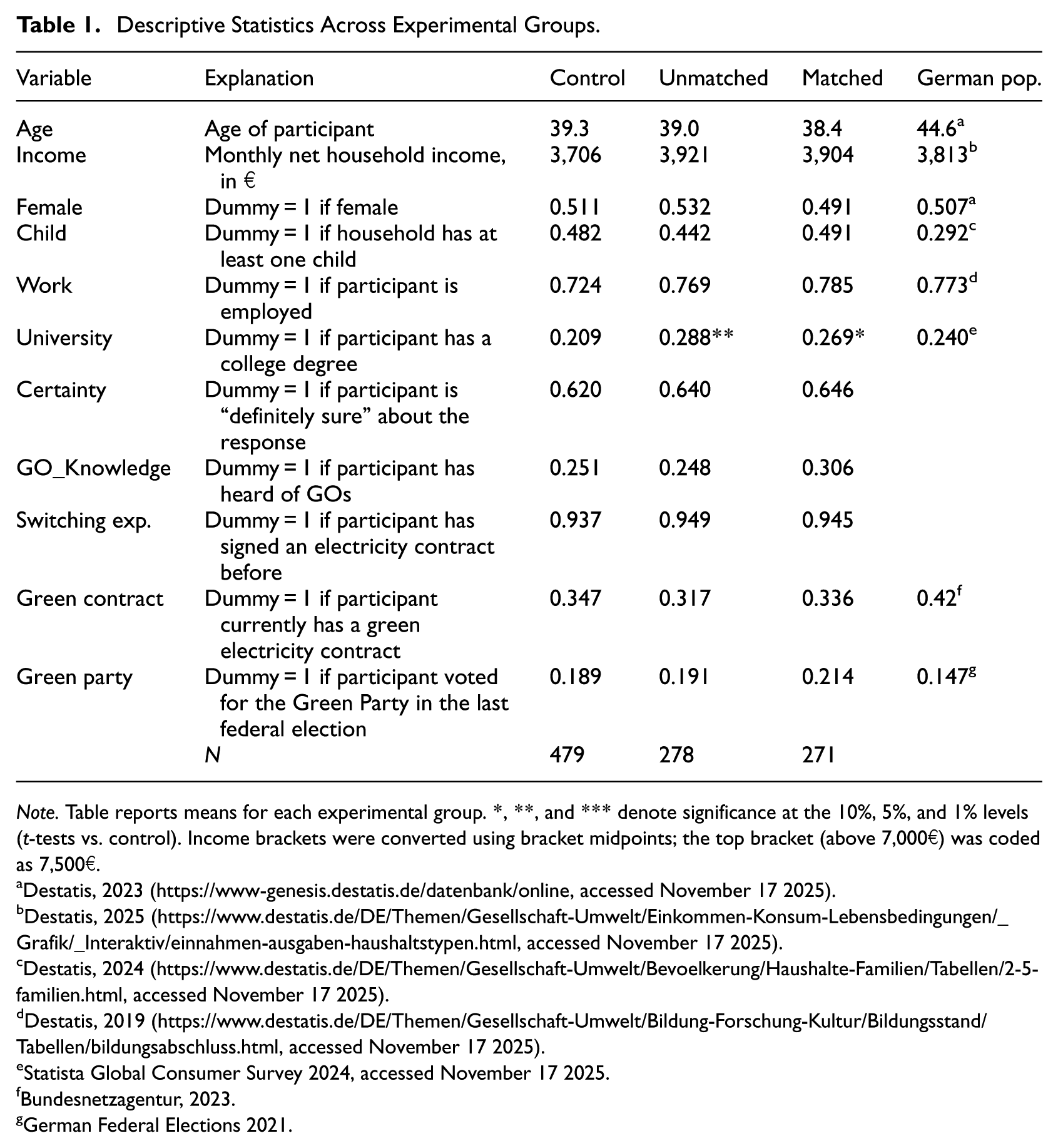
Note. Table reports means for each experimental group. *, **, and *** denote significance at the 10%, 5%, and 1% levels (t-tests vs. control). Income brackets were converted using bracket midpoints; the top bracket (above 7,000€) was coded as 7,500€.
Destatis, 2023 (https://www-genesis.destatis.de/datenbank/online, accessed November 17 2025).
Destatis, 2025 (https://www.destatis.de/DE/Themen/Gesellschaft-Umwelt/Einkommen-Konsum-Lebensbedingungen/_Grafik/_Interaktiv/einnahmen-ausgaben-haushaltstypen.html, accessed November 17 2025).
Destatis, 2024 (https://www.destatis.de/DE/Themen/Gesellschaft-Umwelt/Bevoelkerung/Haushalte-Familien/Tabellen/2-5-familien.html, accessed November 17 2025).
Destatis, 2019 (https://www.destatis.de/DE/Themen/Gesellschaft-Umwelt/Bildung-Forschung-Kultur/Bildungsstand/Tabellen/bildungsabschluss.html, accessed November 17 2025).
Statista Global Consumer Survey 2024, accessed November 17 2025.
Bundesnetzagentur, 2023.
German Federal Elections 2021.
Across experimental groups, characteristics are largely very similar. This suggests that the randomization procedure was largely successful in generating independent samples. 7 The only exception to this is the “University” indicator: both treatment groups include a somewhat higher share of college-educated participants than the control group. A plausible explanation is the additional treatment information and comprehension check required only in the treatment groups. Despite efforts to present the material in a simple and accessible way, participants with higher education may have been more likely to pass. As other characteristics are well-balanced, we proceed with the estimation and return to this difference when we later investigate potential treatment heterogeneity in Section 4.3.2.
Two further observations from Table 1 warrant attention. First, more than 90 percent of respondents across all groups have previously signed an electricity contract, indicating that the sample largely reflects household decision-makers. Second, 62 to 65 percent report being “definitely sure” about their choice, a share that is similar to the 67 percent reported by Andor et al. (2017a). These findings support the validity of applying the certainty approach and motivate our certainty-based robustness checks in the subsequent analysis.
With regard to general population statistics, our sample is broadly comparable to the German population. Two exceptions are the variables “Age” and “Child.” The younger average age in our sample likely reflects the use of an online survey. The difference in the “Child” variable stems from more limited comparability: the population statistic counts only children under 18, whereas our survey does not restrict the age of household members classified as children.
4.2. Household Awareness of Temporal Matching
To assess households’ awareness of the temporal mismatch in standard green tariffs (RQ1), we use control-group responses to Question 2 of the follow-up questionnaire. This question asks whether the offered tariff provides real-time matching between consumption and renewable generation. 8
Figure 2 shows the distribution of responses from the control group across the categories “No,”“Yes,” and “Don’t Know,” aggregated across 4€ and 8€ premium sub-groups (see Table B2 for group characteristics). Only a small minority (15%) correctly identified that the offered green electricity contract does not guarantee temporal matching at all times. By contrast, the majority either explicitly assumes temporal matching at all times (45.3%) or expressed uncertainty (39.7%). These results indicate that most participants are unaware of the current regulatory reality: current green electricity contracts are not required to ensure real-time matching between consumption and renewable generation. Importantly, this response pattern remains consistent when analyzed separately for the 4€ and 8€ premium sub-groups (see Appendix B, Table B3).
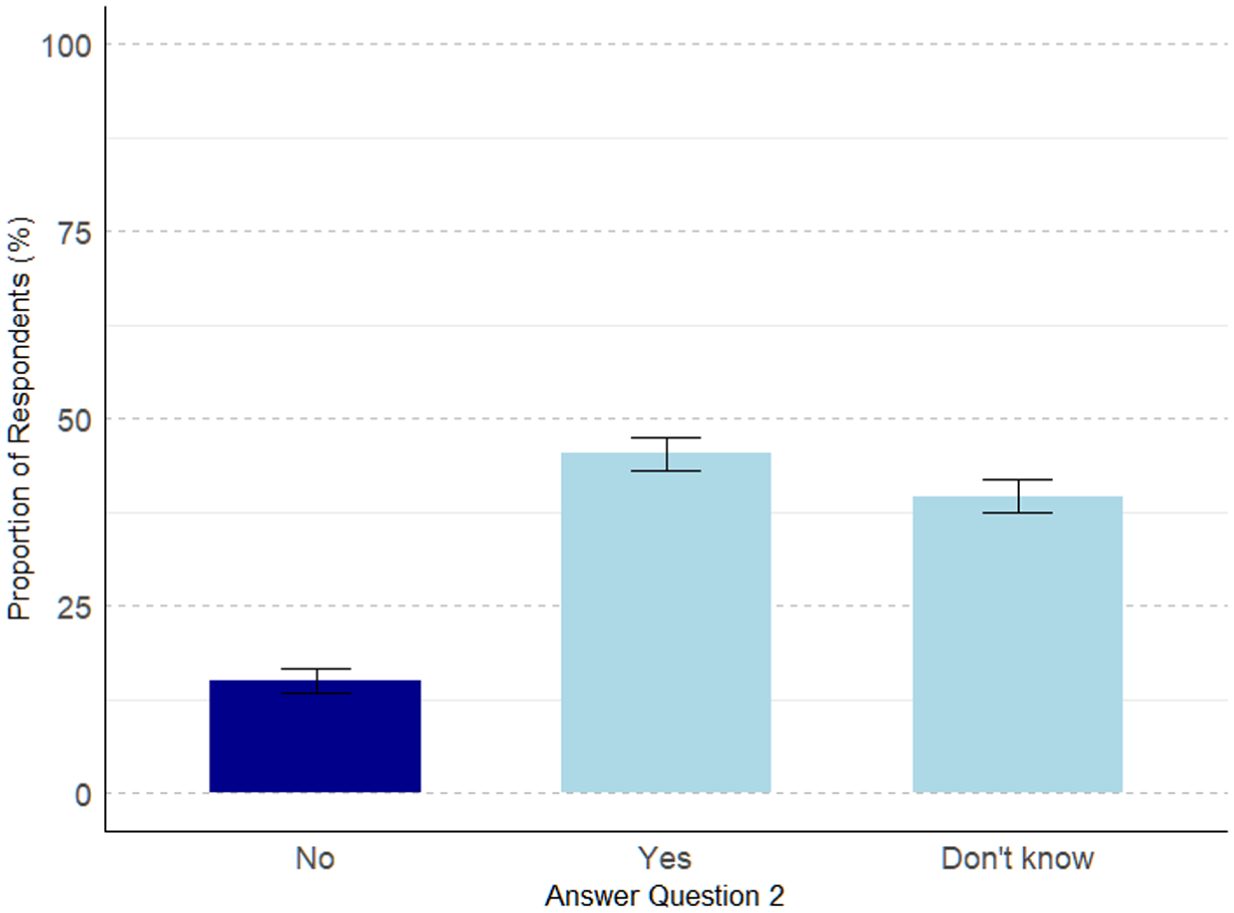
Control group responses to Question 2 of the follow-up questionnaire.
The follow-up questionnaire allows us to analyze how awareness of temporal mismatch varies across socio-economic characteristics (see Figure B1). Individuals with prior knowledge of electricity attribute certificates, existing green contracts, green party voting history, or a college degree are somewhat more likely to answer “No” to Question 2, but even in the most informed sub-group only 24 percent do so. Thus, awareness of temporal mismatch remains low across all socio-demographic groups.
4.3. Household Preferences for Temporal Matching
4.3.1. Test for Equality of Proportions
Turning to the choice experiment of our survey, we examine how information on temporal attributes of green electricity contracts affects consumer preferences (RQ2). Specifically, we compare acceptance rates for paying a price premium across experimental groups.
Table 2 presents results for the full sample. Across all experimental groups, acceptance rates decline as the price premium increases—for example, in the control group, the acceptance rate falls from 51.5% for 4€ to 39.8% acceptance for 8€. This downward-sloping demand curve is in line with prior research (Sundt and Rehdanz 2015) and supports the internal validity of our findings.
Share of Participants Who Accept an Increase of 4 or 8€ per Month per Person to Receive the Offered Green Electricity Contract.
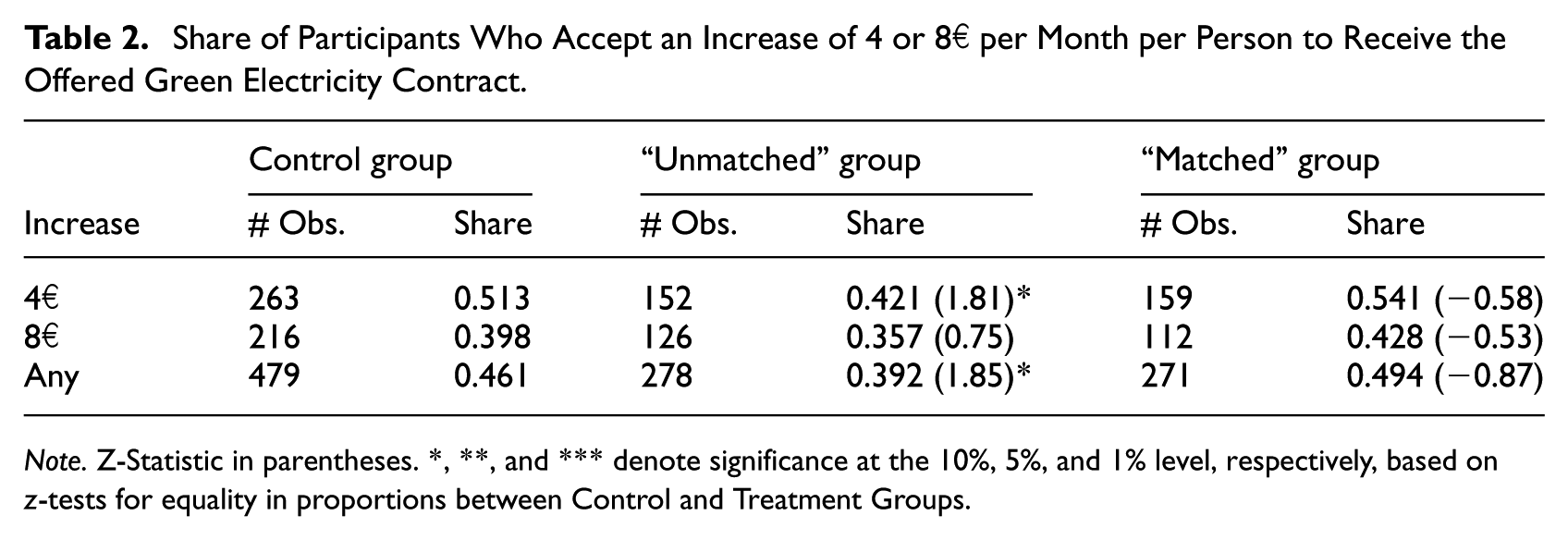
Note. Z-Statistic in parentheses. *, **, and *** denote significance at the 10%, 5%, and 1% level, respectively, based on z-tests for equality in proportions between Control and Treatment Groups.
Chi-square tests for equality of proportions indicate that acceptance rates differ across experimental groups at the 5% significance level (Table B6). To more precisely isolate the impact of each information treatment individually, we conduct pairwise tests for equality of proportions between the control group and our two treatment groups. Complete results are reported in Table 2. In what follows, we focus on the treatment effects themselves (i.e., differences in acceptance between the control and each treatment group), as visualized in Figure 3. For the full sample, two main insights emerge:
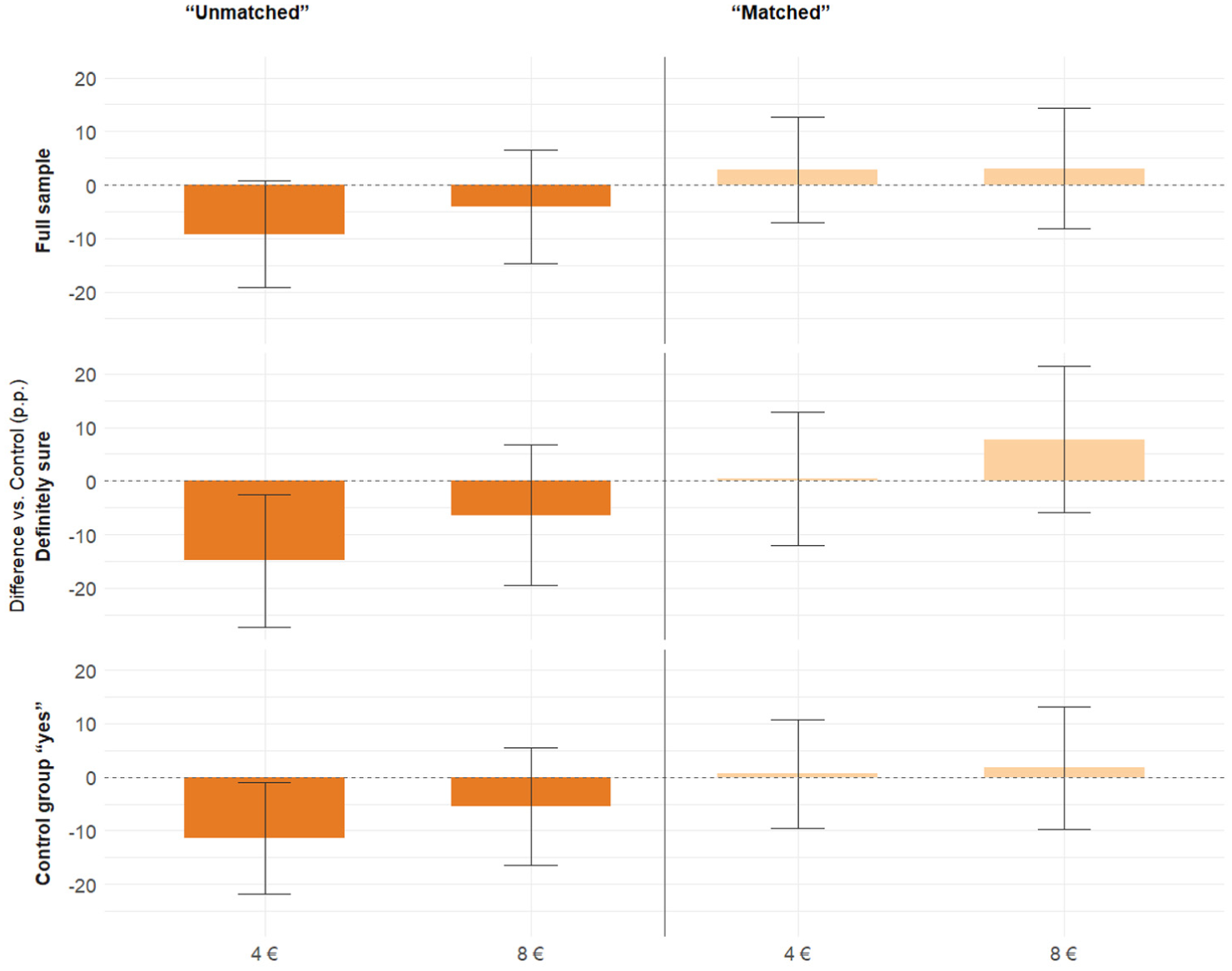
Treatment effects across groups and price levels.
First, we observe a clear drop in acceptance rates for the “Unmatched” group relative to the control group. That is, participants who were explicitly informed about the lack of temporal matching in the offered green electricity contract were less likely to accept the associated price premium. This effect is evident for both the 4€ and 8€ price premiums (with acceptance rates between 9.2 and 4.1 percentage points lower for the “Unmatched Group”). However, these differences reach statistical significance only for the 4€ premium—and only at the 10% significance level. Second, we observe a marginally positive, but not statistically significant, change in acceptance rates for the “Matched Group” relative to the control group. This indicates that participants do not exhibit significantly different preferences when implicitly informed about temporal matching.
We further contextualize these treatment effects for two sub-groups of participants, which we also visualize in Figure 3 (for results of Chi-square and pairwise equality of proportions test see Tables B6–B8). Namely, we first restrict the sample to individuals who indicated they were “definitely sure” of their choice (see Table B1 for group characteristics). For this sub-group the direction of treatment effects remains unchanged. 9 Statistical significance, however, increases: the difference in acceptance rates between the control group and the “Unmatched” group increases to 14.9 percentage points and becomes significant at the 5% level for the €4 premium. By contrast, differences between the control and the “Matched” group remain statistically insignificant. Overall, the certainty-restricted analysis reinforces our main finding: more confident participants reduce their acceptance rates more strongly when informed about the temporal mismatch. Our second approach to contextualizing treatment effects examines heterogeneity within the control group, based on participants’ implicit beliefs about temporal matching. Specifically, we exclude control group participants who already assumed temporal matching for their offered tariff (“No” to Question 2) and compare acceptance rates between the remaining control sub-group and the two treatment groups. As before, we observe unchanged direction of treatment effects, but an increased significance level for the decrease in acceptance rates in the “Unmatched” group relative to the control group: for the €4 premium, this drop increases to 11.4 percentage points and becomes significant at the 5% level. This suggests that the treatment effect is concentrated among participants who initially assumed temporal matching or were uncertain. 10
In summary, across our analysis, we identify a statistically significant treatment effect for the “Unmatched” group: informing participants about the temporal mismatch reduces acceptance rates. This effect is weakly significant in the full sample, but becomes substantially stronger when restricting the analysis to relevant sub-samples. By contrast, we observe no statistically significant treatment effect for the “Matched” group. These results align with the findings in Section 4.2. Given that randomization of participants into experimental groups was successful, we can reasonably assume that similar baseline beliefs prevailed in the treatment groups. Thus, explicitly informing the “Unmatched” group about temporal mismatch presumably contradicts underlying perceptions of a significant share of participants, consistent with the significant treatment effect we observe. By contrast, explicitly informing the “Matched Group” about temporal matching merely aligns with most participants’ existing perceptions, which is consistent with the absence of a significant treatment effect.
4.3.2. Linear Probability Model Results
To further test the robustness of the treatment effects discussed in Section 4.3.1, we estimate six linear probability models based on specification (2; see Table B10). We begin by estimating (2) without socio-economic covariates (Models 1 and 2), then add these covariates (Models 3 and 4), and finally include interactions between treatments and these covariates (Models 5 and 6). In each set, the second model is restricted to “definitely sure” responses.
The coefficient estimates for Models 1 and 2 closely mirror the differences in acceptance rates across experimental groups discussed in the previous section.
Turning to Models 3 and 4, the inclusion of additional socio-economic regressors does not affect the significance levels of the estimated treatment effects, further suggesting the robustness of our results. Examining socio-economic characteristics, we find patterns that are largely consistent with prior work (e.g., Herbes et al. 2015; Sundt and Rehdanz 2015). Respondents with prior knowledge of electricity attribute certificates and those with a university degree are more likely to accept a price premium, while acceptance rates declines with age. Moreover, participants reporting more pro-environmental behaviors and attitudes, as proxied by variables capturing prior green electricity contract choices and green party voting behavior, are more likely to accept a price premium for green electricity. Based on this finding, and as one characteristic of our empirical context is Germany’s comparatively high adoption of green electricity tariffs, we also repeat the equality-of-proportions tests for the sub-sample of participants who do not currently hold a green tariff (Table B9). In this sub-sample, baseline acceptance rates decrease (consistent with the LPM coefficient on “Green_contract”). Further, while the direction and relative ordering of treatment effects remain stable, significance levels partly shift across sub-samples. We discuss these patterns in Section 5.
Models 5 and 6 allow us to examine heterogeneity in treatment effects across socio-economic characteristics. Heterogeneity is mostly concentrated in the “Unmatched” group, and three interaction terms are statistically significant at the 5% level: respondents with higher income, those with a university degree, and those with prior GO knowledge indicate differential reactions to the information treatment. Higher-income and university-educated respondents exhibit a muted treatment effect. In particular, the positive coefficient on the University דUnmatched” interaction also helps to assess potential sampling bias, given the somewhat higher share of university graduates in both treatment groups. Because the treatment effect is weaker for university-educated respondents, our estimated effect for the “Unmatched” group is likely conservative; a more balanced sample may possibly yield an even larger drop in acceptance rates. Lastly, respondents who had heard about GOs before the survey showed a stronger negative reaction to information about temporal mismatch. While we can not identify the exact mechanism, it is plausible that, although familiar with GOs, they were unaware of specific temporal characteristics and therefore more receptive to the corrective information, ultimately leading to a more pronounced drop in acceptance rates.
5. Discussion and Policy Implications
This paper investigates a potential information failure in green electricity markets by studying households’ awareness and preferences for temporal matching in green electricity tariffs. Results from our stated choice experiment suggests that most consumers either lack understanding or even hold misperceptions about the temporal characteristics of green electricity tariffs. When these misperceptions are corrected, stated preferences for green electricity decline. In contrast, explicitly assuring temporal matching does not affect household preferences, indicating that many consumers assume such matching by default.
Table 3 summarizes our three main findings alongside their key policy implications.
Summary of Key Findings and Main Policy Implications.
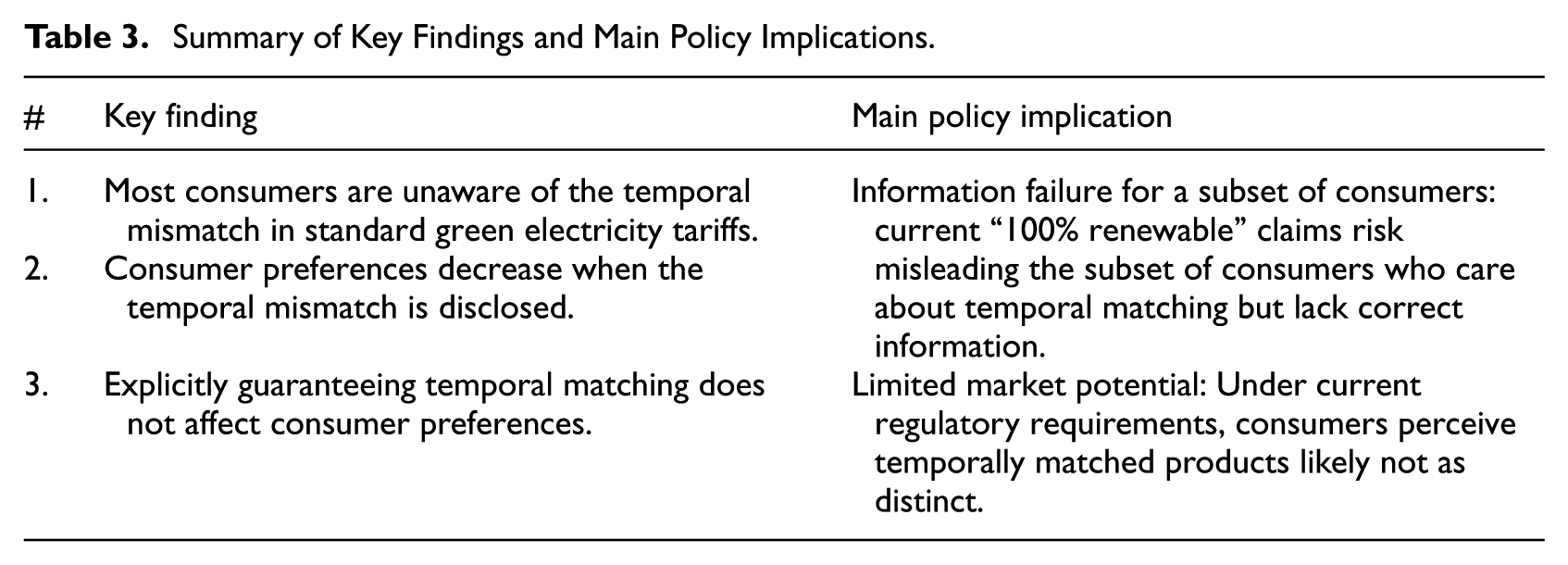
In the following sections, we discuss these results in the context of the broader academic literature, regulatory debates and reflect on their limitations.
5.1. Evidence for Information Failure in Green Electricity Markets
The existence and growth of EAC markets under annual matching can generate welfare gains by reducing information asymmetry and enabling the diffusion of “100% renewable” offers (Hulshof et al. 2019). We, therefore, interpret our findings as highlighting a trade-off between these efficiency benefits and the demand-side misperceptions we document, rather than as an argument against EACs per se. We first discuss the evidence for such misperceptions before returning to potential implications for the diffusion of green electricity tariffs in Section 5.2.
In the presence of information failure, markets fail to allocate resources to coordinate transactions efficiently (Akerlof 1970). Our results suggest that such a failure currently characterizes green electricity markets in two key respects.
First, most consumers possess incorrect or incomplete information about the temporal characteristics of green electricity tariffs. A large share of consumers explicitly assumes a continuous temporal matching between their electricity consumption and renewable generation. An equally large proportion reports uncertainty or lack of knowledge (“Don’t know”). This pattern is consistent with prior evidence on low levels of energy literacy among consumers (Martins et al. 2020).
Second, a non-negligible share of consumers appear to act on these misperceptions. In our experiment, informing participants about the absence of temporal matching led to a statistically significant drop in support for the tariff. This suggests that decisions in the control group were at least partly based on mistaken assumptions. While the absolute effect size is moderate—between 4.1 and 14.9 percentage points (see Section 4.3))—and statistical significance varies across sub-groups, the general effect is robust. 11 It is plausible that some consumers may assign limited importance to the temporal dimension of green electricity, prioritizing other attributes instead (Fait et al. 2022; Kaenzig et al. 2013). We also note that real-market switching behavior may differ (see also Section 5.3). Nevertheless, we interpret our findings as particularly meaningful in relative terms: in our experiment, roughly one in five participants 12 appear to support the green product based on misperceived temporal attributes.
The subsample analysis that excluded current green-tariff users offers additional nuance. Their lower baseline acceptance (37% vs. 46% in the pooled control) plausibly explains both the stronger response to information that explicitly guarantees temporal matching and the more muted effect of information highlighting non-matching. In this group, skepticism toward green premiums appears sufficiently pronounced that negative information adds little further discouragement. These shifts in significance do not change our main conclusions but help contextualize the results. Existing green-tariff users, who account for a sizable share of German households, are more likely to experience information failure. We also observe generally high and increasing churn in electricity markets. 13 We might therefore reasonably assume that existing green-tariff users are also repeatedly exposed to new contract options, making information failure relevant for a large share of consumers.
The misalignment between product attributes and consumer understanding suggests a form of information failure. Current disclosure standards allow suppliers to market green electricity products in ways that at least confuse or even mislead a subset of consumers. This practice appears inconsistent with foundational principles of European consumer protection and energy regulation. For example, EU Directive 2003/54/EC mandates that consumers must be able to make informed choices and that suppliers are obligated to uphold the consumer’s rights to accurate product information (European Parliament and Council of the European Union 2003; also see Aasen et al. 2010). More recently, the proposed Green Claims Directive (European Commission 2023) explicitly aims to ensure that environmental claims are “reliable, comparable and verifiable” to enable consumers to make more sustainable decisions and prevent “green-washing.”
Our results show that these regulatory objectives are likely not being fulfilled in practice. The “100% renewable” label—when used without temporal qualifications—is prone to misinterpretation and can mislead decisions of a non-negligible share of consumers. Our findings echo those of Laffan et al. (2024), who document similar information failures in relation to geographic origin preferences in electricity markets.
More broadly, current labeling practices limit consumers’ ability to make genuinely sustainable choices. While some corporate actors already procure electricity with closer temporal matching to reduce emissions (DeChalendar and Benson 2019), household consumers are effectively unable to do so. Misleading “100% renewable” claims obscure meaningful differences between tariffs and prevent households from identifying more environmentally credible options.
To address this, policy interventions could mandate stricter information disclosure requirements for green electricity products. One option would be that such products indicate the degree of temporal matching (percentage of hours) between consumption and renewable generation or that suppliers report the underlying matching interval (e.g., yearly, monthly, hourly). A more stringent intervention would be to introduce minimum threshold criteria for the “100% renewable” label, such as requiring that a certain target share of hours must be matched with renewable generation. Existing research suggests that hourly matching targets of 90 to 95 percent can be achieved at low cost premia and already result in significant emission reductions compared to current annual matching regimes (Riepin and Brown 2024). More broadly, these options are in line with a growing literature on the benefits of information disclosure for consumer decision-making (Jin and Leslie 2003), particularly in environmental contexts (Beyer et al. 2023).
Beyond policy action, voluntary industry standards could also contribute to more informed consumer choices. Electricity retailers could collectively agree on temporal matching requirements within industry-led initiatives and communicate their participation more openly. Comparable precedents exist in the corporate RE100 initiative, which requires its members to follow defined guidelines, including maximum age and geographic limits for renewable facilities from which EACs may be purchased. 14
Importantly, policy disclosure interventions may also trigger complementary voluntary action by industry. A precedent can be found in the German food sector, where the introduction of a mandatory animal welfare label in 2023 prompted several discounters to voluntarily commit to stocking only products that met certain label thresholds. 15
Lastly, a broader adoption of trusted third party verification and eco-labels—such as the TÜV EE02 label (TÜV Süd 2024), currently adopted by a limited number of providers—could play a supportive role, too (MacDonald and Eyre 2018; Truffer et al. 2001).
5.2. Market Potential for Temporal Matched Green Electricity
Our third key result shows that explicitly guaranteeing temporal matching does not increase support for green electricity tariffs, with acceptance rates remaining comparable to those of the control group. This likely reflects the fact that many consumers either already assume such matching exists or remain unaware of the underlying temporal mismatch (see RQ1). In other words, our data points to a baseline of unawareness rather than active distrust: participants appear to take “100% renewable” claims at face value and treat real-time matching as the default. As a result, the guarantee provides little new information to most participants and has, thus, little impact on their stated preferences. From the perspective of electricity retailers, this finding suggests that there is currently limited potential to charge a price premium for temporally matched green tariffs relative to standard green tariffs.
Introducing stricter transparency mandates or more widely diffused voluntary industry standards, could therefore introduce a trade-off. Correcting prevalent misperception may reduce uptake of standard green tariffs among consumers who previously assumed temporal matching. However, greater transparency also enables product differentiation. A more informed market could segment into tariff classes with varying degrees of temporal matching, allowing consumers to sort according to their preferences (Truffer et al. 2001). While our experiment does not estimate aggregate shifts in product choice, a plausible scenario is reallocation rather than erosion of demand: a subset of consumers may select more temporally aligned products, while others continue to choose standard green tariffs. In this sense, improved information disclosure could enable consumers to make choices more consistent with their preference and therefore be in line with the main intent of EACs: reducing information asymmetry in electricity markets.
5.3. Limitations and Future Research
To the best of our knowledge, this study provides some of the first empirical evidence on how households perceive and evaluate the temporal dimension of green electricity. Naturally, the analysis has several limitations, which may serve as a foundation for future research.
First, our analysis is based on responses from German households and may not entirely generalize to other regions. Future research could assess external validity by replicating our design in other national contexts.
Second, as with any stated-preference study, we cannot fully rule out the presence of hypothetical bias. We mitigate this concern by focusing on between-group effects and applying a certainty-based approach. Nevertheless, the absolute acceptance levels and the share of participants who change their choice in our experiment should not be interpreted as point estimates of real-world switching behavior. Future research could strengthen external validity by comparing stated preferences with revealed behavior in real-world tariff choices or experimental market settings.
Third, we focused exclusively on identifying whether and to what extent temporal matching affect households support for green electricity. However, the study does not explore the underlying psychological mechanisms driving this decision. In particular, we do not directly observe respondents’ trust in green electricity labels or perceptions of deceit once the temporal mismatch is revealed. While our model controls for several socio-economic and attitudinal covariates, future work could examine trust as well as motivational and cognitive drivers of choice heterogeneity. These efforts can draw on the broader literature on pro-environmental behavior (e.g., Bamberg and Möser 2007; Fritsche et al. 2018) and its application to electricity preferences (e.g., Lehmann et al. 2022).
Fourth, the simplicity of our choice experiment allows us to isolate the effect of a single attribute—temporal matching—but limits our ability to understand how consumers trade off multiple tariff attributes. Future studies could employ discrete choice experiments (e.g., Kalkbrenner et al. 2017) to assess the relative importance of temporal matching alongside other features. For example, time-varying tariffs may incentivize shifting demand toward periods of higher renewable generation and thereby increase the degree of temporal matching. At the same time, the associated price volatility may reduce consumer uptake (Cardella et al. 2017).
Fifth, while we identify effects on behavior, we do not evaluate effects on welfare. In particular, we do not quantify potential consumer costs that come with the intervention (e.g., the effort required to process the information). Only a subset of consumers react to the information, and for those who do not adjust their choices, these costs likely remain a relevant component for a full welfare assessment. Future research could extend the design to enable an empirical assessment of the net welfare effects of such information policies (see e.g., Allcott and Kessler 2019 for a relevant discussion).
Lastly, we used a deliberately neutral framing in our information treatments to isolate the impact of temporal matching. However, this may not reflect real-world marketing practices. Previous studies demonstrate that the way non-financial information is framed can significantly shape consumer purchase decisions (Beyer et al. 2023; Tian and Zhou 2015). In the context of voluntary green electricity tariffs, Cardella et al. (2022) show how different information nudges affect consumer preferences. We thus encourage future research to examine how alternative framings and explicit labeling—such as displaying the emission profiles under different matching regimes—influence consumer valuation of green electricity tariffs.
6. Conclusion
Demand for “100% renewable” electricity products has grown rapidly in recent years. Yet most of these tariffs achieve their green label via Energy Attribute Certificates, which may be used long after the electricity is produced, allowing for a temporal mismatch between electricity consumption and renewable generation.
This paper provides novel empirical evidence that “100% renewable” claims are subject to a specific information failure. Results from our stated-choice experiment show that most households mistakenly assume temporal matching between their consumption and renewable generation within their green electricity tariffs. Correcting this misconception leads to a moderate yet statistically significant decline in tariff acceptance: from 46% to 39% in the baseline sample and from 44% to 33% among respondents who reported being “definitely sure”. In contrast, explicitly guaranteeing temporal matching does not significantly affect consumer choice under current disclosure rules–likely because consumers implicitly assume these tariffs to work with temporal matching anyway. Taken together, the findings indicate that insufficient disclosure distorts preferences for a non-trivial share of consumers and may also suppress demand for more temporally granular green electricity products.
Various measures could remedy this information failure in green electricity markets. Policy measures could mandate tighter disclosure and verification standards, as currently discussed under the proposed EU Green Claims Directive. Requiring suppliers to report temporal matching intervals or meet minimum matching thresholds would better align product claims with consumer expectations and could create a premium market for more granular, time-matched green electricity. Another avenue is the development of voluntary industry standards and the wider adoption of eco-labels, which can make differences between green electricity products more observable to consumers. Such differentiation may, in turn, encourage investment in flexible generation, storage, and dynamic-pricing solutions that reduce periods of renewable undersupply, thereby advancing both consumer protection and system-level decarbonization. Future research should test these policy levers in other national contexts and with revealed-preference data to shed light on their potential long-run impact on technology adoption and market evolution.
Footnotes
Appendix
Author Contributions
J.B.: conceptualization, data curation, data analysis, visualization, and writing—original draft and review and editing; M.B: conceptualization, and writing—original draft and review and editing.
Funding
The authors disclosed receipt of the following financial support for the research, authorship, and/or publication of this article: This work has received funding from Stadtwerke München GmbH which was used to conduct the online experiment.
Declaration of Conflicting Interests
The authors declared no potential conflicts of interest with respect to the research, authorship, and/or publication of this article.
Data Availability Statement
The experimental data can be shared upon reasonable request and in anonymized form.
Declaration of Generative AI and AI-assisted Technologies in the Writing Process
During the preparation of this work the authors used ChatGPT in order to review language and improve readability of the manuscript. After using this tool/service, the authors reviewed and edited the content as needed and take full responsibility for the content of the published article.
2
3
In line with several studies in the German context that use a mixed baseline tariff (e.g., Kalkbrenner et al. 2017;  ), we present the standard plan as a mix of renewable and conventional sources, which also reflects the actual composition of the German electricity grid. Since all treatment groups face the same reference point, the specific baseline composition should not affect identification of the relative treatment effects.
4
5
The resulting number of participants per group is not equal, as we include responses from a successful pre-test in the control group.
6
By introducing different levels of temporal matching (e.g., hourly, weekly, monthly) within the experimental design one could theoretically assess whether household‘s tariff choices differ depending on the exact attribute level.
7
In addition to the pairwise test between control and treatment groups, we also perform an ANOVA test to jointly test for differences across the experimental groups (see ). The results align with the pairwise comparisons presented and indicate that the only statistically significant difference across groups relates to the “University” indicator.
8
“Does the green electricity contract offered to you ensure that your consumption is at all times matched by production from renewable energy sources?”
9
General acceptance rates across experimental groups decrease slightly. This is in line with earlier experimental studies, which show that participants expressing higher certainty in their response tend to exhibit lower WTP for green electricity (Bigerna and Polinori 2014; Bollino 2009) and are less likely to accept surcharge increases ().
10
11
Interestingly, for the total sample, the reduction in acceptance in the “Unmatched” group at the 4 € level (−9.2 p.p.) is similar in magnitude to the reduction observed in the Control group when the premium increases from 4 € to 8 € (−11.5 p.p.). The hypothetical nature of our experiment limits strong conclusions about changes in absolute WTP. Yet, it suggests an aggregate behavioral effect: informing participants about the absence of temporal matching removes a non-trivial share of perceived value, behaviorally equivalent to making the tariff 4 € more expensive.
12
This corresponds to an 14.9 percentage point drop from a baseline acceptance rate of 50.6% for the 4€ increase in the “definitely sure” sub-set.