




Abstract
From September 2013 to April 2014, an independent collection of homeless men and women planted their own tent city, Whoville in downtown Eugene, Oregon. Over these 8 months, they fought with the city for more housing for Eugene’s growing homeless population, initiating a citywide dialogue on the marginalization of the homeless. The purpose of this study is to analyze how the homeless tenants of the Whoville community used participatory communication to achieve their long-term goals in sustaining a working camp and also carrying on with their plans after the government intervened. Drawing on seven interviews with camp tenants, highly involved volunteers, board members, and articles from the Eugene Register Guard, I examine the dynamic of participatory communication in sustaining this movement. What components of participatory communication helped these activists form a community and then mobilize the surrounding community? I argue that two key strategies, applicable to other situations of homeless resistance, emerge from the themes found in these interviews: (a) Whoville’s strategy to unite as a physical community, forming a public, collective identity in the greater Eugene community and (b) invoking a collective vision for better housing which mobilized both Whoville and citizens at large to rally to this vision.
Introduction
From September 2013 to April 2014, an independent collection of homeless men and women planted their own tent city, Whoville, on a busy intersection in downtown Eugene, Oregon. Over these 8 months, they fought with the city for more housing for Eugene’s growing homeless population, initiating a citywide dialogue on the marginalization of the homeless. A force of Eugene police officers shut the camp down on April 4, but the former tenants did not scatter. Instead, Whoville tenants had already spoken and mobilized so many Eugene residents during the 8-month sit-in, that several steering committees were already working on a large, permanent homeless sanctuary, funded by several hundred thousand dollars in donations. More than a year later, April 2015, Whoville is now renamed as The Nightingale Health Sanctuary, has a volunteer board which is actively seeking to buy land for the sanctuary with a $400,000 community donation, manages a smaller, temporary camp (this time around, sanctioned by the city), and regularly meets with city leaders to raise more funds and support.
The U.S. economic depression in 2008 sparked the Occupy Movement throughout the United States, as a protest against the weakened U.S. economy (Agarwal, Bennett, Johnson, & Walker, 2014). Occupy was the largest class-based economic protest seen in the United States in decades. The Whoville movement began as an offshoot of the Occupy protest in Eugene and, as such, uses class-based, rights-focused rhetoric that identifies many of the same institutional grievances which prompted Occupy.
Much of the literature on homelessness in the United States centers on how external powers, such as government programs, shelters, and social workers, can help the homeless. What sets Whoville and other tent cities apart in this conversation is that internal forces of power, originating from the marginalized themselves, brought about sustainable change for this population. Self-action and self-efficacy are also central to the understanding of the term participatory communication and, as such, this article is a study of participatory communication as enacted within Whoville.
The purpose of this study is to analyze how the Whoville community used participatory communication to achieve their long-term goals in both sustaining a working camp and also carrying on with their plans after the government intervened. I argue that two key strategies, applicable to other situations of homeless resistance, emerge from the themes found throughout these interviews: (a) Whoville’s strategy to unite as a physically situated, activist community, thus forming a public, collective identity in the greater Eugene community and (b) invoking a demand or collective vision for better housing that mobilized and incited both Whoville and citizens at large to rally to this vision. The rest of this study untangles how these internal two strategies were formed, drawing from my observations on the group’s usage of participatory power and participatory communication.
Drawing on seven interviews with camp tenants, highly involved volunteers, board member, articles from the Eugene Register Guard, and several fliers about the marginalization of the homeless in Eugene created by Whoville supporters, I examine the dynamic of participatory communication in sustaining this movement. On a theoretical level, what participatory strategies did tenants seem to gravitate toward to keep the camp together? What does their conception of empowerment say about participatory communication in the context of homelessness in the United States? The interviews show that the tenants of Whoville understand empowerment to mean, among other things, belonging to their group, that the act of bonding together in a common vision itself is empowering. In this sense, having arrived at this publicized claim to their patch of land was an act of empowerment, a crucial component of participatory communication. Effectively, this study shows the self-guided and self-directed component of participatory communication is a successful strategy for social progress in tent city movements in the United States.
A Brief Sketch of Whoville and Homelessness in Eugene
Whoville’s visible presence in the town of Eugene was a critical part of the group’s emerging identity. Consider the importance of the following description.
A soaking cardboard sign read “Right to sleep.” It was duct-taped to a fence with a dozen or so other signs reading “Whoville,” “Sleep is a human right,” etc. Beyond, a colorful span of tents surrounded a tent kitchen, a campfire pit and outhouses. This scene was typical of the Whoville camp between August 2013 and April 2014 (Pietsch, 2014). Placed at the corner of two major Eugene arterials, Broadway and Hilyard, hundreds of vehicles, bicyclists, and pedestrians passed by the signs and tents each day. Whoville representatives were frequently videoed, interviewed, and photographed by Eugene’s local media (The Eugene Register Guard, 2014; Pietsch, The Eugene Register Guard, 2014). Most individuals in the camp were either people in their 20 s or 30 s or older, in their late 50 s and 60 s. The majority of people were White, many of whom had drifted into Eugene from nearby Oregon towns, such as Roseburg or Salem. Many people hung out in big groups inside the kitchen tent and the individual tents, smoking, drinking, and listening to music on their phones. Four of the five younger women I met were pregnant, often partnered with an older homeless man in his 50 s or 60 s. While I never stayed into the night, several participants told me the camp grew quite noisy each night and into the morning, as people became more drunk, high, and could turn up their music with less citizens, traffic, and businesses operating nearby. I was never able to confirm the use of hard drugs in the camp but saw alcohol, cigarettes, and marijuana consumed and traded quite frequently. Several interviewees told stories of people using the camp to recover after being beaten, robbed, or let out of a hospital after surgery (many were homeless before these incidents). Almost all the tents had a bike or two stacked outside and many people kept a pitbull tied up outside their tent during the day. A continual stream of visitors, largely church staff with prepared food, trickled in and out of the camp at all hours. The main fire pit was in constant use by people working in the kitchen tent; camp members had organized shifts for making communal meals and washing dishes. Other people were responsible for taking out the trash and solving disputes. This description comes from my frequent research trips into the camp, as well as interviews with participants.
Whoville representatives came to every city council meeting. The city issued a first warning to vacate in January, then extended this, then issued another one, then extended that one (Dutcher, 2014). Just after the first warning in January, people began posting cardboard signs, by the dozens, reading “Whoville, right to sleep” all over town. I myself stumbled across a long trail of tiny notes written on used snack wrappers, reading “Right to Sleep,” along east 14th avenue in February, 2014. I picked up each piece of the (somewhat sticky) cardboard for two blocks and read each note. Several contained longer sentences explaining the impending action from the city and asking people to support Whoville.
At a panel for homeless speakers (mostly from Whoville) at a church on March 8, 2015, several homeless advocacy groups in Eugene offered leaflets on a table outside. I discovered Whoville had sparked the creation of a small, monthly newspaper, The Eugene Occupier. Another flier from Lane County Health and Human Services stated that 1,751 homeless were counted on a census day count for homelessness on January 30, 2013. Of the 1,751 people counted, 1,102 were without shelter, 261 were living in transitional shelter, 388 were staying in emergency shelters, and 108 couples or single parents had children living on the street with them.
Lastly, more than a year after the first major shutdown of the camp in April 2014, the original Whoville movement has grown to include the Nightingale Health Sanctuary steering committee, which hosts a new website actively taking donations for the sanctuary, a $400,000 donation for a permanent health sanctuary, a monthly newspaper for homelessness, a 30-person, city-sanctioned tent camp, open until April 2015, and board members hold weekly visits to churches and businesses to mobilize the community. These facts give some context with which to understand the following analysis of empowerment and participatory communication.
Participatory Communication and Empowerment
Scholars in multiple fields of social science began using the term “participatory” in the 1980s to refer to a developing new theory in the field of development work (Armstead & Cancian, 1991; Brown, 1993; Kanji, 2009; Servaes, 1989; Servaes, Jacobson, & White, 1996; Servaes & Lie, 1997). Rooted in self-empowerment, cultural identity, subverted power structures, and grassroots thinking, the term is considered as a response and critique to modernization theory and dependency theory, both of which drew from macrolevel, top-down, one-way flows of development assistance (Servaes et al., 1996). The term “participatory” is linked to multiple social science terms, such as “participatory action,” “participatory approach,” “participatory communication,” or “participatory action research.” Participatory communication refers to a dialogic, self-managed approach in the communication of a project, where multiple stakeholders hold equal power in the decision-making process. In the context of development and relief work, it often means consulting and allowing a native demographic to lead, design, guide, and manifest a project that holds their best interests at heart. The most developed form of participation is self-management. This principle implies the right to participation in the planning and production of media content … One of the fundamental hindrances to the decision to adopt the participation strategy is that it threatens existing hierarchies. (Servaes, 1989, p. 21)
A key mechanism of understanding participatory communication is understanding empowerment (Kanji, 2009; Rowlands, 1995). Empowerment is one’s ability to have control over the decisions that affect one’s life. According to Kanji, empowerment is how one garners the ability to assert power in a relationship of unequal power. As such, one of the main questions in the Whoville survey was, “What does empowerment mean to you?” Rowlands writes of empowerment for an individual existing on three plains:
Personal
“Where empowerment is about developing a sense of self … and capacity, and undoing the effects of internalised oppression” (Rowlands, 1995, p. 87).
Close relationships
“Where empowerment is about developing the ability to negotiate and influence the nature of the relationship and decisions made within it” (Rowlands, 1995, p. 87).
Collective
“Where individuals work together to achieve a more extensive impact than each could have had alone. This includes involvement in political structures, but might also cover collective action based on cooperation rather than competition” (Rowlands, 1995, p. 87).
Further, an additional goal of participatory communication is it seeks a voice for the voiceless as part of subverting the existing power structure (or hierarchies, as Servaes says).
The Machine They Rage Against: The Hierarchy and Hegemony of U.S. Cities and Police
To discuss the idea of “empowerment,” one must also discuss what one is “empowering against.” Homeless resistance struggles against a hegemony of the proper public sphere—the sphere that is discursively constructed by state power, which relegates who is welcome in the city’s public spaces and who is not. Feldman (2004) argues that cities normalize housed citizens when they use their hegemonic power to rule against activity by the unhoused (p. 3). Cities in the United States end up “othering” homeless people by forming ordinances that explicitly ban them from using public spaces. An ideology of public space as “owned” by a normatively enshrined “we” of home-dwelling citizens is both cause and effect of the punitive homeless policies, which these scholars note, beyond simply targeting the problem of homelessness or street disorder, become part of a broader pattern of hegemonic identity construction. (Feldman, 2004, p. 3)
Feldman’s comment on hegemonic identity construction correctly nails what is wrong with both compassionate responses to homelessness and punitive responses; both responses assume a definition of someone operating outside the boundaries of a “normal identity.” Further, both responses to homelessness assume a power structure in which the hegemony (Eugene City Hall, Eugene Police Department, and Eugene citizens giving aid) has more power and more resources than those outside the norm. It is time to pry homelessness loose from its usual frame as a social problem and to see the state and sovereign power as deeper causes, not as superstructural with respect to society. (Feldman, 2004, p. 15)
Feldman’s ideas on the state as a cause of homelessness translate easily onto other discussions of tent cities. Similar to Whoville, a tent city in Chicago in 1995 set up on a piece of land, lasted almost a year, was taken down by the city, and the angry, ousted tenants formed a loud social movement that eventually ended in the city building more low-income public housing (Wright, 1995, pp. 37–68). The tenants of Tranquility City, faced with the same constrictive ordinances as Whoville tenants, challenged the city’s hegemony. In both situations, homelessness becomes an issue framed as an outcast minority fighting to be defined and treated differently by the state hegemony, asking for inclusion in the definition of the public sphere as citizens, to use Wright and Feldman’s terms.
In erasing certain usages of the physical public spaces of a city, Mitchell (1997) argues cities are ultimately annihilating the homeless (p. 305). Mitchell lists seven instances in the 1990s where city council members intentionally passed ordinances banning sleeping in public (Santa Cruz, Phoenix), loitering in a parking lot (Atlanta and Jacksonville, 1993), or begging from people in cars (Cincinnati, 1995; Mitchell, 1997, pp. 306–307).
In another example, Feldman uses an ordinance against sitting on the sidewalk, enacted by Seattle in 1993, to show how state power constructs the definition of “proper citizens” and “unwanted citizens.” A vision of the upstanding citizen is established in opposition to the bare life of the homeless street-dweller and panhandler, who are viewed as physical blockages preventing the achievement of a unified public space in which consumer goods and consumers move unobstructed. (Feldman, 2004, p. 42)
Further, in ruling against certain types of unwanted behavior, the city of Seattle is also reinforcing its own identity (hegemonic identity construction) as a legislative body that holds power over others. Servaes’ ideas on empowerment and participatory communication orient well within this idea of state power making mandates, which privileges some and leaves others needing to empower themselves against the state, as their present lifestyle has trespassed on that state power.
Research Question 1 (RQ1): In the context of living in relationship in the camp, what does empowerment mean to those living in Whoville? Do they consider Whoville a self-managed solution?
Tent City Movements in the United States
The Whoville movement is one of the many similar, past protests by homeless around the United States. In the past 25 years, several major city governments built low-income housing in response to protests from homeless activists. This happened in Sacramento in 2009 (Middleton, 2014), Atlanta in 1990, Chicago in 1992 (Wright & Roberts, 1994; Wright, 1995), Portland, Oregon, in 2001 (Mosher, 2010), and Eugene, Oregon, in 2013 (Heben, 2014). Each study documents a common narrative: A band of homeless begin protesting their municipality’s lack of housing, build a voice for their situation with the media and government, and then work with various agencies to come up with permanent housing. A common thread through these five case studies is collective empowerment and identity building. Such political action was possible, it is argued, because the encampment provided privacy, safety and autonomy and functioned as an identity building device, where those who are typically marginalized or forced to succumb (in shelters or hospitals) to institutional control were able to establish a sense of independence and self-respect and ultimately to gain a sense of political empowerment. (Wright, 1995, p. 37)
One study tracked and qualitatively assessed the progress of a tent city movement in Portland, Oregon, in 2001 (Mosher, 2010). A band of eight people began marching with their shopping carts through the streets, demanding a legal place to sleep because the city shelters were at capacity. Their protest began much like the Whoville protest and ended with the city creating a permanent tent city downtown for the homeless. The young community formed a system of democratic governance that gave rights and responsibilities to the safety of each resident. With a food preparation area, portable toilets, a storage tent, and a heated “security” tent, Dignity Village became a relatively hospitable alternative where weary people could rest. (Mosher, 2010, p. 1)
One aspect missing from the conversation on homelessness is a study of the interpersonal dynamics and interpersonal dialogue between residents of tent cities. What sets Whoville and other tent cities apart in this conversation is that internal forces of power, originating from the marginalized themselves, brought about sustainable change for this population. In terms of participatory communication, what specific dialogue takes place?
Research Question 2 (RQ2): What components of participatory communication helped these activists form a community and then mobilize the surrounding community?
Method
The qualitative direction of this question could best be explored through the method of interviews with Whoville participants. An interview can help reveal the finer details of what this shelter means to residents. The strength of talking with a person at length is that the researcher can create a detailed, local perspective (McCracken, 1988). The interview guide I used can be found in the Appendix.
Gathering Interviews
I located four willing participants living in one of the postcamps that formed after the major shutdown of Whoville on April 4, then reinterviewed two of this group 4 months later, in September 2014. Ten months later, in February 2015, I conducted four more interviews with board members, volunteer supporters, and attended a panel where several former Whoville tenants and Whoville supporters spoke to a church congregation.
The interviews with Nora and Brian took place in late May 2014 and were each about 40 minutes long. The interviews with Mick and Sarah took place in early June 2014 at the same camp. All names were changed to respect the anonymity of the tenants. Both interviews were about 30 minutes long. I also studied several issues of The Eugene Occupier, which formed as an outgrowth of the Occupy Movement but now primarily is printed to bring attention to homeless issues in Eugene. All the interviews were recorded with the participant’s consent. The institutional review board department of the University of Oregon also approved these interviews.
Data Analysis
Three-step, line-by-line open coding was used to analyze the data, which involved breaking down the information, comparing it, and placing it into categories (Corbin & Strauss, 1990; Pontius, 2008). For each coded theme, participant quotes were organized by labels, resulting in subcategories. Through three-step coding, I sifted out four major themes apparent within their dialogue.
Results
A predominant theme among the tenants of Whoville, the volunteer supporters, and the board committee was that occupants of the tent camp have a strong need to belong and matter to the group, as well as care for their friends and partners within the camp. Participants were unanimous in saying that Whoville was a space of belonging for people who felt marginalized, preyed upon, and left with no place to sleep. In this sense, it was the interpersonal relationships and the acceptance and care inherent in those relationships that many participants felt was the most important to them.
Theme 1: A Relational Need to Belong and Care
We support each other. We are all family, said Sarah.
First Theme: A Need to Belong and a Need to Care.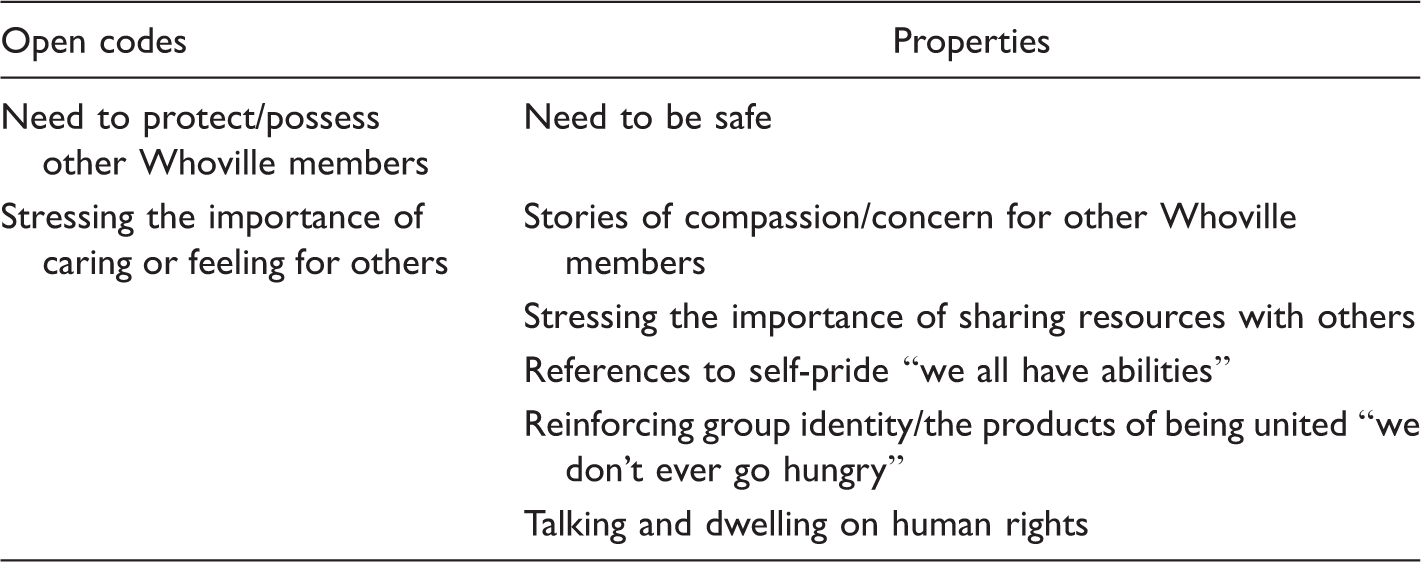
This is the family I thought I’d never have again. It’s being able to help people instead of hurting people, said Mick.
Some place, I can tell, ‘Hey bro, I'm going home’ And I can believe it too. When it’s time, I can say, ‘Hey, I'm going home.’ That’s pretty important to believe. (Brian, personal communication, May 23, 2014)
It was a community of homeless people that would help homeless people in many many different ways; many ways of just feeling a part of something, like there is something more than just the alley way every night. There is actually a kitchen when you wake up. People unite that you would never imagine would unite. (Mick, personal communication, May 25, 2014)
A second component within this theme was participants expressed an overwhelming need to protect and care for others within Whoville. It was clear that belonging to the group gave people a specific urge to look out for their friends within the camp. Participants made repeated references and told stories that emphasized this need. People die from freezing. They lose their toes from frostbite. There’s people we know that’s happened this winter to. He almost died this winter from pneumonia from being in the rain. Lost—some of these people need caregivers. We watch out for each other. We don't see people for a day—we got out looking for them. Have you seen so and so? (Sara, personal communication, May 23, 2014) Okay, I got handicapped people in here. I got mentally ill people in here. The department services in town have sent people to Whoville because we’ve worked together and helped these people, not to take them and put them somewhere and make them take pills and shit. (Mick, personal communication, May 25, 2014) Those two right there, she’s pregnant. They’re just waiting for that right paperwork, the right thing to happen. And that tent gives them that security of knowing they’re going to have a place next week. (Mick, personal communication, May 25, 2014)
Another example of this theme of belonging is that, in every description of Whoville, participants said “we” when referring to their daily activities. Participants used “we” when referring to even the most mundane activities, such as resources found in the camp. Nora references many of her individual actions as actions of the group. We’re all trying hard to stick together and make it successful for us. But it’s hard when we don't have a stable place where we can be. We talk about what’s going on. We ask where people want to move. We try to get people’s opinions and ideas for the situation on hand. (Nora, personal communication, May 25, 2014) All we wanted was to do proposals for rest stops so we had places to rest … The community is freaking awesome … You have to be united as one. That takes a lot of time and attitude. (Mick, personal communication, May 25, 2014)
It is clear participants saw themselves as part of the group, as they used the term “we” dozens of times throughout the interview. The repeated usage of “we” fits well into the theme of “needing to belong” as the continual repetition of saying “we” points to an underlying belief that this individual is close with someone else who does the same things, needs the same things, and uses the same things. The usage of “we” implies a greater suggestion that this person is not alone in their everyday activities and that this person feels the need to express this by collectively summarizing many of their personal activities as if done in one big group. There is a strong sense of belonging and identity in such word choice.
At least three other major studies of tent cities found that “group identity” played a crucial role in the functioning of these communities (Heben, 2014; Mosher, 2010; Wright, 1995). Portland’s Dignity Village and Chicago’s Tranquility City members all held tightly to idea that they belonged together. The creation of this bond or identity is helpful for negotiating for more power within the public sphere of a city; in all three situations, formerly scattered individuals used their group identity to successful advocate the dominant power of their city for a new housing community. This particular finding helps affirm and further the idea of a group identity as a meaningful, helpful product of participatory communication.
Theme 2: Suffering in the Hope That Whoville Will ‘Pay off’
We’re trying to do something for the homeless community. We’re not just here to have a place to crash for ourself. We’re trying to build a community for 60 to 100 people. We can build little huts, maybe have a community garden. Basically, we want a home, kind of place. We say, ‘hey, we’re going home,’ (Brian, personal communication, May 26, 2014).
Second Theme: Suffering in the Hope That Whoville Will “Pay off.”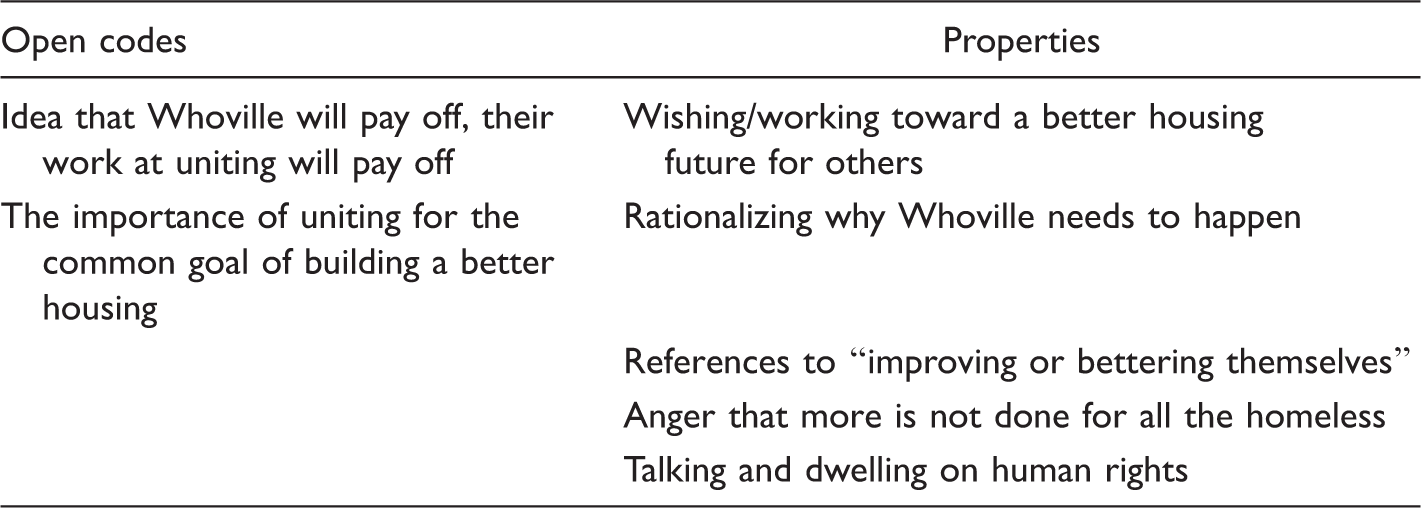
I want transition and change so this doesn't happen to other people. Everyone has a reason why they are here. I’d like to see everyone have a home. Someone might want to stay in tents. That’s our long term. A tent space. ‘Put your tents on land for six months’. I’d like to see everyone have a safe place and stability. (Sara, personal communication, May 23, 2014)
Some people fell away because we can’t find a place to settle the fuck down and make a home. Keeps it all together for me is I think we can do better for ourselves than lying under a fucking dumpster all night. I really think I can do better for myself. That’s why I’m in (Brian, personal communication, May 23, 2014).
Notice that participants speak of the success of Whoville in the future tense. Every participant repeatedly stressed that their life in Whoville would come to solve the problems of their fellow homeless citizens. My long term solution is really to get everybody into some kind of housing. I really want to get property and do like … build their own Conestoga hut or shack, love shack, whatever you want to call them. And move forward in their lives to get on to better housing. (Nora, personal communication, May 23, 2014)
Where participants did not really see the immediate self- management success of Whoville, what they did see was how their long public protest could pay off to make a better long-term housing situation for many. That’s what the future is, that we foresee. Ours is just something personal. We’re still sponsoring Whoville. This is just our heart’s desire. There’s so many out there. There’s so many out there. You see 16 years old having babies—nowhere to go. They’re confused. Mamas—they need love, they need hugs. (Sara, personal communication, May 23, 2014)
Other studies of tent cities also comment on the strength of having a future goal (Heben, 2014; Mosher, 2010; Wright, 1995). Both Wright and Mosher find the activist nature of fomenting homeless resistance means tenants spread a vision to others and to the hegemony of what they want; what their vision is. Similar to the findings in this study, Wright found that Tranquility City tenants were intentionally advocating and disturbing the city for better housing conditions. This presents a potential answer to the critiques raised by Loehwing on mainstream culture’s focus on the cliche, present-centered homeless person. “Characterizing homelessness as a present-tense predicament not only legitimates exclusion but also calls into question the possibility or productivity of resistance against it by asserting the primacy of meeting the needs of the homeless body” (Loehwing, 2010, p. 398).
The findings of this study and other studies demonstrate both the power of having a vision and correct the misguided notion of the homeless as disorganized, in-the-moment people.
Theme 3: Difficulty Responding/Living Within Orders From Non-Homeless
Difficulty Living Within Orders From the Law and Non-homeless.

Two questions on the interview guide asked participants how they defined empowerment and if the participant felt empowered in his or her life. Their stories often reflected the power dynamics of living on the streets. Participants made constant references to police violence, street violence, and the difficulty of surviving outdoors.
[Norah is narrating what happened on the actual morning the largest camp was shut down, in April.] They came in, 50 cops deep, you know. I know they couldn’t even go arrest people who had warrants because they were so busy with Whoville. It was rude and disrespectful the way they treated us, the way they lied to us … Everything I owned went—I put it in my bike cart. (Nora, personal communication, May 23, 2014)
[Brian is narrating how a Eugene police officer told the Whoville camp to leave one of the many new camps they formed after police shut down the larger camp on Broadway and Hillyard Streets in April.] Everybody else was already gone for the day, bikes and all that. He said if you are here tomorrow, I don’t write tickets, I take people to jail. It was a direct threat. In other words, if you’re here tomorrow, you’re fucked …. That’s the biggest cop I ever seen in my life. He was fucking huge, man. He was a monster. (Brian, personal communication, May 24, 2014)
Here, we see the constructs of hegemonic power working against homeless individuals; the challenge to achieve basic daily functions where the government has made it illegal to sleep, urinate, or loiter in many parts of the city. In what Feldman calls an exclusion from the public sphere, the city of Eugene sets itself up as the dominant force in the lives of the homeless, creating a power dynamic that values police, business owners, and housed citizens as more worthy (Feldman, 2004). This theme shows most clearly how Whoville tenants clash with the rules of the public sphere and the hegemonic identity of those with more power. As Servaes points out about the nature of empowerment, it tends to be born from oppression from a higher power. He’s a business owner here that really don’t like us. Yesterday, I had an issue with one of my, one of the kids that just comes in and out of camp. Needs a place to stay for a bit cuz people steal from him, beat him up and stuff … This guy [business owner] comes out and bugs him. He comes out and accuses him of peeing in the corner. Not knowing the guy’s mentally handicapped. (Mick, personal communication, May 25, 2014) You’re always looking over your shoulder. How can you sleep? If you are a single female, which I was for many months out here, tell me how safe you feel when you go to sleep? When they are predators all around you? (Sara, personal communication, May 23, 2014)
As minorities, participants are in a subverted position of power, with the dominant hierarchy interceding for its own interests.
Theme 4: Identity as a Goal and the New Whoville
This theme reflected an emerging collective identity for Eugene’s homeless as evidenced in interviews with volunteers for Whoville, opinion letters to the main city newspaper, the Eugene Register Guard, a homeless-oriented publication The Eugene Occupier, and several pamphlets created by two more (housed) activist groups that formed in response to the Whoville movement, Food Love Rainbow and Homeless Wisdom Circle. There is a growing awareness in Eugene about how traumatic it is to be without shelter, and that social services are unprepared to deal with cascading environmental and economic crises. No one of us has a solution, yet together we have the heart and imagination to discern a way forward. (leaflet, Homeless Wisdom Circle, March 8, 2015)
I called this theme “identity as goal,” in that the community of Eugene began to see the homeless in a different light or with a different identity. The homeless identity was expanded as more people validated and legitimized the steps taken by Whoville. This new identity emphasizes that homeless people are part of the Eugene community, are struggling, and as fellow members of “our” community are therefore deserving of resources and help. I’m trying to create an ethos some churches would want to embrace. We begin to be unified. It’s an overarching social position. As long as we have homeless among us, we seek to find them homes. We can end homeless in our county. Even though that may be ludicrous or irrational, it’s still the direction we are leaning. We want everyone to be sheltered safely. Businesses could house 4 to 12 people. (Board member, personal communication, March 3, 2015)
Instead of scattered, voiceless people, who sleep in dark corners or by themselves down at the river, Whoville forced the community to see a demographic that had a name and a visible location of many people sleeping in a group. What Can the UO do for the Unhoused? … In November, the Philosophy Department at UO hosted a community roundtable on what the university could do to help address homelessness … here are some of the ideas that were introduced … participant observation with people who are homeless by social scientists or advanced social science students to assess myths about the homeless, document relationships with the police and other authorities. (The Eugene Occupier, p. 3, Winter 2015)
The following opinion letters were published in The Eugene Register Guard or The Eugene Occupier. They reflect an emerging awareness and re-conceptualization of the Whoville identity. If homeless people had somewhere they could set up camps without fear of being arrested or forced to move every day, they could more easily deal with their waste materials. The main thing advocates for the former Whoville and other homeless-related groups want is decriminalization of homelessness and the right of people to sleep undisturbed. Adequate homeless housing would be nice but, given Eugene’s city government’s reluctance to legalize homelessness, such housing is just a pipe dream. (Hiatt, S., letter to the editor, The Eugene Register Guard, 2015) A poster I saw driving on Southwood Lane this morning read “Homelessness is not a crime.” I am a health-care provider and an advocate to the underserved who has observed this and other signs of the Whoville community advocating for adequate housing and other rights. (Clifford, C., letter to the editor, The Eugene Register Guard, 2015) “Let’s hope by next year’s count we have more permanent housing and fewer unsheltered in our community.” (One Night Homeless Count, Eugene Occupier, p. 2)
The idea of a shifted community identity for Whoville is confirmed when one considers how Whoville began and where it is today. What began as a 50-person encampment constantly in trouble with Eugene law enforcement today holds much more legitimacy and economic resources. In mobilizing the support of hundreds of citizens, Whoville attracted a following greater than itself, which deepened its resources and political clout. Today’s Whoville (now called the Nightingale Health Sanctuary) has inroads in community money, city-sanctioned ground, political representation, and multiple social groups willing to support it (such as churches).
Whoville’s identity today is now associated with these many resources, demonstrating one more facet of the success of participatory communication. As part of participatory communication, the support of the community was entertained and threaded into the Whoville decision-making process, helping strengthen the overall thrust of the movement.
Analysis of Results
These four themes answer the original question raised in this study: What strategies did Whoville tenants use to form a movement using participatory communication?
Considering the final mobilization of the community to Whoville and homelessness, the first strategy was the group’s ability to form a singular identity. The group’s dialogue around Theme 1 “The Need to Belong” and Theme 4 “Identity as Goal” gave them a voice in the community, as many churches and nonprofits could identify a single group with a somewhat clear goal. Giving themselves a group name also gave them an identity within the city council meetings, police meetings, and so on. Theme 1 shows how this identity was formed through the daily work of relational and community maintenance. Through bonding as a group, Whoville gave itself a place in the public dialogue which had not existed prior. The strategy of forming a group identity is also helpful for negotiating for more power within this social landscape; uniting as a group sent a clearer message to the public that homelessness is not an isolated, occasional occurrence to a handful of people. Rather, through uniting, Whoville gained a public space in this social landscape, which challenged the existing power structure, protesting the government’s laws on sleeping on public property. Just like Tranquility City in Chicago, Dignity Village in Portland or the forced occupation of Atlanta’s Imperial Hotel in 1990, Whoville tenants used the power of a group identity to challenge what Feldman and Mitchell term “the public sphere,” which uses legislation to rule against or annihilate the use of public space for homelessness (Feldman, 2004; Mitchell, 1997; Mosher, 2010; Wright, 1995). Rejecting Eugene’s old, hegemonic order of who can use public space for what, Whoville created it’s own, new identity as goal, rebelling against the old definition of homeless identity. This internally formed empowerment also body checks the same problems Loehwing raises in her critique of Reversal of Fortune, in which the homeless are expected to change their present-centeredness because of an external form of aid.
The second key strategy used by Whoville was forming a specific, collective vision of what they wanted; better low-incoming housing and a safe, legal space to sleep in public. This strategy also engages the problem of present-centeredness raised by Loehwing, in that it became very clear in multiple interviews, that Whoville tenants were specifically looking to the future as part of their collective vision for change. Similar to Wright’s findings in Tranquility City, the use of a collective vision motivated the group to continue fighting, even when the present conditions were not favorable (Wright, 1994, 1995). So a second recommendation for a successful strategy for homeless resistance is the articulation and pursuit of a long-term vision. To further the idea of challenging the hegemony’s prescribed definition of the “public sphere,” Whoville’s persuasive campaign to the Eugene community, newspapers, and city council propelled this vision to a greater audience, challenging the definition of “public sphere” to a greater group of people. Here, Feldman’s identification of the government as a prohibitive, hegemonic body is attacked in its right to define the usage of public space in the face of a rebellious, different vision for the use of public space (Feldman, 2004).
Limitations and Suggestions for Further Research
One suggestion for future research is to broaden the study to include more Whoville tenants and more people in the community who supported them (such as activists, lawyers, and pastors). Interviews with the city council and law enforcement could also add to a deeper, more thorough analysis of the same strategies. Another idea for future research would be to visit several tent cities across the United States and observe the commonalities in identity—building and group—building among them, in order to coalesce a more comprehensive examination of the questions asked in this study. Finally, the recommended strategies from this study can be applied to similar situations for tent cities in the United States. As the economy shifts in the next few years, many more towns may see similar protests for housing among the homeless.
Conclusion
The original research question of this study asked about the participatory strategies used by members to sustain this movement. In summary, one successful strategy was the ability of the group to bond under a common name. This single act of creating an identity led to (a) heightened awareness in the community and (b) a recognized voice in the media, city council meetings, and law enforcement choices. The second successful strategy was that Whoville members seemed to have a common vision that camping out “illegally” would bring attention and action to the plights of hundreds living on the streets. The strategy of creating a common vision motivated the group to stay together in spite of the circumstances and mobilized hundreds of other citizens to their cause.
Footnotes
Appendix
Declaration of Conflicting Interests
The author declared no potential conflicts of interest with respect to the research, authorship, and/or publication of this article.
Funding
The author received no financial support for the research, authorship, and/or publication of this article.