



Abstract
In many Anglophone developing countries, the language of most public service advertising is English, a language that is second rather than primary for audiences. Set in a dual-language context where English exists alongside several local languages, as means of interaction, this means that audiences must engage with messages in a language not necessarily preferred for conversation. In addition, messages are often carried on radio, a transient medium where meaning can be lost in the temporality of messages. This increases the task on audiences for processing messages, as the ability to understand most advertisements becomes contingent on their attainment of formal education. While this highlights the critical role of the English language in determining the effectiveness of public service advertisements among second language audiences, it remains understudied in media/communication scholarship. Using a textual analysis of two public service advertising campaigns in Ghana, the study unpacks the English used and examines the implications for audience comprehension.
Keywords
Introduction
Communication scholarship suggests close links between audiences and the language of media content (Popp, 2006). In the case of advertising, comprehension is so closely welded to language that it remains a key component of strategy (Coffey, 2008). While several other factors, including individual and situational, may be implicated in advertising effectiveness (Wyer, 2002), it appears that audience comprehension is directly contingent on their ability to engage the language of the advertising message. For English-as-second-language audiences, this can be problematic as they must engage with messages in a language they may not be adequately proficient in.
In many Anglophone developing countries in Africa, English is the formal language and also the means of most public service advertising seeking to garner civic responses. Existing alongside this is a myriad of local languages in which most daily interactions are conducted. In this dual-language context where English dominates formal interactions, audiences must engage with public service messages in a language not necessarily preferred for conversation (Karikari, 2000). This is complicated by the pervasive use of radio in Africa not only in media communication (Myers, 2008) but, importantly, also in public service advertising. The issue is that radio is a relatively fleeting medium where those unable to understand the content may not have the opportunity of extended exposure.
Thus, when the language of radio public service ads is complex, audiences may be unable to effectively engage with the message. To the extent that formal English (Standard British or American) is mainly acquired through formal education, and given low literacy levels on the continent (UNESCO, 2012), a majority of audiences may lack the linguistic skills to effectively engage messages presented in complex language (Owu-Ewie, 2014). Such a condition may signal linguistic exclusion (Demont-Heinrich, 2007) because the comprehension task on audiences may be heightened (Wyer, 2002). Evidence suggests that such audiences perceive this challenge and even tend to tune out English language ads (Demont-Heinrich, 2007; Roslow & Nicholls, 1996). In addition, as Shah and Tajima (2008) show, African audiences are sensitive to the language of media content and even infer imperialist ideologies to it.
Given that advertisers struggle to attract and hold audience attention (Jae, 2010), the use of complex language in ads can be problematic (Wyer, 2002), as audience members may tune out rather than try to understand messages. This highlights the critical role of the English language in the effectiveness of ads targeting second language audiences. Yet, it remains an understudied topic. Even more neglected is how this plays out in the context of radio and public service ads seeking to garner citizens’ participation in democracy.
To illuminate these issues, this study examines English language public service radio advertisements directed at English-as-second-language audiences in Ghana. Specifically, it investigates the extent to which the level of sophistication of the English used in these ads might potentially present comprehension barriers to less literate audience members. Building on the works of several scholars (see Jae, 2010; Lowrey, 2006; Wyer, 2002), the study explores two questions: (1) What is the nature of the English language used in public service radio advertisements that target second language audiences in Ghana? and (2) Is the English of public service radio advertisements targeting second language audiences easy to understand?
In doing this, the study makes contributions to the literature on media, language, and communication. Extant literature on linguistic complexity and advertising (Abruzzini, 1967; Jae, 2010; Lowrey, 2006) says little of its applicability to “English-as-a-second-language” audiences. While findings generally converge on the complexity of advertising language (Abruzzini, 1967; Jae, 2010; Lowrey, 2006), these have tended to draw from generic audience frameworks with little known of linguistic diversity. Accordingly, how the English used in ads is implicated in comprehension among second language audiences remains unclear. The literature also appears silent on how radio’s characteristics interlink with the linguistic complexity variable in the specific context of public service ads. This article bridges these issues—linguistic complexity, second language audiences, radio and public service advertising—to illuminate how they influence each other in shaping audience comprehension.
Second, given the Eurocentric/Western bias in African media studies (Mano, 2009), a lot remains unclear about the peculiarities of communication behavior on the continent. For instance, the taken-for-granted nature of English as a colonial inheritance means that its implications for mass media-based civic engagement have received scant attention. In addition, how factors such as literacy levels shape people’s ability to respond to messages on their civic responsibilities remain unclear. As democracy deepens in Africa, the imperative to support civic participation means that scholars must address these gaps in the literature to pave the way for better crafting and matching of civic messages to audiences. This study addresses this need by presenting evidence from Ghana.
Linguistic Complexity and Audience Comprehension
Applied linguistics scholarship has produced extensive research on the implications of linguistic features for text comprehension in both L1 (first language) and L2 (second language) environments (Guo, Roehrig, & Williams, 2011; McNamara, Crossley, & McCarthy, 2010). Scholars highlight lexical and syntactic units as key to text complexity and its link to comprehension (Baumann, 2009). It appears that syntactic and lexical elements combine to make a text complex (McNamara et al., 2010). Thus, the inability to understand words/expressions in an utterance could inhibit comprehension, as complex language requires more processing effort (McNamara et al., 2010).
Listening comprehension involves various complex processes that lead people to make sense of spoken language. To understand speech involves listeners identifying speech sounds and understanding the meaning of words, the structure in which they occur as well as their context of use (Buck, 2001). Listeners bring some personal characteristics that affect the listening act and comprehension. Of interest to this study is the listener’s linguistic skills needed to understand a text (the spoken material and its prosodic features).
Relevant to the present study, we argue that public service radio advertisements, like any other, have an incontrovertible purpose: to attract attention to an issue, aid understanding, and induce action from the audience relative to an issue. On radio, messages are delivered in speech, which is generally transitory. This gives the audience relatively little time to think about the exact meaning of messages (Buck, 2001). Here, meaning is to be constructed almost concurrently with the speech being heard. For this reason, we argue, the linguistic features ought to be simple to enhance comprehension.
The foregoing shows that representations from lexis and syntax are vital to successful listening and comprehension of English language public service radio ads. We define text complexity as the significant occurrence of lexical and syntactic units with characteristics that predispose them to difficulty, thereby making a text in which they occur hypothetically difficult for a given listener, following extant definitions (Hess & Biggam, 2004; Osada, 2004; Mesmer, Cunningham, & Hiebert, 2012). While a more local conceptualization of text complexity would be ideal, studies on language comprehension in Ghana have tended to focus on written (rather than spoken) English. For example, while Owu-Ewie (2014) has investigated readability of English textbooks in Ghana’s educational system, Adika and Klu’s (2014) work focuses on the language of two Ghanaian newspapers and its implications for comprehension. While these studies provide precedence, the auditory quality of radio requires that our study interrogates factors hindering listening comprehension rather than reading comprehension. Accordingly, our analysis focuses on lexical and syntactic features that could undermine radio message processing, thereby causing potential comprehension difficulties (McNamara et al., 2010).
The Social Structure of Ghana: A Linguistic (English) View
One approach to viewing the linguistic structure of multilingual societies is by the basilect–acrolect continuum (Stewart, 1969). The continuum categorizes nonnative speakers of English based on levels of proficiency (see McArthur, 1998) ranging from basilect through mesolect to acrolect levels. Scholars define the acrolect as corresponding to Standard English (Huber & Dako, 2008; McArthur, 1998) and describing speakers with high levels of proficiency and sophistication. The acrolect is, therefore, the version of English mostly used in formal situations (Platt, Weber, & Mian, 1984). Mesolect and basilect represent lower proficiency levels (in descending order; Platt et al., 1984) with the latter identical to “broken English” and characterized by “errors” and oversimplifications. Basilectal users typically include those who have never been to school or who dropped out early and can, therefore, understand only elementary English.
The acrolect–mesolect–basilect framework offers a valuable lens for painting a sociolinguistic picture of English language use among Ghanaians. According to Boadi (1971), Ghanaian basilect speakers either do not have formal education (they may have acquired English through observation) or may not have completed elementary education (6 years). Mesolectal speakers have reasonable formal education up to the secondary level (12 years), while acrolectal speakers are highly educated (university or equivalent). In reality, though, Ghanaian English speakers may not fit neatly into these compartments. There is relative flux in the years-in-school-English proficiency link owing to user motivation and use contexts, among others (Nartey & Ngula, 2014). Indeed, several scholars have documented lapses in the educational system that interfere with the school years-English proficiency link (see Adika & Klu, 2014; Obeng, 1997; Owu-Ewie, 2014).
The Ghana Statistical (2013) pegs literacy among Ghanaians 11 years and older at 74%. More recent corroborating data from the Central Intelligence Agency’s World Fact Book (2015) suggest that 77% of Ghanaians above age 15 are literate. Both agencies use a similar definition of literacy—ability to read and write, with understanding, a short simple statement about their everyday life (our emphasis). This definition, being about language simplicity and mundaneness, implies that persons qualifying as literate need not be highly sophisticated in their English use. Thus, public service ads targeting the general public must, necessarily, employ simple language.
Radio and the Language Context of Advertising in Ghana
Given our focus on the language of public service ads on Ghanaian radio, we draw on the normative function of radio as a provider of sociopolitical information for citizens’ participation in democracy. As Nyamnjoh (2005) notes, the media (radio) exist to provide citizens with information to participate, meaningfully, in civic activities. As a cultural agent, the mass media, and the language in which they broadcast, are viewed as critical in achieving national objectives of African nations (Shah & Tajima, 2008). Accordingly, mass media (radio) operate within a broad context of expectations for them to meet the information needs of citizens to enhance their civic participation. Radio is the most influential means of public information in Africa (Moyo, 2010; Myers, 2008). It is also used to galvanize civic engagement and participation (Ogola, 2011). It is a primary source of information for most African audiences (Mitullah & Kamau, 2013) and the preferred medium for state actors communicating governance policy (Ismail & Deane, 2008). As Hasty (2005) recounts, Ghanaians often wake up to the sound of radio and “… are immediately drawn into the local discourse of news” (p. 1). Not surprisingly, therefore, scholars such as Hyden and Leslie (2003) have touted the opportunities, actual or potential, that radio’s pervasiveness presents for Africa’s democratization.
However, to access these opportunities, radio must transcend the barriers of illiteracy (Ansah, 1991) and address people in a language they can understand. Historically, radio in Africa was in English and largely inaccessible to people. However, new laws emphasizing vernaculars (Heath, 2001) have rendered radio as being, to a large part, based in local languages. Radio speaks the language of the audience (Girard, 2001) and has become popular for this. Yet, English language radio and English language content on vernacular stations are still common across Africa (Musau, 2003).
Ghana has a long history of radio being used for civic engagement purposes. Starting in 1935, radio stations rebroadcast BBC programs for the educated (colonial) elite. It later became instrumental for erstwhile military governments who used it to announce coup de etats and establish power. Radio has also been key in Ghana’s democracy. It was the fulcrum around which ideologies and interests contested for space in the 1990s when Ghana returned to democratic rule (Hasty, 2005). More recent evidence shows that radio remains central to the democratic process in the country. For instance, Penplusbytes (2017) has documented how the citizenry turned to radio for up to the minute accounts of events surrounding the 2016 presidential elections.
There are more than 300 FM stations (mostly private) nationwide (National Communications Authority [NCA], 2016), serving a population of about 27 million (World Bank, 2016). Most Ghanaians (66%) listen to radio daily (Afrobarometer, 2014) at home, work, to and from work and even while shopping (from traders’ blaring radio sets). With the upsurge of mobile phones with inbuilt radio, there is no limit to where Ghanaians listen to radio. Being so widespread means that radio is a favorite among corporate, government, and donor agencies seeking to communicate messages to the people. Where purse strings allow, radio campaigns are often a part of a larger media mix combining TV, newspapers, outdoor, and increasingly, web-based media.
A key feature of the radio culture in Ghana is the language of broadcast. Figures are sketchy but at least 20% of radio stations in the country are community-based and broadcast mostly in local languages (NCA, 2016). Several commercial stations also broadcast in local languages. Thus, radio’s ubiquity is embellished by the opportunity to speak virtually everyone’s language. However, with such diversification of media comes the challenge of rising costs (Doyle, 2010). This is where the English language, although not indigenous to Ghana, becomes a bridge as a common lingua franca (Dakubu, 2015).
While this justifies the use of English as a unifying language in national advertising, it does not guarantee that the audience can understand the language’s standard version, which is most widely used in public spaces discourse (Adedeji, 2015). For this reason, English language advertising coexists with local language ads to boost audience inclusiveness. While national advertising is mostly English-based (with instances of translations), regional and local ads often employ local languages. Nevertheless, vernacular ads typically include elements of code mixing, in which words that do not exist in the local language are borrowed from English. In addition, regional and local ads targeting the growing middle class also typically use English irrespective of the varied proficiency levels of segments within this class of people.
Methodology
The foregoing makes Ghana an ideal context for interrogating the implications of the English used in ads targeting a second language audience. Owing to her political history as a former British colony, Ghana uses the English language for all formal transactions (Obeng, 1997). Alongside this is the predominant day-to-day use of several local languages (about 85; Raymond & Gordon, 2005). This multilinguistic ethos is exemplified within the public institutions–citizen engagement frame where public service messages are, sometimes, delivered in both English and local languages. However, English remains the language of choice for public institutions that seek to reach the national audience in a language that cuts across ethnic boundaries (Obeng, 1997).
The study examined a sample of radio public service advertisements used in two national campaigns in 2016. The first campaign centered on the country’s 2016 general elections and was mounted by the Electoral Commission to inform the voting public of their rights and responsibilities in the elections. The second was by the Ghana Broadcasting Corporation (GBC, the national broadcaster) encouraging citizens to pay their TV license fees to support the national broadcaster in delivering its mandate. Our choice of the campaigns was guided by the fact that both targeted the general adult Ghanaian population. Both campaigns also addressed national issues on which the institutions (EC and GBC) needed to stimulate public understanding, support, and response. For this reason, the language used in the ads needed to be simple to be understood by all.
We chose radio because of its pervasiveness in the country. To assemble the public service advertisements used in the selected campaigns, technicians at GBC were requested to provide us with copies. As the national broadcaster, the GBC is often the first point of call for national campaigns by both commercial and state entities. For this reason, it was the agency most likely to have access to the ads targeted in the study. We received 10 ads (3 for the election campaign and 7 for the TV license campaign).
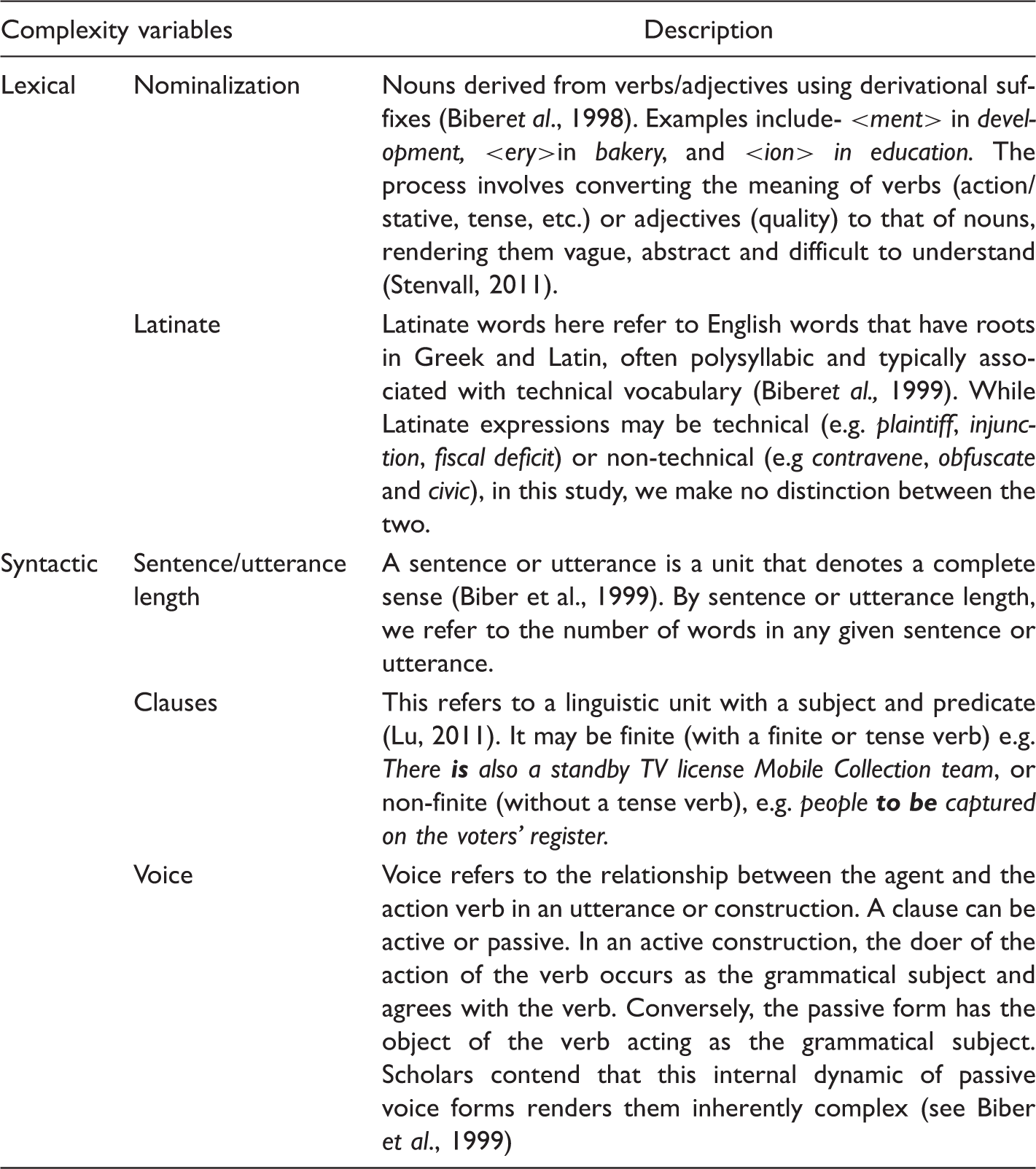
Description of Variables.
Findings
Overview of Lexical Elements.

Lexical Features
We found nominalized and Latinate forms to be highly prevalent in the individual ads. Figure 1(a) and (b) show that, together, these linguistic features constitute at least a quarter of the words in each election campaign ad. In the TV license campaign ads, the ad with the least nominalized and Latinate forms had at least 13% of its words being of this nature. Others had as much as 26% nominalized and Latinate forms.
Nominalizations/Latinate expressions in (a) election campaign (%) and (b) TV license campaign (%).
To exemplify this finding, we highlight, for instance, the first election campaign ad (Appendix A) in which the announcer admonishes voters to “Abstain from acts of intimidation, provocation and violence and ensure peace, before, during and after the elections.” Here, “intimidation,” “provocation,” and “elections” are -tion/sion nominalizations from the verbs intimidate, provoke, and elect. The new forms are created by converting the action represented in them to abstract notions that eliminate the human agent. This makes them potentially complex, as it is not clear who or what would “intimidate,” “provoke,” or “elect.” Is it the speaker or the audience member? Another example is found in the fourth TV license campaign ad (Appendix B) which used <-ment>to convert the action of verbs to nouns: Any person, or corporate body, who contravenes the law, commits an offence, and is liable on conviction to a fine, or to a term of imprisonment, or both. Avoid embarrassment.
Concerning the use of Latinate expressions as evidence of text complexity in the English language radio ads sampled, we found their widespread use across the copy examined. Examples include the following: Volition, contravenes, electoral, discrepancies, noncitizen, credible, biodata, corporate, domestic, mandatory, and directive. Any person, or corporate body, who contravenes the law, commits an offence, and is liable on conviction to a fine, or to a term of imprisonment, or both. Avoid embarrassment. Pay your TV license fee now! Remember, paying your TV license, is your civic responsibility.
Syntactic Complexity
Overview of Syntactic Elements.

Utterance Length
Across the two campaigns, on average, eight utterances were used in each copy. However, a closer look at the within-campaign evidence presents a clearer picture. Copy for the TV license campaign ads averaged 10 utterances each made of between 9 and 18 words. The election campaign had between 8 and 13 utterance units in each ad. Each utterance had at least 14 individual words. While there is relatively wide dispersion in utterance lengths (as indicated by the standard deviations; see Table 3), the analysis indicates many relatively long utterances. For instance, the first election campaign ad and the fourth TV license campaign ad (Appendices A and B) include the following sentences (respectively).
The National Commission for Civic Education, with support from the European Union, is calling on all registered Ghanaian voters to be part of the 2016 presidential and parliamentary elections.
The duration of license is that all licenses granted under the TV License Act 1956 and LCB as amended, shall be annual licenses and shall expire on the thirty-first day of December in the year in which they are issued.
The first example has 29 words, while the second has 41. Such long utterances have implications for complexity, irrespective of the presence of shorter sentences. This is because by the time the audience gets to the end of the utterance, meaning in the beginning section may have been lost. Thus, in the multitasking and attention deficit context of radio consumption, this could be taxing for audience reception and comprehension.
Internal Structure of Utterances
Closely related to utterance length is the internal structure of the utterances. Our evidence shows that the utterances display internal structure characteristics that presage complexity. Four such characteristics are particularly relevant to the research problem: interruptions between subject of an utterance/sentence and its main verb, sentence type, clauses and their linkages, and passive constructions (McNamara et al., 2010; Norris & Ortega, 2009).
The sentence labeled “1” above exemplifies the point on the distance from a subject and its verb. The subject of that sentence, “The National Commission for Civic Education,” is six words removed from its main verb “is calling on.” This is caused by the introduction of additional information on sponsors “with support from the European Union,” which becomes an interrupting unit in the idea of that utterance. According to scholars such as Norris and Ortega (2009), interruptions of three words and above between the subject and verb are a potential source of text complexity.
Another internal structure element is the composition of utterances/sentences and clauses. As Table 3 shows, each of the 10 ads contained more clauses (finite or nonfinite) than the number of utterances. This means that each copy contains instances of coordination, subordination, or both. The analysis also indicates phrase or clause interactions in the utterances, both of which could lead to text complexity. Given that simple utterances (single clauses in line with simple sentences) and compound utterances (analogous with compound sentences) are relatively easy to understand (Lu, 2011; Russell, 2001), we focus our analysis on complex and compound-complex utterances/sentences.
A complex construction is deemed so because of the subordination process that links up the main and subordinate clauses. Example “2” above also provides a good example here. The sentence has six clauses as follows:
The duration of license is (it)
that all licenses granted under the TV License Act 1956 and LCB
as (they are) amended
(they) shall be annual licenses
(and They) shall expire on the thirty-first day of December
in the year in which they are issued
The sentence is compound-complex with the first, fourth, and fifth clauses being independent and the rest being dependent. Given that a clause represents a unit of thought (Biber, Johansson, Leech, Conrad, & Finegan, 1999), this utterance contains six ideas linked through coordination and subordination. This increases complexity (Biber et al., 1999; Russell, 2001).
Voice
Related to the voice variable, passive forms make utterances formal, impersonal, and “weighty” (Biber et al., 1998). As a result, they increase text complexity. This study found relatively few passive formations across the ads sampled (see Table 3). Indeed, more than half of the ads analyzed included no passive forms. Across the 96 sentences/utterances in the sample, we encountered only 9 passive forms. Accordingly, we note with satisfaction the low levels of passive form use in the sampled ads. As an example, we find that sentence/utterance below breaks into the corresponding passive forms listed underneath it: The duration of license is that all licenses granted under the TV License Act 1956 and LCB as amended, shall be annual licenses and shall expire on the thirty-first day of December in the year in which they are issued (TV License Track 6).
… all license is granted under the TV License Act … … as amended the year in which they are issued
Discussion and Conclusions
Overall, the data suggest that the language of the two national campaigns is complex. It is heavily weighted on nominalized and Latinate forms, which scholars say may be difficult for low-proficiency audiences to understand (Russell, 2001; Stenvall, 2011). This is particularly troubling when viewed in the context of the argument regarding content-function words ratios. Extant knowledge suggests that grammatical/function words (e.g., on, in, the, upon, a) which, by themselves, do not carry much information constitute about half the words in any text (Adolphs, 2006). Content words (including Latinate and nominalized) that carry the bulk of information constitute the other half. Accordingly, where a sizeable chunk of content words is difficult to understand, audiences’ ability to engage with messages suffers. With the evidence gathered, the implication is that the opportunity for audience members to understand and act on these civic messages may have been reduced. Indeed, some scholars associate difficult/technical language with deliberate exclusionary tactics (Rock, 2007). We do not presume this to be the case here. Yet, we cannot rule out the possibility that the dominance of such words could result in exclusion of certain audiences.
Similar patterns of complexity were observed relative to utterance length and sentence structure. The sampled ads had relatively long sentences with highly complex internal structures. While these fall within recommended standards for newspapers targeting general readership (Russell, 2001; Smith, 2007), they are unacceptable for radio, which is heard rather than seen/read. As a fleeting medium, radio’s audiences often lack adequate processing time and repeat exposure, meaning that complex messages risk not being understood.
Second, radio is often consumed as a background medium where audiences may be only partially engaging (Lang & Chrzan, 2015). Such audiences may not devote the required attention and thinking effort to the comprehension task. Complex language may thus inhibit effective message processing, recall, and response to the “call to action.” Especially where the activity with which radio competes for attention involves mental processing, difficult language risks messages being forgotten altogether (Lang & Chrzan, 2015), denying citizens inclusion in a civic action.
Thus, our evidence supports a possible case of linguistic exclusion. This is because some audience members, particularly low-proficiency ones, may not have adequately understood the complex language used. We draw inspiration from Marshall McLuhan’s (1967) “the medium is the message” argument that media technology defines the packaging and effectiveness of messages. Consequently, we argue that radio’s fleeting nature requires simple language to encourage audience comprehension. As shown in persuasive communication scholarship, audience response to messages is correlated with their ability to understand (Houts, Doak, Doak, & Loscalzo, 2006). Thus, the findings of this study raise concerns about the extent to which citizens’ information rights are respected in Ghana when it comes to public service advertising. Couching national advertisements of democratic significance in complex language that audience could find difficult to understand may infringe on their rights to such vital information.
While the evidence is based on Ghana, several of the variables explored (radio’s dominance, English language public service advertising, literacy levels, dual-language systems, etc.) replicate across Anglophone West Africa. Accordingly, our evidence extends African media/communication scholarship into the domains of the challenges posed by the language of radio public service messages to audience’s comprehension. We show that beyond the oft-touted promise of radio as an instrument for development and civic engagement (Moyo, 2010; Ogola, 2011; Myers, 2008), scholars must look at the messages being deployed thereon which are intended to engage the largely multilingual audiences on the continent. We may need to look beyond macrolevel benefits of radio to details such as the linguistic properties of the English used. Accordingly, in radio public service campaigns that seek to engender civic responses, it may be useful to scrutinize the copy more closely. One option is to segment and target audience subgroups with tailored messages that account for their English language competencies (Noar, Harrington, & Aldrich, 2009). However, this can be costly as multiple messages must be deployed for at least the three proficiency levels (basilect, mesolect, and acrolect).
The study being the first to highlight the relationship between the English language, multilingual Anglophone audiences and public service advertising messages also extends and bridges both communication and linguistics scholarships. In their separate enclaves, communication scholars and linguists have engaged the subject of message characteristics, complexity, and implications for comprehension (see Adedeji, 2015; Adika & Klu, 2014; Bax, 2011; Biber et al., 1998; Guo et al., 2011; Roslow & Nicholls, 1996). Yet, few attempts have been made to draw the interlinkages between the two disciplines. We believe our study sets the foundation for this area to be developed.
Study Limitations and Future Directions
We believe the evidence presented is compelling in its support of a possible case of linguistic exclusion of audiences from engaging with radio public service messages. However, we are quick to admit the limits to our ability to make any pronouncements on how audiences themselves perceived difficulty in the ads sampled. Our study focused on the extent of linguistic complexity of the ad copy to the exclusion of the audience perceptions of such. Much richer insights may be generated by combining textual analysis with an audience survey in which the sampled ads are administered to them to measure the extent of their comprehension.
Second, we recognize that the variables highlighted for analysis are not exhaustive of all the linguistic elements that have been identified as markers of linguistic complexity. For instance, Bax (2011) highlights cohesion, text organization, and background knowledge as other factors implicated in text complexity. Accordingly, a possible avenue for future research would be to include more of these variables in the analysis. A study that extends the linguistic issues raised into the domain of commercial brands would also be insightful. We also recognize the study’s limited scope of evidence. In using data from Ghana as the sole exemplar of what we problematize as an Anglophone phenomenon, we sought to highlight the phenomenon to open the gates for more inquiry into the African-wide evidence. Future researchers are encouraged to explore this phenomenon from the cross-country angle.
Footnotes
Appendix A
Appendix B
Declaration of Conflicting Interests
The authors declared no potential conflicts of interest with respect to the research, authorship, and/or publication of this article.
Funding
The authors received no financial support for the research, authorship, and/or publication of this article.