



Abstract
The 2014 general elections in India marked a new media beginning. It catapulted Narendra Modi onto the national political scene through his clever use of digital media space as a form of public relations. This article uses rhetorical analysis to analyze 1,230 of Modi’s tweets between April 15 and August 15, 2017. I suggest that Modi’s emphasis on social media governance leads to “selfie nationalism,” a clear break from Mohandas Gandhi’s advocacy of “spiritual nationalism.” Modi’s nationalism is based on a belief in right-wing Hinduism, a relentless advocacy for business, his presentation of himself as both a global leader and a commoner who can identify with Indians of all castes and classes, and his silence on minority rights, poverty, free press, judiciary and legislative processes, and India’s plural religious traditions. I conclude that with the rise of Modi’s brand of “selfie nationalism,” coupled with increasing rural-urban polarization, democracy in India is more akin to what O’Donnell refers to as “delegative” rather than representational democracy.
Studies in postcolonial nationalism over the past two decades have given us a blueprint of why nationalism can take multiple forms as anticolonial nation states establish their global identities. In India, Mohandas Gandhi’s form of “spiritual nationalism” (Young, 2001, p. 312) marked by counter-modernity had been seen, until now, as the historical legacy of a struggle to liberate this nation from British control, a struggle based on nonviolent resistance, adherence to the local, and a skeptical view of modern technology. If we are to study the starkest break from postcolonial Gandhian nationalism, it would have to include studying the rise and popularity of India’s current leader, Prime Minister Narendra Modi. At an early age, Modi joined the right-wing Hindu majoritarian group called Rashtriya Swamyseva Sangh, a group that deified one of its founding members, Nathuram Godse, who was responsible for assassinating Mohandas Gandhi. The more moderate version of Rashtriya Swamyseva Sangh, now called the Bharatiya Janata Party (BJP), evolved as a viable political party in the 1990s as the erstwhile Congress Party, the party of Gandhi and the first prime minister of India, Jawaharlal Nehru, began to lose its chimera as party leaders became embroiled in multiple corruption scandals. BJP’s narrative, now driven and shaped by Modi, established itself as a counter discourse of nationalism to Gandhi’s unmediated secularism and rejection of Western materiality.
As the national Congress Party in India slowly began to fall from grace, beginning in the 1970s, and there were multiple reasons for its fracture and, now seemingly, imminent demise, we saw the gradual rise of regionalism and regional political parties that came to dominate partisan politics and, also, questioned the integrity and usefulness of Mohandas Gandhi’s postcolonial version of nationalism, which had, until then, signified the philosophical approach of governance by the Congress. The politics of ethnicity—caste, religion, and language—which had always been central to 20th-century Indian politics, were being transformed. The key aspect of this transformation was not, as it is usually understood, the replacement of Congress by a single multiethnic party. Rather, the key aspect was the change in the type of ethnic politics that came to dominate the political arena. Congress had, historically, played a coded ethnic card, quietly invoking ethnic identities in its selection of candidates but not openly in its identification of issues; targeted certain ethnic groups without openly excluding others; built differentiated ethnic coalitions across constituencies and states; and courted the support of these ethnic coalitions through the distribution of patronage but never through the rhetoric of identity (Suri, Eilliot, & Hundt, 2016). The rise of BJP upended this dynamic by overtly instituting the rhetoric of identity politics as the answer to caste, gender, and religious marginalization.
The rise of Modi as the chief minister of the western state of Gujarat has been well studied by political scientists and sociologists alike, especially what came to be known as the “Gujarat model” (Jaffrelot, 2015, p. 820). The decade while Modi was chief minister, Gujarat did well in terms of overall growth in every sector. For Jaffrelot (2013), Modi was able to tune in to a constituency that comprised an expanding urban population, what Modi often referred to as the “neo-middle class” (p. 79), that had benefited from years of such rapid economic growth. This “neo-middle class” was made up of upper castes but also, and predominantly, a dynamic, educated, and urban generation of schedule castes and OBC (Other Backward Class), largely thanks to the postindependent government’s affirmative action policies in education and employment. While scholars have cast doubt on whether the Gujarat model of economic growth was also development oriented—for example, during those years all quality-of-life indices for Gujaratis fell, as a whole—the rhetoric around the economic success of Gujarat catapulted Modi onto the national scene.
The 2014 general elections in India marked a new media beginning. Not only did it introduce Modi to the national political scene, it did so, scholars argue, through his clever use of digital media space as a form of public relations (Chibber & Ostermann, 2014). Modi’s social media image, leading up to the elections, became important because he virtually shunned the traditional media during and after his campaign. Yet, he came across as the most interactive politician India has ever had. “If you want to listen to Modi, you go to his social media feed—whether you are a citizen, a print reporter or a television channel,” writes Pal (2015, p. 379). “The social media feed had become the primary source for [the] prime minister’s opinions.” Sardesai (2014), well-known Indian journalist, recalls Modi asking him about his and his wife's Twitter posts at a meeting held the night before. At meetings with cabinet ministers, Modi is said to have handed out report cards containing analyses of how ministers were performing on social media, including the number of followers on Twitter and Instagram, friends on Facebook, and their posts on these platforms (Abrams, 2016). Sardesai recounts Modi's early adoption of social media as a political tool, “It was Modi’s social media team that ensured a constant engagement on Twitter. BJP successfully personalized the social media message around Modi, whereas the Congress strategy was to make it about the party and organization” (p. 22). The Modi selfie, which became a national sensation on television and social media, became the symbol of a “tech friendly leader” making his image both viral worthy and politically communicative (Shekar, 2015, p. 23). Modi’s media team, which comprised diasporic Indian “techies” who became his “foot soldiers on social media,” emulated advertising strategies used in American presidential elections to cull diasporic donors and supporters who would share Modi’s message across digital platforms (Ullekh, 2015, p. 102). The outreach was extensive and unique, writes Ullekh (2015), where the team sent millions of emails, made thousands of calls to Indian voters, posted blogs, and made YouTube videos to create a Modi hype.
In this article, I will attempt to answer two broad questions: (1) What is the rhetorical nature of Modi’s “selfie nationalism” as a socially mediated form of governance? and (2) Does selfie nationalism move India closer to being a delegative rather than a representational democracy? There have been multiple readings of the intersections between democracy and nationalism in contemporary India. It is important to note the works of Bose (2013) who has written of India’s “regionalized” democracy, Jaffrelot (2017) of “ethnic” democracy, Kohli (1990) of “incomplete” democracy, and Zakaria (2008) of “illiberal” democracy among other interpretations. While these analyses are extremely helpful in understanding the complexity of India’s ungainly and massive electoral and democratic processes, for me delegative democracy provides the closest linkage to Modi’s selfie nationalism that I propose in the following sections.
Method
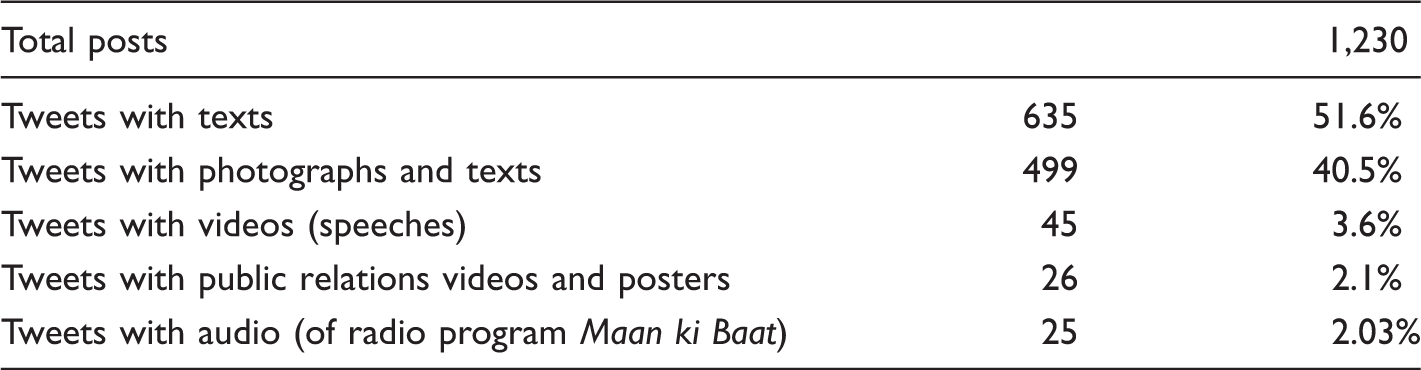
The analysis will be based on a total of 1,230 Twitter posts from the handle @narendramodi collected from June 15 to August 15, 2017. These 4 months were selected for analysis because Modi was not campaigning during this time period having spent the early part of 2017 on campaigning for state elections. This time frame would give readers a view of his social media messaging when Modi was governing rather than campaigning. I divided the tweets into the following categories: tweets with only text, tweets with photographs and texts, tweets with audio recordings (his monthly hour-long radio show) which were linked from his website, tweets with video recordings of speeches, and public relations tweets. Excluded were retweets and responses to tweets. The analysis includes both the texts and photographs of the tweets along with the texts of the speeches and audio recordings posted. There were a total of 110 minutes of speeches and 92 minutes of radio broadcasts. Of the clips of speeches posted on his Twitter feed, 51 minutes were at political rallies, 33 minutes in the parliament, 11 minutes to audiences abroad, 8 minutes in the presence of visiting leaders and dignitaries, and 7 minutes at conferences and other official events.
As of August 2017, Narendra Modi has 30.8 million followers on his personal Twitter handle, one of the highest of any heads of state in the world. Given that 800 million Indians are eligible to vote (66% of them voted in 2014 general elections), this number is small, but Modi’s tweets are widely reported in traditional media and, even more importantly, distributed via SMS (texts) around the country on approximately 700 million mobile phones (Ranganathan, 2014). Social media, especially Twitter, has become an important domain for disseminating and gathering political information. In addition to using Twitter to converse with each other about collective identities, Twitter has enabled real-time interactions and transcends the limitations of physical location among its users. Researchers are now able to observe not only the formation but also the everyday use of bridging (across groups) and bonding (within the group) that Twitter fosters (Sajuria, van Heerde-Hudson, Hudson, Dasandi, & Theoscharis, 2015). Studies in this theoretical tradition often find that the use of Twitter has various facets, from leisurely to political consumption (e.g., Kim, Hsu, & Gil de Zuniga, 2013; Valenzuela, 2013). It is clear that in the last decade, Twitter has appeared as an important source of political information as well as a site of political discussions and some forms of participation and activism. The chatter and clutter of social media may be seen as part of the “civic culture” of our times understood as “the taken for granted orientations—factual and normative—as well as other resources for collective life” (Dahlgreen, 2009, p. 103). In a similar vein, Deuze (2005) writes of the expectations embedded in the current digital culture, that is, the possibility of remixing different forms of cultural texts, our roles as bricoleurs engaged in the “assembly, disassembly, and reassembly of mediated reality” (p. 65) and the necessity of participation.
While there has been significant empirical research on social media content and activity, little rhetorical analysis exists. I followed White’s (1986) approach to rhetorical discourse analysis, which helps us interpret the inherent inconsistencies of concepts and categories by regrouping and understanding propositions in terms of possible repertoires both speakers and authors use in order to give meaning to the issues. Avoiding the classical rhetorical exegesis approach, based on mere analysis of grammatical or stylistic consistencies and repetitions, White’s approach allows for more of a thematic reading based on the significance of the texts and broader societal and political impact. In this kind of criticism, one tries to ascertain the particular posture or image that the author or speaker is establishing in a work in order to produce an effect on a particular audience. These rhetorical themes or repertoires were coded and identified by the author to understand the purposeful use of language to make an argument and are only to be understood as a broad range of Modi’s message to his followers. Future ethnographic and participant observational research can focus on the specifics of these arguments’ impact on audiences and responses to these tweets along with a longitudinal quantitative study of his all tweets during his time as prime minister.
Analysis
Numerical Breakdown of Narendra Modi’s Tweeter Content (June 15–August 15, 2017).
Modi’s India of Gods, Saints, and Heroes
According to Jaffrelot (2015), Modi, since his time as chief minister of Gujarat, has relied on a “discourse that combines Hindu nationalism (slightly de-emphasized) and development (considerably over-emphasized)” (p. 821). Modi continued to use the rhetoric he had honed in Gujarat politics—the “banalization of Hindutva” (Jaffrelot, 2015, p. 821)—at the national level, in which the conflation of Hinduism with India was seen as natural and pedestrian; this comes across strongly in his Twitter messages. In a speech posted on his Twitter account, he says: I am a product of the ancient tradition that firmly believes in dialogue on difficult issues… .The ancient Indian concept of Tarka Shastra [laws of argumentation] is founded on dialogue and debate as the model for exchange of views and avoidance of conflict… .Growing up, I heard stories of Lord Rama, Lord Krishna, Lord Buddha and Bhakta Prahlada… .The purpose of each of their actions was to uphold Dharma, which has sustained Indians from ancient to modern times. (April 18, 2017) India’s saints have a long lasting contribution to our society. We cherish their positive impact & influence. (April 30, 2017) Spoke about India’s rich history of saints & seers who have led the quest for social reform & transformation at various times. (April 29, 2017)
While the Congress Party had few minorities in positions of power and routinely invoked the communal card, most famously by Indira Gandhi in her acquiescence to cultural demands from the most conservative elements of minority communities (Mitra, 2016). For Modi, communalism is naturalized in the discourse of his language on social media. In all his tweeted political observations, sometimes several times a day, Modi never mentions dharmanirpaksh (secularism) as a value that India’s loktantra (democracy) must embrace. Long before the rise of BJP and Modi, scholars, historians, and policy mavens have doubted the success of India’s pragmatic secularism, marked by active state indifference to and neutrality regarding religion and a sturdy refusal by the state to recognize or evaluate religion, except in so far as religious practice and religious institutions contravene other fundamentals of individual or collective citizenship and social well-being, which the state is obligated to protect. Bhatt (2004) writes that such a strong version of secularism, while written in India’s constitution, was never feasible in contemporary India. “There are influential democratic and anti-communal voices that support some variety of institutionalized intervention,” writes Bhatt, “by religious institutions into state and political affairs” (p. 136). One can further debate whether Modi’s rise to power is based on failures of ideological secularism or “distinct Indian secularism” (Bhargava, 2007, p. 20). It is nonetheless clear that Modi himself is noncommittal to secularism in his social media messaging.
It Is a Land of Unbridled Growth and “Ease of Business”
The idea of vikas (development) was important campaign rhetoric, which Modi adopted during the Gujarat elections and resuscitated in the 2014 national elections. His Twitter posts are replete with development-oriented slogans such as “Securing India’s future through infrastructure” (April 17, 2017) and “Make in India” (September 14, 2016) as he relentlessly pushes the theme, “Sabka hain, vishwas hain, ho rahan vikas hain” (It is our own, we believe in it, we are witnessing development). The concept of vikas, however, is far from Keynesian welfare and the developmental economics adopted by postindependent planning commissions, which made economic policy recommendations to the government until it was dissolved by Modi’s government in 2014. For the first eight plans, beginning in 1951, the emphasis was on a growing public sector with massive investments in basic and heavy industries and “the effective and balanced utilization of [the] country’s resources” (Mehrotra, 2014). This philosophy had started to change by 1997, and the emphasis on the public sector has become less pronounced with increasing focus toward privatization and deregulation. In dissolving the planning commission, Modi’s economic agenda was driven by his slogan, “Best regulation is no regulation” (September 22, 2017). He repeats, in his speeches and Twitter messages, his commitment to the end of a seemingly over-regulatory culture: Anyone in the world [who] wants to add India to his or her vikas patra [development chart], they are welcome here … We are open for global business, [there is an] ease of doing business and in three years I have made 7000 pro-business reforms. (June 2, 2017)
Modi, the World Leader, and Modi, the Commoner
Without a doubt, Modi’s Twitter content is driven by global images, such as photographs with heads of states when they visit India; photographs with heads of state when Modi visits their countries, or when he meets them for global or regional summits such as SAARC, G20, or BRICS; birthday wishes to various elected and appointed heads of state (including those in nondemocratic countries); and meetings with diasporic Indians, congratulating them on their successes abroad. The sheer volume of his tweets increases when Modi travels abroad and Prime Minister Modi metamorphoses, in his social media messaging, into the global Modi who presents himself as a cooperative and visionary world leader, willing and able to put India on the world map as a regional, military, and technological power. Under the veneer of the global Modi, writes Deb (2016), rages the commoner Modi who, in his now famous speech given at Madison Square Garden in New York in 2014, had said, “Our country has become very devalued. Our ancestors used to play with snakes. We play with the mouse.” Cheers had resounded, Deb observed, because, in the twist of a metaphor, Modi had restored the honor of the nation … India was not a nation of snake charmers but of high-tech mouse managers. And Modi understood this, because he too was an Indian driven by rage and humiliation, a newcomer to the system and a latecomer to modernity, a leader who would transform India into a land of Silicon Valley white magic, but who would retain its authentic Hindu core. When I address the nation from the ramparts of the Red Fort on 15th of August, I am merely the medium. The voice is of 125 crore Indians. (July 30, 2017) Over the past three years, we have placed our trust on in [sic] each and every Indian. 125 crore Indians will power our nation to new heights. (May 26, 2017)
The Politics of What’s Untweeted
The analysis of Modi’s social media would not be complete without identifying the various silences. The most significant of them are as follows:
Recognition and celebration of India’s plural religious traditions especially those of Islam and Christianity. While the idea of “national heritage” (Harris, 2015, p. 712) is always a contested one, Modi’s Twitter is unequivocally Hindu with few references to major non-Hindu religious holidays and no references to non-Hindu religious figures. According to Palshikar (2015), majoritarian Hindutva is more than intercommunity violence; it is about holding and articulating a set of views and ideas that uphold a majoritarian worldview. Modi’s Twitter messages are full of incipient and majoritarian sentiment that tries to retain a “centrist” image but continuously pushes the center toward a pro-Hindutva platform. Recognition of human or minority rights as integral to socioeconomic development and a functioning democracy. While India’s postindependent governments, sometimes reluctantly but with regularity, recognized the import of developing and promoting policies against practices such as child marriage, human trafficking, discrimination based on disability, and gender violence, Modi’s Twitter is uncharacteristically silent about any aspect of human and minority rights. The only tangential reference to human rights is when minority communities face violence as in the case of multiple lynching of Muslims and Dalits (untouchables) in 2016 following the beef ban law imposed in 18 states. After a period of protracted silence and much criticism from the media, Modi tweeted, “Cow protection is being used as [an] excuse by some criminals. Some people are taking advantage of the situation to destroy cordiality [peace]” (July 16, 2017). While such tweets either ask for an end to violence or blame “undesirable elements in society,” neither speak to minority rights nor provide any substantive claims to protection of those rights by the state. The focus of Modi’s social media messages is on achieving prosperity rather than alleviating poverty; there are no photographs of poor people or Modi among the poor. India, during 1991 to 2011, witnessed the highest increases in poverty since postindependence, with the top 1% of earners increasing their share of the country’s wealth from 36.8% to 53% and the top 10% owning 76.3% of the country’s wealth (Motiram & Sarma, 2011). India remains a stunningly poor country, “riven by shoddy infrastructure, and ravages of lopsided growth, pollution, and climate change” (Deb, 2016). In Modi’s Twitter, the abject poverty of the 450 million Indians receives no image or textual space. No engagement with traditional media or acknowledging India’s free press, judiciary, or the legislative branch of government. Modi’s Twitter is silent about mainstream media—he never links to a news story—and India’s rich history of a free and independent press. Modi ignores the judiciary and never tweets a response or comment about important judicial decisions, including major Supreme Court decisions. While he posts photos of his meetings with various members of parliament from his party, he never tweets about major bills being debated in the Parliament. He posts his speeches to the Parliament, but does not acknowledge or speak to the complexity, successes, or failures of the legislative process. This is in line with his tenure as chief minister, where Modi’s personalization of power led to the decline of the import of the state assembly. The assembly met on average for 31 days a year during 2007 to 2012, in stark contrast with previous administrations (Diwakar, 2016). While Modi frequently tweets about new initiatives that his government has or plans to undertake, no tweets include any scientific data, economic indicators, or academic research. These initiatives appear to be purely public relations exercises with glitzy videos and posters that most often feature him rather than serious policy matter, which requires planning and research.
Selfie Nationalism, Polarization, and Delegative Democracy
By the 1980s, the Congress Party had abandoned its role as an ideological pole that discouraged communal fault lines; instead, it seemed to contribute to the politics of community identity among both the majority and the minority. In this sense, the story of reshaping BJP’s Hindutva nationalism is intertwined with the story of the Congress Party’s decline. However, Modi’s version of nationalism is shaped by some unique features that cannot be comfortably and easily mapped onto the rise of Hindutva as majoritarian politics alone. He advocated for a kind of nationalism that I categorize as “selfie nationalism.” One can derive four dominant characteristics of this nationalism from Modi’s social media messaging. First, it is a nationalism where Modi (as a symbol) is personification of a ubiquitous and anointed leader—via frequent use of photographs and selfies—a symbol around which BJP and the party’s political structure revolves. It was, therefore, not unusual to see Modi tweet posters where he was seen with a halo indicating Hindu symbolism of gods who glow like surya (the sun god). Second, selfie nationalism is driven by economic and technological globalization, and a discourse that rejects, culturally and religiously, any plural narratives of the nation state. Modi’s popular slogan, which he often tweets, “IT + IT = IT … Indian talent + Information technology = India Tomorrow” (May 10, 2017), conflates India and Indian nationalism with technical globalization. The technocentric Indian is, also, a Hindu who finds comfort in his newly found place of prestige in the global order after having finally shed the last remnants of colonialism. Third, the rhetoric of selfie nationalism is uniquely ephemeral. It is a discourse with a short shelf life driven by optics, as in the frequent launch of a new policy initiative that is, then, tweeted. Indian governments have had enduring national policy initiatives, sometimes lasting two decades, such as garibi hatao (“abolish poverty” to reduce rural poverty levels) and hum do, hamare do (“we two, our two” to encourage family planning). In the era of Modi’s selfie nationalism, major policies—their planning and implementation—last for a short duration and disappear even before economists and policy-makers are able to understand the implications of such policies. A good example is the recently launched—and quickly discontinued—bank note demonetization, which led to nationwide chaos and misery for the poor and very poor when a large amount of cash was removed from circulation. While it is unclear as to the depth of the impact of demonetization on poor people’s lives, it is clear that it did little to change the nature and existence of the “shadow economy” it was meant to dismantle and any associated corruption (Crabtree, 2017). Instead, Modi gave a speech—posted on his Twitter—conflating the policy with national pride and patriotism, “Whether it is the 1962 war or the 1965 war, India has seen the patriotism of its people” (November 8, 2016); “India has become witness to a shuddhikaran [purification] drive” (November 8, 2016); and “To fight external evils is an ordinary thing but when ordinary Indians come to fight the evil within, it is inspiring” (November 8, 2016). The fourth feature of Modi’s selfie nationalism is a rejection of the role of traditional media in a democratic society and an emphasis on media use rather than access. Tweeting catchwords and phrases such as digidhan (digital wealth) and “e-governance” (July 30, 2017) do not focus on whether people have access to media—or if people have basic infrastructure to allow connectivity—but rather on the use of media as a potential for profit and growth.
Scholars have written about populist nationalism, and selfie nationalism shares some characteristics with the rise of the kind of populism we have witnessed in the United States and Europe (Brubaker, 2017; Groshek & Koc-Michalska, 2017; Vittori, 2017). These nationalist populisms have formed a distinctive cluster within the wider global conjuncture and in construing the opposition between self and other not in narrowly national but in broader civilizational terms. This shift, writes Brubaker, can be termed as “civilizationism” (p. 1193) and has been driven by the notion of a civilizational threat from Islam. This has given rise to an identitarian “Christianism,” a seeming secularist posture, and an ostensibly liberal defense of gender equality, gay rights, and freedom of speech. Modi’s selfie nationalism, while sharing some commonalities with such type of populism (e.g., being anti-Islam) nevertheless has its own distinctiveness.
Modi’s brand of nationalism, Jaffrelot (2015) suggests, is premised on wide disparities signifying economic, income, and sociopolitical polarization. Jafferlot writes about the “Gujarat model” failing to benefit about one third of the citizens of the state (a group predominantly comprising untouchables, tribals, and Muslims living in rural areas) and rising inequality between the urban and rural poor. If anything, the divide between the urban and rural has dramatically increased in India since the 1990s—reversing earlier trends—and has resulted in mass migration to cities. A much remarked upon manifestation of agrarian distress has been the phenomenon of suicides of thousands of farmers in various regions of India since the late 1990s (Reddy & Mishra, 2009). In a country where agriculture remains the largest employment sector, it contributed only 13.7% to the gross domestic product in 2015 to 2016 with those numbers likely to decline in the future (Hnatkovskaa & Lahiri, 2013). When one looks at India’s rural–urban polarization, in terms of wages and consumption, one can observe that it has been rising since the 1980s but has increased at a very rapid pace since the 1990s. It may not be a coincidence that among the various cleavages that exist in Indian society such as caste, gender, and religion, the rural–urban one is characterized by the most significant and increased polarization (Bandyopadhyay, 2012, 2013). This polarization extends to digital technology where, as recent news reports suggest, only 8% of Indians have regular access to the Internet and about 19% have occasional access (Chopra, 2017). Of all Internet users, urban India has close to 60% Internet penetration, reflecting a level of saturation, but there are 750 million users in rural India who remain disconnected from the digital sphere (Wu, 2016). While Modi’s idea of e-governance was lauded by diasporic and urban Indians, preliminary research shows that it has made almost no impact on the lives of the rural Indian in municipality or gram panchayat (village) governance (Chatterji, 2017). Modi’s social media messages—and policy initiatives—clearly indicate that the rural poor are not the focus of his development strategies and that his rhetoric of vikas is not about reducing economic or digital polarization, instead about but creating wealth.
I argue that with the rise of Modi’s brand of selfie nationalism and increasing rural–urban polarization, democracy in India is more akin to what O’Donnell (1994) in his studies about Argentina, Chile, and Peru refers to as “delegative democracy” (p. 55). Delegative democracy rests on the idea that the paternal figure of the state, embodied in the elected official, is supposed to take care of the whole nation, and his or her political base is a movement signified by the supposedly vibrant overcoming of the factionalism of a multiparty system. In this system, other institutions such as the press, courts, and legislatures are nuisances to governance and must be undermined. Delegative democracy is more democratic than an authoritarian state, but is not intrinsically devoted to the needs, rights, and duties of all its citizens. O’Connell rightly argues that in a representational democratic system, accountability would run not only vertically but also horizontally, and this is where a network of relatively autonomous institutions is able to work independent from political interference from the state. By constantly undermining the press, legislative bodies, and judiciary, Modi has established himself as a delegative democratic leader: strongly individualistic, but more of a Hobbesian than of a Lockean variety; expecting the voters to choose him, irrespective of their identities and affiliations; and presenting himself as the individual who is most fit to take care of the destiny of India. A delegative democratic leader uses the rhetoric of majoritarianism, a voice of the marginalized majority, those who have somehow—often silently—suffered humiliation or defeat, or watched minorities being given privileges that she or he as a member of the majority either does not enjoy or cannot achieve. For example, Modi’s blueprint of the Hindutva discourse of “majority” is based on a historical humiliation by the Mughals, and the current epoch is a return to the masculine Hindu claiming his rightful majoritarian place in history. Further, this majoritarianism is based on a demographic calculus that is not a representational democratic precept. The “majority,” so conceived, certainly has no constitutional, legal—or indeed, real—status. If demographic majoritarianism controverts democratic principles, its rendition as an enumeration, exemplified by the need to cultivate a Hindu electoral vote bank, cannot be democratic. A permanent, religiously defined majority electorate, while conceivable and empirically possible, cannot be a principle of administrating democracy. Bhatt (2004) writes, The Hindutva idea of [majority] “Hindu rights” is undemocratic in its very creation because the concept of “Hindu right” does not emerge from the field of political right (rights declared from a ground of political, deliberative, democratic, civic and constitutional processes) but emerges from an entirely different ground: the “rights” which flow from a sacralized, primordial conception of nation in which the Aryan-Hindu is the only legitimate inheritor of the land. (p. 152)
The most unique aspect of Modi’s selfie nationalism is defined by social media governance, which involves communicating directly to the people via a rhetoric steeped in slogans, obsessiveness with business, and a Hindu identity. Nanda (2010) calls this rhetoric part of a “state-temple-corporate complex” (p. 92), which yields decisive power in modern India. This social media governance is driven by Modi’s deep distrust of mainstream media. As Price (2015) writes, during Modi’s time as chief minister, he had become “wary of the big TV interviews” where he would be asked about communalism and where whatever he said in reply could “overshadow the positive message he wanted to put across” (p. 150). He has since shunned the mainstream media, but this media could not shun him and, instead, provided him—and continues to do so—with wall-to-wall coverage that no other candidate in India’s national elections had ever received. The “Modi effect,” thus, has been a clear break from India’s long history of representational democracy and moderate efforts at secularism, which had, for the first 65 years of its independence, slowly but steadily been building and strengthening vertical democratic institutions. His majoritarian neoliberal Hindutva politics is a flow of political power and knowledge, via social media, which does not foster democratic governance; it is more of a “democratic regime,” akin to delegative democracy. “Elections in delegative democracies are a very emotional and high-stakes process,” writes O’Donnell (1994, p. 60), “various candidates compete to be the absolutely zero-sum winner of the delegation to rule the country with no constraints”; after the election, voters are expected to return to the condition of passive, but hopefully cheering, spectators. Under Modi’s Hindutva regime, as historian Sarkar (2002) warns, a rewriting of the representative constitution is very much a possibility, if his messages are to be read critically, “Justice will be pushed down to the third place in the Preamble [of India’s constitution], far below security and prosperity” (p. 262).
Footnotes
Acknowledgments
The author wishes to thank the reviewers of this journal for their insightful comments. The author thanks Professors Maren Beaufort and Josef Seethaler for inviting her to the conference on digital media, political polarization, and challenges to democracy at the Institute for Comparative Media and Communicative Studies, Austrian Academy of Sciences, Austria, where this article was first presented.
Declaration of Conflicting Interests
The author declared no potential conflicts of interest with respect to the research, authorship, and/or publication of this article.
Funding
The author received no financial support for the research, authorship, and/or publication of this article.