



Abstract
This article reports the results of a qualitative media framing analysis of news coverage about #MeToo in four national contexts: the United States, Japan, Australia, and India. Comparing media coverage of a woman who became associated with #MeToo in each country reveals four media frames: brave silence breaker, stoic victim of an unjust system, recovered or reluctant hero, and hysterical slut. By identifying these frames, and their cultural variations, we add to understanding of #MeToo as an international social movement that has crossed national and cultural barriers.
Introduction
The #MeToo movement, started by activist Tarana Burke in 2006, gained new momentum when Alyssa Milano’s October 2017 “tweet heard ‘round the world” (Pflum, 2018, para. 7) launched #MeToo as a global movement of unprecedented scope (Gersen, 2017). In this article, we explore how the global spread of #MeToo has created variations of the silence breaker frame that is a prominent feature of U.S. media coverage. A prominent example is Time Magazine’s “Silence Breakers” issue, which named individuals who spoke up against sexual violence as the 2017 person of the year, calling them the voices that launched a movement (Zacharek, Dockterman, & Edwards, 2017).
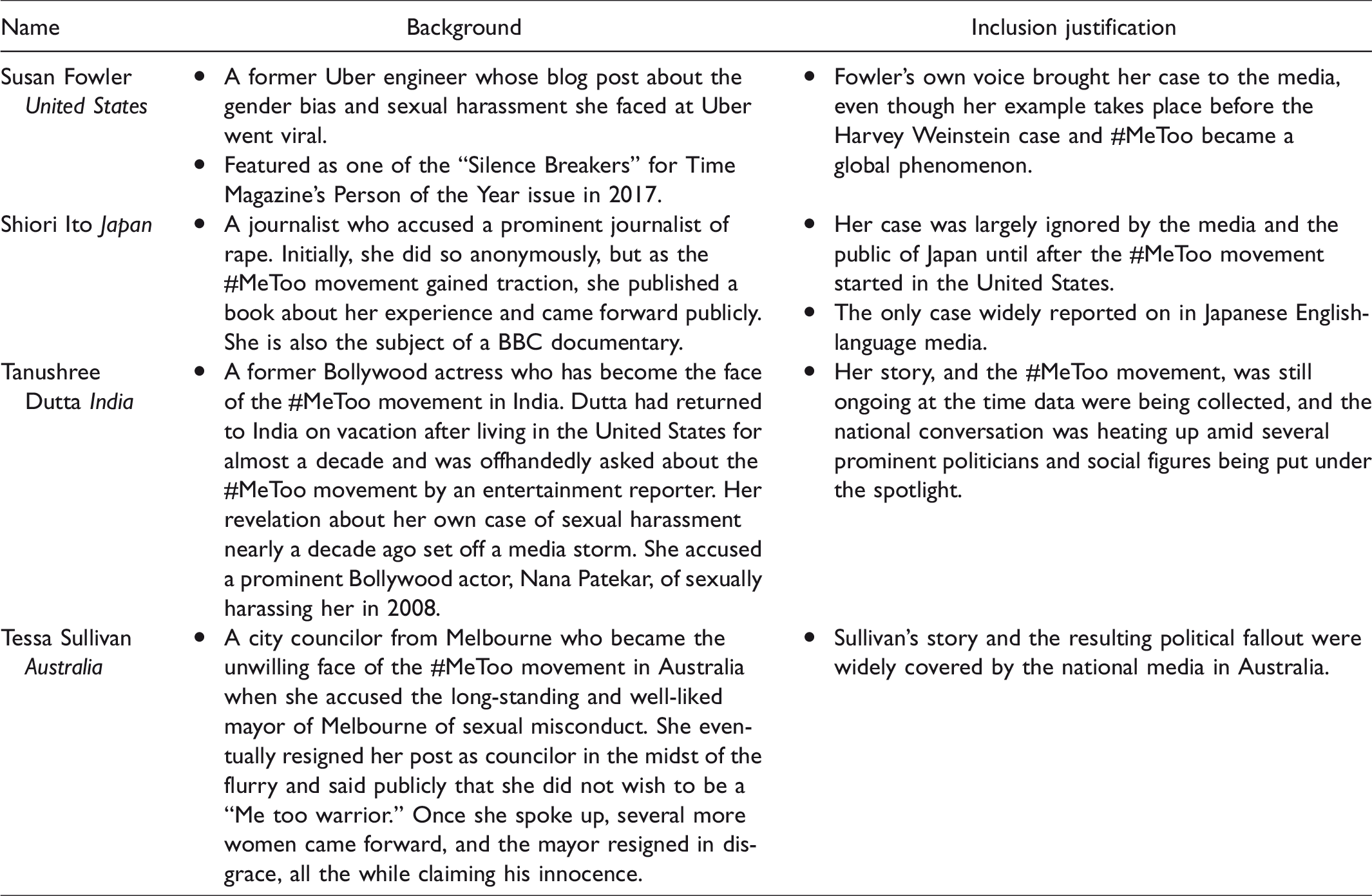
Our analysis joins the efforts of researchers attempting to understand the media’s role in #MeToo around the world (e.g., Dahlström & Sundström, 2018; Kunst, Bailey, Prendergast, & Gundersen, 2018; Lekach, 2017; Pipyrou, 2018; Robinson & Wang, 2018; Zarkov & Davis, 2018) through comparing media framing of women who could be considered silence breakers in four countries: Susan Fowler in the United States, Shiori Ito in Japan, Tanushree Dutta in India, and Tessa Sullivan in Australia. These four women were selected because each is portrayed in their respective national media coverage as starting #MeToo in that country. See Table 1 for details.
Case Studies and Justification.
Our analysis was guided by three research questions:
To what extent is the “silence breaker” frame present across national contexts? If present, how does the “silence breaker” frame differ according to different social and cultural norms? What additional media frames are employed in media coverage of the case studies, and how do these frames differ according to social and cultural norms?
Media Framing and Cross-Cultural Analysis
Framing theory recognizes the power media wields through selectively presenting information and defining narrative (Entman, 1993). Fung and Scheufele (2014) establish a framework for cross-cultural media framing analysis in observing that dominant media frames reflect social norms and encourage individuals to adhere to these norms or face social sanctions. In addition, however, audiences also engage by “decid[ing] how to interpret the social phenomenon and whether or not to adopt the media representation” (Fung & Scheufele, 2014, p. 132), which is especially apparent in hashtag activism. For example, Pennington (2018) considers how #MuslimWomensDay has enabled Muslim women to tell their own stories and, in so doing, to “push back” against dominant media frames depicting them as silent victims (p. 200), and Jackson and Banaszczyk (2016) explore how #YesAllWomen and #YesAllWhiteWomen enabled “feminist counterpublics” to “rewrite dominant public narratives about violence against women” (p. 392).
Because of the impact of social media on collective action, the notion of collective identity becomes a central concept to understand the impact of #MeToo. Milan (2015) argues that social media amplifies collective action and sets in motion an identity building process where membership in the group and taking part of the collective action becomes a new form of collective identity. Treré (2015) also found that participation in social media fueled movements reinforced solidarity and internal group cohesion, thus strengthening inclusion into a collective identity that exists primarily in the digital world.
Research on #MeToo across cultural contexts is limited and mostly comes from Western countries. Some research outlines the challenges that the movement has faced from Western social and academic elites. For example, Pipyrou (2018) recalls French actress Catherine Deneuve’s denouncing #MeToo as a “witch hunt” and British screenwriter Terry Gilliam calling it a “mob rule” (p. 415). Some European critical feminist scholars recognize the movement’s global reach but express concerns about its individualism and marginalization of women without media access. As U.K. scholars Gill and Orgad (2018) note, the #MeToo hashtag has circulated in 85 countries—“arguably the result of, at least in part, its broad and inclusive appeal, and its ability to cross lines of stratification” (p. 1317). But, they add, the global movement privileges career women with “respectable” sexualities while marginalizing many others. Dutch scholars Zarkov and Davis (2018) express ambivalence about #MeToo’s ability to effect global change because “we should not assume that what is happening among the political and cultural elites will automatically ‘trickle down’ to the streets” (p. 6). By contrast, Mendes, Ringrose, and Keller (2018) argue that “hashtag feminism” allows victims “to understand sexual violence as a structural rather than personal problem” (p. 238).
The few studies that compare content filed under the #MeToo hashtag also find similarities across national and linguistic contexts. In Sweden, where #MeToo inspired sector-specific movements, a qualitative content analysis of the first 100 stories posted in December 2017 and January 2018 under the #slutavverkat (clear-felled) hashtag used by forest workers identifies familiar patterns in the narratives: objectification of women’s bodies, unsafe spaces, and reproduction of sexist practices (Johansson, Johansson, & Andersson, 2018). A critical discourse comparison of the content of the U.S. Time’s Up Legal Fund website and the Danish #MeToo website, both started by actors in each country, identifies similarities and differences: (a) U.S. discourse positions women as both victims and survivors, while Danish discourse sees them only as victims; (b) the U.S. site places responsibility on male perpetrators, while the Danish one blames both perpetrators and culture; and (c) the U.S. site acknowledges immigrants and women of color face higher risk of sexual assault, while the Danish site is unconcerned with intersectionality (Jakobsen, 2018).
Two comparative studies of #MeToo media coverage originated in Sweden. One is a qualitative content analysis comparing USA Today with the Swedish newspaper Dagens Nyheter (Wallin, 2018). Findings indicate surprise as a major theme in USA Today, while Dagens Nyheter viewed the phenomenon as long-in-the-making and assumed that the newspaper’s audience had a basic theoretical understanding of gender as a “socially constituted role” rather than a static biological reality (Wallin, 2018, p. 36). Dahlström and Sundström (2018), who also analyze Dagens Nyhete’s #MeToo coverage, identified two major frames: #MeToo as a natural force, and #MeToo as a feminist autumn or season of harvest.
A Hofstede Insights Country Comparison (Hofstede, Hofstede, & Minkov, 2010) provides a useful backdrop for addressing social norms in each country. The Hofstede Insights Country Comparison explores cultural norms through six dimensions. For the purpose of this study, three relevant dimensions are discussed: power distance, individualism, and masculinity. Power distance is defined by Hofstede et al. (2010) as “the extent to which the less powerful members of institutions and organizations within a country expect and accept that power is distributed unequally” (p. 61). Individualism is the degree to “which the interests of the individual prevail over the interests of the group” (p. 90–91), and masculinity examines the degree to which “emotional gender roles are clearly distinct: men are supposed to be assertive, tough, and focused on material success, whereas women are supposed to be more modest, tender, and concerned with the quality of life” (p. 139). For each of the dimensions, scores can range from 0 to 100, with 0 indicating that dimension is absent from a culture and 100 meaning it is the dominant paradigm within a particular dimension (Hofstede et al., 2010).
As shown in Figure 1, India stands out for its high score in the power-distance cultural dimension, which means the national culture emphasizes hierarchy and top-down communication, reflected in organizations that are hierarchical and centralized. Australia and the United States stand out for their high scores in the individualism cultural dimension, implying a cultural emphasis on personal agency and responsibility, rather than membership in groups or collectives. Finally, Japan is notable for its high score in the masculinity cultural dimension, meaning the culture is highly competitive, and desire for professional and personal success is a strong motivating force.

Hofstede Insights Country Comparison. This figure illustrates the differences in three of Hofstede’s cultural dimensions, comparing the United States, Japan, India, and Australia (Hofstede et al., 2010).
Our analysis is one of the first to compare Western and non-Western media sources and to include four national contexts. The four silence breakers examined are objects of media framing, but they are also producers of messages affiliated with #MeToo, whether or not that was their intention. As our analysis reveals, whereas Susan Fowler’s and Tessa Sullivan’s stories were contained largely within their national contexts, Shiori Ito had to leave Japan to have her story told and was shamed and silenced within Japan while being lauded internationally as the hero of Japan’s #MeToo (Rich, 2017; “Shiori Ito,” n.d.). Tanushree Dutta, who had been living in the United States since leaving India after she was shamed for speaking out in 2008, witnessed firsthand the sweeping effect of #MeToo, and was inspired to speak out (Satija, 2018). Citizens in most democratic countries now can access media reports from almost any source, roughly translate them via Google, and use digital platforms to challenge national rhetoric surrounding sexual assault. And yet, even with this access to global perspectives, the differing social norms to which Fung and Scheufele (2014) refer are still evident in the media framing of these four cases. In different ways, these social norms act through media frames to constrain individuals’ efforts to break the silence that surrounds sexual misconduct. We also reveal how social norms in each country relate to the positive or negative valence of media framing—in other words, the extent to which “some frames are indicative of ‘good and bad’ and (implicitly) carry positive and/or negative elements” (DeVreese & Boomgaarden, 2003, p. 363).
Methods
We selected countries where multiple online English-language news sources had run stories on a case connected to #MeToo. Each case represents a story that garnered national media attention and, in some capacity, became affiliated with the start of #MeToo in that country (see Table 1). To allow for close comparisons, we used only written news stories on online news sites, and we did not address social media or reader responses, except when it was reported in the news stories. We examined news stories (n = 352) from February 2017 (when Susan Fowler published her blog post) through October 2018. News websites were identified by, first, identifying the top-ranked news publications (including some TV news sites) for each country through Google and, second, searching within the websites to determine whether they had published stories on #MeToo. Online content was more easily accessible than print, so we sampled only from the web versions. Once case examples were identified, an additional Google search determined whether other online media sources had published pertinent content. A total of 35 sites were identified and searched, using the sites’ local search engines with keywords “#MeToo” and the woman’s name (see Appendix).
PDF versions of news articles were first imported into NVivo 12 Plus. Coding was loosely guided by our research questions and relied on inductive analysis to address the second and third research questions. During the first round of coding, the first researcher read each of the collected news articles and noted how the women were being discussed using analytic memos (Saldaña, 2013). The research team then collectively reviewed the analytic memos and developed a loose descriptive coding hierarchy (Saldaña, 2013), which began to capture the essence of the observed frames. At all points throughout the analysis, the team worked iteratively and collaboratively, discussing differences until agreement was reached.
Results and Analysis
Our coding process resulted in identification of four overarching media frames across the four cases:
The brave silence breaker frame highlights the woman’s courage for coming forward. News reports that used this frame relied on words such as “courageous” and “brave” to describe these women. The stoic victim of an unjust system frame contextualizes the risk that each victim faces in seeking justice in an unjust system. The reluctant or recovered hero frame acknowledges two different forms of heroism: In the reluctant hero frame, the silence breaker is unintentionally shunted to the forefront of a global movement; in the recovered hero frame, the victim initially endures attacks but later emerges as heroic. The hysterical slut frame is the most negatively valenced. In this frame, the silence breaker’s emotions, sexual activity, and overall credibility are questioned.
Susan Fowler: U.S. Silence Breaker Framed as Whistle-Blower
As soon as her February 19, 2017, blog post went viral, Susan Fowler was framed positively. Of the 33 articles in our sample, almost half used either the word “whistleblower” in the headline, or related language, such as “the engineer who shook up Uber” (Houston Chronicle, October 10, 2017) or “She’s 26 and brought down Uber’s CEO…” (The New York Times, October 21, 2017). Consistent with the positive framing that emerged in our coding, Fowler received numerous public recognitions (e.g., Webby Awards, Time person of the year, Financial Times person of the year, Huffington Post 2017 list of most powerful pieces of writing by women).
Brave Silence Breaker
The brave silence breaker frame emerged prominently in our coding of Fowler’s case. Media reports highlighted her bravery: “the 29,000-word missive that blew the door open on the abuses being perpetrated at Uber required…a great deal of bravery” (Houston Chronicle, October 24, 2017). The announcement of Fowler’s Webby award also highlighted her bravery: “As a result of Fowler’s brave and personal post…women entering the tech world in the future stand a greater chance of being treated with fairness” (Webby Awards, December 2017). Other media reports used similar language, suggesting that Fowler “gave women a primer on how to report sexual harassment” (USA Today, December 2017).
Stoic Victim of an Unjust System
Fowler’s blog post, labeled as “the tipping point…for drastic change” (Financial Times, December 11, 2017) and described by The Ringer as “stoic” (February 21, 2018) was characterized as a catalyst for change in an unjust system. Her description of working in Uber’s misogynistic environment emphasizes that “the male-dominated atmospheres are discouraging the talented from seeking careers in the sector” (Fox News, February 20, 2017): On my first official day…my new manager sent me a string of messages…trying to get me to have sex with him…I immediately…reported him to HR…I was told by both HR and upper management that …they wouldn’t feel comfortable giving him anything other than a warning…and that I had to make a choice: (i) I could either go and find another team…or (ii) I could stay on the team, but…he would most likely give me a poor performance review . . ., and there was nothing they could do. (Fowler, 2017)
Reluctant Hero
Fowler’s blog was written nearly seven months before Milano’s tweet; yet, she was featured on the cover of Time Magazine as one of the “Silence Breakers,” and multiple news stories depicted her as responsible for the downfall of Uber’s CEO. This finding may suggest that Fowler’s story was integrated seamlessly into the #MeToo narrative in media reports that used the reluctant hero frame. But this was not her intention: “I expected the reaction to die down, but it never did. It became much bigger than me, so much bigger than Uber” (Financial Times, December 11, 2017). Furthermore, after Fowler left Uber, we see evidence of the recovered hero frame, in reports that she was hired by The New York Times and got a book and movie deal.
Hysterical Slut
In Fowler’s case, the victim discrediting appears to have been internal to Uber, while she was still employed, although some of this internal strife became public in the aftermath of her blog post. For example, on October 9, 2017, a Business Insider article publicized Fowler’s critical response to a Wall Street Journal interview with Uber’s Human Resources director, Liane Hornsey. The Business Insider article highlighted the conflicting perspectives of these two women, quoting excerpts from Hornsey’s interview as well as Fowler’s Twitter responses. Although this is an isolated example of a more negative framing, it appears that none of the stories on Susan Fowler in our sample used the hysterical slut frame.
Shiori Ito: Japanese Silence Breaker Framed as Bad Citizen
Our analysis found that The Japan Times noted that Ito was called a bad citizen and characterized her decision to speak publicly as “rare” (May 2017). The Asahi Shimbun, the only other English-language Japanese news site to have stories about Ito and #MeToo, effectively captured Ito’s experience of coming forward in their headline, “In patriarchal Japan, saying ‘Me Too’ can be risky for women” and supporting statement, “many people think Shiori’s problem has nothing to do with them” (March 2018), adding to our claim that Ito’s status as a silence breaker was negatively associated.
Brave Silence Breaker
In collectivist Japan, where social harmony is a core value, we found Ito’s decision to speak out often characterized as brave: “she braved a room full of journalists to say she was raped” (Asia Pacific Journal, August 2018), and “Ito has become one of the few brave voices to speak out from Japan” (Tokyo Weekender, February 2018). However, in contrast to the prominence of this frame in Susan Fowler’s case, the brave silence breaker frame in Ito’s coverage is scarce, and mostly offered to English-speaking foreigners, with the more traditional publications focusing more on societal disruption and legal ramifications. Thus, overall, the brave silence breaker frame carries a negative valence for Ito.
Stoic Victim of an Unjust System
In contrast to the other three cases, the negative impact Ito faced in reporting to authorities was extremely harsh, as evident in the transcript of a May 29, 2017, press statement. The interactions Ito described, including friends who told her to “get on with her life,” and Ito’s description of trying to report to the police, illustrate the system she was operating in: At first, the police would not let me file a report. Investigators repeatedly tried to convince me not to file and said things like, “This kind of thing happens often, but it’s difficult to investigate these cases;” “This will affect your career;” “You won’t be able to work in this industry after this;” and “All the effort you’ve made so far in your life will go to waste.” (Japan Subculture Blog, October 2017)
Although her experience of reporting rape in Japan is far from unique, we suggest that Ito’s ability to share her story through the press conference enabled later media coverage to frame her as a stoic victim, telling the story in her own words. This frame largely carries a positive valence, but with the caveat that much of this reporting may have been done for Western audiences.
Reluctant Hero
According to one report, “Shiori Ito has inadvertently become the standard bearer for the #MeToo movement in Japan” (The Japan Times, November 25, 2017). In Ito’s case, it seemed timing was everything, catapulting her from a silenced victim to leading a movement in a country that did not want her as its voice. She was repeatedly advised to drop the case, but “for the young freelance journalist…that simply wasn’t an option” (Tokyo Weekender, February 2, 2018). In Ito’s own words, “…this was the only option I had left” (Tokyo Weekender, February 2, 2018).
Ito originally told her story anonymously in a May 2017 press conference, but in October 2017, her book, Black Box, was published with her full name, and then #MeToo forced her back into public view, and eventually into civil court. The public recognition allowed her to be a keynote speaker at a Japanese university, where she framed herself as the reluctant hero (as reported in the school blog): “She opened the conversation by affirming that she has had apprehensions about speaking out publicly on these difficult and polarizing issues,” and in Ito’s own words, “If I couldn’t tell the truth, I couldn’t be a journalist, it would twist me up inside” (Temple University Japan, Student Blog, May 22, 2018). In articles such as these, which often quote Ito, we see a more pronounced and positive presence of the reluctant hero frame.
Hysterical Slut
Japanese media coverage devoted significant attention to public criticism of Ito, especially through social media: “Many online comments criticized her for speaking out, looking too seductive and ruining the life of a prominent figure” (Asahi Shimbun, March 1, 2018). Ito reported social media posts that called her “slut” and “prostitute” and even included death threats (Japan Subculture Blog, October 2017). She was also criticized for having the top button of her blouse undone during the 2017 press conference where she first publicly told her story—“something she was told took away credibility from her testimony and her account of the event” (Agencia EFE, April 3, 2018). In general, we found the public response after her 2017 press release was negative, with people on social media saying, “a true Japanese woman wouldn’t speak of such ‘shameful’ things” (Agencia EFE, April 3, 2018). Ito was the only one of these four women to be characterized as a bad citizen because she spoke out and disrupted the façade of social harmony (“Japanese Culture,” n.d.).
Tanushree Dutta: Indian Silence Breaker Framed as Celebrity
Dutta’s case is a prime example of Indian media’s tendency to sensationalize criminal cases (Arulselvan, 2016). Our analysis suggests the brave silence breaker frame conferred celebrity status on Dutta. In less than a month (from September to October 2018), English-language media sites in India published almost 150 stories on Dutta. Indian media seemed cognizant of their role in #MeToo, as indicated by the first English-language headline from the India Times: “Tanushree Dutta Kickstarts #MeToo in Bollywood, Alleges Nana Patekar of Sexually Harassing Her” (September, 2018).
Brave Silence Breaker
Consistent with this awareness of Indian #MeToo, we found Dutta was frequently framed as brave: “Everyone is lauding her courage to stand against an A Lister actor” (India Times, October 6, 2018); “Tanushree’s courage to share her story gave a lot of other women the courage to share their stories” (India Times, October 19, 2018). Celebrities also lent support through the brave silence breaker frame, like this quote from Freida Pinto: “I add my voice…in support of Tanushree’s bravery…” (Indian Express, October 3, 2018).
Although most references to Dutta as the brave silence breaker carried a positive valence, our analysis revealed some notable instances indicating doubt or mistrust of ulterior motives: “While Tanushree Dutta’s courage is admirable, her testimony will not be a lightning rod for a larger, more disruptive storm” (Indian Express, October 3, 2018), and “while supporting all the brave women who have spoken out against their perpetrators, jewellery designer Farah Khan wants just the truth to be stated with no exaggerations as some may try to misuse it” (Manorama Online, October 15, 2018).
Stoic Victim of an Unjust System
Similar to Fowler and Ito, our research revealed Dutta also initially tried to report to authorities. Recent media coverage depicts this 2008 attempt as a failure. In a September 29, 2018, India Times story, Dutta described her reaction to the 2008 incident and the immediate fallout: “I was shocked. It was…humiliating…I said I am not doing this and I walked off. And right after I did, they called the media and labeled me unprofessional.” But the attack was more than verbal: A mob attacked her car as she tried to leave. When the footage resurfaced, we found at least one media report emphasized Dutta’s stoicism: From people trying to deflate her car tyres (while she is seen sitting inside with a calm face) to how a person jumped on the hood of her car, this video gives us a glimpse of hooliganism that Tanushree had to face. (India Times, October 1, 2018)
Recovered Hero
Dutta, who left Bollywood in shame after the 2008 assault, was largely forgotten by the public but had been trying to speak out about the event and the culture of sexual assault in India for years: I was probably one of the first people in the history of this country in the media field to speak up and stand up. Everybody saw what happened but the memory and the popular perception of it is that Tanushree Dutta spoke up against harassment and then she was no more. (India Times, September 26, 2018) She calls it her destiny. When Tanushree Dutta returned to Mumbai from the US…she had in no way imagined that she would become a catalyst for a “movement.” Yet, the 34-year-old was not unprepared to take on the fight against her sexual harassers. (Indian Express, October 21, 2018) “After Salman Khan avoids talking about Tanushree Dutta, people slam him for acting clueless” (India Times, September 28, 2018); “Shakti Kapoor gets slammed for mocking Tanushree Dutta…” (India Times, October 3, 2018); “Vivek Agnihotri call Tanushree Dutta’s allegations ‘False & Frivolous’, Social Media slams him brutally” (India Times, October 5, 2018).
Hysterical Slut
Although we found that most articles framed Dutta positively, some detractors (mostly the accused) tried to discredit her. The movie director said “that she [Dutta] is ‘probably creating a controversy because she may want to make a comeback’” (India Times, September 27, 2018). Another told reporters that “there is a possibility that she did drugs” (India Times, October 4, 2018), while a movie producer was overheard by reporters saying “I feel that day she was on her periods” (India Times, October 5, 2018).
Thus, we found the hysterical slut frame was evident and was enacted by critics trying to dismiss Dutta’s accusations through discrediting her. Yet simultaneously, our analysis revealed the media and public discredited the attackers. So, while the framing of Dutta as a hysterical slut did occur, we found the public pushback, and subsequent media framing of attackers resulted in an overall positive framing of Dutta.
Tessa Sullivan: Australian Silence Breaker Framed as Slut/Liar
As soon as Tessa Sullivan leveled her accusations against Robert Doyle, she resigned her city council position to avoid claims that she was seeking the mayoral seat, according to several news articles we analyzed. Yet, when the story broke, the Herald Sun used a picture of Sullivan in a bikini on its front page, with salacious headlines suggesting she had been romantically interested in the mayor. It took nearly 3 months for that story to be removed, which only happened after public criticism of the Herald Sun. Attacks on female politicians based on their physical appearance and suspected sexuality are common in Australian news coverage (Peeters, 2004), so the Herald Sun’s response was not surprising.
Brave Silence Breaker
Our analysis revealed the brave silence breaker frame in the coverage of Sullivan through quotes from her colleagues and others close to the case. For example, Councilwoman Cathy Oke (who would eventually come forward with her own allegations), “labelled Ms. Sullivan ‘very brave’ for coming forward with the sexual harassment and indecent assault allegations late last year, but was upset her colleague felt she had to resign afterwards” (9News, February 17, 2018). We found this sentiment echoed by the primary investigator: “Mr. Rimmer said Ms. Sullivan took a courageous step to come forward and it was ‘a matter of regret that Ms. Sullivan felt she had no alternative than to resign as a councillor’” (News.com.au, March 13, 2018). In other reports, where Sullivan’s colleagues were interviewed, bravery was also prominent, but as with Dutta, caveats were sometimes added: “It takes a very brave woman to speak up in this way and, of course, it puts everyone in a very difficult situation” (Daily Telegraph, March 13, 2018).
In contrast to the other three cases, our analysis revealed media coverage of Sullivan reflected far less of her own voice. After her December 2017 statement and resignation, Sullivan did not speak to the media again until March 2018, when several stories reported Sullivan “breaking her silence,” (e.g., News+, March 6, 2018), and then, after findings were released, she gave one more final statement about wanting to be left alone to heal privately with her family (Daily Telegraph, March 14, 2018). Our analysis revealed the brave silence breaker frame was initially negative, focusing on the accused, but evolved throughout the course of the coverage toward a more positive valence.
Stoic Victim of an Unjust System
Of the four cases, we found Tessa Sullivan’s was the only one in which authorities acted immediately on her complaints. Numerous articles reported Sullivan’s accusations and resignation on December 17, 2017, the majority focusing on the accused, such as the Daily Telegraph’s headline, “Melbourne Lord Mayor Robert Doyle steps down amid council sexual harassment probe.”
Cathy Oke, Tessa Sullivan’s fellow councilwoman who later brought allegations against Robert Doyle, explained her hesitation: “I was fearful for a range of reasons. Including being attacked in the media…That if I spoke up…I would be personally attacked” (News.com.au, March 14, 2018). Similar to Ito and Dutta, we found instances of articles criticizing the country’s culture: “the response from workplace leaders…has often been crude” (The Conversation, March 22, 2018). However, aside from the initial attempt at a smear campaign in early Herald Sun reports, we found Sullivan was generally portrayed positively as a stoic victim of an unjust system.
Reluctant Hero
Tessa Sullivan stated that she did not intend to be part of a movement: “I don’t want to be some spokesperson for sexual harassment. I don’t want to join the #MeToo movement, I’m not interested…I didn’t think it would become this” (The Sydney Morning Herald, March 9, 2018). This was the only article in our sample that associated Sullivan with #MeToo, and it clearly framed her as reluctant—not someone who intentionally started the Australian movement. Although other articles aligned the case with #MeToo (e.g., The Sydney Morning Herald’s October 5, 2018 article), we found most Australian stories did not frame the story as part of #MeToo. However, some international media reports did name Sullivan as the face of Australian #MeToo (e.g., Marie Claire, August 2, 2018 and The New York Times, March 11, 2018). This frame was minimally present in this case; yet, when it was used, it has a largely positive connotation.
Hysterical Slut
On December 17, 2017, when the Sullivan story broke, the Herald Sun ran a front-page story, accompanied by a picture of Sullivan in a bikini on a beach with her young son, and the headline, “Rob, I’m so lucky to have you.” According to later news reports, this headline came from an unrelated message. The bikini shot was accompanied by a story inside that began: “Tessa Sullivan wouldn’t take no for an answer.” The original story referring to the bikini was removed in March 2018 after the Herald Sun faced intense public criticism (Lucas & Perkins, 2018). Thus, we observed the initial reaction of at least one media outlet was to fall in line with the expected narrative of silencing or shaming victims, especially when the accused was a powerful person. The Sydney Morning Herald seemed acutely aware of this: “A photo of Sullivan in a bikini is sadly one of the most effective means of discrediting her. With that one image she becomes sexualised, trivialised and therefore untrustworthy” (January 10, 2018).
As with the other cases, we found the hysterical slut frame to be negative, although in Sullivan’s case, media reports shifted over time, toward more positive frames, and there was significant pushback against the attempted discrediting from other media sources and the public.
Discussion and Conclusion
Our analysis identified four main frames in media coverage of all four cases: brave silence breaker, stoic victim of an unjust system, reluctant or recovered hero, and hysterical slut. These findings substantiate Fung and Scheufele’s (2014) observations, revealing differences in the media frames that appear to arise from differences in social and cultural norms.
In Susan Fowler’s case, the positive valence of all four frames might be said to resonate with Hofstede’s high individualism score for the United States, a country that values strength and leadership, although these positive traits are usually attributed to men rather than women (Walker, Bialik, & van Kessel, 2018). In addition, the United States’ low score for power distance suggests that Fowler may have felt freer to speak up than would be the case in a country that scores higher on power distance because individuals from low power-distance cultures are comfortable rejecting formal and rigid hierarchies and tend to embrace equality and openness (Hofstede, 1993; Pascale & Athos, 1981). Fowler has spoken publicly (e.g., Carson, 2019; Levin, 2018) about her desire to speak up against Uber and the injustices she had observed firsthand, emphasizing that she always felt it was her right, and perhaps even her duty to call out the discrimination she was experiencing. However, the resistance that Fowler encountered when she first spoke up reminds us that any particular situation can vary from overarching cultural generalizations—especially when we acknowledge research on the different responses to men and women who express strong emotions in the workplace (e.g., Brescoll & Uhlmann, 2008; Maxfield, Grenny, & McMillan, 2006).
In Shiori Ito’s case, the negative valence of coverage intended for Japanese audiences, in contrast to the positive valence in coverage intended for Western audiences, leads to some important observations about cultural norms. First, the small number of stories indicates that Japanese culture was not ready for a conversation on sexual assault. This also reflects a cultural preference to keep quiet and suffer in silence (“Japanese Culture,” n.d.). This low number could also reflect Japan’s relatively low score on the individualism cultural dimension. In a culture that emphasizes the social collective over the individual, preserving social harmony is prioritized, and thus, it is worth noting that Ito is the only one of the four women who was, in some reports, framed as a bad citizen. This is discussed earlier as a version of the hysterical slut frame, but evidence of a similar cultural norm also appears in conjunction with the reluctant hero frame. We see Ito struggling to reconcile her need for justice and the cultural expectation of honne and tatemae (truth and façade), as Japanese citizens are expected to tell social lies to maintain harmony (“Japanese Culture,” n.d.).
The relationship between cultural norms and media frames is especially complex in Tanushree Dutta’s case. This is partly because the case unfolded over 10 years, with her initial attempt differing from her later attempt. It also relates to her celebrity status, which led the case to receive much more coverage than the other cases, but also led to backlash against her detractors, lending credibility to Dutta in a country where celebrity endorsements are a gold standard (Mahanta & Sangameshwaran, 2010). So, although the negative framing of Dutta as a hysterical slut is evident in some media coverage, the public pushback and subsequent media framing of attackers indicates an overall positive framing of Dutta. This dichotomy may reflect the divided social position of women as revered and subservient, but in a modernized social context, it reflects the rapid change in Indian values as technology and modernization reach all strata of Indian society (ChenarestanSofla & Karami, 2016). Among the three cultural dimensions of Hofstede considered in this analysis, India scores highest on power distance. However, given that Dutta’s celebrity status allowed her, at least in the more recent reports, to exceed the bounds of a traditional workplace, this factor—which might otherwise be seen to discourage a victim from reporting—has less meaning than it would for the other three cases in this study.
In Tessa Sullivan’s case, our understanding of cultural norms in relation to media framing might begin with the fact that she resigned immediately after going public. This, along with the fact that she stayed silent throughout the media storm, may reflect her attempt to balance the social expectation of modesty (Peeters, 2004) with her desire to speak up for herself and demand justice, although it is hard to know for certain that this was her intention. Adherence to tradition, and suspicion toward societal change (Hofstede et al., 2010), played out in this case as the national media struggled to make sense of Sullivan’s story and balance the forces of tradition with the public’s new desire for truth. Sullivan’s desire to stay out of the spotlight may reflect a generalized Australian desire to keep private things private and maintain a modest public persona (Peeters, 2004). Among the three of Hofstede’s cultural dimensions considered for this analysis, Australia scores high on individualism and is within a few points of the United States for all three dimensions. Thus, similar to Susan Fowler, we may expect that Sullivan initially felt relatively free to speak up in the organizational hierarchy, but she experienced much harsher resistance and backlash, perhaps reflecting the Australian tendency to attack female politicians in a particularly personal fashion (Peeters, 2004). As for Susan Fowler, some of this negative response may substantiate previous research on gender differences (Maxfield, Grenny, & McMillan, 2006).
These cross-cultural differences in media framing of #MeToo expand our understanding of hashtag activism by offering an example of a social media movement that crossed national and cultural boundaries, effectively creating a new collective identity (Gerbaudo & Treré, 2015). The traditional tendency to silence or shame victims who speak up about sexual assault or misconduct, which exists to varying degrees in all four countries we examined, was disrupted, to different extents, enabling this cross-cultural collective identity. Thus, although these four women were initially silenced, their stories were publicized through social media, and audience interest forced the media, and ultimately the authorities, to pay attention and take action. By contrast, in previous studies of online social movements (e.g., the Arab Spring), scholars have identified a transnational spread, but there was a shared cultural basis (i.e., people of mostly Muslim background fighting against authoritarian regimes; Falk, 2016).
Nonetheless, our analysis also reminds us of the need to be cautious in our optimism. In each case, the woman in question has experienced some negative effects. Tanushree Dutta was initially run out of Bollywood in 2008, gave up her acting career, and left India. Shiori Ito also fearfully fled Japan and gave up her journalism career. Tessa Sullivan resigned her city council position when she filed her report, in hopes of quashing stories that she wanted to take the mayoral seat, yet still faced those criticisms and worse. Susan Fowler may be the only one who seemingly avoided negative lasting effects. But in reality, she had to give up her dream job at Uber and is now labeled a whistle-blower, which can have long-term negative effects (Jordan, 2018; Park & Lewis, 2018).
Of the four women, only Dutta may have intentionally started #MeToo in her native country (Satija, 2018). The others were simply seeking personal justice and, because of timing, were shunted to the forefront of a media storm, labeled as starters of a movement, and then subjected to all the fallout, positive and negative, that accompanies silence breaking. In this sense, we can see that the collective identity may have been constructed as much by others as by the storytellers themselves (Polletta & Jasper, 2001). Moreover, such framing was not always positive. For example, we can observe cultural differences in the hysterical slut frame. In Fowler’s case, this frame was not prominent, and in Dutta’s case, it was contested by celebrities who spoke out against it. In Ito’s and Sullivan’s cases, however, this frame enabled media coverage to participate in the shaming and ridicule of victims, which was not contested until much later, after damage had been done to the women’s credibility. Thus, an important question that our analysis leaves unanswered is about long-term impact. In the United States, backlash against #MeToo was evident from the beginning, with some expressing fear that the social media movement would become a “witch hunt” (Mumford, 2018, para. 1), or a “casting of stones” (Wilhelm, 2017, para. 18), against all men. On the global scene, of course, there is even more uncertainty about the long-term impact of #MeToo, and we must expect variations from one country to the next. The lack of conclusion about long-term impact is certainly a limitation of the present study.
Another important limitation is that all four women chosen for this study are fluent in English, and we examined only news articles written in English. For the United States and Australia, this is not a problem, as the primary language is English. For India, English is one of 23 official languages, so the limitation exists, but not to the same extreme as for Japan, where English is not widely spoken, and publications that are written in English are more directed at international audiences than are the Japanese-language publications. In addition, by focusing on specific case examples, we may have missed broader, more generalized reporting on #MeToo that might have enabled a closer look at the national contexts where the stories unfolded. These limitations point to future research, such as examining media reports in the native languages, and thematic approaches to changes in public discourse around sexual assault. As we increase our understanding of such changes, we need to ensure this dialogue is framed in a way that victims can relate to and take part in, no matter their cultural expectations and geographic location.
Appendix. News Sources.

Footnotes
Declaration of Conflicting Interests
The authors declared no potential conflicts of interest with respect to the research, authorship, and/or publication of this article.
Funding
The authors received no financial support for the research, authorship, and/or publication of this article.