



Abstract
This research provide a case study to analyses how Chinese government’s social-media accounts were used to communicate during the COVID-19 pandemic through the lens of agenda-setting. Two most active Chinese government official accounts on Sina Weibo, the most popular Chinese social media platform, are selected as examples. The frequencies and content of postings between December 2019 and May 2020, namely the period of the first outbreak of COVID-19, are analysed. The research argues that Chinese government official accounts frequently posted during this period, and three aspects were most salient in the communication: information regarding the virus, US-China relations during the pandemic, and emotional tributes to public servants. The salience of these aspects contributed to narratives that reinforce Chinese government’s efforts in fighting the pandemic, and enable positive portrayal of government to be more visible in the online public space.
Keywords
Introduction
Government communication during a health crisis like the COVID-19 pandemic is crucial, and can generate great social and political impacts (Holmes et al., 2009). For the society, the effectiveness of government communication, in particularly, communications about the virus and prevention measurements determine how well the public are informed and thus influence actions during the pandemic (Guttman, 2000). While on the political side, the government can strategically communicate its role in tackling the virus, showing the public their ability, capability and power, with the intention to influence the public opinions (Di Ruggiero et al., 2015; Entman, 1989). Successful communication strategy during crisis can help the government to increase public supports and favours (Lee, 2009).
Use of social media is a key characteristic in the communication during the COVID-19 pandemic, and both the public and the government were engaging in the communication (Laor & Lissitsa, 2022). This paper aims to establish a specific analysis of the government use of social media during the COVID-19 pandemic by using China as an example. China is chosen as a focus because it was the country that reported the first confirmed case (WHO, 2020), and Chinese government’s communications about the virus at beginning of the outbreak were seen as critically influenced the development of the pandemic (Cole & Owen, 2020; Davidson & Rourke, 2020). While western media often highlighted the element of censorship on social media by the Chinese government (BBC, 2020; Coughlin, 2020), academic studies are critically analysing other approaches in the communication (for example: Li et al., 2020).
To widen the scope of the analyses, this paper will apply agenda-setting theory as an analytic lens. Agenda-setting theory, as McCombs (2005, p. 544) puts, analyses “focus of attention” in political communication, and particularly studies how media, government and candidates establish “salience” in the public communication, as a “key early step” to influence the “formation of public opinion”. By setting agenda, the media, or the government can successfully “influence what to think about” and “how to think about it”. Basic agenda-setting process involves two steps: agenda needs to be set firstly, and then it is possible to talk about the effects. And any of these two processes can be applied as an analytic framework. In particularly, Rogers et al. (1993, p. 69) pointed out that agenda-setting theory had been used to “conceptualise the issue agenda of governmental bodies”, and provide framework to understand policy agenda in government communication. In this type of application, the focus is drawn on the agendas themselves, not the effects of the agenda. Agenda setting theory has been widely used and developed to study the communications between the government, the public and the media. Some adopted it to study the effects of media agenda towards government agenda (for example: Walgrave et al., 2008), some focused on media agenda setting and public opinions (for example: Jasperson et al., 1998), and some use agenda setting theory to understand government communication strategies around policies and current affairs (for example: Pralle, 2009). While the focus of academic debates have been shifted from studying mass media, to social media and the combination of both (Meraz, 2009).
This research applies agenda-setting theory to examine agendas established in Chinese government’ social media communication. It particularly measures the salience of issues, in order to understand which aspects were given attentions to. The research studies posts made by two Chinese governmental social media accounts between 1st December 2019 and 31st May 2020.
This period is selected because it marks the first wave of outbreak in China, as by the end of the May 2020, Chinese government claimed a “temporary victory” in the fight against the pandemic, and believed the country had since entered into the period of normalised epidemic prevention and control (State Council Information Offie, 2020). The selected research period was a unique and important period, during when little was known about this new virus and the outbreak was “sudden” and “serious”. Chinese government described it as the biggest public health crisis since the establishment of the People's Republic of China, and how to deal with it when it firstly started, was a “big test” (State Council Information Offie, 2020). Communication was a critical part of this “big test”, and by studying this period, it is possible to understand the initial reactions from the Chinese government when communicating about this health crisis.
Chinese Government official statistics reported during the first three months of the outbreak, there are 120 ministry-level Chinese government Weibo accounts published total 35000 Weibo posts related to the pandemic (People.cn, 2021). It was also reported by the People.cn, the central party media's news site, these accounts have worked “unified” to achieve four key purposes: “thoroughly promote the decisions and measures from the Party”, “publish official information about development of the pandemic timely”, “report pandemic prevention measures”, “help people with difficulties” and “tell positive stories of fighting against the pandemic”.
This report acknowledged Chinese government's use of the social media for communication purpose, and critically, it highlighted the government had unified purposes for the communication. What reminds little understood is how exactly did the government social media accounts communicate, and what contents have contributed to archive (or not achieve) the set purposes. In other words, a big picture of the communication has been drawn by the government, but the details were not provided for in-depth understandings.
In order to develop the understandings, this research will ask and answer following questions: during the COVID-19 crisis, how governmental official accounts were used; what information has been informed, what saliences were given to what issues, to establish what agenda for the government, and who can be potentially empowered (the Chinese public or the government) through these agendas, and why.
The paper will apply agenda-setting theory as the analytic framework and take a case study approach, based on two most popular Chinese government social media accounts. The framework is used because analysing agenda setting processes can enable discussions of how attentions are forced to certain agendas in the communications to allow the government to achieve the purposes, and thus help to answer the research questions. The following sections of the paper will discuss more specifically of the academic literature related to agenda setting in government communication, and social media communication in China. The methodology will then be outlined, which will include discussions of the reasons of case study approach, selection of the accounts and methods for analyses. The results of the study will provide examples to illustrate some of the methods in Chinese government social media communication strategy, to set the agendas they aimed for.
Government-Public Communication
Government communication in the context of COVID-19 pandemic is the focus of this paper, but before studying the specific focus, it is necessary to note that government communication is an indispensable element in politics, with or without the crisis. In a well-functioned political system, government communications are needed to serve the interests of both the public and the government. For the public, government actions need to be communicated, to ensure the publics are aware of them, and thus discuss whether these actions can best serve the public interests and needs (Young, 2007). By doing so, the publics are giving chances to critically engage in political communication and can thus make well-informed decisions.
While for the governments, communications are mechanism to deliver their political messages, to promote policies, and to express political opinions, so they can seek to gain, exercise and further enhance power (Seymour-Ure, 2003). Communications need to be strategically conducted, to set agendas for political issues and public affairs (Franklin, 1994); to influence public opinions towards the governments and to accept government agenda (Patterson, 2008); and to affect public opinions for electoral gain (José Canel & Sanders, 2013; Seymour-Ure, 2003).
Government Communication, Mass Media and Agenda-Setting
When it comes to the question of “how” government communication is facilitated, media always play crucial roles. Historically speaking, printing media and broadcasting media have been the key sources, as governments rely heavily on media for communications, and have developed sophisticated strategies to influence media agenda (Franklin, 1994; Patterson, 2008). It should be noted that media coverage can only be effected by the government, but not totally determined by them.
Different mass media outlets will have their own agendas and partisanships, so some mass media agendas will be different from and against governments’ ones (Wring & Deacon, 2010). McCombs and Shaw (1972, p. 177) argued that mass media were powerful in setting agendas in public communication, by “forcing attention to certain issues”, i.e. setting agendas on the salience of issues. This can be achieve by giving more attentions and priorities to certain issues in reporting, in order to tell the audiences what is the most important and relevant issues to think about around certain public affairs, and how to think about political issues (Shaw, 1979).
Although media can set their own agendas, government have established “new forms of political communication” as “interlinked institutional practices” involving government organs, politicians, media organisation, and recruited “spin doctors and advertising executives”, in order to influence media agenda (Street, 2005, p. 20 and 23), and consequently influence the audiences’ agenda towards the government and around political issues. So at times mass media agendas can be different from government agenda, other times, mass media agenda can reflect and reinforce government's agenda (Berkowitz, 1994).
Government Communication and Digital Media
More recently, digital media, especially the social media, have increasingly become the main battlefield, as there is a dramatic rise of government use of digital media to communicate (Criado et al., 2013). The key debate surrounding digital media and government communication is whether government is losing power in political communication because of digital media, or they are still maintaining the power. Some argue that digital media are the people's media, as political communications would no longer be interlinked institutional practices between government and media organisation (Warnick & Heineman, 2012). Not only agendas become diversified in online political communication (McCombs, 2005), but also governments need to re-engage with the public by using de-centralised digital platforms, so the public can critically and deliberately access and discuss information provided by the government, and challenge the government in the same platform (Castells, 1996; Feather, 2008; Rheingold, 1994).
A different view is the digital media have been adapted as tools for government to maintain their power through communication. Margolis and Resnick (2000, p. 10) stated that governments favour the Internet as a tool of propaganda and that they would like to use their “social and political forces to tame it”. Also as Bertot et al. (2012, p. 31) put, “[M]uch government activity is now focused on social media”. By studying the Obama administration's use of social media, they found that the US government's use of social media focused on “provide information, communicate with members of the public, and distribute services” (Bertot et al., 2012, p. 31). Social media are easily accessed, and can be constantly used and directly engaged. Different from mass media, for which governments need to strategically influence media agenda (Franklin, 1994; Street, 2005); by using social media, governments can directly publish contents on their own accounts. So although agendas can be diversified across the Internet, governments’ agendas can still be set in their own accounts. Also because of pre-determined attentions that the government already established, their social media posts have the potential to be accessed by many, and influence many.
Yang et al. (2016, p. 4) indicated that social media like Twitter allows governments and politicians to set their political agenda and reach their audience directly. The agendas can be set through the “amount of coverage of an issue, suggesting which issues the public will be more likely to be exposed to”, as well as the “influence of attribute salience”, making “specific issues more accessible” and visible than others. By setting these agendas, governments are hoping to influence what the public can see and read on the social media, what to think about for public affairs, and which issues are more important for discussions than the other ones (Farkas, 2018). When setting agenda through social media, DePaula et al. (2018, p. 99) indicate “self-presentation…and the marketing of products and services” from the governments, are often observed. Through frequent self-presentations and reinforcing the government services and products, governmental social media accounts can increase the exposes of these contents, and make the favourable impressions of government more accessible and visible for the public.
The above reviewed literature focuses primarily on democratic system. The following section will move the focus to China.
Development of Social Media in China
Many academic studies documented that China is a country with a state-controlled media system, but there are certain levels of economic liberalisation for media industry (Brady & Wang, 2013; Goldsmith & Wu, 2008; Li, 2010; O’Rourke et al., 2007; Yang, 2003; Zheng, 2008). Within this context, Scholars (for example: Harwit & Clark, 2001; Kalathil & Boas, 2003; Li, 2010) indicate the Chinese government creates a regulatory framework that places controls over the physical infrastructure and accessibility of the network, regulates and controls online-service providers and regulates and censors online information. All digital media services providers are also regulated to self-censor, and such a responsibility is linked to their economic benefits, as if they fail to self-regulate and self-censor, their licences to offer online services could be revoked, websites could be shut down, or fines could be imposed.
But at the same time, social media platforms are encouraged to grow for economic purposes, and among them Sina Weibo, the Chinese version of a Twitter-like platform, has become the most popular one (Alexa, 2020; Sullivan, 2012). When compared to other interactive sites that emphasise interpersonal connections, Sina Weibo is characterised by political engagement in ways that enable net-users to use the platform to access, engage in and exchange original political opinions around current affairs (CNNIC, 2016, p. 57). These engagements to certain extend, allow different types of users to have voices in online communication and increased public engagement into political communication.
Chinese Government use of Sina Weibo
Sina Weibo is not only a platform for public engagement, but also a key platform in Chinese government's strategy (Wang, 2021). In 2016, the Chinese government issued a State Council order, in which “Internet + government service” strategy was described as a “crucial element” for government to pursue for the goal of improving and reforming public services (The State Council of The People’s Republic of China, 2016). Since the order, ministries and government organs at all levels have started to open their own official accounts on Sina Weibo, as indications of their intention to engage in online discussions and, to provide the public with better services. Statistically speaking, by the end of 2018, Sina had 138,253 official-organisation Weibo accounts active on this platform (CNNIC, 2019), ranging from top-level national ministries accounts, to lower level local governments accounts. Sina also cooperates with the People's Daily, the central party news outlet, in launching catalogues and rankings of government officials’ Weibo accounts, through which members of the public can find relevant services, ministries or officials and see how active and engaged they are on Sina Weibo. This is a key move in Chinese government's communication strategy. The motivations are that Chinese government has realised the importance of social media as a very powerful way of developing understanding of public opinion, and as a means of engaging with the public and influencing public opinion in favour of the government (Wang, 2021). These accounts, although cannot equal to fully represent the whole governmental structure in China, they are still mouthpieces of governmental bodies, and their posts can stand for government's opinions.
Chinese authority acknowledges that although not all official Weibo accounts have fulfilled their intended purposes, still some are successful and become the new platforms to serve the public and showcase the new public image of the government (Kuang, 2019). Ye (2017) argues that if closely examining the characteristics of government official accounts, especially those successful ones, three key functions can be identified.
Firstly, is to inform public affairs, especially affairs that are highly relevant to public daily lives; secondly is to actively promote the positive images of the government by reinforcing government service and government-led positive changes; thirdly is to inform government policies and measures during crisis. These functions demonstrate the overall strategies in Chinese government's online communication. By selecting what affairs are informed in their posts, they are giving attentions to these affairs to increase the salience; by praising government services and contributions, they are making positive tones more visible; and by determining which government policies and measures should be informed firstly during the crisis, they are setting agendas to effect public actions. Ye (2017)'s study provides a foundation to further explore Chinese government's social media communication strategy. If informing the public government's policies and decisions, especially during a crisis, are the major functions of governmental official Weibo account, then the COVID-19 pandemic would be a crucial circumstance for those accounts to perform their functions.
Research Method
This paper aims to provide a case study to discuss Chinese government's social media communication during COVID-19 by using two Chinese government ministry-level, Weibo accounts: @共青团中央 (@Communist Youth League of China - @CYLC) and @中国警方在线 (@Chinese Police Online - @CPO). A case study approach based on these two accounts is used for two reasons. Firstly, ministry-level accounts are selected, because they are the direct mouthpiece of top level Chinese government organs, and are more likely to represent opinions and agendas from the central government. This national level focus fits with the research's aim and purpose. These two official government accounts are selected because they ranked first and second in Sina Weibo's Government + Public Service Accounts Ranking 1 , based on their “ability to communicate, levels of interactions, ability to provide services and recognitions” 2 . These two accounts are among the most recognised, accessed, used and impactful government social-media accounts in China. There are of course other influential government accounts, this paper selects these two because there is an official accordance, i.e., the ranking, to prove their importance. Therefore, for objectivity of the research, these two are used.
Secondly, case study approach will enable this research to conduct specific and in-depth analyses to answer the research questions. As stated previously, official report claimed government Weibo account have achieved set purposes, which were to inform the decision and measures from the government, to engage and help the public, and to promote positive stories. Within this context, this research aims to understand further, in terms how exactly Weibo accounts are used in the communication.
Official statistics recorded 120 ministry level accounts have posted contents, but it is not this research’s aim to establish a generalised understanding of all accounts, instead, its aim is to discuss specifically and in-depth ways, through which information was communicated, to set what agendas and to achieve what purposes. Case study approach is most suitable for this type of specific and in-depth studies, and to answer the research questions. The two selected accounts, although cannot represent all government Weibo accounts, they are still most popular and impactful accounts, and will provide important examples to understand specific contents, narrative and saliences in the communication.
In analysing these two accounts this paper applies content analysis as its method. This method is used in order to understand what contents have been provided by the Chinese government through social media, so it is possible to understand what issues are given salience in the communication. To do so, the paper searched for the key word “coronavirus (新型冠状病毒/新冠/新冠病毒/新冠肺炎)” in these accounts between 1st December 2019 and 31st May 2020.
The paper calculated the frequency of posts in each month, and then categorised posts according to the locations of the outbreak being discussed, i.e. whether the posts were about national outbreaks or outbreaks in foreign countries. After this, the frequencies of words/phrases are calculated. McCombs (2005, p. 550) argued that the most common way to set agenda in communication is to increase salience of issues, namely to given more attentions to certain aspects and topics, so the intended audiences are frequently exposed to those aspects and topics. In social media communications, Yang et al. (2016) stated the contents of the posts are means through which agenda can be set. Their studies collected U.S governors’ twitters posts, and then identified the “most frequent words that could be indicative of specific topics and sound meaningful to ordinary readers” in posts (Yang et al., 2016, p. 5). This study follows this tried and tested model.
The research collected all posts, which contained the key words, from the two selected Weibo accounts. The words and phrases in the collected posts are then examined to identify 10 most appeared words/phrases that are indicative of specific topics and aspects around the communications of the pandemic, in each month in each account respectively. The posts that contain these frequent words/phrases are then analysed to understand the information and opinions generated by them. The data will then be discussed to answer the research questions, in terms of what saliences were given to what issues/aspects to establish what tones toward the government; what agendas were wet; who were empowered through the agenda setting.
The COVID-19 Outbreak and the Chinese Government’s use of Social media
Volume of Posts
Between 1st December 2019 and 31st May 2020, @CYLC and @CPO published a total of 667 posts 3 about COVID-19. Figure 1 breaks down the volume data for each account and each month.

Numbers of posts about COVID-19 in @CYLC and @CPO between 1st December 2019 and 31st May 2020.
Overall, Chinese government official social-media accounts devoted great attention to communications about COVID-19 in the given time frame, and the changes in numbers of reports over the six-month period reflects the development of the pandemic. In @CPO, information regarding COVID-19 started to appear in January 2020 and reached a peak between February and March 2020, during which China was suffering from a serious national outbreak. In the @CYLC’s account, posts about COVID-19 started to appear in December 2019, and the numbers grew dramatically in January 2020, but decreased in February 2020, and then increased again in March. In both accounts, the numbers started to decrease in April when the national outbreak had been controlled.
Chinese government provided very little information regarding the virus in December 2019, as only two posts were published about COVID-19 in @CYLC, and none in @CPO. These two posts in December both reported: an unknown virus had been identified in Wuhan that was not SARS and showed no evidence of human-to-human infections. This means the public was informed limitedly about the virus, the overall tone was that the situation was under control and people should not panic. The same communication pattern, i.e. providing little information, continued until 19 January 2020, and in this period, in @CYLC there were eight posts about the virus, and in @CPO there were three. However, 20 January acted as a turning point. From this day onwards there was a dramatic increase in the number of reports. Between 20 and 31 January 2020, 55 posts were made in @CYLC; and 87 posts in @CPO. The data shows that from this point (20 January), disinformation was no longer the government’s approach when communicating about the virus. The communication strategy had become one of informing and engaging, as the government started to actively provide information through social media.
The exact reason why the communication strategy changed remained unknown, as there was no official explanation. But it can be argued that this change occurred as human-to-human infection of COVID-19 was proved to be possible. Providing information about the virus become crucial to stop the spread the virus - people needed to know about the virus in order to avoid being infected or to seek medical treatment. Thus it would be more beneficial for the whole of society to access information rather than being censored.
Content of Posts
The following section will discuss specifically in terms of what was communicated and how this communication took place. To do so, the location of outbreak, i.e. whether the post was about the situation in China or outside China, the frequencies of words and phrases of posts are analysed for each account. (Figures 2 and 3)

Locations of the outbreak of COVID-19 in posts in @CYLC between 1st December 2019 and 31st May 2020.
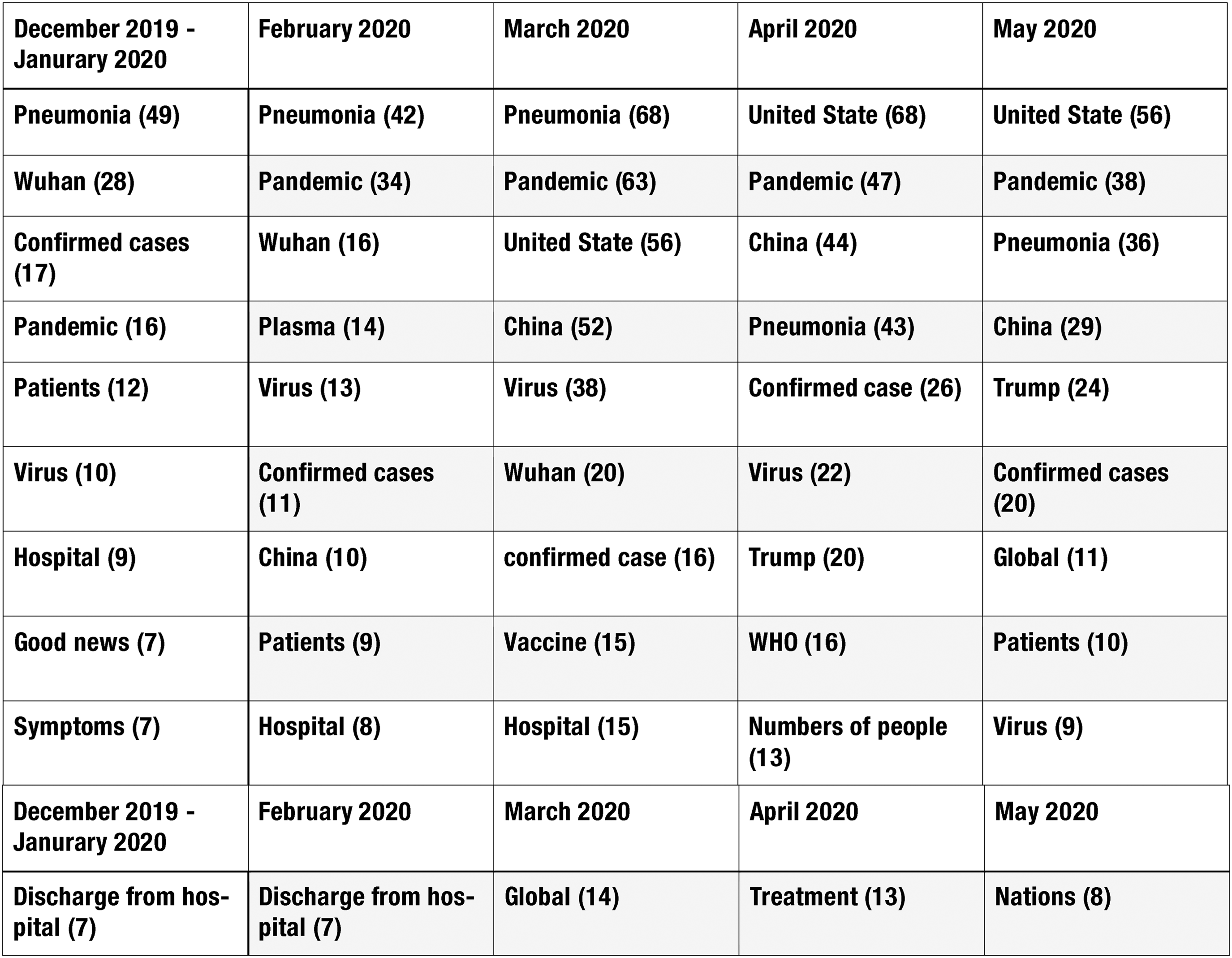
Frequencies of indicative words and phrases in @CYLC between 1st December 2019 and 31st May 2020.
In @CYLC, the reported focus of the outbreak was very much China-centred between December 2019 and February 2020, and shifted towards to the international situation in March 2020, with a visible decrease of posts about the national outbreak from March to May 2020. In terms of the contents posted, there was a visible change of the salience of aspects in the communication, which indicates a change of agenda.
From December 2019 to March 2020, “pneumonia” was the most frequently appeared word, and it was the same word for all 4 months. This means in the first 4 months of the outbreak, @CYLC’s attention were given to inform the nature of the pandemic: COVID-19 is a type of disease cases pneumonia. So when discussing the pandemic, it was expected to mention “pneumonia” often. Beside “pneumonia”, words such as “pandemic”, “Wuhan”, “hospital”, “confirmed cases”, “virus” and “patients” also frequently appeared. These are also indicative words that show the salience of the communication: information that could help the public to understand the origin as well as the development of the pandemic was communicated. It should also be noticed that, in December 2019 and January 2020, word “symptoms” was identified as a frequently appeared word, but the same word was not identified in the following months. Between January and February 2020, “discharged from hospital” was identified, but not in other months. While in February 2020, the word “plasma” was identified, but not in other months. And in March 2020, “vaccine” was identified as frequent word, but not in other months. These changes suggest that @CYLC communicated about the symptoms of COVID-19 primarily in the first two months of the outbreak, and the focuses were shifted to talk about the treatment (plasma) in February and the possible development of the vaccine in March. This matched with the overall development of the pandemic in China, as the country was starting to understand the new virus in the first 2 months, then trying to treat the patients and then starting to develop the vaccine in the following months. Thus information was offered by the social media account to draw an up-to-date picture of the basic situation of the national outbreak. While between December 2019 and February 2020, when the pandemic was at its peak in China, the account also frequently used words “good news” and “discharged from hospital” to spark hopes.
A key change of salience in communication started in March 2020, as the word “United State” was identified, it appeared 56 times in March, 68 times in April, and 56 in May, 2020. In April and May, it was the most frequent word. The word “Trump”, the surname of the then-US-President also frequently appeared in April and May. If we combine this change of words, with the locations of the outbreak discussed, it is clear that the account had a China-oriented focus between January and February, while from March to May posts were more international-focused, and discussed less about the disease, and more of the international relations associated with the pandemic. This shift of focus is due to the overall development of the pandemic of being first reported in China and then spreading globally. Consequently, more reports were about China in the first two months and more reports were about the international situation after March. But another key contributor to this change was the intensified China-US tension over COVID-19, the most significant concern in China’s international relations during the pandemic.
Since March 2020, there were 75 posts solely about the outbreak in the US or China-US disputes because of COVID-19; and this does not include other post that mentioned the US, but the US/China-US relation were not the main topic. This dramatic rise started on 9 March after a US official used the terms “Chinese virus” to label the virus, as a way of blaming China and making it responsible for the global pandemic. While the “blame game” is a card often played in international crises and conflicts (Hveem, 1970; Kutlay, 2011; Tennen & Affleck, 1990), in the case of the COVID-19 outbreak, the US’s naming and blaming has several causes. Most obviously, it is based on the origin of the outbreak, but more crucially it was a result of the on-going China-US conflict since the trade war and was also a card played by the Trump government to drag US citizen’s attention away from its failure in dealing with the pandemic in the US (Wintour, 2020). This blaming has been taken very seriously by the Chinese government, as it did not want the idea of blaming China to become mainstream in the international arena, leading perhaps to China being made to pay for the US’s losses, as suggested by some US think tanks (such as Yoo & Delahunty, 2020). Thus, the Chinese side has rejected the US’s blame, and claimed such ideas were wrong, misleading and illegitimate. This agenda was strongly reflected and reinforced in Chinese government social-media accounts. Evidence is that among the 75 posts related to the US posted in the @CYLC account, two main themes emerged. Firstly, highlighting how US officials had attacked and blamed China for the virus, and how such a blame is morally, legally and politically wrong. Secondly, showing how bad the situation was in the US because of the Trump government’s failure to deal with the outbreak.
But the intended audiences for the agenda were not international. Since the followers of @CYLC’s posts are dominantly domestic, and Sina Weibo is a China-centric platform. As a result, the purpose of reinforcing China’s agenda in the US-China conflict is partly diplomatic, to protest against the US; but more crucially, is to set agenda for the Chinese public. This agenda is established by reinforcing the existence of an external threat (US) that has slandered China and harmed Chinese people’s interests. Establishing an external enemy is a common method used by national governments during crisis to lead nationalistic emotions (Liu, 2006). For Chinese government, communicating about US’s blaming toward China might not always lead to rise of nationalistic emotions, but it could influence what the Chinese public think about the pandemic. It put forward the view that the US was using COVID-19 as a weapon and intended to ask the Chinese people to pay for the US’s losses, and enabled this perspective to be discussed more. Also if we take into consideration of the salience in communication in the previous months, it can lead to a narrative that: although China has successfully controlled the COVID-19 outbreak (from using words such as “good news”, “discharged from hospital”, and reporting decrease in numbers of confirmed cases), the virus was not the only means through which the Chinese public could be threatened, as there is an external enemy, the US.
The agenda set by @CPO, on the other hand, is similar to @CYLC, but with two distinguished characteristic. Firstly, @CPO had a more domestic focus, as although there were also discussions about the US, the primary focus was still what happened within China. Secondly, its attention was given to talk about the contributions of police officers as key workers during the pandemic, and pay emotional tributes to them. The following two charts will unfold the similarities and differences. (Figures 4 and 5)

Locations of the outbreak of COVID-19 in posts in @CPO between 1st December 2019 and 31st May 2020.
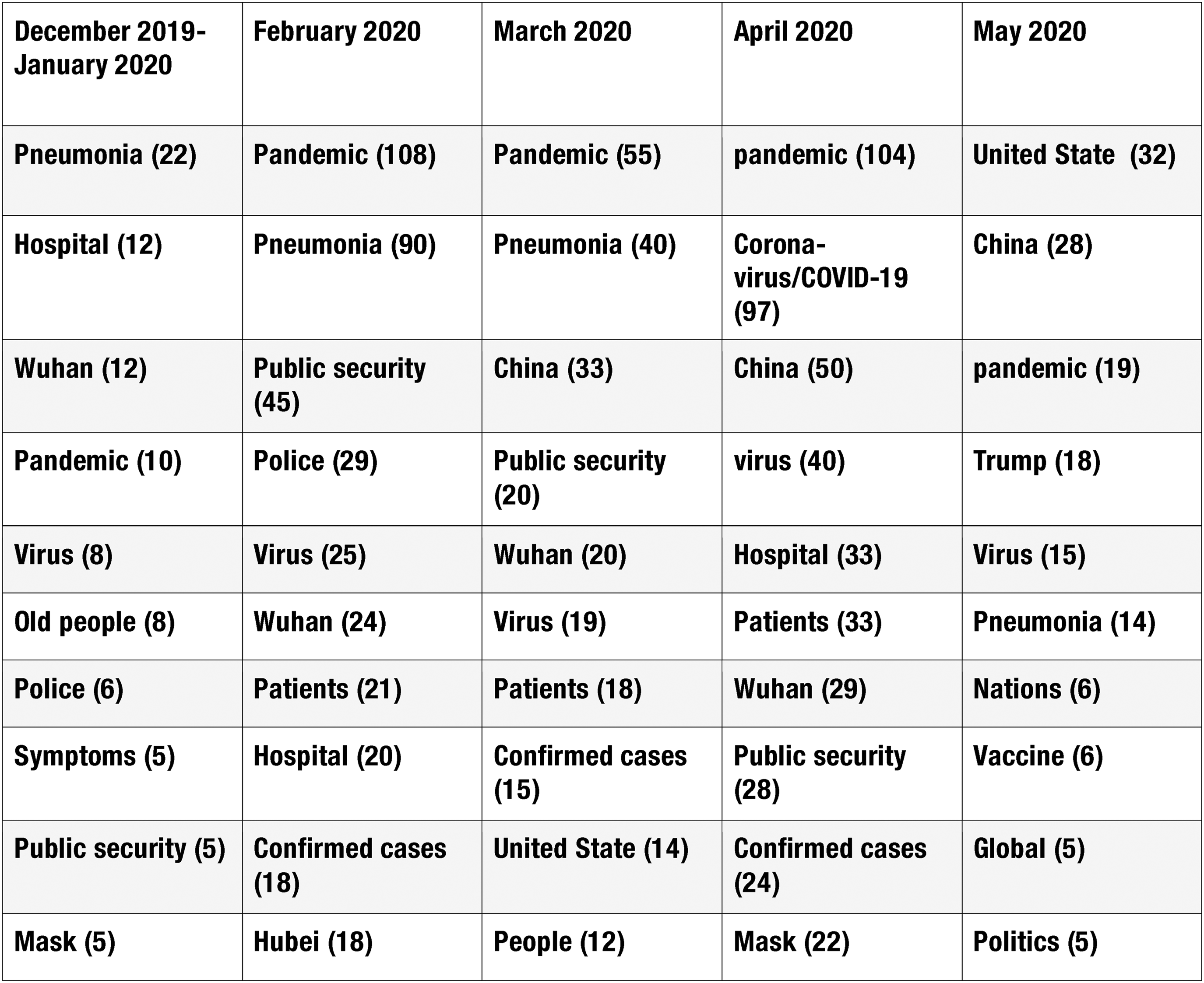
Frequencies of indicative words and phrases in @CPO between 1st December 2019 and 31st May 2020.
From the location of the reported outbreaks, it is clear that the @CPO focuses dominantly on the situation at national level. In January 2020 (no date in December 2019), all posts discussed the outbreak inside China, while in February, 95 posts talked domestic situation, and five were about international situation. In March and April, the total numbers of posts decreased, but still 66 and 35 posts were about China, compared to 37 and 17 were about the global situation. May is the only month in which posts about the international situation were the same as the ones about China.
In terms of contents of posts, words such as “pandemic” “pneumonia”, “hospital”, “Wuhan”, “virus”, “confirmed cases”, and “patients” were among the most frequently appeared words, and these were no difference from the posts in @CYLC. But although the general trend was similar in two accounts, the information provided by @CPO was much more extensive, detailed and specific. To explain: @CPO started to post information about COVID-19 frequently after 20 January, and between 20 and 31 January 2020, it posted 87 times, meaning that on average eight posts a day were about the virus. This offered the public a substantial amount of information to help them understand this unknown virus at that time. Also, the information the account provided was very detailed, especially regarding contact tracing. The blog posted information about specific trains and flights that were used by confirmed COVID-19 patients, and informed the passengers of those trains and flights to report to local authorities and self-quarantine for 14 days. By providing this information, @CPO gave the salience to primarily inform the public of the development of the pandemics. It could also indicate and reinforce the pro-active actions took by public servants and the government in fighting against the pandemic, which led to portrayal of positive image of the government in general. This might not always lead to a praise of the government by all Chinese people, but at least can impact on what the public think when think about the pandemic: the positive and proactive actions conducted by the government to fight against and prevent the pandemic.
The other difference is that discussion of the US and US-China relation in associating with the pandemic did not featured greatly, as “United State” was only identified as frequent word in March and May, and “Trump” was only in May. While “public security” and “police” were among frequent appeared words, which were not identified in @CYLC. These words appeared firstly because of the nature of the account, and they also frequently appeared under a hashtag #police officers are taking actions to fight against the pandemic. Under this hashtag, two issues were salient: stories about police officers’ actions during the pandemic to prevent harmful behaviours to public security and to help the general public, and stories about the deaths of local police officers in fighting against the pandemic.
By posting these contents, the account was reinforcing the hard work of local police officers, namely, a group of public servants working in a government organ. Praise towards them on the one hand reflects the origins of the account as belonging to the police force and thus being more likely to praise its behalf. But more importantly they enabled an establishment of emotional tribute to the police officers, and this type of emotional tribute is also a type of agenda. By showing the contributions and sacrifices made by key workers, the account enabled the public to understand the cost to some people of their efforts to stop the virus. This type of emotional tribute to individuals is much needed during the COVID-19 national crises, as emotions are key driving forces of attitudes and actions (Chen et al., 2021). Such emotion can lead to a sense of hopes of fighting the virus by knowing there were people working very hard on the frontline. Secondly, by knowing people had been sacrificing and dedicating themselves in fighting the pandemic, people would be more likely to follow the guidance and policies. On the other hand, it can also act as an indication of the Chinese government’s efforts in fighting the pandemic. Although this account did not directly praise the government, it set agenda to show how members of Chinese governmental organs, i.e. the police officers, have sacrificed and devoted their lives during the pandemic. It could also establish a perspective that the Chinese government was protecting and serving its people at all costs, which could enable positive tone towards the Chinese government to be visible. This may not change people’s attitudes towards the Chinese government totally, but it associated Chinese government with efforts and sacrifices, and can influence what to think about.
Discussion and Conclusion
This paper has analysed two most impactful ministry level official Chinese government Weibo accounts as cases studies, to understand their communication during the first outbreak of COVID-19 pandemic in China. It finds two accounts were frequently used as primary media to communicate, and both the volume and contents were rich. By applying the agenda setting theory, the research particularly measured the saliences in communications, and demonstrated that attentions were forced toward two agendas: the development of the pandemic, and treatment of the diseases. These attentions contributed particularly to the two purposes claimed by the Chinese government: “public official information about the develop of the pandemic” and “report pandemic prevention measures” (People.cn, 2021). To set these agenda, the two accounts provided the public with information about the confirmed cases, contact traces, treatments and development of vaccines during the crisis. While at @CPO, salience was also given to emotional tributes to the police officers, as key workers during the pandemic, which contribute to the claimed purpose of “tell positive stories of fighting against the pandemic” (People.cn, 2021) by praising scarifies made by people which lead to positive changes. But the agenda of “help people with difficulties” were not given much attentions in both Weibo account. For the @CYLC, the other salience in the communication was the US-China relations during the pandemic. This issue has little connections with four claimed purposes by the government, but featured greatly in the communication, and set a different agenda.
Agenda setting theory provides a powerful framework to indicate what the Chinese government wanted the public to think about the pandemic. It was no surprise that the agendas were set to lead to positive narratives toward the government. These narratives are: Chinese government official accounts have taken pro-active actions to provide the public with detailed information regarding the virus. Also, China has successfully dealt the first outbreak, but the US, as an external threat, was trying to deny the effects and harm China’s image. Additionally, tremendous sacrifices and efforts were made by public servants during the pandemic, and these efforts should be recognised and respected. These three agendas, may or may not change the public opinions toward Chinese government, toward the US and towards Chinese police officers, but they can certainly influence what were visible in the online public space, and increase the salience of these aspects when people think and discuss about the pandemic.
Ultimately speaking, these narratives can benefit both the public and the Chinese government, but they would primarily empower the Chinese government. The public was getting needed information from the government accounts, and the information was necessary and beneficial during a pandemic. The emotional tributes to the police officers were also beneficial, as they respected the efforts of individual key workers, who are also members of the Chinese public. The narrative of US’ s threats primarily leads to nationalistic emotions. These nationalistic emotions were state-led, and not only reinforced the threats of the US, but also portrayed a strong and powerful role of the Chinese ruling party who was leading the Chinese to fight against this external threat. While the narrative of public servants also leads a narrative of recognising efforts from the government to protect the Chinese people from the virus. Through these agendas, the positive image of the Chinese government was generated in the first outbreak in China.
It also becomes clear through the research that the agenda setting process in Chinese government Weibo accounts on the one hand follows the traditional pattern, which is giving almost unified saliences to issues that can promote positive images of the government and, can inform and reinforce government policies and measures. But this does mean all the accounts will publish exact same information and performing exact same functions in the online communication. This demonstrates some levels of the “diversified” nature conceptualised by McCombs (2005) as characteristics of agenda setting in online political communication. Here we should understand “diverse” not as diverse tones in the communication, but as diverse contents and narratives contribute to the agenda. Since the contents of posting are different among different types of accounts, which gave silences to different issues. So although the overall tone is positive towards the government, the public are accessing different types of information and reading different stories. This will further enhance the positive agenda which benefit the government.
It is also means, when discuss government agenda setting through social media communication in China and world widely, both the overall agenda, as well as the diverse narratives contribute to the agenda worth attentions.
As for the limitation of this research, this research is case study based, which although provide specific discussions, can still be developed in further studies, to examine other accounts. Also, the research mainly examined how Chinese government has communicated, so to further develop the understanding of this topic, studies can be conducted to examine public receptions to the government’ agenda, and to assess whether the government has successfully influenced the public opinions through the agenda-setting or not.
Footnotes
Declaration of Conflicting Interests
The author(s) declared no potential conflicts of interest with respect to the research, authorship, and/or publication of this article.
Funding
The author(s) received no financial support for the research, authorship, and/or publication of this article.
