




Abstract

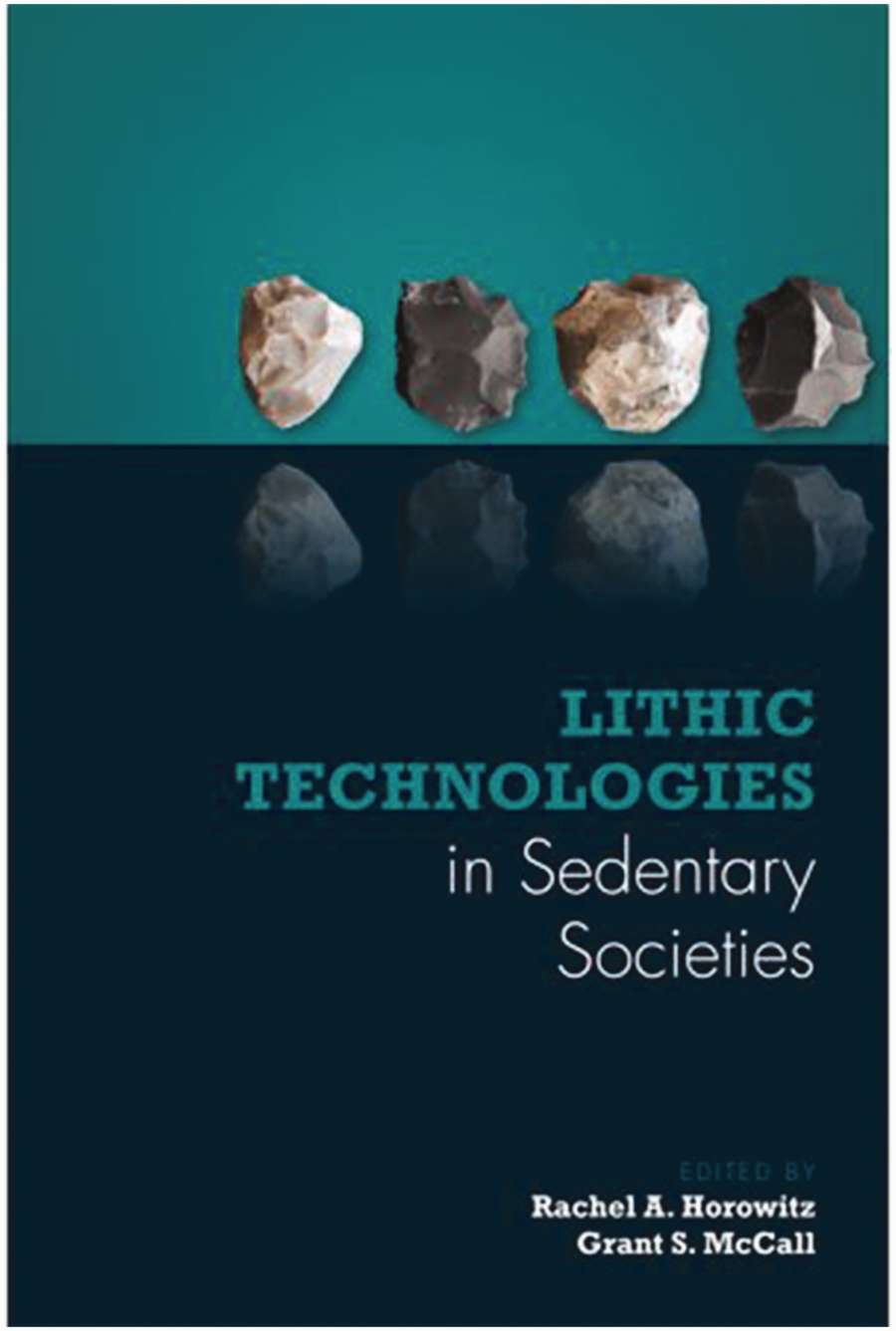
This book is among the first edited volumes to focus on lithic analysis from sedentary and/or complex societies in the archaeological record. A long overdue topic. The editors launch the volume with an introductory chapter that clearly and effectively expresses the need for archaeologists to embrace lithic analysis in sedentary societies. From that introduction (Chapter 1), the volume includes seven more chapters that introduce lithic analysis from various sedentary contexts around the world (Mesoamerica, North America, South Asia, the Near East). The volume concludes with a brief commentary on the state of lithic analysis in sedentary societies (Chapter 9).
Chapter 1 (Horowitz and McCall) lays the foundation for the entire topic of lithic analysis in sedentary societies. The authors begin by reviewing the topic and even state their three axioms, 1) stone tools are the most durable artifact in the record, 2) stone tool technology is reductive in character, and 3) stone tool technology is temporally and spatially ubiquitous across the globe. They go on and review some of the basic literature dealing with informal and expedient stone tools. This is followed by a review of specialized or complex stone tools. The chapter ends with a discussion of areas in lithic analysis that need more attention. One of the themes of this chapter and perhaps a theme of the book is to go beyond the 1987 Parry and Kelly model. By and large, the authors agree with Parry and Kelly but not entirely. They note some significant differences in the lithic data from complex sedentary contexts, and this becomes the pivot point for their perspective on how lithic technology is organized in more complex societies. I would add that their three axioms are true and just as important for residentially mobile societies, and that is why the authors easily adopt a lithic technological organization approach to their specific contributions in the book. In sum, I think this is the best paper in the volume and all lithic analysts would benefit from reading this piece.
Chapter 2 (Davis) provides a case study of lithic analysis from South Asia. The paper is a detailed description of the lithic industry primarily from the Indus Bronze Age at the site of Harappa. The author emphasizes that more detailed lithic analysis is needed but does a fine job of interpreting the materials. There are some themes from Harappa technology that reappear in other studies from the volume. First, lithic technology doesn’t disappear after the adoption of metal tools. Stone tools continue in use alongside copper and copper alloy tools. Like many other complex contexts, blade tool technology tends to predominate. One of the more interesting interpretations of the lithic industry (and I would be interested in seeing more of the analysis that point to this conclusion) is that blades were brought into the site as whole pieces rather than segments. Also, the distribution of the blades was non-centralized. These two statements say much about the political economy of the Bronze Age people at Harappa and a more detailed lithic analysis may be able to unpack this.
Chapter 3 (Manclossi and Rosen) provides a case study from southern Levant dealing with another Bronze Age assemblage. The study focuses upon the informal tools, leaving aside the assemblage associated with tabular scrapers and sickle blades. One of the take away items of the study is that the informal assemblage is a simple Ad hoc technology suggesting the most basic knapping skills. The people were just attempting to get sharp cutting edges to perform domestic activities. This is an important theme that keeps surfacing in this volume. I would also suggest that it is an important theme for hunting and gathering societies as well.
Chapter 4 (Paling) explores the expedient technology from the Pre-classic Maya in households from Belize and Guatemala. The author is quick to point out that centralized craft production throughout the region has eclipsed local household industries and that this is true of the lithic technology as well. However, like the previous chapter, there is the persistence of Ad hoc informal tool production using locally available raw materials. The author provides a detailed analysis of the lithic assemblage, and one key point is that throughout the Pre-classic period, there are multiple modes of lithic technological production at play. This is one of the issues the editors sought to emphasize in their introductory chapter. Lithic technology is complex and not unimodal in sedentary societies. This paper provides the detailed lithic analysis demonstrating multiple modes of economic production.
Chapter 5 (Horowitz) stays with a Mayan data set in Belize. This study examines assemblages from three chert quarry locations. Here the author picks up the theme of multiple technological production modes. She does an excellent job crafting the narrative of how and why lithic technological organization should be used to crack this complex stone technology. The author chooses to focus on the informal utilitarian tools made from local materials, because the nonlocal raw materials and technology focuses primarily upon top-down economic models associated with centralized control of the economy, and this is only a piece of the technological story. Each of the quarry assemblages show different amounts of tool production ranging from simple utilitarian household tool manufacture to specialized production for trade. In all cases, local raw materials play an important and unique economic role. However, it is also stated that these households are somehow insulated from the regional political changes, perhaps because of the importance of the stone tool industry. This is an interesting inference I have seen with hunter gather technology from archaic period quarry locations and worthy of further exploration.
Chapter 6 (McCall, Horowitz, Healan) is a case study from the Formative period in central Mexico. The authors provide a detailed lithic analysis and emphasize a lithic technological organization approach. We see that the vast majority of stone tools are unretouched flakes or informal tools. Cores are worked to exhaustion and the assemblage contains a high frequency of smaller sized flakes and cores. The authors also note that more formalized tools and complex blades are found but these are made from nonlocal stone. They also note that local stone and nonlocal stone are not found in the same assemblages. Elite households are associated with nonlocal materials and non-elite households contain the local cherts. Again, we see two different systems of lithic technology. The authors model this diversity of technology in an interesting way by characterizing these systems as either open or closed. This links to the abundance and size of the stone tools found.
Chapter 7 (Arakawa) moves to the Mesa Verde area of the southwestern U.S. Here the author reviews several independent studies he has conducted over the years and reformulates them into the context of stone tool analysis within a sedentary society. He shows that lithic analysis can be used to address gender roles, migration, and territoriality, all within the context of a sedentary agricultural organization. The key theme of this paper is raw material procurement. Effective raw material locational identification can facilitate broad political/economic interpretations.
Chapter 8 (Mehta, McCall, Marks, Enloe) stays within the North American continent but shifts to the Mississippi River drainage during the Mississippian period. Like the previous paper, this study focuses upon the importance of understanding the source location of lithic raw materials used for stone tools. The authors wish to discover if and to what extent the monumental center of Cahokia contributed to and controlled the distribution of Burlington chert to other urban centers (Carson site). The study revolves around the source location identification of Burlington chert using portable X-Ray Fluorescence analysis (pXRF). The genesis of Burlington chert is a submarine limestone formation that attracts silica during ossification. Submarine cherts undergo a series of genesis and re-genesis over the course of millions of years often resulting in great geochemical diversity over very small distances (sometimes a few feet). To make a long story shorter, it is difficult to get reliable pXRF signatures for submarine cherts. However, the authors appear to have good separation from two areas of the Burlington chert formation, and it appears that most of the Carson site sample is not from the Cahokia area. The study needs more control samples analyzed, but it hints at an unexpected political/economic relationship.
Chapter 9 (Whittaker) was originally a commentary piece on papers presented at the symposium where the volume topic was first introduced. This chapter has since been modified to focus more on stone tool efficiency. The author presents two examples of relatively contemporary stone tool technology. The first details Mediterranean threshing sledges and the flint blades used to arm the sledges and the second is the European gunflint industry. I won’t go into detail about these two industries but simply say that they have one important thing in common. Like most of the papers presented in this volume, both of these contemporary lithic technologies use blades. I take away two things from this interesting paper. The first is the author’s observation that blades are efficient, not because they necessarily have the most cutting edge per stone volume, but because they are the fastest way to make standardized tools. My second take away is that craft specialization can only be supported by complex systems and that specialization implies exclusion. These two observations say much about the lithic technological organization of sedentary and complex societies.
Looking over my notes on this volume made me reflect back on my experiences with the stone tool assemblage from Fred Valdez’s long-term project at La Milpa in Belize. As a hunter-gatherer lithic analyst, I was totally swamped by the La Milpa assemblage density, diversity, and depositional contexts. When I began reading and commenting on this volume, I agreed with the editors that lithic technologies in complex sedentary societies were not the same as lithic technologies from more mobile societies. After finishing the volume, I still agree. However, I also recognize many similarities between the technologies I had never noticed. Yes, complex sedentary societies make and use a great deal of informal technology, and this technology is usually produced outside of the more formal technology, which is probably embedded within the sphere of craft specialization, political hierarchy, and regional market economy. And in order to understand complex sedentary lithic technology, it is prudent to analyze and assess these diverse technologies independently. In some regards the same can be said for lithic technology in more mobile groups. Informal tools are extremely important for hunting and gathering societies, and like the more sedentary societies, this technology is given less attention, as analysts cipher on the more formalized technology (but it is there and in large amounts). I have always advocated for partitioning lithic assemblages into as many behaviorally meaningful units as possible before technological analysis. For instance, why analyze obsidian with chert in a single assemblage when clearly, they were produced by different behavioral events. It is apparent to me that the job of assemblage partitioning is even more important in sedentary and/or complex societies if we wish to do more than just describe what was found. This volume provides several excellent examples of how such partitioning should be conducted.