



Abstract

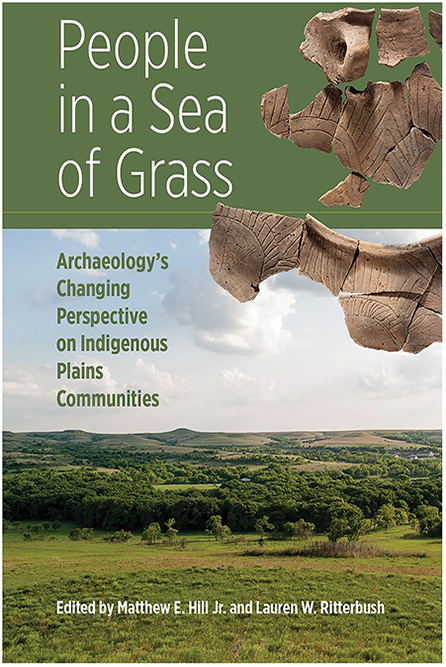 More than just an overview of the archaeology of the Central Great Plains, People in a Sea of Grass provides summaries of the state of knowledge in the region while also presenting new data and ways of thinking that expand our knowledge of the past The editors and all of the authors are steeped in the archaeology of the Central Plains, and their expertise is apparent. The volume correctly honors the contributions of Dr Donna C. Roper, who organized a symposium at the 2008 Plains Anthropological Conference that examined Waldo R. Wedel’s contributions to the archaeology of the Great Plains and the direction archaeology in the region has taken since then. The symposium led to the beginnings of an edited volume, but Donna passed in 2015, before the project had traction.
As a tribute to Dr Roper, editors Matt Hill and Lauren Ritterbush revived the nascent project, rallied many of the best talents in the region, and produced the aptly titled volume. A primary theme is a reconsideration of the theoretical and methodological beginnings of Plains Archaeology, acknowledging the utility of, in particular, the Direct Historical Approach, noting its limitations while still appreciating the intellectual progress that it fostered.
Many of the contributions present current data and theoretical approaches that move beyond what happened when and dig into what happened and why. Approaches include the influence of the distinct Plains environment on both cultural change and stability in a region held together by a primary attribute—a sea of grass. Within this seeming monotony humans thrived and changed to develop distinct ways of living, both through time and through space. Also, many of the studies published here are on groups of people facing tremendous changes as a result of Old World intrusions on the Plains. This calls for analysis that is more than evaluation of adaptation to the natural environment and instead considers interactions between Tribal Nations, sometimes as refugees from their homelands, as well as their interactions with Old World intruders.
The Introduction by Hill and Ritterbush places the people of the Central Plains within a grassland that is both rich and challenging. Rather than focusing on the limitations of this environment, they use it as a unifying theme from which a diversity of adaptations arose and focus on the farming cultures over the past 2000 years. In doing so, they acknowledge the phenomenal pioneering work of Waldo R. Wedel, using his work as a baseline from which the discipline of the region has progressed while also acknowledging its shortcomings.
The following chapter by Hill aptly summarizes early perspectives of the region, starting with descriptions by early Old World populations entering the region, and through the establishment of a foundation of archaeological thought in the region, noting the influence of scientific societies, casual collectors, curiosity seekers, antiquarians, geologists, and paleontologists. From these beginnings, the early generation of professional Plains-focused geologists, historians, and paleontologists began to establish foundations from which the discipline of Plains anthropology developed. Waldo Wedel and William Duncan Strong are identified as the first professional archeologists to work in the Plains. They created a transformation in our thinking about people of the Plains before contact with the Old World. Technological and methodological advances occurred in conjunction with substantial increases in funding and legal support for site salvage. These advances were followed by theoretically guided investigations and the growth of university Anthropology departments. This led to more scientific rigor, an appreciation and utilization of a variety of theoretical approaches—some productive, some not so much—and hypothesis testing. Hill’s tight, clear overview of the development of the field in the Plains provides a well-grounded foundation for the chapters that follow.
Beginning with the founding of the Kansas City Hopewell variant by Wedel, Logan reviews the progression of approaches and ideas that followed, emphasizing Alfred E. Johnson’s measured approach that focused on the basics of population organization and technological change as an adaptation to the local environment. Logan notes that pervasive Hopewell traits indicate engagement with social groups to the east and southeast and successfully argues that differential social status implied by the more exuberant aspects of Hopewell artistry is not necessarily a population intrusion, as earlier thought, but is instead a significant influence upon an otherwise typical Plains population.
Ritterbush provides a succinct overview of the late prehistory on the Central and Northern Plains—the Central Plains tradition. Citing earlier work by Roper, the Central Plains tradition is described as the result of influence from (but not necessarily the migration of) people of the Cahokian/American Bottom region and possibly Caddo influence from the southeast. Thus the Central Plains tradition is described as an in situ development fueled initially by native plant cultivation but followed by introduced cultigens—maize and to a lesser degree beans and squash—that allowed for an adaptation of settling into small, semi-permanent hamlets along drainages. Bison hunts away from settlements to the west substantially supplemented the diet. She does not gloss over the diversity that existed—there is significant variation in lodge structure, and the intensive bison hunting of the Oneota and High Plains populations contrasts with the more diverse fauna found throughout most of the Central Plains tradition. The people represented by this tradition are seen as settlements of family groups, possibly identifiable through design attributes of the pottery they produced. Trade items from northeastern and southwestern sources in particular point to external relations that reduces the notion of podunk provincialism and instead demonstrates broad social connections, and possibly ceremonialism or nascent social inequality. It is worth noting that Roper’s contribution to Central Plains tradition studies are cited 44 times in this chapter, 34 of those citations have Roper as the primary author.
Both Billeck and Logan refute earlier assertions of large scale migrations and settlements when discussing Steed Kisker and Kansas City Hopewell respectively and tamp down assertions of short lived phases based on minor stylistic or compositional changes in ceramic attributes. They both demonstrate that adoption of stylistic attributes of neighboring populations does not necessarily mean colonization by another group of people. Billeck notes that the consultation during the NAGPRA repatriation process determined Steed Kisker is a Central Plains tradition manifestation rather than a southeastern population intrusion into the Plains.
Great Bend aspect “Council Circles,” for lack of a better name, are evaluated by Vehik from an ideological and symbolic reference. Citing the understanding of Indigenous people and discussing their understanding of cosmology and the meaning of the cardinal directions, she presents a thoughtful evaluation of these structures. In turn, the support and contributions of the Pawnee play a strong role in Adair and Hofman’s consideration of Pawnee sites, which evaluate villages occupied in a time of significant cultural change as well as a likely hunting camp. Strong’s student, Waldo Wedel, formalized the phrase Direct Historical Approach in his thesis on the Pawnee. Rather than characterize the central traits of the Pawnee in the recent past, Adair and Hofman focus on the diversity of the separate bands as well as the uneven effect of enculturation upon them resulting from contact with Old World populations. They also summarize the utility of evolving theoretical and methodological approaches to understand the four bands now referred to as the Pawnee. Ritterbush collaborates with the Kaw in a revival of studies on Kaw sites and moves past Wedel’s somewhat derogatory assessment of them that did not take into account that the Kaw sites under his scrutiny were in the midst of significant social and economic upheaval. Thorough evaluation of late precontact Kaw sites would be especially useful, as would continuing study of oral histories and ethnographic accounts.
Trabert, Hill, and Beck’s chapter on the Scott County Pueblo is a lucid summary of their work over the last decade that moves beyond the timing and origin of the pueblo itself but instead uses the material culture of the site to illustrate the rippling impact of European colonization well beyond the borders of the Southwestern pueblos. They also convincingly demonstrate the process of ethnogenesis as a hybridization of cultures coming together as a result of European intrusion. This process is best seen in pottery which, after several generations, is a product of local materials made in a Puebloan manner. This chapter is many steps from mere cultural identification based on artifact lineages. Instead it shows the integration of social dynamics as reflected in prehistoric material culture. Beck underpins this discussion in her robust assessment of not only Pueblo-Plains interaction but the extent of trade throughout the Plains before the arrival of Old World populations. Blakeslee’s chapter on the Quivira expeditions offers documentary evidence of the extensive travel and trade that was present in the Plains and argues that at least some people in the Plains were living in settlements of thousands of people. It is clear that people on the Plains had, on the whole, frequent interaction and exchange and were more cosmopolitan than provincial.
Hill and Ritterbush conclude by summarizing the available results of investigations focusing on social connections to the south, east, and west, the influence of plant cultivation and the importance of bison hunting, the diversity present in the region before Old World intrusion, and the temporally uneven and divergent impacts that followed. They note there are still many avenues to explore.
Unfortunately, the production of the volume is disappointing. There are several typographical errors, a nearly unavoidable malady. But figure quality is inconsistent at best—some images are crisp and clear, others a fuzzy blurry mess, even within the same chapter. There is a white line down the center of figure 75. There is no standard for map framing, format, or legends, breaking the continuity between chapters. In contrast, tables are more uniform in structure and appearance with the exception of the sideways tables in chapters 3 and 5. These just don’t work. Using vertical text for headings and smaller fonts could have alleviated these problems. All cited references are in the back of the volume—a good choice.
While the intent of the volume is in large part a reassessment of the foundations of Plains archaeology, it goes well beyond that in reviewing the theoretical and methodological developments in Plains archaeology since its inception and offer examples of innovative and promising approaches that followed the sometimes good and sometimes less than good frameworks from the early development of Plains archaeology. This volume will introduce a student new to Plains archaeology to an excellent range of studies that summarizes the varied people of the Plains, and the fresh approaches that are presented make this a useful book for seasoned Plains researchers and new explorers alike.
