




Abstract
Repeat migration is a common, but unstudied, pattern of migration. This study examines the potential intergenerational consequences of this behavior. To investigate this, we estimate the effect of fathers’ repeat migration on their children’s grade point averages using population-level register data from Sweden. We find that the children of fathers who repeat migrate have a significantly lower grade point average, even after controlling for individual and family characteristics, than children of permanent migrants. Results suggest selection and delayed integration may exert negative pressure on the GPA of children of repeat migrants.
Introduction
Migration is most often considered a one time and permanent event in which an individual moves from origin to host country; however, research has shown that individuals may engage in several acts of migration over their life course (Bratsberg, Raaum, and Sørlie 2007; Bijwaard 2010). This study expands on this literature by examining the long-term implications of multiple migrations. While multiple migrations include acts of return migration to the country of origin or onward to a tertiary country, this study will focus on individuals who repeat migrate. Repeat migration is defined here as those who immigrate, emigrate, and then re-immigrate to the same destination country. Repeat migrants potentially differ from circular migrants due to the motivations driving their mobility (Aradhya, Scott, and Smith 2017). We focus on the case of Sweden, where 13 percent of Western and 7 percent of non-Western fathers exhibit repeat migration, suggesting that this is not an uncommon phenomenon.
Currently, however, it is unclear whether repeat migration is detrimental to the long-term integration processes of immigrants and their families. One reason for this lack of clarity is that the motivation behind repeat migration can vary. Some individuals may have planned ex ante for a temporary stay in the host country, while others may have an unplanned outmigration, ex post. The differences in planning horizons may well lead to different integration outcomes. Ex ante migrants may have weaker initial incentives to integrate into the host society than ex post repeat migrants. To the extent that they keep to their planning horizon, ex ante return decisions are not made in light of actual conditions in the host country. This may imply that ex post migrants act with more perfect information because the decision to return was based on experienced conditions in the destination country.
Although integration is one potential mechanism determining longterm outcomes, repeat migrants may differ systematically from migrants who do not repeat. This potential selection, along with the consequences of delaying the integration process, may have important repercussions not only for the migrants themselves, but also for their children. This study will specifically examine these ramifications through the lens of educational outcomes of Swedish-born children of immigrants, where children of permanent migrants are contrasted with children of repeat migrants. This is an important distinction, because analyses of second-generation outcomes may very well mask heterogeneities caused by different migration patterns if families of repeat migrants face greater difficulties. To illustrate this, it is theoretically possible that children of permanent migrants outperform children of natives, while children of repeat migrants from the same origin country perform much worse. If this is the case, the average effect for an origin country would be downwardly biased (Aradhya, Scott, and Smith 2017).
Although previous efforts have looked at return migration (Dustmann and Weiss 2007; Dustmann 2008) and even onward migration (emigrating to a tertiary country; Nekby 2006), this is the first to focus on its intergenerational effects of repeat migration. To do this, we exploit comprehensive individual migration history data in the Swedish Interdisciplinary Panel (SIP), which contains information on all individuals living in Sweden with children born between 1973 and 1995. The data contain demographic information, including detailed information on years of immigration and emigration. Fathers’ information is then linked to their children, for whom we have information on their grade point average from 1989 to 2011. This study finds a large negative association of a father’s repeat migration on his children’s GPA, controlling for father’s country of origin, migration characteristics, education, and other demographic characteristics.
The paper is organized as follows. First, we give a brief background regarding the history of migration to Sweden. We then discuss the analytical framework through which we interpret the results from the multivariate analysis. Finally, we present the results and discuss their implications.
Swedish Context
Since World War II, migration to Sweden has become a major source of demographic change. In 2017, first-generation and second-generation immigrants comprised roughly 15 percent and 10 percent of the Swedish population, respectively. Although immigration flows have been relatively consistent throughout the period, the composition of immigrants arriving in Sweden has changed dramatically (Westin 2003; Bengtsson, Lundh, and Scott 2005). This diversity in the source countries and causes of migration, as well as their experiences in Sweden, could lead some groups to take different approaches on whether to settle permanently in Sweden or to remain more mobile.
Following World War II, the Swedish industrial sector was booming from the increased demand during the reconstruction of war-torn European countries. To meet labor demands, Sweden began recruiting foreign workers. This initially consisted of a large number of Nordic immigrants, most prominently from Finland, but also Denmark and Norway. This supply was still insufficient, so companies, in coordination with the migration authorities, began recruiting workers from Germany, Austria, and Italy, and then expanded again to include those from Yugoslavia, Greece, and Turkey. Large flows of labor migration continued until the early 1970s, when Swedish authorities tightened the requirements for foreigners to obtain work visas making it extremely difficult for individuals of non-Nordic origin to enter the country to find work. From the 1970s onward, the Swedish immigration experience has largely been characterized by refugee resettlement from mainly Latin and South America, Vietnam, the Middle East, Africa, and the former Yugoslavia.
Today, Sweden has a fairly diverse immigration experience. According to the Swedish Migration Board (2017), among those immigrating receiving residence permits in 2016, 49 percent were classified as refugees. The second largest category is family reunification with 22 percent of the total, of which 10.5 percent were relatives of refugees, and 11.5 percent were relatives of other Swedish residents. Of the remaining 28 percent, 17 percent were labor migrants, 3 percent were from EES states, and 8 percent were students. Additionally, EU migrants (who do not require residence permits) accounted for 27,000 individuals in 2014, which is roughly on par with the size of the labor migrants. This implies that refugees and their families are by far the largest single category of migrants, with a total of roughly 85,000 receiving the right to remain in 2016.
This composition has long-term effects on the Swedish migrant mix, because refugee groups, on average, are much less likely to return or repeat migrate back to their home country relative labor migrants (Cortes 2004). This is the result of the combined political and market instability (Neumayer 2005; Klinthäll 2007) so that, even when the immediate threat that prompted the initial forced migration subsides, the conditions within the country will make refugees slow to return. The refugees contemplating returning often keep abreast of the conditions within the country to avoid making the “wrong” decision (Bascom 2005). If conditions in the country of origin improve, this reduces the uncertainty of incorrectly returning to the home country.
Analytical Framework
Individual characteristics can influence whether a person becomes a permanent migrant, return migrant, or repeat migrant. Return and repeat migrants display lower levels of labor market integration and full-time stable employment as well as occupational prestige (Borjas 1989; Dustmann 1996; Constant and Massey 2002, 2003; Jensen and Pedersen 2007; Saarela and Scott 2015). Also, whether one is a forced or voluntary migrant can result in different likelihoods of making a return and repeated acts of migration, with refugees being less prone to secondary acts of migration (Cortes 2004). Although some individuals who engage in multiple acts of migration settle in their country of origin or other tertiary destination, others inevitably do settle in the host country. This has implications regarding the composition of immigrants and their descendants that ultimately remain in a host country. The integration process of immigrants with discontinuous exposure to the host society may differ from those uninterrupted residence in the host country. Thus, examining these groups separately allows us to disentangle unique immigration experiences that have been currently masked in the literature.
Among repeat migrants who settle in the host country, their children’s educational performance and attainment could be affected through several mechanisms. In addition to the negative selection among those who repeatedly migrate discussed below, time spent outside the host country does not contribute to integration. Further, even when they are in the host country, those who leave open the possibility of departing are less likely to invest in host country-specific human capital (Dustmann 2008). Parents’ time spent in the host country is often used to measure the level of parents’ incorporation and has been found to have a positive effect on their children’s linguistic acculturation (Bleakley and Chin 2008, 2010; Casey and Dustmann 2008) as well as educational performance and attainment (Nielsen and Rangvid 2012; Åslund, Böhlmark, and Nordström Skans 2015; Smith, Helgertz, and Scott 2016). Repeat migrants could thus be negatively impacted in at least three ways: the effect of anticipating an emigration, the actual time away from the host country, and the negative selection of being a repeat migrant. This triple threat to parental integration may negatively impact their abilities to positively influence their children’s educational performance.
Selection Mechanisms
As mentioned above, return, onward, and repeat migrants are a highly select group. Almost all studies, however, focus on return migrants, with the general consensus that those who return display worse labor market integration compared to permanent migrants, potentially indicating these are negatively selected individuals (Borjas 1989; Dustmann 1996; Constant and Massey 2002, 2003; Jensen and Pedersen 2007). In the Swedish context, Edin, Lalonde, and Åslund (2000) find that those who emigrate after 5 to 10 years are likely to do so with low or no income, while Klinthäll (1998, 1999) finds economic status to correlate positively with male immigrants from Germany, Greece, Italy, and the United States returning to their country of origin. In a seminal study on internal repeat migration, Davanzo (1983) finds the mechanisms driving return migration differ for those that spend short and long intervals, respectively, in the host location. She finds that location-specific capital, measured as time spent in the initial location prior to migrating, is positively associated with returning to the initial location within one year. Similarly, less educated and younger migrants are more likely to return shortly after migrating. DaVanzo argues that less educated and younger individuals may be less informed, and as a result are more likely to have poor information about the host location. One of the few studies that focus on international repeat migrants, in the context of Germany, finds that those who are not homeowners and those with a lower education background are more likely to repeat migrate (Constant and Zimmermann 2011). Although much of the focus is on the poor performance among those who return or repeat migrate, studies have found it can also be the most successful who leave or onward migrate (Borjas and Bratsberg 1996; Pedersen, Røed, and Schröder 2003; Nekby 2006). Although economic well-being is also important for refugees, there are some other factors to consider. Joly (2002) puts forth a model that says refugees view their move as either permanent or temporary. Those who view their migration as permanent can more quickly begin investing in host country-specific capital, while those who view their move as temporary can find themselves stuck in uncertainty, delaying such investments.
Rooth and Saarela (2007) and Borjas and Bratsberg (1996) present a more generalized framework with which to understand the role of selection in return migration. They argue that the composition of the immigrants that remain in the host country differs greatly from that of those that emigrate, and it is largely related to the selection mechanisms driving the original migration flows. They argue that the selective outmigration of immigrants from the host country accentuates the initial selection of the immigrant flows. More specifically, if the original immigrant flow is positively selected on skills, out migrants will be comprised of the least skilled. In contrast, if the original immigrant flow is negatively selected on skills, the emigrants among them will be the most skilled. This framework allows us to conceptualize how return migration impacts the migrant population remaining, but it is most relevant in the context of intended permanent migration.
Coupling this selection framework with the empirical findings on return and onward migration, we may hypothesize the selection mechanisms that impact the composition of repeat migrants. In particular, if immigrants return or onward migrate because their outcomes in the host country did not meet expectations, those that repeat migrate may be negatively selected from this group. This would be the case if those immigrants arrive in their home country or tertiary country and yet again face outcomes lower than their expectations. The costs associated with repeat migrating to the host country are significantly lower because the immigrant accrued some location-specific capital from the time they lived there. Thus, repeat migrating to the host country can be made with more accurate information. If the return or onward migration does not meet the immigrant’s expectations, returning to the host country may allow the individual to recoup some of the location-specific capital he or she acquired there. It can be assumed that the return and onward migrants whose expectations were met in the home country or tertiary destination would never return to the initial host country unless the migration decisions were preplanned. The implications of each these patterns are important to consider because they encompass distinct selection mechanisms.
Incorporation
Incorporation theory posits that, with time in a host country, an immigrant would undergo acculturation, notably linguistic acculturation, and structural assimilation (Gordon 1964; Alba and Nee 2003). These experiences, accrued both over time and across generation, have been found to have a positive effect on the linguistic skills and educational performance of the children (Nielsen and Rangvid 2012; Åslund, Böhlmark, and Nordström Skans 2015; Smith, Helgertz, and Scott 2016). However, within those families where repeat migration takes place, they may be less motivated to begin developing host country-specific skills, in which case time and generation may be more weakly linked to the immigrants’ integration and the intergenerational transfer of incorporation (Dustmann 2008). The combined effect of the anticipated move and the actual time spent away from the country is likely to adversely impact the integration efforts on the immigrant part, which may have negative long-term ramifications on the education of their children. Brown and Bean (Brown and Bean 2006; Brown 2007; Bean, Brown, and Bachmeier 2015) developed the delayed integration hypothesis in which immigrants, as a result of transnational ties and family obligations, focus on immediate economic benefits, and put less effort in accruing the country-specific capital than would normally be expected.
Transnationalism
A final perspective to consider is that repeat migration may be an indication of a family maintaining strong transnational ties that subsequently impact the integration of their children. Maintaining strong transnational ties may be a hindrance to language acquisition, but also may impact the educational integration of immigrant youth (Farley and Alba 2002; Portes 2003; Itzigsohn and Giorguli-Saucedo 2005). Farley and Alba (2002) suggest that transnationalism is a growing phenomenon among second-generation immigrants in Western societies, as the fiscal costs associated with maintaining ties to an individual’s parent’s country of origin are relatively lower today than in the past. They argue that because of this, second-generation immigrants may have less of an incentive to assimilate into the host country’s educational system or learn the host country language when maintaining bonds abroad is simple. Although this is an important theoretical mechanism for intergenerational effects of repeat migration, register data are not well-suited to test the presence of such effects.
Father’s Absence
A final potential mechanism to consider in this article is the effect of father’s absence on the educational outcomes of his children. In our sample, fathers may repeat migrate before or after the child is born. In the latter circumstance, a child’s academic performance may be hindered due to an absent father and, presumably, this relationship will be negatively associated with the duration of father’s absence. A large literature suggests that there is a causal relationship between father absence and several measures of children’s academic performance (McLanahan, Tach, and Schneider 2013; Berg et al. 2014). A recent study using Swedish register data examines the relationship between parental absence and children’s educational performance in Sweden across country of origin groups and finds a degree of variation (Erman and Härkönen 2017). The authors find a negative relationship that is weaker within those groups with a high incidence of parental separation and argue this is the result of parental separation being more common within these communities and therefore less detrimental. In sum, parental absence has an important impact on the educational performance of children, and the evidence suggests that these penalties vary across ethnic origin.
We will test this by focusing on the sample of children whose fathers repeat migrated to examine whether the timing of these repeat migrations (before or after the child is born) and the duration the father’s time abroad impact the GPA of their children. Disentangling the independent impact of father’s absence is of importance for a clear interpretation of our results and may further shed light on the mechanisms driving the relationship.
Data
The data analyzed come from the Swedish Interdisciplinary Panel (SIP) database. The SIP is a register-based longitudinal dataset containing information on the entire Swedish population born between 1973 and 1995, as well as their parents born outside the main sampling window, with data from 1968 until 2011. All of the individuals included in the sample have parents that immigrated to Sweden; thus, we ignore all individuals with two Swedish-born parents. Further, we only include individuals whose parents permanently migrated, or those who repeat migrated as it is defined in the sample. Information on attained primary school grades is available from 1989 to 2011, which therefore constitutes the key period of interest. The SIP also has information on demographic characteristics, including place and date of migration. Through the addition of the multigenerational register, family IDs have been created through linking parents to their biological children. Additionally, school identifiers are provided and employed as a fixed effect to help eliminate potential unobservable between-school heterogeneity. Our subsample consists of second-generation immigrants who have birthplace and immigration information on both parents and report the education outcome of interest. This project focuses specifically on the father’s migration behavior, because males are more mobile than females. Another reason for focusing on fathers is the low labor force participation rates of women in many immigrant groups in Sweden, which makes the repeat migration acts potentially less linked to integration for women. 1
Measures
Educational Performance
The educational performance measure considered in this article is grade point average for the ninth-grade school year for graduating cohorts between 1989 and 2011, which is then standardized by year. This grade is standardized against all those that finish the ninth grade in a given year and calculated as z-scores with a mean of 0 and a standard deviation of 1. The scores reflect performance relative to the entire national graduating cohort for a given year, with school fixed effects included to adjust for potential differences. GPA is of particular importance as it is a strong determinant of upper-secondary enrollment, as well as the educational track (vocational or academic) in which students may enroll in the following year.
Repeat Migration
Migration information in the SIP contains exact dates of immigration and emigration to and from Sweden. This information comes from the income and taxation registry, in which people who anticipate leaving Sweden for six months or longer are required to inform the tax authorities of this move. As individuals must notify the tax authorities when they decide to leave for an extended period, we can assume that each recorded move is made with intent. Among immigrants to and from other Nordic countries, when an individual registers in another Nordic country, they become unregistered in Sweden, thus ensuring that return and repeat migration data from these countries are accurately recorded. For migrants leaving Sweden for other destinations, there is a possibility that this exit is unrecorded. The issue of over coverage, however, does not seem to be problematic as there is only a small percentage of immigrants which display problematic patterns of migration (see Aradhya, Scott, and Smith [2017] for further discussion on the issues of over coverage and misreporting in Swedish register data). If we only measure those who repeat migrated after intentionally registering, then unreported repeat migrants will be misclassified as permanent, thereby attenuating the difference between the two categories. As such, our estimation of any differences can be interpreted as a lower bound.
Specifically, our definition requires repeat migrants to immigrate, emigrate, then repeat immigrate once so as to separate this phenomenon from circular migration. Although this distinction is somewhat arbitrary, it is the most reasonable way, using register data, to discern whether these are corrective forms of migration rather than transnational behavior (Aradhya, Scott, and Smith 2017). Thus, a father is identified as a repeat migrant if he executes this migration pattern before the child completes the ninth grade. As a result, some fathers complete a repeat migration before the birth of a child, while others repeat migrate after; however, all fathers must be present in Sweden in the year the child completes ninth grade. The comparison group in this analysis will be those who migrate once and never leave (permanent migrants) after the first entry and before the child completes ninth grade. Those whose father emigrates, but never returns, grow up without at least parent present, so they are excluded due to their uniqueness.
As discussed in the introduction, repeat migrants can have entered the country with a specific plan to return (ex ante), or have made their return decision after migrating (ex post). While these groups may have different incentives to immigrate during their first stay in the host country, we are unfortunately not able to differentiate between them in this study.
Timing of Repeat Migration
The repeat immigrant variable includes all those whose fathers complete a repeat migration before the child completed the ninth grade. However, there is heterogeneity in the timing of when the acts of migration took place, with approximately 60 percent repeat migrating prior to the child’s birth and 40 percent after. Among those that repeat migrate after the birth of his child, a majority do so in the early ages of the child. As a result, we investigate differences in those who repeat migrated before/after their child’s birth in the analysis. Using detailed immigration information on children, we also identify those second-generation students who accompanied the father leaving Sweden.
Father’s Country of Origin
We define the study population based on country of birth. The focus of the empirical analysis is the Swedish-born children of a foreign-born father. The mother can be either foreign-born or Swedish, and controls for native-immigrant parent mixes are included.
The analysis will examine individuals separately by the father’s country of origin groups, which were constructed based on similarities in history in Sweden. We identify parental country of origin as follows: East Africa, Other Africa, Iraq, Iran, Lebanon, Turkey, Other Asia, Chile, Central/South America, Former Yugoslavia, former USSR (including Poland), Western (including North America, EU 27, and Oceania), Nordic countries and Other Europe (including Czech/Slovakia; Appendix 3 contains a detailed breakdown of country classification).
Father’s Year of Migration
The strong relationship between migration streams and certain periods makes it important to control for the year of migration as different immigrant groups have entered different times and periods in Sweden. As a result, we categorize year of migration into decades (1968, 1969–1978, 1979–1988, 1989–1999, 2000). For repeat migrants, the initial entry is recorded as the year of migration.
Father’s Education Level
Father’s highest education level is used as way to measure socioeconomic status. Father’s education attained abroad is self-reported, but any education acquired in Sweden automatically qualifies as the highest education. These have been categorized into “Less than upper-secondary school,” “Upper-secondary school,” “Post-secondary vocational,” “University or more,” with upper-secondary school representing the Swedish high school equivalent.
Father’s Years Since Migration
Information on father’s migration contains the exact date of immigration to Sweden starting in 1973. As a result, for those that arrived before 1973, we rely on the 1960, 1965, and 1970 censuses to determine whether they were present in Sweden before 1960, between 1960 and 1965, or 1965 and 1970. When constructing age at migration, these individuals are ascribed the years 1959, 1962, and 1967, respectively. The father’s years |since migration is hence derived as the number of years spent in Sweden at the year of the examined individual’s birth. This is adjusted among repeat migrants to reflect actual time in Sweden by subtracting years spent abroad.
Father’s Years Spent Abroad
The number of years fathers spend abroad reflects the time away that the parent is not developing their host country-specific capital. As a result, more time away reflects missed incorporation opportunities that are then not transmitted to their children. This measure is constructed by adding the number of years between emigrating and re-immigrating prior to the child’s year of ninth grade.
Father’s Marital Status
Father’s marital status is included and categorized as “Never Married,” “Married,” “Divorced/Separated/Widowed” and “Remarried,” and “Other” at the time of ninth grade. This last category would include anyone who has married more than twice.
Child’s Generation Status
Children are identified as “2.0” and “2.5” generation based on whether the mother is foreign-born or Swedish-born in combination with the foreign-born father. This is included because the children of intermarried couples typically perform better in schools (Ramakrishnan 2004; Kalmijn 2010, 2015), and those who have a Swedish mother have access to language and cultural norms that those with foreign-born mother do not.
Child Left Sweden
Utilizing the detailed migration history for the children, we identify those who were abroad prior to finishing ninth grade. The assumption is that second-generation children reside in Sweden for their whole upbringing, so an extended stay outside the country in which they are not exposed to Swedish language or culture may influence their performance in school.
Methods
We begin our analysis by comparing the demographic characteristics and unadjusted standardized GPAs of children by fathers who performed repeat and permanent acts of migration. Next, we investigate the adjusted association between father’s migration type and children’s educational performance using OLS regressions with school fixed effects. School fixed effects allow us to more accurately account for nonrandom sorting into educational contexts as compared to other “neighborhood” measures. Due to data limitations, we are unable to account for neighborhood effects at a lower level of aggregation than the municipality of residence. School-level fixed effects are a more precise measure than municipalities, especially urban ones, which encompass several schools and tend to be more diverse. As we are exploiting within-school variation in the educational outcomes of the children of repeat versus permanent migrants, nonrandom sorting into schools is taken into consideration. Again, this measure is more precise than exploiting within municipality variation in which students may subsequently be sorted into better or worse performing schools. In addition, to the extent that there is nonrandom sorting, our measure also accounts for parent’s value for education and measures of socioeconomic status (SES) that are unobservable. One important factor that we cannot account for in this model is unmeasured characteristics at the family level, such as ability. This would be possible using a family fixed-effects model, but we are unable to do this because all children within the family have parents who either repeat migrated or were permanent migrants.
We start with a base model and proceed with stepwise modeling to identify the mediating effects of each set of subsequent controls. The variable of interest is binary, taking the value 1 for children whose father engaged in an act of repeat migration and 0 for those with fathers who were permanent migrants. The empirical specification follows Equation (1), below. Yij is a continuous variable, representing the grade point average of individual i, standardized by year of graduation, belonging to school j. This is modeled as a function of a vector of control variables, Xij, including controls for sex, father’s country of origin and year of migration (Model 1), adding an interaction between father’s country of origin and migration type (Model 2), father’s education (Model 3), father’s years since migration, father’s marital status, the presence of a native-born mother, whether the father emigrated from Sweden before or after the child’s birth, and whether the child left Sweden (Model 4), and finally a full model (Model 5). The key parameter is represented by q, estimated based on the father’s repeat migration status (Z) for individual i, in school j. The identification of all parameters relies on within-school variation in both independent and dependent variables, canceling out unobserved factors that produce school sorting. More specifically, this is accomplished through the parameter μ j , representing the school fixed effects. Lastly, ∊ i is an individual specific error term:

Secondly, we estimate the effect of father’s years spent abroad on children’s GPA for the sample of students whose father’s repeat migrated using OLS regression. The empirical estimation strategy follows Equation 2 below. The outcome, Y, remains standardized grade point average. The key parameter is represented by q and is the father’s years spent abroad. A vector of control variables, represented by X i , includes father’s time abroad squared, father’s country of origin, father’s year of migration, father’s time in Sweden before and after the repeat migration, father’s timing of repeat migration, generation status, and sex:

Results
Table 1 presents the descriptive statistics of the sample. As one can see, repeat migrants comprise between 5 percent and 19 percent of immigrants in each respective immigrant group. The group with the largest portion of repeat migrants are from Nordic countries of origin, but this is to be expected as these groups experience the lowest costs associated with repeat migrating. Interestingly, there is no notable difference in father’s years since migration (FYSM) between permanent and repeat migrants. This provides support for our idea that repeat migrants differ from circular migrants in that they seem to display an attachment to residing in Sweden that is similar to permanent migrants. Circular migrants, on the other hand, would have had far lower values for FYSM because they would have been living transnationally.
Descriptive Characteristics of Sample.

Source: SIP 1989–2011.
If we look at the average number of years fathers spend abroad when they repeat migrate, we see that the repeat migration occurs within a short time window. The average number of years spent abroad ranges between 1.7 and 2.7 years abroad, corroborating the observations of Bratsberg, Raaum, and Sørlie (2007). Finally, it is important to point out the somewhat surprising difference in educational attainment of fathers that repeat migrate. Fathers with a university education or higher comprise a similar, if not higher, share of repeat migrants than permanent migrants. This is unexpected when considering the sizeable disadvantage the children of repeat migrants experience in school performance.
Figure 1 presents the unadjusted zGPA of the children of permanent migrants versus those of repeat migrants by father’s country of origin. Across the board, the children of repeat migrants have lower school performance than those of permanent migrants. Interestingly, there is no circumstance in which the children of repeat migrants perform better than the average.

Average zGPA of Second-generation Children by Father’s Migration Pattern and Country of Origin with 90 Percent Confidence Intervals, 1989–2011.
Table 2 presents the results from the GLS models with school-level fixed effects with standardized GPA as the outcome (full results presented in Appendix 1). Model 1 presents the results from the base model which estimates the association of having a father who was a repeat migrant versus permanent migrant on the child’s grades, while controlling for the father’s country of birth, year of immigration, and the sex of the child. In this model, the children of repeat migrants face 12 percent of a standard deviation penalty in ninth-grade GPA compared to those of permanent migrants. Model 2 extends the analysis by assessing the same association through explicitly focusing on different immigrant groups. In this specification, there is evidence of some diversity of association between repeat migration and the educational outcomes of children by country of origin. The base effect, 12 percent of a standard deviation penalty, refers to the children of Nordic repeat migrants versus permanent migrants. This association is generally consistent across several fathers’ countries of origin as they are not statistically different than the base effect (denoted by the NS estimates); however, a few immigrant groups diverge from this pattern. Namely, Chilean and South American migrants diverge from the general pattern, exhibiting a reduced penalty of repeat migration.
OLS Regression on Child’s ZGPA Controlling for Father’s Repeat Migration Status and Other Migration and Demographic Characteristics, Using School Fixed Effects.
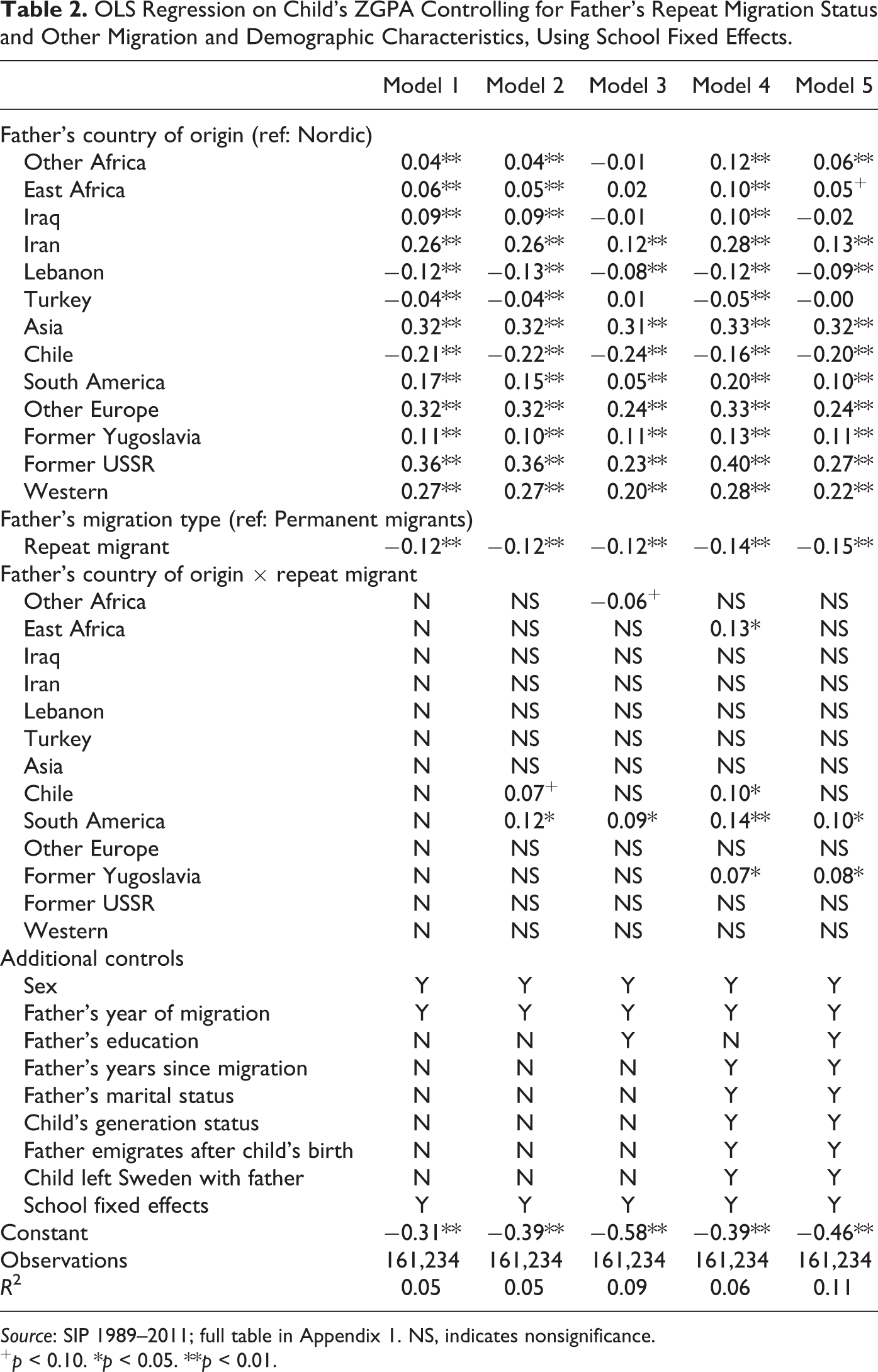
Source: SIP 1989–2011; full table in Appendix 1. NS, indicates nonsignificance.
+p < 0.10. *p < 0.05. **p < 0.01.
Model 3 expands on the specification in Model 2 to control for father’s educational level. Model 4 adds father’s demographic characteristics (years since migration and marital status), the presence of a native-born mother (denoted generation status), and birth timing to the controls in Model 2. We introduce these additional control variables to the specification in Model 2 in order to test whether the negative association of repeat migration is mediated through other paternal characteristics. In both specifications, however, this negative association of repeat migration on the educational performance of children remains unchanged. This indicates that the influence of repeat migration on school performance seems to be independent of other factors that one may expect to mediate the pathway.
Model 5 includes the full set of control variables, and the estimates from the previous models remain largely unchanged. Children with Nordic parents (base category) who repeat migrated obtain standardized GPAs that are 15 percent of a standard deviation lower than permanent migrants. This association is similar for most of the fathers’ country of origin; however, there are certain groups that display diverging effects. Two interesting groups in particular, the children of repeat migrants from South America and the former Yugoslavia face no additional penalty compared to those of permanent migrants. The interaction effects for these two groups largely counteract any penalty associated with having a father that repeat migrates. Among the immigrant groups analyzed in this study, South American immigrants come from the furthest geographical distance from Sweden. This may be an indication that the constraints, fiscal and psycho-social costs, of repeat migrating impose a selection effect into which individuals have the means to perform multiple migrations. In particular, the negative average association of repeat migration may be offset by the characteristics that allowed these individuals to perform repeat migrations to and from Sweden (Klinthäll 2003). Unfortunately, it is impossible to test this potential mechanism with the data available. Next, as an attempt to measure selection, integration, and father’s absence effects, we estimate the effect of time spent abroad on children’s grade point averages for the sample of children of repeat migrants.
Figure 2 compares the relationship between father’s time abroad and child’s grade point average stratified by whether the father repeat migrated before or after the child was born. 2 Two distinct patterns emerge based on the timing of the repeat migration. Among those whose fathers repeat migrated after the individual was born, the more time the father spent abroad seems to have a positive effect on the grade point average of the child, while those who left Sweden with their fathers seem to incur a lesser penalty. Specifically, children whose fathers spent less than a year abroad before returning to Sweden experienced a penalty of 36 percent of a standard deviation, while children whose parents spent four years abroad experienced a penalty of roughly 16 percent, a statistically significant difference at the 5 percent level. This is unexpected as incorporation theory predicts a negative relationship between father’s time away from the host country and children’s academic success.

Predicted zGPA of Second-generation Children Based on Father’s Time Spent Abroad, Controlling for Sex, and Father’s Migration Characteristics, 1989–2011.
We argue that this result depicts the selection effects discussed above. Among those with children, the most transient groups — the migrants that repeat migrate quickly — may represent the most negatively selected population. This may be a group that failed to integrate or obtain employment in the secondary destination or the home country, and immediately repeat migrated to Sweden. The repeat migrants who had a child prior to leaving and spent longer abroad may be the most positively selected repeat migrants, because they were able to live in the secondary destination for an extended period. Returning to Sweden for them may be more due to choice rather than need. Also, efforts are taken to identify those families where the father and mother left, along with the child. The children of these families tend to outperform those whose mother, and the child, remained in Sweden, pointing to the detrimental effect of having an absentee parent in the household, even if it is for a short period of time. Despite the relatively high performance of those who remain abroad for longer periods of time, the children perform significantly worse than those who completed the repeat migration prior to the child’s birth.
Those whose fathers repeat migrated prior to the child’s birth display a neutral relationship between time abroad and child’s zGPA, ranging between 14 percent and 8 percent of a standard deviation below the mean. This is statistically significantly lower than the 5 percent penalty found among those families whose fathers permanently migrate. At face value, this neutral relationship between father’s time abroad and children’s educational performance would suggest this group is not penalized for additional time out of the country, contrary to what incorporation theory would expect. However, further analysis reveals an interesting relationship between child’s standardized GPA when father’s time in Sweden is split into time before and after repeat migration (Appendix 2). Although father’s time in Sweden prior to emigration has a neutral effect on child’s GPA, time in Sweden after remigration has a significant and positive effect. This indicates repeat immigrants use their time more efficiently following the repeat migration, suggesting a developed or renewed interest in integrating into the host society.
Discussion and Conclusion
There appears to be a negative association between having a father who repeat migrates and a child’s academic performance. Possible explanations for this negative relationship include delayed integration and negative selection. Father’s migration characteristics, capturing family integration, and education levels, loosely capturing the selection process among those who return and repeat migrate, are included in the analysis, but do not account for the low performance of those children with fathers who repeat migrate.
As a way to further investigate this negative association, we compared results of father’s years spent abroad on child’s GPA by the timing of the father’s migration. Among those born prior to father leaving and returning, time spent away from Sweden seems to have a curvilinear effect on children’s academic performance, with initial impacts being ameliorated as time away increases. This result is the opposite of what is expected from incorporation theory and may reflect issues of selectivity. Those who leave and come back quickly may do so because of difficulties in both locations, while those who remain away for longer periods of time may have more success abroad, and are instead exercising preference in their return choice. There also appears to be a change in the relationship between father’s time in Sweden and the child’s zGPA among those who repeat migrate prior to the child’s birth. Whereas there is no association with time spent in Sweden before leaving, there is a significant positive association following the return to Sweden.
Following the framework set forth by Rooth and Saarela (2007), the initial selection of immigrants directly impacts the selection into return migration. Among labor migrants, there does appear to be a negative selection into being a repeat migrant with intergenerational consequences. However, there may be distinct selection effects among those with refugee backgrounds dependent on whether individuals came from countries that experienced an improvement in conditions or those that did not (Westin 2003; Bengtsson, Lundh, and Scott 2005). This may explain why children of fathers who are repeat immigrants from South America and Yugoslavia experience smaller penalties relative to the reference group. The improved home context could draw both those successful and less successful refugees to return to South America and the former Yugoslavia, respectively, which is in line with previous findings on repeat migration. Although we imagine repeat migration is done in response to less than satisfactory economic or social conditions, individuals who return after finding success in Sweden may have a higher threshold for defining success after leaving Sweden, compelling them to return. Conversely, those who have experienced success in Sweden may be less enthusiastic to return to those countries in which the economic or social conditions have not improved, leading to the possibility of a negative selection. From this, it seems the pool of repeat migrants among those from the countries who experienced more economic and social development will be more diverse and include a greater proportion of more successful individuals.
Whether the more neutral relationship between father’s migration status and child’s educational performance among refugees from South America and the former Yugoslavia is the result of a less negative selection into leaving Sweden or some positive selection into repeat migration is difficult to ascertain. Drawing on the findings of Erman and Härkönen (2017), who observe that the negative relationship between parental separation and children’s educational performance is tempered among those groups with higher rates of parental separation, a similar phenomenon may be occurring with respect to repeat migration. South American, and to a lesser extent Chilean, fathers display relatively high rates of repeat migration, particularly in light of the distance between origin and destination, indicating that this is a relatively more common behavior and, therefore, potentially less detrimental to the child’s academic performance.
The potential role of incorporation, or the lack thereof, in father’s repeat migration status having a negative effect on child’s educational performance is less clear. In the primary analysis, father’s migration characteristics and educational attainment did not mediate the relationship between repeat migration status and child’s educational performance. Further, in the secondary analysis, the expected negative relationship between father’s years abroad and educational performance is not found. However, an interesting pattern emerges among those whose fathers complete a repeat migration prior to having a child in which the time after returning to Sweden has a more positive effect than time before leaving, suggesting these individuals either develop or renew their process of accruing country-specific knowledge and quickening their pace of integration. Unfortunately, we lack the data to investigate whether immigrant father’s used their time in Sweden to pursue pathways to incorporation or not that would be necessary to untangle whether those who left did so in accordance with a preset expectations, in which case they may not have taken steps to accrue country-specific knowledge, or due to an unsatisfied economic or social life within Sweden.
Father’s absence from Sweden can also be a manifest itself through poor educational performance resulting from an absentee parent during the child’s upbringing, at least in the case of those emigrating after the birth of a child. While this is a possible mechanism, our results suggest otherwise. We find an inverse U-shaped relationship between time spent abroad and children’s educational performance in those families in which the father repeat migrates after the child’s birth. Those with the shortest time abroad after childbirth have the largest negative effects, and these effects taper off with time out of the country. Those with longer periods abroad also display negative effects, but these numbers are smaller in our sample, and therefore, precision is compromised. As one would expect the duration of father’s absenteeism to be increasingly detrimental to his children’s educational performance, these results suggest a more complex relationship is at play. While we cannot exclude the role of fathers’ absence as an important factor, there may be a nuanced interaction between selection and father’s absence.
The issue of transnationalism is not directly addressed in the empirical analysis largely due to our inability to accurately identify transnational behavior in the data. The way repeat migration is defined, however, gives us the best possible distinction between repeat migrants and circular migrants, who are those individuals that can be assumed to maintain the closest transnational ties. In our case, we are less concerned that we are capturing the dynamics of transnationalism simply because the individuals identified are engaging in acts of migration that may be categorized as corrective moves (Aradhya, Scott, and Smith 2017). Furthermore, the way Swedish register data record migration, the moves must have been made with some level of permanency of intent. As a result, these are not simply short-term visits to the home country.
Limitations
Although we are able to make use of unique data that allows us to track detailed migration histories of immigrant populations, there are a few limitations that must be acknowledged. One of the major limitations of the study is that we are unable to account for the outcomes of individuals in the secondary destinations. Having such information would allow us to more accurately identify the mechanisms that drive repeat migration and subsequently the educational outcomes of their children. Nonetheless, the results allow us to hypothesize the potential mechanisms that can be tested when this type of data becomes available. While these limitations are important to address, we do not feel that they threaten the validity of our findings. Rather, they present further research avenues that should be addressed when considering the intergenerational integration process of immigrant populations.
While this research focuses primarily on father’s migration habits, we also investigated whether the relationship was replicated with the mother, and no difference in the results was observed. 3 We have additionally investigated the potential effect of father’s citizenship, and the results remain consistent. Finally, the register data provide information on country of destination and country of origin, and for the majority of all country groups, this involves arriving and departing from their birth country. However, several groups have roughly 10 to 20 percent of individuals who report an “Unknown” destination or origin, making it difficult to discuss the consequences of this variable.
To check for nonlinearity in the association between father’s repeat migration status and grades, we estimated a series of quantile regressions at the 25th, 50th, and 75th percentiles using the Model 5 specifications with results from a standard OLS estimation. There is no statistically significant difference between the results obtained at any of the quantiles examined and OLS regression for the association between father’s repeat migration and children’s grades. Although the association is stronger among the lowest performers (25th percentile), the results and conclusion are not unduly influenced by issues of nonlinearity.
This study represents an advancement in our understanding of the dynamics of immigration, immigrant integration, and how these can have long-lasting intergenerational effects for both the immigrant and second-generation children. Further investigation into this topic is required to understand the respective roles of incorporation and selection in explaining this negative effect of repeat migration. Additionally, although children’s grade point average is analyzed here, other outcomes among the immigrant population themselves, as well as among their children, may reveal a more complete picture as to the effect of repeat migration.
Footnotes
Appendix
Registry and Analytical Country of Origin Groups.

| Analytical Countries | SCB Countries |
|---|---|
| Sweden | Sweden |
| Other Africa | Africa |
| East Africa | Ethiopia |
| Eritrea | |
| Somalia | |
| Iraq | Iraq |
| Iran | Iran |
| Lebanon | Lebanon |
| Turkey | Turkey |
| Other Asia | Asia |
| Thailand | |
| Vietnam | |
| Chile | Chile |
| South America | Other South America/Central America |
| Other Europe | Europe outside EU 27 and Nordic countries |
| Slovakia | |
| Czech republic | |
| Czechoslovakia | |
| Former Yugoslavia | Bosnia-Herzegovina |
| Yugoslavia | |
| Macedonia | |
| Montenegro | |
| Serbia | |
| Slovenia | |
| Former USSR | Soviet Union |
| Poland | |
| Western | EU 27 outside Nordic countries |
| Greece | |
| Italy | |
| Norway | |
| North America (includes Mexico) | |
| Germany | |
| Oceania | |
| USA | |
| Nordic | Denmark |
| Finland | |
| Nordic countries outside Sweden |
Authors’ Note
A previous version of this paper was presented at the Annual Meeting of the Population Association of America 2016, Washington, DC.
Declaration of Conflicting Interests
The author(s) declared no potential conflicts of interest with respect to the research, authorship, and/or publication of this article.
Funding
The author(s) disclosed receipt of the following financial support for the research, authorship, and/or publication of this article: The authors gratefully acknowledge funding from Forte - The Swedish Research Council for Health, Working Life and Welfare (project number 2012–1367).