



Abstract
This article examines the labor-market impact of opening borders to low-wage countries, exploiting time and regional variation provided by the 2004 EU enlargement in combination with transport links to Sweden from new member states. Results suggest an adverse impact on earnings of present workers in the order of 1 percent in areas close to pre-existing ferry lines. Effects are present in most segments of the labor market but tend to be greater in groups with weaker positions. The impact is also clearer in industries that have received more workers from new member states and for which cross-border work is likely to be more common. There is no robust evidence for an impact on employment or wages. We discuss the potential mechanisms driving these results.
1. Introduction
A central dimension of discussions concerning immigration policy involves the consequences of opening borders to low-wage countries and the resulting labor-market competition for present workers (e.g., OECD 2016). This issue is at the heart of the debate on the EU enlargement and relates to U.S. and European strategies for handling immigration pressure on their southern borders (e.g., Kahanec, Zaiceva, and Zimmermann 2010; Hollifield, Martin, and Orrenius 2014). This article investigates the labor-market impact of immigration reform that leads to increased exposure to workers and firms from countries with relatively lower wages and levels of economic development. 1
The broader question under study here is whether the labor-market outcomes of present workers are affected by changes in market conditions brought on by EU enlargement. To address this question, we exploit variation provided by the 2004 EU enlargement, in combination with pre-existing ferry lines between Sweden and new member states. 2 Focusing on harbor regions and ferry lines brings the methodological advantage of defining treatment and control groups but is also relevant since ferries are important transportation modes across borders in the Baltic area. Since the regions of new member states served by these ferry lines are highly populated, the market exposure and potential immigration flow to Sweden were substantial (see section 4). Because it is very difficult to derive plausible estimates of immigration’s impact on the national workforce following a change at the national level, our strategy is instead to investigate whether those who were likely to be more exposed to increased competition and other changes fared differently than those who were less exposed to the reform’s intermediate consequences. We use proximity to transport opportunities as an indication of potential exposure.
Opening a border may affect the labor market of present workers through a number of mechanisms: (i) the number of migrant workers (permanent, temporary, posted, 3 or irregular), (ii) overall economic activity (investments, firm location decisions, passenger and commercial transportation, or tourism), (iii) the trade of goods and services and foreign direct investments, and (iv) the bargaining power of employers and unions through potential competition. Because some of these mechanisms are hard, if not impossible, to capture in data, our focus is on the total impact of being closer to the opened border. 4 However, we present several pieces of evidence illuminating the role of different channels. We also discuss previous evidence on the respective mechanisms in the literature review below.
Using longitudinal population-wide micro data, we find that present workers’ earnings decreased by about 1 percentage point in regions close to the ferry lines after the reform, compared to regions somewhat further from the ports. The result is robust to a number of specification tests and robustness checks. Negative effects tend to be greater among the young and in the lower part of the expected earnings distribution. We also find the clearest impact in industries where the rise in EU8 workers has been most pronounced and where cross-border competition is likely to be particularly strong. We find no robust effects on employment or full-time wages.
As mentioned above, when analyzing the consequences of a border opening, there are many potential factors/mechanisms that could explain the results, factors that many times are hard to observe and separate from one another. It should also be noted that we capture net effects of possibly opposing forces. However, our findings give some indications of the mechanisms that can explain our findings. The 2004 EU expansion led to a drastic increase in permanent and temporary migrants from new member states in southern Sweden (see description in section 4.2). While the fraction of immigrants from new member states was higher in regions close to the transport opportunities before enlargement, there is essentially no evidence that there was an increased clustering as a result of the reform. Thus, differential shocks in registered immigration are unlikely to explain the findings.
Statistics on travel, trade, and investments reveal a strong increase in exchanges between Sweden and new member states (SIKA 2001–2009; OECD Online Statistical Database 2017). Although figures are typically not available at the regional level used in this analysis, people and goods, at the very least, pass through Swedish regions with harbors serving Poland and the Baltic states. Several of our empirical observations are consistent with a situation where posted/undocumented migrants compete for low-skill jobs close to the transport nodes: (i) estimated effects are strongest in the lowest quartile of the predicted earnings distribution; (ii) point estimates tend to be greater in absolute terms in business services, hotels, and restaurants (generally hiring many migrant workers); and (iii) the effects fade out rapidly as we move away from the harbors. Other estimates of the Enlargement’s effects suggest that firms’ cross-border competition may be a mechanism (e.g., large effects are found in the transport sector) that influence our findings.
The rest of the article is organized as follows. Section 2 discusses the earlier literature related to the economic impact of opening borders, the institutional background on the debate preceding the 2004 EU enlargement, the recent history of immigration to Sweden, and the experiences of foreign-born workers in the Swedish labor market. Section 3 describes the empirical strategy and data sources. Section 4 outlines the potential mechanisms at work and describes the characteristics and development of permanent and temporary migration and other key variables. Section 5 presents our empirical results, and section 6 concludes.
2. Related Literature and Institutional Background
The Introduction gave examples of potential channels for the economic and labor-market effects of opening borders. Mechanism (i) — the labor-market consequences of the inflow of migrant workers with certain characteristics — has been the topic of a rapidly expanding literature in recent decades (see overviews by Longhi, Nijkamp, and Poot 2005; Kerr and Kerr 2011). There is no consensus, however, on the presence or magnitude of detrimental effects on native and already-present migrant workers, and there is an ongoing debate on how to best measure these effects (e.g., Dustmann, Schoenberg, and Stuhler 2016).
While some studies conclude that immigration’s impact is probably limited (e.g., Card 2005) or argue that the native population could actually gain from immigration in the long run (e.g., Ottaviano and Peri 2012), other relatively recent studies conclude that immigration poses significant harm to natives’ labor-market prospects (Borjas 2003; Borjas, Grogger, and Hanson 2008). There is also recent Scandinavian evidence pointing toward negative wage effects from immigration; Bratsberg and Raaum (2012), for example, show slower wage growth for occupations more exposed to immigration than for other occupations within the construction industry.
Several studies suggest that the adverse labor-market impact for present workers is more pronounced for low-educated workers and previous migrants, who are closer substitutes to the current immigration flows seen in Europe (Kerr and Kerr 2011). Heterogeneous impacts are also the result in Dustmann, Frattini, and Preston (2013), who find that immigration depresses wages at lower parts of the wage distribution but slightly increases them in the upper part. Similarly, D’Amuri, Ottaviano, and Peri (2010) find little impact on native wages from immigration in Germany during the 1990s but a substantial adverse effect on immigrant employment. Dustmann, Schoenberg, and Stuhler (2017) exploit a commuting policy increasing the presence of Czech workers in areas close to the German-Czech border and find a large negative employment effect primarily for older workers and operating through decreased inflows to employment. Furthermore, Bratsberg et al. (2014) find that immigration’s wage impact depends on the inflow’s region of origin, with greater influence for workers from neighboring countries who are likely to be closer substitutes for native workers.
Studies focusing on EU enlargement provide limited evidence on adverse effects (and many such studies are descriptive). 5 Some UK studies point in the direction of small or insignificant effects on native labor-market outcomes (Portes and French 2005; Gilpin et al. 2006; Lemos and Portes 2008; Reed and LaTorre 2009), while Elsner (2013) finds that for Lithuania, a new member state, wages rose for those who stayed in the sending country.
As for overall economic activity, trade, and investments (the mechanisms mentioned as [ii] and [iii] in the Introduction), regions closer to new markets may benefit from increased economic activity resulting from the opened borders, and proximity could affect location decisions of firms (see Niebuhr and Stiller [2006] for a survey). One example is the experience from the North American Free Trade Agreement, where Mexican manufacturing industry relocated toward the US border, in turn resulting in an increase in manufacturing employment in US border cities (see Hanson 1996, 1998, 2001). International trade is also likely to rise as trade barriers are removed. In this context, geographic proximity to the border could be of importance as trade often requires personal contacts between the seller and buyer, a cost that is likely to be lower for firms located close to the border (Braakmann and Vogel 2010).
On the other hand, the positive impact of increased activity on individual labor-market opportunities might be counteracted by increased competition in the products and services markets. Braakmann and Vogel (2010) studied the effects of EU enlargement in 2004 on German firms located close to the Polish border. They found a negative impact on the turnover and export intensity of large German firms and falling profits for smaller firms, despite an increase in the turnover following the enlargement. 6
Greater adjustments might be required to meet changing market conditions in border regions in comparison with more remote regions (Commission of the European Communities 2001), and increased competition by opening a border to a country with lower average wages may put pressure on native wages even though actual migration flows are not much affected (i.e., mechanism [iv]). A credible threat of finding services or labor abroad may be enough to influence employees’ bargaining power. Tentative evidence supporting this idea is found in Blanchflower and Shadforth (2009), who study the effects of EU enlargement on the UK economy. Such effects are also likely to be larger in local labor markets closer to the new competition.
2.1. EU Enlargement and Post-accession Migration Flows
The EU expansion on May 1, 2004, meant that 10 new states joined the European Union. The free movement of workers (as well as goods and services) between member states is a central feature of EU regulations. In the debate preceding the 2004 enlargement, however, fears of social dumping and the immigration of cheap labor from new member states brought a clause in the Accession Treaty in 2003 to limit this freedom. 7
The Swedish debate concerning the enlargement’s potential adverse effects contained the above-mentioned arguments and emphasized the risk of attracting welfare seekers (Doyle, Hughes, and Wadensjö 2006). Against this stood the argument that since Sweden had actively promoted enlargement, it was not reasonable to implement restrictions. In the end, failing to reach an agreement on how to construct transitional arrangements, Sweden was one of only three countries which did not implement any such restrictions (together with the United Kingdom and Ireland). 8
As expected, the migration flow from new member states increased after the enlargement (Kahanec, Zaiceva, and Zimmermann 2010). The fears of mass immigration, however, did not materialize, and consequently most member states relaxed or abolished their transitional rules before compulsory abolishment in 2011. 9 A feature of the more recent intra-EU migration is that temporary migration has risen (Blanchflower and Lawton 2010). It has also become more common to post workers in other member states (Commission of the European Communities 2008; Dolvik and Eldring 2008), and the presence of foreign firms in other member states has grown (see section 4.3).
2.2. Immigration to Sweden and the Foreign Born in the Swedish Labor Market
This section briefly sketches the recent immigration history to Sweden, with a particular focus on migration from EU8 countries. In Sweden, the period from the Second World War to the late 1970s was dominated by labor migration from Finland and Central and Southern Europe. Starting in the 1970s, however, there was a gradual shift toward immigration of humanitarian character (see Bystrom and Frohnert 2013). Official statistics show that since the late 1980s, refugee migration and family reunification have been the predominant forms of migration to Sweden, although labor migration has remained nontrivial. Over the last four decades, Sweden’s foreign-born population has been growing steadily, from 6.7 percent of the total population in 1970 to 18.5 percent in 2017 (Statistics Sweden 2018). Parallel to the compositional change of migrants to Sweden, the relative labor-market performance of the foreign-born has deteriorated. Sweden is now one of the OECD countries with the highest relative foreign-born to native unemployment rates. 10
In the post-WWII period, political turmoil in EU8 countries caused small waves of refugees to Sweden from Hungary (1956–1957), the former Czechoslovakia (1968–1969), and Poland (1982). Migration from the Baltic States was very limited until the Soviet Union’s collapse in the early 1990s. The inflow of migrants from new member states increased somewhat after the fall of the Soviet Union but remained at relatively low levels until the EU enlargement. In section 4, we discuss migration trends since the enlargement.
3. Data Sources
Our main data come from administrative registers held by Statistics Sweden (SCB). All registers are linked by an anonymized personal identification number. The data we use cover the total population aged 16–64 years old for each year from 1994 to 2008 in southern Sweden (counties of Skåne, Blekinge, Halland, Kronoberg, and Kalmar) — regions either served by ferry lines to Poland or the Baltic states or close to the harbor regions.
The data contain information on age, gender, marital status, children, education, country/region of birth, immigration year, employment status, earnings, and region of residence. There is also information on employment spells and earnings from different employers. Employer information includes industry and the geographical location of firms and their establishments. See Supplemental Table A1 (available in the online version of this article) for variable definitions.
The population-wide information on labor-market outcomes comes from tax registers. While these registers do not include wage information, they do contain wages (corresponding to full-time monthly) for all public-sector employees and for a sample covering about 50 percent of private-sector employees. The sample is stratified by firm size so that small firms are underrepresented. We use the wage data in a supplementary analysis.
The data analyzed here cover the entire population of people living in southern Sweden on a permanent basis. Some countries of birth are grouped for confidentiality reasons, but we are able to separately identify individuals from all new member states, except those from Slovenia, Malta, and Cyprus. This is likely to be a small concern as migrants from Slovenia, Malta, and Cyprus comprise less than 1 percent of the change in the total stock of migrants from new member states between 2004 and 2010 (Statistics Sweden 2018). The post-accession migration inflow is dominated by migrants from Poland and the Baltic States (see section 4).
For an immigrant to enter the “registered population” and be included in the data described above, the expected duration of stay (given work and residence permits) should be at least 12 months. Thus, temporary migrant workers with shorter work permits are typically not included in the registered population. To describe the increasing presence of temporary workers, we also use data on short-term migrant workers, taken from Statistics Sweden.
The primary data source for information on temporary migrants is a tax register that includes tax payments of persons that pay Special Income Tax for Non-residents (Särskild inkomstskatt för utomlands bosatta). All persons who stay in Sweden less than six months are entitled to pay lower taxes than permanent residents. The administrative records include data on gender, age, nationality, income, and employers. Our data also include information on persons that do not apply for the special income tax but stay no longer than six months, as well as persons that stay in Sweden longer than six months but less than a year. The dataset is combined with firm-level data managed by Statistics Sweden, which contains firms’ geographical locations, industry type, sector, and number of employees. The dataset’s quality is in some dimensions poor, with limited coverage of workers’ origins, but is useful for describing the change in migrant characteristics that followed the enlargement.
For descriptive purposes, we make use of travel statistics from the Swedish Institute for Transport and Communications Analysis (SIKA). These statistics contain information on passengers arriving to Sweden and are used to show how travel patterns between new member states and Sweden changed after the 2004 enlargement. Some of these data are available for individual ports. Trade statistics from the OECD are also used to illustrate the trade flow during the studied period. The data, however, are only available at the national level and, thus, cannot be used to explore whether the enlargement had a differential impact across regions.
4. The Studied Regions and Developments since the Enlargement
There are, of course, many ways to travel from EU8 countries to Sweden. To avoid endogeneity and selection problems, we restrict our analysis to pre-existing transportation links. Since air routes are arguably more mobile, we focus on ferry lines, which change less frequently. Furthermore, we exclude ferry lines to the Stockholm region, for which it is very hard to find a suitable comparison region. These restrictions leave us with ferry lines to four municipalities in southern Sweden: Karlskrona and Karlshamn located in the county of Blekinge and Ystad and Trelleborg in the county of Skåne (Figure 1). We also restrict the dataset to Södra Götaland (south of the white areas in Figure 1).

The Treated Regions.
The ferry passenger lines include the one between Ystad in Sweden and Świnoujście in Poland, which has been in place since at least the 1960s (Figure 2). Traffic from Trelleborg, situated close to Ystad, is more orientated toward Germany, with passenger lines to various destinations, including Sassnitz located close to the Polish border. Traffic directly to Poland from Trelleborg has been more periodic, with direct lines serving Świnoujście. In the Swedish county of Blekinge, the ferry line between Karlskrona and the Polish port city of Gdynia has carried passengers during the last decades while ferry lines from Karlshamn primarily serve other destinations in the Baltic countries.
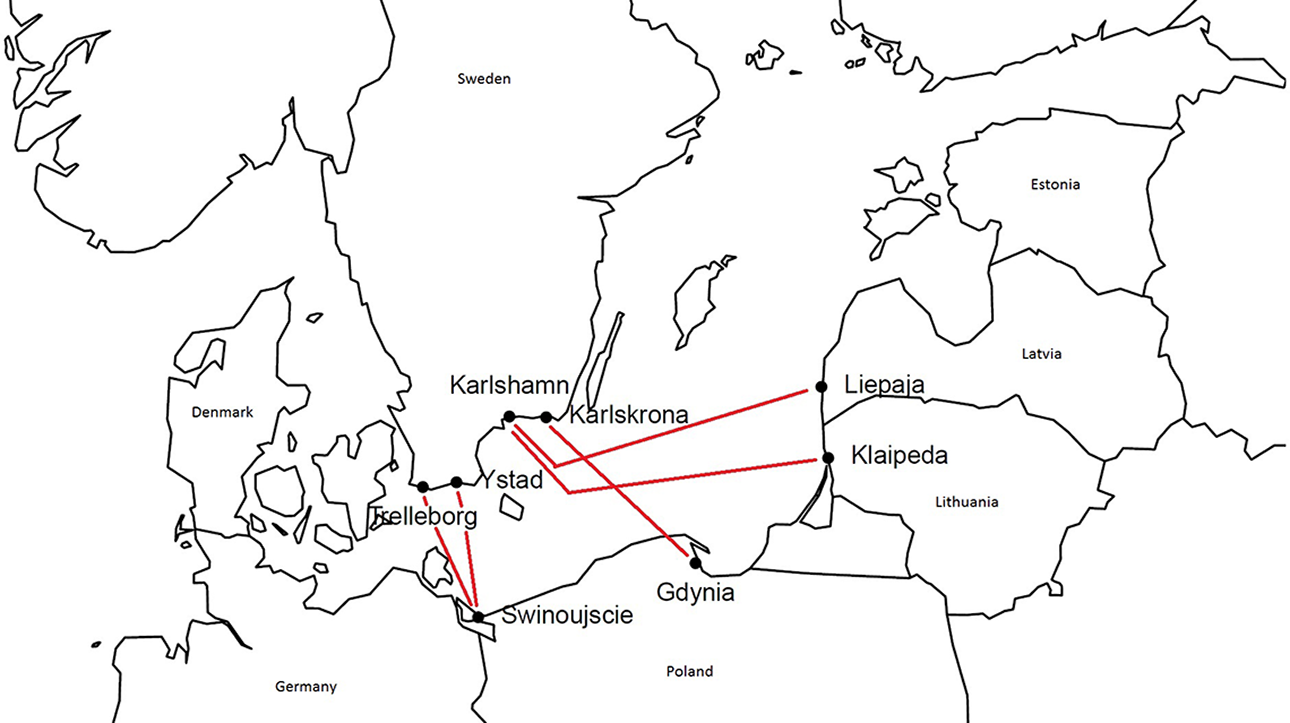
Ferry Lines of Interest in the Baltic Sea.
These ferry lines to/from Poland and the Baltics serve regions that have a relatively high population density in comparison to the Swedish destinations. For example, the Pomeranian Voivodship, the Polish region in which Gdynia is located, had around 2.3 million residents in 2017 (Statistics Poland 2017). The West Pomeranian Voivodship that includes Świnoujście had 1.7 million residents the same year (Statistics Poland 2017). Compare these figures to the populations of Skåne (1.345 million) and Blekinge (159,000) in Sweden. With regards to destinations in the Baltics, both Klaipeida and Liepaja are located in regions with a population that is at least 1.5 times as large as the one in Blekinge (Statistics Latvia 2018; Statistics Lithuania 2018). Thus, it should be clear that the EU8 catchment areas for ferry lines coming to Sweden are large in terms of relative population.
Our baseline analysis uses 50 kilometers (km) as the divider. Municipalities whose center is within this distance from a ferry line harbor are assumed to be affected by the enlargement (our treatment group), areas further away (but in the Södra Götaland region) are used as a control group (i.e., we assume the municipalities further away than 50 km are not affected in the same way). The choice of 50 km to define treated and control areas is somewhat arbitrary. We show, however, that 50 km appears to be a reasonable choice: effects are present within this area but fade rapidly outside it, although estimates also show that the effects (a 25 km delineation) tend to be greater the closer one gets to the port. We discuss several variations and robustness checks defining the control group in different ways. Overall, the results are robust to these variations.
4.1. Estimation Sample and Pre-treatment Characteristics
Our baseline estimation sample consists of individuals born outside the EU8 countries (i.e., native Swedes and other foreign born), 16–64 years old, and living in Södra Götaland (the counties of Skåne, Blekinge, Halland, Kalmar, and Kronoberg). We draw repeated cross-sections for the years 2000 to 2008, imposing these restrictions annually. For reasons discussed below, we only exploit the data’s individual panel aspects in a robustness check.
The first column of Table 1 describes the sample. Average age is close to 40, about 40 percent have children living at home, and a slightly higher fraction are married. A quarter of individuals have less than a high school education, whereas approximately 30 percent have some tertiary education. The employment rate is 71 percent, and annual earnings were on average 176,000 SEK (Swedish krona) during the period. The industry structure contains no big surprises: many people are employed in manufacturing, wholesale and retail trade, health, and education.
Estimation Sample Statistics.
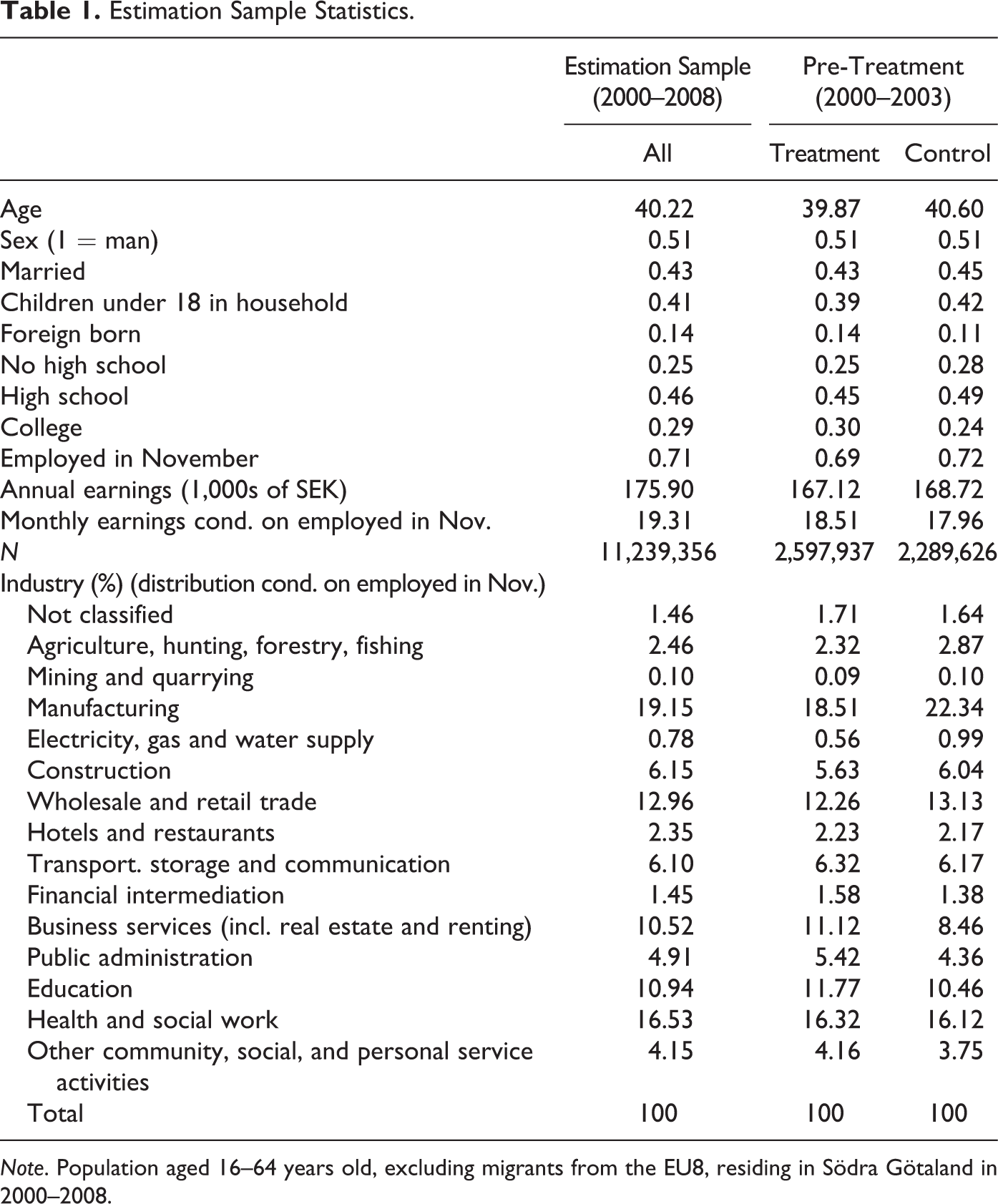
Note. Population aged 16–64 years old, excluding migrants from the EU8, residing in Södra Götaland in 2000–2008.
Our analysis hinges on the assumption that had the treatment and control regions been subject to the same shock, the development would have been the same. We discuss and test this assumption’s plausibility below. A starting point is to see whether the regions are similar in important dimensions. Columns 2 and 3 of Table 1 present characteristics for the baseline (50 km) treatment and control areas in the years prior to the EU enlargement. The demographic characteristics of the treatment and control areas are rather similar for age, gender, marital, and family characteristics, with a slightly higher level of education in the control group. The biggest difference is seen in the percent foreign born, which is higher in the treatment group, which includes Malmö, the region’s largest and most immigrant-dense city. 11 Individual economic outcomes are also quite similar across locations, although the employment rate is a bit higher in the control areas. While there are some differences, industry structure is rather similar in the two groups. In other words, it does not seem as if near-harbor areas are very different from neighboring areas somewhat more distant from the transportation nodes.
4.2. Permanent and Temporary Migration from EU8 Countries
Following the 2004 enlargement, Södra Götaland experienced a rather rapid increase in the presence of permanent migrants from EU8 countries. After increasing only slightly since 2000, the number of EU8 migrants (age 16–64) living in this part of Sweden rose from 19,000 in 2003 to more than 25,000 in 2008. 12 Still, this group of migrants constitutes only a limited part of the population, with the fraction going from 1.5 to slightly more than 1.9 percent. In absolute terms, people of Polish origin constitute the majority of permanent migrants from EU8 countries, but in relative terms there have been substantial increases in the number of migrants from the Baltic countries. Those that arrived after enlargement are younger, to a larger extent male, and have less schooling than migrants that arrived prior to the enlargement (see Supplemental Table A2, available in the online version of this article). Furthermore, in comparison with earlier cohorts, post-enlargement migrants were much more frequently represented in the agricultural sector; construction sector; and within real estate, renting, and business activities and underrepresented in the health and social work sectors.
As an indication of increased labor-market competition, temporary labor migrants are of particular interest. Statistics for EU8 nationals among temporary workers from 2000 to 2008 show that the number of migrants has increased over time, starting before the EU expansion, but at an increased pace following the accession (see Supplemental Table A3, available in the online version of this article). 13 An increasing majority of workers are males and, on average, around 30 years of age. After 2004, temporary workers on average have higher earnings both in total and from their main employer. The fact that average total earnings are only slightly higher than the average earnings from the main employer suggests that most workers have only one employer. In other words, there is an increased presence of labor from new member states, both in terms of individuals and in terms of effective labor.
The distribution across industries has also changed significantly (see lower panel of Supplemental Table A3). Before 2004, most temporary workers from EU8 countries were found in the agricultural sector. Short-term contracts for these workers have for a long time been an established part of agricultural production, especially in southern Sweden (Wadensjö 2015). As the Swedish labor market became generally available for new member states, the share of temporary workers working in agriculture decreased, even though the absolute number increased somewhat. Supplemental Table A3 reveals substantial increases in temporary migrants in construction, business services, and wholesale and retail trade, a pattern also found for permanent migrants.
In terms of our identification strategy, how different demographic groups are located relative to the ferry lines is relevant. Figure 3 shows the inflow of EU8 permanent and temporary migrants relative to the ferry ports. There was a clear increase following 2004, but it seems to be very similar close to and somewhat further from the harbors. 14 Thus, while EU8 migrants in southern Sweden were more concentrated within the 50 km limit both before and after enlargement (statistics not in figure), these regions did not experience a substantially larger immigration shock following enlargement.
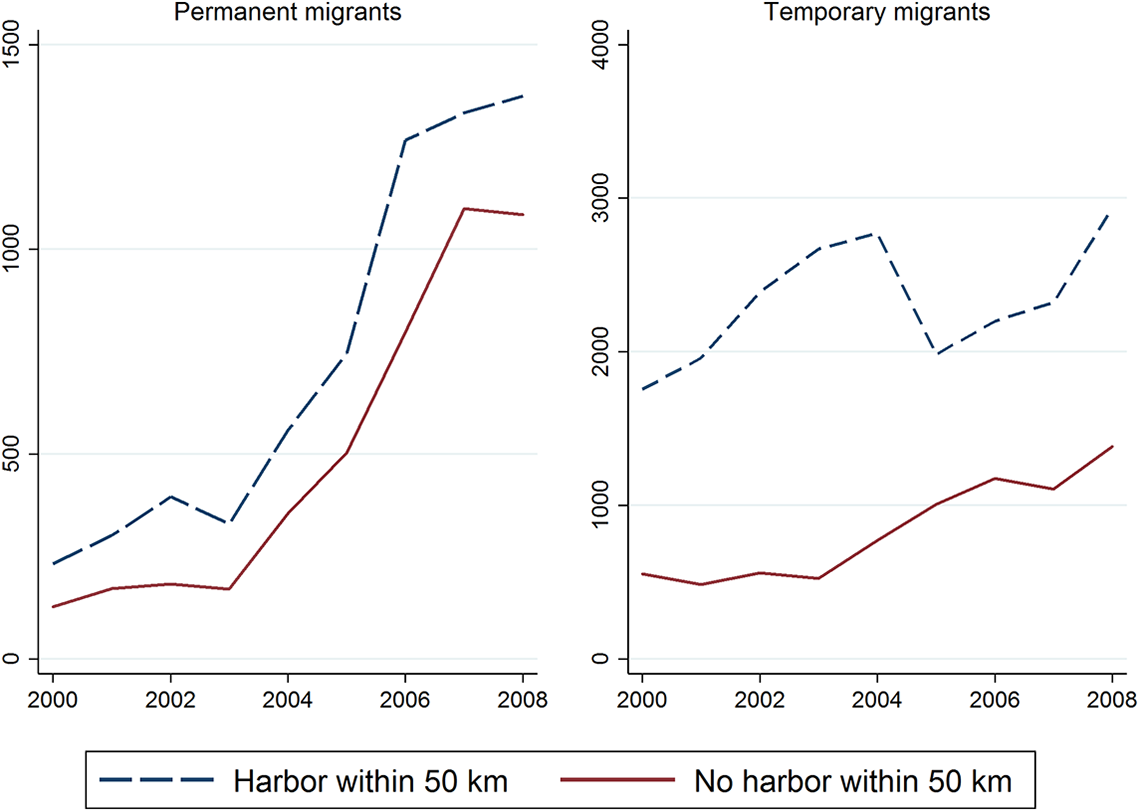
Immigration to Sweden from New Member States.
Passenger traffic statistics provide another indication of the harbor regions’ possibly increased relative exposure. The number of passengers arriving by ferry from Poland, Estonia, Latvia, and Lithuania to Sweden increased substantially after enlargement (SIKA 2001–2009). In absolute numbers, the largest increase in the number of travelers was from Poland and Estonia. In relative terms the increase was larger for passengers from Latvia and Lithuania. By contrast, passenger ferry traffic from other countries (Denmark, Finland, Germany, and the United Kingdom) did not change much during the period (SIKA 2001–2009). Also worth noting is survey evidence collected by IBIS (2011) that indicates that by far the most common mode of transport to Sweden for Polish visitors is by ferry.
The opening of the border toward new member states might also have affected trade flows between Sweden and new member states. Trade with new member states (in terms of both imports and exports of goods and services) increased strongly around the time of enlargement (Figure 4). The increase started prior to enlargement, which could be due to not only anticipation effects but also a general increase in international trade. Indeed, trade grew also between Sweden and EU15 (see the connected dashed red line in Figure 4). However, in relative terms, the growth was much greater for EU8 countries compared to EU15 countries. Statistics for volumes of goods in individual ports are messy but do in some cases suggest stronger increases in our treated areas than in other locations (statistics available upon request).
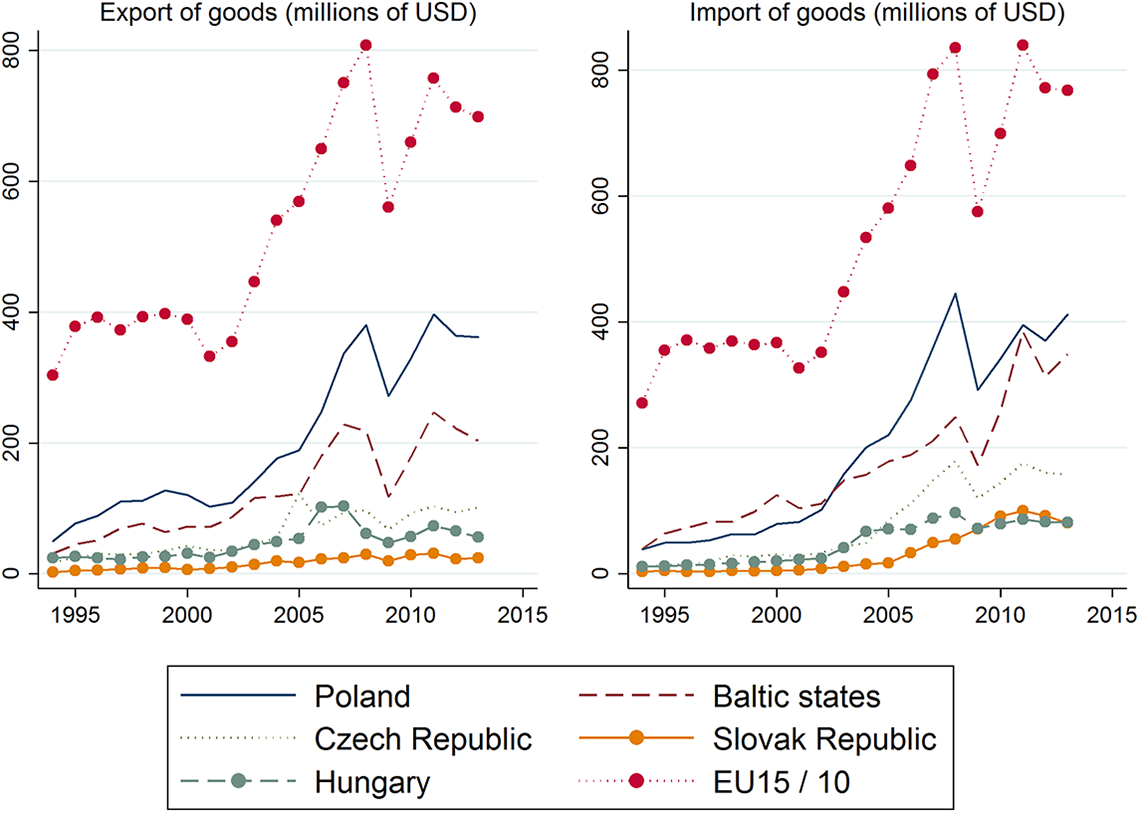
Trade Flows between Sweden and New Member States.
4.3. Summary and Interpretation of Descriptive Patterns
As shown above, the 2004 EU accession meant a greater overall inflow and presence of workers from EU8 countries to southern Sweden compared to previous years. What is not so clear from the data, however, is whether the increased immigration affected the harbor regions to a greater extent. The location patterns of permanent and registered temporary migrants do not indicate that this would be the case.
On the other hand, travel statistics show a very marked increase in the number of people going to and from new member states. Trade with new member states also increased sharply. It seems fair to argue, then, that the economic impact of such changes should be larger in the areas where the transport links are located. At the very least, we know that goods and people arrive at and pass through the treated areas, which could in itself affect economic activity and the labor market.
It should also again be emphasized that we do not have information on the presence of posted workers or irregular labor migration. Such workers are arguably more short term by nature, making it reasonable to expect travel costs to play a bigger role. Of course, one could also hypothesize that the threat effect of cross-border competition is bigger the closer one gets to the competing firms and workers. The importance of such mechanisms is, however, extremely hard to quantify.
In sum, then, whether the harbor regions were differentially affected by the EU expansion is an empirical question. Our comparison of the treated and control areas during the period prior to enlargement suggests that they fulfill reasonable requirements on similarity for the empirical analysis. The discussion above also highlights the fact that the 2004 enlargement did not come as a surprise. Indeed, statistics show an increase in economic activity and passenger traffic in the years before. The shock we exploit is thus the fact that the border was opened, rather than the knowledge that it would be one day.
5. Empirical Analysis
Our approach to investigating the impact of migration policy reform is to compare those who are likely more exposed to the effects of enlargement opening up national borders to those who are likely less affected. Our empirical model is essentially a difference-in-differences specification, comparing the development of labor-market outcomes in treated and control areas. Our baseline model has the following structure:

where yijt is the labor-market outcome (employment, log annual/monthly earnings, or log wage) of individual i in municipality j at time t. Xit is a vector of individual control variables (age, age squared, educational attainment, civil status, children in household, sex, and region of birth [native/foreign-born]), ∅ t is a vector of time fixed effects, and θ j is a set of municipality fixed effects. Djt is an indicator variable taking the value one in the treated regions after the 2004 EU expansion, zero otherwise. γ is thus the parameter of primary interest capturing the average difference in pre-post development across treatment and control areas. We also present results from models augmenting the specification above by linear/quadratic municipality-specific time trends. Throughout, we cluster the standard errors by municipality, allowing for dependence across individuals living in the same location (also in different years).
For our analysis to capture a causal parameter, it must be the case that had the treatment and control areas been exposed in the same way, we would expect to see the same development in both areas. This is by definition an identifying assumption that cannot be tested strictly. The above-described similarity in individual demographic and economic characteristics, as well as in industrial structure, could, however, be taken to indicate that this is a plausible assumption. In the presentation of results we discuss several variations lending credibility to our conclusions, including “placebo reforms” and specifications like individual fixed effects.
5.1. Baseline Results
Table 2 below presents the baseline results on employment and earnings. Column (i) uses specification (i) above, and columns (ii) and (iii) introduce linear and quadratic trends, respectively. To save space, we display only the estimates of primary interest (full results are available upon request).
Baseline Estimates — Employment and Earnings.
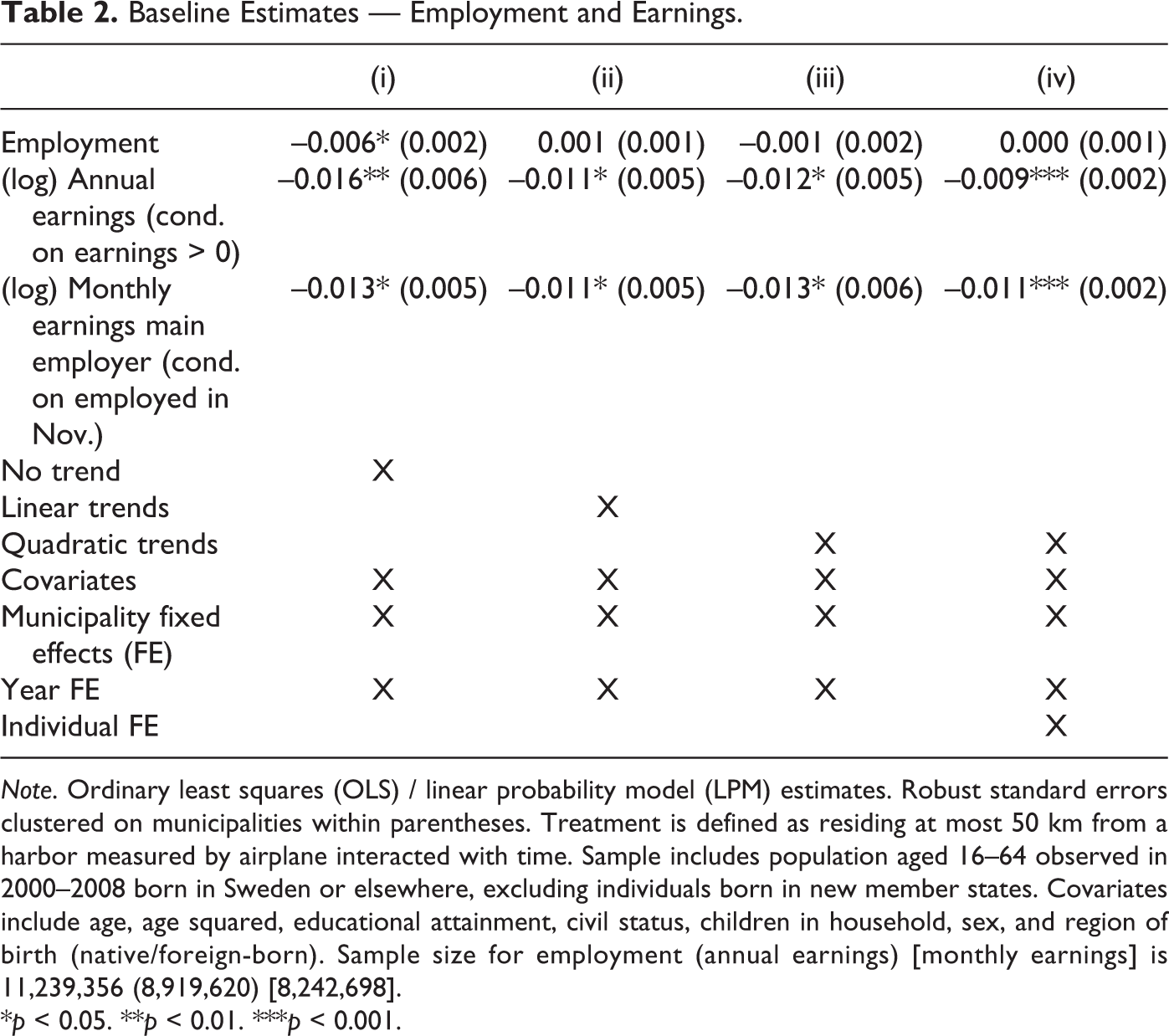
Note. Ordinary least squares (OLS) / linear probability model (LPM) estimates. Robust standard errors clustered on municipalities within parentheses. Treatment is defined as residing at most 50 km from a harbor measured by airplane interacted with time. Sample includes population aged 16–64 observed in 2000–2008 born in Sweden or elsewhere, excluding individuals born in new member states. Covariates include age, age squared, educational attainment, civil status, children in household, sex, and region of birth (native/foreign-born). Sample size for employment (annual earnings) [monthly earnings] is 11,239,356 (8,919,620) [8,242,698].
*p < 0.05. **p < 0.01. ***p < 0.001.
Starting with employment in the table’s upper part, column (i) suggests a small but statistically significant negative impact in the order of 0.6 percentage points on those living closer to the ferry ports in the years following enlargement. 15 This result, however, is sensitive toward the inclusion of municipality-specific trends; in columns (ii) and (iii) the point estimates are close to zero. There is thus no strong evidence that employment was at all affected.
The picture changes when we turn to annual earnings, where the quite-demanding specification (iii) suggests a significant negative impact in the order of 1 percent. The estimates from specifications (i) and (ii) are somewhat larger in absolute terms, but the overall impression is that the results are stable across specifications. The third outcome measure used in Table 2 is monthly earnings in the main employment spell covering the month of November. This measure is used because it reflects the individual’s position and connection to one employer at a time of year when seasonal work is less common. 16 The results for this outcome confirm the negative impact found for annual earnings.
Column (iv) further augments the specification by including individual fixed effects. The estimates are essentially unaffected, suggesting that conditional on the model’s other covariates, compositional changes are not driving the earnings effects. However, whether one conceptually wishes to include such changes is an open question. One could argue that if opening borders makes high-wage people leave employment to the same extent that low-wage people enter (so that employment rates are unaffected), it can still be considered an impact on earnings at the regional level.
As specification (iv) is quite demanding on the data, model (iii) is our preferred specification. Another reason for using specification (iii) is given by a “placebo analysis” using data for the years 1994 to 2002 (rather than 2000 to 2008) and “moving” the time for the reform to 1998 (Supplemental Table A4, available in the online version of this article). The idea is, of course, that a specification that handles the development over time well and does not find “effects” where there should be none has some credibility in also working well in the actual reform period. For annual and monthly earnings, the specifications using repeated cross-sections generate small and insignificant estimates. For employment, and for all outcomes using individual fixed effects, estimates tend to be positive and significant. Although this could be taken to suggest that we underestimate the true negative impact (due to pre-reform trends that were relatively more positive in the treated areas), we think that caution is warranted for models and outcomes where significant estimates unexpectedly appear.
In sum, the estimates suggest a modest but rather robust impact of being closer to the recently accessed countries. It should be stressed that this is not an estimate of the 2004 enlargement’s average impact on the Swedish labor market; it is the difference in the impact between locations close to and a little further away from the transport links. The overall impact may be positive or negative, or for that matter zero.
5.1.1. Wages
The border opening could influence the price of labor through an increased supply or a change in the bargaining power of the agents (see section 1). One could also, however, hypothesize that particularly in a labor market with high union coverage and collective bargaining, earnings could be influenced through a change in hours (i.e., if wages cannot be adjusted, employers diminish the work hours for permanent employees and make use of posted workers).
Table 3 presents estimates of wage impacts using the sample data described in section 3. We choose to report the results by sector (and worker category, where available), partly to get a more detailed picture and partly to reflect the differences in data coverage (recall that the public sector is fully covered but that data for the private sector are a stratified sample where larger firms are overrepresented).
Wage Effects by Sector.
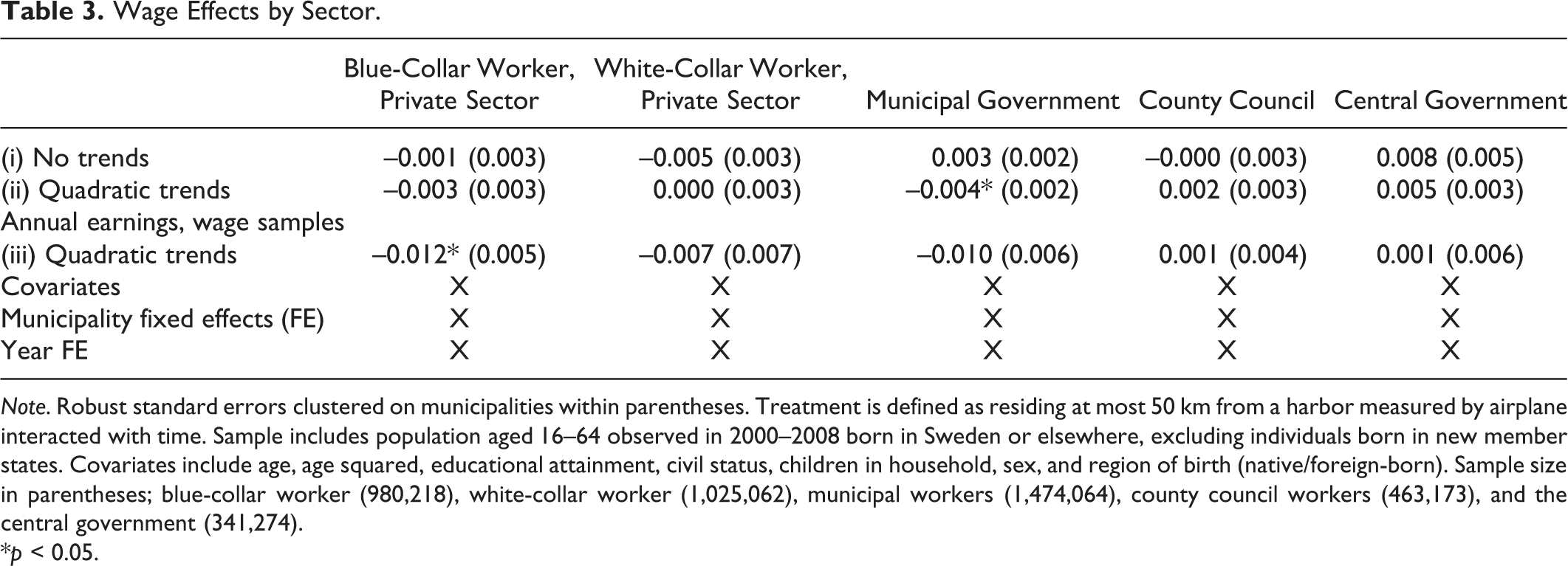
Note. Robust standard errors clustered on municipalities within parentheses. Treatment is defined as residing at most 50 km from a harbor measured by airplane interacted with time. Sample includes population aged 16–64 observed in 2000–2008 born in Sweden or elsewhere, excluding individuals born in new member states. Covariates include age, age squared, educational attainment, civil status, children in household, sex, and region of birth (native/foreign-born). Sample size in parentheses; blue-collar worker (980,218), white-collar worker (1,025,062), municipal workers (1,474,064), county council workers (463,173), and the central government (341,274).
*p < 0.05.
Table 3 shows very limited evidence of any impact on (full-time equivalent) monthly wages. The only significant point estimate is found for workers in the municipal government, when using the model including quadratic municipality-specific trends. One could argue that it is reasonable to find effects in this sector. Local governments are responsible for daycare, schools, elderly homes, streets, and parks and are major employers hiring a lot of low-wage manual labor. Despite this and the fact that model (ii) is arguably the preferred specification, we would urge a great deal of caution in interpreting the evidence as saying that there is any impact on wages.
The difference between the estimates for wages and for monthly earnings from the main employer is worth some attention. For a person working full time, the monthly wage and monthly earnings should be very similar. One interpretation, then, is that the negative influence on earnings is due to a reduction in hours. But there is at least one other possible source of the difference in the estimates: the coverage of the wage data. Further inspection of the data reveals that among those for whom we observe monthly earnings, the fraction not found in the wage data correlates strongly and negatively with age and education and is concentrated in the bottom of the earnings distribution (results available upon request). In other words, for some segments of the labor market, wage data do not tell the whole story. For this reason and due to the advantage of having population-wide data, we focus on earnings rather than wages in the remainder of the analysis. Note, though, that the last row of results shows that there are earnings effects also in the wage samples; the baseline results are thus not purely driven by individuals for whom we do not observe wages. Precision is an issue, but finding a bigger impact in the private sector as compared to the public (in particular at the central and county levels) is expected.
5.2. Varying Distances and Regions
The definition of treatment and control regions in the analysis above is, as already mentioned, somewhat arbitrary. This section presents variations on the distance criterion and investigates whether the results are sensitive to the inclusion/exclusion of certain regions in the sample.
Table 4 displays estimates from a model where the treatment group has been separated into four mutually exclusive categories: harbor municipalities, 0–25 km (excluding harbor municipalities), 26–50 km, and 51–75 km. We then allow the treatment effect to vary across these categories, but within one common regression per outcome. The first set of estimates is from a model not including any trends; the second (which we consider the preferred specification) allows for municipality-specific quadratic trends.
Treatment Effects by Distance from Harbor.
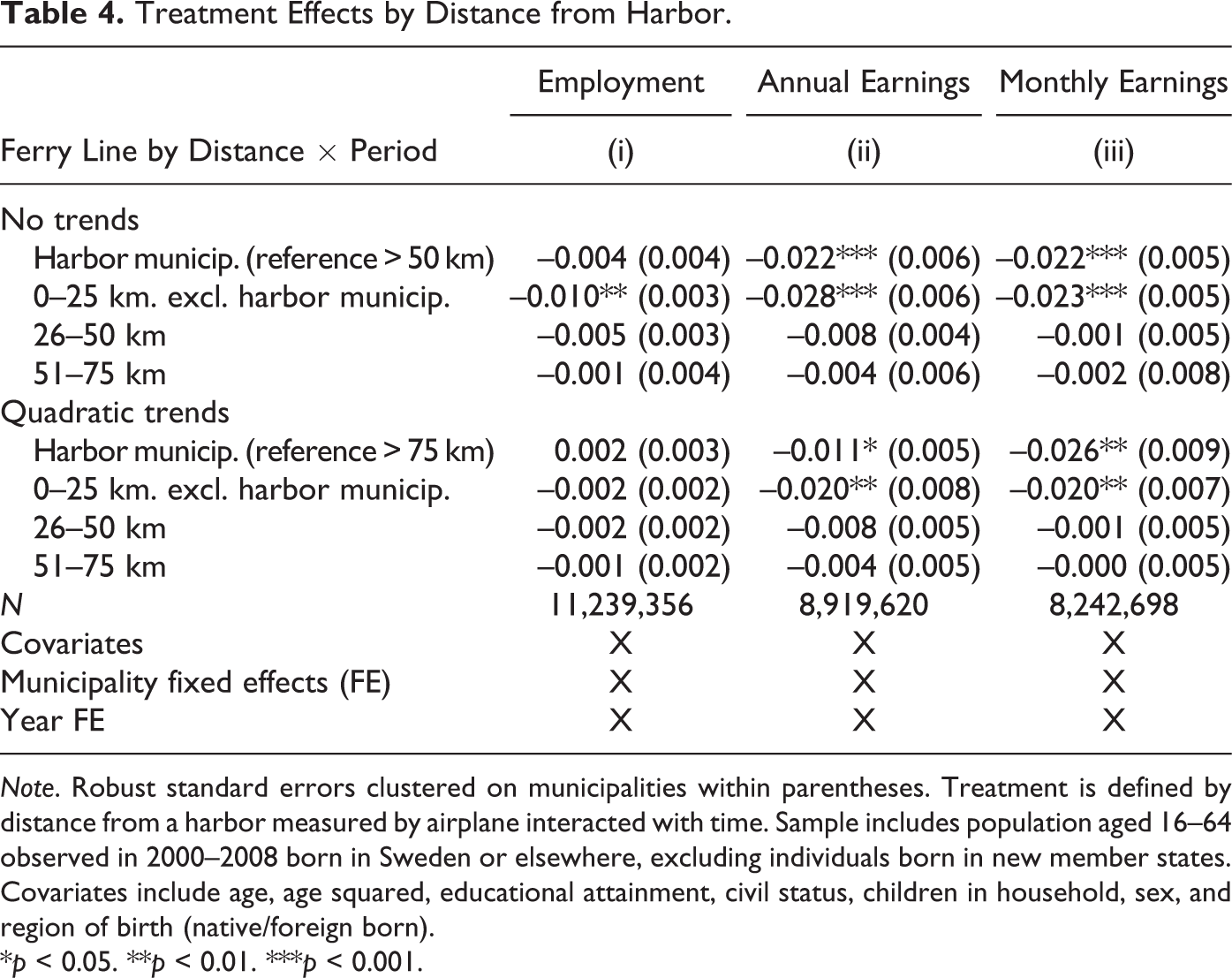
Note. Robust standard errors clustered on municipalities within parentheses. Treatment is defined by distance from a harbor measured by airplane interacted with time. Sample includes population aged 16–64 observed in 2000–2008 born in Sweden or elsewhere, excluding individuals born in new member states. Covariates include age, age squared, educational attainment, civil status, children in household, sex, and region of birth (native/foreign born).
*p < 0.05. **p < 0.01. ***p < 0.001.
Regardless of distance, there is little to suggest that employment probabilities were at all affected. For annual and monthly earnings, on the other hand, results tend to show that the effects are stronger for those closer to the ferries. This pattern is more pronounced when trends are not included but (with the exception of annual earnings in harbor municipalities) holds also in the models allowing for local trends. The estimates for annual earnings in the 25–50 km category are borderline significant, but further out there is no indication of an impact. To us, this signals that using 50 km as baseline is not unreasonable, but given that effects are concentrated closer to the harbors, we present estimates using a 25 km threshold below.
Another variation/robustness check is to investigate whether excluding certain cities/counties from the sample affects the results. Although the placebo estimations discussed above lend support to our regions being suitable for the analysis, the choice of regions is a bit arbitrary. It is therefore reassuring to find that the overall pattern remains if we exclude Malmö (the region’s largest city and a major immigrant destination) or the counties of Skåne and Halland to create a geographically more coherent area. The same conclusion also holds if we extend the analysis to include additional counties (Jönköping and Östergötland) in the control areas (results available upon request). 17 Exploiting only variation within the county of Blekinge consisting of five municipalities in southeastern Sweden, two of which have ferry lines to new member states, largely confirms a zero impact on employment but a significant negative impact on earnings.
5.3. Heterogeneous Effects
The literature reviewed above suggests that while immigration’s labor-market impact may be small for the total population, some workers may be more affected than others. In line with theoretical expectations, the empirical evidence tends to show that those who have a marginal position and/or are more likely to be closer substitutes to recent migrants are also more affected by immigration. While realized permanent immigration is just one channel underlying our findings, the same type of argument is applicable here.
This section investigates whether the impact of the migration reform studied here varied across different parts of the population. First, we look at background characteristics of the incumbent population. Then we study whether the effects vary across the predicted earnings distribution. Finally, we perform separate analyses for different industries.
5.3.1. By background characteristics
Table 5 presents results from estimations on subsamples defined by basic individual characteristics: gender, age, level of education, and region of birth. We focus here on annual and monthly earnings. For employment, the corresponding estimates are small and in almost every case statistically insignificant (results available upon request). The table contains results using two definitions of treatment: the baseline 50 km limit and the 25 km limit (including harbor municipalities but excluding those in the 26–50 km interval). Note that since each cell represents a separate regression, the subgroup estimates do not necessarily add up to the average effect in the overall population (shown in Table 5’s first row).
Heterogeneous Effects — Individual Characteristics.
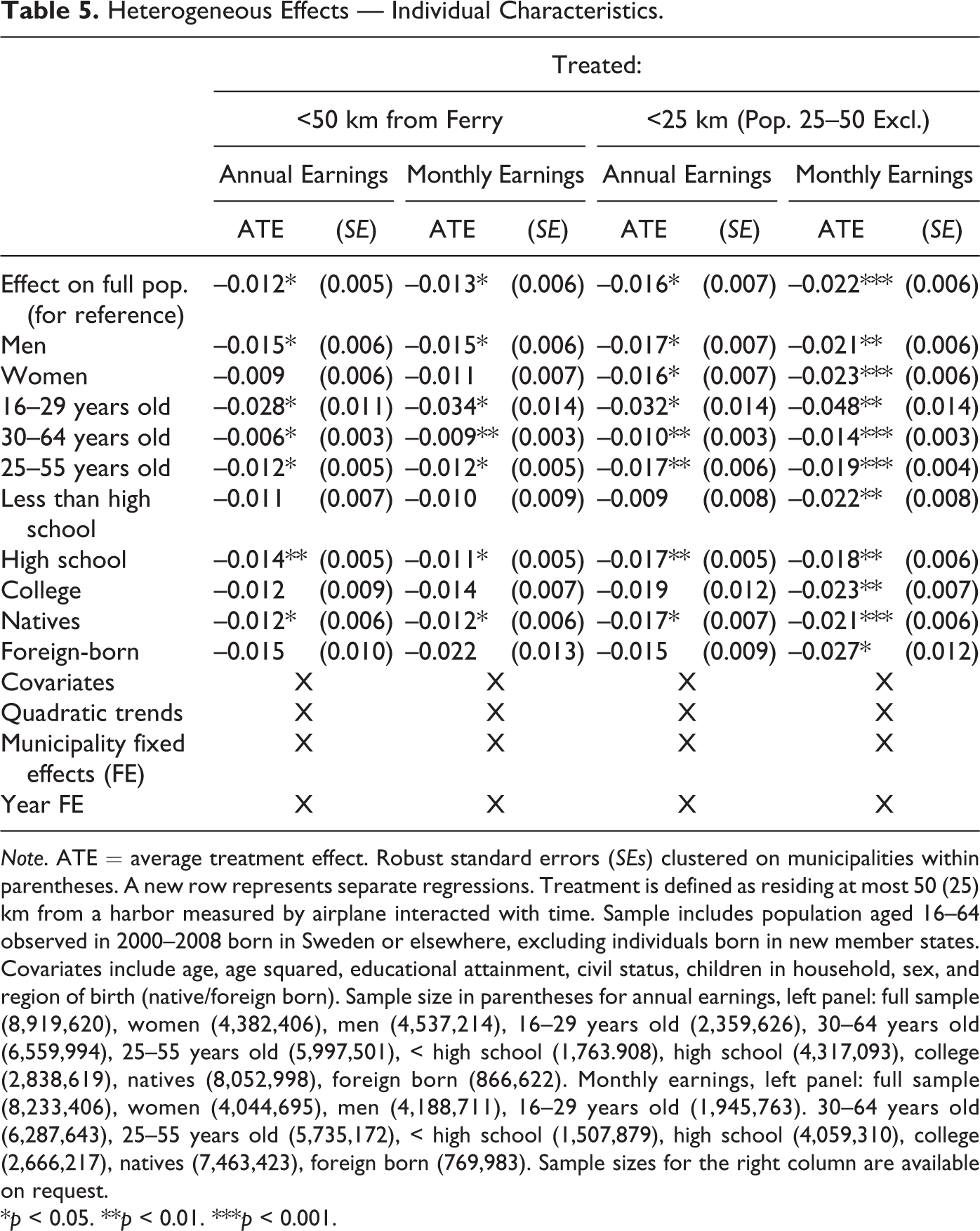
Note. ATE = average treatment effect. Robust standard errors (SEs) clustered on municipalities within parentheses. A new row represents separate regressions. Treatment is defined as residing at most 50 (25) km from a harbor measured by airplane interacted with time. Sample includes population aged 16–64 observed in 2000–2008 born in Sweden or elsewhere, excluding individuals born in new member states. Covariates include age, age squared, educational attainment, civil status, children in household, sex, and region of birth (native/foreign born). Sample size in parentheses for annual earnings, left panel: full sample (8,919,620), women (4,382,406), men (4,537,214), 16–29 years old (2,359,626), 30–64 years old (6,559,994), 25–55 years old (5,997,501), < high school (1,763.908), high school (4,317,093), college (2,838,619), natives (8,052,998), foreign born (866,622). Monthly earnings, left panel: full sample (8,233,406), women (4,044,695), men (4,188,711), 16–29 years old (1,945,763). 30–64 years old (6,287,643), 25–55 years old (5,735,172), < high school (1,507,879), high school (4,059,310), college (2,666,217), natives (7,463,423), foreign born (769,983). Sample sizes for the right column are available on request.
*p < 0.05. **p < 0.01. ***p < 0.001.
The estimates suggest that the effect is quite uniform for men and women. At face value, however, it is much greater for younger than for older (and prime-age) workers. Perhaps surprisingly, given previous findings in the literature (see the overview by Okkerse 2008), the point estimates do not suggest greater effects for low-educated than for older or more skilled workers. In terms of origin, there is some weak tendency that the impact may be bigger on the foreign born, but the estimates are typically not significantly different. Thus, in terms of differential impacts across groups, we cannot draw any strong conclusions.
5.3.2. Impact across the predicted earnings distribution
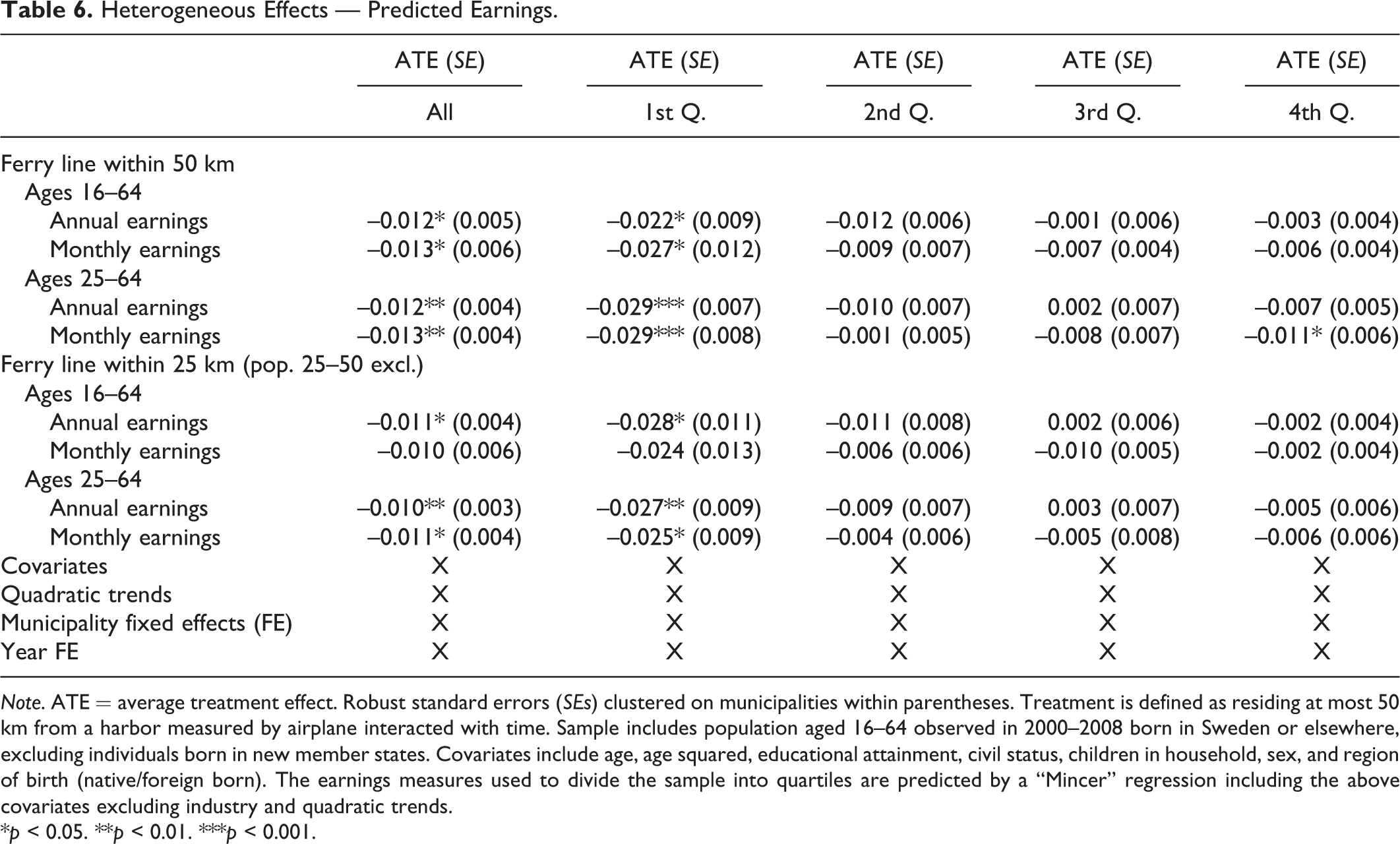
An alternative route to investigating heterogeneity in the impact of migration policy reform is to see if it varies across the predicted earnings distribution. In other words, do those whom we expect to have a strong labor-market position fare differently than those with a weaker position? Table 6 shows results from regressions where the sample was divided into quartiles of predicted earnings (predicted by a Mincer-style regression; see table notes for details). The upper panel uses the 50 km threshold, the lower panel the 25 km limit (excluding individuals in the 25–50 km locations). Each panel contains results for the entire 16–64 age interval, as well as for a sample excluding the youngest workers (25–64 years of age).
Heterogeneous Effects — Predicted Earnings.
Note. ATE = average treatment effect. Robust standard errors (SEs) clustered on municipalities within parentheses. Treatment is defined as residing at most 50 km from a harbor measured by airplane interacted with time. Sample includes population aged 16–64 observed in 2000–2008 born in Sweden or elsewhere, excluding individuals born in new member states. Covariates include age, age squared, educational attainment, civil status, children in household, sex, and region of birth (native/foreign born). The earnings measures used to divide the sample into quartiles are predicted by a “Mincer” regression including the above covariates excluding industry and quadratic trends.
*p < 0.05. **p < 0.01. ***p < 0.001.
The overall picture from the table is that the impact is concentrated in the lower part of the earnings distribution. In both the 50 km and 25 km specifications, the largest effects are found for the first quartile (i.e., people with the lowest expected earnings). Higher up in the predicted earnings distribution, estimates are typically smaller and only sometimes significant, although not miniscule even for the top quartile, which may seem surprising. When we exclude the youngest individuals, many of whom are in education and whose work consists of part-time jobs or employment during holidays, the pattern is qualitatively unaltered.
5.3.3. By industry
The increase in competition following enlargement is unlikely to be uniform across industries. First, as shown by Supplemental Tables A2 and A3, migrant workers are clearly concentrated in certain industries. Second, the latent threat following an opened border is arguably stronger in some parts of the labor market than in others. In this section, we approach this issue by performing the analysis by industry.
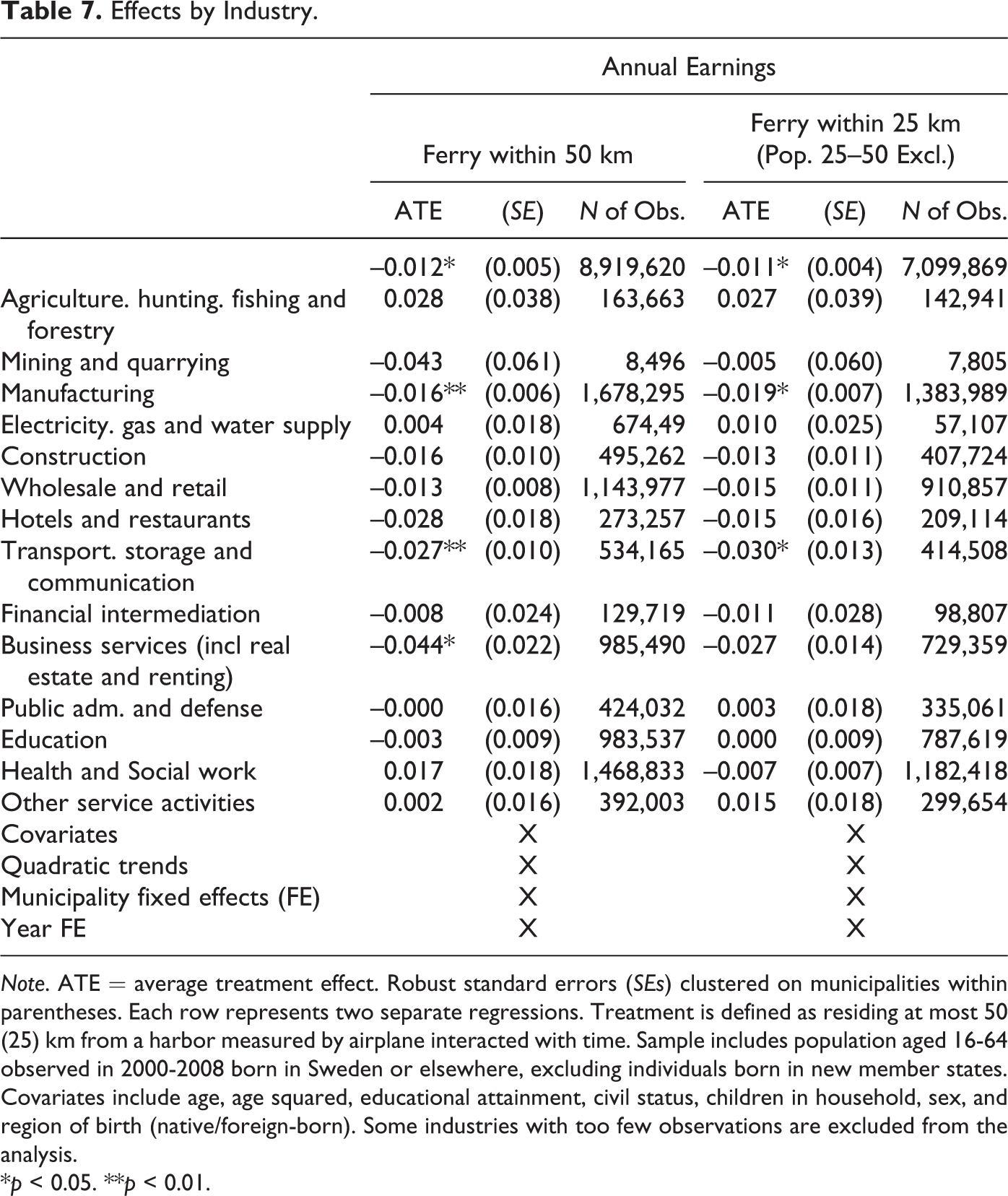
Here, we focus on annual earnings and present results using 50 km and 25 km thresholds (Table 7). Although caution is warranted since the analysis suffers from a multiple testing problem (thus, we run a higher risk of reporting significant estimates by chance), it is relevant to discuss the patterns of this analysis. A first observation is that most estimates are negative, and none are significant and positive. Quite strikingly, we find substantial negative effects in manufacturing and business services (traditionally hosting migrant workers in cleaning services), two industries which have seen marked increases in EU8 labor since enlargement (see Supplemental Tables A2 and A3). For construction, which also experienced a strong rise in the labor supply from EU8, the point estimate is negative and relatively sizable, although not statistically significant. It is also worth noting the substantial point estimate in the 50 km specification for hotels and restaurants, offering many low-qualified and part-time jobs.
Effects by Industry.
Note. ATE = average treatment effect. Robust standard errors (SEs) clustered on municipalities within parentheses. Each row represents two separate regressions. Treatment is defined as residing at most 50 (25) km from a harbor measured by airplane interacted with time. Sample includes population aged 16-64 observed in 2000-2008 born in Sweden or elsewhere, excluding individuals born in new member states. Covariates include age, age squared, educational attainment, civil status, children in household, sex, and region of birth (native/foreign-born). Some industries with too few observations are excluded from the analysis.
*p < 0.05. **p < 0.01.
Transport is the third industry where we find significant negative effects on earnings. Although there appears to be no big inflow of people being hired in Swedish transport companies, the effects seem reasonable given the mobile nature of services. Indeed, the Swedish Transport Workers Union and media have reported that competition from foreign firms has increased following enlargement (Sveriges Radio 2004; Svenska Dagbladet 2010; Sydsvenskan 2011). Competition from abroad is also likely to be a partial explanation for the impact on the business service industry, where foreign staffing companies are sometimes portrayed as important competitors (Petersson 2012). Thus, it is not a surprise that these sectors appear to be affected by the enlargement.
6. Conclusions
The individual labor-market impact of immigration policies is likely to operate through several channels and to vary, depending on individual and regional characteristics. The 2004 EU enlargement meant that the Swedish labor market immediately became much more accessible for workers and firms from neighboring countries with substantially lower wage levels. We investigate whether workers living close to pre-existing ferry links to new member states were differentially affected by this policy reform.
Our analysis of the impact on individual worker outcomes of being close to the transport links when borders were opened suggests a small but robust adverse impact in the order of 1 percent on total annual earnings and on monthly earnings from the main employer. The negative effects tend to be greater the closer to the ports one gets. We also present findings that by and large are consistent with previous studies concluding that workers who are closer substitutes to new competition will be more affected (Kerr and Kerr 2011; Bratsberg and Raaum 2012; Dustmann, Frattini, and Preston 2013). The effects are greater among younger people and in the lower tail of the predicted earnings distribution. Furthermore, we find the clearest negative impact in industries that have seen a greater increase in the presence of EU8 workers or are likely to be exposed to greater competition from the other side of the border.
It should be emphasized that we do not estimate the total impact of the EU 2004 enlargement on the Swedish labor market, but rather the difference in the impact between those closer to transport links and those somewhat further away. The total impact may be positive or more negative. We believe that the relatively modest size of the estimated impact appears plausible. The reform implied a major increase in the openness to neighboring countries with substantially lower GDP and wage levels, and it seems reasonable to see some impact of being more exposed to this competition. Yet given the previous literature (see overviews by Longhi, Nijkamp, and Poot 2005; Kerr and Kerr 2011), we would not expect to see huge effects on the labor-market outcomes of present workers.
As discussed in the Introduction, analyzing the labor-market impact of opening borders is to some extent by definition reduced-form. We capture net effects of several possibly opposing and interacting mechanisms that are hard to disentangle and even observe. Still, our findings provide some indications. First, while there was certainly an increase in the inflow of EU8 migrants to Sweden following enlargement, we do not find that these migrants to a greater extent clustered in the treated (harbor) areas. Thus, differential shocks in registered (permanent or temporary) migration are unlikely to explain our findings.
Second, passenger traffic and trade between Sweden and EU8 countries increased strongly around 2004, implying that people and goods at the very least pass through the harbor regions. Several observations are consistent with a situation where posted/undocumented migrants compete for low-skill jobs close to the transport nodes: (i) the estimated effects are strongest in the lowest quartile of the predicted earnings distribution; (ii) point estimates tend to be greater in absolute terms in business services, hotels, and restaurants (generally hiring many migrant workers); and (iii) effects fade out rapidly as we move away from the harbors. Third, some results suggest that firms’ cross-border competition may be a mechanism of importance. For example, effects are found to be large in the transport sector where statistics and media reports suggest an increased presence of foreign competition.
The results of our study indicate that future research should figure out ways to observe and quantify channels for the overall impact of reforms and policies pertaining to international mobility and border control, which have so far received limited attention. First, with the changing nature of labor migration and international competition, effects on workers and markets may arise through new channels. Second, with growing political tensions, reliable facts and evidence on impacts and consequences are even more essential.
Supplemental Material
Supplemental Material, MRX789067_Supplemental_Material - Open Borders, Transport Links, and Local Labor Markets
Supplemental Material, MRX789067_Supplemental_Material for Open Borders, Transport Links, and Local Labor Markets by Olof Åslund and Mattias Engdahl in International Migration Review
Footnotes
Acknowledgments
We are grateful for comments from Per-Anders Edin, Caroline Hall, Dan-Olof Rooth, and participants in the ELE Nordic Summer Institute in Aarhus 2013, the UCLS Meeting August 2012, the FAFO Workshop Moving for work in Oslo 2012, EALE 2012, the Conference on Immigration and Labor Market Integration in Stockholm 2011, and seminar participants at Institute for Housing and Urban Research (IBF) and Institute for Evaluation of Labour Market and Education Policy (IFAU).
Declaration of Conflicting Interests
The author(s) declared no potential conflicts of interest with respect to the research, authorship, and/or publication of this article.
Funding
The author(s) received no financial support for the research, authorship, and/or publication of this article.
Supplemental Material

Notes
References
Supplementary Material
Please find the following supplemental material available below.
For Open Access articles published under a Creative Commons License, all supplemental material carries the same license as the article it is associated with.
For non-Open Access articles published, all supplemental material carries a non-exclusive license, and permission requests for re-use of supplemental material or any part of supplemental material shall be sent directly to the copyright owner as specified in the copyright notice associated with the article.
