



Abstract
Existing paradigms of immigrant incorporation fruitfully describe immigrants’ upward or downward mobility across generations. Yet we know very little about intragenerational change. Drawing on a case in which upwardly mobile Latino immigrants see their gains reversed, I model what I call intragenerational reverse incorporation. In doing so, I theorize how incorporation gains can be undone through institutional closure and shifts in reception attitudes spurred by securitization and intensified immigration enforcement. Drawing on data gathered in Winston-Salem, North Carolina, I show how these changes both marginalized and racialized Latino immigrants, who in turn internalized and politicized their new status.
Introduction
Immigration scholarship offers two prevailing assimilation theories — straight-line and segmented (Park 1914; Portes and Zhou 1993; Alba and Nee 2003). Both generally treat assimilation as a linear and intergenerational process wherein contextual barriers remain static over the life of the individual. As Zhou (1997, 975) writes of straight-line and segmented assimilation frameworks, “There are three possible patterns of adaptation most likely to occur among contemporary immigrants and their offspring.” One path fits the dominant paradigm of the 20th century — classical straight-line assimilation, in which there is growing acculturation and “parallel integration into the white middle-class” (ibid.). A second pathway leads “straight into the opposite direction to permanent poverty and assimilation into the underclass; still a third associates rapid economic advancement with deliberate preservation of the immigrant community’s values and tight solidarity” (Portes and Zhou 1993, 82, quoted in Zhou 1997). In each of these frameworks, progress is linear and barriers remain static. However, because intragenerational change is a mechanism for intergenerational change, a broader understanding of changes in contextual barriers and their impact on intragenerational processes is required to fully understand immigrant assimilation and integration processes more generally. 1
This article contributes to that understanding by examining nonlinear integration trajectories within a given generation’s lifetime. Building on Gans’s intergenerational theory of bumpy line assimilation (1992), I present a theory of intragenerational reverse incorporation, a process by which immigrants who have acquired social and economic gains experience a reversal of these gains, resulting in downward mobility and intensified racialization as stigmatized minorities. This process, I will show, can result from shifts in the local context of reception and opportunities for immigrant mobility. Moreover, when social and economic incorporation declines, immigrants may experience heightened racialization and politicization.
I theorize the process of intragenerational reverse incorporation through a case study of Winston-Salem, North Carolina. In the 1990s, Winston-Salem welcomed Mexican immigrants, many of whom quickly improved their social and economic status. As a number of scholars have noted, however, the mid-2000s marked a turning point in immigration politics (Winders 2007; Gill 2010; Coleman 2012). Thus, by 2006, native-immigrant relations had soured in Winston-Salem. State-level political shifts, local residents’ changing attitudes, and institutional reconfigurations limited Latino immigrants’ access to education, healthcare, security, and the labor market and reversed immigrants’ previous gains. These changes created long-term cohort effects vis-à-vis mobility trajectories, identity formation, and political outcomes that, I suggest, are poorly captured by existing theoretical frameworks emphasizing intergenerational change and overlooking shifts in context. Gans (1992), Perlmann and Waldinger (1997), and Telles and Ortiz (2008), for example, explain second-generation decline as the result of factors including limited economic opportunity, racial discrimination, exposure to negative outlooks of native-born youth, and pre-migration characteristics such as class standing and migration flows. While these factors are undoubtedly important, they are unable to address how changes in the context of reception itself may be a factor in shaping immigrant integration. The remainder of this article offers a new way to examine the effects of these shifts that take place within a generation and strongly impact immigrant incorporation.
The Role of Crises in Immigrant Incorporation
Many immigration scholars seek to understand how immigrants incorporate into “mainstream” society and achieve upward socioeconomic mobility (Massey 1995; Zhou 1997; Simon 2003; Freeman 2004). Until the 1990s, much of this work assumed that integration followed a trajectory from unincorporated to incorporated (Park 1914; Massey 1981; Alba 1985; Waters and Jiménez 2005). Newer segmented assimilation theories suggest instead that racial stigma and exclusion create barriers for non-white immigrants and identify three linear forms of incorporation: straight-line assimilation into the middle class (Perlmann and Waldinger 1997; Alba and Nee 2003), downward assimilation into the “urban underclass” (Zhou and Bankston 1999), and mobility through selective acculturation and reliance on ethnic resources (Portes and Zhou 1993; Zhou and Bankston 1994). 2
These theories share at least three features. First, they are intergenerational. Like Portes and Zhou (1993), who compare first- and second-generation immigration trajectories, much of this research operationalizes assimilation trajectories as cross-generational processes (e.g., Suarez-Orozco and Suarez-Orozco 2001; Alba and Nee 2003; Waters et al. 2010). Second, many assimilation theories treat race as fixed. Rather than recognizing that race is socially constructed and that individuals’ racial status may change based on their social context (Harris and Sim 2000), this research assumes that non-white status is a fixed barrier to integration into the mainstream, such that immigrants face racialized discrimination and cannot access the white mainstream. Focusing on West Indians (Waters 2001), Asians (Zhou and Bankston 1994), and Latinos (Stepick and Stepick 2009), this work argues that to overcome the fixed barriers of non-white status, to be upwardly mobile, immigrants must rely on both distancing from underclass minorities and ethnic resources to achieve mobility (e.g., Perlmann and Waldinger 1997; Zhou and Bankston 1999; Lee and Zhou 2004; Stepick and Stepick 2009). Third, these theories focus on individual characteristics as key determinants of incorporation. That is, this research stresses that success is based on the individual’s ability to accumulate human capital (Toussaint-Comeau 2006) and the match between that capital and context (Borjas 1999; Friedberg 2000). A significant body of research, thus, investigates this match between human capital and context among Latino immigrants, finding that human capital levels directly affect Latino migrants’ occupational attainment (Sanders and Nee 1996; Borjas 1999; Toussaint-Comeau 2006).
When segmented assimilation scholars consider the context of reception (e.g., ethnic enclaves or urban neighborhoods) as a mobility determinant, they treat those conditions as fixed (Portes and Zhou 1993; Xie and Greenman 2011). For example, in their analysis of second-generation young adults in Florida, Portes and Fernandez-Kelly (2008, 18) argue that whether a context is receptive, neutral, or hostile affects incorporation. This classification scheme assumes, however, that incorporation contexts are fixed for distinct ethnoracial groups, ranging from hostile for Mexicans, Haitians and West Indians to receptive for Cubans and Vietnamese (ibid.).
Likewise, much of the context-of-reception literature treats context as static (e.g., Light 1972; Portes and Böröcz 1989; Bloemraad 2006; Luthra 2013). For example, cross-national studies tend to examine context at a single point in time and to look at its effects on incorporation (Bloemraad 2006). These methodological choices provide a great opportunity to see clear causal relationships, but because they examine periods of stability in context, they do not let us see how changes over time affect incorporation. Although researchers recognize that the context of reception varies by locality (Portes and Böröcz 1989; Reitz 1998; Bloemraad 2006), they have failed to adequately theorize the effects of change within a given context, emphasizing instead a specific point in time and place. Recent work on immigration to new destinations, for example, does an excellent job of exploring how local social, economic, and political conditions shape immigrant trajectories of mobility and belonging (Marrow 2011; Ribas 2016). However, few of these works consider that context itself is unstable. A notable exception to this trend is the work of Stepick and Stepick (2009), who find that variation in the context of reception plays an important causal role in shaping immigrants’ long-term integration pathways. While not examined directly in their ethnographic research, they highlight that the context of reception may evolve over time, noting that receptivity can shift gradually across decades, such as changes in the reception of European immigrants between the late 19th century and the early 20th century or Cubans in Florida from 1960 until the 1980 Mariel Boatlift.
We know, however, that broader social changes can impact local contexts, not just gradually but also rapidly, shifting them in ways that affect immigrant integration trajectories. Economic downturns, changing geopolitical relations, and significant demographic shifts all can spur anti-immigrant backlashes (Ngai 2004; Hopkins 2010; Gleeson and Gonzales 2011). Historic US examples of this phenomenon include the mass deportation of Latinos during the Great Depression (Golash-Boza and Hondagneu-Sotelo 2013), the internment of Japanese Americans during World War II (Nagata, Kim, and Nguyen 2015), and the surveillance of Arab Americans following 9/11 (Naber 2008; Cainkar 2009). These political changes that targeted specific ethnoracial groups reconfigured state and local institutional arrangements, economic conditions, and intergroup relations. Because changes to the social landscape and their concomitant impact on integration contexts are far from rare, more work is needed to understand these shifts and their effects.
In one exception to this trend, Gans (1992) theorizes the role of crises in shaping integration, arguing that crises can produce a nonlinear acculturation process. During crises, he suggests, non-European ethnics may be scapegoated and “forced to define themselves as ethnic and may even draw in their ethnic wagons to defend themselves,” rather than acculturate into the mainstream (ibid., 43). While Gans assumes crises are rare and therefore only important for intergenerational change, I argue that crises happen regularly. Thus, this article builds on Gans’s insights to theorize how one such crisis produced bumps within a single generation, resulting in what I call reverse incorporation.
Intragenerational Reverse Incorporation
Immigrants with linear upward integration trajectories achieve measurable incorporation gains over time, as indicated by employment, native-born friendship networks, wages, education, property acquisition, and social acceptance (Waters and Jiménez 2005). I propose the intragenerational reverse incorporation model to explain when and why immigrants experience downward intragenerational changes in incorporation trajectories and with what consequences. Reverse incorporation, I show, can occur when crises alter attitudes toward immigrants, spurring new, large-scale institutional regime shifts that often scapegoat immigrants.
The model presented in Figure 1 explains reverse incorporation as the result of the mutually constitutive processes of institutional closure and changing native attitudes, which together lead to the internalization of marginalization and exclusion among immigrants. It further posits that changes in the institutions and attitudes of the context of reception can undo incorporation gains in three ways. First, declines in economic investments and rewards can result in individual losses in income, skills, and assets that are difficult to recover, even if circumstances shift (Giuliano and Spilimbergo 2009; McDaniel, Gazso, and Um 2013). Second, such losses can impact households, producing cohort effects over time. Third, persistent marginalization can intensify the racialization of immigrants, reshaping ethnoracial identities and instigating political activation (Brown and Jones 2015). Note, however, that because marginalization can produce political integration even as it produces social and economic disintegration, forms of integration can be at odds. Below, I outline the reverse incorporation model and its mechanisms in further detail.
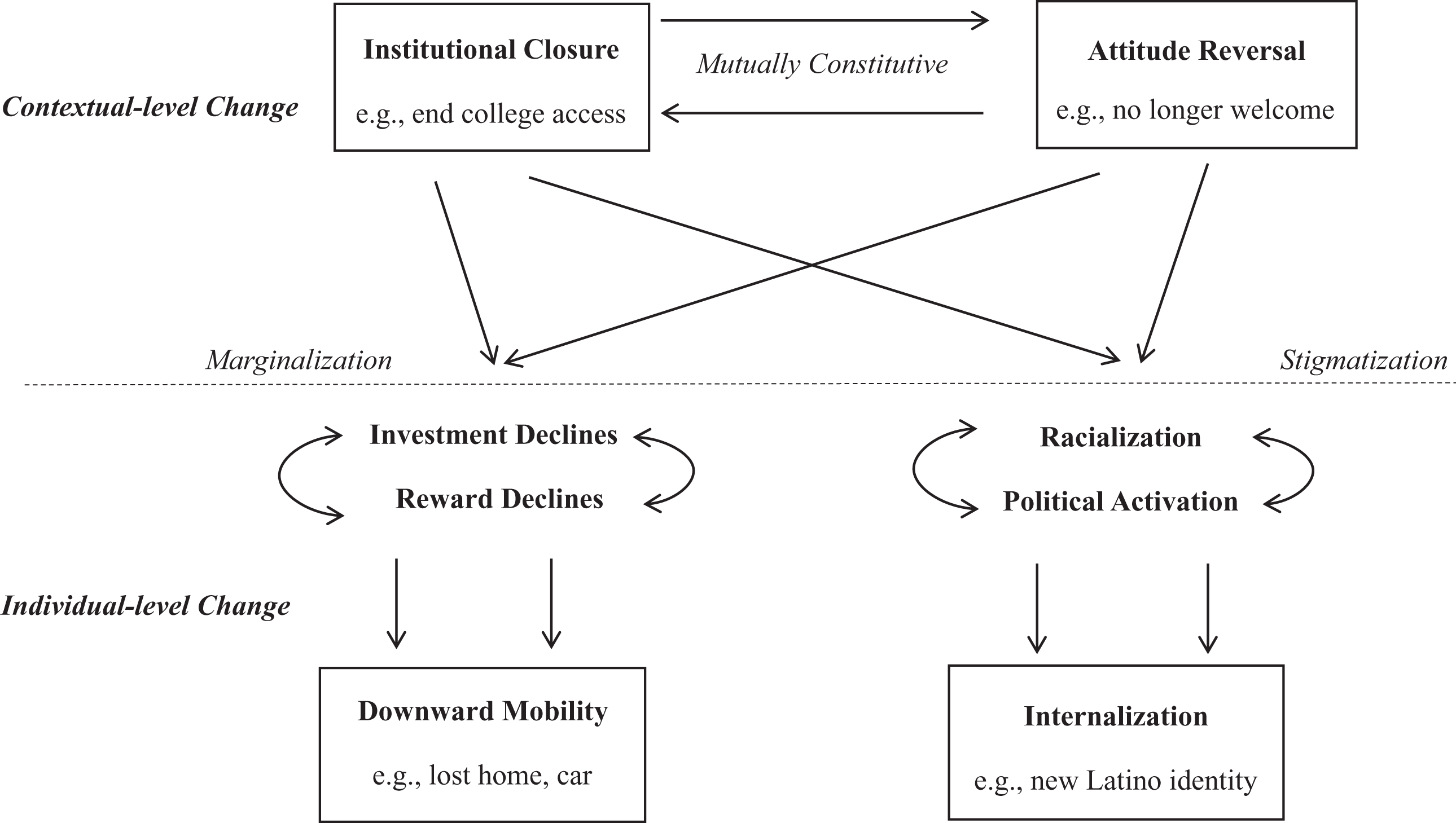
Reverse incorporation model.
Contextual-Level Change
Institutional closure
The intragenerational reverse incorporation process has four components. 3 The first is institutional closure. I contend that institutional closure occurs when policymakers and bureaucrats block structural or public forms of integration by restricting access to employment, housing, education, services, and physical mobility. These restrictions transform the context of reception from open to closed. In such closed contexts, immigrants may no longer have upward mobility.
For undocumented immigrants and their families, institutional access can be an especially volatile driver of mobility. Local authorities have tremendous discretion in determining which services and institutions are accessible to undocumented residents (Marrow 2009), so the context of reception can shift rapidly and dramatically with local or state-level changes. In recent years, for instance, local policy shifts across the United States have restricted some immigrant youths’ access to educational institutions and driver’s licenses, even as federal policies have opened incorporation pathways. As a result, policy shifts have produced sharply divergent mobility trajectories (Gonzales 2011).
Reversing attitudes
The model’s second component is attitude reversal. Institutional barriers can be activated and reinforced by native-born community members’ negative attitudes toward immigrants, with profound impacts on immigrants’ perceptions of the local opportunity structure (Mettler and Soss 2004; Bloemraad 2006). Such negative attitudes can also reverse immigrants’ social integration by eroding ties to native-born networks and civic participation and replacing them with social stigma (Abrego 2011; Gonzales 2011). In similar fashion, attitude shifts can affect native-born community members’ actions toward immigrants. Community members may intimidate or expel newcomers (Massey 2008; Bauer and Reynolds 2009), reinforcing institutional closure; and street-level bureaucrats may feel empowered to limit immigrant access to institutions and services, provide subpar services, or promote restrictive and discriminatory behaviors (Evans and Harris 2004; National Immigration Law Center 2012). In places where local attitudes remain positive despite policy shifts, immigrants may be shielded from some of the most pernicious effects of institutional closure, and intergroup boundaries may remain permeable. 4 Where negative attitude shifts arise alongside institutional closure, however, these exclusionary factors can be mutually reinforcing (Brown 2013).
Individual-Level Change
Together, as Figure 1 shows, negative attitude shifts and institutional closure can alter the receiving context to produce two outcomes for immigrants: downward mobility and increased racialization as stigmatized minorities, the third and fourth components of intragenerational reverse incorporation.
Downward mobility
Even as individual migrants continue to engage in capital accumulation processes, prospects for overall mobility can be reconfigured. Public policies that target undocumented immigrants, for example, can foreclose access to insurance, loans, and property (Denning 2009). Efforts to restrict access to education, training, employment, services, and resources can truncate individuals’ ability to acquire what Grusky and Weeden (2006) call a package of investments (e.g., education, savings), endowments (e.g., skills, networks), working conditions (e.g., safe, engaging), and rewards (e.g., wages, benefits) that facilitate upward mobility. As I show later in this article, these closures can also stall immigrant mobility and reverse previously made gains.
Racialization and politicization
Immigrants can interpret souring attitudes and institutional closure as new and arbitrary forms of racialized discrimination (Portes and Rumbaut 1990/2006; Telles and Ortiz 2008; Sanchez and Masuoka 2010), spurring collective identity formation (Portes and Rumbaut 2006; Telles and Ortiz 2008; Massey and Sánchez 2010). That is, ethnoracial changes can not only create new structural and social barriers but also serve as an impetus for group coherence and political activation (Okamoto and Ebert 2010). In this way, while reverse incorporation deteriorates social and economic incorporation, it may simultaneously heighten politicization. In what follows, I show how the reverse incorporation process unfolded in one community: Winston-Salem, North Carolina.
Research Methodology
Since the 1990s, North Carolina has been a new destination for immigrants increasingly bypassing traditional gateways into the United States, with its Latino population increasing by nearly 400 percent between 1990 and 2000 (Kochhar, Suro, and Tafoya 2005). Research on immigrant settlement in the US South has demonstrated the increased importance of context and new legal regimes in shaping immigrant incorporation trajectories (Smith and Furuseth 2008; Marrow 2011; Ribas 2016). As such work argues, in the US South, Latinos are replacing black and white workers in many sectors, sometimes producing tensions between the native born and newcomers (LeDuff 2000; Mohl 2003; Lacy 2009; Marrow 2011). This research also indicates that rapid demographic change, resource access, and existing race relations shape the experiences of newcomer Latinos to the region (LeDuff 2000; Mohl 2003; Lacy 2009; Rich and Miranda 2009; Marrow 2011). To curtail an immigrant influx, many southern states began to adopt punitive policies in the mid-2000s (Cravey and Valdivia 2011; Armenta 2012). In 2005, for example, North Carolina passed its first immigration-related bill; and in 2006, post-9/11 securitization procedures allowed the state to join in federal/local immigration enforcement partnerships (Nguyen and Gill 2010; Marrow 2011; Coleman 2012).
Winston-Salem experienced these shifts as well. In 1990, the census counted approximately 2,106 Hispanics in Winston-Salem. By 2000, there were 19,577, and by 2012, 44,267 (just under 15 percent of the city’s population) (US Census Bureau 2014a, 2014b). 5 Rapid Hispanic settlement shifted Winston-Salem from a black/white community to a majority-minority community in a short time, provoking a variety of social and political responses that reshaped Latinos’ integration prospects in the community.
To examine immigration incorporation dynamics in Winston-Salem, I used three data sources: 12 months of ethnographic fieldwork from 2008 to 2009; 86 formal and informal ethnographic interviews with Mexican immigrants and with black, white, and Latino community leaders; and a media analysis of newspaper coverage of immigration and Latinos from 1989 to 2009. Data from my ethnographic study do not appear here but provide important contextual knowledge (and helped me identify interview subjects and key community actors).
As highlighted in Table 1, interviews in this study aimed at gaining Mexican immigrants’ insights into their interactions with native-born community members and of change over time in the community. Of the 86 interviews conducted, 37 respondents were Mexican immigrants and 3 of other Latin American origin. Of the 40 immigrants interviewed, 29 were unauthorized. The remaining 46 interviewees were African-American, white, and native-born Latino community members. While I conducted both formal and informal interviews, sometimes in more than one meeting, interviews were also ethnographically embedded in my interactions with respondents (26 were conducted in the process of fieldwork and often emphasized community climate). All respondents were aware of my role as a researcher. 6
Interview Respondent Characteristics.
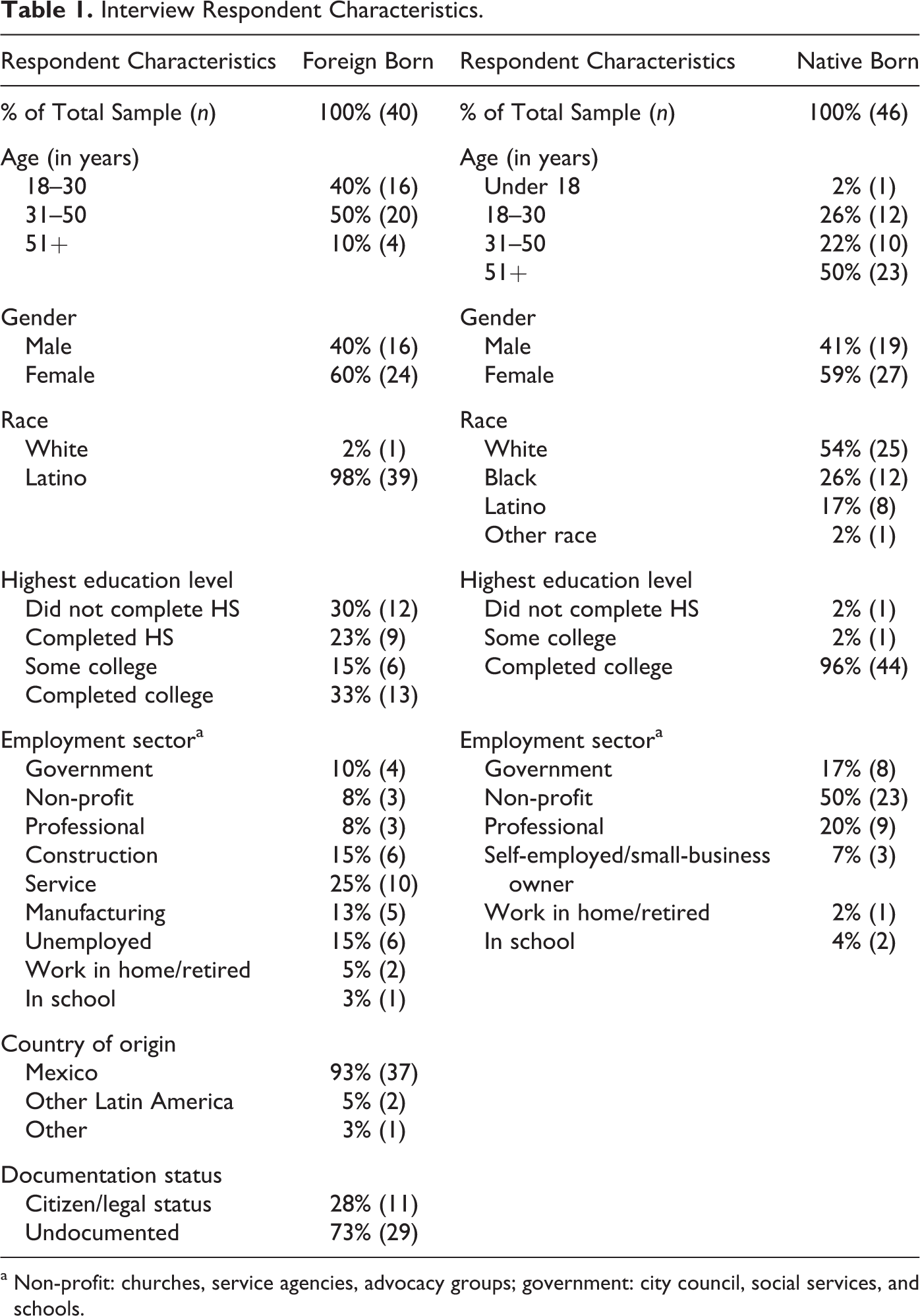
a Non-profit: churches, service agencies, advocacy groups; government: city council, social services, and schools.
I conducted interviews in English, Spanish, or both. Formal interviews lasted from 45 minutes to three hours and followed a structured interview schedule organized around questions covering perceptions of identity, intergroup relationships, community climate, views on immigration, feelings of belonging, labor-market experiences, and differences within and among racial and ethnic groups. Informal interviews lasted from 30 minutes to two hours, were semi-structured, and covered the same topics. I inductively modeled intragenerational reverse incorporation by coding interview transcripts for reports of institutional and attitudinal change or consistency in the community, perceptions of changes in personal mobility, and perceptions of how reported changes impacted participants’ lives. Because ethnographic and interview data collection took place from 2008 to 2009, these interviews and observations provided retrospective accounts of life in Winston-Salem prior to 2008.
I triangulated these sources with newspaper data to substantiate respondents’ claims and gather more information about contextual conditions, creating a database of articles on immigrants and/or Latinos from the Winston-Salem Journal, Winston-Salem Chronicle, and Que Pasa Piedmont Edition from 1989 to 2009, the key period of Latino population growth in Winston-Salem. These three newspapers represent the widest-circulating papers from the mainstream regional press, the local African-American press, and the local Spanish-language press, respectively. The Winston-Salem Chronicle rarely reported on Latinos or immigrants, while the Winston-Salem Journal and Que Pasa Piedmont Edition began covering immigration more aggressively in the early 2000s and showed a marked shift in coverage of policies and attitudes toward immigrants beginning in 2005. This article draws primarily from the Winston-Salem Journal, with supplementary contextual information from the Winston-Salem Chronicle and Que Pasa Piedmont Edition.
Open Doors
During the 1990s, the vast majority of Latino immigrants I interviewed in Winston-Salem reported a community context characterized by institutional openness and acceptance, economic opportunity, and positive intergroup relations. Most immigrants to the region were unauthorized (Kochhar, Suro, and Tafoya 2005), and many had come from states like California and Arizona, where flagging economies and growing anti-immigrant sentiment made life difficult (Calavita 1996). In this time period, North Carolina offered abundant employment and capital-building opportunities. Local institutions facilitated upward immigrant mobility by providing access to capital through bank and credit union loans and to community education. Some small banks and cooperatives specifically targeted Latino immigrants in search of small business loans (Craver 2006). Undocumented immigrants could obtain a driver’s license or state identification (Sturiale 2002) and easily apply for work; hold bank accounts; and purchase trailers, homes, and vehicles. 7
Ample access to employment opportunities and institutional resources provided an avenue to upward mobility and stability, not only in the Winston-Salem area but throughout the state for Latino immigrants. Across North Carolina, in counties where working-class whites and African-Americans were upwardly mobile, Latinos filled an economic void (Tursi 1994; Kochhar, Suro, and Tafoya 2005). 8 Newspaper reports and interviewees corroborated reports that as the North Carolina economy expanded, there was more recruitment of Mexican laborers, and Mexicans came to the state because of its openness and economic opportunities. These immigrants often found work through a robust temporary H2B visa guest worker program and through the non-enforcement of undocumented labor laws. From 1990 to 2000, local and state policy and community-level reception were largely viewed by immigrants and in the press as positive, reflecting market needs.
Despite their unauthorized status, many Mexicans reported that they felt in these early years that they were doing well and becoming part of the Winston-Salem community. Janet, 9 for example, an unauthorized immigrant from Guerrero, Mexico, who came to Winston-Salem in 1995, recalled, “Before [2006], [my husband] had plenty of work. He worked five or six days. And so, things were good. We both worked, and he earned good money. And, well, we just didn’t have any worries then.” Newspaper data confirm Janet’s account: immigration was not a major concern at that time. In 1994, the Winston-Salem Journal referenced immigration in only 21 articles. Many of those stories lauded Latino leaders’ efforts to integrate immigrants into the community, praised immigrants’ industriousness and economic contributions, and encouraged incorporation (Musante 1998, B1).
Prior to 2005, then, many Latino immigrants in Winston-Salem experienced significant economic and structural gains. Many adult immigrants took advantage of free English as a Second Language (ESL) courses provided in partnership by the community college and library, and youth attended and completed primary and secondary school. As noted in both interviews and newspapers, Latino immigrants were able to garner steady employment, good wages, and modest savings (Ahear 1995; Buggs, Paik, and Price 1998; Sturiale 2002). Several respondents reported starting businesses in basic construction, retail, and food services, indicating that they had the capital to hire workers, save money, and/or send remittances to relatives in Mexico. To build businesses and gain employment, many of these immigrant entrepreneurs benefited from institutional support from banks, city development programs, educational courses in the library and community college system, and job search support. Diego, a 1999 migrant to Winston-Salem from Guerrero, told me, “Before, it was easy. There were many Latinos inside of the [employment] agencies, and they helped us. We didn’t have problems.” Diego recalled having plenty of disposable income, paying for as many as 10 different cars in his decade in the city — all in cash. And his story was typical. Few immigrant newcomers who participated in this study reported difficulty accessing job opportunities. In fact, employment was seemingly plentiful enough to minimize exploitation, increase wages, and create opportunities for entrepreneurial activity.
Discrimination and racism in this period certainly existed (Smith 1998; Cravey and Valdivia 2011) but played limited roles in shaping the trajectories of Latino immigrants as a group in Winston-Salem. Reflecting on the pre-2005 period, no interviewee recalled feeling hostility from native-born community members, and many described the broader black and white community as receptive. Though Latino immigrants lacked resource-rich networks due to their recent arrivals, there were efforts by civic organizations and municipal leaders to provide access to American cultural norms and institutions to enable immigrant mobility and integration. Local universities held family days for immigrants (Ball 1998, B2). The city developed a Spanish-language help-line, Spanish-language programming on the public access channel to explain city regulations, and free courses and welcome fairs at the local library, resulting in a broadly welcoming climate for immigrants.
Of the 40 immigrant Latinos I interviewed in-depth, three reported that from 1990 to 2004, they or someone in their household purchased a home, four experienced wage increases, and seven were promoted or moved to a higher-paying occupational sector. Five started new businesses, and 21 pursued or planned to pursue additional education, including degrees, training, and ESL courses. In sum, 82.5 percent of my Latino immigrant sample reported some form of additional human capital accumulation, with several respondents reporting multiple forms. These efforts toward accumulating additional human capital indicate orientations toward and success in achieving upward mobility. Yet in the coming years, a shift in context would dramatically alter these patterns.
Closed Gates
Latino immigrants reported significant reversals in their economic and social integration trajectories by the late 2000s. Reliable quantitative data on unauthorized immigrants are limited; but all of those I interviewed, particularly immigrants in occupations directly related to serving the Latino community, reported a shift in the community climate and the closure of opportunities. In this section, I demonstrate how these patterns occurred as a result of state-level policy changes that altered the context of reception, leading to reverse incorporation. 10
Institutional Closure and Souring Attitudes
Institutional closure in North Carolina reached a critical juncture in 2005. North Carolina’s legislature did not consider legislating immigrants’ access to resources until 2003, when the State Senate passed a resolution to study issues relating to immigration (with a report due in 2005). In 2005, the North Carolina General Assembly saw backlash to a proposed bill allowing some undocumented immigrants to pay in-state tuition, and a state senator introduced a bill to deny state services to all unauthorized immigrants (Martinez 2005). Both bills died in committee but touched off an intensified focus on Latino immigrants in the state. At the same time, North Carolina signed on to the federal REAL ID Act, which required Social Security numbers for driver’s licenses and state identification cards, effectively shutting out undocumented immigrants.
Along with institutional closure, this time period saw a souring of public discourse and attitudes about immigrants. Until 2005, Virginia Foxx, the Republican congressional representative for Forsyth County, where Winston-Salem is located, had promoted neutral policies on immigration (in line with North Carolina’s agricultural and business interests). After 2005, her stance became strongly anti-immigrant, supporting 287(g) agreements, which deputized local law enforcement as immigration officers and allowed them to expedite the identification and potential removal of undocumented residents. Foxx also sponsored a bill to make the US “English only” and advocated the abolition of birthright citizenship.
11
Foxx was not the only public figure who advertised an explicit anti-immigrant stance. In testimony before the US House of Representatives, the American Civil Liberties Union (ACLU) reports that Sheriff Steve Bizzell, former president of the North Carolina Sheriff’s Association, described an incident of drunk driving that resulted in the death of a young boy by saying that the child paid the ultimate price for another drunk Mexican [emphasis added].…He stated that “they are breeding like rabbits,” and that they “rape, rob, and murder American citizens.” He classified Mexicans as “trashy” and said that he thinks “all they do is work and make love.” (Weissman 2008, 14)
By 2006, institutional closure and negative attitudes about immigrants in public discourse were the norm. Many North Carolina municipalities had begun using 287(g) partnerships to refer immigrants to Immigration and Customs Enforcement (ICE) on suspicion of having no driver’s license (Armenta 2012; Coleman 2012). Moreover, in 2007, other cities and counties throughout the US South enacted laws and ordinances to restrict immigrant access to social, educational, and medical institutions and benefits (Hopkins 2010; Capps et al. 2011). Even in counties that did not have 287(g) agreements, sheriffs used what is colloquially referred to as the “wheel and spoke method” to deliver immigrants to neighboring counties that had 287(g) agreements for ICE processing. 12
These institutional shifts created significant hardships for unauthorized immigrants. All 40 immigrant respondents, for instance, were aware of the policy change on driver’s licenses. Many reported other forms of institutional closure, including increased policing, diminished access to social services and higher education, and increased ICE presence. They all said that these institutional shifts created personal challenges, including diminished mobility, increased police vulnerability, and difficulty obtaining and maintaining employment. As we might expect, such institutional closure had a negative impact on mobility trajectories. Andres, a citizen and urban professional who arrived in the US from Monterrey in 1968, was a longtime resident of Winston-Salem’s suburbs. He noted, They’re making it extremely complicated if you’re illegal to get a license.…They will make it very difficult to get a license, very difficult to go to school, go to college…, which, in essence, is going to create a second-class citizen.…They’ll put other laws in place that prevent you from really moving up.…That, I think, is a pretty big injustice.
Facing hostile enforcement and diminished access to resources, many immigrants found their previous gains unexpectedly evaporating and reported feeling blindsided by the changes in policy and institutional closure. Jessica, for example, an unauthorized immigrant from Guerrero, had lived in New York City for 11 years before coming to Winston-Salem in 2002. As she described it, she was shocked: “I would never think such a thing would happen. One thinks that it’s always going to be the way it is, or that North Carolina law is going to be same.”
Policy changes and shifts in public discourse reshaped immigrants’ sense of community reception, with Latinos reporting profiling and hostility as common experiences. Yesenia, an unauthorized Mexican immigrant from Guerrero, explained: We are not free. We are afraid.…We don’t have the power to leave. We cannot drive with any confidence because we are always thinking that the police are going to stop us.…We don’t know if we go someplace if we will be able to return home. We are…fearful when we leave to go to Wal-Mart and immigration comes, that they will take you, so we always go in fear.
Notably, the feeling of widespread anti-Latino sentiment was common even among those with legal status. I asked Cecelia, a documented and long-term Latino resident of Winston-Salem, about the new drivers’ licenses regulations. She was furious: My name is Cecelia Ramos. Do you think that they’re not gonna arrest me? Or if they question that I’m driving with my friends—if my license is legit? Seriously…. And you can’t even get an ID. And it’s gotten to the point where people are so paranoid they get IDs for their small children. You know? Because there are people in this state whose parents are in court, and then they don’t come back. Is that humane? How do you do that to people? And their children are left with the babysitter or whoever. How is that even legal?
Downward Mobility
As migration increased and the US economy stagnated in 2008, immigrants in the Winston-Salem area began to feel a strain in the labor market and a chill in the community (see Hopkins 2010). Ultimately, these shifts created both direct and indirect intragenerational mobility declines in investments and rewards (Grusky and Weeden 2006). Both immigrants and native-born community members interviewed in this study identified institutional and bureaucratic closure as primary causes of this reversed mobility. Without a license, many unauthorized immigrants lost their jobs, could not find new employment, and could not build the credit necessary to obtain small business loans. They were unable to invest in assets such as vehicles or homes. Most importantly, access to education and degree programs was diminished. In other words, the contextual shifts described in the previous section produced not only a more hostile social and political climate for Latino immigrants but also intragenerational declines and downward mobility.
Of the 40 Latino immigrants interviewed in-depth, 65 percent (26 respondents) experienced direct downward mobility. Six reported that they or someone in their household did not enroll in school or dropped out due to changes in state policy. Sixteen reported that someone in their household experienced a wage decline or reduced hours at work, seven reported that someone in their household experienced job loss, and all unauthorized immigrants in North Carolina lost access to driver’s licenses in 2006. Because many Latinos in the US South belonged to mixed-status families, policies targeting the undocumented also impacted Latino citizens and legal residents more broadly. 13
Mayra’s experience illustrates these trends. A Puerto Rican job placement officer, Mayra explained that in the new political climate only two companies would hire people without documentation. I asked if she thought the new refusal to hire undocumented workers was related to economic decline. She dismissed the idea with a wave of her hand: It’s the new 287(g) laws that are causing problems.…Some people I know are returning to California and Texas because there is nothing here and the laws are getting very dangerous. Recently, a friend’s whole family was taken back to Veracruz. You know things started getting worse in 9-1-1 [9/11], and after that, the focus shifted to immigrants. Hispanics are not the only immigrants, and they had nothing to do with 9-1-1! They are not here to hurt anyone. A number of residents spoke during the town hall meeting, including Gabriela Melo. A 12-year resident of Winston-Salem, Melo described a recent incident where she was stopped at a driver’s license checkpoint near the Waughtown Street exit off US Highway 52. Melo said she was stopped by a police officer and asked to show her driver’s license, but a Caucasian driver in a vehicle behind her was waved through the checkpoint. “I felt so discriminated [against],” Melo said. “Because maybe I look Mexican, you ask for my license, but you looked at him, he’s white and you don’t ask him for his license. That’s so unfair. If you’re checking licenses, you’re checking mine, you’re checking his — you’re checking everybody’s.” (Barber 2011)
Spanish-language radio publicized checkpoints, and after-school programs provided transportation to ensure that Latino children could participate even when their parents were afraid to drive. More than one respondent reported losing a job after being unable to show up at work when police set up checkpoints on their routes to work. Not only was there a sense of risk, there was an actual risk — more than 50,000 Latinos in North Carolina were unable to renew their driver’s licenses in 2009, putting them at risk for deportation through the state’s eight active 287(g) agreements. Such increased risks, in turn, affected all Latinos’ prospects for mobility and integration (Vilchez n.d.).
Downward mobility was also hastened as access to capital accumulation declined. In fall 2008, I spoke with Catherine, a manager at a cooperative bank that served immigrant clients, primarily Latinos. In its new Winston-Salem branch, she told me, We have a lot of people who are interested in buying a home, that want to create stability in their families, who want to be a part of the mainstream. But the political atmosphere makes that very difficult. People want their children to get an education, but…things are much more difficult now; particularly the driver’s license issue makes things very difficult. People can’t get to work or take their kids to school. We hear of people afraid to leave their home.…It’s definitely much more hostile.
As Catherine notes, Winston-Salem’s Latinos were still deeply invested in achieving upward mobility, but the context of reception made achieving such milestones newly difficult. 14
Educational opportunities were closing, too. Beginning in November 2004, North Carolina state universities required that unauthorized immigrant students pay out-of-state tuition. Between 2001 and 2009, the community college system changed its policy on unauthorized immigrants five times — sometimes allowing campuses to make their own decisions regarding admissions and other times banning unauthorized immigrant students outright. Beatriz recounted the impact of this type of closure on her own experience as early as 2003: I tried really hard to get into [community college], but they didn’t let me. They told me I wasn’t legal in this country, and even if I finished my education, my college, and everything, nobody will hire me in any company because I wasn’t going have any legal papers to show them who I was. And they told me I had to pay like five or six times more than Americans do, so — I mean, I thought it was really expensive, so I didn’t go to college. I was so depressed because all my friends from Mexico have careers.…And, I didn’t, so I got really, really depressed after I finished high school because they had good jobs now, and when I talk to them and they ask me, “Are you working or…?” I mean, something, something about my education, I just don’t know what to tell them…because I was embarrassed.
As training and ESL courses at local community colleges dried up, employment opportunities began to recede, impacting adults as well as the 1.5 generation. Respondents reported that the recession magnified the effect of institutional closure. According to journalists like Marco, a Mexican national who worked at Que Pasa Media on a visa, and employment officers like Mayra, a long-term Puerto Rican resident of North Carolina, diminishing job opportunities were a consequence of both the shrinking economy and souring attitudes toward Latino workers, suggesting that multiple factors played a role in shifting Winston-Salem’s context from receptive to hostile.
Institutional and bureaucratic closure magnified Latinos’ material losses. Many employers, officials, and service providers stopped assisting immigrants or hiring undocumented residents and actively discouraged Latinos from seeking benefits and services. Paola, for instance, arrived in North Carolina from Mexico City in 1996. Though she and her husband were unauthorized, they bought a trailer in a nearby suburb, he got a good job, and she worked part time and attended school. By many measures, they were upwardly mobile. In 2007, however, Paola’s husband was detained for using false documents to work, and they lost his full-time income. In 2008, Paola told me, “[Without] a Social Security number, many doors are closed to me now.” Their children were citizens, but Paola could not obtain the Supplemental Nutrition Assistance Program (SNAP) and Special Supplemental Nutrition Program for Women, Infants, and Children (WIC) benefits to which they were entitled: the caseworker refused to process Paola’s claim because she was unauthorized. Paola now worked two part-time jobs, but the family struggled. Private-sector companies that had never before asked about legal status suddenly began asking current employees for Social Security numbers. One Latino immigrant told me that her employer unilaterally cut all Latino workers’ wages by $2 per hour and that she was told to leave if she did not like it, highlighting the impact of closure and attitude shifts in shaping immigrants’ downward mobility.
Marginalization, Racialization, and Politicization
Many Latino immigrants interpreted these closures as both systematic and arbitrary stigmatization and racialization. It was not that the US South was free of discrimination prior to 2006 (Smith and Furuseth 2006; Gill 2010; Cravey and Valdivia 2011; Marrow 2011) but that changes in context intensified both the tenor and regularity of anti-Latino and anti-immigrant settlement in new and consequential ways (Cravey and Valdivia 2011). Stereotypes connecting immigrant status and criminal behavior were a key feature of this shift. For example, in March 2009, Marco explained that 287(g) and the measure depriving unauthorized immigrants of driver’s licenses created a dragnet to “profile immigrants by the color of their skin.” He observed that these programs existed only in places with high rates of Latino settlement and, thus, missed their purported intent of rooting out crime and potential terrorist activity.
I interviewed Antonio, a reporter for Que Pasa who arrived in Winston-Salem from Michoacán, Mexico, in 2006. He told me, People that have been here even longer [than I] used to say that back in the 1990s when someone saw a Hispanic, the first reaction was curiosity. “Hey, how are you?” You know? It was, “Good! Hey! So strange to see anyone here!” The treatment was different.…Hispanic…has a negative connotation now. Hispanic is illegal, unauthorized, poor, nothing to offer to the society, criminal, gangster. All sort of negative connotations are together with that phrase “Hispanic.” Hispanic and drunk drivers, Hispanic and illegal, Hispanic and gangs, I think that’s what’s in the people’s mind when they talk about Hispanic.
These stereotypes appeared in public discourse as well. Newspaper coverage of Latinos and immigration increased during this period, with 299 articles published in 2006 (compared to 21 in 1994). These articles were no longer profiles of residents who supported immigrant integration. Instead, reports of Driving Under the Influence (DUI) citations, car accidents, theft, and violent crime were increasingly accompanied by information regarding the arrestee’s race, national origin, and citizenship status (Mitchell 2007). Stories with leads like “Illegal immigrant convicted in pregnant woman’s death” became commonplace (Staff and Wire Report 2007).
Latinos were also criminalized in schools. At a local conference panel on immigration, Rebecca, a staff civil rights attorney for the ACLU, spoke of the widespread use of enforcement measures to manage Latino populations. She gave the example of a student who was punished for being disruptive. Instead of calling school security, the teacher called ICE, and the student now faced deportation. Other scholars have reported similar incidents, including arrests at local high schools for offenses as minor as school pranks and students threatened with deportation, suggesting that the criminalization of Latinos in schools is widespread (Nguyen and Gill 2010). Such practices of criminalization not only marginalized Latino immigrants and created structural barriers to integration but also changed the way they thought about themselves.
Anti-immigrant attitudes, policies, and behaviors created the sense among many Winston-Salem Latinos that they were now an excluded minority. When I asked Yesenia, who arrived from Guerrero to Winston-Salem in 2002 if she had any worries about her status, she burst into tears: These are the worries you have with the licenses because it adds up. There are times when for no other reason than being Hispanic, they stop you…, but the police, many police they stop me for nothing. I am in my car — it’s registered because I don’t have it in my name, but it’s registered. It has insurance. My car is fine, it’s perfect, everything, the lights, everything. And the police, for no reason, I don’t know. They see that I’m Hispanic.…Only because I’m Hispanic, because I’m not documented, they do this.…They stopped me for no reason except to check and see if I was carrying my license.…The laws are tough right now. Why? I do not know. I do not know.
Racialization often led immigrants to develop politicized identities and become politically activated on these grounds. Increasingly, Latino immigrants appeared inclined not only to speak out on immigration issues but to link those issues to larger political concerns about injustice in their communities. At a 2006 neighborhood forum, for example, a Latina woman in the audience remarked to the police captain: Hispanics are more and more receiving the kind of treatment that African-Americans are getting on the street from police, and I speak from personal experience, but it was frightening and I was terrified. What is frightening is that both communities are identifiable by color, most of the time, and that makes them targetable. And the difference between the two is that Hispanics are perceived to be from a different country. Because now you can see that there have been large groups that want something better for the Latinos. And before, this wasn’t the case. Or I imagine it wasn’t before, not much happened then. Like before, people had more fear. And now, there are a lot of people who are afraid. A lot of people. But there are also many people who are fighting, doing something, thinking about something. You know? Yes, that’s what I think is happening now. If you listen to us, you would know the only thing we want here is to work. Because I don’t feel that, that we are taking anyone’s job. I would like that, that they would help us with licenses. And so, everything that they are doing with their strikes, [is good because] many youth, many children are left alone without their father or mother. Why? Because they take them to Mexico. And so, I feel that the [Day without a Mexican] strikes are good. But who knows if they [politicians] will listen?
For example, prior to the shift in immigration policy and attitudes in the broader community, Latino-focused organizations in Winston-Salem largely involved business leaders and focused on cultural events. After 2005, these organizations began to engage in advocacy work, and new groups emerged, including small interfaith groups and nonprofits organized by Latino community members. The Hispanic League expanded its mission to create educational achievement programs, scholarships, and assistance with information and access to a local identity card, applying to Deferred Action for Childhood Arrivals (DACA) and health care services (Hispanic League 2018). This was also apparent at community events, where the presence of outspoken Latino advocates was felt (and reported in the media) as early 2006. In sum, while punitive legislation targeting immigrants and pervasive anti-immigrant attitudes racialized Latinos and reversed incorporation trajectories, they also politicized Latinos, including immigrant newcomers, who felt increasingly compelled to defend their presence in the community.
Conclusion
This article uses data from Winston-Salem, North Carolina, to build a model of intragenerational reverse incorporation. Winston-Salem’s Latino immigrants experienced very different incorporation contexts before and after 2005. Changes in the context of reception reduced access to employment, housing, and education; limited physical mobility; and heightened intergroup hostilities. These shifts resulted in downward mobility, marginalization, and racialization, which, in turn, led to immigrants’ politicization. This study shows the profound effects that contextual-level changes can have on immigrant trajectories, suggesting that intragenerational change can be the mechanism by which blocked mobility, segmented assimilation, or bumpy line assimilation occurs.
Intragenerational changes are an essential, yet undertheorized, piece of intergenerational mobility. To understand intergenerational change, we must better understand what happens within the life course, as this is the mechanism that stimulates mobility and incorporation across generations. Moreover, intragenerational reverse incorporation may have long-lasting effects, even in cases of contextual recovery. After experiencing downward economic mobility or stagnation, it can be difficult for immigrants to recover economic losses, even if they experience some upward mobility over the life course. Indeed, studies of adults who grew up during recessions show that they never recover their initial upward trajectories (Giuliano and Spilimbergo 2009; Bell and Blanchflower 2011). Suarez-Orozco and Suarez-Orozco (2001) suggest that institutional closures and increased anti-immigrant sentiment are likely to affect recently arrived immigrant youth and the children of immigrants, shaping their experiences of place. If this is the case, we may well see the impact of intragenerational reverse incorporation extend to the second generation.
Immigrants’ internalized experience of racialization as stigmatized minorities and discrimination are also likely to persist. Though native-born attitudes may once again become receptive, immigrants are unlikely to forget their previous negative experiences or revise their political attitudes and racialized identities. These outcomes suggest, as outlined in Figure 1, that not only do immigrants’ racial characteristics affect their incorporation opportunities, but the process of incorporation can also shape immigrants’ racial identities. Moreover, increased politicization suggests that intragenerational reverse incorporation may yield political shifts in which generations of Latinos develop a political consciousness.
Traditionally, scholars consider economic and social incorporation together but tend to theorize political incorporation as a separate process that moves in tandem with social and economic incorporation (Waters and Jiménez 2005; Mahler, Siemiatycki, and DeSipio 2011; although see Ramakrishnan and Espenshade 2001). My study suggests that these processes do not always occur in tandem and may actually have an inverse relationship in which declines in social and economic incorporation result in increased politicization. This may explain such phenomena as the 2006 immigrant marches, the relatively low politicization of Asian Americans, and the recent rise in immigrant political activism in Europe (Koopmans et al. 2005; Lee 2008). It is also consistent with the panethnicity literature on the relationship between marginalization and political activation (Okamoto and Ebert 2010).
Intragenerational reverse incorporation is not particular to new destinations — all immigrants are vulnerable to changes in the context of reception. In fact, stratification scholars suggest that recent declines in Latino wages and wealth and increases in Latino poverty rates and residential isolation can be attributed in part to immigration enforcement policies, highlighting the close relationship between immigration policy and mobility (Massey and Pren 2012). Yet efforts to exclude and marginalize US immigrants suggest that Latinos may be especially vulnerable in new destinations, where local officials may be more willing to take an experimental, if not extreme, approach to dealing with population shifts (Varsanyi et al. 2012). 16
Likewise, the role of receptive or anti-immigrant attitudes in shaping immigrant outcomes may vary, depending on which native-born groups hold such views. For example, if local-level bureaucrats and business owners hold receptive views even as the broader population does not, they may mediate some of the negative impact of such attitudes by preserving immigrants’ access to resources. To understand and account for incorporation outcomes, future scholarship must attend to the mechanisms that shape immigrant incorporation over time and space, including within a generation. By examining contextual change, we will be better equipped to understand the dynamics of twenty-first-century immigration and integration.
Footnotes
Acknowledgments
The author thanks Mette Evelyn Bjerre, Mary Kate Blake, Hana Brown, Jessica Cobb, Jessica Collett, Reanne Frank, Kimberly Hoang, Tanya Golash-Boza, Erin Metz McDonnell, Elizabeth McClintock, Cassi Pittman, Christi Smith, Sandra Smith, the anonymous reviewers for their support and feedback, and the Winston-Salem community for their contribution to this work.
Declaration of Conflicting Interests
The author(s) declared no potential conflicts of interest with respect to the research, authorship, and/or publication of this article.
Funding
The author(s) disclosed receipt of the following financial support for the research, authorship, and/or publication of this article: This research was supported by grant SES-1031582 from the National Science Foundation, the UC Center for New Racial Studies, and the University of California, Berkeley.