



Abstract
The uneven distribution of economic and social resources across communities often falls along ethno-racial dimensions. Few demographers have considered whether such axes of place stratification in a migrant-sending country relate to individuals’ access to economic and social resources in a migrant-receiving country. Taking Mexico-US migration flows as our focus, we examine if having origins in an indigenous place, a primary axis of stratification in Mexico, is associated with migrants’ documentation status when crossing the border, a primary dimension of stratification in the United States. We rely on individual-level data from the Mexican Migration Project merged with municipal-level data from the Mexican Census. Using multilevel models, we find that migrants from communities in indigenous municipalities in Mexico are more likely to migrate undocumented than documented to the United States compared with those from communities in non-indigenous municipalities, net of the economic and social resources identified in prior work as useful for international movement. We discuss why indigenous places — marked by a set of correlated conditions of economic and social disadvantage — disproportionately channel migrants into an undocumented status. This study contributes to understandings of stratification processes in cross-border contexts and has implications for the production of inequality in the United States.
Introduction
The Mexican-immigrant population in the United States has grown 20-fold since 1960 to 12 million, and half is undocumented (Passel, Krogstad, and Gonzalez-Barrera 2014). Although multiple studies explain the dynamics underlying this demographic boom (see Garip [2016] for a comprehensive overview), fewer address the processes that sort migrants into different documentation statuses as they enter a new country. Understanding factors that shape whether an immigrant enters the United States with documents is important: scholars recognize documentation status as a new form of inequality in this country (Menjívar 2006; Massey 2007; Gonzales 2015; Waters and Kasinitz 2015), structuring access to immigrants’ political (Jones-Correa and de Graauw 2013), economic (Hall, Greenman, and Farkas 2010; Donato and Sisk 2012), and social opportunities (Aranda and Vaquera 2015).
Place is one dimension associated with the uneven distribution of economic and social resources (see Gieryn 2000; Tickamyer 2000; Gans 2002; Lobao, Hooks, and Tickamyer 2007). Demographers studying Mexico-US flows foreground how features of migrant-sending communities — such as their level of economic development or history of US-bound migration — mobilize or inhibit international movement (e.g., Massey and Espinosa 1997). This vast literature nevertheless rarely considers how the uneven distribution of economic and social resources across communities may fall along ethno-racial dimensions. To be sure, the context of indigeneity — communities whose residents disproportionately have roots in pre-Hispanic populations — patterns the distribution of economic and social resources in Mexico. Though an interdisciplinary set of scholars agrees that indigeneity is a primary dimension of place stratification in Mexico (Zapata 2000; Batalla 1996; de la Peña 2006; Novo 2006), demographers have seldom injected this insight into studies of migratory processes (Fox 2006). Examining resource distribution from a cross-border perspective that considers both sending and receiving contexts may thus illuminate how inequality moves across national boundaries (Faist 2016).
This article examines whether axes of stratification that fall along ethno-racial dimensions in a migrant-sending country relate to migrants’ access to economic and social resources in a migrant-receiving country. We hypothesize that Mexican migrants from indigenous places are more likely to enter the United States undocumented than documented when compared with their peers in non-indigenous places. We test this claim with the Mexican Migration Project (MMP) — a large-scale dataset of migrants and non-migrants across 143 communities in Mexico — and municipal-level data from the Mexican Census. Using multilevel models, we find that the context of indigeneity is a significant sorting mechanism of migrants’ documentation status, net of conventional micro- and macrolevel indicators of economic and social resources. We discuss why the context of indigeneity may disproportionately channel individuals into an undocumented status and outline implications for the production of inequality in the United States. We conclude by theorizing how stratification processes operate in cross-border contexts.
Theorizing (Un)Documented Migration
Demographers seldom consider whether the context of indigeneity — a primary dimension of stratification in Mexico — is related to migratory processes. If patterns of inequality within Mexico influence how people migrate, these patterns may also manifest across borders to shape access to coveted resources in the host country (see Faist 2016). Several theories explain the decision to migrate relative to non-migration as a function of financial, social, and psychological costs and benefits (see Massey [1990]; Garip [2016] for reviews). 1 Although documentation factors into these calculations, what each theory intimates for (un)documented movement is understudied. We begin by drawing from theories of international migration to inform our analysis and then outline how the context of indigeneity can condition these processes. Our hypothesis is that migrants from indigenous communities in Mexico are more likely to migrate undocumented than documented to the United States when compared with their peers in non-indigenous communities, net of the alternative processes suggested by extant literature.
Microlevel Pathways
The dominant theories of international migration suggest that microlevel (i.e., individual or household) characteristics may structure (un)documented movement. Neoclassical and new economics theories posit that income and wealth, respectively, bear on migrants’ documentation outcomes (Sjaastad 1962; Harris and Todaro 1970; Taylor 1987; Borjas 1989). The cumulative causation theory considers how network connections mediate opportunities for (un)documented movement (Massey et al. 1993, 449). We describe these perspectives in turn below.
To enter the United States (un)documented can depend on personal financial resources. Applications for the numerous documentation statuses available to US-bound migrants (see National Academies of Sciences 2015, 94) collect information on income and wealth, ostensibly measures of one’s means and intentions to return home. Application processing may take several years given the enactment of per-country visa limits in the latter half of the 20th century that have brought high legal expenses and long wait times for those seeking documented entry (Massey and Espinosa 1997, 949). Barriers to documented movement are particularly high for countries with historically large volumes of US-bound flows, such as Mexico, where, depending on the visa for which one has applied, it may take decades for an application to be considered (Jasso and Rosenzweig 1986, 291). For example, Mexicans applying for employment-based visas may wait up to two years for application processing, while family-based visa petitioners may wait up to 22 years. 2 In contrast, the average cost for a border smuggler is about US$4,000, 3 but the trip occurs quickly and entry is all but assured (Donato, Wagner, and Patterson 2008). Those eligible, and able to wait, for documents may do so in order to access the privileges they entail, including safe border-crossing conditions (Cornelius 2001) and formal US work authorization (Chávez 2016). The process that sorts migrants into documentation statuses may thus be classed, with those lower on the socioeconomic ladder more likely to migrate undocumented than documented relative to those higher on it.
Personal social resources can also shape opportunities for documented migration. The cumulative causation theory posits that international migration is costliest for the first individuals to leave for a new destination (Massey 1990), who are positively selected on characteristics such as education (Chiquiar and Hanson 2005; Hanson 2006). Subsequent acts of migration expand the social ties that connect non-migrants in the origin country to migrants in the destination country, which non-migrants use to lower the costs and increase the benefits of movement (see Garip and Asad 2015, 2016). This process continues until flows become less selective and decoupled from the economic conditions that initiated them (Massey et al. 1993, 450; see also McKenzie and Rapoport 2010). The theory suggests social networks as one pathway into (un)documented migration. Over time, pioneer migrants accumulate knowledge and experience about how to secure documents and their importance for labor-market gains in the destination (Faist 2016, 327). As they gain documentation, so too may their family members, given the family-reunification entitlements of US immigration law (Jasso and Rosenzweig 1986). Some individuals may first migrate domestically in order to accumulate the financial or social resources useful for international movement (Durand 1994). Differences in documentation may thus stem from a networked process: those lacking family members with domestic or US migration experience may be more likely to migrate undocumented than those with such ties.
Macrolevel Pathways
In addition to the microlevel pathways just enumerated, theories of migration suggest that macrolevel pathways — processes associated with the broader economic and social contexts from which an individual migrates — may relate to (un)documented migration. The neoclassical and new economics traditions imply that individuals’ access to the income and wealth required for securing documentation varies by the macrolevel context they inhabit (see Massey, Durand, and Malone 2002, 13). Those from economically developed communities enjoy access to mobility-enhancing institutions such as schools, as well as industrial, manufacturing, and service occupations (Massey 1988; Durand et al. 1996; Massey, Durand, and Malone 2002). Agrarian communities, where low-wage work in farming is abundant, lack these opportunities (Taylor and Yunez-Naude 2000). Without more secure forms of employment, people from agricultural places may be susceptible to the ebb and flow of a volatile economy. If so, differences in documentation may be a function of economic development, with those from less developed communities more likely to migrate undocumented compared with those from more developed areas.
Communities’ histories of Mexico-US migration may also explain differences in documentation, operating through multiple social mechanisms (see Garip and Asad 2015, 2016). Hagan (1994) describes a “social process of becoming legal,” whereby knowledge and information about how to legalize are transmitted through members of one’s sending community who have already done so. Even when prospective migrants lack personal networks capable of facilitating legalization, a growing proportion of Mexico-US migrants in an origin community may make lawful migration more likely through information diffusion (Corona and Romo 2008; Garip and Asad 2016). If Mexico-US migrant networks are unavailable in the origin community, a community’s history of domestic migration may facilitate individuals’ access to the financial or social resources useful for international migration (Durand 1994). More indirectly, Mexico-US migration experience in an origin community can suggest the efficacy of an international trip through the economic transformations that occur as more individuals engage in cross-border movement (Fussell and Massey 2004). Mexican migrants in the United States send home income earned abroad as remittances to purchase land (Mines 1981; Massey et al. 1990; Garip 2012), arousing a sense of relative deprivation among non-migrants that stimulates their US-bound migration as visible signs of wealth appear (Stark and Taylor 1991; Garip and Asad 2015, 2016). Accordingly, community domestic or Mexico-US migration histories may explain differences in documentation status: individuals from places with more limited domestic or Mexico-US migration histories may be more likely to migrate undocumented when compared with those from places with more extensive domestic or Mexico-US migration histories.
Access to economic and social resources is necessary but insufficient for taking a documented trip to the United States; the timing of one’s migration represents a third macrolevel pathway into (un)documented movement (Massey, Goldring, and Durand 1994). Despite the abrupt end in 1964 of the decades-long Bracero Program that brought millions of Mexicans to the United States for short-term farm labor (Cornelius 1986), US agriculturalists’ labor demand did not change (Massey and Pren 2012). This sustained demand, coupled with visa restrictions implemented between 1965 and 1980 (Jasso and Rosenzweig 1990; Massey and Espinosa 1997), made undocumented cross-border movement almost inevitable: between 1965 and 1986, 80 percent of the 5.7 million Mexicans who entered the United States did so without documents (Bean and Stevens 2003; Durand and Massey 2003b; Massey, Durand, and Malone 2002). The 1986 Immigration Reform and Control Act (IRCA) was an attempt to stem the growth of the undocumented population by not only bolstering immigration enforcement efforts but also granting amnesty to 2.3 million undocumented Mexicans already in the United States. This latter policy nevertheless backfired by spurring amnesty recipients’ relatives to migrate to the United States — with and without documentation (Massey and Espinosa 1997, 960; see also Massey, Durand, and Pren 2016). Even as the US Congress passed the Immigration Acts of 1990 and 1996 to regulate Mexico-US flows through additional immigration enforcement efforts (Donato and Armenta 2011), the undocumented population grew by 79 percent during this time (Passel, Cohn, and Gonzalez-Barrera 2013). The timing of migration may thus impact documentation differences such that individuals who migrated more recently are more likely to migrate undocumented when compared with those who migrated less recently.
Several studies across disciplines have sought to uncover the most likely explanations of migration relative to non-migration (Borjas 1987; Jasso et al. 2000; Massey, Durand, and Malone 2002; Fussell and Massey 2004; Chiquiar and Hanson 2005; Orrenius and Zavodny 2005; Hanson 2006; McKenzie and Rapoport 2010; Riosmena 2010; Ryo 2013), although few consider the processes sorting migrants into undocumented rather than documented movement. One exception is Massey and Espinosa (1997), who adjudicate among the migration theories just reviewed to uncover the correlates of undocumented and documented movement relative to non-migration. Using the MMP data available at the time, the authors find limited support for the predictions made by neoclassical economics and robust support for the new economics and cumulative causation theories. Their findings, however, are mixed about the processes that sort migrants into different statuses (see Massey and Espinosa 1997, 960).
Though informative, the Massey and Espinosa study relied on limited data that restrict the results’ applicability to contemporary Mexico-US flows. First, detailed information was only available for male household heads at the time of their study; thus, we learn little about how other household members respond to the micro- and macrolevel processes identified. Second, since less than 5 percent of the sample is documented, the authors are tentative about their results regarding lawful migration (Massey and Espinosa 1997, 964). Finally, all their respondents come from 25 communities in Central-Western Mexico, the traditional locus of Mexico-US flows; the processes identified may operate differently in areas with less extensive histories of migration or where indigenous communities are more prevalent. The MMP data now provide in-depth information on all household members surveyed in 143 communities across various regions of Mexico. In this way, they allow us to more comprehensively consider how micro- and macrolevel factors work to sort migrants into different documentation statuses.
The Context of Indigeneity
Missing from the theoretical accounts just reviewed is how axes of stratification that fall along ethno-racial dimensions across place in Mexico may be associated with Mexico-US migratory processes. Indigeneity is one such axis (Batalla 1996; Zapata 2000; de la Peña 2006; Novo 2006; Villarreal 2014) that is seldom considered in demographic studies of Mexico-US migration (Fox 2006, 40). Yet ethnographic and historical research describes indigenous and non-indigenous communities’ unequal experiences with the economic, social, and policy developments outlined above (Durand and Massey 2003a, 86, 159–62; see also Fox and Rivera-Salgado 2004). How indigeneity and its resources relate to migratory processes may better reflect Mexico-US migration as a multiethnic process (Fox 2006; cf. Massey and García-España 1987).
Indigeneity is an individual characteristic and a feature of place. People may be classified as indigenous based on their ethnic identification or language proficiency (Villarreal 2014; but see Flores and Telles 2012). Mexico boasts the largest indigenous population in the Western hemisphere by either metric (Layton and Patrinos 2006; Hamilton 2011), home to 68 recognized groups. 4 Research nonetheless shows that residing in an indigenous place excludes even non-indigenous people from resources useful for mobility (Batalla 1996, 22; Novo 2006, 7; see also Friedlander 2006). 5
Migrants from indigenous places have long been represented in Mexico-US flows (Durand and Massey 2003a, 86, 159–62; see also Fox and Rivera-Salgado 2004). Some participated in the Bracero Program — such as the P’urépechas (Durand 1994); the Mixtecs and Zapotecs (Nagengast and Kearney 1990; Stephen 2007); and the Nahuas (Raúl and Romo 2008) — but most did not. Over more than two decades, migrants from these communities secured work visas, cultivated relationships with US employers, and connected their employers to others in their home communities. These binational relationships remained after the Bracero Program sunset, with Mexico’s economic crises in the 1970s and 1980s ensuring continued US migration. IRCA allowed migrants from communities with a history of US migration — few of which were indigenous — the opportunity to legalize (Durand and Massey 2003a, 89).
The historically large outflow of Mexico-US migrants from non-indigenous communities created labor shortages in Mexico that workers from indigenous communities often filled. Following the 1980s economic crisis, however, Mexico’s urban centers could no longer accommodate internal migrants seeking to work as day laborers in factories (Nolasco 1995, 125), and temporary employment on export-oriented farms in Northern Mexico left laborers searching for additional work (Psacharopoulos and Patrinos 1994; Hamilton 2011). These domestic migrants looked to the United States for new opportunities. Some crossed the border before IRCA (FitzGerald et al. 2012), but most entered after — with limited access to documentation, fortified border security, and a bleak economic outlook for Mexico’s indigenous communities (Durand and Massey 2003a, 86).
Mexico underwent a period of agricultural and industrial development in the 1990s that exacerbated disparities between indigenous and non-indigenous areas (Gordon 1997, 422). Infrastructural improvements facilitated access to human and financial capital for residents of non-indigenous places — but not for those in indigenous areas (Hamilton 2011, 131). A 1992 constitutional amendment permitting the privatization of landholdings upended the communal system of farming on which many indigenous communities’ livelihoods depended (Jung 2003). The North American Free Trade Agreement (NAFTA), which sought to eliminate barriers to trade between the United States, Mexico, and Canada, followed in 1994. Indigenous communities strongly opposed NAFTA (Kelly 2001; Fernández-Kelly and Massey 2007), with the Zapatista rebellion exemplifying this opposition (see Harvey 1998; Zapata 2000). NAFTA had uneven effects on economic development in Mexico (Hamilton 2011, 131; see also Kelly 2001; Meza 2006; Fernández-Kelly and Massey 2007): non-indigenous places gained in income and wealth, but poverty rates increased sharply in indigenous areas — particularly those in central and southeastern Mexico. These factors prompted new waves of internal migration (Fernández-Kelly and Massey 2007).
Contemporary Mexico-US migration from indigenous areas occurred against this backdrop (Holmes 2013). The few indigenous communities described above whose histories of US-bound migration allowed them to legalize following IRCA could rely on migrant networks to secure documents for family members adversely affected by NAFTA. Indigenous communities without such extensive Mexico-US migration histories, depicted in ethnographic or census-based analyses of the Hñähñú from Hidalgo (Quezada Ramírez 2008; Schmidt 2012; Schmidt and Crummett 2004), relied on undocumented border-crossing strategies to enter the United States. Facing limited recourse for documentation and a securitized border, migrants from these nascent sending communities served as conduits for undocumented flows.
Taken together, the late 1980s and early 1990s represent the contemporary epoch of Mexico-US migration from indigenous areas. While fewer than 5 percent of all US-bound migrants from Mexico came from indigenous municipalities in 1990, 20 percent did so by 2010. 6 Even as the share of Mexico-US migrants from indigenous areas has increased, the number of pathways for documented migration has decreased, due to the changes to US immigration policy outlined above. The smaller share of migrants and more limited history of migration from indigenous areas, coupled with this stream’s mobilization during an era of slower economic development and restrictive immigration policy, may make undocumented relative to documented migration more likely when compared with individuals from non-indigenous communities.
Data and Methodology
Data
We combine individual-level survey data on migration from the MMP 7 with municipal-level data on individuals’ economic and social contexts in Mexico from the MMP and the Mexican Census, the latter compiled by IPUMS-International (Ruggles 2013). Between 1982 and 2013, the MMP surveyed 143 communities in 24 of the 32 Mexican states during the winter months, when many US migrants return home to visit their families. Each community is located within a municipality, which is roughly equivalent to a US county. In some cases, one or two communities within the same municipality were surveyed. Some communities are villages or towns in small municipalities, while others are neighborhoods in mid-sized and large urban municipalities. Municipalities each have their own governing body over public services and had an average population in 2010 of about 41,000 residents. 8
The MMP questionnaire gathered demographic and socioeconomic characteristics on all household members — including those on US trips at the time of the survey — in about 200 randomly selected households in each community. For each migrant, details of the first and last US trip were recorded. Though not representative of all Mexican communities, comparisons of the MMP with Mexico’s nationally representative Survey of Population Dynamics indicate that the former is an accurate profile of US migrants with at least one household member in Mexico (Zenteno and Massey 1999; Durand, Massey, and Zenteno 2001).
The MMP is a valuable dataset for studying Mexico-US migration, though there are limitations to the sampling design worth noting. In its inception, the MMP focused on migrant-sending communities in Central-Western Mexico. It has since expanded to nascent sending areas, including indigenous ones, but these remain underrepresented. Among the surveyed communities in indigenous areas, they are both more likely to be interviewed more recently — after the implementation of more stringent US immigration policies — and to be in areas with limited economic development and migration histories than are the MMP communities in non-indigenous areas. About one-third of Mexico’s 2,442 municipalities contain more than 10 percent of residents who speak an indigenous language; about 10 percent of the municipalities in our sample do. Figure 1 depicts these selective features of the MMP data by mapping Mexico’s high-indigenous municipalities and the communities sampled by the MMP. The sample of MMP communities in indigenous municipalities is also not representative of the diverse array of indigenous places in Mexico (Durand and Massey 2003a, 159–62). Specifically, since the MMP conducts its ethnosurvey in Spanish, it excludes indigenous-speaking monolinguals — about 7 percent of Mexico’s total population 9 and among the country’s most disadvantaged denizens (INEGI 2009; CONEVAL 2011). It is also unlikely to sample communities with higher shares of monolinguals. Finally, households in which everyone has moved domestically or internationally are excluded because the MMP surveys households with at least one family member in the community.
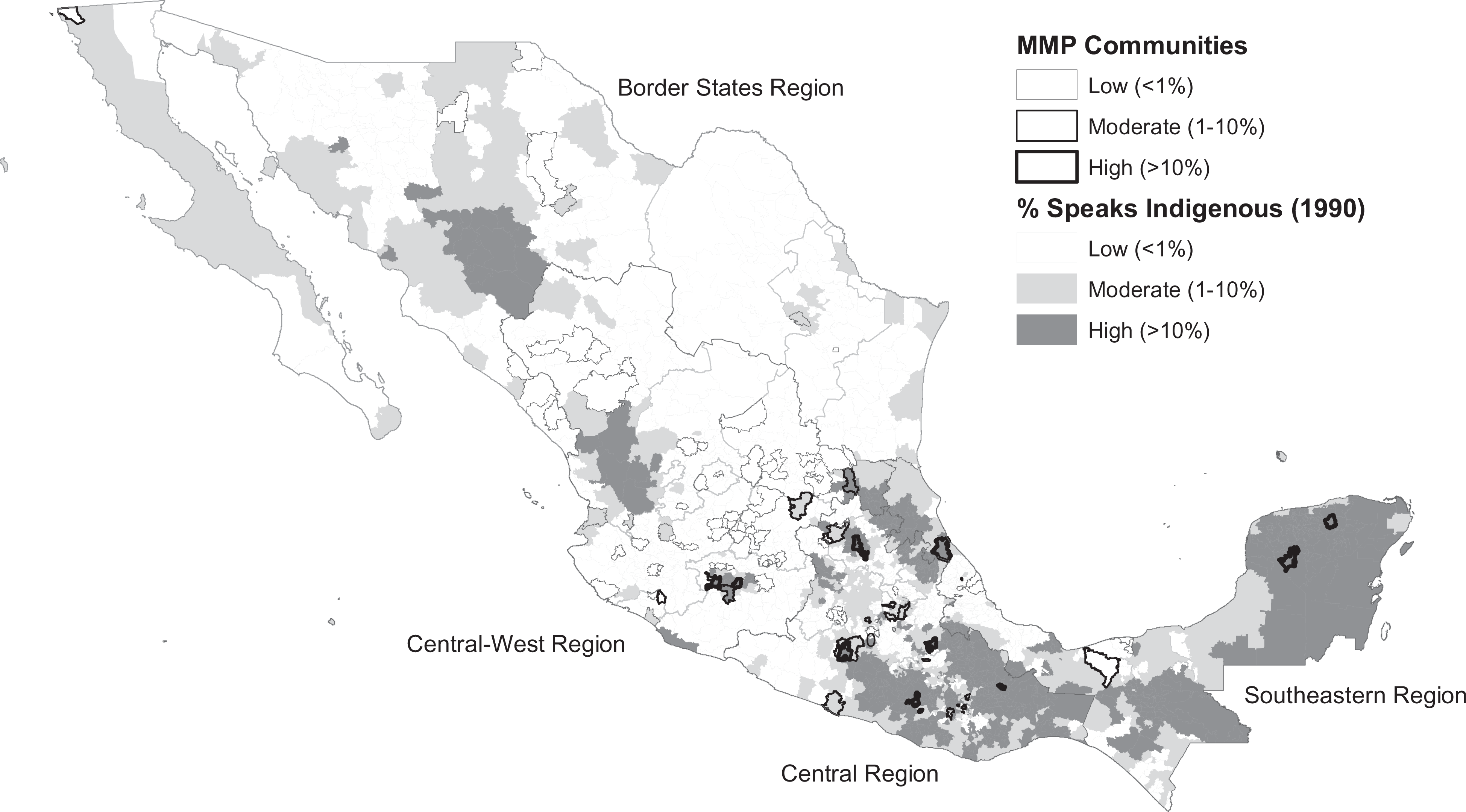
Map of surveyed MMP communities (outlined) and municipalities in Mexico (shaded), by percentage of residents speaking an indigenous language in 1990.
These characteristics of the data may influence our estimates in several ways. The later timing of the MMP survey in indigenous relative to non-indigenous areas may lead us to overestimate the odds of migrating undocumented because indigenous places with longer migration histories are missed. Yet our results may also underestimate the odds of migrating undocumented by overlooking indigenous areas where migration is rare or where Spanish-speaking indigenous households and communities are unavailable. We further suspect that migrants from indigenous places in our sample may be less likely to return to Mexico since they are migrating in an era of heightened enforcement at the Mexico-US border. Previous research suggests that while documented migrants may come and go as needed, border security “cages” undocumented migrants in the United States once they have entered (Massey and Pren 2012). This would likely bias our estimates downwards by undercounting those who migrate without documentation, who are overrepresented in indigenous areas. These limitations notwithstanding, our goal is not to identify the precise relationship between the context of indigeneity and (un)documented migration across all Mexican residents; instead, the inferences we draw stem from the households surveyed in the 143 communities included in the MMP. Our results, as we show, are robust even after considering a number of additional explanations for documentation differences.
We merge the MMP with data from the Mexican Census, conducted every five years since 1990, for respondents’ municipality of residence at the time of the survey. We make two assumptions in doing so. First, while places of birth and residence are the same for over 80 percent of our sample, the MMP data do not specify where individuals lived when they migrated. We thus assume characteristics of respondents’ survey place reflect the context from which migration occurred. Second, variation within municipalities along these contextual indicators is likely. The municipality is nevertheless the lowest aggregation of data available from the Mexican Census, and as such, we assume our estimates represent a lower bound for the variance of place effects.
Key Variables
Our dependent variable is migrants’ self- or household-reported documentation status when they last crossed the US border. Research shows that these reports reliably measure documentation (Bachmeier, Van Hook, and Bean 2014). We assign all migrants who entered with legal authorization at the time of their last US trip in the MMP data — including those holding temporary or discretionary statuses as well as lawful permanent residents and US citizens (see Table A1 in the Appendix) — to a single “documented” category that we compare with “undocumented” migrants, those entering without authorization. 10 We examine the last trip because one’s status at the time of the most recent entry implicates future opportunities for regularization; migrants whose last entry in the country is undocumented have limited recourse for legalization (Jasso et al. 2000). Initial trips to the United States among Mexican migrants are also more likely to be undocumented than later trips because some migrants eventually gain the financial or social capital required to secure documents (Orrenius and Zavodny 2005, 220; see also Massey, Durand, and Malone 2002; Aptekar 2015). Among migrants who took multiple US trips in our data, 37 percent of those lacking documentation on their first trip migrated documented on their last. Our focus on the final US trip should thus serve as a conservative test of the association between the context of indigeneity and documentation status. Nonetheless, 60 percent of migrants in the sample made only one US trip, with 28 percent of migrants from communities in high-indigenous municipalities, and 43 percent of migrants from communities in low-indigenous municipalities, making multiple trips. Results are similar when we examine instead the first trip.
Our primary independent variable is a categorical indicator of the proportion of people who speak an indigenous language in individuals’ municipality of residence. Although the literature debates whether language proficiency or ethnic identification better counts Mexico’s indigenous populations (see Villarreal 2014, 780–83, for a summary), we use the language measure for one crucial reason: 94.1 percent of those who speak an indigenous language also identify as indigenous; fewer than half of those who identify as indigenous report speaking an indigenous language (Villarreal 2014, 786). The municipalities most likely to be perceived as indigenous — whether for their cultural practices, language use, or subjective sense of belonging — are, thus, likely those with higher proportions of individuals proficient in an indigenous language (Friedlander 2006; Serrano Carreto 2006; Villarreal 2014). The proportions of people in a municipality speaking an indigenous language, self-identifying as indigenous, or reporting both are nonetheless highly correlated (r > 0.90). The results are similar using these alternative proxies.
Relying on a single measure of indigenous density, without regard to a specific indigenous population in Mexico, may appear to homogenize a heterogeneous population. As our above overview of ethnographic and historical research suggests (see also Fox 2006), Mexico’s 68 recognized indigenous groups have complex and diverse experiences with US-bound migration. Our indigeneity measure cannot analyze how distinct groups fare as they journey to the United States, but it does reflect how the socially meaningful differences that indigenous-origin communities use to distinguish themselves from one another in Mexico become less salient during US-bound migration due to their shared experiences of subordination (Nagengast and Kearney 1990; Fox 2006). This shared marginalization is tied to the economic and social contexts in Mexico from which these individuals migrate to the United States (Lomnitz 1977/2014, 41).
Municipal-level data on indigeneity are only available from the Mexican Census beginning in 1990, but last US trips in our sample range from 1915 to 2012. We fix indigenous density to 1990 values to minimize the potential for endogeneity, or the notion that a municipality’s history of Mexico-US migration affects its indigenous density. About 50 percent of migrants in our sample migrated before 1990. Municipal-level indigeneity decreases by about 2 percent, on average, between 1990 and 2010, and these changes are much larger for municipalities with high shares of indigenous-speaking residents. We thus expect the 1990 estimates to be conservative measures of indigeneity for those who migrated before 1990 because the share of indigenous-speaking residents is likely higher in their last migration year. Given the lack of data on indigeneity prior to 1990 and the large number of respondents who migrated before 1990, we cannot estimate the precise context from which respondents migrated. Results are nevertheless similar when restricting the sample to those migrating in or after 1990 and when we use linearly interpolated measures of indigeneity based on the year of last US migration.
Mexico’s National Population Council and National Commission for the Development of Indigenous Pueblos classify areas with at least 10 percent of indigenous-speaking residents in a municipality as having a substantial presence of indigenous residents (CONEVAL 2012, 39). We thus categorize communities in municipalities with shares of indigenous-speaking residents over 10 percent as “high,” those in municipalities with shares less than 1 percent as “low,” and those communities in municipalities with percentages in between as “moderate.” Across the municipalities included in the sample, the share of residents speaking an indigenous language ranges from 0.01 to 92.9 percent. This range is not normally distributed: approximately two-thirds of the MMP communities are located in low-indigenous municipalities. About 8.3 percent of all respondents live in high-indigenous municipalities. The substantive results, available upon request, are similar with alternative specifications of this indicator, including continuous and non-linear measures of the share of indigenous-speaking residents in municipalities.
Control Variables
We adjust our models for community characteristics particular to the MMP, as well as individual-, household-, and municipal-level characteristics that may be correlated with documentation based on the literature reviewed. These variables are observed at the time of survey, unless otherwise noted. We control for the MMP survey year to account for how communities were selected over time, as well as the community type (i.e., metropolitan area, smaller urban area, town, or rancho, based on MMP determinations of population sizes). Controls for the mean number of rooms in dwellings and the mean years of education in each community allow us to compare the socioeconomic status of individuals within a community to the community average. A dummy indicator for whether respondents lived in a Mexico-US border state at the time of the survey accounts for the possibility that these individuals were recently deported and have yet to return to their home community, may be preparing to migrate, or may migrate more often than their counterparts in non-border states (Durand and Massey 2003a, 78–79). No MMP community in a high-indigenous municipality is in a border state.
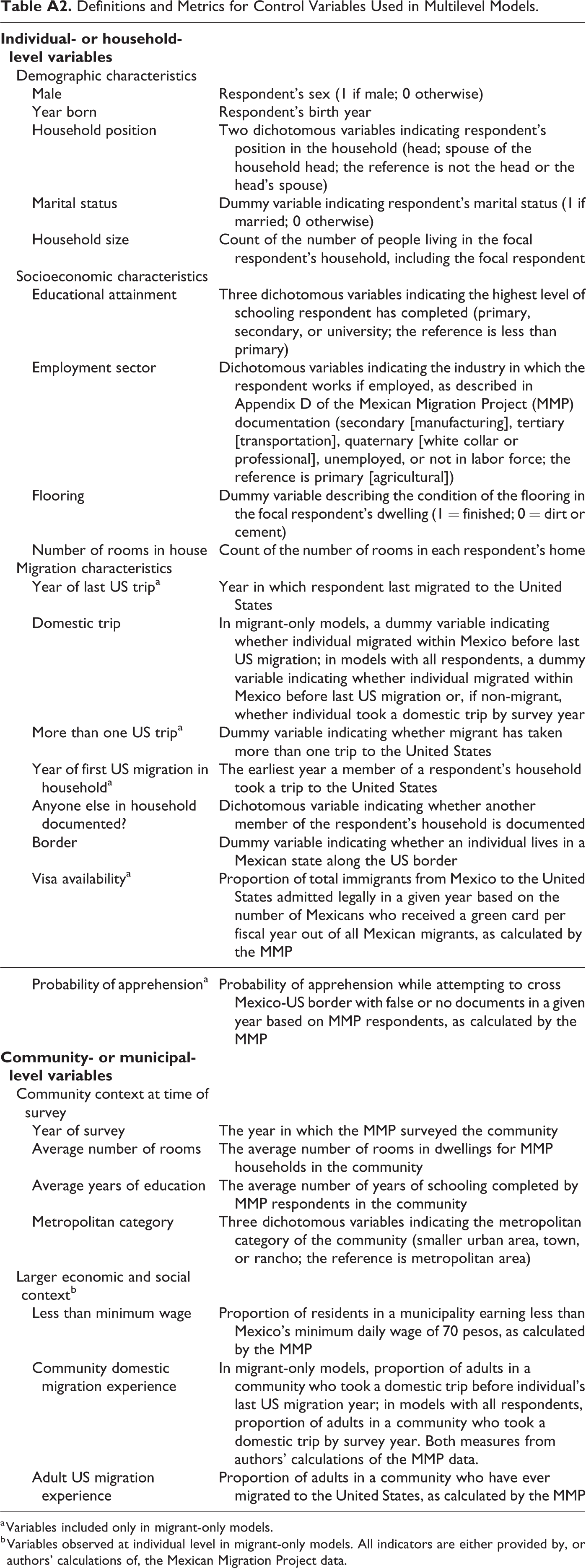
Controls for individuals’ demographic characteristics include birth year, sex, household position, marital status, and household size. Individuals’ socioeconomic characteristics are captured with measures of education, employment status, and occupational sector. We measure household-level socioeconomic status with the number of rooms in each individual’s home and whether the household has finished flooring (Massey et al. 1990). We control for domestic and Mexico-US migration characteristics with indicators reflecting whether individuals have ever migrated within Mexico, the year of Mexico-US migration, whether a migrant took more than one US trip, whether another household member ever made a legal US trip, and the year of the first Mexico-US migration among all household members. We also control for the legal context of Mexico-US migration with the probability of apprehension at the border and visa accessibility in the year of migration. Finally, we adjust for characteristics of migrants’ communities and municipalities with the share of individuals in a community who have migrated within Mexico, the share of the municipality earning less than the minimum wage, and the share of a community’s adults with Mexico-US migration experience. Table A2 in the Appendix provides details regarding all control variables included in the analysis, capturing demographic, socioeconomic, migration, and contextual characteristics.
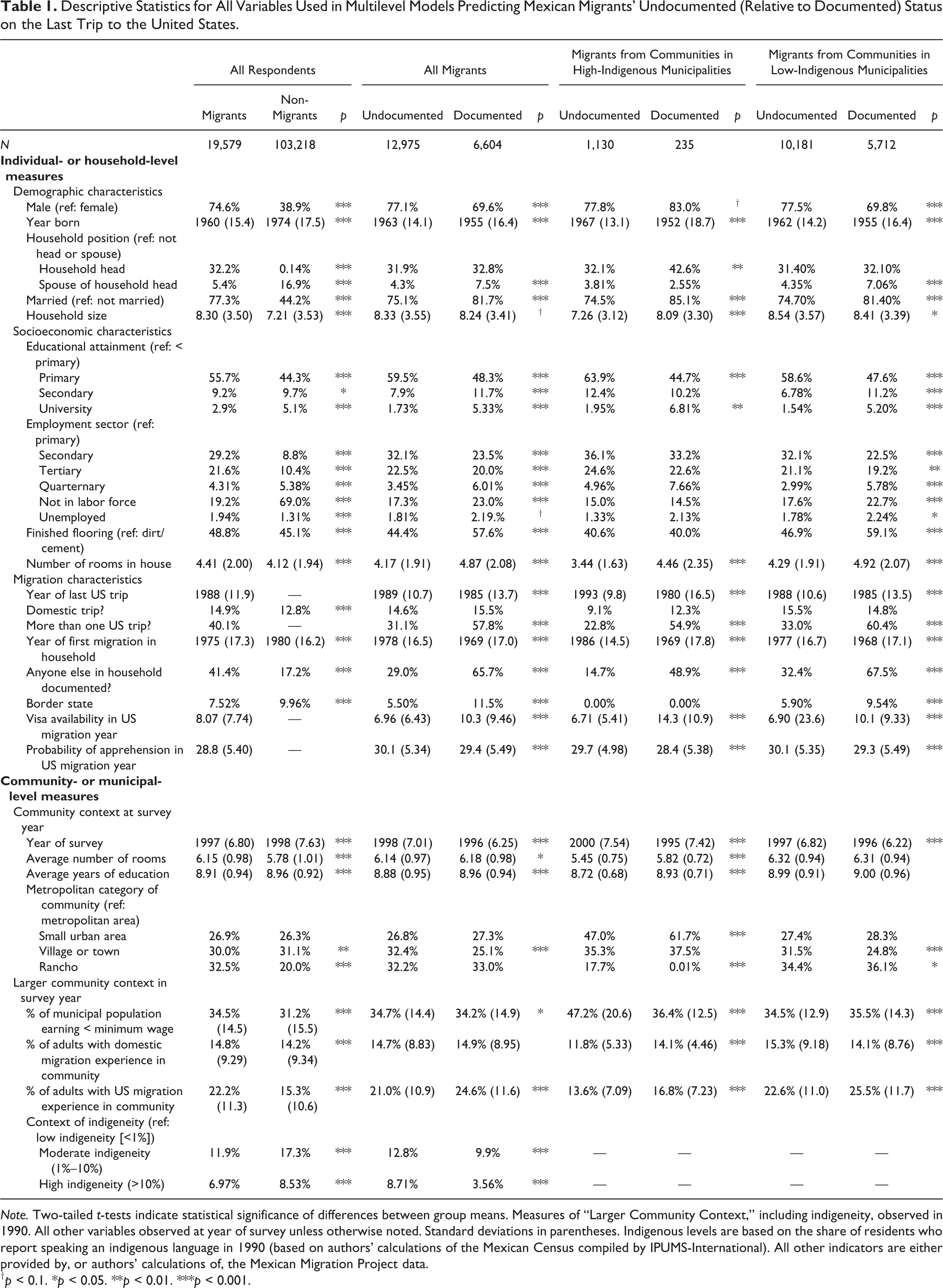
Table 1 compares means of the above indicators for several groupings of respondents, including (1) migrants and non-migrants, (2) undocumented and documented migrants, and undocumented and documented migrants within (3) high- and (4) low-indigenous municipalities. Compared with non-migrants, migrants are more likely to be male, older, a household head, married, more highly educated, to take a domestic trip, to be in the labor force, and to come from households with more extensive Mexico-US migration histories. When we examine average community- and municipal-level characteristics, there are large differences between migrants and non-migrants: migrants are less likely to migrate from metropolitan areas but more likely to migrate from ranchos and less economically developed municipalities with higher rates of domestic and Mexico-US migration experience in the community.
Descriptive Statistics for All Variables Used in Multilevel Models Predicting Mexican Migrants' Undocumented (Relative to Documented) Status on the Last Trip to the United States.
Note. Two-tailed t-tests indicate statistical significance of differences between group means. Measures of “Larger Community Context,” including indigeneity, observed in 1990. All other variables observed at year of survey unless otherwise noted. Standard deviations in parentheses. Indigenous levels are based on the share of residents who report speaking an indigenous language in 1990 (based on authors’ calculations of the Mexican Census compiled by IPUMS-International). All other indicators are either provided by, or authors’ calculations of, the Mexican Migration Project data.
†p < 0.1. *p < 0.05. **p < 0.01. ***p < 0.001.
When comparing undocumented to documented migrants at the time of their last trip, more are male and younger but have lower average education levels and limited migration experience. They live in households with unfinished flooring and short Mexico-US migration histories. Undocumented respondents are more likely to have migrated when access to visas was lower or the probability of apprehension was higher. Importantly for our study, undocumented respondents are more likely to come from high-indigenous municipalities (8.71% versus 3.56%), as well as communities with lower rates of Mexico-US migration and higher poverty levels.
The third set of columns compares undocumented and documented migrants from high-indigenous municipalities, who constitute 7.0 percent of the sample of migrants. The last column does the same for migrants from low-indigenous areas, who make up 81.2 percent of the sample’s migrants. Similar patterns hold for most individual characteristics, except for sex, employment sector, and flooring. These measures do not distinguish migrants in high-indigenous municipalities by documentation status, but female migrants, migrants in specific employment sectors, and migrants with finished flooring are more likely to migrate documented from low-indigenous municipalities. Notable differences exist among household- and community-level indicators for respondents in high- relative to low-indigenous municipalities: Respondents from indigenous areas live in households with limited Mexico-US migration histories, as well as lower rates of economic development and domestic migration. Within indigenous municipalities, undocumented relative to documented migrants are from areas with much higher rates of poverty and less domestic and Mexico-US migration experience; within low-indigenous ones, undocumented relative to documented migrants are from areas with more domestic but less US migration prevalence and slightly lower poverty levels on average. 11
Analytic Strategy
Our goal is to examine the association of the context of indigeneity with documentation status for Mexican migrants to the United States. We use HLM software, version 6.331, to estimate a series of multilevel models to account for the hierarchical structure of the data, in which individuals and households are nested within survey communities, and we predict the odds of undocumented relative to documented migration. Compared with single-level modeling approaches that account for nested data, multilevel modeling not only improves estimates of standard errors for our contextual variables of interest but also allows us to test for community-level effects on migrants’ documentation status (see Gelman and Hill 2006; Gelman 2012). Several alternative models — including single-level models with clustered errors by household and by community, as well as multilevel models that examine only household heads — yielded substantively similar results and are available upon request.
In our first set of models, we consider only migrants and fit a two-level logistic regression with individuals at the first level and communities at the second. In multilevel models, the Level 1 model represents a single equation in which the dependent variable — whether a migrant was undocumented on his or her last trip — is a function of an intercept and independent variables for the Level 1 units (i.e., migrants). The Level 2 model consists of a set of equations in which the dependent variables for each equation are the intercept and each of the coefficients in the Level 1 equation, respectively. The independent variables in the Level 2 equations represent independent variables for the Level 2 units (i.e., survey communities) and can differ across Level 2 equations. Formally, the Level 1 model is as follows:

where the dependent variable is the log odds of whether migrant i living in survey community j crossed undocumented on her or his last trip; β0j is the intercept for survey community j; and βkj represents a set of coefficients for the control variables, X, described above. The model’s second level is represented formally with the following series of equations:


The intercept for survey community j, β0j, is represented by Equation 2, where γ00 is the random intercept at Level 2; γ1j and γ2j are the coefficients for dummy indicators of whether the migrant lived in a moderate- or high-indigenous municipality, based on shares of indigeneity in 1990; γ kj are corresponding coefficients for community- and municipal-level control variables, Z; and δ0j is the random error term. The slopes for each Level 1 control variable, βkj, are represented by Equation 3, where γk0 is the random intercept for each coefficient k.
To account for the possibility that the mode of migration is not independent from the migration decision, we repeat the analysis with both migrants and non-migrants. In this second set of models, we use a three-level multinomial logistic regression with individuals at the first level, households at the second level, and communities at the third level to predict three possible outcomes: not migrating, migrating undocumented, or migrating documented. The analysis described above that contains only migrants does not include a level for households because a large proportion of households have only one or two migrants, making for sparse data structures that complicate estimation (Bell, Ferron, and Kromrey 2008). We cannot include some of the control variables used in the migrant-only models in this second set of models — for example, whether an individual took multiple US trips or the earliest Mexico-US migration year in a household — because some individuals did not take a US trip and some households have no migrants, respectively.
While individuals consider these three outcomes in the migration process (see Epstein 2008, 573), we also evaluated an alternative model specification — a single-level Heckman probit selection model with clustered errors by community — that assumes that the decision to migrate (un)documented is conditional on whether an individual chooses to migrate. This procedure models migration as a two-stage process, in which we first estimate the odds of migrating and then estimate the conditional probability of migrating undocumented. We use our household position indicators, which are highly correlated with migration but not documentation, as our exclusion restriction; results are substantively similar and available upon request.
A core property of multilevel models is that while individual-level characteristics may vary, the value of the higher-order units within which individuals are nested must be the same for all individuals within each unit. Accordingly, in our first set of models of migrants only, the time-varying measures of migrants’ larger economic and social contexts at the year of last migration are included as Level 1 variables, while indicators that approximate the community context at the time of the MMP survey are included at the second level. By contrast, in our second set of models of all MMP respondents, all contextual measures are observed in the survey year and included in the models at the community level (Level 3).
We centered all indicators around each variable’s mean for the entire sample. Accordingly, the Level 1 intercept represents the mean log odds of undocumented relative to documented migration for an individual who has average characteristics across all variables. We drop all respondents missing data for any variables used in the analyses, which removes about 5.2 percent of the sample. Patterns of missingness are not systematically related to either the dependent or primary independent variable, and our main results are similar when we consider models with the full sample and excluding variables with missing data. Our analytic sample of 22,373 households contains 122,797 individuals, of whom 19,579 have ever migrated to the United States.
Results
Stratification in Indigenous Places
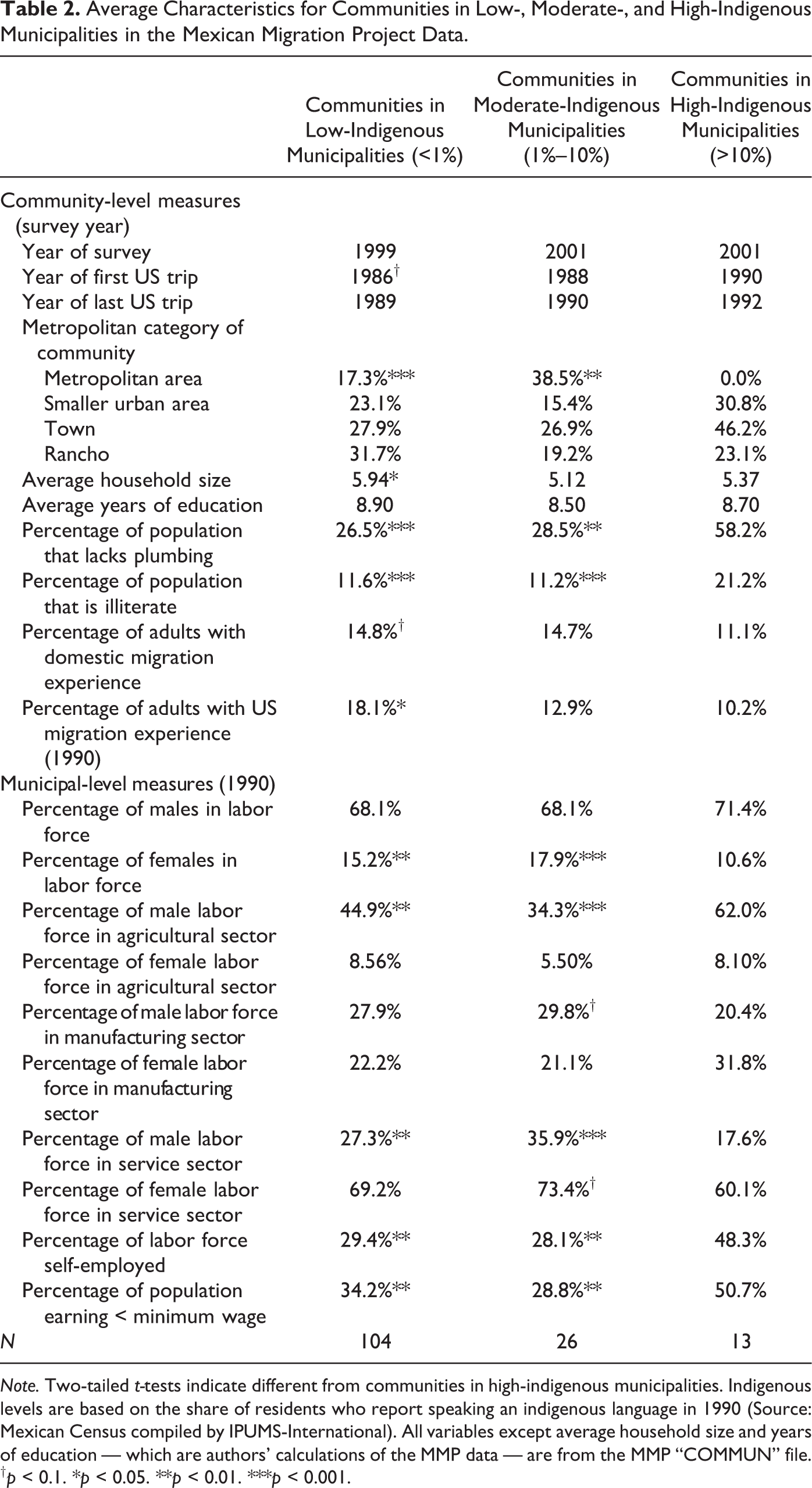
Table 2 presents summary characteristics of the MMP sample communities classified according to their degree of municipal-level indigeneity in 1990. MMP communities in indigenous municipalities are less likely than those in non-indigenous municipalities to have access to the economic and social resources useful for documented migration. With respect to income and wealth, communities in indigenous and non-indigenous municipalities have similar rates of male labor force participation. However, and reflective of their dependence on subsistence farming, men in indigenous municipalities are far more likely to work in agriculture and to be self-employed. Rates of economic development are also lower in indigenous relative to non-indigenous municipalities in the MMP data. Indigenous areas have higher rates of poverty, as measured by the share of residents earning below the daily minimum wage of 70 pesos in Mexico. This limited economic development coincides with indigenous municipalities’ relative lack of plumbing and greater share of residents who are illiterate. Migrant networks are also less extensive in the indigenous municipalities contained in the MMP data, reflective of these areas’ later timing and more limited histories of US-bound migration.
Average Characteristics for Communities in Low-, Moderate-, and High-Indigenous Municipalities in the Mexican Migration Project Data.
Note. Two-tailed t-tests indicate different from communities in high-indigenous municipalities. Indigenous levels are based on the share of residents who report speaking an indigenous language in 1990 (Source: Mexican Census compiled by IPUMS-International). All variables except average household size and years of education — which are authors’ calculations of the MMP data — are from the MMP “COMMUN” file.
†p < 0.1. *p < 0.05. **p < 0.01. ***p < 0.001.
Indigeneity and Documentation Status among US Migrants
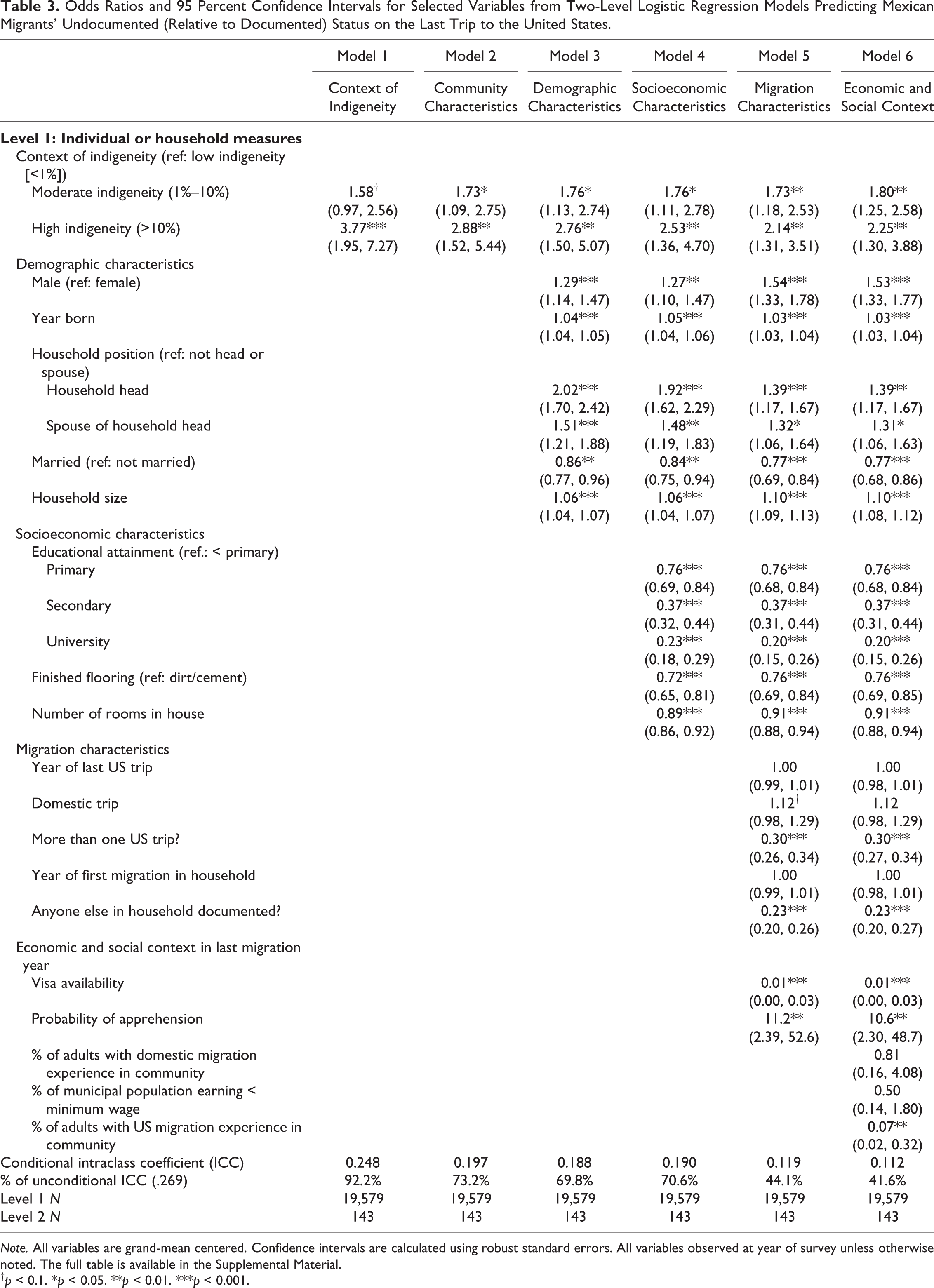
Table 3 presents odds ratios and 95 percent confidence intervals using robust standard errors for selected variables from the first set of models that include only migrants and predict whether Mexican migrants were undocumented on their last US trip. Full results are presented in the Supplemental Material (available in the online version of this article). The odds ratios for Level 1 variables represent the mean expected change in the odds of migrating undocumented relative to documented associated with a one-unit change in the predictor variable, holding other modeled characteristics constant and accounting for the data’s hierarchical structure. The Level 2 odds ratios, shown in the Tables S1 and S2 (available in the Supplemental Material), represent the expected change in the odds of migrating undocumented associated with a one-unit change in the predictor variable for the average migrant. An odds ratio greater than one indicates an increase in the odds of migrating undocumented relative to documented, while an odds ratio less than one indicates a decrease in the odds of undocumented relative to documented migration.
Odds Ratios and 95 Percent Confidence Intervals for Selected Variables from Two-Level Logistic Regression Models Predicting Mexican Migrants’ Undocumented (Relative to Documented) Status on the Last Trip to the United States.
Note. All variables are grand-mean centered. Confidence intervals are calculated using robust standard errors. All variables observed at year of survey unless otherwise noted. The full table is available in the Supplemental Material.
†p < 0.1. *p < 0.05. **p < 0.01. ***p < 0.001.
We also interpret differences in marginal effects to compare our results across models (see Mood 2010). The marginal effects presented reflect the change in the predicted probability of migrating undocumented for a migrant from a high- rather than low-indigenous municipality while holding all other variables at their means. To calculate the marginal effect, we subtract the predicted probability of migrating undocumented for a migrant from a low-indigenous municipality (0.50) from the predicted probability for a migrant from a high-indigenous municipality, which is calculated using its odds ratio. The unconditional model (not shown), which has no independent variables, has an intraclass correlation coefficient (ICC) of 0.269, indicating that approximately 27 percent of the variation in migrants’ documentation status is due to between- rather than within-community differences.
Our independent variable of interest is whether a migrant lives in a high- rather than low-indigenous municipality. We begin by testing our primary hypothesis that migrants from indigenous areas are more likely to make an undocumented rather than documented trip when compared with those from non-indigenous areas (Model 1). We proceed to add community characteristics at the time of the survey, including its metropolitan category, fieldwork year, whether it is in a state on the Mexico-US border, as well as each community’s average household size and education level (Model 2). We next consider individual- and/or household-level demographic characteristics (Model 3); individual- and/or household-level socioeconomic indicators (Model 4); and individual-, household-, and national-level migration characteristics (Model 5). Lastly, we evaluate if migrants’ larger economic and social contexts explain any observed association between the context of indigeneity and documentation status (Model 6).
From Model 1, which does not include controls, we find that migrants from high- relative to low-indigenous areas have 3.77 times higher odds of taking an undocumented last trip. In other words, the marginal effect of living in a high-indigenous area on undocumented migration is 0.29. The conditional ICC of 0.248 measures the degree of dependence among observations within communities after adding the independent variables. The interpretation of the conditional ICC percentage of the unconditional ICC is roughly the proportion of the total variation in between-community differences in documentation status that remains unexplained.
In Model 2, which accounts for various community characteristics at the time of the MMP survey, the odds ratio for high-indigenous places remains large at 2.88 and statistically significant (p < 0.01). Consistent with the literature reviewed earlier, we find that migrants from more recently surveyed communities have higher odds of migrating undocumented compared with those from communities surveyed in earlier years; and we find that those from rural areas, small towns, or villages have higher odds of migrating undocumented compared with migrants from metropolitan areas. We add individual-level demographic and socioeconomic characteristics in Models 3 and 4, respectively. In Model 4, the odds ratio for living in a high-indigenous municipality is 2.53 and remains a significant predictor of undocumented migration. The results from Model 4 indicate that the marginal effect of living in a high- rather than low-indigenous municipality on undocumented migration is 0.22. Consistent with neoclassical and new economics theories of migration, we find that differences in documentation status are classed: higher education levels and better housing quality are associated with lower odds of migrating undocumented.
Model 5 includes controls for individual, household, and national migration characteristics. Migrants from high- relative to low-indigenous municipalities still have higher odds of taking an undocumented last trip — having an odds ratio of 2.14 — which is weaker than prior models but remains statistically significant (p < 0.01). Several additional results stand out. First, we find support for the networked explanation: those who have taken multiple trips to the United States and those living in households in which other members have migrated documented have much lower odds of migrating undocumented compared with those who have less migration experience and those in households with no documented migrants, respectively. In contrast, we find only weak support (p < 0.10) that individuals’ experiences with internal migration are associated with documentation status. Second, though the year of Mexico-US migration is not significant in our models, we find support for the idea that the timing of migration matters: the probability of apprehension during the year of last US migration is associated with higher odds of migrating undocumented, while greater visa accessibility is associated with lower odds of migrating undocumented. This finding is similar in additional analyses not shown comparing those who migrated before and after IRCA was passed in 1986, which is consistent with the idea that US immigration laws have complicated migrants’ access to documentation over time. The addition of migration characteristics reduces the conditional ICC as a percentage of the unconditional ICC to 44 percent, suggesting that these control variables explain a substantial amount of the between-community variation in migrants’ documentation differences.
In Model 6, we control for characteristics that measure economic development, as well as domestic and Mexico-US migration histories, for migrants’ communities at the year of last migration. The odds ratio for high-indigenous municipalities is 2.25, having a marginal effect of 0.19. We do not find support for the economic development explanation, likely because our measure of economic development — the share of residents in a municipality earning less than the minimum wage — is highly correlated with the context of indigeneity. Nor do we find a relationship between communities’ domestic migration histories and migrants’ documentation outcomes. In contrast, we find support for community Mexico-US migration histories as an explanation for documentation differences: those from communities with higher rates of US-bound migration have much lower odds of migrating undocumented than do those from communities with lower rates. Nonetheless, including these variables does not weaken the estimated association of living in a community in a high-indigenous municipality with undocumented migration.
To examine the added explanatory power of the context of indigeneity on the odds of undocumented migration, we re-estimated Model 6 without the indigeneity indicators. In this model, the ICC is 0.124, which is 46.1 percent of the unconditional ICC; this is 4.5 percent higher than the results presented in Model 6. This result suggests that the context of indigeneity accounts for about 5 percent of the variation in between-community differences in migrants’ documentation. Although communities’ economic development and migration histories may be important, the context of indigeneity also appears to explain some proportion of the differences between communities in migrants’ documentation outcomes beyond factors predicted by the existing literature.
Indigeneity and Multiple US Migration Decisions
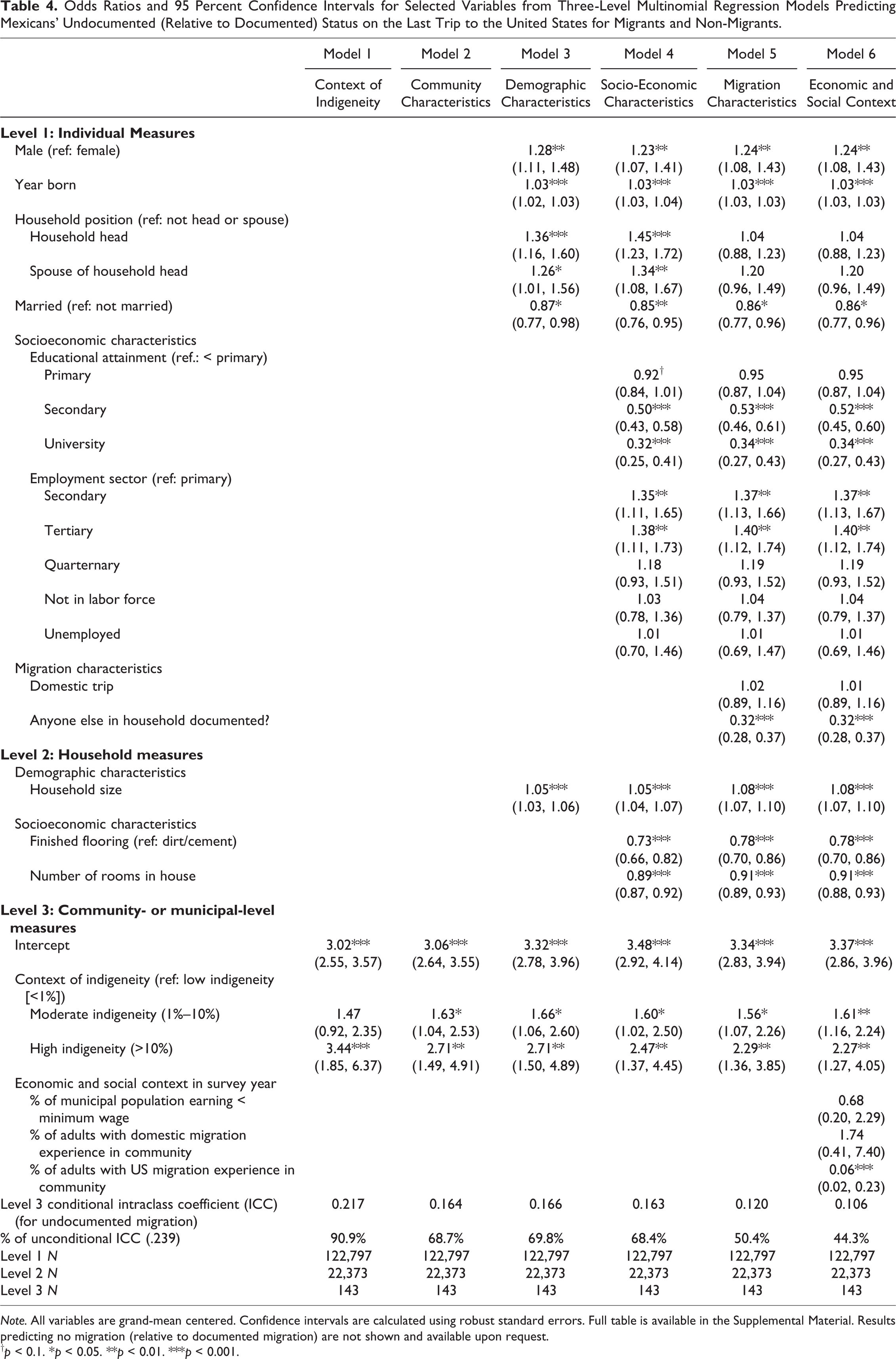
Our second set of models, which are three-level multinominal logistic regression models, includes migrants and non-migrants to account for individuals who make an alternative decision not to migrate. Documented migration remains the reference category. For brevity, Table 4 presents results for selected variables only for undocumented relative to documented migration. 12 Full results are in the Supplemental Material. The odds ratios presented for Level 1 variables are interpreted as in our first set of models. The Level 2 and Level 3 odds ratios represent the expected change in the odds of migrating undocumented associated with a one-unit change in the predictor variable for the average migrant and average household, respectively. We compute and interpret the marginal effects as in the first set of models.
Odds Ratios and 95 Percent Confidence Intervals for Selected Variables from Three-Level Multinomial Regression Models Predicting Mexicans’ Undocumented (Relative to Documented) Status on the Last Trip to the United States for Migrants and Non-Migrants.
Note. All variables are grand-mean centered. Confidence intervals are calculated using robust standard errors. Full table is available in the Supplemental Material. Results predicting no migration (relative to documented migration) are not shown and available upon request.
†p < 0.1. *p < 0.05. **p < 0.01. ***p < 0.001.
The results in the second set of models are substantively similar to those presented in Table 3. Without including any control variables (Model 1), the marginal effect of being from a high- relative to low-indigenous municipality on documentation status is 0.27. This variable remains statistically significant across all models. In the fully adjusted model (Model 6), the marginal effect of having origins in a high-indigenous municipality is 0.19, which is similar to that estimated in the fully adjusted model from Table 3.
The odds ratios in Table 4 are nearly identical to those in Table 3, with three exceptions. The associations between one’s household position and documentation status, as well as between those whose highest level of education is primary school and those who did not complete primary school and documentation status, are weaker and insignificant in Models 5 and 6. These indicators instead predict migration relative to non-migration. We also find that migrants working in the second (i.e., manufacturing) and third (i.e., transportation) occupational sectors have higher odds of migrating undocumented compared with those in the first (i.e., agricultural) sector. Despite these differences, documented migration is associated with social class, individual networks, and community migration histories, even when we consider individuals who decide not to migrate. Most importantly, the context of indigeneity remains an important predictor of documentation status, net of these other factors. Further, when we compare our results with a model that excludes the indigeneity variables, we find that over 5 percent of additional variation in documentation status between communities is unexplained.
Additional Considerations
While indigenous places are associated with lower levels of economic development and US-bound migration, the added explanatory power of indigeneity suggests that these areas entail additional disadvantages associated with the context of indigeneity that impede residents’ access to documentation. Nonetheless, these disadvantages may be beyond those included in our analyses. As summarized in Table 2, indigenous municipalities have a distinct set of correlated conditions that suggest that they are economically and socially disadvantaged relative to low-indigenous municipalities. We examine in additional analyses whether alternative indicators for economic and social context — such as female labor force participation or the percentage of individuals in the agricultural sector — explain the association between municipal-level indigeneity and documentation; our substantive results remain.
An additional factor that may affect our results is that most MMP communities in high-indigenous municipalities are in Central and Southeastern Mexico (see Figure 1), which only recently have experienced economic development and growth in US-bound migration. By contrast, the MMP communities in the two high-indigenous municipalities in Central-Western Mexico — the region that represents the traditional locus of Mexico-US flows — are relatively advantaged socioeconomically. In supplementary analysis, we find no association between the context of indigeneity and documentation outcomes for migrants in central-western communities. Thus, while economic development and community Mexico-US migration histories do not explain our overall findings, our results suggest that a bundle of factors may underlie between-community differences in migrants’ documentation status in Central and Southeastern Mexico. High indigeneity, coupled with limited economic development and low Mexico-US migration prevalence, appear to impede migrants’ access to documentation in these areas.
A final consideration is whether the context of indigeneity bears on individuals’ documentation outcomes or whether it merely captures the unmeasured characteristics described above. To grapple with this issue, we examine the outcomes of the 3.1 percent of respondents who moved away from their birth communities and either moved from low- to high-indigenous municipalities, or vice versa. If indigeneity shapes documentation outcomes, then individuals who move from low- to high-indigenous areas should be more likely to migrate undocumented than otherwise-similar individuals who remain in low-indigenous municipalities. Similarly, individuals who move from high- to low-indigenous municipalities should be less likely to migrate undocumented than otherwise-similar individuals who remain in high-indigenous places.
Although the sample of movers across indigenous categories is small (n = 194), descriptive statistics support the idea that high-indigenous municipalities have distinct characteristics that structure migrants’ documentation outcomes. A lower share of migrants who were born in high- but surveyed in low-indigenous municipalities migrated undocumented than did those born and surveyed in high-indigenous municipalities (p < 0.05). In contrast, a higher share of migrants who were born in low- but surveyed in high-indigenous municipalities migrated undocumented than did those born and surveyed in low-indigenous municipalities, but this difference was not statistically significant at conventional levels. Further, when we measure indigeneity based on individuals’ birth rather than survey municipalities, the relationship between indigeneity and undocumented migration is significantly weaker — having odds ratios of 1.48 and 1.44 in the fully adjusted two- and three-level models, respectively.
Overall, the results suggest that the context of indigeneity is associated with migrants’ access to the economic and social resources needed for taking a documented US trip. The context of indigeneity also entails economic and social disadvantages beyond those observed in our variables or predicted in existing literature that make residents of these places disproportionately likely to migrate undocumented than documented.
Discussion and Conclusion
Stratification researchers have illuminated how the uneven distribution of economic and social resources across communities often falls along racial or ethnic dimensions. However, few studies have evaluated how these dynamics operate in a cross-border setting that considers migrant-sending and migrant-receiving countries. Indigeneity is a primary dimension of stratification in Mexico, but demographers have seldom examined how it relates to migratory processes. As Fox (2006, 42) notes, a “cross-border perspective would…deepen our understanding of” how inequalities in Mexico are reproduced in the United States. We show that the context of indigeneity is associated with migrants’ documentation outcomes when entering the United States, above and beyond microlevel considerations, such as class and social networks, and macrolevel factors, such as the timing of migration, economic development, and community migration histories. These results suggest that indigeneity is an important factor shaping Mexicans’ pathways for taking a documented trip to the United States.
Our results bridge the literatures on place stratification and international migration by pointing to the consequences that living in indigenous places has on cross-border movement. To date, major theories of international migration have focused on how individuals’ access to coveted financial and social resources initiates or sustains migration flows relative to non-migration. Our results reveal a rarely considered dimension of social stratification operating in a cross-border setting and suggest that the context of indigeneity entails distinct disadvantages beyond the economic and social resources that we observe in our data that further restrict migrants’ opportunities for documented migration. Ethnographic work on how economic and social disadvantage are tightly intertwined with indigeneity (Bartolomé 1997, 67) intimates that the resources useful for taking a lawful trip to the United States — such as income and wealth, as well as network connections and communities’ histories of migration — are distinctly lacking in indigenous areas. Our results support this notion with one of the largest-scale analyses of survey data to date on migrants and non-migrants living in 143 Mexican communities.
By revealing that the context of indigeneity is associated with Mexican migrants’ opportunities for documented migration to the United States, our analyses also lend support to ethnographic work that suggests how ethnic classifications in Mexico “operate with political and social force…among Mexico-origin populations in the U.S.” (Stephen 2012, 95; see also Blackwell, Lopez, and Urrieta 2017, 128). Though we lack data to identify a causal relationship, the association we observe is robust to several checks and alternative modeling specifications discussed in detail earlier. We emphasize three considerations here, which provide reassurance that the bundle of characteristics associated with living in an indigenous place relates to documentation outcomes. First, when we exclude the indigeneity indicators from our fully adjusted models, we explain 5 percent less of the variation in between-community differences in migrants’ documentation. Second, migrants born in high- but surveyed in low-indigenous municipalities were less likely to migrate undocumented than did those born and surveyed in high-indigenous municipalities; the reverse was true for migrants born in low- but surveyed in high-indigenous municipalities. Finally, the association between indigeneity and undocumented migration is significantly weaker in fully adjusted models when we measure indigeneity based on individuals’ birth rather than survey place.
Additional work is needed to extend our analyses. First, research with data capable of attributing causal effects to place would be invaluable. Specifically, longitudinal data with information on migrants and non-migrants that include both individual- and contextual-level measures of indigeneity would help assess whether individual- or municipal-level indigeneity — or both — is associated with documentation outcomes. Although ethnographic research illustrates how residence in an indigenous area limits individuals’ access to material and symbolic resources regardless of individual-level claims to indigeneity (Batalla 1996; Friedlander 2006; Novo 2006), data with detailed measures of indigeneity could examine how indigeneity operates at multiple levels to shape documentation status.
Second, demographic research attuned to the complex histories and uneven trajectories of US-bound migration from diverse indigenous communities in Mexico is needed. Our analyses reveal that communities in indigenous municipalities in Central-Western Mexico may have greater access to the resources useful for acquiring documentation than do those in Central and Southeastern Mexico. Ethnographic research on the topic informs these results by pointing to heterogeneity in how specific indigenous groups in Central-Western Mexico (Durand 1994) and Central and Southeastern Mexico (Schmidt and Crummett 2004; Quezada Ramírez 2008; Schmidt 2012) participate in international movement. Analyses of large-scale survey or census data that scrutinize migratory processes from specific indigenous communities would provide a macrolevel complement to these microlevel studies.
Third, we relied on municipal-level measures of individuals’ economic and social contexts — the smallest aggregation of nationally representative data available — but municipalities may not adequately approximate individuals’ localized environments. Efforts to replicate our results with smaller units of analysis might offer further validation of the association between the context of indigeneity and documentation status identified here.
Finally, research is needed to identify what unobserved mechanisms may explain the association between the context of indigeneity and documentation status. Extant literature suggests at least two explanations. First, given that communities within indigenous municipalities tend to be economically underdeveloped, they often lack financial institutions such as banks or money lenders necessary to provide migrants with the funds required to afford documentation (Massey et al. 1990, 235–36). Second, research shows how various migrant brokers — “migrants…who capitalize on their experience, professionals in organizations concerned with labor recruitment, or respected individuals in the sending or receiving communities who facilitate or enable contacts of potential and actual migrants to employers and legal authorities” (Faist 2010, 79) — help mediate opportunities for documented migration. Absent the availability of these economic and social institutions, individuals from indigenous places may be more likely to migrate undocumented than documented.
Our study nevertheless contributes to understandings of place stratification and international migration. Focusing on Mexico-US migration, we elaborate how systems of stratification in migrant-sending countries, such as the context of indigeneity, may have implications for stratification along other dimensions, such as documentation status, in migrant-receiving countries. Doing so helps reveal how inequality moves across national borders. Our findings suggest that who holds an undocumented status in the United States, at least among the Mexican-immigrant population, is conditioned by patterns of inequality that map onto ethno-racial dimensions in migrants’ origin settings. Future demographic research attuned to the cross-border portability of ethno-racial dimensions of inequality may well uncover that migrants from indigenous places in Mexico bear the burden of an undocumented status in the United States.
Supplemental Material
Supplemental Material, MRX801059_Supplemental_Material - Indigenous Places and the Making of Undocumented Status in Mexico-US Migration
Supplemental Material, MRX801059_Supplemental_Material for Indigenous Places and the Making of Undocumented Status in Mexico-US Migration by Asad L. Asad and Jackelyn Hwang in International Migration Review
Footnotes
Appendix
Types of Documentation Used on Last US Trip by Migrants in Communities in Low-, Moderate-, and High-Indigenous Municipalities in the Mexican Migration Project Data. Note. P-values test statistical significance of difference between group means for US migrants in communities in low- and high-indigenous municipalities. Indigenous levels are based on the share of residents who report speaking an indigenous language in 1990 (based on authors’ calculations of the Mexican Census compiled by IPUMS-International). †p < 0.1. *p < 0.05. ***p < 0.001 (two-tailed tests). Definitions and Metrics for Control Variables Used in Multilevel Models. a Variables included only in migrant-only models. b Variables observed at individual level in migrant-only models. All indicators are either provided by, or authors’ calculations of, the Mexican Migration Project data.
Communities in Low-Indigenous Municipalities (<1%)
Communities in Moderate-Indigenous Municipalities (1%–10%)
Communities in High-Indigenous Municipalities (>10%)
Description of Documentation Status
p
Undocumented on last trip
64.1
71.7
82.8
Lacks legal authorization to enter the United States at the time of the last trip.
***
Documented on last trip
US citizen
1.16
1.68
1.03
Entitled to the same rights and privileges as any US-born citizen, except ineligible to be president or vice president if not US-born.
Lawful resident
22.0
13.6
8.6
Achieved primarily through family- or employment-based relationships. Lawful residents enjoy work authorization in the United States but are deportable, unable to vote, and face certain constraints to accessing public benefits.
***
Silva Letter
0.04
0.00
0.00
A temporary and discretionary status that provided work authorization and deportation relief for mostly-Mexican migrants in the US Southwest in the 1970s. Most Silva Letter holders went on to become legal residents.
Bracero
3.37
2.37
4.18
Entered the United States on a contract for short-term farm labor under the auspices of the Bracero Program between 1942 and 1964.
H2A or H2B
1.25
0.26
0.59
Agricultural (H2A) or nonagricultural (H2B) workers who are offered a job that is of a temporary or seasonal nature.
*
Temporary worker
0.92
0.47
0.95
Other temporary workers who did not receive an H2A or H2B visa.
Temporary tourist
7.19
9.91
1.83
Individuals admitted to the United States on a tourist visa and who lack work authorization.
***
Unknown
0.01
0.00
0.07
Specific type of documentation status missing or unreported.
—
N
15,893
2,321
1,365
Demographic characteristics
Male
Respondent’s sex (1 if male; 0 otherwise)
Year born
Respondent’s birth year
Household position
Two dichotomous variables indicating respondent’s position in the household (head; spouse of the household head; the reference is not the head or the head’s spouse)
Marital status
Dummy variable indicating respondent’s marital status (1 if married; 0 otherwise)
Household size
Count of the number of people living in the focal respondent’s household, including the focal respondent
Socioeconomic characteristics
Educational attainment
Three dichotomous variables indicating the highest level of schooling respondent has completed (primary, secondary, or university; the reference is less than primary)
Employment sector
Dichotomous variables indicating the industry in which the respondent works if employed, as described in Appendix D of the Mexican Migration Project (MMP) documentation (secondary [manufacturing], tertiary [transportation], quaternary [white collar or professional], unemployed, or not in labor force; the reference is primary [agricultural])
Flooring
Dummy variable describing the condition of the flooring in the focal respondent’s dwelling (1 = finished; 0 = dirt or cement)
Number of rooms in house
Count of the number of rooms in each respondent’s home
Migration characteristics
Year of last US tripa
Year in which respondent last migrated to the United States
Domestic trip
In migrant-only models, a dummy variable indicating whether individual migrated within Mexico before last US migration; in models with all respondents, a dummy variable indicating whether individual migrated within Mexico before last US migration or, if non-migrant, whether individual took a domestic trip by survey year
More than one US tripa
Dummy variable indicating whether migrant has taken more than one trip to the United States
Year of first US migration in householda
The earliest year a member of a respondent’s household took a trip to the United States
Anyone else in household documented?
Dichotomous variable indicating whether another member of the respondent’s household is documented
Border
Dummy variable indicating whether an individual lives in a Mexican state along the US border
Visa availabilitya
Proportion of total immigrants from Mexico to the United States admitted legally in a given year based on the number of Mexicans who received a green card per fiscal year out of all Mexican migrants, as calculated by the MMP
Probability of apprehensiona
Probability of apprehension while attempting to cross Mexico-US border with false or no documents in a given year based on MMP respondents, as calculated by the MMP
Community context at time of survey
Year of survey
The year in which the MMP surveyed the community
Average number of rooms
The average number of rooms in dwellings for MMP households in the community
Average years of education
The average number of years of schooling completed by MMP respondents in the community
Metropolitan category
Three dichotomous variables indicating the metropolitan category of the community (smaller urban area, town, or rancho; the reference is metropolitan area)
Larger economic and social contextb
Less than minimum wage
Proportion of residents in a municipality earning less than Mexico’s minimum daily wage of 70 pesos, as calculated by the MMP
Community domestic migration experience
In migrant-only models, proportion of adults in a community who took a domestic trip before individual’s last US migration year; in models with all respondents, proportion of adults in a community who took a domestic trip by survey year. Both measures from authors’ calculations of the MMP data.
Adult US migration experience
Proportion of adults in a community who have ever migrated to the United States, as calculated by the MMP
Acknowledgments
The authors thank the International Migration Review editorial team and the anonymous reviewers, as well as Frank Bean, Matthew Clair, Filiz Garip, Hope Harvey, and Alix S. Winter, for helpful feedback on previous versions of this article. Audiences at the Migration and Immigrant Incorporation and Quantitative Methods Workshops at Harvard University, as well as the annual meetings of the Eastern Sociological Society, the Social Science History Association, the Population Association of America, and the American Sociological Association, also provided insightful comments. Any errors are authorial.
Declaration of Conflicting Interests
The author(s) declared no potential conflicts of interest with respect to the research, authorship, and/or publication of this article.
Funding
The author(s) disclosed receipt of the following financial support for the research, authorship, and/or publication of this article: The National Science Foundation Graduate Research Fellowship (NSF; Grant No. DGE1144152), the Radcliffe Institute for Advanced Study, and the Eunice Kennedy Shriver National Institute of Child Health and Human Development of the National Institutes of Health (NIH; Grant No. T32HD007163) supported this research. The content in this article is solely the responsibility of the authors and does not necessarily represent the views of the National Science Foundation, the Radcliffe Institute, or the National Institutes of Health.
Supplemental Material

Notes
References
Supplementary Material
Please find the following supplemental material available below.
For Open Access articles published under a Creative Commons License, all supplemental material carries the same license as the article it is associated with.
For non-Open Access articles published, all supplemental material carries a non-exclusive license, and permission requests for re-use of supplemental material or any part of supplemental material shall be sent directly to the copyright owner as specified in the copyright notice associated with the article.
