



Abstract
This article provides evidence that, like adult immigrants, male childhood immigrants in the United States, that is, those who arrived before age 18, have experienced a declining trend in their earnings, educational attainment, and English language proficiency over time. Consistent with a strong relationship between the outcomes of parents and children, I find that these declining trends in childhood immigrant outcomes can be explained by controlling for the earnings, and especially educational attainment, of the “potential parents” of these childhood immigrants, that is, adult immigrants from the same birthplace who arrived to the United States during the same time period. Such intergenerational correlations appear to be stronger for childhood immigrants who arrive at a later age. These results highlight the importance of considering immigration from a multi-generational perspective, where the characteristics of immigrants admitted today inform the economic prospects of future generations.
Introduction
Understanding how immigrants perform economically after they migrate is of obvious importance in crafting good immigration policy. Much of the immigration policy discussion focuses on which adult immigrants (those who arrive age 18 or older) to admit. The United States, for example, has various visa categories, such as H-1B, that specifically target skilled workers. Other countries, including Canada and Australia, employ points-based immigration systems that favor, for example, immigrants with high education levels. However, characteristics such as educational attainment show significant intergenerational persistence for both immigrants and non-immigrants (Solon 1992); thus, selecting which adult immigrants to admit has consequences beyond the current generation.
The earnings of adult immigrants to the United States (i.e., those arriving age 18 and older) have declined for more recently arrived immigrants relative to immigrants who arrived in the late 1960s (Borjas 1985, 1995a). 1 Less, however, is known about the economic performance of childhood immigrants (those who arrive before age 18) across cohorts, where “cohort” refers to the time period during which an immigrant arrived in the United States. This is a notable omission. In 2010, for example, 14.5 percent of employed men in the United States were immigrants, and 27.0 percent of these immigrants arrived in the United States as children. Thus, childhood immigrants represent a substantial proportion of the working immigrant population.
There are a number of reasons to suspect that childhood immigrants, often referred to as the “1.5 generation,” differ from adult immigrants in important ways. First, language acquisition is believed to be easier for children than for adults, a phenomenon known as the critical period hypothesis (see Chiswick and Miller 2008). The English language ability of US immigrants is an important determinant of earnings (see Bleakley and Chin 2004); thus, differences in language acquisition between adult and childhood immigrants may lead to different economic outcomes between these groups. Second, childhood immigrants are more likely to have acquired some schooling in the United States, which is important if the returns to schooling acquired abroad differ from those of schooling acquired domestically. 2 Also, attending school provides immigrants an opportunity for significant exposure to English, which can aid in the acquisition of English language proficiency (Chiswick and Miller 1995). Finally, nearly all a childhood immigrant’s work experience is accrued in the United States alone, while an adult immigrant may have acquired part of his or her work experience abroad. This difference is relevant since the returns to labor market experience acquired abroad may differ from those acquired in the United States. For all these reasons, when evaluating immigrants’ economic outcomes, adult immigrants and childhood immigrants should be considered separately.
Childhood immigrants, even those who arrived to the United States at a very young age, may also differ from the US-born children of immigrants. For example, US-born children of immigrants are automatically US citizens, while childhood immigrants may not be. Also, differences between the United States and source countries in factors like nutrition and access to healthcare may imply a lasting impact of being born abroad compared to being born in the United States. Thus, childhood immigrants and US-born children of immigrants should also be viewed as distinct (though related) groups.
Duleep and Regets (2002) and Green and Worswick (2012) argue that entry earnings (i.e., earnings measured shortly after arrival in the United States) are an incomplete assessment of an immigrant cohort’s “quality” and that a fuller evaluation of a cohort’s economic performance should instead consider the present value of earnings after arrival, since newly arrived immigrants may trade present earnings for future earnings through human-capital investment. Since parents may also forgo present earnings to invest in their children, it is sensible to extend the assessment of cohort quality beyond the present variable of lifetime earnings and include the earnings of the children of adult immigrants. Studying the children of these adult immigrants, including childhood immigrants, thus provides a fuller picture of the cohort “quality” of adult immigrants by extending the present value of their lifetime earnings to include the next generation.
Due to strong intergenerational correlations in earnings between parents and children, particularly in the United States (Aydemir, Chen, and Corak 2009), one would expect that childhood immigrants’ labor market outcomes are similar to those of their parents and, thus, that declining parental earnings would lead to declining earnings among their children. However, there are several reasons why arriving to a new country as a child, rather than as an adult, may mute or reduce quality differences between immigrant arrival cohorts. If at least some of the decline in adult immigrants’ entry earnings is due to poorer English language ability, this disadvantage should be lessened among childhood immigrants, who can more easily acquire English proficiency. Similarly, if educational differences are driving the decline in cohort earnings, childhood immigrants may experience fewer differences by cohort since they acquire more of their education in the United States. Finally, as discussed above, adult immigrants’ negative cohort effects may in part be driven by these adult immigrants sacrificing their earnings to invest more heavily in their children. It is not obvious, therefore, whether the earnings decline among adult immigrants who arrived after the late 1960s would extend to childhood immigrants to the same extent.
One of the few papers that investigates cohort effects for childhood immigrants is Bonikowska and Hou (2010), who study immigrants to Canada. They find that childhood immigrants’ earnings continue to lag behind native earnings, although successive cohorts of childhood immigrants were more likely to complete university than were natives. They also find that the educational attainment of the “potential” parents of childhood immigrants (i.e., adult immigrants from the same birthplace who arrived to Canada at the same time) is highly relevant in explaining both the earnings and educational attainment of childhood immigrants. However, Canada has a very different immigration policy and history than the United States, so these results may not translate closely to US immigrants.
One advantage of focusing on childhood immigrants born abroad, as opposed to the US-born children of immigrants, is that their entry into the labor market can be observed earlier than it can for the US-born children of immigrants of the same adult immigrant year of arrival cohort. Further advantages relate to data availability: parental birthplace is not available in the US Census after 1970. While the Current Population Survey (CPS) includes parental birthplace information after 1994, there is a long gap in the data between 1970 to 1994. Furthermore, the CPS has relatively small samples compared to the Census, which makes examining group characteristics problematic, especially when dividing by birthplace, age at migration, and years since migration. Also, the CPS does not include immigrant year of arrival to the United States. Since this article considers childhood immigrants whose birthplace is measured in the Census and since it assumes that their parents arrived from the same birthplace at the same time, these issues are avoided.
This article uses US Census data from 1970 to 2011 to test whether the decline in the earnings of male adult immigrant cohorts after the 1960s extends to male childhood immigrants as well. The same methodology as Borjas (1985), as well as many others (e.g., Friedberg 1992; Aydemir and Skuterud 2005), is employed to separately identify cohort, years since migration, and age at migration effects by pooling multiple Census years and natives and immigrants together. The results indicate that as with adult immigrants, the earnings of childhood immigrants (once they entered the labor force) declined for cohorts arriving after the late 1960s. For example, 21 to 25 years after arrival, male childhood immigrants exhibited declines in age-adjusted earnings across cohorts from 2.2 percent higher than natives for the cohort that arrived between 1965 and 1969 to 6.1 percent lower than natives for the 1975–1979 arrival cohort and finally to 15.1 percent lower than natives for the 1985–1989 arrival cohort. The earnings decline across childhood immigrant cohorts occurs for all age-at-migration groups; however, little change is observed between the 1985–1989 and 1995–1999 arrival cohorts, suggesting the declining trend may have ceased and reinforcing the finding that adult immigrants’ declining entry earnings reversed between the late-1980s and late-1990s arrival cohorts (Borjas and Friedberg 2009). I also observe declines across cohorts in both educational attainment and English language proficiency. Note, however, that the latest cohort included in my analysis arrived in the late 1990s, since cohorts of childhood immigrants who arrived after the late 1990s are still entering the labor force. Thus, it is uncertain to what extent the patterns of declining earnings of childhood immigrants will continue for childhood immigrants who arrived to the United States in the year 2000 and later. In the concluding section of this article, I provide further discussion of how childhood immigrants arriving during the 2000s may fare economically in the future.
To help explain childhood immigrants’ declining economic performance between the late-1960s and late-1980s cohorts and given the importance of the intergenerational transmission of skills between parents and children (Borjas 1993; Card, DiNardo, and Estes 2000), controls for the earnings and educational attainment of the parental cohort from the same birthplace and arrival cohort are added. As my analysis shows, controlling for these measures of parental skills can explain the entire declines in earnings, educational attainment, and English language proficiency of childhood immigrants between the late-1960s and late-1980s cohorts. I also find evidence that the intergenerational correlations between parental skills and childhood immigrant outcomes are stronger for older-arriving immigrants.
The existing literature, in particular Borjas (1985, 1995a), has typically considered the earnings of male immigrants. Since I am interested in extending the previous literature to study childhood immigrants, the results presented here also focus on men. However, I repeat all results for female childhood immigrants and natives and include them in the Supplemental Appendix (available in the online version of this article). While the Supplemental Appendix includes a more detailed discussion of results for women, which differ in a number of ways from those for men, the main findings hold: there were declines in earnings, educational attainment, and English language proficiency for female childhood immigrants from the 1965–1969 cohort to the 1995–1999 cohort that can be explained by controlling for the parental cohort’s skills.
Borjas and Friedberg (2009) find that the declining trend in entry earnings of adult immigrants reversed for the 1995–1999 adult immigrant cohort, although this trend is not attributable to changes in source country. My results, however, suggest a leveling off in earnings between the late-1980s and late-1990s arrival cohorts. The reason for this difference appears to be related to educational attainment: the parental educational attainment of the late-1990s cohort does not show improvement over the late-1980s cohort, even though improvement in earnings is evident, consistent with Borjas and Friedberg. Given that the intergenerational results strongly support parental educational attainment, more so than parental earnings, as relevant in explaining childhood immigrants’ outcomes, the leveling off of the negative cohort effects in childhood immigrants’ earnings between the late 1980s and late 1990s is to be expected.
More generally, my results confirm the importance of adult immigrants’ characteristics not only on their own economics outcomes but also on their children’s outcomes. If a goal of immigration policy is to maximize some measure of immigrant cohort “quality,” where quality is viewed from a longer-term, multi-generational perspective, understanding the outcomes of childhood immigrants within these cohorts is critical. Attracting immigrants with higher levels of education would appear to lead to increased earnings not only for adult immigrants but also for the childhood immigrants with whom they arrive.
To develop these arguments, the article is organized as follows. I begin by discussing the data used in my analysis and how key variables are constructed. I then provide evidence of how the earnings of childhood immigrants, relative to natives and adjusted by age, have declined over time and across year of arrival cohorts. The subsequent section, using the methodology introduced in Borjas (1985), provides evidence of negative cohort effects in the earnings, educational attainment, and English proficiency of childhood immigrants. The next section introduces measures of parental skills and finds that controlling for parental skills can fully explain the negative cohort effects in the outcomes of childhood immigrants. This section also provides evidence that the correlations between parental skills and the outcomes of childhood immigrants are stronger for older-arriving than for younger-arriving childhood immigrants. The article concludes with a discussion of the results and their implications for immigration policy, as well as a brief discussion of how childhood immigrants who arrived during the 2000s may perform economically in the future, given the skills of their parental cohort.
Data and Variables
Data for this analysis are taken from the US Census Integrated Public Use Microdata Series (Ruggles et al. 2017) 1970, 1980, 1990, and 2000 decennial Census and the 2009–2011 three-year pooled American Community Survey (ACS) (henceforth the 2010 sample). 3 In the 1970, 1980, and 1990 Census samples, year of immigration is available only in intervals, while in later Census surveys, the actual year of immigration is known. 4 Year of immigration is particularly important when studying childhood immigrants since it is used to calculate years since migration and age at migration, which in turn is used to classify immigrants as either adult or childhood immigrants. To facilitate comparison across samples, the year of immigration in the 1990, 2000, and 2010 samples is converted to the same intervaled structure as the 1980 sample. 5 Following Bleakley and Chin (2004), the maximum year of arrival in a given range of values is used when calculating years since migration, which underestimates the true years since migration for some immigrants and, thus, overestimates their true age at migration. As a result, some older childhood immigrants are mis-allocated as adult immigrants but in a consistent manner across years. The sample of immigrants is restricted to those who arrived after 1960, since the year of immigration variable in the 1980 survey becomes much less precise for arrival years prior to 1960.
Adult immigrants are excluded from the sample. Male workers age 25 and older who are not enrolled in school, are not in group quarters, and report a positive earned income and positive number of weeks worked are included. The oldest immigrant in the sample is age 63 in 2010, so natives ages 25 to 63 are included to match. These restrictions imply that no immigrants are observed until 11 to 20 years after migration and, thus, that no immigrants who arrived in 2000 or later are included.
The sample contains eight immigrant arrival cohorts: 1960–1964, 1965–1969, and so forth until 1995–1999. The first two cohorts (1960–1964 and 1965–1969) are observed four times (1980, 1990, 2000, and 2010 samples), the next two cohorts three times (1990, 2000, and 2010), the next two cohorts twice (2000 and 2010), and the final two cohorts only once (2010). There are eight years since migration groups: 11–15, 16–20, and so forth until 46–50. The sample is divided by age at migration so that each age at migration group appears entirely in a given cohort-years since migration group or does not appear at all. Thus, the following five groups for age at migration are used: 0–3, 4–8, 9–13, 14–15, and 16–17.
The primary variable of interest is log weekly earnings. 6 The language proficiency variable is self-reported and takes one of five values, from does not speak English to speaks only English. Educational attainment takes one of five values: high-school dropout, high-school graduate, some college, college graduate, and more than college.
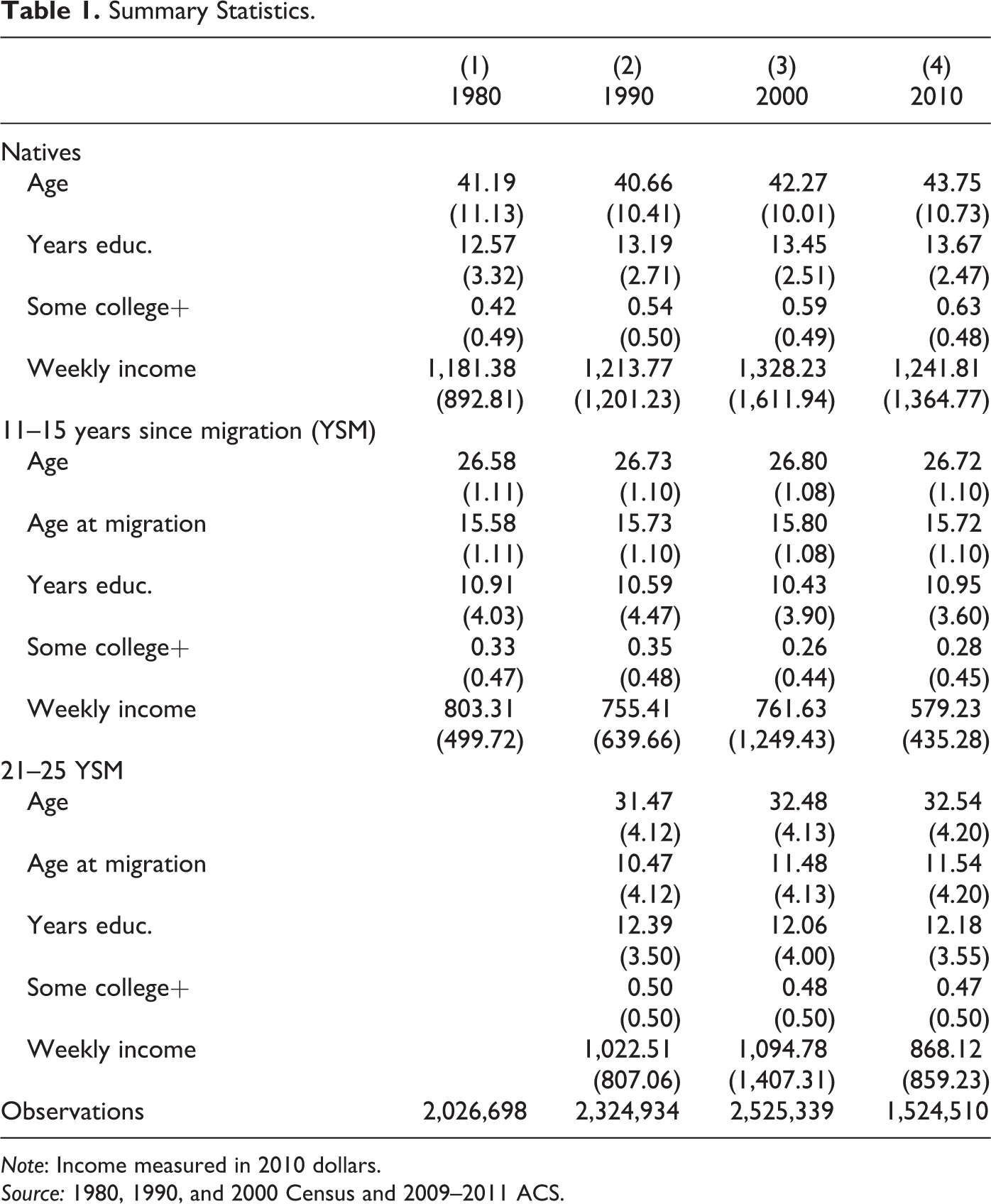
Table 1 shows a small number of descriptive statistics, separately by year, for natives and a subset of immigrant cohorts at the 11–15 and 21–25 years since migration groups. For example, in 1990, 11–15 and 21–25 years since migration correspond to the 1965–1969 and 1975–1979 arrival cohorts, respectively. Reading across the rows compares different cohorts but at the same time since their arrival. Age at migration remained stable over time for the 11–15 years since migration group, although it increased by approximately a year for the 21–25 years since migration group. The deterioration in weekly income relative to natives is clear: in 1990, the 1965–1969 arrival cohort had been in the United States for 21–25 years and had mean weekly earnings of $191 per week less than natives; 21–25 years after migration, the 1975–1979 and 1985–1989 arrival cohorts had mean weekly earnings that were $234 and $374 lower than natives, respectively.
Summary Statistics.
Note: Income measured in 2010 dollars.
Source: 1980, 1990, and 2000 Census and 2009–2011 ACS.
Earnings Gap by Cohort
To further illustrate how childhood immigrants’ earnings have changed across arrival cohorts, each childhood immigrant’s age-adjusted earnings gap with natives in a particular year is calculated. This methodology follows Schaafsma and Sweetman (2001), where in each survey year t, a log earnings regression is estimated on native workers only, controlling for age:

Then, using these regression coefficients, each immigrant’s predicted earnings is calculated, given his age. The difference between the actual and predicted log earnings is the earnings gap:

Table 2 shows the mean earnings gap for a subset of cohorts separately by years since migration. 7 It is important to note that reading across rows, the reduction in the earnings gap observed for all arrival cohorts is not necessarily evidence of earnings assimilation, as it would be with adult migrants, because a cohort’s average age at migration decreases as years since migration increases as younger-arriving immigrants become old enough to enter the labor force.
Log Weekly Earnings Gap, by Cohort and Years since Migration.

Note: The table shows the age-adjusted log weekly earnings gap of childhood immigrants relative to natives, separately by cohort and years since migration. Standard error of the mean shown in parentheses.
Source: 1980, 1990, and 2000 Census and 2009–2011 ACS.
Comparing arrival cohorts at the same years since migration controls for the age at migration distribution, so the main results come from reading down each column, where columns (1) through (4) include immigrants with 11–15, 21–25, 31–35, and 41–45 years since migration, respectively. Comparing the first two rows, there was little change between the 1965–1969 and 1975–1979 arrival cohorts in the first years since migration group but a large decline in the 21–25 years since migration group. Comparing rows 2 and 3, a sizable difference is observed in both columns (1) and (2), indicating a large decline in earnings between the 1975–1979 and 1985–1989 arrival cohorts. Finally, a small decline is observed between the 1985–1989 and 1995–1999 arrival cohorts in the 11–15 years since migration group, which is the only group where the 1995–1999 arrival cohort appears. Overall, from the 1965–1969 to the 1995–1999 arrival cohort, childhood immigrants with 11–15 years since migration experienced a 13.0 percent decline in earnings, while between the 1965–1969 and 1985–1989 arrival cohorts, childhood immigrants with 21–25 years since migration experienced a 17.3 percent decline in earnings.
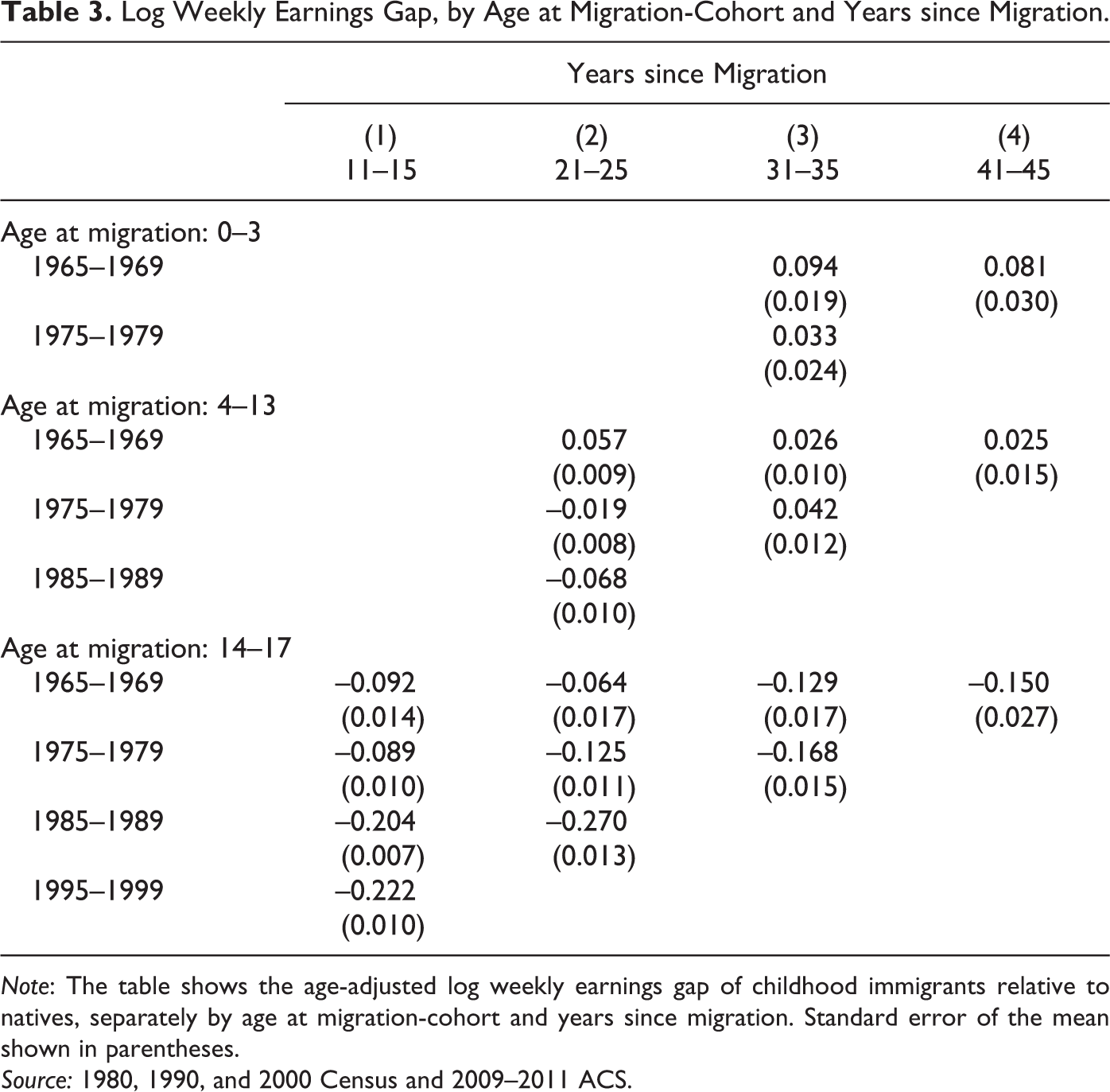
Table 3 shows the earnings gap results where each arrival cohort is separated by age at migration. For brevity I aggregate age at migration into three groups: 0–3, 4–13, and 14–17. Within each age at migration and years since migration group, with only a few exceptions, there is a declining trend in the age-adjusted log weekly earnings gap of childhood immigrants across cohorts. For example, within the 14–17 group, between the 1965–1969 and 1985–1989 arrival cohorts, an 11.2 percent decline in earnings is observed in the 11–15 years since migration group, while a 20.6 percent decline is observed for the 21–25 years since migration group.
Log Weekly Earnings Gap, by Age at Migration-Cohort and Years since Migration.
Note: The table shows the age-adjusted log weekly earnings gap of childhood immigrants relative to natives, separately by age at migration-cohort and years since migration. Standard error of the mean shown in parentheses.
Source: 1980, 1990, and 2000 Census and 2009–2011 ACS.
Cohort Effects
Econometric Model
While the earnings gap results strongly support a decline in childhood immigrant earnings between the late-1960s and late-1990s arrival cohorts, they do not control for important characteristics such as birthplace. Estimating the cohort effects in a regression model allows other controls to be introduced to help explain the observed decline in earnings and to test the statistical significance of the cohort effects.
The approach used to estimate cohort effects follows the methodology introduced by Borjas (1985). An immigrant i’s earnings is assumed to depend on several characteristics, including his age (

This specification suffers from multicollinearity both because years since migration is the difference between survey year and arrival year (

As is common in the literature (e.g., Borjas 1985; Friedberg 1992; Borjas 1995a, 2015), the coefficients for the survey year for natives and immigrants are set equal, so:
The estimation procedure described above implies that the control group (i.e., the group to which I am comparing childhood immigrants) are native-born and of the same age. This is not the only option available. For example, Green and Worswick (2012) compare newly arrived immigrants to natives that have recently entered the labor market, on the basis that from a human-capital investment perspective, these two groups share similar macro events. Since I am studying childhood immigrants, the logical control group are natives of the same age since they enter the labor force at the same time as do childhood immigrants.
Cohort Effects: Earnings
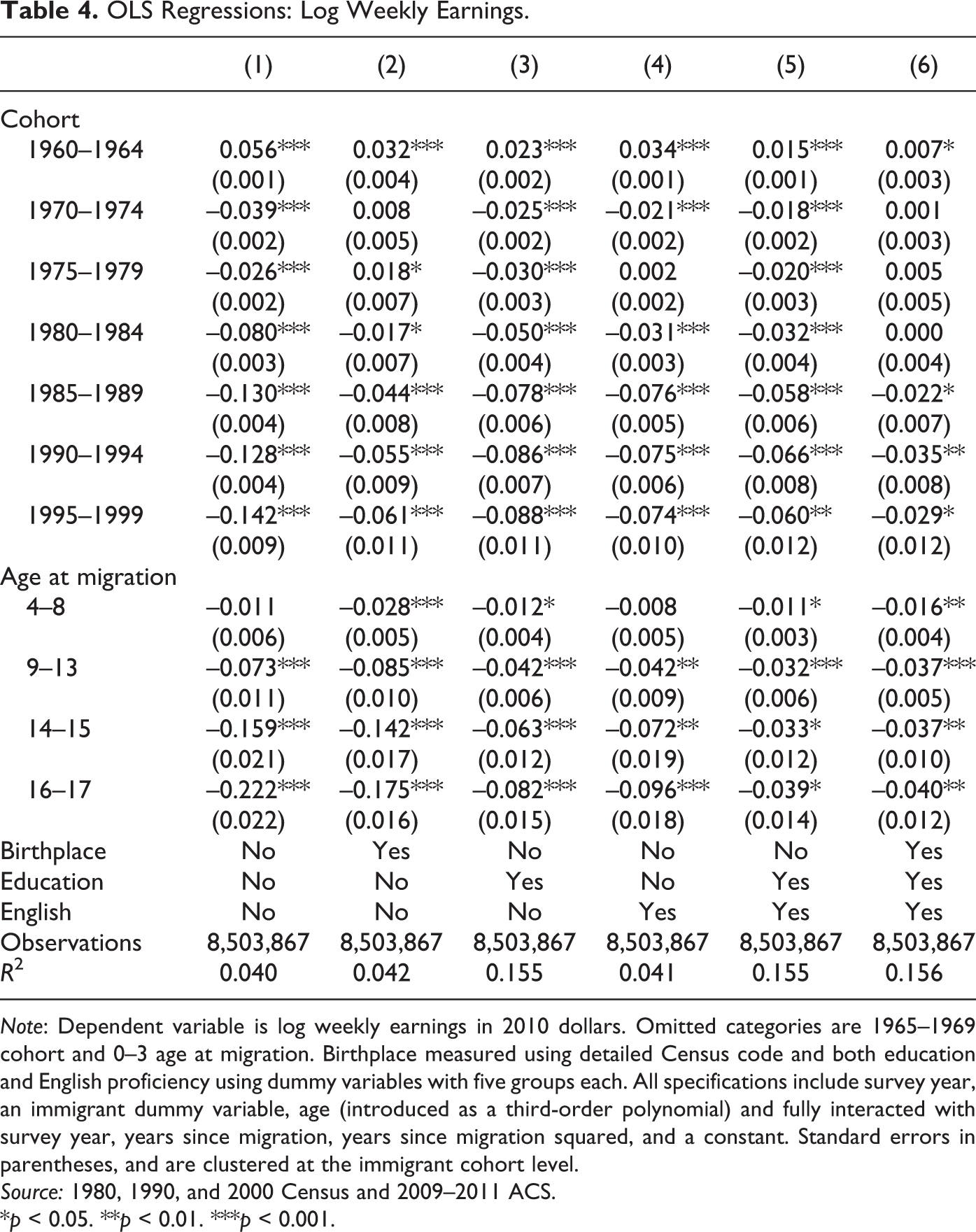
Table 4 shows the pooled regression results for log earnings. Only the coefficients on the immigrant cohort dummy variables (the coefficients of primary interest) and the age at migration controls are shown, although controls for survey year, age (introduced as a third-order polynomial) interacted with survey year, years since migration, years since migration squared, and an immigrant dummy variable are included. The omitted categories are 1965–1969 for arrival cohort and 0–3 for age at migration group.
OLS Regressions: Log Weekly Earnings.
Note: Dependent variable is log weekly earnings in 2010 dollars. Omitted categories are 1965–1969 cohort and 0–3 age at migration. Birthplace measured using detailed Census code and both education and English proficiency using dummy variables with five groups each. All specifications include survey year, an immigrant dummy variable, age (introduced as a third-order polynomial) and fully interacted with survey year, years since migration, years since migration squared, and a constant. Standard errors in parentheses, and are clustered at the immigrant cohort level.
Source: 1980, 1990, and 2000 Census and 2009–2011 ACS.
*p < 0.05. **p < 0.01. ***p < 0.001.
The baseline estimation results are shown in column (1). Consistent with the discussion above, the dummy variables for cohorts who arrived 1970 and later are negative and statistically significant: the 1975–1979 arrival cohort effect is relatively small, at only 2.6 percent below the 1965–1969 arrival cohort, while the 1985–1989 arrival cohort effect is 13.0 percent below the 1965–1969 arrival cohort, and the 1995–1999 cohort is slightly larger still, at 14.2 percent below. The declining cohort effect on childhood immigrants’ earnings largely leveled off after the 1985–1989 arrival cohort. Also, and consistent with Friedberg (1992), I find a strong, negative relationship between age at migration and earnings for immigrants who arrived age nine and older.
Perhaps the most frequent explanation for the overall decline in immigrant economic performance in the United States has been the change in the origin country, away from more developed European countries and toward less developed Latin American and Asian countries (Borjas 1992). The most notable trend has been the substantial increase in childhood immigrants from Mexico and corresponding decrease in immigrants from Western Europe and other developed countries. Among childhood immigrants, for example, between the 1965–1969 and 1985–1989 arrival cohorts, the share from Mexico increased by 72 percent, while the share from Western Europe, Canada, Australia, or New Zealand declined by 87 percent. 9
Column (2) of Table 4 adds controls for birthplace to the baseline specification. Controlling for birthplace substantially reduces the cohort effects’ size, although they remain statistically significant: the cohort effects, relative to the 1965–1969 arrival cohort, for the 1985–1989 and 1995–1999 arrival cohorts, change to –4.4 percent and –6.1 percent, respectively, when birthplace controls are introduced. 10 These results suggest that changes in origin country can help explain a large portion of the decline in earnings experienced by childhood immigrants.
The next three estimations introduce direct measures of human capital — educational attainment and English language proficiency. Column (3) of Table 4 adds education controls to the baseline estimation from column (1) but does not include birthplace controls. Education helps explain a large portion of the cohort effects, although interestingly, less than does birthplace. Column (4) introduces English language proficiency. As with education, English proficiency explains a substantial portion of the cohort effects, although a large portion remains unexplained for most cohorts. Note also that the age at migration coefficients decline greatly in magnitude when either education or English proficiency controls are included, which is consistent with the negative impact of arriving at a later age on earnings acting largely through lower educational attainment and poorer English language proficiency. Column (5) adds both education and English language controls. The cohort effects decline further, as do the age at migration effects, although again negative cohort effects are still present. Finally, the estimation in column (6) adds birthplace controls, education, and English language proficiency. The cohort effects are all further reduced to near zero.
While I discuss a number of robustness checks in the Supplemental Appendix, the issue of how to address age at migration requires particular attention. First, while defining a childhood immigrant as one who arrives before age 18 is common (e.g., Bleakley and Chin 2004), it is not the only option: for instance, Bonikowska and Hou (2010) use age 12 and under as their threshold, while Clarke (2016) uses age 14. In Supplemental Table A1 in the Supplemental Appendix, I repeat column (1) of Table 4 for different maximum values of age at migration by changing the upper threshold of what defines a childhood immigrant. The trade-off is that lowering the age at migration level reduces the number of cohorts observed, since younger-arriving immigrants from later cohorts are not yet old enough to appear in the sample. Nonetheless, regardless of which maximum age I use, I continue to find negative cohorts effects in earnings of later cohorts relative to earlier cohorts that have stayed fairly flat since the late-1980s arrival cohort.
An interesting finding, however, is that excluding the highest age at migration group (ages 16–17) appears to reduce the magnitude of the negative cohort effects, suggesting that these effects have been strongest for that particular age group. I test this explicitly in Supplemental Table A2 in the Supplemental Appendix, which again repeats column (1) of Table 4 but for different age at migration values. In other words, I allow the cohort effects to vary by age at migration group. As expected, the age 16–17 group appears to have significantly more negative cohort effects across all cohorts that arrived after the late 1960s compared to the lower age at migration groups.
One reason for this larger negative cohort effect among the oldest-arriving childhood immigrants may be driven by source country. In particular, older-arriving childhood immigrants arrive disproportionately from Mexico. Thus, insofar as source country is impacting childhood immigrants’ cohort effects, differences in source-country composition across age at migration groups will lead to different cohort effects. Also, the intergenerational correlations between childhood immigrant outcomes and those of their parental cohort may vary, depending on age at migration, as is explored in more detail in a later section.
While English proficiency and educational attainment help explain large portions of childhood immigrants’ negative cohort effects, it is important to note these are, at least to some extent, choices made by childhood immigrants after arrival. The question of what is driving the changes in educational attainment and English proficiency across cohorts over time remains. It is with this in mind that the following section tests if cohort effects are also present for these measures of human capital.
Cohort Effects: Educational Attainment and English Language Proficiency
This section explores how English language proficiency and educational attainment vary across cohorts. The goal of these estimations is to identify whether, and to what extent, we observe cohort differences in two measures of human capital that are important for immigrant success in the labor market. This is done by repeating the same estimation procedure discussed above for log weekly earnings but changing the dependent variable. I follow Ehrlich and Kim (2015), who define high-skilled immigrants as those with at least some college. Thus, for educational attainment, the dependent variable equals one if the worker has at least some college and zero otherwise. I do, however, repeat the results using at least high-school graduate and at least college graduate to define high-skilled immigrants and include the results in the Supplemental Appendix. For language proficiency, the dependent variable equals one if the immigrant is proficient in English and zero otherwise, where proficiency is defined as reporting speaking English either very well or only English. The estimation of educational attainment includes both natives and immigrants, but natives are excluded from the English language proficiency estimation since the vast majority of native workers are proficient in English. This exclusion requires dropping year and age coefficients as they cannot be separately identified without the native sample.
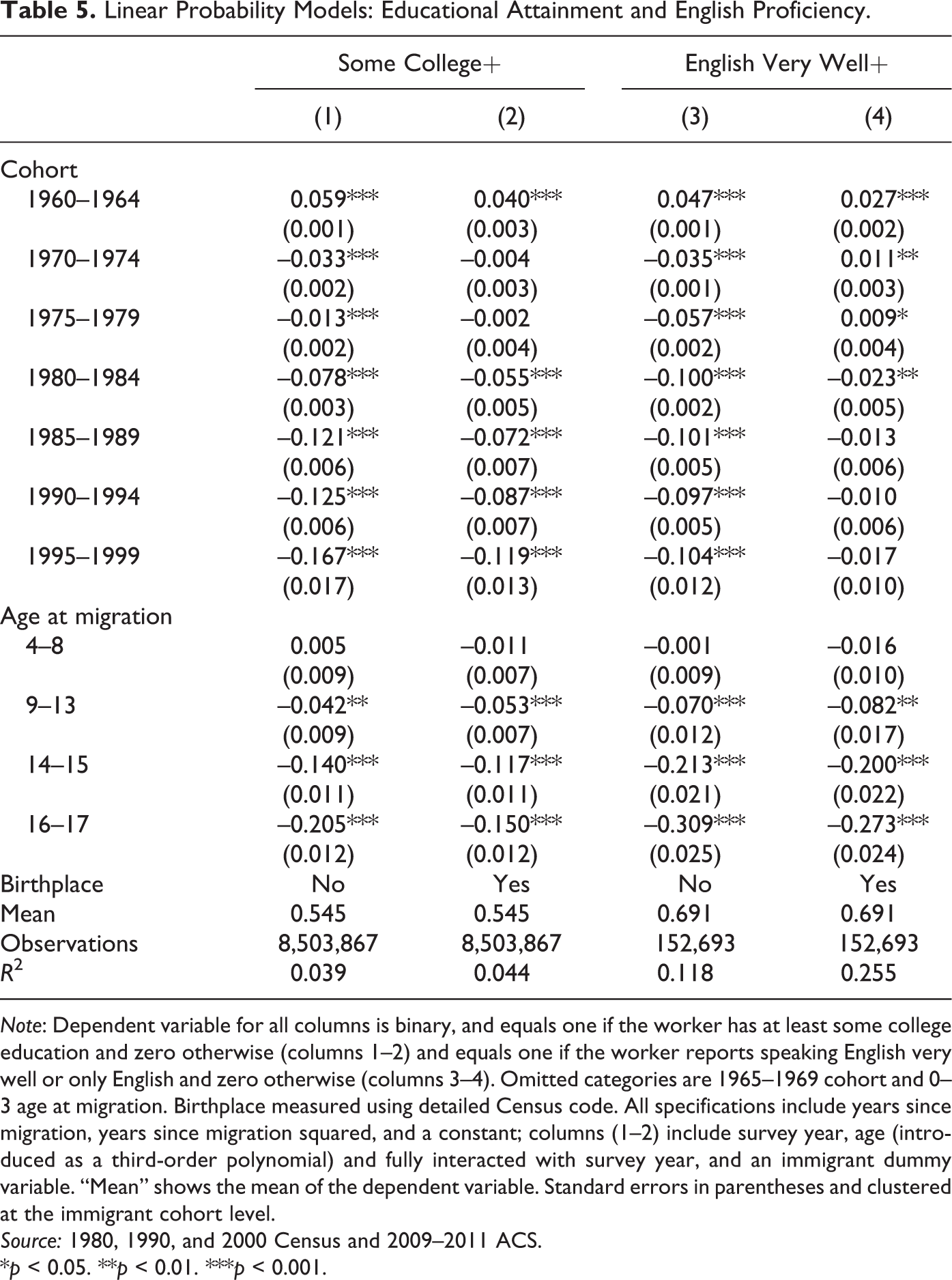
Results are shown in Table 5, where the education level results appear in columns (1) and (2) and the English language proficiency results in columns (3) and (4). Strong, negative cohort effects are observed for both educational attainment and English language proficiency. 11 For example, relative to the 1965–1969 arrival cohort, childhood immigrants who arrived between 1985 and 1989 are 12.1 percentage points less likely to have at least some college education and 10.1 percentage points less likely to report being proficient in speaking English. The negative cohort effects in educational attainment expanded between 1985–1989 and 1995–1999, while they remained essentially constant for English language proficiency. As expected, there is a strong, negative relationship between age at migration and both educational attainment and English language proficiency. Controlling for birthplace (columns 2 and 4) helps explain a portion of the negative cohort effects for educational attainment, although a large, negative, and statistically significant effect remains. Controlling for birthplace eliminates the cohort effects on English language proficiency. The fact that negative cohort effects in educational attainment do not disappear when controlling for birthplace may be due to changes in the composition of immigrants within birthplaces over time. The following section explores this idea further.
Linear Probability Models: Educational Attainment and English Proficiency.
Note: Dependent variable for all columns is binary, and equals one if the worker has at least some college education and zero otherwise (columns 1–2) and equals one if the worker reports speaking English very well or only English and zero otherwise (columns 3–4). Omitted categories are 1965–1969 cohort and 0–3 age at migration. Birthplace measured using detailed Census code. All specifications include years since migration, years since migration squared, and a constant; columns (1–2) include survey year, age (introduced as a third-order polynomial) and fully interacted with survey year, and an immigrant dummy variable. “Mean” shows the mean of the dependent variable. Standard errors in parentheses and clustered at the immigrant cohort level.
Source: 1980, 1990, and 2000 Census and 2009–2011 ACS.
*p < 0.05. **p < 0.01. ***p < 0.001.
Intergenerational Correlations
Results shown thus far strongly support the importance of birthplace in explaining the negative cohort effects in earnings, educational attainment, and English language proficiency. However, simply controlling for birthplace does not explain why birthplaces differ in their effects on childhood immigrant outcomes. Furthermore, each birthplace’s effect may change over time, perhaps due to changes in the source country (relative to the United States) or the selection process of immigrants from a particular country. 12
Following the large literature that emphasizes the intergenerational correlation in earnings and educational attainment among immigrants (e.g., Borjas 1993; Card, DiNardo, and Estes 2000), this section investigates whether the effect of birthplace on childhood immigrants’ outcomes can be measured at least in part by looking at the earnings of the cohort of men from the same birthplace who arrived during the same time period, or the “potential” parents of childhood immigrants. While parental earnings are not observed in the Census, the mean earnings of the father’s cohort is used both as a proxy for childhood immigrants’ fathers’ earnings and as a measure of the characteristics of their neighborhood, which may also impact their economic performance (see Borjas 1995b). An analogous measure of parental educational attainment is also calculated, based on having at least some college education.
The approach used to assign the skill levels of childhood immigrants’ (potential) parents is similar to that used by Card, DiNardo, and Estes (2000). As described in equations (1) and (2), I use coefficients from a log earnings regression on native male workers that controls for age to predict the age-adjusted earnings of male immigrants who arrived as adults. Their age-adjusted earnings gap is the difference between their predicted earnings — given their age and the coefficients from the regression on natives — and their actual earnings. 13 Childhood immigrants are grouped by birthplace and arrival cohort. 14 Their parental earnings is the mean earnings gap of adult immigrants from the same birthplace who arrived during the same time period, measured in the first Census sample after their arrival. 15 For example, for a childhood immigrant from Canada who arrived in the 1975–1979 cohort, his parental earnings would be the mean age-adjusted earnings gap in the 1980 Census of male adult immigrants from Canada who also arrived to the United States between 1975 and 1979. This procedure is repeated for educational attainment, where instead of earnings, the dependent variable equals one if the worker has at least some college and zero otherwise, which yields the second measure of parental skill. Childhood immigrants carry their parental skill levels with them across all samples in which they are observed.
Table 6 shows the parent skills by cohort and a variety of birthplaces. Column (1) shows all birthplaces, while columns (2) through (5) show the results separately for Canada, Mexico, non-Mexico Latin America, and non-Latin America, respectively. 16 First, note the overall importance of birthplace: immigrants from Canada exhibit much higher parental earnings and educational attainment than those from Mexico. Also evident, however, is that within birthplace, significant changes in parental skill levels occur across cohorts: parental skills of Mexican immigrants, based on both earnings and education, declined between the late-1960s and late-1980s arrival cohorts, with some improvement in earnings between the late-1980s and late-1990s arrival cohorts, while Canadian immigrants experienced consistently increasing parental skill levels across arrival cohorts. Simply controlling for birthplace, as was done in the regression results in Table 4, would not capture the change in birthplace characteristics across cohorts.
Parental Skill Levels of Childhood Immigrants, by Cohort and Birthplace.

Note: The table shows the age-adjusted skill levels of the (potential) parents of childhood immigrants relative to natives, separately by cohort and a selection of birthplaces. Panel A shows skills measured based on earnings, while panel B shows skills measured based on having at least some college education, both measured shortly after arrival.
Source: 1980, 1990, and 2000 Census and 2009–2011 ACS.
Thus, based on the data in Table 6 and on the importance of the intergenerational transmission of earnings and educational attainment well known in the literature (e.g., Borjas 1993; Card, DiNardo, and Estes 2000), it is likely that controlling for the skill levels of the parents of childhood immigrants may help explain their declining earnings, educational attainment, and English language proficiency. Table 7 investigates this possibility by introducing parental skill level controls to the baseline results of the pooled regressions for earnings, educational attainment, and English proficiency shown in Tables 5 and 6. For brevity, only the coefficients on the cohort dummy variables and parental skills are shown. Columns (1) and (2) show the log earnings results, columns (3) and (4) the educational attainment results, and columns (5) and (6) the English proficiency results. The parental skill variables equal zero for natives. For ease of comparison, columns (1), (4), and (7) repeat the baseline estimates shown in Tables 4 and 5, while remaining columns add the parental earnings and educational attainment measures.
OLS Regressions: Log Weekly Earnings, Educational Attainment, and English Language Proficiency.
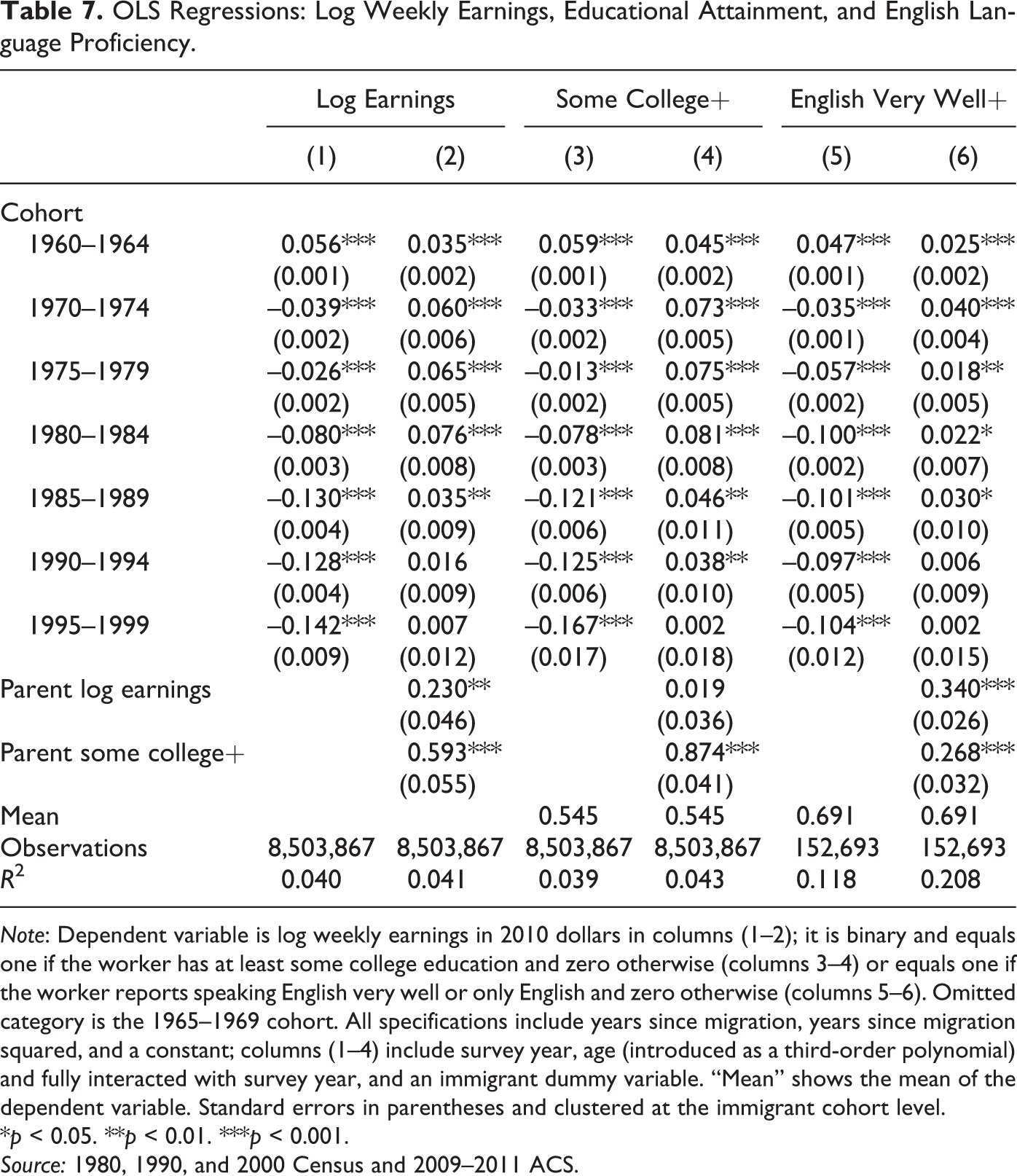
Note: Dependent variable is log weekly earnings in 2010 dollars in columns (1–2); it is binary and equals one if the worker has at least some college education and zero otherwise (columns 3–4) or equals one if the worker reports speaking English very well or only English and zero otherwise (columns 5–6). Omitted category is the 1965–1969 cohort. All specifications include years since migration, years since migration squared, and a constant; columns (1–4) include survey year, age (introduced as a third-order polynomial) and fully interacted with survey year, and an immigrant dummy variable. “Mean” shows the mean of the dependent variable. Standard errors in parentheses and clustered at the immigrant cohort level.
*p < 0.05. **p < 0.01. ***p < 0.001.
Source: 1980, 1990, and 2000 Census and 2009–2011 ACS.
There are two main results. First, the parental cohort’s earnings and educational attainment are positively related to the earnings, educational attainment, and English proficiency of childhood immigrants, which implies intergenerational correlations between the skill of childhood immigrants’ parents and the outcomes of childhood immigrants themselves. 17 It is also clear that the parental cohort’s education level is much more relevant than their earnings in explaining both childhood immigrant earnings and educational attainment, a finding consistent with Card, DiNardo, and Estes (2000). In fact, parental earnings has no statistically significant relationship with childhood immigrant educational attainment, when also controlling for parental educational attainment. Parental earnings do, however, have a strong relationship with English proficiency, even when parental education level is also controlled for.
Second, once the parental skill controls are included, the negative cohorts effects across all three measures nearly disappear, and in fact, for the middle cohorts (around the 1980s), a positive cohort effect appears across all measures. Thus, it appears that the parental cohorts’ declining skill levels can explain the declining earnings, educational attainment, and English proficiency of childhood immigrants.
I explore the importance of age at migration by repeating the specification from Table 7 separately by age at migration group. The results are shown in Table 8, where for brevity I include only the coefficients on parental skills. These specifications allow the relationships between parental skills and childhood immigrant outcomes to vary by the childhood immigrant’s age at migration group. Older-arriving childhood immigrants may more closely resemble their parental cohort, since they have fewer formative years spent in the United States to weaken the connection between their outcomes and the characteristics of their parents’ cohort.
OLS Regressions: Log Weekly Earnings, Educational Attainment, and English Language Proficiency, by Age at Migration.

Note: Dependent variable is log weekly earnings in 2010 dollars in panel A; in panels B and C it is binary and equals one if the worker has at least some college education and zero otherwise (panel B) or equals one if the worker reports speaking English very well or only English and zero otherwise (panel C). Each column includes immigrants with age at migration equal to the value listed, and panels A and B also include natives. All specifications include years since migration, years since migration squared, year of immigrant cohort dummy variables, and a constant; panels A and B include survey year, age (introduced as a third-order polynomial) and fully interacted with survey year, and an immigrant dummy variable. Standard errors in parentheses and clustered at the birthplace-immigrant cohort level.
Source: 1980, 1990, and 2000 Census and 2009–2011 ACS.
*p < 0.05. **p < 0.01. ***p < 0.001.
Indeed, I find evidence supporting this prediction: as age at migration increases, the magnitude of the parental skills coefficient tends to increase, implying a stronger correlation between parental skills and childhood immigrant outcomes. For childhood immigrant earnings, there is a large increase in the magnitude of the parental earnings coefficient, although the coefficient for parental education is stable. For childhood immigrant educational attainment and English proficiency, the pattern is much stronger, especially for English proficiency. This last result is to be expected, given that immigrants arriving at a very young age are likely to be proficient in English as adults regardless of their background. Thus, the parental cohort’s characteristics are only truly relevant in predicting the English proficiency of older-arriving childhood immigrants. These results suggest that older-arriving immigrants are more impacted by their parental cohort’s characteristics and, thus, may have been more adversely impacted by the declining parental skills across cohorts shown in Table 6, which helps explain why we observe more negative cohort effects for older-arriving immigrants than for younger-arriving immigrants.
Conclusion
This article explores whether, similar to adult immigrants, male childhood immigrants in the United States have experienced a decline in economic performance across year of arrival cohorts, from the late 1960s to the late 1990s. Relative to the childhood immigrant cohort that arrived in the late 1960s, more recent childhood immigrant cohorts experienced significant declines in earnings relative to natives once they reached working age. The negative cohort effects on earnings, as well as similar negative cohort effects on educational attainment and English language proficiency, can be explained by controlling for the earnings and educational attainment of the (potential) parents of childhood immigrants in the same arrival cohort from the same birthplace relative to natives. The earnings and education levels of the parents of immigrants declined for cohorts through the late 1990s, due to both a change in the distribution of source countries and changes within source countries.
These results highlight the impact of adult immigrant characteristics on the future economic performance of their children born abroad, a group that represents over a quarter of the working immigrant population in the United States. A number of authors, such as Green and Worswick (2012), have begun to focus on evaluating the “quality” of an immigrant cohort by looking at their longer-term economic performance, which includes both earnings upon entry and earnings growth over time. Incorporating the economic performance of the children of an immigrant cohort is a reasonable extension of this measure of quality, since parents may invest in their children at the expense of their own economic performance. While a fuller picture of the long-term cohort quality would include both the foreign-born and native-born children of adult immigrants, only the foreign-born children of the earlier cohorts have been in the labor market for a meaningful amount of time. Thus, focusing on childhood immigrants allows for an earlier evaluation of the next generation’s performance.
While it may turn out that native-born children of these immigrant cohorts perform better than their foreign-born children, the results of this article suggest that the declining performance of adult immigrant arriving in the 1970s, 1980s, and 1990s indeed extended to their children. Thus, there is no evidence of an increase in the performance of childhood immigrants that might offset the declining performance of adult immigrants and otherwise improve the quality measure of these cohorts.
My analysis considers only childhood immigrants who arrived prior to 2000, since it will take several more years before an assessment of the performance of childhood immigrants arriving after 2000 can be made. However, given the importance of parental skills in predicting the performance of childhood immigrants discussed extensively in this article, we can make a prediction based on the earnings and educational attainment of the parental cohort that arrived during the 2000s, as measured in 2010. The forecast, it turns out, is not optimistic: both the earnings and educational attainment of adult immigrants declined between the 1990s and 2000s arrival cohorts. 18 Thus, it seems likely that the future economic performance of childhood immigrants who arrived during the 2000s will deteriorate relative to the childhood immigrants who arrived during the 1990s.
Consistent with results from Card, DiNardo, and Estes (2000), I find that it is primarily the parental cohort’s educational attainment, more so than their earnings, that helps predict childhood immigrants’ outcomes (i.e., earnings, educational attainment, and English proficiency). Furthermore, I find that older-arriving immigrants tend to have stronger intergenerational correlations than younger-arriving childhood immigrants, suggesting that the parental cohort’s characteristics are more relevant for older-arriving than for younger-arriving childhood immigrants.
These results have implications for immigration policy. As is done in countries such as Canada and Australia that employ a point-based system, preferencing the immigration of more-educated adult immigrants may help increase both the earnings of adult immigrants and the later earnings of the childhood immigrants that accompany them. Educational attainment is particularly important for adult immigrants who migrate with older children, where the intergenerational correlations appear to be especially strong. If the returns to education, which have grown significantly in recent decades, continue to rise, the importance of adult immigrants’ educational attainment to both their and their children’s economic performance will likely also grow.
Supplemental Material
Supplemental Material, MRX824084_Supplemental_Appendix - The Decline in Earnings of Childhood Immigrants in the United States
Supplemental Material, MRX824084_Supplemental_Appendix for The Decline in Earnings of Childhood Immigrants in the United States by Hugh Cassidy in International Migration Review
Supplemental Material
Supplemental Material, Online_appendix,_final_version - The Decline in Earnings of Childhood Immigrants in the United States
Supplemental Material, Online_appendix,_final_version for The Decline in Earnings of Childhood Immigrants in the United States by Hugh Cassidy in International Migration Review
Supplemental Material
Supplemental Material, Online_appendix,_women,_final_version - The Decline in Earnings of Childhood Immigrants in the United States
Supplemental Material, Online_appendix,_women,_final_version for The Decline in Earnings of Childhood Immigrants in the United States by Hugh Cassidy in International Migration Review
Footnotes
Declaration of Conflicting Interests
The author(s) declared no potential conflicts of interest with respect to the research, authorship, and/or publication of this article.
Funding
The author(s) disclosed receipt of the following financial support for the research, authorship, and/or publication of this article: The author received funding related to this research from the Faculty Development Award at Kansas State University.
Supplemental Material

Notes
References
Supplementary Material
Please find the following supplemental material available below.
For Open Access articles published under a Creative Commons License, all supplemental material carries the same license as the article it is associated with.
For non-Open Access articles published, all supplemental material carries a non-exclusive license, and permission requests for re-use of supplemental material or any part of supplemental material shall be sent directly to the copyright owner as specified in the copyright notice associated with the article.
