




Abstract
Our understanding of the sources of educational inequality for the estimated 250,000 undocumented immigrant college students in the United States is limited by poor data. We use student administrative data from a large public university, which accurately identify legal status and include pre-enrollment characteristics, to determine the effect of legal status on GPA and graduation. We find that undocumented students are hyper-selected relative to peers; failing to account for this difference underestimates the effect of legal status on academic outcomes. Our findings also highlight the ways legal status interacts with institutional settings and race/ethnicity to affect educational outcomes.
An estimated 11 million undocumented immigrants — one-quarter of the foreign-born population — reside in the United States without authorization (Passel and Cohn 2017). 1 As unauthorized residents, they cannot legally work, vote, or benefit from social services; in many states, it is difficult to open a bank account or obtain a driver’s license. Undocumented children, however, have the right to kindergarten through 12th-grade (K-to-12) schooling and are not barred from pursuing higher education, 2 yet only 21 states currently offer in-state tuition to resident undocumented youth (National Immigration Law Center 2018). Although an estimated 65,000 undocumented students graduate from high school every year, only a small fraction of those (about one-fourth) go on to attend college (US Department of Education 2015). These students share a common dream with their legal-status 3 counterparts: that higher education will be a vehicle for social mobility. Yet undocumented students face greater barriers to college attendance because they are ineligible for government financial aid, because their returns to education are uncertain since they cannot legally work, and because they attend school under the threat of deportation (Abrego 2006; Gonzales 2011; Terriquez 2014).
Our understanding of how legal status affects the educational experiences of undocumented students in college has been limited by data constraints primarily because large-scale representative surveys in the United States do not collect data on legal status (e.g., American Community Survey, National Longitudinal Survey of Youth, Educational Longitudinal Survey, etc.). This situation is problematic for several reasons. First, we cannot know how legal status affects college outcomes if we cannot compare representative samples of undocumented students with their documented peers. Second, undocumented college students are likely to be hyper-selected relative to college students with legal status because they had to overcome larger financial and psychological barriers to enroll in college (Perez et al. 2009; Enriquez 2011; Hsin and Ortega 2018). Omitting pre-enrollment characteristics—such as academic preparedness and socioeconomic status—will result in underestimating the effect of legal status on educational attainment.
In addition to data limitations, existing research primarily focuses on understanding the experiences of Latino youth, and as a result, we know relatively little about the experiences of non-Latino undocumented youth. Much of what we know about undocumented youth comes from qualitative studies that focus on very specific subpopulations (e.g., Mexicans or Latinos in California) (Abrego 2006; Perez et al. 2009; Enriquez 2011; Terriquez 2014; Enriquez 2017; Patler 2017). Yet the fastest-growing groups of undocumented immigrants are from Asia, Central America, and Africa (Rosenblum and Ruiz Soto 2015), and their experiences are rarely examined. Finally, data constraints have prevented researchers from systematically examining variation by college type. The effect of legal status might vary by college type because community colleges differ from four-year colleges in terms of their institutional structure, student composition, proportion of students working while attending school, and retention/graduation rates.
This article analyzes 10 years of administrative data on students attending a large public university: the City University of New York, or CUNY, from 2002 to 2012. The data are unique because they allow us to accurately identify legal status, contain nearly the entire population of undocumented college students residing in a large metropolitan region, and have information on pre-enrollment variables such as high-school grade point average (GPA). We use these data to examine four questions: (1) Are undocumented students positively selected relative to their peers who have legal status (i.e., those with US citizenship and those with legal permanent residence)? (2) Does legal status have a negative effect on college performance and graduation? (3) How does the effect of legal status vary by students’ origin region? and (4) How does the effect of legal status vary by two-year versus four-year colleges?
Our results from estimating linear probability models indicate the following. First, undocumented students are positively selected relative to their peers with legal status. This finding indicates that undocumented college students represent some of the most resilient and academically prepared youth in the United States. Second, undocumented students significantly outperform their citizen peers and perform as well as their peers with legal permanent resident status. Third, once we account for selection, we find a persistent negative effect of legal status at four-year colleges, suggesting that at relatively selective institutions, legal status functions as a master status, or a social status that has an outsized effect on life chances relative to other social characteristics like socioeconomic status or race/ethnicity (Enghceren 1999). In contrast, legal status does not seem to function as a master status at open-access community colleges, where undocumented students outperform both citizens and legal permanent residents (LPRs), even after accounting for selection. Finally, our analysis reveals interesting sources of variation across origin country in the effect of legal status on student performance. Taken together, these results offer new evidence on the way legal status interacts with educational processes, institutional contexts, and race/ethnicity to affect college outcomes.
Background
Many immigration scholars contend that the condition of illegality functions as a master status that “outweighs and overpowers all other social characteristics” (Enghceren 1999) in shaping individuals’ life chances. Scholars argue that legal status has an overarching effect on every aspect of individuals’ lives, including how they interact with peers and institutions, how they are perceived and treated by society, and how they perceive their own future and social mobility (Gleeson and Gonzales 2012; Terriquez 2014; Gonzales 2016; Patler 2017). In terms of how legal status affects educational pathways, Gonzales (2016) illustrates its outsized role at critical periods during the life course. The transition out of K-to-12 schooling is particularly salient because it involves exiting the legally protected status of primary and secondary education and entering situations where undocumented youth in the United States must assess trade-offs between continuing education or seeking employment without work authorization and residency rights (Gonzales 2011, 2016). The literature to date consistently shows that undocumented status negatively affects decisions to pursue schooling beyond high school (Gonzales 2011; Terriquez 2014). For example, Abrego (2006) finds that undocumented Latino immigrants in Los Angeles, California, were less likely to pursue college, even when they attained college admissions, relative to other working-class Latino immigrants with legal status. Greenman and Hall (2013) also find that undocumented youth are less likely to enter college than their peers, when analyzing nationally representative data from the Survey of Income and Program Participation.
However, there are reasons to suspect that legal status may not necessarily function as a master status for college students. One reason is that the subset of undocumented youth who make it to college are likely to be hyper-selected relative to college students who have legal status. Because legal status plays such an outsized role in steering otherwise-qualified undocumented youth away from college and into the workforce, undocumented college students are likely to be more positively selected in terms of the qualities that correlate with academic performance (e.g., academic preparedness, intellectual ability, motivation, and resilience) relative to college students with legal status. Thus, hyper-selection may reduce the effect of legal status.
Another reason why legal status may not operate as a master status for undocumented college students is because undocumented college students share common challenges with other first-generation college students from low-income families who have legal status, such as lacking both financial and cultural resources that enable educational success (Goldrick-Rab 2006; Bailey, Jenkins, and Jaggar 2015; Suarez-Orozco et al. 2015). For example, Valdez and Golash-Boza (2018) observe that undocumented students attending a Hispanic-Serving Institution identify financial hardship and struggle, not legal status, as their primary source of adversity. As they show, legal status does not have a stand-alone effect on college experiences but intersects with multiple identities — including race and class — to shape college outcomes. Enriquez (2017, 3) contends that legal status introduces unique and insurmountable legal barriers that “weaken resistance to the limitations created by these other social locations.” Enriquez’s work shows that legal status operates as a “final straw” that prevents many undocumented students — already struggling with challenges related to poverty, as well as being immigrant and first-generation college students — from completing their intended degrees. These studies demonstrate that the relative effect of legal status for undocumented college students will not be so pronounced if their documented counterparts are also struggling with a similar set of challenges.
To reliably assess how legal status affects educational outcomes in college, we need (1) ways to account for the hyper-selectivity of undocumented college students and (2) data that allow us to compare representative samples of undocumented college students with representative samples of documented college students. To our knowledge, no such data have previously existed. The research that comes the closest to approximating representativeness is Terriquez’s (2015) mixed-method study of undocumented students attending community college in California. This study is exceptional because Terriquez surveys 18 undocumented college students who were randomly selected from a representative sample of college students contacted by phone. She supplemented these data with 20 additional undocumented students who were non-randomly selected via youth organizations. Her results suggest that undocumented students were more likely to withdraw from college compared to their citizen peers. She concludes that legal status serves as a master status by increasing the likelihood that undocumented students leave college. Terriquez’s study was the first of its kind to use a randomly selected sample of undocumented students. However, because the total sample of students was small, she could not systematically compare undocumented students with their counterparts with legal status (i.e., those with citizenship and those with legal permanent status). Our study seeks to extend Terriquez’s work by analyzing unique administrative data that include valid comparison groups.
How Might Legal Status Affect College Persistence and Attainment?
Existing research offers mixed evidence on the effect of legal status on college persistence and attainment. Some studies suggest that lack of legal status has negative effects on college persistence because undocumented students struggle to pay for college. Nearly 70 percent of families headed by undocumented parents subsist at or near the poverty line (Amuedo-Dorantes and Antman 2017), compared to 29 percent of students who come from poor families nationwide. 4 As a result, undocumented students have greater difficulty paying for college than do their peers with legal status. Additionally, low-income undocumented students are not eligible for federal (or, in most states, state) government financial aid for tuition assistance or work-study programs (US Department of Education 2015). They are also highly credit constrained because they cannot borrow from banks to offset tuition costs (Cowley 2017). According to the National Immigration Law Center, at least 20 states and the District of Columbia have polices that allow undocumented students who reside in the states to pay in-state tuition. 5 In states that exclude resident undocumented students from paying in-state tuition, undocumented students must pay out-of-state or international student tuition rates, making the cost of college attendance substantially higher for them than for their legal-status counterparts. Terriquez (2015) found that twice as many undocumented students at community colleges reported withdrawing from college because of an inability to afford educational expenses compared to students with legal status.
But there are also reasons to believe that the selected group of undocumented youth who overcome challenges to attend college may be more likely to persist and graduate with a degree. Because undocumented youth cannot legally work, they earn lower wages and are employed in jobs that subject them to more occupational hazards, compared to legal immigrant workers (Donato et al. 2008; Hall, Greenman, and Farkas 2010; Ortega, Edwards, and Hsin 2018). This reality means the wages undocumented youth forgo to attend college are lower than the wages their legal-status peers forgo. Lack of legal work options, thus, may have a positive effect on college attainment because the opportunity costs of attending school are lower for undocumented students. Additionally, schools foster a culture of meritocracy where legal status is de-emphasized and students are encouraged and rewarded for pursuing intellectual interests (Gleeson and Gonzales 2012). By contrast, the workplace offers harsher conditions because lack of work authorization renders occupational mobility nearly impossible. As a result, remaining in school helps undocumented youth delay a future that will see them joining the low-wage, contingent workforce where they are at risk of exploitation.
Finally, undocumented youth who beat the odds to attend college are hyper-selected and represent the most academically gifted, motivated, and resilient individuals with exceptionally high educational aspirations (Contreras 2009; Perez and Cortes 2011; Conger and Chellman 2013; Terriquez 2014). Many benefited from a support network of mentors, encouraging high-school teachers and guidance counselors, and supportive friends and family members at critical periods like the transition from high school to college and once they are enrolled in college (Perez et al. 2009; Enriquez 2011). Hyper-selection and the opportunity to draw on supportive networks may mean that undocumented college students are better equipped for the challenges of college than are their peers with legal status.
Variation in the Effects of Legal Status by Two-Year and Four-Year Colleges
Community colleges differ from four-year colleges because they are more affordable, feature open admissions (e.g., accept anyone with a high-school diploma or General Educational Development diploma [GED]), and accommodate working students with variable work schedules and students with family caregiving responsibilities (Goldrick-Rab 2006; Teranishi, Suárez-Orozco, and Suárez-Orozco 2011). Nearly 70 percent of community-college students work while attending school, compared to about 30 percent at four-year college students (Bureau of Labor Statistics 2017). Greater accessibility and affordability mean that community colleges attract non-traditional students including immigrants, students from lower socioeconomic backgrounds, those with young children to financially support, first-generation college students, and those with the least academic preparation. In part because community colleges tend to attract students with the fewest resources, graduation rates at community colleges are significantly lower than at four-year colleges (Bailey, Jenkins, and Leinbach 2005). Nationally, 35 percent of community-college students graduate with a degree within six years, whereas more than 60 percent of students do so at public four-year institutions. 6 Many high-achieving undocumented students may be channeled into lower-cost community colleges because they are denied access to financial aid and scholarships that would have allowed them to attend four-year colleges or more selective institutions (Terriquez 2015; Gonzales 2016). Thus, research suggests that lack of legal status will under-place more high-achieving undocumented students at community colleges than at four-year colleges.
In sum, we know that two-year and four-year colleges substantially differ in terms of institutional settings, student composition, and graduation rates. These differences may also influence how legal status affects undocumented students’ educational outcomes by college type. However, we do not know whether and how legal status varies by two-year and four-year colleges. At community colleges, we might expect undocumented youth to outperform their peers because (1) undocumented students at community colleges are hyper-selected and likely to be under-placed, and (2) the comparison pool of documented students at community colleges tends to be low-performing and to share similar challenges as undocumented students.
Variation in the Effects of Legal Status by Origin Country
While Mexican immigrants constitute the largest share of undocumented immigrants in the United States (56%), the fastest-growing groups of undocumented immigrants are populations from Asia, Central America, and Africa (Rosenblum and Ruiz Soto 2015). However, we know relatively little about the educational outcomes of non-Latino, and more specifically non-Mexican, undocumented youth. The CUNY data offer the unique opportunity to better understand the educational experiences of these under-studied but fast-growing groups from Asia, the Caribbean, and Africa. As shown in Table 1, the data include large numbers of undocumented students from Mexico (10%), Ecuador (6%), South Korea (6%), Jamaica (5%), Dominican Republic (3%), and China (4%).
Top Countries of Birth of Undocumented Immigrants (by Region of Origin).
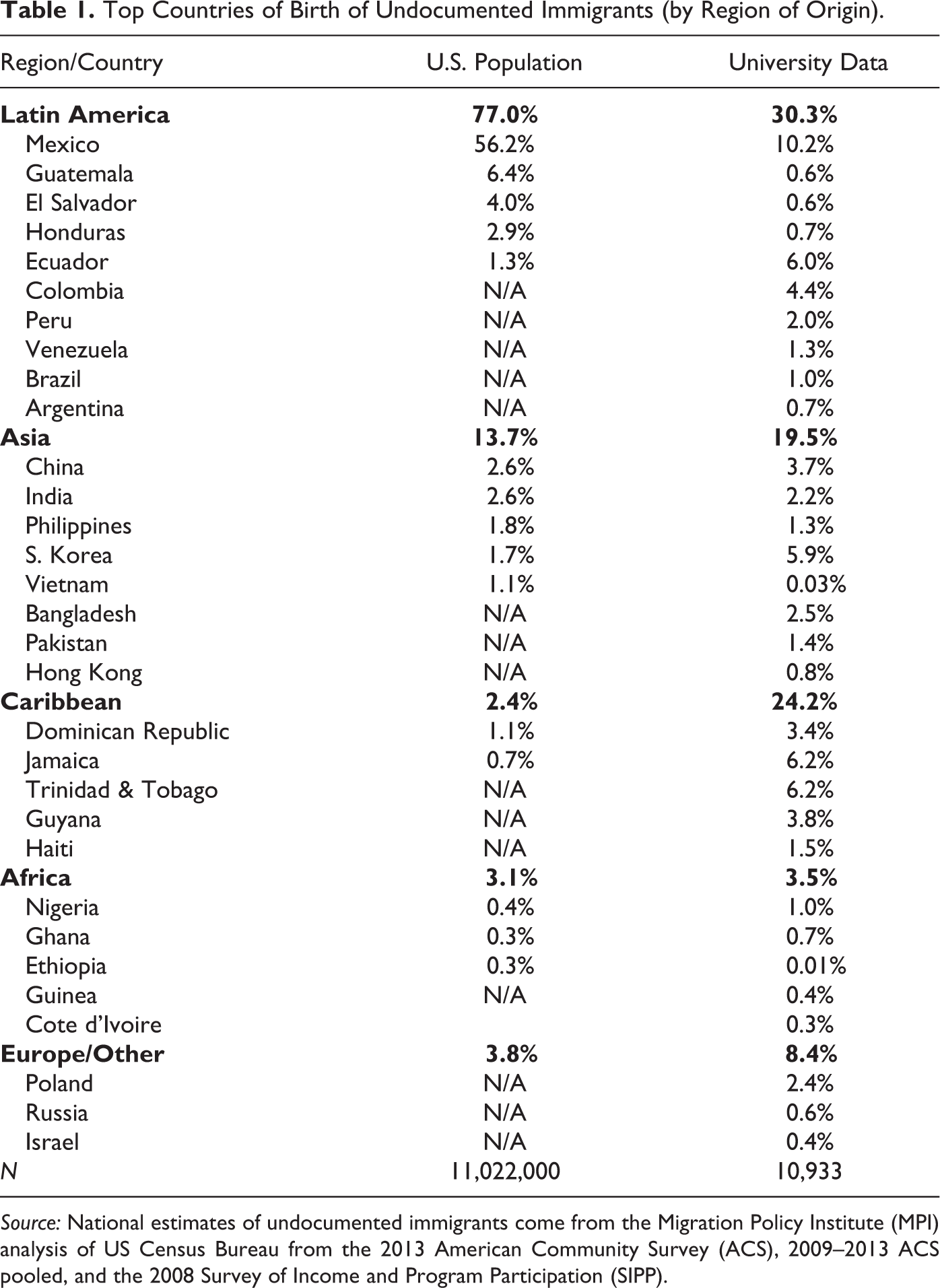
Source: National estimates of undocumented immigrants come from the Migration Policy Institute (MPI) analysis of US Census Bureau from the 2013 American Community Survey (ACS), 2009–2013 ACS pooled, and the 2008 Survey of Income and Program Participation (SIPP).
Racial and ethnic stratification’s effect on the educational outcomes of US citizens is also likely to apply to undocumented students. For example, New York City has one of the country’s most segregated school systems, and black and Latino youth living in New York City are more likely than their white and Asian peers to attend racially segregated schools with high concentrations of poverty (Kasinitz et al. 2009; Kirkland and Sanzone 2017). The racial inequalities and discrimination faced by Black and Latino students with legal status may also affect black and Latino students without legal status and make them less academically prepared for college.
Additionally, we hypothesize that legal status may interact with racial/ethnic stratification to create new forms of inequalities. Stereotypes of the quintessential undocumented student being Latino — and more specifically, Mexican — may reduce the scrutiny of and discrimination against Asian, African, and Caribbean undocumented students in our study (Dreby 2015; Patler 2018). Therefore, non-Latino undocumented youth may be able to “fly under the radar” and avoid being stigmatized as undocumented. At the same time, however, racialized stereotypes of undocumented immigrants may also make it more difficult for non-Latino students to connect with networks and organizations that assist undocumented students with navigating their educational careers, finding resources to help pay for college, and landing a job. For example, many Asian undocumented immigrants are unaware of the existence of other undocumented Asians immigrants in their communities and suffer feelings of shame, loneliness, and isolation (Chan 2010; Cho 2017).
Differential access to co-ethnic resources may also contribute to stratification in educational outcomes across immigrant groups. Chinese and Korean immigrants are two of the largest Asian immigrant groups in New York City, and they benefit from the presence of large and well-established ethnic enclaves (Kasinitz et al. 2009; Min 2011). These enclaves are supported by a strong co-ethnic middle class and a steady flow of foreign transnational investments (Kasinitz et al. 2009; Min 2011). Such enclaves offer valuable sources of ethnic capital to low-income Chinese and Korean immigrants — including undocumented immigrants — like low-cost or free supplementary education programs and vast information networks about schooling (Lee and Zhou 2015). Asian immigrant parents also have some of the highest educational expectations for their children, and it is widely speculated that this orientation toward education contributes to Asian immigrants’ educational achievement (Kao and Tienda 1998; Goyette and Xie 1999; Hsin and Xie 2014). Because ethnic enclaves help reinforce and magnify educational expectations within the community (Lee and Zhou 2015; Hsin 2016), access to these ethnic resources should positively affect Asian undocumented youth’s educational performance and graduation rates. Other immigrant groups — both documented and undocumented — originating from Latin America, the Caribbean, and Africa do not have access to the same kind of resource-rich ethnic enclaves (Kasinitz et al. 2009), which may mean that their educational performance will suffer.
Access to affluent and capital-rich ethnic enclaves may also increase the returns to college education for Asian undocumented youth and motivate them to graduate at higher rates relative to undocumented youth of other immigrant backgrounds who lack similar access. For example, in her ethnographic study of undocumented Mexican and Korean college students in California, Cho (2017) found that Korean students successfully gained employment in a variety of occupations ranging from employment in retail to afterschool centers to law firms. In contrast, Mexican respondents were uniformly placed into low-wage, blue-collar occupations. Cho attributes differences in employment outcomes to the fact that Korean youth had access to a wide network of Korean-owned businesses and organizations willing to employ fellow undocumented Korean compatriots, whereas undocumented Mexican youth lacked similar ethnic resources. As a result, better employment opportunities, including employment in white-collar professions that require college education, may offer Korean and Chinese undocumented youth greater incentives to achieve and graduate at higher rates than other undocumented groups who lack access to similar employment options.
Research Questions
Undocumented status will likely have important effects on college students’ outcomes, and these effects are likely to vary by the type of institution and by students’ origin countries. Building upon and extending the literature to date, we examine four key research questions: To what extent are undocumented students positively selected relative to their peers who have citizenship or legal permanent status? How do undocumented students fare in terms of academic performance and graduation rates relative to their peers (both citizens and LPRs)? How does the effect of legal status on college performance and graduation vary across two-year versus four-year colleges? How does the effect of legal status on college performance and graduation vary by students’ origin countries?
Data and Analytic Approach
We analyze administrative data from one of the largest public university systems in the United States, CUNY. This university is located in the largest US major metropolitan area—New York City—and educates over 260,000 degree seekers each year across 18 undergraduate campuses. Administrative records track each entry cohort of students since Fall 1999, and data collection is ongoing. We analyze entering cohorts for a 10-year period from Fall 2002 to Fall 2012. 7
These data are well-suited for our project for several reasons. First, CUNY, as an institution, spans the range of selectivity. Seven two-year community colleges are open access, with the sole admission requirement being a high-school diploma or GED equivalent. Eleven four-year senior colleges offer bachelor’s degrees (BAs) and vary in terms of admissions selectivity. Thus, our analysis can consider the broad spectrum of institutional selectivity and type (two-year vs. four-year colleges). Second, the data reliably identify documentation status. Upon enrollment at CUNY, students are asked to self-report as US citizens, LPRs, temporary visa holders, refugees, or undocumented immigrants. Students must submit documentation to validate their own self-reports; those who fail to provide documentation are categorized as undocumented. Moreover, to qualify for in-state tuition rates, undocumented students must provide a notarized affidavit stating they will pursue steps to obtain legal residency if such options become available. Using data on self-reported race and birth country, documentation status can be cross-classified with origin country and race/ethnicity to compare undocumented students with co-ethnics who are LPRs and US citizens. Finally, the data track all degree-seeking students as long as they are enrolled and include transfer and re-entry students, as well as outcomes like GPA, time to graduation, credit completion, major choice, and course-taking patterns.
Our main variables for the analysis are described in Tables 2 and 3. The main dependent variables are graduation with an associate’s degree (AA), graduation with a BA, and cumulative college GPA. The first two variables are measured as dichotomous variables indicating whether individuals graduated with a BA or an AA, respectively. The third variable is a continuous variable indicating cumulative GPA. This variable measures the cumulative GPA from the last semester before graduation (if the student graduated). If the student left college, the variable measures the cumulative GPA attained in the last semester that the student attended. To simplify the analysis, we estimate the likelihood of attaining an AA among students enrolled at a community college and the likelihood of attaining a BA among students enrolled at four-year colleges. 8
Sample Characteristics by Citizenship Status and College Type.

1a: difference between citizens and undocumented is significant at 95 percent confidence level; b: difference between LPRs and undocumented is significant at 95 percent confidence level; c: difference between LPRs and citizens is significant at 95 percent confidence level.
College Educational Outcome Characteristics by Citizenship Status and College Type.
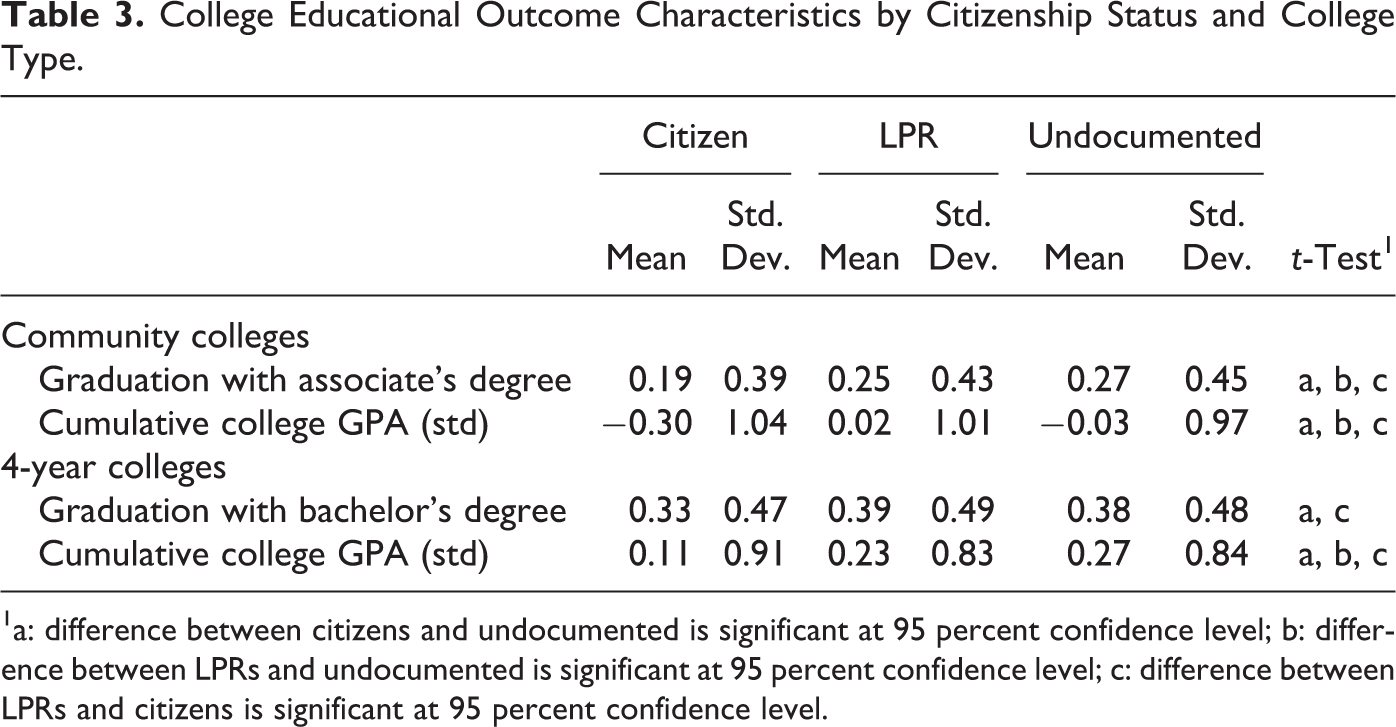
1a: difference between citizens and undocumented is significant at 95 percent confidence level; b: difference between LPRs and undocumented is significant at 95 percent confidence level; c: difference between LPRs and citizens is significant at 95 percent confidence level.
Our key independent variable is legal status. We compare undocumented students to LPRs and US citizens (US born or naturalized). This is a trichotomous variable indicating (1) undocumented: a student who reported being undocumented and submitted an affidavit to obtain in-state tuition rates or failed to provide documentation of legal status; (2) LPR: a student who submitted documentation of legal permanent resident status; or (3) citizen: a student who submitted documentation of US citizenship. Individuals who obtained their high-school degree outside the United States and self-report as undocumented (N = 962) and individuals who obtained their high-school degree in the United States but outside New York (N = 448) were not classified as undocumented. This step was taken to eliminate the possibility that foreign students or out-of-state, documented students were self-reporting undocumented status to gain access to lower in-state tuition rates. Our analytical sample of students includes 3,717 undocumented students, 51,671 LPRs, and 101,554 citizens.
Our control variables include a number of demographic characteristics and pre-college enrollment ability and background characteristics (see Table 2). We include sex (dummy variable; female = 1) and age of entry into college (continuous variable). The models also include Pell Grant receipt (dummy variable; receipt = 1) as a measure of disadvantaged socioeconomic status. Students from families making household income of less than $50,000 are eligible for Pell Grants. Undocumented students, however, are ineligible for Pell Grants. We assume that all undocumented students are disadvantaged and assign them a value of 1. 9 We also include dummy variables for cohort and calendar year.
We use high-school GPA to control for pre-college ability, motivation, and preparation. This variable is standardized to z-scores by subtracting the mean and dividing by the standard deviation. The administrative database also contains information on the type of high school attended, included here as a set of dummy variables indicating no high-school information, GED, private, public, within state, and out of state. Finally, we consider origin regions as key variables for analyses of a subsample consisting of only undocumented students. These are a series of dummy variables indicating the region from which the student immigrated to the United States: Latin America (0, 1), Caribbean (0, 1), Africa (0, 1), Asia (0, 1), and Europe (0, 1).
We estimate linear probability models to predict the probability of attaining an AA or BA and linear ordinary least squares (OLS) models to predict college GPA. We estimate all models separately for two-year and four-year colleges and estimate nested models that successively add control variables. We present and discuss the regression results below.
Results
Descriptive Results
Table 1 presents the distribution of undocumented immigrants by origin country at the national level and at CUNY. Nationally, 77 percent of the undocumented immigrant population originates from Latin America, with about 56 percent of all undocumented immigrants originating from Mexico. Asian and Caribbean undocumented immigrants comprise only 13.7 and 2.4 percent of the national population, respectively. The CUNY population of undocumented students is more diverse. Only 30.3 percent originate from Latin America. Additionally, only 10.2 percent originate from Mexico, with many Latin American students originating from Ecuador (6.0%) and Colombia (4.4%). The second largest group of undocumented students originates from the Caribbean (24.2%). The third largest group originates from Asia (19.5%), with 5.9 percent from South Korea and 3.7 percent from China.
Table 2 presents selected descriptive statistics comparing undocumented students to US citizens and LPRs. The results demonstrate a number of key points. First, undocumented students are more positively selected in terms of high-school GPA relative to their citizen peers at both community and four-year colleges. Second, the results show that on average, community-college students are less academically prepared than students attending four-year colleges. However, at both community and four-year colleges, undocumented students have higher high-school GPAs relative to their citizen peers at their respective schools. For example, citizen students at community colleges have GPAs that are 0.58 standard deviations below the sample mean (77 out of 100), whereas undocumented students have GPAs that are only 0.34 standard deviations below the sample mean. At four-year colleges, citizen students have GPAs that are 0.25 standard deviations above the sample mean, but undocumented students have GPAs that are 0.59 standard deviations above the sample mean. Finally, the results show that at four-year colleges, undocumented students are also significantly more positively selected relative to LPRs. At community colleges, they have high-school GPAs that are slightly below those of LPRs.
Overall, these findings show that undocumented students who enroll in postsecondary schooling are more academically prepared relative to their peers with legal status. We do not have direct measures of resilience, motivation, and academic aspirations; but to the extent that the literature indicates that these qualities correlate with high-school GPA (e.g., Cheng and Ickes 2009; Hartley 2011; Chavira, Cooper, and Vasquez-Salgado 2016), our results suggest that undocumented students are likely positively selected in terms of those qualities as well.
Table 3 presents descriptive statistics for the three outcome variables by legal status. We present rates for graduating with an AA for community-college students and rates for graduating with a BA for four-year college students. Note that the mean age of entry is similar across different groups within the two types of colleges. For two-year colleges, it ranges from 20.53 (citizens; SD: 4.95) to 20.77 (undocumented; SD: 4.88) to 22.77 years (LPRs; SD: 6.34). The mean age of entry into four-year colleges is slightly lower, ranging from 18.89 (citizens; SD: 3.02) to 18.98 (undocumented; SD: 2.51) to 20.10 years (LPRs; SD: 4.28).
The findings indicate two key points. First, the unadjusted averages show that undocumented students graduate at a similar rate and have similar cumulative GPAs as LPR students. Both undocumented and LPR students are significantly more likely to graduate and have higher academic performance than citizen students; 27 percent of undocumented students at community colleges graduate compared to 25 percent of LPR and 19 percent of citizen students, for example. At four-year colleges, 38 percent of undocumented students and 39 percent of LPR students graduate, compared to 33 percent of citizen students. 10 At two-year colleges, LPR and undocumented students have GPAs very close to the mean (0.02 standard deviations higher than the mean and –0.03 standard deviations lower than the mean, respectively), while citizen students have GPAs –0.30 standard deviations lower than the mean. While all three groups have higher GPAs than the mean at four-year colleges, LPR and undocumented students have GPAs of 0.23 and 0.27 standard deviations higher than the mean, respectively, while citizen students only have GPAs 0.11 higher than the mean.
Second, as discussed above, interesting variations in outcomes between two-year and four-year colleges can be observed. The comparison group of citizen students at community colleges is lower performing than at four-year colleges; citizen students at community colleges have a graduation rate of 19 percent and GPAs that are 0.30 standard deviations below the mean. In comparison, citizen students at four-year colleges have a graduation rate of 33 percent and GPAs that are 0.11 standard deviations above the mean. Thus, there is much greater variation in educational outcomes by immigration status at community colleges than at four-year colleges primarily because citizen students at community colleges perform lower than average. This result is consistent with what we know about compositional differences between students attending open-access community colleges and students attending relatively more selective four-year colleges (Bailey, Jenkins, and Leinbach 2005; Suarez-Orozco et al. 2015).
Overall, these descriptive results highlight the importance of accounting for differential selection when considering the effect of legal status on academic performance and educational attainment. The unadjusted averages presented in Table 3 show that undocumented students either perform as well as or outperform their legal-status peers, particularly compared to citizens. Therefore, based on a simple comparison of means, one might conclude that legal status has no effect on educational attainment. Yet our results from Table 2 also indicate important sources of variation in pre-enrollment characteristics that must be included in multivariate analyses to obtain a better understanding of the effect of legal status. Additionally, the descriptive results suggest that differential selection of citizen and LPR students into community versus four-year colleges may lead to differential effects of legal status by institutional setting. Specifically, the results show that the variation in outcomes at community colleges is much wider than at four-year colleges because the comparison group of citizen students at community colleges is so low-performing.
Table 4 examines variation in educational outcomes and students’ backgrounds by undocumented students’ origin region. We find that students from Asia and Europe are more positively selected in terms of high-school GPA at both community and four-year colleges. Caribbean and African undocumented students are the least positively selected at both types of colleges. In terms of graduation rates, the results show that Asian and European students who attend four-year colleges are also more likely to graduate with a BA (45% and 47%, respectively) than Latino, Caribbean, and African (38%, 31%, and 37%, respectively) undocumented students. Interestingly, Asian and European undocumented students at community colleges are not more likely to graduate with an AA compared to other undocumented groups.
Sample Characteristics for Undocumented Students Only by Region of Birth.
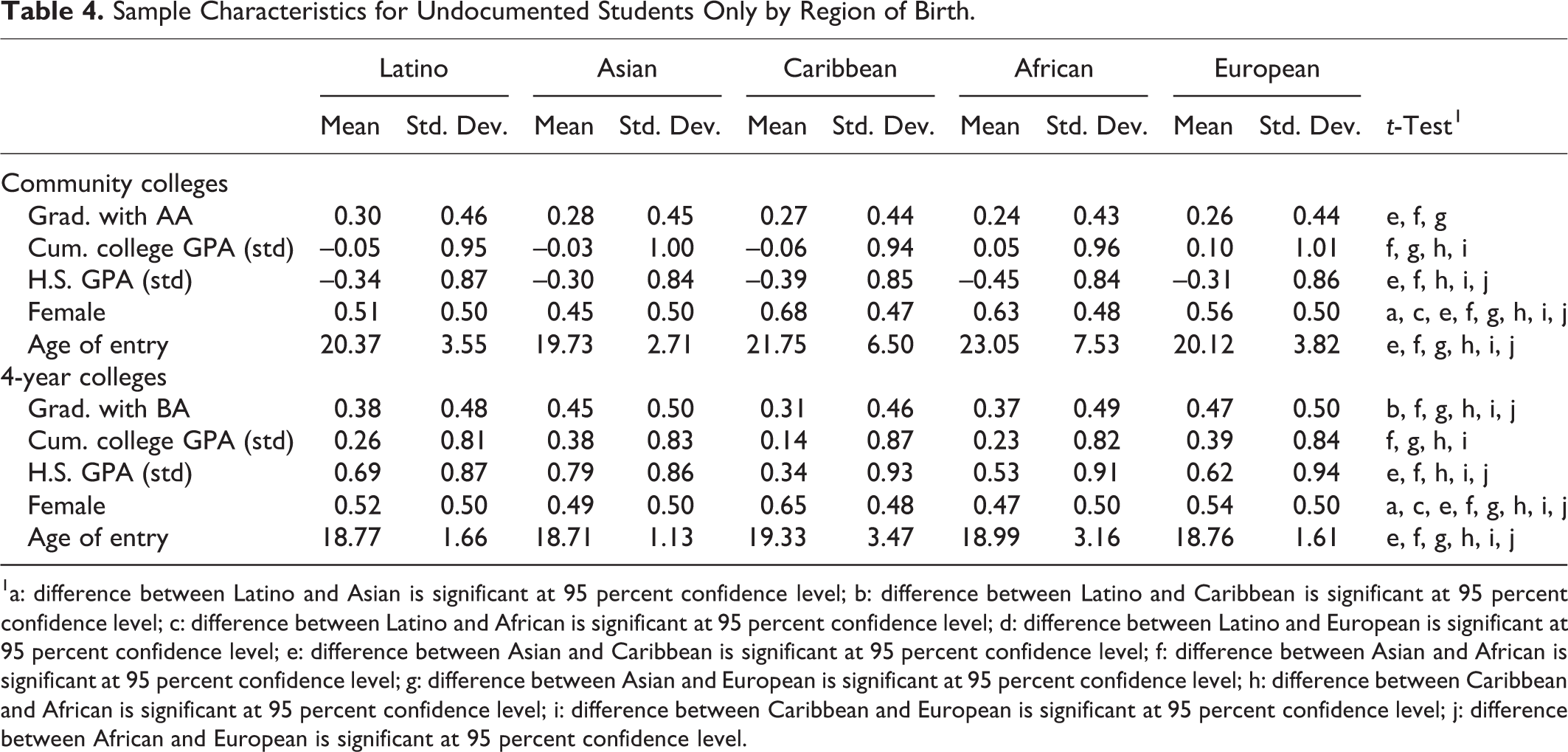
1a: difference between Latino and Asian is significant at 95 percent confidence level; b: difference between Latino and Caribbean is significant at 95 percent confidence level; c: difference between Latino and African is significant at 95 percent confidence level; d: difference between Latino and European is significant at 95 percent confidence level; e: difference between Asian and Caribbean is significant at 95 percent confidence level; f: difference between Asian and African is significant at 95 percent confidence level; g: difference between Asian and European is significant at 95 percent confidence level; h: difference between Caribbean and African is significant at 95 percent confidence level; i: difference between Caribbean and European is significant at 95 percent confidence level; j: difference between African and European is significant at 95 percent confidence level.
Results from Linear Probability and OLS Models
Tables 5 and 6 present results from linear probability models and OLS models predicting degree attainment and GPA, respectively. We compare outcomes across three categories of legal status: undocumented, LPR, and citizen (omitted category). We separately analyze community and four-year colleges and successively estimate nested models. Model 1 includes only immigration status as an independent categorical variable. Model 2 also includes high-school GPA. Model 3 adds origin region. Finally, Model 4 incorporates all control variables, including socio-demographic characteristics (sex, age of entry, Pell Grant receipt, and origin region) and high-school type (whether the student graduated from a public or private high school or obtained a GED). In Model 5, we also include statistical interactions between legal status and race/ethnicity to determine whether the effect of legal status varies by ethnic origin. Only the results for the main independent variable — immigration status — are shown, but full tables with coefficients for all control variables are available upon request.
Regression Results for Likelihood of Attaining a Degree by College Type.

Note: Model 1 includes only the legal status variables as independent variables. Model 2 also adds pre-college ability/motivation (high school GPA). Model 3 includes legal status, high school GPA, and region of origin. Model 4 includes control variables for socio-demographic characteristics (sex, age of entry, Pell Grant receipt, region of origin) and high school type, in addition to all of the variables from the previous models. Finally, Model 5 includes interaction terms for region of origin by legal status, in addition to all of the variables from the previous models.
*p < 0.05. **p < 0.01. ***p < 0.001.
Regression Results for Cumulative College GPA by College Type.
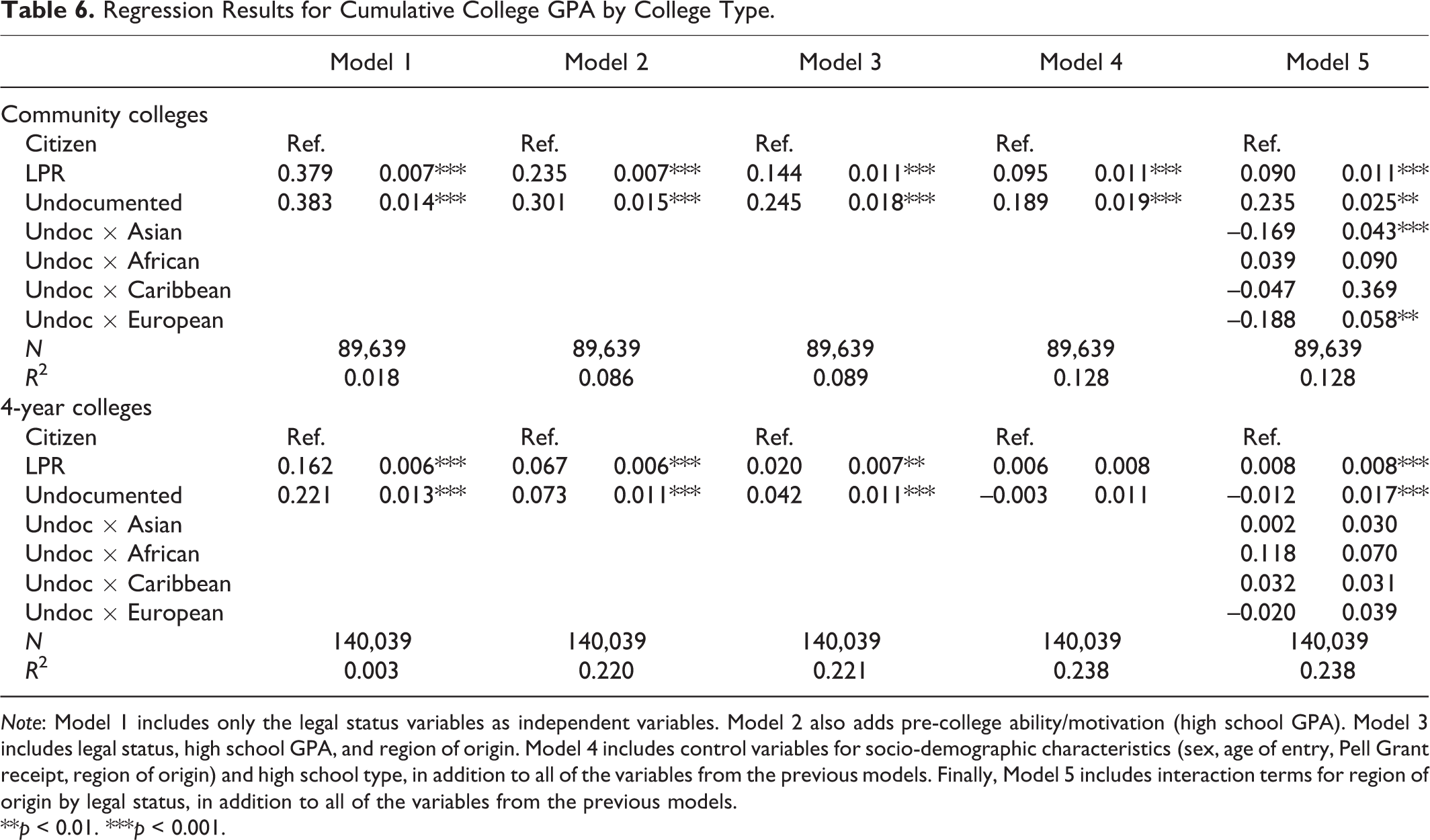
Note: Model 1 includes only the legal status variables as independent variables. Model 2 also adds pre-college ability/motivation (high school GPA). Model 3 includes legal status, high school GPA, and region of origin. Model 4 includes control variables for socio-demographic characteristics (sex, age of entry, Pell Grant receipt, region of origin) and high school type, in addition to all of the variables from the previous models. Finally, Model 5 includes interaction terms for region of origin by legal status, in addition to all of the variables from the previous models.
**p < 0.01. ***p < 0.001.
Table 5 demonstrates that at two-year community colleges, undocumented students are about nine percentage points more likely to attain an AA compared to citizens; LPRs are six percentage points more likely to attain an AA relative to citizens (Model 1). Undocumented students’ advantage over citizens is unchanged once pre-college ability, origin region, and demographic characteristics are added to the model (Models 2, 3, and 4). Interactions with origin country indicate that the advantage undocumented Europeans possess over citizens is smaller relative to that of other undocumented groups.
Turning to the second panel of results for four-year colleges, Model 1 also indicates that undocumented students are more likely to graduate with a BA relative to citizens but not more likely to graduate relative to LPRs. Controlling for pre-enrollment measures of academic preparedness in Model 2 completely eliminates the positive effect of legal status for undocumented students. Once demographic characteristics are controlled for in Model 4, the effect of legal status reverses signs, indicating that undocumented students are less likely to graduate with a BA relative to citizens. In Model 5, we include statistical interactions with origin country. These results indicate that all undocumented students are less likely to graduate relative to citizens, except for Asian undocumented students. Asian undocumented students are as likely to graduate with a BA as citizens are.
Table 6 presents results for cumulative college GPA. Overall, these results are similar to those presented in Table 5. Model 1 shows that at community colleges, undocumented students outperform both citizens and LPRs. The advantage undocumented students have over citizens is reduced by about one-half when all controls are included (0.383 in Model 1 to 0.189 in Model 4), but the advantage remains, net of all controls. In Model 5, we include statistical interactions and find that Asian and European undocumented students underperform relative to Latino, Caribbean, and African undocumented students at community colleges.
In contrast, in the second panel of results, we find that at four-year colleges, controlling for selection completely eliminates the advantage undocumented students have over citizens in terms of college GPA. In Model 1, undocumented students outperform citizens by 0.221 standard deviations. Controlling for pre-enrollment academic preparedness reduces this effect by one-half. Once all demographic characteristics and interactions have been controlled for in Model 5, the results show a negative effect of legal status on cumulative college GPA at four-year colleges. Thus, while undocumented youth continue to outperform their legal status peers at community colleges after controlling for prior characteristics, the same pattern is not observed at four-year colleges. Instead, at four-year colleges, prior characteristics account for all the observed advantage in college performance that undocumented youth have over their legal-status peers.
Conclusion and Discussion
For most undocumented youth, graduation marks a pivotal transition from the protected status that K-to-12 schooling affords them to a harsher reality in the workplace where lack of work authorization presents large barriers to upward mobility (Gonzales 2011; Gleeson and Gonzales 2012). A small minority — about one-quarter — pursue post-secondary schooling (Ortega, Edwards, and Hsin 2018). Debate is ongoing regarding whether legal status continues to exert an outsized effect on educational outcomes once undocumented youth enter college (Abrego 2006; Gonzales 2011; Terriquez 2014) or whether legal status interacts with other characteristics such as race and socioeconomic status to shape college outcomes (Enriquez 2017; Valdez and Golash-Boza 2018). Our study seeks to contribute to this debate by using new data on the population of undocumented college students in a large metropolitan area in the United States. The data give us unique access to critical pre-enrollment student characteristics (e.g., high-school GPA), information on two-year and four-year colleges, and students originating from a diverse group of countries. As a result, we can better address issues of sample selection and how legal status might intersect with race/ethnicity, socioeconomic status, and institutional characteristics to shape educational outcomes.
Our results indicate that undocumented college students are hyper-selected relative to their peers and demonstrate why accounting for this hyper-selection matters. First, we show that undocumented students enter college with significantly higher high-school GPAs than their citizen peers and enter at least as academically prepared as their peers with legal permanent resident status. Second, we find that undocumented students significantly outperform their citizen peers in terms of college GPA and graduation rates when we simply compare students descriptively in terms of graduation and performance across legal-status categories. The story changes, however, when we account for high-school GPA, birth country, and socio-economic status. Once we control for differences in pre-enrollment characteristics, we find that undocumented students outperform their peers with legal status at community colleges but underperform their peers with legal status at four-year colleges.
Why might the effect of legal status vary by college type? One reason undocumented students at community colleges do relatively better may be that the comparison pool of documented students tends to be low-performing. Many undocumented students attending two-year colleges may have had the academic ability to attend four-year colleges but were prevented from doing so because of their legal status and financial and psychological barriers. Thus, undocumented students at community college may be at a greater risk of being “under-placed” relative to their legal-status counterparts. Another reason might be because undocumented students at community colleges are more likely to share common struggles with their community-college peers than undocumented students at four-year colleges with their four-year college peers. Thus, undocumented students’ struggles with poverty and balancing work with schooling are not unique at community colleges but instead are struggles felt by most students with citizenship or legal permanent residency. Therefore, relative to their comparison group, the additional challenges faced by undocumented students associated with their lack of legal status may not be so great at community colleges as compared to four-year colleges.
Our results also uncover sources of variation by origin country. We find that Latin American, Caribbean, and African undocumented students outperform Asian and European undocumented students at community colleges but that at four-year colleges, this pattern is reversed. Asian students are the most likely to graduate among undocumented students at four-year colleges. Undocumented Asian students’ higher academic performance at four-year colleges reflects the well-established patterns of Asian American performance in education settings (Lee and Zhou 2015; Hsin and Xie 2014; Kao and Tienda 1998; Goyette and Xie 1999). The factors that propel Asian American achievement — high parental educational expectations, ethnic resources, and orientation toward education — likely bolster undocumented Asians’ achievement as well. Additionally, there is some evidence that the returns to education for some Asian undocumented college graduates are higher than for other ethnic groups. As already mentioned, Cho (2017) shows that undocumented Korean college graduates can find employment in white-collar professions in Korean ethnic enclaves whereas many undocumented Mexican graduates lack these same resources and were more commonly relegated to low-wage, blue-collar work.
Why this pattern is reversed at community colleges remains an open question. One possible explanation is that legal status has a stronger effect of channeling otherwise-promising Latin American, Caribbean, and African students who would have attended more prestigious colleges to community colleges than it does for Asian undocumented students. However, when we test this hypothesis by simply comparing high-school GPA across ethnic groups at community colleges, we do not find evidence for it: Latino, Caribbean, and African undocumented students do not have higher high-school GPAs than Asian undocumented students. Nevertheless, we cannot rule out that Latino, Caribbean, and African undocumented students are more likely to be under-placed with respect to characteristics that we cannot observe such as academic resilience, educational aspirations, support networks, and school segregation. Regardless, our results reveal important interactions between legal status and origin country that should be further explored by immigration scholars.
Overall, our results offer a more positive, although mixed, picture than what prior qualitative research has shown in terms of how undocumented students fare in college (Abrego 2006; Enriquez 2011; Gonzales 2011; Terriquez 2014). In particular, they highlight the contextual and relational aspects of undocumented status when compared to traditional master-status identities such as race and social class. Moreover, they point to the importance of intersectionality of various factors in determining undocumented students’ college pathways and successes.
There are two possible reasons why our results differ from past findings. First, our data allow us to examine variation in a less biased and more systematic manner. Second, results may differ from past studies because of differences in state-sponsored support. Compared to college students in California, for example, students in New York face significantly larger financial hurdles to college attendance and graduation. California was one of the first states to offer in-state tuition to resident undocumented college students and also offers undocumented students financial aid to attend college. 11 Bills have been introduced to the California state legislature that would allow undocumented students to participate in work-study programs (Assembly Bill [AB] 206) and designate a liaison at each public community and four-year college to offer advising and mentorship to undocumented students (AB 1366, AB 2009, AB 1622). In contrast, our study is focused on students attending public colleges in New York City, which is situated in a state that is significantly less friendly to undocumented immigrants. Undocumented students in New York are able to pay lower in-state tuition rates, but this policy was briefly overturned in 2001, and there are continuing efforts by Republican lawmakers to rescind in-state tuition policies. 12 For over a decade, New York State has been unable to pass the New York Dream Act, which would extend state financial aid to resident undocumented immigrants. As the selectivity of college increases, college access declines, but graduation rates for those who are admitted increase (Bailey, Jenkins, and Leinbach 2005; Suarez-Orozco et al. 2015). Thus, differences in access to state financial aid and other forms of state-sponsored support may account for why we find more positive outcomes for these hyper-selected undocumented college students in New York.
One important caveat is that we do not know whether our findings are generalizable. While New York City is a unique urban setting, it hosts more undocumented immigrants than any other US metropolitan area (Passel and Cohn 2017). Thus, we argue that the experiences of undocumented youth in New York are more typical of the experiences of undocumented youth in other states with large undocumented populations (e.g., Florida, Illinois, New Jersey, and Texas) than California, which has uniquely pro-immigrant policies. The degree to which our findings can be replicated in settings such as Florida, Illinois, and New Jersey would offer important contributions to the literature, and we encourage immigration scholars to pursue this line of inquiry.
Furthermore, unauthorized migration is not unique to the United States. Globally, unauthorized migration is on the increase. There are, for example, an estimated 1.8 to 8 million unauthorized migrants in the European Union; 5 to 6 million in the Russian Federation; 3 to 6 million in South Africa; and tens of millions in India, Pakistan, and Iran (Clandestino Research Project Database on Irregular Migration 2009; Frontex 2010; South African Police Service 2010; International Organization for Migration 2018). The debate in Europe over undocumented migration has most often focused on health-care access (e.g., Winters, de Jong, and Pavlova 2018), with almost no research on undocumented students in higher education. Beyond Europe, there is even less research about educational outcomes and access for undocumented students. Thus, European and other researchers need to examine this issue as undocumented migrant youth transition to adulthood and further integrate into local economies and societies. Undocumented children often have little memory of their origin countries and may not speak their “native” language. They attend primary school with native-born peers where they are taught the values and principles of their host countries. These youth want opportunities to attend institutions of higher education, to work, and to contribute to the countries in which they live, but they are often met with xenophobia and marginalization, rather than supportive integration policies (Ruzza 2019). With access to administrative data, research like ours could be conducted in other settings with large numbers of undocumented migrants to explore whether there are similar or different patterns of achievement and barriers in higher education.
Footnotes
Declaration of Conflicting Interests
The author(s) declared no potential conflicts of interest with respect to the research, authorship, and/or publication of this article.
Funding
The author(s) disclosed receipt of the following financial support for the research, authorship, and/or publication of this article: We are grateful for support from the William T. Grant Foundation.