




Abstract
This article contributes to the debate about migration’s impact on welfare state support by investigating the welfare opinions of migrants and their descendants. It examines whether experiences of group and individual discrimination explain the welfare attitudes of this group over and beyond classical predictors of self-interest and political ideology. Using survey data from Belgian citizens of Turkish and Moroccan descent, we show that stronger support for redistribution is associated with higher levels of perceived group discrimination, religious involvement, and belonging to the second generation. Preferences of government responsibility, however, are strongly determined by labor market position and left-right ideology.
Introduction
Large-scale immigration is considered one of the important challenges facing Western welfare states and the extensive social services provided by their governments (Ervasti, Goul, and Ringdal 2012; Svallfors 2012). A central concern, also referred to as the progressive’s dilemma, is that increased ethnic diversity caused by immigration might erode people’s commitment to welfare state solidarity and redistribution in Europe (Freeman 1986; Alesina, Glaeser, and Sacerdote 2001; Goodhart 2004). Public-opinion research shows that Europeans regard immigration as a strain on the welfare state (Wright and Reeskens 2013), perceive immigrants as the group least deserving of social benefits (van Oorschot 2006), and think that immigrants benefit disproportionally from and contribute insufficiently to the welfare state (Reeskens and van Oorschot 2012; Van der Waal, De Koster, and van Oorschot 2013). Although welfare attitudes and the immigration-welfare nexus have been studied extensively (e.g., Crepaz 2008; Mau and Burkhardt 2009; Van der Waal, De Koster, and van Oorschot 2013; Eger and Breznau 2017), these topics have almost exclusively been investigated from the insider position of native-born citizens. Since an increasing proportion of the population in Western societies has a migration background and since this part of the population is more likely to become welfare dependent (Boeri et al. 2002), it has been argued that the perspective of migrants, both first and second generation, on the welfare state needs to be taken into account (Schmidt-Catran and Careja 2017).
Apart from qualitative research on the views of some specific groups of labor migrants toward the welfare state (Timonen and Doyle 2009; Osipovic 2015; Kremer 2016), only a few quantitative studies have explored migrants’ attitudes toward government responsibility, redistribution, and welfare spending (Dancygier and Saunders 2006; Luttmer and Singhal 2011; Reeskens and van Oorschot 2015; Schmidt-Catran and Careja 2017; Lubbers et al. 2018). These studies tend to focus on two topics: (1) the existence of an opinion gap between migrants and native-born citizens, often referring to social mechanisms such as welfare magnetism (Borjas 1999) and self-selection (Chiswick 1999); and (2) the adjustment of migrants’ attitudes to native-born citizens’ attitudes over time, based on assimilation and socialization theories. Regarding an opinion gap, previous studies have shown that even though most immigrants hold somewhat stronger pro-welfare opinions than do native-born citizens, the differences are largely explained by immigrants’ disadvantaged socioeconomic position and higher welfare dependence (Dancygier and Saunders 2006; Reeskens and van Oorschot 2015). Recently, the idea that the opinion gap is purely based on socioeconomic differences has been questioned by Lubbers et al. (2018), who find large differences in attitudes toward government spending between migrant groups and native-born citizens, even after accounting for their socioeconomic and ideological position. Studies on the adjustment of migrants’ welfare opinions have found mixed results for the premise that immigrants gradually adjust their attitudes to those of the host population over time, depending on the data used and attitudinal dimensions investigated (Luttmer and Singhal 2011; Reeskens and van Oorschot 2015; Schmidt-Catran and Careja 2017).
Despite offering some valuable insights, existing research on migrants’ attitudes toward redistribution and government responsibility has an important limitation because the studies mostly use general population surveys, such as the European Social Survey (Luttmer and Singhal 2011; Reeskens and van Oorschot 2015) or General Social Survey (Luttmer 2001), that do not specifically target or oversample migrants. Although such studies allow comparisons with non-migrants and between countries, they aggregate minority groups with both varying cultural characteristics and different levels of welfare dependency into a single category or divide them into very broad categories, such as European and non-European migrants or first- and second-generation migrants (Dinesen 2012; Reeskens and van Oorschot 2015). As stated by Lubbers et al. (2018), lumping migrants into a catch-all category misses a careful interpretation of migrant status, which cannot be reduced to a less favorable socio-economic status.
In this article, we argue that to understand the welfare opinions of first- and second-generation migrants, the particularities of their minority position in society must be considered, more specifically their experiences of intergroup inequality, social injustice, and ethnic discrimination. Therefore, this study tests whether perceived discrimination affects migrants’ support for government responsibility and redistribution, in addition to testing the traditional determinants regarding structural position, self-interest, and left-right ideology. By testing explanatory models that go beyond the individual’s position in society and by highlighting the importance of perceived group position, we contribute to the growing literature on migrants’ welfare attitudes (Reeskens and van Oorschot 2015; Schmidt-Catran and Careja 2017; Lubbers et al. 2018). Instead of analyzing general population surveys, however, this study innovates by using the Belgian Ethnic Minorities Election Study 2014 (BEMES), which allows a focus on the specific case of Belgian citizens of Turkish and Moroccan descent.
Theory and Hypotheses
Migrants’ Attitudes toward Government Responsibility and Redistribution
To date, individual-level predictors for migrants’ welfare-state opinions stem predominantly from the literature on welfare attitudes within the general population and are based on explanations related to self-interest and political ideology (Jæger 2006). The self-interest approach posits that the welfare state is likely to be supported by people who receive welfare benefits or are at risk of becoming welfare dependent and by employees who profit professionally from an extensive welfare state (Kangas 1995; Gelissen 2000; Blomberg et al. 2012). Research confirms that civil servants and people in more vulnerable categories, such as women, the unemployed, people with health problems, and those with low incomes, are more likely to favor government intervention, income redistribution, and welfare state policies (Hasenfeld and Rafferty 1989; Hoel and Knutsen 1989; Svallfors 1995, 1997; Svallfors and Taylor-Gooby 1999; Svallfors 2004). The self-interest approach is complemented by indicators related to predispositions, values, and normative beliefs (Sears et al. 1980; Mau 2003; Staerklé, Likki, and Scheidegger 2012). Those identifying with the political left are more likely to favor government intervention and to have more positive attitudes toward the welfare state (Papadakis 1993; Papadakis and Bean 1993; Jæger 2008). Furthermore, people with strong feelings of economic insecurity are more in favor of social assistance (Burgoon and Dekker 2010), whereas citizens who believe that the causes of poverty lie within the individual’s control (Fong 2001) and who value a strong work ethic (Hasenfeld and Rafferty 1989) are less supportive of redistribution.
Based on these approaches, first- and second-generation migrants living in Europe, particularly those with origins in the post-war labor migration, can be expected to have positive attitudes toward government responsibility and redistribution, given their vulnerable socioeconomic position (Heath, Rothon, and Kilpi 2008) and preference for left-of-center political parties (Teney et al. 2010; Sanders et al. 2014). Although existing studies confirm these expectations (Dancygier and Saunders 2006; Reeskens and van Oorschot 2015; Schmidt-Catran and Careja 2017), both self-interest — based on predictors such as experience of unemployment, income level, and work status — and left-right orientation have only a limited explanatory capacity with regard to migrants’ welfare opinions (Reeskens and van Oorschot 2015; Lubbers et al. 2018). This finding suggests that to understand the determinants of attitudes toward government responsibility and redistribution among migrants and their descendants, insights into intergroup relations must be considered. More specifically, first- and second-generation migrants are prone to interpret their societal positions in relation to the native society. Compared to other disadvantaged groups, migrants and their descendants are much more likely to perceive discriminatory treatment (Gelijkekansencentrum 2015), and these perceptions have been related to many other outcomes such as acculturation attitudes (Verkuyten and Nekuee 1999), life satisfaction (Verkuyten 2008), and identification and politicization (Fleischmann, Phalet, and Klein 2011). Therefore, traditional frameworks explaining welfare state attitudes should be expanded by taking into account perceptions of discrimination.
Perceived Discrimination and Welfare Attitudes
Borrowing insights from relative deprivation theory and the literature concerning collective action (Stouffer et al. 1949; Van Zomeren, Postmes, and Spears 2008), we assume that the welfare attitudes of migrants and their descendants are related to their perceptions of intergroup inequality and injustice. A person’s or group’s feeling that compared with a relevant reference, they are unfairly deprived of desirable goods is referred to as relative deprivation (Stouffer et al. 1949; Merton and Rossi 1968; Vanneman and Pettigrew 1972). Relative deprivation is conceptualized as containing three elements: (1) people make comparisons with others, (2) they determine a disadvantage between themselves and others, and (3) this disadvantage is perceived as being unfair and causes feelings of resentment (Crosby 1976; Smith et al. 2012; Pettigrew 2016). In the case of ethnic minorities, such as migrants and their descendants, relative deprivation largely coincides with perceived ethnic discrimination, that is, perceptions of differential treatment based on ethnic origin that unfairly disadvantages a person’s own ethnic group (Quillian 2006; Kluegel and Bobo 2001). Although the notion of group relative deprivation emphasizes feelings of disadvantage in comparison with relevant reference groups, whereas perceived group discrimination focuses mainly on the act of unfair treatment, both concepts can be considered forms of perceived social injustice resulting from intergroup inequality (Van Zomeren, Postmes, and Spears 2008).
According to the collective action literature, minority group members who perceive group inequality are more likely to engage in political action to challenge this injustice and improve the group’s conditions (Van Zomeren, Postmes, and Spears 2008; Dixon et al. 2010). Furthermore, group position theory predicts that perceptions of a threatened group position are likely to have a major influence on people’s policy preferences (Bobo 1999, 463). As already mentioned, the welfare state is generally supported by people who have a vulnerable socioeconomic position because government intervention is seen by this group as a primary way to alter unfavorable market outcomes (Blomberg et al. 2012). We, thus, expect migrants who perceive themselves as disadvantaged to be more likely to be conscious of the welfare state’s emancipatory facets and to view government intervention and redistributive policies as collective solutions to rectify the inequalities they experience. Under the condition that they perceive the national government as legitimate and that public institutions are not regarded as the cause of the actual injustice, migrants with strong feelings of relative deprivation or discrimination would therefore be more likely to favor government intervention and redistribution.
With regard to perceived injustice as a determinant of social protest, Runciman (1966) introduces an essential distinction between egoistic relative deprivation (a feeling of being unfairly disadvantaged as an individual) and fraternal relative deprivation (a feeling of being unfairly disadvantaged as a group). In terms of attitudinal and behavioral consequences, individual or egoistic relative deprivation is related to internal states, such as self-esteem, and to individual behavior (Verkuyten 1998). Group or fraternal relative deprivation, on the other hand, involves feelings of social injustice and is associated with intergroup attitudes, such as prejudice, social protest, and collective action aimed at structural changes in society (Runciman 1966; Vanneman and Pettigrew 1972; Walker and Smith 2002; Smith et al. 2012). As stated by Smith and Ortiz (2002, 111), When a disadvantage is defined in intergroup terms, people may be more concerned with outcome differences and less concerned with the implications for their personal self-image than when the same disadvantage is defined in interpersonal terms. Therefore they may be more willing to challenge the inequity. Not only might people feel less devastated by a disadvantage they interpret in intergroup terms, they may actually feel more empowered to deal with it.
Generation and Religious Involvement
In addition to perceptions of discrimination, this study also focuses on the effect of generation and religious involvement on the welfare attitudes of first- and second-generation migrants of Belgians of Turkish and Moroccan descent. Based on assimilation and social integration theories, it is predicted that immigrants adjust to their host country’s cultural values, while the origin-country values are gradually lost (Gordon 1964; van Tubergen 2007; Maxwell 2010). Correspondingly, Reeskens and van Oorschot (2015) show that first- and second-generation migrants differ from each other with regard to their welfare opinions, and Schmidt-Catran and Careja (2017) find that migrants’ preferences about the state’s role, rooted in the culture of their origin country, are shaped by their contact with the host country’s institutions. Considering the lower levels of welfare spending in Morocco and Turkey compared to Belgium, we therefore expect that second-generation migrants will be stronger supporters of redistribution (Hypothesis 5) and government responsibilities (Hypothesis 6) than first-generation migrants.
In terms of religion, a distinctive feature of the investigated population is that they are predominantly Muslim (Torrekens and Adam 2015). The relationship between religious involvement and welfare state support has not yet been studied among Muslim minorities; and existing European research, based on surveys mostly composed of populations with Protestant, Catholic, or secular sectors, presents mixed findings. Stegmueller et al. (2012) find that religious individuals are more opposed to income redistribution by the state, compared with secular individuals; while Ervasti (2012) and Lubbers et al. (2018) show that religiosity is positively related to support for government responsibility, social equality, and government spending on social assistance. In a non-Western context, Davis and Robinson (2006) found a positive association between religious orthodoxy and economic communitarianism; however, little is known about how Muslim minorities in European countries adapt their religious beliefs in relation to the Western welfare state (Dean and Khan 1997, 204). According to Islamic teachings, both the state’s responsibility to ensure a basic standard of living for all citizens and the reduction of the gap between rich and poor are of great importance (Dean and Khan 1997). The moral principle that embodies Islamic commitment to welfare and social justice can be traced back to the concept of Zakat, which is a religious tax on property with the function of avoiding wealth accumulation and reducing the gap between rich and poor (Ahmad 1991; Dean and Khan 1997). The literature on an Islamic vision of a just socio-economic order therefore leads us to expect a positive relation between religious involvement and support for redistribution (Hypothesis 7) and government responsibilities (Hypothesis 8) among the mostly Muslim population in this study.
The Case of Turkish and Moroccan Minorities in Belgium
Turkish and Moroccan minorities in Belgium have their origins in labor migrations of the 1960s and 1970s and subsequent family reunification and marriage migration (Surkyn and Reniers 1996). As official statistics on ethnicity are lacking in Belgium, the exact proportion of the population with a foreign background cannot be calculated. Nonetheless, it is estimated that about 2 percent of the Belgian population is of Turkish descent (Schoonvaere 2013) and 3.8 percent of Moroccan descent (Schoonvaere 2014). The majority of these groups have obtained Belgian citizenship and formally have the same social rights as citizens of native descent (Schoonvaere 2013, 2014; Gsir, Mandin, and Mescoli 2015). However, this formal equality does not translate into an equal social position, given that Turkish and Moroccan minorities are among the lowest in the ethnic hierarchy in Western societies (Hagendoorn 1995). Compared with Belgians that have native-born parents, Turkish and Moroccan minorities attain lower education levels (Timmerman, Vanderwaeren, and Crul 2003), are five times more likely to be unemployed (Martens and Verhoeven 2006; Van den Broucke et al. 2015), and are overrepresented in the labor market’s secondary sectors (Timmerman, Vanderwaeren, and Crul 2003). In addition, more than half the population of Turkish or Moroccan descent has an income below the poverty line, compared with 10 percent of Belgians with a native background (Van Robaeys and Perrin 2007). In sum, the combination of being an insider in the legal sense, while remaining an outsider in reality, creates a high likelihood of perceived discrimination among these groups (Alanya et al. 2017). This dual position makes it relevant to investigate the relationship between perceived discrimination and welfare attitudes among this population.
Data and Methods
Data
We use data from the BEMES, a face-to-face survey among first- and second-generation Belgian citizens of Turkish and Moroccan descent aged at least 18. The survey was conducted in two Belgian cities: Liège, located in the French-speaking part of Belgium (Wallonia); and Antwerp, located in the Dutch-speaking part (Flanders) (Swyngedouw et al. 2015). Computer-assisted personal interviews were conducted at respondents’ homes by trained interviewers in Dutch or French. Since the sample only concerns respondents with sufficient knowledge of Dutch or French, the first generation is likely underrepresented, while relatively well-integrated respondents may be overrepresented. Considering the difficulties related to surveying migrants and ethnic minorities (Font and Méndez 2013), an overall response rate of 34.9 percent was obtained. More specifically, the BEMES data include 878 respondents from four groups randomly selected from the cities’ population registers: Belgians of Moroccan descent in Antwerp (N = 243; response rate 39.1%), Belgians of Turkish descent in Antwerp (N = 239; response rate 37.2%), Belgians of Moroccan descent in Liège (N = 188; response rate 25.8%), and Belgians of Turkish descent in Liège (N = 208; response rate 39.9%). Since the elderly and people of Moroccan descent are somewhat underrepresented, post-stratification weight coefficients based on age, gender, city of residence, and ethnic background were applied.
Measurements
Dependent variables
Attitude toward redistribution is operationalized by a scale based on three 5-point Likert items regarding the reduction of class differences and income inequality. Attitude toward government responsibility is operationalized by three 11-point scales on the government’s responsibility for providing pensions, health care, and a reasonable standard of living for the unemployed. Confirmatory factor analysis showed that a two-factor model — attitude toward government responsibility and attitude toward redistribution — fits the data better (χ2 = 44.061; df = 8; root mean square error of approximation [RMSEA] = 0.072; comparative fit index [CFI] = 0.942; Tucker-Lewis index [TLI] = 0.891) than a one-factor model (χ2 = 288.396; df = 9; RMSEA = 0.188; CFI = 0.552; TLI = 0.253). The standardized correlation between the two constructs is 0.16 (p = 0.004), which is relatively weak and might imply the need for different explanatory models.
Independent variables
We include the following indicators with regard to socio-structural position, self-interest, and political ideology. Gender is operationalized by a dummy variable with the value 1 for women and 0 for men. A dummy variable with the value 1 for Turkish descent and 0 for Moroccan descent indicates respondents’ migration background. City of residence is operationalized in a similar manner, with the value 0 for respondents living in Antwerp and 1 for respondents living in Liège. Age is coded into four categories: 18 to 24 years old, 25 to 34 years old, 35 to 44 years old, and 45 to 93 years old. Respondents’ level of education is measured with four categories: less than lower-secondary education, lower-secondary education, higher-secondary education, and tertiary education. Respondents’ position in the labor market is taken into account by a variable that distinguishes between respondents not active in the labor market, blue-collar workers, and white-collar workers. Economic insecurity is measured by a scale of three items asking respondents how often they worry about having financial difficulties or maintaining their socio-economic position in the future. To measure the left-right identification, respondents had to place themselves on a scale from 0 (left) to 10 (right).
The generation to which respondents belong is operationalized into three categories: first-generation migrants are defined as people who were born abroad and migrated to Belgium after the age of 15; the intermediate generation — or generation 1.5 — refers to people who were born outside Belgium and migrated before the age of 15; and the second generation refers to respondents who were born in Belgium, with one or both parents having been born in Morocco or Turkey (Rumbaut and Ima 1987; Heath et al. 2013). To operationalize religious involvement, a distinction is made between respondents who reported not being Muslim, non–strictly practicing Muslims, and strictly practicing Muslims. To define this last category, we differentiate between male and female respondents (Loewenthal, MacLeod, and Cinnirella 2002). If a female respondent reported having always fasted during the last Ramadan and praying at least five times per day, she was categorized as a strictly practicing Muslim. For male respondents in this category, it was additionally required that they reported visiting a mosque weekly or more. The category of others relates to a small and heterogeneous group containing atheists, Catholics, and Yezidis.
Finally, we introduce two measures of perceived discrimination to explain the welfare attitudes of these immigrant minorities. Perceived group discrimination is measured by four 5-point Likert items referring to perceived differential treatment of respondents’ own ethnic group in times of economic crisis, by the government, by city services, and at the social assistance agency. Confirmatory factor analysis showed that the items are reliable and valid measurements (χ2 = 3.070; df = 2; RMSEA = 0.025; CFI = 0.999; TLI = 0.998). Additionally, we include a dummy variable with score 1 for respondents who reported having personally experienced hostility or unfair treatment because of their background or descent during the last five years.
To test our hypotheses, we used structural equation modeling (SEM) estimated in Mplus version 7.1 (Muthén and Muthén 1998–2012). As suggested by Kline (2011), we used a two-step approach: we first tested the measurement models of support for redistribution and government responsibility and perceived group discrimination and then tested the structural model with the two welfare attitudes as dependent variables. The exact question wordings and standardized factor loadings of the latent variables can be found in Table 1. Descriptive statistics of the observed variables are shown in the Supplemental Appendix (available in the online version of this article).
Descriptive Statistics of Attitudes toward Government Responsibility and Redistribution, Economic Insecurity and Perceived Group Discrimination for Belgians of Turkish and Moroccan Descent.

Note: The measurement equivalence of the model across the two ethnic groups was tested, and goodness-of-fit indices (available on request) showed that full scalar equivalence was obtained.
Source: Belgian Ethnic Minorities Election Study (BEMES) 2014.
Results
Based on the descriptive statistics in Table 1, it appears that the surveyed Belgians of Turkish and Moroccan descent are very supportive of government responsibility and redistribution. The mean scores show that overall, respondents agreed with the reduction of class differences (M = 3.99; SD = 1.02) and government redistribution of income differentials (M = 3.77; SD = 1.02), while they disagreed with the statement that differences between high and low incomes should stay as they are (M = 2.22; SD = 0.99). In general, on an 11-point scale, respondents preferred very high levels of government responsibility in the provision of pensions (M = 8.75; SD = 1.67), health care (M = 9.03; SD = 1.48), and a reasonable standard of living for the unemployed (M = 7.71; SD = 2.2). On average, respondents agreed with the statements that people like them are being systematically neglected (M = 3.05; SD = 1.03) and the first victims in times of crisis (M = 3.12; SD = 1.06). They also reported unequal treatment of their ethnic group by the government (M = 2.95; SD = 1.05) and at the social assistance agency (M = 3.00; SD = 0.96).
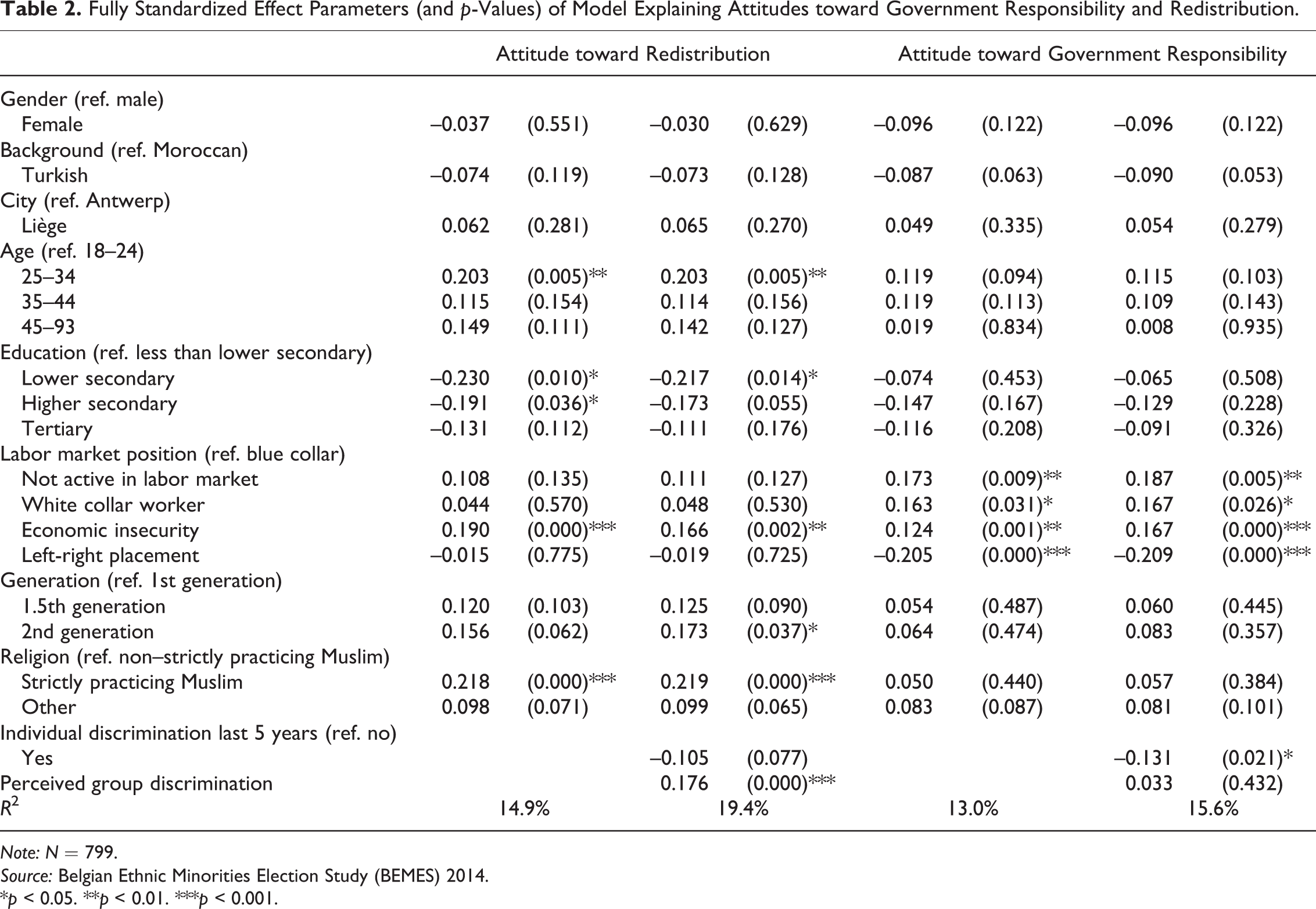
Table 2 presents the results of the analyses explaining the welfare attitudes of Turkish and Moroccan Belgians. We report fully standardized parameter estimates (expressed in how many standard deviations the dependent variable changes when the predictor increased by one standard deviation). As a result, we can compare the effect size of the different predictors and for the two dependent variables. Considering the predictors referring to social position, religious involvement, and generation, we are able to explain 14.9 percent (redistribution) and 13.0 percent (government responsibility) of variation in the welfare attitudes of Turkish and Moroccan Belgians. Adding perceived discrimination in the second step increases the explained variances to, respectively, 19.4 percent and 15.6 percent.
Fully Standardized Effect Parameters (and p-Values) of Model Explaining Attitudes toward Government Responsibility and Redistribution.
Note: N = 799.
Source: Belgian Ethnic Minorities Election Study (BEMES) 2014.
*p < 0.05. **p < 0.01. ***p < 0.001.
Table 2 shows that the structural characteristics mostly used in research among the general population are also relevant for explaining the welfare attitudes of Belgians of Turkish and Moroccan descent. Controlling for generation, it appears that the youngest group of respondents is the least likely to support redistribution. With regard to the self-interest approach, our study shows mixed findings. On the one hand, there is a positive effect of being inactive in the labor market, rather than being a blue-collar worker, on attitudes toward government responsibility (β = 0.187; p = 0.005) and a negative effect of educational level on support for redistribution. On the other hand, the fact that white-collar workers also strongly support government responsibility contradicts the idea of calculated self-interest. Nevertheless, there is a strong positive effect of economic insecurity on both the demand for redistribution (β = 0.166; p = 0.002) and government intervention (β = 0.167; p = 0.000). This finding illustrates the importance of considering not only structural characteristics but also people’s everyday life experiences when explaining their welfare attitudes. Turning to another factor drawn from the general welfare attitudes literature, our results show that left-right identification is one of the strongest predictors of Turkish and Moroccan Belgians’ opinion on government responsibility (β = –0.209; p = 0.000), with leftist people being more supportive. Interestingly, there is no significant effect of political ideology on attitudes toward redistribution (β = –0.019; p = 0.725).
Overall, it stands out that the predictors of the two welfare attitudes are quite divergent. While both generation and religious involvement are relevant for Turkish and Moroccan Belgians’ support for redistribution, they are unrelated to their opinions about government responsibilities. Contrary to our expectations, there are no generational differences in opinions about government responsibility (H6), whereas Turkish and Moroccan Belgians belonging to the second generation are more in favor of redistribution than is the first generation (H5; β = 0.173; p = 0.037). Regarding religious involvement, our analysis shows no effect on attitudes toward government responsibilities (H8) but confirms that compared with non–strictly practicing Muslims, strictly practicing Muslims are much more in favor of redistribution (H7; β = 0.219; p = 0.000). This finding is in line with religiosity’s generally positive effect on welfare attitudes, as found by Ervasti (2012), and our prediction based on the Islamic vision of a just socio-economic order with a strong emphasis on reducing the gap between rich and poor (Dean and Khan 1997).
With regard to perceived discrimination, the results only partly confirm our hypotheses. As expected, Turkish and Moroccan Belgians with higher levels of perceived group discrimination are more likely to favor redistribution. However, while the effect is strong and significant for attitudes toward redistribution (H1; β = 0.176; p = 0.000), perceived group discrimination is not significantly related (H2; β = 0.033; p = 0.432) to attitudes toward government responsibility. Interestingly, the government’s responsibility to ensure social provisions is presumably more interpreted in left-right terms (i.e., the desired degree of direct government regulation and intervention either alongside or instead of market mechanisms) and less understood in terms of actual intergroup relations and the perceived injustice involved. It is noteworthy that perceptions of group discrimination, even after controlling for economic insecurity and perceived individual discrimination, are still relevant for explaining Turkish and Moroccan Belgians’ support for redistribution. Perceptions of group inequality thus matter, as do measures of vulnerability at the personal level.
Lastly, while the absence of a significant effect of perceived individual discrimination on attitudes toward redistribution (H3; β = –0.105, p = 0.077) is in line with our expectations, our analyses show somewhat surprisingly that perceived individual discrimination is negatively related to support for government responsibility (H4; β = –0.131; p = 0.021). Similar to studies on well-being (Molero et al. 2011) and self-esteem (Bourguignon et al. 2006), we find that group and individual discrimination appear to have opposing effects on Turkish and Moroccan Belgians’ welfare opinions. Perceiving group discrimination and attributing this deprivation to an external or structural cause induces collective action (Dixon et al. 2010) and, as our study shows, a stronger demand for the redistribution of income inequalities. Perceived individual discrimination, however, is directly related to evaluations of the self and may result in self-blame (Bourguignon et al. 2006), though not in a demand for redistribution or government intervention. Even more, our analysis suggests a negative effect of perceived individual discrimination on support for government responsibility among Belgians of Turkish and Moroccan descent. Hypothetically, it might be that people who have personally experienced unfair treatment have lower levels of institutional trust and therefore consider the government not to be a legitimate authority for reducing experienced inequalities. More research is required, however, to examine whether the negative effect of perceived discrimination on support for government responsibility is caused by decreased trust in government institutions.
Conclusions
In debates about the relation between migration and the welfare state, migrants tend to be considered objects of discussion rather than subjects with their own opinions (Kremer 2016). The few quantitative studies that try to explain the welfare attitudes of migrants and their descendants are mostly limited to indicators of self-interest and political ideology (Dancygier and Saunders 2006; Reeskens and van Oorschot 2015; Schmidt-Catran and Careja 2017; Lubbers et al. 2018). The analysis presented here adds substantially to our understanding of support for redistribution and government responsibility among first- and second-generation migrants. Taking into account the classic predictors based on structural position and ideology, this study innovates by introducing perceptions of unequal treatment, at both the individual and group level, and by investigating potential divides among migrants along generational lines and religious involvement.
First, our study indicates that Turkish and Moroccan Belgians’ attitudes toward government responsibility are shaped by their labor-market position, economic insecurity, and left-right self-placement, implying that their opinions fit into the conventional left-right ideological divisions between a free market and regulated market poles. Their attitudes toward government responsibility are not related to perceived group discrimination, suggesting that the extent to which the government should be responsible for social welfare provision is not framed in intergroup inequalities. However, contrary to our expectations, perceived individual discrimination appears to be negatively related to support for government responsibility. Based on studies looking at the consequences of individual experiences of discrimination among minority group members (Branscombe, Schmitt, and Harvey 1999; Schmitt and Branscombe 2002; Verkuyten 2005; Jasinskaja-Lahti, Liebkind, and Solheim 2009), we propose that the negative effect of perceived individual discrimination might be related to diminished institutional trust and identification with the host country. However, additional studies including these measures are required to test this post-hoc argumentation.
Second, our study shows that besides educational level and economic insecurity, support for redistribution is related to religious involvement, generation, and perceived group discrimination. In this sense, Turkish and Moroccan Belgians’ egalitarian attitudes seem to be less connected to self-interest and the traditional ideological left-right divide and more structured by cultural capital, actual intergroup relations, and the perceived injustice involved. The feeling of being unfairly deprived as a group results in a greater willingness to challenge income inequality. According to this logic, first- and second-generation migrants’ attitudes toward redistribution originate, at least partially, from the perception that their proprietary claims over certain rights and resources are not valorized by the native society. In a similar vein, our results illustrate that the study of migrants’ welfare attitudes is meaningless without reference to the specific context of group positions and institutional discrimination.
Third, our work suggests that predictors for attitudes toward government responsibility and redistribution are quite divergent. This finding is significant, since the two welfare attitudes are often considered to be strongly interrelated or even equivalent (Svallfors 1997; Blekesaune and Quadagno 2003). These differences in predictors point to the distinction, made by Borre and Scarbrough (1995), between welfare policies aimed at socioeconomic security and welfare policies aimed at socioeconomic equality. We show that among Belgians of Turkish or Moroccan descent, support for redistribution is associated with religious involvement and perceived group discrimination, while preferences regarding government responsibility are shaped by labor market position and left-right placement. Our study thus highlights the importance of group-related social experiences and predispositions for attitudes toward welfare policies aimed at socioeconomic equality (Roller 1995) and the importance of social class and left-right placement for attitudes toward welfare policies aimed at socioeconomic security (Pettersen 1995). This finding reaffirms the need to distinguish between different types of welfare attitudes and to further explore additional explanatory variables. It also suggests that we cannot assume that support for government intervention follows self-evidently from egalitarianism, and vice versa.
Fourth and finally, we assert that it is essential to recognize different fractions within the non-native population, as our findings suggest that both generation and religious involvement cross-cut ethnic divisions. While there is no effect based on origin country, our study shows that second-generation migrants are more in favor of redistribution than are first-generation migrants, while strictly practicing Muslims are the strongest supporters of redistribution. In this regard, we innovate by exploring the role of religious involvement among a mostly Muslim population, demonstrating that Muslim minorities’ strong religious involvement does not necessarily obstruct their welfare state solidarity within Belgian society.
Focusing on well-defined minority groups (i.e., Turkish and Moroccan Belgians) allowed us to overcome some of the difficulties of existing studies caused by aggregating very different minority groups into a single category (Lubbers et al. 2018). This design helped shed light on the wider context of the welfare attitudes of post-war labor migrants and their descendants that have settled in Western Europe. By considering the particularities of migrants’ position in the native society and the perceived unequal treatment that is involved, our study uncovered the complex nature of migrants’ attitudes toward the welfare state, something that cannot be captured by the determinants used in the literature among the general population. As such we contribute to understandings of the welfare opinions of migrants and their descendants, which is highly relevant for policy makers in Europe, where societies are currently debating the impact of migration and increased diversity on support for welfare state solidarity (Kymlicka and Banting 2006; Larsen 2011). Although this study focuses on the role of perceived discrimination for the welfare attitudes of first- and second-generation migrants, its insights may also be relevant for explaining the opinions of other disadvantaged groups.
Nonetheless, this study has limitations related to the investigated population and the data used. First, people of Turkish and Moroccan descent form a specific and visible minority group within Belgian society. Therefore, it remains to be investigated whether perceptions of a disadvantaged group position have the same relevance for welfare opinions in other contexts where migrants form less identifiable minority groups. The fact that this study concerns only respondents with Belgian citizenship and sufficient knowledge of Dutch or French can be considered a second limitation. Given that citizenship and length of stay in the host country are relevant factors in the socialization of migrants’ welfare attitudes (Luttmer and Singhal 2011; Reeskens and van Oorschot 2015), additional research is necessary to understand the predictors of welfare opinions for migrants with a more recent and temporary settlement. Furthermore, since this study is limited to two Belgian cities, it remains to be investigated whether the current findings can be generalized toward the entire community of immigrant minorities. Finally, this study analyzed rather generic welfare attitudes, showing that Turkish and Moroccan Belgians are overall strong welfare-state supporters. However, it has been revealed that migrants’ preferences regarding government spending differ between welfare domains (Lubbers et al. 2018), and it is possible that, due to their dual position, minority group members combine an overall positive attitude toward the welfare state’s general principles with a critique of its functioning. Our main suggestion for future research is therefore to investigate additional welfare attitudes among migrants, such as perceived welfare state consequences (van Oorschot 2010) and deservingness perceptions (van Oorschot 2000).
Supplemental Material
Supplemental Material, MRX830695_Supplemental_Appendix - Attitudes of Turkish and Moroccan Belgians toward Redistribution and Government Responsibility: The Role of Perceived Discrimination, Generation, and Religious Involvement
Supplemental Material, MRX830695_Supplemental_Appendix for Attitudes of Turkish and Moroccan Belgians toward Redistribution and Government Responsibility: The Role of Perceived Discrimination, Generation, and Religious Involvement by Jolien Galle, Koen Abts, Marc Swyngedouw, and Bart Meuleman in International Migration Review
Footnotes
Declaration of Conflicting Interests
The author(s) declared no potential conflicts of interest with respect to the research, authorship, and/or publication of this article.
Funding
The author(s) disclosed receipt of the following financial support for the research, authorship, and/or publication of this article: This study was made possible by grants from the KU Leuven Research Council, the Research Foundation FWO-Flanders, and the Belgian National Lottery.

References
Supplementary Material
Please find the following supplemental material available below.
For Open Access articles published under a Creative Commons License, all supplemental material carries the same license as the article it is associated with.
For non-Open Access articles published, all supplemental material carries a non-exclusive license, and permission requests for re-use of supplemental material or any part of supplemental material shall be sent directly to the copyright owner as specified in the copyright notice associated with the article.
