




Abstract
According to the United Nations High Commissioner for Refugees, the number of refugees worldwide rose to 25.9 million in 2018. Despite the increased need for refugee resettlements, resistance to the welcoming of refugees appears to have grown. The perception that refugees may engage in criminal behavior has served as fuel for closing the door to refugees in the United States and Europe. Is there any basis for this fear? We exploit variation in the geographic and temporal distribution of refugee resettlements across counties to ascertain if their presence can be linked to greater local violence in the case of the United States. We fail to find any statistically significant evidence of refugee resettlements raising local arrest or offense rates. Institutions that help refugees assimilate into the US labor market may contribute to these favorable outcomes. Overall, these findings widen our understanding of refugee resettlement in the United States and suggest that the adoption of humanitarian efforts to support these international flows need not be discouraged.
1. Introduction
Over the past five years, refugees and the refugee crisis have been front-page news worldwide, at the same time that governments in Europe, Latin America, and the United States have become increasingly resistant to accepting more refugees (Patrick 2019). In the United States, concerns over refugees’ potential impact on national security have led to policies curtailing the inflow of refugees, as well as to banning the entry of refugees originating from specific nations. For instance, the number of refugees resettled in the United States dropped from 84,994 in 2016 to 30,000 in 2019, 1 and President Trump has further capped admissions to 18,000 for 2020. 2 These actions have taken place without thorough empirical evidence demonstrating the existence of a significant link between refugee inflows and the incidence of crime. This article addresses this vacuum by examining if there is a casual relationship between refugee resettlement and criminal behavior in the United States.
Assessing any potential link between criminal activities and refugee resettlement is of utmost importance for various reasons. First, the sheer magnitude of refugee flows worldwide underscores the need to understand any safety and security implications for settlement societies. In 2018, the number of refugees worldwide rose to a record high of 25.9 million (UNHCR 2019, 13). If this trend continues, pressures to accommodate refugee inflows will continue to grow globally. It is, therefore, important to understand the consequences and impacts of refugee resettlement programs so that appropriate accommodations to these inflows can be put in place.
Second, claims and concerns regarding the dangerous nature of refugee resettlements have been on the rise in the United States. For example, as the Syrian refugee crisis unfolded, a total of 31 US governors opposed resettling Syrian refugees based on security concerns (Fantz and Brumfield, 2015). More recently, President Trump advised Americans against accepting refugees as Germany had done, arguing that crime rose in that country after their arrival in a tweet: “Crime in Germany is up 10% plus (officials do not want to report these crimes) since migrants were accepted. Others [sic] countries are even worse. Be smart America!” (Trump 2018). Furthermore, safety concerns have also emerged among segments of the US public, as revealed by polls assessing opinion on whether the refugee bans enacted by the Trump Administration made the United States safer. For example, a little more than a third of registered voters in a nationwide Quinnipiac University poll conducted February 16–21, 2017, indicated that they believed the ban would help make the United States safer. 3 Similarly, a CBS poll conducted February 1–2, 2017, revealed that 35 percent of a nationwide sample of adults agreed with the statement that “temporarily banning people from these countries will make the United States safer from terrorism by preventing unwanted people from entering the country.” 4 In sum, rising safety concerns regarding refugees warrant a thorough assessment of the impact of refugee resettlement on crime in the United States.
Third, safety concerns about refugees have been accompanied by policy measures and legislative efforts limiting the entry of foreign nationals to the United States. For instance, starting in 2017, the Trump Administration enacted a travel ban through the Executive Order, Protecting the Nation from Terrorist Attacks by Foreign Nationals (Davis 2017; National Public Radio 2017). The ban greatly restricted inflows of nationals from a list of countries thought to potentially endanger the United States. Now in its third iteration, the list of countries has changed, but the emphasis on limiting immigration and refugees to promote national security remains (Chisti and Pierce 2016). Additionally, refugee admissions to the United States have been severely reduced from 110,000 in 2017 to 18,000 in 2020. 5 Similarly, some Senate and House legislators have expressed opposition to resettling refugees based on safety concerns. For example, on January 24, 2017, Senator Ted Cruz and Representative Ted Poe re-introduced the State Refugee Security Act of 2017. 6 The joint Senate-House effort proposed a mandate that the federal government notify a state at least 21 days prior to resettling a refugee there, while requiring “adequate assurances that the refugee does not present a security risk.”
Despite the volume of refugees worldwide, growing safety concerns regarding refugee resettlement, and the adoption of policy measures limiting refugee resettlement on the basis of security concerns, we know very little about how refugee settlements affect crime in the United States. The few studies examining any potential link between refugee resettlement and crime have focused on Europe or Africa, where they have found some evidence of refugee and asylum flows being linked to increases in non-violent crime (i.e., Bell, Fasani, and Machin 2013; Gehrsitz and Ungerer 2017; Simmler et al. 201; Fisk 2018). With this study, we aim to address the existing void in the literature by examining the link between refugee resettlements and crime in the United States.
To do so, we take an evidenced-based approach and construct a rigorous methodological design to test whether refugees cause crime in their US destinations. Using county-level data from the Refugee Processing Center in the Bureau of Population, Refugees and Migration at the Department of State from 2006 through 2014, we assess if refugee placements in this period were tied to a higher incidence of arrests and reported offenses, as recorded by the Uniform Crime Reporting (UCR) program. Even after addressing potential endogeneity concerns regarding refugees’ non-random placement, we fail to find any statistically significant evidence of refugee resettlements being associated with higher crime rates as proxied by arrests or reported offenses. Overall, the findings uncover the lack of a significant link between refugee resettlement and criminal activity in the United States, widening our understanding of the disconnect between immigrant populations and crime (e.g., Butcher and Piehl 2007, Chalfin 2014), and documenting a growing gap between public rhetoric and policy concerning refugees and the empirical realities of their impacts in local US communities.
The rest of this article is organized as follows. First, in Section 2, we provide a review of various relevant literatures, including studies that have examined the relationship between immigration and crime, both in the United States and elsewhere, as well as more recent analyses focusing on the impact of refugee and asylum seekers on crime in other settlement countries. Subsequently, in Section 3, we describe the US refugee admissions program to provide the institutional framework justifying our methodology, which is presented in Section 4. The various datasets used in our analysis are described in Section 5, and Section 6 discusses our main findings and robustness checks. Finally, Section 7 summarizes the main findings and their implications for the wider study of international migration and for policy approaches to refugees.
2. Related Literature
While interest in the link between refugees/asylum-seekers and crime has received much attention recently (as evidenced by the greater public and academic discourse on the topic), 7 there is a longer-standing literature on immigrants and crime. 8 We begin this section with an overview of models that have served to hypothesize about links between refugees, immigrants, and crime. Subsequently, we present a discussion of the empirical literature on immigrants (refugees) and crime. We conclude this section with a review of the literature on refugee access to education, labor markets, and government services in the United States — a body of scholarship that is key to understanding differences in the link between refugees and crime across countries.
2.1 Research on Immigrants, Immigrant Settlement, and Crime
A wide range of models and frameworks in political economy, sociology, conflict resolution, and criminal justice, some dating to the 1930s, have been offered to explore the link between immigrants and crime. Some models posit that immigrants are more likely to engage in crime (e.g., Merton 1938; Shaw and Mckay 1942; Hirschi and Gottfredson 1983), while others can be used to suggest the opposite (Becker 1968; Butcher and Piehl 2007). For instance, Shaw and McKay (1942) used social disorganization theory to argue that rapid population turnover, often seen in immigrant destination areas, resulted in communities with higher levels of racial and ethnic heterogeneity. This heterogeneity, they suggested, led to weaker institutions of social control and a greater incidence of deviant behavior (e.g., Lee, Martinez, and Rosenfeld 2001; Mears 2001). In contrast, Sampson (2008) argues the opposite — namely, that the greater ethnic diversity characteristic of high-immigration areas reduces criminal behavior because newcomers are not sensitized to an existing culture that promotes crime. This view contrasts with anomie theory, which argues that immigrants may face a gap between their expectations of socioeconomic betterment and their achievements, and that this gap may lead to frustration and engagement in criminal activity in order to satisfy income and status goals (Merton 1938).
Even studies relying on the same approach sometimes arrive at different conclusions regarding a link between immigration and crime. For example, Hirschi and Gottfredson (1983), as well as Pastore and Maguire (2008), used a selection framework to link immigrants with crime, arguing that the demographic characteristics that predict migration may be the same characteristics that are predictive of crime. However, Butcher and Piehl (2007) use a selection framework to argue the converse: Even if immigrants are more likely to display traits associated with crime (e.g. earning low wages), other dimensions may also matter and result in a reduction in criminal behavior. Butcher and Piehl (2007) investigate the role played by deportation, deterrence, and selection as potential mechanisms curtailing immigrant criminal engagement, finding that immigrants are particularly deterred by policy changes that raise the penalties associated with crime — a notion introduced earlier by Becker (1968). Becker’s economic model of crime suggested that immigrants’ engagement in criminal activities depended on their assessments of the relative costs and benefits from criminal behavior. Because the perceived costs and benefits of criminal behavior may vary widely across individuals, the economic modeling of crime suggested by Becker could support a broad range of predictions about immigration and crime.
From an empirical perspective, studies focusing on the United States tend to find a relatively small to null impact of immigration on crime (Butcher and Piehl 1998; Sampson 2008; Spenkuch 2013; Chalfin 2014, 2015). However, the European literature (e.g., Pinotti 2017; Piopiunik and Ruhose 2017) has often found evidence of a positive link — one that could be partially due to many immigrants’ lack of work authorization and employment opportunities upon arrival to the host country. A clear example is provided by Mastrobuoni and Pinotti (2015), who analyze whether recidivism rates vary for immigrants with legal work authorization when compared to immigrants without legal status. They take advantage of a natural experiment provided by an Italian mass clemency in July 2006 that was closely followed by the accession of Romania and Bulgaria to the European Union (EU). Romanians and Bulgarians earned legal residency and employment status with accession and, in comparison to other non-EU nationalities who were also beneficiaries of the clemency, experienced lower recidivism rates. As such, Mastrobuoni and Pinotti’s (2015) findings underscore the importance of migrant legal status as a key factor in explaining crime.
In a similar vein to Mastrobuoni and Pinotti (2015), a few US studies have examined the link between legal status and crime by exploring immigrant behavior following the 1986 Immigration Reform and Control Act (IRCA) (e.g., Baker 2015; Freedman et al. 2018), which granted legal resident status to long-time unauthorized residents while imposing penalties for employers who knowingly hired unauthorized immigrants. 9 Baker (2015) attributes a 3-percent to 5-percent decline in property crimes to increased labor-market opportunities for three million individuals who legalized through IRCA. Along similar lines, Freedman et al. (2018), using administrative data, find evidence of an increase in felony charges for unauthorized immigrants who were unable to regularize and, instead, were negatively disadvantaged by the employer penalties specified in IRCA.
Finally, Ousey and Kubrin (2018) assess the empirical literature on immigration and crime in a meta-analysis, concluding that there is a very weak, yet negative, impact of immigration on crime. In addition, they posit that the few studies finding a positive link between crime and immigration often draw on comparisons of legal to unauthorized immigrants, with unauthorized migrants’ limited employment opportunities likely driving the differential links to criminal activity of the two groups.
2.2 Research on Refugees/Asylum Seekers and Crime
While there are no studies empirically assessing if refugee resettlement is associated with crime in the United States, a number of studies in Europe have examined the link between crime and both asylum-seekers and refugees (e.g., Bell, Fasani, and Machin 2013; Couttenier et al. 2017; Gehrsitz and Ungerer 2017). Of particular interest to us is the analysis by Bell, Fasani, and Machin (2013), who study a large wave of asylum-seekers settling in the United Kingdom during the 1990–2000 period to assess if crime rates within a jurisdiction were related to asylee inflows. The authors conclude that while violent crime was unaffected by asylee inflows, there was a very slight increase in property crime. Similarly, Gehrsitz and Ungerer (2017) document a modest rise in non-violent crime when they focus on the more recent and large 2014 and 2015 refugee influx into Germany. These UK and German studies point to the possibility that increases in non-violent crime might be related to the lack of employment opportunities for recent refugees/asylees. After all, asylees are barred from working for six months after initial resettlement in the United Kingdom (Bell, Fasani, and Machin 2013), whereas the large and sudden refugee influx in Germany may have challenged its labor market’s capacity to accommodate refugees with good employment opportunities.
In a parallel study, Simmler et al. (2017) find evidence of more police-reported crime among refugees, when compared to natives, in Switzerland. The authors attribute the result to refugees’ lack of access to anticipated employment and education opportunities, as suggested by anomie theory. Also in a similar vein, Bevelander (2016) argues that European refugees have experienced poor labor-market integration, while Fasani, Frattini, and Minale (2018) document that variations in refugee settlement policies across European destinations explain differences in refugee integration.
While the narrative on a potentially positive association between refugees and crime mostly focuses on refugees as perpetrators of crime (Patrick 2019), a number of other possibilities could explain a positive association between refugee settlement and crime. For example, Fisk’s (2018) work on refugees in Africa points to camp settlements (as distinct from refugee self-settlement or integration in standard residential communities) as an explanation for alternative outcomes. These outcomes include (a) the refugee camp settlement of individuals fleeing war zones may extend the conflict to resettlement areas; (b) host governments may incite violent behavior toward refugees as a mechanism to drive them out, and/or (c) refugees may be perceived as displacing nationals in the labor market, enticing natives to engage in violent behaviors toward refugees in retaliation or frustration. Hence, even if we were to find an increase in crime after resettling refugees, it does not necessarily imply that refugees are instigating crime. The local population, the local government, or other outsiders could be responsible for the increase in crime.
In sum, then, the literature on refugee settlement and crime discussed earlier suggests that there is room for concluding that a positive association between refugee resettlement and less serious crime may exist. Studies suggest that this link may originate from the lack of or limited employment opportunities in place in many of the countries for which this association has been found. At this juncture, however, it is noteworthy that in the case of the United States, the resettlement process gives refugees immediate access to the labor market (Dagnelie, Mayda, and Maystadt 2019). Improved access to the labor market may reduce the tendency for refugees to commit crime. In addition, the vetting process for admitting refugees to the United States may also lower refugees’ criminal propensity (Park and Buchanan 2017). In the next section, we discuss the relevant literature regarding refugees and labor markets in the United States.
2.3 Other Research on Refugees in the United States
As noted earlier, studies on immigrants, refugees, and crime point to the idea that a lack of employment opportunities can be a potential predictor of criminal engagement (Bell, Fasani, and Machin 2013; Mastrobuoni and Pinotti 2015; Freedman, Owens, and Bohn 2018). If refugees are able to quickly find employment, they might be less likely to engage in criminal behavior. Evidence concerning refugees’ labor-market success has been severely limited, due to the lack of publicly available data identifying migrants’ refugee status at entry. In this regard, the Current Population Survey (CPS), the US Census, and the American Community Survey (ACS) all lack information on immigration status at entry. As a result, most researchers have had to impute such a status or, alternatively, rely on small-scale studies with limited sample sizes (Cortés 2004; Giri 2016). An exception is Dagnelie, Mayda, and Maystadt’s study (2019), which relies on highly confidential individual-level administrative data with information on each refugee’s age, gender, marital status, education level, family size, ties in the country, and employment status 90 days after arrival to the United States. Using these data, they explore the labor-market assimilation of refugees who arrived without existing family ties in the United States, finding evidence of faster labor-market assimilation and success when refugees are resettled in areas with co-national business owners. Similarly, Beaman (2012) uses International Rescue Committee data to examine the impact of networks on refugees’ labor-market outcomes, noting that there is heterogeneity, with even some deterioration, in outcomes from increased social networks.
Other studies on refugee resettlement in the United States point to the importance of considering refugees’ age, as well as the time period when they arrived to the host country, for predicting their labor-market success. Cortés (2004), for example, finds that refugees who arrived in the United States between 1975 and 1980 fared better than economic immigrants in terms of earnings and English skills. Giri (2016) and Evans and Fitzgerald (2017) also find evidence of refugee wage gains, although the wage gains are concentrated among younger refugees. The assimilation success of refugees in the United States could be related to their access to the labor market immediately upon arrival 10 — a quick access that contrasts with the situation in the United Kingdom, where refugees must wait six months before working (Bell, Fasani, and Machin 2013).
The literature on refugees generally supports the idea that refugees in the United States experience relatively rapid labor market integration and that this speed is perhaps related to the institutions surrounding refugee resettlement in the country. Relative to other areas of the world, such as the United Kingdom, the US labor market is immediately accessible to refugees. The openness of the US labor market to refugees upon their arrival could lessen economic exigencies for them, reducing incentives to participate in crime relative to situations where refugees find it harder to participate in the labor market. Nonetheless, given the continued shrinkage of the US refugee resettlement program based on fears that refugees might pose a safety risk, a thorough analysis of refugees’ impact on crime rates is warranted (Fantz and Brumfield, 2015).
3. Background on the US Refugee Program
How does the refugee resettlement process work in the United States? First, those seeking refugee status must fit the refugee definition in section 101(a)(42) of the Immigration and Nationality Act. To qualify as a refugee, the individual must be unable to return to his/her country of nationality, due to a well-founded fear of persecution because of religion, race, political opinion, or membership in a social group (UNHCR 2018b). Those seeking refugee status must be outside their country of nationality when they apply, but not in the United States. They must have been referred to the US program, generally by the UNCHR or a non-governmental organization (Capps et al. 2015; Mossaad 2016). The application for refugee status triggers a lengthy investigative process (carried out by the US Citizenship and Immigration Services (USCIS)) involving interviews to determine eligibility and to satisfy stringent security checks, including researching past criminal activities and health-related concerns (UNHCR 2018b). The length of this process varies from case to case, with the US Department of State estimating it to take 18 months to 24 months from referral to US authorities by the UNCHR or other agency. 11 It is important to note that the entire process takes place outside the United States (USCIS 2019). To be admitted as a refugee, one must apply from abroad and stay abroad while the vetting takes place. 12 Only after being accepted as a refugee do refugees physically enter the United States (USCIS 2019).
Once a refugee is determined to be eligible for admission into the United States, USCIS refers him/her to one of nine resettlement agencies (e.g., US Conference of Catholic Bishops, International Rescue Committee, or the Hebrew Immigrant Aid Society) (UNHCR 2018b). The chosen agency works with its affiliates across the United States to find a spot for the refugee (UNHCR 2018b). The objective is to place refugees where they can most easily adjust and where conditions are best for their successful social and economic integration (UNHCR 2018b). The location of other family members and the concentration of communities that speak the refugees’ language are two variables to which agencies pay special attention when determining where to place refugees. 13 In addition, the Office of Refugee Resettlement works with local agencies to place refugees and provide them with services, including language instruction, job training, job placement services, housing, and health care (UNHCR 2018b). A priority is to help working-age refugees find suitable employment and to provide government services and education for those in need (UNHCR 2018b). After the initial month of arrival, these agencies help refugees enroll directly in government assistance programs, such as the Supplemental Nutrition Assistance Program, Medicaid, and Temporary Assistance for Needy Families (Evans and Fitzgerald 2017). Refugees are also provided with an Employment Authorization Document typically within the first month (Evans and Fitzgerald 2017). Refugees must apply for legal permanent residency (LPR) status after being present in the United States for a year and, after four years of LPR status, may apply for naturalization (USCIS 2019).
With a better understanding of how the refugee resettlement process works in the United States, we empirically assess the link between refugee resettlement and criminal activity in the United States next.
4. Methodology
4.1 Empirical Model Specification
Our main aim is to learn about the link between refugee resettlement and crime. To this end, we rely on aggregated county-level data, as the data needed to examine this link at the individual level are not publicly available. While the National Crime Victimization Survey (NCVS) collects individual-level information on criminal engagement, it does not provide information about refugee (or immigrant) status of victims or perpetrators. Furthermore, data provided about victims and perpetrators are not sufficient to impute refugee status. Hence, following prior work in this literature (i.e., Bell, Fasani, and Machin 2013), we estimate the following benchmark model, using county-level data in first-difference form to better address omitted variable biases:

where our dependent variable (
Our explanatory variable of interest
The coefficient of interest is
4.2 Identification
The model in equation (1) treats refugees’ location as exogenous, which would be justified if the US resettlement program selected incoming refugees’ destinations randomly. However, it does not. Refugees are resettled based on existing family ties and, if none, on the presence of a network of co-nationals who share the same language and cultural background (Berestain Rojas 2015; Zong and Batalova 2017). Other factors taken into consideration in their resettlement include housing availability, cost of living, job opportunities, and the community’s willingness and ability to offer needed language, health, and educational services (Berestain Rojas 2015; Zong and Batalova 2017). Therefore, refugees’ personal circumstances, as well as potential destinations’ traits, play important roles in determining where refugees are resettled.
In addition, states and localities may either resist or welcome refugees. For instance, in the wake of the Paris attacks on November 13, 2015 (six coordinated terrorist events that involved suicide bombings, mass shootings, and approximately 130 deaths), 31 US states indicated that they would resist welcoming Syrian refugees (Frantz and Brumfield 2015; Kwong 2015). Later, in 2016, Texas, Kansas, New Jersey, and Maine indicated they would withdraw from the federal refugee resettlement program based on concerns regarding limited federal funding and security issues (Zong and Batalova 2017). In contrast, a number of towns and cities (Central Falls, Rhode Island; Clarkston, Georgia; Clearfield City, Utah; Evanston, Illinois; Haledon, New Jersey; Rutland, Vermont; and Socorro, Texas) stressed, in a letter to Congress, refugees’ importance in revitalizing their economies and their willingness to welcome them (Henderson 2016). If more depressed local economies where crime is more prevalent are welcoming refugees, the estimated impact of refugee settlements on crime could be biased upwards.
To address refugees’ possible non-random location, we employ an instrumental variable (IV) approach that exploits migrants’ tendency to locate and be placed together (e.g., Bartel 1989; Card 2001; Munshi 2003; Cortés and Tessada 2011). As noted earlier, refugees’ non-random location is a matter of concern with refugees in the United States, whose placement is primarily guided by the presence of family members and/or co-nationals to facilitate social and economic assimilation. 16 As a result, most refugees reside in what are considered immigrant gateway states, such as California, New York, and Texas (Krogstad and Radford 2017). The gathering of refugees in specific locations justifies using prior networks and immigrant clustering by origin country as an instrument for refugees’ current location. 17 Hence, we construct a “shift-share” prediction of the placement of refugees from origin o into each county c in each year t, along the lines of Altonji and Card (1991) and Card (2001). The prediction is based on the idea that refugee placement is likely to be influenced by migration networks from the same countries/regions in order to ease assimilation — a conjecture ultimately tested by the statistical significance of our instrument in the first-stage regression. The instrument is given by the sum of the following shift shares at the (county, year) level:

where
5. Data and Descriptive Statistics
5.1 Data Sources
Data availability limits our focus to the 2007–2014 period. We obtain data on the city placements of refugees from various origins from the Refugee Processing Center in the Bureau of Population, Refugees and Migration at the Department of State. The data are a simple bilateral count (i.e., five individuals originating from Iraq were resettled in Cleveland, Ohio, in 2014). We do not have additional details concerning the individuals included in this bilateral count. We then map the number of refugees resettled in a particular (city, state) and year to our crime data by (county, state) and year.
County-level indicators of crime were gathered from the Inter-university Consortium for Political and Social Research (ICPSR) Uniform Crime Reporting Program Data: County-Level Detailed Arrest and Offense Data (henceforth UCR) for 2007 through 2014. 18 Annual arrest and offense series were derived from compilations of monthly reports submitted to the FBI from law-enforcement agencies around the country. The FBI divides the crime information into two categories: Part I crimes, which are more serious and include murder and forcible rape, and Part II crimes, which are less egregious and include forgery, vice, and drug abuse. Our focus is exclusively on Part I crimes, which include violent and property crimes. Violent crimes comprise murder, forcible rape, robbery, and aggravated assault. Property crimes consist of burglary, larceny-theft, motor vehicle theft, and arson.
We use two separate UCR series to capture the incidence of crime: (a) the arrest series and (b) the known offense series. It is debatable which series constitutes a better indicator of crime. The arrest series might be less desirable to use because it reflects police priorities (Maltz 1999). For example, one jurisdiction may wish to convey that it is “tough on crime” by arresting large numbers of individuals involved in small infractions, whereas another jurisdiction might minimize arrests for less egregious crimes to focus on more serious infractions. In addition, it has been shown that there is a decoupling between arrests and crime, with crimes that do not result in arrests and arrests that do not originate from an actual crime (Weaver, Papachristos, and Zanger-Tishler 2019). Offense data, however, also present disadvantages. For example, noncompliant jurisdictions (police jurisdictions that submit no crime reports during the entire year) are excluded from the offense data, whereas their arrest data are imputed (ICPSR 2011). Since each crime series indicator has strengths and weaknesses, we use both series, estimating our model first using the arrest data and, subsequently, using the known offenses data.
Finally, when modeling refugees’ impact on crime, we account for a number of time-varying county-level traits that can potentially impact the incidence of criminal behavior (e.g., Freeman 1996). Some of those county-level traits include the county’s population and demographic composition (the share Black, the share Hispanic, and the percent male youth) from the US Census Bureau’s bridged-race population estimates. 19 In addition, we account for the county’s population density, constructed using data on counties’ population and size from the US Census Bureau’s American Fact Finder. 20 Lastly, we include several county-level economic traits potentially correlated with county crime rates (e.g., Chalfin 2014, 2015), such as the county’s unemployment rate, poverty rate, and median household income, extracted from the Bureau of Labor Statistics, the Census Bureau, and the US Department of Agriculture. 21
5.2 Some Descriptive Evidence
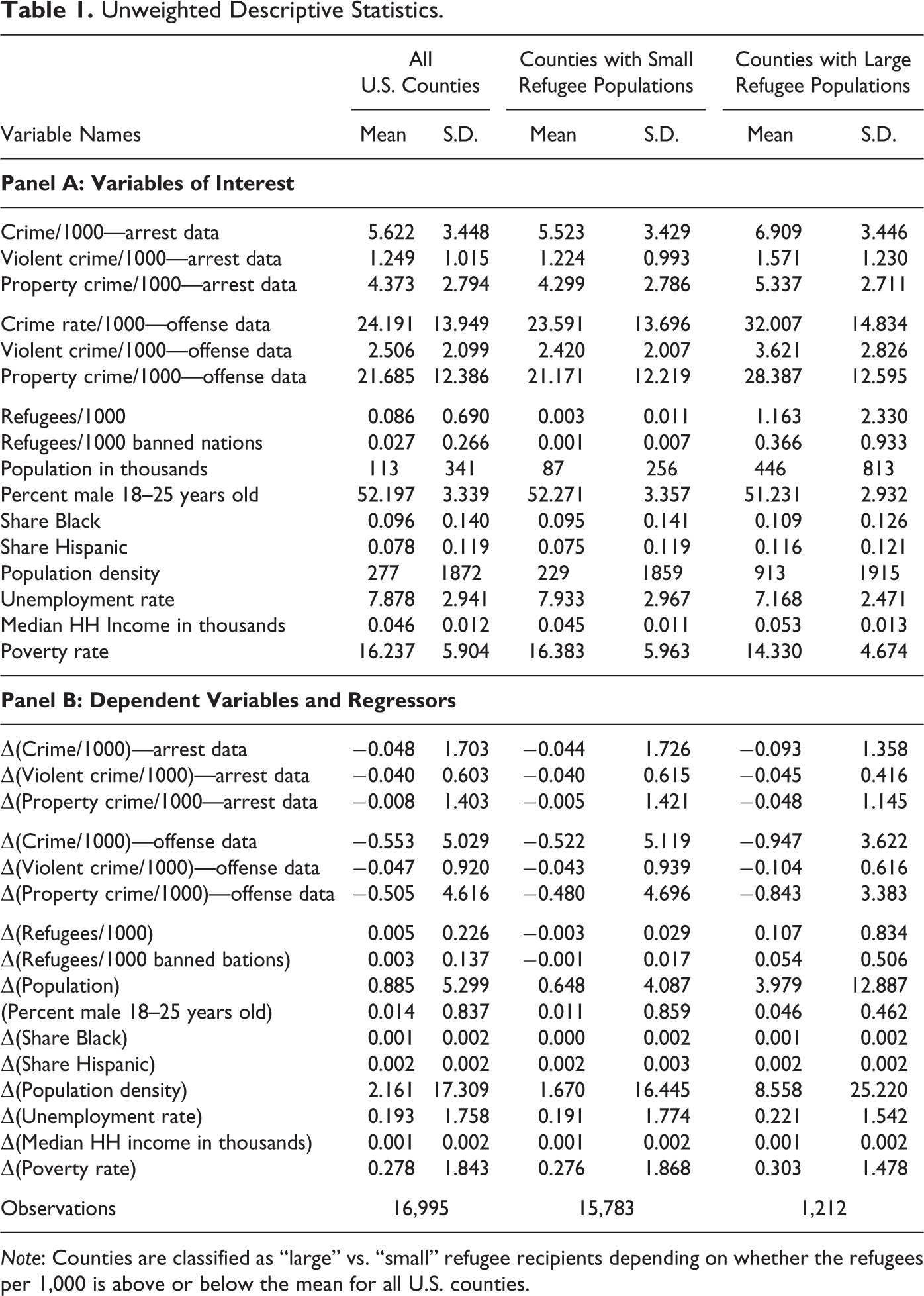
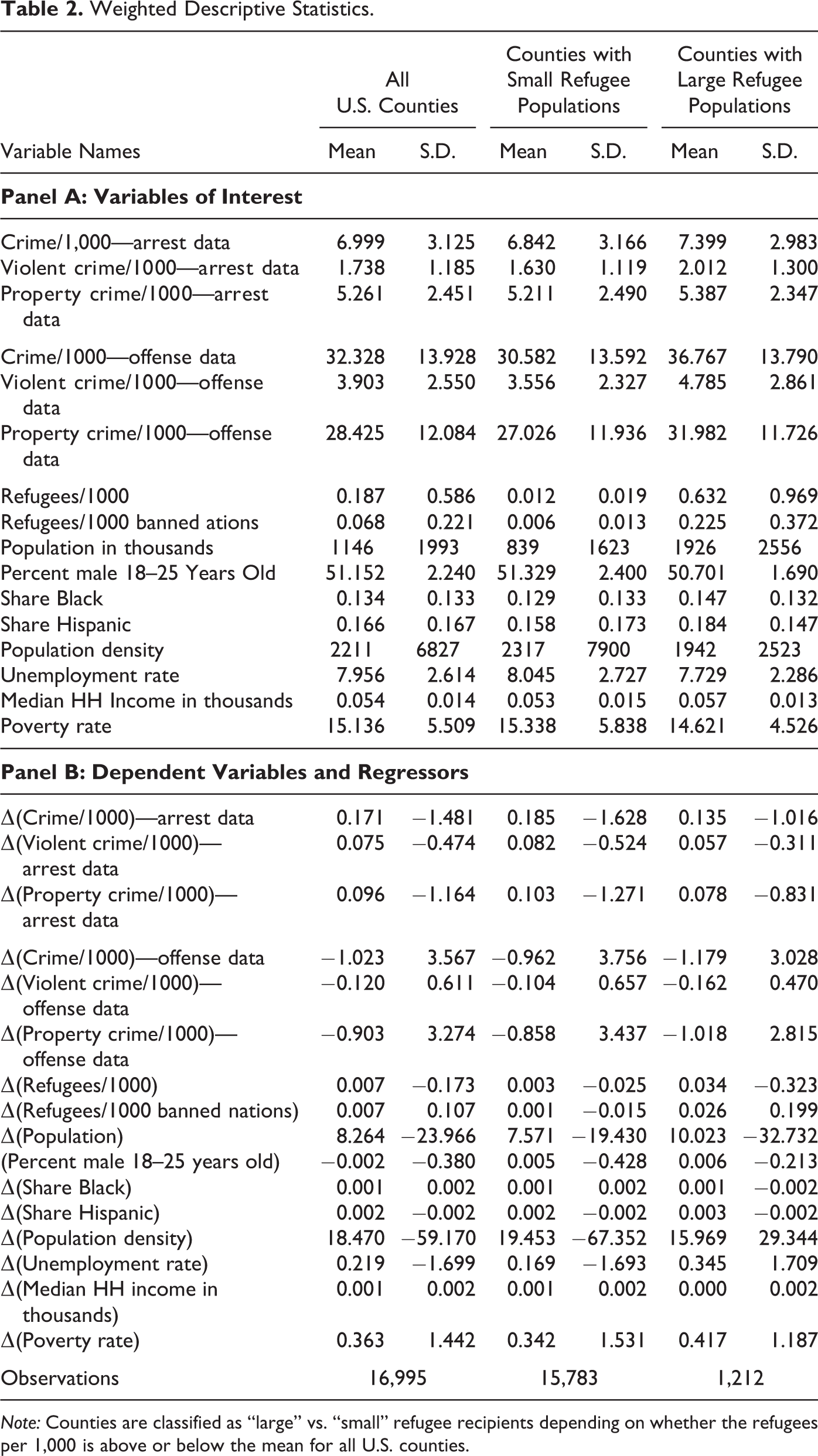
Tables 1 and 2 provide some basic information for our sample and display basic descriptive statistics (unweighted and weighted) for the main variables used in our analysis. The data are displayed in levels in panels A of Tables 1 and 2. We also report the transformed series (differenced), in panels B of Tables 1 and 2, which we use in the estimations. Our key variables are:
Unweighted Descriptive Statistics.
Note: Counties are classified as “large” vs. “small” refugee recipients depending on whether the refugees per 1,000 is above or below the mean for all U.S. counties.
Weighted Descriptive Statistics.
Note: Counties are classified as “large” vs. “small” refugee recipients depending on whether the refugees per 1,000 is above or below the mean for all U.S. counties.
a. Total refugee resettlement by county-year: The data, plotted in Figure 1 and summarized in Table 1, reveal that over the study time period, refugee resettlement in the United States averaged 0.086 per 1,000 (about 8.6 refugees per 100,000 people). While the United States has run the largest resettlement programs in the world, the share of refugees in the US population is quite small (Bernstein and DuBois 2018). 22
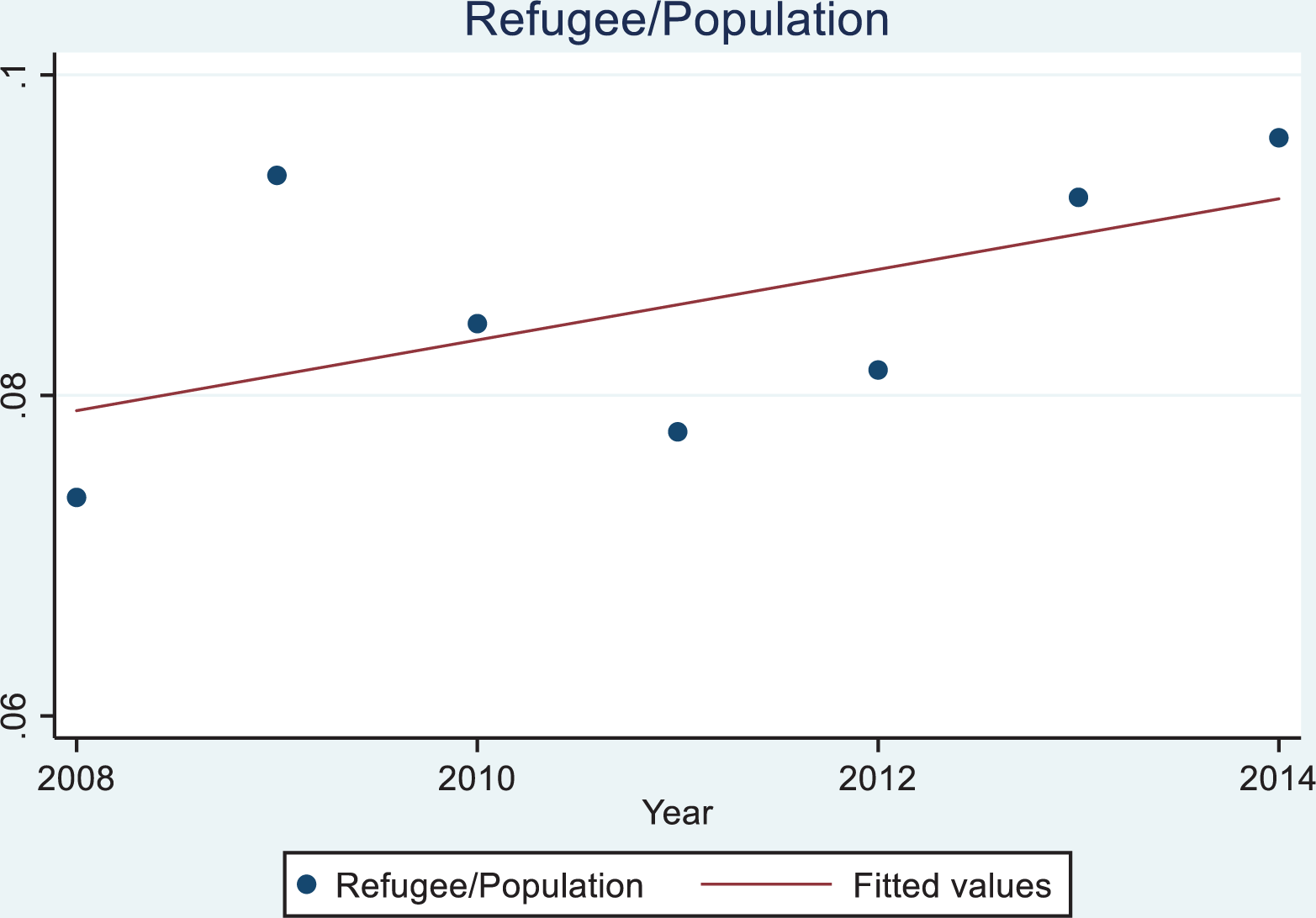
Trend in Average U.S. Refugee Population (per 1,000 Residents).
b. County-level crime statistics: We measure crime using two separate data sources: (a) annual counts of arrests at the county level and (b) annual counts of known offenses at the county level. We then compute the number of arrests/offenses per 1,000 people. Because of the distinct nature of property and violent crimes, we distinguish between arrests and known offenses associated with property and those linked to violent infractions. Total violent and property arrest rates over the 2007–2014 period (see Table 1) averaged 5.6 per 1,000 people — most linked to property crime, which hovered around 4.4 per 1,000 inhabitants. In the offense data, the rates are much higher, averaging 24.2 offenses per 1,000 people. As with the arrest data, property offenses exceed violent offenses by a substantial amount. 23
We also distinguish counties according to refugee resettlement rates. According to Table 2, counties with a refugee resettlement rate that falls below the weighted mean of 0.19 per thousand constitute the vast majority. At a purely descriptive level, crime rates (whether measured using arrest or offense data) are higher in counties receiving more refugees, particularly with regards to violent crimes. However, counties with a higher concentration of refugees might also differ from their counterparts with small refugee concentrations in other regards. Based on the county-level traits, counties with relatively larger refugee flows are those with more vibrant economies, larger populations, higher median incomes, and lower poverty and unemployment rates. Thus, accounting for refugees’ non-random placement is key in order to parse the estimated impact of refugee placements on arrest and offense rates from the role played by other county traits.
Panels A through C in Figures 2A and 2B provide a closer look at trends in crime rates based on the size of the county’s refugee population. The figures reveal declines in crime in counties with both a high and low refugee resettlement rate, although arrest and known offense rates are larger in counties receiving more refugees.
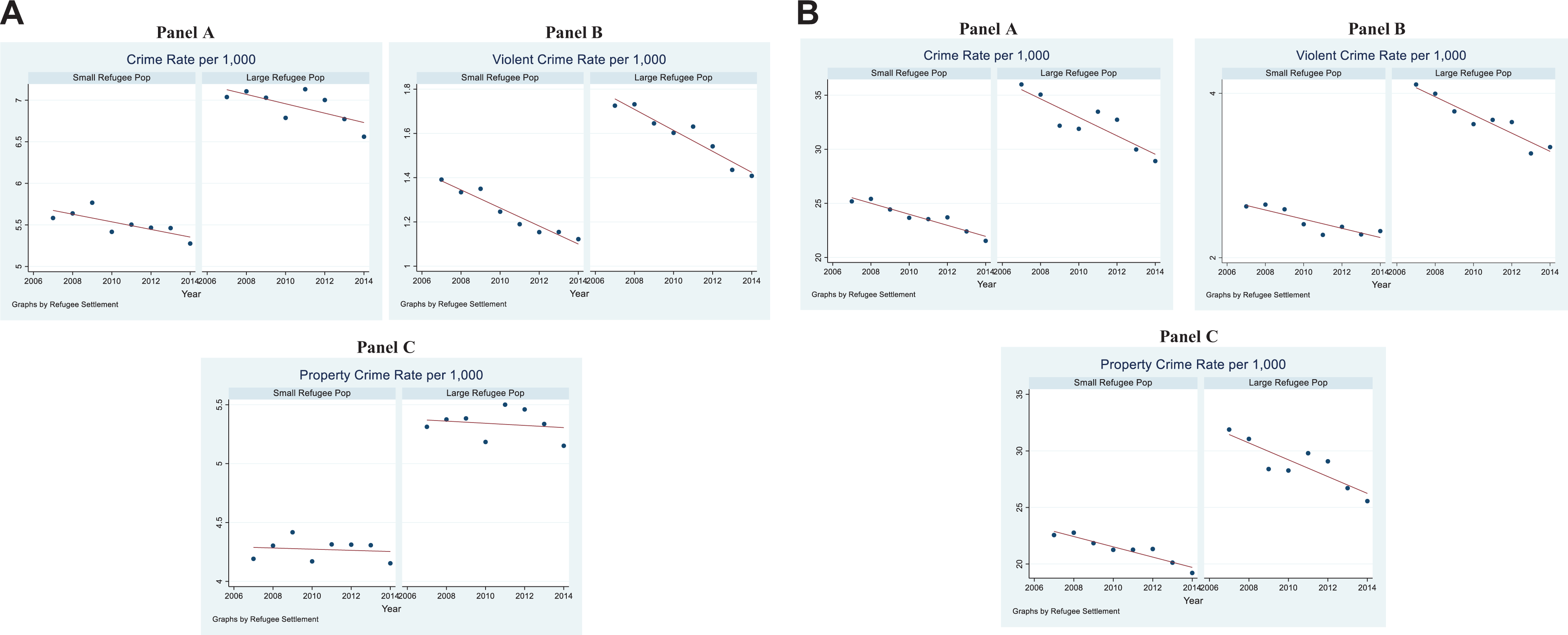
A. Trends in Crime Rates in Counties with Small versus Large Refugee Resettlements using Arrest Data.
However, if we plot arrest rates against the refugee resettlement rates in a given (county, year) cell and fit a regression line to the data, as in Panels A through C in Figure 3A, we find evidence of a negative relationship. The pattern is somewhat less clear when, instead of arrest rates, we use offense data in Figure 3B, with violent offenses slightly falling with a higher refugee placement concentration.
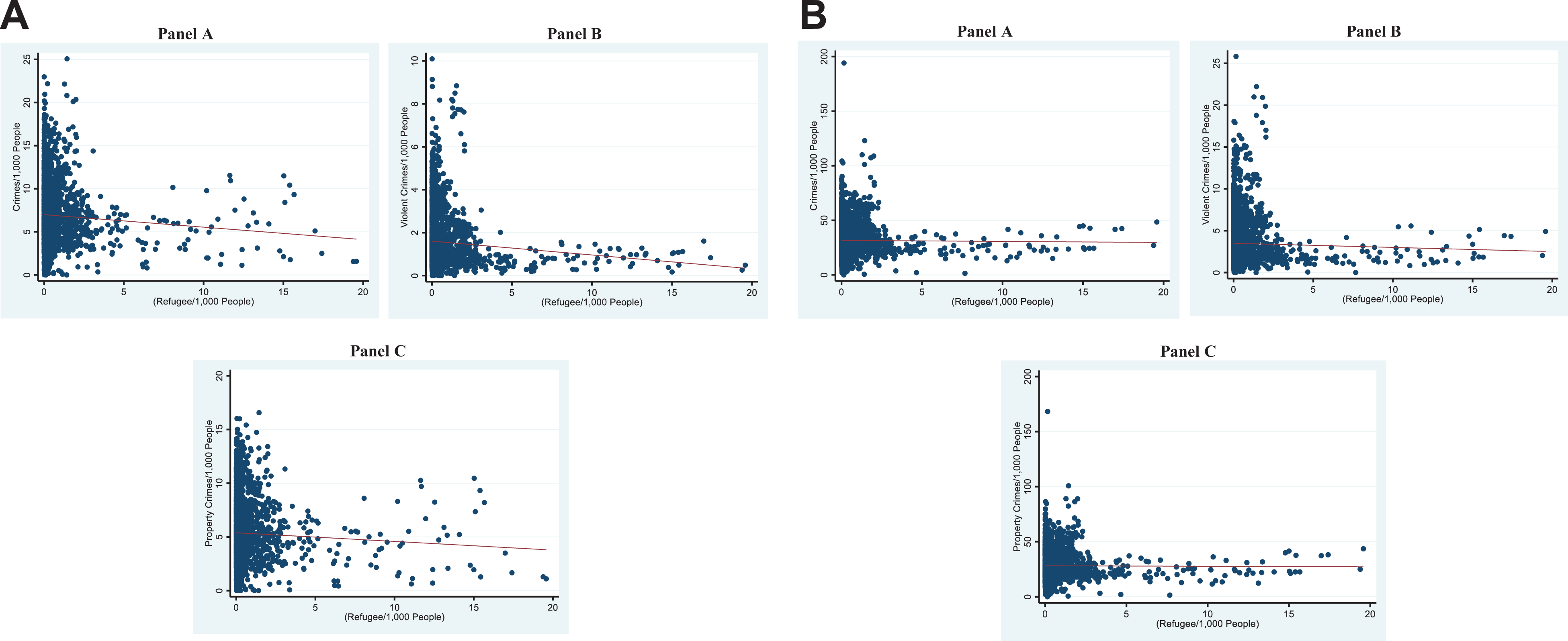
A. Crime Rates by Refugee Concentration using Arrest Data. B. Crime Rates by Refugee Concentration using Offense Data.
Given the noted differences between arrest and offense data in Figures 2A through 3B, we conduct the analysis using both data sources.
6. Assessing the Impact of Refugee Settlements on Local Criminal Activity
6.1 Main Findings
Tables 3 and 4 display the results from estimating equation (1) by OLS, using data on arrests and offenses, respectively, and without accounting for the potentially endogenous nature of refugee placements. We first show the results, using a baseline specification that only includes county and year fixed-effects to account for unobserved time-invariant county level traits, as well as for economy-wide shocks like the Great Recession. Subsequently, we include a number of time-varying county-level traits potentially correlated with crime rates, such as the county’s population growth (or decline), changes in the county’s population density, and information on the county’s population composition — as captured by the share of Blacks, Hispanics, and percent males 18 years to 25 years of age. We also account for changes in county-level economic conditions, including unemployment rates, household median income, and poverty rates. In all instances, the estimates reveal the lack of a statistically significant relationship between refugee resettlements and crime, regardless of whether we use arrest or offense data. These results are also consistent across the various model specifications, suggesting that our results are not driven by the inclusion of potentially endogenous regressors.
Change in Crime Rates and the Refugee Population Using Arrest Data – OLS Results.
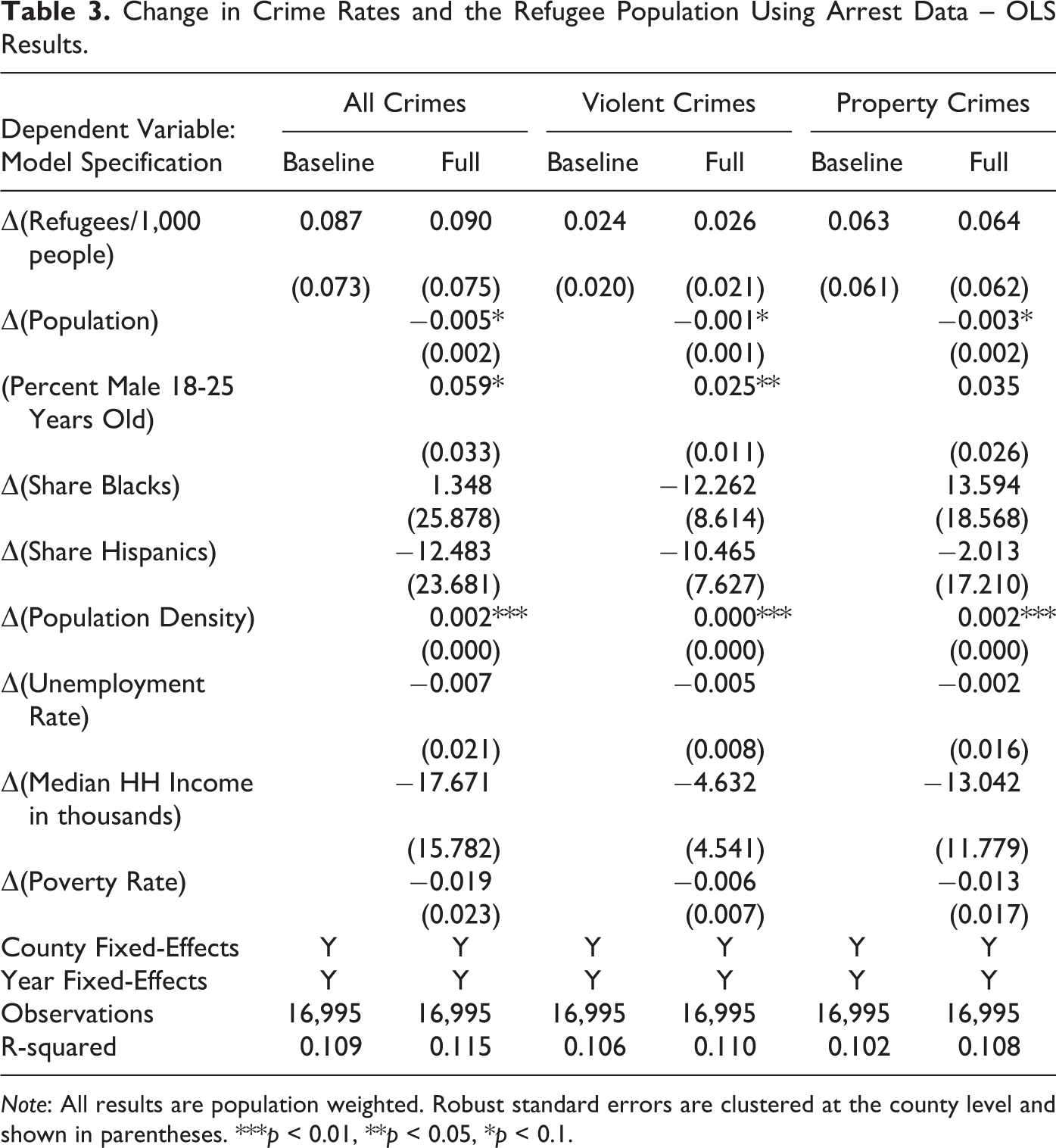
Note: All results are population weighted. Robust standard errors are clustered at the county level and shown in parentheses. ***p < 0.01, **p < 0.05, *p < 0.1.
Change in Crime Rates and the Refugee Population Using Offense Data – OLS Results.

Note: All results are population weighted. Robust standard errors are clustered at the county level and shown in parentheses. ***p < 0.01, **p < 0.05, *p < 0.1
To address refugees’ non-random placement across US counties, we use information on the residential choices of earlier cohorts of immigrants originating from refugees’ home countries to instrument for refugee resettlement rates, as described in Section 4.2. The results from estimating our model using instrumental variable methods are displayed in Table 5.
Change in Crime Rates and the Refugee Population – IV Results.
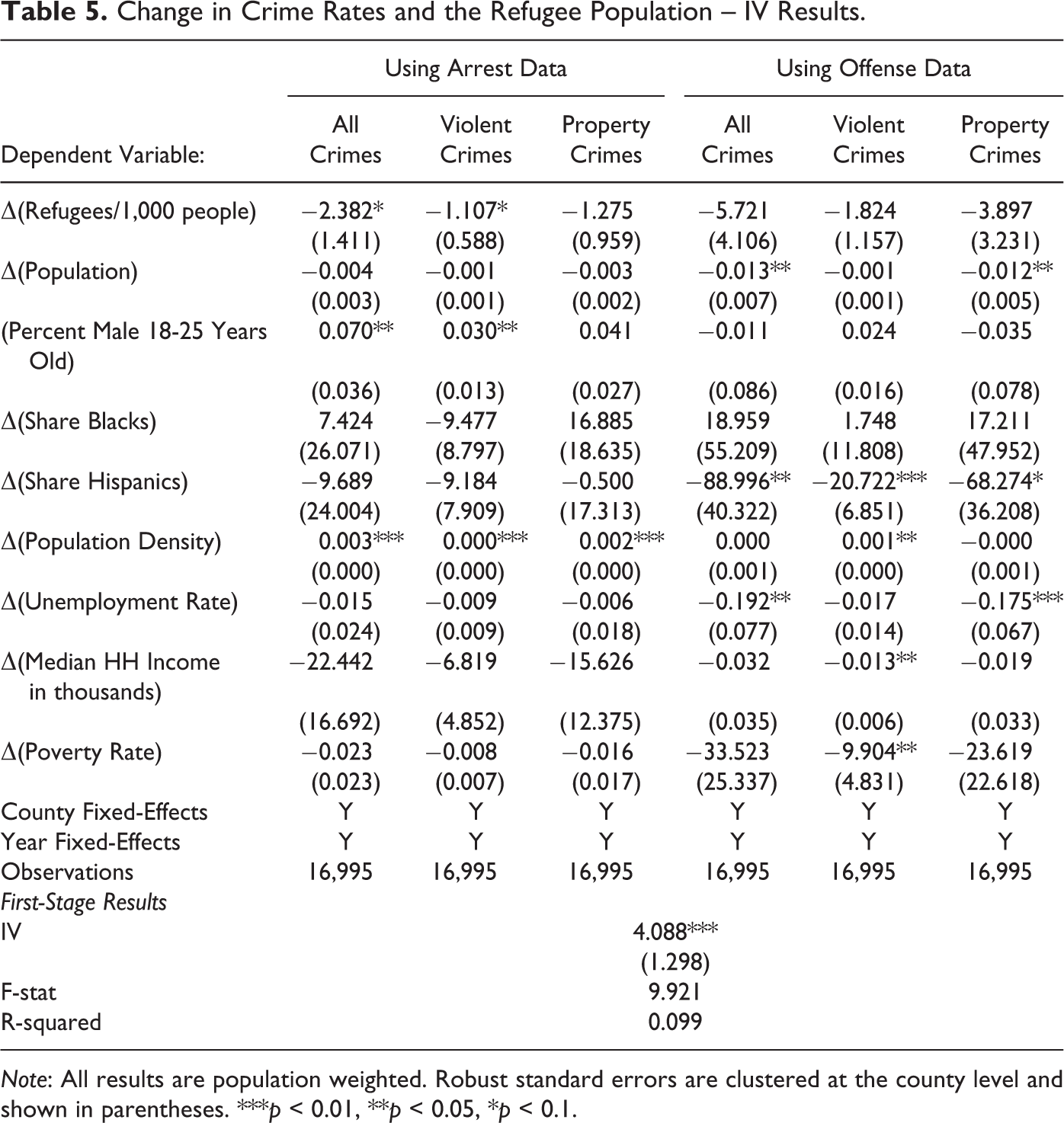
Note: All results are population weighted. Robust standard errors are clustered at the county level and shown in parentheses. ***p < 0.01, **p < 0.05, *p < 0.1.
The last rows reassure us about the suitability of the instrument being used. The F-statistic from the first-stage regression is close to 10, the recommended size by Stock and Yogo (2005). Additionally, the estimated coefficient from the first-stage regression (shown at the bottom of the table) is positive and statistically significant, confirming refugees’ tendency to be placed in areas with established networks originating from their origin countries.
The estimates from the second-stage regressions generally confirm the OLS results —namely, that refugee settlements do not raise the incidence of arrests or offenses for property or violent crimes when corrected for their non-random placement. If anything, we find evidence of an inverse relationship between refugee resettlements and crime when we use arrest data on all crimes or arrest data on violent crimes, even though the estimated coefficient is only marginally significant at the 10-percent level. Specifically, an additional 19 refugees per 100,000 (a doubling of the average refugee resettlement from 0.19 per 1000 to 0.38 per 1000) results in (-2.382*0.19) = 0.45 fewer arrests per 1,000. 24 Hence, arrests for all types of crime drop by 0.45/7 = 0.06 or 6 percent, suggesting that the OLS estimated impacts of refugees on crime might be upwardly biased. The findings are in line with expectations set forward by the literature on immigration and crime in the United States, which argues that immigrants are less likely to commit crimes than natives (e.g., Nowrasteh 2018). If, additionally, we take into consideration the extreme vetting of refugees prior to admission (Bruno 2018), we should expect refugees to display an even lower propensity of committing crimes than the overall migrant population (Wike, et al. 2018).
6.2 Robustness Checks
So far, our estimates reveal that refugee resettlement does not result in higher crime rates, regardless of whether we use arrest or offense data to measure crime. These results make sense. Even though prior studies have found some evidence of refugee and asylum flows being linked to increases in non-violent crime in Europe or Africa (i.e. Bell, Fasani, and Machin 2013; Simmler et al. 2017; Gehrsitz and Ungerer 2017; Fisk 2018), 25 we have no a priori reason to suspect that refugees would be prone to engaging in criminal activities in the case of the United States. After all, refugees are carefully screened prior to being admitted to the country and, by definition, have typically left everything to escape conflict, war, and oppression to start anew somewhere else. These circumstances would suggest that the cost of engaging in criminal activity and potentially losing refugee status might be seen as high.
Because the refugee population represents a relatively small share of the population in most instances, one might be concerned about the ability to detect an impact of refugee placements on overall crime rates when including localities that do not or only rarely welcome refugees. To address that concern, we repeat the analysis from Table 3 restricting our attention to counties receiving a number of refugees that is above the national average in any given year. The results (displayed in the online Appendix Table B) continue to support our prior findings that refugee placements do not raise local arrest or offense rates.
Another concern might refer to the composition of the refugee inflow. Specifically, following President Trump’s executive order from January 27, 2017, one might question whether refugees from the seven nations on the list of banned origin countries behave differently from other refugees and are more apt to engage in crime. To investigate this possibility, we re-estimate equation (1) using placements of refugees originating from the seven nations listed in the executive order: Iran, Iraq, Libya, Somalia, Sudan, Syria, and Yemen. We obtain qualitatively similar results to those found earlier, as is displayed in online Appendix Table C. The first-stage results confirm our instrument’s validity, and refugee settlement cannot be statistically linked to higher crime rates, regardless of the type of crime or data used to measure crime (i.e., arrest or offense data).
7. Discussion and Conclusions
Refugee flows around the world have been on the rise in response to growing international crises, yet the welcome received by refugees has varied worldwide (UNHCR 2018a). In the United States, there has been growing distrust of refugees, owing to rising concerns regarding their impacts on public safety. 26 These concerns have been accompanied by the adoption of policy measures and legislative efforts, including the executive order Protecting the Nation from Terrorist Attacks by Foreign Nationals (Davis 2017; National Public Radio 2017) and the State Refugee Security Act of 2017 introduced by Senator Ted Cruz and Representative Ted Poe on January 24, 2017, 27 both of which place barriers and limits on refugee resettlement based on security concerns. Nonetheless, we still lack empirical evidence on refugees’ impact on crime in the case of the United States — a gap we address with this article.
Specifically, we gathered city-level data (mapped into county-level data) from the Refugee Processing Center in the Bureau of Population, Refugees and Migration at the Department of State for the period spanning 2007 to 2014, as well as data on county-level arrests and known offenses collected from the UCR Program administered by the FBI. Using geographic and temporal variation in the distribution of refugee resettlement across US counties, we fail to obtain convincing empirical evidence of refugee resettlement as a good predictor of local crime. Qualitatively similar results are obtained when we limit our analysis to refugees from the seven banned countries listed in Trump’s January 27, 2017 executive order, Protecting the Nation from Terrorist Attacks by Foreign Nationals — a finding that suggests that the link to criminal behavior is not any stronger among refugees from countries targeted by the travel ban.
The lack of a clear connection between refugee resettlement and crime in the United States contrasts with findings for Europe, where refugee inflows appear to be linked to small increases in non-violent/property crimes (e.g., Bell, Fasani, and Machin 2013; Gehrsitz and Ungerer 2017). It may be that refugees in the United States are able to assimilate more rapidly (helped, in part, by their ability to work as soon as they arrive). Alternatively, there may be differences due to the size of inflows. After all, European studies (e.g., Bell, Fasani, and Machin 2013; Gehrsitz and Ungerer 2017) examine the impact of relatively larger inflows than those in the United States. The inflows’ magnitude may further highlight the importance of labor-market integration, with potentially more bottlenecks for job placements in Europe, as noted by Bevelander (2016). In that regard, one policy suggestion would be for nations to carefully design job programs, particularly when refugee inflows are large and sudden.
In sum, it is unclear why refugees would be prone to crime in the case of the United States, and, indeed, our findings confirm that expectation through the lens of resettlement and crime (proxied by arrest and known offense rates) at the county level. If anything, there is a negative relationship between refugee resettlements and crime in some model specifications. Our findings also prove robust to restricting the focus to refugees from the seven nations included in the January 2017 travel ban. These findings contribute to understandings of the link between refugee resettlement and crime — a crucial element in shaping public attitudes toward refugees (Hartig 2018). Given the ongoing refugee crises around the world, gaining a better understanding of the facts is essential to devising immigration policies that address public concerns and avoid misrepresentation of the refugee phenomenon.
Supplemental Material
Supplemental Material, TABLE_A_-_APPENDIX - Refugee Admissions and Public Safety: Are Refugee Settlement Areas More Prone to Crime?
Supplemental Material, TABLE_A_-_APPENDIX for Refugee Admissions and Public Safety: Are Refugee Settlement Areas More Prone to Crime? by Catalina Amuedo-Dorantes, Cynthia Bansak and Susan Pozo in International Migration Review
Supplemental Material
Supplemental Material, TABLE_B_-_APPENDIX - Refugee Admissions and Public Safety: Are Refugee Settlement Areas More Prone to Crime?
Supplemental Material, TABLE_B_-_APPENDIX for Refugee Admissions and Public Safety: Are Refugee Settlement Areas More Prone to Crime? by Catalina Amuedo-Dorantes, Cynthia Bansak and Susan Pozo in International Migration Review
Supplemental Material
Supplemental Material, TABLE_C_-_APPENDIX - Refugee Admissions and Public Safety: Are Refugee Settlement Areas More Prone to Crime?
Supplemental Material, TABLE_C_-_APPENDIX for Refugee Admissions and Public Safety: Are Refugee Settlement Areas More Prone to Crime? by Catalina Amuedo-Dorantes, Cynthia Bansak and Susan Pozo in International Migration Review
Footnotes
Declaration of Conflicting Interests
The author(s) declared no potential conflicts of interest with respect to the research, authorship, and/or publication of this article.
Funding
The author(s) received no financial support for the research, authorship, and/or publication of this article.

Supplemental Material
Supplemental material for this article is available online.
Notes
References
Supplementary Material
Please find the following supplemental material available below.
For Open Access articles published under a Creative Commons License, all supplemental material carries the same license as the article it is associated with.
For non-Open Access articles published, all supplemental material carries a non-exclusive license, and permission requests for re-use of supplemental material or any part of supplemental material shall be sent directly to the copyright owner as specified in the copyright notice associated with the article.
