



Abstract
In many low- and medium-income countries that are the traditional sources of international migrants, total fertility rates have dropped to levels at or near replacement. In this context of low fertility, we expect migration’s effects on fertility to operate primarily through marital timing and marital stability. We examine the effects of international migration on age at first marriage, union dissolution, timing of first birth, and completed fertility, using retrospective life-history data collected in Mexico and eight other Latin American countries by the Mexican Migration Project (MMP) and the Latin American Migration Project (LAMP). Using discrete-time hazards and Poisson regression models, we find clear evidence that early migration experience results in delayed marriage, delayed first birth, and a higher rate of marital dissolution. We also find evidence among women that cumulative international migration experience is associated with fewer births and that the estimated effects of migration experience are attenuated after taking into account age at union formation and husbands’ prior union experiences. As fertility levels in migrant origin and destination countries continue on their path toward convergence, migrant fertility below native fertility may become more common due to migration’s disruptive effects on marital timing and marital stability and the selection of divorced or separated adults into migration.
Introduction
There is a long tradition in migration studies of studying the link between migration and fertility (Zárate 1967; Goldstein 1973; Lee and Pol 1993; White, Moreano, and Guo 1995; Kulu 2005; Parrado and Morgan 2008). This research is motivated by a concern about the impact of migrant fertility on population growth and composition in migrant destinations (Kulu 2006). 1 The most common finding within this scholarship is that migrant fertility is lower than non-migrant fertility in places of origin and higher than native fertility in places of destination (Lindstrom 2003: 351). Spousal separation due to the migration of one member of the couple, adaptation to destination conditions that discourage high fertility, and migrant selection for characteristics associated with lower fertility are the standard explanations for reduced migrant fertility (Hervitz 1985; Lindstrom 2003). In many low- and medium-income countries that are the traditional sources of international migration, total fertility rates have dropped to levels at or near replacement (International Organization for Migration 2017, World Bank 2019). National total fertility rates in all Latin American countries, for example, are now below 3.0, and the majority are closer to 2.0 (Economic Commission for Latin America and the Caribbean [ECLAC] 2016). In this new context of low fertility in both migrant origin and destination places, we propose that spousal separation and migrant adaptation to destination conditions will matter less as determinants of migrant fertility, and that processes of union formation and union stability will take on greater importance as determinants of migrant fertility.
In this article, we ask five questions: (a) Is international migration associated with a delay in first marriage and first births? (b) Are international migrants at a higher risk of union dissolution? (c) Is cumulative international migration experience associated with lower completed fertility? (d) Do settled international migrants display different nuptial and fertility behavior even before migration? And (e) are the effects of international migration experience on completed fertility mediated by age at first marriage and prior union dissolution? We answer these questions, using retrospective life-history data collected in Mexico and eight other Latin American countries by the Mexican Migration Project (MMP) and the Latin American Migration Project (LAMP). Ours is the first study to incorporate union formation and stability into an analysis of the relationship between migration and fertility — a subject of considerable interest in policy circles and political discourse because of migrant fertility’s potential impacts on future population growth and ethnic composition (e.g., Bipartisian Policy Center 2014; Rubenstein 2016; Camarota and Zeigler 2019). This study is also the first to use pooled data from multiple origin and destination countries to check whether underlying processes and relationships are consistent across national and wider regional contexts. Our analysis brings into relief the significant impact of union formation and stability on migrant fertility not accounted for by the traditional focus on socialization, assimilation, adaptation, selectivity, and disruption effects (Goldstein 1973, Hervitz 1985, Kulu 2005).
To develop these ideas, we organize our article into four sections. First, we review theory and findings on the relationship between fertility and migration, nuptiality and migration, and marital stability and migration. Next, we describe recent patterns in Latin American migration to the United States and Europe and trends in fertility, union formation, and divorce. We, then, describe the data sources for our analysis and review the results from multivariate regression models. Finally, we use the parameter estimates from the regression models to find the mean predicted number of children under alternative scenarios to demonstrate the relative effects of migration experience, delayed marriage, and marital instability on completed fertility.
Migration and Fertility
Historically, research on the relationship between migration and fertility has focused on the fertility of rural origin migrants living in urban areas in developing countries (Iutaka, Bock and Varnes 1971; Goldstein 1973; Martine 1975; Chang 1987; Trovato 1987; Lee and Pol 1993; Brockerhoff and Yang 1994; Brockerhoff 1995; Lindstrom 2003). The context for these early studies was comparatively high fertility in rural areas and much lower fertility in urban destinations. More recently, with the growth in international migration from high-fertility developing countries to the United States, Europe, and other low-fertility destinations, the research focus has shifted to immigrant fertility (e.g., Sobotka 2008; Bogavos 2019). One vein in this scholarship is motivated by questions about immigrant fertility’s potential impact on host societies’ future ethnic composition (Kahn 1988; Bean, Swicegood and Berg 2000; Carter 2000). Another smaller line of research is concerned with whether immigrants will rapidly adopt destination population’s below-replacement fertility, hence limiting immigration’s potential to counter long-term population decline in many high-income destination countries (Sobotka 2008; Adserá and Ferrer 2015). Still other scholarship uses fertility as an indicator of immigrant cultural and structural integration into host societies (Swicegood et al. 1988; Gorwaney et al. 1990; Coleman 1994; Parrado and Morgan 2008).
Five general hypotheses are used to explain the relationship between migration and fertility within this overall body of work: socialization, assimilation, adaptation, selectivity, and disruption ( Lindstrom and Giorguli 2002; Kulu 2005). The socialization hypothesis argues that migrants arrive at a destination with a set of fertility preferences based on norms and values learned during childhood and reinforced in early adulthood. In the case of migration from high- to low-fertility areas, the continuance of pronatalist preferences and values after migration results in migrant fertility that is higher than that of the destination population (Hervitz 1985). The assimilation hypothesis recognizes the influence of early socialization but emphasizes the impact of post-migration experience in the destination society. Once in a destination, migrants are exposed to a new cultural environment and, over time, assimilate into the host society, adopting the destination population’s norms, values, and practices, including those governing family formation and fertility (Martine 1975; Bach 1981; Kahn 1988; Lindstrom and Giorguli 2002). Because the assimilation process involves abandoning origin cultural practices and integration into the host society, the convergence of migrant fertility to destination levels is gradual and may take several generations to complete (Hervitz 1985).
The adaptation hypothesis is a variant of the assimilation hypothesis that focuses on the role of economic opportunities and constraints present in destinations in incentivizing migrants to adjust their fertility behavior (Goldstein and Goldstein 1983; Schoorl 1990; Lindstrom and Giorguli 2002). In moving to economically more-developed areas, migrants encounter a relative increase in family maintenance costs, as well as better educational opportunities for children and a wider range of employment opportunities for women. This change in economic environments increases the real and opportunity costs of each additional child. Because economic conditions prevalent in the destination are felt from the time of arrival, adaptation is expected to occur much faster than assimilation. Implicit in the adaptation hypothesis is an economic theory of fertility that views household income and relative costs of children as primary considerations in decisions about family size. In contrast, assimilation is consistent with cultural theories of fertility that emphasize the role of cultural innovation and ideational systems in fertility change. Although theoretically distinct, assimilation and adaptation are not consistently distinguished in the literature (e.g., Kulu 2005), and both rely on duration in the destination for hypothesis testing (e.g., Stephen and Bean 1992).
The selection hypothesis argues that migrants are selected for characteristics that are also associated with fertility. Selection, from this perspective, can work in both directions with respect to fertility. Migrants with high socioeconomic mobility aspirations and preferences for smaller families are more likely to choose low-fertility destinations that offer better economic opportunities than places characterized by high fertility (Macisco, Bouvier, and Renzi 1969). Similarly, migrants with high fertility preferences are likely to choose destinations with comparatively low family-maintenance costs compatible with large families (Ribe and Schultz 1980). Lindstrom and Giorguili (2002), for example, in an analysis of migration and birth histories for Mexican migrants who returned to Mexico and migrants who settled in the United States, found evidence of selection for lower fertility among couples who settled in the United States and evidence of selection for higher fertility among temporary repeat migrants whose families remained in Mexico.
Finally, the disruption hypothesis focuses on migration’s disruptive effects on family formation and marital relationships (Hendershot 1976; Ortensi 2015). In many instances, migration, particularly international migration, entails the separation of couples for either extended periods of time or short but repeated intervals. The separation of couples reduces women’s risk of conception, which often translates into longer birth intervals and, in some instances, lower completed fertility (Van de Walle 1975; Massey and Mullan 1984; Lindstrom and Giorguli 2002). Even in instances when couples migrate together, they may temporarily delay conceptions in the months preceding and following migration in response to the temporary loss of income that is often associated with a change in employment and labor markets (Lindstrom 2003). In addition, migration’s disruptive effects on fertility can operate through delayed marriage and a higher risk of union dissolution, thus affecting the occurrence and timing of conceptions.
Migration and Nuptiality
The relationship between migration and union formation has received considerably less attention than the relationship between migration and fertility. Those studies that do exist identify four possible connections linking migration and marriage, two of which relate to migration’s disruptive effects (Carlson 1985; Potančokoná et al. 2008; Stankuniene and Jasilioniene 2008; Adserá and Ferrer 2015;), one to its role in savings and future earnings capacity (Parrado 2004), and one to the synchronization of union formation and migration in the life course (Mulder and Wagner 1993). The first connection relates to single international migrants’ frequent separation from their origin marriage market (Carlson 1985; Sobotka 2008; Adserá and Ferrer 2015;). In some cases, migrants may be in a stable relationship and use migration to accumulate savings to finance a wedding and establish an independent household. In other cases, migration may be part of a strategy to accumulate savings for small business formation or the purchase of farmland. In both cases, the mere fact that migrants are outside their home marriage market can result in an older age at marriage. Li (2016), for example, found that single Mexican migrant men tended to stay longer in the United States than married men, and Parrado (2004) found that being in the United States delayed marriage for Mexican men. Single migrants with no intention to return to their home country may find themselves in an unfamiliar marriage market (Carlson 1985; Sobotka 2008; Adserá and Ferrer 2015). Even in contexts where there are well-developed migrant networks from the home community, the number of marriageable partners in a migrant’s network is likely to be smaller than in the home community, especially if there is an unfavorable sex imbalance in the migrant community. All these factors will, on average, delay the timing of marriage.
The second connection involves the disruptive nature of both temporary and long-term labor migration vis-a-vis early life-course transitions into work and adult family roles in the origin community (Potančokoná et al. 2008; Stankuniene and Jasilioniene 2008). The entry into foreign labor markets may involve migrants’ initial under-placement with respect to their educational and skill levels, which can extend the time required to find jobs for which they are trained (Visintin, Tijdens and van Klaveren 2015; Villarreal 2016). Studies also indicate that returning international migrants often experience difficulty reinserting themselves into the home labor market after an extended absence (Lindstrom 2013). These transition costs in both destination and home labor markets are likely to be outweighed by migration’s long-term income returns but nevertheless may result in temporary employment instability (Dustmann 1997) that delays marriage. Oppenheimer’s (1988) theory of marriage markets postulated that uncertainty and delayed transition into stable economic roles delay marriage, due to the valuations that potential spouses, especially women, place on stable economic roles. To the extent that migrants in the initial stage of international migration or return migration are not in stable employment, their marriage prospects may be temporarily depressed.
A third hypothesis suggests that in some instances, international migration experience can enhance return migrants’ marriageability in the home community (Choi and Mare 2012). Return migrants often have an advantage over their non-migrant peers in terms of savings that allows them to afford higher-quality housing and investments in productive assets. Their access to international labor markets and the potential to bring a spouse along in the future may also make them more attractive in the marriage market. Although this enhanced marriageability may accelerate the time to marriage after return to the home community (Parrado 2004), the net effect on age of marriage is ambiguous, since the time spent away as a single migrant may result in an age at return well above the mean age at marriage for non-migrants.
A fourth and final hypothesis relates, not to a causal link between migration and marriage, but to the close interrelatedness of the two events (Mulder and Wagner 1993). Marriage generally involves establishing a new, independent household for the married couple (Brien and Sharen 2003). The typical age at marriage is also the age at which employment-related migration is most common (Bernard, Bell, and Charles-Edwards 2014). The synchronization of these early life-course events means that marriage and migration often go together or are jointly determined (Mulder and Wagner 1993; Flowerdew and Al-Hamad 2004; Lindstrom and Giorguli-Saucedo 2007; Nedoluzhko and Anderson 2007; Hoem and Nedoluzhko 2008; Clark, Glick, and Bures 2009; Jang, Casterline, and Snyder 2014). In empirical analyses, then, marriage may be linked to migration, not because migration increases the chances of marriage but rather because marriage, new household formation, and migration often go together.
In addition to disrupting union formation, migration can place a strain on couples and increase the chances of union dissolution (Frank and Wildsmith 2005; Boyle et al. 2008). Migration often involves rupturing social ties in places of origin and settlement in an unfamiliar environment with a different language, customs, and social arrangements. Migration also entails financial risk and uncertainty and, at least in the short term, severe budgetary constraints that strain conjugal relationships (Gudmunson et al. 2007). In cases where migration is from more patriarchal to more gender-egalitarian societies, a clash in gender values, along with women’s greater freedom and opportunities outside the home, can generate conflict and instability (Anderson, Obućina, and Scott 2015; Caarls and Mazzucato 2015). Equally important, the absence of kinship and other social ties that provide social and moral monitoring in origin communities lowers the social costs of union dissolution, especially in destinations where divorce is common (Frank and Wildsmith 2005).
International migration that involves prolonged or repeated periods of spousal separation is especially hard on marital stability (Muszyńska and Kulu 2007). Boyle et al. (2008), for example, found that repeated migration over long distances increased the chances of union dissolution. Landale and Ogena (1995) showed that migration to the United States increased the chances of union dissolution for Puerto Rican women in the United States and for those who remained behind in Puerto Rico (see also Frank and Wildsmith 2005). On the other hand, migration may also be a response to divorce or separation in the place of origin or a way to escape a failing relationship (Frank and Wildsmith 2005), as divorced individuals are selected into migration. Although the causal direction is from divorce to migration, the potential impact on post-migration fertility remains negative.
Hypotheses
Based on the disruption hypothesis, we expect (H1) being an international migrant to be associated with a lower probability of union formation, a higher probability of union dissolution, and a lower probability of a first birth in a life-year, compared to being a non-migrant. Based on the assimilation and adaptation hypotheses, we expect (H2) cumulative international migration experience to be associated with a higher probability of union dissolution, a lower probability of a first birth in a life-year, and fewer children. Based on the selectivity hypothesis, we expect (H3) being a settled migrant in a destination to be associated with a lower probability of union formation, a higher probability of union dissolution, a lower probability of a first birth in a life-year, and fewer children compared to being a non-migrant, returned migrant, or temporary migrant. Finally, to the extent that H1 and H2 are supported, we expect (H4) the negative relationship between migration experience and the number of children to be attenuated after age at union formation and prior unions are taken into account.
Study Context
In this article, we examine the effects of international migration on age at first marriage, union dissolution, timing of first birth, and completed fertility, using survey data collected in Mexico, Guatemala, El Salvador, Nicaragua, Costa Rica, the Dominican Republic, Colombia, Ecuador, and Peru. To put our analysis and findings in proper context, we provide here a brief overview of trends in migration, fertility, and nuptiality in Latin America.
During the twentieth century, Latin America was transformed from a migrant-receiving to a migrant-sending region. Durand and Massey (2010) identify three major patterns of contemporary movement in the region: migration to the United States and Canada; migration to Europe, Japan, and Australia; and migration within Latin America. Migration from Mexico to the United States goes back to the late-nineteenth century but took off during and after the Second World War, when the Bracero program brought over 4.6 million Mexican men to the United States, primarily as seasonal agricultural workers (Calavita 1992: 218). With the Bracero program’s end in 1964, migration from Mexico to the United States continued to grow, but the majority of workers entered and worked in the United States without legal authorization (Massey et al. 2002). By 2007, the number of Mexicans residing in the United States had reached a peak of 12.6 million and then declined toward the end of the decade, as returnees to Mexico came to outnumber new entrants (Passel, Cohn, and Gonzalez-Barrera 2012: 11).
Migration from Central America to the United States took off during the 1980s in response to political violence and wars in Nicaragua, El Salvador, and Guatemala (Durand and Massey 2010). Even after the wars’ conclusion, ongoing political instability, the emergence of gang violence, and economic stagnation continued to push people out of the region (Lundquist and Massey 2005; Alvarado and Massey 2010; Flores-Yeffal and Pren 2018), and Central American migrant communities established in the United States during the 1980s facilitated these ongoing migrant flows (Durand and Massey 2010).
Migration from South America to the United States, Europe, and more distant high-income countries started in the late 1960s as economic growth slowed, and inequality and unemployment increased in the region (Durand and Massey 2010). The emergence of repressive political regimes in countries such as Chile and Argentina, and protracted military conflict in Colombia also generated out-migration, starting in the 1970s (Silva and Massey 2014), with economic instability and turbulence spurring additional out-migration in the 1990s (Durand and Massey 2010).
Alongside the rise in migration from Latin America to high-income countries, fertility across Latin America has been on a steady decline (ECLAC 2016). The start of this decline varied widely across the region, with Argentina, Uruguay, Chile, and Cuba already at comparatively low fertility in the 1950s, followed by Colombia, Costa Rica, the Dominican Republic, Ecuador, Mexico, Peru, and Venezuela starting in the late 1960s and the 1970s (Chackiel and Schkolnik 1996; Brea 2003;). The Central American countries of El Salvador, Guatemala, Honduras, and Nicaragua were among the last Latin American countries to start the transition to low fertility in the 1970s and the 1980s (Chackiel and Schkolnik 1996; Brea 2003). Among the nine countries represented in the MMP and LAMP databases, the total fertility rate declined from a range of four—seven children in 1970–75 to two—three children in 2010–15 (see Appendix Figure A1). Increased contraceptive access (Chackiel and Schkolnik 1996; Mundigo 1996), rising levels of women’s education and employment (Castro Martín and Juárez 1995), and uneven economic growth and economic uncertainty have all been cited as contributing to the fertility decline in Latin America (Adsera and Menendez 2011).
In Latin America, childbearing occurs largely within conjugal unions, whether consensual 2 or legal (Laplante et al. 2015), and the region is home to a historically high prevalence of consensual unions (Castro Martín 2002), particularly among lower-educated groups (Esteve, Lesthaeghe, and López-Gay 2012). Although consensual unions are, on average, less stable than legal unions (Castro Martín 2002), they generally resemble formal marriages and do not differ from formal unions with respect to childbearing behavior (Laplante et al. 2015). Demographic and health surveys conducted in eight of the nine countries examined here show that national differences in the prevalence of unions among women ages 15–49 years have diminished over time (see Appendix Figure A2), a trend largely due to a decline in unions in Colombia and Mexico. By 2012–2015, 53–58 percent of women ages 15–49 years were in unions. Over the same period, the prevalence of divorce and separation rose in four of the seven countries for which trend data were available, most visibly in Colombia and the Dominican Republic. Nevertheless, in Guatemala, Peru, and Colombia, the prevalence of divorce remained below 15 percent (see Appendix Figure A3).
The volume and growth of migration from Latin America to the United States and Europe make the fertility practices of Latin American migrants relevant to future population growth and composition in destination countries. The regional pattern of high proportions of births occurring within conjugal unions, high proportion of women in unions, and relatively low levels of union dissolution also make Latin American migrants a good case for examining the role of union formation and union stability in the relationship between international migration and fertility.
Data and Methods
The Mexican Migration Project (MMP) has fielded community-based surveys in Mexico and settled migrant communities in the United States since 1982, 3 and its database currently covers 161 communities. The Latin American Migration Project (LAMP) started in 1998 and brings together 63 community-based surveys from 10 Latin American and Caribbean countries. 4 The MMP and LAMP studies use a similar research design that combines the strengths of sample surveys with interactive interviewing techniques traditionally employed in anthropological field research (Massey 1987; Durand et al. 2016). Survey sites in the origin countries are purposively selected to represent the broad range of migrant places of origin (Massey and Zenteno 2000), including rural villages, towns, and neighborhoods in cities and metropolitan areas. Fieldwork in each site begins with the construction of a sampling frame through a street-by-street enumeration of all residential dwellings. Random samples of 200 dwellings are typically taken in each location, with smaller samples in rural communities. In many communities, companion samples of settled migrants in places of destination were completed, using snowball sampling, and they typically include 20 households (Massey 1987; Durand et al. 2016). Pooling the origin and destination samples provides a unique sample of non-migrants in places of origin, active and return migrants, and settled migrants in places of destination.
The MMP and LAMP survey questionnaire is organized into tables that provide interviewers flexibility in the wording and ordering of questions yet ensure comparability across households, communities, and countries. The survey questionnaire includes household- and individual-level information, such as retrospective migration and employment histories for the household head, and his/her spouse and union and fertility histories for the household head. We use the person-year life-history data for male household heads to estimate the probability of first union formation and first union dissolution, and the total number of children ever born. We also combine the currently married male household head life histories with the spouse migration histories to analyze the timing of first births for currently married women and their total number of children. Because the surveys did not collect marital history data for the spouses of household heads, we are not able to analyze women’s marital histories. With the exception of first union formation, we do not distinguish between legal marriages and consensual unions.
The MMP questionnaire’s content was modified over time in response to changes in the composition and dynamics of Mexico–US migration (Durand et al. 2016). Starting in 1991, it added the life history table for spouses, and, starting in 1997, the marital history included the reasons for union dissolution. In this article, we use data for 109 MMP communities, 34 of which have US snowball samples, surveyed from 1997 to 2016 (see Table 1). These data include, among other things, the spouse life histories and reasons for union dissolution. All LAMP surveys included spouse life histories and complete information for the household head union histories. From the LAMP database, we analyze data for 53 communities sampled in Guatemala, El Salvador, Nicaragua, Costa Rica, the Dominican Republic, Colombia, Ecuador, and Peru and 38 destination samples from the United States and Spain. 5 For our analyses, we use data for 15,318 men and 14,227 currently married women. All female household heads in the MMP and LAMP samples were never married, divorced, separated, or widowed. The surveys did not collection information about the former spouse for ever-married female household heads, so we cannot link events in these women’s lives to the migration experience of their former spouses. We do not include a separate analysis of female household heads because of this lack of information and because of the comparatively small number of female household heads in the samples.
Sample Characteristics, Mexican Migration Project (MMP) and Latin American Migration Project (LAMP), 1997–2016.

Our analysis consists of seven multivariate regression models. First, we estimate a discrete-time multinomial logistic hazard model of entry into first consensual or formal union among men. Second, we estimate a discrete-time logistic hazard model of first union dissolution among men. Third, we estimate a discrete-time logistic hazard model of first birth among currently married women. These three models examine the impact of early migration experience on family formation and early and subsequent migration experience on union stability. Next, we use Poisson regression models to estimate the effects of marital timing and stability and migration experience on the total number of children that men and women have. We estimate four Poisson regression models: the total number of children among all men, the total number of children among ever-married men, the total number of children among currently married women without taking into account marital timing and stability, and the total number of children among currently married women taking into account age at marriage and husbands’ prior unions. We estimate all models with robust standard errors adjusted for clustering at the community level.
We use the life-history files from the MMP and LAMP databases to create person-year data sets for the discrete-time hazard models. For the model of first union, the person-year data set starts at age 12 years (the lowest age of unions and births in the data sets) and ends with first entry into a consensual union, a formal union, or right-censoring 6 for men who had not entered a union by the time of the survey. For the model of men’s union dissolution, the person-year data set starts with the first year of the first union and ends with union dissolution or right-censoring for men still in their first union at the time of the survey or in the year in which men were widowed. For the model of first births, the person-year data set starts at the first year of the current union. We do not know whether the current union for a woman is her first or a higher-order union. In the Poisson regression models predicting total number of children, we estimate the models for men at the time of the survey and for women at the time of the survey or age 49 years, whichever is lower. We exclude from the total number of children births that did not survive beyond the first year of life. For currently married women, we include children born prior to the start of the current union and listed on the household registry as step-children of the household head.
We define international migration as migration to a high-income country, which in the MMP and LAMP databases includes the United States, Canada, Spain, other European countries, and Japan. In the person-year files, we treat international migration status as a time-varying dummy variable that equals 1 if the household head or spouse was an international migrant for at least one month during the year. In the first-birth analysis, we distinguish between husband migrant alone, wife migrant alone, or husband and wife migrants together. We also include a time-varying measure of cumulative international migration experience in the model of first union dissolution and time-invariant measures of cumulative international migration experience in the Poisson regression models. We define a time-invariant dummy variable that equals 1 for the destination sample and include in the regression models interaction terms between destination sample and the measures of international migration experience. Considered alone, the destination variable captures pre-migration selection effects in the discrete-time hazard models, and in the Poisson models, it captures the effect of being an established migrant in the United States or Spain, irrespective of total duration. The destination variable, in combination with the experience and interaction variables, captures the differential effect of duration in the United States or Spain for settled versus returned migrants. We treat migration to other countries within Latin America as internal migration, both because of the relatively small number of such trips in the MMP and LAMP databases and because of the comparatively low barriers to intraregional migration.
We include a time-varying dummy variable that equals 1 in life years in which the household head or spouse made an internal migration trip. The internal migration variable captures the synchronization of internal migration and other family life-cycle events observed by other studies (DeJong and Graefe 2008; Geist and McManus 2008). Control variables in all models include birth cohort, years of school completed, and origin country. The discrete-time hazard models include duration and duration-squared to capture duration dependence in the underlying hazard of union formation, union dissolution, and first birth. Student status is included as a time-varying variable in the first union model. The Poisson models include log exposure years, measured as current age minus 12.
Descriptive Statistics
International and internal migration experience among men in the MMP and LAMP samples is widespread (see Table 2). Close to 19 percent of men had internal migration experience, and 25 percent had migration experience to a high-income country. 7 The prevalence of international migration experience varies widely across the nine country samples, from 3 percent in Peru to 30 percent in Mexico. Levels of internal and international migration were considerably lower among currently married women in the samples, at around 6 percent. The MMP and LAMP samples are not nationally representative, so the estimates of migration prevalence are solely for descriptive purposes.
Prevalence of Lifetime International and Internal/Latin America Migration Experience, Men and Currently Married Women Born after 1949, MMP and LAMP, 1997-2016.

Notes: aIncludes internal migration and migration within Latin America. bIncludes migration to high income countries outside of Latin America.
We have suggested that at least some portion of international migration’s potential negative effects on fertility in these countries will operate through delayed marriage and marital instability. Table 3 presents the mean age at first marriage among ever-married men and currently married women by international migration experience. For descriptive purposes, we define both consensual and formal unions as marriage. In eight of the nine countries, premarital international migration experience is associated with an older mean age at first marriage for men, and in seven of these countries, the differences are statistically significant. Men with premarital international migration experience on average married two years later than men without international migration experience. Women who married men with international migration experience also tended to marry at older ages. In all nine countries, the mean age at marriage for these women was greater than the mean age at marriage for women married to non-migrants, and in six of the nine countries, the differences are statistically significant. The mean age at marriage of women married to men with prior international migration experience was 1.4 years greater than the mean for women married to non-migrants.
Men’s Mean Age at First Marriage and Currently Married Women’s Mean Age at Marriage by Men’s Premarital International Migration Status, Men and Women Born after 1949, MMP and LAMP, 1997-2016.

Notes: aIncludes internal migrants, migrants within Latin America, and non-migrants. bIncludes migrants to high income countries outside of Latin America. Significance levels for difference of means tests, **P<0.01, *P<0.05.
Prior research has documented an elevated risk of union dissolution among couples in which one or both of the pair had international migration experience (Landale and Ogena 1995; Frank and Wildsmith 2005; Boyle et al. 2008). In eight of the nine countries examined here, the percentage of men’s first unions that ended in divorce was higher among international migrants than non-migrants, and five of these eight differences are statistically significant (see Table 4). The percentage point differences ranged from a low of 0.8 in Mexico to a high of 12.5 in Colombia.
Percent of Men’s First Unions that are Dissolved, by International Migration Status Prior to Dissolution, Men Born After 1949, MMP and LAMP, 1997-2016.
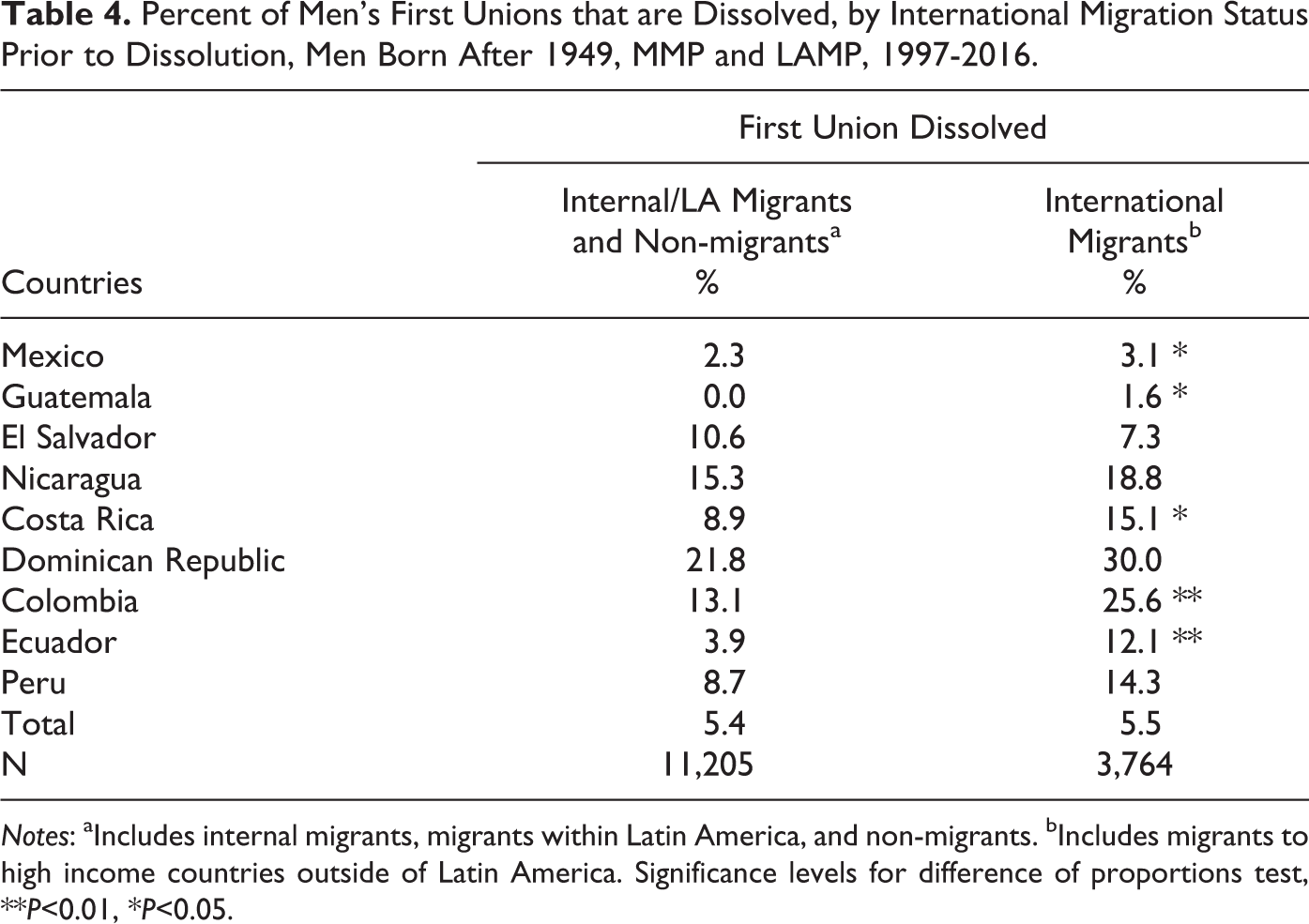
Notes: aIncludes internal migrants, migrants within Latin America, and non-migrants. bIncludes migrants to high income countries outside of Latin America. Significance levels for difference of proportions test, **P<0.01, *P<0.05.
The bi-variate descriptive analyses provide some evidence that international migration experience is related to delayed marriage among men and the women they marry and also to higher rates of union dissolution. We next use multivariate models to estimate international migration’s relative effects on marital timing and first divorce, net of other factors, and then the effects of migration, marital timing, and prior number of unions on the timing of first births and the total number of children.
Multivariate Results
Table 5 presents the estimated coefficients from the discrete-time multinomial logistic hazard regression model predicting men’s first union. Starting with consensual unions, the coefficient for international migrant in the current year is negative and significant, indicating that active or returned migrants in the origin samples had significantly lower probabilities of entering into a consensual union during years in which they were abroad. The destination coefficient is also negative and significant. Interpreted alone, it indicates that men in the destination sample were less likely than other men to enter into a consensual union, even before they migrated abroad. The interaction term is positive and significant and, when combined with the migrant and destination terms, indicates the effect of being in the destination sample and abroad. Adding the three coefficients together still results in a significantly lower probability of entering into a consensual union. However, the negative effect of being abroad on the probability of entering into a consensual union was smaller among migrants in the destination samples (-0.348) than among migrants in the origin samples (-0.558). The results for entry into a formal union are very similar. The migrant and destination coefficients are negative and significant, and the interaction coefficient is positive and significant. The results from the first union model provide evidence that international migration experience was associated with delayed union formation among men and that men who were in the destination samples had even lower probabilities of union formation before they migrated than non-migrant and migrant men interviewed in the origin countries. These results are consistent with the disruption and selectivity hypotheses.
Estimated coefficients from Discrete-time Multinomial Logistic Hazard Model Predicting First Union Formation and Discrete-time Logistic Hazard Models Predicting First Divorce for Men and First Birth for Women Currently in Unions, Men and Women Born after 1949, MMP and LAMP, 1997-2016.
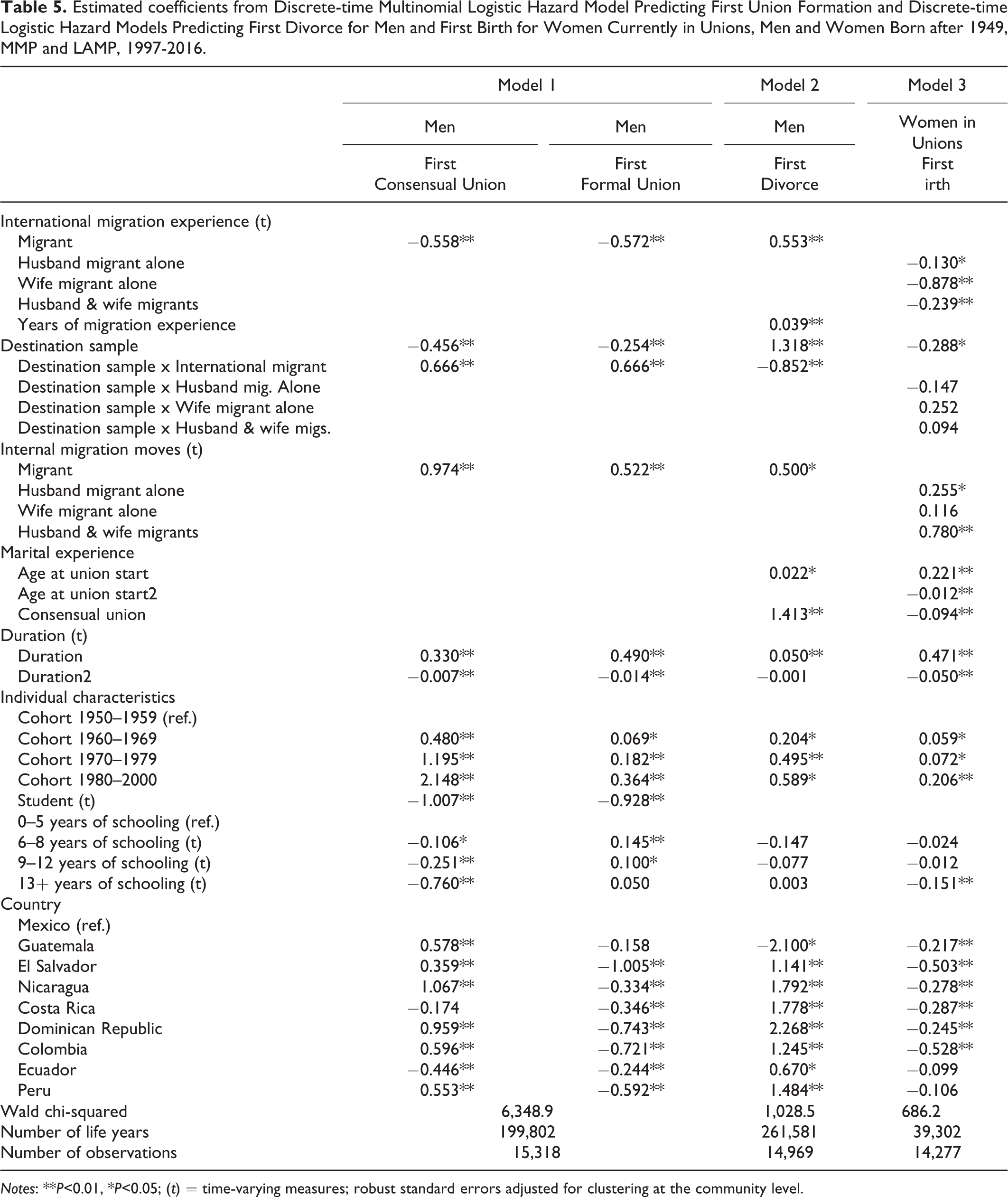
Notes: **P<0.01, *P<0.05; (t) = time-varying measures; robust standard errors adjusted for clustering at the community level.
In the case of union dissolution (Model 2), all international migration coefficients are consistent with our hypothesis and statistically significant. Being an international migrant, cumulative years of prior international migration experience, and being in a destination sample were all associated with higher probabilities of union dissolution. The destination sample coefficient interpreted alone indicates that men from the destination samples had a greater probability of union dissolution before they migrated, suggesting that for some international migrants, separation or divorce in the place of origin preceded migration and may even have been a contributing factor to migration. Adding the migrant, destination, and interaction terms together indicates that the effect of being a migrant on the probability of union dissolution was greater for men who settled in the destinations (1.019) than for men who eventually returned to their origin countries (0.553). We also find that in addition to being a migrant, prior international migration experience significantly increased the chances of union dissolution. With each additional year of prior migration experience, the odds of union dissolution in a given life-year increased by 4 percent (e0.039). Not only did being a migrant place men at a higher risk of union dissolution, but we also find that older ages at union formation were associated with a higher risk of union dissolution. With each one-year increase in the age at first marriage, the odds of union dissolution in a given life year increased by approximately 2 percent (e0.022). The results for union formation and marital stability are consistent with our hypotheses. Migration to high-income countries was associated with both delayed marriage and lower probabilities of marriage and a significantly higher risk of union dissolution. The association between migration and union formation and union dissolution operates through selection effects, the direct effects of being abroad, cumulative time abroad, and, in the case of union dissolution, migration’s effects on delayed marriage. We next review the results for the timing of first births among currently married women.
Our hypotheses predicted that international migration lowers the probability of a first birth because of migration’s disruptive effects and the higher costs of having a child in a high-income country compared to the origin country. Consistent with expectations, we find that all three migration status coefficients are negative and statistically significant. Married women whose husbands were abroad alone, married women who were abroad alone, and married women who were abroad with their husband all had a lower probability of a first birth compared to married women who were in the home country with their husbands. The effect of being in the destination is also negative and statistically significant. None of the interaction effects between destination sample and migrant status are statistically significant, suggesting that the negative effects on fertility of being an international migrant were the same for women whether they were in the destination as temporary migrants or as long-term migrants. However, married women who were in the destination sample had an even lower probability of a first birth than other women, irrespective of current migration status. The significant destination effect is evidence of selection for lower birth probabilities and possibly lower fertility goals compared to temporary migrants who returned to the origin country.
The model also includes age at union start and age at union start squared. We expect older age at union start to be associated with declining probabilities of a first birth. The age coefficient is positive and significant, and the age-squared coefficient is negative and statistically significant, indicating a strong curvilinear relationship. Increasing the age at marriage from 21 years to 22 years was associated with a one-percent decline in the odds of a first birth, and increasing the age at marriage from 21 years to 25 years was associated with a nine-percent decline in the odds of a first birth. 8 As we saw earlier in the descriptive statistics and in the results for union formation, men’s international migration before marriage was associated with an older age at marriage for both themselves and the women they married. The results here indicate that older age at marriage for women was associated with a lower probability of a first birth in a given life-year, and hence a longer interval to the occurrence of a first birth.
Although early international migration experience was associated with delayed marriage, delayed first birth, and a higher risk of union dissolution for men, it is still possible that migrant men and couples had sufficient time to catch up and achieve completed family sizes comparable to those of non-migrants, especially given the relatively low fertility levels in most Latin American countries. Table 6 presents the results from the Poisson regression models predicting the total number of births for men and for currently married women. Model 4 predicts the total number children for all men irrespective of marital status. The coefficients for cumulative years of international migration experience and for destination sample are negative and statistically significant. The interaction between destination sample and migration experience is positive but not statistically significant. The results provide evidence that men with international migration experience, especially men who settled in the United States or Spain, had fewer children in their lifetimes than non-migrant men who remained in their origin countries. When we restrict the analysis to ever-married men and add age at first union and first union dissolved, the magnitudes of both the migration experience and the destination sample effects decrease and the destination sample effect is no longer statistically significant. The coefficients for age at union start and first union dissolved are both negative and statistically significant. Each one-year increase in men’s age at first union was associated with a four-percent decline in the number of children (e -0.041), and having a first union dissolve was associated with an 11-percent decline in the number of children (e -0.117). These results are consistent with our hypotheses that both international migration experience and delayed marriage and marital instability are associated with fewer children and that part of the association between international migration experience and fewer children operates through delayed marriage and marital dissolution.
Estimated Coefficients from Poisson Regression Models Predicting Total Number of Children, Men and Women Currently in Unions Born after 1949, MMP and LAMP, 1997-2016.
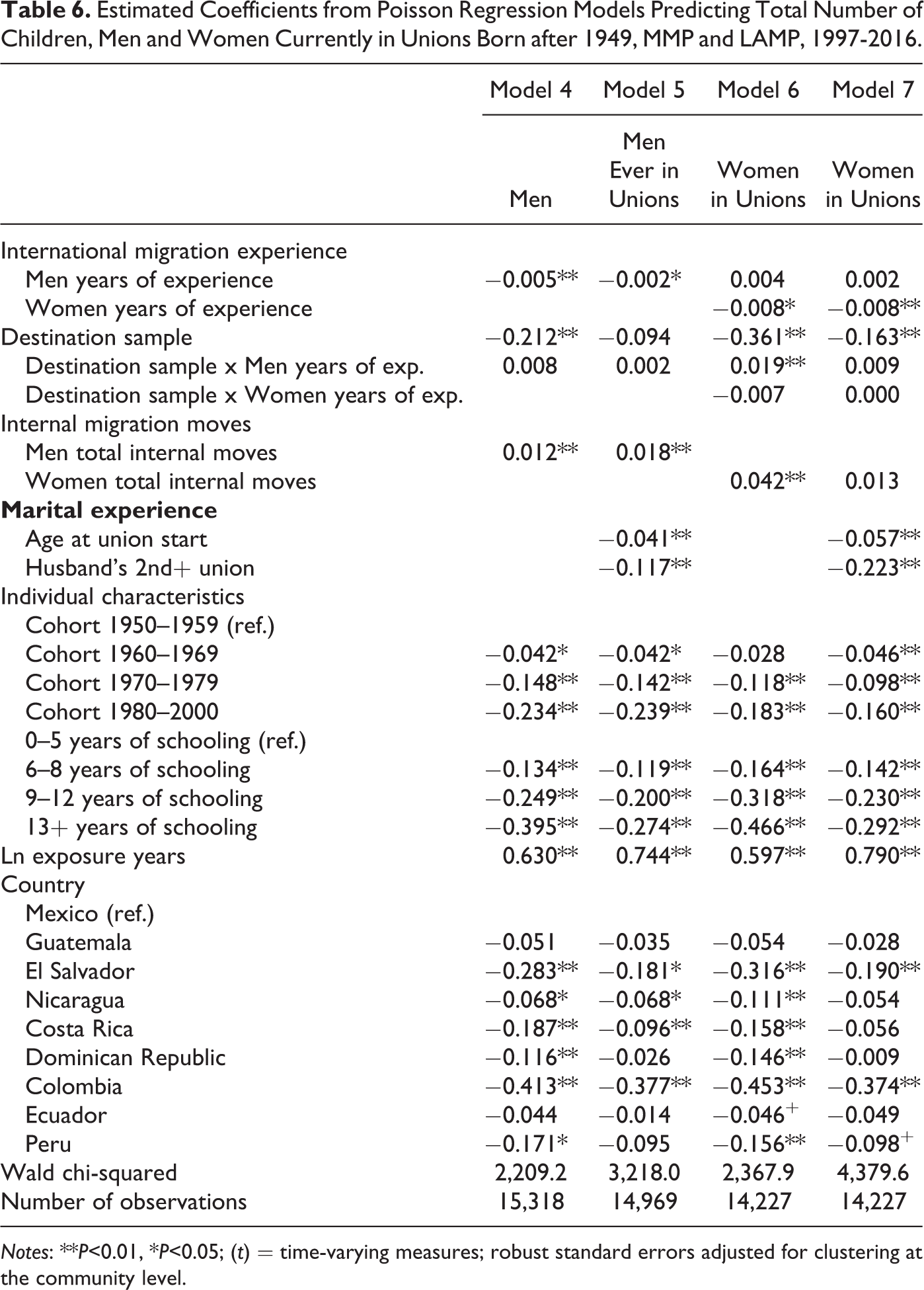
Notes: **P<0.01, *P<0.05; (t) = time-varying measures; robust standard errors adjusted for clustering at the community level.
Among currently married women, the main effect of husband’s cumulative international migration experience is positive but not statistically significant, and the main effect of women’s cumulative migration experience is negative and statistically significant. The coefficient for destination sample is also negative and statistically significant. Of the two interaction terms between destination sample and men and women’s migration experience, only the positive interaction for men is statistically significant. The number of children that non-migrant women had did not vary significantly by their husbands’ international migration experience, net of other factors. However, married women’s international migration experience was negatively associated with the number of children, and the negative effect of being abroad on fertility was greatest among women in the destination samples.
In the case of couples in the destination samples, men and women’s migration experience are collinear, and the combination of the main and interaction effects largely cancel each other out. When women’s age at marriage and husband’s prior union dissolution are added to the model, the main effect and interaction term for men’s cumulative migration experience are no longer statistically significant. However, the negative effect of women’s migration experience remains unchanged. The coefficient for destination sample also remains negative and significant, but the magnitude is reduced by more than one half. Similar to the case of men, each one-year delay in the start of marriage for women was associated with a six-percent reduction in the number of children (e-0.057), and marrying a man who had been in a prior union was associated with a 22-percent reduction in the total number of children (e-0.223). As in the case of men, the negative effect of being in the destination sample on completed fertility was strongly influenced by the relationship between international migration and marital timing and stability and the relationship between marital timing and stability and completed fertility. However, in the case of women, there is evidence that the negative effect of husbands’ prior union dissolutions on completed fertility was even greater than in the case of men. Men who remarried at older ages after a failed earlier marriage were likely to have children from their earlier union and, therefore, desire fewer children in their current union than men who were in their first union.
We next put the relative effects of international migration experience, delay in union formation, and marital instability on completed fertility in perspective by presenting the mean predicted number of births from the Poisson regression models for hypothetical covariate groupings. Figure 1 presents the mean predicted values for all men based on the covariate estimates from Model 4, and for ever-married men based on the estimates from Model 5. If all men in the sample are assigned to the origin country samples, have zero years of international migration experience, and all other characteristics remain as observed, the mean predicted number of children is 2.85. If we give these men 10 years of international migration experience, the mean drops to 2.71. If we give them 20 years of experience, the mean drops to 2.57. If we also assign them to the destination sample, the mean drops even further to 2.08. When we take into account age at first marriage and divorce (first union dissolution) among ever-married men, the drop in the mean predicted number of children is even greater. If all men are assigned to the origin sample and enter a first union at age 23 years, the mean predicted number of children is 2.95. If we increase age at first marriage to 25 years, the mean predicted number of children drops to 2.72. If we assign everyone to the destination samples, the mean drops to 2.47, and if the first union was dissolved, the mean drops even further to 2.20 children. All these differences in predicted values are statistically significant.
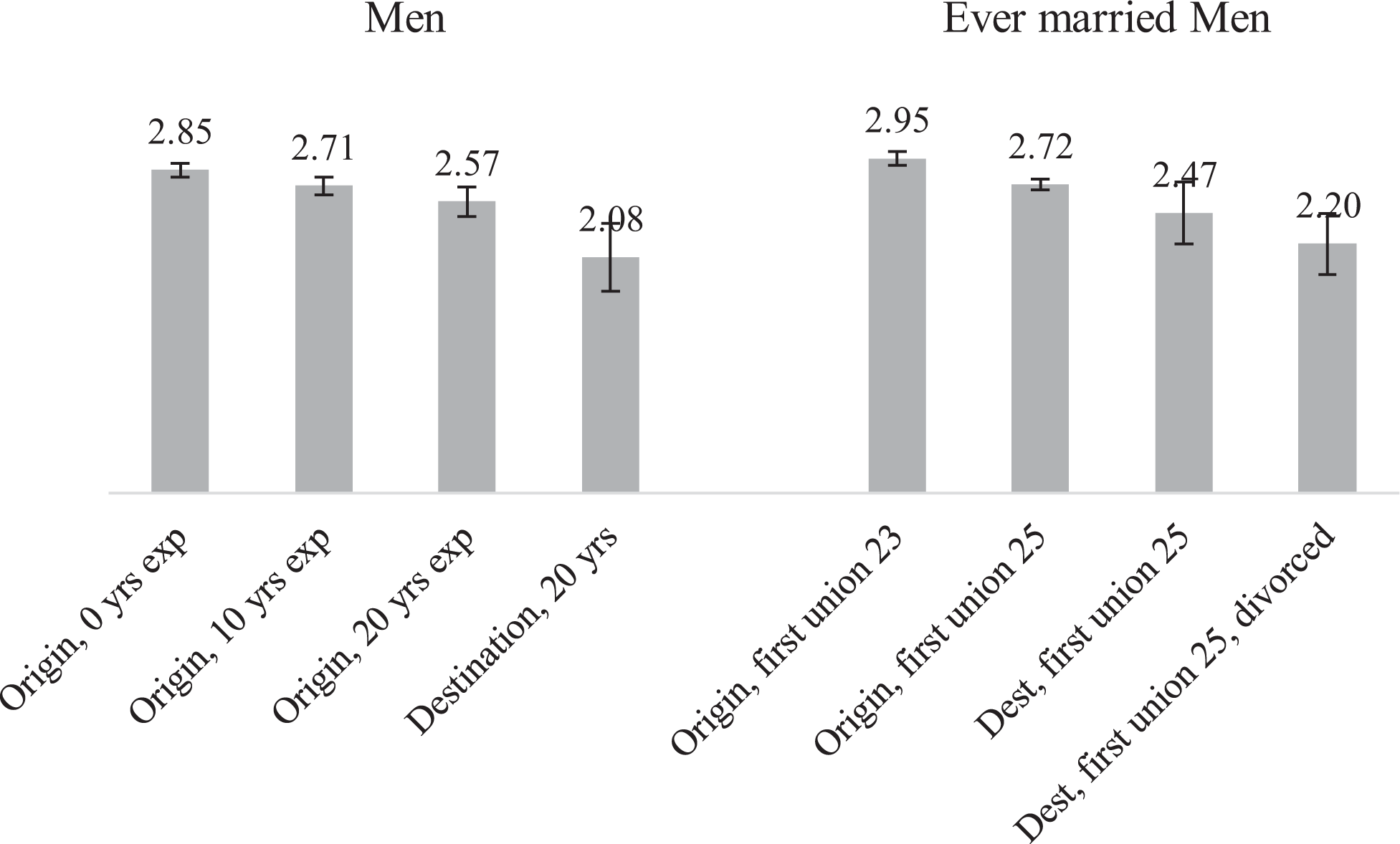
Mean Predicted Number of Children Ever Born from Poisson Regressions, All Men and Ever Married Men, by Sample Location, Years of International Migration Experience, Age at First Union, and First Union Ended in Divorce.
The relative effects of international migration experience and marriage on the mean predicted number of births are even greater for women. If all women are assigned to the origin samples, have zero years of international migration experience, and enter their most recent union at age 21 years, the mean predicted number of children is 2.75 (see Figure 2). If the same women are assigned 10 years of international migration experience, the mean drops to 2.54 children. The mean drops further to 2.16 children if the women are also assigned to the destination samples. Increasing the age at marriage from 21 years to 23 years drops the mean predicted number of children to 1.93. If we also change husband’s union status to second or higher order union, the mean drops to 1.54.
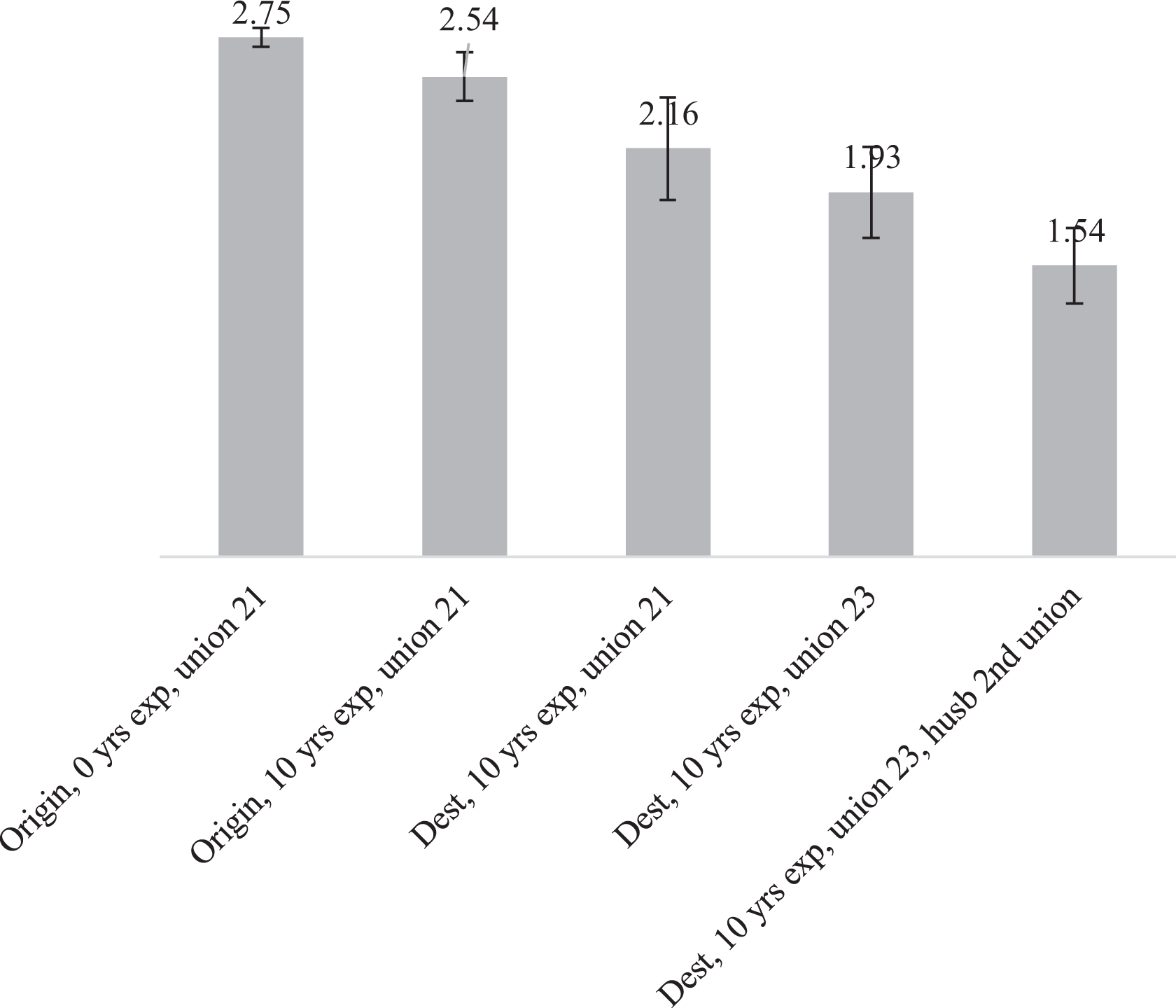
Mean Predicted Number of Children Ever Born from Poisson Regressions, Currently Married Women, by Sample Location, Years of International Migration Experience, Age at First Union, and Husband Ever Divorced.
Figure 2 shows the relative effects of different combinations of nuptial experience and international migration experience on the predicted number of children for a hypothetical woman. It reveals the comparatively large reductions in fertility that can result from the combination of delayed union formation, union dissolution, and settlement in the United States or another high-income country. Figure 3 demonstrates the relative contributions of differences in marital experience and international migration experience on overall sample means for distinct groups of non-migrant and migrant women. The figure defines three groups of married couples in the pooled MMP and LAMP samples: non-migrant couples interviewed in Mexico and the other Latin American countries, returned migrant couples among whom the woman had more than three years of international migration experience (the median years of migration experience for the group), and settled migrant couples interviewed in the United States or Spain (destination samples). The predicted values are based on the coefficients from Model 7 (Table 6). The first set of predictions for the three groups is based on the observed sample characteristics with the current ages set at 39 so that the exposure times are the same across groups.

Mean Predicted Number of Children by Age 39 from Poisson Regression, Currently Married Women, by Sample Location, Marital Experience, and Years of International Migration Experience.
The mean predicted number of children for non-migrant women, returned migrant women, and migrant women in the destination samples are 2.63, 2.74, and 2.13, respectively. These values represent the mean number of children we would expect in the sample if the women were exposed from ages 12 years through 39 years to the relative risk ratios estimated by the Poisson model. They serve as a reference point for alternative scenarios in which nuptiality and migration experience are equalized across the three groups. For example, the second set of mean predictions set women’s age at marriage to 21 years (the median for non-migrant women) and randomly assign husband in second or higher union to 9 percent of the sample (the proportion of second or higher unions in the non-migrant group). After equalizing nuptial patterns across the three groups, the mean predicted values for non-migrants and returned migrants rise marginally by 0.04 and 0.02 children to 2.67 and 2.76, respectively. However, the mean for migrant women rises by 0.24 children to 2.37. In the third set of mean predictions, all the international migration experience variables are set to zero. The mean predicted number of children for returned migrant women rises by 0.16 children to 2.92, and the mean for migrants rises by 0.27 to 2.64 children.
In summary, then, if women in the MMP and LAMP destination samples were to have had the same age at marriage and prevalence of husbands in second or higher order unions as non-migrant women and no international migration experience, our model predicts they would have had on average 0.51 additional children. Migrant women’s older age at marriage and higher prevalence of marriages to men in second or higher order marriages account for 0.24 of the difference, and the direct effects of migration experience account for 0.27 of the difference. Among returned migrant women, nuptiality was not important in differentiating their fertility from that of non-migrant women; however, the experience of living abroad accounted for a 0.16 reduction in the mean predicted number of children. Considering that these figures are means for predicted sample values based on observed characteristics, the predicted differences in the observed and expected means under different conditions are quite substantial. This exercise also demonstrates clearly that age at marriage and marital stability are very important components of the reduction in fertility associated with international migration among long-term and settled migrants.
Summary and Discussion
Our objective in this article was to identify the relative importance of delayed union formation and union instability alongside the direct effects of migration experience in explaining the association between international migration and fertility reduction. We find clear evidence that for men, international migration decreased the probability of entering into a first union and, along with cumulative migration experience, increased the probability of union dissolution. We also find that women married to men with international migration experience tended to marry at older ages than women married to non-migrants. In addition, we find that among married couples, women and men’s international migration experience was associated with a lower probability of a first birth and, hence, a longer first-birth interval compared to non-migrant women. The direct effect of husband’s international migration experience on the timing of a first birth was not so large as that of a wife’s experience. However, we find clear evidence that women’s older age at union formation was associated with a lower probability of a first birth. Using Poisson regression models, we find that men’s cumulative years of international migration experience was associated with fewer children ever born, but that the effect is relatively small in magnitude. We also find that once we take into account age at first union and whether a first union was dissolved, the direct effect of cumulative international migration experience is attenuated. Early international migration experience delayed men’s entry into a union, and subsequent migration experience increased their risk of union dissolution, both of which were associated with smaller completed family size.
Among women in a union at the time of the surveys, we find strong evidence that their cumulative international migration experience was associated with lower completed fertility after taking into account their age at union formation and whether their husband had a prior union, both of which were also associated with fewer births. Finally, we find that being settled in an international destination was consistently associated with older age at first union, a greater risk of union dissolution, a longer waiting time to a first birth, and lower completed fertility. This relationship reflects both selection effects and assimilation and adaptation processes at work. Overall, the evidence is strongly supportive of our four hypotheses. In particular, our model estimates reveal that close to one-half of the mean predicted reduction in settled migrant women’s fertility was attributed to delayed union formation and husbands’ prior union dissolution. Our results underestimate the impact of international migration experience on completed fertility, since the MMP and LAMP life histories under-represent never-married women and women in dissolved unions, neither of which group is included in our analysis.
A strength of our analysis is its basis in a pooled sample of nine countries. Due to the relatively small sample sizes for some countries and the absence of destination samples for all nine countries, we were not able to stratify our analysis by country. However, we did estimate all seven models for the pooled Mexico samples and then for the other country samples pooled, excluding Mexico. Across the seven models, there are 28 coefficients corresponding to the main effects of international migration experience, age at first union, and prior union dissolution that we used to test our hypotheses. Of these 28 main effects, 26 of the paired coefficients from the Mexico and other country samples were in the same direction, and in 12 of the pairs, both coefficients were statistically significant (results available upon request). This highly consistent pattern of results between the Mexico and other country samples provides solid evidence that our results are broadly generalizable to major migrant-sending countries in Latin America.
Our results have important implications for the study of international migration and fertility, and for policy and popular discourse on immigrant fertility. First, with respect to future studies, we provide an analytical framework for incorporating nuptiality and union instability into the analysis of the relationship between migration and fertility. Prior conceptualizations of disruption effects have contemplated migration’s potential impacts on delayed marriage and marital dissolution (Timaeus and Graham 1989; Lindstrom and Giorguli 2002; Hoem and Nedoluzhko 2008; Adserà abd Ferrer 2015), but none have explicitly incorporated both phenomena into an analysis of international migration’s impacts on completed fertility. As we argued at this article’s outset, with fertility in major migrant-sending countries gradually approaching levels in major immigrant-receiving countries, migration’s disruptive effects on union formation and union stability will become a major, if not the most important, determinant reducing migrant fertility from the fertility of non-migrants in the origin country.
From a policy perspective, however, the reference point is the fertility of the host society, not the origin country. Based on our results, we argue that concerns about and expectations of immigrant fertility that is higher than below-replacement native fertility in most high-income immigrant destinations is unfounded, at least in the origin countries we examined. Of the nine Latin American countries in our pooled MMP and LAMP samples, fertility was already at or below replacement in Costa Rica, Colombia, El Salvador, and Mexico (ECLAC 2016). The United Nations 2019 medium variant population projection places total fertility in Latin America and the Caribbean well below replacement by 2020 (United Nations 2019). The marital disruption effects that we detect in our analysis are in addition to assimilation, adaptation, and selection effects. As fertility in the origin countries declines, assimilation, adaptation, and selection effects will also decline in importance, but we expect migration’s disruptive effects on family formation and stability to continue to operate and potentially bring immigrant fertility down even further.
Recent studies of immigrant fertility in the United States and Europe document a wide range of fertility rates among immigrant women and in many instances above the rates of native-born women (Sobotka 2008; Bagavos 2019; Volant et al. 2019). However, these same studies demonstrate that immigrant fertility has negligible effects on increases in the destination country total fertility rate because immigrants constitute a relatively small proportion of the population (Sobotka 2008; Bagavos 2019; Volant et al. 2019). Our findings suggest that the fertility of future cohorts of immigrant women may be even lower than projections of fertility in their origin countries, due to migration’s disruptive effects on family formation and the selection of divorced persons into migration. As fertility continues to decline in many immigrant origin countries, the disruptive effects of migration and the selection of unmarried and divorced persons into migration are likely to result in more instances of immigrant fertility below that of the destination population, further undermining concerns about and expectation of high immigrant fertility.
Footnotes
Declaration of Conflicting Interests
The author(s) declared no potential conflicts of interest with respect to the research, authorship, and/or publication of this article.
Funding
The author(s) disclosed receipt of the following financial supportfor the research, authorship, and/or publication of this article: This study was made possible with support from NIH grants P2CHD041020 and R01 2HD035643-17A1.
