




Abstract
This IMR Research Note examines the impact of the level of bonding social capital on access to employment among newly arrived Afghan refugees in Victoria (Australia). Based on a mixed-methods analysis of biographical interviews with 80 Afghan refugees, it examines their use of social capital, year by year, during the first three years after their arrival. Our analysis shows that higher levels of bonding social capital are associated with greater success in finding employment during the first and second year of settlement. In the third year, however, bonding social capital for Afghan refugees in Victoria is no longer a significant predictor of employment. This Research Note helps clarify inconsistent findings in the literature on the effects of social capital on obtaining employment by suggesting that bonding social capital’s impact on refugee employment success changes significantly across the first three years after arrival. This finding has important implications for migration policy and the prioritization of resources toward services for newly arrived refugees.
Keywords
Introduction
This IMR Research Note presents findings from a mixed-method study among Afghan refugees in Victoria, the largest Afghan community in Australia, and examines how the effect of bonding social capital on Afghan refugees’ access to employment changes during the first three years after arrival. Beginning with a review of the literature on social capital and access to employment, it critically discusses existing empirical research on the effects of bonding social capital on employment, before turning to a mixed-methods study of the experiences of 80 recently arrived Afghan refugees. As the analysis shows, higher levels of bonding social capital assist Afghan refugees in finding employment, but only in the first two years after arrival. The significance of this finding is discussed exclusively against the literature addressing bonding social capital’s impact on employment, as space does not permit discussion of this study’s implications for the broader theory of social capital itself.
Age, language, access to education, non-recognition of educational qualifications, and other structural barriers (such as not understanding the systems governing employment) are some of the major challenges faced by migrants from non-English speaking backgrounds in their efforts to find employment in Australia (Wali, Georgeou, and Renzaho 2018). Social capital can play a key role in tackling these barriers (Allen 2009; Lancee 2010, 2012; Cheung 2014). Bonding social capital usually refers to relations within groups – generally family, close friends, neighbors, and immediate ethnic communities – and bridging social capital to relations between groups, including between distant friends, associates, and colleagues (Woolcock 2001). Previous research has examined how different forms of social capital affect employment opportunities in migrant communities, with inconsistent findings (for a review of the literature, see Dheer 2018). In particular, scholars generally agree about bridging social capital’s positive effect on migrant employment but disagree about whether bonding social capital has a positive or negative effect (Dheer 2018).
In this IMR Research Note, we propose that bonding social capital’s effect on refugees’ access to employment changes significantly over the initial three years following settlement – an issue that has been largely unexplored in previous research. Among the few exceptions are studies that use the German Socio-Economic Panel Survey (GSOEP) data (Lancee 2012; Lancee and Hartung 2012; Kalter and Kogan 2014) and the Migrations between Africa and Europe (MAFE) dataset (Toma 2016). Both the GSOEP and the MAFE, however, do not allow a year-by-year investigation of migration experiences during the first few years after settlement. Thus, to date, no study has fully examined at what point bonding social capital’s effect on employment stops being positive.
Theoretical Background
The term “social capital” has a long history, having first been coined by Jane Jacobs (1961) six decades ago. It only achieved prominence, however, in the late-twentieth century through the work of Pierre Bourdieu (1991), James Coleman (1988), and Robert Putnam (2000). Most current work employing the concept of social capital draws on Bourdieu’s work, which defines social capital as consisting of “resources based on connections and group membership” (Bourdieu 1987, 4). More broadly, social capital has come to be understood in dynamic terms as being inherently fungible in that it “can be acquired, transmitted and converted” into other forms of capital (Van Hear 2006, 129) – here, primarily economic but also cultural capital.
The theoretical dichotomy between bridging and bonding social capital has been criticized by Ryan et al. (2008), who suggest that the links between bonding and bridging are more complex than current operationalizations suggest: within bonding and bridging types of social capital, there can be a horizontal dimension that captures connections within the same cultural and socio-economic group and a vertical dimension that captures connections with people from different backgrounds and skill levels. Ryan’s (2011, 2016, 12) studies demonstrate the importance of paying attention to “the relative social location of the actors and the resources that flow through” bonding and bridging ties, depending on characteristics such as gender and socio-economic status. Consistent with Ryan’s critique of Putnam’s simplistic dichotomous categorization of social capital (2008, 2011, 2016), our research focuses on factors such as gender and education levels.
The Relationship between Social Capital and Employment
Because bridging social capital provides access to host-country resources and labor market opportunities, there is general consensus that it has positive effects on migrants’ employment opportunities (Lancee 2012); however, previous research on social capital’s effects on employment is less clear about the impacts of bonding social capital (e.g., Allen 2009; Lancee 2010, 2012; Cheung 2014). Research on bonding social capital’s effects on migrants’ employment has also yielded contradictory findings. On the one hand, in-group networking has been found to increase migrants’ risk of social isolation and segregation from long-term residents and citizens that have better knowledge of the job market (Aguilera 2002). Relationships between migrants and co-ethnic employers formed with bonding social capital can sometimes be opportunistically exploitative (Portes and Jensen 1992), and within certain migrant communities, women are expected to take care of family and children and, therefore, might be offered fewer job opportunities within the community (Allen 2009). On the other hand, bonding social capital has been found to have a positive effect on migrants’ employment, for example, because of in-group solidarity and trust that facilitate economic exchanges and entrance into ethnic economies (Aguilera 2002; Iosifides et al. 2007). In sum, bonding social capital can have either a positive or a negative effect on employment, depending on the context.
Nakhaie, Lin, and Guan (2009) conducted a survey in Canada of 17,745 full-time waged workers to understand whether social capital’s effects on employment are different depending on the ethno-racial background of the migrant community, finding that social capital’s impact on employment varied across ethno-racial groups and tended to have a less positive effect for visible minorities, especially black Canadians. Similarly, Toma’s (2016) study in Italy, France, and Spain found that bonding social capital’s effect on employment varied across different communities: bonding social capital in the Senegalese community led to employment opportunities in France, where the Senegalese community was more established and integrated, but not in Italy and Spain, where the Senegalese community was largely marginalized. Cheung (2014) surveyed 2,787 respondents from black African, Caribbean, Indian, Pakistani, and Bangladeshi second generations in the UK and found that bonding social capital generally had a negative effect on men’s employment and that bridging social capital tended to have a positive effect on women’s employment. The same study (Cheung 2014) also found that social capital’s effects on employment tended to be more positive for first generations than for second generations. In sum, previous research suggests that bonding social capital’s effects on employment might differ between ethno-racial communities, gender groups, and migrant generations.
Previous qualitative studies suggest that bonding social capital’s effects on employment might change over time: bonding social capital is often the first and only available capital for migrants at the beginning of the migration journey and can help provide security and stability, thus increasing the chances of finding a job, especially for men (Iosifides et al. 2007). Over the longer term, however, qualitative research suggests that migrants who become dependent on bonding social capital, such that they remain in a predominantly mono-ethnic social network, can miss out on developing the necessary skills to enter the host-country job market and, as a result, often face underemployment and low-skilled labor conditions (Remennick 2004). In contrast, those who develop bridging social capital are generally better able to fully access the job market (Lancee 2010, 2012; Cheung 2014). Nonetheless, not all bonding relationships are the same, in terms of actors’ social location: migrants are diverse in age, gender, family situation, occupational background, migratory experience, and strategies, and all these factors affect their bridging and bonding social capital (Ryan 2011, 2016). It is, thus, important to ask what kind of resources flow between actors in specific bonding relationships. In this Research Note, we pay particular attention to these factors in the qualitative analysis of our data.
The Afghan Community in Australia
This article uses the case of first-generation Afghan refugees in the Australian state of Victoria to explore the relationship between bonding social capital and employment in the first years after arrival. Focusing on a refugee group is more appropriate for this sort of analysis than focusing on other categories of migrants (e.g., skilled migrants) because of refugees’ homogenous low levels of both bridging and bonding social capital upon arrival in Australia (Patulny 2015). We focus on the first generation to maintain constant a variable that could affect social capital’s impact on migration (Cheung 2014) and on a single national group that migrated to the same local context (the state of Victoria) because differences in ethno-racial communities and host countries’ contexts can also affect relationships between social capital and employment, as shown by Toma (2016).
At the time of the 2016 census, the Afghan-born population in Australia was 46,800, an increase of 63.6 percent from the 2011 Census (Department of Home Affairs 2018). Of this population, 18,116, the largest single group, lived in the state of Victoria, with about 90 percent (16,253) living in the Greater Melbourne Area (ABS 2019). According to the 2016 census, at least 87 percent of Afghans in Australia arrived after 1996, following the Taliban’s violent seizing of power in Afghanistan, with more than 60 percent arriving between 2015 and 2016 (ABS 2019; SBS 2020). Almost all post-1996 arrivals were fleeing conflict and persecution related to the Taliban and were accepted via a humanitarian program as refugees (SBS 2020). Thus, the Australian Afghan community is overwhelming a first-generation migrant community, having grown 10-fold in the last two decades (Ibrahimi 2017). The Hazara constitute the largest ethnic group among Afghanistan-born Afghans living in Australia, as the systemic persecution of the Hazara minority in Afghanistan meant that they were more readily accepted as refugees in Australia (Department of Home Affairs 2018).
The 2016 census recorded one third of Afghan respondents (15,865) as speaking Hazaraghi, the distinctive Farsi dialect spoken by the Hazara, at home. This number captures only a portion of the Hazara community, however, as many identify as speakers of Dari, the Farsi dialect spoken across Afghanistan. In the 2016 Australian census, 43.5 percent of those born in Afghanistan (20,353) reported speaking Dari at home, 10.2 percent (4,761) reported speaking Farsi (other than the Dari and Hazarghi dialects), and 6.6 percent reported speaking Pashto (Department of Home Affairs 2018; Radford and Hetz 2020).
Previous reports on the Afghan community in Australia have noted a number of barriers to their smooth integration, including difficulty in accessing services and distrust of outsiders (SBS 2020). Due to the disruption of four decades of war, many Afghan migrants in Australia have received no formal education, resulting in them being illiterate in Hazaraghi and Dari/Farsi (Rintoul 2010). Language and literacy barriers continue to present important challenges to education and employment for all refugees in Australia, but especially for Afghan women, and illiteracy represents a particular barrier to employment (Sharifian et al. 2020). Around 50 percent of men and 75 percent of women in Victoria’s Afghan community are illiterate, and this high rate of illiteracy compounds problems by effectively limiting their access to services and awareness of basic rights (Pour et al. 2014). It also makes it significantly more difficult for Afghan refugees to learn English (Sharifian et al. 2020). Many Afghan refugees in Australia also suffer from mental health issues, such as anxiety, depression, and post-traumatic stress disorder (Pour et al. 2014). Among Afghan women, unemployment levels are higher than among Afghan males, due to lower literacy, isolation, and lack of employment skills (Rintoul 2010).
The 2016 Census reported an unemployment rate of 17.8 percent for those born in Afghanistan, which is more than double the 6.9 percent unemployment rate for all Australians. It also reported that only 30.2 percent of Afghanistan-born individuals aged 15 and over had some form of non-school qualification, compared with 60.1 percent of the total Australian population. The net impact of higher unemployment among Afghans is that the median Individual Weekly Income for the Afghanistan-born population in Australia was $371, compared with $688 for all Australian-born and $615 for all overseas-born (Abraham and Busbridge 2014).
Data and Methods
We conducted a mixed-methods study by collecting biographical interviews among Afghan refugees in Geelong and Melbourne (Victoria) between November 2018 and March 2019. Interviews were conducted in both English and Afghan-Persian (Dari). A team of Afghan–Australian interpreters and researchers was employed to collect the data among same-gender participants, translate it, and populate a person-year dataset under supervision of the authors. The sample was composed of 80 Afghan refugees who settled in Australia between late 2013 and early 2016. Computations using G*Power indicate that at least 73 participants are needed to detect a medium effect size (f 2 = 0.15) with five predictors (0.90 power, α level: 0.05, two-tailed), as identified in previous studies examining the relationships between bonding and employment (e.g., Village, Powell, and Pepper 2017). We recruited participants through snowball sampling, starting with one prominent Afghan community organization and research assistants’ personal contacts. Participants were asked to provide information about their experiences and activities in the first three years after arrival in Australia. We decided to focus on the first three years from arrival because, according to a study of 2,400 humanitarian migrants in Australia (Rioseco and De Maio 2017), 6 percent of participants were employed three to six months after arrival, 16 percent one year later, and 23 percent two years later. Based on these data, we hypothesized that focusing on three years from arrival would allow us to capture this four-fold increase in employment. Also, focusing on the first three years in Australia allowed us to interview people who had fresh memories of their migration journey and experiences, as our sample included only Afghan refugees who had arrived in Australia in the last three to five years. Following Ryan and D’Angelo (2018), we use mixed-methods biographical interviews to obtain retrospective longitudinal data about migrants’ social capital and employment in Australia. Based on this information, a person-year data set was created, measuring respondents’ year-by-year social capital and employment, at three points in time: Year 1, Year 2, and Year 3. This dataset is used to explore temporal variations in the relationship between social capital and employment.
We chose biographical interviews because they allowed us to collect rich qualitative data and to elicit memories in a more organic and less directive way than surveys (Bron and Thunborg 2015). Participants were initially prompted to recount their experiences in an unstructured way, with priority being given to participants telling their stories in their own terms. Nevertheless, interviewers had a clear schedule of topics that needed to be addressed in each interview. All interviewers underwent a one-day training session with the authors, where they practiced interviewing mock participants, to ensure that the interviewing technique and information elicited from participants were consistent and that each interviewer was able to collect the relevant information about focus areas of employment and social capital examined in this Research Note.
At the end of each interview, specific questions were asked about participants’ employment, mosque attendance, participation in religious groups and community events, and volunteering activities (e.g., “during your first year in Australia, did you go to the mosque or to community gatherings?”). For each topic, we asked participants to provide information about the people they met and their relationship with them (e.g., “can you please provide more information about the people you met – for example, at the mosque or at a community event – and your relationship with them?”). As a final point, participants were asked a few standardized questions about their demographic characteristics (age, education levels) and proficiency in English: “Thinking about your [first/second] year in Australia, how would you evaluate your English-language proficiency?” Choices ranged from 1 (very low) to 7 (very high). With this question, we aimed to capture a necessary precursor of bridging social capital, since without English language skills, it is virtually impossible to extend social connections beyond the ethnic community (Remennick 2004; Ryan et al. 2008). We acknowledge the limitations of using a self-reported English proficiency tests, but we also point to research that established a high level of accuracy of self-reported language proficiency measures compared to performance tests (Shameem 1998).
Analytical Approach
The 80 mixed-methods biographical interviews provided rich data that were analyzed using both qualitative and quantitative methods. First, the information collected during interviews was coded by the authors to create a quantitative database and to enable univariate, bivariate, and multivariate statistical analyses, using SPSS. Second, the recorded and transcribed interviews were analyzed through the lenses of thematic and discourse analyses.
In the quantitative analyses, the main dependent variable was employment, and the main independent variables were indicators of bonding social capital. We acknowledge that people could have been moving in and out of employment and that the binary coding (employed/non-employed) for each year represents an approximation that might inflate employment figures in given years. Nevertheless, these limitations were inconsequential, given that we are interested in the trajectory from unemployment to employment (and vice versa), which is captured with the current data. As activities used to capture social capital (going to the mosque, participating in religious groups, attending community events, and volunteering) could include both bridging and bonding types of social capital (e.g., Nakhaie, Lin, and Guan 2009), we used information provided in interviews to code which type of social capital applied. We considered whether participants attended religious groups or the mosque predominantly with other Afghans, whether the community events they attended were mainly with other Afghans, and whether volunteering was done with other Afghans in local organizations and schools. In the dataset, all bonding activities were coded as 1 and all other activities as 0. Subsequently, a scaled item combining responses to these four binary variables was created.
To explore whether bonding social capital’s impact has different effects at different points during the first years of settlement, three binary logistic regression models were created, with employment in Years 1, 2, and 3 as outcome variables. In the models, the scaled items indicating bonding activities, self-reported English proficiency, and controls (age, gender, and education levels) were included. In the first model, all variables collected in Year 1 were included to explore relationships between social capital and employment at the time of arrival. To determine whether there was a change in social capital’s effect on employment, the second model tested whether social capital and English proficiency in Year 1 were associated with employment in Year 2, and the third model tested whether social capital and English proficiency in Year 2 were associated with employment in Year 3.
Results
Quantitative Findings
First, we present descriptive statistics of the main variables: 61 percent of participants (N = 49) arrived in 2016, 16 percent (N = 13) in 2015, and the others in 2013 and 2014. Males were 47.5 percent of the sample (N = 38) and females 52.5 percent (N = 42). Participants ages ranged between 18 and 65 (M = 31.9, SD = 13). Participants’ education levels before arriving in Australia varied greatly: 10 percent (N = 8) did not have any schooling, 50 percent (N = 40) attended only elementary schools (5 years or less), 13.8 percent (N = 11) attended some level of high school (between 6 and 12 years of studying), and 26.3 percent (N = 21) attended tertiary education. Participants who declared that they were employed in Year 1 amounted to 21.3 percent (N = 17), in Year 2, 35 percent (N = 28), and in Year 3, 43.8 percent (N = 35). Table 1 reports answers to the questions about participation in community activities, which form the scaled item indicating bonding activities.
Participation in Community Activities in the First Three Years after Settlement.
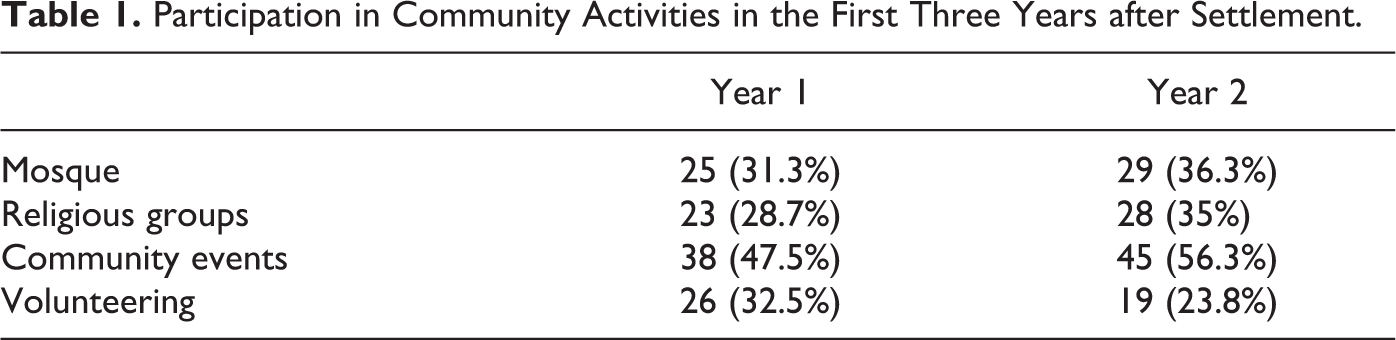
The mean number of types of activities that participants attended in Year 1 was 1.4 (SD = 1.12) and, in Year 2, was 1.51 (SD = 1.10). Bivariate correlations between demographic variables and the other variables of interest were conducted, and there is a significant positive correlation between age and education (r = 0.46, p < 0.01) and a significant negative correlation between age and perceived English proficiency in both Year 1 (r = −0.46, p < 0.01) and Year 2 (r = −0.58, p < 0.01). Being female was negatively associated with having a job in Year 2 (r = −0.35, p < 0.01) and Year 3 (r = 0.52, p < 0.01). Finally, three binary logistic regression models were conducted, as described in the methods section (Table 2).
Binary Logistic Regression Models on Employment in the First Three Years after Arrival.

*p < .05.
**p < .01.
The logistic regression models suggest that for every additional bonding activity in which participants were involved in Year 1 (including mosque attendance, religious group involvement, events, and volunteering), their odds of securing employment in Year 2 increased by 2.51. However, engaging in bonding activities in Year 2 did not significantly increase the odds of having a job in Year 3. It is also interesting to note that self-reported English proficiency in Year 2 is a significant predictor of being employed in Year 3. Participants were asked to self-assess their English proficiency on a scale from 1 to 7 (1 = very low, 7 = very high). An increase of 1 level on this self-assessment corresponds to an increase in the odds of having a job in Year 3 by 1.63.
Qualitative Findings
The qualitative results provide nuanced and deeper understanding about why, in the early years of settlement, participating in activities within the migrant community increased participants’ chances of finding a job in the following year. There were significant differences between Sunni participants (the minority of participants, who came from a variety of ethnic backgrounds) and Shi’a participants (the majority, most, if not all, of whom were ethnic Hazaras). For example, Sunni participants were more likely to engage in religious gatherings with other Australian Muslims that crossed ethnic and national origins and, therefore, built contacts with a larger network that included members of Turkish and Arab communities. Sunni participants’ higher religious engagement is not surprising, given that the vast majority of Muslims in Australia identify as Sunni and the main Muslim community organizations tend to cater exclusively to Sunni Muslims (Yusuf 2014). The only public religious event that Shi’a participants generally attended was Tasu’a-Ashura, which, from participants’ descriptions, was a solely Hazara gathering and did not include other Shi’a Muslims of different backgrounds. Furthermore (and significant to the discussions below on gender), men attended mosques (or in the case of Shi’a, hussayniyahs) more often than women, a pattern which reflects the non-mandatory requirement for women’s attendance at Friday prayer across Islam’s various sects.
For many participants, volunteering and building a reputation within their own ethnic-sectarian community facilitated pathways to employment. For example, a Hazara women in her early twenties who had migrated at 17 mentioned that volunteering at a Persian-language (Dari) Saturday school for the children of migrants ultimately led to her later employment in the same organization: I began volunteering at a Dari school for two years after I arrived in Australia and two years after that, got employed there. (Female, early 20s, Hazara)
In other cases, the outcome of bonding social capital was less linear, with volunteering within an Afghan setting leading to a job within the community but not directly related to the original volunteering. In this example, volunteering at a Dari language school led to the participant building an Afghan-based social network that subsequently resulted in her being hired by a restaurant run by another community member: I came to Australia in 2013 and went one or two days a week to English classes. In 2016, I began going to TAFE [Technical and Further Education schools, which offer vocational training] for an English course and did volunteering once a week at Dari school. Finally, around two weeks ago, I got employed in a [Afghan] restaurant. (Female, 40s, Hazara) One year after I came to Australia, I started volunteering at aged care, and one year after, I got employed there. (Male, 30s, Pashtun) I began studying medical science in 2016 and volunteered in the same year. This was at a hospital as a social supporter until now. In my third year of volunteering, I received a job as a tutor at the same university I study at. (Female, early 20s, Hazara) I’ve never had a job since I moved to Australia, and I still never look for a job as well because I have kids to look after. I also don’t need financial support due to my husband’s job. (Female, late 30s, Hazara) I arrived in Australia in 2016 and never went to any language classes and didn’t have a job. I only did volunteering to teach other Afghan women sewing only in my first two years. After that, I had to leave that to look after my kids. (Female, 50s, Tajik) In my first year, I didn’t know anyone, and didn’t go anywhere. How can I have conversations [with others] when I don’t know what they are saying? (Female, 35, Hazara)
Discussion
This IMR Research Note explores whether bonding social capital’s impact on employment has different effects at different points in time during the first three years of settlement. Drawing on interviews with 80 Afghan refugees who had recently migrated to Victoria (Australia), it shows that bonding social capital’s impact on employment changed during this period. Specifically, we found that for Afghan refugees, participating in community activities in the second year was not significantly associated with having a job in the third year. On the other hand, achieving greater proficiency in English in Year 2 significantly increased the odds of being employed in Year 3.
This finding helps clarify current inconsistencies in the literature about bonding social capital and employment, where some studies have found that bonding social capital has a negligible or negative impact, while others suggest that it has a positive effect on employment (see Dheer 2018). Our original contribution here is to argue that bonding social capital may cease to have a positive effect on employment within three years of arrival. Our findings suggest that bonding social capital does have a positive impact on employment, but only in the first few years of settlement, and that this relationship is no longer statistically significant three years after arrival. We acknowledge that our study relies on participants’ memories of their experiences (as does previous research on this topic, see Toma 2016) and that memories suffer from varying degrees of distortion. Talarico, LaBar, and Rubin (2004), however, found that autobiographical memories associated with emotional events tend to be more accurate, and the experience of migration, especially in the first years, is always emotionally intense (Gómez-Estern and de la Mata Benítez 2013). Thus, as we asked participants to recall memories of relatively recent experiences, we believe that they were reasonably accurate. Future research, though, should focus on collecting longitudinal data at different points in time with newly settled refugees.
The factor of gender deserves additional discussion because it appears to significantly change participants’ relationships with employment over time. Men in our study were more likely to be employed in the first and second years after settlement, but the relationship between being male and being employed became stronger in the third year. Interestingly, bivariate correlations show that being male was not significantly associated with having a job in Year 1 but was in Years 2 and 3. In sum, our analysis suggests that women dropped away from employment in the second and especially the third year after arrival, while, in parallel, men became gradually more successful in finding employment. Our qualitative analysis of interview transcripts suggests that women’s move away from employment might be motivated by cultural expectations of married women to fulfil obligations of raising children and other household roles. Thus, relationships between social capital and employment along the settlement journey might be moderated by gender – a finding that complements previous research on how bonding social capital negatively affects employment prospects among female migrants (Bach and Carroll-Seguin 1986; Allen 2009).
Additionally, future research should look at more nuanced forms of social capital gender differentiation, particularly how the complexities of social capital for different gender groups contributes differently to employment outcomes. Attention to gender could further differentiate between horizontal and vertical dimensions of social capital and their impacts on employment opportunities. Gericke and colleagues (2018) explored this question with qualitative methods, using a small sample of Syrian refugees in Germany, and found that vertical bridging social capital enhanced high-quality employment opportunities, while relying upon horizontal bonding social capital tended to lead to low-skilled work or underemployment. Future quantitative studies with large samples should further examine these distinctions between different forms of social capital along the settlement journey.
The same concept of bonding as having relationships within a nationally defined community should be revisited with more nuanced empirical research. Our qualitative findings suggest that bonding social capital’s effect on employment among Afghan refugees varied significantly along gender, ethnic, religious, and linguistic lines and that social networks across these lines might require a more nuanced theorization of bonding than that offered by Putnam (2000). Similarly, contact with long-term residents and citizens who share the same religious or ethnic identity could, in many cases, be closer to the definition of bonding than bridging social capital. These findings indicate that there is clearly an important need for further research on the multifaceted experiences of bridging and bonding social capital, with particular attention given to examining intersections between ethnic, linguistic, tribal, and religious identities.
Footnotes
Declaration of Conflicting Interests
The author(s) declared no potential conflicts of interest with respect to the research, authorship, and/or publication of this article.
Funding
The author(s) received no financial support for the research, authorship, and/or publication of this article.
