




Abstract
The African Union (AU) has identified opening borders to cross-national mobility as a prime strategic goal, and AU leaders have heralded regional free movement as a vital tool for economic growth and skills development on the continent. Little, however, is known about the level (or determinants) of public support for opening borders in the AU. This article examines public preferences for free movement among 36 African countries. Using data from the sixth round of the Afrobarometer Survey (N = 53,935), the analysis presented here shows a remarkable degree of variation in mobility-related preferences both within and between nations, and explores whether a utilitarian model of attitude formation can explain mass preferences for open borders across African countries. Investigating both macro- and micro-level determinants of public attitudes toward border control, the article shows that the utilitarian model had greater explanatory power at the macro-level than at the micro-level. In addition, some support was found for identity-based predictors (e.g., nationalism versus cosmopolitanism) of support for free movement. These outcomes point toward a new way of understanding public attitudes toward regional integration in Africa. The article concludes by discussing future avenues of public opinion research toward mobility rights on the continent and beyond.
Keywords
Introduction
The African Union Commission (AUC 2015) prepared and published Agenda 2063, a strategic framework that lays out a roadmap for regional integration on the continent. In the First Ten-Year Implementation Plan (2014–2023), the AUC (2015) made it clear that free movement of persons was central to that roadmap. In 2018, at the 30th Ordinary Assembly of the African Union (AU), African leaders met in Addis Ababa, Ethiopia, to discuss visa liberalization and adopted a protocol to the Treaty Establishing the African Economic Community relating to Free Movement of Persons, Rights of Residence and Right of Establishment (known simply as the Free Movement Protocol 1 ). The Free Movement Protocol defined “free movement” as AU citizens’ right to: (i) enter any AU member states and (ii) move freely (subject to states’ laws and procedures) within member states (AU 2018, 5). The Protocol was followed by the Migration Policy Framework for Africa (MPFA) and its plan of action for the period, 2018–2030. The MFPA’s eventual goal is to harmonize member-states’ immigration control regimes and to work toward establishing a continent-wide visa-free zone (AUC 2018).
In spite of the Free Movement Protocol’s importance to the MPFA and to Agenda 2063 more broadly, little is known about popular opinion on free movement within the AU. A number of articles have examined the design and effectiveness of migration strategies on the continent and their relationship with different regional integration frameworks (e.g., Adepoju 2008; Abebe 2017; Dick and Schraven 2018). Although the number of studies on attitudes toward free movement are growing, the factors influencing public attitudes toward visa liberalization in Africa have been largely ignored. Equally important, most existing public-opinion literature (e.g., Ferrera and Pellegata 2018; Vasilopoulou and Talving 2019; Lutz 2021) on cross-national mobility has focused primarily on the European Union (EU), and attitudinal scholarship on free movement in an African context is rare by comparison, as is attitudinal research on regional integration in less developed countries (see also Schlipphak 2015).
The recent departure of the United Kingdom (UK) from the EU, demonstrates that it would be unwise to treat public opinion on regional free movement as irrelevant. Research by Goodwin and Milazzo (2017) found that the UK referendum on leaving the EU was strongly motivated by public opposition toward the free movement of EU citizens (see also Norris and Inglehart 2019). The UK example also shows that a free movement zone can become an object of politicization and help mobilize opposition against regional integration. This article identifies, and then explores, determinants of support for expanding cross-national mobility in the AU. It contributes to the emerging literature on public attitudes toward free movement by testing what factors, at both the macro and micro levels, predict public support for open borders in an African context. As one of the first attempts to map cross-national AU public opinion on this issue, this article has implications for the MPFA and the AU roadmap for regional integration.
Africa has a large stock of international migrants, and this population has grown significantly over the last decade and a half. 2 Available data demonstrate that most of the continent’s migration is intra-regional and driven by economic concerns (Naudé 2010; Ruyssen and Rayp 2014; Lucas 2015). Against this background, this article contends that utilitarian motivations affect AU citizen support for intra-regional mobility at both the macro and micro levels. Some scholars critique the utilitarian approach in public-opinion studies of regional integration for ignoring the role of identity in shaping attitudes (e.g., Carey 2002; Boussalis, Merolla, and Peiffer 2015; Norris and Inglehart 2019). As a result, the power of certain identities (in particular along a cosmopolitan–sovereigntist cleavage) to shape attitudes toward open borders will also be examined. Data from the sixth (2014/15) round of the Afrobarometer survey were used, and this dataset is composed of adult (18 years and older) citizens of 36 African countries.
The empirical analysis presented in this article reveals that utilitarian motivations are important determinants of public support for greater intra-regional mobility at the macro level. The utilitarian model was found, however, not to have strong explanatory power at the micro level, where attitudinal orientations seemed to be more important. Nationalistic attitudes and anti-immigrant sentiments had a negative impact on citizens’ support for free movement. These findings have important implications for how we understand public opinion on visa liberalization in Africa.
To develop these ideas, this article is organized as follows. The next section outlines the various hypotheses to be tested. Section 3 provides a description of the dataset and the estimation model used in the analysis. To test the hypotheses delineated, a series of multivariate models are computed, and the results are presented in Section 4. A robust discussion of these findings and their implications for the existing literature is provided in Section 5. Section 6 concludes by summarizing this article’s contributions and suggesting avenues of future research.
Determinants of Free Movement Preferences in Africa: Theoretical Considerations
This section presents an analytical framework for examining if and how citizen support for intra-regional mobility in the AU might be influenced by utilitarian-related considerations. In particular, it draws from the public-opinion literature on regional integration — a body of work divided between those scholars who favor utilitarian concerns as predictors of attitudes and those who favor identity-based predictors (e.g., Carey 2002; Hakhverdian et al. 2013; Boussalis, Merolla, and Peiffer 2015; Toshkov and Kortenska 2015; Ivlevs and King 2020). Utilizing this analytical framework, a number of different hypotheses are proposed here. Some directly concern the utilitarian model’s predictive power while others act as alternatives to the model. Eight hypotheses will be identified, four at the macro level and four at the micro level. Before discussing these hypotheses, however, it is necessary to understand the utilitarian model’s origins.
The Utilitarian Approach
Writing in the aftermath of the Second World War, neo-classical economists (e.g., James Buchanan, William Riker, and Kenneth Arrow) began arguing that human decision-making was primarily made via a rational cost-benefit analysis (Amadae 2003). Known as Rational Choice Theory (RCT), this theorem contended that individuals sought to maximize their self-interest and, consequently, viewed people as strongly motivated by materialistic concerns (see also Weeden and Kurzban 2017). These propositions were based on earlier works of Western moral philosophy, beginning perhaps most importantly with the Leviathan by Thomas Hobbes. RCT was applied to early studies of public opinion on immigration wherein theorists argued that individuals were more likely to support an immigration policy if they thought it would materially benefit them (e.g., Scheve and Slaughter 2001). In an overview of the public-opinion literature on migration, Hainmueller and Hopkins (2014) found that RCT was frequently employed by scholars to understand popular opposition to immigration. The authors also noted, however, that many scholars challenged this approach and favored sociopsychological explanations for immigration attitudes.
In a review of public-opinion studies on regional integration, Schlipphak (2015) showed that researchers frequently employed RCT to predict support for regional organizations (e.g., EU). The basic thesis here is that decisions to support integration are based on a material cost-benefit analysis. A similar finding was noted in a review of studies on mass preferences for regional European integration by Hobolt and de Vries (2016). The utilitarian approach has also been applied to understand public attitudes toward intra-regional mobility in Europe (e.g., Vasilopoulou and Talving 2019). Attempts to understand popular opinion on regional integration solely through rational utilitarian motivations, however, have been critiqued for ignoring the role of identity (Carey 2002). More and more, scholars argue that identity-related factors are just as important as economic criteria in explaining support for regional integration (see also Boussalis, Merolla, and Peiffer 2015).
How could RCT be used to predict the determinants of public attitudes toward a policy like visa liberalization in the AU? On the one hand, this policy constitutes an expansion of the individual’s existing rights (i.e., to travel) and, consequently, would be in his/her self-interest. At the same time, however, the policy also expands the rights of others and could undermine an individual’s material position by exposing him/her to competition from immigrants. Recognizing this conflict, Lutz (2021) claims that support for free movement depends on the relative salience of two mobility perspectives: (i) outward and (ii) inward. If primed to view visa liberalization through the prism of outward mobility (i.e., emigration), the author contends that people will be more likely to view it as an opportunity and to support it. Seen through the prism of inward mobility (i.e., immigration), however, individuals will perceive free movement as threatening and be less supportive. Under what circumstances, then, would AU citizens see free movement from an inward, rather than an outward, perspective? Drawing on the existing literature on public support for supranational integration, this article seeks to answer that question.
Micro-level Determinants
Applying RCT to attitude formation in the EU, Vasilopoulou and Talving (2019) predict that those with high levels of human capital would be more likely to support free movement in the EU than their less-educated peers. They argue that those with high levels of human capital are more likely to benefit from intra-EU mobility and, consequently, more likely to view it as an opportunity (see also Hakhverdian et al. 2013). Building on this work, it could be argued that human capital will have a similar effect on AU citizens’ attitudes toward open borders. Indeed, scholars have argued that education appears to be a significant micro-level driver of African migration, with better-educated individuals more prone to emigrate (for a review of this research, see Nilsson 2019). However, as Flahaux and De Haas (2016) contend, data on the socio-demographic characteristics of migrants in Africa are very fragmented. It is, therefore, difficult to predict the role that education may play in driving emigration on the continent.
There are reasons to doubt the thesis that human capital will be positively associated with support for free movement. In skill abundant regions (e.g., Europe), the Heckscher-Ohlin Theorem predicts that high-skilled workers will benefit from open borders while their less-skilled counterparts will lose. Consequently, less-skilled workers are expected to oppose open borders out of self-interest.
3
In a much-cited study, by contrast, O’Rourke and Sinnott (2006) show that human capital has a positive relationship with anti-globalization preferences in underdeveloped nations. The authors argued that globalization is against the self-interest of well-educated individuals in these countries. In skill-scarce countries (here, taken to be poorer nations), the Heckscher-Ohlin Theorem predicts that less-educated workers will materially benefit more from greater intra-mobility than their more-educated peers because of immigration. In other words, according to the theorem, open borders will hurt the material interests of skilled workers in poor countries but benefit the unskilled (see also Scheve and Slaughter 2001). Because African nations are skill scarce, a positive relationship between human capital and public preferences for open borders is predicted in the AU. Given these arguments, the following is hypothesized: H1a: AU citizens with low levels of human capital are more likely to support intra-regional freedom of movement.
Viewing free movement in terms of how it benefits an individual’s labor-market returns ignores how cross-national cash remittances in Africa can influence attitudes toward intra-regional mobility.
4
Receiving remittances from abroad has been shown to increase the evaluative well-being of migrant household members staying behind, especially in poorer contexts (Ivlevs, Nikolova, and Graham 2019). Beneficiaries of these remittances may see the opening of international borders as advantageous because they materially benefit from cross-national labor mobility. Simply having family members working abroad may, of course, shape attitudes toward border control. Examining the issue through utilitarian motives, Ivlevs and King (2020) found that having relatives abroad improved support for regional integration in the Balkans. Linkages to these family members may encourage an individual to see the economic opportunities associated with emigration. Consequently, those individuals living in remittance-receiving households may be more likely to view visa liberalization through an outward perspective. Based on this line of reasoning, the article hypothesizes the following: H1b: AU citizens who receive remittances from abroad are more likely to support intra-regional freedom of movement.
The above hypothesis is based on the premise that attitudes toward free movement will be determined by whether an individual sees visa liberalization as an opportunity. On the other hand, it is necessary to consider the contexts in which an individual may view open borders as a threat. Intra-regional mobility will bring together people from different countries, and those who are hostile toward foreigners could view this kind of mobility as dangerous. For this reason, anti-immigration sentiments have been identified as a key variable for understanding public opposition to the EU and its enlargement (for a concise review of this scholarship, see Hobolt and de Vries 2016). Lutz (2021) found that tolerance of immigrants was associated with support for free movement in the EU, suggesting that people favor mobility rights so long as they do not perceive immigrants as a threat. In the MPFA, the AUC (2018) expressed its concern about growing levels of xenophobia in Africa. It is plausible, thus, that intolerance of immigrants would make AU citizens more critical of expanding intra-regional mobility rights, leading to the paper’s third micro-level hypothesis: H1c: AU citizens who are intolerant of foreigners are less likely to support intra-regional freedom of movement.
Attitudinal research in Europe has shown that identity-related factors can be robust determinants of popular opinion toward regional integration (Hobolt and de Vries 2016). Studies tend to show that feelings of national identity diminish support for the EU (see also Carey 2002). Such identity-related factors have also been found to be more robust determinants of public attitudes toward immigration than economic factors (Hainmueller and Hopkins 2014). In their study of public attitudes toward free movement, Vasilopoulou and Talving (2019) note that exclusive national identifications affected EU citizens’ support for visa liberalization, indicating that those citizens who were more willing to transfer sovereignty from the national to the supranational level were more liable to support open borders. In reference to public opinion, Azmanova (2011) outlines a cosmopolitan–sovereigntist cleavage on global economic integration. Here, cosmopolitanism refers to the commitment to an institutionalized global rule of law that infringes on sovereign nation-states’ independence. Indeed, the weakening of national sovereignty appears to be an anathema to individuals who hold an exclusive attachment to the nation-state (see also Norris and Inglehart 2019). Given that regional visa harmonization necessitates the surrender of at least some national sovereignty, the final micro-level hypothesis is: H1d: AU citizens who support national sovereignty over cosmopolitan concerns are less likely to support intra-regional freedom of movement.
Macro-level Determinants
To understand which macro-level conditions most drive attitudes toward free movement, it is prudent to review migration’s major drivers on the African continent. Therefore, we need to ask, what macro-level conditions drive AU citizens to emigrate to other countries? Ruyssen and Rayp (2014) investigated intraregional migration in Africa, from 1980 to 2000, using the World Bank’s Global Bilateral Migration Database. Material opportunities, they found, were one of the largest drivers of intra-regional mobility, with economic underdevelopment pushing individuals to emigrate for better material opportunities. Naudé (2010), who examined the period 1965–2005, came to a similar conclusion, arguing that a lack of job prospects was a major migration driver (see also Lucas 2015). This empirical evidence suggests that people in poorer countries are primed to view open borders as an opportunity to seek work (and better material conditions more generally) abroad. Given that cross-national emigration may be attractive under these conditions, the following macro-level hypothesis is put forward:
H2a: AU citizens in African countries that have poor levels of economic development are more likely to support free movement.
Economically prosperous African states have traditionally been quite resistant to liberalizing their visa regimes (Dick and Schraven 2018). Reviewing the policy discourses on this issue, it would appear that such countries fear greater immigration flows (for a detailed discussion of these discourses, see Abebe 2017). To adequately comprehend the macro-level drivers of attitudes toward free movement, therefore, it is necessary to understand how international migrant population flows affect AU citizen views. Lutz (2021) found that in EU countries with high immigration levels, citizens were more likely to view free movement from an inward perspective and to see this policy as a threat. Vasilopoulou and Talving (2019) made a similar argument, claiming that more affluent states attract more immigrants, which intensifies the immigration question’s salience. In their study of public support for European intergration in four Western European countries, Toshkov and Kortenska (2015) discovered that immigration rates can influence public attitudes toward regional integration in Europe (see also Goodwin and Milazzo 2017). Based on this research, the following hypothesis is proposed:
H2b: AU citizens in countries where immigrants represent a higher percentage of the total population are less likely to support free movement.
When reviewing the macro-level drivers of African migration flows, it is important to note that economic dynamics are not the only major driver on the continent. Factors like state failure may prime people to perceive free movement as an opportunity to escape a dangerous situation. Ruyssen and Rayp (2014), for example, identified socio-political contexts as a key driver of intra-regional migration in Africa. In his gravity model of African migration flows, Lucas (2015) showed that political conflicts and oppression (rather than the level of democratization) are among the most important migration drivers in Africa (see also Naudé 2010). Indeed, macro-level political fragility may be a better predictor of attitudes toward open borders in this part of the world than economic development. Based on the available evidence, the following hypothesis is proposed:
H2c: AU citizens in countries where political systems are fragile or failing are more likely to support free movement.
Due in part to its geography and long history of human inhabitancy, the African continent is the world’s most culturally heterogeneous region (Laitin, Moortgat, and Robinson 2012). This high degree of diversity was maintained (and, in some cases, aggravated) at the state level during the colonial and post-colonial periods (see also Green 2013). In a famous paper, Easterly and Levine (1997) argued that the continent’s high ethnic fragmentation explained a significant part of its economic woes. The authors theorized that diversity undermined social cohesion and, consequently, increased collective action problems (see also Alesina et al. 2003). Dinesen, Schaeffer, and Oslashnderskov (2020) reviewed 87 studies of the association between ethnic diversity and social trust, finding a statistically significant negative relationship between diversity and trust in all of them. In similar fashion, economic researchers tend to claim that cultural diversity has a negative association with social, economic, and political outcomes (for a recent review of this work, see Awaworyi and Smyth 2017).
Adida (2014) found an association between government-ordered mass expulsions of foreigners and ethno-linguistic heterogeneity. Examining 44 such events between 1956 and 1999, the author showed that mass expulsions were more common in heterogeneous states. Whitaker and Giersch (2015) noted a link between ethno-linguistic diversity and support for migration restrictions in their cross-national study of African attitudes. Using cross-sectional data on 11 AU countries between 2000 and 2007 from World Values Survey, they demonstrated that ethnic diversity was positively associated with anti-immigration attitudes. These observations suggest that people living in diverse environments might be more suspicious of foreigners. Citizens may see open national borders as an accelerant in an ethnically fractionalized state, producing even greater intergroup competition for resources. Consequently, the final macro-level hypothesis is: H2d: AU citizens in African countries that are more culturally diverse are more likely to oppose free movement.
Research Design
Data
Public opinion data from the Afrobarometer Survey’s sixth round were employed in this article. 5 The Afrobarometer Survey contains unique data on whether citizens support intra-regional mobility rights. Data were collected from 36 African countries, and (with the exception of Central Africa) most regions are well represented in the dataset. The sample had two key restrictions: an individual had to be: (i) 18 years of age or older and (ii) a citizen of the residing country. Interviews were conducted face-to-face and in respondents’ local languages. The Afrobarometer team used the latest census statistics to achieve a random representative sample, employing a stratified multistage procedure that yielded a randomly selected (but representative) cross-section of adult individuals in each surveyed nation. The sample size was 53,935 in 2016. The data were then weighted based on the following individual selection probabilities: region, gender, urban-rural distribution, household size, and enumeration area. All data presented in this article are weighted, unless otherwise specified.
Dependent Variable
To measure public support for free movement, a survey item on whether people favored open borders in their region was used. The question was worded as follows: Which of the following statements is closest to your view: Statement 1: People living in [West/South/East/North/Central] Africa should be able to move freely across international borders in order to trade or work in other countries; Statement 2: Because foreign migrants take away jobs, and foreign traders sell their goods at very cheap prices, governments should protect their own citizens and limit the cross-border movement of people and goods.
Micro-level Independent Variables
Standard micro-level control variables were used to account for individual socio-demographic status, including dummy variables for education, gender, employment, and urbanization. In addition, a dummy variable on whether an individual received remittances from outside the country was derived from a question on how often, if at all, a respondent or anyone in their household received monetary remittances from friends or relatives living outside the country. Responses to this question were coded onto a binary variable (0 = never received; 1 = received). Unweighted summary statistics are depicted in Table 1.
Summary Statistics.
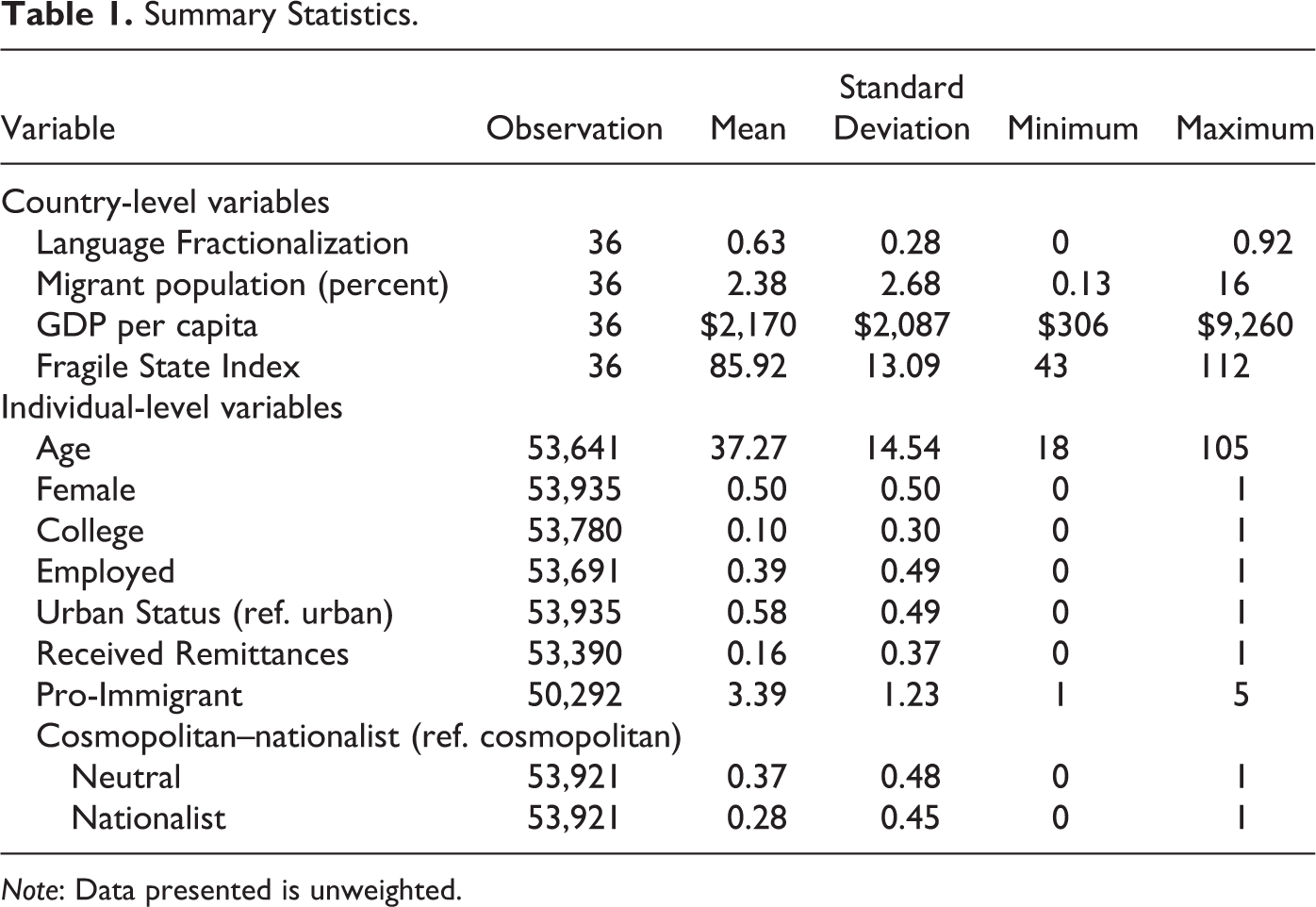
Note: Data presented is unweighted.
An ordinal categorical pro-immigrant variable was created from a measure of tolerance toward foreigners included in the Afrobarometer Survey. The item is part of a modified version of a World Values Survey measure of tolerance for outgroups with one of these groups being “immigrants or foreign workers.” 6 The questions employ a Likert scale ranging from 1 (“strongly dislike”) to 5 (“strongly like”). Results show that a minority (18.2 percent) in the selected countries said that they disliked living next to foreigners. Antipathy toward international migrants was greatest in Lesotho (42.4 percent) and Zambia (34.5 percent) and lowest in Cape Verde (5.5 percent) and Burkina Faso (6.1 percent). This question was included as a part of the Afrobarometer questionnaire in all but three (Algeria, Egypt, and Sudan) countries sampled.
To account for attitudes toward national identity along the cosmopolitan–sovereigntist cleavage outlined by Azmanova (2011), an item on international intervention was used. Afrobarometer respondents were asked to indicate which of the following statements was closest to their views:
Statement 1: The governments of each country in [your region] have a duty to try to guarantee free elections and prevent human rights abuses in other countries in the region, for example by using political pressure, economic sanctions or military force. Statement 2: Each country in this region should respect the independence of other countries and allow them to make their own decisions about how their country should be governed.
Macro-level Independent Variables
To test the macro-level hypotheses, country-level data from a number of different sources were imported into the Afrobarometer dataset. World Bank data were used to account for gross domestic product (GDP) per capita (in current US dollars). GDP per capita was normalized by taking its log. Data from the United Nations Population Division on international migrants as a percentage of the population were utilized. In addition, a metric of a nation’s political volatility that captured multiple types of state instability was needed. After reviewing available options, the Fragile States Index (FSI) was selected. Developed by the Fund for Peace (FfP), this index is designed to measure the fragility of a country’s socio-economic and political systems. 7 The FfP generates the FSI by a simple addition of 12 indicators, each measuring a different kind of fragility (i.e., cohesion, political, economic, and social). The full index ranges from 0 to 120 — the higher the FSI score, the more unstable the country.
Finally, data on cultural diversity were imported from Alesina et al. (2003), who constructed three fractionalization indices. These metrics measure the probability of two randomly selected individuals in a society belonging to different groups (ethnic, linguistic, or religious). These measures were used by Whitaker and Giersch (2015) in their analysis of anti-immigration attitudes in Africa. A review of Africa-centric studies of linguistic diversity suggest that this form of cultural fractionalization may play an integral role in the formation of African public opinion (de la Cuesta and Wantchekon 2016). For this analysis, therefore, the effect of linguistic fractionalization was investigated, and this effect’s robustness was checked by looking at the other two indexes.
Estimation Model
A multivariate regression analysis was used to test the validity of the various hypotheses put forward in this article. Given the dataset’s hierarchical nature, I employed a multilevel regression analysis where respondents (level 1) were nested in country (level 2). This kind of multi-level modeling allowed me to estimate the concurrent effect of individual- and country-level variables while taking into account unobserved group-level heterogeneity. The dependent variable is dichotomous; consequently, all models were estimated using logistic multilevel regressions and sampling weights. 8 The intra-class correlation estimations validated the decision to use a multilevel estimation. As an additional robustness check, a likelihood-ratio test was conducted, and the results justified a multilevel mixed-effects approach. Subsequent tests for multicollinearity revealed no violation of model assumptions. 9 After testing the micro-level independent variables in the multivariate base model, the macro-level variables were introduced. Because of the high number of macro-level variables relative to the number of cases, there was a concern about including all macro-level independents at once. To account for the limited number of countries in the dataset, the number of country-level variables included in any one multivariate model was minimized.
Empirical Results
Before the results of the multi-level modeling are presented, it may be instructive to consider the cross-national weighted mean scores for the dependent variable (Figure 1). Results here suggest that in terms of public opinion, Africa was starkly divided on the question of free movement. The data show that Burkina Faso (M = 0.81; SE = 0.39), Benin (M = 0.78; SE = 0.41), and Kenya (M = 0.75; SE = 0.43) had the highest mean scores while Namibia (M = 0.37; SE = 0.49), São Tomé and Príncipe (M = 0.37; SE = 0.48), and Egypt (M = 0.31; SE = 0.46) had the lowest. From a subregional perspective, support for free movement was strongest in Western Africa and weakest in Southern Africa. Now let us turn to the multivariate modeling; five models were produced for this analysis, and results are portrayed in Table 2.
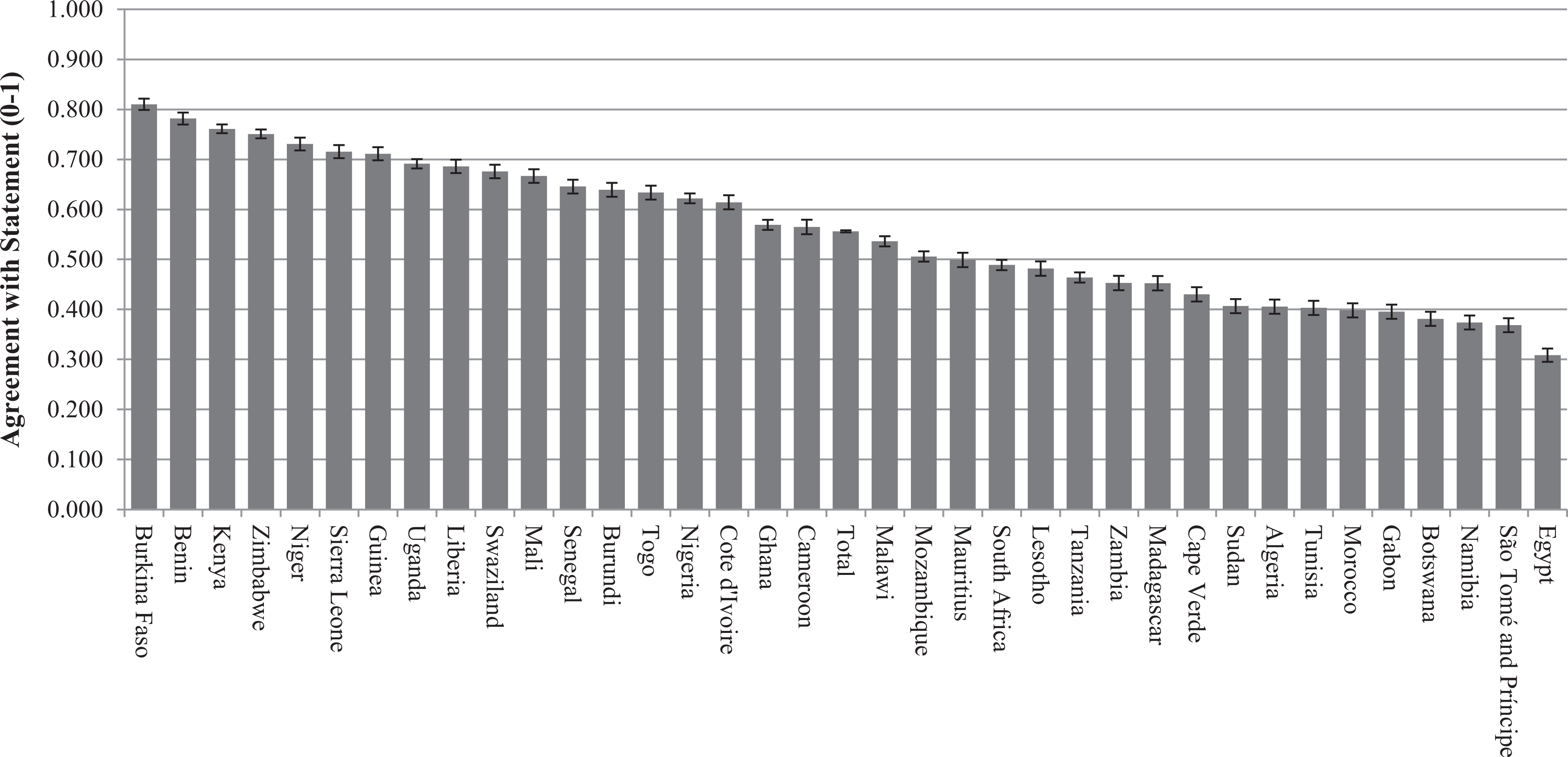
Mean agreement with the statement: “People living in [West/South/East/North/Central] Africa should be able to move freely across international borders in order to trade or work in other countries” (0–1), 2016.
Results Logistic Multilevel Regression Analysis of Public Support for Free Movement.

Note: Standard errors in parenthesis. The number of respondents in each model is 49,257.
Statistical significance denoted at *p < 0.050.
**p < 0.010.
***p < 0.001.
If we examine the effect of educational attainment on AU citizen attitudes toward mobility rights, the results are interesting. In the first model, college education was positively associated with the dependent variable but not at a statistically significant level (r = 0.085; SE = 0.058; p = 0.144). Educated citizens may be more likely to perceive free movement from an outward perspective if they are working. In other words, employment may affect the salience of formal education as a determinant of the dependent variable. To confirm this assumption, I tested whether the correlation was salient for only full-time employed individuals. If the model is adjusted to exclude those not in full-time employment, then the effect for college education (r = 0.151; SE = 0.073; p = 0.039) was a statistically significant determinant of the dependent variable. This outcome confirms the thesis that educational attainment was only a salient (and positive) determinant for those employed full-time in the labor market. 10
The relationship between educational attainment and attitudes toward free movement may be more nuanced than what is depicted in Model I. As a robustness check, this possibility was explored by adjusting the model to use a categorical measure of human capital. 11 This test showed that being at either the top or the bottom of the human capital distribution increased the log odds of supporting free movement. This outcome suggests a more non-linear human capital effect than the Heckscher-Ohlin Theorem would predict. It is possible that those at both the top and bottom of the education hierarchy benefit from greater regional integration and, therefore, are more likely to see visa liberalization as an opportunity. Regardless, the thesis that individuals with low levels of human capital are more likely to support intra-regional freedom of movement (H1a) cannot be validated by the research findings.
It could be argued that micro-level poverty (rather than human capital) drives attitudes toward free movement, as poverty may incentivize people to think of open borders in terms of emigration opportunities. To test this assertion, a version of the Afrobarometer Lived Poverty Index (i.e., a subjective indicator of scarcity) was selected to control for deprivation, 12 and Model I was modified to include this poverty index. The outcomes of this adjusted model show that poverty did not impact public support for free movement at a statistically significant level (r = 0.001; SE = 0.011; p = 0.935).
Let us now turn to the role played by international remittances. As can be observed in Model I, receiving cash remittances from abroad was not a statistically significant determinant. As a robustness check, the model was adjusted to account for the frequency of remittance reception. 13 The regularity by which remittances were received also did not have a statistically significant effect on the dependent variable. This outcome confirms this article’s initial findings and demonstrates that diaspora cash transfers did not motivate individuals to endorse open borders (H1b).
As expected, individual tolerance of foreigners was a statistically significant predictor in Model I. The greater the pro-immigrant sentiment held by an individual, the more favorable that person became toward visa liberalization (H1c). The effect’s size, however, was smaller than anticipated. A one-unit increase in the pro-immigrant variable only improved the log odds of supporting free movement by 0.087 (SE = 0.017; p = 0.000). Attitudes toward national sovereignty were robustly correlated with the dependent variable (H1d). Using “cosmopolitan” as the reference group, holding a “neutral” (r = −0.717; SE = 0.070; p = 0.000) or “nationalist” (r = −0.871; SE = 0.074; p = 0.000) position reduced the likelihood of backing free movement. In other words, adopting a cosmopolitan position increased support for open borders.
In the second model, a statistically significant relationship between the log of GDP per capita and attitudes toward free movement (r = −0.302; SE = 0.073; p = 0.000) was found, confirming the hypothesis that macro-economic development decreased preferences for open borders (H2a). Lower economic development should also reduce the salience of what Lutz (2021) calls “inward mobility.” Whether the (negative) views of immigrants translated into (lower) support for free movement should, therefore, depend on national wealth. To test this thesis, Model II was adjusted by interacting pro-immigrant attitudes and GDP per capita. Adjusted model outputs show a (albeit modest) positive moderation effect (r = 0.033; SE = 0.017; p = 0.048). The more economically developed a nation, the greater the effect of anti-immigrant prejudice on support for free movement. This contextual effect remained highly significant even if the model was modified to include the international migrant population’s size at the country level.
As a robustness check, I considered whether macro-economic development increased human capital’s salience as a predictor of attitudes toward free movement. The Factor Proportions model predicts a positive coefficient on this interaction term (O’Rourke and Sinnott 2006), which would suggest that as skill-scarce countries become more skill abundant (i.e., more affluent), better-educated workers will become more favorable toward open borders. A modified Model II was produced that interacted college education with GDP per capita to show the moderating effect of national wealth. The model was adjusted to exclude those outside full-time employment, and a new model was produced that included only full-time workers. In the modified model, it is possible to observe a robust and positive moderation effect (r = 0.190; SE = 0.066; p = 0.004). It would appear that the wealthier an AU nation, the greater the influence college education has on worker support for intra-regional mobility.
In the third model, no statistically significant correlation (r = −0.025; SE = 0.025; p = 0.341) between the proportion of international migrants in a given country and a preference for open borders was detected. In other words, the presence of a large foreign-born population in a hypothetical AU state did not prime individuals of that state to view open borders as a threat (H2b). In Model IV, state fragility had a statistically significant influence on attitudes toward cross-border mobility (H2c). A one-unit increase in the FSI strengthened the log odds that an individual would support free movement (r = 0.026; SE = 0.007; p = 0.000). The effect of FSI on free movement attitudes remained constant even when the model was modified to include the migration stock variable as a control. It would appear that the relationship between state fragility and the dependent variable was not due to the fact that macro-level stability attracted greater migrant inflows.
To explore which type of state fragility had the strongest effect on attitudes toward cross-border mobility, each of the 12 FSI sub-indicators was tested sequentially, computing 12 adjusted models. The results of these models are available in Online Appendix Table A-2. Reviewing the outcomes of these models shows that the political and social sub-indicators of fragility had stronger effects than did the economic sub-indicators. It was interesting to note that the Refugees and Internal Displaced Persons 14 sub-indicator had one of the most robust correlations (r = 0.198; SE = 0.034; p = 0.000) with the dependent variable. Even if the model was adjusted to control for GDP per capita or the international migrant stock in the country, the sub-indicator’s effect on the dependent remained salient. The Refugees and Internal Displaced Persons sub-indicator was, thus, not acting as a proxy for economic development or the presence of foreign nationals.
In the fifth model, the language fractionalization index was found to have a positive correlation (r = 0.672; SE = 0.240; p = 0.005) with attitudes toward free movement. In other words, the fourth macro-level hypothesis (H2d) could not be validated. As a robustness check, the other two fractionalization indexes were sequentially tested in two separate multivariate regression models. The results show that linguistic heterogeneity had a somewhat similar effect to ethnic heterogeneity (r = 0.705; SE = 0.322; p = 0.029) and a much greater effect than religious heterogeneity (r = 0.142; SE = 0.357; p = 0.691). It would seem that cultural (rather than religious) diversity in the AU increased support for expanding mobility rights. Perhaps cultural diversity in these African countries acts as a kind of proxy for economic underdevelopment. Adjusting Model V to include GDP per capita marginally reduced the predictive power of the language fractionalization index, but the effect was still statistically significant (r = 0.616; SE = 0.271; p = 0.023). This outcome suggests that macro-level cultural diversity affected free movement attitudes via a non-economic mechanism.
Discussion
This article examined the determinants of support for intra-regional freedom of movement among adult citizens of 36 AU countries. Drawing on the public-opinion scholarship on regional integration, eight hypotheses were tested using a logistic multilevel regression approach. Through its analysis, this article contributed to the existing literature on attitudes toward free movement in several ways. First, it showed that utilitarian factors were not strong predictors at the micro level. Identity-related variables (such as cosmopolitanism) had, by contrast, greater explanatory power at this level. Second, macro-economic development had a negative relationship with attitudes toward free movement, demonstrating the predictive power of the utilitarian model at the macro level. Third, the findings confirm the work of Lutz (2021), who argued that attitudes toward foreigners undermine support for free movement, shedding new light on the negative implications of anti-immigration attitudes in the AU. Fourth, the analysis identified key determinants of citizen opinion on free movement (e.g., state fragility and linguistic fractionalization) that were previously ignored by Eurocentric public-opinion scholarship on regional integration (e.g., Toshkov and Kortenska 2015; Ferrera and Pellegata 2018; Vasilopoulou and Talving 2019; Ivlevs and King 2020). This article’s results, and their implications for how scholars understand public attitudes toward visa liberalization, are discussed in more detail below.
Human capital did not appear to be a determinant of public support for intra-regional freedom of movement among AU citizens. However, if the model was adjusted to exclude those outside full-time employment, educational attainment was a salient determinant of attitudes toward free movement. Additional testing revealed that the influence of educational attainment on worker support for intra-regional mobility was moderated by macro-economic development. The positive relationship between worker support for open borders and human capital was found to be more robust in wealthier AU nations. This outcome was consistent with the work of Vasilopoulou and Talving (2019), who noted a similar moderating effect in their study of free movement in the EU. Further investigation, however, found a somewhat non-linear relationship between educational attainment and attitudes toward free movement. Being at the bottom or the top of the human capital pyramid in Africa increased the likelihood of workers supporting open borders. The relationship between human capital and attitudes toward regional intergration on the continent should be continuously monitored, as Hakhverdian et al. (2013) show that formal education’s importance as a determinant of regional intergration can change over time.
In their study of public attitudes toward intra-EU mobility, Ferrera and Pellegata (2018) found that visiting another EU country increased support for free movement. The authors concluded that individuals with cross-border experiences are more prone to express support for visa liberalization. This article attempted to take cross-border experiences into account by including reception of international remittances in its analysis. Receiving remittances, however, did not emerge as a robust predictor of support for intra-regional mobility. A more detailed set of variables is necessary, though, to make strong claims about how migration experiences shape attitudes toward free movement in Africa. Future researchers must, thus, look more closely at personal or familial migration experiences. Such experiences, as public-opinion research in the Balkans by Ivlevs and King (2020) has shown, can have a robust effect on whether an individual supports regional integration.
This article did not investigate how migration desires may have influenced attitudes toward free movement in the AU. But recent research on migration desire in 36 African countries by Sadiddin et al. (2019) found that more than a quarter of the sample said that they would move to another country if they had the opportunity. Utilitarian concerns were an important determinant of both the desire and decision to migrate in the study by Sadiddin and his colleagues. In the African case, we can imagine that a desire to migrate would increase support for free movement, which would make it easier to move between countries. Migration desire has been shown to correlate with public support for regional integration in Europe (Ivlevs and King 2020). It may, thus, be possible for future research to better understand how material self-interest considerations affect support for free movement by investigating the role of migration desire.
Pro-immigrant sentiment had a positive impact on support for free movement, suggesting that AU citizens were in favor of expanded mobility rights if they did not perceive an outgroup threat attached to that expansion. This finding provides further evidence of anti-immigrant sentiment’s power to mobilize public opposition against regional integration. The observed relationship in this article, however, was much weaker than expected. Further analysis showed that macro-economic development moderated the association between immigration sentiments and free movement attitudes. This finding is consistent with the work of Lutz (2021), who argued that examining country context determines whether an inward or outward perspective will be salient when people are asked to think about visa liberalization. When compared to their poorer counterparts, pro-immigrant attitudes had a (somewhat) weaker influence on support for open borders in wealthy AU nations. This finding may be due to the desire of those individuals with anti-immigrant views to protect the “rewards” of economic prosperity for native-born residents.
The results presented here show that cosmopolitanism was linked to AU citizen approval of free movement and that backing a nationalistic perspective on humanitarian interventions decreased individual endorsement of open borders. Here, attitudes toward humanitarian interventions may act as a proxy for an exclusive chauvinistic national identity. This interpretation is consistent with research by Vasilopoulou and Talving (2019), who examined how exclusive national identity influenced attitudes toward intra-regional mobility in the EU (see also Hobolt and de Vries 2016). In public-opinion studies of immigration, scholars often identify national identities as powerful determinants of attitudes toward immigration (Hainmueller and Hopkins 2014). However, researchers frequently find it necessary to distinguish between different dimensions (such as civic versus ethnic) of national identification. For this article, data on the different dimensions of nationalism were not available. Thus, future research should explore whether different types of national identity are related to attitudes toward free movement.
Political and economic instability were linked with attitudes toward visa liberalization, making citizens in the 36 countries surveyed more willing to support greater intra-regional mobility. This finding held even if the model was adjusted to account for international migrant stock. 15 Additional testing showed that political and social sub-indicators of state fragility had a stronger influence on attitudes than did economic sub-indicators. This outcome is consistent with research by Naudé (2010) and Lucas (2015), who found that political factors are central drivers of migration in Africa. Of the different fragility sub-indicators under discussion, one of the most robust predictors of attitudes toward free movement were indicators on refugees and internal displacement. One possible interpretation of this outcome is that the pressure placed on societies by the displacement of large communities can prime citizens to see intra-regional mobility in more compassionate and empathetic terms. To understand how macro-level experiences of mass human displacement shape immigration attitudes in Africa, future research must further explore this thought-provoking finding.
One of the most interesting findings to emerge from this analysis concerns macro-level ethno-linguistic diversity — namely, that the more diverse a nation, the more supportive its citizens tended to be of free movement. Of the three diversity variables tested, language fractionalization was the most robust correlate, consistent with the expectations of de la Cuesta and Wantchekon (2016). Further robustness checking confirmed that this finding cannot be entirely explained by the relationship between heterogeneity and economic development. Diversity pessimists often focus on the lack of social cohesion and trust emanating from diverse preferences and coordination failure (Dinesen, Schaeffer, and Oslashnderskov 2020). If diversity produces such social frictions, this friction may prompt people to see free movement from an outward perspective (i.e., as representing an opportunity to escape a fractious environment). Further work is required to understand how ethno-linguistic fractionalization shapes attitudes here, however. A significant role may be played, for example, by whether an individual is part of an excluded ethnic group, as Wimmer (2017) shows that ethnic exclusion can have a significant effect (via the exchange-theoretic perspective) on attitude formation.
Conclusion
This article’s results have important implications for how scholars understand public-opinion on free movement in the AU. It demonstrated that utilitarian-related considerations influence public preferences for free movement in Africa. As outlined in the previous section, however, material self-interest was less important at the individual level than at the national level. These findings add credence to those scholars (e.g., Carey 2002; Schlipphak 2015; Norris and Inglehart 2019) who challenge the use of the RCT to understand public preferences for regional integration. The findings that material self-interest was less salient at the micro level is also consistent with past public-opinion studies on immigration (Hainmueller and Hopkins 2014). Although more testing is required, the article found some evidence to support the claim by Lutz (2021) that attitudes toward visa liberalization are shaped by the relative salience of two mobility perspectives: (i) outward and (ii) inward. It also identified new avenues of research, showcasing where and how future research can improve on the analysis presented.
Beyond this article’s academic importance, its findings have broader implications for regional integration policy in Africa. It found marked disparities in support for free movement both between and within AU nations. This article showed that a significant share of the AU public holds anti-integration attitudes and that the potential for a backlash against the Free Movement Protocol (and its accompanying Draft Implementation Roadmap) is real. The long-term success of the MPFA (and Agenda 2063 as a whole) may be undermined if such popular opinion is ignored, as the anti-integration reaction in many parts of the EU demonstrates. To help avoid a backlash to the Free Movement Protocol, policy-makers must draw lessons from this article and be proactive in building support for open borders on the continent.
Four key recommendations for policy-makers can be derived from this article’s findings. First, since opposition to an integrated visa-free zone is not derived from hosting a population of international migrants. Restricting foreign-born settlement will, therefore, not improve attitudes toward free movement in the AU. Second, opposition to intra-regional mobility is more likely to come from the middle working strata of any African country than from the poorest or most affluent in society. Addressing the concerns of this middling group will be key to avoiding backlash. Third, combatting anti-immigrant prejudice will increase public backing for visa liberalization, particularly in more affluent AU countries, where the relationship between pro-immigrant sentiments and free movement attitudes appears to be stronger. Fourth and finally, there is a need to promote cosmopolitan identities in the AU, as exclusive nationalism can undermine public attitudes toward regional integration in Africa. Such a campaign should be part of a larger effort to get ordinary people to identify more strongly with the AU as a supranational organization.
Supplemental Material
Supplemental Material, sj-docx-1-mrx-10.1177_01979183211026243 - Mass Preferences for the Free Movement of People in Africa: A Public Opinion Analysis of 36 Countries
Supplemental Material, sj-docx-1-mrx-10.1177_01979183211026243 for Mass Preferences for the Free Movement of People in Africa: A Public Opinion Analysis of 36 Countries by Steven Gordon in International Migration Review
Footnotes
Declaration of Conflicting Interests
The author(s) declared no potential conflicts of interest with respect to the research, authorship, and/or publication of this article.
Funding
The author(s) disclosed receipt of the following financial support for the research, authorship, and/or publication of this article: This study was supported by Department of Science and Innovation (DSI) - National Research Foundation (NRF) Centre of Excellence in Human Development, University of Witwatersrand, Johannesburg (P2018003).

Supplemental Material
Supplemental material for this article is available online.
Notes
References
Supplementary Material
Please find the following supplemental material available below.
For Open Access articles published under a Creative Commons License, all supplemental material carries the same license as the article it is associated with.
For non-Open Access articles published, all supplemental material carries a non-exclusive license, and permission requests for re-use of supplemental material or any part of supplemental material shall be sent directly to the copyright owner as specified in the copyright notice associated with the article.
