




Abstract
This article investigates the intersection of care and migration regimes by comparing four carefully matched familialist countries—Italy, Japan, South Korea, and Spain. These four countries, while sharing a similar familialist culture and welfare regime, responded to the problem of eldercare deficits differently in the 1990s and the 2000s. Italy and Spain developed a ‘migrant-in-the-family model,’ relying heavily on informal eldercare provided by migrant workers whom Italians colloquially call badante. Korea and Japan, by contrast, relied more on marriage migrants, with Korea developing its own variant of the migrant-in-the-family model where the migrant is typically the daughter-in-law. In Japan, some marriage migrants became care workers in the formal eldercare sector. By tracing the historical trajectories of female migration to these four countries, the article identifies a recursive relationship between migration regimes and care regimes. Initial differences in migration regimes shaped the female migratory pathways in specific ways, which, in turn, affected the development of distinctive eldercare regimes. Once these new care regimes emerged, however, they influenced the migration regime in the next cycle. The article contributes to the literatures on the intersection of care and migration regimes by untangling the reciprocal feedback processes between these two systems.
Keywords
Introduction
Demographic aging, coupled with increases in female labor-force participation, has given rise to care deficits in many advanced industrial societies (Hochschild and Ehrenreich 2004; Bettio, Simonazzi and Villa 2006; ILO 2016). The number of women from the Global South who worked as nannies or domestic and eldercare workers in the Global North increased in the 1990s, giving rise to what Hochschild (2000) has called the global care chain. Concern about the commodification of care marks the first wave of studies on care and migration (Hochschild and Ehrenreich 2004; Parreñas-Salazar 2001; Piper and Roces 2003). During the past two decades, research by ethnographers, economic sociologists, and social policy and migration scholars, particularly in political science and sociology, has woven a rich tapestry of literature on the intersection of gender, migration, and care (Amelina and Lutz 2018; Anderson and Shutes 2014; Bettio, Simonazzi and Villa 2006; Constable 1997; Hondagneu-Sotelo 2007; Kofman 2012; Lan 2008; Lutz 2008; Michel and Peng 2012; Michel and Peng 2017; Oishi 2005; Van Hooren 2012; Williams 2012). While many feminist scholars have been interested in this intersection, relatively little attention has been paid to the role of migration regimes in shaping patterns of female migration. As Kofman (2004, 2012) points out, the literature on European care regimes has paid insufficient attention to the specific migration pathways used by migrant care workers, who come to a host country as variously workers, au pairs, wives, or family members. Feminist scholars of Asia, however, have long been aware that female migrants blur the boundary between marriage migration and labor migration countries (Palriwala and Uberoni 2005; Piper and Roces 2003; Constable 2005; Lan 2008; Asako 2016; Liaw, Ochiai and Ishikawa 2010; Ogawa 2014).
Despite Fiona Williams' call to pay closer attention to migration regimes in research on the intersection of gender, care, and migration (Williams 2012), studies that examine how specific migration policies affect care regimes have been few and far between (Boyd 2017; Brennan et al. 2017). This article contributes to the literature on these themes by investigating the recursive relationship between migration regimes and care regimes in three specific historical sequences. First, it looks at the migration regimes that existed prior to the development of new eldercare systems. Here, we focus on the ways in which migration regimes shaped patterns of female migration in four familialist welfare states—Italy, Japan, South Korea (hereafter Korea), and Spain—in the 1980s and 1990s. Second, the article looks at what happened after the labor market compositions changed in the four countries. As the analysis shows, an increase in the supply of low-skill female migrants in Italy and Spain, in contrast to trends in Japan and Korea, facilitated the development of paid informal eldercare in the late 1990s and 2000s. Third, this article looks at the period after the four countries developed their own specific eldercare systems, demonstrating how, once new eldercare regimes were established, demands for specific types of care workers began to influence migration policies, giving rise to a recursive relationship between the care and migration regimes.
The choice of the four countries analyzed here is part of the research design. We adopt a “most similar cases” design popular in the field of Comparative Politics to identify the effect of migration regimes on female migration patterns and, consequently, care regimes (see Nielsen 2016). The four countries under study in this article constitute the most similar cases in that they possessed the three key factors held to explain the development of specific eldercare regimes—rapid demographic aging, familialist cultural traditions, and familialist welfare states (Estévez-Abe and Naldini 2016; Ferrera 2016; Ogawa 2014; Saraceno 2016). Notwithstanding their overall similarities, the four countries began to diverge in their migration regimes, beginning in the late 1980s. We attribute this divergence to the development of eldercare regimes based on informal care by migrants in Italy and Spain. This “most similar cases” design permits us to examine the relationship between our key independent variable of interest (migration regimes) and the dependent variable (the development of care regimes dependent on informal care by migrants), while controlling for the other variables (such as culture). We use historical process tracing to demonstrate that the divergence in migration regimes played a key role in affecting the relative abundance of female migrants willing to work as care workers in each country and, consequently, in shaping their distinctive care regimes.
To develop these ideas, the article proceeds in six sections. Section 2 identifies different patterns of female migration in our four countries. Section 3 defines the concept of migration regimes and presents our argument about the role that migration regimes play in facilitating or constraining the development of informal eldercare by migrants. Sections 4 describes how the Italian and Spanish migration regimes became markedly different from the Japanese and Korean ones during the 1980s, prior to the rise in demands for eldercare. Section 5 demonstrates how the divergent migration regimes that emerged in the 1980s affected the relative supply of cheap migrant labor, which, in turn, shaped the menu of eldercare options available to families and governments in each country in the 1990s and 2000s. Section 6 highlights the recursive process involving migration regimes. Section 7 briefly concludes.
Badante or Bride? Female Migration in Italy, Japan, South Korea, and Spain
Since the 1980s, large numbers of female migrants from less-affluent countries have entered Italy and Spain, either as wives or daughters of male migrant workers or as workers in their own right (Gonzalez-Ferrer 2011; Colombo and Sciortino 2004; van Hooren 2012). Many of these female migrants have worked as domestic and care workers (Ibid.). Bettio and her collaborators call the new type of informal eldercare that emerged in Italy in the mid-1990s a “migrant-in-the-family” model in which families directly hire live-in or live-out foreign women to look after their aging parents (Bettio et al. 2006). Italians colloquially call these foreign care and domestic workers “badante.” Table 1 compares the numbers of documented foreign domestic and care workers (badante) and the numbers of foreign brides from less-affluent countries (operationalized as countries that are not OECD members) in our four countries during the period, 2001−2016. Except for Japan, care workers included in Table 1 are those who worked as live-in or live-out caregivers in the informal sector, which requires no training and certification. At their peak, the numbers of registered female foreign care and domestic workers (excluding undocumented workers) reached 645,921 in Italy in 2012 and 224,747 in Spain in 2005. Note that in Spain, large numbers of migrants from Central and South America naturalized in the late 2000s and early 2010s, reducing the number of ‘foreign’ domestic and care workers (Finotelli and La Barbera 2017). The numbers of foreign domestic and care workers in Japan and Korea were minuscule: 3,665 in Japan in 2016 and between 40,000 and 70,000 in Korea from 2010 to 2012. 1 The Japanese statistics on foreign domestic and care workers do not include those marriage migrants, especially Filipina wives, who worked in the formal eldercare sector (Michel and Peng 2012; Ide and Takabayashi 2014), whose number Hayashi (2019) estimates at 11,584 in 2015.
The Number of Domestic and Care Workers and the Number of Foreign Brides from Less Affluent Countries ( = non-OECD Countries).
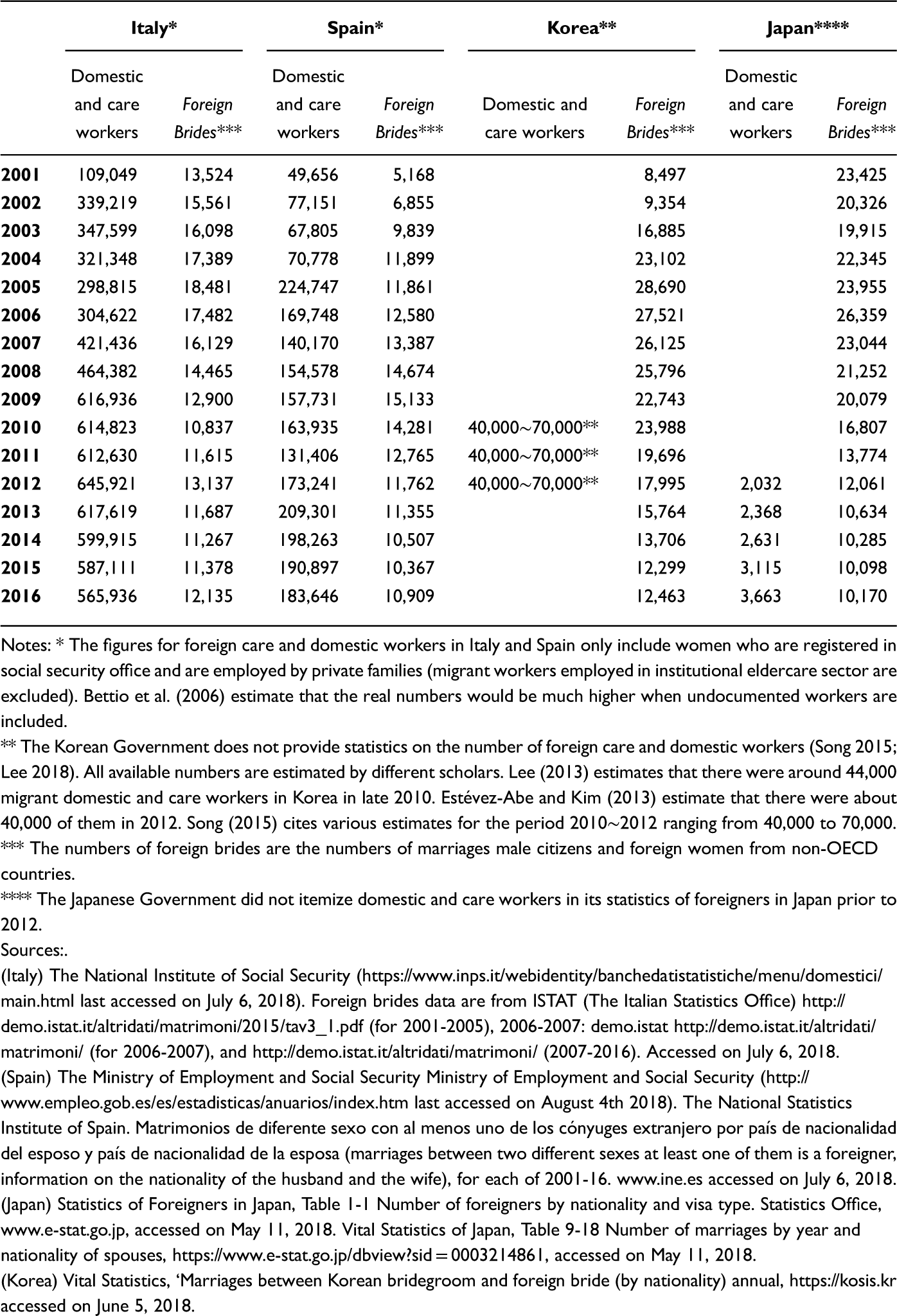
Notes: * The figures for foreign care and domestic workers in Italy and Spain only include women who are registered in social security office and are employed by private families (migrant workers employed in institutional eldercare sector are excluded). Bettio et al. (2006) estimate that the real numbers would be much higher when undocumented workers are included.
** The Korean Government does not provide statistics on the number of foreign care and domestic workers (Song 2015; Lee 2018). All available numbers are estimated by different scholars. Lee (2013) estimates that there were around 44,000 migrant domestic and care workers in Korea in late 2010. Estévez-Abe and Kim (2013) estimate that there were about 40,000 of them in 2012. Song (2015) cites various estimates for the period 2010∼2012 ranging from 40,000 to 70,000.
*** The numbers of foreign brides are the numbers of marriages male citizens and foreign women from non-OECD countries.
**** The Japanese Government did not itemize domestic and care workers in its statistics of foreigners in Japan prior to 2012.
Sources:.
(Italy) The National Institute of Social Security (https://www.inps.it/webidentity/banchedatistatistiche/menu/domestici/main.html last accessed on July 6, 2018). Foreign brides data are from ISTAT (The Italian Statistics Office) http://demo.istat.it/altridati/matrimoni/2015/tav3_1.pdf (for 2001-2005), 2006-2007: demo.istat http://demo.istat.it/altridati/matrimoni/ (for 2006-2007), and http://demo.istat.it/altridati/matrimoni/ (2007-2016). Accessed on July 6, 2018.
(Spain) The Ministry of Employment and Social Security Ministry of Employment and Social Security (http://www.empleo.gob.es/es/estadisticas/anuarios/index.htm last accessed on August 4th 2018). The National Statistics Institute of Spain. Matrimonios de diferente sexo con al menos uno de los cónyuges extranjero por país de nacionalidad del esposo y país de nacionalidad de la esposa (marriages between two different sexes at least one of them is a foreigner, information on the nationality of the husband and the wife), for each of 2001-16. www.ine.es accessed on July 6, 2018.
(Japan) Statistics of Foreigners in Japan, Table 1-1 Number of foreigners by nationality and visa type. Statistics Office, www.e-stat.go.jp, accessed on May 11, 2018. Vital Statistics of Japan, Table 9-18 Number of marriages by year and nationality of spouses, https://www.e-stat.go.jp/dbview?sid = 0003214861, accessed on May 11, 2018.
(Korea) Vital Statistics, ‘Marriages between Korean bridegroom and foreign bride (by nationality) annual, https://kosis.kr accessed on June 5, 2018.
A different picture emerges, however, when we look at the number of foreign brides from less-affluent countries—what scholars call “global hypergamy” (Asako 2016; Constable 2005; Kofman 2012; Lan 2008). Such marriages peaked in 2006 in Italy (17,482), in 2009 in Spain (15,133), in 2005 in Korea (28,690), and in 2006 in Japan (26,359). As Table 1 shows, there have been more global hypergamy marriages in Korea and Japan and, relative to the small numbers of foreign domestic and care workers in both countries, these numbers stand out. Even allowing for a margin of error, Table 1 indicates that women from less-affluent countries attained legal residence via different migratory pathways in the four countries. During the period covered in Table 1, marriage with a native man was the primary legal female migration pathway into Korea and Japan, but the same was not true in Italy and Spain. 2 In all four countries, the nationalities of brides from less-affluent global regions matched the domestic and care workers’ sending countries (i.e., Romanians and Ukrainians in Italy; Ecuadoreans in Spain; and Chinese, Filipinas, and Vietnamese in Japan and Korea).
What explains these differences in female migratory pathways? The literature on care regimes provides a mix of cultural and institutional explanations. We start with cultural explanations. Scholars of European social policy have attributed the emergence of the “migrant-in-the-family” model (i.e., the large numbers of female care workers) to ‘familialist’ cultural norms and welfare states in Italy and Spain (Bettio et al. 2006; Van Hooren 2012). ‘Familialist’ here refers to such norms as multi-generation cohabitation and eldercare and childcare by family members. Scholars often attribute familialist norms to the under-development of formal care services, whether government or market based (Esping-Andersen 1999). Japan and Korea, however, have very similar familialist cultural norms but much smaller numbers of female migrant care and domestic workers (Asako 2016; Estévez-Abe and Naldini 2016; Ogawa 2014). For this reason, scholars of East Asian social policy look beyond familialism to explain the relative absence of foreign domestic and care workers and point, instead, to other cultural factors, such as attitudes to foreigners, aversion to domestic helpers, and conceptions of citizenship and nationhood (Michel and Peng 2012; Song 2016; Oishi 2005; Peng 2017). Oishi (2005) and Peng (2017) attribute the relatively small numbers of native and foreign domestic workers in Korea and Japan to a cultural aversion to having strangers working in the home. Michel and Peng (2012), in turn, explain that Koreans and Japanese are less willing to rely on foreign care workers because of their ethnically homogeneous sense of nationhood. Michel and Peng (2012) also consider care by foreign brides to be more compatible with the Korean and Japanese sense of nationhood.
The existing cultural explanations fail to account for the variations in the pattern of female migration and eldercare systems in the four countries under study. First, we find no evidence of cultural aversion to domestic workers in Japan or Korea. Well into the 1970s, it was very common for urban middle-class Korean and Japanese families to have young rural women as live-in domestic help (Lee 2012, 2018; Nozawa 2010). In Korea, 4.6 percent of the female workforce was engaged in domestic work in 1965 – a share that declined to 0.9 percent in 1995 and to 0.7 percent in 2005 (Lee 2012, 2018). In Japan, where industrialization took place earlier than Korea, 4.6 percent of the non-agricultural female workforce in 1955 worked as (mostly live-in) domestic workers, but this share dropped to 0.5 percent in 1975. 3 The rapid disappearance of live-in domestic workers in Japan and Korea reflected a rapid rise in the educational attainment of young rural women and the growing supply of better jobs. 4 According to Nozawa (2010), Japanese families also used to hire informal help to look after their sick family members both at home and in hospitals due to the nurse shortage. More than 140,000 women, many of them divorced and widowed, worked as informal care givers in the early 1990s, but their numbers dramatically shrank to less than one third by 1999 (Nozawa 2010). In short, historical evidence suggests that the relative absence of domestic and informal care workers in Korea and Japan observed in Table 1 is because of labor supply problems, not cultural reasons.
Second, ethnically based nationhood per se does not explain why there are more foreign wives than migrant care workers in Japan and Korea relative to Italy and Spain nor why there are more migrant care workers in Korea than in Japan (see Table 1). Given that the two countries have expansive co-ethnic diaspora in less-affluent global regions (Lee and Chien 2017; Kamibayashi 2018), they could have easily recruited foreign workers in ways that were compatible with their idea of nationhood. In fact, Japan and Korea offer favorable entry visas to co-ethnic foreigners (Ibid.). As we discuss in greater detail in our analysis of the historical sequences, Korea has chosen to let co-ethnic foreigners work as domestic and care workers in a limited way since 2002 (and more broadly since 2007), but Japan has not. Ethnically based nationhood cannot explain this difference.
Third, while Korea and Japan differ from immigration-based civic nations such as Canada and the United States, they do not differ so greatly from Italy and Spain. Our quartet share a common history of large-scale emigration to the Americas. Second, like Korea and Japan, Italy and Spain give preferential treatment to co-ethnics (Seol and Skrentny 2009; Zincone 2012). When it comes to citizenship, Italy and Spain are stricter than immigration-based countries like Canada and the United States (Zincone 2012; Marín 2012). 5 Until immigration increased in the 1980s in Italy and the 1990s in Spain, both countries’ resident populations consisted of relatively homogenous native-born citizens, despite extensive internal migration (Einaudi 2007; Valero-Matas et al. 2010). Italy provides a special visa quota for descendants of past emigrants to Latin America (Art. 17, Law n. 189/2002, c. 1, par. b). Italy also grants fast-track naturalization to foreigners who can provide evidence of their Italian ancestry (Art. 4, Law n. 91/1992, c. 1, par. a) after only three years of legal residence in Italy, instead of the ten required for non-EU citizens (Zincone 2012). As for Spain, immigrants from former Spanish colonies and from countries linked to Spain through historical connections and identified as belonging to an Ibero-American culture have access to citizenship after two years, instead of ten (Marín 2012).
While scholars interested in explaining the relative absence of migrant care and domestic workers in Korea and Japan attribute it to the specific conceptions of nationhood and cultural aversions to domestic help in the two countries, scholars interested in explaining the cross-national variations in the size of migrant care workforce within Europe generally turn to specific features of welfare states. Bettio et al. (2006), Van Hooren (2012), and Williams (2012) point to the absence of public care services, the state's unwillingness to regulate care services, and the presence of cash allowances in explaining why Southern European countries came to depend heavily on informal live-in or live-out migrant care workers (i.e., the migrant-in-the family model). Furthermore, some scholars note the importance of a pre-existing cash benefit called ‘carers’ allowance’ (indennità d’accompagnamento) in Italy—a non-means-tested flat-rate cash benefit with no strings attached (Bettio et al. 2006; Van Hooren 2012) - in giving rise to a migrant-in-the-family model. 6 In a mirror image, Peng (2017) and Song (2015) apply the insights from this European literature and attribute the small numbers of migrant care workers in Japan and Korea to their governments’ willingness to provide and regulate care services (i.e., the creation of the Long-Term Care insurance and the national skill certification system for care workers).
These institutional explanations, however, do not fully account for the development of specific eldercare regimes in the four countries under study here, and we highlight three questions that remain unanswered. First, the existing institutional accounts do not explain why there are more informal migrant care workers in Korea than in Japan. Second, such accounts fail to explain why Spain, which the existing literature considers to be a similar case to Italy, legislated the Dependency Law (la Ley de Dependencia) in 2006 to create a formal long-term care system while Italy did not (Rodríguez Cabrero and Marbán Gallego 2013). Third question, if Japan had a similar cash benefit, would the Japanese have also opted for cheaper informal care services? There is, of course, no definitive way to answer this hypothetical question, but process tracing in a most similar cases design allows us to contemplate a counterfactual (Nielsen 2016). What happened in Japan in the 1990s is instructive. In this period, Japanese families faced a care deficit, particularly in eldercare (Campbell et al. 2009; Estévez-Abe 2003). Municipal governments tried to increase the supply of eldercare services but had difficulty recruiting care workers (Estévez-Abe 2003). Officials in urban municipalities had to persuade middle-aged housewives (all citizens) to help out as “paid volunteers” (Ibid.). In an economy with a limited supply of unskilled workers, Italian-style cash benefits for carers would simply have been claimed by middle-aged ‘native’ housewives, who were already looking after their parents and in-laws, thus making eldercare by migrants irrelevant. 7
Our Argument: The Importance of Migration Regimes
The previous section has demonstrated that existing cultural and institutional explanations of care regimes do not fully account for the variations in patterns of female migration in our four countries. We argue that to understand such patterns, it is necessary to pay more attention to the role of migration regimes. First, let us clarify what we mean by a migration regime and which aspects of it affect female migration. Despite its frequent use (for a review, see Horvath, Amelina and Peters 2017), the concept of a migration regime is far from being analytically clear. Most scholars (Demeny and McNicoll 2003) use the term loosely to refer to groups of countries that share similarities in terms of migration's timing and magnitude, migrants’ demographic characteristics, patterns of migrant settlement and incorporation in the labor market, the evolution of immigration policies, and sometimes the outcomes of integration processes. Political scientists working on migration use the term more restrictively to refer to the laws and policies that regulate migration in a specific country (Boucher and Gest 2015). However, even in this more restricted use, the concept remains problematic in many respects. Whereas some scholars consider only entry and admission policies (e.g., Williams 2012), others like Ruhs and Martin (2008) emphasize the importance of taking into account migrant workers’ rights (see also Ruhs 2013). Most recently, scholars have begun to emphasize the need to include policies enacted by sending countries to protect migrants abroad (e.g., Lafleur and Vintila 2020), which can influence the terms of their citizens’ settlement in receiving countries.
In this article, we follow Ruhs and Martin (2008) and define a migration regime as a host country's set of core rules establishing the conditions for the entry and admittance of foreigners, together with the rights accorded to migrants, including settlement (i.e., family reunion, access to permanent residency, and naturalization) and mobility rights. Although Ruhs and Martin limit the application of ‘migration regime’ to the rules regarding the entry and rights of migrants for work reasons, we take a more extended approach and consider the different categories of migrants specified by national laws, including migrants arriving for marriage and family reasons. Rules regulating family migration particularly affect the migration of women, many of whom may not have initially migrated as workers even if they have consequently become gainfully employed in host countries (Gonzalez-Ferrer 2011; Kofman 2004; Palriwala and Uberoi 2005).
We posit that migration regimes, as defined by host-country rules on entry and access to rights, shape the initial migration and settlement pathways of women from less-affluent countries in wealthier countries. Such women have had access to residence, work, and long-term settlement in Italy and Spain since the 1980s. In Korea and Japan, for most low-skilled migrants from less-affluent countries, the primary legal pathway to freedom to work and long-term settlement is by means of marriage with a citizen (Chung and Kim 2012; Piper and Roces 2003; Seol and Skrentny 2009). This cross-regional difference in migration regimes, we argue, has created very different migratory paths for women from developing countries who were seeking economic opportunities and better lives for themselves and their families in the four countries.
As explained in the introduction, we adopt a ‘most similar cases’ design to examine the effect of migration regimes on female migratory pathways. Our four countries shared similar initial conditions: fast pace of demographic aging, shared histories as emigration countries, similar migration regimes, highly gendered norms of family care, and underdeveloped government-provided and market-based care services. In spite of these initial similarities, by 1990, the migration regimes in Italy and Spain had become significantly more accommodating to low-skilled migrants and their families, while Korea and Japan continued to restrict low-skilled migrants’ entry. 8 This difference in their migration regimes, we argue, shaped the trajectories of female migration, which subsequently shaped the care regimes in these four countries.
The main part of the analysis compares and contrasts the impact of migration regimes on the care options available to families and governments in our four countries. We choose the 1970s and 1980s as the starting point of our analysis because key differences in the migration regimes in our four countries emerged in this period. To make it easier to compare and contrast historical sequences across the four countries, we present our case studies in three historical stages. The first is when migration regimes in each country came to diverge on two key dimensions: rules of entry and rights of low-skilled migrants. During the 1980s, Italy and Spain began granting work permits (sometimes through ex-post amnesties) to low-skilled migrants, while Korea and Japan continued to restrict the entry of such migrants. Most crucially, the divergence of migration regimes preceded the development of distinctive care regimes.
The second stage concerns the emergence of distinctive care arrangements adopted by families and governments in the four countries. When care deficits became a pressing problem in the 1990s, the composition of the labor force looked very different in each country because of their divergent migration regimes. Italy and Spain had an abundance of female migrant workers willing to provide cheap informal eldercare, while Korea and Japan did not. Because care is highly gendered, the scarcity of outsourcing options for eldercare led to higher care burdens on Korean and Japanese women. Marriage in this context meant an increase in care responsibilities for the wife, who would be expected to look after both her parents and her in-laws. Low-income men in Korea and Japan who were disadvantaged in local marriage markets began to seek brides from poorer countries (Asako 2016; Constable 2005; Lan 2008; Wang 2007).
The third stage concerns the reciprocal feedback between migration and care regimes. As we show, once distinctive care arrangements emerged, they, in turn, affected migration policies. At times, economic and political concerns that were totally unrelated to care issues, such as decisions by the European Union (EU) and political pressures from the US Department of State regarding human-trafficking issues, also reshaped migration regimes in the four countries. As we show, regardless of the specific reasons behind legal changes, once migration rules changed, they reshaped female migration pathways and, by extension, also affected care regimes.
The Divergence of Migration Regimes Prior to the Problem of
Care Deficits
This section demonstrates that by the end of the 1980s, Italy and Spain had come to accept the entry of low-skilled migrant workers from less-affluent countries, albeit with some restrictions, while Korea and Japan did not. In Korea and Japan, for unskilled foreign women from less-affluent countries, marriage to a citizen has been the primary pathway to long-term legal residence until very recently (Lee 2008; Piper 2003; Chung 2020).
Italy and Spain were countries of emigration rather than countries of immigration, but this pattern changed when the first wave of migrants started to arrive in the 1970s and 1980s (for Italy, see Einaudi 2007; for Spain, see Finotelli 2012). This migration was initially prompted by the tightening of immigration policies in Central and Northern European countries after the 1973 oil crisis (Zincone 2012). Later, however, migration to both countries occurred as a response to the high demand for low-skilled workers in the manufacturing, construction, and agricultural sectors (Einaudi 2007; Finotelli 2012). The initial wave of migration occurred in the absence of entry regulations and was met with a random and discretionary response (for Italy, see Zincone 2012; for Spain, Bruquetas-Callejo et al. 2012). In 1985, Spain introduced a new immigration law concerning low-skilled migrants, only to reform it in 1993 (Bruquetas-Callejo et al. 2012). Italy introduced its law in 1986 and reformed it in 1990 (Zincone 2012). Although these laws introduced formal restrictions on new entries to comply with requests from the European Community (Pastore and Sciortino 2004), both countries in this period tolerated the presence of undocumented migrants (Einaudi 2007; Finotelli 2012).
Italy and Spain also introduced annual quotas for migrant workers, so-called contingente in Spain and numero programmato in Italy, and applications for entry were subjected to extremely lengthy bureaucratic procedures (Zincone 2012; Bruquetas-Callejo et al. 2012). Although only employers were eligible to submit applications for entry, legal migrant workers were free to change employment (Ibid.). In addition to the freedom to change jobs, Italy and Spain also granted legal migrants the right of family reunification (Seol and Skrentny 2009). The first immigration law approved in Italy allowed for family reunification of legal resident migrants, while requiring one year of legal residence before migrants’ spouses could work (Zincone 2012). In Spain, the 1985 law did not contain any provisions on family reunification, but a 1986 decree did provide for a family-reunification visa (Seol and Skrentny 2009). In other words, there was a high degree of freedom once a migrant worker attained legal residence through an initial employment contract. In reality, however, the vast majority of migrant workers and their families arrived in Italy and Spain with a tourist visa, which they overstayed (Colombo and Sciortino 2004; Finotelli 2012). Even though the laws mentioned above aimed to prevent undocumented migration, several amnesties in the form of mass regularizations were introduced in both countries, beginning in the mid-1980s and continuing into the 1990s (in 1986, 1990, 1996, and 1998 in Italy and in 1985, 1991, and 1996 in Spain) (see Colombo and Sciortino 2004; Finotelli 2012). Note that the first wave of these regularizations preceded the emergence of the migrant-in-the family model of eldercare in the mid-1990s (Bettio et al. 2006).
In contrast to the pattern seen in Italy and Spain, in Japan and Korea, a strong emphasis on controlling flows has been a key feature of migrant employment policies (Chung 2004; Seol and Skrentny 2009). Just like Italy and Spain, Japan and Korea began to attract growing numbers of undocumented migrant workers from less-developed global regions in the 1980s and 1990s, when both countries began to face shortages of low-skilled workers (Lee and Chien 2017; Kamibayashi 2018). According to Japan's Ministry of Health, Labour and Welfare, the number of undocumented foreigners peaked at 300,000 in 1993. 9 In Korea, there were 89,000 undocumented ethnic Korean-Chinese citizens in 1992, the year when diplomatic relations between Korea and China were normalized (Um 2012). While Italy and Spain grew more tolerant of undocumented migrants (i.e., through amnesties) and granted them more rights to freedom of employment, family reunification and long-term settlement, Japan and Korea did none of these things.
Three points here are worth highlighting. First, Japan and Korea continued to restrict low-skilled migrants’ entry even when both countries faced an acute labor shortage. When they allowed the entry of low-skilled migrants, Japan and Korea permitted only a short-term stay with very limited rights, including limited freedom of employment, no family reunification, and no option to extend the period of legal residence. Faced with a labor shortage, both countries chose to bring in migrant workers from less-developed countries as “trainees,” rather than as “workers.” Japan introduced a foreign trainee system in 1981(updated in 1990), and Korea introduced something very similar (the Industrial Technical Trainee Program) in 1993 (Chung 2004; Lee and Chien 2017; Kamibayashi 2018). Trainees had no legal means of staying beyond the duration of their traineeship. Moreover, only citizens of countries with which Korea and Japan had signed bi-lateral agreements were eligible to become trainees (Seol and Skrentny 2009). However, Japan made an exception with "entertainer visas" for young women from the Philippines. Beginning in the 1970s, numerous bars and nightclubs applied for these visas to bring in tens of thousands of young (unskilled) Filipinas (Chung and Kim 2012). Many of these Filipinas worked in Japan on short-term visas only later to come back as brides (Chung and Kim 2012; Piper 2003).
Second, Japan and Korea introduced special immigration measures for co-ethnics (Lee and Chien 2017; Seol and Skrentny 2009). In 1990, a worsening of the low-skilled labor shortage prompted Japan to create a special visa category for co-ethnic workers (mostly from Brazil and Peru), who could apply for legal residence in Japan, regardless of their skill levels. These co-ethnics were granted freedom of employment, family reunification, and long-term settlement (Kamibayashi 2018). In 1999, Korea introduced something similar called the Overseas Korean Act, which granted residency and work authorization to former citizens of Korea (Lee and Chien 2017; Seol and Skrentny 2009).
Third, the Korean government, unlike its Japan counterpart, discriminated against co-ethnics on the basis of their skill levels (and their nationalities) (Lee and Chien 2017). Children and grandchildren of Korean immigrants to countries like the United States were welcomed because they were seen as an economic asset, while ethnic Koreans from China and former Soviet countries were not eligible for the 1999 Overseas Koreans visa (Ibid.). Many Korean legislative and executive actions concerning immigration in the 1990s and 2000s, such as the Industrial Technical Trainee System (1993), the Employment Management System (2002), and the Special Working Visit System (2007), involved efforts to control the flow of Korean Chinese into the country (Lee and Chien 2017; Um 2012). When the trainee system failed to curb undocumented migration, Korea implemented an Employment Management System in 2002, which allowed co-ethnics from China with family ties to Korean citizens to work in designated sectors, including care and domestic work, for two years (Ibid.). In 2004, Korea introduced a broader visa system called the Employment Permit System, which granted temporary work permits to (co-ethnic and non-ethnic) low-skilled migrants (Seol and Skrentny 2009; Lee and Chien 2017). In 2007, Korea introduced a Special Working Visitor System—a version of the Employment Permit System specifically designed for co-ethnic Korean Chinese—which granted a multi-entry work visa to co-ethnics from China and allowed them to work in an expanded list of low-skill occupations for three years during a period of five years. (i.e., only co-ethnics were allowed to work in the service sector) (Ibid.).
Notwithstanding these crucial differences in the treatment of low-skilled migrants, when it came to the treatment of marriage migrants, the four countries were more similar than different. In Italy and Spain, foreign spouses can join their partners through family reunion procedures and are eligible to work (Zincone 2012; Bruquetas-Callejo et al. 2012). The 1992 Italian nationality law allowed foreign spouses of Italian citizens to gain access to citizenship after only 6 months of regular residence (Zincone 2012). Likewise, in Japan, foreign spouses of citizens and special permanent residents were granted renewable residence permits and could work freely. 10 Although Japan generally imposed strict eligibility criteria for permanent residency and naturalization—an income requirement, a residency requirement, and language requirement in the case of naturalization—the eligibility rules were significantly loosened for foreigners who were spouses, children, or parents of citizens and special permanent residents (tokubetsu eijyusha) (The Japanese Nationality Law Articles 4, 6-8, and 22). For instance, foreign spouses were eligible to become permanent residents after three years of marriage and one year of residence in Japan, as opposed to the 10 years of residence required of non-marriage migrants (The Japanese Nationality Law Article 22). Korea fast-tracks the naturalization eligibility for foreign spouses of citizens by only requiring two years of residence (Chung and Kim 2012; Lee 2008). Furthermore, a 2002 reform authorized non-naturalized marriage migrants to work (Ibid.).
In sum, by the end of the 1980s, Spain and Italy had developed migration regimes that were much more open to labor migration from less-affluent countries, granting low-skilled migrants rights to freedom of employment, family reunification, and the possibility of long-term settlement. Japan and Korea, however, remained more restrictive, gradually opening their doors to low-skilled migrants but only as trainees with severely limited rights. For low-skilled women from the Global South, their primary legal pathway to attain rights to freedom of employment in Korea and Japan was marriage migration. The one exception here was the case of co-ethnics in Japan, among whom even low-skilled workers had achieved these rights in 1990 (Kamibayashi 2018).
Migration Regime Shaping the Emergence of Distinctive Care Trajectories
This section discusses how the divergent migration regimes described in the previous section helped shape new care regimes in the four countries. We start with the Italian and Spanish cases. Bettio and her co-authors date the emergence of the migrant-in-the-family model in Italy to the mid-1990s and indicate that other Southern European countries, including Spain, were undergoing the same process (Bettio et al. 2006). 11 During the 1980s, more migrant workers from less-affluent countries, including women who had come as wives and daughters of lawfully employed male migrant workers, settled in Italy and Spain (Colombo and Sciortino 2004; Gonzales-Ferrer 2011). Thus, when care deficits arose, Italian and Spanish families had access to low-skilled female migrants willing to work as care givers. Once care arrangements based on informal care by migrant workers had taken root, the Italian and Spanish migration regimes provided incentives for more female migrants to arrive, whether documented or undocumented (Bettio et al. 2006; Oso and Caterino 2013).
Italy is the only country of the four examined here which has never attempted to legislate a formal long-term care system for eldercare. In 1997, Italian academic experts in the Onofri Commission set up by the center-left government recommended the introduction of a more professionalized public long-term care (hereafter, LTC) scheme in lieu of the current informal care by badante (Costa 2013). However, Italian legislators were not interested in developing any formal long-term care system, largely because the migrant-in-the-family model was much cheaper for the state than creating a publicly subsidized formal eldercare system (Estévez-Abe and Naldini 2016).
Spain also had a cash allowance program for the care of people with severe disabilities. But unlike Italy, Spain did not extend the eligibility to care needs associated with old age (Rodríguez Cabrero and Marabán Gallego 2013). Instead, Spain's socialist government and unions were eager to establish a new public long-term care system to create “good” public sector jobs for Spanish workers, and in 2006, the government enacted the Dependency Law (La Ley de Dependencia), with the aim of universalizing access to eldercare services (Ibid.). The Spanish government envisaged an LTC system which provided formal services and benefits-in-kind, rather than cash benefits (Ibid.). However, the 2008 financial crisis and the austerity policies that followed thwarted these legislative intentions, and the new Dependency Law had to be implemented as a moderate cash benefit program (Ibid.). Municipal officials accepted families’ reliance on migrant care workers as a cheaper option to public provision of eldercare in the aftermath of the euro-crisis (see the interviews of Barcelona officials quoted in Hellgren 2015). As the Spanish case shows, it is not the institutional path dependence that mattered. Rather, it was the toleration of the supply of cheap migrant workers which, in turn, enabled informal care by migrants. 12
The situation in Japan and Korea was very different. As has already been discussed, the migration regimes in these two countries treated low-skilled foreigners as a source of temporary labor and restricted both the duration and types of employment. Temporary foreign workers had no right to family reunification. In this context, it is not difficult to understand why there was a smaller supply of female migrants in Japan and Korea compared to Italy and Spain. That said, there were more foreign domestic and care workers in Korea than in Japan because the Korean migration regime allowed co-ethnics from China to work as baby-sitters, as well as domestic and eldercare workers, to a limited extent from 2002 and to a greater extent from 2007. However, unlike domestic and care workers in Italy and Spain, who could remain in the country as long as they were in employment, co-ethnic domestic and care workers in Korea had no such possibility until migration policy reforms mandated by a Constitutional Court ruling increased their legal options to stay in Korea after 2010. 13
When care deficits emerged in Japan in the 1980s, Japanese families, which had access to neither cheap foreign care workers nor Italian-style cash benefits, came to rely instead on hospitals for the care of their frail elderly parents and relatives (Estévez-Abe and Naldini 2016). The resulting skyrocketing healthcare costs were one of the reasons the Japanese government began expanding home-care services in the 1990s and introduced a new LTC system in 2000 (Ibid.; Campbell et al. 2009). This new LTC system was a mandatory social insurance scheme and, just like health care insurance, only provided services (not cash benefits). Municipal government officials in the Greater Tokyo region encountered great difficulties in recruiting care workers during the 1990s and had to invent a ‘paid volunteers’ category to recruit educated middle-aged housewives (Estévez-Abe 2003). In preparation for the new LTC system's introduction, the national government introduced a formal training and certification process for various LTC-related occupations, all of which were considered skilled occupations to varying degrees. Indeed, Japanese care workers are among the most educated in OECD countries (OECD 2019, Figure 11.23), and there is no significant informal care market in Japan (Ogawa 2014). According to the Japanese Ministry of Health, Labour and Welfare, between 2000 and 2019, the number of beneficiaries using institutional care and home care services increased by almost two-fold and four-fold, respectively. 14
Korea, too, introduced a similar LTC insurance system in 2008 (Chon 2014; Peng 2010; Seok 2010; Um 2012). Korean families, as in Japan, began using hospital beds, in lieu of LTC beds, thereby causing deficits in the public healthcare budget (Seok 2010). Fiscal concerns prompted the Korean government to introduce a separate insurance scheme for LTC (Ibid.). At the same time, the government also hoped that the new LTC system would increase employment opportunities for native Korean women (Chon 2014). Unlike the situation in Japan, however, Korea developed a dualistic care regime whereby Korean nationals worked in the formal sector and middle-aged Korean-Chinese women in the informal sector (Um 2012; Lee 2012, 2018). Korea had allowed Korean-Chinese migrants to engage in short-term work (up to 2 years) in informal care sector since 2002, while the Korean LTC insurance system only reimburses for the formal care services provided by nationally certified care workers (Um 2012). Only citizens were permitted to take the national certification examination (Um 2012).
The presence of a formal-informal dualism in the Korean eldercare system and its absence in Japan can only be explained by looking at the differences in the migration policies adopted by the two countries. Korea's migration policies toward Korean-Chinese migrant workers restricted their employment options to a number of unskilled jobs, while Japan imposed no such restrictions on co-ethnic migrants. Under the Japanese and Korean restrictive labor migration regimes, marriage migration became the primary legal pathway for low-skilled foreigners, particularly women, to gain legal access to long-term residence. In Japan, Filipinas became the largest group of foreign wives by the late 1980s, highlighting the importance of the aforementioned entertainer visas in the local marriage market (Liaw et al. 2010, Piper 2003). Japanese men met Filipinas working in Japan on short-term entertainer visas, married them, and, in many cases, brought them back to Japan as brides (Ibid.). In 1999, the Korean government deregulated international marriage brokers, with the hope of helping rural men find brides, a decision which led to an increase in international marriages, first, with co-ethnic Korean Chinese and, then, with women from other southeast Asian countries, such as the Philippines and Vietnam (Chung and Kim 2012). As a result, two-track female migratory paths developed for co-ethnic Korean Chinese: daughters settled in Korea as marriage migrants and mothers employed as temporary workers in the service sector, including domestic and care services (Lee 2018; Um 2012).
Most of the young women from less-developed regions of Asia, who settled in Korea and Japan as brides, were married to low-income citizens, particularly in rural areas (Asako 2016; Chung and Kim 2012; Chung 2020; Lee 2012, 2018; Liaw et al. 2010; Ogawa 2014; Piper and Roces 2003). These marriages represented a classic case of global hypergamy, whereby women from poorer countries married men from wealthier countries. Experts on marriage migration note that working-class men, who are less desirable in the domestic marriage market, seek brides from less-developed countries (Asako 2016; Constable 2005; Lan 2008; Wang 2007). Many of these marriages between Korean men and foreign women from less-affluent countries involved commercial marriage brokers (Lee 2008, 2018). The number of female marriage migrants in Korea saw a big spike after 2002, when a legal change granted marriage migrants immediate authorization to work (see Table 1). This timing attests to the importance of migration regimes and the blurriness of the line between marriage and labor migration.
Many marriage migrants who went to Korea became unpaid family caregivers for their Korean parents-in-law, thereby creating a variant of the South European ‘migrant-in-the-family’ model of eldercare (Lee 2012, 2018; Ogawa 2014). In Japan, by contrast, many marriage migrants, mainly Filipinas, began to work in the formal care sector in their middle age (Ide and Takabayashi 2014; Michel and Peng 2012; Ogawa 2014; Peng 2017). By 2009, nearly 40 percent of nursing homes and elder care facilities in Tokyo employed at least one long-term foreign resident—either a Filipina marriage migrant or an ethnically Japanese-Brazilian worker (Tokyo Council of Social Welfare Corporations 2009).
Global hypergamy exists in Italy and Spain as well (Albert Guardiola and Ripoll 2008; Arjona Garrido and Checa Olmos 2014; Maffioli, Paterno and Gabrielli. 2014), but the Italian and Spanish local marriage markets had included women from less-affluent countries since the 1990s, who had established legal residence for family and work reasons (Venturini and Vignoli 2015). Moreover, because, as already explained, migrant women have a better chance of gaining legal work authorization and residence on their own in Italy and Spain, they do not see marriage with citizens as the primary pathway to legal employment and long-term settlement.
New Migration Politics and Reciprocal Feedback Between Care and Migration Regimes
The previous section demonstrated the importance of pre-existing migration regimes in influencing women's migratory paths in the 1990s and 2000s by comparing and contrasting the experiences of the ‘most similar’ four country cases. However, new political and economic circumstances changed the migration regimes in all four countries under study in the 2000s and 2010s. This section offers a brief analysis of this more recent period to highlight the recursive relationship between migration regimes and care regimes. Just as the political and economic circumstances of the 1970s and 1980s changed the migration regimes in Italy and Spain, so, too, a new cycle of circumstances changed the migration regimes in all four countries in the late 2010s. In this latest cycle, the distinctive care regimes that had developed in the preceding period came to influence the politics of migration, as all four countries continued to struggle with a shortage of care workers. Despite the efforts by right-wing and center-right political parties during the 2000s to restrict low-skilled migration from the Global South, in neither Italy nor Spain did the migration regime change much. However, their migration regimes did begin to change in the 2010s primarily because of decisions taken at the EU level.
In Italy in the early 2000s, both center-left and center-right governments introduced increasingly expansive amnesties for undocumented badante (Zincone 2012). The second Berlusconi government (2001-2005), the parliamentary majority of which included the two more anti-immigrant parties of the time (i.e., the Lega Nord and National Alliance), tried to implement restrictive immigration control policies only to face a backlash from Italian employers and families who depended on their badante (Zincone 2012). The same government introduced special quotas for badante in 2004, and the number of work authorizations grew from 2,500 to 15,000 in 2005 and 45,000 in 2006 (Ibid.). Quotas were further expanded by the subsequent center-left government to 65,000 authorizations in 2007 and 105,400 in 2008, and in 2009 a special amnesty was approved that received over 290,000 applications (Salis 2012). The special quota was reintroduced in 2010 by the fourth Berlusconi government (30,000 authorizations) and then definitively abandoned because of the euro crisis (Ibid.).
From 2000 to 2004, the Spanish center-right government imposed a more restrictive migration policy, but the center-left government that took power in 2004 used the booming economy to implement a new amnesty in 2005 (not specific to undocumented badante) (Finotelli 2012). Spain further introduced a more systematic reform in 2004 (Réal Decreto n. 2393/2004), which allowed for the entry of specific categories of low-skilled workers, as well as for an individual regularization mechanism called arraigo (Finotelli and Echeverría 2017).
In Italy and Spain, the inclusion of East European member-states in the EU internal mobility regime profoundly affected the composition of migrant care and domestic workers, with important ramifications for their care regimes (Finotelli 2012; Salis 2012). In fact, both countries opened their borders to Romanians and Bulgarians after 2007, thereby enabling women from these countries (mostly from Romania) to come and work as care and domestic workers (Finotelli 2012; Salis 2012). EU legislation grants EU citizens mobility and settlement rights, as well as full access to the labor market in other EU member-states (see Directive 2004/38/EC of the European Parliament and of the Council of 29 April 2004). The eurozone crisis and the migration/refugee crisis, both of which were multi-year crises beginning in 2010, created a political push to restrict migration in Italy and Spain (Caponio and Cappiali 2018). As a result, Italy and Spain shifted toward ‘selectively open migration regimes,’ since they are open toward EU citizens (and to Latin Americans in Spain) but closed to other third-country nationals (e.g., Finotelli and Sciortino 2013). However, this shift has not reduced the migrant-in-the-family care model in the two countries; quite the contrary, the policy of EU enlargement to East European countries has led to an increase in the supply of care and domestic workers, mainly from Romania (Finotelli 2012; Salis 2012).
As Italy and Spain tightened entry control of non-EU and non-Latin American migrants during the 2010s, Korea and Japan slowly opened their restrictive migration regimes (Chung 2020). Since 2007, Korea has eased the entry of Korean-Chinese migrants to work in the informal care sector within the framework of the Special Working Visit System (Lee and Chien 2017). Although the Korean government had initially kept migrant workers out of the formal LTC sector in its attempt to create jobs for native women, only one fourth of Korean citizens who had become nationally certified care workers took positions in LTC (Chon 2014; Song 2015). Facing labor shortages, the government subsequently reversed its policy and began offering training to co-ethnic migrants and marriage migrants so that they could pass the national certification exams to work in the formal care sector (Song 2015). The government's change of heart was also prompted by the Constitutional Court's ruling, which forced the Korean government to allow co-ethnics from China and Russia to change their visa status from unskilled to a more favorable skilled status and, thus, affected their eligibility for long-term settlement in Korea (Lee and Chien 2017). This change in the formal migration regimes and its implementation led to an increase in the number of co-ethnic Korean Chinese attaining more favorable visas for co-ethnic ‘skilled’ foreigners (Lee and Chein 2017).
Japan's deepening economy-wide labor shortage since 2014 has intensified pressures on the formal LTC sector. 15 Between 2017 and 2019, the Japanese government expanded visa eligibility to foreigners with traineeship and employment contracts in eldercare (Hayashi 2019). Furthermore, in 2018, Japan overhauled its immigration system to promote labor migration, including introducing several designated low-skilled occupations for the first time (Ibid.). In 2019, the Japanese government created a renewable visa category for foreign LTC workers, opening the door to long-term employment—again, for the first time (Ibid.). Previously, foreign LTC workers were only eligible for short-term non-renewable visas. The looming shortage of care workers drove Japan's new eagerness to bring in foreign care workers (Ibid.). Its recent reforms mark a complete departure from the previous status quo. Japan had previously signed bi-lateral EPA with Indonesia in 2008, with the Philippines in 2009, and with Vietnam in 2014 to bring in nursing and LTC trainees from these countries. However, employment in Japan was conditional on trainees’ passing the Japanese language certification during their three years of traineeship. 16 This stringent requirement limited the number of applicants.
In contrast to their gradual opening to labor migration, both Japan and Korea tightened controls over marriage migration from other Asian countries during the 2000s. Japan restricted eligibility of entertainer visas for Filipinas in 2005, after being accused of enabling human trafficking by the US State Department (Fujimoto 2013). As a result, the number of Filipina entertainers in Japan decreased by 90 percent between 2004 and 2011, and the number of Filipina brides also dropped (Ibid.). Additionally, Japan tightened the requirements for spouse visas to address the problem of “fake marriages” whereby Japanese citizens would sponsor spouse visas in exchange for money (Fujimoto 2013). Similarly in 2008, the Korean government targeted the “mail-order-bride” businesses by requiring all international marriage brokers to register with the government (Fujiwara 2012). In both countries, the number of international marriages began to drop, again underscoring the way in which migration regimes shape the pathways of female migration (see Table 1).
Conclusion
Using a “most similar” design, we compared and contrasted political developments in Italy, Spain, Japan, and Korea to show: (i) how migration regimes shaped female migratory pathways differently in the four countries, (ii) how different patterns of female migration, in turn, influenced the development of eldercare regimes, and (iii) how, once the specific eldercare systems and marriage markets had developed, they affected politics, leading to modifications in the migration regimes.
This article has defined the concept of migration regime as a set of core rules which establish the main channels of entry and the rights bestowed upon different categories of migrants in a specific country. While Ruhs and Martin (2008) limit the application of the concept of “migration regime” to the rules regarding the entry and rights of migrants for work reasons, this article takes a more expansive concept of migration regime by including the rules over migrants for marriage and family reasons. The rules regulating family migration are particularly relevant in understanding female migratory pathways as many women who did not initially migrate as workers consequently become gainfully employed in host countries (Gonzalez-Ferrer 2011; Kofman 2004; Palriwale and Uberoi 2005).
In answering Williams’ call for more research on the intersection of care, employment, and migration regimes, we have gone beyond the usual intra-regional comparisons and single-country studies (Williams 2012). Our cross-regional comparison of countries has provided unique analytical advantages to explore the role of migration regimes. Our quartet of countries has allowed us to adopt a 'most similar cases' design to identify the effects of their migration regimes on distinctive female migratory pathways and the supply of cheap female migrant labor in the four countries.
This article has also compared how the migration regimes that emerged in Italy and Spain in the 1980s and the 1990s extended various rights to low-skilled migrants, including freedom of employment, family reunification, and long-term settlement while Japanese and Korean migration regimes limited low-skilled migration (at least until recently). As we show, different migration regimes presented women from less-affluent global regions with very different prospects of migration. In Italy and Spain, women from less-affluent countries could migrate as workers in their own right, for family reunification, or as brides of citizens. In Japan and Korea, by contrast, marriage with citizens has, until recently, been the primary migration pathway for women who wanted to stay longer than a temporary work visa would allow. Our attention to women's range of legal migration options has been influenced by scholarship that highlights the blurriness of the difference between marriage migration and labor migration (Constable ed. 2005; Liaw et al. 2010; Palorwale and Uberoi 2005; Piper 2003; Piper and Roces eds. 2003). We built on this literature to investigate this blurry area by focusing on the recursive relationship between migration regimes and care regimes.
As this article has shown, this divergence of migration regimes explains the supply of low-skilled migrant female workers in Italy and Spain and their relative scarcity in Japan and Korea in the 1990s. The relative abundance of unskilled migrant labor allowed families in Italy and Spain to use informal eldercare by migrants as a fallback option in the context of under-developed formal services—state-based or market-based. Families in Japan and Korea lacked such an option. Furthermore, this article has identified an important difference between Japan and Korea, which emanates from their different treatments of unskilled co-ethnic foreigners. Japan does not place employment restrictions on co-ethnic foreigners, while Korea does. In eldercare, co-ethnic foreign workers were kept out of Korea's formal eldercare sector, as their unskilled short-term visas did not make them eligible to take a national certification exam to become formal eldercare workers. As a consequence, co-ethnic migrants formed an informal care sector in Korea, but not in Japan. More than anything, this finding illustrates the importance of migration regimes in shaping eldercare regimes.
This article has also identified the recursive context in which a migration regime is situated. Migration regimes are far from static; they change and are changed by political and economic conditions. Our case studies have demonstrated that a labor shortage is one driver of immigration reforms. As wealthy countries try to cope with demographic aging by mobilizing the labor of native women, the resulting care shortage must be addressed. As developing countries also experience reductions in their fertility rates, we expect competition for migrant care workers in wealthier and demographically older societies to intensify. The experience of our quartet of countries suggests that migrant workers gravitate toward countries that offer freedom of employment, family reunification, and long-term stability. In fact, as discussed in the final section of this article, the latest changes in the Japanese and Korean migration regimes indicate that Japan and Korea are both starting to provide more rights to low-skill migrants. Obviously, many factors affect the flow of people across borders, including economic push and pull factors. This article has contributed to understandings of the complex interplay of multiple factors by focusing on the role of migration regimes in shaping cross-national patterns of female migration.
Footnotes
Acknowledgements
The authors would like to thank Ito Peng and other participants at the International Sociological Association meeting in Toronto in 2018 as well as the editor and the reviewers for their helpful comments and suggestions.
Declaration of Conflicting Interests
The author(s) declared no potential conflicts of interest with respect to the research, authorship, and/or publication of this article.
Funding
The author(s) received no financial support for the research, authorship and/or publication of this article.
