




Abstract
By examining negative sentiment toward recent migrants among local residents in Hong Kong, this study fills a research gap in understanding group relations between migrants and local residents in post-colonial societies. We suggest that negative sentiments toward recent migrants among local residents in Hong Kong are the result of the society's post-colonial development, which has fostered a local identity and defined a group boundary between residents born in Hong Kong and migrants from the mainland. Linking post-colonial literature with literature on group boundaries, group threats, and scapegoating, we developed four hypotheses to explain the negative sentiments of local residents toward Chinese migrants. Using findings from data collected in 2014, we show that having close friends from mainland China, having higher income, and level of job satisfaction are all related to the level of negative sentiment toward mainland migrants in Hong Kong. Implications of the findings are discussed.
Introduction
Hong Kong is both a post-colonial city and a city of migrants. Although its sovereignty was returned to China by Great Britain in 1997, the city has retained its own jurisdiction under the legal framework of “one country, two systems” (Chen 2019). Pursuant to this framework, Hong Kong exercises control and responsibility over domestic affairs, including immigration and customs, which means that there continues to be a controlled border between mainland China and Hong Kong. Individuals from the mainland must apply to immigrate to Hong Kong. As of 2016, according to the Hong Kong census, about 40 percent of Hong Kong residents were not born locally.
Hong Kong is also a Chinese society. According to the 2016 census, 92 percent of its residents are of Chinese ethnicity. About 30.3 percent of Hong Kong Chinese were born in mainland China, Macau, or Taiwan, with the majority being from mainland China. Unlike their counterparts in most European and North American countries, most migrants in Hong Kong belong to the same ethnic group. An overwhelming majority of local residents or their parents arrived from the mainland decades ago.
Intriguingly, although these migrants from the mainland share the same ethnic cultural background as local residents, obvious group boundaries exist between local Hong Kong residents and mainland Chinese migrants, sometimes causing conflicts (Lee, Ng and Chou 2016; Li 2016). These conflicts result largely from differences in the social systems and ways of life in the two places (Ku 2004). They are rooted in the division that has existed for more than a century between colonial Hong Kong and mainland China, and for more than half a century in the case of communist China (Blalock 1960; Fung 2004).
Looking at Hong Kong's development provides an opportunity to understand how the growth of a post-colonial local identity has facilitated group boundaries. In particular, it shows how the politics of post-colonial identity, based on colonial legacies of group relations, have given rise to strong social boundaries that shape negative sentiments toward “outsiders.” It expands the study of group relations in a post-colonial society from a focus on relationships among different racial groups to the study of groups with similar ethnic background (Go 2018; Horowitz 1973; McNamee 2020; Nobles 2000). It helps to highlight how a colonial legacy can shape group relations beyond racial schemas.
Our study also provides a unique opportunity to understand the relationship between migrants and local residents without the effect of race. Similar studies on discrimination toward immigrants of the same race are prevalent in some European countries. For example, by comparing Eastern European immigrants to German immigrants in the Netherlands, researchers discovered that the latter exhibited a smoother process of integration and experienced less discrimination (Polek, Wöhrle and Oudenhoven 2010). Cultural proximity likely contributed to the better psychological and linguistic adaptation of German Netherlanders. From the perspective of discrimination net the effect of race, Hong Kong is similar to European countries that have placed more emphasis on culture and historical trajectories. However, Hong Kong is unique in the sense that the two groups of people (i.e., Hong Kong locals and mainland migrants), from the same ethnic background, have even closer cultural origins than the Europeans.
This article will extend immigration literature to understand group relations in a post-colonial society. We interpret the hypothesis and findings from a post-colonial perspective. In the following section, we provide a brief overview of the history of migration in Hong Kong. The discussion focuses on the local identity that emerged during the colonial period and solidified in the post-colonial era. Specifically, we explain how a local identity developed in a colonial society that clearly differentiates local residents from mainland migrants fosters negative sentiments among local residents toward mainland migrants. We also suggest that although the colonial legacy shapes negative sentiments directed to a specific group, current contexts can alleviate or aggravate the relationship (Go 2018). We then offer hypotheses drawn from the literature on group relations, supplemented by post-colonial literature, to discuss how individual factors contribute to an individual's negative sentiments toward mainland migrants. Based on data collected in 2014, we suggest that having close friends from mainland China, level of job satisfaction, and level of satisfaction with the community in which one lives are all related to the level of negative sentiment toward mainland migrants in post-colonial Hong Kong. In addition, high income is significantly related to negative sentiments toward mainland migrants, but the magnitude of the relationship is small.
History of Migration to Hong Kong
In Hong Kong, as in other favorable migration destinations, most migrants have come to seek better economic opportunities and a stable social and political environment. After the end of the civil war in China in 1949, the newly formed communist government created great uncertainty, which triggered a large number of people from southern China, mainly Guangdong province, to move to Hong Kong, a British colony at the time. Between 1945 and 1948, the Hong Kong population increased dramatically, rising from approximately 0.6 million to approximately 2 million. Another 1 million people arrived in 1949.
Despite the border control, many mainland refugees, especially from Guangdong, continued to flee to Hong Kong to escape the constant political movements in mainland China, such as the Hundred Flowers Campaign between 1956 and 1957, the Anti-Rightist Campaign between 1957 and 1958, the Great Leap Forward between 1958 and 1963, the policies that resulted in the Great Famine between 1959 and 1961, and the Cultural Revolution between 1966 and 1978 (Ku 2004). These political events and the failure of social experiments eventually led to the overhaul of economic development, which triggered people to seek for better life (Lam and Liu 1998).
In 1980 the Hong Kong colonial government abolished the “touch-base” policy (i.e. illegal immigrants allowed to stay in Hong Kong as they reached the urban areas) and tightened border controls. The waves of refugees from the mainland subsided (Caroll 2007). Thereafter, Hong Kong accepted only small numbers of legal migrants. Following negotiations between the British and mainland Chinese governments in the 1980s, a set quota of only 75 (later increased to 150) mainlanders per day was allowed to migrate to Hong Kong. Most joined their families. Though the 150 One-Way Permit Scheme was active for many years thereafter, there were few migrants from the mainland before 1997 (Leung and Lee 2005). It is clear that most of them migrated for political reasons.
Hong Kong was returned to China in 1997. The post-colonial Hong Kong government implemented a number of migration policies (Chan and Rwezaura 2004). Among them, the One-Way Permit Scheme emphasizes family reunification. Migrants settling in Hong Kong through the One-Way Permit Scheme accounted for 93 percent of its population growth between 1997 and 2001. Most applicants for the one-way permit have been females married to Hong Kong males in China seeking family reunification in Hong Kong. To attract high-skilled human capital to Hong Kong, the Admission of Talents Scheme was launched in 1999 to recruit individuals from the mainland with high levels of education to fill positions in specific industries. In 2000, the Admission of Mainland Professionals Scheme was launched. Both programs were terminated in 2003 and replaced by the Admission Scheme for Mainland Talents and Professionals (ASMTP). At the same time, the Capital Investment Entrant Program was introduced in 2003. Individuals investing HKD $6.5 million were allowed to apply for immigration to Hong Kong. The Quality Migrant Admission Program recruited 320,000 migrants with high levels of education and skill to come to Hong Kong from 2006 until it ended in 2012. Beginning in 2008, international students in Hong Kong were allowed to look for jobs in the city within a year of graduation. Although most of these programs were open to all, the overwhelming majority of applicants were from mainland China. In short, a large number of highly skilled migrants arrived in Hong Kong from the mainland through these programs after 1997. The increase in group size may be perceived by local Hong Kong residents as a threat to their economic security.
The Post-Colonial Local Identity
As mentioned earlier, the influx of refugees from mainland China to Hong Kong virtually stopped in early 1980 due to the closing of the border. Refugees were sent back to the mainland when they were caught. With a “stable population” of non-locals in Hong Kong between the late 1970s and the end of the 1990s, the migrants had ample opportunity to integrate into Hong Kong society without pressure from a continuous influx of immigration, while local residents could adjust gradually to the same group of newcomers over time. Many of the migrants gradually settled down and formed their own families (Caroll 2007; Chen 2019).
During the 1960s and 1970s, Hong Kong underwent tremendous social and economic developments. Numerous public housing projects were undertaken to provide homes for newly formed families. Compulsory six-year primary education was instituted in 1971 to ensure education provided to their children. The Independent Commission Against Corruption was established in 1974. At the same time, the concept of the rule of law gradually took root among local residents The economy of Hong Kong benefited from the considerable expansion of the world economy during this time. Many of the families who had fled communist China began to develop a sense of belonging in Hong Kong.
At the same time, the Hong Kong entertainment industry developed rapidly, with the emergence of popular television series and movies (Chau 2013; Ma and Fung 2007). Popular songs began to adopt the local Cantonese dialect in their lyrics. Many of these productions began to use the daily experiences of Hong Kong people as the background for their stories (Ku 2004; Ma and Fung 2007). A Hong Kong local identity began to emerge (Lee 2008). Concurrently, the less developed legal system and economy in the mainland provided a stark contrast to the newly emerging Hong Kong identity. Many second generation Hong Kong migrants grew up in families in which the parents had escaped from communist China. They were socialized by an intense anti-communist sense of the mainland, which further reinforced a Hong Kong local identity (Chan 1997).
At the government level, the “Englishized” daily conversation and official correspondence, and the neglect of teaching contemporary Chinese history in high school with a depoliticized and decontextualized content further distanced Hong Kong local residents from the mainland by institutionalizing an abstract “Chineseness” (Luk 1991; Vickers, Kan, and Morris 2003). The appointment of senior government officials directly from England, and the limited voting power created the classic “subaltern” discrepancy of emphasizing the importance of the West, while depicting the backwardness of the East, in this case China (Tam 2019). Hong Kong residents, even though they might have been regarded as “intact” Oriental people by the British, viewed mainlanders through the “Orientalism” lens (Chan 1997; Man and Wai 1998). These elements, compounded by institutional arrangements, differences in legal systems, economic prosperity, and political stability not only differentiated Hong Kong from the mainland, but also implicitly highlighted the “superiority” of Hong Kong over the mainland.
The return of Hong Kong to China in 1997, immediately followed by the process of re-nationalization, triggered resistance from local residents that further reinforced the Hong Kong identity (Lowe and Tsang 2017). The resistance reflected the continuation of group relations during the colonial era (Go 2018). According to Go (2018), the “culture of empire” is unconsciously inscribed in the minds of people even in post-colonial times. In 2003, people protested against a national security bill that prohibited “treason, secession, sedition, subversion against the Chinese government or theft of state secrets” (Basic Law Article 23). The protest reflected the deep concern of the public about the threat to freedom and democracy under the umbrella of national security. The event also reflected a desire to maintain the current legal system without outside interference. The campaign against the demolition of the Star Ferry pier in 2006 and the Queen's Pier in 2007 was the beginning of the “New Preservation Movement” in Hong Kong, which argued that preservation is not about colonial nostalgia, but is a way for the next generation to understand the past (Chen and Szeto 2015). The movement led to protests from various communities to maintain their current way of life in the face of urban development, i.e., building condominiums, hotels, and large-scale shopping malls (Chen and Szeto 2015). The result was the enhancement of local identity through re-identification of social spaces (Ng et al. 2010). It can also be seen as an effort to retain the colonial imagery in the city, which is important for maintaining the Hong Kong group identity.
In 2009 and 2010, the campaign against a high-speed train linking Hong Kong with the growing network of high-speed trains in mainland China demanded that the Hong Kong government pay attention to local needs rather than develop infrastructure to connect the city with the mainland. In 2011, the movement against moral and national education that included topics of China's history, culture, and national identity again demonstrated that Hong Kong residents perceived a clear boundary between themselves and the mainland and rejected many aspects of mainland life and governance, in this case education (Cheng 2017; Lowe and Tsang 2017). All these events reflected negotiations and resistance by local residents that enhanced the local identity and group boundary that were developed during the colonial era.
The growing sense of belonging and solidarity among Hong Kong residents was further reinforced by a number of “crises” after the return of Hong Kong to mainland China in 1997. In October 1997, the Hong Kong dollar, which had been pegged at 7.8 to the US dollar since 1983, faced tremendous speculative pressure. The Hang Seng Index dropped 23 percent from Oct 20 to Oct 23. On October 23, the overnight interest rate rose from 8 to 23 percent. The Hong Kong government spent about HK$120 billion to buy shares of various companies. The city faced and overcame a “tsunami” of financial crises.
From March 2003 to June 2003, Hong Kong faced the SARS epidemic. About 1,750 cases were identified and 286 people died of the disease. The city was on high alert. Residents from all walks of life followed instructions from the Public Health Department to combat the spread of the disease. Finally, the health crisis was over. The sense of solidarity and belonging among citizens grew considerably (Cheng, Wong and Tsang 2006).
The post-colonial local identity was developed largely in colonial times, reinforced during the post-colonial period, and is widely shared by many Hong Kong residents in the post-colonial society. It is defined “on the basis of geohistorical, sociopolitical and cultural differences” from the mainland (Lowe and Tsang 2017). A study conducted in 2006 found that about 81 percent of Hong Kong residents identified themselves as “Hong Kong people” (Ma and Fung 2007). The post-colonial local identity has three distinct elements (Ip 2015). First, Hong Kong is seen as their home, with which they are strongly identified and emotionally attached. Second, those who cherish the local identity contend that there are common values and a shared way of life that are treasured by Hong Kong residents. Third, those who maintain the local identity assert that Hong Kong residents have a responsibility to retain and protect these values and way of life by all means. Thus, when threats to their common values and way of life are detected, Hong Kong residents are compelled to protect the integrity of their values and their original way of life. Some go further to argue that they should initiate protection even before a threat is observed (Ping and Kwong 2014). Lowe and Tsang (2017) suggest that this post-colonial identity has been constructed in opposition to and with a sense of superiority over mainland Chinese by focusing on culture rather than race or ethnicity.
Given the increased contact with the mainland and perceived differences in lifestyle after the return of Hong Kong's sovereignty to China in 1997, some local residents began to view the arrival of mainland migrants as a threat (Law and Lee 2006; Lee and Chou 2018). Many developed an exclusionary attitude toward mainland migrants receiving social benefits in Hong Kong. Beginning in the 2010s, negative sentiment toward mainland migrants grew rapidly (Lee, Ng and Chou 2016; Ma 2015). In 2011, public concern began to mount over the growing number of pregnant females from the mainland giving birth in Hong Kong hospitals. They were commonly known as “doubly non-permanent resident pregnant (DNRP) women,” and their children born in Hong Kong were known as “doubly non-permanent resident (DNR) children.” The Hong Kong government responded by banning this practice in 2013. In the same year, many parents living in the northern part of Hong Kong complained that places in local schools were being taken by cross-border children living in mainland China with Hong Kong resident status. There also was a heated public debate in 2013 over a ruling from Hong Kong's Court of Final Appeal declaring its unconstitutional refusal of applications for Comprehensive Social Security Assistance made by new migrants, who were mainly from the mainland. In 2019
These daily struggles and conflicts between Hong Kong residents and mainlanders strengthened the already existent group boundary, which with the ever-growing local identity helped to differentiate the groups and solidify a “we” vs. “they” mentality (Leung and Ngai 2011; Ping and Kwong 2014). The group boundary serves the function of “racism” to discriminate against mainland migrants in the politics of identity by viewing the presence of mainland Chinese as a threat to the Hong Kong culture and economy (Ip 2015).
In the next section, we extend three major explanations to group relations discussed in the literature: constructionist, structural, and socio-psychological explanations (Bayar 2009; Brubaker 2006; Cornell and Hartmann 2004; Wimmer 2008), to understand the factors that have contributed to local residents’ negative sentiments toward migrants in post-colonial Hong Kong society. It is important to mention that our paper does not deal with the Occupy Central event that occurred in 2014 or the movement opposing the anti-extradition bill since 2019. These two movements developed out of policy disputes between Hong Kong and Beijing. The causes of the movement and the conflicts that manifested are related to the Hong Kong and Beijing governments. They have little to do with the daily interactions and relationships between local residents and mainland migrants that are the focus of this study. The data for this study were collected in 2014, just before the start of the Occupy Central event.
Theoretical Framework
Our article's framework draws on post-colonial and immigration literature to discuss group relations in Hong Kong. First, drawing from the post-colonial literature, we explain how mainland migrants have become the target of negative sentiments expressed by Hong Kong local residents. Second, we extend the constructionist, structural, and socio-psychological explanations found in immigration literature to understand post-colonial society, in order to explore whether the proposed relationship may be interpreted differently in the current context, or whether the expectations of the proposed relationship may be different from those suggested in conventional immigrant literature that alleviate or aggravate negative sentiments toward mainland migrants in a post-colonial society.
Constructionist Perspective
The constructionist perspective is that ethnicity is a social construct. It is fluid and can be changed (Nagel 1994; Omi and Winant 2014), which in turn can have significant implications for group relations. Wimmer (2008) proposed the concept of boundaries as the key mechanisms to understand group relations. Drawing on the work of Barth (1969), Wimmer (2008) argued that “ethnic distinctions may be fuzzy and boundaries soft, with unclear demarcations and few social consequences, allowing individuals to maintain membership in several categories or switch identities situationally. The concept of boundary does not imply closure and clarity, which vary in degree from one society, social situation, or institutional context to another” (p. 976). It is exactly the softness of boundary that allows it to shift through expansion, contraction, and blurring. Alba and Nee (1997) related this idea to immigrant integration. They suggested that inter-group boundaries are socially constructed and malleable, and that assimilation essentially begins when an immigrant crosses the boundary from being “they” to becoming “we.”
How are group boundaries drawn in a post-colonial context? Post-colonial literature suggests that there are constraints to the ways that people draw group boundaries. One of the key constraints is institutions that “specify the historical context” of how boundaries are drawn (Hansen 2002). Gramsci suggested that these constraints are embedded in “historical forces” (Hall 1986; Blanton, Mason and Athow 2001). In his view, social and political struggles relate not only to class differences, but more importantly to antagonism between groups that stems from historical developments in the group relationship (Hall 1980, 1986). In a post-colonial society, the society's view of group relationships is passed from the colonial society. In Hong Kong, it is clear that anti-mainland Chinese sentiments have been embedded in the society since the British colonial era.
Though the view of group relationships is passed from the colonial society, the level of antagonism between groups can be strengthened further in a post-colonial environment. As Bhabha (1995) argued, the local identity of a post-colonial society often emphasizes “differences” rather than “diversity,” which leads to the creation of boundaries that differentiate one group from other groups (1995). The focus on differences in the discourse on post-colonial identity has inevitably led to rigidity of group boundaries and identification of local residents as the dominant group (Easthope 1998). Through essentializing the view of a racialized group, Spivak (2005) argued that group differentiation become sustainable and enhance a hierarchical relationship between the two groups: the subordinate group and the superordinate group. It also facilitates fosters collective identity (Lowe and Tsang 2017).
In Hong Kong, the local identity since colonial times has included an essentialist view of people from the mainland as “inferior and benighted … less civilized people” (Lowe and Tsang 2017). This “historical force” has been passed on and reinforced in the post-colonial era through the strong “anti-mainland Chinese” sentiment and the rise of localism since the 2000s (Yang, Miao, and Wu 2022). It emphasized differences and became the boundary contour between local Hong Kong residents and mainland migrants. It is a rigid boundary, fueled by a strong desire to retain and “protect” the local social system and way of life, and it became the impetus for discriminatory behavior toward migrants from mainland China.
The rigidity of the group boundary that reflects post-colonial group relations can be loosened when local residents reach out to the other group. On the one hand, local residents have the chance to hear the voice of the group that is experiencing discrimination. The process is similar to the voice of a subaltern group being heard in a post-colonial environment. In this case, migrants become the subaltern group. On the other hand, for migrants, the status and feeling of being marginalized are alleviated because of the ties with local residents.
The discussion is close to Massey and Sánchez’s (2010) suggestion that developing friendships, especially close friendships, implies that local residents are learning more about the life of migrants. The argument, similar to the contact hypothesis, is that more individual contact across groups leads to less group conflict. (Forbes, 1997; Gaddis & Ghoshal, 2015; Pettigrew & Tropp, 2011). This is because more outgroup contact reduces group essentialist beliefs, which in turn shapes social and cognitive processing about group relations (Bagci et al. 2019; Pauker et al. 2018). Subsequently, local residents decrease discriminatory attitude toward the outgroup. Friendships also give migrants the opportunity to learn about local ways of life and to share resources. In addition, Massey and Sánchez (2010) suggested that developing friendships with local residents helps migrants learn to negotiate boundaries by effectively responding to institutions and structures that limit their opportunities. In the terminology of post-colonial literature, subaltern groups learn to engage in the discussion that is dominated by local residents. Therefore, we hypothesize that:
Hypothesis 1: Local residents without close migrant friends from mainland China will have a higher level of negative sentiment toward recent migrants from mainland China.
Structural Explanation
Negative sentiments toward migrants can also be explained by structural factors (Cornell and Hartmann 2004; Rustenbach 2010). As a form of economic relations, structural factors can influence relations between groups (Rex 1971). A major structural factor is the size of the migrants in specific industrial sector. When the industrial sector has high concentration of migrants, the local born population perceives their economic well-being and other benefits to be threatened as the presence of migrant groups becomes more visible, they discriminate against minority groups to protect their own position (Lamont and Molnár 2002). Later studies echo similar arguments (Deiwiks, Cederman and Gleditsch 2012; Esteban, Mayoral and Ray 2012; Esteban and Ray 2011; Olzak 1992).
Along the same line of logic, the structural explanation also expects those with lower income group will fear immigrants competing social services, such as health service, and social benefits, such as public education, with them (Jaime-Castillo, Marqués-Perales and Álvarez-Gálvez 2016; Marx and Schumacher 2018). Compounding by the fact that lower income group is more likely to believe that immigrants rely heavily on welfare (Borjas 1999; Young, Loebach and Korinek 2018), they are having stronger negative sentiment toward migrants even there is widespread of negative sentiment.
To link these arguments of the ways that structural factors contribute to discrimination against another group in a post-colonial society, Said's (2006) famous Orientalism argument provides a hint. Bhatt (2012) forcefully argued that past colonial history should be taken into consideration in order to understand the current social structure of a post-colonial society (Bhatt 2012). Current group relations in a post-colonial society are a product of its colonial past, referred to by Glenn (2004) as “settler colonialism.” Therefore, current economic factors alone cannot explain the level of negative sentiment toward mainland migrants in Hong Kong. Specifically, the negative sentiment against migrants from mainland China is not associated with local Hong Kong residents who are involved in industries where migrants have high visibility. Nor is it associated with local residents who have higher income, as would be expected from the literature on immigration.
This argument is similar to studies of Islamophobia in Europe, which have suggested that being anti-Muslim is not simply the prejudice directed at a minority immigrant group, but can also be understood from a post-colonial perspective (Hafez 2018; Meer, 2014; Skenderovic & Späti, 2019). The basic argument acknowledges that prejudice against and mistrust of Muslims in Europe is deeply rooted in the “colonial horizon of modernity” (Hafez 2018), and is based on essentializing Islam (Skenderovic & Späti, 2019). In other words, the perception and social position of the group dates back to the way they were perceived in colonial times, not the current context. The contemporary view of the group is simply a reproduction of the colonial perception. From these observations, we expect that as a continuity of the historical colonial dynamics, the current actual or perceived situation of competition and threat will not change the level of negative sentiment of local residents who have lower income or participate in industries that have more migrants (Lorenz, 2018; Meer, 2014).
Therefore, we hypothesize that:
Hypothesis 2: Share of migrants in the industry is not associated with negative sentiments toward recent migrants
Hypothesis 3: Low income is not associated with negative sentiments toward recent migrants.
Socio-Psychological Explanation
Another set of literature on factors related to negative sentiments toward outside groups has focused on the social-psychological explanation. According to Echabe (1997), the concept of scapegoating was the first attempt by social psychologists to explain group prejudice. It explains why frustration and aggression are directed at minority populations and vulnerable groups in a society, noting that individuals have a tendency to blame others for their own problems. Once a group is blamed for a problem, it is dehumanized, and its members are then treated with little compassion.
The literature on scapegoating combined with an understanding of post-colonial society provides a framework to understand why certain groups are chosen for blame (Hersh 2013). Go (2018) argued that, with group relations embedded from colonial times, the understanding of the present relationship between groups in a post-colonial society should transcend “racism's presentism,” as discrimination against another group is based not only on race. Focusing on the current context overlooks the deeply embedded group relationship that dates back to the colonial era. We extend this argument and speculate that the strong group identity among Hong Kong local residents and their mistrust of mainlanders are deeply rooted in the post-colonial society. The strong group boundary that differentiates local residents from mainland migrants and protects their interests may lead local residents to perceive new migrants as taking away their resources and opportunities. Recent migrants likely become an obvious target of blame whenever local residents have unfavorable experiences.
Therefore, we suggest that:
Hypothesis 4: Negative sentiments toward recent migrants from mainland China are stronger for local residents who are living or working in unfavorable environments.
Data and Methods
Data
Data for the study were drawn from a larger survey conducted in 2014 that interviewed both local residents and recent migrants. The data were collected in five districts that have high concentrations of migrants: Kwan Tong and Sham Shui Pao in the Kowloon peninsula, Yuen Long and Kwai Tsing in the New Territories, and the Eastern district of Hong Kong Island. About 23,000 living quarters were randomly selected from all living quarters in these districts. These living quarters house almost all the residents of these districts. Households were randomly selected from these quarters. One person from each household was selected to be interviewed at their home. 1
Local residents in the study included 528 local residents between the ages of 18 and 59, with only 437 valid cases included in the analysis. We selected information only from local born and mainland migrants who had arrived before 1997. All migrants are eligible to become Hong Kong permanent residents after staying in Hong Kong for at least seven years. Local residents included local born and migrants who had arrived at least 20 years earlier, for three reasons. First, most migrants who arrived before 1997, especially those who arrived from the 1950s through to the 1980s, made considerable contributions to the development of Hong Kong, as Hong Kong experienced dramatic economic growth during that period. Many of them learned fluent Cantonese, formed families, and took root in Hong Kong. Some of them even took important political positions and served as key economic players in Hong Kong over the years. They usually developed a clear and strong Hong Kong identity (Ku 2004; Leung 2007). Second, migrants who arrived earlier had strong pressure to integrate into Hong Kong society for economic survival during the colonial period. Subsequently, they developed a strong Hong Kong identity. Finally, while most mainland migrants before 1997 came mainly from the neighboring province of Guangdong, after 1997 a large number arrived through different schemes from diverse provinces. The early migrants spoke the same dialect as local residents. They are less likely to be differentiated as outsiders.
Dependent variable
The dependent variable in this study is the negative sentiment toward new migrants from mainland China (new migrants). It is a composite indicator based on five questions. All the respondents were asked whether new migrants 2 had (1) reduced job opportunities for locals, (2) worsened educational opportunities for locals, (3) increased traffic congestion, (4) lowered likelihood of home ownership for locals, and (5) worsened opportunities for social welfare for locals. There were four categories of response: “strongly agree” (4), “agree” (3), “disagree” (2), and “strongly disagree” (1). The composite indicator, ranging from 5 to 20, is the aggregate of the answers to the five questions. A composite indicator covers respondent's view on wide range of issues. It avoids narrowly focusing on one specific issue. The alpha coefficient of these variables is 0.92. Higher scores represent stronger negative sentiment toward new migrants.
Key Independent Variables
Three key independent variables represent three possible factors that may affect the negative sentiment of Hong Kong locals toward new migrants: boundary crossing, economic threat, and the scapegoat theory of prejudice.
To capture the extent to which boundary crossing might affect a respondent's negative sentiments, we included a dummy variable to indicate whether any of the respondent's three closest friends were mainland-born and arrived in Hong Kong when they were adults, known hereafter as “migrants” (yes = 1, no = 0). The question is commonly used in studies on inter-group friendship (Kandel & Davies 1991; Pahl & Pevalin 2005; Stern 2008). We expected a negative relationship between having a close mainland-born friend and level of negative sentiment toward new migrants. Since we limited the number of closest friends to three, the intensity and extensity of friendship is being controlled.
We included two variables to address the structural explanation. We expected that respondents who worked in industries with high proportions of mainland migrants would be more likely to develop negative sentiments toward migrants. We constructed a dummy variable to denote the respondents who participate in industries that are densely populated by mainland migrants. Based on the 2016 Hong Kong By-census, we picked top two industries that were most densely populated by mainlanders: “accommodation and food” (45.7 percent) and “construction” (42.4 percent). We expected that locals who participate in these two industries would be more likely to develop negative sentiments toward mainland migrants. Respondents with different levels of income may have different concerns about the presence of migrants as stated in Hypothesis 3. Household income categories are divided into low, medium, and high (HKD$0-HKD $19,999 3 , HKD $20,000–24,999, HKD $25,000 or above).
For examining the socio-psychological explanation, we included three variables. The respondent's level of satisfaction with their own situation is captured by three variables: (1) their physical environment, (2) their level of satisfaction with the community where they live, and (3) their level of satisfaction with their job. Physical environment is captured by the size of the living area per person in square feet, obtained by dividing the size of a household dwelling by the number of people living in the household. Given Hong Kong's outrageously high real estate prices, we expected that respondents from more crowded living environments would feel more negatively toward new migrants, who would become scapegoats for the dire housing situation in Hong Kong. Satisfaction with their community was measured by taking the average of the responses to the following four statements: “Living here is comfortable,” “The government has provided enough social support for this community,” “Non-governmental organizations have provided enough support for this community,” and “I like my neighbors.” The response to each statement was measured on a 5-point Likert scale, with 1 being “strongly disagree” and 5 being “strongly agree.” The composite indicator of satisfaction with community also ranged from 1 to 5. The higher the indicator, the more satisfied the respondent was with their community. The alpha coefficient of these variables is 0.67.
The level of satisfaction with their work situation was measured by taking the average of the responses to the following three statements: “I enjoy my current job,” “I often feel passionate about my job,” and “I am satisfied with my job in general.” The response to each statement was measured on a 7-point Likert scale, with 1 being “extremely disagree” and 7 being “extremely agree.” The work satisfaction indicator also ranged from 1 to 7. Numbers with higher values represent higher levels of work satisfaction. The alpha coefficient of these variables is 0.87.
Control Variables
In this study, we controlled for the respondent's demographic background, i.e., age, gender, marital status, spouse's place of birth, and whether they had children. Age captures the effect that older individuals tend to be more prejudiced toward migrants (von Hippel, Silver, & Lynch, 2000). Gender captures possible gender differences, as women expressed more tolerant attitudes, in expressing negative sentiment toward mainland migrants (Bierly, 1985; Navarrete, McDonald, Molina, and Sidanius 2010). Married people may have different concerns from those who are not married (Jackson, Brown, Brown, and Marks 2001). They may need to give more consideration to the living standard of their families, which may influence their perception of mainland migrants. In addition to marital status, previous research has also shown married with different groups is associated with lower negative attitude toward other groups because they may have more first-hand knowledge about mainland migrants through their spouse (Bystydzienski 2011; Kalmijn 1998). Translating the findings to our study, we expect that local born residents married mainland migrants may be associated with lower levels of negative sentiment to mainland migrants. In the end, individuals with children may be more sensitive to the presence of migrants (Schahbasi, Huber, and Fieder 2022), who may create stiff competition for the younger generation in school.
We also controlled for the respondent's socio-economic background by including their highest educational attainment. Previous research has shown that people who are less educated are often associated with higher levels of prejudice toward migrants.
Analytic Strategy
Our aim was to test how three sets of factors (having mainland migrant friends, working in industries with high presence of mainland migrants, and level of satisfaction with their own situation) could explain Hong Kong residents’ negative sentiments toward new migrants. We employed generalized linear regression models with log link function. 4 This approach is similar to Papke and Woolridge (1996) as it draws on the generalized linear modeling that addresses the dependent variable with bounded value. Since the respondents reside in different districts with specific socioeconomic characteristics, we included robust standard error in our analysis to take care of possible heteroscedasticity issue of the data. Finally, the negative relationship between having a close mainland-born friend and negative sentiment toward migrants could be related to unobserved characteristics, such as the respondent's personality. We used Epanechnikov kernel function matching algorithms to estimate the average treatment effect on the treated (ATT), i.e., the (average) impact of having a close friend born in mainland China on the respondent's negative sentiments toward new migrants. Mahalanobis Distance Matching (MDM) is used for the analysis.
Results
Table 1 presents the distribution of the different levels of negative sentiment the respondents had toward new migrants in general. It also breaks down the negative feelings into the following perspectives: whether new migrants reduce job and educational opportunities for locals, whether they increase traffic congestion, whether they lower the likelihood of home ownership for locals, and whether they reduce the opportunity for social welfare for locals. Across all categories, more than half the respondents either agreed or strongly agreed with the statements, demonstrating overall strong negative sentiment toward new migrants.
The Distribution of Hong Kong Locals’ Negative Sentiments Toward New Migrants.
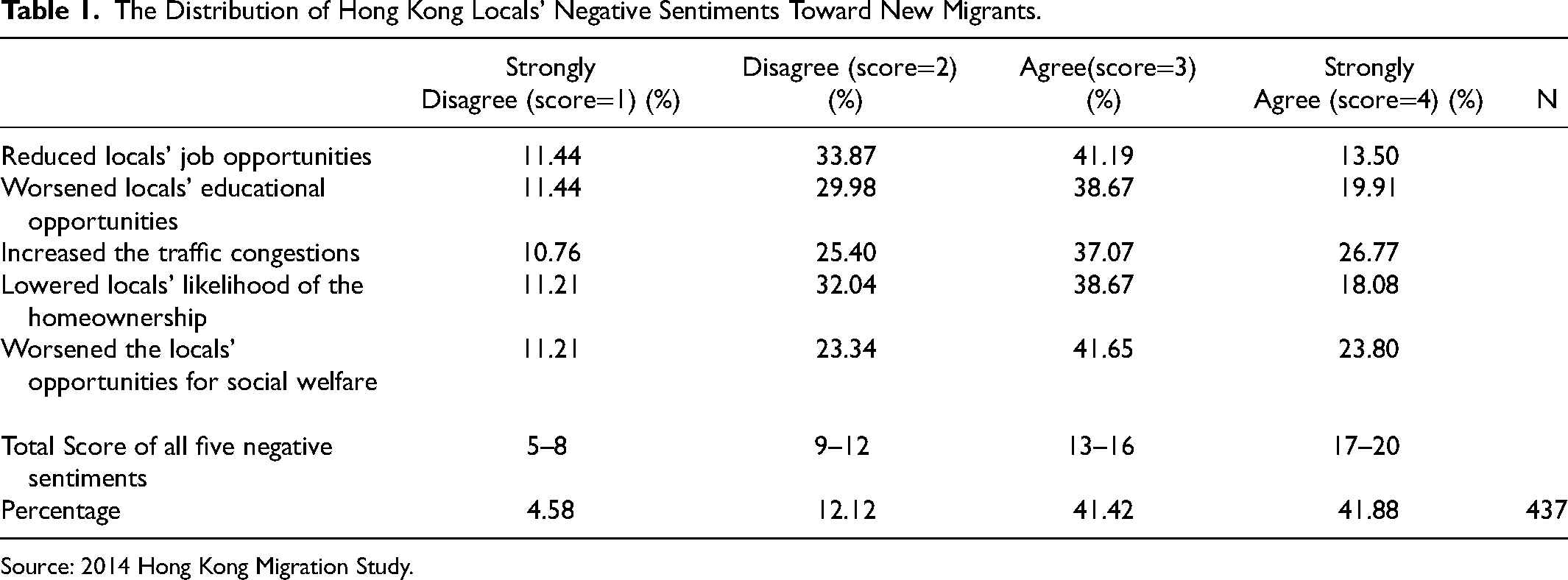
Source: 2014 Hong Kong Migration Study.
Table 2 provides descriptive statistics for the total score of all five negative sentiment and all independent variables included in our model. The mean of total score of all five negative sentiment toward new migrants, was 16.43, which was higher than the mid-value and therefore corresponds to the information in Table 1. About 29.8 percent respondents had at least one mainland-born friend among their three closest friends. About 5.3 percent worked in the food and accommodation industrial sector, and about 5.0 percent were involved in the construction sector. There is bipolar income distribution, i.e., higher percentages earning low income and high income. These percentages roughly correspond to the information in the 2016 Hong Kong Census.
Descriptive Statistics of the Total Score of All Five Negative Sentiments and All Independent Variables .

Source: 2014 Hong Kong Migration Study.
The mean of satisfaction with community was 3.45, which suggests that the respondents tended to be quite satisfied with the communities in which they lived. Similarly, the mean of satisfaction with work was 4.68, suggesting that most of the respondents were satisfied with their jobs.
Table 3 reports the results of the generalized linear regression on the relationship of variables derived from constructionist, structural, and socio-psychological explanations and respondents’ negative sentiments toward new migrants. We present the analysis result of the composite indicator of negative sentiment and each item of the composite indicator. No matter whether the results are based on the composite indicator or on individual items, they clearly show that boundary crossing, captured by having a close friend who was born in the mainland, significantly decreased negative sentiments toward new migrants. The finding is consistent with the first hypothesis and is robust throughout the models.
GLM Model on Negative Sentiments Toward New Migrants By Total Score of Five Negative Sentiments, Job, Education, Transportation, Property, and Welfare.
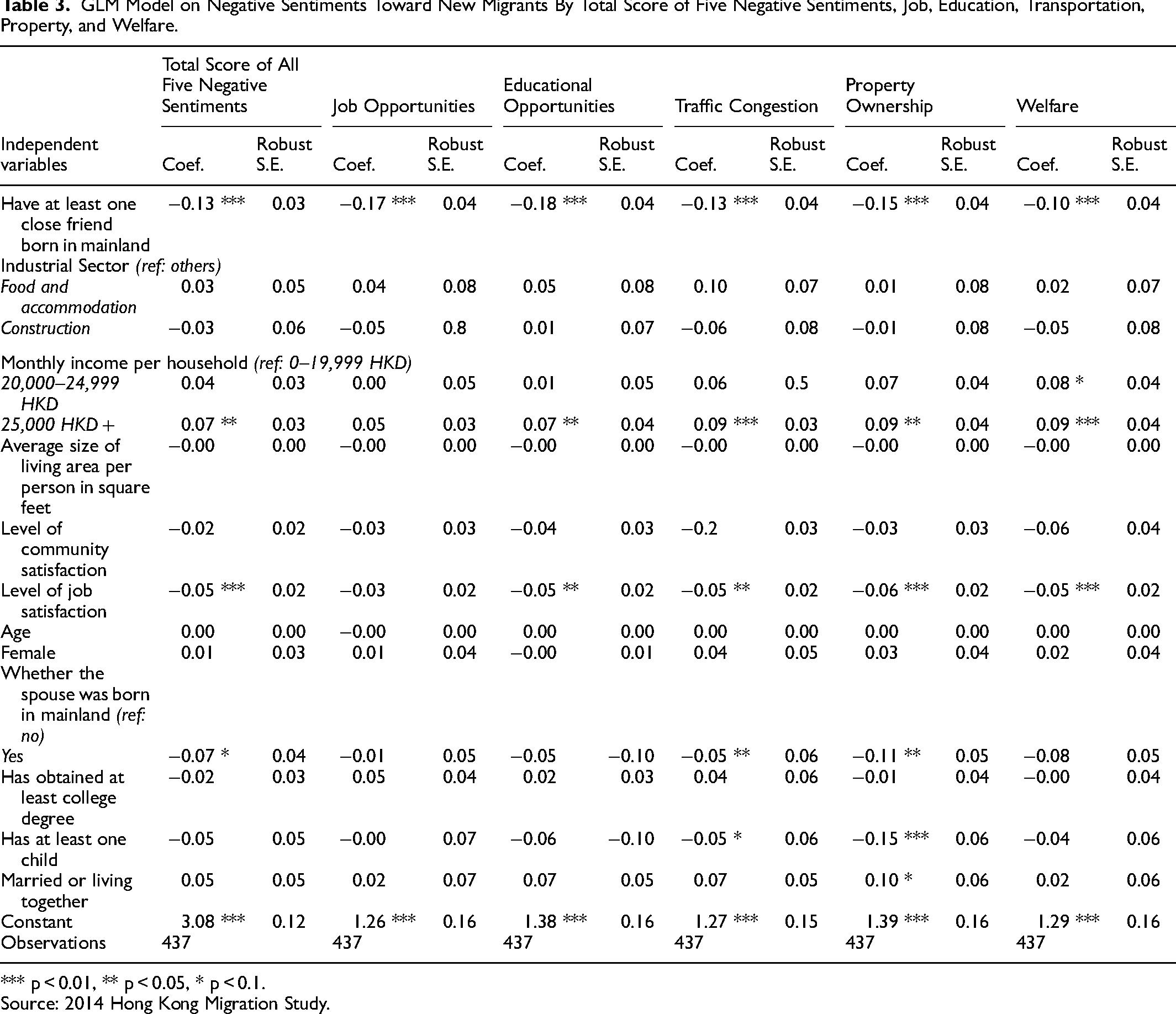
*** p < 0.01, ** p < 0.05, * p < 0.1.
Source: 2014 Hong Kong Migration Study.
High concentrations of mainlanders in industrial sectors did not appear to have significant effect on respondents’ negative sentiments. Only higher income, and not medium-level income, was associated with higher negative sentiment toward recent migrants, although the magnitude was very small. The findings do not support the second and marginally support the third hypotheses. Two of the three variables that captured the relationship of new migrants being scapegoated (average size of living area and satisfaction with the community where they live) were not related to the negative sentiment. Although respondents who were less satisfied with their work tended to have higher levels of negative sentiment, the magnitude of the relationship is small. The findings only marginally support the fourth hypothesis. In addition, the set of control variables suggests that age, gender, having local spouse, education, the marital status, in most models, are not related to the negative sentiment toward new migrants.
Mahalanobis Distance Matching (MDM) Results
One concern of the analysis is a possible selectivity issue. The relationship between having a close mainland-born friend and lower level of negative sentiment toward migrants may be related to unobserved characteristics, such as personality. To further explore the causal effect of boundary crossing, and considering the possible effect of unobserved characteristics, this analysis implemented Epanechnikov kernel function matching algorithms to estimate the average treatment effect on the treated (ATT), that is, the (average) impact of having a close friend born in mainland China on the respondent's subsequent total score of all five negative sentiments toward new migrants with the same set of variables as the previous analysis. Given the recommendation not to use propensity score matching because of various statistical concerns and the proposed use of a matching procedure that approximates the “fully blocked” experiment, we employed Mahalanobis Distance Matching (MDM), recommended by King and his associates (King, 2018; King & Nielsen, 2019). Mahalanobis distance is a scale-free Euclidean distance. The idea is to find control units close to the treated units on the Mahalanobis distance.
Table 4 compares the effect of having a close mainland-born friend on negative sentiments toward new migrants. On average, respondents who had at least one close mainland-born friend were 2.52 points lower on the scale of negative sentiments than those who did not have any migrant close friends, and the difference was significant at the one percent level. This result suggests that while keeping other factors constant, even with possible unobserved characteristics, having a close mainland-born friend did significantly lower the respondents’ negative sentiments toward migrants.
Mahalanobis Distance Matching Treatment Effects Estimation of Total Score of All Five Negative Sentiments a.

*** p < 0.01, ** p < 0.05, * p < 0.1.
Bandwidth is 5.08.
Source: 2014 Hong Kong Migration Study.
Conclusion
We have explored negative sentiments toward recent migrants among local residents in Hong Kong, a post-colonial city. Our discussion took the past colonial political history and current post-colonial context into consideration. We suggest that negative sentiment toward recent migrants in Hong Kong results from the city's specific post-colonial context, which has fostered a local identity and defined a clear group boundary between residents born in Hong Kong and recent migrants from the mainland. This local identity has provided the context for the development of negative sentiments toward migrants from mainland China, even though these two groups are from the same ethnic background.
Our discussion developed three hypotheses from the post-colonial and immigration literature which largely were supported by the analysis. Drawn from the constructionist perspective, we found the relationship between knowing more migrants as close friends and lower levels of negative sentiment (Hypothesis 1 supported). The post-colonial perspective helps to understand this particular pattern in three ways. First, the unique historical, social and economic developments in Hong Kong during colonial and post-colonial times helps to understand why the negative sentiment toward recent migrants from the same ethnic group sharing similar culture can be possible. Second, the literature on post-colonial identity reveals how the content of the local post-colonial identity creates a clear boundary between local residents and recent migrants from mainland China. Third, contact with migrants from mainland China can reduce the level of negative sentiment, which in turn may reduce the influence of the essentialist view of the two groups because of the colonial past and the post-colonial context.
With the incorporation of the post-colonial literature with the structural explanation, we suggested that working in industries with higher percentages of mainland migrants is not related to negative sentiments. The suggested relationship is supported by the data (Hypothesis 2 supported). However, we also found that only higher income is minimally associated with higher negative sentiment (Hypothesis 3 marginally supported). Drawing from the socio-psychological explanation, the effect of size of living area and community satisfaction were not significant in all of our models. Respondents who were less satisfied with their jobs tended to have higher levels of negative sentiment, but the magnitude of the relationship is small. The findings only marginally support the fourth hypothesis (Hypothesis 4 marginally supported). The findings suggest that current group relations in a post-colonial society are a product of its colonial past, but less are related to present situation.
Our findings have several implications. First, hostility toward another group, even with the same ethnic background, is possible if a clear boundary has been developed. Our findings suggest that Hong Kong, in a specific post-colonial context, with the emergence of a local identity, can develop and maintain a clear boundary in relation to migrants from the same ethnic group. Our study indicates that understanding group relations in a post-colonial society is explained not only by group boundaries and structural factors, but also by the way that one group perceives another in a historical post-colonial context. Such an approach helps us identify how negative sentiments develop toward a specific group in a post-colonial society.
Second, the post-colonial identity can serve as a useful conceptual tool to understand conflicts among groups in post-colonial societies, even migrants. Specifically, the post-colonial literature helps us to understand why negative sentiments are targeted at certain group. Such an approach is important because there are many post-colonial societies throughout the world. The colonial history of a place helps to explain its group dynamics in general and why there is discrimination against particular groups. In other words, the understanding of group relations must not neglect the historical context of the society. Researchers should give full consideration to both historical colonial and current post-colonial contexts. This is especially important for understanding many Asian post-colonial societies that have become independent states (e.g., Malaysia and India) or have returned to their original states (e.g., Hong Kong and Macau).
Finally, the case of Hong Kong has clearly demonstrated that the existing literature on group conflict and group relations should be extended to incorporate post-colonial literature in order to provide a historical context with which to appreciate group relations in post-colonial Asian and African societies. As many studies on group conflict and group relations have been based on North American and European experiences, and there has been less emphasis on the uniqueness of colonial history, those studies may have limited application to understanding group dynamics in Asian societies.
Our study was limited to Hong Kong and migrants from mainland China. Future studies should be extended elsewhere in order to develop further understanding of post-colonial societies and migrants of other racial/ethnic groups in Hong Kong. We discussed the importance of local identity in understanding group dynamics in Hong Kong, yet we do not have information about the level of local identify held by the respondents in our study. Future research may include such information to test directly how an individual's or group's level of local identity is related to negative sentiments toward recent migrants. In addition, future studies should go one step further to delineate how specific reasons for dissatisfaction in work or living environment are related to the level of negative sentiment toward migrants.
Finally, this study is based solely on quantitative survey data. Future studies should include qualitative data to provide a dynamic account of the relationship. Nonetheless, this study provides the first understanding of negative sentiment toward recent migrants in a post-colonial society. We believe this approach could help us understand group relations in other post-colonial societies, particularly Asian societies.
Footnotes
Declaration of Conflicting Interests
The author(s) declared no potential conflicts of interest with respect to the research, authorship, and/or publication of this article.
Funding
The author(s) disclosed receipt of the following financial support for the research, authorship, and/or publication of this article: This work was supported by the Faculty of Social Science, The Chinese University of Hong Kong.
