



Abstract
What role do intermarriages (i.e., interethnic marriages) play in immigrants’ life satisfaction? Only a few studies have addressed this question. While intermarriages are associated with upward mobility for immigrants, they are more likely to get divorced than intramarriages (i.e., marriages among co-ethnics), which suggests either a positive or negative association between intermarriage and immigrants’ life satisfaction. Drawing on data from the German Socio-Economic Panel (1984–2018), we estimate three-level hybrid models to investigate immigrants’ life satisfaction in inter- compared to intramarriages across the family life course. After controlling for socioeconomic characteristics, we find that intermarried immigrants had lower life satisfaction, especially after the birth of their first child. This result suggests that the socialization of children might be a more contentious issue in intermarriages. Overall, these findings illustrate that marriage types and the life course should be considered in future studies on immigrants’ life satisfaction and integration.
Introduction
In an age of international migration (Castles, de Haas, and Miller 2013), there is increasing interest in studying the consequences of migration, including immigrants’ adaptation and well-being (e.g., Kogan, Shen, and Siegert 2018). An important indicator of people's subjective well-being is life satisfaction (Diener et al. 1985). However, immigrants often report having lower life satisfaction in the destination country than natives (e.g., Sam 1998; Verkuyten 2008; Safi 2010; Kogan, Shen, and Siegert 2018). This finding is surprising since well-being itself is a driver for migration (Sam 1998, 5). Lower levels of well-being among immigrants are concerning because their well-being can be seen as an indicator of immigrant integration (Amit 2010; Gokdemir and Dumludag 2012; Angelini, Casi, and Corazzini 2015). Although life satisfaction is considered a top-level life goal of people (e.g., Diener and Chan 2011), immigrants’ life satisfaction has received far less attention than that of natives in Germany and other multi-ethnic societies. Previous research on immigrants’ well-being has predominately focused on objective indicators, such as immigrants’ labor market position, general economic situation, education level, housing, language skills, social ties, or naturalization status (Amit 2010; Gokdemir and Dumludag 2012; Siegert 2013). This article explores the impact of social integration on immigrants’ subjective well-being, through the lens of intermarriage.
The growing number of immigrants in European societies (Castles, de Haas, and Miller 2013) has led to an increase of intermarriages (i.e., marriages between immigrants and natives, also termed as interethnic marriages) relative to marriages among co-ethnics (intramarriages) (Burkart 2018). The different marriage types may have different implications for immigrants’ well-being, as assimilation theory has argued that the spouse plays a critical role in immigrant integration (Gordon 1964; see also Eisnecker 2020). Therefore, this article focuses on immigrants’ life satisfaction as a classical indicator of subjective well-being by asking: Does being in an intermarriage enhance immigrants’ subjective well-being more than being in an intramarriage, and how does this potential effect differ across family life course stages?
Research on the role of intermarriages in immigrant well-being is rare, and interest in this topic has only recently started to increase (e.g., Bratter and Eschbach 2006; Chang 2016; Milewski and Gawron 2019). Existing studies on the topic have primarily investigated mental health for different multi-ethnic societies (Bratter and Eschbach 2006; Milewski and Gawron 2019; Eibich and Liu 2021). While Bratter and Eschbach’s study (2006) was conducted in the United States and focused on race, research in Western Europe rather concentrates on differences between immigrants and natives (e.g., Milewski and Gawron 2019; Eibich and Liu 2021). Other studies on the association between intermarriage and self-rated health or life satisfaction have examined marriage immigrants, but only in South Korea (Chang 2016; Chang and Wallace 2016).
There are two main contradictory hypotheses regarding the association between intermarriage and immigrants’ well-being. On the one hand, intermarriages are seen as an indicator of immigrants’ social integration in classic assimilation theory (Gordon 1964). As intermarried immigrants are, for instance, more educated, wealthier, and culturally integrated than intramarried immigrants (e.g., Furtado and Song 2015; Rodríguez-García et al. 2015), they should have higher levels of subjective well-being in the destination country. On the other hand, the rates of separation and divorce are higher for intermarriages than for intramarriages of both natives and immigrants in different multi-ethnic societies (e.g., Kalmijn, de Graaf, and Janssen 2005; Milewski and Kulu 2014; Carol 2016). This evidence suggests that intermarriages might be more conflictual and, as a consequence, associated with immigrants’ lower well-being (e.g., Hawkins and Booth 2005; Kamp Dush, Taylor, and Kroeger 2008). Milewski and Gawron (2019) found that immigrants in nine European countries benefited from intermarriages, especially in the long run. Potarca and Bernardi (2020) examined the life satisfaction changes of intermarried immigrants and natives in Germany before and up to 10 years after the marriage and observed that immigrants experienced a short-term life satisfaction premium, which, however, diminished over time. We argue that a dynamic perspective on intermarried immigrants that considers longitudinal variation across the entire family life course and, thus, investigates the short-term and long-term implications of these marriages is currently lacking. As a previous qualitative research on intermarried couples’ psychosocial well-being has indicated that the strains of negotiating ethnic differences may vary over their family life course (Singla and Holm 2012), we want to investigate all stages in the life course, while assuming that the lives of parents and children are linked.
By employing a life course perspective by looking at how being in an intermarriage affects the partners’ life satisfaction throughout various life stages, including the child-rearing, empty nest, and old age stages, we add to the small number of studies on the association between intermarriage and life satisfaction (e.g., Chang 2016; Potarca and Bernardi 2020). To do so, we employ data from the German Socio-Economic Panel (GSOEP), a rich longitudinal dataset with 35 waves/rounds that include information on immigrants from Western and non-Western countries. We look at the role of intermarriage in immigrants’ life satisfaction (i.e., first- and 1.5-generation immigrants) in the context of social integration, while also considering the various stages of the family life course.
In sum, this article argues that intermarriage is per se neither detrimental nor beneficial for immigrants’ life satisfaction; while intermarried immigrants typically had more socioeconomic resources than intramarried immigrants (e.g., higher income), boundary crossing might reduce life satisfaction at certain stages of family life associated with negotiating ethnic differences (e.g., child-rearing). While we focus on marriages, the observed life course variation among immigrants can have implications for other forms of social integration (i.e., interethnic contacts in neighborhoods, friendships, workplaces, or schools). Every form of social integration may contribute to immigrants’ integration on other dimensions (e.g., economic, cultural, or identificative integration). However, immigrants’ encounters with natives may come at a cost, as such interactions can increase the likelihood of conflicts, which may, in turn, endanger immigrants’ willingness to fully integrate. For instance, conflicts with natives may reduce the likelihood that immigrants will successfully complete their school career. Based on the transferability of insights on intermarriages to other forms of social integration, intermarriages can be understood as a “microlaboratory of intercultural relations” (Rodríguez-García 2015, 25) that teach us about the barriers to full integration that immigrants face more generally.
To develop these ideas, this article is structured as follows. First, we derive hypotheses from assimilation theory and research on intermarriages. Second, we describe the data, study context, and the sample analyzed here, as well as the variables and methods we used. Third, we analyze our findings. In the final section, we discuss our results by reflecting the finding's implications for assimilation theory and suggest avenues for future research. The article ends with a summary of our study's contribution to migration research.
Theoretical Framework
Satisfaction with life “provides an integrated judgment of how the person's life as a whole is going” (Diener et al. 1985, 140). Life satisfaction has been characterized as the cognitive component of subjective well-being, while the emotional elements of well-being are positive affect (e.g., joy and happiness) and negative affect (e.g., depression and anxiety) (Diener et al. 1985). This article addresses immigrants’ life satisfaction as a dimension of subjective well-being, depending on whether they are inter- or intramarried.
Immigrants in Europe often report lower life satisfaction in their destination country (Safi 2010; Kogan, Shen, and Siegert 2018), a finding which is likely rooted in the multiple losses that the process of migration entails (Sam 1998, 5–6). In particular, immigrants may experience a loss of culture, social relations, or status and may be exposed to prejudice, hostility, and discrimination in their destination country (Verkuyten 2008; Safi 2010; Kämpfer 2014; Kirmanoğlu and Başlevent 2014). Moreover, other migration-related factors, such as being confronted with new values and having to learn a new language, can arouse stress among immigrants (Berry 1997). Scholars have shown that immigrants’ life satisfaction is associated with their structural assimilation (financial problems, income, and general economic condition) (Bartram 2011; Gokdemir and Dumludag 2012; Kämpfer 2014; Kirmanoğlu and Başlevent 2014; Kóczán 2016), citizenship (Kirmanoğlu and Başlevent 2014), cultural assimilation (host-country language) (Beier and Kroneberg 2013; Angelini, Casi, and Corazzini 2015; Kóczán 2016), and identificative assimilation (Verkuyten 2008; Amit 2010; Kirmanoğlu and Başlevent 2014; Angelini, Casi, and Corazzini 2015). Thus, different dimensions of integration are linked to immigrants’ subjective well-being.
This article sheds light on the role of social integration in immigrants’ life satisfaction. The assimilation literature has described social integration as a form of “boundary crossing” and assumes that over time, immigrants’ levels of social integration improve within immigrant destination countries (Gordon 1964; Alba and Nee 2003). In assimilation theory, intermarriage is often cited as a prime example of boundary crossing, blurring (i.e., decreasing dissimilarities between spouses), and shifting of boundaries (Alba and Nee 2003). However, the share of intermarriages is still relatively small in Europe (Lanzieri 2012), and the desire for endogamous partnering remains strong (Carol 2016). This pattern is often explained by people's preference to have a culturally similar partner (i.e., homophily) (Kalmijn 1998).
According to the economic theory of marriage, individuals may be expected to choose a partner based on rational deliberations about their potential gains, for instance, in terms of well-being, prestige, or love (Becker 1974). While an interethnic partner choice may be associated with greater socioeconomic resources, some immigrants may perceive an intramarriage as conferring higher prestige within their ethnic group, especially if intermarriages are less accepted in their culture. Thus, both types of marriages might be associated with advantages that cancel each other out, resulting in similar levels of life satisfaction for the inter- and intramarried couples. However, once we control for the different advantages that come with a certain marriage type, significant differences in life satisfaction should be revealed. Moreover, the type of marriage an immigrant is in can have contradictory implications for his/her life satisfaction, as we discuss in the following sections.
Intermarriages and Well-being
This article adds to the debates on immigrants’ life satisfaction and on the role of intermarriage for integration (Song 2009) by investigating the association between intermarriage and immigrants’ well-being over the family life course in Germany. While investigations on this topic are rare, we can learn from research in the United States that has focused on racial instead of ethnic differences in life satisfaction among intermarried couples. This research has shown that interracial couples are more prone to psychological distress (Bratter and Eschbach 2006). Moreover, research in Europe has shown that intermarried couples’ well-being can vary, depending on whether we look at the spouse of native origin or the spouse of immigrant origin (Milewski and Gawron 2019; Eibich and Liu 2021). According to assimilation theory, immigrants’ well-being should benefit from ties with natives (Gordon 1964; Alba and Nee 2003), as immigrants also benefit from interethnic ties in relation to other integration indicators, such as income (the finding of a higher income among intermarried immigrants was termed as intermarriage premium) (Meng and Gregory 2005; Meng and Meurs 2009). The often-observed better structural integration of intermarried immigrants in terms of higher income might be the result of the accelerated acquisition of native language skills (Rodríguez-García et al. 2015). Consequently, intermarriage could be understood as an engine for immigrants’ integration.
Nevertheless, other scholars found evidence that intermarried immigrants’ higher socioeconomic resources are the result of selection into intermarriage (Kantarevic 2004; Dribe and Nystedt 2015; Furtado and Song 2015). Having a higher socioeconomic status provides more opportunities for immigrants to meet natives (Costa and de Valk 2018). Thus, marital integration may be the consequence of incorporation into the majority society, not the cause (Rodríguez-García et al. 2015). However, selection effects and the intermarriage premium do not have to be mutually exclusive (Osanami Törngren, Irastorza, and Song 2016). Although the relationship between structural assimilation and intermarriage is complex, intermarried immigrants’ on-average more advantageous structural integration should contribute to their higher life satisfaction. The association between intermarriage and structural integration leads us to our first hypothesis:
Intermarried immigrants report higher life satisfaction than intramarried immigrants.
However, as in all marriages, the level of well-being might vary with relationship quality (Kamp Dush, Taylor, and Kroeger 2008). For instance, marriages with low relationship quality are associated with lower well-being among married people (Hawkins and Booth 2005). Decreased social support from the spouse and increased hostility in troubled relationships are seen as relevant sources of depression (e.g., the “marital discord model for depression,” Beach, Sandeen, and O’Leary 1990; Kamp Dush, Taylor, and Kroeger 2008). We argue that intermarried couples are exposed to more marital conflict and that intermarriages are less socially accepted in social networks due to the spouses’ heterogeneity in traits like ethnic background, education, religious affiliation, culture, or social status (Kalmijn 1998).
Among the challenges intermarried couples face are differences in language skills, language use, and communication styles, as well as cultural differences in norms, values, beliefs, and attitudes, which are, in turn, associated with different behaviors and mutual expectations (Sharaievska, Kim, and Stodolska 2013). These differences can reduce the time spent together, hinder joint decisions, and increase misunderstandings and conflicts (Kalmijn, de Graaf, and Janssen 2005). Intermarried couples often differ in their religion, age, socioeconomic background, or other characteristics (Milewski and Kulu 2014), and these differences can add to the marital challenges they face. Such differences might also contribute to an unequal distribution of marital power (Chang 2016) and lower marital quality (Myers 2006). Thus, intermarried couples’ heterogeneity may explain why they have lower levels of relationship quality (Fu, Tora, and Kendall 2001; Hohmann-Marriott and Amato 2008) and higher rates of separation and divorce (Milewski and Kulu 2014).
In addition, feeling less accepted and supported by the social environment might increase partners’ incompatibility (Milewski and Kulu 2014) and the costs of an intermarriage in relation to its benefits. Intermarried individuals might face discrimination and exclusion from their families and communities (Rodríguez-García et al. 2015; Rodríguez-García, Solana-Solana, and Lubbers 2016). Familial rejection might even lead to distancing, contact termination, and a loss of familial support (Rodríguez-García, Solana-Solana, and Lubbers 2016). In light of the negative consequences of heterogeneity within the partnership, we expect to observe a negative association between intermarriage and immigrants’ life satisfaction.
Intermarried immigrants report lower life satisfaction than intramarried immigrants.
Family Life Course Stages
However, well-being varies not only with relationship quality but also across the life course, with certain stages being particularly conflict-ridden, resulting in lower well-being (e.g., Switek and Easterlin 2018). The traditional family life cycle theory highlights the dynamics within families (Duvall 1988). Based on a developmental approach, it distinguishes among eight stages, including family formation, the birth and raising of children, children moving out, retirement, and, finally, death (Duvall 1988). Each stage is associated with critical tasks and strains, such as establishing a mutually satisfying marriage, adjusting to retirement, or maintaining kin ties with older and younger generations (Olson et al. 1983). The satisfactory adaptation of all family members to their living conditions ensures mutual approval and happiness (Duvall 1988). Cohesion within the family is a central strategy for coping with those demands; furthermore, the emotional bonding between family members reduces strains and contributes to greater well-being (Duvall 1988).
Pursuing these adaptation and bonding strategies is made more difficult when family members differ in their cultural values, socioeconomic status, or religion (Duvall 1988). As culture defines norms for family development, cultural differences are accompanied by differences in approaches to family development tasks and in the ways family members cope with these tasks (Duvall 1988). Moreover, the challenges are greatest in the stages in which children are born, children are of school age, and children are leaving home and in the empty nest phase that follows children's departure (Olson et al. 1983). With the birth of children, the family's emotional and material structure changes (Kapinus and Johnson 2003), which might, in turn, lead to changes in life satisfaction.
A number of studies have shown that people's life satisfaction increases during pregnancy and after childbirth but drops with the child's increasing age (Myrskylä and Margolis 2014; Switek and Easterlin 2018). Potarca and Bernardi (2020) also found that for immigrants, being in an intermarriage is associated with higher life satisfaction from the year when partners move in together up to one year after the marriage. However, they also observed that between two and 10 years after union formation, this intermarriage life satisfaction premium disappears. Thus, these findings indicate only temporary effects of intermarriage on life satisfaction. However, there is also evidence that negative events can have long-term effects on well-being (Anusic, Yap, and Lucas 2014). While Potarca and Bernardi (2020) focused on union formation and examined changes in the association between intermarriage and life satisfaction 10 years before and 10 years after marriage, we focus on the period after marriage and look at life satisfaction over the entire family life course. In line with the developmental approach, we analyze how intermarriage affects immigrants’ average life satisfaction at different stages of family life, including child-rearing.
Based on the findings of a qualitative study, Singla and Holm (2012) reported that couples perceive cultural heterogeneity differently, depending on the stage of their relationship. During the “honeymoon phase,” spouses see their differences as interesting and view their future positively, even though the partners increasingly have experiences that compromise the quality of their daily lives. During the “stage of family establishment,” the couple's differences become more visible and problematic due to the pressure to negotiate gender roles, parenting, and work–family balance. During this time, either the immigrant or the native partner adapts to the other partner's culture, or a reciprocal intercultural exchange must take place (Collet 2015). This stage is likely to be more conflict-ridden (Singla and Holm 2012). For instance, more conflicts will appear if the partners’ gender role attitudes or religious beliefs diverge (Rodríguez-García 2006; Bhugun 2017). If the relationship continues, a shared identity is developed in the form of joint opinions, which strengthens the bond between partners in the later relationship phases (Singla and Holm 2012).
Of all the family life course stages, child-rearing is the “most obvious context” for conflicts within intermarried couples (Rodríguez-García 2006, 421). Although intramarried parents may also support different child-rearing practices, differences in child-rearing styles among intermarried parents are often rooted in their cultural values and experiences (Bustamante et al. 2011). Consequently, cultural differences can intensify dissimilarities in child-rearing styles and expectations about family life. The conflicts that emerge might involve disagreements not just about children's socialization processes, language, or food (Bhugun 2017) but also about the partners’ responsibilities for child-rearing or household tasks (Rodríguez-García 2006; Bustamante et al. 2011). Moreover, the potential lack of emotional and practical engagement of the family members who reject intermarriage might be particularly detrimental during child-rearing, as support from the extended family is a relevant resource in child-rearing. Compensating this lack of support might require intermarried couples to invest more time and energy in parenting (Qian and Lichter 2021).
From the family life course perspective, we assume that partners’ ethnic differences are less likely to affect their life satisfaction before and after child-rearing. Like intramarriages, intermarriages are formed on the basis of rational motives (Becker 1974), although different motives might be more important for each type of marriage. The child-rearing stage can lead to a “culture clash” in intermarried families (Rodríguez-García 2006), which may, in turn, increase stress and decrease intermarried immigrants’ life satisfaction. After the raising and supervision of children are mostly completed, the main stressors should vanish. Thus, contrary to the heterogeneity hypothesis, the association between intermarriage and immigrants’ life satisfaction may not be universally negative. Instead, the following hypothesis highlights life course variation and that a negative association may especially be evident when raising children.
Intermarried immigrants report lower life satisfaction than intramarried immigrants during the life stages associated with raising children. In life course stages before or after raising children, intermarried immigrants should have no lower life satisfaction than their intramarried counterparts.
Methodology
The Data
This article is based on data drawn from the GSOEP 1 (Wagner, Frick, and Schupp 2007), an annual panel study that began in 1984 as a random representative sample of private households in West Germany and expanded to cover East Germany in 1990. The survey was conducted through face-to-face interviews with household heads and household members. Generally, the GSOEP oversamples immigrants, initially from the five countries that were the most important sources of “guest workers”: Turkey, Greece, the former Yugoslavia, Italy, and Spain. However, a special subsample of immigrants was added in 1995 in response to the large-scale immigration of ethnic Germans after the Soviet Union's breakup. Up to 2018, further samples were drawn to increase the number of immigrants, particularly after large immigration waves. Enlargement samples were added in 2013 and 2015 to cover the immigration of European Union (EU) citizens from Central and Eastern Europe after freedom of movement was implemented in the EU, and in 2016 and 2017 to cover the arrival of refugees from Syria and other Middle Eastern countries (Goebel et al. 2019). Moreover, to ensure an appropriate sample size, refreshment samples of the residential population of Germany are collected.
The composition of immigrants in our sample corresponds with the history of German migration. The majority of intramarried immigrants moved from Eastern Europe to Germany (i.e., Poland, Hungary, Czech Republic, Slovenia, Lithuania, Slovakia, Croatia, Bulgaria, and Romania; in total 24.3 percent) after the Soviet Union's breakup and the EU enlargement in the late 2000s. Other groups with larger shares of intramarried immigrants are from Turkey (19.7 percent) and Southern Europe (i.e., Italy, Greece, Spain, and Portugal; in total 15.8 percent). Most of these immigrants entered Germany between the late 1960s and the 1980s, when “guest worker” immigration was strongest (Castles, de Haas, and Miller 2013).
The largest shares of intermarried immigrants originate from Eastern (19.8 percent) or Southern Europe (16.2 percent), although a large share also emigrated from Northern and Western Europe (19.8 percent). Non-Western immigrants are less prone to intermarrying, which reflects the role of cultural differences and religion in union formation (Alba and Foner 2015). Intermarried immigrants of non-Western origin are from Asia (13.3 percent), South America (5.2 percent), or Russia (5 percent), while only 3.7 percent emigrated from Turkey.
For the analyses, we use data from 35 waves up to 2018 in the GSOEP long format, allowing us to study a broad sample of immigrants, based on the definition of immigrant as a person who was born abroad. 2 We include in our sample immigrants between 18 and 89 years old who are in a heterosexual marriage. We focus on married couples, as the majority of the children of immigrants are born within marriage and as cohabitation and divorce are less common among immigrants (Hartung et al. 2011; Milewski and Kulu 2014). We consider first marriages only.
Moreover, we include individuals who reported valid information on relevant variables in each wave. 3 Finally, if a marriage ended due to separation, divorce, or widowhood, the observations are censored at the moment these events occurred. The resulting sample consists of 38,220 observations from 4,373 individuals. Of these individuals, 12.7 percent of the women and 9.3 percent of the men were living in intermarriages at the time of the survey. 89 percent of the sample was intramarried.
Operationalization
We operationalize life satisfaction, using the item: “How satisfied are you with your life, all things being considered?” Responses are measured on a scale of zero (completely dissatisfied) to 10 (completely satisfied).
Our main explanatory variable is marriage type. If the spouses reported having the same origin country, their marriage type was labeled intramarriage (0). Intermarriages (1) are defined as unions in which one spouse is of native origin (meaning the spouse and his/her parents were born in Germany) and the other spouse is an immigrant. Marriages between immigrants born in two different countries have been deleted from the dataset due to the low case numbers (7.1 percent).
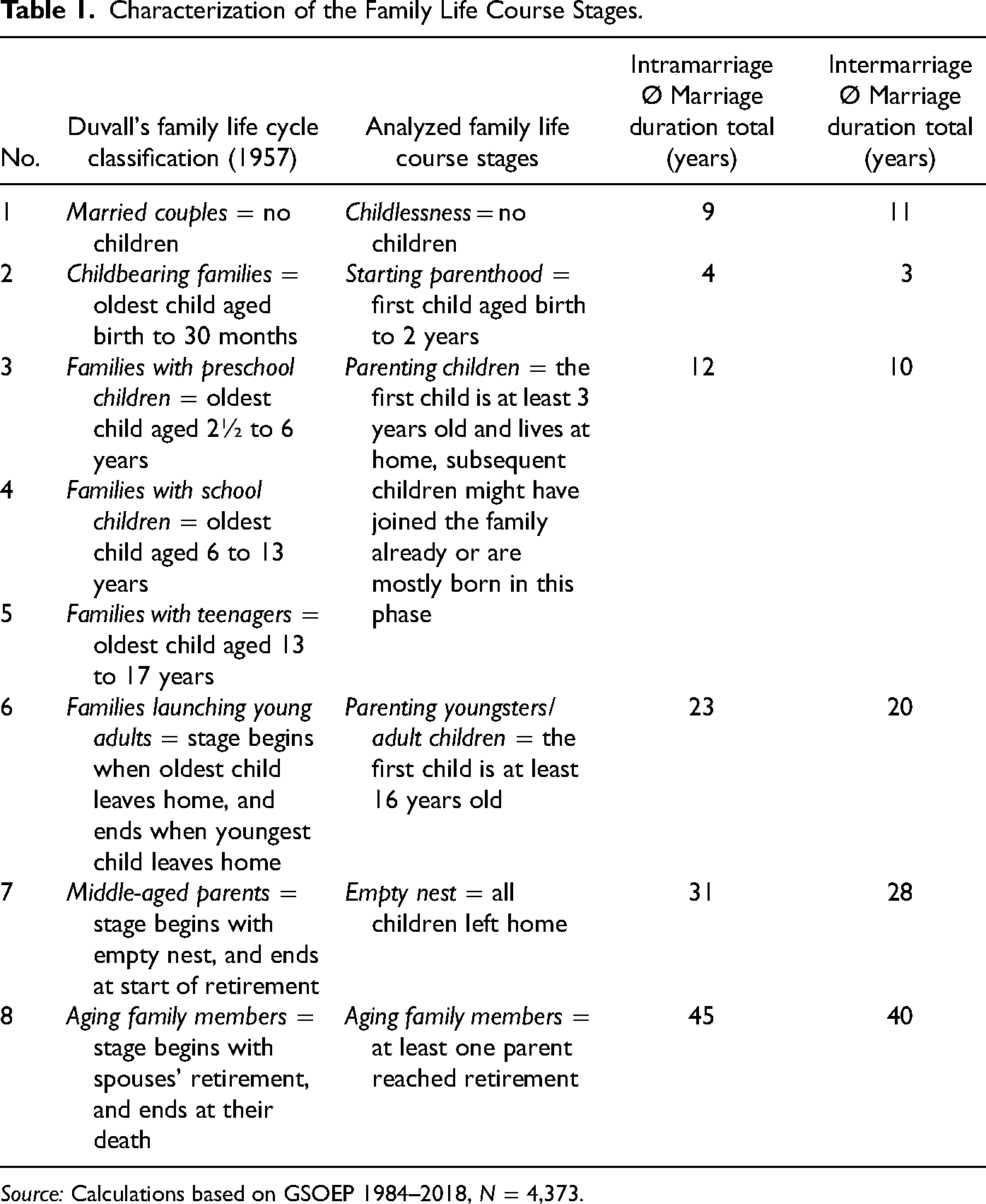
Our second main explanatory variable is the family life course, which is divided into six stages of family development (see Table 1). As Duvall's family life cycle classification (1957) has lost its universality due to demographic changes, such as increases in divorce, remarriage, single parenthood, and step-parenthood (e.g., Popenoe 2017), we have adapted this classification. The first category covers individuals with no children (31.4 percent are temporarily childless, and 68.6 percent are permanently childless). The second stage captures the first phase of parenthood, when the first child is zero to two years old. The third stage is parenting children (oldest child is older than two years), and the fourth stage is parenting youngsters/adult children (based on the oldest child's age). The post-parental period (also called the “empty nest” phase) begins when all children have left home. The final stage is aging. For these classifications, we use information on the oldest child's age, on the point at which all children have moved out, and on the individual's and spouse's retirement. Table 1 shows all family life course stages and compares them with Duvall's family life cycle classification (1957). Supplemental Table A-1 in the Supplemental Appendix illustrates the changes in the family life stages within the sample.
Characterization of the Family Life Course Stages.
Source: Calculations based on GSOEP 1984–2018, N = 4,373.
The explanatory variables on the individual level are as follows. Education is represented by using the ISCED (1997) codes ranging from 1 (primary school) to 6 (doctoral degree). The next explanatory variables capture net household income per month (metric) and perceived discrimination (0 = no, 1 = yes). In addition, we control for survey year (metric), gender (0 = men, 1 = women), immigrant generation (0 = first generation, 1 = 1.5 generation 4 ), immigrants’ origin country (0 = Western immigrant, 1 = non-Western immigrant 5 ), and birth year (metric).
On the couple level, we investigate the partners’ degree of homophily. The variable age homophily is divided into two categories. The variable takes the value of zero if the wife and the husband are nearly the same age, meaning that the wife is no more than 1 year older or 5 years younger than the husband. If the wife is more than 1 year older or more than 5 years younger than the husband, the variable takes the value of 1. A similar approach is taken to the variable educational homophily; the value is zero if the wife and husband have the same education level, and the value is 1 if the wife has higher or lower education than the husband. Another dummy captures religious homophily (i.e., whether partners have the same denomination (0) or a different denomination (1)).
Method
To account for the dependence of answers due to repeated measurements of the same person in couples, we estimate three-level (Rabe-Hesketh and Skrondal 2012) hybrid models (Allison 2009; Schunck 2013). In our analysis, we deal with three levels that are nested within each other: level 1: repeated measurements of the same person across waves (e.g., their family life course stages); which is nested within level 2: individual characteristics that do not vary across time and are, therefore, called time-invariant (e.g., origin country); which is nested within level 3: couples and their characteristics (e.g., intermarriage, religious homophily). The models differentiate between so-called within differences and between differences. Equivalent to cross-sectional analyses, between differences estimate variations between individuals. Within differences estimate the individual change between years, net of all characteristics, and thus control for time-invariant unobserved heterogeneity. 6 Time-invariant unobserved heterogeneity describes differences between participants that have not been measured in the data but that might be associated with the time-varying independent variables. For instance, certain attitudes or biological aspects might be correlated with the likelihood of childbearing and, thus, with the time-varying variable of the family life course stages. Hybrid models allow us to do both by estimating within- and between-person differences. 7 Missing values are replaced, using multiple imputation with chained equations (m = 20).
Analyses are carried out in a stepwise fashion. In Model 1, we compare the general advantages or disadvantages of intermarried immigrants with those of intramarried immigrants by using a dummy variable for inter- versus intramarriage. We also control for the survey year in this model. Model 2 introduces the family life course stages, as well as the control variable for gender and birth year. In Model 3, we include immigrant generation and origin country. In Model 4, we include information on immigrants’ structural assimilation as measured by the potential mediators of education level and household income. In Model 5, we add perceived discrimination as an important determinant of life satisfaction. Finally, Model 6 captures age and educational and religious heterogeneity.
Results
Comparison of Inter- and Intramarriages
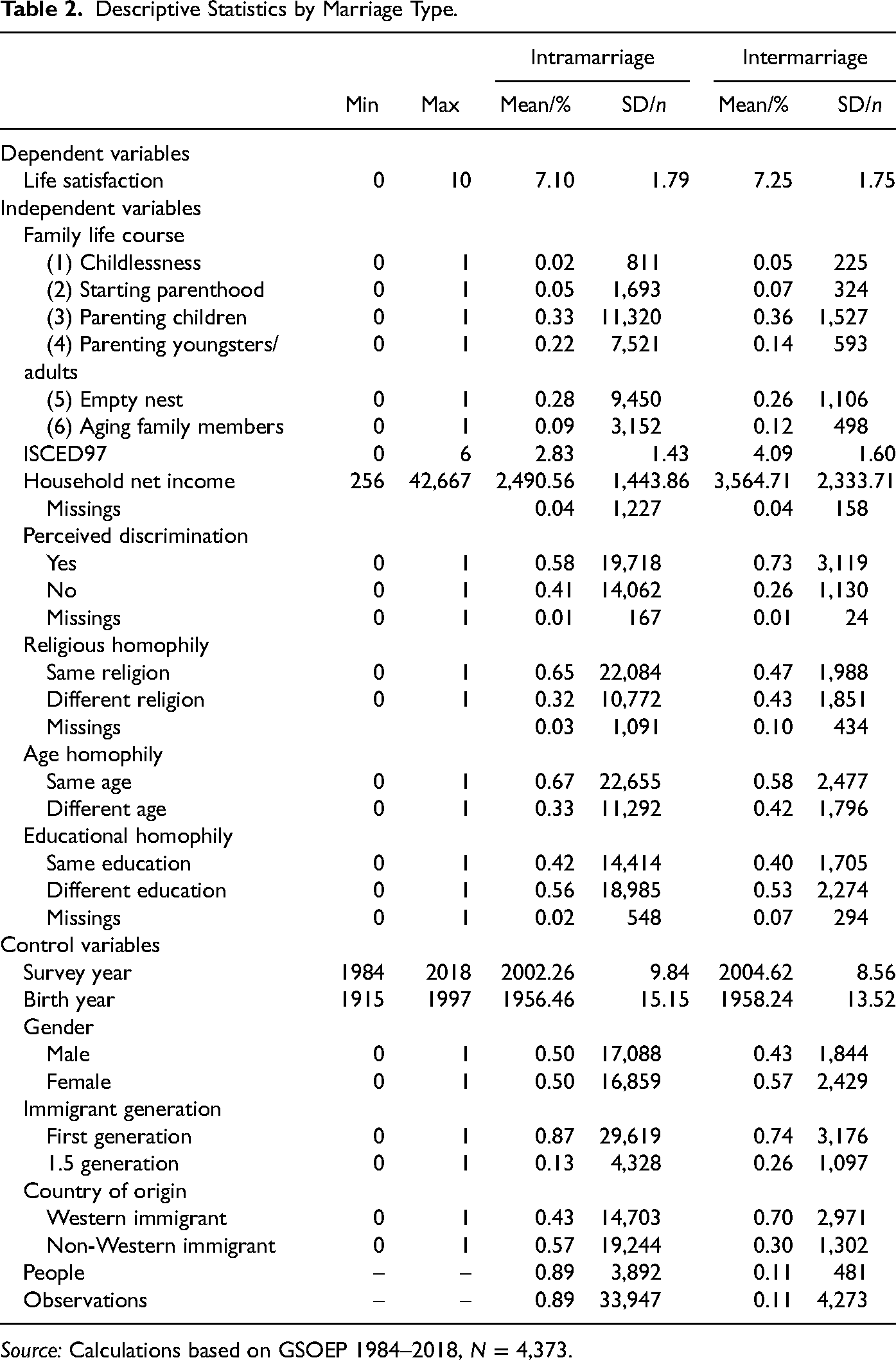
Descriptively, we do not observe substantial differences in the life satisfaction of inter- and intramarried immigrants (Table 2). Thus, we find that intermarriages are neither significantly detrimental nor beneficial for immigrants (Table 3).
Descriptive Statistics by Marriage Type.
Source: Calculations based on GSOEP 1984–2018, N = 4,373.
Determinants of Life Satisfaction.

Source: Calculations based on GSOEP 1984–2018.
Note: The table first shows the between differences of time-varying variables, and then the within differences.
Standard errors are given in parentheses.
p < .10, *p < .05, **p < .01, ***p < .001.
However, once we control for socio-demographic variables, we find a negative association between intermarriage and life satisfaction. Contrary to the assimilation hypothesis, the coefficient becomes larger and significantly negative (Table 3, Model 4), meaning that individuals in intermarriages had lower life satisfaction. The significant negative association persists after controlling for all variables (Table 3, Model 6). Income is generally associated with higher life satisfaction (between and within effects in the hybrid model), and intermarried immigrants had, on average, a higher income than intramarried immigrants, as Table 2 shows and as previous studies have reported (Dribe and Nystedt 2015; Furtado and Song 2015). However, higher income is not necessarily associated with higher life satisfaction. Moreover, the following question arises: Why are no differences in the life satisfaction of inter- and intramarried immigrants observed in the descriptives (Table 2) or in the first models of Table 3? An explanation could be that two effects are canceling each other out, resulting in a null effect (i.e., the positive effect of high income on life satisfaction and the lower life satisfaction in intermarriages). Thus, the lower life satisfaction in intermarriages only becomes visible and significant when we control for structural integration (education and income).
Perceived discrimination, which is another important determinant of life satisfaction (Safi 2010), is linked to lower life satisfaction but does not noticeably mediate the relationship between intermarriage and life satisfaction (it is possible that intermarried immigrants are more exposed to conflict and discrimination because they have more encounters with natives than intramarried immigrants) (Table 3, Model 5). Interestingly, couples’ heterogeneity in terms of age, education, or religion is not found to affect the relationship between intermarriage and life satisfaction (Table 3, Model 6), which contradicts our heterogeneity hypothesis. We conclude that the measured forms of heterogeneity are largely irrelevant to life satisfaction.
The Role of the Family Life Course
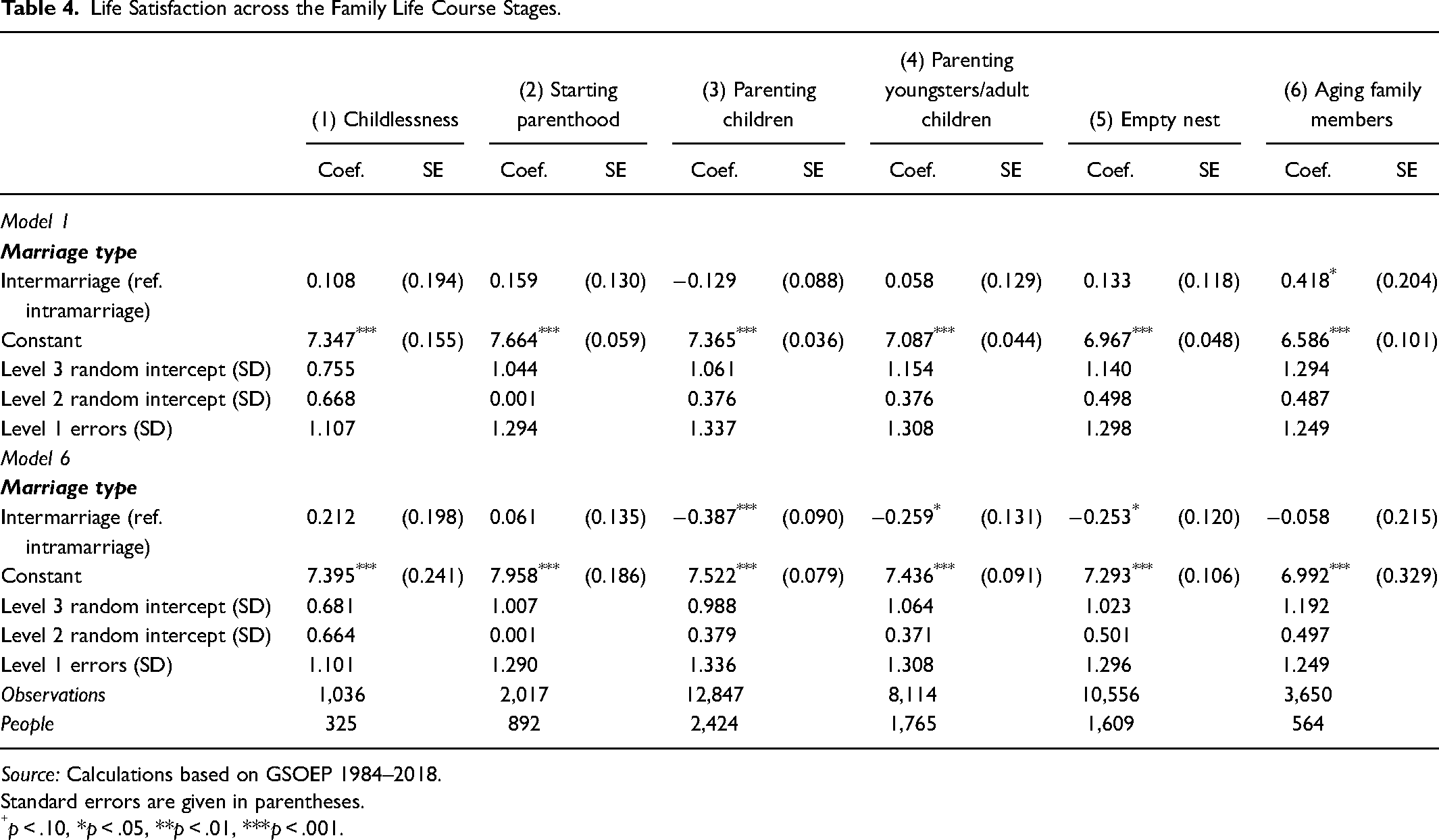
In the next step, we present comparisons for scrutinizing the interactions between marriage types and life satisfaction over the family life course. Table 4 displays the life satisfaction separately for intermarried immigrants and the reference group of intramarried immigrants in each family life course stage based on the variables included in Models 1 and 6 (Table 3).
Life Satisfaction across the Family Life Course Stages.
Source: Calculations based on GSOEP 1984–2018.
Standard errors are given in parentheses.
p < .10, *p < .05, **p < .01, ***p < .001.
Based on the results of our analyses (Table 4, Model 1), we can conclude that intermarried immigrants’ life satisfaction does not vary across the family life course more than that of intramarried immigrants, except in the last stage of the family life course. While in all other stages, the effects for intermarried immigrants are not significantly different from those in intramarriages, we observe that intermarried immigrants had significantly higher life satisfaction in the aging phase. This finding corresponds to previous findings on intermarried immigrants (Milewski and Gawron 2019). However, once we control for structural integration, discrimination, and homophily (Table 4, Model 6), the significantly higher life satisfaction of older intermarried immigrants disappears. Hence, the aging stage seems to be equally challenging for all immigrants, when controlling for several compositional differences. Thus, the benefits intermarried immigrants experience in old age might result from socioeconomic advantages and processes of homophily (i.e., partners becoming more alike over the life course, see Singla and Holm 2012) and the socioeconomic disadvantages of intramarried immigrants. The interplay of these factors (socioeconomic status and homophily processes), in turn, might explain why we observe higher life satisfaction among intermarried immigrants, especially in the final family life course stage.
Another difference is observed after we control for structural integration, discrimination, and homophily: the coefficient for intermarriage turns into a negative one, indicating that intermarried immigrants had significantly lower life satisfaction during the stages of parenting children and youngsters/adults. This finding is in line with our family life course hypothesis, which states that intermarried immigrants are more likely to report lower satisfaction than intramarried immigrants during the socialization of their children. This significant negative association appears to last until the children leave home. Again, the advantage of having fewer child-rearing conflicts in intramarriages is offset by the advantage of having higher socioeconomic status in intermarriages, which could result in the two marriage types being associated with similar levels of life satisfaction. However, once we account for higher socioeconomic status, we can see the negative relationship between life satisfaction and intermarriage. In the next step, we carry out additional analyses to further investigate our findings on the late-life satisfaction advantage of intermarried immigrants.
Selection Effects
Two possible scenarios might bias our findings, especially our finding that intermarried immigrants had a late-life satisfaction advantage. First, there may be selection due to remigration, and second, there may be a bias due to union dissolution. As selective return migration increases during retirement (Constant and Massey 2003), it might affect our findings (i.e., intramarried individuals with lower life satisfaction might be more likely to return to their origin country before dying [salmon bias]). Thus, the late-life satisfaction advantage of intermarried immigrants that we detected might be biased. While highly skilled immigrants are more likely to engage in return migration (Gundel and Peters 2008), the factors that reduce the likelihood of return migration include years since migration; the ability to speak German; feeling German; and having social ties, having a child, owning property, and having higher occupational prestige in the destination country (Constant and Massey 2003). Intramarried immigrants should have more reasons to return to their origin country, especially if both partners still have family ties there. Moreover, Baykara-Krumme and Platt (2018) showed that returnees to Turkey are less happy and more likely to be ill than Turkish immigrants who stayed in Europe. Accordingly, intramarried immigrants’ average life satisfaction might be higher, and the differences between inter- and intramarried immigrants might be lower, if, on average, immigrants who are more ill have returned to their origin countries.
To investigate the impact of return migration, we use the statement about the intention to leave Germany as a proxy for return migration and repeat the analysis, while reducing the sample of intramarried immigrants to those who intended to stay in Germany. Descriptive analyses reveal that people who were more tempted to leave Germany tended to be less healthy, to have a lower income, and to be intramarried. If we exclude the intramarried immigrants with the intention to leave, intermarried immigrants’ late-life satisfaction advantage vanishes (Supplemental Table A-2 in the Supplemental Appendix). The vanished positive association between life satisfaction and intermarriage suggests that selective return migration of the, on average, less satisfied intramarried immigrants explains the late-life satisfaction advantage of intermarried immigrants.
Selection in terms of “survived marriages” might bias intermarried immigrants’ life satisfaction advantage as well. Intermarried couples are more likely to separate and divorce (e.g., Kalmijn, de Graaf, and Janssen 2005; Milewski and Kulu 2014). As a consequence, particularly stable marriages in which both partners report high levels of life satisfaction are more likely to survive. To assess how unstable marriages affect our results, we eliminated all observations of people whose data were censored during the observation period due to subsequent separations. The re-estimation of Table 4 shows no strong differences (see Supplemental Table A-3 in the Supplemental Appendix). In principle, the associations between intermarriage and life satisfaction described above do not change. Consequently, the results do not indicate a bias in the estimation of life satisfaction related to union dissolution.
In addition, we reran the examinations separately for immigrants from Western countries, immigrants from non-Western countries, first- and 1.5-generation immigrants, and women and men (Supplemental Table A-4). Overall, we did not observe that gender or generation matters for the development of life satisfaction across the life course. While immigrants from non-Western countries had, on average, lower life satisfaction, the results of the additional analyses mainly support the validity of the observed pattern related to the stage of parenting children.
Discussion
In the literature on immigrant assimilation, it is frequently assumed that intermarriages are not only an indicator of immigrants’ social integration but also beneficial for other dimensions of integration (e.g., economic or identificative integration) (Gordon 1964; Meng and Meurs 2009). However, scholars have also been skeptical about intermarriage being a good indicator of social integration, and instead emphasized the complex relationship between intermarriage and integration (Song 2009; Rodríguez-García et al. 2015). Three points of criticism can be outlined as follows: First, studies have found that intermarried couples have higher divorce risks than intramarried natives and immigrants, which is not necessarily beneficial to their integration (Milewski and Kulu 2014). Second, intermarriage as an indicator of immigrant integration can be viewed critically, as studies sometimes focus on the side of immigrants, only generating the impression that it is a one-sided rather than two-sided story although it also depends on natives’ willingness to marry immigrants (Song 2009). Considering intermarriage as a two-way process is highly relevant in a country such as Germany, where the largest immigrant groups, particularly those of Turkish origin, experience exclusion and discrimination on various levels (e.g., Carol et al. 2019). Third, a previous study found that elderly intermarried natives had lower mental health, while their immigrant spouses in Europe had higher mental health (Milewski and Gawron 2019). These puzzling findings challenge the common notion that intermarriage is a good indicator of integration. Therefore, this article argues that it needs a life course perspective to acknowledge that the role of intermarriage and its meaning as an indicator of social integration vary across the life course. We extended previous research by studying intermarriage's effects on immigrants’ life satisfaction across the family life course.
We found that after controlling for socioeconomic status, intermarried immigrants’ life satisfaction was particularly low while they were raising children. However, their life satisfaction increased with age and eventually became indistinguishable from that of intramarried immigrants. Importantly, this article has underlined that there is no universal effect of being in an intermarriage. Consequently, the results presented here allow us to draw the conclusion that while intermarriage should not be perceived as a general threat to immigrants’ life satisfaction in the long run, it might have implications for a marriage's stability during certain life stages.
What do these findings imply from the perspective of assimilation theory? We conclude that our results underscore the differences between the social and structural dimensions of integration in immigrants’ life satisfaction. While structural integration (e.g., income) is clearly associated with higher life satisfaction, social integration does not appear to be similarly beneficial for the individual, at least directly. We observed that intermarried immigrants’ life satisfaction was lower, especially in life stages associated with raising children, whereas assimilation theory assumes that for intermarried couples, having children blurs the boundaries of other dimensions, such as identification (Qian and Lichter 2021). Yet how intermarried couples negotiate child-rearing determines how the boundaries are blurred for their children. Thus, our results imply that during life phases when partners must engage in intense negotiations (like child-rearing), their ethnic differences might lead to lower life satisfaction. Consequently, our study demonstrates that social integration is not an entirely harmonic process, as challenges emerge from negotiations and conflicts, which are, in turn, vital parts of boundary change (see similar approaches in Klarenbeek 2019). To summarize, social integration can begin and continue only if interethnic contacts in marriages, friendships, workplaces, and neighborhoods are seen as personally enriching, despite their potential challenges (e.g., due to conflicts). These conclusions indicate that assimilation is a life course process.
A potential methodological problem associated with life course research is related to selection (George 2003). In our article, we had to deal with the problem that not all individuals survived the first marriages we analyzed. As intermarriages are especially prone to union dissolution, we might have underestimated the differences in the well-being of inter- and intramarried immigrants if separated intermarried immigrants dropped out of the dataset. To approximate selection's impact via union dissolution, we excluded immigrants who separated during the observation period in additional analyses. Our findings remained largely robust. Nevertheless, as we did not draw on complete life histories, we were not able to fully consider this selection effect.
Moreover, immigrants might engage in return migration before death, which could have affected our estimation of life satisfaction. When we reran our analyses while excluding intramarried immigrants who mentioned an intention to leave, we observed a decrease in the size and significance of intermarried immigrants’ late-life satisfaction advantage. This finding suggests that the late-life satisfaction advantage might be biased by return migration. Indeed, we found that the higher life satisfaction of older intermarried immigrants resulted primarily from intramarried immigrants, some of whom were ill, engaging in return migration. Consequently, intermarriages as such are neither detrimental nor advantageous at older ages. Thus, we have refined previous research findings that intermarried immigrants have better mental health than their intramarried counterparts in Europe (Milewski and Gawron 2019).
In addition to the selection issues mentioned above, it is important to note that we studied a selective group of immigrants by focusing on people in their first marriages. As information on partnership duration is less comprehensively collected in the 35 waves of GSOEP than information on marriage, matrimony was the central indicator we used to detect an inter- or intramarriage. However, immigrants often have more traditional patterns of family formation, which justifies our focus on first marriages (Pailhé 2015). Nevertheless, as the share of cohabiting couples in the minority population increases, it might become feasible to include immigrants in non-marital partnerships in future studies. Moreover, other demographic trends like increases in remarriage, single parenthood, and step-parenthood could also be considered in forthcoming analyses on union types and their implications on immigrants.
The article points to four important avenues for future research. First, the relatively small numbers of intermarried immigrants in our sample allowed for only rough categorizations of ethnic origin. We observed that non-Western immigrants’ lower life satisfaction is partly linked to discrimination and the cultural distance between partners, as the coefficient for ethnic origin drops. This finding suggests that cultural distance to natives and different propensities to enter an intermarriage by ethnic group might play a role in life satisfaction. As the share of minorities in European populations is growing, further research will benefit from the ability to distinguish between immigrants’ countries of origin. Second, it would be interesting to examine marital satisfaction and coping during the family life course in connection with a comparison of the life satisfaction of inter- and intramarried couples. Immigrants in intramarriages exhibit the lowest tendency to separate or divorce (Milewski and Kulu 2014), but the lower likelihood of union dissolution may not be because they have greater marital satisfaction. Indeed, the societal or material barriers to leave an unhappy intramarriage might be higher for people who belong to ethnic communities with stronger family values. Third, as it takes two to tango, it would be highly relevant to investigate whether natives’ life satisfaction varies equally over the life course. Fourth, with societies becoming more diverse, other types of intermarriages must be investigated more extensively, such as marriages between members of different immigrant groups. Moreover, the number of mixed children is on the rise, which will blur the groupings used in existing research and challenge intermarriage's suitability as an indicator of integration (Song 2015). In addition, more qualitative research is needed to find out whether these groupings are salient categories for intermarried couples (see also Song 2009) and how intermarried couples negotiate their family life in terms of their parenting styles and work–family arrangements. It would also be important to ask whether people in intermarriages have equal access to support in times of crisis.
As subjective well-being is related to health and morbidity (Diener and Chan 2011), the results of this article underscore that it is generally important to consider marriage types in future studies on immigrants’ well-being and health. To conclude, our findings are relevant for studies of migration research, subjective well-being, gerontology, and family sociology, as we detected that immigrants in intermarriages had both a late-life satisfaction advantage and lower life satisfaction while raising children. In line with Rodríguez-García’s (2015) suggestion to also include other dimensions such as life satisfaction when analyzing integration, we add to current research by investigating life satisfaction in relation to intermarriage as an indicator of social integration. We conclude that there is no uniform effect of intermarriages, as our results reveal that the importance of intergroup ties varies over the life course. The observed life course variation resonates well with findings that intermarriage's importance varies depending on the dimension of integration, the order in which the different dimensions of integration occur, and variation across ethnic groups (Song 2009; Furtado and Song 2015; Rodríguez-García et al. 2015). However, this article ultimately demonstrates the usefulness of applying a life course perspective in migration research and implies that we might need a more refined assimilation theory that accounts for variation across individuals’ life courses and that, in line with segmented assimilation theory, does not depend on linear assumptions. Our findings underline the potential implications of our diverse and aging societies, as well as the importance of understanding how intermarriages can succeed, as these marriages represent a path for overcoming group boundaries in societies.
Supplemental Material
sj-rtf-1-mrx-10.1177_01979183221133320 - Supplemental material for Immigrants’ Life Satisfaction in Intermarriages with Natives: A Family Life Course Perspective
Supplemental material, sj-rtf-1-mrx-10.1177_01979183221133320 for Immigrants’ Life Satisfaction in Intermarriages with Natives: A Family Life Course Perspective by Annegret Gawron and Sarah Carol in International Migration Review
Footnotes
Author's Note
Sarah Carol is also affiliated at WZB Berlin Social Science Center, Germany.
Acknowledgements
We thank Nadja Milewski, Heike Trappe and Katja Köppen for their constructive feedback on earlier versions of this article.
Declaration of Conflicting Interests
The author(s) declared no potential conflicts of interest with respect to the research, authorship, and/or publication of this article.
Funding
The author(s) received no financial support for the research, authorship, and/or publication of this article.

Supplemental Material
Supplemental material for this article is available online.
Notes
References
Supplementary Material
Please find the following supplemental material available below.
For Open Access articles published under a Creative Commons License, all supplemental material carries the same license as the article it is associated with.
For non-Open Access articles published, all supplemental material carries a non-exclusive license, and permission requests for re-use of supplemental material or any part of supplemental material shall be sent directly to the copyright owner as specified in the copyright notice associated with the article.
